




No CrossRef data available.
THE SYMBOLISM OF JADE IN CLASSIC MAYA RELIGION
Published online by Cambridge University Press: 19 July 2005
Abstract
The Classic Maya esteemed jadeite not only for its preciousness and beauty but also as stone of great symbolic import. This paper examines the religious significance of jade and certain types of jade artifacts among the Classic Maya. In this study, I note that the Classic Maya ascribed a number of meanings to jade, including maize, centrality, and rulership, as well as a material embodiment of wind and the vitalizing breath soul. Because of its close relationship to the breath spirit, jade was an important component of funerary rites and the ritual conjuring of gods and ancestors. Carved in floral form, jade earspools were considered supernatural sources or passageways for the breath spirit, frequently portrayed as a bead or a serpent emerging from the center of the jade flare. A common Classic Maya death expression, och b'ih, pertains directly to resurrection of the soul through the symbolism of earspools. Many of the symbolic meanings and imagery found with Classic Maya jade also appears with other cultures of ancient Mesoamerica, including Teotihuacan, Xochicalco, and the contact-period Aztec. Rather than being wholly of Classic Maya origin, many aspects of this jade symbolism and related artifacts can be also found among the earlier Middle Formative Olmec.
Information
- Type
- Research Article
- Information
- Copyright
- © 2005 Cambridge University Press
In Classic Maya art, jade is so inextricably linked to images of Maya rulers that it is difficult to conceive of them without this precious stone. In fact, one of the more common ways of portraying the abject and pathetic state of captive elites is to have them stripped of their jade finery. Perhaps because of its ubiquity in Maya art, discussions of Maya jade have been largely descriptive. Although a great deal of attention has been paid to jade accoutrements, such as “Jester God” diadems, belt celts, and beaded skirts, research regarding the symbolic qualities ascribed to jade is not extensive. In volumes devoted to Mesoamerican jade, discussions of its symbolic meaning are generally limited to several paragraphs (e.g., Digby 1972; Lange 1993; Proskouriakoff 1974). One noteworthy exception is a work by Gutierre Tibón (1983), although it focuses primarily on the symbolism of jade in Late Postclassic central Mexico. This also holds true of the detailed study by Marc Thouvenot (1982), which concerns jade in sixteenth-century documents pertaining to the Aztecs.
In Maya studies, jade is often related to rulership and authority, wealth, water, maize, and centrality, themes that will be further discussed in this study (Fields 1991; Freidel 1990; Miller and Samayoa 1998; Taube 2000a, 2004b). In addition, it will be noted that jade embodies ancient Maya conceptions of wind and the breath soul. Much of the Classic Maya symbolism regarding jade has considerable time depth and can be readily traced to the earlier Olmecs. In fact, the Mayas seem to have identified jade with antiquity, both in terms of precious heirlooms passed down through generations and by the ritual use of the stone to communicate with the ancestors.
JADE AND THE FORMATIVE OLMEC
The use of jadeite is of considerable antiquity in the Olmec region, and excavations at the site of El Manatí, Veracruz, have yielded jadeite beads and polished celts dating to approximately 1500 b.c, well before the Olmec apogee at San Lorenzo (Ortiz and Rodríguez 2000:79). Although jade celts continued to be offered at El Manatí during the San Lorenzo phase (1150–900 b.c.), this stone is notably rare at San Lorenzo (in this study, all dates are uncalibrated). During the Middle Formative period of La Venta (ca. 900–500 b.c.) jade becomes far more common in the Olmec heartland and other regions of Mesoamerica. For the Olmecs of La Venta, jade was manufactured into a wide variety of items, including headdress plaques, earspools, beads, belt celts, pectorals, and figurines. The celt, however, continued to be a dominant form in Olmec jade carving. Vast quantities of greenstone celts of jadeite or softer serpentine are found in La Venta caches as well as at the recently excavated site of La Merced, Veracruz (Rodríguez and Ortiz 2000). Charlotte Thomson (1975:98) suggested that celts served as the basic form in Olmec jade exchange, with figurines, pendants and other jewelry being cut from celt “pre-forms.”
Aside from their economic importance, greenstone celts also had profound cosmological significance in Olmec thought by defining the four directions and world center. In ancient Mesoamerica, one of the most basic and widespread cosmological models is the four-sided world, with the intercardinal corners framing the central and pivotal axis mundi (Taube 1998:429–432, 2003a). This model can be readily documented for the Middle Formative period (900–500 b.c.), when maize agriculture became a central component of Mesoamerican subsistence and economy. In Olmec iconography, the four-sided world is portrayed by the bar-and-four-dots motif, formed of a central vertical bar with four elements delineating the corners. As Kent Reilly (1994:257) notes, this sign constitutes a two-dimensional form of a three-dimensional model, with the central bar being the vertical axis surrounded by elements marking the four quarters (for a diagram, see Reilly 1994:Figure 15.29). A number of incised jade celts portray the Olmec maize god as the central world tree, and these scenes probably constitute early versions of the Mesoamerican conception of the four-sided world as a maize field (Taube 2000a:303). For one example, the corner elements are celtiform maize ears (Figure 1a). It has been widely noted that among peoples of ancient Mesoamerica, jade served as a basic symbol of maize and agricultural wealth, a concept that probably originated during the Formative period (e.g., Coe 1988:225; Joralemon 1988:38; Miller and Samayoa 1998; Taube 1996:71, 2000a, 2004b; Tibón 1983:20; Wagner 2001).

Formative Olmec and Classic Maya celt symbolism. (a) Incised jadeite celt portraying Olmec maize god surrounded by four celtiform maize ears (drawing by the author after Porter 1996:Figure 2). (b) Monument 25/26, La Venta (drawing by the author after Porter 1996:Figure 8). (c) Middle Formative celt and earspool cache, Mound 20, San Isidro, Chiapas (drawing courtesy of the New World Archaeological Foundation). (d) Detail of Late Classic Maya text describing “celt image” of stela, Copan Stela 4 (after Stuart 1996:Figure 17). (e) Detail of text from Copan Stela A describing vertical sky celt and horizontal earth celt (after Schele and Mathews 1998:Figure 4.28).
CONCEPTS OF CENTRALITY, MAIZE, AND RULERSHIP
James Porter (1996) notes that the Olmecs of La Venta carved certain stelae in the form of giant celts (Figure 1b). Fashioned of green stone, La Venta Monuments 25/26, 27, 58, and 66 portray the maize god as a celtiform world tree (Taube 1996:50–51). Porter (1996) also mentions that Classic Maya stelae are commonly celtiform, a convention probably derived from the earlier Olmecs (Figure 1b). Copan stelae texts provide epigraphic evidence for the Classic Maya identification of stelae with celts (Figure 1d). David Stuart (1996:162) notes that at Copan, stelae are frequently described as “celt stones.” The text of Copan Stela A provides a contrast between a vertical sky celt and a horizontal earth celt, suggesting that an upright celt alludes to the heavens and a flat lying celt, the surface of the earth (Figure 1e). Maya stelae may have been considered vertical “sky celts.” According to Postclassic Mixtec mythology, a vertical copper ax supported the heavens (Taube 1996:54).The form of the Maya celt sign is similar not only to flint ax blades but also to the jade belt celts appearing in Classic Maya art, including examples from Copan stelae. For the Leiden Plaque and other Early Classic examples, the belt celts can display incised images closely resembling portrayals of rulers on stelae, much as if they were miniature monuments (Proskouriakoff 1950:105).
Middle Formative caches excavated at La Venta, San Isidro, Seibal, and Cival contained celts oriented to the cardinal directions (Estrada-Belli et al. 2004:77, Figures 8, 9; Taube 2000a:301). The offering from San Isidro, Chiapas, had jade earspools as well as celts at the four directions. Whereas most of the celts were placed flat, two on the east and west axis were bit upward, much like miniature stelae (Figure 1c). As in the case of the Copan Stela A text, vertical and horizontal celts appear in symbolic opposition. The carefully placed earspools recall an Early Classic cache discovered within Structure 10L-26 at Copan. This offering included six roughly cut earspool “blanks,” four at the corners and two near the center, the latter probably alluding to zenith and nadir (Figure 2a). The central area contained a jade statuette of the maize god as a contortionist arching his legs up over his head (Figure 2b). Portrayals of the maize god in this position are fairly common in Classic Maya art, including other examples from Copan (Figures 2c–f, 3). A number of examples have a curl at the back of the head, an important trait of the maize god during the Early Classic period (Figure 2b,c,e,f). One Early Classic jade has a cross with foliage sprouting from the top of the maize god's head, delineating the world tree (Figure 2d). The contortionist position alludes to a growing tree and is found both with depictions of the maize god as a cacao plant and the well-known crocodilian ceiba axis mundi (Figure 2f,g). The Copan cache portrays the maize god as the pivotal world tree in the center of the four directions. At Copan, a similar composition recently was discovered by Seiichi Nakamura (2000, 2003:130–131) in Offering 7 of Quadrant 10J, which contained a central jade image in a shell symmetrically surrounded by four jades and four shells. Wearing a zoomorphic headdress topped by a maize ear and foliage, this figure is also the pivotal maize god framed by the four directions (Figure 6c).

The Early Classic Maya maize-god contortionist as the world tree. (a) Early Classic cache excavated within Structure 10L-26, Copan (after Fash 1988:Figure 1b). (b) Detail of jade contortionist maize god from cache (after Fash 1988:Figure 1c). (c) Early Classic jade of maize-god contortionist, Museo Barbier-Mueller de Arte Precolombino (after Muñoz Cosme et al. 1999:Number 81). (d) Early Classic jade pendant of maize god with world tree atop head, Salitrón Viejo, Honduras (after Hirth and Hirth 1993:Figure 13.8a). (e) Jade of acrobatic maize god, Dumbarton Oaks collection (after Bliss 1957:Plate 64). (f) Maize god in acrobatic position as a cacao tree, detail of Early Classic incised vase (after Kerr 2000:972). (g) Late Classic Maya crocodilian world tree in acrobatic position, detail of Late Classic codex-style vase (from Taube 1992b:Figure 12h).

Classic Maya portrayals of maize god as a contortionist. (a) Maize god contortionist, detail of Early Classic incised vessel (after Berjonneau et al. 1985:Plate 329). (b) Late Classic maize-god contortionist, fragmentary monument from Isla El Bellote, Laguna Mecoacan, Tabasco (after Navarrete et al. 1993:Figure 74). (c) Late Classic pectoral of Maya maize god, Tikal Burial 196 (after Gallenkamp and Johnson 1985:Number 105).
For the Mayas, the radial placement of four jades around a central image appears as early as the Late Preclassic period at Cerros and probably at Nohmul, as well (Hammond 1987). As in the case of the Olmec examples, such placements delineate the center surrounded by the world directions. At the eastern periphery of Mesoamerica, the Classic-period site of Salitrón Viejo, Honduras, possessed large quantities of carved jade, including a maize god contortionist (Figure 2d). Jade earspool fragments were placed as dedicatory caches at the corners of Structure 21, thereby marking the four world quarters (Hirth and Hirth 1993:176–177). The quadripartite directional placement of jade in dedicatory caches continued among the Late Postclassic Aztec and their early colonial Nahua descendants. Writing in 1569, Pedro Ponce de León noted that during the ritual dedication of houses, the Nahua would place small idols or “stones of good color” at the four corners of the structure (Garibay 1979:129). Building L in the Aztec Templo Mayor precinct contained Offerings 16 and 16-A, two adjoining, stone-lined cysts, each with five jade beads forming a quincunx oriented to the four quarters and world center (López Luján 1994:173, 191, 428–430). A two-horned statue, possibly an aspect of the fire god Xiuhtecuhtli, was also placed on the central axis of Offering 16. This composition is notably similar to the interior of the Aztec stone box from Tizapan. The painted interior lid of this square vessel depicts four directional Tlalocs surrounding a jade disk. Below, inside the lower half of the box, there is a greenstone image of the Aztec maize goddess atop another jade sign. In this box, the maize deity is portrayed once again as precious jade in the center of the four directions (Taube 2000a:319, Figure 23).
At Late Classic Palenque, the great ruler K'inich Janaab' Pakal was buried with jades oriented to the four quarters and world center. It is widely recognized that the Sarcophagus Lid from his burial chamber portrays Pakal as the maize god at the base of the world tree (Freidel et al. 1993:276; Ruz Lhuiller 1973:225; Schele and Mathews 1998:115–117; Taube 1992b:48–50). Within the sarcophagus, Pakal was arrayed with one of the richest offerings of jade known in the Maya region. Four large jade beads were placed at the hands and feet, framing Pakal as the world axis (Ruz Lhuiller 1973:Figures 205–206, 234a–d). In addition, a fifth, central jade lay in his groin region, making a pattern strikingly similar the Olmec bar-and-four-dots motif (Figure 4a). Linda Schele and Peter Mathews (1998:Figure 3.29G) tentatively identify the upper portion of the central jade as the head of the maize god (Figure 4b). Given the coiffure and projecting vegetal element atop the head, this seems a likely interpretation, although the curious, spiraling lower portion of this jewel remains to be identified. It is a crocodile snout, complete with the widely spaced curving teeth and the conch element at the tip of the nose. This snout is very similar to crocodile examples appearing in texts from the Northeast Court at Palenque (Figure 4c,d). This jade conflates two beings identified with the pivotal world tree, the crocodile as the lower trunk and the maize god, the upper foliation.

K'inich Janaab' Pakal buried as the maize god. (a) Schematic outline of Pakal with five jades placed in the areas of the hands, feet and groin (after Ruz Lhuiller 1973:Figures 205, 206). (b) Two views of central jade from groin area (after Ruz Lhuiller 1973:Figure 242). (c, d) Examples of crocodile glyphs from Palenque (after Greene Robertson 1985:Figures 319, 333b). (e) Glyphic epithet of maize-god crocodile from codex-style bowl illustrating resurrection of corn god out of the earth (from Taube 1993:77). (f) Comparison of pectoral worn by crocodilian maize god in resurrection scene with central jade from Pakal's sarcophagus (upper, from Taube 1993:77).
One well-known codex-style bowl portrays the reborn maize god sprouting as the world tree out the center of the turtle earth (Taube 1993:77). The accompanying text explicitly describes him as the maize god crocodile (Figure 4e). Supplied with a phonetic ya for the ayiin (crocodile) reading, the crocodile logograph has the conch-tipped nose and the widely spaced, curving teeth found with the Palenque jade. The crocodile epithet probably again refers to the corn god as the cosmic tree in the world center. In the vessel scene, the maize deity wears a jade pendant on the central axis of his body (Figure 4f). The lower portion of the pendant is the fanged snout of the crocodile with a nose plug projecting from the nostril region. Along with the snout, the jade also has a human face on its upper portion. This carving is the same type of jewel found between the legs of Pakal, a crocodilian maize god as the axis mundi. The placement of this jade in the groin area recalls the iconography of Classic Maya loincloths, which frequently portray the world tree (Schele and Miller 1986:77). In the case of Copan Stela C, an entire crocodile head hangs atop the central pendant loincloth (Fash 2001:Figure 68). The five jades within the sarcophagus portray Pakal, the maize-god world tree, as the pivotal axis of the four quarters.
A long jade bead from Burial 196 of Tikal displays four images of the contortionist maize god as the world tree, possibly alluding to maize plants of the cardinal directions (Figure 3c). Its proportions recall long, tubular beads bearing a related world-tree motif, although in this case not the corn god but, rather, the deity serving as the Classic-period patron of the month Pax (Figure 5c–e). A large and elaborate Early Classic bead of this type was recently excavated by Nakamura (2003:124–125) in Quadrant 10J at Copan (Figure 5c). A jade plaque portraying the same being was also cached at the base of the stairway of Copan Structure 10L-26 (Figure 5d). However, the tubular form of the Quadrant 10J piece more closely resembles a Pax God jade discovered near Nohmul, Belize, which is also a long bead (Figure 5e). An aspect of the sun deity, the Pax God lacks a lower jaw. In Maya art, he often appears as a personified world tree, an identification corroborated by Maya epigraphy (Figure 5a,b). In Long Count texts, the Pax God can display foliation or the te sign signifying wood or tree (Figure 5a). Moreover, this head can serve epigraphically as a variant of the te glyph (Schele and Mathews 1998:127; Stuart and Houston 1994:39). Just as the maize-god contortionist represents the pivotal axis mundi, the Pax God carvings are also world trees of precious jade. It is surely no coincidence that, along with the maize-god crocodilian world tree, a small Pax God jade statuette was placed at the feet of Pakal, once again placing him at the central axis of the world tree (Ruz Lhuillier 1973:Figures 205, 242, 244; Schele and Mathews 1998:127).

The Classic Maya Pax God in epigraphy and jade carving. (a) Pax God appearing in Initial Series Introductory Glyph, Copan Stela 9; note wood marking on cheek (after Maudslay 1889–1902:I:Plate 110). (b) Pax God appearing in Initial Series Introductory Glyph, Zoomporph B, Quirigua; note foliage emerging from mouth (after Maudslay 1889–1902:II:Plate 14). (c) Roll-out drawing of large jade Pax God pectoral, Burial 36, Quadrant 10J, Copan (drawing by the author from photographs courtesy of Seiichi Nakamura). (d) Pax God pectoral from Hieroglyphic Stairway cache, Copan (after Fash 2001:Plate 9). (e) Pax God pectoral from vicinity of Nohmul, Belize (after Digby 1972:Plate 3).
The theme of the cosmic tree is reiterated by the foliated Ajaw element topping the Pax God jades from Copan Quadrant 10J and Nohmul (Figure 6a,b). This device is a schematic form of the jade “Jester God” as the world tree, a symbol of centrality and rulership (Taube 1998:454). Such foliated Jester Gods frequently cap the headdresses of stelae at Copan and other Classic Maya sites (Figure 6d). In fact, the central jade maize god in the aforementioned cache from Copan Quadrant 10J wears the foliated Jester God as his headdress (Figure 6c). Virginia Fields (1991) noted that the vegetal, trefoil form of the Maya Jester God derives from an Olmec prototype of a foliated ear of corn. A number of massive Early Classic jades portray the maize deity as the Jester God, thereby conflating the concepts of centrality, jade, and corn as the world tree (Figure 6e). An especially massive Jester God jade was discovered in Tomb B-4/7 at Altun Ha, Belize (Figure 6f; Pendergast 1982:56–59). However, rather than the maize god, this carving portrays the avian head of the Principal Bird Deity with foliage and an Ajaw sign on the brow. This foliated bird head is an important variant of the Jester God jewel and appears in Late Preclassic as well as Classic Maya iconography (Taube 1998:454–458). As with the large Pax God jades, these foliated Jester Gods denote the symbolic role of the ruler as the pivotal world tree.

The foliated jade Jester God. (a, b) Foliated Ahau Jester Gods atop Pax God pectorals (Figure 4d, 4e). (c) Maize God wearing headdress of foliated Jester God, central jade figure from Offering 7, Quadrant 10J, Copan (after photograph courtesy of Seiichi Nakamura). (d) Foliated Jester God, Copan Stela P; note Ahau sign on brow, (from Taube 1998:Figure 15g). (e) Large Early Classic jade portraying maize god as foliated Jester God; note foliated Ahau sign atop head (from Taube 1998:Figure 17d). (f) Roll-out drawing of jade Jester God boulder sculpture, Altun Ha (from Taube 1998:Figure 17b).
The themes of rulership and centrality are also expressed by the Classic Maya linkage of jade to thrones. Tubular beads often display the woven mat design denoting royal thrones, concisely conflating the concepts of kingship and jade (Kidder et al. 1946:Figure 146h; Laporte and Fialko 1995:Figure 28; Proskouriakoff 1974:Plates 44f,5, 45,5,7; Sharer 1999:Figure 6; Shook and Kidder 1961:6). Throne borders of mat signs and jade disks appear in Classic Maya art and in the murals at Tetitla, a Teotihuacan apartment compound containing many references to the Classic Maya, including Maya glyphic texts (Figures 7a–c; Taube 2003c). At times, Classic Maya jaguar-cushion thrones are rimmed with four jade-mask and pendant-celt assemblages, thereby framing and delineating the center (Figure 7d). Altar 1 at Tonala, Chiapas, is a three-dimensional portrayal of a jaguar-headed throne surrounded by three pendant-mask assemblages bound by knots (Ferdon 1953:Plate 21b). Classic Maya stelae also portray kings wearing four sets of mask-and-belt-celt assemblages on their belts, quite probably portraying them as the world axis surrounded by jade celts of the four directions. There was probably considerable thematic overlap between jade-ornamented thrones and the belt assemblages worn by Maya kings. Dos Pilas Stela 9 portrays the belt of B'alaj Chan K'awiil as a massive element projecting out sharply from the back, strongly suggesting the appearance of a throne (Figure 7e). Wearing jaguar-pelt kilts and elaborate jade-belt assemblages, Maya kings may have been considered living embodiments of royal thrones in ritual performances.

Jade elements appearing on mat thrones in Classic-period Mesoamerica. (a) Maya-style throne with pendant tassels and green jade disks on mat, Tetitla, Teotihuacan (from Taube 2003c:Figure 11.12a). (b) Mat throne with jade elements, detail of Early Classic Maya stucco facade in the Museo Nacional de Antropología, Mexico City (from Taube 2003c:Figure 11.12d). (c) Jaguar-pelt-cushion throne with jade signs on horizontal mat element, Naranjo Stela 22 (from Taube 2003c:Figure 11.12e). (d) Probable jaguar-pelt-cushion throne with jade plaques on horizontal mat elements and jade-mask and belt-celt assemblages, Lintel 2 of Tikal Temple III (after Jones and Satterthwaite 1982:Figure 72). (e) Ruler wearing heavy belt in form of jaguar-pelt-cushion throne with jade-mask and belt-celt assemblages, Dos Pilas Stela 17 (detail of drawing after Schele and Miller 1986:Figure 1.4d).
JADE AND WIND
Along with relating to maize, centrality, and rulership, jade embodies the concept of life essence in Mesoamerican thought: “[j]ade is the stone with life that gives life, because it is identified with the sun, water, blood, sacrifice, sustenance” (Tibón 1983:147; my translation). In his discussion, Gutierre Tibón (1983:14, 26) focused on jade in respect to the life-giving qualities of water, an association also proposed J. Eric S. Thompson (1950:78) for the pre-Hispanic Maya. Nevertheless, the ancient Mayas identified jade more closely with wind, carrier of rain, and the essence of the life spirit. Michael Coe (1988:225) suggested that the Classic Maya burial practice of placing jade in the mouth relates to a sixteenth-century funerary ritual performed at the death of Pokom Maya lords: “[w]hen it appears then that some lord is dying, they had ready a precious stone which they placed at his mouth when he appeared to expire, in which they believe that they took the spirit, and on expiring, they very lightly rubbed his face with it. It takes the breath, soul or spirit” (translation in Miles 1957:749; for the original Spanish text, see Las Casas 1967:II:525–526). As Coe (1988:225) noted, this account indicates that the jade bead was regarded as the breath spirit essence of the deceased.
Early Formative burials from the Valley of Oaxaca at times contain a jade bead in the mouth, suggesting that the concept of jade as the breath spirit may of great antiquity in Mesoamerica (Marcus 1999:Figures 4, 5). In addition, the breath bead appears in Mesoamerican art from the Middle Formative Olmec to the Late Postclassic period, commonly portrayed as an element projecting from or hovering in front on the nose (Houston and Taube 2000:267). The Aztec also related jade to moist breath. According to the Florentine Codex, precious stones are discovered by the humid, smoke-like vapor that they “exhale”: “[i]n this manner [they see,] they know where it is: they can see it is breathing, [smoking], giving off vapor” (Sahagún 1950–1982:Book 11:221). Although this portion of the account only mentions “piedras preciosas,” prospecting for jade, or chalchihuitl, is also specifically described: “[a]nd thus do they know that this precious stone is there: [the herbs] always grow fresh; they grow green. They say that this is the breath of the green stone, and its breath is very fresh” (Sahagún 1950–1982:Book 11:222). The same source adds that the finest translucent green jade attracts water: “[i]t attracts moisture, becomes wet, has dew (Sahagún 1950–1982:Book 11:222).” This may well relate to the collection of moisture by breathing on the surface of highly polished jade, as occurred in the Pokom Maya death rites.
For the ancient Mayas, jade both exhaled and inhaled breath and moisture. Recent iconographic and epigraphic research has determined that the breath soul was personified by the Classic Maya wind god, a handsome, youthful being also identified with flowers and music—aroma and sound being phenomena carried by air and wind (Houston and Taube 2000; Taube 2001, 2004a). Appearing as God H of the Postclassic codices and epigraphically as the patron of the month Mak and the personified form of the number 3, the wind god typically has long, unbound hair and wears a flower or jade jewel on his woven headband (Figure 8; Taube 1992b:56–60, 2004a:72–74). Quite frequently, this brow ornament emits a pair of symmetrical volutes denoting breath or aroma (Figure 8a, e; Houston and Taube 2000:270). One of the more common death expressions in Classic Maya inscriptions concerns the expiration of the white flower wind—that is, the breath soul (Houston and Taube 2000:267). In one death phrase from Palenque, the wind god substitutes directly for the ik' wind sign as the personified form of the breath spirit, the same soul captured by jade during death rites (Figure 8b).

The Classic Maya wind god. (a) Early Classic wind god appearing as patron of the month Mak (from Taube 1992b:Figure 26e). (b) Wind god substituting for ik' breath sign in death expression, Palenque (from Houston and Taube 2000:Figure 4e). (c) Jade pendant of wind god, Cenote of Sacrifice, Chichen Itza (after Proskouriakoff 1974:Plate 62a.5). (d) Detail of jade wind god pendant, Cenote of Sacrifice, Chichen Itza (after Proskouriakoff 1974:Plate 68.2). (e) Early Classic pendant of wind god, Quadrant 10J, Copan (drawn after photograph courtesy of Seiichi Nakamura).
The well-known jade mosaic funerary masks of Palenque and Calakmul probably concern the preservation of the vital breath soul. One Calakmul example has breath volutes of white shell emerging from the nostrils and corners of the mouth (Houston and Taube 2000:Figure 5d). The jade mosaic masks are probably more developed forms of the jade bead placed in the mouth, a means of holding and sustaining the living soul of the dead king.
Along with the Calakmul jade mask portraying the breathing, vital face of the king, the personification of the breath spirit, the wind god, also appears in jade, including examples from the Sacred Cenote at Chichen Itza (Figure 8c,d). The excavations by Nakamura in Quadrant 10J at Copan have uncovered a jadeite statuette of the wind god, complete with a floral headband emitting a pair of aroma elements and long hair cascading down the back of the figure (Figure 8e). Although few specialists have noted the fact, Maya jade objects and portrayals of jade jewelry frequently display breath and wind signs (Figures 8a, 9, 10). Jade pectorals portraying the ik' wind sign appear both in Classic Maya art and as actual objects, including a pectoral from Calakmul (Figure 9a,b; Schmidt et al. 1999:Number 144). The aforementioned jade belt celts, typically hanging as tinklers in sets of three, often display the ik' sign (Figure 9c). Aside from alluding to jade, the ik' sign on celts may refer to music, as rattles, drums, and other musical instruments are frequently marked with this element (Houston and Taube 2000:273). A very dense and hard stone, jadeite has striking acoustical qualities, particularly when the surface is highly polished. In replicative research, I have found that a set of three jadeite belt celts emits high and sharp clinking sounds, something that must have especially impressive to the non-metal-using Classic Mayas.

Classic-period portrayals of jade with wind and breath signs. (a) Jade pectoral with ik' sign, Temple of the Inscriptions, Palenque (after Greene Robertson 1983:Figure 189). (b) Pectoral with serpents and ik' sign, Structure 10L-11, Copan (after Schele and Miller 1986:Plate 36). (c) Jade belt celts with ik' signs, Caracol Stela 5 (after Beetz and Satterthwaite 1981:Figure 6). (d) Serpent exhaling symmetrical breath volutes, detail of Blom Plate, Late Classic (after Hellmuth 1987:Figure 409). (e) Jade flare with breath volutes, detail of Leiden Plaque (after Schele and Miller 1986:Plate 33b). (f) Jade flare with bifurcated breath element, Caracol Stela 4 (after Beetz and Satterthwaite 1981:Figure 5). (g) Jade pendant of maize god and bifurcated breath element (after Stierlin 1998:Plate 247).

Classic Maya earspools and the winds of the four directions. (a) Late Classic portrait glyph of wind god with ik' sign earspool, detail of carved bone text, Tikal Burial 116. (b) Sky glyph surrounded by four ik' elements in the form of earspools, Naranjo Altar 1 (after Graham 1978:103). (c) Four ik' sign earspools within floral motif, detail of Late Classic vessel, Museo Popol Vuh (after photograph courtesy of Zachary Hruby). (d) Four jade and breathing flower elements framing central disk, detail of Late Classic vessel lid, British Museum (after Coe 1973:86).
Along with being ornamented with ik' wind signs, jades exhale the same symmetrical breath volutes that emerge from flowers and the mouths of serpents in Maya art (Figures 8a, 9d–g). According to Stuart (1992), earspools were symbolic flowers among the Classic Mayas. As symbols of wind and breath, they also often exhale pairs of breath volutes. Late Classic zoomorphic facades from the northern Maya Lowlands frequently depict earspools with pairs of symmetrical breath volutes (Gendrop 1983:Figures 38f, 52f, 65c, 79d, 82a, 92d). These earspool emanations can be extremely large and elaborate. For the roof comb of the Casa Colorada at Chichen Itza, the earspools and breath elements accompanying the three masks constitute more than half of the sculptural facade. At Chichen Itza, the outwardly curling volute pairs often emerge simultaneously from the earspools and mouth corners of zoomorphs, clearly indicating that they are breath (Schmidt 1999:37). Jade flares worn on the brow or as earspools commonly exhale breath volutes, including an example from the Early Classic Leiden Plaque (Figure 9e,f). An emerald green jade portrays the maize god with a pair of large volutes denoting the breath essence of the precious stone (Figure 9g). The smoking or exhaling jade flare on the brow denotes this figure god as an ancestor, a motif commonly found on Late Classic carved jades as well as in scenes of conjuring (Proskouriakoff 1974:Plate 71, c1; Yaxchilan Lintel 55).
CLASSIC MAYA EARSPOOL SYMBOLISM
Of the various jade ornaments worn by Classic Maya elites, the earspool appears to have been most closely related to the symbolism of breath and wind. At times, the aforementioned breath bead appears as an earspool (Figure 19g). In Classic Maya art, earspools are even portrayed in profile as versions of the ik' sign (Figures 8a, 10a). The Classic wind god frequently has earspools of this form, and in the Postclassic codices the glyph of the wind god has a brow jewel element in the form of a earspool assemblage (Taube 1992b:Figure 25a,e). A Naranjo text portrays four ik' signs surrounding a sky glyph (Figure 10b). The form of these wind signs are identical to earspools portrayed in profile (Figure 10a). Zachary Hruby (personal communication 2001) has called my attention to a similar quadripartite program on a Late Classic polychrome (Figure 10c). Portraying four earspool wind signs placed to the cardinal directions within a floral form, this sign probably refers to the winds of the four directions. Both the Naranjo glyph and the vessel motif recall the directional earspools from Middle Formative and Early Classic caches from San Isidro and Copan (Figures 1c, 2a). In addition, three-dimensional ceramic earspools appear on three sides of an Early Classic, Teotihuacan-style rectangular cache vessel or censer from the Escuintla area of Guatemala (Schmidt et al. 1998:Figure 252). A similar program appears on the lid of a Tepeu 1, Naranjo-style vessel in the British Museum (Figure 10d). The lid portrays four equidistantly placed jade and breathing floral elements surrounding the handle in the form of a jade disk. Caches featuring four jades placed around a central element may concern not only the cardinal world directions and center but directional winds, as well.
In Late Classic Maya art, Teotihuacan-style supernaturals frequently breathe rain clouds from the corners of their mouths (Figure 11d, f). For these breath volutes, raindrops fall from a cloud scroll. Late Classic Maya scenes portray the same Teotihuacan-derived cloud-and-rain element emerging out of earspools, much as if they were breathing clouds of rain (Figure 11b,c, e). In fact, Early Classic murals from the Tepantitla compound at Teotihuacan portray the rain god with an undulating stream of water falling from his earspool (Figure 11a). The concept of jade earspools exhaling rain clouds immediately recalls the Florentine Codex description of jade breathing fresh moisture onto growing plants. However, the concept of earspools exhaling moist breath is by no means limited to central Mexico. The same curving breath element can be seen in Early Classic and Late Preclassic Maya portrayals of earspools, including a figure from the recently discovered murals at San Bartolo (Figure 12c). Tipped with a raindrop, the breath volute on the Late Preclassic San Bartolo example is very similar to Late Classic Maya portrayals of Teotihuacan earspools (Figures 11b,c,e, 12c).

Rain-breath elements at Early Classic Teotihuacan and in Teotihuacan-style Late Classic Maya art. (a) Teotihuacan Tlaloc with water stream falling from mural, detail of Early Classic mural from Tepantitla, Teotihuacan (drawn after image courtesy of Jennifer Browder). (b) Ruler 3 with schematic Tlaloc mask and rain-breathing earspools, Dos Pilas Stela 16 (after Graham 1967:Figure 7). (c) Tlaloc figure with earspool breathing rain element, detail of text from Temple 26, Copan (after Stuart 2000:Figure 15.24). (d) Skull breathing rain cloud from corner of mouth, detail of temple text from Structure 10L-26, Copan (after Stuart 2000:Figure 15.24). (e) Tikal ruler Jasaw Chan K'awiil with brow goggles and earspools breathing rain clouds, Lintel 2 of Tikal Temple 1 (after Jones and Satterthwaite 1982:Figure 69). (f) Schematic drawing of War Serpent breathing rain cloud from corner of mouth, Lintel 2 of Tikal Temple I (after Jones and Satterthwaite 1982:Figure 69).

Late Preclassic Maya earspool iconography. (a) Earspool with raindrop, detail of Late Preclassic mural, Stucture 5D-Sub.10- 1st, Tikal (after Coe 1990:Figure 32a). (b) Male figure with earspool emanation with pair of drops, West Wall mural, San Bartolo, Guatemala (detail of drawing courtesy of Heather Hurst). (c) Goddess with cloud and raindrop element projecting from side of earspool, detail of North Wall Mural, San Bartolo (after drawing courtesy of Heather Hurst). (d) Earspool with serpent exhaling raindrops, detail of Late Preclassic stucco facade, Cerros (after Freidel 1985:Figure 6b). (e) Figure with earspool emanation with drops personified by deity head, possibly Chaak, detail of Kaminaljuyu Stela 5 (after Parsons 1986:Figure 53). (f) Figure with pair of beaded breath elements, detail of stone sarcophagus from La Lagunita, Protoclassic period (after Ichon 1977:Figure 49). (g) Olmec-style figure with pair of breath beads, detail of Shook Panel, Middle Formative period, Guatemala (after Taube 2004b:Figure 9f).
In Classic Maya art, the most common way of denoting earspool breath is neither the curving rain cloud nor pairs of breath volutes. Rather, it is the virtually ubiquitous tube and spherical bead projecting from the center of the jade flare (Figures 7e, 15b, 19g). This bar and bead is clearly a part of actual earspool assemblages and is well documented in archaeological excavations (Kidder et al. 1946:Figures 45f, 145b; Ruz Lhuiller 1973:249, Figure 226). But the jade bar and bead also represents moist breath and commonly projects out of the nostrils of serpents and other creatures, denoting the breath soul of these zoomorphic beings (Figures 4f [left], 7e, 15a, 17e,f, 18a; Baudez 1999:56; Houston and Taube 2000:265). The bar and bead closely resembles Mesoamerican depictions of falling rain, including examples from Middle Formative Chalcatzingo to the Late Postclassic Aztec. This convention also recalls the stream of water falling from the earspool at Tepantitla, Teotihuacan (Figure 11a). Late Classic Maya portrayals of “wind jewel” jades often have pendant bar-and-bead assemblages, quite probably depicting drops falling from cloud-making wind (Figure 9a,b). The elements projecting from Classic Maya earspools indicate that they are living, flower-like entities breathing moisture and life.
The concept of earspools exhaling water and rain is very ancient and was already present among the Preclassic Maya. Mention has been made of the San Bartolo mural portraying an earspool with the curving cloud element tipped by a raindrop (Figure 12c). Simpler examples appear in the exterior murals of Structure 5D-Sub-10-1st of Late Preclassic Tikal, which are earspools backed by prominent raindrops (Figure 12a). Another figure from the San Bartolo murals has an earspool emanation with a pair of beads or drops (Figure 12b). Protoclassic figures from La Lagunita, Guatemala, display breath elements similarly tipped with a pair of beads, a convention that can also be seen on the earlier, Olmec-style Shook Panel (Figure 12f,g). An especially elaborate earspool element appears on the Late Preclassic Stela 5 from Kaminaljuyu (Figure 12e). In this case, the breath element with its two beads appears as the lower face of a zoomorphic being, quite possibly the Maya rain god, Chaak. In addition to this being, earspool breath elements can also appear as serpent heads. The well-known facades from Structure 5C-2nd at Cerros depict earspools with profile serpent heads exhaling raindrops from their mouths and nostrils (Figure 12d). Aside from the Cerros facades, Late Prelassic earspools with serpent heads appear on the incised Olmec heirloom plaque at Dumbarton Oaks, the stucco facades of Structure 5D-Sub.3 at Tikal, and Stela 1 of Nakbe (Coe 1990:Figure 43a, Miller 1996:61; Schele and Miller 1986:119). The Late Preclassic earspool elements portray the same concept of moist breath but in different levels of complexity, from a simple drop, to a curving cloud and raindrop, to, finally, serpent and other zoomorphic heads as the embodiment of the exhalation.
In Late Classic Maya iconography, serpent heads continue to represent the symbolic breath of earspools (Figures 13, 14, 16f). The West Building at Uxmal supports a series of stacked zoomorphic mountain masks, each having earspools with plumed serpent heads exhaling prominent breath scrolls from the corners of their mouths (Figure 13a). Quite probably, these serpents are simplified forms of the great Quetzalcoatl serpents extending across the entire facade. It is widely known that in central Mexico, Quetzalcoatl is the embodiment of rain-bringing wind, and it subsequently will be noted that Quetzalcoatl can be found emerging from earspools in Late Postclassic Aztec art (Figure 19b,c). In Classic Maya iconography, serpents are not only presented in profile against the earspool but can emerge directly from the center of the device, a convention that appears with other jade flares. On Caracol Stela 5, the aforementioned breath element in the nostrils of zoomorphic beings is a serpent emerging from a jade flare (Figure 13b). In another example, a serpent head in profile embodies the smoke or breath exhaled from the brow flare (Figure 13c). The stacked headdresses on the eastern side of Copan Stela C have four earspools with serpents displaying probable cloud volutes on their bodies (Figure 13d). Breathing-serpent earspools continue to appear in Late Postclassic Maya art, including in the Dresden Codex (Thompson 1972), as well as on the murals at Santa Rita, Belize (Figure 13f,g). In the Dresden Codex example, the serpent emerges from the central projecting bar of the earspool.

Late Classic and Postclassic Maya earspool iconography. (a) Earspool with plumed serpent exhaling volutes at corners of mouth, detail of facade from West Building of Nunnery Quadrangle, Uxmal (after Schele and Mathews 1998:Figure 7.36). (b) Jade flare and serpent breath element, Stela 5, Caracol (after Beetz and Satterthwaite 1981:Figure 6). (c) Serpent as smoke or breath of jade brow flare, Lintel 1, Itzimte (after von Euw 1977:31). (d) Four earspools with emergent breath serpents, east side of Copan Stela C (after Fash 2001:Figure 68). (e) Serpent emerging as central breath element of earspool, Stela 3, Machaquila (after Graham 1967:Figure 49). (f) Late Postclassic Chaak with serpent emerging from central breath element of earspool, Dresden Codex, page 35b. (g) K'awiil with serpent in earspool, detail of mural from Santa Rita, Belize (after Taube 1992b:Figure 32f).

The fret-nosed breath serpent emerging from faces and earspools. (a) Fret-nosed serpent emerging from nasal area, detail of Late Classic jade plaque (after Schele and Miller 1986:Plate 34). (b) Sun god breathing serpent from nose, Quirigua Stela D (after Maudslay 1889–1902:II:Plate 26). (c) Ruler with breath serpent emerging from earspool, Seibal Stela 10 (after Graham 1996:32). (d) Ik' sign earspool with breath serpent, detail of carved alabaster vase (after Bliss 1957:Plate 86). (e) Breath serpent emerging from earspool, Dos Pilas Stela 8 (after Mathews 2001:Figure 40.2). (f) Breath serpent emerging from floral earspool, Yaxchilan Lintel 25 (after Graham and von Euw 1977:55).
In concept, the Dresden Codex earspool is very similar to an example from Late Classic Machaquila Stela 3, which depicts a fret-nosed serpent as the projecting bar and bead of the earspool assemblage (Figure 13e). But in contrast to the central bar and bead of actual Maya earspools, this serpent is usually not a solid, carved jade object. Instead, it is an idealized portrayal of breath. Thus, the Maya sun god and other beings often exhale this same breath serpent from their noses (Figure 14a,b). An incised alabaster vessel portrays a fret-nosed serpent head emerging from an earspool in the form of the ik' sign (Figure 14c). The fret-nosed serpent probably denotes warm, living breath, as this creature also emerges from solar disks and burning censers. Although heat and warmth may seem to oppose the concept of water, warm summer breezes bring the fructifying rain. Moreover, in the Florentine Codex account of finding precious stone mentioned earlier, Aztec prospectors would watch for the breathing mist at the dawn rising of the sun. A very dense silicate, jadeite strongly absorbs solar heat. Left in tropical sun, a polished piece of jade is both burning to the touch and fully capable of producing vapor if moistened.
For the Classic Maya, the most grandiose forms of breathing earspools occur on a particular form of the ceremonial bar wreathed in flowers and the mat design at both ends (Figure 15). This bar appears to be a rolled mat with flaring stoppers at both ends. Stuart (personal communication 1999) suggests that these end pieces are giant jade earspools, with the Pomona Flare being an example of such an object. Kenneth Hirth and Susan Hirth (1993:185) call attention to particularly massive earspools, or “biconical earflares,” that are far too heavy and large to be worn through the ear. The Hirths note the presence of these earflares in central Honduras, Copan, and Quirigua (Hirth and Hirth 1993). In addition, many of these jade flares were found in the Early Classic jade cache from Cerro de las Mesas, Veracruz (Drucker 1955:51–52, Plate 41). Philip Drucker (1955:51–52) also expresses the opinion that they were not worn as earpieces: “a number of earspool flares from the cache, in fact a considerable number, are so large and heavy that I am inclined to doubt that they could have been actually worn in the ears.” Hirth and Hirth (1993:185) suggest that the large flares could have been worn as belt plaques or as headdress ornaments, but it is also possible that many served as stopper-like endpieces on ceremonial bars.

The ceremonial bar in Classic Maya iconography. (a) Detail of Early Classic ceremonial bar from Tikal Stela 2; note also earspool assemblage and earspool necklace in upper and lower center respectively (after Jones and Satterthwaite 1982:Figure 2). (b) Codex-style vessel portraying K'awiil being conjured out of ceremonial bar by probable wind god wearing crocodilian headdress (after Kerr 1992:389).
Many Early Classic figures holding ceremonial bars wear large earspools edged with the same mat and floral devices found on the bars, much as if their heads—the space between the pair of spools—constituted a personified form of the bar (Figure 15a [upper center]). In addition, on the Early Classic Stelae 1 and 2 of Tikal and Stela 6 of Caracol, rulers wear long necklace chains of earspools while wielding the ceremonial bar (Figure 15a [lower center]; Beetz and Satterthwaite 1981:Figure 7; Jones and Satterthwaite 1982:Figures 1, 2). At Late Classic Coba, rulers holding ceremonial bars invariably have long earspool chain necklaces (Graham and von Euw 1997). For Stelae 2 and P at Copan, earspool necklaces with pairs of symbolic serpent heads substitute directly for the ceremonial bar (Fash 2001:Figures 50, 51, 58). The southern side of Quirigua Stela F portrays a pair of long earspool chains ending with serpent heads hanging from the headdress to below the arms of the ruler. As Herbert Spinden (1913:58) noted long ago, the pair of descending chains and serpent heads substitutes directly for the ceremonial bar. Quite frequently, Early Classic figures adopt the ceremonial bar arm pose—but without the bar—over their pendant jade necklaces, as if the jades serve as substitute ceremonial bars (Figures 5c–e, 6e). In Classic Maya costume and regalia, the ceremonial bar was clearly related to the symbolism of earspools and jade.
Along with jade earspool chains, the ceremonial bar is portrayed in the form of jade pectorals, items worn in the same chest region where the bar would be held. An excellent example was recently discovered by Nakamura in Copan Quadrant 10J; it portrays a miniature ceremonial bar in the form of a mat tube with stylized flowers and flares at the ends (Figure 16a). The Early Classic Burial 48 at Tikal, the tomb of Siyah Chan K'awiil, also contained a jade in the form of a rolled mat with ends resembling earflares (Figure 16b). A markedly similar jade pectoral, attributed to the Atlantic Watershed of Costa Rica, depicts the rolled mat as well as serpent heads projecting from the ends of the earflares, recalling portrayals of ceremonial bars in Classic Maya art (Figures 15, 16c). As with other Early Classic jades known from Costa Rica, this pectoral was probably imported from the Maya region.

Jade pectorals in the form of ceremonial bars. (a) Early Classic ceremonial bar pectoral of rolled mat with four-lobed flowers and earspools at ends, from Burial 36, Quadrant 10J, Copan (drawing by the author from photograph courtesy of Seiichi Nakamura). (b) Jade pectoral from Burial 48, Tikal (after Shook and Kidder 1961:6). (c) Jade pectoral of rolled mat with earspools and emergent serpent heads at both heads, attributed to Atlantic Watershed, Costa Rica (after Jones 1998:Plate 83). (d) Jade pectoral portrayed on carved bench, Temple XIX, Palenque (drawing by the author after field drawing by David Stuart). (e) Jade pectoral depicted on carved panel, Temple XIX, Palenque (drawing by the author after field drawing by David Stuart). (f) Figure with serpents emerging from bar pectoral and earspool, fragmentary bas-relief from vicinity of Pomona (after field drawing courtesy of Ian Graham).
Late Classic sculptures from the recently excavated Temple XIX at Palenque portray the ruler K'inich Ahkal Mo' Nab' wearing a ceremonial bar pectoral, complete with serpent heads projecting from the earflare ends (Figure 16d,e).The many specific traits shared among the Temple XIX examples suggest that they portray the same pectoral, a specific jade assemblage worn by K'inich Ahkal Mo' Nab. A fragmentary looted panel from the region of Pomona portrays yet another example of a ceremonial bar serpent pectoral (Figure 16f). In this case, a virtually identical serpent head emerges out of the earspool, once again linking the symbolism of the ceremonial bar to earspools.
The ceremonial bars portrayed on Classic monuments and as jade pectorals are idealized portrayals of supernaturally charged but also physically inert items. Rather than actual carved objects, the serpent heads emerging from the ends of ceremonial bars are probably symbolic, breath-like emanations, massive versions of the serpents exhaled from jade earspools. One Late Classic vessel scene portrays a youthful, long-haired male—probably the wind god—holding the rolled mat bar, complete with large earspool ends wreathed in mat and floral designs (Figure 15b). The writhing serpent passing through this item is clearly not part of the static ceremonial bar. Often known as the Bearded Dragon, this serpent is a creature of breath and wind and frequently rises out of burning bowls as swirling convection currents or is exhaled out of the mouths of zoomorphic mountains (Figure 17f; Taube 2003c:295–296). As with many ceremonial bars, the serpent exhales a god—in this case, K'awiil—from its open maw. The accompanying vessel text describes the birth of K'awiil, denoting the scene as an act of conjuring. The serpent heads and gods at the ends of ceremonial bars portray supernatural beings breathed and conjured into existence.

The och b'ih expression in Classic Maya epigraphy and art. (a) Och b'ih glyph portraying serpent penetrating earspool, detail of Early Classic Death Vase (after Kerr 2000:972). (b) Och b'ih compound, Sarcophagus Lid, Temple of the Inscriptions, Palenque. (c) Och b'ih variant with hand substituting for och rattlesnake tail, Tikal Stela 31, G28. (d) Piscine figure with och hand sign on brow, Tikal Stela 1 (after Jones and Satterthwaite 1982:Figure 1). (e) One of pair of snakes passing through probable earspools, Tikal Stela 1 (after Jones and Satterthwaite 1982:Figure 1). (f) Zoomorphic witz mountain breathing snakes through earspools, Tonina Monument 106 (partly reconstructed by the author after Becquelin and Baudez 1982:Figure 175). (g) Breath element emerging out of ik' sign earspool, detail of upper portion of Pier C, Palenque (after Maudslay 1889–1902:IV:Plate 55).
Along with the Classic Maya phrase referring to the expiration of the breath soul, another common death expression is och b'ih, meaning “enters the road.” Typically, the glyphic compound for this phrase is a rattlesnake tail, och, followed by an earspool, read b'ih (Figure 17b). However, the snake tail and earspool composing the sign are not simply phonetic; they also relate to the concept of the breath serpent passing through the jade earspool “road,” or b'ih. On the Early Classic vessel commonly referred to as the Death Vase, the och b'ih expression is explicitly rendered as a serpent penetrating an earspool (Figure 17a). Simon Martin (personal communication 1999) notes that the hand och variant, as can occur in a version of the och b'ih phrase, appears in the brow of four small supernaturals on the sides of Tikal Stela 1 (Figure 17c,d). Aside from the serpent conjuring bar and earspool necklace, Stela 1 portrays a pair of descending serpents passing through a pair of disks, quite possibly earspools (Figure 17e). The scene of the conjured birth of God K described earlier is a graphic portrayal of och b'ih, here in the context of conjuring as symbolic birth (Figure 15b).
Early Classic witz monsters frequently exhale snakes through their earspools. Excellent examples occur on Tikal Structure 5D-33-2nd and D5-1 at Tonina (Figure 17f). Both were obviously extremely important and revered buildings; in the case of the Tikal structure, this was the mortuary monument for Siyah Chan K'awiil. Quite probably, the serpent earspools portray these witz mountains as places of och b'ih for conjuring revered ancestors into the sky. Whereas the death expression och ha', or “enters the water,” refers to expiration and netherworld descent, och b'ih apparently concerns rebirth and resurrection related to fire, flowers, and the celestial road of the sun (Taube 2003b). On the Early Classic Death Vase, the och b'ih expression appears in a scene where a solar disk rises above the bundled corpse of the maize god (Kerr 2000:972). The Sarcophagus Lid text of Pakal of Palenque contains many och b'ih phrases, including explicit reference to the buried king (Figure 17b). From the sarcophagus, a hollow masonry “psychoduct” snakes its way up the interior steps to end at Pier C. The upper portion of the stucco facade of Pier C, and only this pier, features the date 1 Ik', or 1 Wind, as well as an ik'-sign earspool with smoking breath pouring onto a solar sign, quite probably depicting the celestial resurrection of Pakal's breath soul (Figure 17g).
The relationship of och b'ih to celestial solar ascent can be traced to Stela 4 of Late Preclassic Takalik Abaj (Figure 18a). The monument portrays an undulating and burning serpent rising out of a form described by Julia Guernsey Kappelman (2002:77) as a “medallion-decorated portal.” This device is an earspool, quite like an example that appears on Takalik Abaj Stela 2 (Figure 18c). The serpent has a solar k'in sign in its coils and is apparently being breathed out of the watery depths of Flower Mountain, marked by a pair of zoomorphic witz heads with flowers atop their brows. Along with transporting the sun, the serpent bears a human face in its mouth. Guernsey Kappelman (2002:77) notes that this figure wears a jade bead in front of the nose. This is the breath bead, which apparently was accompanied by a pair of large breath volutes extending beyond the length of the face. A Late Preclassic form of och b'ih, the Takalik Abaj scene depicts a serpent rising out of an earspool to carry an ancestor or god upward into the celestial road of the sun.

The och b'ih event in the art of Late Preclassic Takalik Abaj. (a) Serpent with solar sign and probable ancestral head in mouth rising out of earspool in water; note zoomorphic witz heads with flowers on brows flanking pool of water, Takalik Abaj Stela 4 (partially reconstructed drawing by the author). (b) Detail of earspool in pool of water, Takalik Abaj Stela 4. (c) Figure with earspool assemblage, Takalik Abaj Stela 2 (after drawing courtesy of James Porter).
JADE AND EARSPOOL SYMBOLISM IN CLASSIC AND POSTCLASSIC HIGHLAND MEXICO
The relationship of jade earspools to breath, wind, and supernatural serpents was not limited to the Classic Maya. It was also present in Postclassic Central Mexico. As with the Classic Maya, the Aztecs commonly portrayed earspools as disks with a central projecting bar and bead, a device that also serves as a basic Aztec sign for jade and preciousness (Pasztory 1983:Plate 45). However, two massive Tlaloc censers attributed to Late Postclassic Oaxaca or Veracruz display earspools with explicit serpents emerging in place of the central bar and bead, a convention strikingly similar to the Maya rain god in the Dresden Codex (Figures 13f, 19a; for Tlaloc censers, see Brettell 1993:8; Matos Moctezuma 1995:31). Leonardo López Luján (personal communication 2001) has called my attention to an Aztec silver mask pendant that has earspools in the form of disks with penetrating serpents (Figure 19c). With their rattlesnake tails and plumed crests, these serpents probably portray Quetzalcoatl as the embodiment of wind. A small Aztec stone sculpture in the collections of the Frieda Kahlo Museum portrays Quetzalcoatl surging out from the center of an earspool, probably to denote the breath essence of the ornament (Figure 19b). Such an earspool may have been a specific costume element of Quetzalcoatl. In the Telleriano-Remensis Codex (Quiñones-Keber 1995), Quetzalcoatl wears a serpent earspool in the thirteen-day trecena of 1 Wind, and this is the only example of such an earspool in the entire manuscript (Figure 19f).

Plumed serpents, breath, and earspools in Postclassic Mesoamerica. (a) Serpent emerging from earspool, detail of Late Postclassic Tlaloc censer (after Brettell 1993:8). (b) Aztec stone sculpture of Quetzalcoatl emerging out of large earspool (drawing by author of item on display in Museo Frida Kahlo, Mexico City). (c) Aztec feathered serpent in earspool, detail of silver Yacatecuhtli mask from Templo Mayor, Tenochtitlan (after Bonifaz Nuño 1981:Number 83). (d) One of pair of plumed serpents on eyes of gold mask from the Cenote of Sacrifice, Chichen Itza (after Coggins and Shane 1984:Number 32). (e) Detail of pair of earspools with quetzal feathers on body of plumed serpent (after Coggins and Shane 1984:Number 32). (f) Quetzalcoatl with serpent earspool, Telleriano-Remensis Codex, Folio 22r. (g) Earspool and quetzal feather breath element, detail of Late Classic Maya vase (after Kerr 1997:837). (h) Early Postclassic portrayals of breathing earspools, Tula, Hidalgo (after de la Fuente et al. 1988:Figures 140–41).
The identification of earspools with Quetzalcoatl and breath was clearly present during the Early Postclassic period. The magnificent gold mask discovered in the Cenote of Sacrifice at Chichen Itza portrays a pair of undulating plumed serpents above the eye orbits (Figure 19d). Each of the serpents carries a pair of earspools emitting long quetzal plumes (Figure 19e). In Classic Maya iconography, floral or jade breath elements frequently appear with quetzal feathers. A Chochola-style carved vase depicts this breath device as an earspool with quetzal plumes emerging from the center of the jade, a concept identical to the examples that appear on the Chichen Itza plumed serpents (Figure 19g). Moreover, stone almenas from roughly contemporaneous Tula depict earspools in profile with prominent breath volutes (Figure 19h).
The Pyramid of the Plumed Serpents at Xochicalco constitutes one of the most elaborate, monumental portrayals of Quetzalcoatl known in ancient Mesoamerica. The Terminal Classic facades also portray a great deal of imagery pertaining to Classic Maya jade symbolism. Many researchers have noted that the seated nobles on the northern, eastern, and southern facades of the lower platform Xochicalco are based on the format of Late Classic Maya jade plaques (Coe 1984:106; Nagao 1989:94–95; Ringle et al. 1998:205). In fact, the entire tableaux of these facades concerns the symbolism of jade, breath, and wind in the context of royal Maya ancestors (for entire scenes of facades, see Smith 2000:Figure 4.2). All of the seated Maya figures wear breathing spools in their headdresses, denoting them as conjured supernaturals (Figure 20a). The form of these brow pieces resembles not only Classic Maya examples but also the breathing earspools at Early Postclassic Tula (Figures 9e, 19h). Similar breath volutes cap the speech scrolls of the Xochicalco figures, speech and breath being closely related phenomena in Mesoamerican thought (Houston and Taube 2000:274–276). Along with breath volutes, the quetzal plumes hanging from these speech scrolls probably also denote breath and wind (Figure 20a).

Imagery pertaining to jade, breath, and wind from the Pyramid of the Feathered Serpents, Xochicalco. (a) Seated lord with bifurcated breath element atop speech scroll and emerging from jade flare on brow (drawing from photograph by the author). (b) Profile rendering of earspool with flames and bifurcated breath element (drawing from photograph by the author). (c) Mat motif in center of north, east, and south facades (drawing from photograph by the author). (d) Mat form placed with pair of breathing earspools (composite drawing from the author). (e) Pairs of bearded plumed serpents and earspools with mat form (composite drawing by the author).
The breathing-jade-spool motif appears again in far larger form on the three Xochicalco facades, here atop Reptile Eye glyphs with the coefficient of 9 (Smith 2000:Figure 4.2). According to Alfonso Caso (1962:53), the Reptile Eye sign probably corresponds to the day name Wind, equivalent to the Maya day Ik', an identification also favored by other researchers (Coe 1984:106; Ringle et al. 1998:209). Supported by flame volutes, the breathing spools are virtually identical to the examples ornamenting the brows of the seated Maya lords (Figure 20b).
On the Pyramid of the Plumed Serpents, a massive vertical bar with a mat motif marks the center of all three facades (Figure 20c). I suspect that this device portrays the ceremonial bar of Maya kings, commonly in the form of a rolled mat with flaring spools at both ends (Figures 15a,b, 16a–c). In the roughly contemporaneous Terminal Classic murals of Structure A at Cacaxtla, the Maya eagle warrior carries such a bar with mat designs while standing on a plumed and bearded serpent (Coe 1984:105). However, although the Xochicalco examples lack the pair of spool ends, there are two of these with each facade, these being the large, breathing spools atop the pair of Reptile Eye Glyphs appearing on all three sides of the building. In the case of the north and south facades, the pairs of breathing spools and Reptile Eye signs flank the sides of the vertical bar (Smith 2000:Figure 4). It is thus readily possible to place the pairs of breathing spools with each of the three bars (Figure 20d). However, aside from the breath volutes, these facades contain far larger portrayals of breath and wind, these being the pairs of massive, bearded plumed serpents extending out from both sides of the central bars (Figure 20e). These serpents display cut conch “wind jewels” on their bodies and exhale quetzal plumes from their nostrils, indicating that their feathered bodies and essence is breath and wind (Taube 2001:111, 121, 2003c:291).
Extending outward from both sides of the central bar, the pairs of bearded plumed serpents at Xochicalco are quite like the Bearded Dragon heads emerging as symbolic breath out of the ends of Maya ceremonial bars (Figure 15a). However, whereas conjured beings typically appear in the mouths of the Maya Bearded Dragons, the Xochicalco facade portrays the Maya lords floating in the coils of the plumed serpents. The lower facades of the Pyramid of the Plumed Serpents portrays the Maya figures not as living kings but as ancestors embodied in jade and conjured and carried by breath and wind.
The references to elite Maya jade lore on the Pyramid of the Plumed Serpents could suggest that many of the aspects of jade symbolism noted for Postclassic highland Mexico may have been derived from the Classic Maya by way of Xochicalco. However, although jadeite is notably rare at Teotihuacan, there was nevertheless an elaborate symbolic complex concerning earspools. At Teotihuacan, earspools were commonly portrayed as flowers, often with four-petaled forms (Figure 21b; Berrin and Pasztory 1993:Numbers 70, 75, 104; Sejourné 1966:Figures 54–59). In the Teotihuacan-derived Early Classic art of Escuintla, Guatemala, a number of censer lids have central chimneys in the form of hollow earspools (Figure 21a; Hellmuth 1975:Plates 23, 36, 39). At times, the rim is beaded, a common trait of both Classic Maya and Teotihuacan earspools (Figures 13e, 21a; Berrin and Pasztory 1993:Number 102; Sejourné 1966:Figures 54–55, 57–59). A Teotihuacan-style censer lid from Early Classic Kaminaljuyu depicts a seated drummer within such an earspool displaying the beaded rim (Kidder et al. 1946:Figures 87, 201i). Vents under the arm and in the open mouth of the singing figure served as the exit holes and smoking “breath” of the censer. Like the Classic Maya concept of och b'ih, the smoke passing up through these symbolic earspools constitutes the conjured soul essence rising into the sky. In addition, these censers vividly recall the breathing spools placed directly atop pairs of flames at Xochicalco (Figure 20b).

Early Classic Teotihuacan earspool iconography. (a) Censer lid with chimney in form of earspool atop quetzal, Escuintla region, Guatemala (after Hellmuth 1975:Plate 39c). (b) Earspool with four-lobed flower and petaled rim, detail of fragmentary Teotihuacan censer (after Easby and Scott 1970:Number 123). (c) Quetzalcoatl with War Serpent headdress on body passing through petaled rim, detail of facade of Temple of Quetzalcoatl, Teotihuacan (drawing by the author).
As circular, flower-like stone objects, mirrors and earspools are closely related in Teotihuacan symbolic thought. Both are considered cave-like, supernatural passageways (on mirrors as symbolic caves, see Taube 1992a:194–197). A number of earspools from the Early Classic Esperanza phase burials at Kaminaljuyu were encrusted with iron-ore mosaic, thereby conflating earspools with mirrors (Kidder et al. 1946:109). Teotihuacan murals frequently portray mirrors having an earspool in the center of the reflective face (Miller 1973:Figures 149, 315, 366). This mirror type was found in an Esperanza phase tomb at Kaminaljuyu, with the central jade earspool containing a jade face carved in profile (Kidder et al. 1946:Figures 26, 143b). The Teotihuacan examples of figures within earspools may not be simply decorative fancy; they may depict conjured beings (Berrin and Pasztory 1993:Number 184). The Early Classic Burial A-31 at Uaxactun contained a pair of earspools with mosaic faces of Tlaloc in their centers, recalling the depictions of clouds and rain emerging from Teotihuacan-style earspools, including the Early Classic example from Tepantitla (Kidder 1947:44, Figure 79g).
At Teotihuacan, one structure in particular appears to evoke the concept of och b'ih and the celestial ascent of the soul. Constructed near the beginning of the third century a.d., the Temple of Quetzalcoatl featured images of Quetzalcoatl, the rain-bringing god of wind, writhing through great rings rimmed with apparent feathers (Figure 21c). The serpents emerge from giant, three-dimensional flowers in the center of the rings, suggesting that they are breathlike emanations of the blossoms. Although I have identified the outer feathered rings as the rims of mirrors (Taube 1992a:197), it is quite possible that they are earspools, as there are examples with similar rims at Teotihuacan, including one with a four-petaled flower in the center (Figure 21b). Of course, the earspool identification would be very consistent with the breath serpent and floral earspool imagery noted for the Classic Maya. In addition, although there are portrayals of serpents emerging from mirrors in Postclassic Central Mexico (Taube 1992a:Figure 21e), serpents also pass through earspools, including the explicit Aztec portrayal of Quetzalcoatl exiting from such a device (Figure 19b).
As creatures of life-giving breath and wind, the plumed serpents from the Temple of Quetzalcoatl are being exhaled into the sky as a massive Teotihuacan version of the Classic Maya och b'ih (Taube 2003b:433–435, 2004a:88–91). Whereas the feathered serpents at Xochicalco carry conjured Maya rulers on their bodies, the Teotihuacan examples bear the War Serpent helmet denoting an office of war (Taube 1992c:59–61). The dedicatory mass burials within the Temple of Quetzalcoatl contained many individuals dressed and armed as warriors (Sugiyama 1992). It is becoming increasingly evident that, as with the later Aztec, the souls of dead warriors at Teotihuacan were transformed into celestial butterflies (Berlo 1983; Taube 2000b). Carrying war helmets on their bodies, the plumed serpents on the Temple of Quetzalcoatl may portray the ascent of such heroic warriors into the sky and the celestial paradise of the sun (Taube 2003b, 2004a).
CONCLUSIONS
Among the ancient Mayas, jade was esteemed for its beauty and preciousness and as a rarefied embodiment of life essence, not only as maize and life-giving water, but also as a physical manifestation of the breath spirit. The fleeting and ethereal breath soul was commonly portrayed in jade, one of the hardest and most durable materials in ancient Mesoamerica. This breath soul thematically relates to music and flowers, and the importance of sound is reflected in the jade belt celts often suspended from ancestor masks. The tinkling celts may well have denoted the breath and speech of the jade mask. The belt celts also recall floral Aztec gold jewelry, which, when worn or handled, emits a sweet, delicate sound. Clearly, individuals wearing such items had a special and direct link to the gods and ancestors. Among the Classic Mayas, jade earspools symbolized rain-making wind and the breath spirit, and in their hollow, flared form, both evoked flowers and supernatural, cave-like portals. The four-petaled form of many earspools represented the quatrefoil cave motif as well as flowers. Elites wearing such jade devices probably were conceived as being in continuous sonic contact with numinous beings. In Classic Maya rituals of conjuring, gods and ancestors were symbolically exhaled and conjured from pairs of massive earspools placed at the ends of ceremonial bars.
Much of the Classic Maya breath symbolism found with jade, including earspools, was also present in highland Mexico. Aside from the explicit portrayals of serpents emerging from earspools, massive architectural facades and Xochicalco and Teotihuacan portray earspool and jade symbolism in relation to the plumed serpent Quetzalcoatl, the embodiment of life-giving breath and wind. Although it may appear strange to lavish such monumental attention on a relatively simple item of adornment, this is also clearly the case with many Classic Maya facades, which are filled with elaborate portrayals of earspools and their breath-like emanations.
In the Maya region, the relationship of earspools to breath and celestial serpents can be traced to the Late Preclassic period, including the elaborate scene on Takalik Abaj Stela 4. However, much of this symbolism was already present among the Middle Formative Olmecs, including the portrayal of breath beads before the face (Houston and Taube 2000). Mention has been made of the San Isidro cache containing earspools oriented to the four directions, an antecedent of the later Classic Maya placement of earspools as the winds of the four directions. In addition, a pair of jade earspools from La Venta bear incised miniature breath elements in the form of a disk, possibly a miniature earspool, with pairs of outcurving breath volutes (Taube 2001:Figure 81). Two of the more ancient jade forms appearing among the Formative Olmecs, earspools and belt celts were both related to antiquity and ancestor veneration among the Classic Maya. In part, the relationship of jade to the ancient past concerns the tough and durable nature of this stone, which allows objects to be used and reused for hundreds of years as heirlooms and material testimony to past events (Joyce 2000:13–15). However, jade also symbolized the immaterial breath essence of the soul, allowing for ritual contact with otherwise remote gods and ancestors. In Classic Maya thought, jade was a stone of beauty and ancient tradition, a living material that, through heirlooms and rituals of conjuring, linked the living to generations of the dead.
RESUMEN
Los mayas del período clásico estimaron la jadeita, no solamente por su valor como materia preciosa y su belleza, sino también por ser una piedra de gran importancia simbólica. Este trabajo examina el significado religioso del jade y varios tipos de artefactos de jade entre los mayas del clásico. En este estudio, notaré que los mayas del clásico atribuyeron un número de significados al jade, incluyendo el maíz, centralidad y gobierno, así como un personificación del viento y la vitalidad del espíritu o aliento sagrado. Debido a la cercana relación al aliento sagrado, el jade fue un componente importante de ritos funerarios y de la aparación ritual de los dioses y ancestros. Talladas en forma floral, orejeras de jade fueron consideradas como fuentes supernaturales o conductos para el aliento sagrado, frecuentemente representado como una cuenta o serpiente surgiendo del centro de la orejera. Una expresión común de la muerte entre los mayas del clásico, och b'ih, tiene que ver directamente con el renacimiento del espíritu a través el simbolismo de las orejeras. Muchos de los significados e imagines encontrados con el jade de los mayas del clásico también aparecen en otras culturas del Mesoamérica antiguo, que incluye Teotihuacan, Xochicalco y los aztecas del período de contacto. En lugar de ser completamente de origen maya, muchos aspectos del simbolismo del jade artefactos relacionados al mismo también se pueden encontrar entre los olmecas tempranos del formativo medio.
ACKNOWLEDGMENTS
A version of the paper was first presented during the 2001 Congreso Internacional de Copán. I am grateful to Ricardo Agurcia Fascquelle and others of the organizing committee for allowing me to participate in this session. I thank Seiichi Nakamura for generously sharing his detailed descriptions of the excavations and finds from Quadrant 10J at Copan. Takeshi Inomata and Shuji Araki kindly assisted with Japanese bibliographic information. Virginia Fields provided a number of useful suggestions and comments. Jennifer Browder and Claudia Garcia des Lauriers were of great help in translating Nahuatl texts concerning jade. Thanks also to William Saturno and Heather Hurst for kindly sharing their unpublished material concerning the murals of San Bartolo, Guatemala. Stephen Houston and David Stuart were a steady source of information and inspiration during the preparation of this manuscript. Finally, I thank William Fowler and a reviewer, William Ringle, for their many thoughtful comments and suggestions for the final published version of this paper.
References
REFERENCES
Baudez, Claude F.
1999
Los templos enmascarados de Yucatan.
Arqueología Mexicana
7(37):54–59.Google Scholar
Becquelin, Pierre, and
Claude F. Baudez
1982
Tonina: Une Cité Maya du Chiapas (Mexique), vol. 2.
Mission Archéologique et Ethnologique Française au
Mexique,
Paris.
Beetz, Carl P., and
Linton Satterthwaite
1981
The Monuments and Inscriptions of Caracol, Belize.
University Museum Monograph 45.
University Museum, University of Pennsylvania,
Philadelphia.
Berjonneau, Gerald,
Emile Deletaille, and
Jean-Louis Sonnery
1985
Rediscovered Masterpieces of Mesoamerica:
Mexico–Guatemala–Honduras.
Editions Arts,
Bologne.
Berlo, Janet
1983
The Warrior and the Butterfly: Central Mexican Ideologies of Sacred
Warfare and Teotihuacan Iconography. In
Text and Image in Pre-Columbian Art: Essays on the Interrelationship
of the Visual and Verbal Arts, edited by
Janet Berlo, pp.
79–117.
BAR International Series 180.
British Archaeological Reports,
Oxford.
Berrin, Kathleen, and
Esther Pasztory (editors)
1993
Teotihuacan: Art from the City of the Gods.
Thames and Hudson,
London and New York.
Bliss, Robert Woods
1957
Pre-Columbian Art: The Robert Woods Bliss Collection.
Phaidon Publishers,
London.
Bonifaz Nuño, Rubén
1981
The Art in the Great Temple: México-Tenochtitlan.
Instituto Nacional de Antropología e Historia,
Mexico City.
Brettell, Richard
1993
The Museum of the Americas: Dallas Museum of Art.
Apollo Magazine,
London.
Caso, Alfonso
1962
Calendario y escritura en Xochicalco.
Revista Mexicana de Estudios Antropologicos
18(1):49–80.Google Scholar
Coe, Michael D.
1973
The Maya Scribe and His World.
Grolier Club,
New York.
Coe, Michael D.
1984
Mexico: From the Olmecs to the Aztecs.
3rd ed.
Thames and Hudson,
London.
Coe, Michael D.
1988
Ideology of the Maya Tomb. In
Maya Iconography, edited by
Elizabeth P. Benson and
Gillett G. Griffin, pp.
222–235.
Princeton University Press,
Princeton, NJ.
Coe, William R.
1990
Excavations in the Great Plaza, North Terrace, and North Acropolis
of Tikal.
6 vols.
Tikal Report No. 14.
University Museum, University of Pennsylvania,
Philadelphia.
Coggins, Clemency, and
Orrin Shane III
1984
Cenote of Sacrifice: Maya Treasures from the Sacred Well at Chichen
Itza.
University of Texas Press,
Austin.
De la Fuente, Beatriz,
Silvia Trejo, and
Nelly Gutierrez Solana
1988
Escultura en piedra de Tula.
Universidad Nacional Autónoma de México,
Mexico City.
Digby, Adrian
1972
Maya Jades.
British Museum,
London.
Drucker, Philip
1955
The Cerro de las Mesas Offering of Jade and Other Materials.
Bureau of American Ethnology Bulletin
157:25–68.Google Scholar
Easby, Elizabeth Kennedy, and
John F. Scott
1970
Before Cortes: Sculpture of Middle America.
Metropolitan Museum of Art,
New York.
Estrada-Belli, Francisco,
Judith Valle,
Chris Hewitson,
Marc Wolf,
Jeremy Bauer,
Molly Morgan,
Juan Carlos Pérez,
James Doyle,
Edy Barrios,
Angel Chávez, and
Niña Nievens
2004
Teledetección, patrón de asentamiento e historia en
Holmul, Petén. In
XVII Simposio de Investigaciones Arqueológicas en
Guatemala, edited by
Juan Pedro Laporte,
Bárbara Arroyo,
Héctor L. Escobedo, and
Héctor E. Mejía, pp.
73–83.
Instituto de Antropología e Historia,
Guatemala City.
Fash, William
1988
A New Look at Maya Statecraft from Copán, Honduras.
Antiquity
62:157–169.Google Scholar
Fash, William
2001
Scribes, Warriors and Kings: The City of Copán and the
Ancient Maya, rev. ed.
Thames and Hudson,
London.
Ferdon, Edwin N., Jr.
1953
Tonala, Mexico: An Archaeological Survey.
Monographs of the School of American Research 16.
School of American Research,
Santa Fe, NM.
Fields, Virginia
1991
The Iconographic Heritage of the Maya Jester God. In
Sixth Palenque Round Table, 1986, edited by
Merle Greene Roberston and
Virginia Fields, pp.
167–174.
University of Oklahoma Press,
Norman.
Freidel, David
1985
Polychrome Facades of the Lowland Maya Preclassic. In
Painted Architecture and Polychrome Monumental Sculpture in
Mesoamerica, edited by
Elizabeth Boone, pp.
5–27.
Dumbarton Oaks,
Washington, DC.
Freidel, David
1990
The Jester God: The Beginning and End of a Maya Royal
Symbol. In
Vision and Revision in Maya Studies, edited by
Flora Clancy and
Peter Harrison, pp.
67–78.
University of New Mexico Press,
Albuquerque.
Freidel, David,
Linda Schele, and
Joy Parker
1993
Maya Cosmos: Three Thousand Years on the Shaman's Path.
William Morrow and Company,
New York.
Gallenkamp, Charles, and
Regina Elise Johnson (editors)
1985
Maya: Treasures of an Ancient Civilization.
Harry N. Abrams,
New York.
Garibay, Angel
1979
Teogonía e historia de los mexicanos: Tres opúsculos
del siglo XVI.
Editorial Porrúa,
Mexico City.
Gendrop, Paul
1983
Los estilos Rio Bec, Chenes y Puuc en la arquitectura Maya.
Universidad Nacional Autónoma de México,
Mexico City.
Graham, Ian
1967
Archaeological Explorations in El Petén, Guatemala.
Middle American Research Institute Publication 33.
Tulane University,
New Orleans.
Graham, Ian
1978
Corpus of Maya Hieroglyphic Inscriptions 2, 2: Naranjo, Chunhuitz,
and Xunantunich.
Peabody Museum of Archaeology and Ethnology.
Harvard University,
Cambridge, MA.
Graham, Ian
1996
Corpus of Maya Hieroglyphic Inscriptions 7, 1: Seibal.
Peabody Museum of Archaeology and Ethnology.
Harvard University,
Cambridge, MA.
Graham, Ian, and
Eric von Euw
1977
Corpus of Maya Hieroglyphic Inscriptions 3, 1: Yaxchilan.
Peabody Museum of Archaeology and Ethnology,
Harvard University, Cambridge, MA.
Graham, Ian, and
Eric von Euw
1997
Corpus of Maya Hieroglyphic Inscriptions 7, 1: Coba.
Peabody Museum of Archaeology and Ethnology,
Harvard University, Cambridge, MA.
Greene Robertson, Merle
1983
The Sculpture of Palenque, Vol. 1: The Temple of the
Inscriptions.
Princeton University Press,
Princeton, NJ.
Greene Robertson, Merle
1985
The Sculpture of Palenque, Vol. 3: The Late Buildings of the
Palace.
Princeton University Press,
Princeton, NJ.
Guernsey Kappelman, Julia
2002
Carved in Stone: The Cosmological Narratives of Late Preclassic
Izapan-style Monuments from the Pacific Slope. In
Heart of Creation: The Mesoamerican World and the Legacy of Linda
Schele, edited by
Andrea Stone, pp.
66–82.
University of Alabama Press,
Tuscaloosa.
Hammond, Norman
1987
The Sun Also Rises: Iconographic Syntax on the Pomona Flare.
Research Reports on Ancient Maya Writing
7:11–24.Google Scholar
Hellmuth, Nicholas
1975
The Escuintla Hoards: Teotihuacan Art in Guatemala.
FLAAR Progress Reports, Vol. 1, No. 2.
Foundation for Latin American Anthropological Research,
Guatemala City.
Hellmuth, Nicholas
1987
Monster und Menschen in der Maya Kunst.
Akademische Druck -u.,
Graz, Austria.
Hirth, Kenneth G., and
Susan Grant Hirth
1993
Ancient Currency: The Style and Use of Jade and Marble Carvings in
Central Honduras. In
Pre-Colombian Jade: New Geological and Cultural
Interpretations, edited by
Frederick W. Lange, pp.
173–190.
University of Utah Press,
Salt Lake City.
Houston, Stephen D., and
Karl Taube
2000
An Archeology of the Senses: Perception and Cultural Expression in
Ancient Mesoamerica.
Cambridge Archaeological Journal
10(2):261–294.Google Scholar
Ichon, Alain
1977
Les Sculptures de La Lagunita, El Quiché, Guatemala.
Centre National de la Recherche Scientifique,
Institut d'Ethnologie, Guatemala City.
Jones, Christopher, and
Linton Satterthwaite
1982
The Monuments and Inscriptions of Tikal: The Carved Monuments.
University Museum Monograph 44.
University Museum, University of Pennsylvania,
Philadelphia.
Jones, Julie (editor)
1998
Jade in Ancient Costa Rica.
Metropolitan Museum of Art,
Washington, DC.
Joralemon, Peter David
1988
The Olmec. In
The Face of Ancient Mesoamerica: The Wally and Brenda Zollman
Collection of Precolumbian Art, edited by
Lee Parsons,
John B. Carlson, and
Peter David Joralemon, pp.
9–50.
Indiana University Press,
Bloomington.
Joyce, Rosmary A.
2000
Gender and Power in Prehispanic Mesoamerica.
University of Texas Press,
Austin.
Kerr, Justin
1992
The Maya Vase Book, vol. 3.
Kerr Associates,
New York.
Kerr, Justin
1997
The Maya Vase Book, vol. 5.
Kerr Associates,
New York.
Kerr, Justin
2000
The Maya Vase Book, vol. 6.
Kerr Associates,
New York.
Kidder, Alfred V.
1947
The Artifacts of Uaxactun, Guatemala.
Carnegie Institution of Washington, Publication 576.
Carnegie Institution of Washington,
Washington, DC.
Kidder, Alfred V.,
Jesse D. Jennings, and
Edwin M. Shook
1946
Excavations at Kaminaljuyu, Guatemala.
Carnegie Institution of Washington, Publication 561.
Carnegie Institution of Washington,
Washington, DC.
Lange, Frederick W.
1993
Precolumbian Jade: New Geological and Cultural
Interpretations.
University of Utah Press,
Salt Lake City.
Laporte, Juan Pedro, and
Vilma Fialko
1995
Un reencuentro con Mundo Perdido, Tikal, Guatemala.
Ancient Mesoamerica
6:41–94.Google Scholar
Las Casas, Bartolomé
1967
Apologética historia sumaria.
Universidad Nacional Autónoma de México,
Mexico City.
López Luján, Leondardo
1994
The Offerings of the Templo Mayor of Tenochtitlan.
University Press of Colorado,
Niwot.
Marcus, Joyce
1999
Men's and Women's Ritual in Formative Oaxaca. In
Social Patterns in Pre-Classic Mesoamerica, edited by
David C. Grove and
Rosemary A. Joyce, pp.
67–96.
Dumbarton Oaks,
Washington, DC.
Mathews, Peter
2001
Notes on the Inscriptions on the Back of Dos Pilas 8. In
The Decipherment of Ancient Maya Writing, edited by
Stephen Houston,
Oswaldo Chichilla Mazariegos, and
David Stuart, pp.
394–415.
University of Oklahoma Press,
Norman.
Matos Moctezuma, Eduardo (editor)
1995
Dioses del Mexico antiguo.
Antiguo Colegio de San Ildefonso,
Mexico City.
Maudslay, Alfred P.
1889–1902
Biologia Centrali-Americana: Archaeology,
5 vols.
R.H. Porter and Dalau,
London.
Miles, Susan W.
1957
The Sixteenth-Century Pokom Maya: A Documentary Analysis of Social
Structure.
Transactions of the American Philosophical Society, n.s.
47:735–781.Google Scholar
Miller, Arthur
1973
The Mural Painting of Teotihuacan.
Dumbarton Oaks,
Washington, DC.
Miller, Mary
1996
The Art of Mesoamerica: From Olmec to Aztec.
Thames and Hudson,
London.
Miller, Mary, and
Marco Samayoa
1998
Where Maize Grows: Jade, Chacmools, and the Maize God.
RES: Anthropology and Aesthetics
33:54–72.Google Scholar
Muñoz Cosme, Gaspar,
Cristina Vidal Lorenzo, and
Juan Antonio Valdés Gómez
1999
Los Maya: Ciudades Milenaris de Guatemala.
Edelvives,
Zaragoza.
Nagao, Debra
1989
Public Proclamation in the Art of Cacaxtla and Xochicalco.
In
Mesoamerica after the Decline of Teotihuacan, edited by
Richard A. Diehl and
Janet C. Berlo, pp.
83–104.
Dumbarton Oaks,
Washington, DC.
Nakamura, Seiichi
2000
Las excavaciones de rescate en el Cuadrante 10J, al sur de las
Estelas 5 y 6, Copán: Informe Preliminar.
Unpublished manuscript in possession of author.
Nakamura, Seiichi
2003
The Rise and Fall of the Copan Dynasty. In
Shipono ocho maya bunmeiten (Dynasties of Mistery: Maya Exhibit
Catalog, edited by
Masahiro Ono and
Hisao Baba, pp.
89–104.
TBS,
Tokyo.
Navarrete, Carlos,
Thomas A. Lee, and
Carlos Silva Rhoads
1993
Un catalogo de frontera.
Universidad Nacional Autónoma de México,
Mexico City.
Ortiz, Ponciano, and
María del Carmen Rodríguez
2000
The Sacred Hill of El Manatí: A Preliminary Discussion of
the Site's Ritual Paraphernalia. In
Olmec Art and Archaeology: Social Complexity in the Formative
Period, edited by
John E. Clark and
Mary Pye, pp.
74–93.
Studies in the History of Art, Vol. 58.
National Gallery of Art,
Washington, DC.
Parsons, Lee Allen
1986
The Origins of Maya Art: Monumental Stone Sculpture of Kaminaljuyu,
Guatemala, and the Southern Pacific Coast.
Studies in Pre-Columbian Art and Archaeology 28.
Dumbarton Oaks,
Washington, DC.
Pasztory, Esther
1983
Aztec Art.
Harry N.
Abrams,
New York.
Pendergast, David M.
1982
Excavations at Altun Ha, Belize, 1964–1970, vol. 2.
Royal Ontario Museum,
Toronto.
Porter, James B.
1996
Celtiform Stelae: A New Olmec Sculpture Type and Its Implication
for Epigraphers. In
Beyond Indigenous Voices: LAILA/ALILA 11th International
Symposium on Latin American Indian Literatures (1994), edited by
Mary H. Preus, pp.
65–72.
Labyrinthos,
Lancaster, CA.
Proskouriakoff, Tatiana
1950
A Study of Classic Maya Sculpture.
Carnegie Institution of Washington, Publication 593.
Washington,
DC.
Proskouriakoff, Tatiana
1974
Jades from the Cenote of Sacrifice, Chichen Itza, Yucatan.
Memoirs of the Peabody Museum of Archaeology and Ethnology, Vol.
10, No. 1.
Harvard University,
Cambridge, MA.
Quiñones-Keber, Eloise
1995
Codex Telleriano-Remensis: Ritual, Divination and History in a
Pictorial Aztec Manuscript.
University of Texas,
Austin.
Reilly, Frank Kent III
1994
Cosmología, soberanismo y espacio ritual en la
Mesoamérica del Formativo. In
Los Olmecas en Mesoamérica, edited by
John Clark, pp.
238–259.
El Equilibrista,
Mexico City.
Ringle, William M.,
Tomás Gallareta Negrón,
and
George Bey III
1998
The Return of Quetzalcoatl: Evidence for the Spread of a World
Religion During the Epiclassic Period.
Ancient Mesoamerica
9:183–232.Google Scholar
Rodríguez, María del
Carmen, and
Ponciano Ortiz
2000
A Massive Offering of Axes at La Merced, Hidalgotitlán,
Veracruz, Mexico. In
Olmec Art and Archaeology: Social Complexity in the Formative
Period, edited by
John E. Clark and
Mary Pye, pp.
154–67.
Studies in the History of Art, Vol. 58.
National Gallery of Art,
Washington, DC.
Ruz Lhuiller, Alberto
1973
El Templo de las Inscripctiones, Palenque.
Instituto Nacional de Antropología e Historia,
Mexico City.
Sahagún, Fray Bernardino
1950–1982
Florentine Codex: General History of the Things of New Spain,
translated by Arthur J.O. Anderson and Charles E. Dibble.
School of American Research,
Santa Fe, NM.
Schele, Linda, and
Peter Mathews
1998
The Code of Kings: The Language of Seven Sacred Maya Temples and
Tombs.
Scribner,
New York.
Schele, Linda, and
Mary Ellen Miller
1986
The Blood of Kings: Dynasty and Ritual in Maya Art.
George Braziller,
New York.
Schmidt, Peter
1999
Chichen Itza: Resultados y proyectos nuevos
(1992–1999).
Arqueología Mexicana
7(37):32–39.Google Scholar
Schmidt, Peter,
Mercedes de la Garza, and
Enrique Nalda (editors)
1998
Maya.
Rizzoli,
New York.
Sejourné, Laurette
1966
El lenguaje de las formas en Teotihuacan.
Gabriel Mancera 65,
Mexico City.
Sharer, Robert
1999
Archaeology and History in the Royal Acropolis, Copán,
Honduras.
Expedition
41(2):8–15.Google Scholar
Shook, Edwin M., and
Alfred Kidder
1961
The Painted Tomb at Tikal.
Expedition
4(1):2–7.Google Scholar
Smith, Virginia
2000
The Iconography of Power at Xochicalco: The Pyramid of the Plumed
Serpents. In
Archaeological Research at Xochicalco, vol. 2, edited by
Kenneth G. Hirth, pp.
57–82.
University of Utah Press,
Salt Lake City.
Spinden, Herbert
1913
A Study of Maya Art. Memoirs of the Peabody Museum of American
Archaeology and Ethnology, vol. 6.
Harvard University,
Cambridge, MA.
Stierlin, Henri (editor)
1998
Mexique Terre de Dieux: Trésors de l'art
Précolombien.
Musée Rath,
Geneva.
Stuart, David
1992
Flower Symbolism in Maya Iconography. Paper presented at the 8th
Symposium of the Maya Meetings at Texas, Origins: Creation and Continuity,
Mythology and History in Mesoamerica, March 11, Austin.
Stuart, David
1996
Kings of Stone: A Consideration of Stelae in Ancient and Maya Ritual
and Representation.
RES: Anthropology and Aesthetics
29–30:148–171.Google Scholar
Stuart, David
2000
“The Arrival of Strangers”: Teotihuacan and Tollan in
Classic Maya History. In
Mesoamerica's Classic Heritage: From Teotihuacan to the
Aztecs, edited by
Davíd Carrasco,
Lindsay Jones, and
Scott Sessions, pp.
465–513.
University Press of Colorado,
Boulder.
Stuart, David, and
Stephen D. Houston
1994
Classic Maya Place Names.
Studies in Pre-Columbian Art and Archaeology 33.
Dumbarton Oaks,
Washington, DC.
Sugiyama, Saburo
1992
Rulership, Warfare, and Human Sacrifice at the Ciudadela,
Teotihuacan: An Iconographic Study of Feathered Serpent
Representations. In
Art, Ideology, and the Ancient City of Teotihuacan, edited by
Janet C. Berlo, pp.
205–230.
Dumbarton Oaks,
Washington, DC.
Taube, Karl A.
1992a
The Iconography of Mirrors at Teotihuacan. In
Art, Ideology, and the City of Teotihuacan, edited by
Janet C. Berlo, pp.
169–204.
Dumbarton Oaks,
Washington, DC.
Taube, Karl A.
1992b
The Major Gods of Ancient Yucatan.
Studies in Pre-Columbian Art and Archaeology, Number 32.
Dumbarton Oaks,
Washington, DC.
Taube, Karl A.
1992c
The Temple of Quetzalcoatl and the Cult of Sacred War at
Teotihuacan.
Res
21:53–87.Google Scholar
Taube, Karl A.
1993
Aztec and Maya Myths.
British Museum Press,
London.
Taube, Karl A.
1996
The Olmec Maize God: The Face of Corn in Formative
Mesoamerica, Res
29/30:39–81.Google Scholar
Taube, Karl A.
1998
The Jade Hearth: Centrality, Rulership, and the Classic Maya
Temple. In
Function and Meaning in Classic Maya Architecture, edited by
Stephen D. Houston, pp.
427–478.
Dumbarton Oaks,
Washington, DC.
Taube, Karl A.
2000a
Lightning Celts and Corn Fetishes: The Formative Olmec and the
Development of Maize Symbolism in Mesoamerica and the American
Southwest. In
Olmec Art and Archaeology: Social Complexity in the Formative
Period, edited by
John E. Clark and
Mary Pye, pp.
296–337.
Studies in the History of Art, Vol. 58.
National Gallery of Art,
Washington, DC.
Taube, Karl A.
2000b
The Turquoise Hearth: Fire, Self-Sacrifice, and the Central Mexican
Cult of War. In
Mesoamerica's Classic Heritage: From Teotihuacan to the Great
Aztec Temple, edited by
Davíd Carrasco,
Lindsay Jones, and
Scott Sessions, pp.
269–340.
University Press of Colorado,
Niwot.
Taube, Karl A.
2001
The Breath of Life: The Symbolism of Wind in Mesoamerica and the
American Southwest. In
The Road to Aztlan: Art from a Mythic Homeland, edited by
Virginia M. Fields and
Victor Zamudio-Taylor, pp.
102–123.
Los Angeles County Museum of Art,
Los Angeles.
Taube, Karl A.
2003a
Ancient and Contemporary Maya Conceptions about Field and
Forest. In
Lowland Maya Area: Three Millenia at the Human–Wildland
Interface, edited by
Arturo Gómez-Pompa,
Michael F. Allen,
Scott L. Fedick, and
José J. Jiménez-Osornio,
pp.
461–492.
Haworth Press,
New York.
Taube, Karl A.
2003b
Maws of Heaven and Hell: The Symbolism of the Centipede and Serpent
in Classic Maya Religion. In
Antropología de la eternidad: La muerte en la cultura
Maya, edited by
Andrés Ciudad Ruiz,
Mario Humberto Ruz Sosa, and
Maria Josefa Iglesias Ponce de
León, pp.
405–442.
Sociedad Española de Estudios Mayas and El Centro de la
Cultura Maya,
Madrid.
Taube, Karl A.
2003c
Tetitla and the Maya Presence at Teotihuacan. In
Teotihuacan and the Maya: Reinterpreting Early Classic Maya
Interaction, edited by
Geoffrey Braswell, pp.
273–313.
University of Texas Press,
Austin.
Taube, Karl A.
2004a
Flower Mountain: Concepts of Life, Beauty and Paradise among the
Classic Maya.
RES: Anthropology and Aesthetics
45:69–98.Google Scholar
Taube, Karl A.
2004b
Olmec Art at Dumbarton Oaks.
Dumbarton Oaks,
Washington, DC.
Thompson, J. Eric S.
1950
Maya Hieroglyphic Writing: An Introduction.
Carnegie Institution of Washington, Publication 589.
Carnegie Institution of Washington,
Washington, DC.
Thompson, J. Eric S.
1972
A Commentary on the Dresden Codex.
American Philosophical Society,
Philadelphia.
Thomson, Charlotte
1975
A Study of Olmec Art.
Ph.D. dissertation,
Department of Anthropology, Harvard University,
Cambridge, MA.
Thouvenot, Marc
1982
Chalchihuitl: Le jade les Azteques.
Mémoirs National de l'Institut
d'Ethnologie. Musée de l'Homme,
Paris.
Tibón, Gutierre
1983
El jade en México.
Panorama Editorial,
Mexico City.
von Euw, Eric
1977
Corpus of Maya Hieroglyphic Inscriptions 4, 1: Itzimte, Pixoy,
Tzum.
Peabody Museum of Archaeology and Ethnology.
Harvard University,
Cambridge, MA.
Wagner, Elizabeth
2001
Jade—The Green Gold of the Maya. In
Maya: Divine Kings of the Rain Forest.
Koenemann,
Cologne.
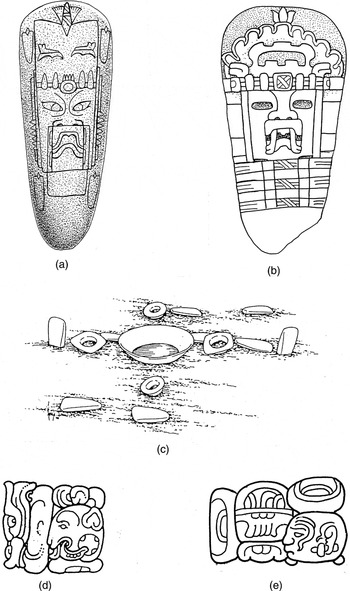
Formative Olmec and Classic Maya celt symbolism. (a) Incised jadeite celt portraying Olmec maize god surrounded by four celtiform maize ears (drawing by the author after Porter 1996:Figure 2). (b) Monument 25/26, La Venta (drawing by the author after Porter 1996:Figure 8). (c) Middle Formative celt and earspool cache, Mound 20, San Isidro, Chiapas (drawing courtesy of the New World Archaeological Foundation). (d) Detail of Late Classic Maya text describing “celt image” of stela, Copan Stela 4 (after Stuart 1996:Figure 17). (e) Detail of text from Copan Stela A describing vertical sky celt and horizontal earth celt (after Schele and Mathews 1998:Figure 4.28).
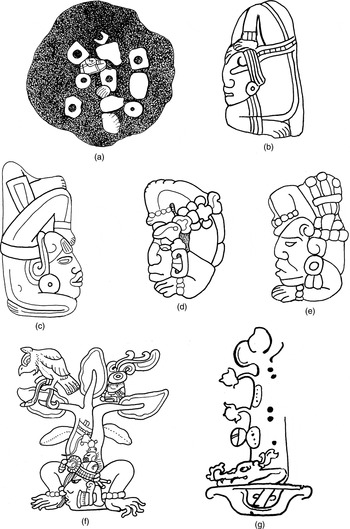
The Early Classic Maya maize-god contortionist as the world tree. (a) Early Classic cache excavated within Structure 10L-26, Copan (after Fash 1988:Figure 1b). (b) Detail of jade contortionist maize god from cache (after Fash 1988:Figure 1c). (c) Early Classic jade of maize-god contortionist, Museo Barbier-Mueller de Arte Precolombino (after Muñoz Cosme et al. 1999:Number 81). (d) Early Classic jade pendant of maize god with world tree atop head, Salitrón Viejo, Honduras (after Hirth and Hirth 1993:Figure 13.8a). (e) Jade of acrobatic maize god, Dumbarton Oaks collection (after Bliss 1957:Plate 64). (f) Maize god in acrobatic position as a cacao tree, detail of Early Classic incised vase (after Kerr 2000:972). (g) Late Classic Maya crocodilian world tree in acrobatic position, detail of Late Classic codex-style vase (from Taube 1992b:Figure 12h).
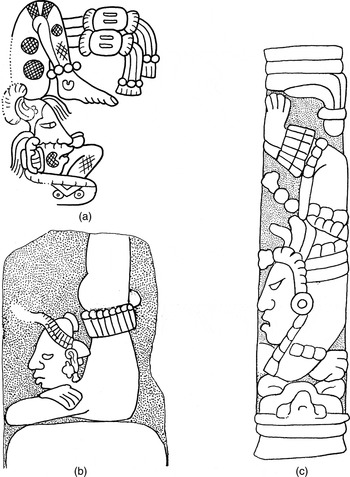
Classic Maya portrayals of maize god as a contortionist. (a) Maize god contortionist, detail of Early Classic incised vessel (after Berjonneau et al. 1985:Plate 329). (b) Late Classic maize-god contortionist, fragmentary monument from Isla El Bellote, Laguna Mecoacan, Tabasco (after Navarrete et al. 1993:Figure 74). (c) Late Classic pectoral of Maya maize god, Tikal Burial 196 (after Gallenkamp and Johnson 1985:Number 105).
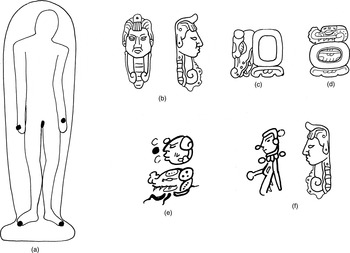
K'inich Janaab' Pakal buried as the maize god. (a) Schematic outline of Pakal with five jades placed in the areas of the hands, feet and groin (after Ruz Lhuiller 1973:Figures 205, 206). (b) Two views of central jade from groin area (after Ruz Lhuiller 1973:Figure 242). (c, d) Examples of crocodile glyphs from Palenque (after Greene Robertson 1985:Figures 319, 333b). (e) Glyphic epithet of maize-god crocodile from codex-style bowl illustrating resurrection of corn god out of the earth (from Taube 1993:77). (f) Comparison of pectoral worn by crocodilian maize god in resurrection scene with central jade from Pakal's sarcophagus (upper, from Taube 1993:77).
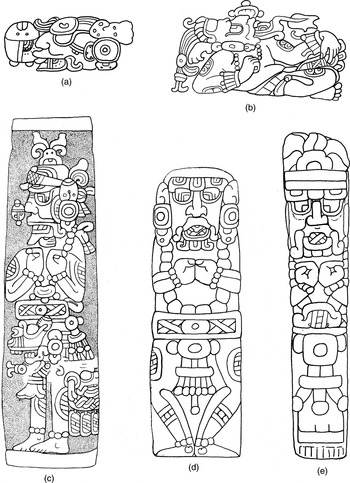
The Classic Maya Pax God in epigraphy and jade carving. (a) Pax God appearing in Initial Series Introductory Glyph, Copan Stela 9; note wood marking on cheek (after Maudslay 1889–1902:I:Plate 110). (b) Pax God appearing in Initial Series Introductory Glyph, Zoomporph B, Quirigua; note foliage emerging from mouth (after Maudslay 1889–1902:II:Plate 14). (c) Roll-out drawing of large jade Pax God pectoral, Burial 36, Quadrant 10J, Copan (drawing by the author from photographs courtesy of Seiichi Nakamura). (d) Pax God pectoral from Hieroglyphic Stairway cache, Copan (after Fash 2001:Plate 9). (e) Pax God pectoral from vicinity of Nohmul, Belize (after Digby 1972:Plate 3).
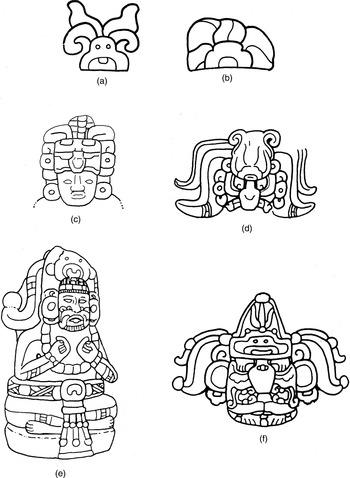
The foliated jade Jester God. (a, b) Foliated Ahau Jester Gods atop Pax God pectorals (Figure 4d, 4e). (c) Maize God wearing headdress of foliated Jester God, central jade figure from Offering 7, Quadrant 10J, Copan (after photograph courtesy of Seiichi Nakamura). (d) Foliated Jester God, Copan Stela P; note Ahau sign on brow, (from Taube 1998:Figure 15g). (e) Large Early Classic jade portraying maize god as foliated Jester God; note foliated Ahau sign atop head (from Taube 1998:Figure 17d). (f) Roll-out drawing of jade Jester God boulder sculpture, Altun Ha (from Taube 1998:Figure 17b).
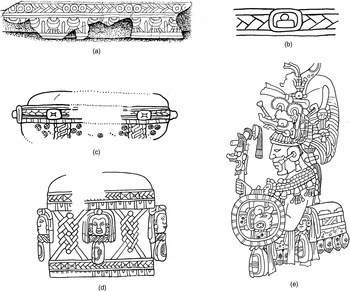
Jade elements appearing on mat thrones in Classic-period Mesoamerica. (a) Maya-style throne with pendant tassels and green jade disks on mat, Tetitla, Teotihuacan (from Taube 2003c:Figure 11.12a). (b) Mat throne with jade elements, detail of Early Classic Maya stucco facade in the Museo Nacional de Antropología, Mexico City (from Taube 2003c:Figure 11.12d). (c) Jaguar-pelt-cushion throne with jade signs on horizontal mat element, Naranjo Stela 22 (from Taube 2003c:Figure 11.12e). (d) Probable jaguar-pelt-cushion throne with jade plaques on horizontal mat elements and jade-mask and belt-celt assemblages, Lintel 2 of Tikal Temple III (after Jones and Satterthwaite 1982:Figure 72). (e) Ruler wearing heavy belt in form of jaguar-pelt-cushion throne with jade-mask and belt-celt assemblages, Dos Pilas Stela 17 (detail of drawing after Schele and Miller 1986:Figure 1.4d).
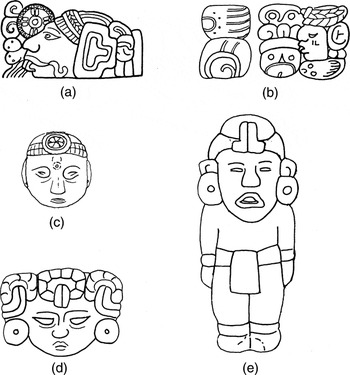
The Classic Maya wind god. (a) Early Classic wind god appearing as patron of the month Mak (from Taube 1992b:Figure 26e). (b) Wind god substituting for ik' breath sign in death expression, Palenque (from Houston and Taube 2000:Figure 4e). (c) Jade pendant of wind god, Cenote of Sacrifice, Chichen Itza (after Proskouriakoff 1974:Plate 62a.5). (d) Detail of jade wind god pendant, Cenote of Sacrifice, Chichen Itza (after Proskouriakoff 1974:Plate 68.2). (e) Early Classic pendant of wind god, Quadrant 10J, Copan (drawn after photograph courtesy of Seiichi Nakamura).
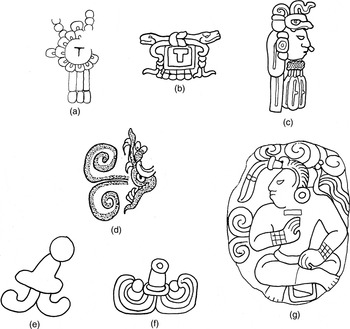
Classic-period portrayals of jade with wind and breath signs. (a) Jade pectoral with ik' sign, Temple of the Inscriptions, Palenque (after Greene Robertson 1983:Figure 189). (b) Pectoral with serpents and ik' sign, Structure 10L-11, Copan (after Schele and Miller 1986:Plate 36). (c) Jade belt celts with ik' signs, Caracol Stela 5 (after Beetz and Satterthwaite 1981:Figure 6). (d) Serpent exhaling symmetrical breath volutes, detail of Blom Plate, Late Classic (after Hellmuth 1987:Figure 409). (e) Jade flare with breath volutes, detail of Leiden Plaque (after Schele and Miller 1986:Plate 33b). (f) Jade flare with bifurcated breath element, Caracol Stela 4 (after Beetz and Satterthwaite 1981:Figure 5). (g) Jade pendant of maize god and bifurcated breath element (after Stierlin 1998:Plate 247).
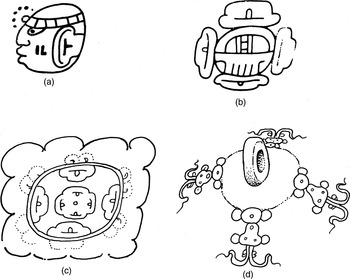
Classic Maya earspools and the winds of the four directions. (a) Late Classic portrait glyph of wind god with ik' sign earspool, detail of carved bone text, Tikal Burial 116. (b) Sky glyph surrounded by four ik' elements in the form of earspools, Naranjo Altar 1 (after Graham 1978:103). (c) Four ik' sign earspools within floral motif, detail of Late Classic vessel, Museo Popol Vuh (after photograph courtesy of Zachary Hruby). (d) Four jade and breathing flower elements framing central disk, detail of Late Classic vessel lid, British Museum (after Coe 1973:86).
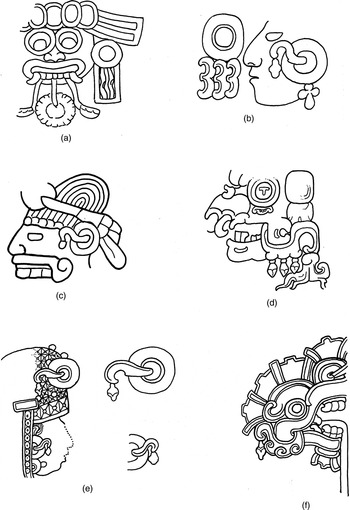
Rain-breath elements at Early Classic Teotihuacan and in Teotihuacan-style Late Classic Maya art. (a) Teotihuacan Tlaloc with water stream falling from mural, detail of Early Classic mural from Tepantitla, Teotihuacan (drawn after image courtesy of Jennifer Browder). (b) Ruler 3 with schematic Tlaloc mask and rain-breathing earspools, Dos Pilas Stela 16 (after Graham 1967:Figure 7). (c) Tlaloc figure with earspool breathing rain element, detail of text from Temple 26, Copan (after Stuart 2000:Figure 15.24). (d) Skull breathing rain cloud from corner of mouth, detail of temple text from Structure 10L-26, Copan (after Stuart 2000:Figure 15.24). (e) Tikal ruler Jasaw Chan K'awiil with brow goggles and earspools breathing rain clouds, Lintel 2 of Tikal Temple 1 (after Jones and Satterthwaite 1982:Figure 69). (f) Schematic drawing of War Serpent breathing rain cloud from corner of mouth, Lintel 2 of Tikal Temple I (after Jones and Satterthwaite 1982:Figure 69).
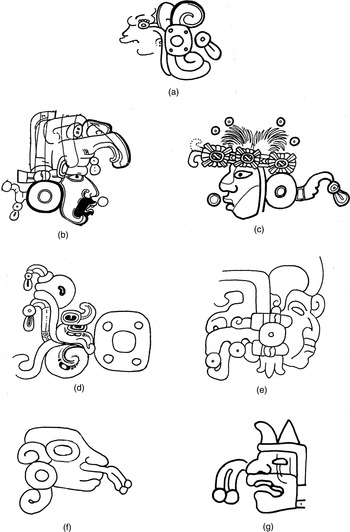
Late Preclassic Maya earspool iconography. (a) Earspool with raindrop, detail of Late Preclassic mural, Stucture 5D-Sub.10- 1st, Tikal (after Coe 1990:Figure 32a). (b) Male figure with earspool emanation with pair of drops, West Wall mural, San Bartolo, Guatemala (detail of drawing courtesy of Heather Hurst). (c) Goddess with cloud and raindrop element projecting from side of earspool, detail of North Wall Mural, San Bartolo (after drawing courtesy of Heather Hurst). (d) Earspool with serpent exhaling raindrops, detail of Late Preclassic stucco facade, Cerros (after Freidel 1985:Figure 6b). (e) Figure with earspool emanation with drops personified by deity head, possibly Chaak, detail of Kaminaljuyu Stela 5 (after Parsons 1986:Figure 53). (f) Figure with pair of beaded breath elements, detail of stone sarcophagus from La Lagunita, Protoclassic period (after Ichon 1977:Figure 49). (g) Olmec-style figure with pair of breath beads, detail of Shook Panel, Middle Formative period, Guatemala (after Taube 2004b:Figure 9f).
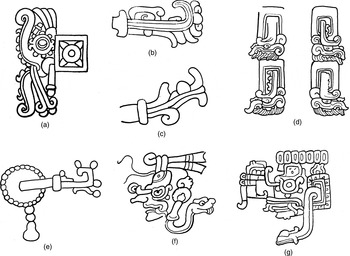
Late Classic and Postclassic Maya earspool iconography. (a) Earspool with plumed serpent exhaling volutes at corners of mouth, detail of facade from West Building of Nunnery Quadrangle, Uxmal (after Schele and Mathews 1998:Figure 7.36). (b) Jade flare and serpent breath element, Stela 5, Caracol (after Beetz and Satterthwaite 1981:Figure 6). (c) Serpent as smoke or breath of jade brow flare, Lintel 1, Itzimte (after von Euw 1977:31). (d) Four earspools with emergent breath serpents, east side of Copan Stela C (after Fash 2001:Figure 68). (e) Serpent emerging as central breath element of earspool, Stela 3, Machaquila (after Graham 1967:Figure 49). (f) Late Postclassic Chaak with serpent emerging from central breath element of earspool, Dresden Codex, page 35b. (g) K'awiil with serpent in earspool, detail of mural from Santa Rita, Belize (after Taube 1992b:Figure 32f).
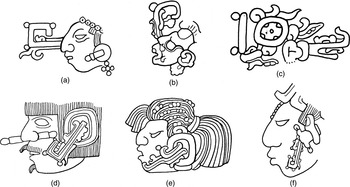
The fret-nosed breath serpent emerging from faces and earspools. (a) Fret-nosed serpent emerging from nasal area, detail of Late Classic jade plaque (after Schele and Miller 1986:Plate 34). (b) Sun god breathing serpent from nose, Quirigua Stela D (after Maudslay 1889–1902:II:Plate 26). (c) Ruler with breath serpent emerging from earspool, Seibal Stela 10 (after Graham 1996:32). (d) Ik' sign earspool with breath serpent, detail of carved alabaster vase (after Bliss 1957:Plate 86). (e) Breath serpent emerging from earspool, Dos Pilas Stela 8 (after Mathews 2001:Figure 40.2). (f) Breath serpent emerging from floral earspool, Yaxchilan Lintel 25 (after Graham and von Euw 1977:55).
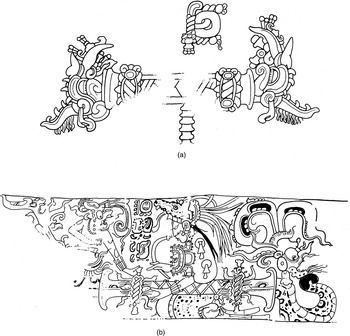
The ceremonial bar in Classic Maya iconography. (a) Detail of Early Classic ceremonial bar from Tikal Stela 2; note also earspool assemblage and earspool necklace in upper and lower center respectively (after Jones and Satterthwaite 1982:Figure 2). (b) Codex-style vessel portraying K'awiil being conjured out of ceremonial bar by probable wind god wearing crocodilian headdress (after Kerr 1992:389).
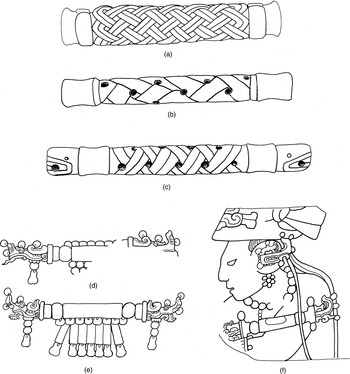
Jade pectorals in the form of ceremonial bars. (a) Early Classic ceremonial bar pectoral of rolled mat with four-lobed flowers and earspools at ends, from Burial 36, Quadrant 10J, Copan (drawing by the author from photograph courtesy of Seiichi Nakamura). (b) Jade pectoral from Burial 48, Tikal (after Shook and Kidder 1961:6). (c) Jade pectoral of rolled mat with earspools and emergent serpent heads at both heads, attributed to Atlantic Watershed, Costa Rica (after Jones 1998:Plate 83). (d) Jade pectoral portrayed on carved bench, Temple XIX, Palenque (drawing by the author after field drawing by David Stuart). (e) Jade pectoral depicted on carved panel, Temple XIX, Palenque (drawing by the author after field drawing by David Stuart). (f) Figure with serpents emerging from bar pectoral and earspool, fragmentary bas-relief from vicinity of Pomona (after field drawing courtesy of Ian Graham).
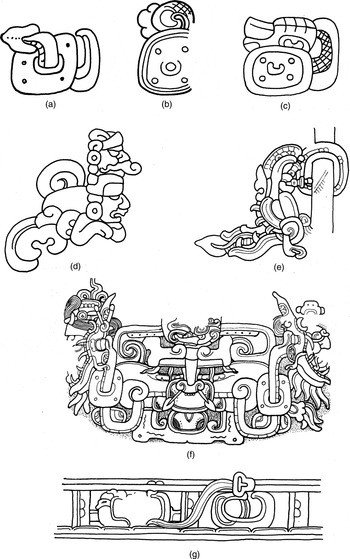
The och b'ih expression in Classic Maya epigraphy and art. (a) Och b'ih glyph portraying serpent penetrating earspool, detail of Early Classic Death Vase (after Kerr 2000:972). (b) Och b'ih compound, Sarcophagus Lid, Temple of the Inscriptions, Palenque. (c) Och b'ih variant with hand substituting for och rattlesnake tail, Tikal Stela 31, G28. (d) Piscine figure with och hand sign on brow, Tikal Stela 1 (after Jones and Satterthwaite 1982:Figure 1). (e) One of pair of snakes passing through probable earspools, Tikal Stela 1 (after Jones and Satterthwaite 1982:Figure 1). (f) Zoomorphic witz mountain breathing snakes through earspools, Tonina Monument 106 (partly reconstructed by the author after Becquelin and Baudez 1982:Figure 175). (g) Breath element emerging out of ik' sign earspool, detail of upper portion of Pier C, Palenque (after Maudslay 1889–1902:IV:Plate 55).
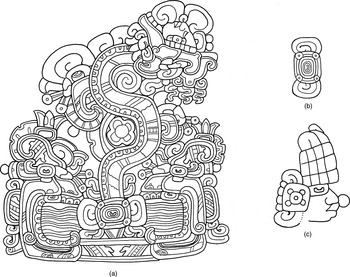
The och b'ih event in the art of Late Preclassic Takalik Abaj. (a) Serpent with solar sign and probable ancestral head in mouth rising out of earspool in water; note zoomorphic witz heads with flowers on brows flanking pool of water, Takalik Abaj Stela 4 (partially reconstructed drawing by the author). (b) Detail of earspool in pool of water, Takalik Abaj Stela 4. (c) Figure with earspool assemblage, Takalik Abaj Stela 2 (after drawing courtesy of James Porter).
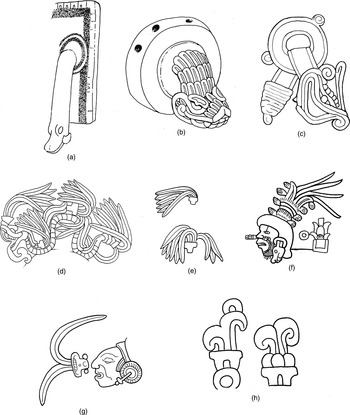
Plumed serpents, breath, and earspools in Postclassic Mesoamerica. (a) Serpent emerging from earspool, detail of Late Postclassic Tlaloc censer (after Brettell 1993:8). (b) Aztec stone sculpture of Quetzalcoatl emerging out of large earspool (drawing by author of item on display in Museo Frida Kahlo, Mexico City). (c) Aztec feathered serpent in earspool, detail of silver Yacatecuhtli mask from Templo Mayor, Tenochtitlan (after Bonifaz Nuño 1981:Number 83). (d) One of pair of plumed serpents on eyes of gold mask from the Cenote of Sacrifice, Chichen Itza (after Coggins and Shane 1984:Number 32). (e) Detail of pair of earspools with quetzal feathers on body of plumed serpent (after Coggins and Shane 1984:Number 32). (f) Quetzalcoatl with serpent earspool, Telleriano-Remensis Codex, Folio 22r. (g) Earspool and quetzal feather breath element, detail of Late Classic Maya vase (after Kerr 1997:837). (h) Early Postclassic portrayals of breathing earspools, Tula, Hidalgo (after de la Fuente et al. 1988:Figures 140–41).
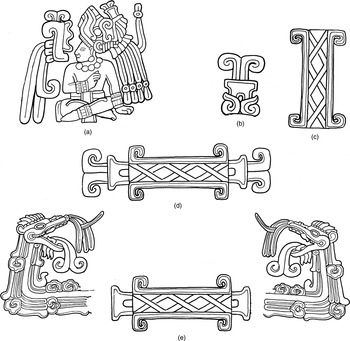
Imagery pertaining to jade, breath, and wind from the Pyramid of the Feathered Serpents, Xochicalco. (a) Seated lord with bifurcated breath element atop speech scroll and emerging from jade flare on brow (drawing from photograph by the author). (b) Profile rendering of earspool with flames and bifurcated breath element (drawing from photograph by the author). (c) Mat motif in center of north, east, and south facades (drawing from photograph by the author). (d) Mat form placed with pair of breathing earspools (composite drawing from the author). (e) Pairs of bearded plumed serpents and earspools with mat form (composite drawing by the author).
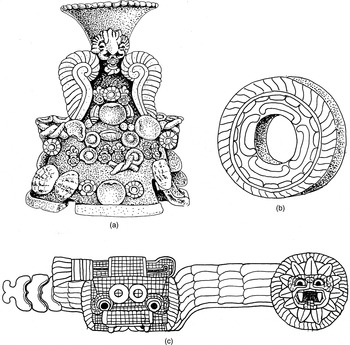
Early Classic Teotihuacan earspool iconography. (a) Censer lid with chimney in form of earspool atop quetzal, Escuintla region, Guatemala (after Hellmuth 1975:Plate 39c). (b) Earspool with four-lobed flower and petaled rim, detail of fragmentary Teotihuacan censer (after Easby and Scott 1970:Number 123). (c) Quetzalcoatl with War Serpent headdress on body passing through petaled rim, detail of facade of Temple of Quetzalcoatl, Teotihuacan (drawing by the author).
 You have
Access
- 73
- Cited by