Significant outcomes
-
∙ Moderate dose of AA-5HT elicits significant antidepressant-like effect in forced swim test (FST) mediated by cannabinoid receptor 1 (CB1-R) activation.
-
∙ High and low doses of AA-5HT were ineffective.
Limitations
-
∙ Isolated blockade of transient receptor potential cation channel subfamily V member 1 (TRPV1) channels was not investigated.
-
∙ A larger injection volume was used comparing to other studies that inject drugs into the medial prefrontal cortex (mPFC).
-
∙ Only locomotor activity and depressive-like behaviour was analysed in the present study, with other parameters such as anxiety being left out.
Introduction
Despite decades of research, the pathophysiology of depression remains elusive. Available antidepressants primarily target the monoaminergic system, but lack efficacy in 30–40% of patients (Reference Holtzheimer and Mayberg1), emphasising the complexity of this disease. In this regard, the prefrontal cortex has gained a lot of attention as disrupted cellular morphology and signalling in this brain area are believed to underlie essential symptoms such as memory impairments, feelings of worthlessness and abnormal regulation of emotional behaviour (Reference Willner, Scheel-Kruger and Belzung2). Several receptors have been suggested as candidates involved in this underlying disruption, including the CB1-R and TRPV1. Despite belonging to different receptor families both are activated by the endocannabinoid ligand anandamide (AEA), which is hydrolysed by the enzyme fatty acid amide hydrolase (FAAH). These receptors are expressed in brain areas involved in controlling emotional coping behaviour, such as the mPFC (Reference Mezey, Toth and Cortright3,Reference Tsou, Brown, Sanudo-Pena, Mackie and Walker4). However, their effect on behaviour appears to be diverse. Blockade of AEA hydrolysis both systemically and locally in the mPFC reduced anxiety and depression-like behaviour in rodents by a CB1-R-dependent mechanism (Reference Gobbi, Bambico and Mangieri5–Reference Rubino, Realini and Castiglioni8). In contrast, TRPV1 activation exacerbated depressive and anxiety-like behaviour, whereas blockade of the channel induced the opposite effects (Reference Rubino, Realini and Castiglioni8–Reference Micale, Cristino and Tamburella11). This is in line with the observation that mice lacking CB1-R showed a depressive-like phenotype whereas TRPV1−/− mice revealed less anxiety and depressive-like behaviour (Reference You, Jung and Kim12,Reference Marsch, Foeller and Rammes13). Hereby the CB1-R and TRPV1 channel appear to exert opposite behavioural effects when activated. Interestingly low doses of methanandamide injected into the mPFC of rats induced a CB1-R mediated anxiolytic-like effect, whereas high doses caused a TRPV1-dependent anxiogenic-like effect (Reference Rubino, Realini and Castiglioni8). Hence, AEA appears to dose-dependently activate the two receptors, with low doses acting on CB1-R and higher doses activating TRPV1, thus facilitating opposite behavioural effects. This is consistent with evidence that AEA possesses higher affinity for CB1 than for TRPV1 receptors (Reference Hillard14,Reference Toth, Blumberg and Boczan15). In this matter, selective pharmacological targeting of CB1-R with AEA or FAAH inhibition would be difficult to achieve. In theory, a dual inhibition of FAAH and TRPV1 would be more attractive. In this regard, the drug N-arachidonoyl-serotonin (AA-5HT) was found to meet the pharmacological profile and showed far more potent anxiolytic-like effect than selective blockade of TRPV1 or FAAH, both when administered systemically and when injected into the basolateral amygdala (Reference Micale, Cristino and Tamburella11,Reference John and Currie16).
In summary recent studies suggest that CB1-R and TRPV1 channel mediate opposing behavioural effects when activated. Therefore, it is highly attractive to investigate this interaction in areas involved in depression such as the mPFC. Hereby, our study tested the hypothesis that local injection of the FAAH/TRPV1-dual blocker AA-5HT into the mPFC would be able to induce antidepressant-like behaviour, in dose-dependent fashion, in rats exposed to the FST.
Experimental procedure
Animals
Male Sprague Dawley (SD) rats 323±18 g (Taconic MB A/S, Ry 8680, Denmark) were kept under standard laboratory conditions (12 h light/dark cycle; room temperature at 22°C) and housed singly after surgery. All animals had free access to food and water. All animal procedures were approved by the Danish National Committee for Ethics in Animal Experimentation (2012-15-2934-00254).
Drugs
The dual FAAH/TRPV1 blocker, N-arachidonoyl-serotonin (AA-5HT), at a dose of –0.125; 0.250; 0.500 nmol in 0.4 µl, rimonabant (RIM) at a dose of –1.6 µg in 0.4 µl and a mixture of AA-5HT 0.25 nmol/0.4 µl and RIM 1.6 µg in 0.4 µl were dissolved in 20% dimethyl sulfoxide, 10% Tween 20, 10% polyethylene glycol and 60% saline. The dose of rimonabant was based on the literature (Reference Bambico, Katz, Debonnel and Gobbi17).
Surgery
SD rats were anesthetised by subcutaneous (s.c.) injections of fentanyl–fluanisone (0.0945 and 0.3 mg/kg, respectively) and midazolam (0.25 mg/kg); 25 G guide cannulas were implanted bilaterally aimed at the prelimbic part of mPFC (coordinates relative to bregma: anterior/posterior +3.00 mm, medial/lateral: ±0.6 mm and dorsal/ventral: −3.00 mm) (Reference Paxinos and Watson18) and secured by three steel screws and dental acrylic cement. Directly following surgery rats were treated s.c. with an antibiotic (ampicillin; 670 mg/kg), an opioid agonist (temgesic; 0.1 mg/kg), a non-steroid anti-inflammatory drug (rimadyl; 0.5 mg/ml) and sterile saline (1.0 ml). The animals recovered for 7 days before the beginning of the test session. They were handled daily during the recovery period.
Test session
FST
Behaviour was evaluated in the modified FST as previously described (Reference Cryan, Markou and Lucki19). A single experiment extended over 2 days. On day 1, the rats underwent their first swimming session in acrylic plastic cylinders (height: 60 cm, diameter: 24 cm) filled with 40 cm of water (23°C) for 15 min. On the second day, rats were reintroduced to the swim cylinder, and their behaviour was recorded with a digital video camera for 7 min. Rats were manually scored by an experienced observer blind to the treatment for displaying immobility (movements only necessary to keep the head above the water), swimming (horizontal movements) or climbing (vertical movements) behaviour. All experiments were carried out between 09:30 and 12:30 h.
Open field
Five minutes before the second day FST session the animals were introduced to an open field arena (1×1 m) in order to analyse the influence of drug treatments on locomotor activity. The behavioural session was recorded for 5 min, and locomotor activity was analysed as the total distance moved by behavioural analysis software (EthoVision XT version 11; Noldus Information Technology, Waacheningen, The Netherlands).
Procedure
Intra-mPFC injections
In order to evaluate the behavioural effect of simultaneous blockade of AEA hydrolysis and TRPV1 activation, AA-5HT was infused into the mPFC of rats submitted to FST. SD rats were divided into vehicle (n=18) and six different treatment groups (n=9–15). The three first groups received a single bilaterally dose of AA-5HT (0.125, 0.250 or 0.500 nmol/0.4 µl per side). To investigate if the observed effect was CB1-R dependent, another cohort received a combination of AA-5HT (0.250nmol) and RIM (1.6 µg) at a volume of 0.4 µl per side. Lastly, another group received RIM (1.6 µg/0.4 µl) alone to evaluate the isolated effect of CB1-R inverse agonism. All drugs were delivered at a flow rate of 0.35 µl/min via a 27 G injector tip attached by polyethylene tubing to a 10 µl syringe that was driven by a microdialysis pump (CMA/100). To allow local diffusion of the drugs the injector tip was kept in the brain tissue for 30 s after the end of the infusion. After 30 min of drug administration the animals were exposed to the test session.
Verification of cannula placement
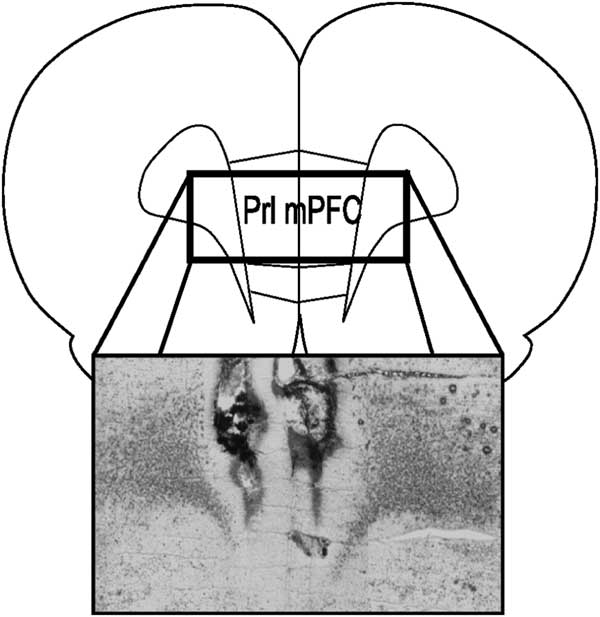
Upon the completion of the behavioural experiments, the rats were decapitated and injected with ~0.4 µl methylene blue through the cannula. The brains were removed, frozen and later cut into 60 µm coronal sections using a cryostat (Leica CM3050 S; Germany) with a chamber temperature at −20°C and object temperature at −15°C. Sections were mounted onto an object glass and observed under a microscope (Nikon H600L, Japan, coupled with an Olympus DP73 digital camera; Olympus, Danmark A/S, Ballerup, Denmark) to confirm the cannula placement (Fig. 1). Only animals with the correct cannula placement were included in the behavioural analysis.
Cannulae placement related to the prelimbic region (PrlmPFC) based on Paxinos and Watson (7th edition).

Statistical analysis
The data for immobility, swimming and climbing of all treatment groups were analysed using one-way analysis of variance followed by Dunett’s multiple comparison tests.
Results
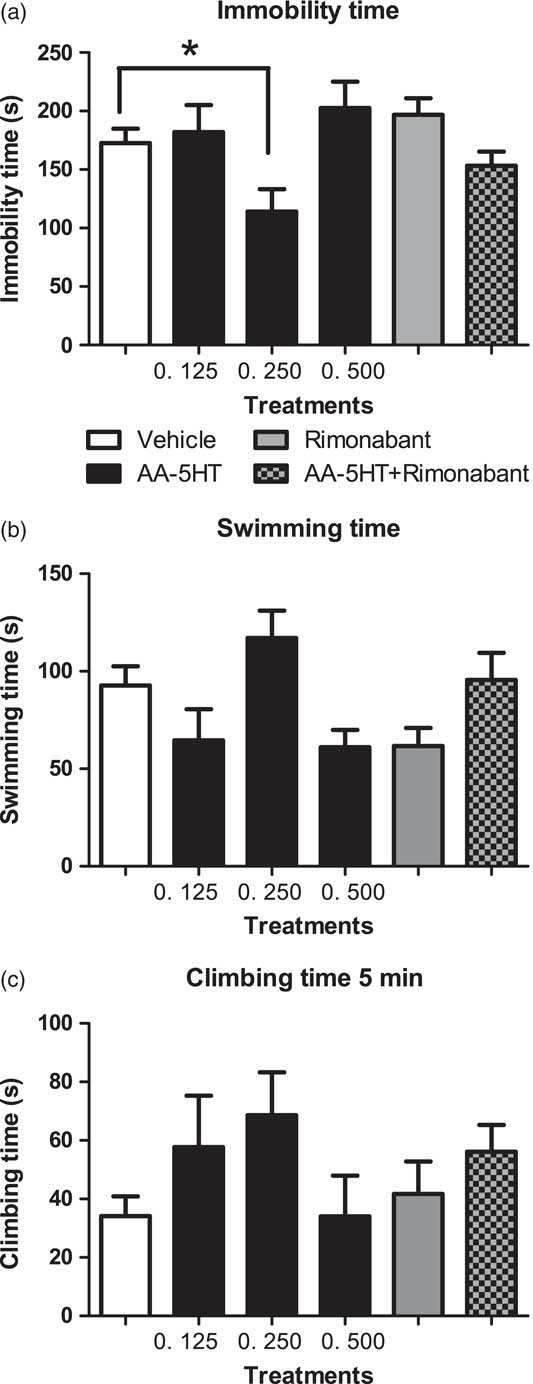
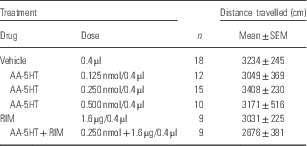
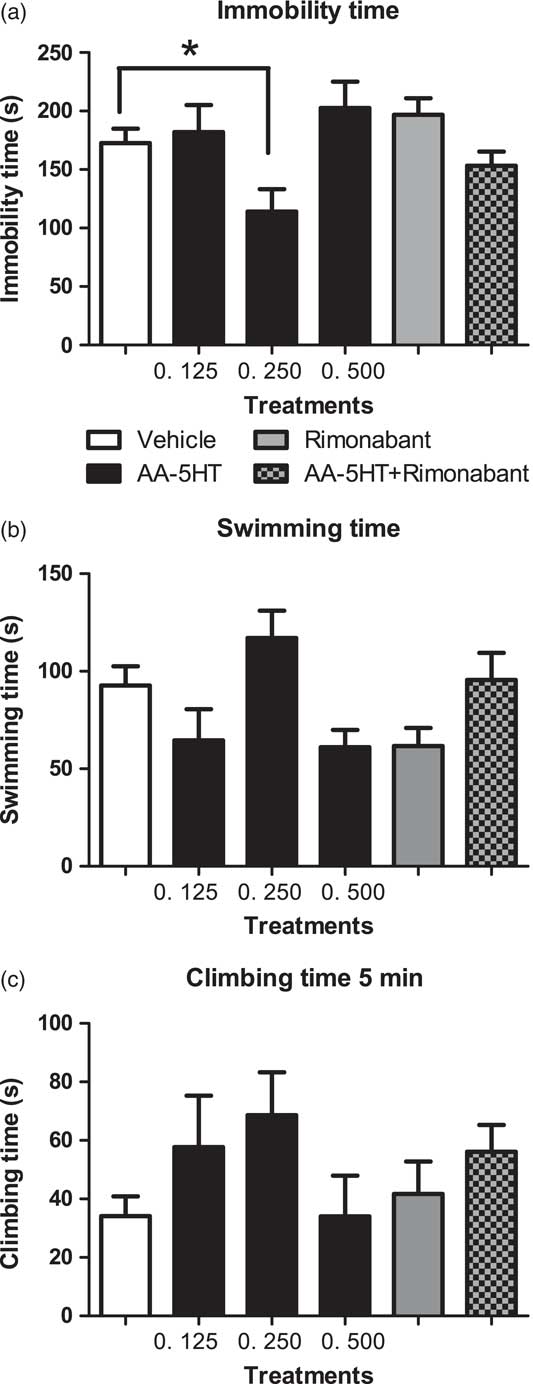
The effect of drug treatment on immobility, swimming and climbing time of SD rats is shown in Fig. 2a–c. A dose of 0.250 nmol/0.4 µl of AA-5HT decreased immobility time in the FST compared with vehicle (F(5,72)=3.32; p=0.0096), whereas lower and higher doses had no significant effect (p>0.05). No effects were observed with Rimonabant alone or in combination with AA-5HT at 0.250 nmol/0.4 µl (Fig. 2a). An overall significant difference in swimming time was observed between the groups (F(5,72)=3.32; p=0.0097), but Dunnetts multiple comparison test did not reveal any differences between specific groups (Fig. 2b). Regarding climbing time no significant differences were observed (F(5,72)=3.33; p=0.2607). Lastly, locomotor activity was not affected by any treatment (Table 1; F(5,71)=0.529; p=0.753) (Table 1).
The effect on (a) immobility, (b) swimming and (c) climbing time in the forced swim test after acute injection of the dual FAAH/TRPV1-channel blocker, AA-5HT (0.125; 0.250; 0.500 nmol/0.4 µl/side), rimonabant (RIM; 1.6 µg/0.4 µl/side) and AA-5HT+RIM (0.250 nmol+1.6 µg/0.4 µl/side), into the mPFC. FAAH, fatty acid amide hydrolase; mPFC, medial prefrontal cortex; TRPV1, transient receptor potential cation channel subfamily V member 1.
Effect of treatment on locomotor activity

One-way analysis of variance revealed no significant differences between the groups.
Discussion
Our study shows that the intermediate dose of the dual FAAH/TRPV1 antagonist AA-5HT injected into the mPFC of rats induced significant antidepressant-like response in the FST without affecting locomotor activity. As blockade of CB1-R with rimonabant was unable to fully abolish the antidepressant-like response of AA-5HT, it is likely that the remaining effect is due to TRPV1 blockade. Hereby, it is possible to suggest that the antidepressant-like effect of AA-5HT is partially mediated by indirect activation of CB1-R and blockade of TRPV1. Interestingly, the bell-shaped dose-response curve suggest that the missing effect of the highest dose is not mediated by TRPV1 activation.
Another group failed to see the bell-shaped dose-response effect after AA-5HT administration into the prelimbic region of the mPFC (Reference Sartim, Moreira and Joca20). The drug induced antidepressant-like effects when injected at 0.25 and 0.5 nmol, an effect partially blocked by the CB1-R antagonist pretreatment. In addition, co-administration of subeffective doses of URB597 (FAAH inhibitor) and SB366791 (TRPV1 antagonist) induced significant antidepressant-like effects. Altogether, these results indicate that both mechanisms FAAH inhibition and TRPV1 blockade contribute to AA-5HT effects. The discrepant results between the studies could be due to experimental differences such as rat strains (SD rats vs. Wistar rats) and volume injected into the prefrontal cortex (0.4 vs. 0.2 µl).
Nevertheless, both studies indicate that AA-5HT administration into the mPFC induces antidepressant-like effects and that it involves CB1-R activation and TRPV1 blockade.
A previous study demonstrated the antidepressant-like effect of systemic treatment of AA-5HT in the FST was only present after acute restraint stress, when the HPA-axis was activated (Reference Navarria, Tamburella and Iannotti21). In our experiment no stress protocol was conducted, and the drugs were delivered locally into the brain hereby avoiding interacting factors such as blood brain barrier permeability and peripheral metabolism, which could be influenced by the HPA-axis and explain some of the different findings between the two conditions in these studies.
Beside technical differences and testing condition as a reason for our discrepant results, other factors of importance should be mentioned. First, the ability of AA-5HT to affect AEA levels has to be taken into account as a study investigating anxiety revealed that all doses of AA-5HT causing anxiolytic-like effect was associated with increased tissue levels of AEA. Notably, the highest dose was unable to induce this effect and neither to increase AEA levels (Reference Micale, Cristino and Tamburella11). The underlying mechanism remains unclear but could explain the lacking effect of the highest dose in our study. However, we did not measure AEA levels after AA-5HT injection and cannot rule out other explanations. Another group measuring anxiolytic-like effect of AA-5HT injected into the basolateral amygdala of rats, using the same doses as we did, demonstrated decreased anxiety-like behaviour at 0.250 and 500 nmol (Reference John and Currie16). The present effect at the highest dose indicates that the effectiveness of AA-5HT is also dependent on testing paradigm and the brain region.
Beyond the pharmacological abilities of AA-5HT and testing paradigm, another explanation could be the interaction of AEA with CB1-R expressed on different neuronal subpopulations in the mPFC, as these are more densely expressed on GABAergic relative to glutamatergic neurons (Reference Kano22). In this regard, it is possible that intermediate dose of AA-5HT caused a moderate elevation of AEA levels that predominantly induced antidepressant-like response through activation of GABAergic CB1-R, whereas a high dose caused higher elevation of AEA thereby also stimulating glutamatergic CB1-R and abolishing the antidepressant-like response. In support of this theory, mice lacking CB1-Rs on glutamatergic cortical neurons displayed significant reduced immobility time in FST indicating a crucial role for these receptors in mediating depressive-like behaviour (Reference Steiner, Marsicano, Wotjak and Lutz23).
Hence, our observations showed antidepressant-like effect of AA-5HT when injected into the mPFC. This observation highlight the involvement of both prefrontal CB1-R and TRPV1-channels in emotional behaviour. However, as the effect of AA-5HT was dose-dependent, this suggests that other factors such as testing conditions and different cellular expression of receptors in different brain regions also play an important role in emotional behaviour of rodents. In this regard, the complexity of emotional behaviour appears to extend beyond ‘simple’ AEA interaction between prefrontal CB1-R and TRPV1 channels hereby indicating the need for further investigation of these receptors in emotional behaviour.
Conclusion
Taken together, we found a clear dose-dependency for the antidepressant-like effect after local injection of the dual FAAH/TRPV1 channel blocker, AA-5HT, into the mPFC of SD rats with the antidepressant-like effect only being evident at the medium dose tested.
Acknowledgements
Authors’ Contribution: Planning of the experiment was done by Nico Liebenberg and Christian Kirkedal with supervision of Gregers Wegener. Stereotactic surgery and behavioural testing was done by Christian Kirkedal with supervision and assistance of Nico Liebenberg. Data analysis and interpretation was obtained with help from Fabricio Moreira and Samia Joca. The draft of the article was made by Christian Kirkedal and critically revised by all the contributing authors. Neither Gregers Wegener, Nico Libeneberg or Samia Joca was involved in the decision process of this paper in Acta Neuropsychiatrica.
Financial Support
This study was financially supported by Direktør Jacob Madsens&Hustru Olga Madsens Fond, Fonden til Lægevidenskabens Fremme and Region Midtjyllands Psykiatriske Forskningsfond.
Conflicts of Interest
Gregers Wegener declares having received lecture fees from H. Lundbeck A/S, Servier SA, Astra Zeneca AB, Eli Lilly A/S, Sun Pharma Pty Ltd, and Pfizer Inc. All other authors declare no conflict of interest.