1. Introduction
The increasing poverty levels among most small-scale farmers in sub-Saharan Africa offers the greatest developmental challenge as to how best to balance the seemingly conflicting goals of agricultural production and environmental stewardship. To ensure an adequate livelihood, prioritization of food security over the concern for sustainable environmental management has taken centre stage. However, there exist agricultural land use practices that produce multiple outputs that offer potential opportunities for achieving the two seemingly polarized objectives (Ajayi et al., Reference Ajayi, Akinnifesi, Sileshi, Chakeredza and Matakala2007). One such practice is the improved fallow technology. According to Böhringer (Reference Böhringer, Eade and Eade2002), improved fallows are fast-growing leguminous nitrogen-fixing woody trees or shrubs that are deliberately planted to grow on a field for a minimum of two years to ensure rapid replenishment of soil fertility. The improved fallows, developed and promoted by the World Agroforestry Centre (WAC, formerly the International Centre for Research in Agroforestry) in most parts of sub-Saharan Africa since the late 1980s, serve to achieve objectives of natural fallows within a shorter time or a smaller area (Cooper et al., Reference Cooper, Leakey, Rao and Reynolds1996). The main species used as improved fallows in Zambia and many parts of sub-Saharan Africa include: Gliricidia sepium (Mexican lilac), Cajanus cajan (Pigeon pea), Sesbania sesban (River bean), Tephrosia vogelii (Fish bean) and Faidherbia albida (Winter thorn). After being cut, nutrients from the fallows support a crop (usually maize in most parts of the region) for three to four years without the application of any external inputs (Kwesiga et al., Reference Kwesiga, Akinnifesi, Mafongoya, McDermott and Agumya2003).
In addition to improving soil fertility levels, evidence suggests that improved fallows provide environmental services. According to the literature, the technology generates several environmental services (Sileshi et al., Reference Sileshi, Akinnifesi, Ajayi, Chakeredza, Kaonga and Matakala2007), such as carbon sequestering (Makumba et al., Reference Makumba, Akinnifesi, Janssen and Oenema2007; Kaonga and Bayliss-Smith, Reference Kaonga and Bayliss-Smith2009), improvement of biodiversity Sileshi et al. (Reference Sileshi, Akinnifesi, Ajayi, Chakeredza, Kaonga and Matakala2007), mitigating deforestation through provision of fuel wood (Mafongoya and Kuntashula, Reference Mafongoya and Kuntashula2005) and improvement of soil physical structure (Chirwa et al., Reference Chirwa, Ong, Maghembe and Black2007). Although there are several studies (that we review below) that have generally linked on-farm tree planting to households' consumption of fuel wood, we note that the specific evaluation of the environmental impacts of improved fallows in sub-Saharan Africa has rarely incorporated the socioeconomic circumstances of farmers. To the best of our knowledge, empirical evidence that takes into account the inter-linkages that exist between the socioeconomic conditions of farmers and the improved fallows' provision of environmental services are very few. Moreover, extant literature (Govere, Reference Govere2002; Pattanayak and Depro, Reference Pattanayak, Depro, Alavalapti and Mercer2004; Ndayambaje and Mohren, Reference Ndayambaje and Mohren2011) on the environmental impacts of improved fallows or agroforestry in general under farmer field conditions suggest the employment of methods that would give precise causal effects estimates of the technology. Consequently, the purpose of this study was to estimate in a very precise way the potential impact of improved fallows on environmental service provision under farmer field conditions, using well-designed quasi experiments.
We noted above that improved fallows can potentially produce multiple environmental services. However, estimating the value of many of these services under farmer field conditions is potentially costly and scientifically challenging considering that with the exception of a few (e.g., fuel wood supply), most are not easily quantifiable. For instance, it would be very costly to randomly and accurately measure the soil erosion or carbon sequestration benefits across farms planted with improved fallows. Likewise, relying on farmer perception estimates of soil erosion or carbon sequestration benefits across farms planted with improved fallows might produce contestable scientific results. Although the primary objective of adopting improved fallows is soil fertility replenishment, the technology also co-produces fuel wood that adopting farmers use, and thus helps in reducing deforestation. It is relatively much easier to compare public fuel wood consumption between adopters and non-adopters of improved fallows and attempt to estimate how much of this difference could be attributable to the technology.
Our decision to use fuel wood consumption as the outcome variable in estimating the causal effects of improved fallows on environmental services provision under farmer field conditions was made through informed consideration. Several economic studies and reviews of household fuel wood demand and supply in developing countries exist (Patel et al., Reference Patel, Pinckney and Jaeger1995; Bardhan et al., Reference Bardhan, Baland, Das, Mookherjee and Sarkar2001; Kohlin and Parks, Reference Kohlin and Parks2001; Arnold et al., Reference Arnold, Kohlin and Persson2006; Cooke et al., Reference Cooke, Kohlin and Hyde2008). Typically the studies involve the estimation of fuel wood quantity and collection time. A number of these studies (Patel et al., Reference Patel, Pinckney and Jaeger1995; Kohlin and Parks, Reference Kohlin and Parks2001; Pattanayak and Depro, Reference Pattanayak, Depro, Alavalapti and Mercer2004) use multivariate econometric analyses that generally include tree planting as one of the explanatory variables. Most of the coefficients of the tree planting dummy are negative, validating the contribution of trees to reduced public forest fuel wood demand. However, in all the reviewed literature a more precise estimate of how much of the forest wood is replaced by planted trees or agroforestry is lacking. Collectively, the studies on fuel wood show that household fuel wood consumption can easily (relatively) be estimated. Then fuel wood consumption between adopters and non-adopters of improved fallows could be compared.
In addition, the economic and environmental impacts of fuel wood cannot be overemphasized. The World Resources Institute (WRI, 2000) estimates that fuel wood consumption accounts for about 15 per cent of the primary energy supply in developing countries and provides up to 80 per cent of total energy in some countries. It is the primary energy source for most poor rural households (Mercer and Soussan, Reference Mercer, Soussan and Sharma1992; Trossero, Reference Trossero2002) and thus is an important factor in forest degradation. FAO (2010) estimates that in parts of Africa, fuel wood which is often the only domestically available and affordable source of energy accounts for almost 90 per cent of primary energy consumption. There is currently a shortage of fuel wood in Zambia and yet, according to Chidumayo (Reference Chidumayo1997), urban demand for fuel wood and charcoal has increased, and is said to be the major cause of deforestation in the country.
Chongwe district in Zambia, the site for the present study, provides a good example for policy to understand and evaluate the causal effect of provisioning environmental services (here, fuel wood collected from improved fallows) under farmer field conditions. To begin with, Kasisi Agricultural Training Centre (KATC), a quasi-public institution mandated to promote good practice agriculture, has massively promoted improved fallows in the district since the late 1990s. In addition, deforestation in the district has of late been on the upswing partly due to its proximity (about 30 km) to Lusaka, the capital city of Zambia. Most urban Lusaka dwellers rely on charcoal for their cooking energy requirements, with most of the charcoal coming from Chongwe district. Recently there have been calls by government officials (Government of the Republic of Zambia, 2012) to reintroduce trees and shrubs into existing cropland and to manage them systematically, so as to obtain fuel wood as well as to address land degradation problems. In this paper we seek to answer the question: is it necessarily true that the success of improved fallows in supplying fuel wood in on-station trials can be replicated under farmer field conditions to levels where deforestation rates will significantly decline?
Published studies on the environmental performance of improved fallows (Chirwa et al., Reference Chirwa, Ong, Maghembe and Black2007; Mafongoya and Kuntashula, Reference Mafongoya and Kuntashula2005; Makumba et al., Reference Makumba, Akinnifesi, Janssen and Oenema2007; Sileshi et al., Reference Sileshi, Akinnifesi, Ajayi, Chakeredza, Kaonga and Matakala2007; Kaonga and Bayliss-Smith, Reference Kaonga and Bayliss-Smith2009) mostly relied on data sourced from on-station and researcher-managed on-farm experiments. It is generally costly and complex to carry out randomized environmental measurements across several farms; thus most researchers resort to using quasi experiments on data obtained from real-life situations. The goal of such experiments is to control for confounding factors in the estimation of the impact of the technology. Our search has yielded scanty literature on the use of proper identification methods in isolating the role of improved fallows on environmental performance under farmers' socioeconomic conditions.
Pattanayak and Depro (Reference Pattanayak, Depro, Alavalapti and Mercer2004) used farm-level data from the Manggarai region of Indonesia to estimate the impact of agroforestry on fuel wood consumption and soil erosion prevention. The study found that agroforestry reduced the collection of fuel wood from forests and that prevention of soil erosion depended on the type of agroforestry practised. While the role of confounding factors in affecting both soil erosion and fuel wood consumption outcome variables was accounted for through multivariate ordered probit regressions, the study acknowledged the superior ability of robust methodologies such as matching or instrumental variables approaches in addressing the potential endogeneity of the adoption choice. For sub-Saharan Africa, where improved fallows have been promoted since the late 1980s, we found only one published review article (Ndayambaje and Mohren, Reference Ndayambaje and Mohren2011) on the role of agroforestry in fuel wood demand and supply in Rwanda. Although this article suggests that the demand for fuel wood is partly supplied by agroforestry systems, it does not quantify how much fuel wood is supplied by the systems. Unpublished work on improved fallows and natural miombo woodland use in eastern Zambia by Govere (Reference Govere2002) applied descriptive analysis (t-tests) and concluded that adopters consumed less fuel wood from the miombo forests than non-adopters. Technology impact evaluation without accounting for confounding factors may lead to evidence that could mislead policy. It is difficult to attribute the changes in outcome variables to technology adoption alone, since confounding factors that could have also influenced the outcome variables are not taken into consideration. Thus controlling for confounding factors in the process of evaluating the impact of technologies becomes very pertinent.
In this study we contribute to the literature on the on-farm environmental performance of improved fallows in two ways. First, since the literature is noticeably thin with respect to economic modelling of environmental services from improved fallows under farmers' field conditions, we attempt to partly fill this void. The studies reviewed above on the impacts of the improved fallow or agroforestry on on-farm environments could have not have succeeded in comparing similar groups of adopters and non-adopters as argued above. It follows that these studies most likely could have produced over- or under-identifiable causal effect estimates. In other words, the studies might have failed to explicitly explain the counterfactual analysis so as to properly isolate the causal effect of the technology. This study used matching impact evaluation techniques in estimating the causal effect of improved fallows on environmental performance under farmers' field conditions. Second, since most studies used binary or categorical responses to argue for the case of tree planting in general or agroforestry in particular, in reducing forest fuel wood demand, we attempt to provide more precise estimates of the actual size of forest fuel wood consumption changes that could be attributed to improved fallows. We hypothesized that households embracing improved fallows in Chongwe district would collect less fuel wood from forests for their energy requirements, since the technology provides wood as a by-product. Analysing farm-level data collected in 2011 from a random cross-section sample of 324 small-scale farmers revealed that improved fallows can significantly supply household fuel wood requirements.
The paper is structured as follows: discussions on the study area, sampling design, survey instrument development, implementation and analytical frameworks on households' production of environmental services, ordered probit and propensity matching in this order, are covered in the section on methodology. This is followed by the results and discussion section. Finally conclusions are drawn based on the findings of the study.
2. Methodology
2.1. Study area
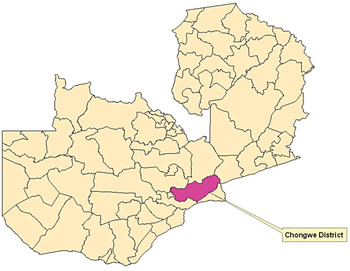
Although promoted throughout Zambia, most research and development activities related to agroforestry have mainly been conducted in Chipata district of eastern Zambia and Chongwe district of Lusaka province. In Chipata district, the main organization promoting agroforestry was the WAC. Since the late 2000s, WAC has significantly scaled down agroforestry research and development in eastern Zambia as a result of diminishing funding. In Chongwe district, Kasisi Agricultural Training Centre (KATC) is the main organization promoting agroforestry in the form of improved fallows. The scaling down of agroforestry activities in eastern Zambia, and the continued promotion of agroforestry by KATC in Chongwe district, led to the latter being purposively selected as the study area for this case study. The location of the district is shown in figure 1. Informal interviews specifically designed to plan for the study and identify areas where agroforestry is most concentrated in the district were held with extension officers from KATC. Three (out of 28) agricultural camps, namely Nyangwena, Chinkuli and Katoba, were identified as the main catchment areas with farmers practising improved fallows, and were targeted for the study. Generally, farmers in the catchment areas mainly grow the staple maize crop for food and sale. They also grow annual cash crops such as groundnuts, cotton and beans. Vegetable production involving rape, cabbage, tomato and onion in seasonally waterlogged wetlands is also common. The most common animals reared include cattle, chickens and goats.
Map of Zambia showing the location of the study area

2.2. Sampling
The study used agricultural camp lists compiled by the Zambia Ministry of Agriculture camp extension officers to come up with a sampling frame. The lists from the three camps (catchment areas) were consolidated into one. Although we considered the samples drawn from the three camps as homogeneous at this stage (hence consolidation into one list), the analysis to follow incorporated the heterogeneous effects of the camps. The sampling frame was then stratified between adopters and non-adopters of improved fallows. The sampling frame had a total of 7,081 households of which approximately 20 per cent were adopters of improved fallows. Due to limited logistics, the study aimed at interviewing around 5 per cent (335 households) of the total households in the sampling frame.
Since matching strategies, one of the methodologies used in this study, require treatment or adopting units to have a larger pool of control or non-adopting units from which matches can be obtained (Caliendo and Kopeinig, Reference Caliendo and Kopeinig2005), the sample was stratified into 2:3 ratios for adopters and non-adopters, respectively. It follows that from a stratum of 1,416 listed households using improved fallows, 134 were randomly selected using Stata (Stata version 11.2, 2009). Similarly, from 5,665 listed households, 201 non-adopters were randomly selected. Eventually, due to non-responses, 130 adopting and 194 non-adopting households were interviewed. For the household to experience consumption of fuel wood from improved fallows, it should have harvested at least a fallow. The minimum period for improved fallow maturity in the study area was two years. Since this study was carried out at the end of 2011, a household should have planted improved fallows not later than 2009 to qualify as an adopter who could potentially influence consumption of fuel wood collected from forests. In addition, since our interest was to include only those households most likely to reap substantial benefits from consuming fuel wood harvested from improved fallows, our sample only included households that have been growing at least a quarter of a hectare under improved fallows. Using these criteria, 14 households using improved fallows dropped out from the 130 that were in the original adoption category. These were added to the non-adopters category at the results analytical stage. As a result, the final sample used in the analysis was composed of 116 adopters and 208 non-adopters. Notwithstanding the above categorization of adopters and non-adopters, we also ran two additional sets of models in which the 14 households were either included in the adoption category (since they had shown intention to adopt) or were entirely dropped from the sample. Since the probability of selection differed between adopters and non-adopters, we adjusted our standard errors by weighting our analyses through the inclusion of the probabilities of being selected in the two strata, i.e., the probability of being selected was equal to N/n where N represented total adopters (non-adopters) of improved fallows and n, the actual samples selected.
2.3. Survey instrument development, pre-testing and implementation
The first author informally interviewed officers at Kasisi Agricultural Training Centre, agricultural camp extension officers and some lead farmers in the catchment areas. The informal interviews covered a wide range of issues including the general agricultural practices and agroforestry activities in the area. Factors affecting the farmers' uptake of the improved fallows were also discussed. Using findings from these interviews and a review of the literature, a structured formal questionnaire was drafted. The questionnaire went through several refinements following interactions between the authors. The final version of the questionnaire found particularly useful for this specific study covered four main sections. The first section covered the basic households' demographic and socioeconomic characteristics. The second section explored the asset levels of households and use of improved fallows. The third section assessed general agricultural practices in the study area such as agricultural-related challenges, types and amounts of inputs used and crop production levels. The final part looked at issues related to environmental impacts of the improved fallows such as households' fuel wood consumption.
Before the formal survey, a pre-test study comprising 16 households was carried out in the study area in October 2011. The pre-test survey served two purposes: firstly, the study wanted to ensure that the questionnaire had questions that were well understood by farmers, that questions were logically flowing, and that the interviewer could clearly understand the responses given by farmers; secondly, the pre-testing provided the opportunity to practically train the research assistants on how best to implement the survey and measure the key outcome variable, i.e., household fuel wood consumption. The household fuel wood consumption variable was a combination of both researcher-measured and farmer self-reporting data. The steps involved in measuring this variable involved the following:
-
• Step 1: Usually, the household head (main respondent) would take the enumerator to where the household stored fuel wood. The quantity of fuel wood found was measured using a hanging scale. Using the fuel wood found, the head would be asked how much of such fuel wood they consume in a month. This gave us the monthly quantity consumed by the household regardless of their improved fallow adoption status. This monthly estimate was multiplied by 12 months to give us the amount of annual fuel wood used by a household. This estimate was made in hot summer (November and December). We note that there is high probability that the monthly quantity of fuel wood could have been different in other seasons like the dry season.
-
• Step 2: This step involved establishing how much fuel wood was consumed from improved fallows by the adopters so that necessary adjustments could be made to their annual fuel wood consumption demand. Since the adopters could not clearly remember the quantities of fuel wood from the technology at fallow termination, we went around this problem by asking the adopters to estimate how long in a year they had used fuel wood from improved fallows after fallow termination. They were further asked if they ever exchanged through selling or bartering with neighbours the improved fallow fuel wood. All adopting households confirmed they never sold wood, they used it for their own consumption. The annual estimate for the adopting households was adjusted by the average number of months during which they were consuming fuel wood from the improved fallows. Since most households indicated that they cut improved fallows every two years, we emphasize that the estimated causal effects figures are obtained in the year the household terminates the fallow.
A few modifications were made to the questionnaire after the pre-testing. The finalized questionnaire was used to interview the 324 households selected for this study in November and December 2011. The first author, the three camp extension officers from the catchment areas and an officer from Kasisi Agricultural Training Centre in Chongwe were involved in both the pre-testing and the final implementation of the survey.
2.4. Theoretical and analytical frameworks
2.4.1. Production of environmental services by improved fallows
The production of environmental services by improved fallows was viewed as part of the many deliberate activities that a farmer engages in to maximize overall utility on the farm. The study considered an agricultural household model where farmer decisions in a given period were assumed to be derived from the maximization of expected utility subject to land, labour, credit and other constraints such as materials used to have a successful improved fallow stand. Expected utility or profit was considered as a function of the farmer's choices of crops and the discrete choice to select the improved fallow from a mix of technologies in each time period. Detailed modelling of a typical farmer who maximizes utility derived from income and environmental services from a technology such as improved fallows can be found in Pattanayak and Depro (Reference Pattanayak, Depro, Alavalapti and Mercer2004).
The primary objective of adopting improved fallows is soil fertility improvement that would boost crop production. The environmental service such as fuel wood production comes as a secondary benefit. Allocation of resources including those used in the production of the improved fallows is done in such a way that the marginal opportunity costs are equal to the marginal utility of consumption generated by that resource. The marginal utility of consuming privately produced fuel wood can also be equated to the marginal opportunity costs incurred in the collection of fuel wood from the public forests.
2.4.2. Ordered probit regression and propensity score matching techniques
First we divided the fuel wood consumption outcome variable into four broad categories and used ordered probit regression as specified by Greene (Reference Greene2003) to generally test predictions about signs between the outcome variable and adoption of improved fallows. Then we performed a more precise causal effect estimation of the improved fallows on the quantity of fuel wood consumed through the use of matching identification strategies. We used the potential outcome framework for causal inference discussed by Rubin (Reference Rubin1974) which estimates the average treatment effect on the treated (ATT) as:
 $$E\lpar Y_1 - Y_0 \backslash T = 1\rpar \comma \;$$
where E is the expectation in the difference in the outcome (Y 1 − Y 0) between the adopters of improved fallows (receiving treatment), T = 1, and the counterfactual outcome if they had not adopted (if treatment had not been received), T = 0. One possible identification strategy is to impose the conditional independent assumption (CIA) which states that, given a set of observable covariates X, the potential outcome in case of no adoption (no treatment) is independent of adoption (treatment) assignment:
 $$Y_0 \coprod T\backslash \lpar X\rpar.$$
Besides the CIA, a further requirement for identification is the common support or overlap condition, which ensures that for each adopting household there are non-adopting households with the same observables. With these two assumptions, within each cell defined by X, adoption of improved fallows is random, and the outcome of non-adopting households can be used to estimate the counterfactual outcome of the adopting households in the case of no treatment. This matching estimation was implemented using the propensity score, which is the conditional probability of adopting the improved fallow technology (Heckman et al., Reference Heckman, Ichimura, Smith and Todd1998). The propensity score is usually unknown and this study estimated it through a probit regression in which the dependent variable equalled one if the household adopted improved fallows and zero otherwise. This was followed by checking the balancing properties of the propensity scores. Various specifications of the probit model were attempted until the most complete and robust specification that satisfied the balancing tests was obtained. We also checked the success of matching by comparing the bias in covariates between the adopters and non-adopters before and after matching using the matching test. To provide for robustness check within the matching strategies, we implemented nearest neighbour with replacement (NN) and kernel matching (KM) techniques whose advantages and disadvantages can be reviewed in Caliendo and Kopeinig (Reference Caliendo and Kopeinig2005). Stata version 11 was used to run the ordered probit regression models and matching algorithms.
3. Results and discussions
3.1. Socioeconomic characteristics of the sample households
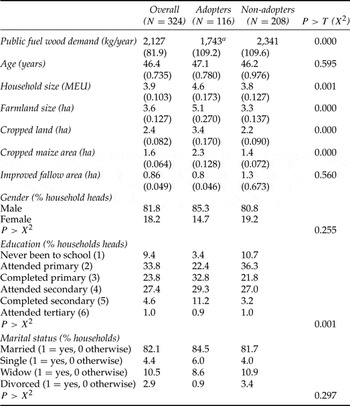
Socioeconomic characteristics of the household heads involved in the study are shown in table 1. There was no significant difference in the average age of adopters and non-adopters of improved fallows. For the whole sample, the average age of the surveyed household heads was about 46.4 years. There was a significant difference in the average active family labour force between the adopters (4.6 persons) and non-adopters (3.8 persons). The sample was dominated by male-headed households with no significant differences in gender between the adopters and non-adopters. More adopters of improved fallows were educated compared to non-adopters. About 40 per cent of the adopters had been to secondary school compared to about 30 per cent of the non-adopters. No significant difference was observable in the marital status of household heads. For both categories more than 80 per cent of households were from married homesteads. Adopters compared to non-adopters, had large farm sizes, and cropped land as well as land put to maize production in the 2010/2011 season (table 1).
Households' fuel wood consumption and socioeconomic characteristics of farmers in Chongwe district, Zambia
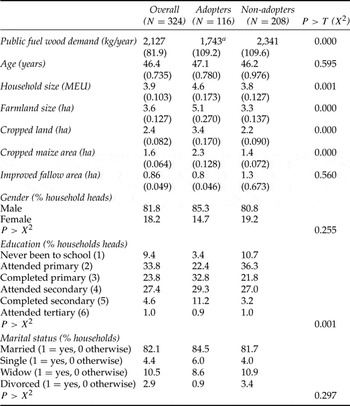
Notes: Figures in parentheses are standard errors of the mean. Man equivalent units (MEU) were calculated following: Runge-Metzger (Reference Runge-Metzger1988) as: <9 years = 0; 9–15 years and over 49 years = 0.7; 16–49 years = 1.
a Fuel demand the year the adopters terminate the fallows. Common practice is that farmers terminate fallows every other year.
3.2. Improved fallows and the consumption of fuel wood from forests
There was a significant difference at the 95 per cent confidence level between adopters and non-adopters of improved fallows in the average number of times per month (3.6 versus 4.7 times, respectively) they collected fuel wood from forests. This was despite the average monthly weight of fuel wood collected from the forest being statistically the same (adopters = 84.3 kg and non-adopters = 80.7 kg). It was estimated by adopters of improved fallows who had cut their improved fallows in 2011 that they spent on average 1.56 months annually using fuel wood from the technology. Therefore, while non-adopters consumed forest wood for the entire 12-month period in a year, adopters consumed forest wood for 10.44 months. The monthly fuel wood demand estimates were multiplied by these factors to come up with the annual estimates that were used in the later analysis.
3.3. Ordered probit estimates
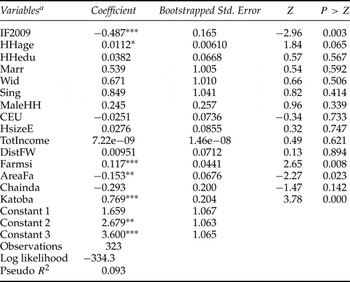
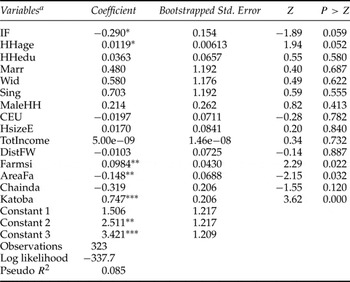
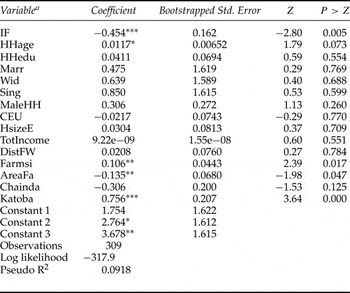
The fuel wood consumption outcome variable was divided into four broad categories with 49 per cent of households consuming less than 1,500 kg of fuel wood, 31 per cent consuming between 1,501 and 3,000 kg, 15 per cent consuming between 3,001 and 5,000 kg and 5 per cent consuming more than 5,000 kg per annum. We estimated three models based on whether or not the 14 farmers who had not harvested wood from the fallows before were: (1) included in the adoption category, since they had shown intention to adopt; (2) included in the non-adoption category since they had not yet reaped fuel wood benefits from the fallows; or (3) entirely excluded from the sample. Just like evidence from Pattanayak and Depro (Reference Pattanayak, Depro, Alavalapti and Mercer2004), all three models (tables 2a–2c) show that consumption of forest fuel wood is negatively correlated with on-farm planting of improved fallows. The level of significance was, however, higher when the 14 farmers with intention to adopt were either dropped from the adoption category or excluded from the sample altogether. The other striking and significant result from the models was that, while farm size was positively correlated, the amount of land reserved as fallow had a negative correlation with consumption of forest fuel wood. Fallowed land usually provides some tree shrubs (depending on the period of fallowing) and these serve as an alternative source of fuel wood.
Ordered probit results with 14 farmers with intent to adopt omitted from the adopters category

Notes: Standard errors bootstrapped 1,000 times. ***p < 0.01; **p < 0.05; *p < 0.1.
a For variable descriptions, see table 3.
Ordered probit results with 14 farmers with intent to adopt included in the adopters category

Notes: Standard errors bootstrapped 1,000 times. ***p < 0.01; **p < 0.05; *p < 0.1.
a For variable descriptions, see table 3.
Ordered probit results with 14 farmers with intent to adopt dropped from the sample
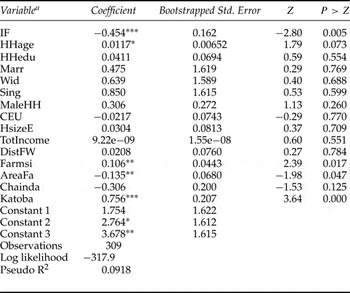
Notes: Standard errors bootstrapped 1,000 times. ***p < 0.01; **p < 0.05; *p < 0.1.
a For variable descriptions, see table 3.
3.4. Propensity score matching estimates
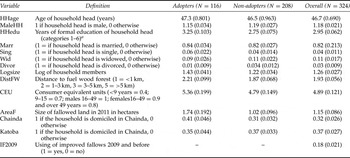
The descriptions of the variables used in estimating the propensity score model are shown in table 3. The choice of the variables was based on an extensive literature review and various model fitting attempts.
Descriptive statistics of selected variables used in various models and in estimating the propensity score

Notes: *Significant at 10% level; **significant at 5% level; ***significant at 1% level. a See table 1 for definition of categories.
The propensity score estimation results for the three models are shown in online appendix tables A1a–A1c, available at http://journals.cambridge.org/EDE. We tried out different model specifications while checking for the balancing properties of the propensity score. The specification used in this study satisfied the balancing procedure tests. The variables of household head age, age squared, single-headed households, household membership size, distance to forest, fallow size, and being domiciled in Chainda and Katoba areas significantly influenced the conditional probability of adopting the improved fallows in the models where the 14 farmers with intent to adopt were either included in the adoption category or were dropped from the sample (online appendix, tables A1a and A1b). All these variables except the single-headed household variable again significantly affected the conditional probability of adopting the improved fallows for the model with the 14 intent to adopt farmers pushed into the non-adoption category (online appendix, table A1c). The estimated propensity scores (conditional probability of adopting the improved fallows) were used to estimate the average adoption effects of improved fallows on the adopters with regard to fuel wood consumption.
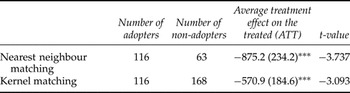
The causal-effect estimates of improved fallows on forest fuel wood dependence using both NN and KM strategies and for the three categories of models are shown in tables 4a–4c. Results in the case where the farmers with intent to adopt were relegated to the non-adoption category are shown in table 4a. The NN strategy showed that the causal effect of the improved fallow technology on forest fuel wood consumption was about −875 kg per household in 2011 (assuming all adopters terminated or harvested fallows this year). Since most adopting households in the study area harvested fallows at least every other year, it can be estimated that dependence on the forest for fuel wood is reduced by approximately half of this amount annually. The KM strategy that used more observations to come up with a counterfactual group also showed that the technology significantly contributed to households' provision of fuel wood. The causal effect estimate from this strategy was however lower (−571 kg) than that from the NN approach. As expected, since more observations were used, the standard error from the KM strategy was relatively lower than that from the NN strategy.
ATT estimation of the causal effect of improved fallows on forest fuel wood (kg) using matching method in Chongwe, Zambia – 14 farmers with intent to adopt added to non-adopters

Notes: *Significant at 10% level; **significant at 5% level; ***significant at 1% level. Bootstrapped standard errors in parentheses with 1,000 replication samples. The numbers of treated and controls refer to actual nearest neighbour (NN) matches. Only 63 non-adopting households could be matched with the adopters.
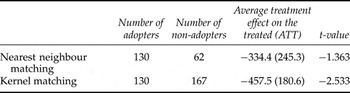
ATT estimation of the causal effect of improved fallows on forest fuel wood (kg) using matching methods in Chongwe, Zambia – 14 farmers with intent to adopt added to adopters

Notes: *Significant at 10% level; **significant at 5% level; ***significant at 1% level. Bootstrapped standard errors in parentheses with 1,000 replication samples. The numbers of treated and controls refer to actual nearest neighbour (NN) matches. Only 62 non-adopting households could be matched with the adopters.
ATT estimation of the causal effect of improved fallows on forest fuel wood (kg) using matching methods in Chongwe, Zambia – 14 farmers with intent to adopt dropped from sample

Notes: *Significant at 10% level; **significant at 5% level; ***significant at 1% level. Bootstrapped standard errors in parentheses with 1,000 replication samples. The numbers of treated and controls refer to actual nearest neighbour (NN) matches. Only 63 non-adopting households could be matched with the adopters.
Results when the 14 farmers with intent to adopt were included in the adoption category are shown in table 4b. The causal effect of the improved fallows as estimated using the NN strategy was −334 but not significant at the 5 per cent confidence level. In contrast, the KM strategy showed that the technology significantly contributed about 457 kg of fuel wood the year the improved fallows are terminated.
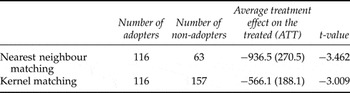
When the 14 farmers with intent to adopt are dropped from the sample (table 4c), the NN strategy showed that the causal effect of improved fallows on forest fuel wood consumption was −936 kg. The KM strategy showed that the technology provided about 560 kg of fuel wood. Both results were statistically significant.
3.5. Matching balancing tests
Before matching, the variables used had a high degree of bias between the adopting and non-adopting categories in all the three models. During matching, this bias was significantly reduced in all the variables used except for household head's age squared in the model where the 14 farmers with intent to adopt are dropped from the sample (online appendix, tables A2a–A2b). These results show that matching was reasonably successful.
3.6. Quasi-experimental estimates versus experimental results
Estimates from quasi-experiments are expected to approximate those you would get from well-designed randomized experiments. This is because by controlling for confounding factors, there is a mimic of control plots in the randomized biophysical experiments. This study controlled for observable confounding factors through matching strategies. From the estimates that produced significant results, the causal effect of the improved fallows at fallow termination ranged from about 457 kg in the case of KM when the farmers with intent to adopt were included in the adoption category to about 936 kg (NN matching estimate) when these farmers were dropped from the sample. This is about 21–44 per cent of the annual fuel wood demand at fallow termination or half of these figures since the farmers in the study area terminated the fallows after every other year.
Considering that the average area of improved fallows per household in 2011 was almost 1 hectare (0.86 ha), a crude comparison with researcher-managed trials could be made. Kwesiga et al. (Reference Kwesiga, Franzel, Place, Phiri and Simwanza1999) estimated that more than 10,000 kg per hectare of fuel wood can be harvested from researcher-designed and managed 2–3-year-old improved fallows. Climate Management, a project promoting production of fuel wood from the Cajanus cajan improved fallows in the study area estimated that up to 7,000 kg of fuel wood per hectare could be obtained from well-managed and supervised two-year-old demonstration plots. This shows a huge disparity between what can be obtained on the farmers' fields and on professionally managed plots. Since the effects of confounding factors were only equalized between adopting and non-adopting farmers, and not between farmers and experimenters (demonstrators), it appears reasonable to attribute such differences to farmers' limited capacity to properly manage fallows. However, as already indicated, it should be noted that the primary objectives for farmers adopting improved fallows is soil fertility improvement and not fuel wood production. Households may not consider forest conservation benefits when making the fallow adoption decision. There is some sort of trade-off between allowing the trees to grow for a longer period and providing more fuel wood, and terminating the trees as soon as it is felt that they have fixed enough nitrogen in the soil. Therefore, the size of the fuel wood reduction associated with improved fallow adoption may not be that huge.
3.7. Potential of improved fallows to protect the forests
According to Mafongoya and Kuntashula (Reference Mafongoya and Kuntashula2005), fuel wood from on-farm improved fallows could provide a means to conserve the natural vegetation, which is under threat due to deforestation. The authors use literature such as Kwesiga et al. (Reference Kwesiga, Franzel, Place, Phiri and Simwanza1999), already cited above, to back their claim. However the authors fail to give a precise figure on how much fuel wood is obtained from improved fallows under farmers' conditions. Results from this study showed that there is a significant causal effect between adoption of improved fallows and household forest fuel wood demand. Although this case study was localized to a specific area and the size of the public fuel wood reductions were not very huge, some crude conclusions could be made on the capacity of adopting farmers for protecting the public forests. The average area put under improved fallows in the study area stood at 0.86 ha per household. Chidumayo (Reference Chidumayo1997) estimated that Zambia loses about 200,000 ha of forests per year. More recently the Zambian government officials at the Ministry of Environment and Tourism (Government of the Republic of Zambia, 2008) estimated that about 300,000 ha of forest is being cleared every year. Using the recent estimate (and 0.86 ha per household), it would require about 349,837 households putting part of their farms to improved fallows every year to counter this level of deforestation. Zambia currently has a population of 1.3 million households engaged in agriculture with relatively enough land (Musanya, Reference Musanya, Mapaure, Mhango and Mulenga2011). Therefore, meeting such a target is not far-fetched as long as there is political will and concerted efforts in promoting the technology on-farm. Given that the Government of Zambia subsidizes inorganic fertilizer to most resource poor small-scale farmers (900,000 in 2011/2012 farming season) through the Fertiliser Input Support Programme (Hichaambwa and Jayne, Reference Hichaambwa and Jayne2012), consideration towards tying these subsidies with the uptake of improved fallow could be an option. Farmer investment in improved fallows could also be promoted through the explicit provision of extension messages that link the technology to environmental benefits such as the conservation of forests.
4. Conclusions and recommendations
This study used simple, cost-effective and more scientifically robust techniques to demonstrate the benefits of improved fallows in the provision of environmental services on farmers' fields. The study evaluated the potential impact of adopting improved fallows on on-farm environmental quality measured by the technology's contribution to fuel wood provision. The study utilized farm household-level data collected in 2011 from a randomly selected sample of 324 households in Chongwe district of Zambia. Estimates from both ordered probit regression and propensity score matching showed that technology has an impact on household fuel wood consumption. Adoption of improved fallows reduced dependence on forests for fuel wood by up to 936 kg at fallow termination, implying that less forest would be deforested. Better improved fallow management by farmers could increase the size of fuel wood contributed by the technology. Since these results confirm the role of the technology in improving on-farm environmental quality, explicit provision of extension messages that link the technology to environmental benefits such as the conservation of forests should be made available. This is in addition to the welfare contribution through crop production that is primarily the objective of the improved fallow technology.
Supplementary materials and methods
The supplementary material referred to in this paper can be found online at journals.cambridge.org/EDE/.