INTRODUCTION
The solitary ascidian Ciona intestinalis (Linnaeus, 1767) usually adheres vertically to substrates, with its siphons pointing downward. Its cylindrical body reaches 100–150 mm in length, with its two siphons at the anterior end. Its tunic is soft and transparent, making the internal organs visible (Jackson, Reference Jackson2008). This is a species frequently introduced in areas under the influence of organic pollution (NIMPIS, Reference Hewitt, Martin, Sliwa, McEnnulty, Murphy, Jones and Cooper2002). In North America, C. intestinalis occurs on the east coast, as a result of multiple introductions. On the west coast, both C. intestinalis and C. savignyi occur. Ciona savignyi, long a resident of California, is now actively invading the north-west coast. Ciona intestinalis came from northern Europe and was introduced in bays along both coasts of North America, in New Zealand, in the Mediterranean Sea, in Australia, Korea, Hawaii, Chile, South Africa and Hong Kong (Blum et al., Reference Blum, Chang, Liljesthröm, Schenk, Steinberg and Ruiz2007). In many places, C. intestinalis became a serious problem for aquaculture, especially on mussel farms (Clancey & Hinton, Reference Clancey and Hinton2003; Daley & Scavia, Reference Daley and Scavia2008; Ramsay et al., Reference Ramsay, Davidson, Landry and Stryhn2008). Besides, C. intestinalis decreases the diversity of sessile invertebrates in benthic communities (Blum et al., Reference Blum, Chang, Liljesthröm, Schenk, Steinberg and Ruiz2007). The latest known distribution of C. intestinalis does not include the western South Atlantic Ocean (NIMPIS, Reference Hewitt, Martin, Sliwa, McEnnulty, Murphy, Jones and Cooper2002; Jackson, Reference Jackson2008). However, C. intestinalis has been recorded in Brazil in the past, in the States of Paraná and São Paulo (Millar Reference Millar1958, Reference Millar1966), in the State of Rio de Janeiro (Costa, Reference Costa1969), and also on the Argentine coast, in Mar del Plata and Punta Arenas–Strait of Magellan (Pisanó et al., Reference Pisanó, Rengel and Bustuoabad1971; Orensanz et al., Reference Orensanz, Schwindt, Pastorino, Bortolus, Casas, Darrigran, Elías, López Gappa, Obenat, Pascual, Penchaszadeh, Piriz, Scarabino, Spivak and Vallarino2002). Most of the records date from the 1970s and even before (Orensanz et al., Reference Orensanz, Schwindt, Pastorino, Bortolus, Casas, Darrigran, Elías, López Gappa, Obenat, Pascual, Penchaszadeh, Piriz, Scarabino, Spivak and Vallarino2002; Instituto Horus de Desenvolvimento e Conservação Ambiental, 2007).
Ciona intestinalis was last recorded on the Brazilian coast in 1991 (Silva et al., Reference Silva, Brasil, Skinner and Zalmon1991a), in the Guanabara Bay. Later experiments carried out by different authors from 1993–2008 failed to detect this species (Omena et al., Reference Omena, Zalmon and Barreto1993, Reference Omena, Barreto, Zalmon and Brasil1995; Omena & Souza, Reference Omena and Souza1999; Jara et al., Reference Jara, Miyamoto, Da Gama, Molis, Wahl and Pereira2006; Xavier et al., Reference Xavier, Da Gama, Porto, Antunes and Pereira2008), and there is an unconfirmed record of C. intestinalis in the State of São Paulo (Lotufo, Reference Lotufo2002). The main difference between these studies and Silva et al.'s is predator exclusion as it was carried out in the latter. In view of the 17-year absence of records, some of the researchers who work with fouling organisms or ascidians in Brazil suggested that C. intestinalis was no longer present in the Guanabara Bay or even in other parts of the Brazilian coast (Rocha & Kremer, Reference Rocha and Kremer2005).
Despite the time elapsed since the last recording of C. intestinalis in the Guanabara Bay, it is possible to say that this lack of records is a consequence of inappropriate sampling methodology. As the tunic of C. intestinalis is soft and thin, many predators, especially fish, may feed on it (Gulliksen & Skjzveland, Reference Gulliksen and Skjaeveland1973; Lambert, Reference Lambert2005 for review).
In 1991, successful experiments conducted by Silva et al. were able to detect great amounts of C. intestinalis using predator exclusion. In the 1990s, as a consequence of changes in the ecological paradigm for the structure of fouling communities, there was a decline in the amount of research carried out on the role of predation in such communities. This led to neglect of important aspects of the biology of C. intestinalis, and resulted in the absence of records in the region and in other places as well.
Thus, since previous and current research had not taken into account relevant aspects of the biology and ecology of this species, we decided to investigate its extinction in the Guanabara Bay, using a predator exclusion experiment to try to sample specimens of this ascidian.
MATERIALS AND METHODS
Experimental design
Granite plates (23 × 11 cm) were placed inside black plastic boxes, which were immersed and kept suspended at 1 m depth, with their openings turned to the bottom. These boxes were divided into two groups: control and predator exclusion, each containing five replicate plates. Predator exclusion was achieved by using nets with mesh size of 0.5 cm to cover box openings.
The area of experiment immersion was Urca (22°57′5.93″S 43°10′9.24″W), in the Guanabara Bay, where numerous specimens of Ciona intestinalis were detected by different experiments during the nineties (Silva et al., Reference Silva, Brasil, Skinner and Zalmon1991a, Reference Silva, Brasil, Zalmon and Silvab), including some with predator exclusion (Silva et al., Reference Silva, Brasil, Skinner and Zalmon1991a). The Guanabara Bay is highly polluted, as a consequence of intense urban, oil, and port activities that favour the development of fouling organisms and the establishment of exotic species such as C. intestinalis (Carlton & Geller, 1993). Plates were immersed in August 2008, and photographed in the first, second and fourth weeks. Nets were cleaned weekly to keep water circulating inside the boxes.
RESULTS AND DISCUSSION
Identification of Ciona intestinalis
Since different species of Ciona have been introduced in North America and elsewhere, it was important to distinguish accurately the species under this study. In spite of important internal structural differences (Hoshino & Nishikawa, Reference Hoshino and Nishikawa1985), the easiest way to discriminate between Ciona species is observing body wall pigmentation (Hoshino & Nishikawa, Reference Hoshino and Nishikawa1985; Lambert & Lambert, Reference Lambert and Lambert1998). None of the specimens we examined had body wall pigmentation. On the North American Pacific coast, C. intestinalis has a red spot at the end of the sperm duct, which is also present in Japanese C. intestinalis, but absent in C. savignyi and in the Atlantic C. intestinalis (C. Lambert, Reference Lambert2005, personal communication).
Results of predator exclusion and control treatments
In the first week, plates of both treatments (control and predator exclusion) were colonized by barnacles (Amphibalanus amphitrite and Megabalanus coccopoma), polychaetes (Serpulidae), bryozoans (Bugula neritina and B. turrita), and colonial ascidians (Botrylloides nigrum, Didemnum spp. and Diplosoma spp.), but no C. intestinalis was found. However, in the second week, two individuals of C. intestinalis were observed inside the net-protected boxes (predator exclusion), a result that persisted until the fourth week. In addition to C. intestinalis, another solitary ascidian, Ascidia curvata (Traustedt, 1882), was observed in both control and predator exclusion boxes. The fast colonization of C. intestinalis suggests that reproductive adults were close, since C. intestinalis larvae do not disperse over great distances in the plankton and are not found frequently in such samples (Petersen & Svane, Reference Petersen and Svane1995; Howes et al., Reference Howes, Herbinger, Darnell and Vercaemer2007).
Ciona intestinalis is not found on substrates in the infratidal zone. It is possible that it lives in protected crevices, where predation is usually reduced, making it difficult to detect it. This hypothesis is reinforced both by early substrate recruitment (two weeks) and also by the presence of specimens inside net-protected boxes only. This is good evidence that predation excludes C. intestinalis from exposed substrates. Gulliksen & Skjzveland (Reference Gulliksen and Skjaeveland1973) suggested previously that predation could be primarily related to the spatial abundance of this species. In Denmark, for instance, C. intestinalis occurs in high abundances in a dense layer of Zoostera marina, which provides protection against predators. Besides, the low salinity observed there also contributes to reduce the number of potential predators (Petersen & Svane, Reference Petersen and Svane1995).
Ciona intestinalis has a cosmopolitan distribution, tolerates organic pollution, and is abundant in ports and marinas all over the world (Meliane, Reference Meliane2003). This environment description agrees with the environment description of the Guanabara Bay and other Brazilian bays where C. intestinalis has been recorded: Paranaguá Bay and São Sebastião Bay (Millar, Reference Millar1958), although Rocha & Kremer (Reference Rocha and Kremer2005) have not found C. intestinalis in a study focusing on ascidian species introduced in the Paranaguá Bay. These authors reported the occurrence of C. intestinalis in the recent past, but not in the present. As it was previously stated in this paper, there are no records of C. intestinalis over the last 17 years in the Guanabara Bay, even though research on biofouling continued to be carried out in a variety of environments (Omena et al., Reference Omena, Zalmon and Barreto1993, Reference Omena, Barreto, Zalmon and Brasil1995; Omena & Souza, Reference Omena and Souza1999; Zalmon et al., Reference Zalmon, da Gama and Leta1993; Jara et al., Reference Jara, Miyamoto, Da Gama, Molis, Wahl and Pereira2006; Xavier et al., Reference Xavier, Da Gama, Porto, Antunes and Pereira2008). The difference between such studies and this one is predator exclusion. This hypothesis is reinforced by Dias (2008, personal communication), who found C. intestinalis in São Sebastião, São Paulo, during a recent predator exclusion experiment.
In other studies, conducted in different areas, predation does not seem to be a selective factor for recruitment (Petersen & Svane, Reference Petersen and Svane1995; Blum et al., Reference Blum, Chang, Liljesthröm, Schenk, Steinberg and Ruiz2007; LeGresley et al., Reference LeGresley, Martin, McCurdy, Thorpe and Chang2008). An additional study, in which C. intestinalis was sampled after recruiting in mussel farm bags, does not demonstrate clearly the influence of predators (Ramsay et al., Reference Ramsay, Davidson, Landry and Stryhn2008), since it has not shown if recruits were protected from predators or not, nor if they were inside or outside the bags.
However, the abundance and distribution of C. intestinalis can be very different in some regions. In Australia, for example, C. intestinalis seems to be declining in many places where it used to be frequent before (Kott, Reference Kott, Shepherd and Thomas1997). In her study, Kott (Reference Kott, Shepherd and Thomas1997) reports C. intestinalis only in Port Phillip Bay, Victoria. This decrease in distribution and frequency of occurrence is confirmed by Hewitt et al. (Reference Hewitt, Martin, Sliwa, McEnnulty, Murphy, Jones and Cooper2002). However, McDonald (Reference McDonald2004) has recorded C. intestinalis in eastern Australian ports for more than a decade, showing that this and other invasive fouling species could be spreading in this region as a result of port activities and boat traffic.
According to some research, the seasons of the year are a factor that influences the presence of C. intestinalis. In California, for instance, there are large seasonal die-offs of C. intestinalis (Lambert & Lambert, Reference Lambert and Lambert1998). However, the studies in the Guanabara Bay were carried out in different seasons, and even so no record was made for this species (Omena et al., Reference Omena, Zalmon and Barreto1993 Reference Omena, Barreto, Zalmon and Brasil1995; Omena & Souza, Reference Omena and Souza1999; Jara et al., Reference Jara, Miyamoto, Da Gama, Molis, Wahl and Pereira2006; Xavier et al., Reference Xavier, Da Gama, Porto, Antunes and Pereira2008). Again, the main difference between such studies and ours is predator exclusion, which reinforces our hypothesis. The suggestion that searches made in some of the previous studies were conducted during a period of minimalization does not agree with our results. Even if the time of immersion in our study corresponded to a period of minimalization, low C. intestinalis recruitment happened exclusively as a result of predator exclusion.
Ciona intestinalis is very tolerant to pollution and other environmental changes, such as salinity and temperature variations (Jackson, Reference Jackson2008; Therriault & Herborg, Reference Therriault and Herborg2008). This is the reason why its decrease cannot be completely understood in many places. In the Blanca Bay estuary, Argentina, Hoffmeyer (Reference Hoffmeyer2004) recorded the disappearance of C. intestinalis larvae in plankton samples of the annual cycle 1990–1991 when compared to 1979–1980. This decrease can be related to population decline or even to local extinction, both due to the absence of adequate substrates (Ramsay et al., Reference Ramsay, Davidson, Landry and Stryhn2008) and to the predator effect, as stated in our study.
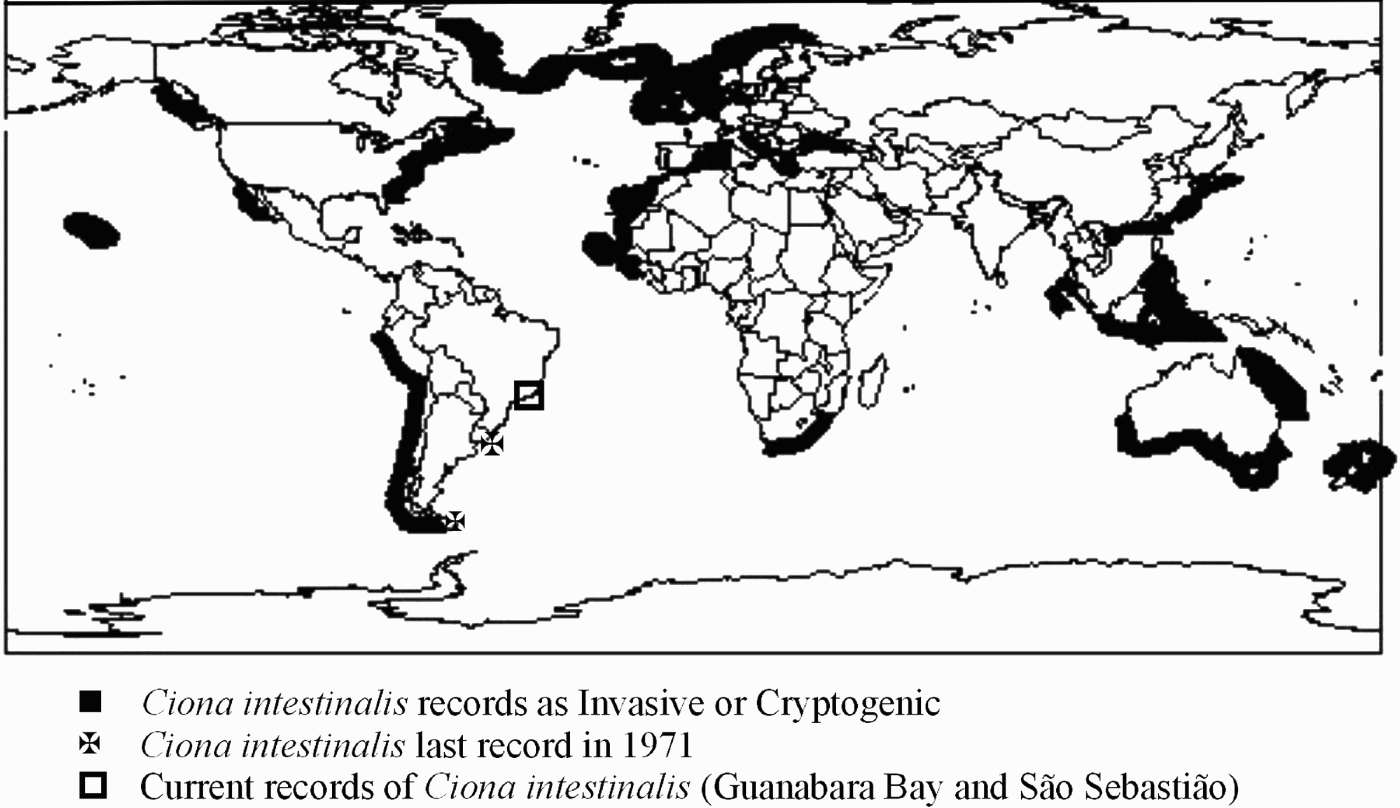
Therefore, a thorough review of C. intestinalis distribution, including sampling methods and strategies, could show it is broader than reported so far. This study succeeded in broadening the geographical distribution of C. intestinalis, since it started with no occurrence and advanced to recording two new sites in Brazil (Figure 1). The distribution of C. intestinalis might prove wider, if the predator exclusion methodology is applied to other places, such as the Paranaguá Bay, in the State of Paraná, and even Mar del Plata, Argentina.
World distribution of Ciona intestinalis, showing where it is introduced, native, or cryptogenic, and also its records in western South Atlantic (adapted from NIMPIS, Reference Hewitt, Martin, Sliwa, McEnnulty, Murphy, Jones and Cooper2002; Therriault & Herborg, Reference Therriault and Herborg2008).

ACKNOWLEDGEMENTS
This study was supported by a scholarship awarded to Flávia O. Marins (PROATEC UERJ/FAPERJ) to Camila S. Oliveira and Nathalia M.V. Maciel (PIBIC-UERJ) and by two research grants FAPERJ awarded to Luis F. Skinner (Proc.E-26/110.009/2007 e E-26/170.552/2007). We thank Dr C. Lambert and Dr J. McDonald for their invaluable suggestions and for reviewing the English version of our manuscript.