INTRODUCTION
The fountain darter Etheostoma fonticola Jordan & Gilbert 1886 (Percidae) is a federal and state of Texas listed endangered fish limited to only the headwaters of the Comal and San Marcos rivers, in central Texas, USA. During a drought in 1996, concerns were raised when San Marcos Aquatic Resource Center (SMARC; San Marcos, TX, USA) staff collected fountain darters with swollen gills from the Comal River. Further investigation revealed that fountain darters were infected with the Asian digenetic trematode Centrocestus formosanus Nishigori 1924 (Heterophyidae) that infects definitive (birds and mammals), first intermediate (snails), and second intermediate (fish) hosts (Yamaguti, Reference Yamaguti1975; Scholtz and Salgado-Maldonado, Reference Scholz and Salgado-Maldonado2000). Depending on the fish's parasite intensity (number of cysts/fish) and immune response, C. formosanus can cause severe mechanical gill damage (Mitchell et al. Reference Mitchell, Salmon, Huffman, Goodwin and Brandt2000), respiratory problems (Blazer and Gratzek, Reference Blazer and Gratzek1985; Balasuriya, Reference Balasuriya1988; Alcaraz et al. Reference Alcaraz, Perez-Ponce de Leon, Garcia, Leon-Regagnon and Vanegas1999) and altered behaviour (Balasuriya, Reference Balasuriya1988; Alcaraz et al. Reference Alcaraz, Perez-Ponce de Leon, Garcia, Leon-Regagnon and Vanegas1999; Salmon, Reference Salmon2000) that can result in mortality (Mitchell et al. Reference Mitchell, Salmon, Huffman, Goodwin and Brandt2000; McDonald et al. Reference McDonald, Bonner, Brandt and Trevino2006) potentially altering population demographics.
Sampling methods using birds (Kuhlman, Reference Kuhlman2007), bird feces (Knott and Murray, Reference Knott and Murray1991), snails (Knot and Murray, Reference Knott and Murray1991; Mitchell et al. Reference Mitchell, Salmon, Huffman, Goodwin and Brandt2000), wild-caught fish (McDermott, Reference McDermott2000; Mitchell et al. Reference Mitchell, Salmon, Huffman, Goodwin and Brandt2000; Cantu, Reference Cantu2003; Fleming et al. Reference Fleming, Huffman, Bonner and Brandt2011) and caged fish (Cantu, Reference Cantu2003; Fleming et al. Reference Fleming, Huffman, Bonner and Brandt2011) have been used to identify different life stages (e.g. eggs, rediae, cercariae, metacercariae and worms) of C. formosanus to determine which hosts harbour the parasite and spatial and temporal distributions. Although these sampling methods may be used to quantify the presence and prevalence (percentage of fish infected in a sample or population) of C. formosanus in hosts, wild-caught and caged fish sampling have an additional advantage of quantifying intensity (number of cysts/individual), an indication of how life-threatening the infections are to fish hosts. Mitchell et al. (Reference Mitchell, Salmon, Huffman, Goodwin and Brandt2000) suggested that an intensity of >800 cysts/fish was life-threatening to fountain darters. Although cercariometry (method that uses filters to quantify cercariae L−1 from infected waters) provides similar results with caged rodents (Prentice and Ouma, Reference Prentice and Ouma1984) with less effort and cost (Prentice, Reference Prentice1984; Theron, Reference Theron1986), cercarial density from cercariometry has not been evaluated for consistency in trends with intensity in caged fish. Here, we evaluated wild-caught fish, caged fish and cercariometry sampling methods to determine their relative value for monitoring C. formosanus in the Comal River based on the biological information provided, coupled with their associated cost.
MATERIALS AND METHODS
Study site
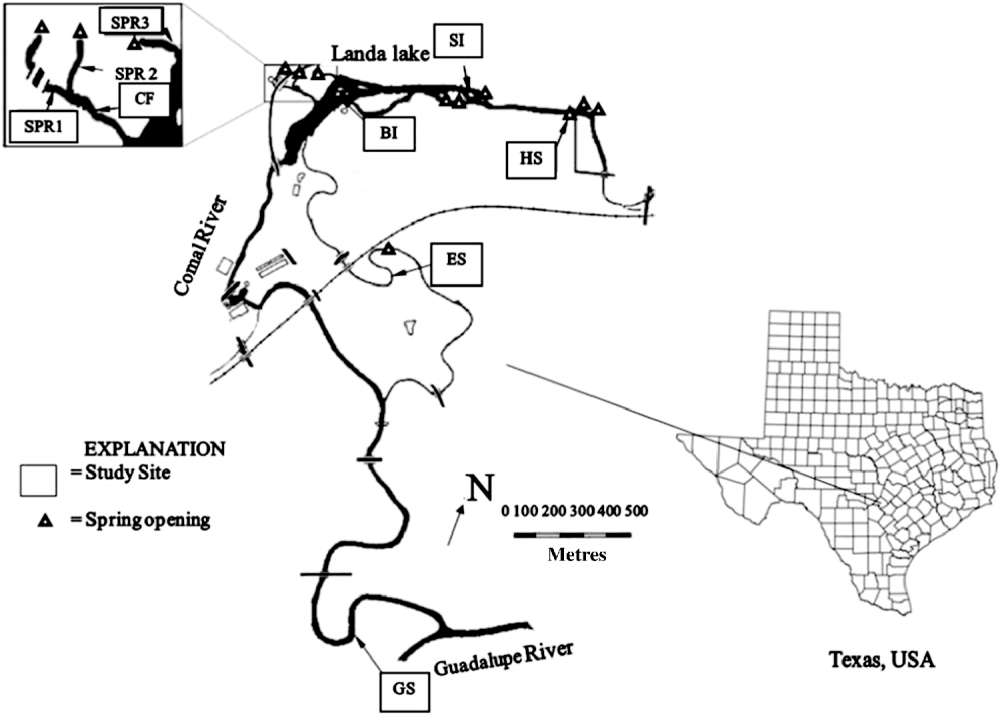
Our study was conducted in the Comal River in New Braunfels (29°42′50·6″N; 98°08′0·65″W), TX. It is the largest spring system in the southwestern United States (George, Reference George1952) with a mean annual discharge of 8·0 m3/s (USFWS, 1996). Although flow from the Comal Springs tends to fluctuate seasonally, water hydrochemistry remains uniform (water temperature = 22·0 to 24·5 °C, pH 7·1 to 7·8, and specific conductance = 509·0 to 548·0 mS cm−1) year-round (Fahlquist and Slattery, Reference Fahlquist and Slattery1997). Three separate methodological assessments for C. formosanus were conducted concurrently within a 10-day sampling period and seasonally (autumn 2002, winter 2002, spring 2003, and summer 2003) at the same 8 sites (Fig. 1) for 1 year. To collect representative C. formosanus samples from the Comal River, samples were collected from the upper, middle and lower sections of the river. Within each site, C. formosanus samples were collected from fountain darter habitats described in USFWS (1996).
Study sites where Centrocestus formosanus were collected from river water and in caged and wild-caught fountain darters in the Comal River, Comal County, TX. Spring Run 1 (SPR 1) and Spring Run 3 (SPR 3) sites converge into the Confluence (CF) site and flow into Landa Lake. Houston Street (HS), Spring Island (SI), and Bird Island (BI) sites are in Landa Lake. Elizabeth Street (ES) site is about midstream of the Comal River, while Garden Street (GS) site is the furthest downstream reach of the Comal River.

Wild-caught fish collection
When possible, 10 fountain darters were collected/site (8 sites, 4 seasons, N = 235, range = 23–35 mm total length TL) within 30 min (Fig. 1) with a 40 × 40 cm dip-net (mesh size 1·6 × 1·6 mm). All darters were euthanized in a 200 mg L−1 solution of tricaine methanesulfonate (FINQUEL MS-222®; Argent Chemical Laboratories Inc., Redmond, WA, USA). After removing darters from the FINQUEL® solution, darters were rinsed thoroughly with water, preserved in 10% buffered formalin (Hexion Specialty Chemicals Inc. Springfield, OR, USA), and transported to SMARC for gill examination.
After preserving fountain darters in 10% buffered formalin for at least 24 h, each darter was rinsed with water, weighed (g), measured to the nearest mm (TL), sexed and examined for C. formosanus and other gill parasites. Gill arches on the right side were removed and examined using a compound microscope (100×). A cover slip was pressed against each gill filament to view cysts more clearly. The number of C. formosanus cysts/gill and developmental stage of each cyst (i.e. not developed = visible eyespots, developing cyst = faded eyespots, and fully developed = visible X-shaped glands) were recorded using the methods of McDermott (Reference McDermott2000). Because cysts are relatively evenly distributed between the left and right gills (Madhavi, Reference Madhavi1986), the intensity (total number of cysts/fish) was estimated by doubling the number of cysts found on the right gill arches. Prevalence was determined as the percentage of fish found infected in a fish sample.
Caged fish
The caged fish sampling method was used to determine parasite infection potential in fountain darters by controlling the exposure period of fountain darters confined to infected waters at designated sites. To reduce the chance of fountain darters escaping through the mesh (2·4 mm2) of the cages (27 cm diameter × 31 cm high), we used 4-month-old (∼25 mm TL) captive-bred fountain darters (N = 300). To ensure that these fish were not infected with C. formosanus or other pathogens, a subset (N = 60) of the 300 fish was examined at the US Fish and Wildlife Service Pinetop Fish Health Center, Pinetop, AZ, USA (PFHC). The remaining 240 fish received a 1-h formalin (250 mL formalin L−1 water) treatment and were allowed to recuperate at SMARC for 1 week before being placed in the river. On day 1 of each caged trial, 10 fountain darters were placed into 3 individual cages at each of the 8 Comal River sites where fountain darters had been collected the previous day (Fig. 1). Cages were cleaned of debris and algae every other day, and removed after 7 days of exposure in the river (in a preliminary cage trial, 40% of the darters appeared thin with no mortality by day 8, while 100% mortality occurred by day 10; Cantu, Reference Cantu2003). All darters were then euthanized with FINQUEL®, rinsed, preserved and transported to SMARC for gill examination, as mentioned with the wild-caught fish method. In the spring of 2003, when one set of cages was removed by park visitors from the river at the SPR 3 site (Fig. 1) and placed on the bank, a new set of darters were treated as previously described, then placed in the cages the following day and left in the river for 7 days.
Cercariometry
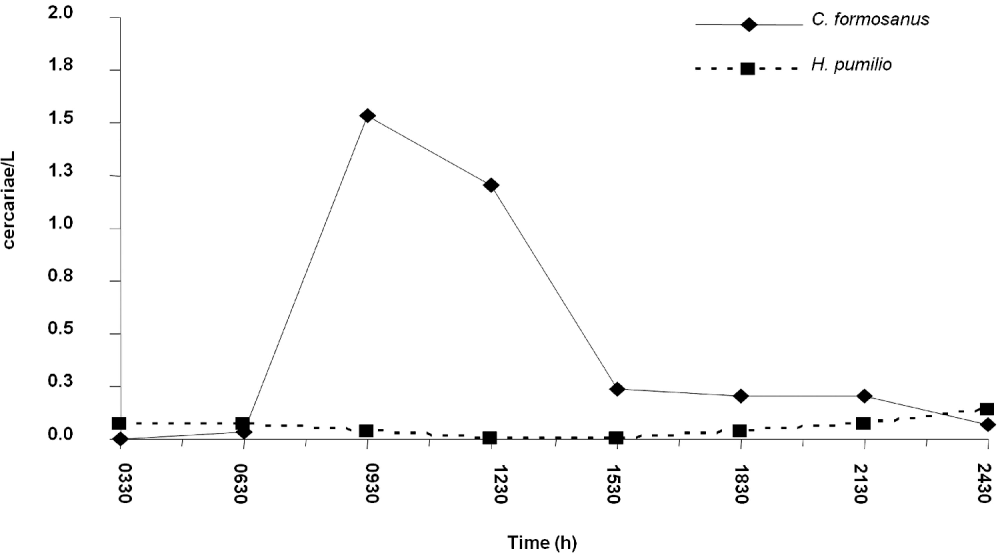
Centrocestus formosanus cercariae were collected at each of the 8 sites between 09.30 and 12.30 h since the greatest cercarial densities occur during this time period (Fig. 2; Cantu, Reference Cantu2003). During methodological assessments, 3 × 5 L samples of river water were collected directly over each cage, on days 2, 6 and 9 at 4 sites and on days 3, 7 and 10 at the other 4 sites. A 0·1% formalin solution was used to eliminate potential cercarial loss during the filtering process (see Prentice, Reference Prentice1984; Cantu, Reference Cantu2003). Water samples were then poured through a filtration apparatus similar in design to that used by Theron (Reference Theron1979) and by Prentice (Reference Prentice1984). The contents on the 30-μm nylon monofilament filter (Sefare Filtration Inc., Depew, NY, USA) were stained with 1·5 mL of Rose Bengal (Fisher Scientific, Fair Lawn, NJ, USA) to enhance the visibility of cercariae on filters, preserved with 3 mL of 10% formalin, and then sealed in a Petri dish with Parafilm M (American Can Co., Greenwich, CT, USA) to prevent drying of the cercariae on the filters. Centrocestus formosanus and other species of cercariae were enumerated on filters using a compound microscope (100×). Cercarial density was defined as the number of cercariae L−1 filtered from a 5 L sample. The filters were cleaned and re-used following the methods outlined by Prentice (Reference Prentice1984).
Average diel cercarial densities of Centrocestus formosanus and Haplorchis pumilio collected from the water column in the Comal River, Comal County, TX.
The parasite data from cercariometry, caged fish and wild-caught fish sampling methods are from an ecological study that examines the spatial and temporal dynamics of C. formosanus at the Comal River (Cantu, Reference Cantu2003). Prior to all statistical analyses, data were log(x) or x 0·25 transformed to meet the assumptions of parametric tests. STATGRAPHICS Centurion XVI.I Version 16.1.02 (Statpoint Technologies, Inc., Warrenton, VA, USA) was used to conduct: (1) correlation analysis (r statistic) to determine whether significant relationships existed between cercarial densities and wild-caught and caged darter intensity, (2) regression analysis (r 2 statistic) to determine whether cercarial density (cercariae/L) could predict intensities (number of cysts/fish) in wild-caught and caged darters and (3) two-factor ANOVA (F statistic) to determine whether spatial and temporal differences occurred among sampling methods. If significant differences (P < 0·05) were detected with ANOVA tests, Fisher's multiple range tests were conducted to determine which means were significantly different.
Longevity of infected fish was estimated by using the caged fish infection rate and number of cysts/fish considered to cause mortality. Infection rate was determined by regressing cercarial density against intensity in caged fish, while the number of cysts/fish considered to be life threatening was based on estimates reported by Mitchell et al. (Reference Mitchell, Salmon, Huffman, Goodwin and Brandt2000) in wild-caught fish (range = 19–35 mm TL) with >800 cysts/fish and McDonald et al. (Reference McDonald, Bonner, Brandt and Trevino2006) in hatchery-raised adults (range = 36–41 mm TL) with a mean±s.e. of 1131 ± 101 cysts, juveniles (range = 16–20 mm TL) with 353 ± 28·8 cysts, and larvae (range = 9–13 mm TL) with 60 ± 18·6 cysts/fish.
The handling time (mean±s.d. min, N = 3) for processing the number of parasites in one fish or filtered water sample was assessed. Processing of wild-caught fish samples included netting, euthanizing, rinsing, preserving, measuring, weighing, dissecting and enumerating samples. Processing of caged fish samples included setting up and removing cages and euthanizing, rinsing, preserving, measuring, weighing, dissecting and enumerating samples. Processing of filter samples included filtering, staining, preserving, sealing and enumerating samples. Handling times to conduct tasks associated with each sampling method were averaged to get the mean handling time/sample for each sampling method. Handling time for rearing one caged fish to 27 mm TL was estimated from 1 group of fountain darter offspring. Waiting periods where no effort was involved (e.g. 3 weeks waiting for fish health inspection by PFHC, 1-h formalin treatment, 24-h fish recuperation, 7-days exposure of caged fish to river water) were excluded from handling time.
RESULTS
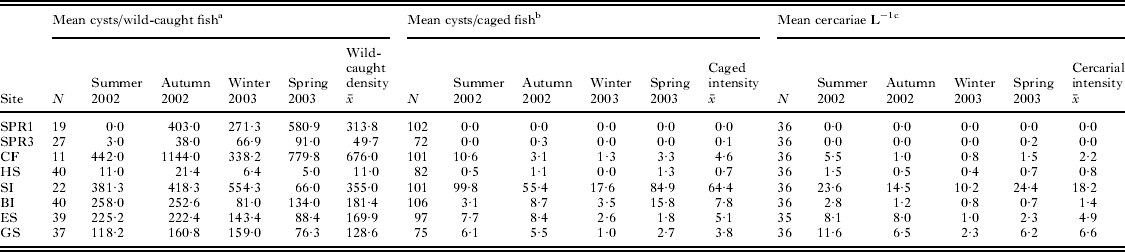
Only 235 of the attempted 320 wild-caught fountain darters were collected during the study due to scarcity of fountain darters at SPR1, SPR3, CF and SI sites at the Comal River (Table 1). The mean±s.e.C. formosanus intensity in wild-caught darters was 232·4 ± 46·5 cysts/fish with a range of 0 to 1662 cysts/fish. The mean prevalence was 94·8% with 5·1% having life-threatening intensities of >800 cysts/fish. Of the wild-caught darters examined, 23·4% were infected with cysts from an unidentified monogenean species of Monopisthocotylea. Of 23 000 C. formosanus cysts examined, 99·0% contained eyespots, 0·7% contained faded eyespots and 0·4% contained X-shaped glands.
Mean seasonal Centrocestus formosanus cercarial densities from filtered river water, caged fountain darters, and wild-caught fountain darters at eight sites in the Comal River, Comal County, Texas
a Two hundred and thirty-five fish of a proposed 320 wild-caught fish were collected (10 fish/site, 8 sites, 4 seasons) due to fish scarcity.
b Seven hundred and thirty-six fish of the 960 caged fish (10 fish/cage, 3 cages/site, 8 sites, 4 seasons) survived in cages after 7 days.
c Two hundred and eighty-seven river water samples were filtered (9 samples/site, 8 sites, 4 seasons).
The mean±s.e.C. formosanus intensity in caged darters (N = 736 fish) was 10·8 ± 4·2 cysts/fish with a range of 0–348 cysts/fish. The mean prevalence was 55·0% with none of the caged darters having intensities >800 cysts/fish. Of all the caged darters examined, only 0·8% were infected with cysts from an unidentified monogenean species of Monopisthocotylea. Of 4032 C. formosanus cysts examined, 100·0% contained eyespots.
The mean±s.e.C. formosanus cercarial density in filters (N = 287) was 4·3 ± 0·4 cercariae L−1, with a range of 0 to 45 cercariae L−1. Of the filters examined, 74·6% contained C. formosanus cercariae and 15·3% contained Haplorchis pumilio Looss 1896 (Heterophyidae) cercariae, another exotic digenetic trematode introduced from Asia.
Significant differences of C. formosanus abundance were detected among sites with cercariometry (F = 43·54, P < 0·01) and caged fish sampling (F = 38·93, P < 0·01), but not with wild-caught fish sampling (F = 1·36, P = 0·27). Overall, the abundance of C. formosanus collected from cercariometry and caged fish sampling followed a similar pattern by site (Table 1) with the highest C. formosanus abundances at SI sites (P < 0·05) and the lowest abundances at SPR1 and SPR3 sites (P < 0·05). Similarly, significant differences of C. formosanus abundance were also detected among seasons using cercariometry (F = 4·88, P = 0·01) and caged fish sampling (F = 5·29, P = 0·01), but not with wild-caught fish sampling (F = 0·97, P = 0·42). Overall, the abundance of C. formosanus collected from cercariometry and caged fish sampling followed a similar pattern by season (Table 1) with the highest C. formosanus abundances occurring during the summer and spring months (P < 0·05).
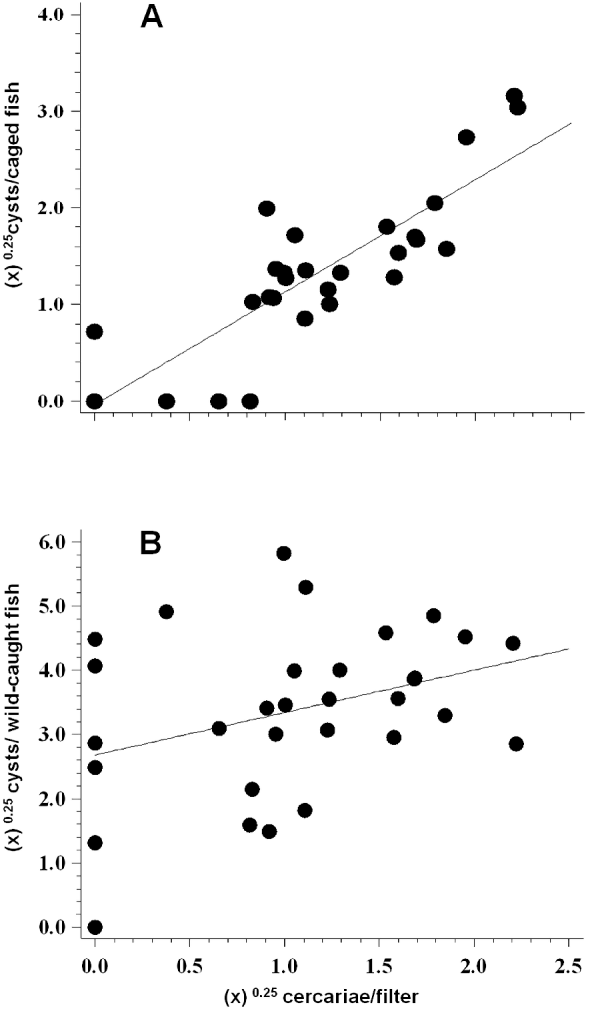
Among the sampling methods compared, cercarial density from cercariometry and intensity from caged fish sampling were the most strongly related (Fig. 3A, r = 0·88, P < 0·01). In contrast, the relationship was not significant between the intensity of wild-caught fish and the cercarial density from cercariometry (Fig. 3B, r = 0·33, P > 0·05). Cercarial density was an acceptable predictor of intensity in caged darters (Fig. 3A, r 2 = 0·77, y = 1·16x – 0·04, P < 0·01), but not in wild-caught fish. At the overall mean±s.e. cercarial density of 4·3 ± 0·4 cercariae L−1 at the Comal River (Table 1), we estimated (using regression) that the intensity in caged darters would be 7·1 cysts/fish, resulting in an infection rate of 1·0 cyst/day. However, at the SI site where the highest cercarial density (18·2 ± 2·1 cercariae L−1) occurred in the Comal River, the intensity in caged darters would be 30·7 cysts/fish, resulting in an infection rate of 4·4 cysts/day. Based on life-threatening intensities estimated by Mitchell et al. (Reference Mitchell, Salmon, Huffman, Goodwin and Brandt2000) and McDonald et al. (Reference McDonald, Bonner, Brandt and Trevino2006), we estimated the longevity of infected fountain darters in the wild. At an infection rate of 4·4 cysts/day at the SI site, adult resident fountain darter longevity would likely be reduced by reaching a life-threatening intensity of >800 cysts in 6·1 months and >1131 cysts in 8·6 months. At the SI site, juveniles would reach a life-threatening intensity of >353 cysts in 2·7 months, while larvae would reach a life-threatening intensity of >60 cysts in 15 days.
The relationships between (A) cercarial density from cercariometry and intensity from caged fish sampling and (B) cercarial density from cercariometry and intensity from wild-caught fish sampling. The equations are: (A) y = 1·16x – 0·04, r 2 = 0·77, P < 0·01 and (B) y = 0·69x +2·55, r 2 = 0·11, P > 0·05.
The handling time/sample to process wild-caught fish (mean±s.d. = 16·2 ± 7·0 min), caged fish (mean±s.d. = 18·7 ± 2·4 min) and cercariometry (mean±s.d. = 15·3 ± 2·1 min) sampling methods were similar. However, the price to rear one caged fish to 27 mm2 TL would add an additional 10·3 min/sample of handling time to the caged fish method. The mean±s.d. handling time for wild-caught fish sampling included 4·9 ± 4·5 min to net, 1·7 ± 0·1 min to euthanize, rinse and preserve, and 9·7 ± 5·0 min to weigh, measure, dissect and enumerate cysts in one fish. Caged fish sampling included 5·9 ± 2·1 min to set up and 5·8 ± 0·7 min to remove one cage, 1·7 ± 0·1 min to euthanize, rinse and preserve fish, and 5·3 ± 0·7 min to weigh, measure, dissect and enumerate cysts in one fish, and 10·3 min/sample to rear one caged fish to 27 mm2 TL. Cercariometry took 6·3 ± 0·6 min to filter, stain, preserve, and seal and 9·0 ± 2·0 min to enumerate cercariae in one filter.
DISCUSSION
Among the three sampling methods evaluated, cercariometry appears to be the best sampling method to monitor C. formosanus in the Comal River because of the biological information it provides at a relatively low cost. The similar spatio-temporal patterns and strong relation detected between cercariometry and caged fish sampling methods would allow managers to project relatively quickly when and where C. formosanus should be managed in infested aquatic ecosystems. Although the caged fish method and cercariometry provide similar information, the caged fish method requires a source of uninfected fish, which results in increased labour costs associated with culturing and inspecting fish. Therefore, it would take longer to obtain infection results and would slow down management decisions. Conversely, infection results could be acquired more quickly using wild-caught fish, but managers would be unable to project the accumulation rate of C. formosanus since the relation of infections from wild-caught fish was not significant when compared with the intensity in caged fish and the cercarial density from cercariometry. Collectively, our results suggest that cercariometry is the most pro-active, practical and cost-effective sampling method to monitor C. formosanus and its immediate effects on fountain darters. Nevertheless, all methods have utility and should be considered depending upon the monitoring and management goals and the objectives.
In our study, cercariometry and caged fish sampling methods shared similar spatio-temporal patterns, increasing or decreasing similarly in C. formosanus abundance. Similar temporal patterns also were observed in rainbow trout (Stables and Chappell, Reference Stables and happell1986) and caged rodents (Prentice and Ouma, Reference Prentice and Ouma1984). Unlike caged fish, wild-caught fish were not restricted to a single location, but likely moved within and among sites of different cercarial densities throughout its life. We surmise that the exposure histories of wild-caught fish samples to C. formosanus were more variable and potentially exposed longer to infected waters than caged fish samples, contributing to the inability of the wild-caught fish sampling method to detect similar infection patterns with cercariometry. Mitchell et al. (Reference Mitchell, Salmon, Huffman, Goodwin and Brandt2000) similarly did not find any patterns of infections by site or season in wild-caught fountain darters collected from the Comal and San Marcos rivers. Since cercariometry and caged fish sampling methods detect more recently emerged C. formosanus from the Comal River than the wild-caught fish sampling method, estimates from cercariometry and caged fish samples represent the current (⩽7 days) infection potential and the effects of C. formosanus on wild fountain darters. In contrast, estimates from wild-caught fish samples are infections that accumulated in wild fountain darters throughout their lives.
Although the lifespan of fountain darters in the wild is unknown, adult fountain darters live up to 4·7 years in captivity (Brandt et al. Reference Brandt, Graves, Berkhouse, Simon and Whiteside1993). Fish in the wild subjected to relatively harsh biotic (e.g. parasitism, disease, predation, food availability) and abiotic (e.g. extreme weather events) processes would have shorter lifespans than captive-reared fountain darters. Estimates of the longevity of infected fountain darter suggest that the younger life stages of the fountain darter are likely to be the most negatively affected by C. formosanus infections in the Comal River, especially at sites where cercarial densities are high. Efforts should be made to continue monitoring the C. formosanus infestation in the Comal River and methods should be developed to control or eradicate the invasive parasite to prevent further fountain darter losses. How effective management would be at curtailing fish losses still must be assessed. If in situ management of C. formosanus falls short, preparations should be made for fountain darter supplementation efforts.
Although we recommend cercariometry, the choice of sampling method to monitor C. formosanus in an aquatic ecosystem may depend on required biological information (e.g. intensity, prevalence, infection rate, longevity predictions, life-threatening intensities, host suitability and host site selectivity), the ability to detect relations and spatio-temporal patterns, and time and budget constraints. We prefer cercariometry because it provides reliable information on the current infection potential and effects of C. formosanus on wild fountain darters that can be used to make quick management decisions regardless of a stream's abiotic conditions (Johnson et al. Reference Johnson, Bolick, Alexander, Oborny and Monroe2012), does not require state and federal permits or the sacrifice of an endangered fish, and is relatively inexpensive to use. Cercariometry does not require either live fish that need extra time and money for culturing or the risk of replacing caged fish samples when cages are disturbed. Although it would be less time consuming and costly to collect uninfected fountain darters from the headwaters of the San Marcos River to use in cages in the Comal River (instead of rearing uninfected fish), this is discouraged due to the risk of transferring new pathogens and parasites into the Comal River. Although wild-caught fish sampling does not provide similar infection patterns or trends like cercariometry or caged fish sampling, wild-caught fish sampling could be used as a quick, inexpensive and simple way to verify existing intensities to determine how infected the wild fish have become throughout their lives. Caged fish sampling provides reliable information on current infections and could be used if time and funding are available. In other infested aquatic ecosystems recently infected with C. formosanus, cercariometry could be used to monitor the progress of management actions and to initiate management actions before intensities in the fish population become life-threatening.
ACKNOWLEDGEMENTS
Our gratitude to the staff (L. Tolley-Jordan, R. Gibson and D. McDonald) of the SMARC and volunteers (L. Ash-Cantu, L. Greigo, L. Buetow, S. Amadon, P. Keleta, N. Martinez, M. Keegan, P. Trevino, T. Leavy, S. McCormick, G. Carrillo, L. Doyen and A. Echlin) from Texas State University whose help was extremely valuable to this study.
FINANCIAL SUPPORT
This project was funded by the Edwards Aquifer Authority. We thank two anonymous reviewers for their suggested improvements to an earlier draft of the manuscript. Use of trade names or mention of specific companies does not imply endorsement of these companies or their products. The views presented are those of the authors and do not necessarily reflect those of the United States Fish and Wildlife Service.