



1 Introduction
In this article, we are concerned with the static Schrödinger equation
 $$ \begin{align} -\Delta u=u^{p-1}(W \ast u^p), \quad u>0 \ \ \mathrm{on} \ \ \mathbb{R}^3, \end{align} $$
where
 $p>1$
, and
 $W(x)=|x|^{\alpha -3}+|x|^{\beta -3}$
with
 $\alpha ,\beta \in (0,3)$
can be used to describe problems with different width of two body potentials. The analysis of (1.1) reduces to that of the following integral equation in the case
 $n=3$
and
 $\gamma =2:$
 $$ \begin{align} \left\{ \begin{aligned} &u(x)=\int_{\mathbb{R}^{n}}\frac{u^{p-1}(y)v(y)}{|x-y|^{n-\gamma}}dy, \quad u>0 \quad \mathrm{on} \quad \mathbb{R}^{n},\\ &v(x)=\int_{\mathbb{R}^{n}}\left(\frac{u^p(y)}{|x-y|^{n-\alpha}} +\frac{u^p(y)}{|x-y|^{n-\beta}}\right)dy. \end{aligned} \right. \end{align} $$
Here,
 $n\geq 3$
,
 $p>1,$
and
 $\alpha ,\beta ,\gamma \in (0,n)$
. In fact, when
 $n=3$
and
 $\gamma =2$
, an analogous argument as Theorem 4.3 in [Reference Chen, Li and Ou9] shows that the classical solutions of (1.1) satisfy (1.2) a.e. in
 $\mathbb {R}^3$
.
We will establish two Liouville theorems: One concerning the nonexistence of positive locally bounded super-solutions and the other regarding the nonexistence of positive integrable solutions. These results yield important critical conditions associated with p: the Serrin-type condition and the Sobolev-type condition.
1.1 General overview
Consider the Schrödinger equation
 $$ \begin{align} i\partial_t\phi+\Delta\phi+F(|\phi|)\phi=0, \quad \mathrm{on} \ \ \mathbb{R}^+\times \mathbb{R}^{3}, \end{align} $$
where
 $\phi : \mathbb {R}^+\times \mathbb {R}^{3} \to \mathbb {C}$
is a complex-valued function, and
 $F(|\phi |)=(W \ast |\phi |^p)|\phi |^{p-2}$
, with
 $W(x)=\mu |x|^{\alpha -3}+|x|^{\beta -3}$
, and
 $p>1$
,
 $\mu \in \mathbb {R}$
. When
 $\alpha>1$
and
 $\beta>1$
, the potential W is a short-range, two-body interaction of the van der Waals type (cf. [Reference Dzyaloshinskii, Lifshitz and Pitaevskii14, Reference Serov and Prystavka34, Reference Yang, Li and Tang37, Reference Zheng and Narayanaswamy40]). The van der Waals potential (force) between atoms and molecules plays a fundamental role in quantum chemistry, physics, and materials sciences. For further background on van der Waals potentials, we refer readers to [Reference Anapolitanos and Sigal1, Reference Lieb and Thirring28, Reference Rytov33] and the references therein.
Consider a standing wave (or soliton) solution of (1.3). Inserting
 $\phi (t,x)=e^{i\lambda t}u(x)$
into (1.3), one can see that
 $$ \begin{align*}-\Delta u+\lambda u=\mu (|x|^{\alpha-3}\ast u^p)u^{p-1}+(|x|^{\beta-3}\ast u^p)u^{p-1}, \quad u>0 \ \ \mathrm{on} \ \mathbb{R}^3. \end{align*} $$
When
 $\mu>0$
, Cao et al. [Reference Cao, Jia and Luo3] studied the stability of the standing wave solutions for the related time-dependent problem, and proved several results on the existence, multiplicity, and asymptotic behavior of the solution u. Paper [Reference Liu and Wu29] shows the existence and stability of traveling waves for semi-relativistic Schrödinger equations with van der Waals-type potentials. When
 $\mu <0$
, paper [Reference Yang and Yu38] demonstrates the existence and nonexistence of ground state solutions and multiple solutions.
In addition, the following equation is helpful to understand the global existence and the scattering property for equation (1.3)
 $$ \begin{align} -\Delta u=\mu (|x|^{\alpha-3}\ast u^p)u^{p-1}+(|x|^{\beta-3}\ast u^p)u^{p-1}, \quad u>0 \ \ \mathrm{on} \ \mathbb{R}^3. \end{align} $$
When
 $\mu =-1$
, Su and Liu applied Lieb’s translation lemma in Coulomb–Sobolev space to investigate the existence of Pohozaev-type ground state solutions (cf. [Reference Su and Liu36]). In this article, we will study the nonexistence of positive solutions of (1.4) with
 $\mu =1$
.
When
 $\alpha =\beta $
, (1.4) is related to the following static Schrödinger–Newton equation
 $$ \begin{align} -\Delta u =(|x|^{\alpha-n}\ast u^p)u^{p-1}, \quad u>0 \ \ \mathrm{on} \ \mathbb{R}^n. \end{align} $$
Existence and nonexistence results for this equation are associated with the global existence and scattering of solutions to the corresponding time-dependent Schrödinger equation (cf. [Reference Li, Miao and Zhang25]). Subsequently, Moroz et al. [Reference Moroz and Van Schaftingen32] established the nonexistence of super-solutions in exterior domains. In addition, Liu looked into the case of
 $n \geq 5$
,
 $\alpha =4,$
and
 $p=2$
, and obtained positive integrable solutions of the form
 $$ \begin{align} u(x)=c(1+|x|^2)^{\frac{2-n}{2}}, \quad c=\left(\frac{n(n-2)\Gamma (n-2)}{\Gamma(\frac{n}{2}-2)\pi^{\frac{n}{2}}}\right)^{1/2}, \end{align} $$
where
 $\Gamma (x)$
is the
 $\Gamma $
-function (cf. [Reference Liu30]). In 2013, paper [Reference Lei23] presented a nonexistence result of positive solutions when
 $p=2$
. Their work shows that any solutions of (1.5) must satisfy the following integral system:
 $$ \begin{align} \left\{ \begin{aligned} &u(x)=\int_{\mathbb{R}^n}\frac{u^{p-1}(y)v(y)dy}{|x-y|^{n-2}},\\ &v(x)=\int_{\mathbb{R}^n}\frac{u^p(y)dy}{|x-y|^{n-\alpha}}. \end{aligned} \right. \end{align} $$
In 2019, Le classified positive integrable solutions of (1.7) by using the method of moving planes in integral forms (cf. [Reference Le20]). Afterward, the nonexistence of positive solutions to the double-nonlocal inequality with
 $1<p \leq (n+\alpha )/(2n-2\gamma )+1/2$
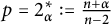
was established in [Reference Le21]. In 2023, Ghergu et al. obtained a necessary and sufficient condition for existence of super-solutions to (1.7) (cf. [Reference Ghergu, Liu, Miyamoto and Moroz15]). When
 $p=2_{\alpha }^*:=\frac {n+\alpha }{n-2}$
, Du–Yang [Reference Du and Yang13] and Guo et al. [Reference Guo, Hu, Peng and Shuai17] applied the method of moving planes in integral forms to prove radial symmetry and uniqueness for certain positive integrable solutions, which take the form of (1.6).
In addition, Yang et al. studied the following nonlocal critical equation (cf. [Reference Yang, Zhao and Zhao39]):
 $$ \begin{align} -\Delta u= (|x|^{2_{\mu_1}^*-n}\ast u^{2_{\mu_2}^*})|u|^{2_{\mu_2}^*-2}u +(|x|^{2_{\mu_2}^*-n}\ast u^{2_{\mu_1}^*})|u|^{2_{\mu_1}^*-2}u, \quad \mathrm{on} \ \mathbb{R}^n. \end{align} $$
They obtained existence, integrability, regularity, and classification results of positive solutions. For other related results, readers can refer to [Reference Dai, Huang, Qin, Wang and Fang11, Reference Du, Gao and Yang12, Reference Le22, Reference Li, Yang and Zhou26, Reference Melgaard, Yang and Zhou31] and the references therein.
A similar integral system to (1.7) is
 $$ \begin{align} \left\{ \begin{aligned} &u(x)=\int_{\mathbb{R}^n}\frac{u^{p_1}(y)v^{q_1}(y)dy}{|x-y|^{n-\gamma}},\\ &v(x)=\int_{\mathbb{R}^n}\frac{v^{p_2}(y)u^{q_2}(y)dy}{|x-y|^{n-\alpha}}.\\ \end{aligned} \right. \end{align} $$
The symmetry and monotonicity of nonnegative solutions, which imply the nonexistence and the classification result, were proved in [Reference Huang, Li and Wang18] by the method of moving planes in integral forms. Here, the Sobolev-type condition plays a key role. Another integral system related to (1.7) is the Lane–Emden-type integral system
 $$ \begin{align} \left\{ \begin{aligned} &u(x)=\int_{\mathbb{R}^n}\frac{v^q(y)dy}{|x-y|^{n-\gamma}}, \quad u>0 \ \ \mathrm{on} \ \ \mathbb{R}^n,\\ &v(x)=\int_{\mathbb{R}^n}\frac{u^p(y)dy}{|x-y|^{n-\gamma}}, \quad v>0 \ \ \mathrm{on} \ \ \mathbb{R}^n.\\ \end{aligned} \right. \end{align} $$
This system is the Euler–Lagrange system satisfied by the extremal functions of the Hardy–Littlewood–Sobolev inequality (cf. [Reference Lieb27])
 $$ \begin{align*}\int_{\mathbb{R}^n}\int_{\mathbb{R}^n}\frac{f(x)g(y)}{|x-y|^{n-\gamma}}dxdy \leq C(n,s,\gamma)\|f\|_r\|g\|_s, \quad \forall (f,g) \in L^r(\mathbb{R}^n) \times L^s(\mathbb{R}^n), \end{align*} $$
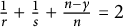
where
 $0<\gamma <n$
,
 $1<s,r<\infty $
and
 $\frac {1}{r}+\frac {1}{s}+\frac {n-\gamma }{n}=2$
. Hereafter, we denote
 $\|f\|_{L^s(\mathbb {R}^{n})}$
by
 $\|f\|_s$
. Set
 $Tg=|x|^{\gamma -n} \ast g$
. The inequality above becomes (cf. [Reference Stein35])
 $$ \begin{align} \|Tg\|_s\leq C(n,s,\gamma)\|g\|_{\frac{ns}{n+\gamma s}}. \end{align} $$
In 2008, Caristi et al. studied the nonexistence of positive solutions to (1.10), and obtained the Serrin-type and the Sobolev-type critical conditions (cf. [Reference Caristi, D’Ambrosio and Mitidieri4]). Qualitative properties of (1.10), such as radial symmetry, regularity, and asymptotics, are helpful to classify positive solutions. Chen et al. established radial symmetry for positive integrable solutions using the method of moving planes in integral forms (cf. [Reference Chen, Li and Ou7–Reference Chen, Li and Ou9]). Subsequently, the authors of [Reference Chen, Jin, Li and Lim5, Reference Jin and Li19] determined optimal integrable intervals of these solutions using the regularity lifting lemma induced by contraction mappings. Based on these results, paper [Reference Lei, Li and Ma24] shows asymptotic rate estimates for such solutions.
In this article, we focus on the nonexistence results for positive solutions, which are also associated with several qualitative properties. The regularity arguments for (1.1) and (1.2) are more complicated than that for (1.5)–(1.10). In particular, determining the integrability condition in the definition of integrable solutions (see Definition 1.2) requires considerable effort.
1.2 Main results
First, we investigate the nonexistence of positive locally bounded super-solutions.
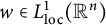
Definition 1.1 A positive function
 $w \in L_{\mathrm {loc}}^1(\mathbb {R}^n)$
is called the super-solution of (1.1) if it satisfies
 $$ \begin{align*}-\Delta w \geq w^{p-1}(W \ast w^p), \quad \mathrm{on} \ \ \mathbb{R}^n \end{align*} $$
in the distribution sense. Similarly, w is called the super-solution of (1.2), if
 $$ \begin{align*} w(x) \geq \int_{\mathbb{R}^{n}} \frac{w^{p-1}(y)v(y)}{|x-y|^{n-\gamma}}dy, \quad\mathrm{on} \ \ \mathbb{R}^n. \end{align*} $$
Theorem 1.1 Let
 $0<\min \{\alpha ,\beta ,\gamma \} \leq \max \{\alpha ,\beta ,\gamma \}<n$
. If
 $0<p-1 \leq \frac {\max \{\alpha ,\beta \}+\gamma }{2(n-\gamma )}$
, then system (1.2) has no positive super-solution in
 $L_{\mathrm {loc}}^\infty (\mathbb {R}^n)$
.
Theorem 1.1 implies that if u is a positive solution of (1.2) in
 $L_{\mathrm {loc}}^\infty (\mathbb {R}^n)$
, then the following Serrin-type condition must hold:
 $$ \begin{align} p-1>\frac{\max\{\alpha,\beta\}+\gamma}{2(n-\gamma)}. \end{align} $$
Remark 1.2 When
 $\alpha =\beta $
, (1.12) is consistent with the second condition of Theorem 1.1 in [Reference Ghergu, Liu, Miyamoto and Moroz15] for double-nonlocal inequality. Now, the first condition of Theorem 1.1 in [Reference Ghergu, Liu, Miyamoto and Moroz15] is
 $p-1>(\beta +\gamma -n)/(n-\gamma )$
, and it is covered by (1.12) when we note
 $\max \{\beta ,\gamma \}<n$
.
Next, we seek necessary conditions for the existence of a class of solutions with rich regularities. These solutions satisfy a specific integrability condition. Define
 $$ \begin{align*}s_1:=\frac{2n(p-1)}{\max\{\alpha,\beta\}+\gamma}, \quad s_2:=\frac{2n(p-1)}{\gamma-\max\{\alpha,\beta\}+2\min\{\alpha,\beta\}}. \end{align*} $$
Definition 1.2 Let
 $\gamma \geq \max \{0,\max \{\alpha ,\beta \}-2\min \{\alpha ,\beta \}\}$
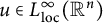
. A positive solution u of (1.1) or (1.2) is called the integrable solution, if
 $u \in L_{\mathrm {loc}}^\infty (\mathbb {R}^n)$
satisfies
 $$ \begin{align} u\in L^{s_1}(\mathbb{R}^{n})\cap L^{s_2}(\mathbb{R}^{n}). \end{align} $$
Remark 1.3 The work in [Reference Chen, Jin, Li and Lim5–Reference Chen, Li and Ou7, Reference Jin and Li19] shows that solutions with some initial integrability (i.e.,
 $u \in L^{s_0}(\mathbb {R}^n)$
) can be improved to have better integrability. The Hardy–Littlewood–Sobolev inequality is a key tool used to determine the initial integrability index. When
 $\alpha =\beta $
, the initial integrability index
 $s_0$
is easily set to
 $s_1$
. When
 $\alpha \neq \beta $
, we need to relax the initial integrability condition so that the Hardy–Littlewood–Sobolev inequality still works. By the argument in Theorem 1.8,
 $u \in L^{s_1}(\mathbb {R}^{n})\cap L^{s_2}(\mathbb {R}^{n})$
is the proper setting. When ensuring the validity of the Hardy–Littlewood–Sobolev inequality, we also need to overcome the imbalance caused by
 $\alpha \neq \beta $
. Now,
 $s_2$
is also important and is not easy to determine. Thus, we call
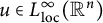 $u \in L_{\mathrm {loc}}^\infty (\mathbb {R}^n)$
the “integrable” (i.e., u has initial integrability) solution if it satisfies (1.13). Clearly, function
 $e^{c|x|^\theta }$
with
 $c<0$
and
 $\theta>0$
belongs to
 $L^{s_1}(\mathbb {R}^{n})\cap L^{s_2}(\mathbb {R}^{n})$
. In addition, in view of
 $s_1<s_2$
, we see that
 $|x|^{-\theta _1}(1+|x|^{\theta _2})^{-1} \in L^{s_1}(\mathbb {R}^{n})\cap L^{s_2}(\mathbb {R}^{n})$
for
 $\theta _1 \in [0,n/s_2)$
,
 $\theta _2>0,$
and
 $\theta _1+ \theta _2>n/s_1$
.
Theorem 1.4 Let
 $1<\min \{\alpha ,\beta \} \leq \max \{\alpha ,\beta \} \leq \gamma < n$
and
 $p \geq 2$
. If the Sobolev-type condition
 $$ \begin{align*}p \not\in \left[\frac{n+\min\{\alpha,\beta\}}{n-\gamma}, \frac{n+\max\{\alpha,\beta\}}{n-\gamma}\right] \end{align*} $$
holds, then system (1.2) has no positive integrable solution.
Remark 1.5 Different from the case of
 $\alpha =\beta $
, it is unknown whether conditions of the Serrin-type and the Sobolev-type are optimal for the existence of solutions to system (1.2). We expect to prove the criticality of these conditions in the future.
Note that the right-hand side of (1.1) is positive when u is positive. Therefore, by Theorem 2.4 in [Reference Caristi, D’Ambrosio and Mitidieri4], any positive distribution solution of (1.1) satisfies the integral equation
 $$ \begin{align*}u(x) = \inf_{\mathbb{R}^3} u +C_*\int_{\mathbb{R}^3}\frac{u^{p-1}(y)v(y)}{|x-y|}dy, \end{align*} $$
where
 $C_*>0$
and
 $$ \begin{align*}v(x)=\int_{\mathbb{R}^3}\left(\frac{u^p(y)}{|x-y|^{3-\alpha}} +\frac{u^p(y)}{|x-y|^{3-\beta}}\right)dy. \end{align*} $$
We claim that
 $l:=\inf _{\mathbb {R}^3} u =0$
when
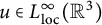 $u \in L_{\mathrm {loc}}^\infty (\mathbb {R}^3)$
. Otherwise,
 $l>0$
implies
 $$ \begin{align*}v(x) \geq l^p \int_{B_R(x)} \frac{dy}{|x-y|^{3-\alpha}}=\alpha^{-1}l^pR^\alpha|S^2| \end{align*} $$
for some
 $R>0$
. Consequently, there holds
 $$ \begin{align*}u(x) \geq l+C_* \alpha^{-1}l^{2p-1}R^\alpha|S^2| \int_{\mathbb{R}^3 \setminus B_{2|x|}(0)} \frac{dy}{|x-y|}=\infty, \end{align*} $$
which contradicts the fact that
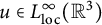 $u \in L_{\mathrm {loc}}^\infty (\mathbb {R}^3)$
. Thus,
 $l=0$
. In view of
 $p>1$
, we write
 $$ \begin{align*}\tilde{u}(x)=C_*^{\frac{1}{2(p-1)}} u(x), \quad \tilde{v}(x)=C_*^{\frac{p}{2(p-1)}} v(x). \end{align*} $$
Then,
 $(\tilde {u},\tilde {v})$
solves (1.2) with
 $n=3$
and
 $\gamma =2$
. According to Theorems 1.1 and 1.4 with
 $n=3$
and
 $\gamma =2$
, we can see the following results of positive distribution solutions of (1.1) in
 $L_{\mathrm {loc}}^\infty (\mathbb {R}^3)$
.
Corollary 1.6
(i) Let
 $0<\min \{\alpha ,\beta \} \leq \max \{\alpha ,\beta \}<3$
. If
 $0<p-1 \leq 1+\max \{\alpha ,\beta \}/2$
, then equation (1.1) has no positive super-solution in
 $L_{\mathrm {loc}}^\infty (\mathbb {R}^3)$
.
(ii) Let
 $1<\min \{\alpha ,\beta \} \leq \max \{\alpha ,\beta \} \leq 2$
and
 $p \geq 2$
. If
 $p \not \in [3+\min \{\alpha ,\beta \},3+\max \{\alpha ,\beta \}]$
, then equation (1.1) has no positive integrable solution.
Remark 1.7 System (1.2) is associated with the following differential equation with the fractional Laplacian:
 $$ \begin{align} (-\Delta)^{\gamma/2}u=u^{p-1}(W \ast u^p), \quad u>0 \ \ \mathrm{on} \ \ \mathbb{R}^n, \end{align} $$
where
 $n \geq 3$
,
 $0<\min \{\alpha ,\beta \} \leq \max \{\alpha ,\beta \} < n$
,
 $\gamma \in (0,2),$
and
 $p>1$
. Here, the fractional Laplacian is defined by the Cauchy principal value P.V., that is,
 $$ \begin{align*}(-\Delta)^{\gamma/2}u=C_{n,\gamma}P.V.\int_{\mathbb{R}^d}\frac{u(x)-u(y)}{|x-y|^{n+\gamma}}dy. \end{align*} $$
Similar to the argument of Theorem 5.1.3 in [Reference Chen, Li and Ma10], if
 $u \in \mathcal {L}_\gamma \cap L_{\mathrm {loc}}^\infty (\mathbb {R}^n)$
is a lower semi-continuous solution, then u solves (1.2). Here,
 $\mathcal {L}_\gamma =\{u \in L_{\mathrm {loc}}^1(\mathbb {R}^n); (1+|x|^{n+\gamma })^{-1}u(x) \in L^1(\mathbb {R}^n)\}$
. According to Theorems 1.1 and 1.4, we also have the corresponding Liouville-type results of (1.14).
To prove Theorem 1.4, we need several qualitative properties of positive integrable solutions.
First, we will investigate the optimal integrability interval for integrable solutions, which is crucial for understanding their boundedness and decay rates. We employ the method introduced in [Reference Chen, Jin, Li and Lim5, Reference Chen, Li and Ou7, Reference Jin and Li19], where the authors studied the regularity of (1.10).
Theorem 1.8 Let u be a positive integrable solution of (1.2) with
 $$ \begin{align} 0<\min\{\alpha,\beta\} \leq \max\{\alpha,\beta\} \leq \gamma<n. \end{align} $$
Then,
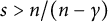
-
(i)
 $u\in L^s(\mathbb {R}^{n})$
for all
$s> n/(n-\gamma )$
. If
$s \in (0,n/(n-\gamma )]$
,
$u \not \in L^s(\mathbb {R}^{n})$
.
-
(ii) Both
$u(x)$
and
$v(x)$
are bounded and
$\lim _{|x|\to \infty }u(x)=0$
.





When
 $\max \{\alpha ,\beta \}>\gamma $
, it seems difficult to lift the integrability of positive locally bounded solutions of (1.2) from (1.13). The question of how to define a new integrability condition in Definition 1.2 remains open.
Next, we will apply the method of moving planes in integral forms, as introduced in [Reference Chen, Li and Ou7–Reference Chen, Li and Ou9], to study the radial symmetry of integrable solutions.
Theorem 1.9 Assume u is a positive integrable solution of system (1.2) with (1.15) and
 $p \geq 2$
. Then, u and v are radially symmetric and decreasing about some point
 $x_0\in \mathbb {R}^{n}$
.
Based on Theorems 1.8 and 1.9, we can estimate the decay rates of positive integrable solutions of (1.2) as
 $|x|\to \infty $
. In view of
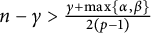 $n-\gamma> \frac {\gamma +\max \{\alpha ,\beta \}}{2(p-1)}$
(implied by (1.12)), we call that a radial solution u decays rapidly with rate
 $n-\gamma $
if
 $$ \begin{align*}u(x) \simeq |x|^{\gamma-n}, \quad \mathrm{as} \; |x|\to\infty, \end{align*} $$
and decays slowly with rate
 $\frac {\gamma +\max \{\alpha ,\beta \}}{2(p-1)}$
if
 $$ \begin{align*}u(x) \simeq |x|^{-\frac{\gamma+\max\{\alpha,\beta\}}{2(p-1)}}, \quad \mathrm{as} \; |x|\to\infty. \end{align*} $$
Next, we consider the radially symmetric and decreasing solution of (1.2) in
 $L_{\mathrm {loc}}^\infty (\mathbb {R}^n)$
. The following theorem shows that integrable solutions decay rapidly, and non-integrable solutions decay almost slowly.
Theorem 1.10
(i) Let
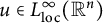 $u \in L_{\mathrm {loc}}^\infty (\mathbb {R}^n)$
be a super-solution of (1.2) with (1.15). If u and v are radially symmetric and decreasing about
 $x_0\in \mathbb {R}^{n}$
, then there exist positive constants
 $C_1$
and
 $C_2$
such that for large
 $|x|$
,
 $$ \begin{align*}C_1|x|^{\gamma-n} \leq u(x) \leq C_2|x|^{-\frac{\gamma+\max\{\alpha,\beta\}}{2(p-1)}}. \end{align*} $$
Moreover, if
 $\min \{\alpha ,\beta \}<\max \{\alpha ,\beta \}$
, then
 $u \in L^{s_2}(\mathbb {R}^n)$
. In addition, if
 $u \in L_{\mathrm {loc}}^\infty (\mathbb {R}^n) \setminus L^{s_1}(\mathbb {R}^n)$
, and
 $u(x) \simeq |x|^{-\theta }$
when
 $|x| \to \infty $
, then
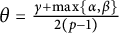 $\theta =\frac {\gamma +\max \{\alpha ,\beta \}}{2(p-1)}$
.
(ii) Let u be a positive integrable solution of (1.2) with (1.15). If u and v are radially symmetric and decreasing about
 $x_0\in \mathbb {R}^{n}$
, then
 $u \in L^\infty (\mathbb {R}^n)$
and
 $u(x) \simeq |x|^{\gamma -n}$
when
 $|x|\to \infty $
.
The following theorem shows that integrable solutions are differentiable.
Theorem 1.11 Assume u is a positive integrable solution of the system (1.2) with
 $$ \begin{align*}1<\min\{\alpha,\beta\} \leq \max\{\alpha,\beta\} \leq \gamma<n. \end{align*} $$
Then, u is differentiable.
2 Nonexistence of super-solutions
In this section, we prove Theorem 1.1.
Suppose u is a positive super-solution of (1.2) in
 $L_{\mathrm {loc}}^\infty (\mathbb {R}^n)$
. We will deduce a contradiction.
Clearly, for
 $|x|>2$
,
 $$ \begin{align} u(x)\geq \int_{B_1(0)}\frac{u^{p-1}(y)v(y)}{|x-y|^{n-\gamma}}dy \geq \frac{c}{|x|^{n-\gamma}}. \end{align} $$
Hereafter, we assume without loss of generality that
 $\alpha =\max \{\alpha , \beta \}$
.
Step 1. Case of
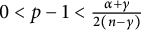 $0<p-1< \frac {\alpha +\gamma }{2(n-\gamma )}$
.
For
 $|x|>4$
, by (2.1), we have
 $$ \begin{align*}v(x)\geq \int_{B_{|x|/2}(x)}\frac{u^p(y)dy}{|x-y|^{n-\alpha}} \geq \frac{c}{|x|^{p(n-\gamma)}}\int_{B_{|x|/2}(x)}\frac{dy}{|x-y|^{n-\alpha}} \geq \frac{c}{|x|^{p(n-\gamma)-\alpha}}. \end{align*} $$
Set
 $a_0=n-\gamma $
and
 $b_0=p(n-\gamma )-\alpha $
. For
 $|x|>8$
, by (2.1) and the result above, we see that
 $$ \begin{align*}u(x)\geq \int_{B_{|x|/2}(x)}\frac{u^{p-1}(y)v(y)}{|x-y|^{n-\gamma}}dy \geq \frac{c}{|x|^{(p-1)a_0+b_0-\gamma}}:=\frac{c}{|x|^{a_1}}. \end{align*} $$
This result can be used to estimate a new lower bound of v. By induction, when
 $|x|>R$
for some
 $R>0$
, we get
 $$ \begin{align*}u(x)\geq \frac{c}{|x|^{a_j}}, \quad v(x)\geq \frac{c}{|x|^{b_j}}. \end{align*} $$
Here,
 $b_j=pa_j-\alpha $
,
 $a_{j+1}=(p-1)a_j+b_j-\gamma $
,
 $j=1,2,\ldots $
. This implies
 $$ \begin{align*}a_j=\left(a_0-\frac{\alpha+\gamma}{2(p-1)}\right)(2p-1)^j+\frac{\alpha+\gamma}{2(p-1)}. \end{align*} $$
Clearly,
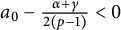 $a_0-\frac {\alpha +\gamma }{2(p-1)}<0$
under the assumption
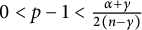 $0<p-1<\frac {\alpha +\gamma }{2(n-\gamma )}$
. Thus, there exists a suitably large
 $j_0>0$
such that
 $a_{j_0-1}>0$
and
 $a_{j_0} \leq 0$
, which implies
 $\gamma -(p-1)a_{j_0}-b_{j_0}=\gamma -(2p-1)a_{j_0}+\alpha>0$
. Therefore, for fixed
 $x\in B_{R/2}(0)$
, we have
 $$ \begin{align*}u(x) \geq \int_{\mathbb{R}^n \setminus B_{R}(0)}\frac{u^{p-1}(y)v(y)}{|x-y|^{n-\gamma}}dy \geq C\int_{R}^{\infty}r^{\gamma-(p-1)a_{j_0}-b_{j_0}}\frac{dr}{r}=\infty. \end{align*} $$
This is impossible. Thus, (1.2) has no positive super-solution.
Step 2. Case of
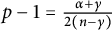 $p-1=\frac {\alpha +\gamma }{2(n-\gamma )}$
.
Taking
 $R>0$
. Then, there hold
 $$ \begin{align} u(x)\geq \frac{1}{(R+|x|)^{n-\gamma}}\int_{B_R(0)}u^{p-1}(y)v(y)dy \end{align} $$
and
 $$ \begin{align} v(x)\geq \left(\frac{1}{(R+|x|)^{n-\alpha}}+\frac{1}{(R+|x|)^{n-\beta}}\right) \int_{B_R(0)}u^p(y)dy. \end{align} $$
From (2.2), it follows that
 $$ \begin{align*}\int_{B_R(0)}u^p(x)dx \geq \frac{C}{R^{p(n-\gamma)-n}}\left(\int_{B_R(0)}u^{p-1}(y)v(y)dy\right)^p. \end{align*} $$
Inserting this into (2.3) yields
 $$ \begin{align} \begin{aligned} v(x)\geq &\frac{C}{R^{p(n-\gamma)-n}}\left(\frac{1}{(R+|x|)^{n-\alpha}}+\frac{1}{(R+|x|)^{n-\beta}}\right)\\ &\cdot \left(\int_{B_R(0)}u^{p-1}(y)v(y)dy\right)^p. \end{aligned} \end{align} $$
Combining this result with (2.2), we get
 $$ \begin{align} \begin{aligned} &\int_{B_R(0)}u^{p-1}(x)v(x)dx\\& \quad \geq CR^{n+\alpha-(2p-1)(n-\gamma)} \left(\int_{B_R(0)}u^{p-1}(y)v(y)dy\right)^{2p-1}. \end{aligned} \end{align} $$
Noting
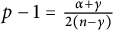 $p-1=\frac {\alpha +\gamma }{2(n-\gamma )}$
, we have
 $$ \begin{align*}\int_{B_R(0)}u^{p-1}(x)v(x)dx\leq CR^{n-\gamma-\frac{\alpha+\gamma}{2(p-1)}}=C. \end{align*} $$
Here,
 $C>0$
is independent of R. Letting
 $R\to \infty $
, we obtain
 $u^{p-1}v \in L^1(\mathbb {R}^{n})$
.
Take
 $A_R=B_{2R}(0)\setminus B_R(0)$
. By a similar derivation as for (2.5), from (2.2) and (2.4), we also have
 $$ \begin{align*}\int_{A_R}u^{p-1}(x)v(x)dx \geq C\left(\int_{B_R(0)}u^{p-1}(y)v(y)dy\right)^{2p-1}. \end{align*} $$
Here,
 $C>0$
is independent of R. Letting
 $R\to \infty $
and noting
 $u^{p-1}v \in L^1(\mathbb {R}^{n})$
, we obtain
 $$ \begin{align*}\int_{\mathbb{R}^{n}}u^{p-1}(x)v(x)dx\leq 0, \end{align*} $$
which contradicts the fact that
 $u^{p-1}(x)v(x)>0$
.
Thus, we complete the proof of Theorem 1.1.
3 Integrability
In this section, we consider the integrability of integrable solutions to (1.2). The following regularity lifting lemma plays a key role.
Lemma 3.1 (Theorem 3.3.1 in [Reference Chen and Li6])
Let V be a function space equipped with two norms
 $\|\cdot \|_{X}$
and
 $\|\cdot \|_{Y}$
. Define
 $$ \begin{align*}X=\{v\in V;\|v\|_{X}<\infty\}, \quad Y=\{v\in V;\|v\|_Y<\infty\}. \end{align*} $$
Assume that spaces X and Y are complete under the corresponding norms and the convergence in X or in Y implies the convergence in V. Let T be a contraction map from X into itself and from Y into itself. Assume
 $g\in Z:X\cap Y$
. If
 $f\in X$
satisfies
 $f=Tf+g$
in X, then f belongs to Z.
This lemma can also be found in [Reference Chen, Jin, Li and Lim5, Reference Jin and Li19].
Now, we prove (i) of Theorem 1.8. Without loss of generality, we assume
 $\alpha =\max \{\alpha ,\beta \}$
.
Define
 $$ \begin{align} \frac{1}{\tilde{r}}:=\frac{\gamma-\alpha}{2n}+\frac{\alpha+\gamma}{2n(p-1)}. \end{align} $$
Applying (1.11) to the second equation to (1.2), we get
 $$ \begin{align} \|v\|_{\tilde{r}}\leq C(\|u\|_{\frac{n\tilde{r}p}{n+\tilde{r}\alpha}}^p +\|u\|_{\frac{n\tilde{r}p}{n+\tilde{r}\beta}}^p). \end{align} $$
Clearly,
 $$ \begin{align*}\frac{n\tilde{r}p}{n+\tilde{r}\alpha}=s_1 \quad \mathrm{and} \quad \frac{n\tilde{r}p}{n+\tilde{r}\beta}=\frac{2n(p-1)p}{(\gamma-\alpha+2\beta)(p-1)+\alpha+\gamma}\in (s_1,s_2). \end{align*} $$
Since u is an integrable solution, (3.2) implies
 $$ \begin{align} v\in L^{\tilde{r}}(\mathbb{R}^{n}). \end{align} $$
Proposition 3.2 Under the assumption of Theorem 1.8, then
 $(u,v)\in L^s(\mathbb {R}^{n})\times L^r(\mathbb {R}^{n})$
for all
 $$ \begin{align} \frac{1}{s} \in \left(0,\frac{n-\gamma}{n}\right), \quad \frac{1}{r} \in \left(\frac{\gamma-\alpha}{2n},\frac{2n-\gamma-\alpha}{2n}\right). \end{align} $$
Proof
Step 1. For
 $A>0$
, define
 $$ \begin{align*}u_A(x)= \begin{cases} u(x), &\quad \mathrm{if} \; u(x)>A \; \mathrm{or} \; |x|>A,\\ 0, &\quad \mathrm{otherwise}, \end{cases} \end{align*} $$
and
 $u_B(x)=u(x)-u_A(x)$
.
To use the Hardy–Littlewood–Sobolev inequality (1.11), we choose s and r satisfying
 $$ \begin{align} \frac{1}{s}\in \left(0,\frac{n-\gamma}{n}\right), \quad \frac{1}{r}-\frac{1}{s}=\frac{\gamma-\alpha}{2n}. \end{align} $$
Let
 $f\in L^r(\mathbb {R}^{n})$
,
 $g\in L^s(\mathbb {R}^{n})$
. Set
 $$ \begin{align*}\begin{cases} T_1f(x):=\displaystyle\int_{\mathbb{R}^{n}}\frac{u_A^{p-1}(y)f(y)}{|x-y|^{n-\gamma}}dy,\\ T_2g(x):=\displaystyle\int_{\mathbb{R}^{n}} \left(\frac{1}{|x-y|^{n-\alpha}}+\frac{1}{|x-y|^{n-\beta}}\right)u_A^{p-1}(y)g(y)dy, \end{cases} \end{align*} $$
and
 $$ \begin{align*}\begin{cases} F(x):=\displaystyle\int_{\mathbb{R}^{n}}\frac{u_B^{p-1}(y)v(y)}{|x-y|^{n-\gamma}}dy,\\ G(x):=\displaystyle\int_{\mathbb{R}^{n}}\left(\frac{1}{|x-y|^{n-\alpha}}+\frac{1}{|x-y|^{n-\beta}}\right)u_B^p(y)dy. \end{cases} \end{align*} $$
Denote the operator T
 $$ \begin{align*}T(g,f):=(T_1f,T_2g) \end{align*} $$
with the norm
 $\|T(g,f)\|_{s\times r}=\|T_1f\|_s+\|T_2g\|_r$
. Obviously,
 $(u,v)$
solves the operator equation
 $$ \begin{align*}(g,f)=T(g,f)+(F,G). \end{align*} $$
Step 2. In view of (3.5), applying (1.11) and the Hölder inequality yield
 $$ \begin{align} \|T_1f\|_{s}\leq C\|u_A^{p-1}f\|_{\frac{ns}{n+s\gamma}} \leq C\|u_A\|_{s_1}^{p-1}\|f\|_r, \end{align} $$
where
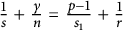 $\frac {1}{s}+\frac {\gamma }{n}=\frac {p-1}{s_1}+\frac {1}{r}$
, and
 $$ \begin{align} \begin{aligned} \|T_2g\|_{r}&\leq C(\|u_A^{p-1}g\|_{\frac{nr}{n+r\alpha}}+\|u_A^{p-1}g\|_{\frac{nr}{n+r\beta}})\\ &\leq C(\|u_A\|_{s_1}^{p-1}+\|u_A\|_{s_2}^{p-1})\|g\|_s, \end{aligned} \end{align} $$
where
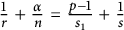 $\frac {1}{r}+\frac {\alpha }{n}=\frac {p-1}{s_1}+\frac {1}{s}$
and
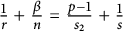 $\frac {1}{r}+\frac {\beta }{n}=\frac {p-1}{s_2}+\frac {1}{s}$
.
By virtue of (1.13) and the definition of
 $u_A$
, we can choose
 $A>0$
sufficiently large such that
 $$ \begin{align*}C\|u_A\|_{s_1}^{p-1}\leq \frac{1}{2}, \quad C(\|u_A\|_{s_1}^{p-1}+\|u_A\|_{s_2}^{p-1})\leq \frac{1}{2}. \end{align*} $$
Therefore,
 $$ \begin{align} \begin{cases} T \ \textrm{is a contracting map from} \ L^s(\mathbb{R}^{n})\times L^r(\mathbb{R}^{n}) \\ \textrm{to itself for all} \ (s,r) \ \textrm{satisfying} \ (3.4). \end{cases} \end{align} $$
Noting the Serrin-type condition (1.12), we can deduce
 $$ \begin{align} \left[\frac{1}{s_2},\frac{1}{s_1}\right] \subset \left(0,\frac{n-\gamma}{n}\right), \quad \frac{1}{\tilde{r}} \in \left(\frac{\gamma-\alpha}{2n},\frac{2n-\gamma-\alpha}{2n}\right). \end{align} $$
Therefore, by (3.8), T is also a contraction map from
 $(L^{s_1}(\mathbb {R}^{n})\cap L^{s_2}(\mathbb {R}^{n})) \times L^{\tilde {r}}(\mathbb {R}^n)$
to itself.
Step 3. Similar to (3.6) and (3.7), for any
 $(s,r)$
satisfying (3.4), we have
 $$ \begin{align*}\|F\|_s\leq C\|u_B^{p-1}v\|_{\frac{ns}{n+s\gamma}}\leq \|u_B\|_{s_3}^{p-1}\|v\|_{\tilde{r}}, \end{align*} $$
where
 $s_3$
satisfies
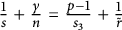 $\frac {1}{s}+\frac {\gamma }{n}=\frac {p-1}{s_3}+\frac {1}{\tilde {r}}$
, and
 $$ \begin{align*}\|G\|_r\leq C\|u_B\|_{s_1}^p+C\|u_B\|_{s_2}^p. \end{align*} $$
By the definition of
 $u_B$
and (3.3), we see that
 $F\in L^s(\mathbb {R}^{n})$
and
 $G\in L^r(\mathbb {R}^{n})$
as long as
 $(s,r)$
satisfies (3.4). In view of (3.9),
 $(F,G) \in (L^{s_1}(\mathbb {R}^{n})\cap L^{s_2}(\mathbb {R}^{n}))\times L^{\tilde {r}}(\mathbb {R}^{n})$
.
Let
 $X=(L^{s_1}(\mathbb {R}^{n})\cap L^{s_2}(\mathbb {R}^{n}))\times L^{\tilde {r}}(\mathbb {R}^{n})$
and
 $Y=L^s(\mathbb {R}^{n})\times L^r(\mathbb {R}^{n})$
. Then, by Lemma 3.1, we conclude that
 $(u,v)\in L^s(\mathbb {R}^{n})\times L^r(\mathbb {R}^{n})$
for all
 $(s,r)$
satisfying (3.4). The proof of Proposition 3.2 is complete.
Proposition 3.3 Assume u is a positive super-solution of (1.2), then
 $u\notin L^s(\mathbb {R}^{n})$
for
 $s\in (0,{n}/(n-\gamma )]$
.
Proof When
 $|x|>2$
, we have
 $$ \begin{align*}u(x)\geq \int_{B_1(0)}\frac{u^{p-1}(y)v(y)}{|x-y|^{n-\gamma}}dy\geq \frac{c}{|x|^{n-\gamma}}. \end{align*} $$
Then, when
 $s\in (0,\frac {n}{n-\gamma }]$
, inserting the estimate above, we obtain
 $$ \begin{align*}\int_{\mathbb{R}^{n}}u^s(x)dx\geq c\int_{\mathbb{R}^{n}\setminus B_2(0)}\frac{1}{|x|^{s(n-\gamma)}}dx=\infty.\\[-38pt] \end{align*} $$
Combining Propositions 3.2 and 3.3, we complete the proof of (i) in Theorem 1.8.
4 Boundedness of solutions
In this section, we prove (ii) of Theorem 1.8. Without loss of generality, we assume
 $\alpha =\max \{\alpha ,\beta \}$
.
Theorem 4.1 Under the assumption of Theorem 1.8, u and v are bounded.
Proof For
 $d\in (0,1)$
, from (1.2), it follows that
 $$ \begin{align*}u(x)=\int_{B_d(x)}\frac{u^{p-1}(y)v(y)}{|x-y|^{n-\gamma}}dy +\int_{\mathbb{R}^{n}\setminus B_d(x)}\frac{u^{p-1}(y)v(y)}{|x-y|^{n-\gamma}}dy:=I_1+I_2. \end{align*} $$
Take
 $\frac {1}{s}=\frac {\varepsilon }{2n(p-1)}$
and
 $\frac {1}{r}=\frac {\gamma -\alpha +\varepsilon }{2n}$
, where
 $\varepsilon>0$
is sufficiently small, such that
 $\frac {p-1}{s}+\frac {1}{r}<\frac {\gamma }{n}$
. Applying the Hölder inequality and Proposition 3.2, we obtain
 $$ \begin{align*} I_1 \leq \|u\|_s^{p-1}\|v\|_r \left(\int_{B_d(x)} |x-y|^{\frac{\gamma-n}{1-\frac{p-1}{s}-\frac{1}{r}}}dy\right)^{1-\frac{p-1}{s}-\frac{1}{r}} \leq C. \end{align*} $$
In addition, take
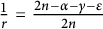 $\frac {1}{r}=\frac {2n-\alpha -\gamma -\varepsilon }{2n}$
and
 $\frac {1}{s}=\frac {\alpha +\gamma +\varepsilon }{2n(p-1)}$
. Here,
 $\varepsilon>0$
is sufficiently small such that
 $\frac {1}{s}<\frac {n-\gamma }{n}$
, which can be verified by (1.12). Clearly,
 $\frac {1}{r}+\frac {p-1}{s}=1$
. Applying the Hölder inequality and Proposition 3.2, we also obtain
 $$ \begin{align*}I_2\leq d^{\gamma-n}\int_{\mathbb{R}^{n}\setminus B_d(x)}u^{p-1}(y)v(y)dy \leq d^{\gamma-n}\|u\|_s^{p-1}\|v\|_r\leq C. \end{align*} $$
Combining the estimates of
 $I_1$
and
 $I_2$
, we see that u is bounded.
Next, we prove that v is bounded.
From (1.2) and the boundedness of u, it follows that
 $$ \begin{align*}\begin{aligned} v(x)&\leq \|u\|_{\infty}^p\int_{B_d(x)} \left(\frac{1}{|x-y|^{n-\alpha}}+\frac{1}{|x-y|^{n-\beta}}\right)dy\\& \quad +\int_{\mathbb{R}^{n}\setminus B_d(x)} \left(\frac{1}{|x-y|^{n-\alpha}}+\frac{1}{|x-y|^{n-\beta}}\right)u^p(y)dy\\&\leq \|u\|_{\infty}^p(d^{\alpha}+d^{\beta})+I_3, \end{aligned} \end{align*} $$
where
 $$ \begin{align*}I_3=\int_{\mathbb{R}^{n}\setminus B_d(x)}\left(\frac{1}{|x-y|^{n-\alpha}} +\frac{1}{|x-y|^{n-\beta}}\right)u^p(y)dy. \end{align*} $$
When
 $p>\frac {n}{n-\gamma }$
, Proposition 3.2 shows that
 $u\in L^p(\mathbb {R}^{n})$
. Then,
 $$ \begin{align*}I_3\leq (d^{\alpha-n}+d^{\beta-n})\|u\|_p^p \leq C. \end{align*} $$
When
 $p\leq \frac {n}{n-\gamma }$
, choose
 $\frac {1}{s}=\frac {n-\gamma -\varepsilon }{n}$
with sufficiently small
 $\varepsilon>0$
so that
 $s>p$
. Using the Hölder inequality, we have
 $$ \begin{align*}I_3 \leq C\|u\|_s^p \left[\left(\int_d^{\infty}t^{n-\frac{s(n-\alpha)}{s-p}}\frac{dt}{t}\right)^{1-\frac{p}{s}} +\left(\int_d^{\infty}t^{n-\frac{s(n-\beta)}{s-p}}\frac{dt}{t}\right)^{1-\frac{p}{s}}\right]. \end{align*} $$
Since
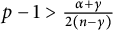 $p-1>\frac {\alpha +\gamma }{2(n-\gamma )}$
implies
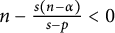 $n-\frac {s(n-\alpha )}{s-p}<0$
and
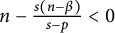 $n-\frac {s(n-\beta )}{s-p}<0$
, the result above and Proposition 3.2 imply
 $I_3\leq C$
.
Thus, v is bounded.
Theorem 4.2 Under the assumption of Theorem 1.8, we have
 $\lim _{|x|\to \infty }u(x)=0$
.
Proof Let
 $x_0\in \mathbb {R}^{n}$
. By exchanging the order of the integral variables, we can express
 $u(x_0)$
using the Wolff-type potential. Namely, (1.2) implies
 $$ \begin{align} \begin{aligned} u(x_0)&=\int_{\mathbb{R}^{n}}\frac{u^{p-1}(y)v(y)}{|x_0-y|^{n-\gamma}}dy\\&=(n-\gamma)\int_{\mathbb{R}^{n}}u^{p-1}(y)v(y)\int_{|x_0-y|}^{\infty}t^{\gamma-n}\frac{dt}{t}dy\\&=(n-\gamma)\int_0^{\infty}\frac{\int_{B_t(x_0)}u^{p-1}(y)v(y)dy}{t^{n-\gamma}}\frac{dt}{t}. \end{aligned} \end{align} $$
Since u and v are bounded, for any
 $\varepsilon>0,$
there exists
 $\delta \in (0,1)$
such that
 $$ \begin{align} \int_0^{\delta}\frac{\int_{B_t(x_0)}u^{p-1}(y)v(y)dy}{t^{n-\gamma}}\frac{dt}{t} \leq \|u\|_{\infty}^{p-1}\|v\|_{\infty}\int_0^{\delta}t^{\gamma}\frac{dt}{t}<\varepsilon. \end{align} $$
When
 $x \in B_\delta (x_0)$
, we have
 $B_t(x_0)\subset B_{t+\delta }(x)$
. Thus,
 $$ \begin{align} \begin{aligned} &\int_{\delta}^{\infty}\frac{\int_{B_t(x_0)}u^{p-1}(y)v(y)dy}{t^{n-\gamma}}\frac{dt}{t}\\& \quad \leq \int_{\delta}^{\infty}\frac{\int_{B_{t+\delta}(x)}u^{p-1}(y)v(y)dy}{(t+\delta)^{n-\gamma}} \left(\frac{t+\delta}{t}\right)^{n-\gamma+1}\frac{d(t+\delta)}{t+\delta}\\& \quad \leq 2^{n-\gamma+1} \int_0^{\infty}\frac{\int_{B_{t}(x)}u^{p-1}(y)v(y)dy}{t^{n-\gamma}}\frac{dt}{t}\\& \quad \leq Cu(x). \end{aligned} \end{align} $$
Inserting (4.2) and (4.3) into (4.1), we get
 $$ \begin{align*}u(x_0)<\varepsilon+Cu(x) \quad \mathrm{when} \quad x \in B_\delta(x_0). \end{align*} $$
Take
 $s>\frac {n}{n-\gamma }$
sufficiently large. Then, for
 $x \in B_\delta (x_0),$
we have
 $$ \begin{align*}u^s(x_0)\leq C\varepsilon^s+Cu^s(x). \end{align*} $$
Integrating on
 $B_{\delta }(x_0)$
and multiplying by
 $|B_{\delta }(x_0)|^{-1}$
, we obtain
 $$ \begin{align} u^s(x_0) \leq C\varepsilon^s+C|B_{\delta}(x_0)|^{-1}\|u\|_{L^s(B_{\delta}(x_0))}^s. \end{align} $$
By virtue of
 $u\in L^s(\mathbb {R}^{n})$
(implied by Proposition 3.2), it follows
 $$ \begin{align*}\lim_{|x_0|\to \infty}\|u\|_{L^s(B_{\delta}(x_0))}=0. \end{align*} $$
Inserting this into (4.4) and letting
 $\varepsilon \to 0$
, we have
 $$ \begin{align*}\lim_{|x_0|\to \infty}u^s(x_0)=0. \end{align*} $$
This completes the proof of Theorem 4.2.
Therefore, Theorems 4.1 and 4.2 show that (ii) of Theorem 1.8 holds.
5 Radial symmetry
In this section, we prove Theorem 1.9 using the method of moving planes in integral forms, as introduced in [Reference Chen, Li and Ou8].
Without loss of generality, we always assume
 $\alpha =\max \{\alpha ,\beta \}$
in this section.
For
 $\lambda \in \mathbb {R}$
, define
 $$ \begin{align*}\Sigma_{\lambda}=\{x=(x_1,x_2,\ldots, x_n):x_1\leq \lambda\}, \end{align*} $$
 $$ \begin{align*}x^{\lambda}=(2\lambda-x_1,x_2,\ldots,x_n), \quad u_{\lambda}(x)=u(x^{\lambda}), \quad v_{\lambda}(x)=v(x^{\lambda}), \end{align*} $$
and
 $$ \begin{align*}\Sigma_{\lambda}^u=\{x\in \Sigma_{\lambda}: u(x)>u_{\lambda}(x)\},\quad \Sigma_{\lambda}^v=\{x\in \Sigma_{\lambda}: v(x)>v_{\lambda}(x)\}. \end{align*} $$
Lemma 5.1 Assume u is a positive solution of (1.2) with (1.15). Then, we have
 $$ \begin{align} \begin{aligned} &u(x)-u_{\lambda}(x)\\ &\quad =\int_{\Sigma_{\lambda}}\left(\frac{1}{|x-y|^{n-\gamma}}-\frac{1}{|x^{\lambda}-y|^{n-\gamma}}\right) [u^{p-1}(y)v(y)-u_{\lambda}^{p-1}(y)v_{\lambda}(y)]dy \end{aligned} \end{align} $$
and
 $$ \begin{align} \begin{aligned} &v(x)-v_{\lambda}(x)\\ &\quad =\int_{\Sigma_{\lambda}}\left(\frac{1}{|x-y|^{n-\alpha}}+\frac{1}{|x-y|^{n-\beta}} -\frac{1}{|x^{\lambda}-y|^{n-\alpha}}-\frac{1}{|x^{\lambda}-y|^{n-\beta}}\right)\\ &\qquad \cdot [u^p(y)-u_{\lambda}^p(y)]dy. \end{aligned} \end{align} $$
Proof By direct calculations, there hold from (1.2)
 $$ \begin{align*}u(x)=\int_{\Sigma_{\lambda}}\frac{1}{|x-y|^{n-\gamma}}u^{p-1}(y)v(y)dy+ \int_{\Sigma_{\lambda}}\frac{1}{|x-y^{\lambda}|^{n-\gamma}}u^{p-1}(y^{\lambda})v(y^{\lambda})dy \end{align*} $$
and
 $$ \begin{align*}u_{\lambda}(x)=\int_{\Sigma_{\lambda}}\frac{1}{|x^{\lambda}-y|^{n-\gamma}}u^{p-1}(y)v(y)dy+ \int_{\Sigma_{\lambda}}\frac{1}{|x^{\lambda}-y^{\lambda}|^{n-\gamma}}u^{p-1}(y^{\lambda})v(y^{\lambda})dy. \end{align*} $$
By virtue of
 $|x^{\lambda }-y|=|x-y^{\lambda }|$
and
 $|x-y|=|x^{\lambda }-y^{\lambda }|$
, we have (5.1).
Similarly, we can also obtain (5.2).
Lemma 5.2 Under the assumption of Theorem 1.9, for any
 $\lambda <0$
, there exists a constant
 $C>0$
such that
 $$ \begin{align} \begin{aligned} &\|u-u_{\lambda}\|_{L^{s_1}(\Sigma_{\lambda}^u)}\\ &\quad \leq C\|u-u_{\lambda}\|_{L^{s_1}(\Sigma_{\lambda}^u)} \|u\|_{L^{s_1}(\Sigma_{\lambda}^u)}^{p-2}\\ &\qquad \cdot[\|v\|_{L^{\tilde{r}}(\Sigma_{\lambda}^u)} +\|u\|_{L^{s_1}(\Sigma_{\lambda}^v)}(\|u\|_{L^{s_1}(\Sigma_{\lambda}^u)}^{p-1} +\|u\|_{L^{s_2}(\Sigma_{\lambda}^u)}^{p-1})], \end{aligned} \end{align} $$
where
 $s_1$
and
 $s_2$
are in (1.13), and
 $\tilde {r}$
is in (3.1).
Proof Firstly, we divide the domain of integration into four disjoint parts as
 $$ \begin{align*}\Sigma_{\lambda}=\{\Sigma_{\lambda}^u\cap\Sigma_{\lambda}^v\} \cup\{\Sigma_{\lambda}^u\setminus \Sigma_{\lambda}^v\} \cup\{\Sigma_{\lambda}^v\setminus \Sigma_{\lambda}^u\} \cup\{\Sigma_{\lambda} \setminus (\Sigma_{\lambda}^u\cup\Sigma_{\lambda}^v)\}. \end{align*} $$
When
 $y\in \Sigma _{\lambda }^u\cap \Sigma _{\lambda }^v$
, by the mean value theorem, we have
 $$ \begin{align*}u^{p-1}v-u_{\lambda}^{p-1}v_{\lambda}\leq (p-1)u^{p-2}v(u-u_{\lambda})+(v-v_{\lambda})u^{p-1}. \end{align*} $$
When
 $y\in \Sigma _{\lambda }^u\setminus \Sigma _{\lambda }^v$
, by the mean value theorem, we have
 $$ \begin{align*}u^{p-1}v-u_{\lambda}^{p-1}v_{\lambda}\leq (p-1)u^{p-2}v(u-u_{\lambda}). \end{align*} $$
When
 $y\in \Sigma _{\lambda }^v\setminus \Sigma _{\lambda }^u$
, we have
 $$ \begin{align*}u^{p-1}v-u_{\lambda}^{p-1}v_{\lambda}\leq u^{p-1}(v-v_{\lambda}). \end{align*} $$
When
 $y\in \Sigma _{\lambda } \setminus (\Sigma _{\lambda }^u\cup \Sigma _{\lambda }^v)$
, we have
 $$ \begin{align*}u^{p-1}v-u_{\lambda}^{p-1}v_{\lambda}\leq 0. \end{align*} $$
Therefore, in view of
 $|x^{\lambda }-y| \geq |x-y|$
for
 $x\in \Sigma _\lambda $
, from (5.1), we deduce
 $$ \begin{align*} \begin{aligned} u(x)-u_{\lambda}(x)&\leq (p-1)\int_{\Sigma_{\lambda}^u}\frac{1}{|x-y|^{n-\gamma}}u^{p-2}(y)v(y)(u(y)-u_{\lambda}(y))dy\\& \quad +\int_{\Sigma_{\lambda}^v}\frac{1}{|x-y|^{n-\gamma}}u^{p-1}(y)(v(y)-v_{\lambda}(y))dy. \end{aligned} \end{align*} $$
Similarly, from (5.2), we have that for
 $x\in \Sigma _{\lambda }$
,
 $$ \begin{align*} v(x)-v_{\lambda}(x) \leq p\int_{\Sigma_{\lambda}^u}\left[\frac{1}{|x-y|^{n-\alpha}}+\frac{1}{|x-y|^{n-\beta}}\right] u^{p-1}(y)[u(y)-u_{\lambda}(y)]dy. \end{align*} $$
Therefore, using (1.11) and the Hölder inequality, we derive that
 $$ \begin{align} \begin{aligned} &\|u-u_{\lambda}\|_{L^{s_1}(\Sigma_{\lambda}^u)}\\ &\quad \leq C\|u^{p-2}v(u-u_{\lambda})\|_{L^{\frac{ns_1}{n+s_1\gamma}}(\Sigma_{\lambda}^u)} +C\|u^{p-1}(v-v_{\lambda})\|_{L^{\frac{ns_1}{n+s_1\gamma}}(\Sigma_{\lambda}^v)}\\ &\quad \leq C\|u\|_{L^{s_1}(\Sigma_{\lambda}^u)}^{p-2}\|v\|_{L^{\tilde{r}}(\Sigma_{\lambda}^u)}\|u-u_{\lambda}\|_{L^{s_1}(\Sigma_{\lambda}^u)}\\ &\qquad+C\|u\|_{L^{s_1}(\Sigma_{\lambda}^v)}^{p-1}\|v-v_{\lambda}\|_{L^{\tilde{r}}(\Sigma_{\lambda}^v)}, \end{aligned} \end{align} $$
and
 $$ \begin{align} \begin{aligned} &\|v-v_{\lambda}\|_{L^{\tilde{r}}(\Sigma_{\lambda}^v)}\\ &\quad \leq C\|u^{p-1}(u-u_{\lambda})\|_{L^{\frac{n\tilde{r}}{n+\tilde{r}\alpha}}(\Sigma_{\lambda}^v\cap \Sigma_{\lambda}^u)} +C\|u^{p-1}(u-u_{\lambda})\|_{L^{\frac{n\tilde{r}}{n+\tilde{r}\beta}}(\Sigma_{\lambda}^v\cap \Sigma_{\lambda}^u)}\\ &\quad \leq C\|u\|_{L^{s_1}(\Sigma_{\lambda}^u)}^{p-1}\|u-u_{\lambda}\|_{L^{s_1}(\Sigma_{\lambda}^u)} +C\|u\|_{L^{s_2}(\Sigma_{\lambda}^u)}^{p-1}\|u-u_{\lambda}\|_{L^{s_1}(\Sigma_{\lambda}^u)}. \end{aligned} \end{align} $$
Inserting (5.5) into (5.4), we can find a constant
 $C>0$
such that (5.3) holds. Thus, the proof of Lemma 5.2 is completed.
Proof Theorem 1.9.
Step 1. Start moving the plane
 $T_{\lambda }:=\{x \in \mathbb {R}^{n}:x_1=\lambda \}$
from near
 $x_1 = -\infty $
.
In view of (1.13) and (3.3), for sufficiently negative
 $\lambda $
, we have
 $$ \begin{align*}C \|u\|_{L^{s_1}(\Sigma_{\lambda}^u)}^{p-2} [\|v\|_{L^{\tilde{r}}(\Sigma_{\lambda}^u)} +\|u\|_{L^{s_1}(\Sigma_{\lambda}^v)}(\|u\|_{L^{s_1}(\Sigma_{\lambda}^u)}^{p-1} +\|u\|_{L^{s_2}(\Sigma_{\lambda}^u)}^{p-1})] \leq \frac{1}{2}. \end{align*} $$
Inserting this into (5.3), we can find
 $M>0$
such that for
 $\lambda <-M$
,
 $$ \begin{align} u(x)\leq u_{\lambda}(x), \quad v(x)\leq v_{\lambda}(x), \quad in \quad \Sigma_{\lambda}. \end{align} $$
Thus, we can move the plane
 $T_{\lambda }$
from the negative infinity of the
 $x_1$
-direction to the right as long as (5.6) holds.
Step 2. Define
 $$ \begin{align*}\lambda_0=\sup\{\lambda:u(x)\leq u_{\mu}(x), v(x)\leq v_{\mu}(x), x\in \Sigma_{\mu}, \mu\leq \lambda\}. \end{align*} $$
Similar to the argument in Step 1, we see
 $\lambda _0< +\infty $
. For
 $x\in \Sigma _{\lambda _0}$
, the following four cases are possible:
-
(i):
$u(x)=u_{\lambda _0}(x)$
,
$v(x)=v_{\lambda _0}(x)$
; -
(ii):
$u(x)=u_{\lambda _0}(x)$
,
$v(x)<v_{\lambda _0}(x)$
; -
(iii):
$u(x)<u_{\lambda _0}(x)$
,
$v(x)=v_{\lambda _0}(x)$
; -
(iv):
$u(x)<u_{\lambda _0}(x)$
,
$v(x)<v_{\lambda _0}(x)$
.








When (i) holds, we are done. In view of (5.1) and (5.2), cases (ii) and (iii) are impossible. In the following, we prove that (iv) is also impossible.
We carry out the argument by contradiction and assume that (iv) is true.
When
 $\lambda _0=0$
, a similar argument, moving
 $T_\lambda $
from positive infinity of the
 $x_1$
-direction to the left to
 $T_0$
, leads to a contradiction with case (iv), and hence obtain the opposite conclusion to (iv). Hence, only (i) can occur when
 $\lambda _0=0$
.
When
 $\lambda _0<0$
, we claim that there exists
 $\varepsilon>0$
such that
 $$ \begin{align} u(x)\leq u_{\lambda}(x), \quad v(x)\leq v_{\lambda}(x),\quad \forall \; \lambda\in[\lambda_0,\lambda_0+\varepsilon), \quad x\in \Sigma_{\lambda}, \end{align} $$
which contradicts the definition of
 $\lambda _0$
. Therefore, (iv) is also not true, and hence we obtain
 $$ \begin{align} u\equiv u_{\lambda_0}, \quad v\equiv v_{\lambda_0}, \quad \forall x\in \Sigma_{\lambda_0}. \end{align} $$
To prove (5.7), set
 $$ \begin{align*}\Sigma_{\lambda_0}^u=\{x\in \Sigma_{\lambda_0}|u(x)\geq u_{\lambda_0}(x)\},\quad \Sigma_{\lambda_0}^v=\{x\in \Sigma_{\lambda_0}|v(x)\geq v_{\lambda_0}(x)\}. \end{align*} $$
Obviously,
 $\Sigma _{\lambda _0}^u$
has measure zero and
 $\lim _{\lambda \to \lambda _0}\Sigma _{\lambda }^u\subset \Sigma _{\lambda _0}^u$
. The same is true for that of v. Again (1.13) and (3.3) ensure that we can choose sufficiently small
 $\varepsilon>0$
such that for all
 $\lambda \in [\lambda _0,\lambda _0+\varepsilon )$
,
 $$ \begin{align*}C \|u\|_{L^{s_1}(\Sigma_{\lambda}^u)}^{p-2} [\|v\|_{L^{\tilde{r}}(\Sigma_{\lambda}^u)} +\|u\|_{L^{s_1}(\Sigma_{\lambda}^v)}(\|u\|_{L^{s_1}(\Sigma_{\lambda}^u)}^{p-1} +\|u\|_{L^{s_2}(\Sigma_{\lambda}^u)}^{p-1})] \leq \frac{1}{2}. \end{align*} $$
Now, by (5.3), it follows that
 $ \|u-u_{\lambda }\|_{L^{s_1}(\Sigma _{\lambda }^u)}=0. $
This means that
 $\Sigma _{\lambda }^u$
must be measure zero. Similarly,
 $\Sigma _{\lambda }^v$
is also measure zero. This verifies (5.7), and hence (5.8) holds.
Since
 $x_1$
-direction can be chosen arbitrarily, we deduce that
 $(u,v)$
must be radially symmetric and monotone decreasing about some point in
 $\mathbb {R}^{n}$
. The proof of Theorem 1.9 is complete.
6 Asymptotic behavior
In this section, we prove Theorem 1.10.
Let
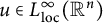 $u \in L_{\mathrm {loc}}^\infty (\mathbb {R}^n)$
be a super-solution of (1.2). By (2.1), we can find a constant
 $c>0$
such that for large
 $|x|$
,
 $$ \begin{align} u(x) \geq c|x|^{\gamma-n}. \end{align} $$
Without loss of generality, we always assume
 $\alpha =\max \{\alpha ,\beta \}$
.
Theorem 6.1 Let u be a positive super-solution of (1.2) with (1.15). If u and v are radially symmetric and decreasing about some point
 $x_0 \in \mathbb {R}^n$
, then there exists a constant
 $C>0$
such that for large
 $|x|$
,
 $$ \begin{align} u(x) \leq C|x|^{-\frac{\gamma+\alpha}{2(p-1)}}. \end{align} $$
Moreover, if
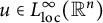 $u \in L_{\mathrm {loc}}^\infty (\mathbb {R}^n)$
and
 $\beta <\alpha $
, then
 $u \in L^{s_2}(\mathbb {R}^n)$
.
Proof Without loss of generality, assume
 $x_0=0$
. Since u and v are radially symmetric and decreasing about the origin, there hold
 $$ \begin{align} u(x) \geq c\int_{B_{|x|/2}(0) \cap B_{|x|}(0)} \frac{u^{p-1}(y)v(y)}{|x-y|^{n-\gamma}}dy \geq cu^{p-1}(x)v(x)|x|^{\gamma}, \end{align} $$
 $$ \begin{align} \begin{aligned} v(x) &\geq c\int_{B_{|x|/2}(0) \cap B_{|x|}(0)} \left(\frac{1}{|x-y|^{n-\alpha}} +\frac{1}{|x-y|^{n-\beta}}\right)u^p(y)dy\\ &\geq cu^{p}(x)|x|^{\alpha}. \end{aligned} \end{align} $$
Inserting (6.4) into (6.3) yields
 $u(x) \geq cu^{2p-1}(x)|x|^{\gamma +\alpha }$
, which implies (6.2).
Clearly, (6.2) shows that we can find
 $R>0$
such that
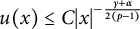 $ u(x) \leq C|x|^{-\frac {\gamma +\alpha }{2(p-1)}}$
for all
 $|x|>R$
. Therefore, by
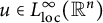 $u \in L_{\mathrm {loc}}^\infty (\mathbb {R}^n)$
, it follows that
 $ \|u\|_{L^{s_2}(\mathbb {R}^n)}^{s_2} \leq \|u\|_{L^{s_2}(B_R(0))}^{s_2} +\|u\|_{L^{s_2}(\mathbb {R}^n \setminus B_R(0))}^{s_2}<\infty. $
Theorem 6.2 Assume
 $u \in L_{\mathrm {loc}}^\infty (\mathbb {R}^n) \setminus L^{s_1}(\mathbb {R}^{n})$
is a positive function. Then, there does not exist
 $C>0$
such that for large
 $|x|$
,
 $$ \begin{align*}|x|^{\theta}u(x) \leq C \quad \mathrm{with} \ \ \theta>\frac{\alpha+\gamma}{2(p-1)}. \end{align*} $$
Proof If there exists
 $C>0$
such that for large
 $|x|$
,
 $$ \begin{align*}u(x)\leq C|x|^{-\theta} \quad \mathrm{with} \; \ \theta>\frac{\alpha+\gamma}{2(p-1)}. \end{align*} $$
We can deduce a contradiction. In fact, there exists
 $R>0$
such that
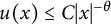 $u(x) \leq C|x|^{-\theta }$
as
 $|x|>R$
. By virtue of
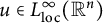 $u \in L_{\mathrm {loc}}^\infty (\mathbb {R}^{n})$
, it holds that
 $ \|u\|_{L^{s_1}(\mathbb {R}^n)}^{s_1} \leq \|u\|_{L^{s_1}(B_R(0))}^{s_1} +\|u\|_{L^{s_1}(\mathbb {R}^n \setminus B_R(0))}^{s_1}<\infty , $
which contradicts the fact that
 $u \not \in L^{s_1}(\mathbb {R}^{n})$
. The proof of Theorem 6.2 is completed.
Combining (6.1) with Theorems 6.1 and 6.2, we obtain (i) of Theorem 1.10.
Note that
 $u \in L_{\mathrm {loc}}^\infty (\mathbb {R}^n) \setminus L^{s_1}(\mathbb {R}^n)$
is not a sufficient condition for slow decay of u. In fact,
 $$ \begin{align*}u(x)=(1+|x|)^{-\frac{\gamma+\alpha}{2(p-1)}}(\log\log(2+|x|))^{-1} \end{align*} $$
belongs to
 $L_{\mathrm {loc}}^\infty (\mathbb {R}^n) \setminus L^{s_1}(\mathbb {R}^n)$
. It is a conjecture that if
 $u \in L_{\mathrm {loc}}^\infty (\mathbb {R}^n) \setminus L^{s_1}(\mathbb {R}^n)$
is a radially symmetric and decreasing solution of (1.2), then
 $$ \begin{align*}u(x) \simeq |x|^{-\frac{\gamma+\alpha}{2(p-1)}} \quad (|x| \to \infty). \end{align*} $$
Theorem 6.3
(i) Let
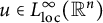 $u \in L_{\mathrm {loc}}^{\infty }(\mathbb {R}^{n})$
be a positive function. If (1.15) holds and
 $u(x)=O(|x|^{\gamma -n})$
when
 $|x| \to \infty $
, then
 $u\in L^{s_1}(\mathbb {R}^{n}) \cap L^{s_2}(\mathbb {R}^{n})$
.
(ii) Let u be a positive integrable solution of (1.2) with (1.15). If u is radially symmetric and decreasing about
 $x_0 \in \mathbb {R}^n$
, then
 $\lim _{|x|\to \infty }|x|^{n-\gamma }u(x)=\|u^{p-1}v\|_{L^1(\mathbb {R}^{n})}$
.
Proof (i) Clearly, there exists
 $R>0$
such that
 $u(x) \leq C|x|^{\gamma -n}$
for
 $|x|> R$
. In addition,
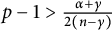 $p-1>\frac {\alpha +\gamma }{2(n-\gamma )}$
(implied by (1.12)) leads to
 $$ \begin{align} n-\frac{2n(p-1)}{\alpha+\gamma}(n-\gamma)<0. \end{align} $$
Therefore, by
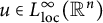 $u \in L_{\mathrm {loc}}^\infty (\mathbb {R}^{n})$
, we get
 $ \|u\|_{L^{s_1}(\mathbb {R}^n)}^{s_1} \leq \|u\|_{L^{s_1}(B_R(0))}^{s_1} +\|u\|_{L^{s_1}(\mathbb {R}^n \setminus B_R(0))}^{s_1}<\infty. $
In view of (1.15) and (6.5), we have
 $n-\frac {2n(p-1)}{\gamma -\alpha +2\beta }(n-\gamma )<0$
. Thus,
 $ \|u\|_{L^{s_2}(\mathbb {R}^n)}^{s_2} \leq \|u\|_{L^{s_2}(B_R(0))}^{s_2} +\|u\|_{L^{s_2}(\mathbb {R}^n \setminus B_R(0))}^{s_2}<\infty. $
(ii) Take
 $$ \begin{align*}\frac{1}{s}=\frac{\alpha+\gamma+\varepsilon}{2n(p-1)}, \quad \frac{1}{r}=\frac{2n-\alpha-\gamma-\varepsilon}{2n} \end{align*} $$
with
 $\varepsilon>0$
sufficiently small. By the Hölder inequality and Proposition 3.2, we obtain
 $$ \begin{align} \|u^{p-1}v\|_{L^1(\mathbb{R}^{n})} \leq \|u\|_s^{p-1}\|v\|_r<\infty. \end{align} $$
For fixed
 $R>0$
, set
 $$ \begin{align*}L_1:=\int_{B_R(0)}\left(\frac{|x|^{n-\gamma}}{|x-y|^{n-\gamma}}-1\right)u^{p-1}(y)v(y)dy. \end{align*} $$
When
 $y\in B_R(0)$
and
 $|x|\to \infty $
, we have
 $$ \begin{align*}\left|\frac{|x|^{n-\gamma}}{|x-y|^{n-\gamma}}-1\right|u^{p-1}(y)v(y)\leq 2u^{p-1}(y)v(y). \end{align*} $$
In view of (6.6), we can use the Lebesgue dominated convergence theorem to obtain
 $L_1 \to 0$
when
 $|x|\to \infty $
. Namely,
 $$ \begin{align} \lim_{R\to \infty}\lim_{|x|\to\infty} \int_{B_R(0)}\frac{|x|^{n-\gamma}}{|x-y|^{n-\gamma}}u^{p-1}(y)v(y)dy =\|u^{p-1}v\|_{L^1(\mathbb{R}^{n})}. \end{align} $$
Set
 $$ \begin{align*}L_2:=\int_{(\mathbb{R}^{n}\setminus B_R(0))\setminus B_{|x|/2}(x)} \frac{|x|^{n-\gamma}}{|x-y|^{n-\gamma}}u^{p-1}(y)v(y)dy. \end{align*} $$
When
 $y\in (\mathbb {R}^{n}\setminus B_R(0))\setminus B_{|x|/2}(x)$
, it holds that
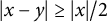 $|x-y|\geq |x|/2$
. Therefore, noting (6.6) and letting
 $R\to \infty $
, we see
 $$ \begin{align} L_2\leq C\int_{\mathbb{R}^{n}\setminus B_R(0)}u^{p-1}(y)v(y)dy \to 0. \end{align} $$
Set
 $$ \begin{align*}L_3:=\int_{B_{|x|/2}(x)}\frac{|x|^{n-\gamma}}{|x-y|^{n-\gamma}}u^{p-1}(y)v(y)dy. \end{align*} $$
Without loss of generality, suppose that symmetric point
 $x_0$
is the origin. When
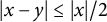 $|x-y|\leq |x|/2$
, we have
 $|x|/2 \leq |y| \leq 3|x|/2$
. Therefore,
 $$ \begin{align} \begin{aligned} L_3 &\leq C|x|^{n-\gamma}u^{p-1}(\frac{x}{2})v(\frac{x}{2})\int_{B_{|x|/2}(x)}\frac{1}{|x-y|^{n-\gamma}}dy\\ &\leq C|x|^nu^{p-1}(\frac{x}{2})v(\frac{x}{2}). \end{aligned} \end{align} $$
Write
 $r=|x|$
, and define
 $\tilde {u}(r)=u(x), \tilde {v}(r)=v(x)$
. Proposition 3.2 shows that for sufficiently small
 $\varepsilon>0$
,
 $$ \begin{align*}(u,v)\in L^s(\mathbb{R}^{n})\times L^r(\mathbb{R}^{n}), \quad \frac{1}{s}=\frac{\alpha+\gamma}{2n(p-1)}+\frac{2\varepsilon}{p-1}, \ \frac{1}{r}=\frac{2n-\gamma-\alpha}{2n}-\varepsilon. \end{align*} $$
This integrability result, together with the decreasing property of
 $\tilde {u}$
, implies
 $$ \begin{align*}\tilde{u}^s(|x|/2)|x|^n\leq C\int_{B_{|x|/2}(0)\setminus B_{|x|/4}(0)}u^s(y)dy \leq C. \end{align*} $$
Namely,
 $\tilde {u}(|x|/2)\leq C|x|^{-n/s}$
. Similarly, we also have
 $\tilde {v}(|x|/2)\leq C|x|^{-n/r}$
. Inserting these two estimates into (6.9), we derive
 $$ \begin{align} L_3\leq C|x|^{n-n(p-1)/s-n/r} \to 0, \quad as \quad |x|\to \infty. \end{align} $$
Combining (6.7), (6.8), and (6.10), we see that
 $$ \begin{align*}|x|^{n-\gamma}u(x)-\|u^{p-1}v\|_{L^1(\mathbb{R}^{n})} \to 0, \quad\mathrm{when} \quad |x|\to \infty. \end{align*} $$
Thus, the proof of Theorem 6.3 is completed.
7 Differentiability
In this section, we prove Theorem 1.11.
Theorem 7.1 Assume u is a positive integrable solution of the system (1.2) with
 $$ \begin{align*}1<\min\{\alpha,\beta\} \leq \max\{\alpha,\beta\} \leq \gamma<n. \end{align*} $$
Then,
 $u(x)$
and
 $v(x)$
are differentiable in
 $\mathbb {R}^{n}$
. Now,
 $$ \begin{align} \nabla u(x)=\int_{\mathbb{R}^{n}}(\nabla_x |x-y|^{-(n-\gamma)})u^{p-1}(y)v(y)dy, \end{align} $$
 $$ \begin{align} \nabla v(x)=\int_{\mathbb{R}^n}\nabla_x (|x-y|^{-(n-\alpha)}+|x-y|^{-(n-\beta)})u^p(y)dy. \end{align} $$
Moreover, if u and v are radially symmetric and decreasing about
 $x_0\in \mathbb {R}^{n}$
, then there exists a constant
 $C>0$
such that for large
 $|x|$
,
 $$ \begin{align} |\nabla u(x)|\leq C|x|^{-(n-\gamma)-1}. \end{align} $$
Proof First, we prove the differentiability of
 $u(x)$
.
We can see that the defects of
 $$ \begin{align*}T(x):=\int_{\mathbb{R}^{n}}(\nabla_x |x-y|^{-(n-\gamma)})u^{p-1}(y)v(y)dy \end{align*} $$
may happen at x and
 $\infty $
.
Take
 $R>2|x|+1$
, and denote
 $B_R(0)$
by
 $B_R$
. For
 $y\in \mathbb {R}^{n}\setminus B_R$
, from (6.6), we have
 $$ \begin{align*}|x-y|^{-(n-\gamma)-1}u^{p-1}(y)v(y)\leq Cu^{p-1}(y)v(y)\in L^1(\mathbb{R}^{n}\setminus B_R). \end{align*} $$
Therefore, the differentiability theorem for integrals with parametric variables (cf. Theorem 3.16 in [Reference Benedetto2]) shows that
 $$ \begin{align*}T_1(x):=\int_{\mathbb{R}^{n}\setminus B_R}|x-y|^{-(n-\gamma)}u^{p-1}(y)v(y)dy \end{align*} $$
is differentiable at x, and
 $$ \begin{align} \nabla T_1(x)=\int_{\mathbb{R}^{n}\setminus B_R}(\nabla_x|x-y|^{-(n-\gamma)})u^{p-1}(y)v(y)dy. \end{align} $$
Next, we claim that
 $$ \begin{align*}T_2(x):=\int_{B_R}|x-y|^{-(n-\gamma)}u^{p-1}(y)v(y)dy \end{align*} $$
is differentiable at x. Inspired by the ideas in Section 4.2 of [Reference Gilbrag and Trudinger16], we set
 $$ \begin{align*}\omega(x):=\int_{B_R}[\nabla_x|x-y|^{-(n-\gamma)}]u^{p-1}(y)v(y)dy. \end{align*} $$
By virtue of
 $\gamma>1$
and Theorem 4.1, x is not a singular point of this integral, so
 $\omega $
is well-defined. Let
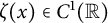 $\zeta (x) \in C^1(\mathbb {R})$
be a smooth function such that
 $$ \begin{align*}\begin{cases} \zeta (x)=0,&\quad \mathrm{when} \ |x| \le 1; \\ \zeta (x) \in [0,1],&\quad \mathrm{when} \ |x| \in [1,2]; \\ \zeta (x)=1,&\quad \mathrm{when} \ |x| \ge 2, \end{cases} \end{align*} $$
and
 $0\leq \zeta '\leq 2$
. Define the cutting-off function
 $\zeta _{\varepsilon }(x)=\zeta ({x}/{\varepsilon })$
for sufficiently small
 $\varepsilon \in (0,1/2)$
. Let
 $$ \begin{align*}T_2^{\varepsilon}(x):=\int_{B_R}|x-y|^{-(n-\gamma)} \zeta_{\varepsilon}(|x-y|)u^{p-1}(y)v(y)dy. \end{align*} $$
After cutting off the singularity, we know that
 $T_2^{\varepsilon }(x)$
is differentiable at x, and
 $$ \begin{align*}\nabla T_2^{\varepsilon}(x) =\int_{B_R}\nabla_x[|x-y|^{-(n-\gamma)} \zeta_{\varepsilon}(|x-y|)]u^{p-1}(y)v(y)dy. \end{align*} $$
Thus, we obtain
 $$ \begin{align*}\begin{aligned} |T_2(x)-T_2^{\varepsilon}(x)| &=\int_{|x-y|\leq 2\varepsilon} (1-\zeta_{\varepsilon})|x-y|^{-(n-\gamma)}u^{p-1}(y)v(y)dy\\&\leq C\varepsilon^{\gamma} \sup_{B_{2R}}[u^{p-1}(x)v(x)], \end{aligned} \end{align*} $$
and
 $$ \begin{align*}\begin{aligned} &|\omega(x)-\nabla T_2^{\varepsilon}(x)|\\& \quad =\left|\int_{|x-y|\leq 2\varepsilon}\nabla_x[(1-\zeta_{\varepsilon})|x-y|^{-(n-\gamma)}] u^{p-1}(y)v(y)dy\right|\\& \quad \leq C \int_{|x-y|\leq 2\varepsilon} (\varepsilon^{-1}|x-y|^{-(n-\gamma)}+(n-\gamma)|x-y|^{-(n-\gamma)-1})u^{p-1}(y)v(y)dy\\& \quad \leq C\varepsilon^{\gamma-1}\sup_{B_{2R}}[u^{p-1}(x)v(x)]. \end{aligned} \end{align*} $$
Since
 $\gamma>1$
and by Theorem 4.1,
 $T_2^{\varepsilon }(x)$
and
 $\nabla T_2^{\varepsilon }(x)$
converge uniformly to
 $T_2$
and
 $\omega ,$
respectively, as
 $\varepsilon \to 0$
. Hence, the claim holds and
 $$ \begin{align} \nabla T_2(x)=\int_{B_R}[\nabla_x|x-y|^{-(n-\gamma)}]u^{p-1}(y)v(y)dy. \end{align} $$
Thus,
 $u(x)=T_1(x)+T_2(x)$
is differentiable at x. In addition, (7.4) and (7.5) imply (7.1).
The differentiability of v can be proved similarly. For
 $y \in B_R(0)$
, the function
 $$ \begin{align*}T_3(x):=\int_{B_R}(|x-y|^{-(n-\alpha)}+|x-y|^{-(n-\beta)})u^p(y)dy \end{align*} $$
is differentiable at x, and
 $$ \begin{align} \nabla T_3(x)=\int_{B_R}[\nabla_x(|x-y|^{-(n-\alpha)}+|x-y|^{-(n-\beta)})]u^p(y)dy. \end{align} $$
For
 $y\in \mathbb {R}^{n}\setminus B_R$
, we have
 $$ \begin{align*}\int_{\mathbb{R}^{n}\setminus B_R}(|x-y|^{-(n-\alpha)-1}+|x-y|^{-(n-\beta)-1})u^p(y)dy \leq (R-|x|)^{-1}v(x)<\infty. \end{align*} $$
Therefore, according to the differentiability theorem for integrals with parametric variables (cf. Theorem 3.16 in [Reference Benedetto2]),
 $$ \begin{align*}T_4(x):=\int_{\mathbb{R}^{n}\setminus B_R}(|x-y|^{-(n-\alpha)}+|x-y|^{-(n-\beta)})u^p(y)dy \end{align*} $$
is differentiable at x, and
 $$ \begin{align} \nabla T_4(x)=\int_{\mathbb{R}^{n}\setminus B_R} [\nabla_x(|x-y|^{-(n-\alpha)}+|x-y|^{-(n-\beta)})]u^p(y)dy. \end{align} $$
Thus,
 $v(x)=T_3(x)+T_4(x)$
is differentiable at x. In addition, (7.6) and (7.7) imply (7.2).
Next, we estimate
 $\nabla u$
for large
 $|x|$
.
Assume that v is radially symmetric and decreasing about the origin, and
 $\alpha =\max \{\alpha ,\beta \}$
. Proposition 3.2 shows
 $v\in L^r(\mathbb {R}^n)$
for any
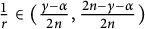 $\frac {1}{r}\in (\frac {\gamma -\alpha }{2n}, \frac {2n-\gamma -\alpha }{2n})$
. Thus,
 $$ \begin{align*}v^r(x)|x|^n\leq C\int_{B_{|x|/2}(x)\cap B_{|x|}(0)}v^r(y)dy\leq C. \end{align*} $$
Therefore,
 $$ \begin{align} v(x)\leq C|x|^{-n/r}, \quad \forall \frac{1}{r} \in \left(\frac{\gamma-\alpha}{2n}, \frac{2n-\gamma-\alpha}{2n}\right). \end{align} $$
Define
 $$ \begin{align*}S(x):=\int_{\mathbb{R}^n}\frac{1}{|x-y|^{n-\gamma+1}}u^{p-1}(y)v(y)dy. \end{align*} $$
Since x and
 $\infty $
are not the singularity points of
 $T(x)$
,
 $S(x)$
is well-defined, and
 $$ \begin{align*}|\nabla u(x)| \leq (n-\gamma)S(x). \end{align*} $$
Clearly,
 $$ \begin{align} \begin{aligned} |x|^{n-\gamma+1}S(x) &=\int_{\mathbb{R}^n\setminus B_{|x|/2}(x)}\frac{|x|^{n-\gamma+1}}{|x-y|^{n-\gamma+1}}u^{p-1}(y)v(y)dy\\&\quad +\int_{B_{|x|/2}(x)}\frac{|x|^{n-\gamma+1}}{|x-y|^{n-\gamma+1}}u^{p-1}(y)v(y)dy\\&:= S_1(x)+S_2(x). \end{aligned} \end{align} $$
When
 $y\in \mathbb {R}^n\setminus B_{|x|/2}(x)$
, we have
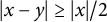 $|x-y|\geq |x|/2$
. In view of (6.6), it follows that
 $$ \begin{align} S_1(x)\leq C\int_{\mathbb{R}^n\setminus B_{|x|/2}(x)}u^{p-1}(y)v(y)dy\leq C. \end{align} $$
When
 $y\in B_{|x|/2}(x)$
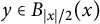
, it holds that
 $|x|/2\leq |y|\leq 3|x|/2$
. Using (7.8) with
 $r=r_\epsilon =\frac {2n-\gamma -\alpha }{2n}-\epsilon $
for suitably small
 $\epsilon \in (0,(n-\gamma )/(2n))$
, and Theorem 6.3 (ii), we derive
 $$ \begin{align*}\begin{aligned} S_2(x)&\leq C|x|^{n-\gamma+1-(p-1)(n-\gamma)-n/r_\epsilon} \int_{B_{|x|/2}(x)}|x-y|^{-n+\gamma-1}dy\\&\leq C|x|^{n-(p-1)(n-\gamma)-n/r_\epsilon}. \end{aligned} \end{align*} $$
By (1.12), we can choose
 $\epsilon $
in (7.8) sufficiently small such that
 $n-(p-1)(n-\gamma )-n/r_\epsilon \leq 0$
. Therefore,
 $S_2(x) \leq C$
. Inserting this and (7.10) into (7.9), we have
 $$ \begin{align*}S(x)\leq C|x|^{-n+\gamma-1} \end{align*} $$
for large
 $|x|$
. This means that (7.3) holds. The proof of Theorem 7.1 is completed.
8 Nonexistence of integrable solutions
In this section, we prove Theorem 1.4. Without loss of generality, we always assume
 $\alpha =\max \{\alpha ,\beta \}$
.
In fact, Theorem 1.4 is a corollary of the following result.
Theorem 8.1 Let u be a positive integrable solution of (1.2) with
 $1<\beta \leq \alpha \leq \gamma <n$
. If u and v are radially symmetric and decreasing about
 $x_0 \in \mathbb {R}^n$
, then
 $$ \begin{align} \frac{n+\beta}{n-\gamma}\leq p\leq \frac{n+\alpha}{n-\gamma}. \end{align} $$
Proof Take
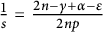 $\frac {1}{s}=\frac {2n-\gamma +\alpha -\varepsilon }{2np}$
with
 $\varepsilon>0$
sufficiently small. By the Hölder inequality,
 $$ \begin{align*}\int_{\mathbb{R}^{n}}u^p(x)v(x)dx\leq (\int_{\mathbb{R}^{n}}u^s(x)dx)^{p/s}(\int_{\mathbb{R}^{n}}v^{s/(s-p)})^{1-p/s}. \end{align*} $$
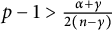
Since u is an integrable solution, Proposition 3.2 and the condition
 $p-1>\frac {\alpha +\gamma }{2(n-\gamma )}$
imply
 $u\in L^s(\mathbb {R}^{n})$
and
 $v\in L^{s/(s-p)}(\mathbb {R}^{n})$
. Hence, we have
 $$ \begin{align} u^pv\in L^1(\mathbb{R}^{n}). \end{align} $$
Therefore, there exists a sequence
 $R_j\to \infty (j\to \infty )$
such that
 $$ \begin{align} R_j\int_{\partial B_{R_j}}u^p(x)v(x)ds\to 0. \end{align} $$
In addition, Theorem 7.1 shows that u and v are differentiable.
Step 1. We prove the convergence of several improper integrals.
First, we claim that
 $$ \begin{align} x\cdot \nabla(u^p(x)v(x))\in L^1(\mathbb{R}^{n}). \end{align} $$
Integrating by parts, we get
 $$ \begin{align*}\int_{B_R}x\cdot \nabla(u^p(x)v(x))dx=R\int_{\partial B_R}u^p(x)v(x)ds-n\int_{B_R}u^p(x)v(x)dx. \end{align*} $$
Letting
 $R=R_j\to \infty $
and utilizing (8.3), we can get (8.4) immediately and
 $$ \begin{align} \int_{\mathbb{R}^{n}}x\cdot \nabla(u^p(x)v(x))dx=-n\int_{\mathbb{R}^{n}}u^p(x)v(x)dx. \end{align} $$
Next, we claim that the improper integral
 $$ \begin{align} \left|\int_{\mathbb{R}^{n}}\frac{z\cdot \nabla(u^{p-1}(z)v(z))}{|x-z|^{n-\gamma}}dz\right| <\infty, \quad \mathrm{at \ each} \ \ x\in \mathbb{R}^{n}. \end{align} $$
Define
 $$ \begin{align*}I(\mathbb{R}^{n}):=\int_{\mathbb{R}^{n}}\frac{u^{p-1}(z)v(z)(x-z)\cdot z}{|x-z|^{n-\gamma+2}}dz. \end{align*} $$
The singularities of
 $I(\mathbb {R}^{n})$
occur at x and
 $\infty $
. When z is near x, from Theorem 4.1 and
 $\gamma>1,$
we have
 $$ \begin{align*}|I(B_\delta(x))| \leq C\int_{B_{\delta}(x)}\frac{1}{|x-z|^{n-\gamma+1}}dz \leq C\int_0^{\delta}t^{\gamma-1}\frac{dt}{t}<\infty. \end{align*} $$
When z is near
 $\infty $
, take
 $r>2|x|+1$
such that
 $|x-z|>|z|/2$
for
 $|z|>r$
. From (1.2), we have
 $$ \begin{align*}|I(\mathbb{R}^{n}\setminus B_r)| \leq C\int_{\mathbb{R}^{n}\setminus B_r}\frac{u^{p-1}(z)v(z)}{|x-z|^{n-\gamma}}dz \leq Cu(x)<\infty. \end{align*} $$
Therefore, the improper integral
 $I(\mathbb {R}^{n})$
absolutely converges for every
 $x\in \mathbb {R}^{n}$
.
In addition, for each
 $x \in \mathbb {R}^n$
, (1.2) shows that
 $|x|^{\gamma -n}*[u^{p-1}v]<\infty $
. Then, there exists
 $R_j\to \infty (j\to \infty )$
such that
 $$ \begin{align} R_j\int_{\partial B_{R_j}}\frac{u^{p-1}(z)v(z)}{|x-z|^{n-\gamma}}ds \to 0. \end{align} $$
Integrating by parts yields
 $$ \begin{align*}\begin{aligned} &\int_{B_R}\frac{z\cdot \nabla(u^{p-1}(z)v(z))}{|x-z|^{n-\gamma}}dz\\& \quad =R\int_{\partial B_R}\frac{u^{p-1}(z)v(z)}{|x-z|^{n-\gamma}}ds -n\int_{B_R}\frac{u^{p-1}(z)v(z)}{|x-z|^{n-\gamma}}dz\\& \qquad +(n-\gamma)\int_{B_R}\frac{u^{p-1}(z)v(z)(x-z)\cdot z}{|x-y|^{n-\gamma+2}}dz. \end{aligned} \end{align*} $$
Letting
 $R=R_j$
and utilizing (8.7), (1.2) and
 $|I(\mathbb {R}^{n})| < \infty $
, from the result above, we deduce that
 $$ \begin{align*}\int_{\mathbb{R}^{n}}\frac{z\cdot \nabla(u^{p-1}(z)v(z))}{|x-z|^{n-\gamma}}dz =-nu(x)+(n-\gamma)I(\mathbb{R}^{n}). \end{align*} $$
This implies that (8.6) holds and the claim is true.
Similar to the claim above, we can also prove that
 $$ \begin{align} \left|\int_{\mathbb{R}^{n}}\left[\frac{1}{|x-z|^{n-\alpha}} +\frac{1}{|x-y|^{n-\beta}}\right]z\cdot \nabla u^p(z)dz\right|<\infty. \end{align} $$
Finally, we claim that the improper integral
 $$ \begin{align} |G(\mathbb{R}^n)| <\infty, \end{align} $$
where
 $$ \begin{align*}G(\mathbb{R}^n):=\int_{\mathbb{R}^n}[x\cdot \nabla u(x)]u^{p-1}(x)v(x)dx. \end{align*} $$
In fact, we see that the defect point of
 $G(\mathbb {R}^n)$
is
 $\infty $
. For large
 $|x|$
, choose
 $\frac {1}{r_0}=\frac {\gamma -\alpha +\varepsilon }{2n}$
with suitable small
 $\varepsilon>0$
. From (7.3) and (7.8), there holds
 $$ \begin{align*}\begin{aligned} |G(\mathbb{R}^n\setminus B_R)|&\leq \int_{\mathbb{R}^{n}\setminus B_R}|x||\nabla u(x)|u^{p-1}(x)v(x)dx\\&\leq C\int_{\mathbb{R}^n\setminus B_R} |x|^{-(n-\gamma)-(n-\gamma)(p-1)-n/r_0}dx\\&\leq C\int_R^{\infty}r^{\gamma-(n-\gamma)(p-1)-n/r_0}\frac{dr}{r}<\infty. \end{aligned} \end{align*} $$
This means that
 $G(\mathbb {R}^n)$
absolutely converges for every
 $x\in \mathbb {R}^n$
, and then (8.9) holds.
Moreover, from (8.4) and (8.9), it follows that
 $$ \begin{align} \left|\int_{\mathbb{R}^n}[x\cdot \nabla v(x)]u^p(x)dx\right|<\infty. \end{align} $$
Step 2. We use the Pohozaev inequality in integral forms to prove theorem.
For any
 $\mu \geq 1$
, from (1.2), we have
 $$ \begin{align*}u(\mu x)=\mu^{\gamma}\int_{\mathbb{R}^{n}}\frac{u^{p-1}(\mu z)v(\mu z)}{|x-z|^{n-\gamma}}dz \end{align*} $$
and
 $$ \begin{align*}v(\mu x)=\int_{\mathbb{R}^{n}}\left[\mu ^{\alpha}\frac{u^p(\mu z)}{|x-z|^{n-\alpha}} +\mu^{\beta}\frac{u^p(\mu z)}{|x-y|^{n-\beta}}\right]dz. \end{align*} $$
Differentiating both sides of the equations above with respect to
 $\mu ,$
respectively, and then letting
 $\mu =1$
, we get
 $$ \begin{align} x \cdot \nabla u(x)=\left[\frac{du(\mu x)}{d\mu}\right]_{\mu=1} =\gamma u(x)+\int_{\mathbb{R}^{n}}\frac{z \cdot \nabla(u^{p-1}(z)v(z))}{|x-z|^{n-\gamma}}dz, \end{align} $$
 $$ \begin{align} \begin{aligned} x \cdot \nabla v(x)&=\left[\frac{dv(\mu x)}{d\mu}\right]_{\mu=1}\\& =\alpha\int_{\mathbb{R}^{n}}\frac{u^p(z)}{|x-z|^{n-\alpha}}dz +\beta\int_{\mathbb{R}^{n}}\frac{u^p(z)}{|x-z|^{n-\beta}}dz\\&\quad +\int_{\mathbb{R}^{n}}\left[\frac{1}{|x-z|^{n-\alpha}} +\frac{1}{|x-z|^{n-\beta}}\right]z\cdot \nabla u^p(z)dz. \end{aligned} \end{align} $$
Multiply (8.11) by
 $u^{p-1}(x)v(x)$
and integrate on
 $\mathbb {R}^n$
. By the Fubini theorem and (1.2), we see that
 $$ \begin{align*}\begin{aligned} &\int_{\mathbb{R}^{n}}[x\cdot \nabla u(x)]u^{p-1}(x)v(x)dx\\& \quad =\gamma\int_{\mathbb{R}^{n}}u^p(x)v(x)dx +\int_{\mathbb{R}^{n}}[z\cdot \nabla(u^{p-1}(z)v(z))]u(z)dz, \end{aligned} \end{align*} $$
which implies
 $$ \begin{align} \begin{aligned} 2\int_{\mathbb{R}^{n}}[x\cdot \nabla u^p(x)]v(x)dx &-p\gamma\int_{\mathbb{R}^{n}}u^p(x)v(x)dx\\ &-p\int_{\mathbb{R}^{n}} z\cdot \nabla[u^{p}(z)v(z)]dz=0. \end{aligned} \end{align} $$
Similarly, multiplying (8.12) by
 $u^p(x)$
and integrating on
 $\mathbb {R}^n$
, respectively, we get
 $$ \begin{align} \begin{aligned} \beta \int_{\mathbb{R}^{n}}u^p(x)v(x)dx &\leq \int_{\mathbb{R}^{n}}[x\cdot \nabla v(x)]u^p(x)dx -\int_{\mathbb{R}^{n}}[z\cdot \nabla u^p(z)]v(z)dz\\ &\leq \alpha \int_{\mathbb{R}^{n}}u^p(x)v(x)dx. \end{aligned} \end{align} $$
Notice (8.11)–(8.14) are well-defined by (8.2), (8.4), (8.6), and (8.8)–(8.10). Combining (8.13) and (8.14) yields
 $$ \begin{align*}\begin{aligned} \beta \int_{\mathbb{R}^{n}}u^p(x)v(x)dx &\leq (1-p)\int_{\mathbb{R}^{n}} x\cdot \nabla[u^p(x) v(x)]dx -p\gamma\int_{\mathbb{R}^{n}}u^p(x)v(x)dx\\ &\leq \alpha \int_{\mathbb{R}^{n}}u^p(x)v(x)dx. \end{aligned} \end{align*} $$
In view of (8.5) and
 $\|u^pv\|_{L^1(\mathbb {R}^{n})}>0$
, we derive (8.1).


