One of the darker aspects of nineteenth-century American history is the manner in which certain ethnic groups were treated by the largely white ethnic majority. Everyone knows that prior to the Civil War, the largely agricultural southern economy was based upon slavery, the ownership and forced labor of black workers abducted from Africa. Also well known is the systematic forced expulsion of American Indians from their native lands attendant on westward migration and economic development of the vast American interior. The early experiences of Chinese immigrants provide a third example of how ethnic minorities were mistreated during this period, though with the obvious difference that beginning in the early 1850s, the Chinese immigrated willingly, even eagerly, to the United States in significant numbers. Yet once here, they encountered virulent discrimination and ultimately, legislative prohibitions on further immigration when Congress enacted the Chinese Exclusion Act in 1882. This law, subsequently renewed in 1892 and 1902, imposed restrictions on immigration from China, including penalties of fines and possible imprisonment for the captains of ships caught transporting Chinese to the United States. Understanding the origins of Chinese exclusion sheds light both on nineteenth-century ethnic tensions and on the experiences of subsequent immigrants who have also been subjected to racial discrimination, which in some cases(such as that of the Japanese) included exclusion.
The reasons for exclusion of the Chinese given by historians go beyond a naïve story of simple racism or nativism. Many studies emphasize that Chinese workers competed with native workers for scarce jobs, generating support for exclusion among the latter.1
See, for example, Saxton, Indispensable Enemy, pp. 72–75; Mann, After the Gold Rush, pp. 188–93; Daniels, Asian America, pp. 33–56; Marks, Precious Dust, pp. 300–01; and Takaki, Strangers, pp. 92, 95–99, 110–12.
This argument does not, however, easily explain why exclusion legislation did not occur for roughly 30 years after the first significant Chinese in-migrations. A more realistic interest group story also recognizes that employers desired low-wage labor, perhaps opposing exclusion because the Chinese were inexpensive, highly productive workers and their presence increased company profits and reduced the bargaining power of native workers.
2 Chiu, Chinese Labor, pp. 129–32; Brown and Philips, “Competition,” p. 63; and Daniels, Asian America, pp. 51–52.
Some evidence suggests that exclusion was given impetus both by depressed labor market conditions in the late 1870s and by an increased tendency for Chinese to compete directly with white-owned firms.
3 See Cross, History, p. 84; Takaki, Strangers, pp. 110–11; and Brown and Philips, “Competition,” p. 70.
These explanations, based solely on the interests of labor and management, have dominated economic thinking on the politics of Chinese exclusion.
The California Gold Rush provides a useful context in which to examine the politics of exclusion. The state experienced a massive influx of Chinese miners in response to the discovery of gold in 1848, and exclusionary laws were seriously considered by the legislature from quite early on. Furthermore, the process of mining underwent an organizational transformation during the 1850s, where initially mining was a largely transient, entrepreneurial enterprise in which miners were either self-employed or organized into cooperative joint stock companies. It was only over time that mining companies adopted an industrial model of miners working as wage labor. This means that during the initial Gold Rush years, the labor-management interest group model would predict representatives of mining counties to be largely captured by labor and thus strongly favor exclusion, because Chinese workers lacked an effective political voice. Nevertheless, during this early period we observe significant opposition to exclusion among miners and mining representatives in the legislature, suggesting other factors were operant.
One explanation for early opposition to exclusion in California, largely overlooked in existing scholarship, lies in the fact that the state levied taxes on foreign miners, which provided both the state and counties with mixed incentives to exclude Chinese miners.4
This foreign miners' tax appears in many historical descriptions of the early Chinese experience in California (see, for example, Cross, History, p. 17; Chiu, Chinese Labor, pp. 10, 14, 16, 22–23; Mann, After the Gold Rush, pp. 53–56; and McClain, In Search of Equality, pp. 12, 18–20), but it is typically simply provided as evidence of discrimination against Chinese and other foreign miners. To my knowledge, no existing studies examine its effect on propensities to exclude the Chinese, though Chan briefly mentions it as a reason the Chinese were initially tolerated (see Chan, “People,” p. 74).
On the one hand, miners favored Chinese exclusion as a means of reducing competition for the available gold. On the other hand, Chinese miners contributed significantly to state and local tax revenues while adding relatively little demand for public services such as schools and hospitals, being mostly adult males. This latter factor was particularly salient immediately after statehood when both the state and localities were strapped for cash, generating significant opposition to exclusion. However, as financial conditions improved over time, opposition to exclusion fell so that by 1858, the state was able to enact exclusionary legislation. Exclusion of the Chinese became politically feasible in California only after the state had managed to put its fiscal house in order.
THE CALIFORNIA GOLD RUSH AND CHINESE IMMIGRATION
The discovery of gold at Sutter's Mill in the middle fork of the American River in 1848 triggered a massive influx of miners into California. By 1852 a special state census reported that the non-Indian population of the state totaled over 250,000, of which over 47 percent resided in the seven most important mining counties—Calaveras, El Dorado, Mariposa, Nevada, Placer, Sierra, and Tuolumne.5
U.S. Department of Interior, Statistical View, p. 394. These figures are probably not entirely accurate given enormous difficulties in obtaining precise head counts, but still convey the broad pattern of population growth during this period. See Chan, This Bittersweet Soil, p. 42.
Among these miners were significant numbers from foreign countries such as Mexico, Chile, Australia, various European countries, and of course, China, all of whom comprised nearly one-third of the total population in these seven counties. In total there were about 25,000 Chinese immigrants, who would have comprised 10 percent of the total non-Indian population and over 35 percent of the total foreign-born population. By 1860 the Chinese were the single largest foreign-born ethnic group in California and comprised from 12 to 23 percent of the population of various mining counties.
6 Chan, “People,” pp. 49, 73. In immigrating to the United States, many Chinese incurred significant amounts of debt, either to friends and relatives or to labor brokers. Cloud and Galenson, “Chinese Immigration and Contract Labor,” describe an interesting institutional development in which organizations run by Chinese merchants—the so-called Chinese Six Companies—were organized in San Francisco and were centrally involved in the recruitment of Chinese workers, to many of whom they advanced funds for passage to the United States. Cloud and Galenson's interpretation of the precise nature of the involvement of the Chinese Six Companies has been challenged by McClain, “Chinese Immigration,” but there seems little doubt that they played a major role. See also Cloud and Galenson, “Chinese Immigration: Reply.”
Gold mining was initially performed in a highly labor-intensive manner using primitive methods such as panning, or rockers and cradles. Early miners worked alone or with a handful of partners, or organized into joint-stock companies as entrepreneurial teams.7
Paul, California Gold, pp. 50–58; Cross, History, p. 12; and Saxton, Indispensable Enemy, p. 52.
These mining methods were well suited to the limited financial resources of most Chinese miners. Over time, mining moved to a hierarchical industrial model in which Chinese (and other) workers provided wage labor to mining companies, when major technological advances enabled companies to take advantage of significant economies of scale. Two in particular were important: the invention of hydraulic mining (which required large amounts of water) and advances in quartz mining, both of which transformed mining into a much more heavily capital-intensive endeavor than it had previously been. Though the precise timing of the move from entrepreneurial to industrial mining is not entirely clear, available evidence suggests widespread reliance on the industrial model probably did not occur until at least the late-1850s.
8 According to Chiu, the move was underway by 1852 as surface deposits near available water were already becoming scarce and quartz and hydraulic mining were proving to be profitable (Chinese Labor, p. 13). Cross seems to corroborate Chiu, but identifies the change as occurring in mid-decade (History, p. 25). However, Paul and Saxton have stressed the financial difficulties of quartz mining companies during the 1850s, and Paul has concluded that quartz mining was largely unimportant during the 1850s (Paul, California Gold, pp. 144–45; and Saxton, Indispensable Enemy, p. 57). Hydraulic mining was invented in 1853, but historians differ on how quickly it came to be adopted as common practice (see May, Origins; Paul, California Gold, p. 155; and Greenland, Hydraulic Mining, pp. 48–50). The Alta Californian contains virtually no evidence that mining workers clashed with mining company management during the 1850s. See also Cornford, “‘We All Live,’” p. 93.
The early dominance of entrepreneurial, not industrial, mining meant that typically, miners or teams of miners were competing directly against each other for the gold in a given diggings. Under these circumstances, all miners were competitive threats but foreign, and especially Chinese, miners bore the brunt of antagonism from native miners in part because it was easier to rationalize excluding them. As early as April 1849, the San Francisco-published Daily Alta Californian was reporting local sentiment for excluding foreign miners from working the mines.9
Alta Californian, 26 April 1849.
Contemporary news accounts contain many descriptions of native miners taking up arms against foreign miners, or combining to expel foreign miners from their diggings. Native miners were known to engage in intimidation of local claims recorders to discourage them from recording foreign claims, and to use antiforeign sentiment as a “litmus test” for aspirants for political office.
10 See, for example, Alta Californian, 12 June 1852.
Chinese miners often bore the brunt of antagonism from native miners. In 1849 native miners in Tuolumne County passed a resolution prohibiting Chinese miners from working claims. In the early 1850s, Chinese miners were the targets of vigorous anti-Chinese sentiment in Nevada County. In 1859 the sheriff of Shasta County requested assistance from the governor to put down an insurrection of locals attempting to drive Chinese out of the county. Indeed, local attempts to exclude Chinese miners were made in various mining districts throughout the state, including Agua Fria, Grass Valley, Horsetown, Oregon Gulch, Middletown, Mormon Bar, Horse Shoe Bar, Columbia, Deer Creek, Rough and Ready, Wood's Creek, Foster's Bar, and Yuba River Camp.11
These various evidences of discrimination against Chinese miners are found in a number of sources. See Williams, “Chinese,” pp. 65–67; Chan, This Bittersweet Soil, p. 58, and “People,” p. 74; Mann, After the Gold Rush, pp. 55–56; and Alta Californian, 26 November 1858, 4 March 1859.
On occasion, prohibitions against Chinese miners appeared in the bylaws of local mining districts. The 1856 by-laws of Columbia District in Tuolumne County explicitly prohibited Asiatics and South Sea Islanders from mining in the district.12
Heckendorn and Wilson, Miners, p. 9.
Similarly, the 1854 by-laws of Dutch Flat in Placer County, and the 1857 by-laws of Centreville and Helltown in Butte County, prohibited Chinese from purchasing mining claims.
13 For the by-laws of Dutch Flat, see the Placer Herald, 18 November 1854. For the by-laws of Centreville and Helltown, see U.S. Department of Interior, United States Mining Laws, p. 296.
In other cases, district by-laws specified that only those who intended to become citizens could hold claims, implicitly targeting Chinese miners because federal law reserved the right of naturalization to “free white persons.” The fact that mining districts were largely democratic, miner-operated frontier institutions confirms the importance of native miners as a driving force behind exclusion during this period.
14 See, for example, the 1850 by-laws of Gold Mountain district, 1851 by-laws of Union Quartz Mountain district, U.S. Department of Interior, United States Mining Laws, pp. 331–32. On naturalization law, see Takaki, Strangers, p. 82; Mann, After the Gold Rush, p. 55. For more on the operation of the mining districts, see Shinn, Mining Camps; Umbeck, Theory; and Clay and Wright “Order.”
Historians have commonly ascribed antiforeign and anti-Chinese sentiments during the nineteenth century to nativist and racist tendencies, perhaps fueled by beliefs in Manifest Destiny.15
Mann, After the Gold Rush, p. 56; Rohrbough, Days, pp. 221, 228; Chan, “People,” especially pp. 75–77.
The evidence presented so far suggests that during the California Gold Rush, antipathy toward the Chinese was driven by the simple fact that foreign miners competed with native miners for the scarce gold, thus lowering their productivity and expected income.
16 This effect on native wages is the theoretical prediction of a closed-economy model in which unskilled immigrants compete with unskilled native workers (see Friedberg and Hunt, “Impact,” p. 28). This was an approximately accurate characterization of Gold Rush California.
Opposition to Chinese workers was rationalized in a number of ways, including depictions of them as virtual slaves to “foreign masters and foreign capitalists,” and suggestions that their presence had various negative, and potentially dangerous, social side-effects without which the state would be better off.
17 California, Legislature, Report of the Committee on Mines, p. 831. See also California, Legislature, Majority and Minority Reports, pp. 13, 15. These sentiments are found echoed in testimony before the state senate in the late 1870s, when popular and political support for exclusion was growing. See Cloud and Galenson, “Chinese Immigration and Contract Labor,” pp. 35–36.
ANTI-CHINESE LEGISLATION
Partly in response to anti-Chinese popular sentiments, the state legislature enacted two broad measures that negatively impacted Chinese immigrants during this period. The first was a foreign miners' tax, initially instituted in 1850 when all foreign-born miners were required to pay $20 per month to obtain a license to mine for gold.18
“An Act for the better regulation of the Mines, and the government of Foreign Miners,” Chapter 97, Statutes of California (1850), pp. 221–23. To place this figure in context, Paul has estimated that the average daily wage in the California gold mines in 1850 was about $10, but also that it declined dramatically over the next few years (Paul, California Gold, pp. 349–50). See also Margo, “Wages,” p. 2. It is also likely that Chinese miners received significantly less than the average wage (Paul, California Gold, pp. 351–52).
The stated aim of this tax was to exert greater control over foreign miners while raising badly needed revenues for the depleted state treasury. Some historians, however, have argued that its true aim was to drive foreign miners from the mining regions.
19 Morefield, Mexican Adaptation; and Peterson, “Foreign Miners' Tax.”
Evidence suggests it had precisely this effect in certain areas such as the Columbia and Sonora mining districts and, by one estimate, as many as 10,000 miners may have been driven back to Mexico.
20 Alta Californian, 5 February 1859; History of Tuolumne County, pp. 28–29. Cornford, “We All Live,” p. 86.
Sucheng Chan has suggested that the tax legitimized and encouraged antiforeign violence in the mining regions, contributing to the exodus of foreign miners.
21 Chan, “People,” pp. 64–65.
Numerous enforcement difficulties led the legislature to repeal the tax in the following year.22
“An Act to repeal “An Act for the better regulation of the Mines, and the government of Foreign Miners,” Chapter 108, Statutes of California (1851), p. 424.
Revenues had fallen far short of expectations, totaling less than $34,000.
23 California, Legislature, Annual Report, 1856, pp. 10–11, and Journal of the Senate, Appendix S: Report of Mr. Green, p. 497.
However, the legislature restored the tax in modified form in 1852, this time charging a more modest three dollars per month. In an attempt to improve enforcement, county sheriffs were designated as tax collectors and required to post a $15,000 bond to ensure payment. To provide an added incentive to pursue collection, counties were permitted to keep 50 percent of all revenues collected, minus collection costs.
24 “An Act to provide for the Protection of Foreigners, and to define their liabilities and privileges,” Chapter 37, Statutes of California(1852), pp. 84–87. The original 1850 statute required all revenues minus collection costs to be paid into the state treasury.
In 1853 the legislature raised the tax to four dollars per month.
25 “An Act to provide for the Protection of Foreigners, and to define their liabilities and privileges,” Chapter 44, Statutes of California (1853), pp. 62–65.
Two years later, the legislature drew a distinction between foreigners eligible and those ineligible to become citizens, calling for the tax on ineligible foreigners (that is, the Chinese) to increase by $2 per month every year.
26 “An Act to Amend ‘An Act to provide for the Protection of Foreigners, and to define their liabilities and privileges,’ passed March thirtieth, eighteen hundred and fifty-three,” Chapter 174, Statutes of California (1855), pp. 216–17.
This law was, however, repealed the following year, when the tax was restored to four dollars per month for all foreign miners.
27 “An Act to Repeal an Act entitled ‘An Act to Amend “An Act to provide for the Protection of Foreigners, and to Define their Liabilities and Privileges,”’ passed March 30th, 1853, Approved April 30th, 1855, and to Revise the Original Act,” Chapter 119, Statutes of California(1856), p. 140.
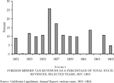
The foreign miners' tax comprised a major source of revenue to the State government for most of the period, consistently providing at least 10 percent of total state revenues from the early 1850s until 1864 (see
Figure 1).
28 California, Legislature, Annual Report, various years 1851–1865.
FIGURE 1 FOREIGN MINERS' TAX REVENUES AS A PERCENTAGE OF TOTAL STATE REVENUES, SELECTED YEARS, 1851–1865
The state's experience with levying the foreign miners' tax should be understood within the larger context of state finances during this period. From the onset of statehood in 1850, the state experienced steady and persistent deficits, with annual expenditures far outpacing revenues. In the first fiscal year ending June 1850, the state collected virtually no revenues, while spending over $350,000. By the end of 1853 the total civil debt of the state exceeded two million dollars. Immigration was causing rapid population growth, requiring the state to spend ever-increasing amounts on hospitals, prisons, legislative expenses, the court system, and other administrative expenses. Meanwhile, the state was experiencing enormous difficulties in raising revenues to match, particularly in the mining regions where the transient nature of early gold mining made it difficult to collect property and poll taxes.29
Throughout the 1850s state comptrollers regularly bemoaned the extreme difficulties associated with collecting taxes from the mining regions. See California, Legislature, Annual Report, 1854, p. 38; 1855, p. 32; 1857, p. 6; and 1861, pp. 5–6.
However, by 1857 the fiscal situation had largely stabilized due to increasing success in revenue collection and a major retrenchment in administrative expenses, and the state managed to run the smallest deficit in its brief history. In 1858 the state enjoyed its first-ever budget surplus, and from that point on the state was on reasonably firm financial footing. This secular improvement in the state's finances would play an important role in explaining political patterns of support for state policies regarding the Chinese.
30 Figures on revenues, expenditures, and debt are found in California, Legislature, Annual Reports, various years 1852 to 1858.
The second measure was legislation that more directly attempted either to limit Chinese immigration, or eliminate it altogether. In 1852 and 1853 the legislature enacted the commutation tax, which required incoming ships to post a $500 bond for each foreign passenger, ostensibly as surety against their becoming a financial burden to the state.31
“An Act Concerning Passengers arriving in the Ports of the State of California,” Chapter 36, Statutes of California (1852), pp. 78–83; “An Act to Amend an Act Entitled ‘an Act Concerning Passengers arriving in the Ports of the State of California’,” Chapter 51, Statutes of California (1853), pp. 71–73.
In practice, posting of this bond could be commuted by direct payment of anywhere from $5 to $50 per passenger, suggesting that the legislature was at least equally concerned with raising revenues to meet immediate financial needs.
32 McClain has emphasized the distributional consequences of this tax, noting that it was likely that immigrants bore the brunt of the tax burden (McClain, In Search of Equality, pp. 12–13). I would argue in addition that an important objective of the commutation provision was probably simply to raise tax revenues at a time when the state was experiencing severe financial difficulties.
In 1855 the legislature passed a law taxing arriving vessels carrying persons “incompetent … to become citizens” of the United States, at the rate of $50 per head.
33 “An Act to Discourage the Immigration to this State of Persons who cannot become Citizens thereof,” Chapter 153, Statutes of California (1855), pp. 194–95.
This
capitation tax obviously targeted Chinese immigrants. Then in 1858 the legislature, under pressure from mining localities, imposed a ban on Chinese immigration, with fines and possible imprisonment for anyone found guilty of knowingly transporting Chinese into the state.
34 “An Act to prevent the further immigration of Chinese or Mongolians to this State,”, Chapter 313, Statutes of California (1858), pp. 295–96.
This law was, however, declared unconstitutional by the state Supreme Court early the following year.
35 Alta Californian, 13 January 1859.
A CLOSER LOOK AT THE CHINESE QUESTION
Closer examination of the early experience of Chinese miners, however, reveals a more complex picture than the simple anti-Chinese one painted above. Chinese miners did undertake a considerable amount of mining and much of it under reasonably peaceful circumstances. During the 1850s the Alta Californian contains numerous stories about Chinese miners working their claims diligently and without interference.36
See, for example, Alta Californian, 13 March 1854, 29 March 1854, 30 April 1854, 7 May 1856, 5 August 1856, 15 June 1857, 8 August 1857, 13 September 1858, and 12 October 1858; see also Paul, California Gold, p. 130; and Rohrbough, Days, p. 228.
Though as we have seen, some mining district by-laws contained antiChinese provisions, the vast majority did not.
37 Heckendorn and Wilson, Miners; and U.S. Department of Interior, United States Mining Laws.
Indeed, native miners sometimes took strong positions against mistreatment or expulsion of Chinese miners from their localities. In 1859, for example, a miners' meeting in Shasta County adopted resolutions firmly opposing expulsion of Chinese miners from the county and vowing to hold accountable county officers who failed to uphold the law and protect the rights of the Chinese.
38 Alta Californian, 9 February 1859.
Given the evidence presented earlier, how do we interpret such concrete expressions of support for the Chinese presence? One explanation is simply that a substantial segment of the population possessed (perhaps altruistic) desires for justice and fair play and to uphold basic human and legal rights.39
See, for example, Alta Californian, 9 April 1858 and 9 February 1859. It should be mentioned that one may wish to take quotes from the Alta Californian as altruistic expression with a grain of salt, as during the 1850s the newspaper was strongly anti-union. See, for example, Cross, History, pp. 23–24. I am grateful to an anonymous referee for this point.
Additional evidence, however, suggests a number of economic factors were probably no less important. Contemporary accounts strongly suggest, for example, that many were concerned that exclusion of the Chinese could damage trade relations with China. Indeed, this very concern was expressed in two separate committee reports in the state assembly in 1853 and 1855.
40 See California, Legislature, Majority and Minority Reports, p. 5, and Minority Report of the Select Committee, p. 12. For more on the importance of trade relations with China, see Takaki, Strangers, p. 22; Daniels, Asian America, pp. 51–52; and Alta Californian, 13 January 1859.
In addition, some opposed exclusion on the grounds that the Chinese were a source of potentially valuable cheap labor for nonmining activities such as reclamation of farmlands in the Central Valley and construction of transportation and water delivery facilities.
41 California, Legislature, Report of Mr. Flint, p. 4. See also San Francisco Bulletin, 15 December 1856.
Finally, a commonly heard argument against exclusion during the early Gold Rush concerned its ramifications for the public finances of the state and localities. Many viewed Chinese miners as an important source of tax revenues vital to the financial stability of both the state and the counties in which they resided. In 1855, the Alta Californian asked the rhetorical question: “Are the Chinese Injuring the State?” Its answer was assuredly not, that on the contrary: “Were it not for the taxes paid by the Chinese, the credit of nearly every mining county would now be verging on bankruptcy.”42
Alta Californian, 5 November 1855.
Four years later, the Auburn Herald put it even more starkly:
Expel the Chinamen and Bankrupt the State. —We do not believe it practicable or desirable that the Chinamen shall be expelled … and we assert this upon the well-grounded conviction that the taxes at present derived from them are a necessity to the state; and therefore, any law that looks to their immediate expulsion from the mines, at the same time aims at the immediate cutting off of large revenues from the several mining counties and the State government.43
Alta Californian, 23 February 1859.
Furthermore, there was a definite sense among some in the late 1850s that driving out the foreign miners could inflict costs on other miners by making it more likely that the state legislature would be forced to tax mining claims, which were exempt from taxation after 1857. In 1859, for example, the Shasta Republican argued against expelling Chinese miners from Shasta County:
By a late decision, it has been declared clearly within the power of the Legislature to pass a law taxing mining claims, …. Drive (the Chinese out), thus de-priving (mining counties) of the heavy revenue collected from this source and see how soon a necessity for such taxation will become apparent. To choose, of two evils, the least, has, for a long time, been considered wise, and that the existence of such a law would be a greater evil to the mining class … than the presence of ‘poor John’ appears to be not likely to be denied.44
Alta Californian, 11 February 1859.
A SIMPLE MODEL OF TAXATION AND IMMIGRATION RESTRICTIONS
The preceding discussion reflects a self-inflicted dilemma faced by the state of California during the Gold Rush. By imposing a tax on Chinese miners, the state acquired a fiscal interest in the presence of a Chinese population. This meant that any political and other costs associated with a Chinese presence would have to be weighed against its fiscal benefits. Mining counties faced a similar tradeoff after 1852, when the state permitted counties to keep nearly half of all foreign miners' revenues collected.
A simple model will clarify the argument. Assume the government wishes to maximize political support among its relevant constituencies, and assume initially the absence of a foreign miners' tax. This government may be modeled as possessing the following objective function
where I is a policy regulating immigration of Chinese miners into the state, E is total expenditures by the government (which buy political support), R is total revenues (from current taxes, which inflict political costs), and B([bull ]) and C([bull ]) are political benefit and cost functions.
45 This model is an obvious extension of the fiscal model of Wallis, Sylla, and Legler, “Interaction,” pp. 123–25.
Without loss of generality, assume that
I is simply the number of Chinese miners permitted to enter the state. The state enjoys benefits and incurs costs from the presence of Chinese miners. The benefits derive from a larger consumer base, cheaper labor for agriculture, or improved trade relations with China, all of which generate tangible political benefits to the government. The costs derive from political opposition from potentially key constituencies (such as native miners). Assume both that ∂
B/∂
I > 0 and ∂
C/∂
I > 0. In this model, the government maximizes with respect to immigration by equating the marginal benefits and marginal costs, setting
I at some level
I*.
46 Being static models, neither this model nor that of Wallis, Sylla, and Legler consider dynamic impacts of immigration such as long-term fiscal impacts on government revenues and expenditures. Economists appear to be divided on the magnitude of the long-term fiscal impact of immigration, at least within the context of current U.S. immigration policy. Auerbach and Oreopoulos, “Analyzing the Fiscal Impact,” use a generational accounting model to conclude that the long-term fiscal impact of immigration is likely to be “extremely small.” However, using an overlapping generations model Storesletten, “Sustaining Fiscal Policy,” concludes that the fiscal impact of low-skilled immigrants is probably low, though the same is not true of highskilled immigrants in their prime working years. Because early mining required low-skilled labor, I would argue that this static model captures the first-order fiscal impacts of immigration that would have been considered by Gold Rush legislators.
Now consider imposing a unit tax on Chinese miners, and assume that this tax negligibly affects how much revenue the government can raise from other sources. Then revenues increase to R′ = R + tI. However, this tax adds nothing to political costs because it is imposed on a group with no voting and little other political power. The objective function of the government is then
Now the government maximizes by simultaneously choosing t and I. For any positive t, optimal I** exceeds original I* because the increased revenues permit the government to buy more political support through increased expenditures. Imposition of the tax generates a fiscal tradeoff between the stringency of the immigration policy and demand by the government for tax revenues. That is, when the government imposes this particular type of tax, it experiences political incentive to relax its immigration policy in order to enjoy added fiscal benefits.
47 In the full-blown optimization problem, the government also selects optimal t, which has not been derived here as it is not necessary for the analysis. In the market for immigrants, the market-clearing tax will equate the government's supply of immigrant slots with immigrants' demand for these slots. It is mathematically possible that the market-clearing tax rate will be zero, in which case I* = I**.
Models 1 and 1′ embody a balanced budget constraint that revenues must equal expenditures. Relaxing this constraint adds a choice variable for the government; namely, how much additional debt to assume in any given time period. How this extra degree of freedom affects optimal t and I depends upon the costs of incurring additional debt. If these costs are infinite, the government's problem reduces to model 1′ and the government chooses t and I**. However, if the costs are sufficiently low, the option of assuming debt can become attractive. Then the fiscal advantages of a taxable Chinese population decrease and optimal I falls, to I*** (< I**). Relaxing the fiscal constraint makes maintaining a Chinese population less desirable.
The analysis so far does not distinguish among the political tradeoffs confronting legislators representing different constituencies. During the Gold Rush, the most relevant distinction for our purposes was between legislators representing mining interests and their nonmining counter-parts. In terms of the model, throughout this period representatives of mining interests experienced much higher political costs from supporting Chinese immigration than did nonmining representatives. However, they would have reaped more political benefits in terms of local tax revenues after 1852, when counties began to keep half of the revenues from the foreign miners' tax. The model thus yields an ambiguous prediction regarding the relative levels of support for exclusion among mining versus nonmining representatives. As financial conditions improved over time, however, the relative tax benefits to mining representatives of supporting immigration declined and concomitantly, one would predict greater support for exclusion.
EVIDENCE FROM THE LEGISLATIVE HISTORY OF CHINESE EXCLUSION POLICIES IN GOLD RUSH CA
The Legislative Arguments Regarding Exclusion
The issue of exclusion was brought before the legislature in 1852 when Governor Bigler called on the legislature to “check this tide of Asiatic immigration” and keep them from taking gold out of the country.48
California, Legislature, Journal of the Proceedings of the Senate, p. 373.
Bigler proposed a tax on Chinese immigrants and called on Congress to prohibit Chinese contract labor from entering the country to mine for gold. The assembly referred the matter to its mining-dominated Committee on Mines and Mining Interests, which recommended “passage of a law which shall prevent our mines from being overrun by (the Chinese),” while supporting reinstatement of the foreign miners' tax, though at a lower level than previously.
49 California, Legislature, Report of the Committee on Mines, p. 831. In 1852 the seven members of the assembly Committee on Mines and Mining Interests represented Yuba, El Dorado, Placer, Mariposa, Calaveras, Nevada, and Tuolumne Counties, mining counties all.
A senate special committee dominated by nonmining interests, however, recommended the Chinese be expelled from the mines.
50 Report of Committee on the Governor's Special Message, pp. 736–37. Only one member of this committee represented a mining county(Placer), the others represented Napa/Solano, San Diego, San Francisco, and Sacramento.
The fact that the mining interest-dominated assembly committee recommended not expulsion but rather, a tax, strongly suggests that its members believed that mining counties had a financial interest in retaining their populations of foreign miners. It is also telling that the largely non-mining-dominated senate committee favored expulsion from the mines but not from the state.
51 The senate report suggests that its members were concerned about the effect wholesale expulsion might have on trade relations with China. See California, Legislature, Report of Committee on the Governor's Special Message, p. 736.
In the following 1853 session, a bill was introduced in the assembly permitting Chinese miners to be involuntarily ejected from their claims “by citizen miners … desirous and prepared to work (the claims) immediately,” upon payment of the value of any improvements made.52
California, Legislature, Majority and Minority Reports, p. 4.
This bill was reported on unfavorably by the Committee on Mines and Mining Interests, still heavily dominated by mining interests, which instead recommended that the foreign miners' license fee be increased from $3 to $4. The Committee was, however, deeply divided on the issue of exclusion, which generated a majority and two minority reports. The majority report contained a spirited defense of Chinese immigration, arguing that it bolstered expanded trade with China and that even the threat of exclusion had already damaged trade relations with China. This report added that exclusion of foreign miners was likely to damage the state financially: “If we exclude Chinamen and other foreigners from the mines of California, we lose an important part of the source from whence we might derive our revenue.”
53 Two members of the Committee, however, submitted a fierce rebuttal to the majority view, in which they argued strenuously for permitting mining localities to exclude Chinese from mining. In doing so, they downplayed the importance of trade with China and focused instead on the negative effects of Chinese immigration on “the free white labor of our State.”54
California, Legislature, Majority and Minority Reports, p. 14.
They proposed adding the following provision to the statute modifying the foreign miners' license fee:
Section 18: The provisions of this Act shall not be so construed as to prevent the Miners in any mining district from adopting and enforcing rules and regulations preventing foreigners, who, on account of their color, are ineligible to the rights of citizenship from working the mines in said mining district.55
This provision, which targeted Chinese miners, was narrowly defeated in the assembly in a 26 to 25 vote in which a majority of the representatives from mining counties voted against it. Another provision that would have simply prohibited Chinese from working in the mines was overwhelmingly defeated 31 to 10, with mining representatives opposed by a three-to-one margin.56
California, Legislature, Journal of the Assembly, 3rd session, pp. 287–88.
Taken together, these votes suggest that broadly speaking, in 1853 miners desired self-rule and the right to make their own decisions, but did not favor exclusion of Chinese miners.
Within two years, however, continued Chinese immigration had resulted in greater pressure on the state legislature to enact exclusionary legislation.57
See, for example, Mann(1982), p. 62; McClain(1994), pp. 17-18.
In early March of 1855 three separate bills were introduced in the assembly that would have prohibited Chinese from mining. These were all referred to a select committee dominated by mining representatives that reported back a bill embracing this exclusionary principle. In fact, the committee report went further, arguing that as a matter of constitutional law, the state had the right to expel the Chinese from the state altogether.
58 California, Legislature, Reports of the Select Committee, p. 6.
The report also downplayed the contention of the previous committee on the importance of liberal immigration policy in encouraging and supporting Chinese trade. All of which strongly suggests that the attitudes of mining interests regarding exclusion had changed dramatically since 1853. It should also be noted that a motion in the assembly to kill the bill was handily defeated, 51 to 14, as representatives from mining counties voted overwhelmingly against killing the bill by a better than six-to-one margin.
It is worth mentioning that S. B. Stevens, an assemblyman from Calaveras County, an important mining county, authored a minority report that strongly opposed excluding the Chinese from mining. Stevens emphasized the importance of Asian trade and the likely negative effect of exclusion on that trade. However, he also expressed concerns that lost tax revenues from exclusion of Chinese miners would likely force the state to raise taxes on other miners.59
California, Legislature, Minority Report of the Select Committee, p. 12.
In interpreting this report, two facts are important to keep in mind. First, Calaveras County had one of the largest foreign-born populations of any county in the state, both in absolute terms and as a percentage of total county population, meaning that the local loss of tax revenues from exclusion would likely have been considerable.
60 According to the 1852 census, over half of the population of Calaveras County was foreign-born, second in the state only to San Francisco County.
Second, whereas Stevens voted to kill the exclusion bill, the other two representatives from Calaveras County did not. This intracounty split suggests strong local ambivalence about the desirability of exclusion in a heavily mining-dependent region.
In any case, exclusion of the Chinese from mining never became law, as this bill was superceded by another one calling for the capitation tax referred to earlier that taxed incoming vessels $50 for every Chinese immigrant brought into the state. In enacting this tax, the legislature was drawing a key distinction between new Chinese immigrants and Chinese already present in the state. The senate committee that recommended this capitation tax downplayed its possible negative effect on trade relations with China. It was, however, highly ambivalent about expelling the existing Chinese population from the mines, arguing that the expulsion would cause problems elsewhere as the displaced Chinese miners flooded into cities and agricultural areas. Also important in the committee's view, however, was the negative impact such expulsion would have on the local finances of the mining counties:
Another consideration, entitled to some weight in the estimation of your Committee, arises from the fact, that one-half of the nett(sic) proceeds of this foreign miners' tax, is paid into the various county treasuries of the counties in which it is collected, and to abruptly take that source of revenue away from them, while many of them have heavy debts hanging over them, would be doing them injustice, and create a necessity for a very great increase of taxation, which would be burdensome upon their citizens.61
California, Legislature, Report of Mr. Flint, p. 6.
Given this fiscal reality, the committee argued that it would be better to allow the Chinese to remain until counties had their fiscal houses in order.
The capitation tax turned out to be highly controversial, and by the next year the assembly had received a number of petitions requesting reduction of the tax, which were referred to its Committee on Mines and Mining Interests. The Committee report recommended keeping the capitation tax and advanced an extensive legal and philosophical defense of the right of the state to exclude anyone it chooses, if in the best interests of the state. In response to arguments that Chinese immigration provided financial and commercial benefits to the state, it loftily retorted that “in a question of this kind we must be governed by considerations of a higher character than dollars and cents.”62
California, Legislature, Report of Committee on Mines and Mining Interests (1856), p. 11.
The legislature followed its recommendation and retained the capitation tax. The report did not explicitly address the possible effect of Chinese exclusion on tax revenues but did recommend that the action of the previous legislative session to increase the foreign miners' license fee be overturned and that it be restored to its $4 per month level. This suggests that it believed that the previously higher fee levels were having a negative effect on tax revenues, perhaps by discouraging Chinese from mining.
Finally, in 1858 the legislature passed a law prohibiting Chinese immigration and calling for fines and possible imprisonment for anyone found guilty of transporting Chinese workers into the state.63
“An Act to prevent the further immigration of Chinese or Mongolians to this State.” Chapter 313, Statutes of California (1858), pp. 295–96.
This bill was passed in the assembly 50 to 21, with representatives of the most heavily mining counties virtually unanimous in favor, while others were evenly split. In securing passage, an amendment was defeated that would have exempted eight southern and coastal counties from its operation. This amendment enjoyed unanimous support of the representatives of those eight exempted counties, indicating they fully expected to enjoy significant benefits from continued immigration of the Chinese. It should be mentioned that each of these eight counties had a relatively light foreign presence, with foreigners comprising less than 10 percent of the county population, well below the state average. The bill then went to the senate, where it passed by a narrower margin, 15 to 10, again with strong support from mining representatives.
Analysis of Exclusion Legislation
The preceding discussion indicates that legislative support for Chinese exclusion increased between the earlyand late-1850s and also strongly suggests that legislative concerns regarding the impact on the financial condition of mining counties may have tempered opposition to exclusion. I now provide more systematic evidence that corroborates this temporal trend in support for exclusion and also links local financial conditions to patterns of support for exclusion.
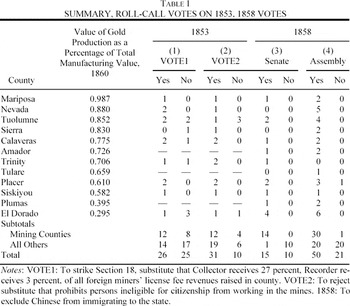
Consider first the patterns of support for Chinese exclusion in several key roll call votes in the assembly and senate in 1853 and 1858. The 1853 votes, both in the assembly, concern the two measures mentioned earlier that would have made it easier to exclude the Chinese from mining. The first is the proposed Section 18 that would have allowed mining districts to enact rules to exclude Chinese miners. The second bill would have prohibited Chinese from mining entirely. The 1858 votes are the senate and assembly votes to prohibit Chinese immigration to the state. Table 1 reports the votes on these measures among representatives of the 12 counties where mining was occurring in significant amounts. In columns 1 and 2, “Yes” votes are votes to strike or weaken exclusion in 1853. No clear pattern is apparent besides the general, largely across-the-board opposition of mining representatives to excluding the Chinese from mining.64
For the votes on VOTE1 and VOTE2, see California, Legislature, Journal of the Assembly, 3rd session, pp. 287–88.
Columns 3 and 4, however, indicate that by 1858, the attitudes of mining representatives had changed dramatically to virtual unanimity in favor of exclusion, this time from the state entirely. Had this shift not occurred, exclusion would likely not have been enacted in 1858 because nonmining assemblymen were deadlocked on, while nonmining senators were virtually unanimous against, exclusion.
A simple econometric analysis helps to understand legislative attitudes toward Chinese exclusion and why these changed over time. The basic model, applied to both the 1853 and 1858 votes, assumes that legislative support for exclusion was potentially influenced by the extent of the Chinese presence, the importance of mining, financial conditions, and stakes in the Chinese trade, all on the local level. The basic model is then
where PROB is the probability of voting for exclusion.
For the econometric analysis of the 1853 measures, VOTE1 and VOTE2 are pooled to conserve degrees of freedom, thus providing 91 observations. The dependent variable, VOTE53, equals one if a representative voted “Yes” on a given vote and equals zero if the representative voted “No.” In all cases, therefore, a “Yes” vote may be interpreted as a vote against exclusion. The Chinese presence is captured by the variable FOREIGN, defined as the total number of foreign-born male residents in a county as a percentage of total county population, based on figures in the 1852 census.65
U.S. Department of the Interior, Statistical View, p. 394. This variable obviously overstates the total number of Chinese residents. Total foreign residents is used because comprehensive county-level data on Chinese residents are not available.
The local importance of mining is captured by the variable
MINING%, defined as total value of mining production within a county as a percentage of total manufacturing value in 1860, the nearest census year for which manufacturing and mining values are available.
66 U.S. Department of the Interior, Census of Manufactures, pp. 23–36.
Stakes in the Chinese trade are captured by a dummy variable
SANFRANCISCO that equals one if the legislator represents San Francisco and zero if not. This variable captures trade stakes imperfectly as other areas of the state also had a stake in Chinese trade, but there is little doubt that San Francisco occupied a unique position in terms of expectations of trade benefits.
Comprehensive, consistent information on local financial conditions during this early period is difficult to obtain. We do know, however, the identities of those counties that had incurred debt by 1853 because such debt had to be authorized by special acts of the legislature.67
Beginning in 1852, such county-level funding acts were enacted every year by the legislature for at least the next six years.
Prior to 1853 six counties, all mining counties, had been authorized by the legislature to float bond issues: Calaveras, El Dorado, Nevada, Placer, Sierra, and Siskiyou. To capture the financial condition of a county, the dummy variable
DEBT equals one if a county had been authorized by the legislature to float a bond issue prior to 1853 and equals zero if not.
A final factor to consider is north-south sectional differences that may have affected voting behavior in the assembly. Histories and contemporary accounts have described strong differences over taxation between mining counties and counties in the southern part of the state. Southern counties complained of having to pay more than their share of property taxes because the gold mines were situated on federal public lands, which were not subject to property tax.68
See Ellison, Self-Governing Dominion, pp. 66–67; and California, Legislature, Journal of the Assembly, 3rd session, pp. 12–13.
This dispute over taxes regularly arose during the 1850s and was serious enough that by the eve of the Civil War, several southern counties favored breaking off from the rest of the state.
69 See, for example, Ellison, Self-Governing Dominion, pp. 167–91; and Caughey, California, pp. 336–37.
If foreign miners were contributing importantly to tax revenues, southern counties may have opposed excluding them from mining. To capture these sectional differences, I created a dummy variable
SOUTH that equals one for southern counties and equals zero for all other counties.
70 The southern counties are Fresno, Los Angeles, Monterey, San Bernardino, San Diego, San Joaquin, San Luis Obispo, Santa Barbara, and Santa Cruz.
Assuming a logit specification, the estimations are performed on the following model
where P is the probability of a “Yes” vote and VOTEDUMMY equals zero if the vote is on VOTE1 and equals one if on VOTE2. There are several important things to notice about this specification. First, the interaction term between DEBT and FOREIGN permits the effect of a greater foreign presence on opposition to exclusion to differ between indebted and non-indebted counties. Recalling that only mining counties had incurred debt by this time, mining counties with no debt may favor exclusion because Chinese miners competed with native miners for the gold, but their indebted counterparts may not because of greater concerns for lost tax revenues. Similarly, the interaction term between DEBT and MINING% permits support for exclusion in more heavily mining counties also to be tempered by the presence of debt.
71 It should be noted that the theoretical effect of MINING% on support for exclusion is ambiguous. In the absence of debt considerations, support for exclusion among native miners would have depended upon how intensely they competed for gold with Chinese miners. Such competition could have been more or less intense in more heavily mining-intensive counties.
Finally, the inclusion of
VOTEDUMMY permits the probability of opposition to exclusion to differ depending upon the stringency of the exclusion measure the vote would allow.
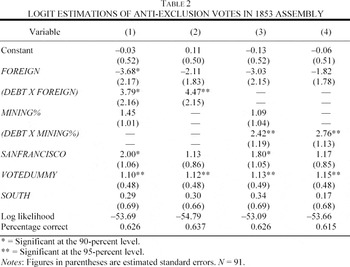
The results of logit estimations of model 3 are reported in Table 2. The problem arose that (DEBT X FOREIGN) and (DEBT X MINING%) were highly multicollinear, so that both variables were highly insignificant when included simultaneously. I therefore report the results of estimations with each included separately. The striking result is that debt seems to matter. Regarding the presence of foreigners, the results provide weak evidence that a greater foreign presence in nonindebted counties increases support for exclusion (β1 < 0), but columns 1 and 2 reveal that the same was not true among indebted counties (β1 + β2 is not significantly different from zero). In columns 3 and 4, among nonindebted counties opposition to exclusion is essentially unchanged as the local economy becomes more mining-intensive (β3 not significantly different from zero). However, among indebted counties, opposition to exclusion increased with mining intensity (β4 > 0). These findings reflect both that the costs of exclusion in terms of foregone tax revenues were higher for indebted counties and that these costs increased as these counties relied more heavily on mining in their local economies.
Finally, the result on SOUTH (β5 insignificant) indicates no systematic opposition to exclusion by southern interests. Because there is ample evidence that southern counties were aware that they were bearing a disproportionate share of state taxes even at this early stage, one possible interpretation is that they did not perceive the presence of foreign miners to be a contributing factor.72
Annual Message of the Governor, California, Legislature, Journal of the Assembly, 3rd session, p. 13. See also Ellison, Self-Governing Dominion, pp. 174–75.
The fact that the coefficient on
SANFRANCISCO is borderline significant provides weak evidence that trade interests opposed exclusion of the Chinese from mining. This variable is, however, an imprecise proxy for the stakes of California merchants in the Chinese trade, which may also explain its relative lack of significance. It is also impossible to dismiss other hypotheses, such as the concerns expressed by the 1853 senate committee that exclusion from the mines might lead to massive relocations of Chinese to other areas of the state, including cities such as San Francisco.
To understand how and why legislative attitudes towards the Chinese presence apparently changed by 1858, I now turn to the roll-call vote in the assembly on passage of the 1858 exclusion act. The dependent variable here is VOTE58, equal to one if a representative voted “Yes” and equal to zero if the representative voted “No.” The basic model is the same, though with a few subtle differences. First, improved census data in 1860 permit me to capture the Chinese presence with the actual number of Chinese, not foreign, residents. The variable is CHINESE, defined as the number of Chinese as a percentage of the total population of a county in 1860.73
U.S. Department of the Interior, Census of 1860, p. 28.
As before, support for exclusion is potentially influenced by stakes in the Chinese trade, the local importance of mining, and local indebtedness, which are again captured by SANFRANCISCO, MINING% and DEBT. In addition, I control for a structural change that occurred in 1856. The debt that had accumulated in the early 1850s occurred despite a constitutional provision limiting state debt to no more than $300,000 in total.74
Statutes of California (1850); and Constitution of the State of California, Appendix, p. IX.
The state's growing indebtedness was eventually challenged in court and in 1856 the state supreme court, in
People v. Johnson, declared this debt unconstitutional in overturning a statute that called for the state to take on more debt to build a wagon road.
75 6 Cal 499(1856). See also Nougues v. Douglass 7 Cal 65(1857), in which the Court struck down a statute calling for construction of a new State capitol.
By calling a halt to increased state debt,
People may have raised the expectation that reduced revenues resulting from exclusion would be reflected in reduced state expenditures rather than increased state debt.
76 Recall that in my model, a tightening of the balanced-budget constraint increased the short-term benefits of immigration by permitting the state to maintain or increase expenditures.
Thus, localities that stood to lose the most from reduced expenditures may have opposed exclusion. To allow for this possibility, I created the variable
SCHOOLEXP, defined as total expenditure by the state on schools in the county represented by a legislator in 1858. School expenditures were by far the largest and most important component of county-level state spending that is available from public documents. The assumption is that counties enjoying the largest state expenditures on schools could potentially be hurt the most by the loss of tax revenues attendant on Chinese exclusion, in which case the coefficient on
SCHOOLEXP is predicted to be negative.
Again assuming a logit specification, the model I estimate here is
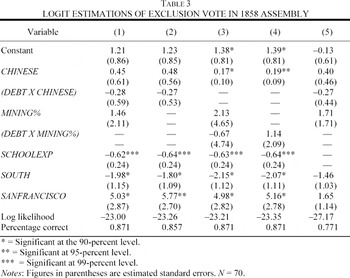
This model is virtually identical to model 3, except for the addition of SCHOOLEXP and the omission of VOTEDUMMY, which is now unnecessary. The results of a series of estimations are reported in Table 3. The most striking result is the highly significant negative coefficient on SCHOOLEXP, which indicates that localities with greater stakes in the state budget more strongly opposed exclusion, even when we control for the amount of local indebtedness. This finding is consistent with the hypothesis that exclusion was perceived to have adverse financial implications for localities, operating through the state budget. The fact that the model performs noticeably worse when SCHOOLEXP is excluded confirms its importance, and the fact that the other coefficients in the model do not improve in significance indicates that their lack of significance is not due to collinearity with SCHOOLEXP. The findings on the coefficient on CHINESE suggest that support for exclusion was moderately stronger where the Chinese presence was greater, as predicted. The relative insignificance of this coefficient when MINING% and (DEBT X CHINESE) are included in part reflects significant multicollinearity among these variables.
77 The correlation coefficient between CHINESE and MINING% is 0.54, and between CHINESE and (DEBT X CHINESE) is 0.80.
The negative coefficient on
SOUTH indicates the definite presence of the north-south rift described in the histories. The positive coefficient on
SANFRANCISCO indicates that by 1858, any additional stakes in the Chinese trade enjoyed by the city were now more than outweighed by other factors, such as competition with urban labor. Again, given that this variable is an imprecise proxy for stakes in the Chinese trade, interpretation of this result is somewhat problematic.
Finally, it is noteworthy that the coefficient on MINING% is totally insignificant. This relatively weak finding may reflect the fact that as we saw earlier, by 1858 mining had become more of a capital-intensive industrial endeavor where miners worked for companies under wage contracts. Consequently, support for exclusion among mining workers who competed with Chinese immigrants for access to gold may have been counterbalanced by opposition to exclusion among mining companies, who desired larger pools of cheaper labor. This finding is consistent with historians who have argued that employers provided a counterweight to the demands of labor to exclude the Chinese.
CONCLUSIONS
The early experiences of Chinese immigrants in Gold Rush California were shaped by a complex set of economic factors that centered on their new role as participants in the labor market for the burgeoning mining industry. No doubt native miners perceived the Chinese to be a competitive threat and engaged in various discriminatory practices designed to extract greater rents from the available gold. The perceived threat posed by the Chinese gave rise to observable public support for exclusion as early as 1852. During the early 1850s, however, political support for exclusion was mitigated by several factors including possible altruistic concerns for the rights of the Chinese, mercantile concerns that trade with China might be damaged, demands for cheap labor for nonmining endeavors such as agriculture, and the fact that Chinese miners were contributing significant amounts of tax revenues to both the state and mining counties when both were experiencing major fiscal difficulties. These factors combined to forestall exclusion for several years. By the end of the 1850s, however, continued Chinese immigration and gradual improvement in the state's finances led tax interests to favor more restrictive exclusionary policies. Even then, the fiscal consequences of exclusion were a definite source of concern, though they were not sufficient to defeat exclusion legislation. Thereafter, the intervention of the courts was necessary to ensure continued Chinese immigration.
I gratefully acknowledge generous financial support from the National Science Foundation, the American Philosophical Society, and Carleton College. This article has benefited from helpful comments by Nathan Grawe, Jenny Wahl, Gavin Wright, seminar participants at Iowa State University, and two extraordinarily helpful anonymous referees. All errors are mine.