




No CrossRef data available.
BACKCOUNTRY POTS
Published online by Cambridge University Press: 11 July 2003
Abstract
In Mesoamerica, the pottery made and used in regions peripheral to highly developed core areas is relatively plain; it is not standardized; and it has a narrow range of forms. Such pottery does not represent cultural “backwardness” or a tradition separate from that of core areas. Instead, backcountry pottery is explained by rational economic behavior of producers and consumers whose choices are constrained by location at the distant ends of dendritic or solar market systems. The literature on peasant markets provides a basis for distinguishing core versus peripheral economic behavior. Expectations for peripheral pottery are generated from this and from archaeological studies of pottery specialization. The pre-Hispanic pottery form Peñoles, a mountainous periphery of the Valley of Oaxaca, exhibits the expected characteristics. These results are limited by small sample size; more detailed studies should find a macroregional economy that is more variegated than that portrayed by the core–periphery dichotomy.
Information
- Type
- Research Article
- Information
- Copyright
- © 2003 Cambridge University Press
CORE AND PERIPHERY
A core is a concentration of massed demographic and economic power. A periphery is a zone whose lesser demographic and economic power is in some measure due to its relationship to a core. Cores usually dominate, in normal times. They exercise political and military power over peripheries and enjoy a net surplus in the flow of materials or labor vital to core interests. Mesoamerica had multiple cores, surrounded by large peripheries. Cores have received more archaeological attention; thus, the evolution of this civilization tends to be written as the evolution of its core zones (Blanton et al. 1993:222–225). But investigations in peripheral areas have shown that the aggregate demographic and political power outside traditional core zones has to be given more weight in our explanations. Study of areas outside the known cores can also demonstrate that what we previously thought of as peripheries did not always function in that way. I will not make this latter claim for Peñoles. Its role vis-à-vis the Valley of Oaxaca changed over time, as Laura Finsten (1996) has written, but it has never been central to surrounding regions as a core would be.
This is a study of one aspect of periphery–core relations, economic behavior, and, in only a minor part of material life, pottery. The article suggests that the pre-Columbian pottery in Peñoles was just that expected at the ends of solar or dendritic market systems. In other words, I show here that the pottery from Peñoles is distinctive in certain respects and that it looks the way it does because of this area's longstanding “backcountry” economic position.
I take it as given that, after the rise of urbanism, the basic Mesoamerican economy was one of market exchange. This is not to say that other forms of exchange, including tribute, did not exist, for the institution of tribute is well known. But market systems were omnipresent at the time of the Spanish Conquest and essential for daily existence. In Mesoamerica, the bulk of exchange for most goods took place through markets where buyers and sellers met and where prices were determined largely by supply and demand.
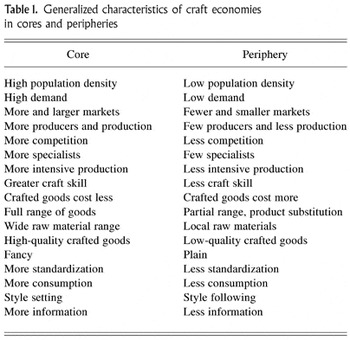
In market exchange, economic behavior is quite different in cores and peripheries. Table 1 is my compilation of core and periphery economic characteristics. These characteristics are drawn from empirical and theoretical studies of recent peasant markets and their production and exchange systems (Appleby 1985; Beals 1973, 1975; Cook and Diskin 1976; Johnson 1970; Smith 1976; Underwood 1970). Carol Smith (1976) provided the classic summary of the cross-cultural phenomenon of solar and dendritic market systems. The main feature of solar market systems is their dominance by a primary market center, which is surrounded by secondary markets. In the dendritic variant, goods and services pass along linear arrangements of markets that decrease in size toward the periphery. People at the farthest reaches of the market system have few buying and selling choices and tend to be dependent on only one nearby market. Peripheries are market-sparse in terms of market choices; cores are market-rich.
Generalized characteristics of craft economies in cores and peripheries

Peripheries tend to supply raw materials to the core, and cores in turn supply transformed goods. The economic and political power of cores, expressed in part through market dominance, tends to drive down the price of peripheral products in relation to core goods. In the periphery, imports from the core are relatively expensive, there is not much choice or competition, and transportation costs are higher.
The expected economic behavior in Table 1 applies especially to peripheries and cores of solar or dendritic market systems. These are generalized characteristics, verbal representations of the ends of a continuum, and they need to be specified for particular cases. The next section attempts to specify what would be expected for the case of pottery under the conditions of Mesoamerican market systems.
POTTERY IN CORE–PERIPHERY SYSTEMS
Several factors may be particular to how goods such as ceramics are made and distributed in core–periphery situations. Pottery is a fairly flexible good. Pots have relatively low cost. They have elastic renewal rates, being replaced infrequently to very frequently. Unit profits tend to be low (cf. Underwood 1970). Potential specialists may thus select other occupations before becoming potters. In these ways, pottery is similar to low-end textiles, but ceramics usually do not have the high-end value that cloth can have. Pots are purchased largely on the basis of visual appearance. Pots might be tapped or sounded by prospective consumers, but pottery is not tried out or tried on, like shoes. Traits of visible appearance are the most important criteria for discriminating quality, cost, function, and variety. Pottery consumers can forgo costly styles of pots in favor of simpler functionality, as consumers do with clothing. Producers and consumers of pottery thus can alter their behavior to adjust to different costs in core or periphery situations.
Basic raw materials are typically available to potters in most localities in Mesoamerica. However, preferred clays, tempers, and pigments are not uniformly distributed. Peñoles, the area of this case study, is an upland, mountainous zone of granitic and old metamorphic rock, steep slopes, very narrow canyons, and fast-moving creeks. Its clays are saprolites occurring in relatively small deposits, and the clay soils tend to be coarse rather than fine. The neighboring Valleys of Oaxaca and Nochixtlan have more extensive deposits of finer alluvial clays, as well as the upland primary clays. Upland potters in highland Oaxaca have access to local clays, but if they wish to make a very fine clay body they may have to work harder at procurement or paste preparation. Thus, there is some basis in geology as well as economics for the widespread coarse brownwares in upland situations.
Given this distribution of raw materials, the nature of pottery as an economic good, and the general economic characteristics of cores and peripheries, we can make some predictions about pottery in the core versus on the periphery of Mesoamerican market systems. First, there should be less production, less demand, and less consumption on the periphery of market systems. There should be fewer pots, fewer potters, and fewer pots and potters per capita. Production should be less intensive than in the core. Producers on the periphery are at a competitive disadvantage compared with their peers in the core in terms of access to multiple markets and numbers of consumers. Peripheral potters can take less advantage of economies of scale, and this should be reflected in their production process and their output.
Peripheries will have a narrower range of pottery goods, either as imports or as locally made products. Demand is not sufficient for peripheral potters to make a wide range of pots. The price of imported pots in the periphery is relatively high because of the greater transportation costs, the lack of economies of scale, and the monopoly dominance enjoyed by markets at the ends of dendritic chains. Transportation costs weigh against the long-distance movement of larger vessels. The range of imported offerings may be restricted to smaller pots. Local pottery is expected to be of lower quality and plainer design. Potters will invest less time and effort per pot, from procuring materials to forming, decorating, and firing.
Two additional dimensions of potting have received attention in the archaeological literature and are expected to vary with the core–periphery economic position of potters. These are variation in the degree of standardization and the degree of skill evident in the potter's work. As Cathy Lynne Costin (1991) has pointed out, the degree of standardization is influenced by quite a few factors, including economies of scale, intensity of production, the relative number of production units, competition, and efficiency in costing and marketing from both sellers and consumers. “Within the technological limits of functional necessity and the constraints created by social expectations, vessel standardization generally reflects the relative number of potters working within a particular production system” (Costin 2001:213). Potters will share more information if they work near one another. Larger-scale or more intensive potting enterprises encourage more routine in the production process and may discourage idiosyncratic behavior.
Closely related to standardization, but not quite the same thing, is skill. “[A]rtisans who spend more time at their work, and those who work without significant hiatus, are expected to be more competent at their tasks because of increased repetition and experience” (Costin 2001:217). Costin measured skill by the degree of consistency in vessel-wall thickness and the presence or absence of “firing cores.” It should be clear that skill in this sense is only that manifest in the product at hand, not a general valuation of a potter's or a production unit's whole work or real capacity, for there is no doubt that a skilled potter could turn out both shoddy and finely crafted goods, depending on the target market.
Finally, I expect that peripheries tend to copy core styles, especially in gross visual appearance. Core producers and markets are likely to set trends. As with low-end textiles, it is fairly easy for peripheral pottery specialists to copy the general appearance of pottery made by others, even though the materials and technology employed may not be identical. For example, peripheral Pueblo II potters in northeastern Arizona “were able to manipulate local materials to produce reasonable facsimiles of almost any Anasazi or Mogollon pottery type from the surrounding regions” (Hays-Gilpin and van Hartesveldt 1998:194). In low-demand situations it is not worth a potter's time to copy high-end products or to bother with exact replicas. Consumers in the periphery can make infrequent trips to a distant central market to acquire the occasional high-end piece, and these infrequent trips will undercut peripheral potters' ability to produce high-end products for local consumption.
Especially in archaeological cases there are caveats about this principle of peripheries copying core styles. Frequently it is not known where a style originated and what is the original and what is the copy. It is often assumed that the area of greatest abundance and elaboration is the originator. Cores receive the earliest archaeological attention and are the first described in the literature, but this of course does not necessarily mean that core ceramics are not copies.
Likewise, peripheries may reproduce and elaborate distinctive styles that are valued and preserved in core and periphery alike—for example, the hundreds of locally specific cheeses and wines in modern France (Planhol and Claval 1994). Peripheries may develop distinctive styles marking micro-ethnic groups, as with locally produced textiles in Middle America and the Balkans (Cordry and Cordry 1968; Wobst 1977). In solar and dendritic systems, especially where there are primate centers dominating extensive peripheries, exchange at the periphery tends to run vertically back and forth toward the center rather than horizontally among neighboring groups on the periphery. Relations among peripheral groups are often competitive, a situation that may not be discouraged by the primate center. The clothing distinctiveness of ethnic groups in Mexico and the Balkans is consistent with their intergroup competition and peripheral political and economic position. Dress, however, is a more mobile display medium than pottery. Textiles can translate family labor into ethnic messages better than ceramics. Peripheries may develop distinctive styles of their own in some media, but pottery, I think, is a less likely channel for sending ethnic messages in a market system. (Highly crafted polychrome pictorial pieces, distinctive to place and made by specialists attached to noble houses, are a different phenomenon.)
PEÑOLES: A PERIPHERY
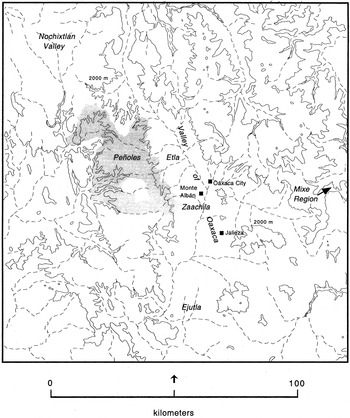
“Peñoles” (Figure 1) is our term (based on a sixteenth-century name for a set of villages in the region's center) for an approximately 1,000 km2 sierra region adjoining the western side of the Valley of Oaxaca. It is completely mountainous and is separated from the valley by an agriculturally forbidding and never much occupied mountain divide. The western side of this divide, the heart of Peñoles, is a land of narrow ridges and V-shape canyons. The northwest gradually opens out onto the foothills of the Nochixtlan Valley. To the west, the terrain becomes even more rugged and forbidding. Maize yields in Peñoles tend to be low compared with those of the lower-lying valleys (Garvin 1994). The traditional ways to make cash income have been emigration and trade in mountain products (flowers, tree fruits, agave products, firewood, charcoal, and lumber) (Garvin 1994). Today, travel by foot from the populated areas on the western side of the divide to the markets in the valley takes ten or twelve hours.

Central Oaxaca from the Nochixtlan Valley to the eastern Valley of Oaxaca, showing places discussed in the text.
In 1990, our project, directed by Laura Finsten, carried out a systematic survey of the Peñoles region, finding some 545 sites, many of which are quite extensive and have excellent preservation of architectural remains. The information from this project suggests that Peñoles has always been peripheral to the Valley of Oaxaca and, in part, to the Nochixtlan Valley. It was slow to be occupied by sedentary villagers. The first good evidence of sedentary villages comes from Late Formative times. Terminal Formative and Early Classic sites are infrequent and small (Finsten 1996). Richard Garvin (1994:Chapter 6) has proposed that maize farming at the high elevations of Peñoles was too unproductive for much settlement until higher-yielding maize varieties were developed in Classic and Postclassic times.
Population and numbers of settlements increased in the Late Classic and peaked in the Postclassic period. Population densities were lower than those of the core regions. Nevertheless, the Postclassic kingdom centered on Itzcuintepec Peñoles had a population of 5,000 to 15,000. In colonial and recent times, Peñoles has been at the political fringes of the Etla, Zaachila, and Nochixtlan districts. The market orientation is toward the valley plazas of Oaxaca City or Zaachila, except for the northwestern edge, which has more to do with Nochixtlan. Finsten has shown that in many ways, Peñoles had its own internal development, not like that of either the Nochixtlan Valley or the Valley of Oaxaca. Yet in the main, the region was dominated from the outside, economically and politically, although the kind of domination changed over time (Finsten 1996).
THE POTTERY SAMPLE
The Peñoles project collected ceramics by the usual procedures for regional surveys in highland Mesoamerica. The main purpose for collecting was to date occupations, but we also wanted to make preliminary interpretations about economy and ceramic spheres. Our survey provided information about the dating of most site occupations and about the distribution of common ceramic types and wares. More in-depth studies will require larger, systematic collections. In addition to the usual tension that we feel in the field between the goals of regional coverage versus studying sites in more depth, this survey gave us three new problems: (1) Potsherds were not as abundant as in the valleys; (2) leaf litter and erosion meant that visible sherds were spottily distributed; and (3) a common disposal pattern was to throw refuse downslope. Therefore, our sampling strategy was sometimes a matter of ferreting out scarce artifacts. Where artifacts were relatively abundant, we collected temporally diagnostic sherds that were roughly representative of types and wares. We also made collections where the material was a good representation of special activities. Where sherds were scarce, we picked up everything we could find. We searched for the refuse toss zones. The actual collections are only a small fraction of the artifacts inspected, but it is the detailed lab study of collections that forms the basis of this paper.
We took 334 surface collections, which provide good overall coverage of the region. But a significant limitation of the collections is their small size. The total is only 4,475 sherds, a mean of 13 sherds per collection. The small numbers and the lack of a systematic collecting design preclude quantitative treatment beyond presence and absence. However, the collection procedures are probably biased against the hypothesis of peripheral economic behavior. Our collections favor decorated, temporally diagnostic sherds, not the plain wares and odd examples expected in the peripheral-economy hypothesis.
The present study does not explore change in core–periphery economic relationships over time. Most Peñoles settlement dates to the Classic period, and especially to the Postclassic period. Distinguishing differences in ceramic economy within or between these broad periods is not possible at present. As discussed later, one of the features of the Peñoles assemblages is the relatively high frequency of temporally undiagnostic sherds.
RESULTS: PEÑOLES POTTERY IS PERIPHERAL POTTERY
Given the limitations of sample size, the survey collections nevertheless tend to exhibit the characteristics discussed earlier for producer and consumer behavior at the ends of a market system.
Fewer Pots
Without excavations and controlled samples, it is impossible to assess rates of pottery consumption per household. Here I must substitute my impressionistic judgment, which is that Peñoles inhabitants consumed less pottery. In addition to economic differences, there are other reasons that we saw less pottery. Pine-duff and oak-leaf litter sometimes obscured the ground surface. The steep slopes and thin soils over most of the area could mean that refuse tended to move downslope, away from habitation areas. Some of the settlements may have had relatively short occupations. All of these factors may reduce the number of sherds we saw without there being any difference in the rate of consumption. However, there are many sites where none of these conditions applied, sites with deeper soils, intact residential terraces, good ground visibility, and long-term occupations. These sites did not have the sherd densities of similar sites in the neighboring valleys. Recently plowed single domestic units had relatively few ceramic artifacts compared with similar situations in the adjacent valleys.
Narrower Range of Goods
One indicator of the range of goods is the number of types, defined in the Valley of Oaxaca by general vessel forms, specific shape modes, and modes of decoration. Ceramic types in this sense reflect both vessel function and stylistic variation. For present purposes, this measure of the range of goods is less than perfect, because for any collection the number of types present will be strongly influenced by sample size, unsystematic collecting, and a typology that is not uniform across wares or time periods. Instead of using the number of types per collection, I counted the total number of types for all the Peñoles collections and compared this total number with the comparable number from our surveys in the Valley of Oaxaca, where we had used the same typology. We used 70 types for the Peñoles collections versus 223 in the Valley of Oaxaca (Kowalewski et al. 1978; Kowalewski et al. 1989:2:825–828). Since Peñoles was not occupied in the Early and Middle Formative periods, we might subtract the roughly 75 types of those periods from the Valley of Oaxaca total, leaving 148. The difference, about 2:1, is striking, especially because Peñoles in theory could draw on both Nochixtlan and Valley of Oaxaca pottery stores. Product substitutions, including gourds, wooden bowls, and baskets, might have filled gaps. Also, Peñoles has fewer special items such as figurines and urns and none of the ollitas common in Nochixtlan.
Copying Core Fashions
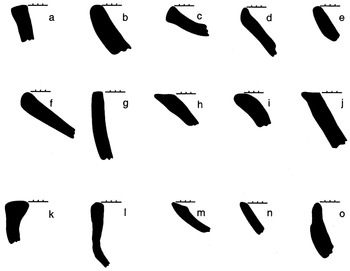
Technical provenience studies have yet to be carried out, but on macroscopic grounds most Peñoles ceramics are local. A much smaller proportion is imported. Most pottery, whether local or imported, was fashioned in the Valley of Oaxaca tradition (Caso et al. 1967). Valley of Oaxaca types and wares were in use all the way to the western boundary of Peñoles. These include gris cremosa; crema; G-35 and its related gray-ware forms; and the low, differentially fired, composite silhouette bowl, which was the most common serving bowl type in Peñoles and the adjacent Etla and Central parts of the Valley of Oaxaca in the Postclassic period. Toward the northwest we found pottery similar but not identical to some of the Nochixtlan types (Spores 1972), as in Figure 2o. Postclassic ritual objects such as braziers are in the Nochixtlan style. We recognized only a handful of types in the Peñoles collections not known elsewhere.

Selected rim profiles of bowls from Peñoles emphasizing “non-standard” treatments. Scale bar is 1 cm. (a) ET-SMP-CA-4 T. 11, café, cylindrical, exterior barely smoothed, M.A. V; (b) ET-SMP-SP-1 C.A. A, café, hemispherical, M.A. V; (c) NO-SAN-SAN-100 C.A. B, café, hemispherical, thickened rim, Classic or Postclassic; (d) ET-SMP-SMP-11 T. 48, 49, W. 6, sandy cream, hemispherical, M.A. IIIB-IV; (e) ET-STM-STM-102 C.A.1, sandy cream (fine), outleaned, bolstered rim, M.A. IIIB-IV; (f) ET-SMP-SMP-7 C.A. E, brown sandy cream, outleaned, thickened rim, period unknown; (g) ZAA-SMP-SMP-13 C.A. B, brown sandy cream, hemispherical, burnished, black slip, M.A. IV?; (h) ET-SMP-SMT-1 C.A. A, gris cremosa, outleaned, thickened and flattened rim, period unknown; (i) ET-SMP-SCE-1 T. 5-17, gris, outflaring, thickened rim, M.A. I-II?; (j) ET-SMP-SCE-1 T. 18, gris, outleaned, flattened rim, period unknown; (k) ZAA-SMP-SMP-1 C.A. H, gris, hemispherical, thickened rim, M.A. IIIB-IV; (l) NO-SDN-EO-4 Gen. Coll., G3M, composite silhouette, thick, M.A. V; (m) NO-SAN-SAN-100 C.A. B, G3M, hemispherical, flattened and pointed rim, M.A. V; (n) NO-SAN-SAN-22 Gen. Coll., G3M, hemispherical, flattened and pointed rim, M.A. V; (o) NO-SIZ-RZ-5, Zaragoza (cf. Nochixtlan gray and cream shapes), hemispherical, M.A. V.
The visible characteristics of surface finishes and vessel shapes are often shared with the core regions. In Peñoles, the walls of serving bowls tend to be flaring in the Terminal Formative and Early Classic and straight and outleaned in the Late Classic–Epiclassic, just as in the core regions. In both regions, Late and Terminal Formative and Early Classic exterior bowl surfaces tend to be scraped, and in the Late Classic and Epiclassic these surfaces are left plain or rough. Postclassic bowl exteriors are burnished in Peñoles and in the adjacent valleys.
In many cases the visible surface appearance is that of the Valley of Oaxaca types, but the pastes are variant and local. For example, three bowls from a domestic collection (from the site ET-SMP-SMT-2, terraces T2-4) were made with a paste like a Valley of Oaxaca crema, but the temper is all quartz instead of the Valley of Oaxaca crema's characteristic opaque white chunks. Another example is an outleaned wall bowl, the exterior spalled or kiln-wasted, the rim scalloped, with two or three incised lines in the style of a G-12 (from ET-SMP-SMT-10, T1-11). This vessel looks like a Valley of Oaxaca crema from the outside, but the paste is a local brown sandy cream. Such cases suggest that consumers expected pots to conform visually to core-region pottery known to them.
Lower Quality and Plainer Design
Lower quality here means less input per pot. Peñoles ceramics have less decoration than the pottery from the adjacent valleys. Plastic decoration, painting, appendages, and appliqués are rare. It is my impression that less time was spent on such activities as winnowing, levigating, and burnishing.
A few rare collections have specific similarities and quality comparable to costly vessels from the Valley of Oaxaca, as at sites along the route that follows the continental divide between Nochixtlan and the Valley of Oaxaca. Collections from a few of the top political centers of the Classic period have vessels of comparable time input as those from the Valley of Oaxaca at similar sites. A Postclassic collection (from ET-SMP-SMP-6 C.A. A) has costly graphite- and red-painted bowls, highly burnished fine cream and G-3M bowls, and a greater than usual variety of forms, including a decorated brazier or sahumador (many of these were made on local pastes). Such assemblages of high-quality pottery, whether imported or local, are the exception to the general rule of low input per pot.
Non-intensive Production
We found no pottery-production sites. Such places are fairly common in the Valley of Oaxaca. We found no localities with uncommonly high densities of specific wares or types, which can sometimes signal proximity to workshops. I conclude that the intensity of production was low, and the scale of production was small.
Could each household have made its own pottery? Household-only potting, with little or no specialization, seems doubtful during Classic and Postclassic times. The Peñoles settlement density was less than that of the Valley of Oaxaca, but it was still substantial. If thousands of households made their own pots, this should have increased the chances of our finding remnants of production. That we did not suggests that localized specialists were working fairly non-intensively and on a small scale.
Less Standardization
Pastes are quite variable. Peñoles has the main paste wares recognized in the Valley of Oaxaca (gris, café, crema, gris cremosa), a sandy cream like Nochixtlan, a local brown sandy cream, and minority, unidentified pastes.
Within paste wares, extraordinary proportions of sherds do not fall into established types or new types we recognized for Peñoles. “Types” here are defined as consistently occurring clusters of traits. Examples of known types are fine combed bottom bowls, G3-M hemispherical bowls, and a new type, a “Peras cajete,” which is a distinctive flaring-rim bowl with a scraped exterior. “Untyped” sherds represent plain, generic vessels of little diagnostic value or sherds with sets of traits that do not cluster consistently. For the five most common wares in Peñoles, more than three-fourths of café sherds are not classified into types. Two-thirds of the sandy creams and half the gray and gris cremosas are untyped. Of the Postclassic-period thin, hard gray ware (G3-M) sherds, almost a quarter do not fit the well-known types.
Less Skillful Execution
Color differences on surfaces and in cross-sections are evidence of variation in the temperature, oxygen exposure, and duration of firing. The Peñoles ceramics show considerable variation in firing. Unpatterned fire clouding is common (apart from the patterned differential firing characteristic of some types). The colors of cross-sections are likewise variable, suggesting different fuels, temperatures, or ventilation from one firing episode to the next, for different vessels in the same firing, or varying conditions for different parts of the same vessel. It is uncertain whether Peñoles potters fired in the open or in kilns.
Other clues about skill come from traits that suggest shortcuts in forming and finishing. The reinforced rim, in which excess clay at the rim is simply folded over, is one such shortcut (Figure 2e); likewise, thickened rims may also indicate non-standard treatment (Figure 2c, f, i, k). Flattened rims can also be a labor-saving shortcut: The potter simply cuts off excess clay and does not bother to shape a lip (Figure 2h, j, m, n). The collections contain many reinforced, rolled, and flattened rims. Vessels out of round, and simple, idiosyncratically modeled figurines are other examples of less skillful potting.
Some assemblages have especially non-standard vessel shapes, surface finishes, and firing traits. One collection from the Peñoles eastern fringe (ZAA-SIM-SIM-1) included three bowls (on three different pastes) with flat rims and a chilmolero made atypically on brown sandy cream paste. Another collection (from ET-SMP-CDH-15) with local café ware has a bowl with a wavy, imperfect rim, and another bowl with a rolled-over rim. A collection from six adjacent, contemporary terraces (NO-SDN-SDN-19 T. 1-6) has nineteen sherds split among five paste types, with a few fairly standard differentially fired composite silhouette bowls and other Postclassic bowl shapes. The rest are thick, crude, non-standardized utility wares. Out of ten sherds in another collection (from NO-SDN-OA-24) all but one (a standard G-3M bowl) have atypical or low-skill pastes, firing, and shapes, including a café rim so wavy that we could not discern the vessel form.
COMPARISONS AND CONCLUSIONS
In sum, the Peñoles surface collections, small and biased as they are toward recovering diagnostic sherds, have suggestive evidence bearing on conditions of production, distribution, and consumption. Peñoles apparently made and consumed less pottery, had fewer types, and had a narrower range of goods. Potters copied core fashions but in a cost-conscious way that emphasized the general visual appearance of vessels. Ceramics were plain and were made with fewer production steps than in the core region. Local production seems to have been non-intensive, with few specialists who worked with less competition, a condition that promoted less standardization and less skillful execution. Potters may not have fired as often as did their valley counterparts. All of these features meet the expectations for market behavior at the distant ends of regional market systems.
The Peñoles ceramics are hardly unique in Mesoamerica. The “backcountry” look of the pottery is probably common in peripheral areas. Prudence Rice and Don Rice (1979:23) describe the pottery from the savannas of the central Petén in these succinct words: “[T]he artifacts … were not rich in either quantity or quality. Pottery fragments, for example, were sparse and generally poorly made. This scarcity may be because a large number of utensils and containers were made of perishable materials such as wood or gourds.”
The economy in central Oaxaca was more complicated and varied than the core–periphery dichotomy that I have emphasized thus far. A broader perspective on the Peñoles backcountry is provided by ceramic studies from the Valley of Oaxaca and from Ejutla.
Jalieza, a major population and craft-production center, as well as a well-connected market center, might be a benchmark for ceramic standardization in the core Valley of Oaxaca. Jalieza should represent the more uniform end of the production range. In studies elsewhere, rim diameters and vessel-wall thicknesses have been used to gauge standardization and uniformity in pottery production (e.g., Allen 1992). Similarly, Finsten (1995:46–54) measured thousands of bowls, jars, and comals from Early Classic and Early Postclassic Jalieza. She speaks of the “remarkable homogeneity” and “astonishing degree of similarity in average rim thickness” in the Jalieza assemblages (Finsten 1995:52, 54). (Coefficients of variation—original measurements in millimeters and statistics reported in centimeters to two decimal places—for rim thicknesses for Early Classic assemblages range only between .13 and .24 for high-quality serving bowls; .24 and .38 for utilitarian bowls; .26 to .37 for jars; and .09 to .2 for comals. For Early Postclassic assemblages, the coefficient ranges are .16 to .25 for high-quality serving bowls; .27 to .44 for utilitarian bowls; .28 to .36 for jars; and .07 to .35 for comals.)
There is also a tendency at Jalieza for the Early Classic pottery to be slightly more uniform than the Early Postclassic pottery. Coefficients of variation for the Early Classic collections are somewhat lower than their Early Postclassic counterparts. This is consistent with the Valley of Oaxaca Settlement Pattern Project's conclusion that there was greater market integration in the Early Classic than in the Early Postclassic.
Unfortunately, there is no corpus of measurements for Peñoles pottery to compare with Valley of Oaxaca assemblages. Having studied collections from both areas, it is my impression that Peñoles pottery is less uniform in such physical traits as rim diameter and wall thickness, but this remains to be tested with adequate samples.
Ejutla, adjoining the Valley of Oaxaca proper to the south, is considered part of the central valleys (Figure 1). It is mostly piedmont, not mountainous like Peñoles. Over its history, this region has been an economic and political periphery of the core Valley of Oaxaca. Ejutla had a ceramic economy that in some ways was similar to that of Peñoles. The Ejutla region was surveyed by Gary Feinman and Linda Nicholas, who then carried out excavations at a Classic-period domestic unit where pottery was made. They compared the pottery of Ejutla with that of the Valley of Oaxaca, concluding that Ejutla's ceramics tended to be plainer and less temporally diagnostic. Pottery was made by specialists in Ejutla and in the Valley of Oaxaca, but manufacture was less intense in Ejutla and less standardized. Feinman and Nicholas (2001) inferred less competition among potters in Ejutla than in the main part of the Valley of Oaxaca.
Pottery manufacture in Ejutla probably was more intensive than in Peñoles. Feinman and Nicholas were able to come up with direct archaeological evidence of pottery making, from the surface and from excavations, which uncovered a pit-firing facility. So far, pottery production in Peñoles lies below that level of visibility.
Within the core Valley of Oaxaca there is also evidence of regional differences in the intensity of ceramic production. A study by Gary Feinman, Stephen Kowalewski, Sherman Banker, and Linda Nicholas (1992) draws on surface collections from systematic survey, a locational analysis of pottery and other craft production places, re-firing experiments, and eighty-eight petrographic thin sections of representative sherds. The study helps demonstrate that there was a continuum in regional ceramic economies that depended on the degree of market commercialization. In the Valley of Oaxaca during the Postclassic period, the Tlacolula region was the most commercialized and market-dependent. That conclusion is based on Tlacolula's higher incidence of all types of craft production, land-use analysis showing higher dependence on food exchange, and the density of large central places (Kowalewski et al. 1989:348–364; Nicholas 1989:482–503). In its ceramic economy, Tlacolula shows more standardization in paste composition compared with other parts of the valley. Likewise, its pottery tended to be more uniformly fired at a time that preferences were for high-temperature firing. Tlacolula-made serving bowls were made in a shape more easily transported than the most common bowls of other districts in the Valley of Oaxaca.
These studies provide a perspective showing that Peñoles pottery was part of a larger economy. It was not a separate tradition. At any one time, the conditions of production and consumption varied from market-rich locations such as Jalieza and Tlacolula to market-poor areas such as Peñoles, with Ejutla somewhere in between. This variegated economy in central Oaxaca, of course, changed over time. Previous investigations have described how the Classic-period economy was centralized and tied to the state; the Postclassic economy was more commercialized and operated to a greater degree apart from state institutions. How these changes over time played out in peripheral areas such as Peñoles is currently unknown.
Finally, as Feinman and Nicholas (2001) have pointed out, the plainness and non-standard character of ceramics in peripheral areas have a pernicious influence on the ability of archaeologists to use ceramics for dating. It may appear to us that older types persist on the periphery as the core moves into newer fashions. However, lest one conclude prematurely that people in adjacent regions can be out of ceramic synchrony for centuries, an economic interpretation would allow peripheral potters and consumers to forgo more costly pots (the archaeologist's best markers) in favor of plainer, more generic vessels that would tend to persist for long periods of time in both core and peripheral regions. The copying of core styles would be more common when open exchange puts peripheral inhabitants in contact with core markets, and less common when, for whatever reason, markets are weaker and less integrated. The most likely time for such a weakening of markets would have been the Epiclassic period, which for archaeologists in Oaxaca happens to be the most intractable time period for chronological refinement. Deborah Nichols, Elizabeth Brumfiel, Hector Neff, Mary Hodge, Thomas Charleton, and Michael Glascock (2002) have reached a similar conclusion about lesser market integration and ceramic style confinement for the Epiclassic Basin of Mexico.
RESUMEN
En las regiones apartadas es común que se presente una alferería reducida en formas, sencilla en decoración, más tosca que fina, y aparentamente baja en calidad artesanal. Este artículo ofrece una explicación basada no en el atraso cultural, sino en la acción racional de productores y consumidores en el ambiente económico de los márgenes o términos de sistemas de mercado (tianguis).
Estudios de los mercados campesinos de Mesomérica y otras regiones del mundo han demostrado definidas regularidades en la acción de pequeños productores y consumidores, según su posición respecto a las plazas mayores del sistema, o en las periferias, donde las plazas son pequeñas y poco frecuentes (Smith 1976). Los consumidores localizados en el centro de estos sistemas regionales, tienen acceso a múltiples plazas y aprovechan las ventajas que trae la competencia entre numerosos productores y vendedores. En cambio, las personas en los márgenes no tienen acceso a la misma variedad de mercados y están sujetas a los precios dictados por monopolios; también los pequeños productores en las zonas apartadas no pueden sostener una especialización intensiva a causa de la poca demanda y la competencia procedente del núcleo del sistema regional de mercado.
Las condiciones económicas en las periferias de los sistemas de mercado implican definidas consecuencias para la alferería. Se espera una cantidad menor de producción y consumo de vasijas de cerámica, un rango de productos restringuido, la sustitución de productos (por ejemplo, vasijas de madera o de calabaza en vez de vasijas de barro), una escala e intensividad de producción reducida, una menor capacidad en cuanto a la forma, cocción, y acabado de las vasijas, un menor inversión de tiempo, labor, y materiales, diseños sencillos, y la imitación de los estilos de los centros urbanos. Los estudios arqueológicos previos se han enfocado en la identificación arqueológica de la especialización, sobre todo en los centros mayores. El presente estudio incorpora las mismas medidas de la cerámica (e.g., Costin 2001) pero se dirige al lado opuesto del contínuo de la especialización.
Este es un estudio del caso de la cerámica precolumbina de los Peñoles, una región montañosa y marginal entre los Valles Centrales de Oaxaca y el Valle de Nochixtlan. Tanto en tiempos modernos como en la época pre-Hispanica, los Peñoles ha sido una zona de abastecimiento de productos serranos—frutas de árboles, flores, madera, leña, carbon y minerales. El potencial para la intensificación agrícola es más limitada que en los valles mayores pero se ha practicado un sistema de riego a zanja utilizando los numerosos ojos de agua.
El recorrido arqueológico sistemático de los Peñoles, dirigido por Laura Finsten en 1990, registró aproximadamente 545 sitios arqueológicos, entre los cuales predominan las ocupaciones del período cláscio y, en mayor cantidad y extensión, las ocupaciones del período postclásico. Se hicieron 334 colecciones de superficie; sin embargo la muestra es pequeña, de sólo 4,475 tiestos en total. El tamaño reducido de la muestra y la falta de control estadístico en el método de muestreo restringe el estátus lógico de las interpretaciones, que se ofrecen como hipóteses para esta investigación específica.
La cerámica de los Peñoles es consistente con las expectivas del modelo económico. Parece que la cantidad de las vasijas es menor que la de los valles adyacentes. El número de tipos de cerámica es menor. A simple vista las vasijas parecen semejantes a los tipos de las zonas nucleares, aunque los barros y los detalles tecnológicos son distintos y variables. Hay gran variabilidad en los barros y en la cocción de vasijas. En diseño y acabado, la cerámica de Peñoles demuestra la sencilléz y un menor grado de inversión de tiempo y materiales como se espera. La decoración es mínima. La falta de indicios de la producción de cerámica, en comparación con los Valles Centrales donde se han encontrado muchos sitios de alfarería, se interpreta como un régimen de producción no intensivo y de baja escala. Las colecciones cerámicas de Peñoles sugieren un grado menor en cuanto a la estandardización y la destreza artesanal que los valles circundantes.
Esto no quiere decir que no se encuentra vasijas semejantes de baja calidad en los centros mayores. Es cierto que productos baratos se vendían en todos los mercados. Pero la tésis de este estudio es que por lo general la cerámica de las zonas periféricas de los sistemas de mercado tiende a ser más sencilla debido a la especialización no intensiva.
ACKNOWLEDGMENTS
The original version of this paper was presented at the symposium “A Culbert Festival, Part I: Containing Culture,” organized by K. Anne Pyburn and Patti Cook, at the 65th Annual Meeting of the Society for American Archaeology, Philadelphia, April 2000. I thank Gary Feinman, Laura Finsten, Verónica Pérez Rodríguez, Charlotte A. Smith, and several anonymous reviewers for their contributions to the paper. The Peñoles project was funded by the Canadian Social Science and Humanities Research Council, the National Science Foundation, and the National Geographic Society, and authorized by the Instituto Nacional de Antropología e Historia (INAH) and its Centro INAH Oaxaca. While I was a student, T. Patrick Culbert taught me that a half-million sherds was approaching an adequate sample size for understanding a Mesoamerican ceramic sequence. This paper violates his principle by two orders of magnitude.
References
REFERENCES
Allen, Kathleen M.S.
1992
Iroquois Ceramic Production: A Case Study of Household-Level
Organization. In
Ceramic Production and Distribution: An Integrated Approach,
edited by
G. Bey and
C. Poole, pp.
133–154.
Westview Press,
Boulder, CO.
Appleby, Gordon
1985
Marketplace Development in the Gambia River Basin. In
Markets and Marketing, edited by
Stuart Plattner, pp.
79–97.
University Press of America and Society for Economic Anthropology,
Lanham, MD.
Beals, Ralph L.
1973
Ethnology of the Western Mixe.
Cooper Square,
New York.
Beals, Ralph L.
1975
The Peasant Marketing System of Oaxaca, Mexico.
University of California Press,
Berkeley.
Blanton, Richard E.,
Stephen A. Kowalewski,
Gary Feinman, and
Laura Finsten
1993
Ancient Mesoamerica: A Comparison of Change in Three Regions.
2nd ed.
Cambridge University Press,
Cambridge.
Caso, Alfonso,
Ignacio Bernal, and
Jorge R. Acosta
1967
La Cerámica de Monte Albán. Memorias 13.
Instituto Nacional de Antropología e Historia,
México, DF.
Cook, Scott, and
Martin Diskin (editors)
1976
Markets in Oaxaca.
University of Texas Press,
Austin.
Cordry, Donald, and
Dorothy Cordry
1968
Mexican Indian Costumes.
University of Texas Press,
Austin.
Costin, Cathy Lynne
1991
Craft Specialization: Issues in Defining, Documenting, and
Explaining the Organization of Production. In
Archaeological Method and Theory, vol. 3, edited by
Michael B. Schiffer, pp.
1–56.
University of Arizona Press,
Tucson.
Costin, Cathy Lynne
2001
Production and Exchange of Ceramics. In
Empire and Domestic Economy, edited by
Terence N. D'Altroy,
Christine A. Hastorf, and
Associates, pp.
203–242.
Kluwer Academic/Plenum,
New York.
Feinman, Gary M., and
Linda M. Nicholas
2001
The Production of Pottery in Ejutla: Reflections on the
Classic-Period Ceramic Complex for the Valley of Oaxaca from a
Specialized Manufacturing Context. In
Memoria de la primera mesa redonda de Monte Albán: Procesos
de cambio y conceptualización del tiempo, edited by
Nelly M. Robles García, pp.
129–146.
Instituto Nacional de Antropología e Historia,
México, DF.
Feinman, Gary M.,
Stephen A. Kowalewski,
Sherman Banker, and
Linda Nicholas
1992
Production and Distribution in Late Postclassic Oaxaca: Stylistic
and Petrographic Perspectives. In
Ceramic Production and Distribution: An Integrated Approach,
edited by
G. Bey and
C. Poole, pp.
235–259.
Westview Press,
Boulder, CO.
Finsten, Laura
1995
Jalieza, Oaxaca: Activity Specialization at a Hilltop Center. Publications in Anthropology No. 48.
Department of Anthropology, Vanderbilt University,
Nashville, TN.
Finsten, Laura
1996
Periphery and Frontier in Southern Mexico: The Mixtec Sierra in
Highland Oaxaca. In
Pre-Columbian World Systems, edited by
Peter N. Peregrine and
Gary M. Feinman, pp.
77–96.
Prehistory Press,
Madison, WI.
Garvin, Richard D.
1994
Modern and Pre-Hispanic Agriculture in the Sierra Mixteca, Oaxaca,
Mexico.
Ph.D. dissertation,
Department of Archaeology, University of Calgary,
Alberta.
Hays-Gilpin, Kelly, and
Eric van Hartesveldt
1998
Prehistoric Ceramics of the Puerco Valley: The 1995
Chambers-Sanders Trust Lands Ceramic Conference.
Ceramic Series No. 7.
Museum of Northern Arizona,
Flagstaff.
Johnson, E.A.J.
1970
The Organization of Space in Developing Countries.
Harvard University Press,
Cambridge, MA.
Kowalewski, Stephen A.,
Charles Spencer, and
Elsa Redmond
1978
Ceramic Appendix. In
Monte Albán: Settlement Patterns at the Ancient Zapotec
Capital, by
Richard E. Blanton, pp.
167–193.
Academic Press,
New York.
Kowalewski, Stephen A.,
Gary Feinman,
Laura Finsten,
Richard E. Blanton, and
Linda Nicholas
1989
Monte Albán's Hinterland, Part II: Pre-Hispanic
Settlement Patterns in Tlacolula, Etla, and Ocotlán, the Valley
of Oaxaca, Mexico. 2 vols.
Museum of Anthropology Memoir No. 23.
University of Michigan,
Ann Arbor.
Nicholas, Linda M.
1989
Land Use in Pre-Hispanic Oaxaca. In
Monte Albán's Hinterland, Part II: Pre-Hispanic
Settlement Patterns in Tlacolula, Etla, and Ocotlán, the Valley
of Oaxaca, Mexico, vol. 1, edited by
Stephen A. Kowalewski,
Gary Feinman,
Laura Finsten,
Richard E. Blanton, and
Linda Nicholas, pp.
449–506.
Museum of Anthropology Memoir No. 23.
University of Michigan,
Ann Arbor.
Nichols, Deborah L.,
Elizabeth M. Brumfiel,
Hector Neff,
Mary Hodge,
Thomas H. Charleton, and
Michael D. Glascock
2002
Neutrons, Markets, Cities, and Empires: A 1,000-Year Perspective on
Ceramic Production and Distribution in the Postclassic Basin of
Mexico.
Journal of Anthropological Archaeology
21:25–82.Google Scholar
Planhol, Xavier de, and
Paul Claval
1994
An Historical Geography of France.
Translated by Janet Lloyd.
Cambridge University Press,
New York.
Rice, Prudence M., and
Don S. Rice
1979
Home on the Range: Aboriginal Maya Settlement in the Central
Petén Savannas.
Archaeology
32(6):16–25.Google Scholar
Smith, Carol A. (editor)
1976
Regional Analysis, Volume I: Economic Systems.
Academic Press,
New York.
Spores, Ronald
1972
An Archaeological Settlement Survey of the Nochixtlán
Valley, Oaxaca.
Publications in Anthropology No. 1.
Vanderbilt University,
Nashville, TN.
Underwood, Frances W.
1970
The Marketing System in Peasant Haiti.
Publications in Anthropology No. 60.
Yale University,
New Haven, CT.
Wobst, H. Martin
1977
Stylistic Behavior and Information Exchange. In
For the Director: Research Essays in Honor of James B. Griffin, edited by
Charles E. Cleland, pp.
317–342.
Museum of Anthropology Anthropological Papers No. 61.
University of Michigan,
Ann Arbor.
Generalized characteristics of craft economies in cores and peripheries
Central Oaxaca from the Nochixtlan Valley to the eastern Valley of Oaxaca, showing places discussed in the text.
Selected rim profiles of bowls from Peñoles emphasizing “non-standard” treatments. Scale bar is 1 cm. (a) ET-SMP-CA-4 T. 11, café, cylindrical, exterior barely smoothed, M.A. V; (b) ET-SMP-SP-1 C.A. A, café, hemispherical, M.A. V; (c) NO-SAN-SAN-100 C.A. B, café, hemispherical, thickened rim, Classic or Postclassic; (d) ET-SMP-SMP-11 T. 48, 49, W. 6, sandy cream, hemispherical, M.A. IIIB-IV; (e) ET-STM-STM-102 C.A.1, sandy cream (fine), outleaned, bolstered rim, M.A. IIIB-IV; (f) ET-SMP-SMP-7 C.A. E, brown sandy cream, outleaned, thickened rim, period unknown; (g) ZAA-SMP-SMP-13 C.A. B, brown sandy cream, hemispherical, burnished, black slip, M.A. IV?; (h) ET-SMP-SMT-1 C.A. A, gris cremosa, outleaned, thickened and flattened rim, period unknown; (i) ET-SMP-SCE-1 T. 5-17, gris, outflaring, thickened rim, M.A. I-II?; (j) ET-SMP-SCE-1 T. 18, gris, outleaned, flattened rim, period unknown; (k) ZAA-SMP-SMP-1 C.A. H, gris, hemispherical, thickened rim, M.A. IIIB-IV; (l) NO-SDN-EO-4 Gen. Coll., G3M, composite silhouette, thick, M.A. V; (m) NO-SAN-SAN-100 C.A. B, G3M, hemispherical, flattened and pointed rim, M.A. V; (n) NO-SAN-SAN-22 Gen. Coll., G3M, hemispherical, flattened and pointed rim, M.A. V; (o) NO-SIZ-RZ-5, Zaragoza (cf. Nochixtlan gray and cream shapes), hemispherical, M.A. V.
 You have
Access
- 7
- Cited by