Introduction
Achieving a good death is one of the health priorities for modern societies. Reliable and valid measures of the quality of dying and death (qodd) would provide practice and policy implications for improving person-centered end-of-life (EOL) care. Pre-mortality measures such as the McGill Quality of Life Questionnaire (Cohen et al., Reference Cohen, Mount and Strobel1995) have been used for inquiring the quality of life before death. However, individuals at the EOL might not provide accurate answers due to their deteriorating physical and cognitive status (Kupeli et al., Reference Kupeli, Bridget and Tamura-Rose2019). Additionally, EOL is highly emotive and puts great pressure and strains on patients and families (Broom and Kirby, Reference Broom and Kirby2013). Thus, measures happening at this stage, either with dying patients, families, or health-care professionals (HCP) might not be ideal under this complex dynamic. Post-mortality measure with caregivers would be an alternative of and supplement to pre-mortality qodd measures. One such instrument is the Quality of Dying and Death Questionnaire (QODD) (Patrick et al., Reference Patrick, Engelberg and Curtis2001).
The QODD was originally developed in the USA, with 31 individual items and two overall assessment questions to assess one's qodd during the last seven days of one's life or the last month of one's life, if the decedent in general population was unable to communicate during the last seven days. By surveying the caregiver after one's death, the QODD quantifies the evaluation of a decedent's multidimensional EOL experience, including six conceptual domains: Physical Symptoms, Preparation for Death, Family Involvement, Treatment Preferences, Whole Person Concerns, and the quality of life at the Moment of Death (Patrick et al., Reference Patrick, Engelberg and Curtis2001).
The QODD is one of the most widely used and validated tools for measuring one's qodd (Sánchez et al., Reference Sánchez, Cruzado and Cuesta-Vargas2018; Kupeli et al., Reference Kupeli, Bridget and Tamura-Rose2019). However, to cater to different situations, researchers have consistently made adjustments to the QODD items or add new ones. There are so far four main QODD versions: the original 31-item version, a 14-item version for nurses in the ICU (Treece et al., Reference Treece, Engelberg and Crowley2004), a later Version 3.2 for self-administration by a significant other (family member and/or friend) of a patient who died in a hospital or ICU (Glavan et al., Reference Glavan, Engelberg and Downey2008), and a similar version for self-administration by HCP who cared for a patient who died in a hospital or ICU (UW Medicine, n.d.). Certain versions have also been validated or used in populations other than Americans, e.g., South Korean ICU patients (Version 3.2 for HCP) (Cho et al., Reference Cho, Lee and Lee2018), Chinese ICU patients (Version 3.2 for HCP) (Han et al., Reference Han, Mei and Zhang2021), German palliative care patients (31-item version) (Heckel et al., Reference Heckel, Bussmann and Stiel2015, Reference Heckel, Bussmann and Stiel2016), Kenya cancer patients (31-item version) (Mah et al., Reference Mah, Powell and Malfitano2019b), Chilean cancer patients (30 items) (Pérez-Cruz et al., Reference Pérez-Cruz, Pérez and Bonati2017), and cancer patients in Spain (26 items) (Sánchez and Cuesta-Vargas, Reference Sánchez and Cuesta-Vargas2018). Due to these substantial differences in the versions, raters, and settings, results from the QODD's validation studies could not be grouped as one (Kupeli et al., Reference Kupeli, Bridget and Tamura-Rose2019). In this paper, we focused on validating the original six-domain (conceptually), 31-item QODD version among the general Chinese population.
A review study (Kupeli et al., Reference Kupeli, Bridget and Tamura-Rose2019) found that the 31-item QODD, although widely used, had limited to moderate evidence of good psychometric properties based on the COSMIN checklist (Mokkink et al., Reference Mokkink, Terwee and Patrick2010). The QODD's advantages include multi-item with multiple (theoretical) domains, incorporating item weighting, responsiveness to change, and good internal consistency (Hales et al., Reference Hales, Zimmermann and Rodin2010; Sánchez et al., Reference Sánchez, Cruzado and Cuesta-Vargas2018), but its six-domain theoretical framework could not be validated, some studies did not conduct the factor analysis at all, and some studies in non-American populations did not report the details on translation and adaption process (Kupeli et al., Reference Kupeli, Bridget and Tamura-Rose2019), warranting the necessity to further refine and test it in other populations.
Regarding the scale's domains and factor structure, studies in different countries yielded different results. In the USA, the six domains could not be validated by confirmatory factor analysis (CFA) (Downey et al., Reference Downey, Curtis and Lafferty2010). In the German version, factors extracted by factor analysis could not be usefully interpreted, and thus they used all individual items as a whole (Heckel et al., Reference Heckel, Bussmann and Stiel2015). In a Canadian study, researchers identified a 20-item model derived through exploratory factor analysis comprising four domains: Symptoms and Functioning, Preparation for Death, Spiritual Activities, and Acceptance of Death (Mah et al., Reference Mah, Hales and Weerakkody2019a). This indicates that the 31-item QODD's domains and factor structure are not conclusive, and little is known among the non-western populations.
Another issue is the high missing rates of certain QODD items. In the USA validation study (Curtis et al., Reference Curtis, Patrick and Engelberg2002), four items were dropped before factor analysis because more than 50% of respondents answered not applicable: spending time with spouse, spending time with pets, clearing up bad feelings, and attending important events. In the Germany study (Heckel et al., Reference Heckel, Bussmann and Stiel2015), four items were dropped because more than 50% of respondents answered not applicable: spending time with pets, attending important events, use of a mechanical ventilator to prolong life, and use of kidney dialysis to prolong life. In the Canada study (Mah et al., Reference Mah, Hales and Weerakkody2019a), spending time with spouse, children, and pet questions were dropped due to large missing values. It seems that if researchers want to use this scale in other populations, they need to examine the missing rates of items to make the instrument more appropriate for their populations.
Certain socio-demographic characteristics of decedents and respondents were found to be associated with the QODD total score, but results were mixed. While Curtis et al. (Reference Curtis, Patrick and Engelberg2002) found the decedent's age, gender, education, marital status, or income were not associated with the QODD, in Braun et al. (Reference Braun, Hasson-ohayon and Hales2014), older age at death was related to a higher total score and higher scores in domains of Preparation for Death and Moment of Death. Additionally, older caregiver age (Weerakkody et al., Reference Weerakkody, Hales and Fernandes2018) and death at home (Curtis et al., Reference Curtis, Patrick and Engelberg2002; Braun et al., Reference Braun, Hasson-ohayon and Hales2014; Hales et al., Reference Hales, Chiu and Husain2014) were correlated with a higher total score, and spouse caregivers reported higher scores on the Whole Person domain (Braun et al., Reference Braun, Hasson-ohayon and Hales2014).
The 31-item QODD has never been tested in the general Chinese populations in the community. We wanted to validate the 31-item version which was designed to be used in a broader range of settings with more general populations to enrich the literature of the QODD and measurements of qodd in general. In 2018, the 31-item QODD was translated into Chinese by a group of EOL care researchers, including us, using forward and back translation. Two bilingual researchers first independently translated the QODD instructions and questions into Chinese; disagreements were discussed with another two bilingual researchers until a consensus was reached. Then, a bilingual, native English speaker, who was a graduate student, translated the Chinese version back to English. The four researchers compared the student's translation and the original version, and disagreements were discussed among four researchers until a final 31-item Chinese version was approved to be used. After that, pilot testing was conducted in Shanghai and Anhui, China, to confirm the translation made sense to the respondents.
In this paper, we reported the evaluation of the 31-item version, and also the validation of a shortened version (QODD-C) derived from the original scale based on CFA results, with its internal consistency, content validity, construct validity, and discriminant validity reported.
Methods
Sampling and data collection
The data comprised of two parts. First, 112 survey interviews were conducted in Shanghai, Chongqing, and Hong Kong with an older adult's primary caregiver. A primary caregiver was defined as someone, either family or non-family member, who was fully involved with all phases of the older adult's dying experience and could answer most questions as an informed person. Inclusion criteria included: (1) Age 18 and older, (2) Speak Chinese (e.g., Mandarin or Cantonese), and (3) Have been involved in an older adult's dying experience of 30 days prior to death. Caregiver participants were recruited from hospitals, nursing homes, and hospice agencies. Death records were used to identify older adult deaths (age 50 or over at the time of death) occurring within one year prior to the initiation of the study. After identifying a deceased older adult, the agency staff called the primary contact person and asked whether he/she was the primary caregiver; if yes, whether he/she was willing to participate in the study. If he/she was not the primary caregiver, referral information for another person was requested, and another call was made. If a primary caregiver consented over the phone, an in-person interview was scheduled for obtaining the informed consent and conducting the survey. Each survey interview lasted 30–45 min.
An addition of 128 observations was retrieved from the dataset of the Longitudinal Study of Rural Elder's Well-Being in Anhui Province, China. A detailed description of the project could be found elsewhere (Zuo et al., Reference Zuo, Li and Mao2014). The post-mortality survey used for this study is from the seventh wave in 2018. The survey assessed the deceased older adult's information recalled by informants, such as the older adult's socio-demographics, death place, bedridden time, family caregiving, and the EOL experience. Informants were sought based on the following order: spouse of the deceased older adult, children, daughter-in-law, son-in-law, grandchildren, spouses of grandchildren, other relatives, and other people. The interviews were conducted in the respondents’ homes or on the phone by trained college student interviewers.
Measurements
The QODD consists of 31 individual items and two overall assessments. For 31 items, the scale first asks a respondent whether the decedent experienced an activity using “yes” or “no,” or how often the decedent experienced an activity using a scale where 1 is “none of the time” and 6 is “all of the time.” Then it asks how the respondent rates this aspect as it relates to the quality of the decedent's dying experience, using a scale where 0 is a “terrible experience” and 10 is an “almost perfect experience.” Respondents could answer “do not know,” “not applicable,” or “not willing to answer.” Two overall assessments are “how would you rate the quality of the decedent's life during the last month of his/her life” and “how would you rate the quality of the decedent's moment of death,” also using a scale from 0 to 10.
Additionally, the information on decedent's age at death, gender, death place, death reasons, and the respondent's age, gender, relationship with the decedent, and education level was collected.
Data analysis
Data management
If, within an observation, there were more than seven missing values among QODD individual items, the observation would be deleted. If, for a QODD item, more than 25% of observations were missing, the item would be deleted. In total, we deleted 28 out of 240 observations (11.7%) and two items (i.e., “spending time with spouse/partner” and “spending time with pets”); 212 observations and 29 items remained.
Factor analysis
Factor analysis was performed using SPSSAU, Version 20.0 (SPSSAU, n.d.). CFA was used to verify the model fit between the 29-item scale and the original conceptual model. Twenty-nine items were specified to associate with a single domain. If the model fitting index was poor, we would use factor loading and Modification Indices (MI) of correspondence between factors and measurement items to keep or delete items (SPSSAU, n.d.). Items with a factor loading less than 0.7 were deleted. The model fit was evaluated using the following standards: χ²/df < 3, goodness of fit index (GFI) > 0.9, root mean square error of approximation (RMSEA) < 0.10, root mean square residua (RMR) < 0.05, comparative fit index (CFI) > 0.9, normed fit index (NFI) > 0.9, non-normed fit index (NNFI) > 0.9.
Descriptive statistics
After conducting CFA and generating the new version of the scale (QODD-C), we imputed the mean score for the missing items based on that item completed by other respondents and summed up item scores to obtain the QODD-C total score. A higher score indicates a better qodd. The range, mean, and standard deviation of the total score, domain scores, and item scores were described.
Reliability
Internal consistency was assessed using Cronbach's α and split-half coefficient between the total scale and domain scores. A coefficient of greater than 0.7 would be considered indicative of acceptable internal consistency (Terwee et al., Reference Terwee, Bot and de Boer2007).
Validity
We examined the QODD-C's content validity, construct validity, and discriminant validity. Content validity was tested using the correlation coefficient between an item and its domain, and between the item and other domains. If the former was higher than the latter, the scale would have good content validity. Construct validity was examined using correlation coefficient between (1) domain scores, (2) the total score and each domain score, and (3) the total score and the score for one overall rating question: “How would you rate the decedent's qodd during the seven days/one month before death?,” and (4) domain scores and the overall rating question. If all of these correlation coefficients were significant, the construct validity would be considered as good. For discriminant validity, the association between the total score and socio-demographic characteristics of respondents and decedents was tested using t-test or ANOVA. Differences between groups identified with ANOVA analyses were further explored with LSD's pairwise comparisons.
Results
Respondents and decedents’ characteristics
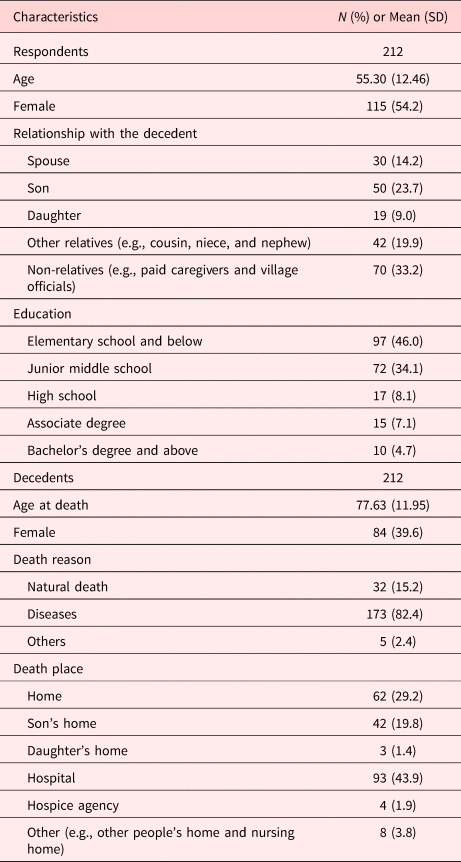
Table 1 shows respondents’ and decedents’ characteristics. Among 212 respondents, their mean age was 55.30 (12.46). Most respondents were female (54.2%) and had an education level of junior middle school and below (80.1%); 66.8% were family members and relatives. As for decedents, their mean age at death was 77.63 (11.95); most were male (60.4%); 82.4% died from diseases.
Socio-demographics of respondents and decedents

Confirmatory factor analysis
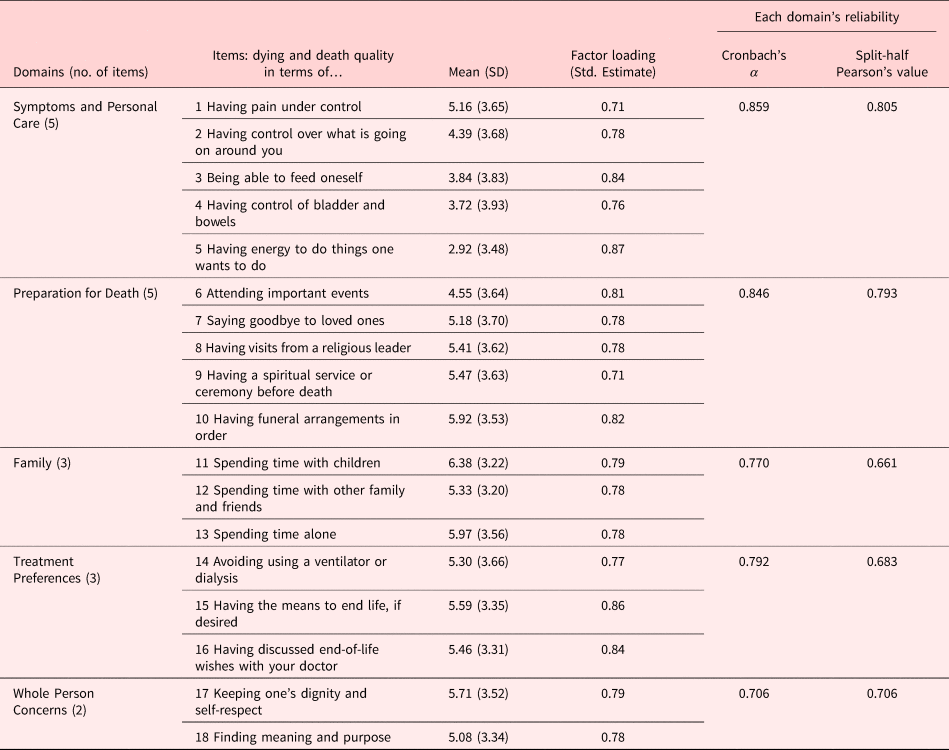
Based on factor loading values and MI, a five-domain, 18-item QODD-C scale was formed. Domains include “Symptoms and Personal Care” (five items), “Preparation for Death” (five items), “Family” (three items), “Treatment Preferences” (three items), and “Whole Person Concerns” (two items). Table 2 lists items in each domain.
QODD-C conceptual domains, reproduced factors by confirmatory factor analysis and each domain's reliability

Additionally, CFA tested the model fit degree of the QODD-C. Results showed that six out of eight indicators reached standards, one was close to the standard, and one did not reach the standard (p = 0.001, RMSEA = 0.055, CFI = 0.969, RMR = 0.536, GFI = 0.888, NFI = 0.906, NNFI = 0.962). This indicated that the model of five-domain, 18-item QODD-C fits well for our Chinese sample. Factor loading values confirmed that 18 items could be extracted effectively, with five items’ factor loading larger than 0.8, and the rest larger than 0.7 (Table 2).
The QODD-C total score ranged from 0 to 180 (mean = 91.39, SD = 43.67). The distribution was approximately normal (skewness = 0.201, kurtosis = −0.632; the result of Kolmogorov–Smirnov was significant, p < 0.05). We checked the Q–Q diagram for further confirmation and it was basically near the straight line, indicating obeying the normal distribution. The mean score for each domain ranged from 4.01 to 5.89, and SD from 2.76 to 3.01. The mean score for each item ranged from 2.92 to 6.38, and SD from 3.20 to 3.93 (Table 2).
Reliability
Cronbach's α and split-half Pearson's values of the total scale were 0.933 and 0.855, respectively. Table 2 shows the Cronbach's α and split-half Pearson's value for each domain.
Validity
Content validity
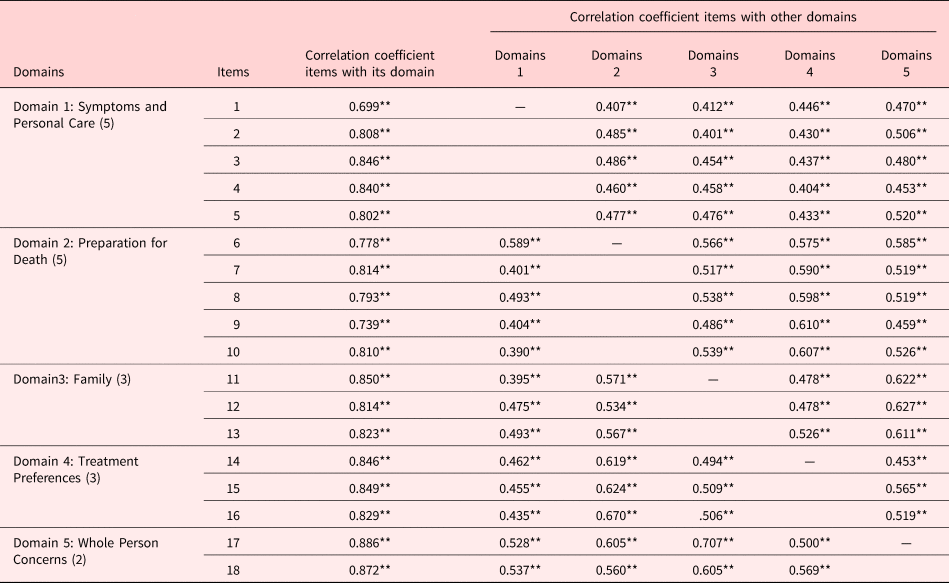
As shown in Table 3, the correlation coefficient between each item and its domain ranged from 0.699 to 0.886 (p < 0.01); the correlation coefficient between each item and other domains ranged from 0.395 to 0.707. The correlation coefficients between each item and its domain were higher than those between other domains, indicating that the QODD-C had good content validity.
QODD-C content validity

** At 0.01 level, the correlation was significant.
Construct validity
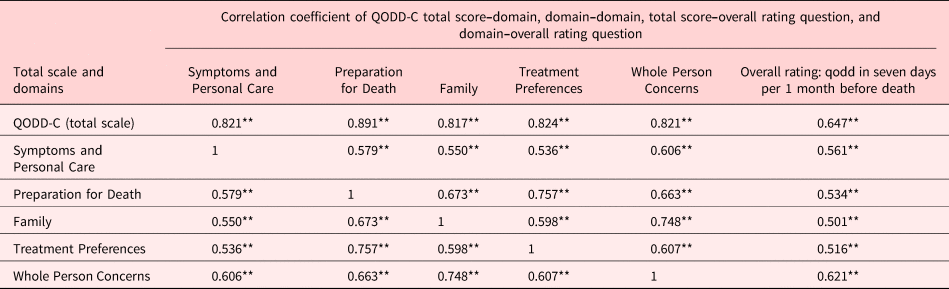
The correlation coefficient between domains ranged from 0.536 to 0.757; the correlation coefficient between each domain and the total score ranged from 0.817 to 0.891 (Table 4). The correlation coefficient between each domain and the total score was significantly higher than that between domains. Meanwhile, the total score was significantly associated with the overall rating question (r = 0.647, p = 0.000).
QODD-C construct validity

** At 0.01 level, the correlation was significant.
Discriminant validity
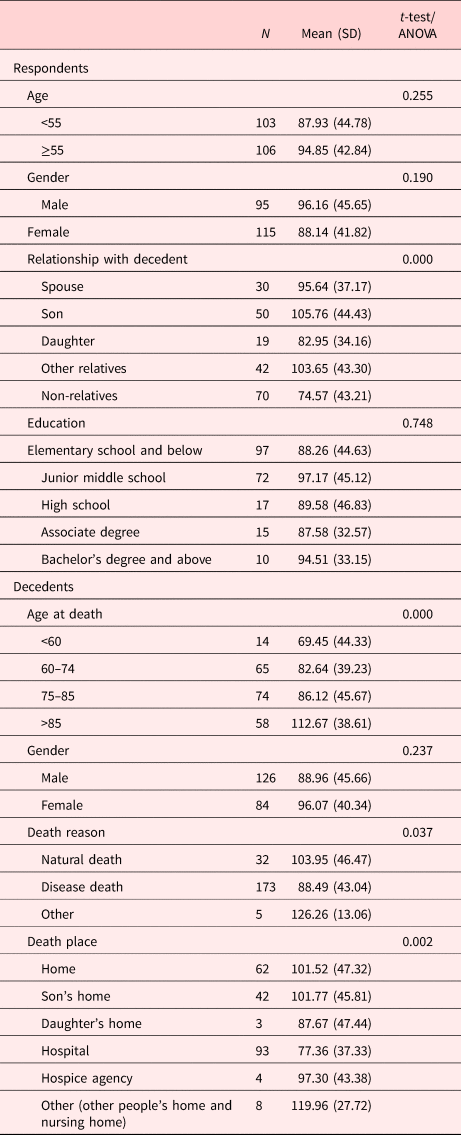
The total QODD-C score was not associated with the respondent's age, gender, education, or decedent's gender. Significant differences existed in the QODD-C total score by respondent's relationship with the decedent (F = 5.43, p = 0.000), age at death (F = 7.65, p = 0.000), death reasons (F = 3.36, p = 0.037), and death place (F = 4.04, p = 0.002). Multiple comparisons indicated that spouses [Mean difference (MD) = 21.06, standard error (SE) = 9.17, p = 0.023], sons (MD = 31.19, SE = 7.78, p = 0.000), and other relatives (MD = 29.08, SE = 8.20, p = 0.000) rated the decedent's qodd higher than non-relatives. Also, compared to daughters, sons rated the quality higher (MD = 22.81, SE = 11.32, p = 0.045). Decedents who died at the age over 85 had higher total scores than other age groups (age<60: MD = 43.22, SE = 12.44, p = 0.000; age 60–74: MD = 30.03, SE = 7.55, p = 0.000; age 75–85: MD = 26.55, SE = 7.33, p = 0.000). Besides, decedents who died in their own home (MD = 24.16, SE = 6.91, p = 0.001), their son's home (MD = 24.41, SE = 7.84, p = 0.002), and other places (e.g., nursing home and other people's home) (MD = 42.61, SE = 15.54, p = 0.007) had higher scores than those who died in the hospital Table 5.
QODD-C total score by respondent and decedent characteristics

Discussion
This study evaluated the QODD using a sample of caregivers of recently deceased older adults in China and identified and validated a shortened version (QODD-C) comprising five domains and 18 items. Findings showed that the QODD-C had favorable measurement properties and a normal distribution. The QODD-C total score was significantly associated with constructs related to five domains out of six original conceptual domains: Symptoms and Personal Care, Preparation for Death, Family, Treatment Preferences, and Whole Person Concerns. The primary caregiver's relationship with the decedent, the decedent's age at death, death reason, and death place was associated with the QODD-C total score. These findings suggested that the QODD-C could be a useful tool for evaluating Chinese populations’ EOL experiences.
Based on our data, the initial QODD items were not ideal for evaluating dying and death experiences among the Chinese. We achieved a significantly better fit QODD-C which does not include the Moment of Death domain. The patient could be unconscious or did not have an opportunity to talk about the wishes, or that health professionals were not attentive enough to the patient's wishes (Heckel et al., Reference Heckel, Bussmann and Stiel2016). Further research is needed to explore the association between this domain and the qodd experience. Additionally, HCPs could use living wills to solicit one's preferences for dying and death when the patient is still capable of doing so.
The QODD-C is a shortened instrument, which could be used relatively conveniently and efficiently among HCPs. Care is a complex procedure, and HCPs need to pay continuous attention to and provide person-centered care for the physical, psychological, and spiritual needs of a dying patient. A shorter tool like this could help them better understand a patient's needs, dynamically identify, monitor, evaluate the dying experience, and finally provide more appropriate care during one's last days of life.
This study also contributes to the literature on the QODD's cultural adaptations. China's familism culture emphasizes raising sons for old age (Huang, Reference Huang2019). The gender difference between sons and daughters in supporting their parents is one Chinese family tradition. A son is expected to live with his parents after marriage, also to take care of their daily lives and the death and funeral business. In contrast, if a daughter is married, her responsibility would be to care for her husband's family (Xu, Reference Xu2015). Consistent with this tradition, our findings validated the family domain. Results showed that the better qodd of the decedents cared by sons was significantly higher than those cared by daughters.
Different from other studies (Heckel et al., Reference Heckel, Bussmann and Stiel2015, Reference Heckel, Bussmann and Stiel2016), the QODD-C total score varied significantly by the decedent's age and death reasons. One reason could be that it matches the traditional Chinese belief that a good death is a natural death with longevity (Hu et al., Reference Hu, Kong and Chen2019). In China, some death could be called a “white happy event” who had a natural death at an advanced age, with music and drums played to celebrate his good death at the funeral (Long and Xiao, Reference Long and Xiao2017). Asian decedents were reported to have unmet needs due to a lack of respect for cultural traditions (Kim et al., Reference Kim, Price and Bunker2020), so the validation of the QODD in different cultures is an area where very little is currently known, but new knowledge is urgently needed. The psychometric testing of the QODD-C confirmed its good reliability and validity in the Chinese population.
We also found that the QODD-C total score varied significantly by a caregiver's relationship with the decedent. Consistent with our findings, the literature showed the advantage of family caregivers is communication with patients, which is significantly associated with caregivers’ perceptions of a good death (Lee et al., Reference Lee, Sussman and Kaasalainen2020). However, other studies pointed out that the rating qodd is a complex construct based on multiple perspectives and comparison standards (Hales et al., Reference Hales, Gagliese and Nissim2012). For instance, older adults who were more likely to receive formal care were more psychologically frail than expected (Lambotte et al., Reference Lambotte, De Dondera and Van Regenmortela2018). The above discussion showed there are pros and cons of both formal and informal care, and informal and formal caregiving experience should be shared, communicated, and supplemented (Clark et al., Reference Clark, Cain and Campbell2014; van Wieringen et al., Reference van Wieringen, van Groenou and Groenewegen2015).
Finally, our findings represent an empiric demonstration of significant differences existed in the QODD-C total score by decedent's death place. Chinese people who died in their own home or son's home had a better qodd than those who died in the hospital. Findings in other studies also supported the hypothesis that death at home and death in the location the patient desired were associated with a higher qodd (Curtis et al., Reference Curtis, Patrick and Engelberg2002; Braun et al., Reference Braun, Hasson-ohayon and Hales2014; Hales et al., Reference Hales, Chiu and Husain2014), showing the importance of having people die comfortably at home while also resources to reduce family caregivers’ burden of caring for dying people at home.
Limitations
This study has several limitations. First, there may be a gap between a decedent's real death experience and their caregiver's subjective evaluation. Second, there was the potential for non-response bias. Finally, we surveyed four geographic areas in China, and thus our findings cannot be generalizable to other regions. More research is needed to further validate the QODD-C and other QODD versions in other populations.
Conclusion
Despite some limitations, the study identified a five-domain, 18-item QODD-C scale, with examination showing its good psychometric properties among the Chinese population to measure the qodd. Family caregivers, HCPs, and researchers could use the QODD-C for Chinese in community settings while further measuring and monitoring its reliability and validity to identify how caregiving could help dying people meet their preferences, maintain their hope, and enhance their EOL care experiences.
Acknowledgments
The authors received department funding from the Suzanne Dworak-Peck School of Social Work, University of Southern California. The Anhui study was partly supported by the National Natural Science Foundation of China (Grant Nos. 71573207 and 72074177). The Shanghai and Chongqing study received a research grant from the Shanghai Lixin University of Accounting and Finance. The team also thank Dr. Feng Tong from Sichuan International Studies University for data collection and management.
Conflict of interest
The authors declared no conflict of interest.