Introduction
As China’s commercial legal system evolved, the Coca-Cola Company (hereafter, Coca-Cola) gradually improved its legal mechanisms for trademark protection in the country. China’s first trademark law, introduced in 1923, came slightly later than those in Britain and the United States.Footnote 1 Coca-Cola registered its English trademark in China in 1925 and secured the Chinese-language mark “可口可樂” (pronounced Kekoukele) in 1928.Footnote 2 In 1930, the company established its China office in the Shanghai International Settlement, tasked with safeguarding Coca-Cola’s exclusive trademark rights in the Chinese market.Footnote 3 Local bottling plants, by contrast, had no authority to intervene in trademark enforcement. This arrangement left Coca-Cola without reliable local partners dedicated to defending its trademark rights.
Multinational corporations entering foreign markets often confronted the dual challenges of trademark imitation and the widespread circulation of counterfeits. Scholars examining early twentieth-century China have shown that imitation goods, by leveraging imitated trademarks, advertising campaigns, and price wars, managed to position themselves in the marketplace as acceptable alternatives.Footnote 4 In some cases, even firms that only copied the trademark, without affixing it to actual counterfeit goods, confused consumers and damaged the brand integrity of foreign firms.Footnote 5 To curb such free-riding behavior, many multinational corporations resorted to lawsuits, buyouts, and diplomatic pressure to safeguard their trademark rights.Footnote 6 One strategic consideration was whether to involve local partners in trademark enforcement. These local actors could more readily identify and prosecute infringers, yet they also posed latent risks, as some became counterfeiters themselves. Coca-Cola encountered such risks in both Colombia and China, where former bottlers, after losing their contracts, quickly launched imitation beverages that infringed on Coca-Cola’s trademark.Footnote 7 Some multinational corporations responded by tightening oversight of their partners or by establishing wholly owned subsidiaries to maintain direct control.Footnote 8 Others pursued deeply localized strategies, embedding themselves in local industry associations to influence regulatory structures from within. The Dutch electronics firm Philips, for instance, integrated itself into Australian society and helped shape the postwar development of Australia’s electronics policy.Footnote 9
Previous studies on how multinational corporations responded to trademark infringement and product imitation in China have largely focused on industries that generated large numbers of acceptable alternatives, such as dairy products, cigarettes, and electric light bulbs.Footnote 10 These industries relied on readily available raw materials and technologies and had low production costs, which made imitation relatively easy for local competitors. The proliferation of acceptable alternatives reshaped local consumer habits, further complicating trademark enforcement. In contrast, Coca-Cola did not face a flood of imitations. Its strict control over raw material supplies, standardized production processes, and effective marketing strategies ensured consistency in flavor, quality, and brand recognition, making it harder for imitators to replicate the product. Nevertheless, Coca-Cola struggled to maintain control over its trademark rights in China.
In reality, the intricate interplay of war, culture, and law created a host of new challenges, and Coca-Cola failed to align its trademark protection strategies with the specific conditions of the Chinese market. First, cultural differences between China and the United States led the company to overlook numerous instances of trademark infringement involving Chinese characters. For example, well-known performers adopted “可口可樂” as their stage names, and some soda products employed trademarks with phonetic resemblances to “可口可樂.” Coca-Cola’s absence of locally embedded enforcement structures left such infringements undetected and unaddressed. Second, wartime dynamics and political instability reshaped the business environment. While Coca-Cola seized certain wartime opportunities, it remained ill-prepared for broader structural shifts. The company drew on its extensive experience in domestic trademark enforcement and benefited from extraterritorial privileges in China.Footnote 11 The United States Court for China could invoke US legal precedents in cases involving American firms. In the early years of World War II, numerous Chinese businesses voluntarily restructured themselves as subsidiaries of American companies to escape Japanese control, including newly established factories producing imitations of Coca-Cola. Coca-Cola swiftly leveraged extraterritoriality to penalize “爱的可樂 Eddie Kola” (pronounced Aidekele), one such counterfeit.Footnote 12 However, as the war progressed, Coca-Cola’s supply of raw ingredients was cut off, and imitation products proliferated. These copycat sodas thrived temporarily but lost their market share after the war, when Coca-Cola resumed distribution in Shanghai.Footnote 13 Finally, Coca-Cola failed to devise adequate responses to the limitations of Chinese trademark law. Although the company registered its Chinese and English trademarks with the China Trademark Office and established a Shanghai office to handle enforcement, gaps in the legal framework left key issues unresolved. Chinese trademark law prohibited the registration of identical or similar marks within the same product category but remained silent on similar trademarks across different classes. After World War II, Coca-Cola’s surging market presence prompted Chinese merchants to legally register marks featuring “可口可樂” or “Coca-Cola” in other categories. Coca-Cola submitted formal complaints to the China Trademark Office, but officials rejected each petition.
This article examines Coca-Cola’s trademark protection practices in the Chinese market during the first half of the twentieth century. It demonstrates how war, culture, and law shaped the challenges multinational corporations faced in protecting their trademarks abroad. The study highlights the importance of attending to local specificities in foreign markets for effective trademark protection. It draws on business archives, press reports, and industry publications. The first section explores how cultural differences between China and the United States allowed Coca-Cola’s Chinese name to be adopted by popular performers as part of their stage identities, an act of infringement that the company failed to address. The second section provides historical context on Shanghai’s “Isolated Island” period (1937–1941) and analyzes how US extraterritorial rights in China enabled Coca-Cola to crack down on counterfeit products such as Eddie Kola. The third section investigates Coca-Cola’s 1939 trademark lawsuit against the China Finance Corporation Federal Inc., USA (hereafter, CFC), which had marketed Eddie Kola. Although Coca-Cola sought to enforce its trademark rights, it overlooked local companies’ tactics of using phonetically similar Chinese names to imitate its brand. The fourth section explains how the outbreak of the Pacific War disrupted Coca-Cola’s privileged legal and commercial status in China. The company’s failure to adapt its trademark strategy to the Chinese legal framework ultimately left it in a reactive and disadvantaged position.
“Coca-Cola”: Products, Translations, and Stage Names
Coca-Cola originated in 1886 in Atlanta, Georgia, USA.Footnote 14 In the early 1920s, Coca-Cola began investing in overseas bottling plants, marking the beginning of its international expansion.Footnote 15 Unlike vertically integrated multinational corporations, Coca-Cola outsourced the manufacturing of all noncore products to powerful local enterprises in host countries. This strategy significantly reduced corporate costs and mitigated political as well as economic risks. Scholars have described this model as “Coca-Cola capitalism.”Footnote 16 Within this global operational network, trademark protection remained a core function under the direct management of Coca-Cola itself.
Shanghai was among the first overseas markets to attract Coca-Cola’s attention, largely due to the city’s distinctive political and economic environment. At that time, several countries, including the United States, held extraterritorial rights in China. The Shanghai International Settlement was established in 1863.Footnote 17 Within the International Settlement, the Shanghai Municipal Council was formed through property-based elections and exercised a high degree of autonomy. Dominated by European and American residents, the Council oversaw local governance.Footnote 18 Trade between China and the United States was notably active here, with a large community of American expatriates.Footnote 19 Moreover, Americans doing business in China enjoyed certain preferential economic policies. On September 19, 1922, President Warren G. Harding signed the China Trade Act, which exempted US companies operating in the Republic of China from federal registration fees and certain domestic taxes.Footnote 20 George Bronson Rea, a representative of the American Chamber of Commerce in Shanghai, believed that the purpose of the Act was to promote cooperation between American and Chinese capital, with the goal of creating new joint ventures in China.Footnote 21
Based on available advertising materials, Coca-Cola was already served at Sullivan’s Café, an establishment run by Americans in the Shanghai International Settlement, as early as 1916.Footnote 22 By 1921, advertisements for Coca-Cola appeared in newspapers, promoting its distribution by the American-owned Reid’s Ltd. Inc. (hereafter, Reid’s) and the beverage began to be known by its Chinese name “可口汽水” (pronounced Kekouqishui).Footnote 23 However, Reid’s went bankrupt in 1922 due to mismanagement.Footnote 24 Thereafter, Watson’s Aerated Water Company in Shanghai (hereafter, Watson’s) took over the distribution of Coca-Cola, and the Chinese name was changed to “可口露” (pronounced Kekoulu).Footnote 25 Foreign expatriates in the International Settlement formed Coca-Cola’s earliest customer base. A 1926 report from Watson’s noted that expatriates in Shanghai eagerly purchased Coca-Cola.Footnote 26 At that time, Coca-Cola was not produced through standardized mechanical bottling, but was instead served from soda fountains, which limited its production capacity.Footnote 27
Starting in Shanghai, Coca-Cola gradually elevated the priority of its Chinese operations. In 1925, the company registered the English trademark “Coca-Cola” with the China Trademark Office.Footnote 28 During the late 1920s, Coca-Cola signed formal agreements with Watson’s and Shanhaiguan Aerated Water Company in Tianjin, designating them as authorized bottlers. This arrangement enabled Coca-Cola to establish standardized local bottling production in China. It was also during this period that the now-iconic Chinese name “可口可樂,” was coined in Shanghai.Footnote 29 By 1928, the Chinese trademark “可口可樂” was officially registered.Footnote 30
As the 1930s began, Shanghai had become the centerpiece of Coca-Cola’s operations in China. On March 13, 1930, Coca-Cola’s China office was officially established in the Shanghai International Settlement.Footnote 31 This marked the formal integration of Coca-Cola’s business in China into the company’s global marketing network.Footnote 32 The office, supervised by the Pacific Division of Coca-Cola, oversaw several key functions: managing the bottling of Coca-Cola products in China, safeguarding exclusive trademark rights, monitoring the sales operations of local bottling plants, and collecting related reports.Footnote 33 Additionally, the company envisioned that, when political and economic conditions allowed, the office would eventually oversee the local production of Coca-Cola syrup in China.Footnote 34 The office remained modest in scale, staffed by a manager, an English stenographer-typist, and a secretary.Footnote 35 It organized large-scale, planned marketing campaigns in Shanghai and Tianjin, and in 1932, it signed a contract with a new bottling partner in Qingdao, Shandong.Footnote 36
Although Coca-Cola’s Chinese bottling partners were all soda factories with strong local roots, the company prohibited them from interfering in brand and trademark-related matters. Zhang Jiayan, the assistant manager of Watson’s, described the relationship between Coca-Cola and the bottling plants as one of raw material supply and production oversight.Footnote 37 Coca-Cola’s China office maintained close ties with the American expatriate community in Shanghai. Geographically, it was housed in Hamilton House, a building that accommodated several US commercial and government institutions.Footnote 38 On a personal and social level, staff at Coca-Cola’s China office maintained connections with American business and political elites in Shanghai through civic and professional associations. Charles T. Carroll, who managed the China office, was an active member of organizations such as the American Junior Chamber of Commerce and the American Rotary Club in Shanghai.Footnote 39 On the eve of World War II’s end, the China-America Council of Commerce and Industry was established, with James A. Farley, chairman of the Coca-Cola Export Corporation, serving as a board director.Footnote 40
In its collaboration with professional lawyers, Coca-Cola’s China office appointed the American attorney Norwood F. Allman as legal counsel. Allman was highly active in Shanghai, participating in several prominent American expatriate organizations and maintaining close ties with administrative bodies and media circles within the International Settlement.Footnote 41 He had previously worked at the US Consulate General in Shanghai and, in April 1940, was elected to the Shanghai Municipal Council’s board of directors, the governing body of the International Settlement.Footnote 42 Allman also had a deep interest in Chinese trademark law. During his tenure at the US Consular Department in China in 1923, he translated China’s first trademark law, enacted by the Beiyang government. This law served as a reference for foreign merchants operating in China.Footnote 43
Coca-Cola employed various methods, including newspaper advertising, event sponsorships, and outdoor signage, to repeatedly reinforce brand exposure in cities such as Shanghai, Tianjin, and Qingdao.Footnote 44 As Coca-Cola’s brand recognition expanded, foreign expatriates in the concessions remained loyal consumers, while an increasing number of Chinese customers gradually embraced the beverage.
Compared to “Coca-Cola,” Chinese consumers showed a stronger preference for its Chinese translation “可口可樂.” The translation was not a simple phonetic rendering rather, it cleverly combined characters that conveyed notions of deliciousness and pleasure to Chinese audiences. According to attorney Allman, the Chinese trademark evokes the idea of “allowing the mouth to rejoice or something palatable from which one derives pleasure.”Footnote 45 The name was not only playful in sound but also incorporated the characters for “mouth” (口) and “happiness” (樂), reinforcing associations with taste and joy.
This cleverly crafted name soon attracted the attention of popular performers. Some adopted “可口可樂” as a stage name to attract public interest. Once they had built up reputations in the entertainment world, the name became their personal brand. Performers of Chinese crosstalk and vocal mimicry both oral traditions closely associated with the mouth and joy even used newspaper platforms to publicly claim ownership of the name. Chinese crosstalk, a comedic dialogue form akin to Western stand-up comedy, and vocal mimicry, an art of imitating sounds from nature using only the mouth, both rely on voice-driven performance to entertain audiences. These art forms thus mirrored the literal meaning of “可口可樂” as something “delicious” and “joyful.” In many parts of rural and urban China, such oral performance traditions commanded large followings and wielded considerable cultural influence.
In 1936, a performing artist in Tianjin adopted the stage name “可口可樂” and became active in local entertainment circles. Skilled in both vocal mimicry and Chinese crosstalk, he gained recognition for his versatility and vocal artistry.Footnote 46 In early 1937, a Tianjin-based performing troupe named “Linglong” introduced a vocal mimicry act featuring “可口可樂” in its title. The performance was unrelated to Coca-Cola soda but intended to convey that the show could bring joy and happiness to the audience.Footnote 47 As a result, the fans of the performer were deeply offended, believing that the program’s name misled the public and could easily create the false impression that the performer was involved.Footnote 48 The performer also issued a newspaper statement, emphasizing that “可口可樂” was his stage name and that they had never participated in any other troupe’s performance.Footnote 49 The two parties engaged in a public dispute in the local Tianjin newspaper WuXianDianRiBao, attracting widespread attention. The performer’s fans emphasized that the term “可口可樂” had already been adopted by a well-known entertainer, and therefore, competitors within the same industry should no longer be allowed to use it. Interestingly, the fans compared the situation to the naming of beverages, arguing that just as there is a drink called Coca-Cola on the market, no other beverage should be allowed to bear the same name.Footnote 50 The “Linglong” troupe, on the other hand, argued that they had used “可口可樂” as the name of their program, not as a personal name, and therefore had not misled the audience. They also pointed out that, aside from being used for soda, “可口可樂” had not been registered in other fields. As a result, they believed that the term remained available for broader use in the performing arts.Footnote 51
Coca-Cola’s China office made no statement regarding the Tianjin dispute over the name “可口可樂.” Perhaps this was because the performance’s audience was predominantly Chinese, and the reports of the dispute were published in local Chinese newspapers in Tianjin. As a result, the staff at the Shanghai-based office may not have been able to respond in a timely manner. A comparable situation unfolded in Shanghai around 1939, when a dancer named Tian Xiuli adopted the stage name “可口可樂” and used it for her commercial activities in the city.Footnote 52 In 1940, some local tabloids referred to her as “one of the ten most popular stars.”Footnote 53 Tian Xiuli’s rise to fame inspired imitators. Several other dancers in Shanghai adopted the stage name “可口可樂” and used newspapers to promote themselves.Footnote 54 Tian Xiuli later moved to Hong Kong, where she continued to use “可口可樂” in her commercial performances. In 1948, she was even invited by Coca-Cola’s Hong Kong subsidiary to visit its factory and pose for commemorative photographs with senior company executives. In a dramatic turn, in the spring of 1949, Coca-Cola’s Hong Kong subsidiary warned Tian Xiuli not to use “可口可樂” as her stage name, citing that “可口可樂” (Coca-Cola) was a registered trademark. Tian Xiuli reacted angrily. Through the local press, she accused Coca-Cola of damaging her personal reputation. She insisted that she had used the stage name for a decade and that her fans had affectionately coined it—a name she could not simply abandon.Footnote 55 In the end, the dispute quietly dissipated after Tian Xiuli returned to Shanghai from Hong Kong in 1949.Footnote 56
The American “Eddie Kola” hat emerged in Shanghai During the Isolated Island Period
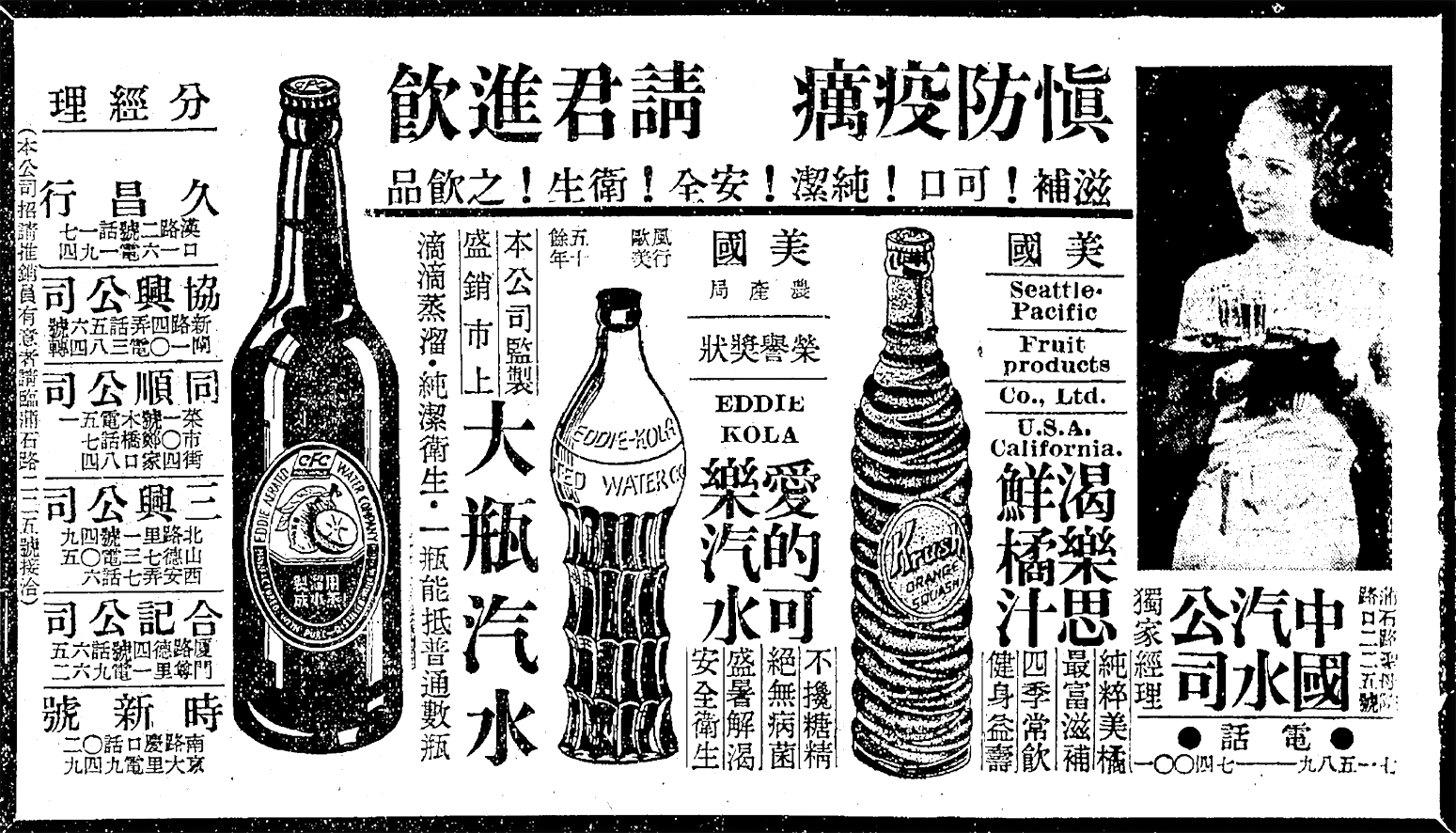
In May 1939, a soft drink named “Eddie Kola” (爱的可樂, pronounced Aidekele) appeared in newspaper advertisements in Shanghai (see Figure 1). The advertisement featured illustrations of three products manufactured by the Eddie Aerated Water Company (hereafter, Eddie): Eddie Kola, Large Bottle Soda Water, and Krush Orange Squash, accompanied by promotional slogans. In the top-right corner, a smiling white woman serving beverages. The advertisement claimed that Eddie Kola had received an honorary certificate from the US Department of Agriculture and was a popular soda in Europe and America. It emphasized that the drink was free from saccharin, entirely free of bacteria, refreshing in the summer heat, and a safe choice.Footnote 57
“Shenfang yili qing jun jinyin,” [To Prevent Epidemics, Please Take a Drink] Shenbao (May 21, 1939): 11.

This advertisement likely led Chinese consumers to associate Eddie Kola with Coca-Cola. Although the spellings of “Kola” and “Cola” are similar but not identical, their Chinese translations are exactly the same, both rendered as “可樂.” Prior to this, Eddie had long promoted its brand as a “Chinese-made” product targeting primarily Chinese consumers.Footnote 58 Among domestically produced soft drinks in China, Eddie Kola was the first to use the Chinese term “可樂” in its brand name. By sharing this translation and claiming in the advertisement that Eddie Kola had received an American award, Eddie subtly implied to Chinese consumers that this drink’s composition and quality were comparable to the well-known American Coca-Cola.
Before the emergence of Eddie Kola, Eddie broke from the conventional image of Chinese-owned enterprises by becoming a subsidiary of the American firm CFC. Eddie was founded in 1926 by Chinese businessman Xu Tingzuo.Footnote 59 However, by 1935, the company had gone bankrupt and entered liquidation.Footnote 60 As Eddie’s primary creditor, CFC advanced funds in 1936 to help the company resume production.Footnote 61 Registered under the Act, CFC was established in Shanghai in 1925. Its primary business activities included mortgage lending and investment.Footnote 62
In the summer of 1938, advertisements for Eddie began prominently displaying the “CFC” trademark registered to CFC, while the company’s classic Chinese trademark disappeared.Footnote 63 Clearly, Eddie no longer emphasized its identity as a “Chinese-made” brand. Instead, in print media, it actively highlighted the American affiliation of its products. This shift reflected the broader context of the Sino-Japanese War and the extraterritorial privileges the United States enjoyed in China at the time.
The timing of Eddie’s incorporation into CFC is highly significant. This occurred during Shanghai’s “Isolated Island” period, when many Chinese enterprises nominally transferred ownership to foreign nationals to reduce wartime risk. From August to November 1937, the Chinese Nationalist government’s forces and the Japanese army engaged in the Battle of Shanghai, which ended in defeat for the former. Throughout the conflict, the Shanghai International Settlement and French Concession authorities declared “neutrality” and retained control over their respective jurisdictions. However, these areas were surrounded by Japanese forces, with external transportation largely cut off, effectively turning them into an isolated enclave. This period ended in December 1941 with the outbreak of the Pacific War, when the Japanese army fully took over the Shanghai concessions.Footnote 64 In Japanese-occupied Shanghai, Chinese-owned enterprises were considered enemy property and faced the constant threat of requisition or confiscation by Japanese forces.Footnote 65 Moreover, the Japanese authorities required all large-scale Chinese manufacturing enterprises to operate as joint ventures with Japanese firms, with 51% of the shares held by Japanese investors.Footnote 66 During the “Isolated Island” period, many Chinese entrepreneurs invited American, British, and other Western expatriates in Shanghai to serve as nominal company heads. This strategy aimed to shield their businesses from Japanese interference. The arrangement also created new business opportunities for expatriates. Many Americans began offering this service to Chinese businesses seeking protection, charging fees to incorporate these companies under their names. Consequently, originally Chinese-owned enterprises became nominally American and avoided Japanese intervention.Footnote 67 Allman, Coca-Cola’s legal counsel in China during this period, became the nominal owner of several prominent Chinese enterprises, including ShenBao(申報), the China Chemical Industry Corporation (中國化學工業社 Zhongguohuaxuegongyeshe), and the Wuzhou Soap Factory(五洲制皂廠 Wuzhouzhizaochang).Footnote 68
The incorporation of Eddie into CFC directly supported Coca-Cola’s trademark enforcement efforts. Under the 1906 statute titled An Act Creating a United States Court for China and Prescribing the Jurisdiction Thereof, the US Court for China, based in Shanghai, had jurisdiction over cases involving defendants who were US citizens.Footnote 69 As a result, Coca-Cola’s lawsuit against Eddie Kola for trademark infringement became a dispute between two American enterprises within the Shanghai International Settlement. This jurisdictional alignment enabled the case to circumvent Chinese trademark law altogether.
Before this shift, American expatriate businesses seeking to sue Chinese firms had to navigate the complexities and inconsistencies of Chinese commercial law. In 1925, the American firm Nestlé & Anglo-Swiss Condensed Milk Co. (hereafter, Nestlé) petitioned Clarence E. Gauss, the US Consul General in Tianjin, to intervene with the Chinese Ministry of Foreign Affairs. Nestlé claimed that counterfeit dairy products bearing the Eagle Brand trademark were being sold widely in Tianjin, infringing its commercial interests. Although the Eagle Brand originally belonged to the Borden Company, Nestlé had acquired the trademark rights for China. However, it had failed to register the mark in a timely manner with the China Trademark Office. Citing this omission, the Foreign Ministry declined Gauss’s protest but advised Nestlé to complete the registration process without delay. Nonetheless, in light of Sino-American relations, the Ministry instructed local officials to dissuade Chinese merchants from infringing on foreign trademarks based on principles of commercial ethics.Footnote 70 In 1929, Nestlé filed a trademark infringement lawsuit against the Chinese brand Pe-Henc (百亨), arguing that its “Captive Bird” logo closely resembled the Eagle Brand trademark. Yet once again, Nestlé found itself at a disadvantage due to registration issues. Following a change in China’s political regime in 1927, Nestlé failed to resubmit the required trademark documentation under the new government. After losing the case, the company attempted to acquire the Pe-Henc brand, but its offer was categorically rejected by the brand’s owner, Wu Baiheng.Footnote 71 China’s commercial laws evolved in response to shifting political and economic conditions. Without local partners to alert them to regulatory changes, foreign enterprises often struggled to adapt quickly, particularly when it came to procedural details.
In the food and beverage sector, advances in processing technologies and distribution networks during the late nineteenth and early twentieth centuries significantly improved the efficiency of product circulation. Trademarks played a crucial role in this transformation by reducing consumers’ search costs.Footnote 72 This era also marked the period of Coca-Cola’s rapid expansion in the United States. In 1926 alone, there were over 7,000 trademark infringement cases involving Coca-Cola in the United States.Footnote 73 As a result, the US Court for China had accumulated a substantial body of judicial precedents concerning Coca-Cola trademark disputes. These precedents could be cited in subsequent cases, providing a robust legal foundation for resolving future trademark conflicts involving the company. Coca-Cola compiled and published a three-volume collection of materials documenting opinions, orders, injunctions, and decrees related to Coca-Cola trademark infringements from 1886 to 1938.Footnote 74
In contrast, Coca-Cola’s experience with trademark enforcement in China was notably limited. Prior to 1939, there were no recorded trademark disputes involving Coca-Cola in the country. To address the activities of Russian expatriates in China, Coca-Cola’s China office registered the Russian-language trademark “кока-кола” with the China Trademark Office in 1935.Footnote 75 Later, in 1943, drawing on trademark enforcement cases from the United States, Coca-Cola registered the “Coke” trademark with the Nationalist government’s China Trademark Office in Chongqing.Footnote 76 “Coke” and “кока-кола” were both registered under the category of soft drinks. However, in practice, the registration of these two foreign-language trademarks placed only minimal restrictions on domestic Chinese beverage producers.
For example, the orange squash brand “Krush” (渴樂斯, pronounced Kelesi), produced by the same bottling company as “Eddie Kola,” exploited Chinese homophones.Footnote 77 Although Krush bore no resemblance to Coca-Cola in English, its Chinese name included the characters “渴樂” (pronounced Kele), which were phonetically identical to “可樂” (pronounced Kele), the established transliteration of “Cola” in Chinese. Among Eddie’s primarily Chinese consumer base, this phonetic similarity could create associations not only between Eddie Kola and Coca-Cola but also between Krush and Coca-Cola. When responding to the Eddie Kola trademark infringement, Coca-Cola chose not to pursue legal action against another imitator, Krush, whose Chinese name bore phonetic similarities to Coca-Cola. In contrast, the German firm Bayer adopted a far more aggressive approach to trademark protection for its product Aspirin (阿司匹靈, pronounced Asipiling). After 1923, Bayer registered numerous trademarks with the China Trademark Office, covering not only packaging and logos but also both the English and Chinese versions of the brand name. As counterfeit pharmaceuticals began to appear using Chinese names that mimicked the sound of “阿司匹靈,” and following the 1935 revision of China’s trademark law—which explicitly required trademarks to account for phonetic resemblance—Bayer retained legal counsel and launched a wide-scale anti-counterfeiting campaign, forcing several pharmacies to stop selling infringing products.Footnote 78 Bayer’s actions demonstrate that multinational corporations could indeed use Chinese trademark law to combat phonetic imitation. Coca-Cola, however, failed to make use of this legal framework.
Coca-Cola Trademark Infringement Case in the US Court for Shanghai
Shortly after Eddie Kola entered the market, Coca-Cola filed a lawsuit against CFC in the US Court for China. Coca-Cola alleged that the Eddie Kola trademark, used for a soft drink with a similar color and appearance to Coca-Cola’s product, constituted both trademark infringement and unfair competition.Footnote 79
This case was presided over by Milton J. Helmick—the final Chief Justice of the US Court for China—who assumed office on April 26, 1934.Footnote 80 According to his 1941 article, the United States Court for China did not employ a jury system; even in capital cases, the judge alone presided over the trial and rendered the verdict.Footnote 81 A substantial collection of US federal court rulings on Coca-Cola trademark infringement cases provided Helmick with established legal standards and interpretive criteria to guide his decision.
The plaintiff, Coca-Cola, represented by American lawyers Allman, Jim Davies, and Paul Kops, argued that “Coca-Cola” is a distinctive compound word. As a trademark, “Coca-Cola” was first registered in the United States in 1893 and re-registered in 1905. In China, the trademark was registered with the Republic of China’s Trademark Office in 1925, and again in 1932 using Chinese characters. The defendant sold a soft drink under the name Eddie Kola in China, which closely resembled Coca-Cola in color and appearance. This beverage was packaged in bottles with metal caps, similar in size and overall design to the plaintiff’s product.
The defendant, CFC was represented by American lawyer Cornell S. Franklin. The defendant argued that it held the right to produce and sell beverages containing “kola nut extract.” Furthermore, it claimed that it had not implied to consumers that the beverage was Coca-Cola, nor had it designed its trademark or marketed its product in any way that could deceive or confuse the public. The defendant also contended that “kola” and “cola” were generic terms, commonly defined in dictionaries and pharmacopeias, and therefore descriptive rather than distinctive. As such, the use of these terms by any manufacturer was legally permissible, provided they were not employed in a manner intended to deceive or mislead the public.Footnote 82
On May 29, 1939, the US Court for China issued a ruling in favor of the Coca-Cola Company, determining that Eddie Kola had infringed upon its trademark rights. The court prohibited CFC from further use of the infringing trademark. The defendant also voluntarily agreed to cease using the plaintiff’s registered Chinese tradename, “爱的可樂.”Footnote 83 From late May to early June, both Chinese and foreign newspapers in Shanghai published a series of reports on the case.Footnote 84
The judge supported the plaintiff’s claims, primarily on the basis of precedents set by higher courts. Judge Helmick cited three similar cases. The first was the 1920 ruling by the United States Court of Appeals for the Ninth Circuit in the case of The Coca-Cola Company v. The Koke Company of America, which involved the alleged infringement of the “Koke” trademark.Footnote 85 The Ninth Circuit Court determined that the defendant’s beverage was an imitation of the plaintiff’s product, and that the choice of the name “Koke” was designed to capitalize on the plaintiff’s advertising efforts and to sell the imitation as if it were the plaintiff’s product. In this case, the defendant argued that “the plaintiff’s trademark and advertisements convey fraudulent representations to the public” because, in earlier years, Coca-Cola had claimed that its product contained kola nuts and coca leaves. Initially, this defense was accepted by the United States District Court, resulting in a loss for Coca-Cola. However, the case was later appealed to the Ninth Circuit. The Ninth Circuit ruled that, for the public, the name “Coca-Cola” had come to represent the beverage itself—namely, the plaintiff’s product—rather than its ingredients. The court emphasized that “for the public generally, the name came to signify the beverage itself, the plaintiff’s product, rather than its ingredients” and further stressed that “Coca-Cola probably means to most persons the plaintiff’s familiar product to be had everywhere rather than a compound of particular substances.”Footnote 86
Drawing on the 1920 decision by the United States Court of Appeals for the Ninth Circuit, the US Court for China held that the terms “Kola” and “Kole” used by Eddie Kola could not be considered descriptive words, as the defendant claimed. The court asserted that “Coca-Cola” should be recognized as a unique product from a single source, widely known within the community. Judge Helmick emphasized that among the American community in China, “Coca-Cola” was undoubtedly as well-known as it was in the United States. With the plaintiff’s entry into the Chinese market, both its name and product had also become familiar to non-American residents.
The second precedent that Judge Helmick cited was the 1930 ruling by the United States Court of Appeals for the Sixth Circuit in The Coca-Cola Company v. Carlisle Bottling Works, which concerned the alleged infringement of the “Roxa Kola” trademark. In this case, Coca-Cola was unsuccessful. The Sixth Circuit Court concluded that the name “Roxa Kola” did not constitute an infringement of “Coca-Cola,” even though both names were used for carbonated beverages. One of the key reasons was that, after a meticulous comparison of the letters, the court determined that the two trademarks were sufficiently distinct.Footnote 87
Nevertheless, Judge Helmick stated, “This Court does not care to embark upon any such minute dissection of the tradenames involved here. This Court does not feel called upon to act as umpire in some sort of a spelling bee in which a competitor tries to see how close he can come to the forbidden mark without touching it and incurring penalty.” He emphasized that the key issue in the trial was whether the defendant’s trademark might cause confusion or misunderstanding in the minds of the public, leading to the deception of purchasers. To support this point, he cited a third precedent: the 1936 case of The Coca-Cola Company of Canada v. Pepsi-Cola Company of Canada, which concerned the alleged infringement of the “Pepsi-Cola” trademark. The case was heard by the Exchequer Court of Canada, which referenced numerous decisions from US courts on similar cases and, in 1938, ruled that “Pepsi-Cola” had infringed Coca-Cola’s trademark rights. Regarding the Exchequer Court’s approach and its ruling, Judge Helmick stated, This court concurs with that decision and finds it “seems applicable to the case at bar.”Footnote 88 Interestingly, however, the Pepsi-Cola Company of Canada later appealed the decision and won the case in 1940. The ruling in favor of the defendant was based on the judges’ reasoning that, if Coca-Cola were to win the case, it would effectively gain exclusive rights to the term “Cola,” which was clearly impermissible.Footnote 89
In addition to the aforementioned precedents, Judge Helmick stated, “There are literally scores of adjudicated cases similar to the instant case to be found in the federal and state reports. Many of these cases involve competition by products marketed under various compounded names in which the second word of the combination is ‘cola.’ Without carefully reading all of these cases or attempting to make any extended analysis of them, it appears to the Court that the plaintiff company has been unusually successful in most of this litigation.” Ultimately, the judge sided with Coca-Cola, concluding that the defendant’s adoption and use of the infringing trademark “Eddie Kola” was intended to capitalize on Coca-Cola’s established market position for commercial advantage or advertising benefits, and that it had caused harm to the Coca-Cola Company.Footnote 90
In 1928, Coca-Cola filed its first overseas lawsuit in Britain’s Chancery Division.Footnote 91 Since then, Coca-Cola has increasingly relied on legal measures to protect its trademark in international markets. The 1939 ruling by the US Court for China in the case of The Coca-Cola Company v. China Finance Corporation also became a precedent that was later cited by other US courts. For example, when the two electric motor brands “B-Line” and “Life-Line” went to court in 1952, one of the judges cited the Chinese case. The judge believed that previous rulings in Coca-Cola trademark disputes had already established that when the purchasing public assigns a name to a product different from its registered trademark, such as using “Koke” for “Coca-Cola,” anyone who appropriates such a nickname for use on identical goods, regardless of fraudulent intent or proof of actual injury, commits unfair competition for which protection by injunction will be granted.Footnote 92
The central debate in the trademark dispute between Coca-Cola and Eddie Kola centered on whether the term “Cola” could be exclusively used by Coca-Cola. John A. Sibley, Coca-Cola’s chief legal counsel, maintained that all soft drinks using the term “Cola” in their names should be considered infringing on Coca-Cola’s trademark.Footnote 93 However, this position sparked significant controversy. In many Coca-Cola trademark disputes outside China, soda brands using the term “Cola” challenged this claim. For instance, in the previously mentioned Canadian lawsuit involving Pepsi-Cola and Coca-Cola, similar objections were raised. The defense lawyer for Eddie Kola, Franklin, shrewdly recognized and exploited this controversy. Nevertheless, the extensive body of prior US trademark cases that overwhelmingly favored Coca-Cola established a precedent that worked in its favor. As a result, Coca-Cola’s office in China, benefiting from the extraterritorial privileges of US jurisdiction, was able to secure a favorable outcome in the case.
Product Imitation and Trademark Appropriation in the 1940s
During the Eddie Kola trademark dispute, both Coca-Cola and Eddie Aerated Water commanded strong brand recognition in Shanghai. However, Coca-Cola’s successful trademark enforcement in this case did not serve as an effective deterrent within Shanghai’s soda production industry. Following the outbreak of the Pacific War, numerous Coca-Cola imitations proliferated in the city. The war disrupted the established order of the Shanghai International Settlement and compelled the Coca-Cola Company to confront a drastically altered commercial environment.
One key reason Coca-Cola prevailed in the “Eddie Kola” trademark dispute was that, under wartime pressure, Eddie rebranded itself as a US firm. This shift enabled the case to be tried in the United States Court for China, thereby circumventing Chinese trademark law. Unfortunately for Coca-Cola, the Pacific War broke out at the end of 1941, and Japanese forces occupied the Shanghai International Settlement, bringing an end to the operations of the US Court for China. In 1943, the Treaty between the United States and China for Relinquishment of Extraterritorial Rights in China and the Regulation of Related Matters was signed, officially abolishing US extraterritorial rights in China, and the US Court for China was formally dissolved.Footnote 94 Thereafter, Coca-Cola’s business and activities in China were required to fully comply with Chinese law.
Coca-Cola’s operations in China suffered major disruptions due to the Pacific War. Meanwhile, imitations of Coca-Cola entered a “golden age” of expansion. During the war, supply routes from the United States to China were severed, causing Coca-Cola’s products to disappear from the Shanghai market. Coca-Cola did not resume supply in China until 1945, after the Allied victory in World War II.Footnote 95 Under Chinese trademark law, soda brands in the same category as Coca-Cola were prohibited from designing trademarks identical or similar to Coca-Cola’s. However, this did not prevent them from imitating the product itself. Reports in Shanghai newspapers from the wartime period indicate that several beverages were perceived by citizens as “Coca-Cola imitations.” These included brands such as “金菓” (GinKo, pronounced Jinguo), “維他福祿” (pronounced Weitafulu), “樂口維他” (pronounced Lekouweita), and “可口露” (Coca Jonic, pronounced Kekoulu).Footnote 96
The imitation brand “可口露” (Coca Jonic) closely resembled Coca-Cola in its cursive English logo and bottle design. As previously mentioned, when Watson’s first took over Coca-Cola’s bottling operations, the beverage was initially translated as “可口露” (pronounced Kekoulu). Although “可口露” frequently appeared in Coca-Cola’s advertisements at the time, the company never registered it with the China Trademark Office. Once the Chinese translation “可口可樂” emerged, the use of “可口露” was discontinued. During the Pacific War, Zhongxing Aerated Water Company launched a new soft drink under the English name Coca Jonic, using the Chinese name “可口露,” which Coca-Cola had previously abandoned.Footnote 97
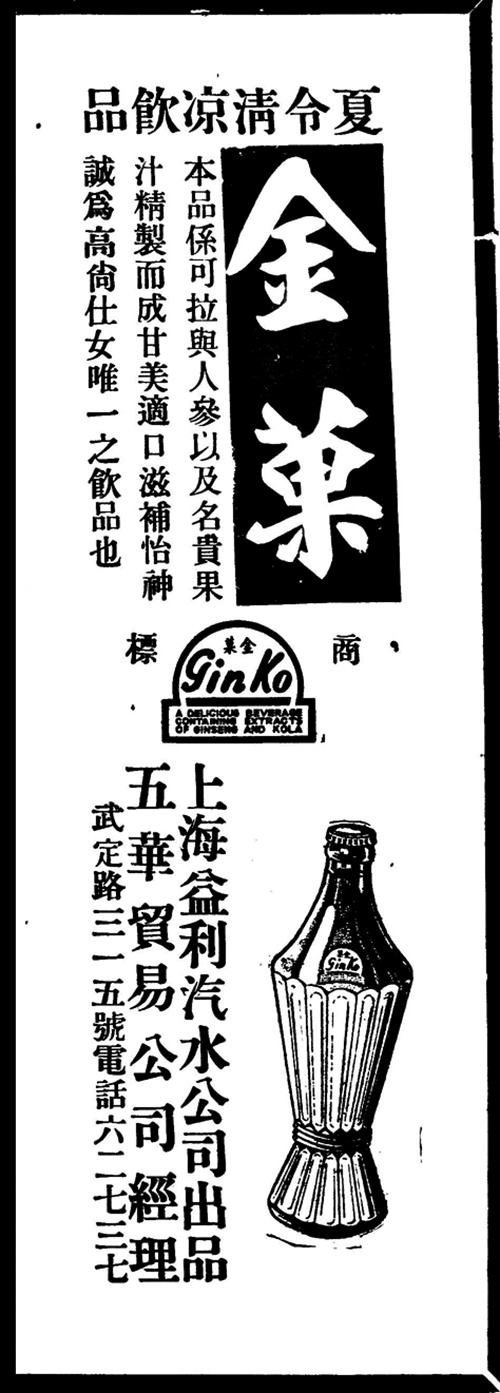
Among Coca-Cola’s numerous imitations, the most noteworthy was GinKo (see Figure 2). Many citizens at the time believed that GinKo most closely resembled Coca-Cola.Footnote 98 During the period when Coca-Cola was unavailable in Shanghai, many Western-style restaurants served GinKo as a substitute. Some customers even noted that while menus listed “Coca-Cola,” waitstaff actually brought GinKo to the table. This practice highlights how GinKo not only imitated Coca-Cola’s product but also capitalized on its reputation and unmet wartime demand.Footnote 99
“Xialing qingliang yinpin jinguo,” [Summer Refreshing Beverage GinKo] Xinwenbao (July 28, 1942): 8.

It is highly likely that GinKo was a rebranded version of the earlier “Eddie Kola.” First, GinKo was produced by the Eddie. Second, when GinKo was initially registered with the China Trademark Office, its Chinese name was “人参露” (pronounced Renshenlu), accompanied by the English description: “A Delicious Beverage Containing Extracts of Ginseng and Kola.”Footnote 100 Later, “人参露” was renamed “金菓” (GinKo), a name that more closely resembled the English brand in pronunciation. Due to the absence of Coca-Cola in the market, GinKo became a popular substitute and enjoyed brisk sales in Shanghai. Eddie placed considerable emphasis on the GinKo brand, even publishing a public statement in 1943 to assert its exclusive trademark rights.Footnote 101 According to advertisements, GinKo’s bottle design bore an even stronger resemblance to Coca-Cola’s than Eddie Kola’s did in 1939.
After World War II ended in 1945, Coca-Cola syrup was brought back to Shanghai along with the US military forces stationed there.Footnote 102 By 1946, with maritime shipping between China and the United States fully resumed, Coca-Cola once again became available to Shanghai residents. As a result, Coca-Cola imitations—including GinKo—quickly disappeared from the market.Footnote 103
Although the United States no longer held extraterritorial rights in China, its military influence in the country expanded significantly at the end of World War II. By leveraging its close ties to the US military supply system,Footnote 104 Coca-Cola quickly emerged as the dominant player in China’s postwar soft drink market. The strong diplomatic relationship between China and the United States enabled Coca-Cola—with its distinctly American cultural identity—to reap substantial benefits. In the postwar era, Coca-Cola was considered a premium beverage in cafes.Footnote 105 In 1947, a scandal broke out at National Chi Nan University during student “autonomy association” elections, where it was alleged that “ten bottles of Coca-Cola” could buy a vote.Footnote 106 That same summer, newspapers reported that Coca-Cola sales in Shanghai had reached 100,000 bottles per day.Footnote 107 A commentator later observed that Coca-Cola’s popularity in Shanghai was closely tied to its association with the United States. He remarked that after the war, the Chinese people admired America and respected the US military, and that this admiration extended by association to Coca-Cola. As a result, Coca-Cola came to dominate the cold beverage market.Footnote 108
The strong postwar sales of Coca-Cola further underscored its brand influence in the eyes of Chinese merchants. Some Chinese businesses, taking advantage of loopholes in the trademark regulations of the time, directly registered Coca-Cola’s Chinese and English trademarks under product categories unrelated to soft drinks.
In 1947, acting on behalf of The Coca-Cola Company, lawyers Allman and Li Zemin submitted a petition to the Trademark Office of the Republic of China, alleging that Shanghai Lifu Pharmacy was infringing upon Coca-Cola’s trademark. The pharmacy had registered the mark “可口可樂 Coca-Cola” for its toothpaste and other daily-use products and had publicly announced this to inform the consumers. The trademark used by Lifu Pharmacy was an exact replica of Coca-Cola’s soft drink trademark in both Chinese and English. However, the Trademark Office ultimately denied Coca-Cola’s petition, allowing Shanghai Lifu Pharmacy to register the “可口可樂 Coca-Cola” mark.Footnote 109 That same year, Coca-Cola also petitioned the Trademark Office to cancel a trademark registered by Tongle Candy Factory for candy products, on the grounds that the trademark design included the English words “Coca-Cola.” However, the petition was likewise rejected.Footnote 110
Unlike the earlier soft drink “Eddie Kola,” by 1947, businesses selling toothpaste, candy, and other products directly registered trademarks that included both the Chinese characters “可口可樂” and the English words “Coca-Cola,” and these registrations were formally recognized by Chinese authorities. Although China’s trademark law prohibits the imitation or copying of another’s trademark, it also sets specific conditions. Section 2, Clause 6 of the 1935 Trademark Law stipulates that “trademarks identical or similar to well-known marks belonging to others, used on the same type of goods,” cannot be registered. In other words, while the law prohibits the registration of identical or similar trademarks, the restriction applies only when they are used on the same category of goods. Clearly, the law does not prohibit identical or similar trademarks for products in different categories. According to the product classification system defined by trademark law, Coca-Cola’s products fall under the first category of medicinal aids and the thirty-ninth category of beverages such as soda and fruit juices. Toothpaste and tooth powder, by contrast, belong to the fifth category of “cleaning and polishing preparations not included in other categories.” Therefore, from a trademark text perspective, Shanghai Lifu Pharmacy was legally permitted to use the “可口可樂 Coca-Cola” mark in China.Footnote 111
According to the regulations of the China Trademark Office, if Coca-Cola objected to another company’s trademark registration application, it needed to submit an “Objection Petition” to the Trademark Office within six months after the latter announced the registration in the Trademark Gazette. This petition had to explain the grounds for objection, list the name and approval number of the disputed trademark, the name and registration number of Coca-Cola’s own trademark, and include a public fee of 8,000 yuan.Footnote 112 Coca-Cola argued that the use of “可口可樂 Coca-Cola” for toothpaste and tooth powder could mislead the public, causing consumers to mistakenly believe that “可口可樂 Coca-Cola” is not an American soft drink but rather a Shanghai toiletry product. This, Coca-Cola claimed, violated Section 2, Clause 4 of the 1935 Trademark Law, which prohibited the registration of trademarks that “may harm public order or are likely to deceive the public.”Footnote 113 In response to Coca-Cola’s objection, the Trademark Office asserted in its “Evaluation Report” that the decisive issue was whether the goods associated with the trademarks were identical or similar in nature. Coca-Cola’s trademarks “可口可樂 Coca-Cola” were registered for medicinal aids and soft drinks, while the respondent applied the trademark to toothpaste and tooth powder. Since bottled soft drinks and toiletry products differed in production methods, raw materials, and function, the office concluded that consumers would not assume they came from the same manufacture. Therefore, the respondent’s actions did not indicate an intent to deceive the public.Footnote 114
However, Coca-Cola’s postwar popularity in China proved short-lived. In 1949, when the Chinese Communist forces took control of Shanghai, Coca-Cola, as a symbol of American consumer culture, found itself once again facing significant challenges. After the United States imposed a materials embargo on China, the partnership between Coca-Cola and its Shanghai bottling affiliate, Watson’s Aerated Water Company, collapsed. Even so, Watson’s Aerated Water Company continued to bottle and distribute Coca-Cola using stockpiled raw materials, sustaining production until 1954.Footnote 115
Ironically, although the regime change dealt a heavy blow to Coca-Cola’s business in China, it simultaneously spared the company from becoming entangled in prolonged trademark litigation. Under the new socialist government, US–China diplomatic relations underwent a complete transformation. No commercial actors remained fixated on retaining the Coca-Cola trademark, and those who had previously registered it opportunistically failed to thrive in the new political and economic landscape. “Coca-Cola” became a symbol of high-quality soft drinks from capitalist countries. Within the new ideological framework, it emerged as the benchmark that domestic soda brands were expected to surpass.Footnote 116 Several local soda factories sought to develop a “Chinese-style” herbal soft drink that could outperform Coca-Cola. Among them, the Laoshan Aerated Water Company in Qingdao, formerly a Coca-Cola bottling plant, introduced Laoshan Cola (崂山可樂, pronounced Laoshankele) in 1956. The product gained strong market popularity and remains locally available to this day.Footnote 117 The enthusiasm with which domestic producers attempted to replicate Coca-Cola reflected the brand’s enduring appeal in major Chinese cities. In an unexpected way, this wave of imitation helped sustain Coca-Cola’s brand presence even after the company’s withdrawal from the Chinese market. That sustained brand influence, coupled with Coca-Cola’s association with American political and cultural identity, laid the groundwork for its return to China following the normalization of US–China relations in December 1978.
Conclusion
Coca-Cola’s trademark protection efforts in the Chinese market during the first half of the twentieth century underscore the complex interplay of culture, war, and law in shaping multinational business operations abroad. While China’s evolving commercial environment created new opportunities, Coca-Cola depended primarily on legal instruments and neglected to devise strategies tailored to local challenges. The absence of local partners in its trademark enforcement efforts further undermined its position, ultimately entangling the company in prolonged trademark disputes.
In the absence of local partners, multinational corporations often struggled to detect how cultural differences complicated trademark protection. Coca-Cola cultivated considerable brand influence in the Chinese market, and its well-crafted Chinese trademark played a vital role in shaping its brand identity. Yet the company failed to anticipate that, in a cross-linguistic environment, a successful product translation could also invite new forms of infringement. Coca-Cola overlooked local merchants who created phonetically similar Chinese trademarks and performers who adopted “可口可樂” as a stage name. It neither identified these infringements in a timely manner nor pursued effective countermeasures. In contrast, the German company Bayer responded swiftly to changes in Chinese trademark law and took prompt action against phonetic infringements. This disparity does not suggest that Coca-Cola ignored the Chinese market. Rather, it lacked the experience required to navigate the novel challenges posed by US–China cultural differences.
Wartime disruptions continually reshaped Coca-Cola’s commercial environment in China, directly affecting its trademark protection efforts. In the early stages of the war, Coca-Cola invoked US extraterritorial rights in China to target counterfeits. However, as the conflict intensified, supply chain breakdowns severed the company’s access to essential ingredients, creating space for imitations to flourish. The eventual termination of US extraterritoriality in China also deprived Coca-Cola of key legal privileges. After World War II, Coca-Cola extended its wartime cooperation with the US military by supplying American troops stationed in China, while gradually restoring civilian distribution. These efforts enabled the company to quickly regain market share and curb local imitators. The postwar warming of Sino-American relations gave Coca-Cola unprecedented visibility in China. Yet this surge in brand prominence carried latent risks. Recognizing the brand’s growing commercial value, Chinese merchants exploited a key gap in Chinese trademark law, which had yet to prohibit the registration of similar marks across different product categories, and legally registered Coca-Cola’s English and Chinese names for non-soda products.
Commercial law often lags behind the emergence of practical challenges. In the absence of complementary strategies tailored to real-world conditions, multinational corporations may end up reacting rather than acting when enforcing trademark rights. Cases involving celebrity stage names, phonetically similar Chinese trademarks, and the legal registration of Coca-Cola marks by local merchants do not necessarily indicate that Chinese commercial law was inherently unfavorable to foreign companies. Rather, when legal provisions fell short, corporations needed to pursue alternative avenues, such as negotiation, buyouts, or diplomatic intervention. For example, when Nestlé faced trademark imitation in China, it secured support from diplomatic officials. Although Nestlé had not yet completed formal trademark registration in China, the Chinese government still intervened on ethical grounds and urged local firms to abandon their claims. In contrast, Coca-Cola relied primarily on direct legal mechanisms: registering trademarks, invoking extraterritorial rights to prosecute counterfeiters, and filing complaints with the China Trademark Office. These actions, while legitimate, lacked the adaptability to address unresolved or novel challenges. Multinational corporations that actively identify and resolve practical issues may gain long-term advantages. Yet as the Cold War intensified, Coca-Cola again faced supply disruptions. With its product withdrawn from the Chinese market, its trademark disputes receded into obscurity.
Acknowledgments
I am grateful to Editor-in-Chief Andrew Popp and the four reviewers for their insightful feedback. I also thank my doctoral advisor, Professor Feng Xiaocai, for his guidance in shaping my argument. I appreciate Professor Jiang Jie, Dr. Chen Bin, Dr. Lu Yijun, Dr. Liu Peng, and Dr. Kang Yueliang for their valuable comments on earlier drafts. Finally, I am deeply thankful to my wife, Ms. Wu Baixin, for her unwavering support throughout this project.