Introduction
Bruce articulated the quality of care framework in 1990 and emphasized the importance of organizing family planning services to address the different and changing needs of a diverse range of individuals over time. Considerable progress has been made since then and many different approaches and models to improve quality have been implemented (see, for example, RamaRao & Mohanam, Reference RamaRao and Mohanam2003). These range from system-wide investments to smaller, focused efforts on a specific component of service delivery. While improvements in such aspects as infrastructure, supplies and equipment are necessary, they do not always translate into better care for clients.
Client orientation in service delivery is justified in its own right because clients deserve to be, and value being treated with respect and courtesy and, at the same time, need to receive accurate information about contraceptive methods appropriate to meet their reproductive health needs. Clients also value receiving individualized services that address their needs, and which provide them with a choice of methods and comprehensive information (Kols & Sherman, Reference Kols and Sherman1998). In addition, improvements in quality of care have been suggested as a mechanism to reduce unmet need (Bongaarts & Bruce, Reference Bongaarts and Bruce1995; Robey et al., Reference Robey, Ross and Bhushan1996).
The positive effect of improvements in service quality on contraceptive use, which was first hypothesized through a modelling exercise (Jain, Reference Jain1989), has now been demonstrated in diverse settings through cross-sectional studies (Mensch et al., Reference Mensch, Arends-Kuenning and Jain1996; Mroz et al., Reference Mroz, Bollen, Speizer and Mancini1999; Steele et al., Reference Steele, Curtis and Choe1999; Blanc et al., Reference Blanc, Curtis and Croft2002) as well as through longitudinal studies (Pariani et al., Reference Pariani, Heer and Van Arsdol1991; Lei et al., Reference Lei, Wu., Wu, Garceau, Jiang, Yang, Wang and Vander Meulen1996; Mensch et al., Reference Mensch, Arends-Kuenning, Jain and Garate1997; Koenig et al., Reference Koenig, Hossain and Whittaker1997, Reference Koenig, Ahmed and Hossain2003; Patel et al., Reference Patel, Patel, Mehta, Koenig and Khan1999; RamaRao et al., Reference RamaRao, Lacuesta, Costello, Pangolibay and Jones2003; Sanogo et al., Reference Sanogo, RamaRao, Jones, N'diaye, M'bow and Diop2003). Although the accumulated empirical evidence from these studies in favour of improving quality is strong, this effect has not been demonstrated through an intervention study in which those exposed to a quality improvement intervention continue with contraception with greater frequency than those who were not exposed to the intervention.
This paper examines an intervention study conducted in the Davao del Norte province of the Philippines to assess whether an intervention that improves quality of care received by clients also improves contraceptive continuation and reduces the occurrence of unintended pregnancies and unwanted births.
Methods
Intervention
Quality of care is a comprehensive concept including such elements as choice of methods, information exchange and provider's competence. It is programmatically quite difficult and expensive to expand choice to add a new method to the ongoing services in many settings. The intervention implemented in Davao del Norte province therefore aimed to improve quality of care within the constraints of service delivery in the province and focused on one aspect of quality of care: client–provider interaction.
The intervention in this study consisted of two components: training of family planning service providers working in public sector facilities and training of their supervisors. The service providers were trained in effective information exchange: carefully listening to clients and responding with relevant, accurate and complete information (AVSC International, 1995; AVSC International & DoH, Philippines, n.d.). The design of this intervention was based on the prevailing knowledge about the poor quality of client–provider interactions at that time. For example, data from several developing countries indicated that the information exchange between providers and clients was often poor or inadequate (see, for example, Mensch et al., Reference Mensch, Fisher, Askew and Ajayi1994; Miller et al., Reference Miller, Heidi, Horn, Miller, Miller, Askew, Horn and Ndhlovu1998). Moreover, clients often attributed discontinuation of a method to the side-effects (Ali & Cleland, Reference Ali and Cleland1995). Provision of information to clients has also been shown to result in better selection and continuation of the method selected (Pariani et al., Reference Pariani, Heer and Van Arsdol1991).
This training programme was conducted in March 1997 by AVSC International and three refresher courses were conducted in 1998 and 1999. Supervisors were trained in facilitative supervision – an approach that emphasizes mentoring, joint problem solving and two-way communication between the supervisor and those being supervised (Ben Salem & Beattie, Reference Ben Salem and Beattie1996). The intervention was designed and implemented in partnership with colleagues and researchers based in the Ateneo de Davao University, Davao city, and with the Department of Health at the national, regional and provincial levels (see Costello et al., Reference Costello, Lacuesta, RamaRao and Jain2001, for further details).
Design
A quasi-experimental design was used to evaluate the effect of the intervention. The 20 municipalities of Davao del Norte province were matched into ten pairs. One municipality from each pair was randomly assigned to the experimental group and the other to the control group. One Rural Health Unit (RHU) and three of its nearest Barangay Health Stations (BHS) in each municipality participated in the study; hence, the study covered 20 RHUs and 60 BHSs. The study excluded the city of Tagum because it was too difficult to match it with any other municipality due to its relatively greater development and urbanization.
Service providers and their supervisors based in the 40 facilities in the experimental group underwent the training described above. A second aspect of the design was the constitution of a panel of new family planning clients who had received services in 80 study clinics between April and December 1997. Thus, women who received services from 40 clinics in the experimental group during this period were exposed to providers who had been trained in March 1997, unlike those in the control group.
Use of random allotment increases the likelihood that the experimental and control groups were similar before the intervention. Hence, any subsequent differences between the two groups in the knowledge and behaviour of both providers and clients can be attributed to the intervention. Furthermore, the existence of a control group allows the net effect of the intervention on the behaviour of clients in the experimental group to be measured. The following effects were anticipated:
1) Training of providers was expected to improve their knowledge about contraceptive methods and their behaviour towards clients;
2) Clients in the experimental group were expected to receive better quality of care in terms of treatment and information about contraceptive methods;
3) Improved quality of care received by clients at the time of initiating a method was expected to result in better continuation subsequently; and
4) Clients in the experimental group were expected to show a higher continuation of methods than those in the control group.
Data
The panel of 1728 new family planning users was identified from the records of 80 study facilities. Respondents were interviewed at their homes three times: once in 1997 at the time of recruitment into the panel and twice later in 1999 and 2000. The first interview collected information on respondent's socioeconomic and demographic profiles, the method they had accepted during their visit to the facility, the quality of care they had received at the time of acceptance and their reproductive intention. This minimized the effect of recall bias in data collected about quality of care.
At the follow-up interviews, women were asked about their reproductive and contraceptive behaviour since the time they were last interviewed, i.e. between the first and second interviews and between the second and third interviews. Information was collected using a calendar similar to that used in Demographic and Health Surveys (DHS), except that the period of recall was much shorter than in the DHS. At the time of the follow-up interviews, starting with the current month and working retrospectively, respondents were asked about pregnancy and contraceptive status in each month, type of method used, reasons for discontinuing or switching methods and the outcome of the pregnancy, if pregnant. In a different section of the questionnaire, information was also collected on the respondent's experience with using the method, their current reproductive intention and current socioeconomic background.
All respondents entered the study only after having provided informed consent. Respondents were told that the information provided by them would be treated confidentially and kept in a secure place. Also, at the end of the first and the second interview, consent was obtained for a re-visit in the future.
Variables
Dependent variables. The three dependent variables used in the study were: contraceptive use, unintended pregnancy and unwanted birth. Contraceptive use was measured by whether the woman was using a modern contraceptive method at the time of the third interview. Researchers have observed that women find it difficult to label retrospectively some of their living children as being unwanted pregnancies or births (Bongaarts, Reference Bongaarts1991; Bankole & Westoff, Reference Bankole and Westoff1998; Casterline & Sinding, Reference Casterline and Sinding2000). This issue of post-birth rationalization was handled to a large degree in this study by using a prospective design. Unwanted births and unintended pregnancies were created by linking responses on reproductive intention reported at the beginning of the period with pregnancies and births that occurred subsequently.
In this study, reproductive intentions were measured by two questions: ‘Do you want more children?’ and, for those who answered in the affirmative, ‘How long do you want to wait until your next child?’ This information was used to classify women with at least one subsequent unwanted live birth and those with at least one unintended (unwanted or mistimed) pregnancy. Women who wanted no more children at the first interview and had at least one birth between the first and the third interview were classified as having an unwanted birth. Women having an unintended pregnancy include those who have at least one unwanted or mistimed pregnancy between the first and third interview. Inclusion of reproductive intentions at the second interview did not make much difference.
Independent variables. All the independent variables included in the analyses were reported at the time of the first interview. The principal independent variables of interest were: quality of care received at the time of the first interview and membership in the experimental group. Quality of care was measured from women's reports at first interview about their experience at the time of adopting a contraceptive method. Information was collected from the respondents on 24 items shown in Table 3 reflecting five aspects of care: the assessment of her reproductive goals and prior contraceptive experience (three items), the method choices offered (four items), the information conveyed (seven items), her perceptions about interaction (eight items), and whether she was told about follow-up services (two items). Each item for a woman was scored as 1 for yes and 0 for no. All scores were added to get a summary score on quality of care for each woman; equal weights to each element were assigned because there was no empirical evidence to indicate their relative importance. The total quality of care score was transformed into a three-category variable: low, medium and high. The medium level was defined as quality within one-half of a standard deviation of the mean for all women in the study; values falling below were categorized as low and those falling above the medium were categorized as high level of quality.
Other independent variables of relevance included are: educational status of respondent and her spouse; the employment status of the respondent and her spouse, and ownership of various consumer durables (as proxies for the economic situation of the household); and other characteristics of the individual and household reflecting the demographic and social background, such as age of respondent and her spouse, the number of children they have, and religion.
Analysis
Four sets of analyses were undertaken by using the woman as the unit of analysis: tests for selectivity bias, for equivalence between the intervention and control, for effect of the intervention on provider's knowledge and quality of care received by clients and whether the quality of care and the intervention had an effect on the dependent variables. Chi-squared tests and t-tests were performed to test for statistically significant differences between the groups on their socioeconomic, demographic and reproductive backgrounds. Bivariate comparisons using chi-squared tests were performed to examine the effects of the intervention and quality of care on dependent variables. Logistic regression models were used to predict the effect of baseline variables on the women followed up at round 3, and to study the effect of quality after adjusting for the effects of background characteristics.
Results
Is there selectivity between rounds 1 and 3?
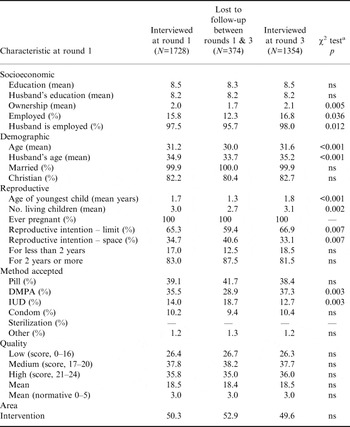
At the time of the third and last contact, 1354 or 78% of the original sample of 1728 women were interviewed. The results presented in Table 1 indicate that no serious selectivity bias was introduced by the attrition of women between the first and third rounds. The existence of the selectivity bias was checked by comparing those who were re-interviewed at the third round with those who were not (columns 3 and 4 in Table 1). The two groups are quite similar in many socioeconomic aspects: education, marital status, religion, contraceptive used and quality of care received. The two groups were significantly different on other characteristics: ownership of consumer durables, employment, age, number of living children, age of the youngest child and reproductive intentions. However, there were no significant differences between those re-interviewed at round 3 and those lost to follow-up between the first and third rounds in the crucial variables of interest: the quality of care they reported receiving at the time of their first facility visit, and membership status in the intervention group. These findings are similar to those found by comparing those re-interviewed at the second contact and those who were not (RamaRao et al., Reference RamaRao, Lacuesta, Costello, Pangolibay and Jones2003). The existence of the selectivity bias was further tested by running a logistic regression on being interviewed in the last round and controlling for the set of characteristics at the first round. The results of this regression analysis showed that those who were interviewed at the third round were significantly different from those who were not interviewed on the ownership of the modern durables, husband's employment and the age of the youngest child (data not shown).
Socioeconomic and demographic characteristics at round 1 of women interviewed at rounds 1 and 3 and those who were lost to follow-up between these rounds

a χ2 tests assessing whether the round 1 characteristic of women interviewed at round 3 are statistically different from round 1 characteristic of those who were not interviewed at round 3.
Did the randomization work?
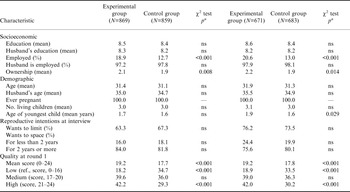
The results presented in Table 2 indicate that the randomization of facilities in experimental and control groups was largely successful in achieving two equivalent groups of clients. In round 1 respondents in the experimental and control groups shared similar socioeconomic and demographic characteristics differing only in that the experimental group had a higher percentage of employed and greater ownership of consumer durables than those in the control group (also see Costello et al., Reference Costello, Lacuesta, RamaRao and Jain2001). The same minor differences between experimental and control group respondents is noted by comparing round 3 data, with the addition of the lower age of the youngest child in the control group becoming significant. Also, the proportion of respondents who reported wanting to limit childbearing had increased in both groups over time (from 63% to 76% in experimental; 67% to 74% in control).
Socioeconomic and demographic characteristics of women at rounds 1 and 3 by study group
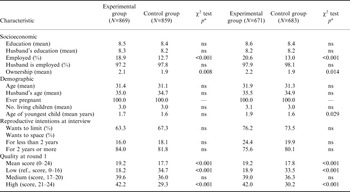
a p is the probability that the characteristics of women between experimental and control areas are different.
Did the intervention improve providers' knowledge and quality of care received by clients?
The intervention significantly improved providers' knowledge and the quality of care received by clients (see Costello et al., Reference Costello, Lacuesta, RamaRao and Jain2001 for details). The training intervention improved the knowledge of service providers in the experimental group in comparison with their pre-intervention levels as well as in comparison with providers in the control group. Most of the increases occurred in specific aspects of contraceptive knowledge such as side-effects or warning signs. For example, the average score for number of side-effects and warning signs known for oral contraceptives rose significantly from 3.0 to 5.6 among providers in the experimental group compared with an increase from 2.9 to 3.4 in the control group.
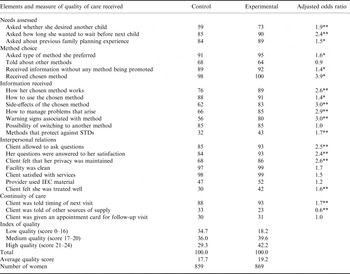
The intervention also improved the quality of care received by clients. Respondents in the experimental group reported receiving significantly higher levels of care than those in the control (see Table 3). There were statistically significant differences between intervention and control groups on 18 out of 24 elements of care after controlling for the effects of background characteristics. Clients in the experimental and control groups received similar care on such aspect of choice as being told about other methods and such aspect of care as being satisfied with the services. Clients in the experimental group received better care on such aspects as assessing client needs, providing information and informing about return dates. For example, respondents in the experimental group were more likely to be asked about their reproductive intentions than those in the control group (73% versus 59%); they were more likely to be told of side-effects (83% versus 62%) and also about warning signs (80% versus 56%). Further improvements are still possible on some elements: for example, information on other methods (64% versus 68%), and other sources of supply (23% versus 33%). Without this information, switching of contraceptive method or current source of supply would be difficult if either became problematic.
Percentage of women by quality of care they received at the time of initiation of a contraceptive method by study group

Adjusted odds ratios measure the effect of intervention after controlling for all background variables.
* p≤0.05;
** p≤0.01 (show the probabilities that these adjusted odds ratios are significantly different from one).
Source: Costello et al. (Reference Costello, Lacuesta, RamaRao and Jain2001).
Did the quality of care and intervention affect contraceptive use and reproductive behaviour?
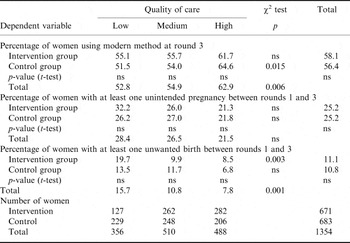
Table 4 presents the results for contraceptive use and reproductive behaviour between rounds 1 and 3 by quality of care received at round 1, separately for intervention and control groups of clients. The level of contraceptive use increases with the level of quality received for women in both groups and achieves statistical significance for the control group. The level of unintended pregnancy decreases with improved quality and the relationship was almost statistically significant (p=0.056) in the intervention group. A similar statistically significant and negative association is observed between quality and unwanted births, both in the intervention and control groups, with a weaker effect in the control group (p=0.067). Once the two groups are pooled, quality of care received at the time of initial adoption of a method is found to increase the likelihood of using contraception at the third interview from 53% at low levels of quality to 55% at medium levels, and 63% at high levels. Quality of care received at initial visit decreased the likelihood of subsequently having an unintended pregnancy from 28% to 22% and also decreased the likelihood of subsequently having an unwanted birth from 16% to 8%. Multivariate regression analysis using controls for social, economic, demographic and cultural factors confirmed the effects of improved quality on subsequent contraceptive use and reproductive behaviour (data not shown).
Contraceptive use, unintended pregnancies and unwanted births by quality of care separately for intervention and control groups
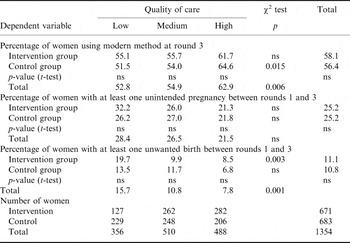
A comparison of women in the experimental group with those in the control group, however, did not show a significant effect of the provider-level training intervention on any of the three client-level outcome variables: contraceptive use, unintended pregnancy or unwanted birth (Column 6, Table 4). For example, 58% of the respondents in the experimental group were using a modern method at the time of the third interview as compared with 56% in the control group. One-quarter of the women in both experimental and control groups reported having an unintended pregnancy by the time of the third interview, and about 11% of women in both groups reported having an unwanted birth (11.2% in experimental group and 10.8% in control). This set of results indicates that the effect of the training intervention on women's subsequent contraceptive use and reproductive behaviour was extremely weak.
Discussion
This paper presents the results of a training intervention study conducted in the province of Davao del Norte in the Philippines. The intervention aimed to improve client–provider interactions in public sector facilities by focusing on the information exchanged between the two parties.
The principal hypothesis tested in this study was that the provider-level training intervention would improve client-level outcomes in terms of their contraceptive use and reproductive behaviour. The results from the Philippines study could not demonstrate a statistically significant effect of the provider-level training intervention on the client-level impact indicators. In other words, the intervention may not have been powerful enough to improve continuation of contraception or to reduce unwanted fertility among women in the experimental group in comparison with those in the control group.
This is a conundrum because the study demonstrated the validity of all the causal links in the chain. For example, the training intervention significantly improved the knowledge of providers; it also improved the quality of client–provider interactions in the experimental group, compared with the control group (Costello et al., Reference Costello, Lacuesta, RamaRao and Jain2001). Furthermore, the study results also demonstrated and confirmed the existence of a link between quality of care received by women and their subsequent contraceptive and reproductive behaviour; receiving better quality care at the time of initial adoption increased contraceptive continuation and reduced both unintended pregnancies and unwanted births.
So, what explains the lack of significant differences in the observed levels of contraceptive continuation, unintended pregnancies and unwanted births between the experimental and control groups? The answer seems to be a combination of two factors: women in the control clinics received a fairly good quality of care and the effect of the training intervention on improved quality, while statistically significant, was not large enough. Facilities in Davao surprisingly did not start from a very low or abysmal level of care. In fact, in the control group of facilities, 29% and 36% of clients received a high or medium level of care, respectively, and only 35% received a low level of care (Table 2). The average level of care received by all clients in the control clinics on a 24-point scale was as high as 17.7 points. Consequently, the potential for improving quality through an intervention was reduced due to the ceiling effect. Nevertheless, the intervention – training of providers – indeed shifted the distribution of women in the experimental group in the right direction. Only 18% of the clients in the experimental group received low level of care and as many as 42% received high level care. The average level of care also increased to 19.2 points. While this improvement in quality was significant statistically, the difference of 1.5 points was not large enough to produce significant differences in contraceptive continuation and unwanted childbearing among women between the two groups. Increasing the divergence when the base (i.e. control) level is not poor is a difficult task as most programme managers and field practitioners will attest; it is easier to move from low levels and becomes increasingly harder at higher levels.
Implications
The absence of straightforward and uncomplicated results of this study may be interpreted by some key stakeholders as a lack of rationale to invest in approaches that are client oriented and that promote good quality services. Such a conclusion, however, is not warranted because women's reproductive behaviour is influenced not only by service environment but also by a combination of contextual and individual factors not under the control of service providers. The effect of provider-level intervention must be interpreted within this context.
To begin with, quality along with accessibility and cost are three dimensions of services, and information exchange is one of the six elements of quality. Moreover, the contribution of side-effects to discontinuation may be overestimated from retrospective studies that ascertain causes of high discontinuation only by interviewing those who discontinue. It is quite possible that these responses are proxies for more intimate and personal reasons for discontinuation that women may not want to share with interviewers. An accurate estimation of the probability of discontinuing contraception among those who experience side-effects would require that the study also ascertain the extent to which women continue to use contraception even though they experience similar side-effects. The results of this study, while disappointing, do not negate the significant effect of quality of care received by women on their subsequent behaviour observed in this study and many other studies mentioned in the Introduction section.
The main reason for continuing efforts to improve the nature and the content of client–provider interactions, however, remains intuitively simple: as long as there are programmes that intend to serve their beneficiaries, there will be points of contact between providers and clients, resulting in interactions between them. In many settings, these interactions may be the only source for receiving accurate information about contraceptive methods. Providing accurate information to clients through these interactions becomes crucial in these circumstances. The nature and the content of these interactions, however, need to be defined explicitly within the local contexts in terms of such topics as: assessing clients' reproductive goals, helping them to select a method appropriate to achieve those goals, informing them how to use the method selected, what to expect in terms of side-effects, how to manage these side-effects, and treating them decently. Moreover, this type of orientation could easily be incorporated without too much additional cost in the ongoing training programmes for providers. In addition to monitoring progress in improving client–provider interactions, future studies could also focus on identifying clients that consistently receive poor quality care or providers that consistently offer poor quality care to all or certain group of clients. Remedial actions to improve quality could then focus on these groups.