Organizations offer flexible work practices (FWPs) as a strategic tool to attract, retain and motivate a diverse range of talented employees (Kossek & Lautsch, Reference Kossek and Lautsch2018). FWPs are defined as ‘working practices that allow more control with regard to where, when and how work is done’ (Avgoustaki & Bessa, Reference Avgoustaki and Bessa2019: 432). FWPs usage provides employees with more control over the scheduling, location and amount of work they perform, which enhances their work−personal time coordination (e.g., Kauffeld, Jonas, & Frey, Reference Kauffeld, Jonas and Frey2004). Such usage is associated with a range of positive employee outcomes such as employee performance and productivity (e.g., de Menezes & Kelliher, Reference de Menezes and Kelliher2017), job satisfaction, commitment, work engagement, turnover intentions (e.g., Chen & Fulmer, Reference Chen and Fulmer2018; Ugargol & Patrick, Reference Ugargol and Patrick2018), health, wellbeing and work−life/work−family balance (Kröll, Doebler, & Nüesch, Reference Kröll, Doebler and Nüesch2017; Peters, Den Dulk, & Van Der Lippe, Reference Peters, Den Dulk and Van Der Lippe2009). Contrary to these positive effects, several prior studies have linked FWPs usage with negative career consequences (e.g., Blair-Loy & Wharton, Reference Blair-Loy and Wharton2002) such as lack of career and wage progression (e.g., Cohen & Single, Reference Cohen and Single2001; Costa Dias, Joyce, & Parodi, Reference Costa Dias, Joyce and Parodi2018), negative performance appraisals (Bornstein, Reference Bornstein2013), social and professional isolation (Cooper & Kurland, Reference Cooper and Kurland2002) and co-worker dissatisfaction (Golden, Reference Golden2007).
Little is known, however, about how FWPs usage influences employee outcomes. This study investigates the mediating role of work−life balance (WLB) in the relationship between FWPs usage and employee outcomes. WLB is ‘the extent to which an individual is able to adequately manage the multiple roles in their life, including work, family and other major responsibilities’ Haar (Reference Haar2013: 3308). FWPs provide employees with some control over their work schedule to better coordinate their transition among work and personal roles (Bond & Galinsky, Reference Bond and Galinsky2006; de Menezes & Kelliher, Reference de Menezes and Kelliher2011; Pierce & Newstrom, Reference Pierce and Newstrom1980). Increased WLB, in turn, may positively influence employee outcomes. A successful balance among multiple life roles leads to positive employee outcomes as suggested by role balance theory (Carlson, Grzywacz, & Zivnuska, Reference Carlson, Grzywacz and Zivnuska2009; Marks & MacDermid, Reference Marks and MacDermid1996). Past studies have identified various factors such as gender egalitarianism, cultural context and job demand to moderate the relationship between the WLB−employee outcomes (Chiang, Birtch, & Kwan, Reference Chiang, Birtch and Kwan2010; Haar, Russo, Suñe, & Ollier-Malaterre, Reference Haar, Russo, Suñe and Ollier-Malaterre2014). However, there is a lack of empirical evidence related to the role of employee age as a moderator on this relationship (Gragnano, Simbula, & Miglioretti, Reference Gragnano, Simbula and Miglioretti2020; Treadway, Duke, Perrewe, Breland, & Goodman, Reference Treadway, Duke, Perrewe, Breland and Goodman2011).
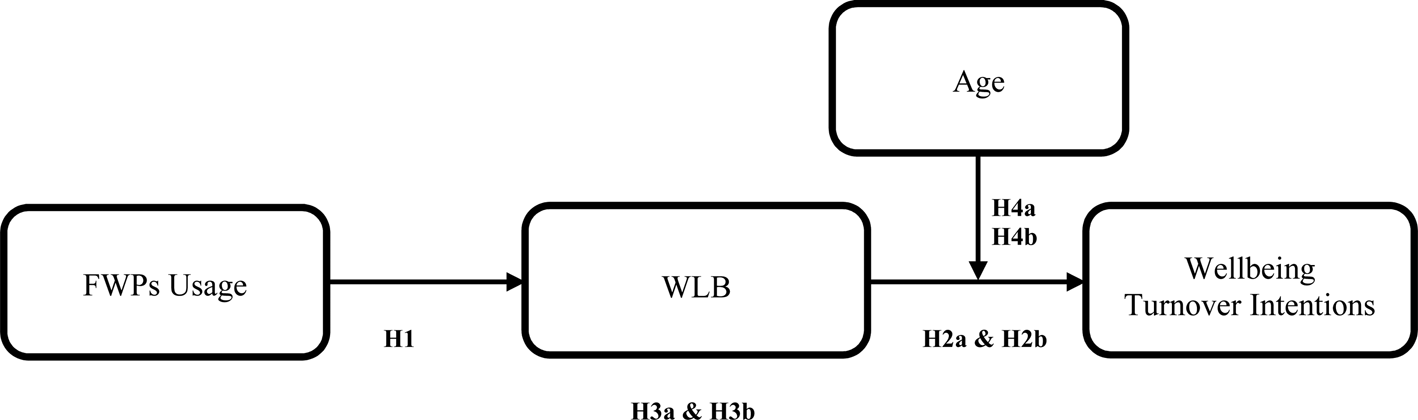
This study advances work−life literature in several ways. First, integrating boundary theory (Ashforth, Kreiner, & Fugate, Reference Ashforth, Kreiner and Fugate2000; Nippert-Eng, Reference Nippert-Eng1996) and role balance theory (Marks & MacDermid, Reference Marks and MacDermid1996), this study predicts and tests the mediating role of WLB in the relationship between FWPs usage and two employee outcomes: wellbeing and turnover intentions (see Figure 1). Past literature provides evidence of a positive relationship between FWPs usage and WLB (e.g., Duncan & Pettigrew, Reference Duncan and Pettigrew2012; Hill, Ferris, & Martinson, Reference Hill, Ferris and Martinson2003), a positive relationship between WLB and employee outcomes (e.g., Haar et al., Reference Haar, Russo, Suñe and Ollier-Malaterre2014; Jang, Reference Jang2009), and a positive relationship between FWPs usage and employee outcomes (Chen & Fulmer, Reference Chen and Fulmer2018; Kossek, Lautsch, & Eaton, Reference Kossek, Lautsch and Eaton2006). These three bodies of the literature suggest that WLB may partially (other possible mediators, not tested in this study, include affective commitment) mediates the relationship between FWPs usage and employee outcomes. A lack of empirical evidence exists for this mediation effect (e.g., Jang, Reference Jang2009). Second, this study advances the current WLB literature by predicting and testing the moderating effects of age on the relationship between WLB and employee outcomes of wellbeing and turnover intention, based on socioemotional selectivity theory (Carstensen, Reference Carstensen1995) (see Figure 1). The socioemotional selectivity theory (Carstensen, Reference Carstensen1995) suggests that with age, individuals' motivation and priorities in life changes, leading to varied work and non-work outcomes. Third, this study provides additional evidence of the direct effects of: FWPs usage on WLB (e.g., Peters, Den Dulk, & Van Der Lippe, Reference Peters, Den Dulk and Van Der Lippe2009), and WLB on wellbeing and turnover intentions (e.g., Jang, Reference Jang2009; Parkes & Langford, Reference Parkes and Langford2008). Testing both effects in the same study controls for the factors (e.g., industry effects, legislative environment, etc.) which might have contributed to some inconsistent findings (e.g., Felstead, Jewson, Phizacklea, & Walters, Reference Felstead, Jewson, Phizacklea and Walters2002; Greenhaus, Collins, & Shaw, Reference Greenhaus, Collins and Shaw2003). The hypotheses are tested using employee data from an Australian financial and insurance service organization.
Research model.

Theoretical background and hypotheses development
Use of FWPs and WLB
Boundary theory (Ashforth, Kreiner, & Fugate, Reference Ashforth, Kreiner and Fugate2000; Nippert-Eng, Reference Nippert-Eng1996) predicts a positive relationship between FWPs usage and WLB. This theory is about how individuals create, maintain or change boundaries to simplify and manage the environment around them (Allen, Cho, & Meier, Reference Allen, Cho and Meier2014; Ashforth, Kreiner, & Fugate, Reference Ashforth, Kreiner and Fugate2000). It originates from Nippert-Eng (Reference Nippert-Eng1996) cognitive theory of social classification, where he discussed how individuals value work and home and the ways of transitioning between these two life domains. FWPs are organizational resources to assist individuals to create and/or maintain boundaries between work and non-work domains.
In work−life literature, boundary theory is used to understand the existence of behavioural, physical and/or cognitive boundaries between individuals' work and non-work domains and how these boundaries work as separators between the two (Allen, Cho, & Meier, Reference Allen, Cho and Meier2014; Ashforth, Kreiner, & Fugate, Reference Ashforth, Kreiner and Fugate2000; Nippert-Eng, Reference Nippert-Eng1996). Boundary theory focuses on the transition across various roles. Ashforth, Kreiner, and Fugate (Reference Ashforth, Kreiner and Fugate2000) broadly classify such transitions as macro- and micro-role transitions. Macro transitions involve irregular and permanent transitions, such as promotion, whereas micro transitions involve regular and recurring transitions, such as commuting to/from work (Allen, Cho, & Meier, Reference Allen, Cho and Meier2014; Ashforth, Kreiner, & Fugate, Reference Ashforth, Kreiner and Fugate2000). Work−life literature primarily discusses micro-role transitions between work and personal life (Allen, Cho, & Meier, Reference Allen, Cho and Meier2014), using the ‘segmentation-integration continuum’ concept and ‘boundary flexibility and permeability’ (Ashforth, Kreiner, & Fugate, Reference Ashforth, Kreiner and Fugate2000: 474).
According to Kreiner (Reference Kreiner2006), individuals regularly negotiate boundaries between work and home roles while performing daily activities. The success of boundary negotiation is influenced by individual and/or environmental characteristics that determine the ease or difficulty of boundary transition from work to home and vice versa. The degree of segmentation (separation between work and life) or integration (blending of work and life) between work and non-work domains determines the success or failure of role transitions. Segmentation and integration represent two opposite approaches to WLB (Ashforth, Kreiner, & Fugate, Reference Ashforth, Kreiner and Fugate2000; Nippert-Eng, Reference Nippert-Eng1996). As individuals differ in their preferences for segmentation or integration between work and non-work roles, they use various strategies to manage work and non-work boundaries, which creates a ‘segmentation–integration continuum’ (Bulger, Matthews, & Hoffman, Reference Bulger, Matthews and Hoffman2007; Kreiner, Reference Kreiner2006; Languilaire, Reference Languilaire2009; Nippert-Eng, Reference Nippert-Eng1996; Park & Jex, Reference Park and Jex2011).
High segmentation preference reduces the possibility of role blurring as boundaries between roles become impermeable and inflexible. Individuals at this end of the continuum maintain a strict boundary between work and non-work domains. On the other hand, high integration preference increases the possibility of role blurring as boundaries between roles become permeable and more flexible, allowing free interaction between work and non-work roles (Allen, Cho, & Meier, Reference Allen, Cho and Meier2014; Ashforth, Kreiner, & Fugate, Reference Ashforth, Kreiner and Fugate2000; Bulger, Matthews, & Hoffman, Reference Bulger, Matthews and Hoffman2007; Daniel & Sonnentag, Reference Daniel and Sonnentag2016). Similar to individual differences, workplace practices, such as FWPs, can differ in terms of facilitating or hindering integration and segmentation between work and non-work domains (Daniel & Sonnentag, Reference Daniel and Sonnentag2016; Kreiner, Reference Kreiner2006; Lirio, Reference Lirio2017). For instance, some workplaces allow flexible schedules to deal with personal and/or family demands. Conversely, other workplaces provide only fixed schedules and require physical presence (Daniel & Sonnentag, Reference Daniel and Sonnentag2016; Rothbard, Phillips, & Dumas, Reference Rothbard, Phillips and Dumas2005).
In sum, FWPs usage is likely to increase employee WLB by harmonizing work and non-work roles. Empirical evidence links FWPs usage with WLB. For instance, Peters, Den Dulk, and Van Der Lippe (Reference Peters, Den Dulk and Van Der Lippe2009) identified that part-time employees working between 12 and 24 h per week experienced higher WLB compared to other part-time employees and teleworkers. Similarly, Hill, Ferris, and Martinson (Reference Hill, Ferris and Martinson2003) reported an increased WLB and personal/family life success in telecommuters (i.e., employees working from home). Thus, it is proposed:
Hypothesis 1: FWPs usage is positively related to employee WLB.
WLB and employee outcomes
Drawing on the theoretical lens of role balance proposed by Marks and MacDermid (Reference Marks and MacDermid1996), we predict a positive relationship between WLB and employee outcomes. The literature related to multiple roles and identities mostly emphasizes that individuals exert a salience hierarchy to manage multiple roles, prioritizing some roles over others to avoid role overload and/or strain (Goode, Reference Goode1960; James, Burkhardt, Bowers, & Skrupskelis, Reference James, Burkhardt, Bowers and Skrupskelis1890; Stryker, Reference Stryker1968). Following Mead's (Reference Mead1964) assumption, Marks and MacDermid suggest that instead of prioritizing one role over another and restricting the number of life roles, individuals try to cultivate a flexible attitude to organize and engage in multiple roles in a way that maximizes balance and alleviates strain (Carlson, Grzywacz, & Zivnuska, Reference Carlson, Grzywacz and Zivnuska2009; Grzywacz & Carlson, Reference Grzywacz and Carlson2007). In sum, WLB does not depend on the number of roles individuals have to perform but rather on how successfully they can organize themselves and manage harmony among roles to gain additional benefits.
Role balance theory suggests that individuals who can balance multiple jobs harmoniously may achieve additional benefits and enjoyment than those with less balance (Carlson, Grzywacz, & Zivnuska, Reference Carlson, Grzywacz and Zivnuska2009; Marks & MacDermid, Reference Hayman1996). The additional satisfaction gained from role balance is expected to positively influence employee work and non-work outcomes, while a lack of harmony/balance leads to negative outcomes and role strain. Work outcomes include increased job satisfaction, organizational commitment and reduced turnover intentions (Aryee, Tan, & Srinivas, Reference Aryee, Tan and Srinivas2005; Carlson, Grzywacz, & Zivnuska, Reference Carlson, Grzywacz and Zivnuska2009; Fox & Fallon, Reference Fox and Fallon2003; Kossek & Ozeki, Reference Kossek and Ozeki1999; Noor, Reference Noor2011). Non-work outcomes include life satisfaction, family satisfaction, family performance and family functioning (Allen, Reference Allen2001; Carlson, Grzywacz, & Zivnuska, Reference Carlson, Grzywacz and Zivnuska2009; Clarke, Koch, Hill, & Journal, Reference Clarke, Koch and Hill2004). Lower work−family balance and higher work−family conflict are related to employee stress, burnout and poor psychological health (Allen, Herst, Bruck, & Sutton, Reference Allen, Herst, Bruck and Sutton2000; Bell, Rajendran, & Theiler, Reference Bell, Rajendran and Theiler2012; Wang, Reference Wang2006).
In sum, based on role balance theory, we expect that individuals with a higher balance between work and non-work roles will enjoy more positive outcomes than those with lower role balance. Empirical evidence exists for a positive WLB−employee outcomes relationship. For instance, Brough et al. (Reference Brough, Timms, O'Driscoll, Kalliath, Siu, Sit and Lo2014) identified a positive impact of WLB on family and job satisfaction. Similarly, Haar (Reference Haar2013) identified a positive impact of WLB on employee job satisfaction, life satisfaction and psychological outcomes (emotional exhaustion, anxiety and depression). Thus, we propose:
Hypothesis 2a: WLB is positively related to employee wellbeing.
Hypothesis 2b: WLB is negatively related to employees' turnover intentions.
Mediating role of WLB
The mediating role of WLB in the relationship between FWPs usage and employee outcomes can be derived from the integration of boundary theory and role balance theory. We argue that FWPs usage leads to improved WLB among employees (see preceding theoretical arguments leading to Hypothesis 1). Boundary theory suggests that FWPs usage assists employees with a smooth transition between work and non-work domains, leading to increased WLB (Grant, Wallace, & Spurgeon, Reference Grant, Wallace and Spurgeon2013; Hill, Ferris, & Martinson, Reference Hill, Ferris and Martinson2003). We also argue that WLB leads to positive employee outcomes (see preceding theoretical arguments leading to Hypotheses 2a and 2b). Role balance theory suggests that WLB facilitates successful performance in multiple roles simultaneously (Grzywacz & Bass, Reference Grzywacz and Bass2003; Haar, Reference Haar2013). Employees who perceive more balance in their work−life roles are likely to report positive work outcomes as well as physical and mental health outcomes (Brough et al., Reference Brough, Timms, O'Driscoll, Kalliath, Siu, Sit and Lo2014; Ferguson, Carlson, Zivnuska, & Whitten, Reference Ferguson, Carlson, Zivnuska and Whitten2012; Haar et al., Reference Haar, Russo, Suñe and Ollier-Malaterre2014). In sum, FWPs usage drives WLB and WLB drives positive outcomes. Theories also predict the FWPs usage−employee outcomes relationship (Person-Environment fit theory, Edwards, Reference Edwards1996). Thus, we predict that part of the effect of FWPs usage on employee outcomes may occur through the mediating process of WLB. The other parts of effects may occur through processes, such as affective commitment (de Menezes & Kelliher, Reference de Menezes and Kelliher2017; Shin, Garmendia, Ali, Konrad, & Madinabeitia-Olabarria, Reference Shin, Garmendia, Ali, Konrad and Madinabeitia-Olabarria2020). Indeed, the affective commitment was found to mediate the relationship between informal remote working and employee performance in a past study (de Menezes & Kelliher, Reference de Menezes and Kelliher2017).
There is a lack of empirical evidence regarding the mediating role of WLB in the relationship between FWPs usage and employee outcomes. Empirical evidence supports the above mentioned three relationships separately (FWPs usage−WLB, WLB−employee outcomes, and FWPs usage−employee outcomes) that suggest the mediating role of WLB in the relationship between FWPs usage and employee outcomes. For instance, Hill, Ferris, and Martinson (Reference Hill, Ferris and Martinson2003) reported a positive relationship between FWPs usage and WLB while Haar et al. (Reference Haar, Russo, Suñe and Ollier-Malaterre2014) reported a positive relationship between WLB and job and life satisfaction. Moreover, de Menezes and Kelliher (Reference de Menezes and Kelliher2017) reported a positive association between FWPs usage and employee performance FWPs. Thus, we propose:
Hypothesis 3a: WLB partially mediates the relationship between FWPs usage and employee wellbeing.
Hypothesis 3b: WLB partially mediates the relationship between FWPs usage and employee turnover intentions.
Moderating effect of age
‘Mature age’ is defined differently in various reporting and social contexts (Atkinson & Sandiford, Reference Atkinson and Sandiford2016; Loretto & Vickerstaff, Reference Loretto and Vickerstaff2015). Managing flexibility and demographic diversity in organizations often considers employees over 45 years as mature aged (Ali & French, Reference Ali and French2019; Diversity Council Australia, 2013; Warren, Reference Warren2015). Today's workforce comprises employees from various age groups who have different motives for seeking a balance between work and non-work roles (Kelliher, Richardson, & Boiarintseva, Reference Kelliher, Richardson and Boiarintseva2019). For instance, young employees may prefer to balance work with travel, study, volunteering, leisure and hobby (Klimchak, Matthews, Robbins, & Zhang, Reference Klimchak, Matthews, Robbins and Zhang2019) while mature employees focus more on balancing work and family responsibilities (Haar, Reference Haar2013). This variation in the preference may have a differential impact on various work and non-work outcomes of WLB (Gragnano, Simbula, & Miglioretti, Reference Gragnano, Simbula and Miglioretti2020).
Various life-span theories suggest that individuals' priorities, values and attitudes change over their life span (Klimchak et al., Reference Klimchak, Matthews, Robbins and Zhang2019; Kooij, De Lange, Jansen, Kanfer, & Dikkers, Reference Kooij, De Lange, Jansen, Kanfer and Dikkers2011). According to socioemotional selectivity theory (SST) (Carstensen, Reference Carstensen1995), individuals' ‘goals, preferences and cognitive processes’ change with age as they perceive that time is expiring as they progress in life (Carstensen, Reference Carstensen2006: 1913). This theory suggests that individuals social behaviours are motivated, modified and changed based on their future time perspective, i.e. perception of the time left in life (Carstensen, Reference Carstensen1995; Gragnano, Simbula, & Miglioretti, Reference Gragnano, Simbula and Miglioretti2020). For instance, when individuals are younger and perceive time in life as plentiful, they focus more on long-term goals such as acquiring knowledge, developing new skills and investing in relationships that facilitate future career objectives (Gragnano, Simbula, & Miglioretti, Reference Gragnano, Simbula and Miglioretti2020; Klimchak et al., Reference Klimchak, Matthews, Robbins and Zhang2019). They value work-related extrinsic benefits, such as interesting work, preferred job characteristics and work environment (Klimchak et al., Reference Klimchak, Matthews, Robbins and Zhang2019; Kooij et al., Reference Kooij, De Lange, Jansen, Kanfer and Dikkers2011). On the other hand, when individuals mature and perceive time in life as limited, they focus more on emotionally meaningful work and social interactions (Carstensen, Reference Carstensen2006). They value intrinsic benefits, such as cognitive perceptions, professional and personal relationships and caring responsibilities (Kanfer & Ackerman, Reference Kanfer and Ackerman2000; Klimchak et al., Reference Klimchak, Matthews, Robbins and Zhang2019). This different view of individuals' future time perspective works as motivation and may determine their attitudinal responses leading to differential work outcomes (Gragnano, Simbula, & Miglioretti, Reference Gragnano, Simbula and Miglioretti2020; Kooij et al., Reference Kooij, De Lange, Jansen, Kanfer and Dikkers2011).
Young employees' perception of WLB has changed in the last few decades in such a way that they now prioritize a balance between work and non-work life over increased wage and career progression (Deloitte Millennial Survey, 2018). SST suggests that due to young employees' longer future time perspective, they may feel more confident than mature employees to invest their energy and resources in expanding their skills while incorporating personal life priorities (Klimchak et al., Reference Klimchak, Matthews, Robbins and Zhang2019; Veth, Korzilius, Van der Heijden, Emans, & De Lange, Reference Veth, Korzilius, Van der Heijden, Emans and De Lange2019). In contrast, due to a shorter future time perspective, mature employees prioritize in maintaining existing skills and strengthening existing relationships. Thus, it is expected that a mismatch between work and life priorities (i.e., low WLB) may influence younger employees' attitudinal and behavioural responses more strongly than their mature counterparts (Bal & De Lange, Reference Bal and De Lange2015; Treadway et al., Reference Treadway, Duke, Perrewe, Breland and Goodman2011).
In sum, employee age may moderate the relationship between WLB and employee outcomes. While empirical evidence exists for age differences in employee work-related attitudes, such as turnover intentions, motivation, organizational commitment and job satisfaction (e.g., Fazi, Zaniboni, Estreder, Truxillo, & Fraccaroli, Reference Fazi, Zaniboni, Estreder, Truxillo and Fraccaroli2019), only one study tested this moderating effect. Gragnano, Simbula, and Miglioretti (Reference Gragnano, Simbula and Miglioretti2020) considered work−family conflict as a proxy of WLB and tested the moderating effect of age on the relationship between work−family conflict and job satisfaction. They identified that work−family conflict and job satisfaction relationship was stronger for elderly employees (over 49 years of age) than for younger employees. Thus, we propose:
Hypothesis 4a: Employee age moderates the relationship between WLB and employee wellbeing such that the positive relationship becomes stronger for young employees than mature employees.
Hypothesis 4b: Employee age moderates the relationship between WLB and employee turnover intention such that the negative relationship becomes stronger for young employees than mature employees.
Methods
A cross-sectional research design was used to test the predictions. Data were collected through an employee survey administered in a Queensland (Australia) organization which operates in the financial and insurance service industry.
Sample and data collection
The study's population comprises of employees for-profit organizations in Australia. The initial sample frame was 2,300 employees from the case organization. The study included all employees from 11 business divisions of the organization. An online survey link was sent to the organization's Human Resources (HR) representative to forward to all employees. Data collection was conducted for 3 weeks, with a final sample of 293. Most respondents were female (70%), aged between 36 and 55 years (59%), worked full-time (75%), had a partner (81%), and did not have managerial responsibilities (82%). The survey response rate was 12.74% and included only fully completed responses. The low response rate can be attributed to factors such as over-surveying of employees which results in survey fatigue (Baruch & Holtom, Reference Baruch and Holtom2008; Weiner & Dalessio, Reference Weiner, Dalessio and Kraut2006), the sensitivity of the research topic (Rogelberg & Stanton, Reference Rogelberg and Stanton2007) and possible irrelevance of the study topic for many employees (Baruch & Holtom, Reference Baruch and Holtom2008).
Australian context
FWPs have become mainstream HR policy among organizations across developed nations like the United Kingdom, the United States and the European Union, supported by government and industrial legislation (de Menezes & Kelliher, Reference de Menezes and Kelliher2017). Likewise, the Australian Government introduced its own right to request FWP legislation as part of the National Employment Standards under the Fair Work Act 2009. This legislation gave certain employee groups (e.g., parents of pre-school-aged children and children with a disability up to the age of 18 years) a legal right to request FWPs. This right was extended in 2013 to include carers (as defined by the Carer Recognition Act 2010), workers with a disability, mature-age workers (55 years or older), workers experiencing domestic violence and workers providing care or support to someone as a result of domestic violence (under certain circumstances) (Fair Work Ombudsman, Best Practice Guide, 2013). Additionally, in Australia, the financial and insurance industry has been one of the pioneers in developing and implementing FWPs. Approximately 78% of these companies have formal flexible working policies compared to other industries (57%) (Workplace Gender Equality Agency, 2018). Many organizations in this industry have a collective enterprise agreement that encompasses the terms and conditions of employment, including the legal right for employees to request FWPs.
Measures
Predictor
FWPs usage was measured using 12 items. Eight items (flexitime, part-time work, casual work, compressed working week, part-year work, job sharing, teleworking, voluntary reduced time) were borrowed from Kossek and Michel (Reference Kossek and Michel2011). Four items (flexible holidays, purchased leave, ad hoc flexibility and time off in lieu) were added as per the participating organization's flexible work policy, which was designed according to the national policy. Respondents selected the types of practices they have used in the past 12 months. The response options were ‘yes’ (1) or ‘no’ (0). The FWPs usage score was calculated by adding the total number of ‘yes’ responses for each item. The highest usage score is 5, while the lowest is 0. The Cronbach's alpha for the 12 items is .12. The low alpha is acceptable as the scale is of a formative nature, where responses to items were added to create the final index score for the predictor (Ali, Reference Ali2016; Liao, Toya, Lepak, & Hong, Reference Liao, Toya, Lepak and Hong2009). The final score does not reflect an underlying construct unlike in the case of a reflective scale (Ali, Reference Ali2016).
Outcomes
Employee wellbeing was measured using a three-item scale to represent distress, developed by Nomaguchi, Milkie, and Bianchi (Reference Nomaguchi, Milkie and Bianchi2005), with a reported reliability of .74. The Cronbach's alpha for the current study is .78. A representative item is, ‘How often are you bothered by minor health problems such as headaches, insomnia, or stomach upsets?’ Responses were measured on a 5-point Likert scale ranging from 1 (very often) to 5 (never). The mean of the responses to the three items indicated a respondents' level of wellbeing, where a higher score refers to greater wellbeing.
Employee turnover intention was measured using a three-item scale used by Brough et al. (Reference Brough, Timms, O'Driscoll, Kalliath, Siu, Sit and Lo2014), with a reported reliability of .85. The Cronbach's alpha for the current study is .89. A representative item is ‘How often do you actively look for jobs outside your current job?’ Responses were measured on a 5-point Likert scale ranging from 1 (never) to 5 (almost always). The second item of the scale, ‘How likely are you to leave your job in the next six months?’, was coded using 1 (very unlikely) to 5 (very likely). The response mean for the three items indicated the level of turnover intention, where a higher score demonstrates higher levels of turnover intention in respondents.
Mediator
WLB was measured using a four-item scale used by Brough et al., (Reference Brough, Timms, O'Driscoll, Kalliath, Siu, Sit and Lo2014) with a reported reliability of .84. The Cronbach's alpha for this study is .93. A representative item is ‘I currently have a good balance between the time I spend at work and the time I have available for non-work activities.’ Responses were measured on a 5-point Likert scale ranging from 1 (strongly disagree) to 5 (strongly agree), where a higher score represents the perception of higher balance. The second item in the scale (‘I have difficulty balancing my work and non-work activities’) was reverse-coded to align with the responses of other items, where a higher score indicates a higher WLB. The response mean for the four items indicates the level of WLB demonstrated by the respondents.
Moderator
Age was coded as a dummy variable, where 0 = participants aged over 45 years (‘mature employees’) and 1 = participants aged under 45 years (‘young employees’).
Controls
The analyses controlled for the effects of gender, partner status, managerial responsibility, caring for others, disability and commute time that may have an effect on employee FWPs usage and work outcomes evident from prior studies (Chen & Fulmer, Reference Chen and Fulmer2018; Lambert, Marler, & Gueutal, Reference Lambert, Marler and Gueutal2008; Leslie, Manchester, Park, & Mehng, Reference Leslie, Manchester, Park and Mehng2012; Richman, Civian, Shannon, Hill, & Brennan, Reference Richman, Civian, Shannon, Hill and Brennan2008). Several dummy variables were created for gender (0 = male, 1 = female), partner status (0 = no partner, 1 = with a partner), managerial responsibility (0 = without managerial responsibility, 1 = with managerial responsibility), caring responsibility for anyone other than their own children (0 = no, 1 = yes), and whether the respondent has any kind of disability restricting his/her day-to-day activities (0 = no disability, 1 = has disability). Commute time was a continuous variable measured in minutes.
Data analysis
According to Parker, Nouri, and Hayes (Reference Parker, Nouri and Hayes2011), a direct relationship between two variables is not a prerequisite for a mediation effect. Therefore, the hypotheses presented in this paper are independent of each other. All hypotheses were tested using the Process macro (Hayes, Reference Hayes2013), which uses an ordinary least-squares regression including the bootstrap method for inferences (Ali, Reference Ali2016; Preacher & Hayes, Reference Preacher and Hayes2004).
Results
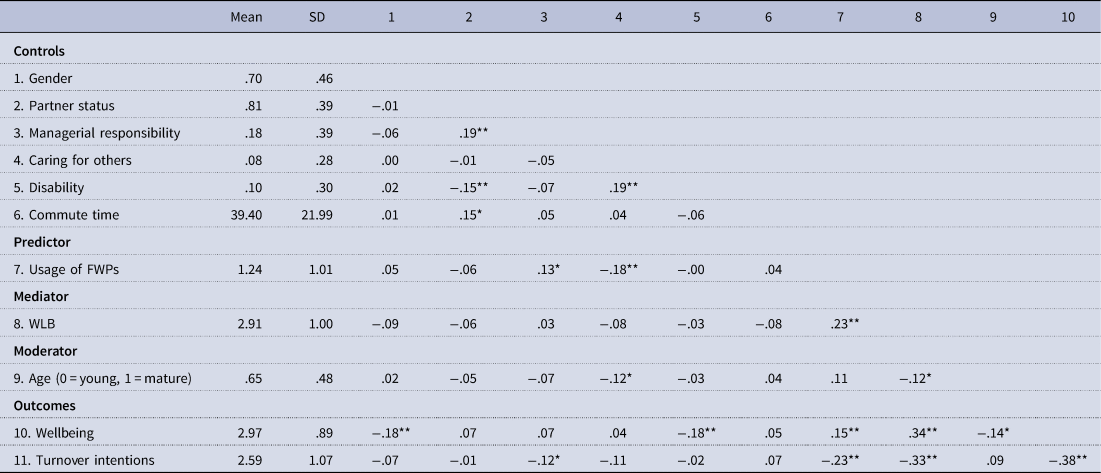
Table 1 presents the means, standard deviations and correlation coefficients for all variables. The correlations among the controls, predictor and moderator variables range between low to moderate (±.1 to ± .3), which indicates that multicollinearity was not a serious threat to the analyses (Tabachnick, Reference Tabachnick2001). To assess the common method bias, Harman's single-factor test was performed (Harman Reference Harman1967; Podsakoff, MacKenzie, Lee, and Podsakoff, Reference Podsakoff, MacKenzie, Lee and Podsakoff2003). The results indicated that a single factor explained only 40.3% of the variance (less than 50% is acceptable) which suggests that the common method bias was not an issue (e.g., Ali & French, Reference Ali and French2019; Kooij et al., Reference Kooij, De Lange, Jansen, Kanfer and Dikkers2011).

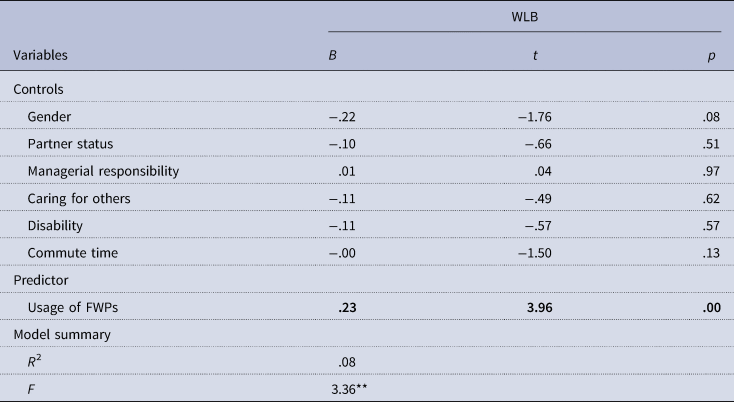
To test the direct effects (Hypotheses 1, 2a and 2b) and indirect effects (Hypotheses 3a and 3b), the simple mediation model (Model number 4) of the Process macro was used. Table 2 presents the results of the direct effects of FWPs usage on WLB (Hypothesis 1). The analysis controlled for gender, partner status, managerial responsibility, caring for others, disability and commute time. The results indicate that FWPs usage B = .23, p < .001 had a significant positive effect on employees' WLB. Thus, Hypothesis 1 is fully supported.
Effects of FWPs usage on WLB- Hypothesis 1
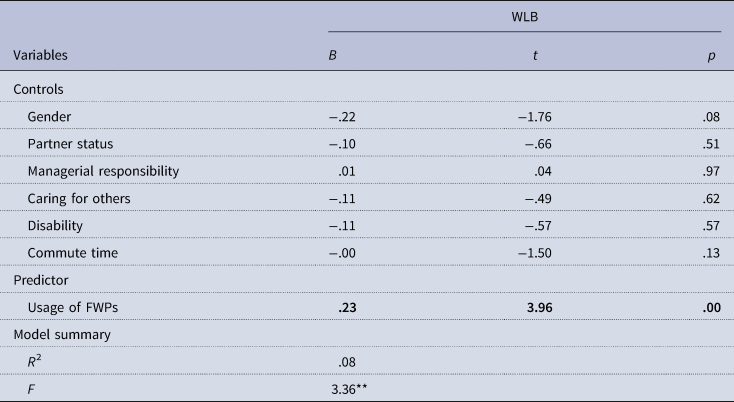
N = 293. Unstandardized regression coefficients are reported; *p < .05, **p < .01, ***p < .001.
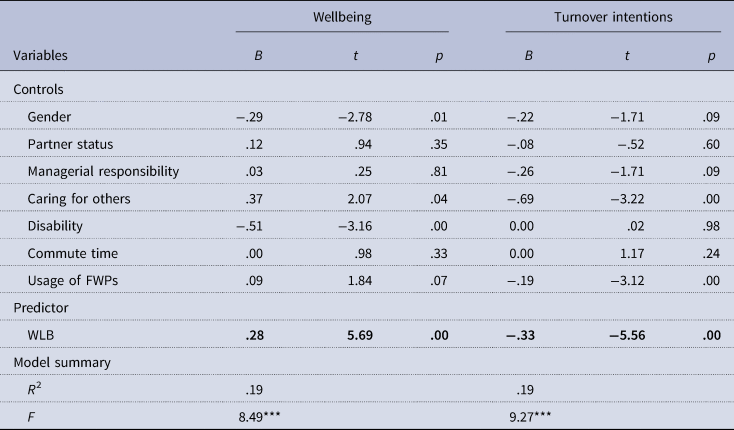
Table 3 presents the results of the direct effects of WLB on employee wellbeing (Hypothesis 2a) and turnover intentions (Hypothesis 2b). The analysis controlled for gender, partner status, managerial responsibility, caring for others, disability, commute time and FWPs usage. The results indicate that WLB (B = .28, p < .001) had a significant positive effect on employee wellbeing. Thus, Hypothesis 2a is fully supported. The results also indicate that WLB (B = −.33, p < .001) had a significant negative effect on employee turnover intention. Thus, Hypothesis 2b is fully supported.
Effects of WLB on wellbeing and turnover intentions − Hypotheses 2a and 2b
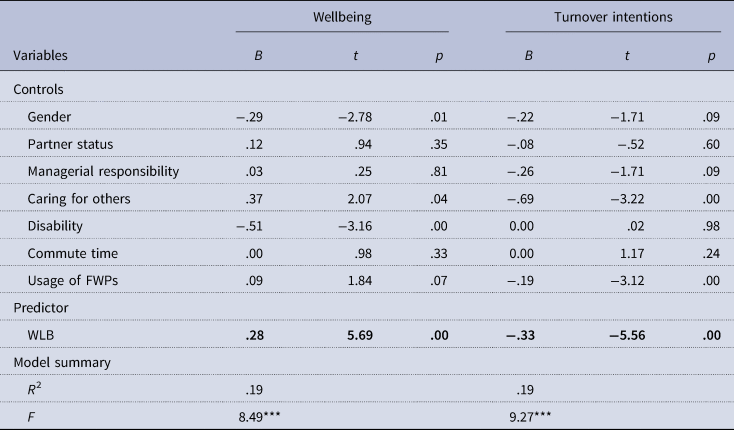
n = 293. Unstandardized regression coefficients are reported; * p < .05, ** p < .01, *** p < .001.
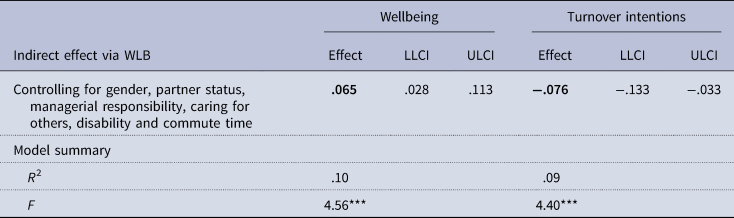
Table 4 presents the results of the mediation analysis for Hypotheses 3a and 3b with detailed indirect effects. The analysis again controlled for gender, partner status, managerial responsibility, caring for others, disability and commute time. The model summary statistics are as follows: Hypothesis 3a for well-being R 2 = .10, F(7, 285) = 4.56, p < .001 and Hypothesis 3b for turnover intentions R 2 = .09, F(7, 285) = 4.40, p < .001.The results indicate that FWPs usage had a significant positive effect on employee wellbeing via WLB (B = .065, LLCI .028, ULCI .113). The results also indicate that FWPs usage had a significant negative effect on employee turnover intentions via WLB (B = −.076, LLCI −.133, ULCI −.033). As the 95% bootstrap confidence intervals based on 5,000 samples did not include a zero, it can be said that WLB partially mediated: the positive relationship between FWPs usage and employee wellbeing and the negative relationship between FWPs usage and employee turnover intentions. Thus, both Hypotheses 3a and 3b are fully supported.
Indirect effects of FWPs usage – Hypotheses 3a and 3b
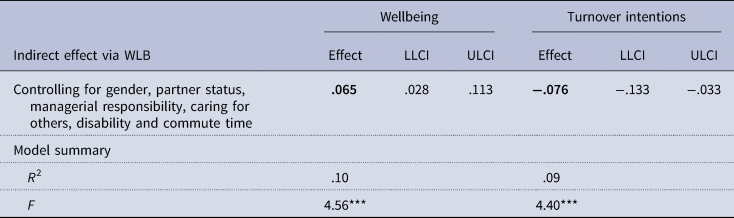
LL, lower limit; CI, confidence interval; UL, upper limit, level of confidence 95%.
N = 293. Unstandardized regression coefficients are reported; *p < .05, **p < .01, *p < .05, ***p < .001.
Bootstrap sample size = 5,000 bias corrected.
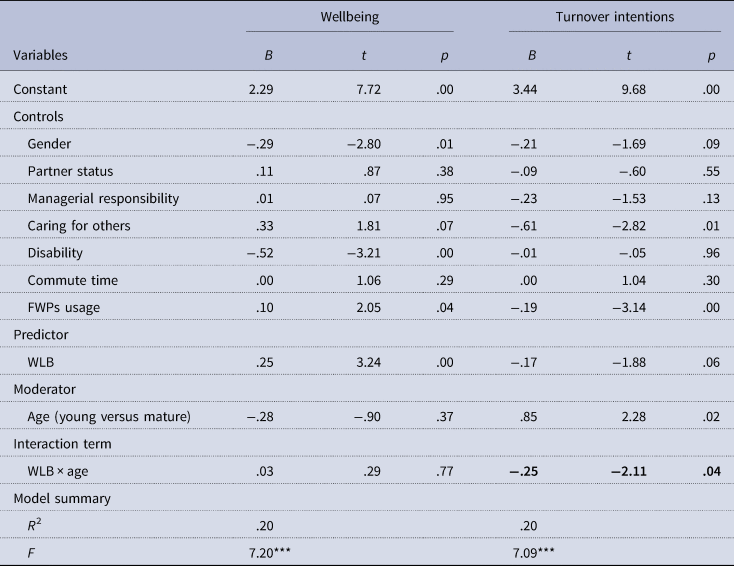
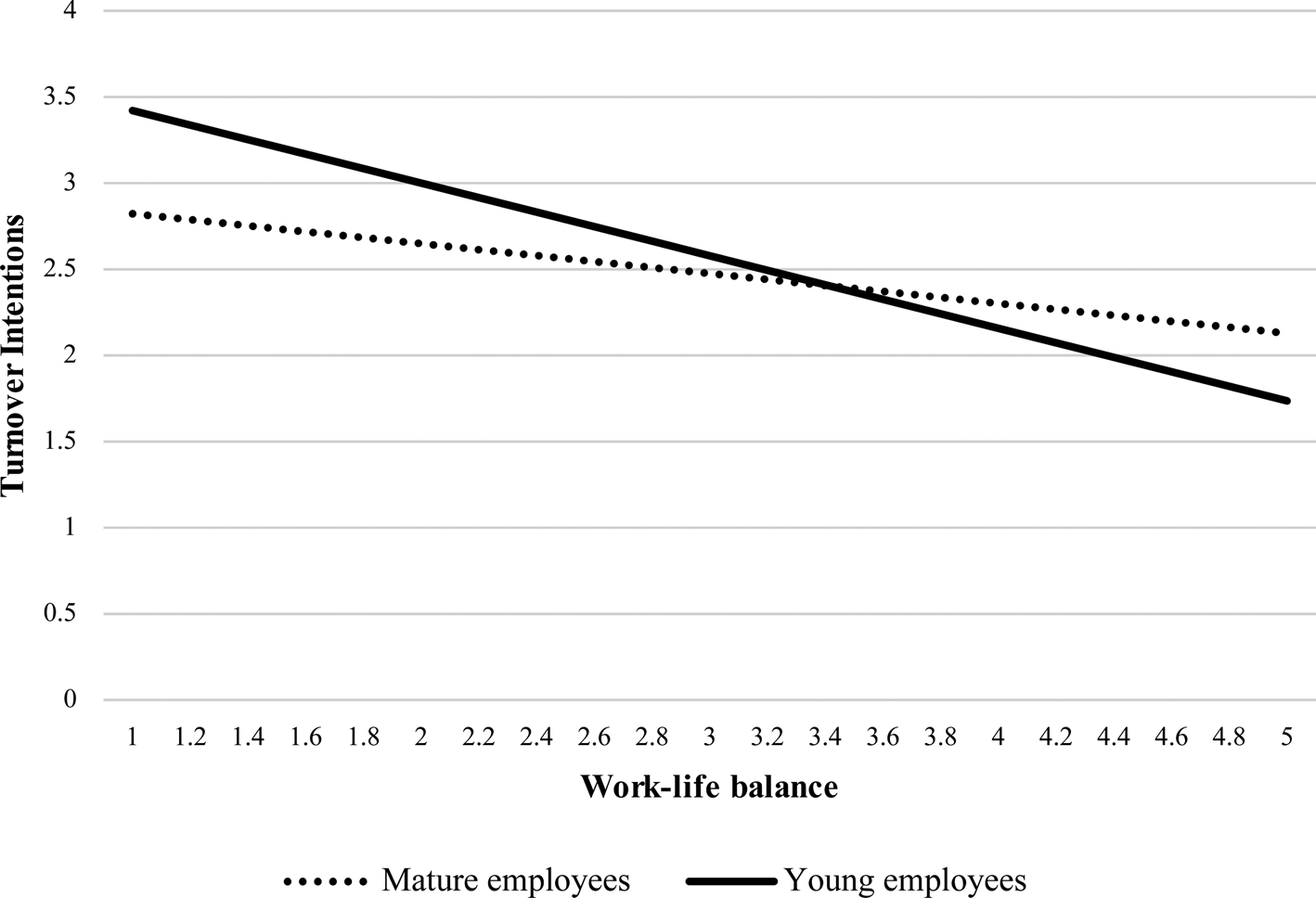
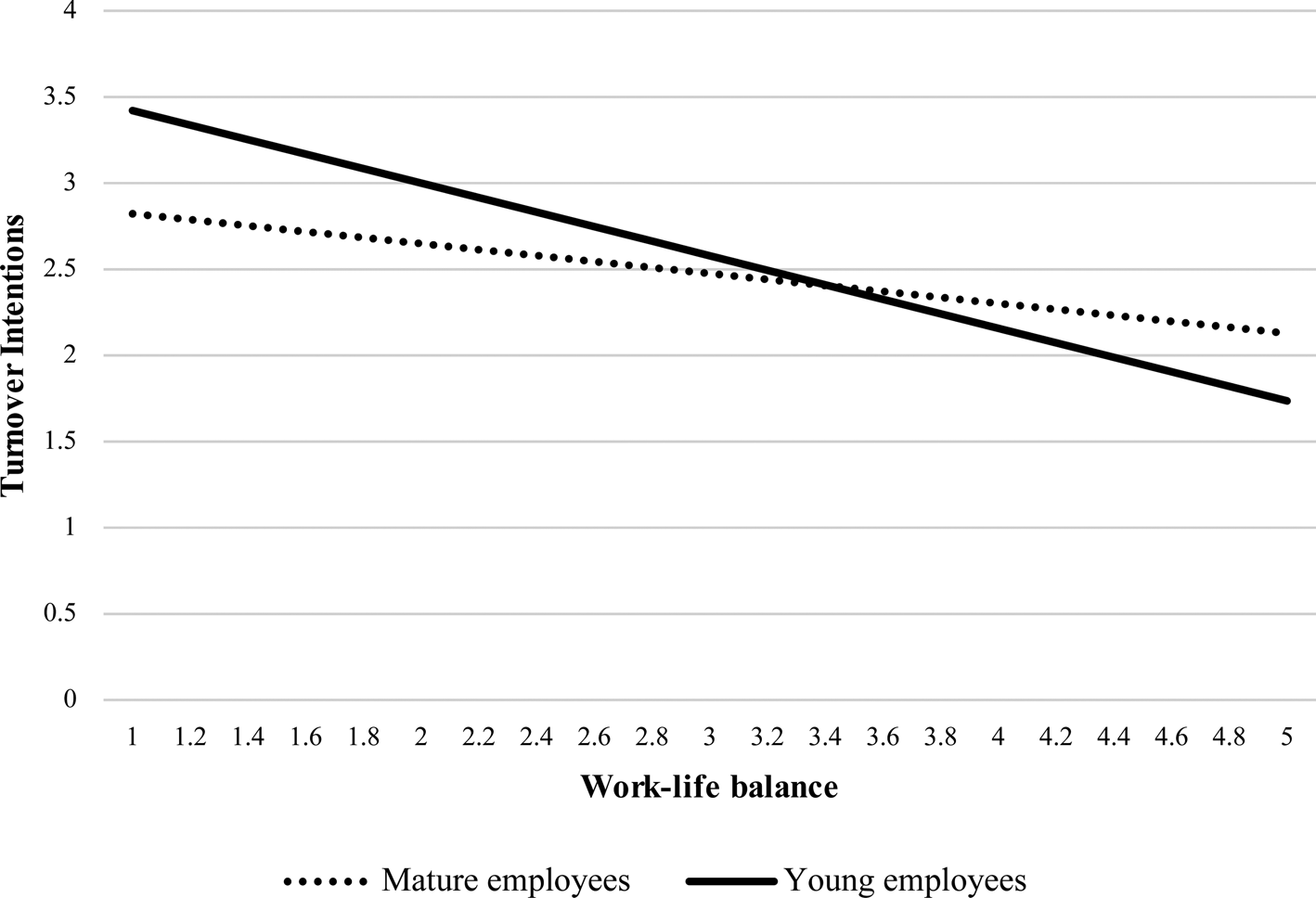
We used Process Model 1 to test Hypotheses 4a and 4b. This model tests the moderating effects. Table 5 presents the results of the moderating effects of employee age. The analysis controlled for gender, partner status, managerial responsibility, caring for others, disability, commute time and FWPs usage. The results indicate that the interaction term WLB × Age did not have a significant effect on employee wellbeing. Thus, Hypothesis 4a is not supported. On the other hand, the results indicate that the interaction term (B = −.25, p < .05) had a significant effect on employee turnover intention. Using the Modprobe macro (Hayes & Matthes, Reference Hayes and Matthes2009), the interaction term was probed to visualize the moderating effects of age on the relationship between WLB and employee turnover intention. Figure 2 illustrates the relationships between WLB and turnover intentions for young and mature employees. The figure demonstrates that the negative relationship was significant for young employees (b = −.42, p < .001) but not significant for mature employees (b = −.17, n.s). Thus, Hypothesis 4b is partly supported.Footnote 1 To rule out the possible multicollinearity among predictor, moderator and control variables that may lead to incorrect inferences (Becker, Reference Becker2005), the analysis reported in Table 5 was repeated without the control variables. The results did not differ, and the conditional indirect effect remained significant in the absence of control variables. An independent t-test was performed to rule out the skewness in responses due to a higher proportion of female participants in the study sample. No differences were found.Footnote 2
Results for moderating effects of age – Hypotheses 4a and 4b
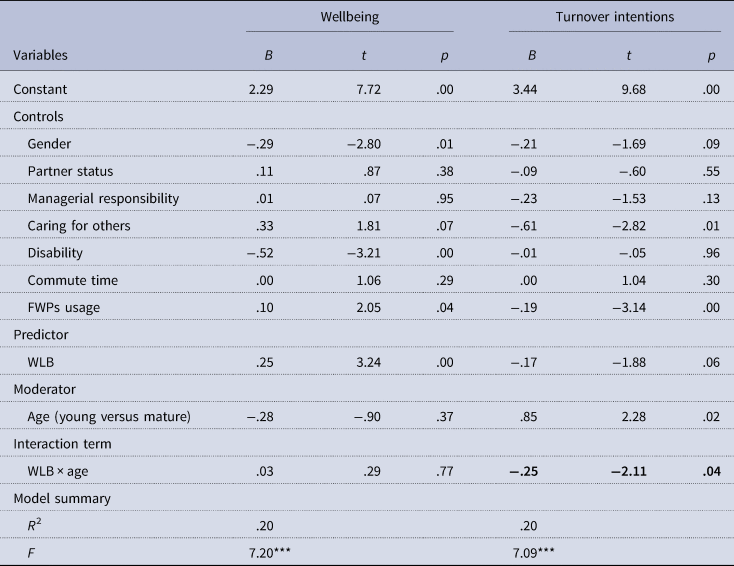
LL, lower limit; CI, confidence interval; UL, upper limit, level of confidence 95%.
N = 293. Unstandardized regression coefficients are reported; * p < .05, ** p < .01, *** p < .001.
Bootstrap sample size = 5,000 bias corrected.
Moderating effect of employee age.
Discussion
The primary objectives of this study were to investigate whether: (i) FWPs usage is positively associated with WLB; (ii) WLB is positively associated with employee wellbeing and negatively associated with turnover intentions, and (iii) WLB mediates the relationship between FWPs usage and two employee outcomes (wellbeing and turnover intentions), and (iv) the relationships between WLB and employee outcomes are moderated by employee age. The findings of this study provide evidence for these relationships.
Direct and mediation effects
We found support for a positive relationship between FWPs usage and employee WLB. The results are consistent with some previous empirical research that also found a positive relationship between the work time control and work and non-work balance (Nijp, Beckers, Guerts, Tucker, & Kompier, Reference Nijp, Beckers, Guerts, Tucker and Kompier2012), FWPs usage and work−home interference (Peters, Den Dulk, & Van Der Lippe, Reference Peters, Den Dulk and Van Der Lippe2009), perceived usability of FWPs and work−family and family−work interference (Hayman, Reference Hayman2009), and perceived flexibility and WLB (Handley, McGrath-Champ, & Leung, Reference Handley, McGrath-Champ and Leung2017). However, our result is unique as it found support for the positive impact of actual FWPs usage by employees on work−life balance as opposed to work−family balance. Life outside work involves various aspects of life apart from family responsibilities exclusively (Haar, Reference Haar2013). This finding adds to research on the impact of the usage of various FWPs on employee outcomes (Avgoustaki & Bessa, Reference Avgoustaki and Bessa2019; Chen & Fulmer, Reference Chen and Fulmer2018; de Menezes & Kelliher, Reference de Menezes and Kelliher2017).
The current results advance the knowledge of work−life literature by identifying a positive impact of WLB on employee wellbeing and negative impact on employee turnover intentions (e.g., Brough et al., Reference Brough, Timms, O'Driscoll, Kalliath, Siu, Sit and Lo2014; Gröpel & Kuhl, Reference Gröpel and Kuhl2009; O'Driscoll, Brough, & Haar, Reference O'Driscoll, Brough, Haar, Kelloway and Cooper2011). However, the findings are unique as we combined both physical and psychological wellness to measure employee wellbeing. Past studies found support for the positive relationship between WLB and life satisfaction (Haar, Reference Haar2013), work–social life balance and emotional wellbeing (Gröpel & Kuhl, Reference Gröpel and Kuhl2009), work−family enrichment and employee physical and psychological health (Gareis, Barnett, Ertel, & Berkman, Reference Gareis, Barnett, Ertel and Berkman2009; van Steenbergen & Ellemers, Reference van Steenbergen and Ellemers2009), and a negative relationship between WLB and psychological strain (Brough et al., Reference Brough, Timms, O'Driscoll, Kalliath, Siu, Sit and Lo2014).
The results of this study extend our knowledge by providing evidence for the positive effects of FWPs usage on employee wellbeing and turnover intentions via WLB as a mediator. In other words, FWPs usage leads to higher WLB, which, in turn, leads to higher wellbeing and lower employee turnover intentions. Although no prior research has tested such mediation effects, the findings are broadly consistent with some prior research that found positive effects of perceived flexibility of work schedule on employee wellbeing via work−family balance (Casey & Grzywacz, Reference Casey and Grzywacz2008; Jang, Reference Jang2009).
Moderation effect
The findings of this study advance our knowledge of the moderating effect of employee age on the relationship between WLB and employee outcomes. Specifically, this study found that higher WLB leads to lower turnover intentions among young employees. Theoretically, this result can be linked to an individual's perceived future time perspective which suggests that young employees, in general, perceive longer future time than mature employees which determines their attitudinal and behavioural responses (Gragnano, Simbula, & Miglioretti, Reference Gragnano, Simbula and Miglioretti2020; Treadway et al., Reference Treadway, Duke, Perrewe, Breland and Goodman2011). As a result, these employees feel more confident in revisiting their life objectives and changing direction at any time, such as quitting their job (Klimchak et al., Reference Klimchak, Matthews, Robbins and Zhang2019; Kooij et al., Reference Kooij, De Lange, Jansen, Kanfer and Dikkers2011). Indeed, when experiencing a severe imbalance between work and non-work roles, young employees are likely to seek alternative employment with an organization that promotes increased WLB (O'Driscoll, Brough, & Haar, Reference O'Driscoll, Brough, Haar, Kelloway and Cooper2011). In contrast, as finding alternative employment is difficult for mature age employees, they become more cautious about turning over (Human Rights and Equal Opportunity Commission, 2000).
However, the moderating effect was non-significant for WLB and wellbeing relationship, which is counterintuitive and warrants further investigation. This lack of a significant effect can be explained by other contributing factors, such as social and/or family support, individual differences and cultural differences. For instance, individuals who have stronger social and/or family support available may cope with life adversities better than those who don't have that support system (Haar et al., Reference Haar, Russo, Suñe and Ollier-Malaterre2014; Powell, Francesco, & Ling, Reference Powell, Francesco and Ling2009). Moreover, individuals differ in terms of their boundary preference (segmentation versus integration) between work and non-work domains (Allen, Cho, & Meier, Reference Allen, Cho and Meier2014; Daniel & Sonnentag, Reference Daniel and Sonnentag2016; Kreiner, Reference Kreiner2006). For those who prefer segmentation, the failure to balance work and non-work lives may influence their wellbeing more adversely than it would for those who prefer integration.
Theoretical and research contributions
These results contribute to the existing work−life literature in several ways. First, the significant positive impact of FWPs usage on employees finding a balance between their work and non-work responsibilities provides strong support for boundary theory (Ashforth, Kreiner, & Fugate, Reference Ashforth, Kreiner and Fugate2000; Nippert-Eng, Reference Nippert-Eng1996). HR policies such as FWPs may facilitate effective employee work and personal life boundary transitions and management. Second, the significant positive impact of WLB on employee wellbeing and significant negative impact of WLB on turnover intentions support the importance of balancing multiple life roles, as suggested by role balance theory (Carlson, Grzywacz, & Zivnuska, Reference Carlson, Grzywacz and Zivnuska2009; Marks & MacDermid, Reference Marks and MacDermid1996). The ability to maintain a higher balance among multiple life roles leads to positive employee outcomes (Aryee, Tan, & Srinivas, Reference Aryee, Tan and Srinivas2005; Haar et al., Reference Haar, Russo, Suñe and Ollier-Malaterre2014; Jackson & Fransman, Reference Jackson and Fransman2018; Noor, Reference Noor2011).
Third, the significant negative effect of WLB on turnover intentions for young employees supports the socioemotional selectivity theory (Carstensen, Reference Carstensen1995). The finding strengthens the argument that age determines the motives for work and overall WLB perceptions, thus, influence individual work and non-work outcomes (Bridges, Reference Bridges2018; Costanza, Badger, Fraser, Severt, Gade, & Psychology, Reference Costanza, Badger, Fraser, Severt and Gade2012). Thus, our findings linking FWPs usage with the beneficial effects of achieving a higher WLB which influence individual outcomes differently support the integration of boundary theory (Ashforth, Kreiner, & Fugate, Reference Ashforth, Kreiner and Fugate2000; Nippert-Eng, Reference Nippert-Eng1996) with role balance theory (Carlson, Grzywacz, & Zivnuska, Reference Carlson, Grzywacz and Zivnuska2009; Marks & MacDermid, Reference Marks and MacDermid1996). The mechanisms through which workplace flexibility influences WLB and employee outcomes are complex and thus require the integration of multiple theories to predict and explain their impact on employee outcomes. The significant results of this study encourage similar integration of theories to develop a comprehensive theoretical framework that will facilitate a holistic understanding of various HR practices and employee outcome relationships.
This study strengthens the case for using WLB as a separate construct as opposed to work−family balance to include all employees (e.g., single and partnered, with and without family responsibilities) as well as all life roles to understand ‘balance’ (Brough et al., Reference Brough, Timms, O'Driscoll, Kalliath, Siu, Sit and Lo2014; Casper, Vaziri, Wayne, Dehauw, & Greenhaus, Reference Casper, Vaziri, Wayne, Dehauw and Greenhaus2018; Haar, Reference Haar2013; ten Brummelhuis, Haar, & Roche, Reference ten Brummelhuis, Haar and Roche2014). Our study also contributes to the stream of research exploring the impact of FWPs usage on employee wellbeing by considering a comprehensive approach to understand wellbeing which the extant literature mostly ignores (Casey & Grzywacz, Reference Casey and Grzywacz2008; Jang, Reference Jang2009; Thomas & Ganster, Reference Thomas and Ganster1995). Moreover, this study addresses a significant gap in the work−life literature by exploring the moderation effect of employee age to understand the underlying mechanisms through which WLB influences employee outcomes. Hence, this study advances the understanding of complex dynamics of work redesign and the role of contingent factors influencing employee outcomes (Chen & Fulmer, Reference Chen and Fulmer2018; de Menezes & Kelliher, Reference de Menezes and Kelliher2011). Similarly, the research in this direction may benefit from additional sequential mediators, such as affective commitment (de Menezes & Kelliher, Reference de Menezes and Kelliher2017). Additionally, various contextual factors, such as culture and country contexts, family and social support systems, humane orientation and gender egalitarianism can help understand how these models operate in various industry and organizational settings (Haar et al., Reference Haar, Russo, Suñe and Ollier-Malaterre2014; House, Reference House2004; Ollier-Malaterre, Valcour, Den Dulk, & Kossek, Reference Ollier-Malaterre, Valcour, Den Dulk and Kossek2013).
The impact of mandatory work from home on employee outcomes in a disruptive environment warrants further exploration (O'Connor, Reference O'Connor2020). The findings of this study are related to voluntary FWPs usage during business as usual environment. Enforced/mandatory FWPs usage may lead to different results as suggested by the grey literature and empirical studies being published during the current COVID-19 pandemic (Guy & Arthur, Reference Guy and Arthur2020; Lederman & Dreyfus, Reference Lederman and Dreyfus2020). For instance, the mandatory work from home along with home-schooling of the children, illness of self and/or family members, distractions at home and uncertainties associated with the pandemic negatively influence the spillover between the work role and non-work roles (Lyttelton, Zang, & Musick, Reference Lyttelton, Zang and Musick2020). As a result, employees, in general, are experiencing decreased WLB (Utoft, Reference Utoft2020). Similarly, mandatory FWPs usage may have a different effect on employees from various age groups. For example, during this pandemic, job losses are approximately double among employees 16–24 years of age compared to employees over 25 years of age. Since the majority of young employees work in the hospitality and retail industry, they are severely affected by the current COVID-19 business shutdown. Moreover, a large proportion of older workers are expected to delay their retirement to recover from the current economic crisis. This will make it difficult for young employees to find a job as suggested by recent research (Borland, Reference Borland2020).
Practical implications
The current findings have several practical implications. This study found a positive impact of FWPs usage on employee WLB. It may encourage employees to request and utilize FWPs to balance their work and non-work lives. A diverse range of employees (e.g., young students, mature age employees, individuals with disabilities) can enter and remain in the workforce as FWPs enable them to balance work and non-work responsibilities (Rubery, Keizer, & Grimshaw, Reference Rubery, Keizer and Grimshaw2016). The positive outcomes strengthen government initiatives to implement employment policies to increase workforce participation of diverse workgroups such as individuals with caring responsibilities and individuals with disabilities (Australian Bureau of Statistics, 2017). Increased participation of these employee groups in the paid workforce helps reduce welfare dependency and welfare costs (Purcell, Reference Purcell2010; Rubery, Keizer, & Grimshaw, Reference Rubery, Keizer and Grimshaw2016).
This study emphasizes the significance of work−life programmes such as FWPs as strategic tools to manage the various needs of a diverse workforce. The findings suggest that FWPs usage facilitates higher WLB among employees, which may be the key to improved work and non-work outcomes. Therefore, organizations should embrace a supportive work culture by encouraging employees to use work−life practices available, such as FWPs, and thus promote their support for employee WLB (Allen, Reference Allen2001; Eaton, Reference Eaton2003; Haar et al., Reference Haar, Russo, Suñe and Ollier-Malaterre2014). Furthermore, our findings provide evidence of a negative effect of WLB on employee turnover intentions. This finding can help managers to design and implement practices to retain current employees and attract new talent and thereby gain a long-term competitive advantage (Rubery, Keizer, & Grimshaw, Reference Rubery, Keizer and Grimshaw2016). Most importantly, the results suggest that employees from different age groups have different motivations for expecting a WLB that significantly influences their turnover intentions. This finding can help managers to acknowledge workforce demographic differences and thus formulate HR practices to maximize the potential of their workforce (Chen & Fulmer, Reference Chen and Fulmer2018; Haar et al., Reference Haar, Russo, Suñe and Ollier-Malaterre2014).
Limitations
This study has a few limitations. First, the analysis relied on cross-sectional data which undermines causality (Eaton, Reference Eaton2003; Zikmund, Babin, Carr, & Griffin, Reference Zikmund, Babin, Carr and Griffin2009). Longitudinal data may provide additional insights as the length of policy usage may influence employee outcomes differently (de Menezes & Kelliher, Reference de Menezes and Kelliher2011). Second, this study includes a sample of 293 employees from a single organization. To increase the generalizability of the study's results, research is required to investigate the FWPs usage–employee outcomes (wellbeing and turnover intentions) relationship in different geographical and/or industrial settings. This can be explored using a large heterogeneous sample from different contextual settings, such as country (more versus less government-mandated FWPs), cultural (collectivist versus individualist) and industry (manufacturing versus service) contexts. Third, this study utilized self-reported data to measure all variables that might have contributed to the response bias, inflating the correlations among FWPs, WLB and wellbeing (Podsakoff et al., Reference Podsakoff, MacKenzie, Lee and Podsakoff2003). However, the effect of method bias would not change the statistical significance of the observed relationship between the study variables (Hayman, Reference Hayman2009; Kent, Reference Kent2001). As employee WLB and wellbeing can only be assessed by their own perception, using a self-report questionnaire is an appropriate and convenient method for collecting data. Finally, the findings of this study may be influenced by the sample characteristics as the sample comprised more female employees (70%) than male employees (30%). For instance, Haar and O'Driscoll (Reference Haar and O'Driscoll2005) investigated the moderating role of gender on the relationship between employee attitude towards work−family practices (which included flexible working hours) and use of work−family practices. They identified a difference in outcomes between male and female employees with a similar gender composition (69% female compared to 31% male). Contrary to Haar and O'Driscoll's (2005), our independent t-test did not show any difference in outcomes (Kurowska, Reference Kurowska2020).
Tahrima Ferdous Tahrima Ferdous is a PhD student at QUT School of Management. She has completed her MPhil from Queensland University of Technology (QUT) in 2020. She also has completed her MBA (Management Information Systems) and BBA (in Management) from University of Dhaka, Bangladesh. Before starting her research journey, she was working as a tax consultant with H & R Block tax accountants in Sydney, Australia. Her research interest includes flexible work arrangements, work−life programmes and diversity policies.
Dr. Muhammad Ali Muhammad Ali is a senior lecturer at QUT School of Management. He commenced his career as a full-time academic at QUT in 2010 after receiving his PhD from The University of Melbourne, Australia. Ali's research focuses on measuring effectiveness of workforce diversity management policies and practices and work−life programmes. He also investigates the human resource elements of corporate governance. His research has provided important insights in the areas of board age and gender diversity, managerial and non-managerial gender diversity, work−life programmes, gender-focused HRM, age diversity practices, board size and firm performance.
Dr. Erica French Erica is an associate professor at QUT School of Management working for more than 10 years at QUT. She completed her PhD from QUT. She is engaged in collaborative research projects which examine women in management and is widely published in Australia and internationally in these areas. Her current research is investigating the position of women in management and equal opportunity specific to various industries including finance, transport and local government. She is an author of Managing Diversity in Australia: Theory and Practice, with Professor Glenda Strachan and Professor John Burgess. She is also an associate editor of EDI Journal.