In the wake of the financial crisis and the Great Recession of 2008–9, governments across the industrialized world have accumulated unprecedented peacetime debt levels. To stabilize their public finances, they responded with ambitious fiscal adjustment programmes that sought to regain market confidence and to comply with various national and supra-national fiscal rules. To the extent that core expenditure – defence, public investment, general administration and so on – have been squeezed from earlier episodes of fiscal consolidation in recent decades (Castles Reference Castles2007), there is increasing pressure for social expenditure to take the lion’s share of adjustment. Welfare budgets are coming under intense strain, highlighting the scholarly importance of the welfare retrenchment literature once again.
The politics of welfare retrenchment is set against the backdrop of an extensive body of research on the partisan politics that drives welfare state outcomes. On one side of this debate stand proponents of partisan theory (Alesina Reference Alesina1987; Allan and Scruggs Reference Allan and Scruggs2004; Hibbs, Reference Hibbs1977) who argue that the partisan politics of welfare reflect differences in class-based socioeconomic preferences. Accordingly, right-wing parties seek to retrench a welfare state that they see as bloated, inefficient and increasingly unaffordable, whereas left-wing parties try to resist this offensive on their most cherished piece of social progress in the post-war era (Korpi Reference Korpi1983). By contrast, the highly influential ‘New Politics’ school put forward by Paul Pierson in a number of seminal contributions (Pierson Reference Pierson1994, Reference Pierson1996, Reference Pierson1998, Reference Pierson2001) argues that in our age of ‘permanent austerity’, traditional partisan patterns of welfare politics unravel. Rather than broad socioeconomic classes, the main actors in the political game of welfare cutbacks are organized interests that seek to protect their favoured social programmes. These organized interests make it all but impossible for even ideologically committed opponents of the welfare state to ‘end welfare as we knew it’, paraphrasing Bill Clinton’s (in)famous phrase on the issue.
One idea that the two approaches share is the inherently unpopular nature of cutbacks. The vast empirical arsenal of electorally successful retrenchment episodes, however, presents us with a puzzle which has been largely unexplored by the welfare state literature.Footnote 1 Both in terms of large-scale and sustained fiscal adjustment efforts (Alesina et al. Reference Alesina, Perotti, Tavares, Obstfeld and Eichengreen1998, Reference Alesina, Carloni and Lecce2011; Mulas-Granados Reference Mulas-Granados2006) and in terms of cuts targeted at the welfare state per se (Giger Reference Giger2010; Giger and Nelson Reference Giger and Nelson2011), the surprising pattern that emerges is that there has been little, if any, systematic electoral punishment in the wake of fiscal and welfare cutbacks.
This article’s main contribution is to offer a potential explanation for that by building on a crucial but all too often overlooked angle of partisan politics. Beyond representing the socioeconomic interests of their constituents, political parties are vote-seeking organizations that come to the polls with a set of prior beliefs by the electorate on where these parties stand and what policy they intend to pursue in office. These beliefs create partisan biases (Adams Reference Adams2001) that allow parties to build on their reputation and credibility in imposing losses on their own constituencies. I will argue that these integral aspects of electoral politics give rise to unexpected partisan outcomes: in particular, times of austerity are characterized by a ‘Nixon-goes-to-China’ political environment where the axe falls on welfare programmes that serve the incumbent’s core supporters, such as low-skilled blue-collar workers under left-wing governments.
After reviewing the current state of the partisanship–welfare state nexus, the next section will offer a more formal conceptualization of partisan bias in times of austerity leading up to the hypotheses I will test. Next, I will operationalize my data and measurements. I then proceed to my empirical analysis in a time-series cross-section framework in a set of 23 OECD countries over three decades. The final section concludes.
THE PARTISANSHIP–WELFARE STATE NEXUS IN AUSTERE TIMES
Literature Review
The role of partisanship in shaping the post-war consensus in economic and social policymaking has long been recognized. Social democratic parties – and to some extent their Christian democratic counterparts based on their cross-class appeal (see Kalyvas and van Kersbergen Reference Kalyvas and van Kersbergen2010 for a review) – have been widely acknowledged as responsible for ensuring full employment in the face of adverse economic shocks, providing decommodification to workers, or expanding social programmes to the socially vulnerable in an attempt to protect against various sources of social risks along the life-cycle (Cusack Reference Cusack2001; Hibbs Reference Hibbs1977; Korpi Reference Korpi1983). As slowing growth, structural unemployment, deindustrialization (Iversen and Cusack Reference Iversen and Cusack2000), increased pace of globalization (Jahn Reference Jahn2006; Swank and Steinmo Reference Swank and Steinmo2002), population ageing and other concomitant social processes put an end to a period of welfare expansion in the 1970s, the importance of partisan politics came under closer scrutiny (Huber and Stephens Reference Huber and Stephens2001).Footnote 2
In his seminal work on welfare-state resilience in the face of an international surge in conservative power, Pierson (Reference Pierson1994) provided a comprehensive analysis of how welfare recipients managed to block retrenchment efforts. The channels of this logic were twofold. On the one hand, mature welfare states created their own constituencies with vast organizational capacity and popular support to block reform efforts (e.g. the American Association of Retired Persons in the US). Secondly, as Pierson’s subsequent works emphasize, governments also recognized the ‘tremendous electoral risks’ of retrenchment policies (Pierson Reference Pierson1996: 178), but see also Green-Pedersen and Haverland (2002) for a broader review of the ‘New Politics’ literature. Even though their political mandate pointed towards welfare cuts, conservatives simply could not disregard the electoral risk that an outright assault on the welfare state would entail. These observations led Pierson to put forward two propositions for the era of ‘permanent austerity’ that are of direct relevance for this study: (1) contrary to the era of welfare state build-up, the role of partisan politics in shaping welfare outcomes is reduced at best and irrelevant at worst; (2) the numerical and organizational strength of welfare clienteles make overt retrenchment an electoral suicide, what one can expect, at best, is hidden adjustment whereby policymakers attempt to introduce cost-saving measures in less visible welfare items – such as tax expenditures, indexation rules, etc. – to obfuscate the true impact of their policies (Hacker Reference Hacker2004; Howard Reference Howard1997).
Pierson’s verdict on the ‘end of partisan politics’ (first proposition) chimed in well with a burgeoning literature in political sociology that looked at the micro-link between socioeconomic circumstances of voters and their vote choice. Empirical evidence for class-dealignment (Clark and Lipset Reference Clark and Lipset1991; Evans and Tilley Reference Evans and Tilley2011, 2012) rendered traditional partisan theory with its focus on the traditional class cleavage (Lipset and Rokkan Reference Lipset and Rokkan1967) rather obsolete. An ever-decreasing share of the electorate seemed to conform to the simple formula of post-war politics whereby working-class voters vote for the centre-left and middle/upper-income voters forming the electoral coalition of centre-right parties.
The apparent unravelling of post-war partisan politics notwithstanding, proponents of ‘Old Politics’ have staged a spectacular revival. Allan and Scruggs (Reference Allan and Scruggs2004), Kim and Fording (2001, 2002), Korpi and Palme (Reference Korpi and Palme2003), Kwon and Pontusson (Reference Kwon and Pontusson2005) and Swank (Reference Swank2005) have all provided evidence that the partisan composition of governments continues to shape welfare outcomes in the conventional way, with left-wing governments being more successful in halting the decline of the welfare state. More recently, Klitgaard et al. (Reference Klitgaard, Schumacher and Soentken2015) argued that traditional partisan effects are present but only in domains of institutional reforms that seek to redistribute power resources between political actors (e.g. the bargaining position of trade unions) but do not necessarily impose direct gains and losses on different constituencies. A few critiques also pointed to the instability of the partisan politics effect over time (Huber and Stephens Reference Huber and Stephens2001; Kittel and Obinger Reference Kittel and Obinger2003) as well as to the conditioning role of welfare regime times (Vlandas Reference Vlandas2013). With these caveats in mind, the main thrust of this strand of scholarship can be summarized as partisan politics still matters in the traditional sense. The welfare state may have survived its conservative assault, but on the margin, left-wing governments have appeared its more reliable defendant nevertheless.
If the debate surrounding Pierson’s first proposition has been inconclusive, the empirical record of the second proposition outright defies previous expectations. Though recent electoral backlashes against governments presiding over austerity – such as Spain in 2011 and 2015, Greece in 2012 and 2015 and Portugal in 2015 – might suggest otherwise, a longer-term view of the electoral repercussions of fiscal adjustment paints a rather nuanced picture. Alesina et al. (Reference Alesina, Perotti, Tavares, Obstfeld and Eichengreen1998, Reference Alesina, Carloni and Lecce2011) convincingly show that fiscal adjustment episodes had little, if any, predictive power on the re-election prospects and within-cycle popularity of incumbent governments. In a similar vein, Brender and Drazen (Reference Brender and Drazen2008) find no direct evidence for deficits increasing incumbent popularity; if anything, election-year deficits are negatively correlated with the likelihood of chief executives staying in power. Moreover, as subsequent contributions to this debate have confirmed (von Hagen et al. Reference von Hagen, Hallett and Strauch2002; Illera and Mulas-Granados Reference Illera and Mulas-Granado2008; Mulas-Granados Reference Mulas-Granados2006), the composition of adjustments has been a strong predictor of the duration and hence the political viability of adjustment efforts: cuts in transfer programmes and public wages, in contrast to public investment cuts and tax hikes, have led to more permanent debt stabilization programmes. Studies treating social policy retrenchment, rather than fiscal adjustment as the main subject of analysis (Giger Reference Giger2010; Giger and Nelson Reference Giger and Nelson2011) have also arrived at similar results: retrenchment efforts entail very limited systematic electoral punishment in their wake (see Table 1A in the online appendix).Footnote 3
While these contributions are largely silent on partisan dynamics driving the adjustment efforts, a related study by Alesina et al. (Reference Alesina, Ardagna and Trebbi2006) shows that when faced with fiscal crises, governments led by left parties tend to undertake adjustment earlier than their conservative rivals. In fact, when one takes a closer look at these retrenchment periods, the frequency of consolidation efforts initiated by the left is striking. While a detailed analysis of retrenchment periods lies beyond the scope of this article, a few well-known cases from a wave of welfare reforms (Weyland Reference Weyland2008) occurring in the 1990s and 2000s bring the point home. The Swedish Social Democrats’ long tenure in power under the premiership of Goran Persson, New Zealand’s Labour governments under Helen Clark in the years preceding the Great Recession, British New Labour’s first term in office between 1997 and 2002, Gerhard Schroder’s ‘third-way’ Social Democratic Party (SPD)-led coalitions all saw a significant reduction of social expenditure and welfare retrenchment efforts. Not only were these and other episodes successful in stabilizing public finances but they also resonated well with the electorate, who returned these governments to power on a number of consecutive occasions.
These unexpected partisan outcomes are closely linked to a crucial, but often neglected, aspect of the electoral game: parties compete for each election with a priori held beliefs by the electorate on where these parties stand on different policy domains. Political science scholarship generally refers to these beliefs in the framework of issue ownership. While there is a broad range of definitions of issue ownership in the literature (see Walgrave et al. Reference Walgrave, Tresch and Lefevere2015 for a recent review), the basic idea is best understood as a relatively permanent link between voters’ expectations of a given party’s policy priorities and competence to deal with an issue and the party’s efforts to emphasize the issue in its electoral strategy.
A direct corollary of issue ownership is the partisan loyalty it creates among certain voting groups, on the one hand, and the credibility (dis)advantages for these parties concerning their ability and willingness to deal with problem pressures, on the other (Cukierman and Tomassi Reference Cukierman and Tomassi1998). Moreover, as Adams (Reference Adams2001) argues, these partisan loyalties imply a biased assessment of parties’ policy platforms by a part of the electorate, creating incentives for parties to deviate from the static predictions of median-voter models. Note that this conceptualization of partisan biases is qualitatively different from a biased assessment of economic performance known from the economic voting literature (Hobolt and Tilley Reference Hobolt and Tilley2014; Wlezien et al. Reference Wlezien, Franklin and Twiggs1997). Rather than being biased in their economic perceptions as a function of their partisanship, voters are biased in their evaluation of parties’ capacity and willingness to prioritize certain issues and constituencies over others.
For conceptually similar considerations, Kitschelt (2001) concludes that the left can more effectively deal with welfare pressures than the right when it does not face opposition parties that are credible defenders of the welfare state. The electoral importance and implications of the left’s credibility advantage on the welfare state is perhaps best captured by Ross, who emphasizes left-wing parties’ issue-association with welfare programmes that has been accumulated over more than half a century:
According to this logic, rightist parties should be more vulnerable in their retrenchment efforts than parties of the left – and especially so on explosive issues like welfare reform. The principal psychological mechanism conditioning voters’ response to issue-associations appears to be trust – specifically the opportunities trust provides for framing retrenchment initiatives in a manner that voters find acceptable if not compelling. (Ross Reference Ross2000: 164)
This article builds on this intuition, formally spelt out in the following sub-section, by incorporating the notion of trust, credibility and issue-association/ownership under the label of partisan biases via the following theoretical channel. At any given point in time in any given country, parties come to the electoral contest with a large historical baggage inherited from their past. That baggage primarily consists of their reputation for dealing with and prioritizing over certain policy areas over others. As various social groups rally around those policy areas, they develop long-standing ties with and political attachment to their respective parties. This attachment then creates partisan biases in the way these groups evaluate the parties’ subsequent policy output, with important consequences for the parties’ policymaking flexibility in hard times.
Theory: Preference Polarization under Partisan-biased Constituencies
Before incorporating the idea of partisan biases in parties’ strategic positions on a policy space, a basic conceptualization of permanent austerity with regard to welfare preferences of the electorate is in order. Importantly, I assume endogenous preferences by the electorate whereby their preferred welfare provision takes into account the possibility frontier defined by ‘permanent austerity’. Building on insights from the literature on social attitude formation in the contexts of economic crises (Stevenson Reference Stevenson2001), I expect voters to adopt more selfish preferences when resources are scarce. Specifically, I make the assumption that in times of ‘normal’ or ‘old’ politics, electoral preferences point towards an expansion of multiple welfare programmes. In times of retrenchment politics, however, recognizing the trade-off nature of welfare provision, electoral preferences will reflect the defence of one’s favoured programme at the expense of the other(s).Footnote 4
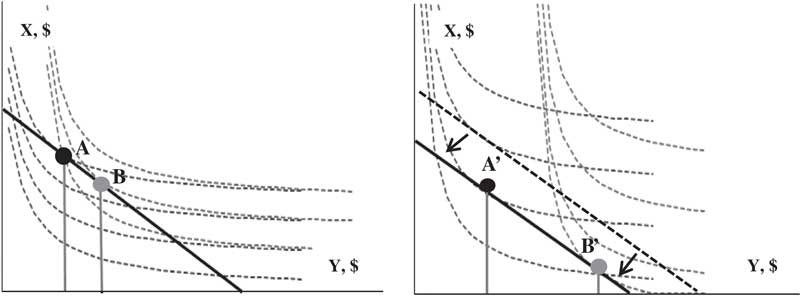
More formally, I assume government provides two public services (or two welfare programmes) in the political economy: X and Y with two distinct constituencies (Group 1 and Group 2) benefiting from them.Footnote 5 Figure 1 is a stylized illustration of the pre-retrenchment period (left panel) compared to ‘permanent austerity’ (right panel). In the first period, as high growth and low debt levels allow the expansion of the welfare state without running into financial constraints, the two groups forge an alliance for the parallel expansion of the programmes: their preferences are relatively proximate. One can conceptualize this idea by regular (circular) indifference curves for two groups of voters: Group 1 preferring higher provision in good X and Group 2 preferring higher level of provision in Y. Both groups, however, are willing to trade off X for Y at similar rates at any given combination of X and Y. As a result, given the budget constraint of the welfare state, ideal points A and B are relatively close to each other.
Indifference Curves and Ideal Points for Two Groups of Voters during Welfare-State Building (left) and Retrenchment (right)

Once austerity hits, the mutual expansion of spending programmes gives way to a distributional conflict between the two groups under a tighter budget constraint. Translating this into visual representation on the right-hand panel of Figure 1, indifference curves for the two groups are now very different. The most intuitive way to understand the new scenario is that for Group 1 (2), a higher level of Y (X) is required to leave it at the same level of utility compared to the pre-retrenchment scenario. As a result, given the new budget constraint of the welfare state, the ideal points A’ and B’ will be further apart compared to the pre-retrenchment period.
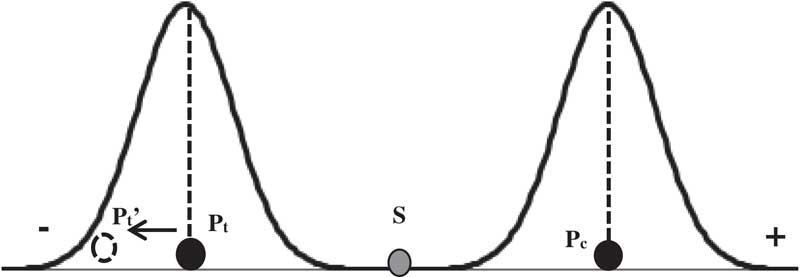
The next step in the analysis is to translate this distributional conflict to a single-issue space for X. The incumbent party (S for social democratic) tries to optimize its vote share among two groups, its traditional core constituency and a target group that it tries to sway to support it. The groups are caught in a distributional conflict on the provision of X, as the core is interested in its maintenance/expansion while the target is interested in its reduction in order to free up resources for its own preferred programme. Intuitively, the two groups along the single-issue space are distributed bimodally, with the two peaks located at the two groups’ ‘ideal points’ of provision level.Footnote 6 Therefore, in Figure 2, the core constituency for party S has an ideal preference point Pc. The target constituency of party S has an ideal preference point Pt.
The Preference Distribution of Two Groups of Voters on a Single-Issue Space

The incumbent government party’s vote-maximizing strategy is to find an ideal location along the issue space (ranging from less to more provision of X). The further it locates from the ideal preference point of its core (target) constituency, the more votes it will lose among the respective constituencies. Specifically, I adopt a quadratic loss function for the vote share the government faces, with a minor, but crucial, modification. Building on the logic of partisan biases, I assume that party S, the natural guardian of X, enjoys positive (negative) partisan bias among the core (target) constituency because of its historical commitment (or ideology) to the core group and its preferred programme, X. In political terms, this idea can be expressed by an asymmetric evaluation of a policy shift by the core and the target group: if the government reduces the provision of X, its vote loss among the core and its vote gain among the target group will be smaller relative to a neutral scenario without partisan biases. The vote loss function of S can thus be expressed as follows:
 $${\rm F}\left( {\rm V} \right)\, {\equals}\, \,{\minus}\, \left( {P_{c} \,{\minus}\, {\rm S}} \right)^{2} \alpha \,{\minus}\, \left( {S\,{\minus}\, P_{t} } \right)^{2} {\rm \beta }$$
where 0<α<1 and 2>β>1 are two partisan bias parameters to reflect the idea above.Footnote 7 The constraints of these parameters reflect the idea that the vote loss function can be either amplified (by β) or dampened (by α) as a function of the relative partisan biases of the ruling party among the two constituencies. By minimizing the loss function with respect to S, the first-order condition gives
 $${{{\rm dV}} \over {{\rm dS}}}\, {\equals}\, 2\left( {{\rm P}_{{\rm c}} {\rm \alpha }{\plus}{\rm P}_{{\rm t}} {\rm \beta }} \right)\,{\minus}\, 2\left( {{\rm S\alpha }{\plus}{\rm S\beta }} \right)\, {\equals}\, 0$$
Which solves to:
 $${\rm S}\, {\equals}\, {{{\rm Pc\alpha {\plus}Pt \beta }} \over {{\rm \alpha {\plus}\beta }}}$$
Comparing this result to a party with no partisan bias among the electorate (i.e. α=1; β=1) the vote loss function simplifies to:
 $${\rm F}\left( {\rm V} \right)\, {\equals}\, \,{\minus}\, \left( {{\rm P}_{{\rm c}} \,{\minus}\, {\rm S}} \right)^{2} \,{\minus}\, \left( {{\rm S}\,{\minus}\, {\rm P}_{{\rm t}} } \right)^{2} $$
Which results in the solution of:
 $${\rm S}\, {\equals}\, {{{\rm Pc{\plus}Pt}} \over 2}$$
Which leads party S to locate exactly halfway between the two groups’ ideal points. To the extent permanent austerity sharpens the trade-off between the provision of two welfare programmes, one can expect that austerity shocks trigger into redistributive preferences by moving Pt to the left towards Pt* on Figure 2, reflecting the target group’s attempt to safeguard its own preferred programme, Y. What happens to S’s vote maximization location in response to a leftward one-unit shift of Pt? Under a government with no partisan bias among either of the constituencies, the result is straightforward from (2): S follows Pt by half a unit. However, once partisan biases are introduced, the impact on S’s new location is given by taking the first derivative of (1) with respect to Pt, resulting in:
 $ {{\rm \beta } \over {{\rm \alpha }{\plus}{\rm \beta }}}$
. It is easy to see that given the constraints of the partisan bias parameters, this fraction is strictly
 $\,\gt {{ 1} \over { 2}}$
and asymptotically converges to 1 with β going to 2 and α going to 0. In other words, the austerity shock is expected to result in the greatest move against the core constituency when the incumbent government has high partisan bias (low α) among them.
The result of this heavily stylized model suggests two hypotheses to test in the empirical section of this article. The two hypotheses offer two different conceptualizations of austerity periods. According to the first (baseline) hypothesis, austerity implies a permanent preference shift (‘permanent austerity’; Pierson Reference Pierson1998), but see also Streeck (Reference Streeck2013) for voters (from the left panel of Figure 1 to the right panel) as they recognize the inevitable trade-off between the welfare programmes that the government delivers – in the present and the future. Alternatively, according to the second (conditional) hypothesis, voters’ preference changes follow the short-term exigencies of austerity politics. In other words, periods of fiscal stress reflect the preference alignment of the right panel of Figure 1, but in times of relative prosperity, regular preference alignments (left panel of Figure 1) and traditional partisan politics return. Stated more concisely, therefore:
Hypothesis (baseline): Since the mid-1970s, welfare retrenchment is guided by a Nixon-goes-to-China logic. Parties enjoying a high degree of partisan bias among certain social groups are more likely to inflict pain on these groups when structuring their welfare budgets.
Hypothesis (conditional): Since the mid-1970s, governments occasionally had to surrender their commitments to welfare programmes in their effort to stabilize debt levels. Only in times of retrenchment do we observe a Nixon-goes-to-China logic, but when budgetary exigencies are absent, traditional partisan effects dominate.
PARTISAN BIAS IN TIMES OF AUSTERITY: DATA AND MEASUREMENT
The major empirical challenge of this article is to provide a theoretically informed operationalization of partisan biases that can be subjected to empirical application. For these purposes, neither a party’s historical ideological roots nor its positioning on various issue domains in its official documents – see Budge and Bara (2001) for a critical review of manifesto-based research – are particularly helpful as they say very little about parties’ programme-specific commitments within the broad edifice of the welfare state. I thus adopt a novel approach which relies on the revealed preferences of social groups. I argue that group-specific support for a given party systematically reflects the party’s programmatic appeal to that group and can thus be used as a powerful proxy for the notion of partisan biases introduced above. I measure this relative appeal by the vote share parties can expect to obtain among members of a given social group relative to the overall vote share in the population, based on annual opinion data from Eurobarometer and the International Social Survey Programme (ISSP) (GESIS 2016a, 2016b).
More specifically, I constructed a group-specific relative support measure (RSP from here on),Footnote 8 which is defined as follows:
 $$\matrix{ {{\rm RSP}_{{{\rm gp}}} } = {{{V_{{gp}} \,{\minus}\, V_{{tp}} } \over {V_{{tp}} }}} \cr } $$
Where Vgp and Vtp are the vote (intention) share of party P among social group G and its total vote (intention) share, respectively. The logic behind this measure is that the deviation of group-specific support from overall support (numerator) is divided (standardized) by the overall strength of the party (denominator). Accordingly, the obtained measure takes on the value 0 when the group-specific support share equals the overall support for the party. It takes on the value −1 when no member of the given group votes for the party. If the group-specific support is double that of the overall support, RSP will equal 1.
With RSP thus defined, the next task is to pin down the social groups of interest. One concern is identifying groups with clear material interest in welfare programmes. Another is size: overly small groups’ (less than 5 per cent of the electorate) electoral support is notoriously hard to measure reliably in electoral surveys. Moreover, including small groups in the analysis is also problematic for their probably limited electoral influence. Two important voting blocs that are comparable in size (each comprising around 20 per cent of the voting population) and both constitute important clienteles of the welfare state satisfy these criteria: pensioners and low-/semi-skilled working-age individuals (see the online appendix for details on the identification of these groups from the ISSP and Eurobarometer surveys).
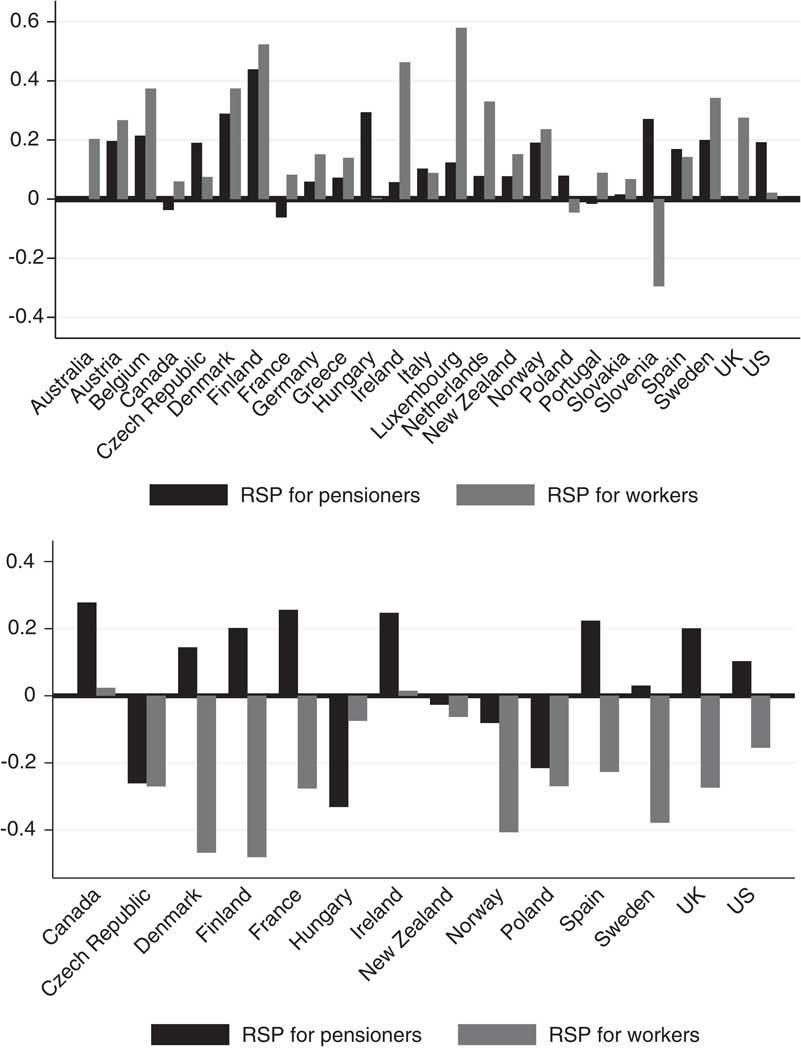
To offer a brief illustration of the utility of this measure, it is helpful to compare RSPs for parties belonging to the same party-family in established democracies. Figure 3 depicts the average RSP for workers and pensioners for the two largest party families throughout the sample period: social democratic parties and conservative parties.
Average Relative Support Propensities for Pensioners and Workers across Party Families: (top) Social Democratic Parties and (bottom) Conservative Parties Source: Eurobarometer, ISSP, author’s calculation.

While the general pattern is in line with conventional wisdom, the large variation between parties within the same party families suggests that the use of partisan family labels is limited for empirical research. Average social democratic/labour RSP for workers ranges from 0.58 in Luxembourg (Parti Ouvrier Socialiste Luxembourgeois, POSL – Socialist Workers Party) to −0.3 in Slovenia (Socialdemokratska stranka Slovenije, SDS – Social Democratic Party of Slovenia), while the corresponding RSP for pensioners varies between −0.06 in France (Parti Socialiste Francaise, PSF – French Socialist Party) to 0.439 in Finland (Suomen Sosialidemokraattinen Puolue, SSDP – Social Democratic Party of Finland). This group-specific variation is also substantial among conservative parties. The average worker-specific RSP for this party family ranges between −0.481 in Finland (Kansallinen Kokoomus, KOK – National Coalition Party) to 0.023 in Canada (Progressive Conservative Party of Canada, PCP). Likewise, the average pensioner-specific RSP among conservative parties is lowest in the Czech Republic (Občanská Demokratická Strana, ODS – Civic Democratic Party, −0.261) and highest in Canada (PCP, 0.278). These variations clearly show that different parties are positioned very differently among social groups in different countries.
Turning to the main dependent variable of our study, welfare retrenchment, a lively debate has emerged on measurement issues. Allan and Scruggs (Reference Allan and Scruggs2004) cogently argue that looking at the policy parameters of welfare programmes (replacement rates, eligibility criteria etc.) is a superior measure of welfare retrenchment to conventional expenditure data because, as Esping-Anderson (Reference Esping-Anderson1990: 21) famously remarked, ‘it is hard to imagine that anyone struggled for spending per se’. Moreover, critics of spending measures – see Starke’s (Reference Starke2006) excellent review in this regard – often make the valid point that spending is driven by a number of structural developments in welfare states, such as ageing, structural unemployment and deindustrialization (Huber and Stephens Reference Huber and Stephens2001; Iversen and Cusack Reference Iversen and Cusack2000).
For our purposes, however, several other considerations weigh against these arguments. Firstly, as the welfare regime literature (Esping-Anderson Reference Esping-Anderson1990; Iversen and Wren Reference Iversen and Wren1998) has long emphasized, welfare services constitute a significant part of ‘welfare effort’ in a number of modern welfare states. Spending data are better suited to capturing welfare effort on such services. Secondly, much of the welfare retrenchment debate revolves around the goal of cost-containment (Pierson Reference Pierson2001; Starke Reference Starke2006), making expenditure outcomes per se of high conceptual relevance for this study. Thirdly, the valid concerns about demand- as opposed to policy-driven spending outcomes are less problematic than they first seem: careful control variables (see a more detailed discussion below) on these structural drivers are easily available and applicable for quantitative analysis.
Accordingly, I chose programme-specific expenditure data (as a percentage of GDP) as the dependent variable of interest. As previously mentioned, one of the main considerations in defining social groups was to clearly align them with welfare programmes where they have a vested interest. For the first group, the pensioner population, old age pension expenditure is an obvious programme that satisfies this criterion. Workers face a number of risks along the life-cycle, so it is less obvious which programme they are most prepared to defend. I argue that unemployment is probably the most prominent of these risks: a shrinking manufacturing base in advanced economies, global competition, structural employment and dualized labour markets (Rueda Reference Rueda2005) all expose this low-skilled group to the risk of job loss (Rehm Reference Rehm2011). I thus choose unemployment benefits as the core programme of workers.
In addition to these core measures, I also adopt a broader measure for the two groups that takes into account other welfare programmes that are potentially relevant for their interest. For pensioners, the broader measure includes health expenditure and survivor benefits. The elderly are frequent users of healthcare facilities, regular consumers of subsidized drugs as well as the main beneficiaries of survivor programmes. For workers, these complementary programmes largely address what the welfare state literature identifies as ‘new social risks’ in the post-industrial economy (Bonoli Reference Bonoli2005): measures to fight structural unemployment by activation policies as well as family policies to ease women’s entry and re-entry in the labour force after child-bearing. I thus included active labour market policies, incapacity and family benefits because these policies primarily target working-age individuals. All spending variables are expressed in percentage of GDP.
The final variable of main interest to discuss is the fiscal consolidation variable. The second hypothesis addresses the possibility that the era of ‘permanent austerity’ should not be understood in a homogeneous manner, but rather as extended efforts to stabilize/bring down debt levels interspersed with times with less pressure on public budgets. Recognizing this heterogeneity, I followed the approach of Alesina and Ardagna (Reference Alesina and Ardagna2009), who identify large fiscal efforts by changes in the cyclically adjusted primary balance of the general government (capb). Specifically, they code fiscal adjustment periods as those calendar years when the cyclically adjusted primary balance improves by at least 1.5 per cent of potential GDP. As a minor but important modification to this coding rule, I use underlying primary balances obtained from the OECD’s economic outlook database – more commonly known as the structural balance – which also eliminate one-off transactions, such as bank bailouts from the headline measure. I thus identify fiscal consolidation episodes as those calendar years when the underlying primary balance improved by at least 1.5 per cent of potential GDP.
In addition to the main variables of theoretical interests, control variables are essential for the analysis. Most importantly, structural developments driving programme-specific expenditure outcomes have to be correctly specified. Firstly, as expenditure data are expressed as a percentage of GDP, GDP growth has to be accounted for to take into account the denominator effect. Moreover, growth has an indirect effect on expenditure as the cyclical position of the economy affects the pool of beneficiaries of welfare claimants. Secondly, unemployment is taken into account for the worker-related specifications because it increases the pool of unemployed, directly impacting unemployment benefits and indirectly other welfare expenditure for the working-age population. For pensioners-related expenditure, in turn, I control for ageing by including a variable for the percentage of older people (people aged above 60) in the population. In addition to these structural developments, a set of dummy variables for party family membership of the ruling (senior coalition) parties is included to disentangle the effects of partisan biases (RSP) from the traditional effects of ideology. Finally, two further control variables capture the role of domestic and external influences on policymaking. While large numbers of partisan and institutional veto players can create deadlocks in policymaking (Bonoli Reference Bonoli2001; Tsebelis 2002), globalization can put pressure on governments to rein in their welfare budget in order to address real or perceived threats to national competitiveness.Footnote 9 I thus included the widely used index for political constraints (POLCON III; Henisz Reference Henisz2006) as well as a sub-component of the KOF index of globalization (Dreher Reference Dreher2006) that captures economic flows and restrictions on movements of goods, services and capital.
Before proceeding to the empirical analysis of this article, a final note on the partisan variables is in order. The welfare state literature, as a rule, measured incumbency by incorporating all parties holding cabinet portfolios. This is warranted on the grounds that government portfolios offer the primary tools for parties to affect policy. It is not all that clear, however, that a numerical (percentage) measure of junior coalition parties is appropriate to determine their influence on welfare decisions: a small coalition partner controlling the environmental and the transport ministry, for instance, may have considerably less policymaking power than one controlling welfare-related portfolios. Focusing on the leading government party is thus arguably a safer choice because the control over the premiership and the finance ministry (typically the case for large senior coalition members) gives the leading party considerable, if not predominant, leverage in acting according to its own welfare preferences.Footnote 10 Moreover, the clarity-of-responsibility thesis in electoral research (Duch and Stevenson Reference Duch and Stevenson2008; Powell and Whitten Reference Powell and Whitten1993) has consistently shown that senior parties are held more responsible for electoral outcomes, hence their strategic incentives for Nixon-goes-to-China policymaking should also be sharper. Although the omission of coalition partners should be kept in mind as a possible limitation, these considerations suggest that focusing on leading parties is a theoretically informed choice.
EMPIRICAL ANALYSIS: NIXON-GOES-TO-CHINA IN TIMES OF WELFARE RETRENCHMENT
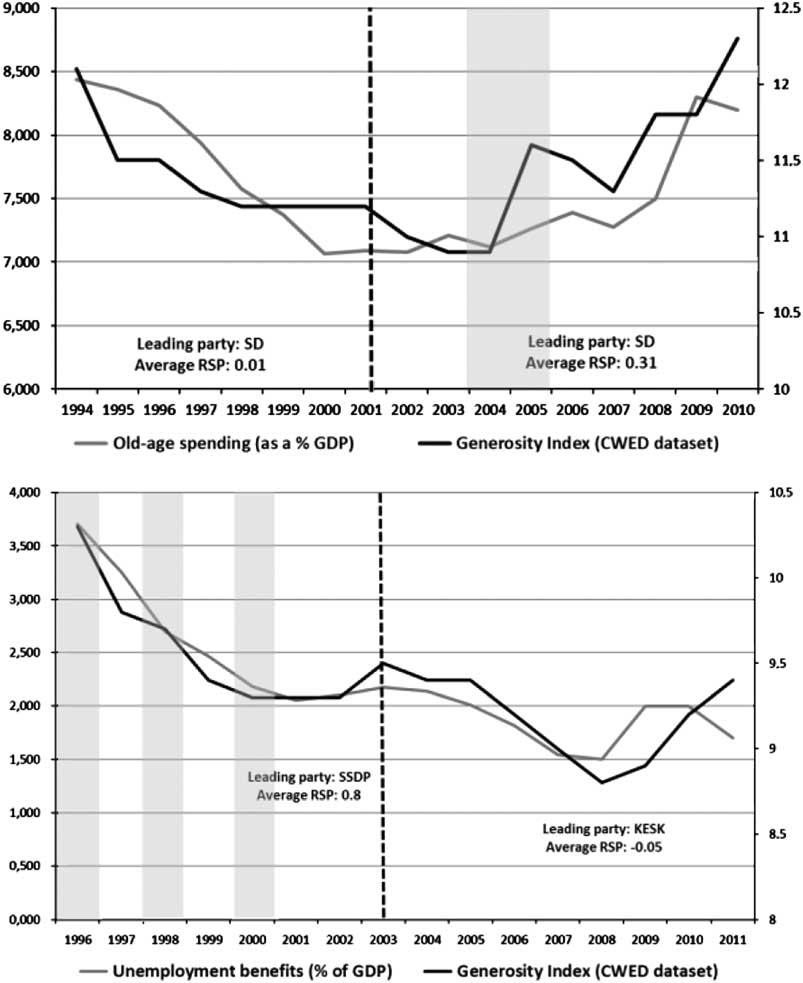
To motivate the empirical analysis, Figure 4 provides an initial illustration of the patterns that we expect to generalize in the econometric models below. For the selected pair of countries (Denmark in the upper and Finland on the lower panel), the graphs compare two relatively stable and extended political episodes with a sharp alternation of partisan control in the middle of the period. In the Danish case, the Social Democratic Party’s eight years in power as a leading party in multiparty coalitions gave way to a Liberal–Christian Democratic coalition in 2001. While the Social Democrats enjoyed high relative propensity among pensioners (0.31 on average over their government tenure), the Liberal Party was considerably less popular among them (0.01). In Finland, the partisan alternation occurred in 2003 from a social-democrat-led government to a coalition led by the centrist Keskusta Party (KESK – Centre Party). Here, the swing in the relative propensity is measured for workers with an even greater swing from a leading party that was extremely popular among workers (average RSP over the period 0.8) to a relatively unpopular (average RSP = −0.05) one.
The Evolution of Old-Age Spending (Denmark – upper panel) and Unemployment Benefit Spending (Finland – lower panel) and the Corresponding Generosity Indices Over Time Sources: OECD (2016a, 2016b), CWED data set, Scruggs et al. (2014), ParlGoV database (Döring and Manow Reference Döring and Manow2016)

The evolution of old-age spending in Denmark and unemployment benefit spending in Finland as a percentage of GDP as well as the changes in the relevant generosity indices (Allan and Scruggs Reference Allan and Scruggs2004) show a pattern that conforms well to the two hypotheses. In both cases, the partisan break illustrated by the vertical black lines separate an episode marked by spending cuts and reduced generosity from one with increasing or stable spending and generosity levels. Moreover, some of the most significant changes (e.g. the leap in the Danish generosity index for public pensions in 2005) correspond to years of fiscal adjustment, illustrated by the shaded grey areas.
To extend these patterns to a large sample of country-years, I first lay out the general time-series cross-section model to be estimated, taking the general form of:
 $${\rm Y}_{{{\rm it}}} \, {\equals}\, {\rm \beta }_{0} {\plus}\mathop{\sum}\limits_1^k {\beta k\, {\asterisk}\, X_{{kit}} {\plus}{\rm \alpha }_{i} {\plus}{\rm \mu }_{t} {\plus}{\rm e}_{{{\rm it}}} } $$
Where Yit is the endogenous (dependent) variable of the model, Xkit is a vector of k regressors (including interactions), αi, µt are unit- and time-specific intercepts and eit is an observation-specific error term. The observations are taken from a sample of 25 OECD countries – including five new member states of the European Union – over three decades (1980–2012) that largely cover the period of ‘permanent austerity’.Footnote 11
The first concern that immediately arises is to what extent the main variable of our interest, RSP, can be regarded as exogenous so that the weak exogeneity assumption – E(Xiteit) = 0 – holds. Theoretically, we have strong expectation to assume that the contemporaneous RSP and expenditure data are mutually endogenous, as the relative party support among different constituencies may very well depend on welfare spending decisions. To circumvent this possibly severe endogeneity bias, I ‘fixed’ my RSP measure to the year that a new government came to power. For the entire term of the incoming government, the group-specific RSP will reflect the preceding four years’ average of the RSP measure at the beginning of the term.Footnote 12 Measuring RSP from the pre-incumbency period is a theoretically informed way to capture the notion of a government’s ‘electoral mandate’ and goes a long way in addressing endogeneity concerns.
A second important theoretical consideration is the functional form of the dependent variables. While level specifications are usually interpreted as models predicting ‘long-run’ effects, first-difference specifications are better suited to capture ‘short-run’ dynamics. For our purposes, it is the latter aspect that we mostly care about: to what extent do incumbent governments adopt retrenchment policies – often in the face of financial pressures to take urgent decisions – as a function of their electoral constituencies. Moreover, as Kittel and Winner (2005) discussed in their re-analysis of Garrett and Mitchell’s (Reference Garrett and Mitchell2001) public expenditure data, the level form of these series can often be non-stationary with a coefficient of the autoregressive term being very close to unity. First differencing the dependent variable thus also has a technical advantage wherein the risk of running spurious regressions is minimized.
The empirical models thus estimate the impact of the RSP variables in isolation (Hb) and in interaction with fiscal adjustment episodes (Hc) on the annual changes in the programme-specific categories. A series of Hausman tests suggested that the omission of fixed effects to obtain more efficient random-effects estimates is warranted. However, year-specific time dummies are included to account for common shocks (such as the Maastricht process or the recent austerity period) that affected multiple countries simultaneously in the sample. Panel-corrected standard errors (Beck and Katz Reference Beck and Katz1995) are used to correct for the standard violations of the Gauss–Markov assumptions in cross-section time-series data (Beck Reference Beck2001): autocorrelation (AR1), panel heteroscedasticity and cross-sectional correlation between the error terms.Footnote 13
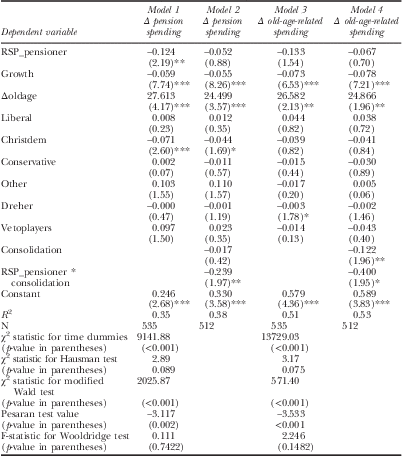
Table 1 summarizes the main findings for the pensioner population (time dummies suppressed from this and all subsequent tables). All models use the annual change in old-age spending (both cash transfers and services) as the dependent variable. The baseline model shows that structural variables are important determinants of spending outcomes: higher growth and a larger increase in the ratio of the elderly decreases and increases the share of output devoted to old-age expenditure, respectively. By contrast, the Henisz index for veto points and economic openness did not achieve statistical significance in any of the models.
Models Explaining Old-Age Spending in OECD CountriesFootnote a

Notes: *p<0.1; **p<0.05; ***p<0.01.
a The coefficients are random-effects estimates with a set of time dummies (suppressed) and panel-corrected standard errors (t-statistics in parentheses).
The main variable of interest, pensioner-specific RSP, is significant in the expected (negative) direction. Looking at the baseline model (Model 1), the only other noteworthy finding is the generally non-significant coefficients for the party family dummies, with the minor exception of Christian democrat parties having a significant, albeit small, negative impact on spending changes compared to the baseline social-democratic category.Footnote 14 This null finding confirms one of the article’s main contentions: party ideology, as conventionally equated with party families, is a poor indicator for the underlying social support coalitions and their impact on welfare effort.
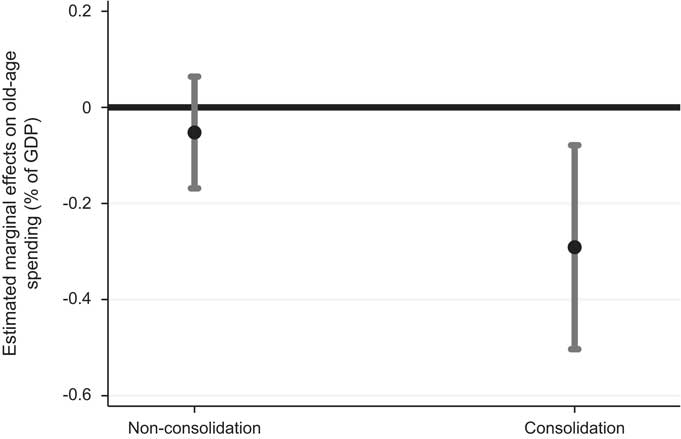
Introducing the interactive models (Model 2), the estimates largely lend support to the second hypothesis. The left panel of Figure 5 depicts the marginal impact of the RSP variable in different fiscal periods. The point estimates of the RSP variable are negative and significant in consolidation periods but very close to 0 and non-significant in non-consolidation periods. In other words, the Nixon-goes-to-China patterns of pension spending are present only in periods of acute fiscal stress.
Marginal Effects with Point Estimates and 95% Confidence Interval for the RSP_pensioner Variable in Different Fiscal Episodes: (left) Pensioner Spending and (right) Old-Age-Related Spending

The same patterns, with an even larger estimated magnitude can be discerned when taking a broader measure of pensioner-related spending, including survivor benefits and health expenditure. While the point estimate for the unconditional (baseline) hypothesis is now non-significant, the interactive patterns are stronger. In periods of fiscal consolidation, shown on the right panel of Figure 5, ruling parties with a one-unit higher location on the RSP scale are associated with a more than 0.4 per cent greater cut in pensioner-related spending relative to parties with a lower RSP score. In fiscally more tranquil periods, the marginal effect of the RSP variable is negligible and non-significant.
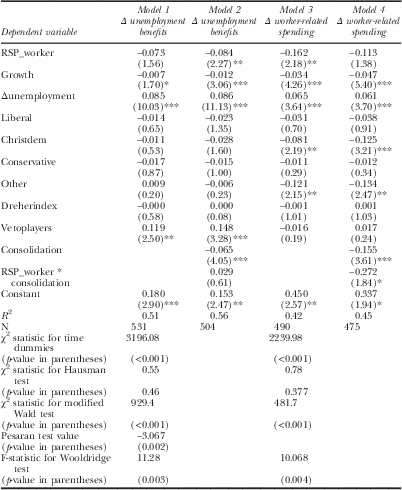
Proceeding to the empirical models for workers, the first two models in Table 2 predict the annual change in unemployment benefit spending (as a percentage of GDP).
Models Explaining Unemployment Benefit Spending in OECD CountriesFootnote a

Notes: *p<0.1; **p<0.05; ***p<0.01.
a The coefficients are random-effects estimates with a set of time dummies (suppressed) and panel-corrected standard errors (t-statistics in parentheses).
According to the baseline model (Model 1) the effect of worker-specific RSP is in the expected direction, though falling short of significance at conventional levels. Similar to the models for the pensioners, the estimated effects of the party family dummies are small and insignificant, suggesting that changes in unemployment spending were little affected by party ideology in the conventional sense. The structural variables – growth and the change in unemployment rates – are highly significant in the expected direction: lower growth and increased unemployment put an upward pressure on unemployment benefit spending. While the impact of globalization measured by the KOF index is both statistically and substantively indistinguishable from 0, political constraints are found to matter for unemployment benefit spending. A higher number of veto players is associated with larger (positive) changes in outlays. A tentative interpretation of this finding is that in times of severe pressures to cut replacement rates, tighten eligibility and shorten duration for the unemployed, veto players act as a brake on this particular programme-specific retrenchment strategy.
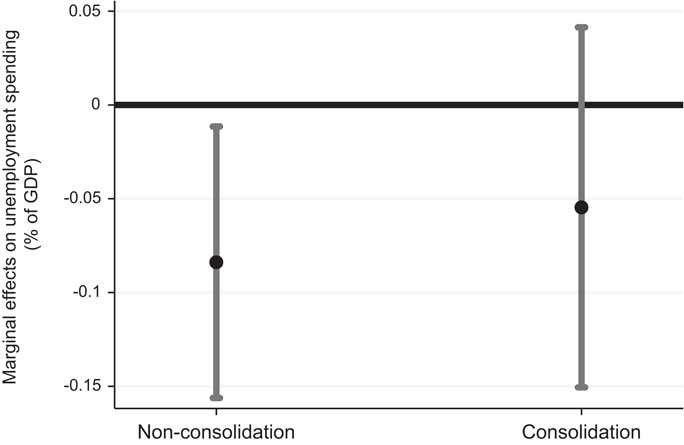
Turning to the interactive model (Model 2), the conditional hypothesis can be rejected by the data. The left panel in Figure 6 shows the point estimates and 95 per cent confidence interval for the RSP_worker variable under different fiscal stances. The point estimates are virtually identical in both fiscal episodes (around 0.05–0.07 per cent of GDP) and, if anything, it is during periods of non-consolidation when higher RSP among workers is associated with deeper cuts in unemployment benefit programmes. This finding, although rather weak, clearly runs against the conditional hypothesis of this article.
Marginal Effects with Point Estimates and 95% Confidence Interval for the RSP_worker Variable in Different Fiscal Episodes: (left) Unemployment Benefit Spending and (right) Worker-related Spending

The evidence corroborating the conditional formulation of the Nixon-goes-to-China policymaking pattern is substantially stronger, however, when we look at a broader measure of worker-related spending that now captures incapacity benefits, active labour market policies and family benefits. Under this broader measure, the evidence for the unconditional (baseline) hypothesis (Model 3) is quite strong: on average, a one-unit higher location on the RSP scale is associated with a 0.16 per cent greater cut in worker-related spending items. The conditional formulation of the hypothesis (Model 4) provides even stronger empirical results. As the right panel in Figure 6 shows, in periods of fiscal consolidation, a one-unit increase in the RSP scale is associated with an almost 0.4 per cent larger cut in worker-related spending, as a percentage of GDP. The marginal effect of RSP is still negative but falls short of statistical significance in non-consolidation periods, however.
To sum up our findings thus far, the evidence for the baseline Nixon-goes-to-China hypothesis (Hb) is mixed. On the one hand, both for the pensioner and the low-skilled worker models, incumbents impose a higher fiscal burden on their core constituencies relative to other parties. On the other hand, the strength of the evidence varies among the two social groups and according to the particular social spending categories used. As far as the conditional version of the Nixon goes-to-China hypothesis (Hc) is concerned, the evidence is strong and robust for pensioners: incumbents who are well positioned among this social constituency implement larger cuts in the main social programmes that they benefit from relative to other governments. The evidence for workers, by contrast, is somewhat less consistent. The same Nixon-goes-to-China can be identified for the broader measure of spending categories but if anything, the opposite seems to play out when one analyses unemployment benefit spending only.
As a validity test for the argument, I investigated the role of external influences that may potentially change the results. While the control variable for globalization (KOF index) and veto players as well as the second hypothesis on the conditioning role of fiscal adjustment episodes both speak to the importance of constraints, they say little about direct external influences on social policy that may constrain domestic political considerations when designing programme-specific cuts. A logical implication of these external influences is that they are expected to moderate the Nixon-goes-to-China effect as domestic policymakers have a reduced scope for responding to electoral incentives. A particular example of such external influences is the role of the emerging Social Investment State paradigm (Morel et al. 2012) in the EU. Codified as a set of general guidelines and country-specific recommendations by the Lisbon strategy in 2000, the paradigm put considerable pressure on policymakers to respond to challenges in their pension systems and labour market policies. Alternatively and additionally, membership of the Economic and Monetary Union may act as another form of constraint over governments because of the fiscal straitjacket that the common currency entails.
Accordingly, I created two dummy variables: one corresponding to EU countries after the adoption of the Lisbon strategy; the other to eurozone members after the introduction of the common currency. Re-estimating the core models with the RSP variables interacted with these dummy variables, the moderating role of these external influences are partly borne out by the results (shown in Table A2 in the online appendix). While the adoption of the Lisbon strategy fundamentally changes the Nixon-goes-to-China effect for the broader measure for worker-related spending, eurozone membership moderates and even reverses the partisan logic for pensioner-related spending items. It appears, therefore, that the Nixon-goes-to-China logic postulated by this article requires a fair amount of political discretion and autonomy from external influences on social policy priorities.
CONCLUSIONS
How partisanship shapes welfare preferences of different incumbent governments has long been one of the primary interests of welfare state scholars. Electoral considerations in most of these accounts have been implicit at best with highly pessimistic expectations: welfare state retrenchment should be inherently unpopular so even conservative governments with a clear electoral mandate often shy away from it. The main contribution of this article has been to nuance this assessment; when partisan loyalties and the policymaking flexibility that results from them are explicitly incorporated in quantitative measures of partisan politics, a somewhat paradoxical result emerges. Parties that are electorally well positioned among certain constituencies systematically cut social programmes that cater for the needs of these groups. Such an effect tends to be especially pronounced in fiscally challenging times.
While the overall evidence has been fairly strong and held up for different expenditure items and social groups in the sample, a reasonable objection to raise is the specific causal dynamics put forward by this article. The notion of partisan biases, mirroring the Nixon-goes-to-China logic in international relations, is but one out of other possible candidates that could account for the reverse partisan logic in hard times. Alternative explanations – not explicitly addressed by this contribution for want of space – might relate to changing preferences of social constituencies or changing party strategies relative to earlier decades of welfare state building.
If the proposed causal dynamics are correct, however, an obvious next step that my argument calls for is the investigation of the micro-level dynamics of welfare programmes. Specifically, the individual-level determinants of vote-switching between elections during retrenchment periods would offer valuable insights into how partisan-biased individuals assess government policy and cast their vote in the ballot box.
Supplementary Material
To view the supplementary material for this article, please visit https://doi.org/10.1017/gov.2017.3.