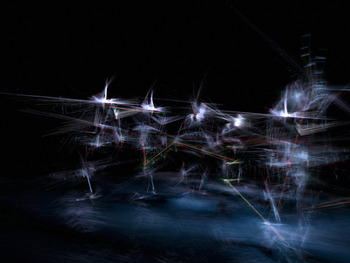
In 1999, noted choreographer and dancer Bill T. Jones, in collaboration with digital artists Paul Kaiser and Shelley Eshkar of the OpenEndedGroup, presented an installation at the intersection of dance, drawing, and digital imaging.Footnote 1Ghostcatching features Jones's previously improvised movements recorded using motion capture technology, which in the piece manifest in various virtual dancing bodies. With reflective motion capture sensors placed on Jones's body as he improvised, cameras positioned around him recorded the movements of each sensor, coding Jones's motions into data for Kaiser and Eshkar to re-design. In Ghostcatching, Jones's dancing body—which arguably had become a sign for black gay male sexuality by the time artist Robert Mapplethorpe photographed him in 1985 as both portrait and figure study—is physically absent yet virtually present.Footnote 2 In motion capture, a digital character model is generated from an armature or a human body with the purpose of recording only the movements of the performer, not his or her visual appearance. The virtual bodies in Ghostcatching seem to follow this formula. Whereas the digital characters in Ghostcatching refer to Jones's physical body, which generated them, they are not meant to reproduce his likeness or visual appearance. But Jones's virtual dancing is cast from his own singular and iconic movements. While the labor of his dancing is mediated, re-mediated, and ultimately subsumed by motion capture technology, his bodies in virtual and physical form remain inextricably linked. Thus, a tension between liveness and likeness emerges from this use of motion capture coupled with the recurring presence of Jones's signature movements, voice, breathing, and recognizable style of storytelling in Ghostcatching. Jones is well known for deploying autobiography and recited text alongside movement as a technique for making dances. To this end, his “bodies”—physically absent yet virtually present—duplicate each other, complicating the relation between sign and referent that motion capture technology seeks to disrupt.
In 2010, just over ten years after Ghostcatching premiered, the OpenEndedGroup and Jones presented After Ghostcatching as part of The Dissolve, SITE Santa Fe's 2010 Biennial.Footnote 3 Specially commissioned for the Biennial, After Ghostcatching is “a re-envisioning” composed of a larger sampling of Jones's motions and vocalizations captured for Ghostcatching in three dimensions (Kaiser Reference Kaiser2010). What can these two pieces tell us about the politics of bodies and identities in the twenty-first century? Can a work succeed in its efforts to broach identity while rejecting the tyranny of categories such as race, gender, and sexuality that have become prominent features of Jones's oeuvre? In this essay, I question the status of Jones's raced, gendered, and sexed body in Ghostcatching and After Ghostcatching to track a shift from so-called identity politics to a discourse of post-racialism over a ten-year period in U.S. history. In my reading, which positions dance as a visual medium, Ghostcatching and After Ghostcatching mediate the multiple registers in which race and racial discourse, and by extension post-racial discourse, operate.Footnote 4 Does race still matter? What role does the body play as a container of social and biological constructions of race in the face of body reductionism, critical theories of the body-as-text, and, more importantly, the techno-utopia of the digital as a new sphere of sociality? In spite of the persistence of visible markers such as skin color that are mobilized to construct racial subjects, to what degree is race actually, or solely, visual? To answer these questions, I explore the visual, haptic, and spatial registers of race in Ghostcatching and After Ghostcatching by considering how Jones's blackness is subject to and determined by specific media—photography and digital art, improvised dance, and choreographic form.
An analysis of Ghostcatching and After Ghostcatching with regard to motion capture technology, digital art and imaging, and improvised, virtual dance highlights the ways in which race matters in the twenty-first century. I believe examining improvised, virtual dance and the use of motion capture technology in these two pieces, which span a decade of the most recent and provocative debates regarding race and racial identification in the U.S., might allow us to rethink a racially overdetermined politics of visuality. In the first half of this essay, I establish a clear trajectory of critical perspectives and their potential blind spots concerning Ghostcatching that I bring to bear on After Ghostcatching in the second half of this essay. In doing so, I advance the scholarship on Jones's involvement in the two pieces in two ways. The first is to chart how a discourse about race and technology in the second decade of the twenty-first century has changed since Ghostcatching was first presented. This sea change also aligns with the choreographic shift in Jones's career—from making dances about identity politics to a concerted return to choreographic form and pure movement. The second is to illustrate how the use of improvised dance and digital imaging technology in these two pieces refigure the multiple registers that visually constitute race, which consequently expose the limits of these technologies of representation.
Critical accounts by dance studies scholars Ann Dils and Danielle Goldman exemplify the difficulty in making sense of Jones as a signified body among the digital dancing bodies that populate Ghostcatching. For instance, in I Want to Be Ready: Improvised Dance as a Practice of Freedom (2010), which went to print before After Ghostcatching was exhibited for the first time, Goldman addresses the radical juxtaposition of recited text, improvisation, and narrative in The Breathing Show. The Breathing Show (1999), Jones's first-ever evening-length solo work that he described as an opportunity to return to himself, “going back to the time when [he] was 19 and a young dancer who wanted to fly” (Jones quoted in Barclay Reference Barclay1999), included a portion of Ghostcatching projected onstage while Jones danced.Footnote 5 For Goldman, seeing the live Jones on stage simultaneously moving in tandem with the virtual Joneses on screen is tantamount to the piece's politics. For Goldman, sweat, breath, and flesh matter, and she leans on Jones's physical (signifying) body in order to make sense of the work. But Goldman's reliance on Jones's actual body to stabilize the differences she analyzes does not fully account for the significant presence of recorded sound and spoken autobiography in marking Jones's identity alongside the digital renderings in Ghostcatching. Though she gestures toward this relation in her analysis, and Jones's live performance of both text and movement are crucial for Goldman, the effects of recorded voiceover, narrative storytelling, and Jones's humming and singing that comprise Ghostcatching also warrant individual attention. In my view, Jones's use of recorded breath and text in Ghostcatching disrupts a motivating thematic of the work: dissociating Jones's actual body—his liveness—from the virtual bodies derived from it—his likenesses. Performance curator and critic RoseLee Goldberg reminds us that “Jones began working on Ghostcatching [around] the same time that he was completing ... We Set Out Early, Visibility Was Poor (1997) [which] began with a disciplined choreographic premise: strip the body of connotations—political, psychological, racial, even sexual—and concentrate on pure movement as the sole design for dance” (1999, 20). According to Goldberg (Reference Goldberg1999), Jones's approach to Ghostcatching relates to his motivations in making We Set Out Early, in which he challenged the way the body was perceived through a focused exploration of form.
Given this relation between sound, movement, and image, I argue that the elements of The Breathing Show that Goldman identifies—recited text, improvisation, narrative, and mediated labor—are all present in Ghostcatching itself. Jones's, Kaiser's, and Eshkar's manipulations of these elements, combined with Jones's digital dancing bodies, constitute a complex matrix of formal exercises. While I agree with Goldman's larger aim to “[trace] a trajectory of Jones's career, from his rejection of contact improvisation, to his aggressive, politically charged works of the 1980s, to his controversial return to form” (2010, 112), the linkages between sound, movement, and image as technologies of representation also deserve independent consideration. Additionally, Goldman excludes from her analysis the visual implications of Ghostcatching's initial exhibition context and the exhibition's accompanying photographs, which construct a significant material relationship between Jones's signified body and the photographic documentation that in turn relentlessly binds Jones to his ghosts.
In his polemical Against Race: Political Imagining Beyond the Color Line (2000), which was published one year after Ghostcatching premiered, scholar Paul Gilroy asserts, “skin is no longer privileged as the threshold of either identity or particularity” (2000, 47).Footnote 6 With the development of digital imaging and new visual technologies, specifically in the medical field, Gilroy urges us to let “old visual signatures of ‘race’ go” (43). For Gilroy, the color line is obsolete. But the terrain of racial politics and visuality has changed since Gilroy made these claims, which do not easily fit the United States political landscape. The span between 1999 and 2010 when Ghostcatching and After Ghostcatching were each presented aligns with the rise of post-racial discourse and a shift in the U.S. political stage. For example, U.S. President Barack Obama's successful bids for election in 2008 and re-election in 2012 have become touchstones by which the boundaries of race and racialization are measured and contested. Obama's two-term presidency stands as a marker of what has been heralded as a new era of racial meaning out of which a discourse of racial transcendence, post-racialism, has emerged. Obama began as an icon of post-racialism, but his presence in the U.S. political arena has spurred controversial, polarizing debates that actually confirm that we are not beyond race (Taranto Reference Taranto2009).
Post-racialism posits the collapse of racial boundaries and categories in favor of a more tolerant, colorblind society. Proponents of post-racialism assume that race and racism are no longer present, and that they no longer have any formative bearing on contemporary culture and politics. Post-racialism in effect signals that we are beyond race as an organizing politics. In this frame, Gilroy's “radicalism”—a humanism unbound by what art historian Jennifer A. González calls the visual hegemony of race—borders on a colorblind universalism that fails to map onto a Western context in general and the unique history of race relations and persistent racial disparities in the U.S. specifically (Reference González2008, 2).Footnote 7 In the latter half of this essay, I turn to more recent writings on race and technology by Anne Everett (Reference Everett, Lisa and Peter A.2012) and Wendy Chun (Reference Chun, Hui, Lisa and Peter A.2012) to offer a counterpoint to Gilroy's claims. The expressions of visual and choreographic form in both digital imaging and dance challenge the risky assumption that a digital body, turned into a utopian space by making essentializing information about race less visible, can dissolve crucial problems of race and visuality. In the U.S., a history of race has been a central feature of national identity and, as a result, citizen subjects have been conditioned to see race in a unique way. The very practices of looking have been colonized. Thus, retreating to a digital body as a new sphere of sociality, as a utopian space that potentially and optimistically erases essentializing information—or renders it invisible—in order to escape the persistence of race as visual does little to solve the problems of racialized looking practices. Ghostcatching and After Ghostcatching, in my view, capture how race mediates politics, culture, and subjectivity. Jones's choreographic engagement with charged issues of identity also shows how race in turn gets mediated in a digital era in which racial difference is coded as obsolete and forms of oppression are normalized to the point of misrecognition or obfuscation.
Before
When Jones began working with Kaiser and Eshkar in 1998, the pair was in the midst of finishing a collaboration begun in 1997 with Merce Cunningham. Cunningham, whose approach to composition involved developing dance, music, and set design elements independently to be later performed simultaneously, often coming together for the first time in live performance, is perhaps most known for his experiments with Cageian chance operations.Footnote 8 Long interested in experimenting with new media, technology, and composition (from dance films to using three-dimensional computer animation as a choreographic medium), Cunningham, Kaiser, and Eshkar used motion capture technology to track and project Cunningham's dancers in motion. These motion capture collaborations resulted in Hand-drawn Spaces and BIPED, two of what Kaiser and Eshkar call virtual dance installation works (Kaiser Reference Kaiser1999a). As Kaiser notes, “Cunningham's method of collaboration is famous for being unusual. Perfected in the 50s . . . the idea is to expunge all traces of illustration from the three main strands of the dance: the choreography, the music, and the visual décor” (Kaiser Reference Kaiser1999a). Cunningham's commitment to removing the illustrative, or representational, traces from the three formal elements that Kaiser lists is also present in his treatment of dancing bodies. For Hand-drawn Spaces, Cunningham taught movement sequences to two dancers, one female and one male. Their motions were recorded and drawn, reproduced without sexual markings, allowing for seamless combinations of each dancer's phrases to overlap and merge without disrupting the visual field. In an exhibition catalog essay for Ghostcatching, Kaiser explains:
A curious thing about Hand-drawn Spaces: The movements we captured were truly detached from the dancers who had so brilliantly performed them, Jeannie Steele and Jared Phillips. The differences between the two in size and sex and style were annulled as Merce combined their captured phrases freely, making long passages in which one dancer's movements alternated frequently with the other's, both mapped to the same hand-drawn figure. Psychology and intention were absent from this choreographic process, for Merce used chance operations to see what phrase went next. Here as elsewhere, his art was all about movement, his interest absorbed by how the dancing worked in space and time. (1999b, 39)
As Kaiser suggests, the virtual dancers in Hand-drawn Spaces appear as interchangeable, sexless bodies; political significations of sex and gender are disavowed. Whereas Cunningham's affinity for pure movement over identity politics and bodies-as-signs led him to explore motion capture technology for its formal qualities, Bill T. Jones used the medium to different ends.
Jones's attraction to motion capture technology was “‘its level of veracity’” (Jones quoted in Goldberg Reference Goldberg1999, 20). RoseLee Goldberg writes, “[T]he sophisticated software used in Ghostcatching ... was unlike anything he had seen before. ‘Watching the moving dots on the screen afterward,’ Jones said, ‘I felt like I was looking at another being’” (1999, 20). Jones was struck by the technology's ability to render a faithful image that arguably would capture his liveness but not his likeness, producing another being that was not intrinsically, or essentially, him. Jones's rhetorical move from the act of watching to the act of looking parallels both the investments he makes in Kaiser and Eshkar's motion capture technology and the politics of vision and racialized looking that Jones seeks to interrogate with Ghostcatching.Footnote 9 As background for Jones's experiments with motion capture technology, Goldberg avers that Jones's concentrated focus on form and pure movement in We Set Out Early was a reaction to The New Yorker dance critic Arlene Croce's infamous dismissal of Jones's 1994 piece Still/Here as victim art. Croce's emphasis on “obvious problems”—of the aging and “overweight,” a dancer's inability to complete the line of long legs extended with “properly” pointed feet, and “physical deformities”—are irresponsibly grouped with the “unsightly” presentations of victimized others (Reference Croce1994, 54–55).Footnote 10 This grouping assumes that the dancing body is not only naturally legible but that it must also conform to an idealized aesthetic as Croce juxtaposes deformed bodies with “dissed” black bodies, reinforcing the aesthetic codes of concert dance as white, male, and heteronormative (Reference Croce1994, 54–55). Croce's anti-review of Still/Here makes it clear that the dance world had come to see Jones's dancing body as a black gay male body—subject positions that for Croce walked a fine line between agency and victimhood within a discipline predicated on aesthetic beauty. As such, “other” bodies do not belong in Croce's view, so much so that she literally refuses to see them.
According to Goldberg, Jones responded to Croce's review by welcoming the opportunities motion capture technology posed “as a way of escaping the aftermath of critical reactions to the emotionally wrought Still/Here” (Goldberg Reference Goldberg1999, 20). Consequently, Jones's investigations into stripping the body of racial, sexual, and psychological significations carried over from We Set Out Early to Ghostcatching, and “would govern his solo improvisations for Ghostcatching, but for different reasons” (Goldberg Reference Goldberg1999, 20). Jones's quest to disallow the process of signification relative to race and blackness runs parallel to the potential of motion capture technology to produce de-sexed bodies, moments of misidentification or disidentification engendered in Cunningham's Hand-drawn Spaces described earlier. However, Jones did not wish “‘to be a disembodied, denatured, de-gendered series of lines moving in a void’” (Jones quoted in Kaiser Reference Kaiser1999b, 39). The different ends to which Jones uses motion capture technology, then, derive from Jones's critical attention to a politics of representation relative to how race and gender as dominantly visual, even human and embodied phenomena.
Jones's use of motion capture technology as a response to the confines of race and racialized looking practices cannot be dismissed, given all of the preconceptions surrounding his choreographic output in the 1990s and his attraction to the medium. This response is reinforced by Merce Cunningham's own investments in form and how Jones's choreographic approach to race, gender, sex, and sexuality differed so obviously from Cunningham's, despite their use of the same technology in collaboration with Kaiser and Eshkar. In using the same technology to different ends, Jones attempts to defy the relational process of racialization by digitally manipulating the “fact” of blackness, or altering to what extent his racial identity is visibly apprehensible. To this end, part of Ghostcatching's project was not to be denatured himself but to denature race and racialized looking, and this project extends to After Ghostcatching. The digital frontier promised a race-free imaginary wherein Jones's blackness, his gender, and his sexuality would be allowed to proliferate, unhindered by a history of race and visuality that sought to render these identities invisible, abject, and undiscussable. Race-free does not refer to a sphere of production that is without race. It is instead an opportunity to complicate the visual hegemony of race by momentarily transcending the apparatuses—racialized looking practices and his visibly apprehensible black gay male body—that condition viewer attachments to Jones. As a challenge to the problem of the visual that Jones experienced in the critical reception of his work, Jones came to see the virtual bodies created for Ghostcatching as distinct beings with their own essences unmarked by racial difference. Jones's career turned a corner with pieces like We Set Out Early and The Breathing Show, and these pieces mark Jones's return to form as a move away from his more overtly politically charged identity work (Goldman). In Ghostcatching, however, Jones attempts to disabuse viewers and critics of how race structures and conditions the visual through the use of motion capture technology and choreographic form.
During
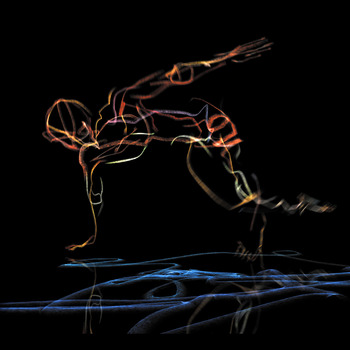
Ghostcatching and its accompanying exhibition premiered at The Cooper Union for the Advancement of Science and Art's Houghton Gallery in New York City on January 4, 1999, and closed on February 5, 1999. The piece begins with a drawn figure encased in a tall, rectangular prism made of straight vertical and horizontal lines.Footnote 11 The prism is divided into two boxes stacked atop one another. The bottom box is taller than the top box; its dimensions appear to make up two-thirds of the total shape. The bottom portion has other distinguishing features, such as translucent walls in contrast to the transparent walls of the top portion. The ghostly bluish-gray lines that form the edges of the prism are rough etchings; they intersect and extend slightly beyond their points of overlap into the black void in which the figure-in-a-box is centered. The figure in the prism resembles a wooden drawing figurine but with straight-lined edges. Here, Jones's actual body is refracted into a digital figure in three dimensions with flat, continuous, constituent surfaces and limbs roughly sketched like the prism that surrounds it. Diegetic sound that approximates a cross between a wind or echo chamber and the whooshing effects of sudden movement through space enters the composition as the figure begins to move. The figure shifts its center of gravity, bends its knees, and transfers its weight to the right leg. A voice definitively states, “A.” With its right arm raised, the figure pivots and pauses in a herculean shape, the first of a series of poses—or images—each initiated in conjunction with the enunciation of letters A through F. The figure's poses give form to each letter as it repeats this text-and-image combination, establishing a compositional theme-and-variation that continues throughout the piece. With each repetition, the figure spawns a new form of itself. The new form improvises and adds onto the initial images of A through F, then disappears, folding back into its original form. At points B, D, and A, the second of these new forms—ghosts to which the piece's title refers—arrives at the same pose as the original figure, literally facing its maker. Though similar, each form composed of either retracted or curvier lines differs slightly from the first. A third apparition springs from the original figure and travels beyond the perimeter of the prism. The camera follows it, and the sound score gradually changes from recited letters to a combination of whooshing sounds to mimic the arced lines the figure marks in space. Generated from the figure's distal ends, the curved lines remain for only seconds—traces of movement that linger in the black, vacant space of the dancing figure's virtual world. Now the figure is fully mobile, gliding through space (Photo 1). It rolls and pirouettes, drops, dips, and rebounds, carving through space with every leap and bound.
Ghostcatching (1999, Bill T. Jones, Paul Kaiser, and Shelley Eshkar).

Next, another figure emerges out of virtually nowhere, this time in vibrant color. The sound score changes once again; with the introduction of orange, yellow, and reddish lines we hear Jones recite excerpts of a text about a mother. The recited text mixes with Jones's humming and singing of “Dink's Song,” an American folk standard. More figures emerge adding brighter blues and vibrant red and green lines to the composition. These lines form an intricate, undulating web that partially obstructs the camera's and the viewer's visual command of the figures. A new figure leaps at the camera, then searches frantically for something on the virtual floor. Instead of continuous surfaces, though, the figure's body is formed by latticed surfaces, a skin or exoskeleton of sorts. Jones's voice re-emerges and delivers a spoken exchange between a mother and a child about cornbread, a retelling of one of his maternal grandmother's “story-songs.”Footnote 12 The song, adapted from the sinister Brothers Grimm's fairy tale, The Juniper Tree, is called “Mama killed me, Daddy ate me, who's gonna hang me on the Christmas tree?” Jones's syncopated breathing seems to drive the movement here more than anywhere else in the piece. We hear a moment of brief silence, and then through a high-angle shot, another figure encased by a cube-like structure comes into view. Two bursts of yelling follow this scene, and Jones's recitation and breathing continues. He grunts as the figure jumps, dances, improvises, and abruptly pushes against the transparent walls of the cubed enclosure. Here Jones and the figure share space, in recorded sound and digitally manipulated body. Layers of identity—the webs of colored lines resembling the double helix structure of DNA—are literally mapped out before us.
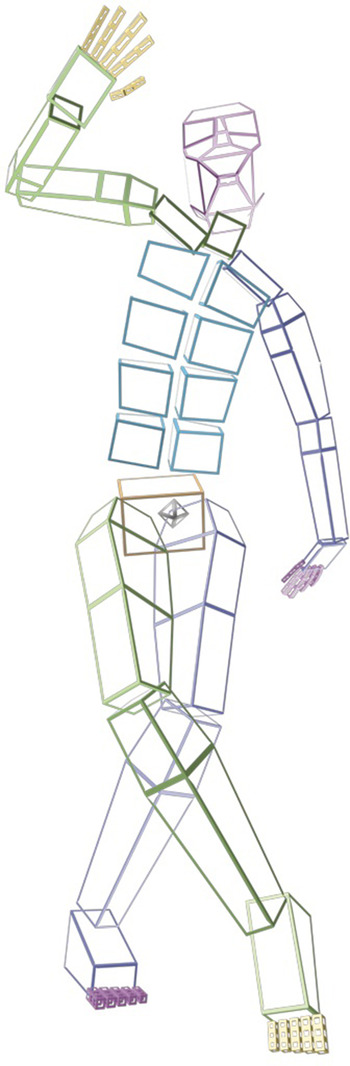
Describing her experience of The Cooper Union premiere of Ghostcatching, Ann Dils recalls seeing the eight-and-a-half-minute video for the first time with its intrigue, wonder, and impressive virtual display of Jones's actual virtuosity. The virtual dancing bodies in Ghostcatching first appear to be mere representations, or contained identities that materialize with each iterative form, unmarked by race or sex. Dils declares, “Bill T. Jones's often fierce movement is performed by gutless animated line drawings. Aspects of dance that seem fundamental become ‘ghosts in the machine’ in these works, lost in the motion capture and animation processes” (2002, 94). However, gender is never left behind. Each figure possesses broad shoulders, and both musculature and male genitalia are rendered in digitally drawn lines at various points throughout the piece. Indeed, it is not so easy to forget the figures' connection to an actual body; Jones's signified body is never quite relinquished. In an essay titled “The Ghost in the Machine: Merce Cunningham and Bill T. Jones,” Dils (Reference Dils2002) points to an inherent tension in dissociating Jones from his iconic movement vocabulary. For Dils, Ghostcatching is “a portrait of Jones as performer. Kaiser and Eshkar capture something essential about dancers and dancing in these motional portraits” (2002, 94, emphasis added). Here Dils not only slips between locating Jones as the source of movement and the politics of virtual re-presentation of that movement (Photo 2). She also desperately holds onto a notion of an essential nature—formally, kinetically, emotionally—of dancing and the dancing body, a nature that is both enhanced and threatened by motion capture technology.
Ghostcatching (1999, Bill T. Jones, Paul Kaiser, and Shelley Eshkar).

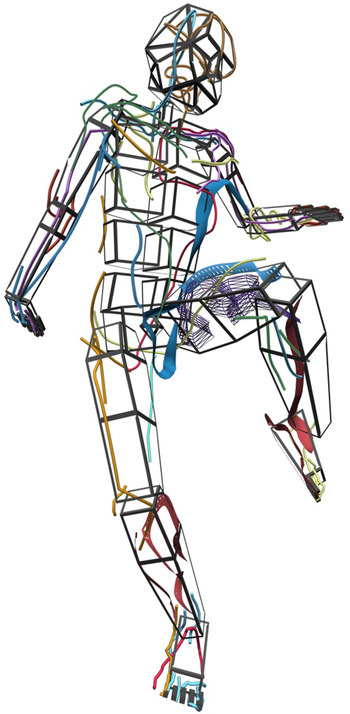
Dils (Reference Dils2002) recounts how her viewing of Ghostcatching was impossibly conditioned by the front matter of the exhibition, which included six photographs and a documentary video of Jones's transformation from signifying black male dancing body to virtual dancing ghost(Photo 3). She writes:
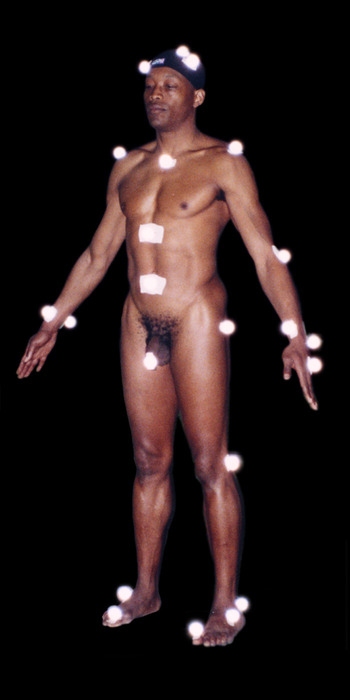
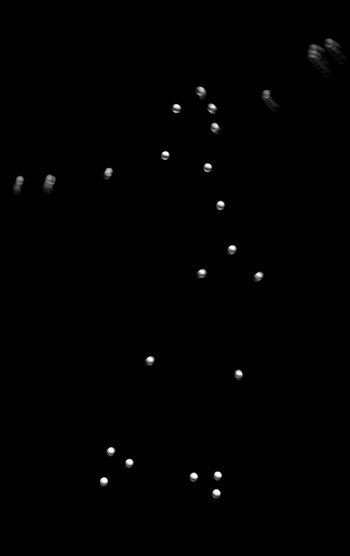
The exhibition's designers seemed determined that Ghostcatching be viewed with Bill T. Jones and his role in the work firmly in mind. In six giant images positioned outside the gallery where the digital projection was shown, Jones moved from flesh and blood to cartograph. First was an image of Jones improvising at Cooper Union. Next were images of the motion capture and animation processes that showed Jones transforming from self to dots that represent movement patterns to a biped figure that provides the scaffolding for the animated figure (and was the source of Cunningham's title). Next was an image of the animated ghost. A video of Jones improvising in the Cooper Union gallery and huge stills of Ghostcatching figures completed the exhibition, dramatizing and connecting the beginning and end points of the process. While the ghosts didn't look like Bill T. Jones, the lobby display bound Jones and the ghosts together and provided a ready mental reference to Jones and his movement that I relied on in viewing the video. Jones's movement might have been made to inhabit very different kinds of bodies, slight bodies, stout bodies, or womanly bodies. But none of this occurs. The ghosts don't look like Jones, but they look male. They all have broad shoulders and are rendered to emphasize muscle. The figures are just solid enough to encase the movement but not fully formed enough to suggest separate beings. As I hope to see the parent in the child or the theme in the variation, I look to see Jones in the images. (Dils Reference Dils2002, 98, emphasis added)
Ghostcatching (1999, Bill T. Jones, Paul Kaiser, and Shelley Eshkar).

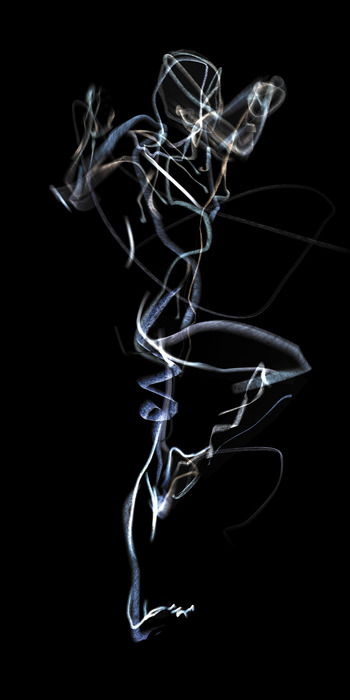
Dils's lengthy description is full of rich detail that recreates the viewing experience for the reader. Just as Jones is bound by his dancing ghosts and his fixed image in the photographs, Dils's viewing experience is bound by the exhibition's structure; the ready mental reference to Jones is ever present (Photo 4). She looks to see Jones in the work—not just his humanity but the significations of race, gender, and sexuality that his actual body has come to bear—even as the ghosts don't look like Jones, even as the very utility of motion capture technology is meant to complicate the sign–referent relation.
Ghostcatching (1999, Bill T. Jones, Paul Kaiser, and Shelley Eshkar).

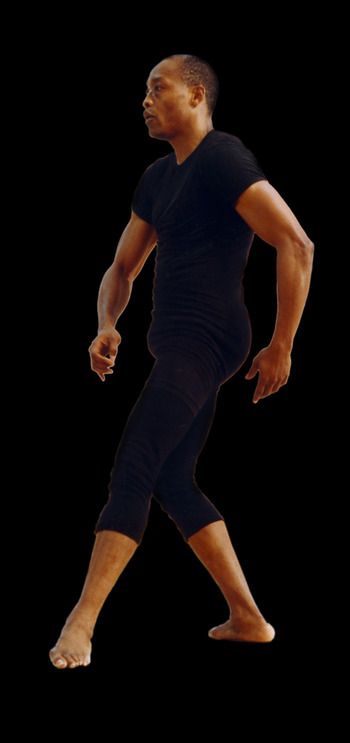
Additionally, Dils neglects to note that Jones is pictured profile in the letter B pose in the first of the six photographic stills, further emphasizing his emblematic presence in the transformation from actual to virtual (Photo 5). His black tee and leggings blend with the black background of the photograph, leaving his head and parts of his arms and legs exposed. In the second photograph (Photo 6), Jones is pictured naked, physically hyperexposed with a motion-capture sensor attached to the tip of his penis. In the third (Photo 7), only the sensors remain—white dots suspended in a black void. But the impression of Jones's raced, gendered, and sexed bodily form is already imprinted on our retina, and the image of him lingers so that the sensors do not appear to be simply floating aimlessly and detached. We consequently reconstruct the specific figure of Jones within each photographic and virtual frame. Dils (Reference Dils2002) avers, “Allowing spectators to see Jones in a non-confrontational work, and without his well-known face and the cultural moorings of race and sexuality that mix into his public image, provides a sense of intimacy” (100), harkening back to Jones's attempt to embrace form as an antidote to the constraints of his identity-based work. But the presence of the photographs as part and parcel of Ghostcatching's exhibition suggests that these moorings are impossible to escape, that they are always with us and there is always a politics to them. Instead of dislodging the constraints of identity to which Jones is reacting, these photographs and their relationship to Jones's digital image in the exhibition display temporarily undo the project of motion capture. Jones's identity—his blackness, his gender to a lesser extent, and his sexuality to an even lesser degree—is reinforced by these photographs as well as Jones's deployment of his voice and stories.
Ghostcatching (1999, Bill T. Jones, Paul Kaiser, and Shelley Eshkar).

Ghostcatching (1999, Bill T. Jones, Paul Kaiser, and Shelley Eshkar).

Ghostcatching (1999, Bill T. Jones, Paul Kaiser, and Shelley Eshkar).

Form: An Interlude
Those familiar with Bill T. Jones's work recognize his signature use of recited text alongside improvised movement. Of Jones's use of autobiography as choreographic material within the context of improvised dance, Goldman writes, “By introducing autobiography and emotional experience into his work via spoken improvisation, Jones ushered in an important challenge to 1970s postmodern dance” (2010, 117). But like many dancers, Bill T. Jones initiated his dance training at the ballet barre. A historically white-dominated, high-art discipline imbued with notions of classicism, narrative reinforcements of heteronormative coupling, and constructions of white nymphal femininity, Jones soon found ballet to be incompatible with his previously untrained, black male body. At SUNY Binghamton, he experimented with contact improvisation, a form of movement developed in 1972 by dancer Steve Paxton along with fellow Judson Group and Grand Union members (Novack Reference Novack1990, 10, 58).Footnote 13 Contact improvisation is typically performed as a duet in which the dancers read each other's movements, reacting and responding to various impulses. They connect, glide over each other's body surfaces, support and share weight, yield to gravity, fall and recover. In its beginnings, contact improvisation represented an unfettered ideological space in which people “participate[d] equally, without employing arbitrary social hierarchies in [a] group” (Paxton Reference Paxton1972, 130). In her definitive anthropological account of contact improvisation, dancer and scholar Cynthia J. Novack describes contact improvisation's early development stages:
Especially during the early years of contact improvisation, the form really was dangerous because no one knew what might happen; dancers were trying to discover the possibilities for the action of two bodies flinging somewhat uncontrollably through space together. ... Contact improvisation ... emphasizes the wildness and awkwardness of falling, relying on conditioned or reflexive controls and strategies rather than on choreographed movement. (1972, 151)
Novack highlights the appeal of one of contact improvisation’s early movement experiments—the act of falling, which enabled danger, thrill, abandon, and, most notably, choice and agency. Learning techniques of falling and disorientation trained dancers to respond quickly to imposed, yet extreme and dangerous, situations; improvising yielded simultaneous feelings of control and freedom. In Jones’s first experiments with improvised movement, it was these freedoms that attracted him—the potential to embody transgression and challenge normative assumptions around choreography, race, and sexuality. In his memoir Last Night on Earth, Jones recalls that “contact improvisation encouraged an unselfconscious, direct physical intimacy in which all differences—weight, size, psychological temperament, even gender and race—were negated in favor of cohesion—tissue to tissue, bone to bone, muscle to muscle” (Jones with Gillespie Reference Jones and Gillespie1995, 158). Thus Jones was drawn to contact improvisation because of the liberatory and egalitarian possibilities that Novack (Reference Novack1990, 11) describes: “Many of the early participants, audience members, and critics felt that the movement structure of contact improvisation literally embodied the social ideologies of the early ’70s which rejected traditional gender roles and social hierarchies.” Novack (Reference Novack1990) further links contact improvisation’s beginning utopian ideals with liberation movements of the 1960s and 1970s, and upon transferring to SUNY Brockport in 1973, Jones actively pursued his interests in improvisation by studying with two of the form’s pioneers, Richard Bull and Lois Welk. For an openly gay black man in an interracial relationship in the 1970s and 1980s, improvised dance offered Jones a momentary reprieve from the prisms of blackness, homophobia, and visuality. But by the mid-1980s, as revealed in an infamous public exchange with Steve Paxton, Jones felt unfit for the utopian project of contact improvisation.Footnote 14 Susan Leigh Foster pinpoints the shift from the early days of contact improvisation that resulted in Jones’s disenchantment with the form. She writes:
By isolating the physical experience of touch and weight from any psychological or sociological values inherent in movement, contact improvisers intended to open up the form to any and all types of bodies, regardless of size, age, gender, or color. ... Yet even as they broke through barriers prohibiting access to dancing, practitioners of contact remained largely white and middle-class. (Foster Reference Foster2002, 97)
No longer interested in identifying as a “contact person,” Jones began to explore the political contours of his blackness, at once rejecting contact improvisation's race-free ideals and the dance world's reductive labels. Because of his skin color, his contributions to Marlon Riggs's 1994 film Black Is, Black Ain't, and the identity-driven content of works such as Social Intercourse (1981) and Last Supper at Uncle Tom's Cabin/The Promised Land (1990), Jones became embroiled in a tug-of-war with critics who saw him as a “black choreographer.” In a New York Times review of Social Intercourse, dance critic Jack Anderson (Reference Anderson1981) describes the piece's finale as a “crescendo of rage [that] made the evening an evocation of the frustration and anxieties of black Americans.” Soon after, Jones began using language as a formal device—a mode of deconstruction against the racist assumptions of his publics, audiences, and critics alike (Jones with Gillespie Reference Jones and Gillespie1995, 164). He states:
I rankled at being called a “black artist.” Coming of age in the sixties, I had embraced a host of values that placed a premium on freedom from social definition, and being so described seemed an attempt to diminish individuality, to reduce the possible interpretations of what I was trying to express. It seemed perpetrated by racist people. Add to this my deep feeling of alienation from both black and white culture and the implicit social tension between the white avant-garde and black performers, and this strategy became essential. ... Deconstruction yielded solos that were confessional, often painful, taking unpleasant emotions and exposing them spontaneously in a fashion that was brutal on both the audience and me. (Jones with Gillespie Reference Jones and Gillespie1995, 164–5)
Jones's use of autobiography and spoken text as a strategy of deconstruction attempts to disempower the politics of race-based looking that construe him as a racialized subject.
Jones's long-held interest in language informs the work of Ghostcatching and After Ghostcatching. Jones's recitation as a sound element to his virtual dancing in both pieces is not only self-authored text about his lived experiences; the use of autobiography is also an expression of self, made manifest in the forms of speaking and dancing. While spontaneity, isolation, and reacting against previously held dance and theater traditions were at the foundation of various schools of improvisation, “[t]he purpose of improvisation was not self-expression” (Halprin Reference Halprin and Rachel1995, 77). Thus, Jones's employment of improvisation and language as modes of self-expression is not only a reaction to (contact) improvisation but also the ways in which displays of his identity politics were discouraged within concert and improvised dance traditions. For Jones, autobiography and narrative are essential to each digital work, allowing viewers to catch glimpses of his many selves.
By reading Ghostcatching within the frame of The Breathing Show, Danielle Goldman (Reference Goldman2010) positions Jones's live dancing body as the nexus for her discussion regarding form rather than the technology used in Ghostcatching itself. But Dils's experience of Ghostcatching's premiere re-centers the piece's complex politics. Despite her desire to release racialized, gendered, and sexed conditions of looking, she is seduced by the promise and fulfillment she has come to expect of Jones's body in fluid motion. She writes:
At the same time, the loss of Jones's race and sex contributes to a void in the work and, ultimately, the sense of loss I feel as a viewer. As the materiality of Jones's body is lost, I lose the sensuality of his motion. There's no sweat in Ghostcatching. In his discussion of the motion-capture process, Paul Kaiser mentions that they had trouble keeping the sensors attached to Jones's body [as Jones moved and sweated]. Indeed Jones eludes being captured through this technology in several ways. ... Without bodily information such as skin color and sexual characteristics, meaning is depleted. (Dils Reference Dils2002, 100–3)
Dils goes back and forth here, conflicted by what a virtual dance made from an actual body, Jones's hypervisible body specifically, could represent. And while she proposes that meaning is depleted in the piece, Jones's elusion of capture is precisely where the works triumphs by exposing the limits of the technology as well as representation. Constrained by a twenty-first-century technological optimism that no longer sees racial difference, Dils's response signals the exact frictions conjured by Ghostcatching and After Ghostcatching.
After
The following description of After Ghostcatching marks the shift from Ghostcatching to its sequel:
[After Ghostcatching] explores the themes of disembodiment and identity with the new possibilities opened up by 3D projection. ... After Ghostcatching (2010) is as much about touching with the hand as it is about seeing with the eye. ... Though the work's imagery comes entirely from a computer simulation, it bears an unmistakable human trace—that of dancer Bill T. Jones, abstracted from his physical body via a process of optical motion capture that preserves his movement but not his likeness. (Kaiser Reference Kaiser2010)
The emphasis on abstraction and preservation—the desire to retain Jones's movement but not his likeness—underscores a tension present in both Ghostcatching and After Ghostcatching at issue in this essay. Each piece bears Jones's human trace, or his liveness, but not his likeness—a conundrum of simile and metaphor. Neither piece can exist without Jones's bodily presence, yet each insists on dissociating the artist from his likeness, all the while reproducing it. After Ghostcatching extends Ghostcatching and introduces new terms and senses: three-dimensional projection technologies that are meant to afford experiences, or at least visualizations, of disembodiment. But three dimensions also suggest or invoke embodiment even as motion capture technology complicates the relation between sign and referent, between the virtual dancing images and Jones's actual body. Thus, a spatial dimension is introduced, which represents a kind of sensory embodiment that connects the bodies of viewers with the virtual dancing bodies in Ghostcatching and After Ghostcatching. This connection requires an alternative strategy of seeing, what film scholar Laura U. Marks (Reference Marks2002) calls a haptic approach to looking.
Marks states that it “is timely to explore how a haptic approach might rematerialize our objects of perception, especially now that optical visuality is being refitted as a virtual epistemology for the digital age” (2002, xiii). New media studies has shifted its focus from the virtual to the physical in the last fifteen years, and the temporal and technological distance between Ghostcatching and After Ghostcatching attests to this shift; the pieces move from seemingly disembodied digital dancing bodies in an abstract, decontextualized space to the three-dimensional, embodied experience of augmented reality. Marks's formulation of haptic visuality represents one such study in the affordances of new media. A multisensory way of seeing and knowing, haptic visuality constitutes a method of sensory analysis for new media works in relation to multiple senses, affects, and embodiments—a tactile way of apprehending new media images that directly involves viewers' bodies. Though related, haptic visuality contrasts optical visuality, which privileges sight as a sense that both motivates and masters perception and representation. In haptic visuality, the eyes function as organs of touch. Touch is privileged over sight as a primary sense by which we apprehend images and objects in this formulation, and as a result, haptic visuality points to the limits of sight, sound, and representation by linking embodiment with an intimate, multisensory viewing experience.
While Ghostcatching and After Ghostcatching are far from the low-resolution images Marks takes as her case studies, haptic visuality is a useful tool in unpacking the complexities of each piece and particularly the latter work. If “[o]ptical perception allows us to symbolize, to give every object a name” (Marks Reference Marks2002, 12), then “[h]aptic looking tends to rest on the surface of its object rather than to plunge into depth, not to distinguish form so much as to discern texture” (8). For Marks, resting on the surface allows for more freedom in looking—a bodily relation between viewer and image rather than a viewing experience overdetermined by presuppositions. The haptic discourages “identification with a figure” (Marks Reference Marks2002, 3)—a figure that signifies—per optical perception's demands. Here, Ghostcatching is in tension with the haptic, whereas After Ghostcatching eases this tension. The attempts to move beyond the deeply embedded and textured significations that rest on the surface of Jones's virtually present, visibly apprehensible dancing body, even while his physical body is absent, adhere in exercises in pure form and movement in both pieces. And if improvisation offered Jones a new way of moving and negotiating the world at the beginning of his career, then digital animation and virtual dance in Ghostcatching provide Jones a new way of presenting himself to the (dance) world—a new way of structuring how he is seen. However, even in virtuality Jones is unable to elude the confines of racialized conditions of looking precisely because of certain viewers' attachments to the materiality of Jones's racial, gender, and sexual identities, even as he eludes being captured by the technology. These attachments are shored up by the presence of Jones's photographed and filmed body in exhibition front matter as well as his voice and his breath in Ghostcatching. Indeed in its critique of racialized vision, Ghostcatching also exposes the limits and paradox of such a project.
Given their shared database of movement material and Jones as figure, After Ghostcatching is intimately related to but not conflated with Ghostcatching. After Ghostcatching, in its revision of Ghostcatching, puts on display elements left out of the preceding work, and Ann Dils's descriptions of Ghostcatching further underscore the paradox to which After Ghostcatching responds. When Dils writes that Ghostcatching is a portrait of Jones as performer, and that it is nearly impossible to isolate movement from his originating body, Dils refers less to dissociating the digital dancer in Ghostcatching, stripped down of somatic characteristics and skin color, from Bill T. Jones's identity. Instead, Dils suggests that in the abstract, pastel-colored figure, we recognize Jones's signature movements; digital form, bodily form, and choreographic form move in tandem. In this way, form is found in both the digital re-presented contours of Jones's body and in his choreography to express a more profound connection between the technological apparatus of motion capture and digital imaging and the recognizable elements of Jones's creative signatures. These formal experiments, in which motion capture accuracy is coupled with digital abstraction, motivate many of the OpenEndedGroup's collaborations, all of which aim to reveal the less somatically visible identity of the choreographers and performers.Footnote 15 But even as Dils celebrates the formal possibilities of motion capture technology, she also recognizes the impossibilities of isolating movement from the originary signifiying body—impossibilities that I argue result in deliberate manipulations of the visual hegemony of race in Ghostcatching and After Ghostcatching.
If Ghostcatching leaves us with a paradox, then After Ghostcatching dispels this paradox by revising its predecessor in two crucial instances in addition to the piece's three-dimensional element. First, different from the singular, though derivative, figures in Ghostcatching, the drawn figures in After Ghostcatching are multiple. For example, the sequence that opens After Ghostcatching is populated with stiff, rectangular figures that overlap and seem to share “bodily” surfaces. They build up to stand and topple to the ground “at will,” their pooling at once primordial and protean. When the originating figure from Ghostcatching is finally introduced, now electric blue lines amid the pool of rigid multiples, the A to F sequence that is so central to Ghostcatching and so vocally recognizable as Jones is no longer present. Instead, the brief interplay and echo between figures and poses in Ghostcatching's opening sequence are now more dimensional, more ominous, and more machinic. In After Ghostcatching, the echo is audibly computerized, momentarily reminding viewers of the data and computing processes that have reproduced in code not only the sound but also, more importantly, the movement that is on the screen. And as each figure multiple slowly disappears from view in After Ghostcatching's opening sequence, the electric blue ancestral figure in the prism remains in solitude. The computer echo overtakes Jones's voice at this moment, with Jones's distinct vocalizations following after their computerized imitator, presaging the second instance in which the two pieces differ—the inauspicious end sequence discussed below.
Post, or a Return to the Beginning
In her concluding remarks on Ghostcatching within The Breathing Show, Danielle Goldman writes:
Jones makes clear the fact that we are not in a world beyond difference, outside of history. ... Similarly today, even as he becomes increasingly interested in the how of dance, Jones points to the limits of motion-capture technology and asks us not to embrace its liberatory potential too quickly. To Bill T. Jones, form is never neutral and removed from politics. He urges audiences to view dance doubly. And ... Jones suggests that the act of “cleaning out one's eyes” by wiping away markers of difference could easily become a brutal hygiene. (2010, 138)
Goldman's assertions echo Anna Everett's skepticisms about the “wish-fulfillment that imagines America as having arrived at some idyllic race, gender, class neutrality” (Everett Reference Everett, Lisa and Peter A.2012, 165) through digital environments. Wendy Chun's (Reference Chun, Hui, Lisa and Peter A.2012) observation, that to “see race as technology, thus, is always to see double: to see possibilities (reworkings) and domination (eugenics) together” (49), also resonates here. In “Race and/as Technology,” Chun proposes race as a technology that is active instead of passive, a mechanism in line with denaturing race in order “to loosen the connection between the bodily sign of race and what it signifie[s]” (41). For Chun, “‘race as technology’ shifts the focus from the what of race to the how of race, from knowing race to doing race by emphasizing the similarities between race and technology” (38, emphasis in original). Following Chun and Goldman, it is necessary to think Jones's exploration of form and the “how” of dance and technology alongside the “how” of race. In Ghostcatching and After Ghostcatching, Jones appears to move within and outside—beyond—form and race, using both as productive technologies to reveal that race is not simply about a politics of visual representation, but that race in fact structures the visual.Footnote 16
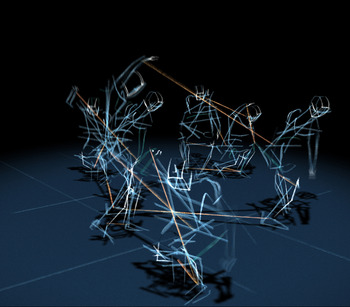
To conclude, I turn to the end sequences of both pieces to suggest that the remaining bounded figures signify further than what the eye immediately sees. Seven figures that resemble the ancestral figure from each piece's opening sequence are bound together by eight brownish-orange lines (Photo 8). They struggle to move; the previously fluid movements exhibited by individual figures no longer adhere. A computer-generated voice speaks commands, most of which are codified dance terms: “Grande plié. Lift the right arm up. Right arm maintains the position as we straighten both legs.” Six of the seven figures move in pairs to these commands, working in unison rather than mirroring each other. Not only does improvisation disappear here, but so does Jones. As figure and movement merge, they become de-individualized, repeated without variation like the bound movement—in effort and circumstance—the virtual bodies perform.Footnote 17 The computer and codified dance overtake Jones's virtual fluidity; he is subsumed, and the figures yield to both technology and technique. Beth Coleman suggests that “[b]odily autonomy is no longer a given” in art centered on “the interaction between performer and technology” (2001, 47). But for all its imagined freedoms, the digital sphere's constraints are put on display in Ghostcatching's and After Ghostcatching's last sequences, and the figures remain caught and bound by these media as the video fades to black. Indeed, it would seem that “what is at stake in these efforts to take control of media is also the control of corporeal representation—the material experience of our bodies and identities” (Coleman Reference Coleman2001, 47).
Ghostcatching (1999, Bill T. Jones, Paul Kaiser, and Shelley Eshkar).

In his memoir, Jones acknowledges his relation to a history of racial subjugation, a notion of what the auction block might have felt like through generational memory, and the racialized looking that upheld these practices of objectification (Jones with Gillespie Reference Jones and Gillespie1995, 74). He writes, “I know that I can be food for fantasy, but at the same time I am a person with a history—and that history is in part the history of exploitation” (Jones with Gillespie Reference Jones and Gillespie1995, 74). Linking practices of segregation in the southern United States to a legacy of slavery, historian Grace Elizabeth Hale argues that race was “dependent on space, and the color bar became less a line than the ground on which southern people were allowed to drink and buy and stand” (Reference Hale1999, 21). Commenting on Hale's conclusions, Wendy Chun confirms that segregation “did not only map space, but was a reaction to the transgression of space brought about by modern technologies, such as trains. It fought mobility with immobility” (Reference Chun, Hui, Lisa and Peter A.2012, 46). Chun and Hale point out a persistently fraught relationship between racialized bodies, modern technologies, and politics of space and mobility—a relationship visualized in the last sequences of Ghostcatching and After Ghostcatching. The currency of each piece obtains in an abstracted abstraction in which the construction of race and Jones's blackness are further attenuated as he morphs into virtual dancing bodies, and this project of deconstruction also extends to space. Just as race is retooled, so are the white, racially coded spaces of concert dance, contact improvisation, and the studio. Just as segregated buses and trains in relation to racialized mobility represented the transgression of space in the South, Jones transgresses the spaces of the studio and stage, trading material space for virtual space, one coded space for another.
Yet even this momentarily liberatory recoding devolves into bodies bound together in the end, with the figures' movements constrained, prescribed, and no longer individuated. Moreover, even as the figures at the end of After Ghostcatching are bound together, subjected to electronically issued instructions in both sound and code that resemble the one-way transmission of a radio broadcast, they become more diffuse in both three-dimensional projection as well as composition. Here, “bodily” figuration gives over to static concentrations of white light or dispersed funnel clouds, oscillating between discernible rectangular surfaces and swirling digital masses (Photo 9). Finally, in After Ghostcatching, then, form is isolated from the body. We are left only with isolated, fluid forms that echo Jones's attachment to form's liberatory potential. In isolating form and its supposed fluidity, he attempts to find freedom from overdetermined looking practices and racialized expectations that mark him as a black choreographer. In this way, form is a basic organization or architecture that functions much like Jones's relationship to improvisation or motion capture technology, that is, as a means to an end. In using isolation as a prompt within improvisation, “[t]he body's kinesiological structure, construed as its most basic organization, serve[s] to liberate the body from prior patternings and to enable new interactivity” (Foster Reference Foster2002, 59). Thus the isolated forms mirror the task of isolation within improvised movement scores and return us to Jones's motivating impulse toward pure movement as a way to dissociate the body from cumbersome significations.
After Ghostcatching (2010, OpenEndedGroup with Bill T. Jones).

After Ghostcatching represents an emphatic expression of Laura Marks's (Reference Marks2002) recommendation precisely at the point of contact where the viewing eye and the surfaces of Jones's bodies—actual and virtual—meet in the space between the viewer and the screen. Unlike Ghostcatching, After Ghostcatching was shown in movie theaters and large-scale entertainment venues after premiering at SITE Santa Fe's international biennial of contemporary art—obvious indicators that the scale and stakes of the work had changed since its first iteration.Footnote 18 Furthermore, After Ghostcatching was produced with a more technologically sophisticated apparatus than Ghostcatching—three-dimensional projection, which requires the use of 3-D eyeglasses to encounter the visual, haptic, and spatial layers of the work. Therefore, in the years between Ghostcatching and After Ghostcatching, we actually get closer to a return to form that originally motivated Jones. Moving further away in time from Jones's identity politics–laden work of the 1980s and 1990s urges the multivalent nature of the work upon viewers, and we see more clearly the complex stakes that obtain in the temporal distance and three-dimensional renderings.
Ghostcatching and After Ghostcatching heed Gilroy's (Reference Gilroy2000) calls to let outmoded “visual signatures of ‘race’ go” yet arrive at Chun's provocation. To use race “even as one is used by it” (Chun Reference Chun, Hui, Lisa and Peter A.2012, 38; emphasis added) exposes race as a set of visible and invisible characteristics that are stored and transmitted: coded, encoded, and recoded (48). In its persistence, race demands an evacuation of its visual hegemony in the twenty-first century, one that dismantles the relation between race and racialogy to use Gilroy's (Reference Gilroy2000) terms. In other words, the scopic regime of racism cannot be coterminous with race. And yet: How can we recast race? To what degree can we abandon it altogether, or hold on to it as a productive category for subject formation and agency?
While I hesitate to offer any definitive conclusions to this set of questions, I believe that Chun's suggestion to use race is perhaps the most promising path to travel, for now. Along with Chun, then, we can think of Ghostcatching and After Ghostcatching as operating within a political imaginary that is what Toni Morrison calls race-free yet race-specific, a way to “enunciate race while depriving it of its legal cling” (Reference Morrison and Lubiano1997, 5). Here Dils's reference to the ghosts in the machine in Ghostcatching recalls Morrison's study of the black or Africanist presence that often goes unacknowledged in canonical U.S. literature.Footnote 19 Kaiser's reference to the figure-in-a-box in Ghostcatching's opening sequence as an “ancestral figure” (Kaiser Reference Kaiser1999b, 47) and Jones's repeated use of autobiography as an essential component to his work also resonate with this idea.Footnote 20 That is, Jones's blackness is present in code—in languages that are specific to black expression yet free of explicit references to racial difference, from autobiography to algorithms. To this end, motion capture technology and digital imaging permit Jones's blackness to multiply in the coupling of two forms, digital motion-captured bodies and Jones's signature choreography. However, the image of the bound figures at the end of both pieces calls this coupling of forms in a race-free imaginary into question. In this frame, the objective is not so much to escape race, despite the liberatory potential motion capture technology offers. To retool race from within produces complex alternatives—of being, seeing, thinking—that nonetheless may not be reparative or redemptive in the end. Here Jones's pursuit of form, or pure movement, and his collaborative use of motion capture technology are thwarted, for it is in his bound “ghosts” that we encounter what technological mediation cannot convey. In Ghostcatching and After Ghostcatching, the complex innerworkings of identity and race obtain in visual, haptic, and spatial figurations. The technical apparatuses of motion capture technology and improvised dance thus mediate these figurations, which in the end are bound, not free. Therefore, an analysis of Ghostcatching and After Ghostcatching in relation to postracial politics reveals that rather than querying “have we arrived yet?” the question becomes “can abandoning race be a productive move?” To this end, Ghostcatching and After Ghostcatching affirm the latter by positioning digital imaging technologies and the category of race as inherently visual against one another, exposing the limits of each. In this exposure, the two virtual dance works encourage us to rethink twenty-first century technologies of representation by pulling apart the imbrications of racial politics, practices of looking, and the body.