I. INTRODUCTION
Superabsorbent polymers (SAPs) are lightly crosslinked hydrophilic polymers, which can absorb and retain large amounts of water and physiological solutions. These highly swellable hydrogels are primarily used in hygiene products and agriculture,Reference Omidian, Doroudiani and Kabiri1–Reference Sabzevari and Kabiri3 and to a lesser extent are used for variety of other purposes including modification of industrial fibers.Reference Sabzevari, Kabiri and Siahkamari4
The absorbency under load (AUL) in saline, as one of the most critical properties of SAPs, reflects the actual performance and usability of SAPs in real service. In the case of SAPs used in hygienic products, the main approach to enhance AUL is by reacting (crosslinking) the functional groups, particularly carboxyl groups located at the surface of the SAP particles, with diglycidyl compounds.Reference Omidian, Doroudiani and Kabiri1 Although there are few reports on surface modification of hygienic SAPs,Reference Sabzevari and Kabiri3–Reference Mudiyanselage and Neckers10 we have previously reported surface crosslinking of poly(sodium acrylate–acrylic acid) SAPs using cycloaliphatic epoxy,Reference Moini and Kabiri5 bisphenol A diglycidyl ether,Reference Moini, Kabiri, Zohuriaan-Mehr and Esmaeili7 diethyleneglycol diglycidyl ether,Reference Moini, Kabiri and Zohuriaan-Mehr8 and divinylbenzene.Reference Huang, Huang, Bao and Weng9 Ma et al.Reference Ma, Liu and Chen11,Reference Chen, Liu and Ma12 reported a two-step approach for surface modification of SAPs, which includes treatment with ethylene glycol diglycidylether followed by treatment with KH2PO4 and NaAlO2.
Using surface modification, we induced antibacterial properties to poly(sodium acrylate–acrylic acid) SAPs by employing a simple ion-exchange process to achieve hygienic SAPs with greater swelling rate, lower gel-blockage, and greater salt resistance.Reference Shahi and Zohuriaan-mehr13 We also utilized surface modification using benzyl chloride and 1,2-dichloroethaneReference Shahi and Zohuriaan-mehr13,Reference Shahi, Motasadizadeh and Zohuriaan-Mehr14 as well as epoxy silaneReference Moini, Kabiri and Zohuriaan-Mehr8 to effectively reduce the gel-blocking and improve the AUL properties of our SAPs. Very recently, we used epoxy silane modifiers to enhance the AUL of hygienic SAPs, where the surface modification occurred via the reaction of epoxy groups with carboxyl groups that resulted in the formation of a polysiloxane network at the SAP surface.Reference Moini, Kabiri and Zohuriaan-Mehr8
Acrylamide-based SAPs, such as crosslinked poly(sodium acrylate–acrylamide), have also been surface treated using an external crosslinker. In an inverse suspension reaction, hydrophobic divinyl benzene reported improving the swelling properties of the SAP in the presence of salts.Reference Huang, Huang, Bao and Weng9 Another hydrophobic crosslinker, bismethacryloyl azobenzene, has also been used for the same purpose.Reference Mudiyanselage and Neckers10 The SAPs treated using hydrophobic crosslinkers possessed a highly porous structure with a core-shell-like morphology, faster swelling rate, and lower soluble fraction.
To our knowledge,Reference Omidian, Doroudiani and Kabiri1–Reference Moini, Kabiri and Zohuriaan-Mehr8,Reference Shahi and Zohuriaan-mehr13–Reference Moini, Kabiri and Zohuriaan-Mehr15 there is no report on transamidation as an approach to improve SAP properties. Transamidation, a process for transforming one amide to another amide, is conducted via amide–amide or amide–amine reactions. Different catalysts such as AlCl3,Reference Ban, Bigg and Bertrand16 hydroxylamine hydrochloride,Reference Allen, Atkinson and Williams17 and L-prolineReference Rao, Mohan and Adimurthy18 have been used for this process. In agricultural SAPs based on acrylamide (∼60 mol%), the primary amide groups can react with aliphatic amines; therefore, we studied the effect of a small polyamine (i.e., diethylenetriamine) and a macromolecular one (i.e., branched polyethyleneimine) on SAP swelling properties.
II. EXPERIMENTAL
A. Materials
Crosslinked acrylamide–potassium acrylate–acrylic acid terpolymer (particle size 150–200 μm), SUPER AB A200, was purchased from NanoAb Iranian Co. (Tehran, Iran). According to the manufacturer, the SAP sample was not surface-modified, and its chemical composition was 60, 30, and 10 mol% of acrylamide, potassium acrylate, and acrylic acid, respectively. Anhydrous aluminum chloride (AlCl3, 98%), diethylenetriamine (DETA, 98%), sodium chloride (NaCl, 99.5%), and solvents were purchased from Merck (Darmstadt, Germany). Polyethyleneimine (PEI, branched) was purchased from Shenzhen Nexconn Pharmatechs Ltd., Shenzhen, China. All chemicals were used as received.
B. SAP surface treatment
Surface modification was performed according to the previous reports after some appropriate modifications.Reference Moini and Kabiri5,Reference Moini, Kabiri, Zohuriaan-Mehr, Omidian and Esmaeili6,Reference Ban, Bigg and Bertrand16 In brief, SAP particles (5.0 g) were soaked in 20 mL of treatment solution (acetone/water, 90/10 v/v) containing polyamine modifiers (DETA or PEI) and AlCl3. After 30 min, the modified SAP particles were filtered and placed in an air-forced oven. The dried particles were placed in a desiccator. The effect of time and temperature of the surface treatment on free-swelling properties (g/g absorption capacity in either deionized water or in saline) and AUL in saline were investigated. Figure 1 shows the surface treatment process, sample codes, and the chemical structures of the polyamine crosslinking agents.
General pathway of the SAP surface crosslinking by DETA and PEI as well as their corresponding sample codes (a), and chemical structures of DETA (b) and PEI (c).

C. Characterization
The central chemistry of this research is to react primary amide groups of the SAP structure with amine groups of an external agent at the very surface (micron-sized) of the SAP particles. Therefore, ATR-FTIR (Specac, Golden-gate, U.K.) spectroscopy was used to confirm the surface treatment. The spectra were obtained at a wave number range of 600–4000 cm−1 and a resolution of 1 cm−1.
A scanning electron microscope (SEM; Vegall, Tescan Co, Brno, Czech Republic) equipped with an EDX detector (INCA model, Ofordinst) was used to perform a microstructural study on the SAP particles. The samples dried at 100 °C for 2 h were sputter coated with gold and imaged in the secondary electron mode with an accelerating voltage of 20 kV.
The rheological measurements were performed on the swollen samples (1.00 g dry SAP in 10.0 g distilled water) using a para-physical vibrational device (model MCR 300, Anton Paar Co., Ostfildern, Germany) at 25 °C, and no special trap system was used due to negligible dehydration. The plate diameter was 25 mm and the distance between the plates was set at 3 mm. The strains were selected to be in the linear viscoelastic range. The effect of shear strain on G′ at a constant frequency (1 rad/s) was investigated. Since G′ (ω) was independent of the strain at deformations below 0.2%, the strain was set at 0.2%. The frequency sweep test was carried out between 0.1 and 100 rad/s.Reference Ramazani-Harandi, Zohuriaan-Mehr, Yousefi, Ershad-Langroudi and Kabiri19 Relative standard deviation (RSD) for the rheometric method was found about ±3–5%.Reference Moini, Kabiri, Zohuriaan-Mehr, Omidian and Esmaeili6
Swelling capacity of the hydrogel samples was measured using a tea bag method. The SAP samples (0.20 g) were left in 100 mL of distilled water at room temperature until they reached their equilibrium swelling capacities. The swelling capacity was calculated according to the following equation:
 $${\rm{Swelling}} = {{{\rm{ws}} - {\rm{wd}}} \over {{\rm{wd}}}}\quad ,$$
where ws and wd are the weights of the swollen and dried gels, respectively.Reference Moini, Kabiri, Zohuriaan-Mehr, Omidian and Esmaeili6 Q DW and Q S stand for the swelling capacity in distilled water and saline (NaCl aqueous solution, 0.90 wt%), respectively.
To determine the AUL,Reference Ramazani-Harandi, Zohuriaan-Mehr, Yousefi, Ershad-Langroudi and Kabiri19 0.5 g of a dried SAP sample was uniformly dispersed on the surface of a polyester gauze sited on a macroporous sintered glass filter plate in a Petri dish. A cylindrical solid load (Teflon, d = 60 mm) was placed on the dry SAP particles that could freely slip in a glass cylinder. The sample was loaded (0.3 psi) and saline was then added to the Petri dish. After 90 min, the swollen particles were removed, reweighed, and the AUL value was calculated using Eq. (1). Swelling measurements were repeated five times, and the RSD for Q DW, Q S, and, AUL were ±8, ±2, and ±4%, respectively.
III. RESULTS AND DISCUSSION
As outlined in Fig. 1, two different polyamines (i.e., DETA and PEI) were used for the surface treatment in the absence and presence of AlCl3 as a catalyst. The modified samples were then spectrally and morphologically characterized, and their swelling behavior was investigated.
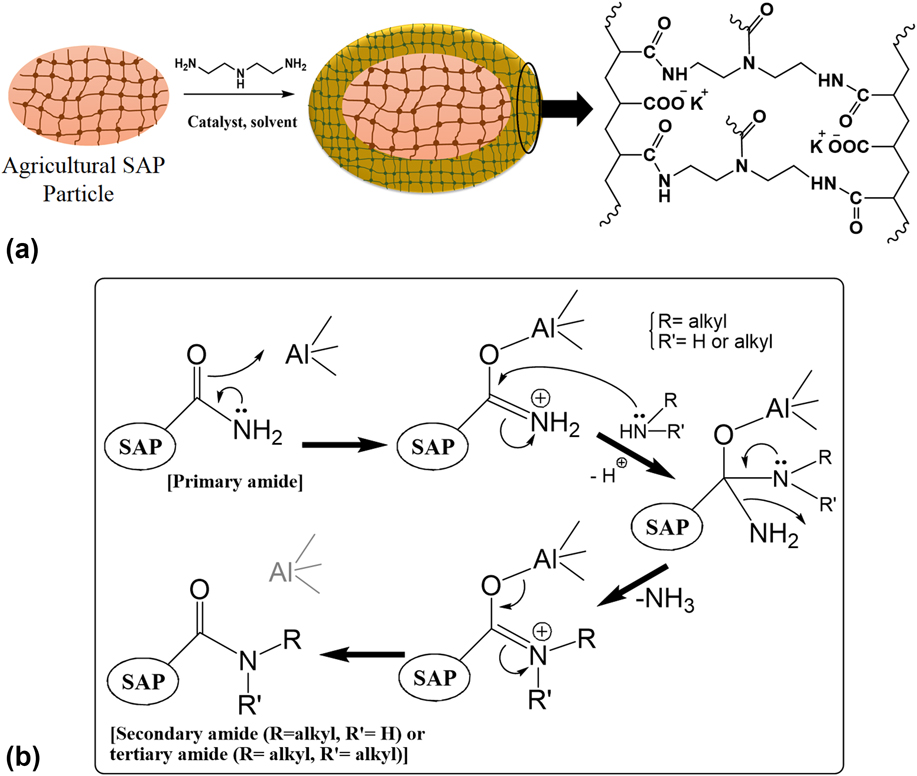
Figure 2(a) shows the possible reaction between the amide groups of the SAP with the amine groups of the polyamine modifier.
Postulated chemical treatment on an agricultural SAP particle via transamidation by a typical polyamine (a) and proposed mechanism for the Al-catalyzed transamidation reaction (b).

A. Spectral study
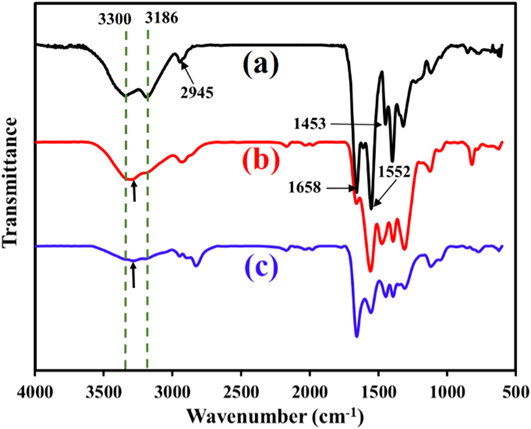
Figure 3 shows the ATR-FTIR spectra of the intact and DETA-modified SAPs. With the intact SAP, the wide peak appeared at 3186–3300 cm−1 belongs to the stretching vibration of the N–H peak of the primary amide groups, overlapping with the carboxylic acid O–H groups. Moreover, the stretching vibration of the C=O carbonyl groups and the C–H groups are appeared at 1658 and 2945 cm−1, respectively. The peak at ∼1552 cm−1 is assigned to the N–H bending in all the samples.
ATR-FTIR spectra of intact and its corresponding surface-modified SAP (a), DETA-treated SAP, Dcat3 (b), and PEI-treated SAP, Pcat2 (c).

In general, the amide I band is appeared at 1670–1650 cm−1 as a very strong band, for primary amides in the solid phase. Secondary amides have a characteristic, strong absorption at 1570–1515 cm−1.Reference Socrates20 Primary amines have a medium-to-strong absorption band in the 1650–1580 cm−1 region, and secondary amines have a weaker band at 1580–1490 cm−1. The C–N stretching absorption of primary aliphatic amines is weak and generally occurs in the 1090–1020 cm−1 range. Secondary aliphatic amines have two bands of medium intensity at 1190–1170 cm−1 and 1145–1130 cm−1.Reference Socrates20 On the other hand, in the modified samples, some of the primary amide groups of SAP and some of the amine groups of the modifiers have been remained unreacted. Since various vibrational modes of N–H, C–N, and C=O bonds of the amides and amines appear in similar ranges (in the fingerprint region of 1660–1100 cm−1), all the absorption bands are similarly observed in the spectra of the modified samples.
Meanwhile, a weak peak is appeared at ∼3250 cm−1 for the treated SAPs, which is assigned to the nonreacted N–H stretching vibration of the polyamine modifiers. More importantly, the transamidation reaction primarily decreases the intensity of the initial amide peak that appears at 3186 cm−1 (the N–H stretching of the primary amide group). This is the most acceptable spectral evidence for the conversion of the primary amides at the SAP surface.
B. Morphological study
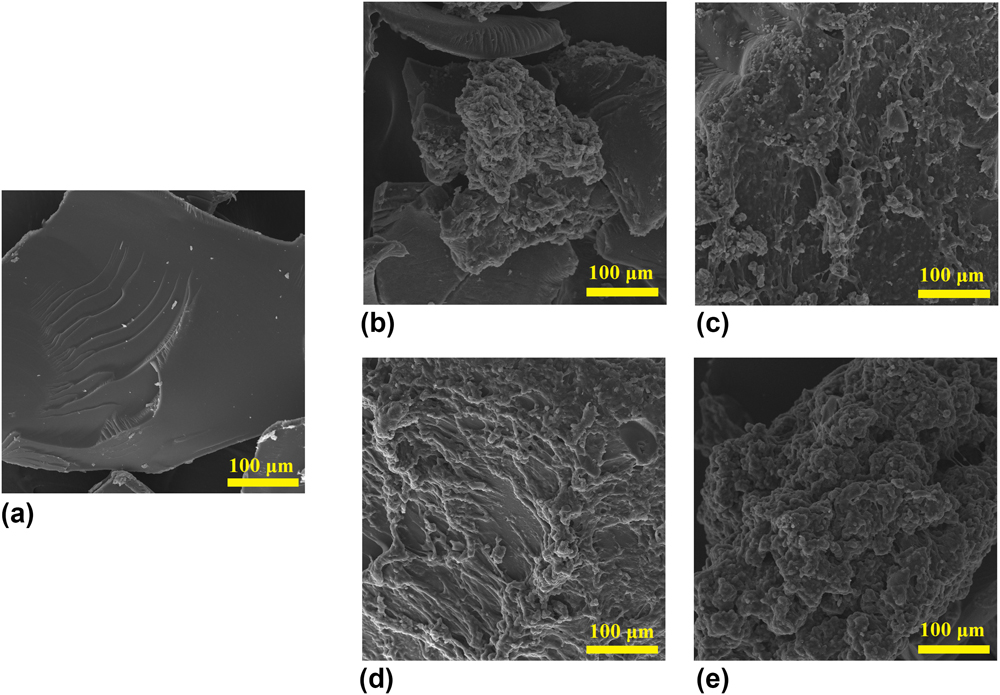
Morphologies of the intact and surface-treated SAPs in the absence and presence of AlCl3 using DETA as a surface crosslinking agent are shown in Fig. 4. As clearly shown in Figs. 4(a)–4(c), the surface of the intact SAP is more uniform and smoother than that of the treated SAP. This indicates that the surface morphology was influenced by the surface treatment.
SEM micrographs of (a) intact SAP, (b) noncatalyst DETA-treated SAP, (c) DETA-treated in the presence of AlCl3, (d) noncatalyst PEI-treated SAP, and (e) PEI-treated in the presence of AlCl3.

Figures 4(d) and 4(e) show SEM images of the samples treated with PEI in the presence or absence of AlCl3 as the transamidation catalyst. The smooth surface of the SAP was changed into a rough surface following the noncatalyzed treatment [Fig. 4(d)] and become lumpy following the treatment in the presence of catalyst [Fig. 4(e)]. With the latter, a slightly porous morphology was also observed.
The effect of catalyst was found to be more significant with DETA than with PEI as the surface modifier. As shown in Fig. 4(b), in some areas, the morphology of the DETA-treated SAP in the absence of AlCl3 was found similar to that of the intact SAP, while these regions were disappeared in the presence of the catalyst. On the other hand, such intact regions were not noticeable in the case of the PEI-treated SAP in the absence of AlCl3 [Fig. 4(d)]. This confirmed that the catalyst assisted the completion of the surface treatment by the DETA.
C. Swelling studies
1. DETA as surface modifier
a. Effect of DETA and the catalyst concentration
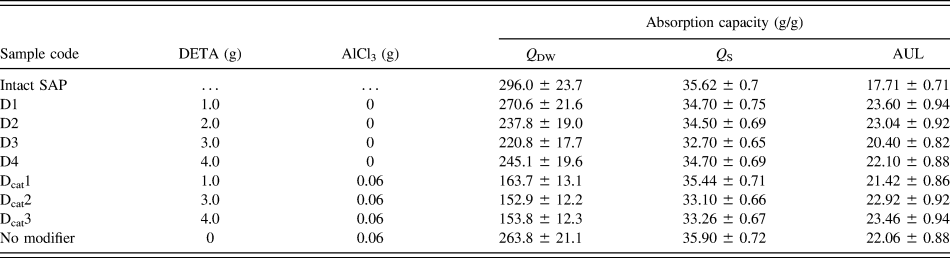
The effect of surface crosslinker concentration in the absence of transamidation catalyst on swelling properties of SAP (samples D1–D4) is presented in Table I. Free-swelling capacity (Q DW values) of the intact SAP was 296 ± 23.7 g/g and decreased as the DETA concentration increased. For instance, the swelling capacity of the D2 sample in distilled water was 237.8 ± 19.0 g/g, showing a 20% lower swelling capacity than that of the intact SAP. Nevertheless, the Q S values indicate that the change in swelling was insignificant in saline. Due to the presence of salt and load in real applications, the free-swelling data (i.e., Q DW and Q S) are not practically useful, therefore we primarily relied on the saline AUL values as explained below.
The effect of DETA and AlCl3 contents on free absorbency in distilled water (Q DW), saline (Q S), and saline-AUL.a The swelling measurements (Q DW, Q S, and AUL) were repeated five times.

a The acetone-to-water ratio in the treatment solution was 90:10 v/v, and the samples were treated at 100 °C for 2 h.
As shown in Table I, the DETA treatment led to ∼30% increase in AUL for D2 (23.04 ± 0.92 versus 17.71 ± 0.71 g/g). The anticipated reduced free-swelling and increased AUL values can be attributed to DETA reacting with the SAP amide groups. This reaction increases the crosslink density of the SAP particles at their surfaces.
Since crosslinking density has often a direct relationship with AUL, the results showed that DETA was a suitable surface crosslinking agent for acrylamide-based superabsorbents. The high content of amide groups (∼60%) facilitated the transamidation reaction between amide and amines, leading to an increased crosslink density and hence an improved AUL. Although a successful amide–amine reaction requires using a proper catalyst,Reference Ban, Bigg and Bertrand16–Reference Rao, Mohan and Adimurthy18,Reference Yedage, D’silva and Bhanage21 our data suggested that the transamidation reaction between DETA and amide groups at the SAP surface did not necessarily need to be catalyzed.
The effect of DETA concentration on the swelling properties of the treated SAP in the presence of AlCl3 was investigated, and the results are shown in Table I (samples Dcat1, Dcat2, and Dcat3). The swelling capacity of the SAPs treated with DETA (Dcat3) in the presence of AlCl3 resulted in 152.9 ± 12.2 g/g swelling capacity in distilled water (49% loss), while loss in swelling was found around 20% in the absence of the catalyst.
Due to the presence of water in the reaction medium, the anhydrous AlCl3 reacts with water and generates aluminum hydroxide, Al(OH)3. Given the known effect of the multivalent cations in reducing the SAP swelling capacity,Reference Zohuriaan-Mehr and Kabiri2,Reference Ma, Liu and Chen11 the SAP surface can potentially be crosslinked with Al(OH)3 resulting in a lower swelling capacity. The same aluminum compound can also catalyze the transamidation reaction as proposed in Fig. 2(b).
In general, the swelling capacity of ionic hydrogels is highly sensitive to the presence of metal cations in the swelling media.Reference Mudiyanselage and Neckers10 Therefore, carboxyl groups of the SAP surface react with three-valent cations of the aluminum compound. This irreversible reaction leads to the formation of new ionic crosslinks at the surface of the SAP particles, resulting in significant reduction in swelling, particularly in distilled water.
The saline-absorbency of the unmodified SAP was 35.62 ± 0.7 g/g and did not change with the amounts of DETA in the treatment solution (Table I, Q S of D1 to D4 samples). Similarly, the presence of AlCl3 had no substantial effect on saline absorbency of the treated SAP. This can be attributed to the fact that the saline absorbency is not highly dependent on the crosslink density,Reference Kabiri, Omidian, Hashemi and Zohuriaan-Mehr22 and the key parameter affecting saline absorbency remains to be the main structure of the polymer chain (including the core of particles) that remains unchanged in the course of the surface treatment with or without the catalyst. This outcome is different from what we previously concluded for saline absorbency of nonacrylamide-based SAPs (i.e., sodium acrylate-co-acrylic acid polymers), where surface crosslinking using a diglycidylether led to a lower saline absorbency.Reference Zohuriaan-Mehr and Kabiri2,Reference Sabzevari and Kabiri3
The AUL of the intact SAP was 17.71 ± 0.71 g/g and increased with the amounts of DETA in the treatment solution (Table I). For instance, the AUL of the DETA-treated sample (Dcat3) was increased up to 23.46 ± 0.94 g/g (∼33%). As presented in Fig. 2, the transamidation reaction presumably increased the surface crosslink density of the SAP particles, and these additional crosslinks increased the AUL. The AUL improvement is nearly identical for transamidation with and without the Al compound used as the catalyst and ionic crosslinker.
2. PEI as surface modifier
a. Effect of PEI and the catalyst concentration
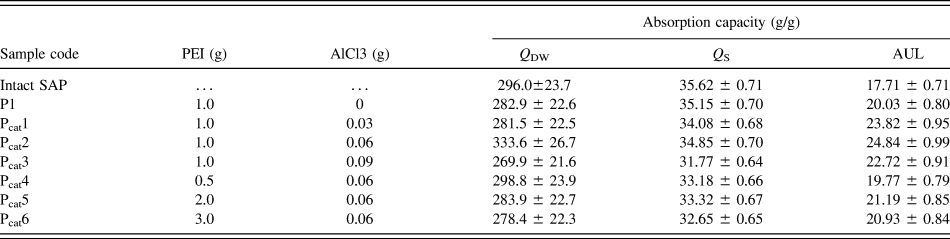
Swelling capacities of the PEI-treated SAPs are shown in Table II. Except for the sample Pcat2, PEI (with or without the catalyst) had no considerable effect on the SAP swelling capacity. For instance, the SAP treated with 3.0 g of PEI lost only 6% of its swelling capacity after treatment.
The effect of PEI and AlCl3 contents on free absorbency in distilled water (Q DW), saline (Q S), and saline AUL.a The swelling measurements (Q DW, Q S, and AUL) were repeated five times.

a The acetone-to-water ratio in the treatment solution was 90:10 v/v, and the samples were treated at 100 °C for 2 h.
Treatment with PEI resulted in different degrees of modification that can be attributed to two opposite phenomena involved in the swelling process of the PEI-modified samples: (i) surface crosslinking that reduces the swelling capacity and (ii) increased hydrophilicity that increases the swelling capacity due to the highly branched nature of the PEI compared with the DETA. Due to the significant contribution of the latter, the swelling capacity of the Pcat2 SAP increased from 296.0 ± 23.7 to 333.6 ± 26.7 g/g.
Among the main factors determining the swelling capacity of an ionic hydrogel (i.e., polymer–solvent interaction, crosslinking leading to elastic forces, electrostatic repulsion of similar charges of the network, and ionic mobility leading to osmotic pressure difference between the gel and the swelling medium),Reference Shahi, Motasadizadeh and Zohuriaan-Mehr14,Reference Omidian, Hashemia, Sammesb and Meldrumb23 the first factor plays a significant role in determining the ultimate swelling capacity of the PEI-treated SAPs. Branched PEI is a bulky macromolecule containing a large number of primary, secondary, and tertiary amine groups (Fig. 1). Only primary and secondary amine functionalities contribute in the transamidation reaction as shown in Fig. 2(b). All the tertiary amine groups as well as the residual nonreacted primary and secondary amine groups are remained intact after the treatment. Either these amine groups or the newly formed secondary and tertiary amide groups linking on the SAP surface can presumably increase the polymer–solvent interaction through hydrogen bonding, which improves the swelling capacity of the PEI-modified SAPs. As hypothesized in Fig. 5, the aliphatic amine groups at the surface of the PEI-treated SAPs are much more abundant than the amide groups at the surface of their DETA counterparts, favoring the hydrogen bonding with water.
The polymer–solvent interaction via hydrogen bonding postulated for the particle surface of the (a) PEI-treated sample and (b) DETA-treated sample.

On the other hand, the nitrogen atom of the amide bond of the treated surfaces is electron-deficient and cannot effectively participate in H-bonding.Reference Socrates20 Therefore, compared with the PEI-treated SAPs, the hydrogen bonding will be less abundant with the DETA-treated samples prepared under similar conditions.
For the Pcat6 sample, the PEI treatment reduced the swelling capacity in saline by 8% down to 32.65 ± 0.65 g/g. However, it is to be noted that the changes in saline absorbency were not noticeable among the PEI-modified samples.
Table II also shows the changes in AUL as the PEI content of the reaction medium increases. With about 41% increase, the highest AUL of 24.84 ± 0.99 g/g was obtained for the Pcat2 sample, which was significantly higher than what obtained for its DETA counterpart (Table I, sample Dcat3). Despite its superior performance, the PEI-treated SAPs were however lumpy in nature after drying, which requires further investigation and improvement to be used as a desirable final product.
Table II also shows changes in swelling capacity with changes in AlCl3 concentration. In general, AlCl3, as the transamidation catalyst, increased the AUL. While the AUL of the PEI-treated SAP in the absence of the catalyst (i.e., P1) was 20.03 ± 0.80 g/g, the AUL was increased up to 24% when the same sample was treated in the presence of 0.06 g of AlCl3. The reason for the improvement was discussed in Sec. III.C.1.a.
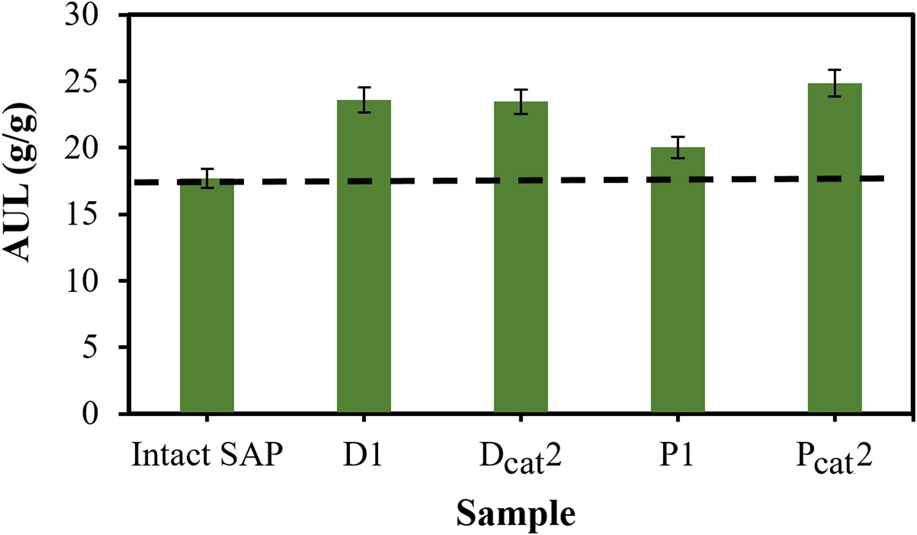
Summing up, both DETA and PEI did not affect the Q S of the samples treated with or without the catalyst (Fig. 6). For the DETA-treated samples, however, Q DW was decreased particularly for the samples modified in the presence of catalyst (Fig. 6, samples D3 and Dcat3). The adverse effect of PEI on Q DW was significantly lower than that of the DETA-treated samples modified either with or without the catalyst. As shown in Fig. 7, while the AUL was improved for all treated SAPs, the catalyst was found to be more effective on AUL when PEI was used for the treatment.
Comparative swelling capacities for typical samples (See Tables I and II for the sample codes). The swelling measurements (Q DW and Q S) were repeated five times for each sample.

Comparative AUL values for typical samples (See Tables I and II for the sample codes). The AUL was repeated five times for each sample.

The effect of time and temperature on QDW, QS, and AUL of DETA- and PEI-treated SAPs were also investigated and the results are denoted in Tables SI and SII (Supplementary Material).
D. Rheological study
Transamidation reaction forms new crosslinks at the SAP surface, resulting an increase in the crosslink density of the SAP and hence its stiffness and modulus. Since the storage modulus is directly related to crosslinking density according to the Flory–Rehner correlation,Reference Ban, Bigg and Bertrand16 such an observation can hence be verified through rheological measurements.
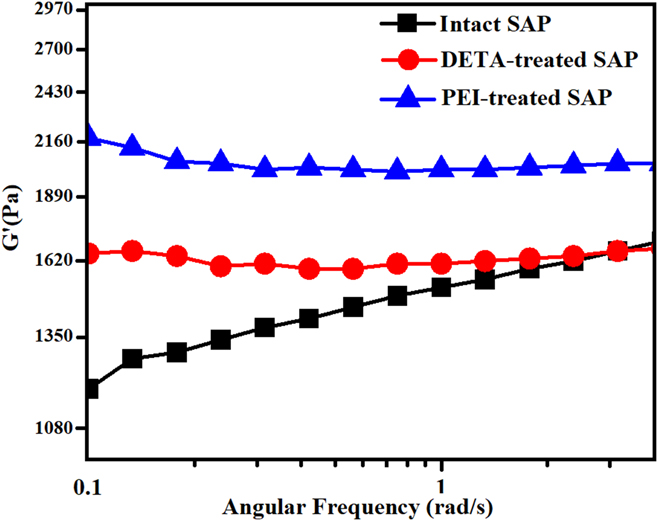
Figure 8 shows storage modulus versus angular frequency for the intact SAP, and corresponding samples treated with DETA and PEI. The storage modulus was increased for the surface modified SAPs compared with the unmodified one. At an angular frequency of 1 rad/s, the storage moduli were found to be 1520, 1610, and 2020 Pa for the intact SAP, DETA-treated, and the PEI-treated SAPs, respectively. The results showed that the transamidation reaction utilizing both surface modifiers desirably increased the modulus of the hydrated SAPs. With no surprise, these data are clearly in agreement with those obtained from the AUL studies, as both storage modulus and the AUL values are determined by similar factors.
Representative storage modulus versus angular frequency for the intact SAP, DETA-modified sample (Dcat3), and PEI-modified sample (Pcat2).

The moduli differences of the intact and the surface-treated samples are not major but they should be considered. These minor differences are due to the fact that the crosslinking has occurred only at the surface, and the extent of the surface-crosslinking is very low, while the crosslinking degree of the bulk is unchanged. It means that the main polymer network structure [i.e., poly(AM–potassium acrylate–acrylic acid)] having highest impact on the storage modulusReference Ramazani-Harandi, Zohuriaan-Mehr, Yousefi, Ershad-Langroudi and Kabiri24 is rather unchanged after the surface treatment.Reference Moini, Kabiri, Zohuriaan-Mehr, Omidian and Esmaeili6,Reference Moini, Kabiri and Zohuriaan-Mehr8 Therefore, a significant difference between the modulus of the intact and the surface-modified samples is not expected.
IV. CONCLUSIONS
Through catalytic and noncatalytic transamidation reactions, polyamine structures including DETA and PEI could improve the swelling properties of the acrylamide-based SAPs that are commonly used in agriculture. The saline AUL, a critical swelling factor for agricultural and hygiene applications, was increased with the transamidation time and temperature. Both polyamines resulted in more or less similar swelling behavior and increased the AUL value by about 25% in general. However, the use of PEI resulted in some undesirable outcomes such as lumpy SAP structure and agglomeration of SAP particles, which requires further improvement in the process. Overall, the transamidation process can successfully and feasibly be used to improve saline AUL of the acrylamide-based agricultural SAPs.
SUPPLEMENTARY INFORMATION SUMMARY
The supplementary information includes Tables SI and SII. Table SI represents the effect of transamidation time and temperature on DETA-treated SAP sample free absorbency in distilled water (QDW), saline (QS) and saline absorbency under load (AUL). Also, the effect of transamidation time and temperature on the PEI-treated SAP sample QDW, QS, and AUL are denoted in Table SII.
Supplementary Material
To view supplementary material for this article, please visit https://doi.org/10.1557/jmr.2018.240.