Psycholinguistic research has shown that lexical, semantic, and syntactic information all contribute to syntactic parsing for first language (L1) sentence comprehension, although when and how these various types of information work is controversial. Given that the world is now a global village, the majority of the world's population tends to learn and use a second language (L2). It is important to understand how L2 learners use or process their L2 and whether significant differences exist between native speakers and L2 learners whose L2 competence may keep on developing (Corder, Reference Corder1967; Nemser, Reference Nemser1971; Selinker, Reference Selinker1972), as compared to that of adult native speakers. In addition, the presence of L2 learners at different levels of proficiency may further our understanding of how L2 sentence processing may develop. Thus, the central question of the present study was whether English learners in Taiwan immediately resolve main verb versus reduced relative clause (MV/RRC) ambiguities in a similar way as native English speakers do.
This article first illustrates MV/RRC ambiguities and then discusses two models of L1 online sentence processingFootnote 1 that attempt to account for how to resolve MV/RRC ambiguities. Finally, a core issue over L2 sentence processing is tackled.
MV/RRC AMBIGUITIES
Sentences (1a) and (1c) are examples of MV/RRC ambiguities, which are types of temporary syntactic or local ambiguities. The local ambiguities are defined as cases where sentences remain syntactically ambiguous until they are later disambiguated as more of the sentences is heard or read (Frazier & Rayner, Reference Frazier and Rayner1989).
- (1)
a. The defendant examined by the lawyer turned out to be unreliable.
b. The defendant that was examined by the lawyer turned out to be unreliable.
c. The evidence examined by the lawyer turned out to be unreliable.
d. The evidence that was examined by the lawyer turned out to be unreliable.
The ambiguities result partly from the human sentence-parsing mechanism (the parser) and partly from the morphologically ambiguous verb “examined.” The parser is generally convinced to be a word-by-word and left-to-right processor (Carroll, Reference Carroll1999; Crain & Steedman, Reference Crain, Steedman, Dowty, Karttunen and Zwicky1985; Green & Mitchell, Reference Green and Mitchell2006). Just and Carpenter (Reference Just and Carpenter1980) claimed that the parser immediately processes a word encountered in order to decrease the burden on working memory. In contrast, the verb “examined” is morphologically ambiguous, with identical past tense and past participle forms. When it immediately follows the noun phrase (NP) “the defendant” and the NP “the evidence” at the beginning of (1a) and (1c) respectively, the sequences “the defendant examined” and “the evidence examined” can temporarily be analyzed as either an MV reading or an RRC reading.
The MV reading is concerned with a main clause with the past tense verb “examined,” and the NPs “the defendant” and “the evidence” are the subjects of the verb “examined” and play the thematic role of agent. The RRC reading is concerned with a RRC with the past participle verb “examined,” and the NPs “the defendant” and “the evidence” are the grammatical objects of the verb “examined” and play the thematic role of theme/patient. Taken together, the morphologically ambiguous verb “examined” that immediately follows the NPs “the defendant” and “the evidence” at the beginning of (1a) and (1c) makes the sentences MV/RRC ambiguities for a word-by-word and left-to-right parser.
TWO MODELS FOR MV/RRC AMBIGUITY RESOLUTION
Two models of L1 online sentence processing particularly address MV/RRC ambiguity resolution: one is the garden path model (Ferreira & Clifton, Reference Ferreira and Clifton1986; Frazier, Reference Frazier1978, Reference Frazier and Coltheart1987, Reference Frazier1995; Frazier & Rayner, Reference Frazier and Rayner1982; Rayner, Carlson, & Frazier, Reference Rayner, Carlson and Frazier1983), and the other is the integrated theory of lexical and syntactic ambiguity resolution (MacDonald, Pearlmutter, & Seidenberg, Reference MacDonald, Pearlmutter and Seidenberg1994; Trueswell, Tanenhaus, & Garnsey, Reference Trueswell, Tanenhaus and Garnsey1994). However, both of the models hold distinct assumptions about when and how lexical, semantic, and syntactic information affect MV/RRC ambiguity resolution.
The garden path model assumes that an encapsulated phrase structure-based parser initially adopts the minimal attachment strategy (i.e., postulating no potentially unnecessary nodes) to construct single simpler MV structures for MV/RRC ambiguities. Then the parser involves thematic role information in a later stage of reanalyzing the incorrect MV readings to correct RRC ones. The model therefore predicts first that the segment “by the lawyer” of both (1a) and (1c) will take more time to process than that of their unambiguous counterparts in (1b) and (1d) due to the initial use of the minimal attachment strategy. The strategy leads to an incorrect MV reading, which needs reanalyzing later. In addition, in the later stage of parsing, it will be more difficult to reanalyze (1a) than (1c). Specifically, (1a) will take longer to reanalyze than (1c). This is because the NP “the defendant” of (1a) is animate and thus a good agent of the action “examined,” in favor of the initial incorrect MV interpretation, whereas the NP “the evidence” of (1c) is inanimate and thus a poor agent of the action “examined,” which supports the correct RRC interpretation.
Carroll (Reference Carroll1999) claimed that the encapsulated phrase structure-based parser is similar in spirit to Fodor's (Reference Fodor1983) modular approach to language comprehension, suggesting that syntactic processing proceeds automatically. It follows that the syntactic analysis is initially independent of information outside the syntax module. Hence, Taraban and McClelland (Reference Taraban, McClelland, Balota, Flores D'Arcais and Rayner1990) have thought of the garden path model as a “syntax-first model.” Flores D'Arcais (Reference Flores d'Arcais, Balota, Flores d'Arcais and Rayner1990) has similarly referred to the garden path model as “autonomy of syntax model.” In sum, the model argues that syntactic information takes precedence over other types of information such as thematic role information or noun animacy cue in an initial stage of parsing.
Then, holding different assumptions from the garden path model, the integrated theory of lexical and syntactic ambiguity resolution supposes that more than one alternative analysis can immediately be evaluated by complex interactions between five different levels of information a morphologically ambiguous verb usually has and between a relative frequency of the MV structure and the RRC structure the verb leads to and contextual surrounding information at sentence level. The five different levels are syntactic structure, tense morphology, voice, argument structure, and assignment of thematic role to the subject NP preceding it. Clearly, a lexical item (i.e., a morphologically ambiguous verb) includes syntactic information (i.e., syntactic structure) and semantic information (i.e. assignment of thematic role to the NP preceding the ambiguous verb).
However, the properties of specific verbs and contexts determine exactly how many different levels of information are contained in an ambiguous verb. To take the ambiguous verb “examined” of (1) as an example, except for the argument structure level,Footnote 2 the verb has four other levels of information that are still ambiguous and interact with each other to result in an MV and an RRC interpretation.
In addition, both MV and RRC interpretations constructed simultaneously may immediately interact with the contextual surrounding information, that is, thematic role information. In the interaction, MacDonald et al. (Reference MacDonald, Pearlmutter and Seidenberg1994) stressed that a relative frequency of MV structure and RRC structure may play a crucial role. For instance, when MV interpretation can accommodate the argument structures of both transitive and intransitive, whereas RRC interpretation must require a transitive argument structure, the frequency of the MV interpretation is higher than that of the RRC interpretation. On this occasion, the higher frequency of the MV interpretation does have a substantial effect on the interaction of both MV and RRC interpretations and thematic role information. That is why such an immediate interaction may sometimes cause an initial MV misanalysis or a garden path effect.
According to this model, it thus is predicted that, for inanimate relatives, the reading times for the segment “by the lawyer” of (1c) will not be longer than those of its counterpart (1d). However, for animate relatives, the segment “by the lawyer” of (1a) will take more time to read than that of its counterpart (1b). This is so because a correct RRC analysis can immediately be constructed for (1c) due to its inanimate NP “the evidence,” which is a poor agent but a good theme/patient of the transitive verb “examined.” Conversely, the animate NP “the defendant” of (1a) plays such a good agent that an initial MV misanalysis may be caused and need extra time to be reanalyzed. In addition, for reduced relatives, the segment “by the lawyer” of (1a) will cost more time to read than that of (1c) because of noun animacy cues.
Previous studies on the MV/RRC ambiguity resolution by native English speakers found mixed results that lent empirical support to the garden path model and the integrated theory of lexical and syntactical ambiguity resolution respectively. For example, Ferreira and Clifton (Reference Ferreira and Clifton1986) and Clifton et al. (Reference Clifton, Traxler, Mohamed, Williams, Morris and Rayner2003) argued for the garden path model, but Trueswell et al. (Reference Trueswell, Tanenhaus and Garnsey1994) for the integrated theory of lexical and syntactic ambiguity resolution.
Using an eye-tracking task,Footnote 3 Ferreira and Clifton (Reference Ferreira and Clifton1986) demonstrated that animacy cues could not override the initial use of the minimal attachment strategy in the resolution of MV/RRC ambiguities such as illustrated in adult native English speakers. They found first that the reading times for the disambiguating segment “by the lawyer” were longer in the RRC condition than in the unreduced relative clause condition. Moreover, they discovered it took their readers more time to read the ambiguous verb “examined” when it followed the inanimate NP “the evidence” than when it followed the animate NP “the defendant.” This is because the inanimate NP “the evidence” could not be a good agent of the action “examining.” On this occasion, the preferred main clause analysis for it actually resulted in an anomaly. However, their readers apparently did not resolve this anomaly based on the animacy cue or thematic role information. Moreover, they reanalyzed these nonminimal attachment sentences until the prepositional phrase “by the lawyer” appeared.
These findings reflected the initial use of the minimal attachment strategy in the resolution. As a result, Ferreira and Clifton (Reference Ferreira and Clifton1986) concluded that syntactic processing is independent in an initial stage of parsing, in line with the assumptions of the garden path model. Nevertheless, they recognized that their findings could not specify in what stage of analysis the animacy cues or thematic role information was used.
With respect to the uncertainty mentioned above, Clifton et al. (Reference Clifton, Traxler, Mohamed, Williams, Morris and Rayner2003) showed that animacy cues are employed in the second stage of parsing MV/RRC ambiguities. In their eye-tracking study, they found that the rereading times were long only for animate NPs such as “the defendant” of (1a), but not for inanimate NPs such as “the evidence” of (1c). The rereading times were an indication of the time spent in reanalyzing the erroneous MV structures initially constructed for the MV/RRC ambiguities, a result of using the minimal attachment strategy. Because “the defendant” was animate and a good agent of the action “examining,” their readers felt this sentence was much more difficult and spent more time reanalyzing it as the theme/patient. This effect reflected that animacy cues affected how the readers recovered from an initial misanalysis. In other words, the animacy cues were considered in the second stage of parsing. Clifton et al.'s study also confirmed the assumptions of the garden path model.
Modifying the materials and the display mode adopted in Ferreira and Clifton's (Reference Ferreira and Clifton1986) eye-tracking study, Trueswell et al. (Reference Trueswell, Tanenhaus and Garnsey1994) also used an eye-tracking task to verify clear and immediate effects of noun animacy cues on the resolution of MV/RRC ambiguities such as (1), which was slightly changed as shown in (2). Trueswell et al.'s results were in line with the assumptions of the integrated theory of lexical and syntactic ambiguity resolution.
- (2)
a. The defendant examined by the lawyer turned out to be unreliable.
b. The defendant who was examined by the lawyer turned out to be unreliable.
c. The evidence examined by the lawyer turned out to be unreliable.
d. The evidence that was examined by the lawyer turned out to be unreliable.
To avoid the weaknesses which may put Ferreira and Clifton's (Reference Ferreira and Clifton1986) findings into question, Trueswell et al. (Reference Trueswell, Tanenhaus and Garnsey1994) first selected inanimate NPs with strong constraints from Burgess (Reference Burgess1991) sentence completion norms, which were much more compatible with the role of theme/patient than with the role of agent. Then, they displayed all of the scoring segments of the test sentences on a single line so that the interaction between the thematic constraints and the “by” phrases constraints would not be weakened. Finally, they used morphologically unambiguous verbs (e.g., “taken”) to generate reduced and unreduced relative clauses as baseline so as to account for any possible bigger difficulty in processing RRCs that does not result from ambiguity.
As the integrated theory of lexical and syntactic ambiguity resolution predicts, Trueswell et al. (Reference Trueswell, Tanenhaus and Garnsey1994) found, for example, that, for reduced relatives, only animate NPs showed clear signs of processing difficulty. Specifically, the disambiguating segment “by the lawyer” of (2c) took their readers a shorter time to read than did that of (2a). They explained that, when both MV and RRC structures were simultaneously constructed because of the ambiguous verb “examined,” an interaction between thematic role information and the preposition “by” determined to bias toward correct RRC interpretation and/or incorrect MV one.
More specifically, the interaction between the inanimate NP “the evidence” of (2c), which is a good theme/patient of the verb “examined,” and the preposition “by” immediately guided their native readers to build a correct RRC reading. In contrast, when interacting or competing with the animate NP “the defendant” of (2a), the “by” constraints could not defeat the powerful influence of the animate NP “the defendant,” which is a good agent of the verb “examined.” Therefore, such an interaction immediately biased toward an initial incorrect MV reading, needing extra time to be reanalyzed. The analyses indicate that their native readers were immediately sensitive to the interaction of lexical, semantic, and syntactic information in the MV/RRC ambiguity resolution.
In sum, the garden path model and the integrated theory of lexical and syntactic ambiguity resolution describe when and how lexical, semantic, and syntactic information operate against the MV/RRC ambiguity resolution by native English speakers. Note, however, that the garden path model is hardly able to give a sensible account of interaction effects obtained in empirical studies (Boland & Blodgett, Reference Boland and Blodgett2006; Camblin, Gordon, & Swaab, Reference Camblin, Gordon and Swaab2007; Green & Mitchell, Reference Green and Mitchell2006; Murray, Reference Murray2006). In contrast, interaction of various types of information to immediately influence the resolution does not argue against importance of syntactic information, nor does it guarantee absolute effects of lexical and semantic information. As a consequence, the integrated theory of lexical and syntactic ambiguity resolution is better able to account for MV/RRC ambiguity resolution.
CORE ISSUE IN L2 SENTENCE PROCESSING
The role of syntactic information, which has generally been considered a main determinant in L1 online sentence processing, however, remains a controversial issue in L2 online sentence processing. During the past decade, studies of L2 online sentence processing have yielded conflicting findings. Some studies suggested that, like native speakers, L2 learners can use syntactic information or phrase structure-based strategies when parsing the L2 (Dussias, Reference Dussias2003; Frenck-Mestre & Pynte, Reference Frenck-Mestre and Pynte1997; Juffs, Reference Juffs1998a, Reference Juffs1998b, Reference Juffs2004, Reference Juffs2005; Juffs & Harrington, Reference Juffs and Harrington1996; Williams, Möbius, & Kim, Reference Williams, Möbius and Kim2001). Others indicated, however, that L2 learners hardly adopt phrase structure-based parsing strategies but rely on lexical and semantic information (Felser et al., Roberts, Marinis, & Gross, Reference Felser, Roberts, Marinis and Gross2003; Marinis, Roberts, Felser, & Clahsen, Reference Marinis, Roberts, Felser and Clahsen2005; Papadopoulou & Clahsen, Reference Papadopoulou and Clahsen2003).
Dussias (Reference Dussias2003) employed a self-paced reading taskFootnote 4 to determine that both proficient Spanish-speaking learners of English and English-speaking learners of Spanish used the late closure strategyFootnote 5 to resolve relative clause (RC) attachment ambiguities such as (3) below in their L1 and L2. For example, they all favored to attach the RC “who studied in California” to the lower NP “the psychologist” over the higher NP “the daughter” when interpreting (3) in their L1 and L2. Dussias (Reference Dussias2003) therefore assumed the existence of a fixed, universal set of syntactic parsing strategies.
(3) Peter fell in love with the daughter of the psychologist who studied in California.
By using a self-paced reading task, however, Papadopoulou and Clahsen (Reference Papadopoulou and Clahsen2003) discovered that when analyzing Greek RC attachment ambiguities, one of the English equivalents as indicated in (4), advanced Spanish-, German-, and Russian-speaking learners of Greek were sensitive to the lower NP attachment cue provided by a thematic preposition such as “with” of (4a). In contrast, no clear attachment preferences occurred when such lexical cues, such as “of” in (4b), were absent. Papadopoulou and Clahsen (Reference Papadopoulou and Clahsen2003) thus suggested, “L2 learners integrate information relevant for parsing differently from native speakers, with the L2 learners relying more on lexical cues than the native speakers and less on purely structurally based parsing strategies” (p. 501).
- (4)
a. A man called the student with the teacher who was disappointed by the new educational system.
b. A man called the student of the teacher who was disappointed by the new educational system.
Apart from the conflicting results found for RC attachment ambiguities, how L2 learners process sentences containing long-distance filler-gap dependencies is also contentious. With a self-paced reading experiment, Juffs and Harrington (Reference Juffs and Harrington1996) showed that, like native speakers, advanced Chinese-speaking learners of English significantly slowed down only at the embedded finite verb “likes” of (5a) because of the extra time required to reanalyze the filler “who.” The authors thus concluded that the learners, like native speakers, had wh-movement competence.
- (5)
a. Whoi did Ann say ei likes her friend? (finite subject extraction)
b. Whoi did Jane say her friend likes ei? (finite object extraction)
c. Whoi does Ann want ei to win the election? (nonfinite subject extraction)
d. Whati does Bill want to win ei? (nonfinite object extraction)
However, this conclusion is refuted by Marinis et al. (Reference Marinis, Roberts, Felser and Clahsen2005), who found that for native speakers only, the complementizer “that” would elicit longer reading times in the long-distance object extraction condition than in the no-extraction condition. The longer reading times were evidence of an intermediate gap being used during processing of the sentences (cf. Gibson & Warren, 2004). Yet Chinese-, Japanese-, German-, and Greek-speaking learners of English appeared to associate fronted wh-phrases directly with their thematic role assigners for sentences with long-distance object extraction.
- (6)
a. The nurse whoi the doctor argued e'i that the rude patient had angered ei is refusing to work late. (long-distance object extraction)
b. The nurse thought the doctor argued that the rude patient had angered the staff at the hospital. (no extraction)
To account for the conflicting findings, Clahsen and Felser (Reference Clahsen and Felser2006a, Reference Clahsen and Felser2006b) proposed shallow processing or shallow structure hypothesis (SSH), suggesting that “the syntactic representations that adult L2 learners compute during comprehension are shallower and less detailed than those of native speakers” (Clahsen & Felser, Reference Clahsen and Felser2006b, p. 3). The SSH thus predicts that in L2 sentence processing, adult learners rely on lexical, semantic, and pragmatic information in the same way as native speakers. However, the effects of syntactic structure that have been seen in native speakers appear to be absent in L2 processing.
Sorace (Reference Sorace2006) first pinpointed that the developmental data of studies on L2 acquisition may show a decreasing reliance on shallow processing. Second, it is more likely that shallow processing occurs in particular syntactic representations, favoring this strategy because of their greater complexity. Similarly, Dowens, Carreiras, and Laguna (Reference Dowens, Carreiras and Laguna2006) questioned whether all syntactic representations computed by L2 learners are less detailed.
The SSH and the inquiries into this hypothesis indeed make it necessary to consider two potential factors that might lead to differing roles of L2 syntactic information in L2 sentence processing. First, it is uncertain whether the L2 learners investigated in different relevant studies were at the same or similar level of L2 proficiency, though they were all described as proficient or advanced. Is it possible that the role of syntactic information varies with different levels of proficiency in L2 sentence processing (cf. Su, Reference Su2001a, Reference Su2001b)? Specifically, is it possible that syntactic information, that is, the minimal attachment strategy, has different meanings to English learners at various proficiency levels in MV/RRC ambiguity resolution? Based on what the SSH proposes and predicts, it follows that, for proficient English learners, effects of interaction between animacy and reduction are likely to be observed, whereas no reduction effects are. This pattern of results supports the integrated theory. For English learners with lower proficiency, by contrast, effects of reduction may take place, but interaction effects may not. How lower proficient English learners resolve MV/RRC ambiguities in real time favors the garden path model.
Second, the syntactic structures leading to the aforementioned differing findings, such as RC attachment ambiguities or filler-gap dependencies, are almost never addressed in L2 English language classrooms. The syntactic representations L2 learners compute are extremely likely to be shallower and less detailed than those of native speakers. What role will L2 syntactic information play in online sentence processing, however, when the syntactic structures that are being processed by L2 learners have explicitly been instructed in the L2 classroom?
As English teachers in Taiwan know well, the grammatical structures involved in the MV/RRC ambiguity resolution include subject–verb–object, relative clause, RRC, and passive construction. These structures are explicitly described as focal structures in different volumes of English textbooks for students of junior high schools in Taiwan. It is quite likely that these structural representations computed by Taiwanese English learners are not shallower or less detailed than those computed by native English speakers, who acquire such structures through use.
In a self-paced reading study, Juffs (Reference Juffs1998a) provided evidence that the syntactic structures Chinese-speaking learners of English computed when the learners resolved MV/RRC ambiguities such as shown in (7) were not shallower or less detailed than those computed by native English speakers. In addition, Juffs's advanced learners of English from various language backgrounds (i.e., Chinese, Japanese, Korean, and Romance) were immediately sensitive to use of lexical–semantic information in the resolution.
- (7)
a. The large birds killed almost every week could not see the cat. [bad cue]
b. The large birds killed in the garden could not see the cat. [good cue]
Like native English speakers, Juffs's advanced learners immediately used a semantics-syntax correspondences strategy to disambiguate the ambiguities. This semantics-syntax correspondences strategy is to map “agent” into syntactic subject position and “theme: into syntactic object position (cf. Pritchett, Reference Pritchett1992).Footnote 6 The garden path effects or initial MV misanalyses thus happened in the processing of the ambiguities with bad cues such as (7a), but not of the ones with good cues such as (7b).
According to Juffs's explanation, the bad cue of (7a) for his advanced L2 learners and native speakers took place because the first two words of the adjunct adverbial phrase immediately following the transitive verb “killed” provided no cue as to the correct RRC analysis, but a good cue to a theme mapped into the syntactic object position of such a verb. Therefore, both advanced L2 learners and native speakers showed evidence of being “garden pathed,” with the evidence suggesting that in terms of using the semantics–syntax correspondences strategy, the advanced English learners were immediately sensitive to use of both lexical–semantic and syntactic information in the resolution of the ambiguities such as those in (7).
Taken together, L2 studies and the SSH, as well as related inquiries, all shed light on the potential role proficiency plays in L2 online sentence processing, which might in turn help produce a more convincing profile of the human sentence-processing mechanism.
THE PRESENT STUDY
The present study was modeled after one done by Trueswell et al. (Reference Trueswell, Tanenhaus and Garnsey1994). Using a self-paced reading task, it aimed to investigate (a) whether English learners in Taiwan immediately resolve MV/RRC ambiguities in a similar way as native English speakers do and (b) whether the learners at various English proficiency levels show diverse profiles.
With the predictions of the SSH, we hypothesized that the pattern of results consistent with the integrated theory would be obtained in the resolution of MV/RRC ambiguities for native speakers, as well as for intermediate and advanced English learners in Taiwan. However, it was hypothesized that elementary English learners would depend more on the minimal attachment strategy, which approaches the pattern of results assumed by the garden path model. In essence, different levels of English proficiency would be expected to lead to diverse profiles of the resolution.
The study sought to answer the following research questions:
1. Are English learners in Taiwan able to process the RRCs under investigation online?
2. If so, how do the learners resolve RRCs?
3. When and how do the learners use noun animacy cues when they are comprehending RRCs?
4. Do different levels of English proficiency lead to diverse profiles of MV/RRC ambiguity resolution?
METHOD
Subjects
The present study recruited four groups of subjects. All subjects were naive with respect to the experimental manipulations so that they could not develop any response strategies. The first group included 20 students at National Kaohsiung Marine University who passed the elementary level of General English Proficiency Test (GEPT), which is developed by Language Training and Testing Center (LTTC) in Taiwan. The LTTC indicates that those who pass the elementary level of the GEPT will have a vocabulary of around 2,263 words and be able to read simple English needed in daily lives, such as words on road signs, traffic signs, simple menus, and time tables. The elementary level of GEPT is equal to the A2 level (i.e., basic user) of Common European Framework of Reference for Languages: Learning, Teaching, Assessment.
The second group consisted of 20 students at National Sun Yat-sen University (NSYSU) who passed the intermediate level of GEPT. The LTTC indicates that those who pass the intermediate level will have a vocabulary of about 4,947 words and be capable of reading articles, stories, letters, advertisements, and briefings in daily lives; and gain common knowledge of announcements, routine documents, instructions, and menus in working situations. The intermediate level of GEPT is equal to the B1 level (i.e., independent user) of the Common European Framework of Reference for Languages.
The third group was made up of 20 English-major PhD students. Because it was very difficult to find those who have passed the advanced level of GEPT, we decided to regard English-major PhD students in Taiwan as advanced learners. It was also believed that these students could read texts of different subjects and genres and that their ability to read English may be similar to that of native English speakers who are proficient users of English. Eleven English-major PhD students came from National Kaohsiung Normal University, and nine others came from NSYSU.
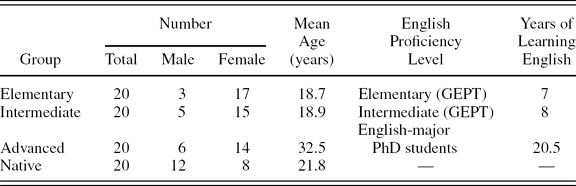
The native group was composed of 20 freshmen from Cambridge University who were learning Chinese language at the Chinese Language Center of National Taiwan Normal University in the summer. Table 1 shows the sample sizes, mean ages, English proficiency levels, and years of learning English for all four groups.
Profiles of the 80 subjects in the four groups

Note: GEPT, General English Proficiency Test.
Instruments
Three instruments were used in the present study. First, language profile questionnaires were adopted to record the Taiwanese students English learning history and the baseline data of the native English speakers. Second, a self-paced reading task was employed to investigate the way English learners in Taiwan resolve the MV/RRC ambiguities in real time. As mentioned earlier, the rationale for that task is because “increased reading times for a particular segment (relative to the same segment in a control condition) indicate a relatively higher processing difficulty at this point during the parse” (Papadopoulou & Clahsen, Reference Papadopoulou and Clahsen2003, p. 513). That is, reading times for the disambiguating segment should be longer in those conditions that force the dispreferred interpretation, reflecting the extra time readers use to revise their initial analysis (i.e., preferred reading) of the sentence. Third, a grammaticality judgment test was conducted to ascertain that all English learners have competence of the RRCs examined in the present experiment. The grammaticality judgment test included 20 target sentences with RRCs and 30 filler sentences that consisted of a variety of constructions.
Materials
Following Trueswell et al. (Reference Trueswell, Tanenhaus and Garnsey1994), we generated two kinds of target sentences (see Appendix A). The first kind was 10 morphologically ambiguous verbs such as “kissed.” Animacy and reduction were manipulated to generate the materials. In addition, the animacy constraints tested here had first been measured to be strong enough through a sentence completion task before the self-paced reading experiment. Thirty-one English-major freshmen at NSYSU were recruited to perform the completion task. They constructed complete sentences by using 20 ambiguous noun/verb sequences in which the 10 morphologically ambiguous verbs were preceded by animate NPs such as “the boy kissed,” and/or by inanimate NPs such as “the apple kissed.” As Appendix A shows, significant differences were found in MV completions between two NP conditions.
The second kind was 10 morphologically unambiguous verbs such as “seen.”Footnote 7 For the 10 unambiguous verbs, sentences with reduced and unreduced relative clauses started only with inanimate NPs. Trueswell et al. (Reference Trueswell, Tanenhaus and Garnsey1994) explained that “there are relatively few commonly known verbs with distinct past tense and past participle forms, and many of these verbs cannot be used naturally with both animate and inanimate objects” (p. 291). Thus, like Trueswell et al., we settled upon the inanimate conditions for the morphologically unambiguous verbs.
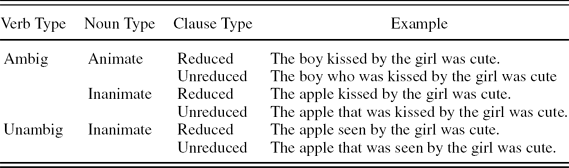
Accordingly, there were four types of target sentences for the 10 ambiguous verbs and two types of target sentences for the 10 unambiguous verbs, as exemplified in Table 2. Sixty grammatical target sentences were embedded among 90 filler sentences, 30 of which were grammatical, and 60 of which were ungrammatical. There were a total of 150 test sentences; the 60 target sentences consisted of five segments of six conditions, such as illustrated in (8).
- (8)

Example sentences of each condition from self-paced reading experiment
Note: Ambig, ambiguous; Unambig, unambiguous.
Procedure
In random order among all 150 sentences, each sentence was presented in a segment-by-segment fashion. Each segment contained two words of a sentence. A two-word segment designed here made it possible to preview the preposition “by.” As Trueswell et al. (Reference Trueswell, Tanenhaus and Garnsey1994) suggested, it is important to preview the preposition “by” so that the previewed “by” can immediately interact with noun animacy cues. Each new segment appeared on the screen alone each time when the preceding segment disappeared. The mixed case words were presented in white letters (24-point Arial) on a black background in the center of a 13-in. monitor.
The reading times and comprehension accuracy data were collected using the noncumulative moving window or self-paced reading procedure (Just, Carpenter, & Woolley, Reference Just, Carpenter and Woolley1982) on a personal computer. All subjects were individually tested using the computer running the software developed in the present study and they were instructed to read each segment as carefully and rapidly as possible for comprehension. After finishing reading each segment, they had to press a pacing button (i.e., “next” button) to bring up the next segment. The times between button presses provided the critical experimental measure in terms of milliseconds. The end of each sentence was indicated by a period after the last word of the final segment.
To ensure that the subjects paid attention to the content of the sentences, the last segment of all sentences was followed by a yes/no question, asking “Was this a correct sentence in English?” At the same time, two answer options appeared on the screen, one on the left- and the other on the right-hand side. The subjects were instructed to press either the “yes” or the “no” button when they made the decision. When the choice was wrong, an alerting statement appeared on the screen. The subjects were familiarized with the self-paced reading task through a practice session containing 10 sentences. They spent 15 to 25 min completing the self-paced reading task, and then the grammaticality judgment test was administered.
RESULTS
In order to examine whether all subjects were able to process RRCs online and to immediately use lexical, semantic, and syntactic information, this section reports the results of accuracy data and segment-by-segment reading time data. The alpha was set at .05 for all statistical tests.
Accuracy
This section analyzes accuracy data of the grammaticality judgment test and the self-paced reading task. First, all subject groups scored highly in judging the RRCs contained in the grammaticality judgment test. The mean accuracy score of the native English speaker group was 0.96. The mean accuracy scores of learner groups were as follows: the elementary level group scored 0.89, the intermediate level group scored 0.97, and the English-major PhD student group scored 0.99. The results demonstrated that all subjects have competence of the RRCs investigated in the present experiment.
A one-way analysis of variance (ANOVA) showed significant differences in the mean accuracy scores for the four groups, F (3, 76) = 10.57, p < .001, η2 = 0.31. Specifically, the post hoc tests indicated that the mean accuracy score of the elementary group was significantly lower than that of the native group but that the mean accuracy scores of the intermediate group and the advanced group did not differ from that of the native group or from each other. This reveals that the competence of RRCs of both intermediate English learners and English-major PhD students was equivalent to that of native speakers and better than that of elementary English learners.
All subject groups scored above 0.80 in answering the comprehension question that followed six types of target sentences in the self-paced reading task. For the between-groups analyses, a two-way (6×4) ANOVA with repeated measures with structure as within-subjects factor and proficiency as between-subjects factor showed no main effect of structure and interaction between structure and proficiency, but a main effect of proficiency, F (3, 36) = 14.82, p < .001, η2 = 0.55. Furthermore, the post hoc tests displayed that the mean accuracy scores on six types of target sentences of the elementary group were significantly lower than those of the native group but that the mean accuracy scores of the intermediate group and the advanced group did not differ from those of the native group or from each other. The analyses demonstrate that MV/RRC ambiguities were not more difficult to understand online than their unambiguous counterparts for all English learners and native English speakers. Moreover, the learners’ ability to process the MV/RRC ambiguities online, except in the elementary group, was very similar to that of the native group.
Segment-by-segment reading times
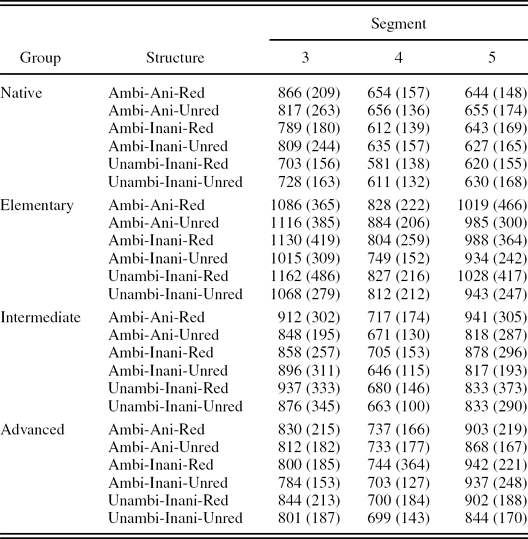
Table 3 provides an overview of the four subject groups’ mean reading times and standard deviations for Segments 3, 4, and 5 under all conditions, as exemplified in (8). These three segments are critical to determine how English learners in Taiwan resolve MV/RRC ambiguities online and when and how noun animacy cues affect this resolution.
Mean (standard deviation) reading times (ms) per critical segment and condition for the four groups
Analysis of sentences with ambiguous verbs
For the between-groups analyses, a series of three-way (2×2×4) ANOVAs with repeated measures were carried out for the data of the ambiguous verbs. The factors reduction (RRC vs. unreduced relative clause) and animacy (animate NP vs. inanimate NP) were within-subjects factors, and the factor proficiency (native, elementary, intermediate, advanced) was between-subjects factor. The results could determine whether there were main effects of reduction, animacy, and proficiency, as well as interaction effects. At Segment 3, a main effect of proficiency, F1 (3, 76) = 12.23, p < .001, η2 = 0.34; F2 (3, 36) = 43.78, p < .001, η2 = 0.079, and a significant three-way interaction among reduction, animacy, and proficiency, F1 (3, 76) = 8.03, p < .001, η2 = 0.27; F2 (3, 36) = 7.12, p = .001, η2 = 0.37, were observed. In addition, a marginal effect of reduction (i.e., the effect of reduction is approaching significance, p = .05–.1) was found in the subjects analysis, F1 (1, 76) = 2.87, p < .1; F2 (1, 36) = 2.66.
At Segment 4, the results revealed a main effect of proficiency, F1 (3, 76) = 4.09, p < .01, η2 = 0.14; F2 (3, 36) = 7.48, p = .001, η2 = 0.38, and a marginal effect of reduction in the subjects analysis, F1 (1, 76) = 2.81, p < .1; F2 (1, 36) = 2.54. In addition, a main effect of animacy was observed, F1 (1, 76) = 4.88, p < .05, η2 = 0.05; F2 (1, 36) = 5.38, p < .05, η2 = 0.13.
At Segment 5, the results showed a main effect of proficiency in the items analysis but not in the subjects analysis, F1 (3, 76) = 1.46; F2 (3, 36) = 5.16, p < .01, η2 = 0.30. A marginal interaction between animacy and proficiency was found in the subjects analysis, F1 (3, 76) = 2.44, p < .1; F2 (3, 36) = 1.03. In addition, a main effect of reduction was found, F1 (1, 76) = 7.93, p < .01, η2 = 0.10; F2 (1, 36) = 6.16, p < .05, η2 = 0.15.
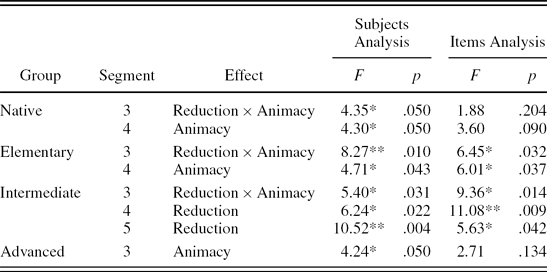
As the results showed a main effect of proficiency at Segments 3, 4, and 5 and interactions with the factor proficiency at Segment 3, we went on to analyze the reading time data from each of the four subject groups (native, elementary, intermediate, and advanced) separately. A series of two-way (2×2) ANOVAs with repeated measures with reduction and animacy as within-subjects factors were performed to analyze reading times on Segments 3, 4, and 5 for different proficiency groups. Table 4 summarizes main effects of animacy and reduction and significant interactions obtained for all four groups.
Main effects and/or interactions found at Segments 3, 4, or 5 for the four groups
*p ≤ .05. **p ≤ .01.
For the reading time data of native speakers, as shown in Table 4, the analysis of Segment 3 revealed a significant interaction between reduction and animacy in the subjects analysis, F1 (1, 19) = 4.35, p = .05, η2 = 0.18; F2 (1, 9) = 1.88. Subsequent ANOVA results showed that, for reduced relatives, the reading times for animate conditions were on average 77 ms longer than those for inanimate conditions, resulting in a main effect of animacy in the subjects analysis that was approaching significance in the items analysis, F1 (1, 19) = 5.57, p < .05, η2 = 0.22; F2 (1, 9) = 3.55, p < .1. However, for unreduced relatives, the reading times for animate conditions were on average 8 ms longer than those for inanimate conditions, resulting in no effect of animacy, F1 (1, 19) = 0.12; F2 (1, 9) = 0.02.
At Segment 4, animate relatives were on average 32 ms longer than inanimate relatives, resulting in a main effect of animacy in the subjects analysis that was approaching significance in the items analysis, F1 (1, 19) = 4.30, p = .05, η2 = 0.18; F2 (1, 9) = 3.60, p < .1. At Segment 5, neither main effects of animacy and reduction nor a significant interaction was observed.
Next, for the elementary group, as Table 4 indicates, in the analysis of reading times for Segment 3, a significant interaction between reduction and animacy was found, F1 (1, 19) = 8.27, p = .01, η2 = 0.30; F2 (1, 9) = 6.45, p < .05, η2 = 0.42. The interaction observed in the elementary group was because, for inanimate relatives, the reading times for reduced conditions were on average 115 ms longer than for those in their unreduced conditions, resulting in a main effect of reduction, F1 (1, 19) = 7.57, p < .05, η2 = 0.29; F2 (1, 9) = 8.11, p < .05, η2 = 0.47. In contrast, for animate relatives, the reading times for reduced conditions were on average 30 ms shorter than those for their unreduced conditions, resulting in no effect of reduction, F1 (1, 19) = 0.30; F2 (1, 9) = 0.17.
At Segment 4, the analysis of the data showed that the reading times for animate relatives were on average 80 ms longer than those for inanimate relatives, resulting in a main effect of animacy, F1 (1, 19) = 4.71, p < .05, η2 = 0.20; F2 (1, 9) = 6.01, p < .05, η2 = 0.40. At Segment 5, the analysis of the data showed no main effects of animacy and reduction nor any significant interaction.
Then, for the reading time data of intermediate learners, as indicated in Table 4, the data analysis of Segment 3 showed a significant interaction between reduction and animacy, F1 (1, 19) = 5.40, p < .05, η2 = 0.22; F2 (1, 9) = 9.36, p < .05, η2 = 0.51. The interaction was because, for reduced relatives, the reading times for animate conditions were on average 54 ms longer than those for inanimate conditions, resulting in a main effect of animacy, F1 (1, 19) = 5.34, p < .05, η2 = 0.22; F2 (1, 9) = 5.70, p < .05, η2 = 0.39. However, no main effect of animacy was found for unreduced relative clauses, F1 (1, 19) = 1.94; F2 (1, 9) = 4.12, p < .1.
At Segment 4, the reading times for reduced relatives were on average 53 ms longer than those for unreduced relatives, resulting in a main effect of reduction, F1 (1, 19) = 6.24, p < .05, η2 = 0.25; F2 (1, 9) = 11.08, p < .01, η2 = 0.55. At Segment 5, the reading times for reduced relatives were on average 92 ms longer than those for unreduced relatives, resulting in a main effect of reduction, F1 (1, 19) = 10.52, p < .01, η2 = 0.39; F2 (1, 9) = 5.63, p < .05, η2 = 0.36.
Finally, for the advanced group, the analysis of Segment 3 revealed a main effect of animacy in the subjects analysis, F1 (1, 19) = 4.24, p = .05, η2 = 0.18; F2 (1, 9) = 2.71. Neither main effects of animacy and reduction nor significant interactions were observed at Segments 4 and 5.
Analysis of sentences with unambiguous verbs
For sentences with unambiguous verbs, the means of reading times for Segments 3, 4, and 5 were entered ANOVAs with repeated measures. Only reduction (reduced vs. unreduced) was within-subjects factor for the analysis of each group. No significant difference in reading times existed between reduced relatives and their unreduced counterparts, and thus no main effect of reduction was observed (all Fs < 1). This suggests that the RRCs with unique forms of past participles did not cause bigger processing difficulty for native English speakers or English learners. As a result, any problems with reduced relatives found in the present study are related specifically to ambiguity, that is, morphologically ambiguous verbs.
To summarize, the results from our native speakers replicate Trueswell et al.'s (Reference Trueswell, Tanenhaus and Garnsey1994) findings to some extent. Like Trueswell et al., we observed that Segment 3 took more time to read in animate conditions compared to in inanimate conditions for reduced relatives, but not for unreduced relatives. The results support the assumption that an interaction between reduction and animacy immediately influences the MV/RRC ambiguity resolution.
In addition, the main effect of reduction obtained for our elementary and intermediate learner groups showed that they still adopted the minimal attachment strategy. These results dispute the conclusion that L2 learners hardly use phrase structure-based parsing, but depend overwhelmingly on L2 lexical and semantic information during L2 parsing (Felser et al., Reference Felser, Roberts, Marinis and Gross2003; Marinis et al., Reference Marinis, Roberts, Felser and Clahsen2005; Papadopoulou & Clahsen, Reference Papadopoulou and Clahsen2003). Nevertheless, it seems puzzling how our English-major PhD students comprehended the ambiguities when neither a main effect of reduction nor a significant interaction occurred, but a main effect of animacy. The following section will examine that issue.
DISCUSSION
The purposes of this study were to investigate (a) whether English learners in Taiwan immediately resolve MV/RRC ambiguities in a similar way as native English speakers do, and, (b) whether the learners at various English proficiency levels show diverse profiles. The main results of the self-paced reading study can be summarized as follows:
1. Both native English speakers and English learners in Taiwan could handle the RRCs under investigation online.
2. Elementary and intermediate English learners were immediately sensitive to use of reduction, which indicated that RRCs were harder to deal with; native speakers and English-major PhD students, however, were not immediately sensitive to use of reduction, suggesting that they were used to RRCs.
3. Native speakers, elementary, and intermediate English learners were immediately sensitive to use of noun animacy cues, whereas English-major PhD students were not.
4. English proficiency leads to developmental profiles of the MV/RRC ambiguity resolution, indicating proficiency is a factor in L2 online sentence processing.
Interaction of various types of information in L1 sentence processing
When parsing MV/RRC ambiguities, as discussed earlier, the parser is likely to initially misanalyze MV. The garden path model assumes that the MV misanalysis is a result of initial use of the minimal attachment strategy. By contrast, the integrated theory of lexical and syntactic ambiguity resolution holds that such an incorrect MV interpretation is derived from complex interactions of various types of information. Some studies of MV/RRC ambiguity resolution show that biasing noun animacy cues cannot immediately help disambiguate the ambiguities. Trueswell et al. (Reference Trueswell, Tanenhaus and Garnsey1994), however, proved that erroneous MV analyses can immediately be resolved when the constraints of biasing noun animacy cues are strong enough and when the constraints of “by” phrases are not reduced by the display mode.
To eliminate the potential weaknesses, we first generated noun animacy cues with strong constraints by means of a sentence completion task. Then we made the preposition “by” able to be previewed in a two-word segment-by-segment presentation fashion so that it could immediately provide positive support for RRC interpretations and negative support for MV interpretations.
The results from our native speakers reported here demonstrate that they did not tend to initially build simpler MV structures by using the minimal attachment strategy when processing MV/RRC ambiguities in real time, thus resulting in no main effect of reduction across the board. More specifically, when encountering a morphologically ambiguous verb, native speakers did not immediately analyze the subject NP as an agent nor this ambiguous verb as an MV in a main clause. Rather, they realized that the ambiguous verb contains different levels of information, and they further processed an interaction between such different levels of information. Therefore, they could evaluate both MV and RRC structures simultaneously. This reflects that our native speakers had sophisticated knowledge about morphologically ambiguous verbs.
While evaluating both MV and RRC structures, however, native speakers could not help but be influenced by the possible higher frequency of MV structures, as compared to that of RCC structures. As explicated previously, when MV interpretation can accommodate the argument structures of both transitive and intransitive whereas RRC interpretation must require a transitive argument structure, the frequency of MV interpretation is higher relative to that of RRC interpretation. In a similar vein, based on preliminary analyses of corpus data, Tabossi, Spivey-Knowlton, McRae, and Tanenhaus (Reference Tabossi, Spivey-Knowlton, McRae, Tanenhaus, Umilta and Moscovitch1994) indicated that, when immediately following an animate NP at the beginning of a sentence, a morphologically ambiguous verb is more likely to be a past tense verb in a main clause than to be a passive past participle in an RRC.
When a good semantic fit existed between the NP and the role of agent (e.g., “the boy kissed . . .”), native speakers naturally incorporated such a good semantic fit into the higher frequency of MV structures. They did not experience processing difficulty until they encountered the preposition “by,” which is not consistent with the MV interpretation. At this moment, they were forced to spend extra time reevaluating the MV misanalysis.
In contrast, when there was a good semantic fit between the NP and the role of theme/patient (e.g., “the apple kissed . . .”), this good semantic fit was able to effectively decrease the frequency of MV structures and increase the frequency of RRC structures. In this case, native speakers experienced far less difficulty in constructing RRC structures when they subsequently processed the preposition “by,” which further helped reduce processing cost associated with sentences with reduced relatives. This is the reason why, for native speakers, a main effect of animacy was observed for RRCs at Segment 3, which contained a morphologically ambiguous verb and the preposition “by.” In other words, it took them less time to comprehend reduced relatives with inanimate NPs than with animate NPs.
In addition, a main effect of animacy observed at Segment 4 showed that a good semantic fit between the NP and the role of agent or between the NP and the role of theme/patient kept on affecting native speakers in a checking stage. Specifically, because Segment 4 contained the NP of an explicit agentive phrase (e.g., by “the girl”) in relative clauses, it was a point at which the syntactic structures analyzed first could be checked. Because animate subject NPs played a good role of agent, they inevitably elicited longer reading times for reduced relatives associated with the animate subject NPs and their unreduced counterparts, in both of which these animate subject NPs actually played a dispreferred role of theme/patient. In contrast, the good semantic fit between the NP and the role of theme/patient, at this moment, helped accelerate reading times for reduced relatives with inanimate subject NPs and their unreduced counterparts, where the preference for the role of theme/patient occurred.
In sum, our observations demonstrated that the way our native speakers resolved MV/RRC ambiguities online fully shows that interactions between lexical, semantic, and syntactic information occurred immediately, which is in accordance with the assumptions proposed by the integrated theory of lexical and syntactic ambiguity resolution.
Native English speakers versus English learners in Taiwan
Some studies of L2 online sentence processing suggested that L2 learners behave differently from native speakers in L2 online sentence processing. Recall first that the syntactic structures such as RC attachment ambiguities or filler-gap dependencies that make L2 learners underuse them may be because they are barely taught explicitly in English language class. In addition, as discussed previously, syntactic information or phrase structure-based strategies do not necessarily take precedence over lexical and semantic information in MV/RRC ambiguity resolution by native English speakers. Thus, whether L2 learners behave similarly or differently from native speakers in MV/RRC ambiguity resolution is at issue.
Exploring how English learners in Taiwan at various English proficiency levels resolved the MV/RRC ambiguities online, we discovered that the learners behaved in a similar way as native English speakers to a varying extent. Like native speakers, English-major PhD students (i.e., advanced learners) did not initially prefer to adopt the minimal attachment strategy in the resolution. Instead, they capitalized on their sophisticated knowledge about morphologically ambiguous verbs and about the syntactic structure the preposition “by” constrains while dealing with the ambiguities online. They thus had no problem at all with the ambiguities.
When processing a morphologically ambiguous verb in RRCs, advanced learners did not think that the verb needed to be in past tense in a main clause. They could efficiently and effectively activate different levels of information of the ambiguous verb. On this occasion, they were capable of evaluating both MV and RRC structures. However, they were likely to be biased toward a possible higher frequency of MV structures, as explained previously. This possible bias was immediately prevented by the preposition “by,” which introduced an explicit agent in reduced relatives. The “by” constrained or helped advanced learners to construct RRC structures for all reduced relatives, regardless of whether subject NPs were animate or inanimate. No main effect of reduction was therefore found.
As shown in Table 4, a main effect of animacy obtained at Segment 3 indicated that English-major PhD students were already aware of and influenced by the thematic role information provided by noun animacy cues in the resolution. Given that inanimate subject NPs were a good role of theme/patient, the learners could use less time to analyze relative clauses with the inanimate NPs, regardless of whether the relative clause was reduced or unreduced. For another, animate subject NPs were a good role of agent, so they could not avoid meeting a relatively big struggle with the processing of relative clauses with the animate NPs, even when they were unreduced. This suggests that the main effect of animacy took place as a result of the learners making immediate use of semantic information in the resolution.
However, no significant interaction between reduction and animacy revealed that while resolving MV/RRC ambiguities, the learners were most assisted or constrained by the preposition “by.” The constraints of “by” were sufficient and strong enough to overcome a possible higher frequency of MV structures and a good semantic fit between the NP and the role of agent. As a result, unlike native speakers, the learners did not need to use noun animacy cues to resolve the ambiguities. On the contrary, they could come up with the idea that RRC analyses were most optimally associated with the morphologically ambiguous verbs.
This difference in the use of noun animacy cues between advanced learners and native speakers provides evidence that the learners may have a much more analytic perspective on English than native speakers. That perspective may result from the learners having more experiences in academic English reading, because they were on average 11 years older than native speakers, as indicated in Table 1. The parsing behavior of English-major PhD students was still similar to that of native speakers in that they did not immediately employ the minimal attachment strategy to clarify the ambiguities. Rather, they brought into use their knowledge about lexical, semantic, and syntactic information. This type of parsing behavior agrees with the predictions of the SSH but challenges the assumptions of the garden path model. It does not yet accord exactly with the assumptions of the integrated theory either.
For intermediate English learners, a significant interaction observed at Segment 3 showed that, like native speakers, they were immediately guided by the interaction between a relative frequency of MV and RRC structures, a good semantic fit between a NP and thematic role information, and the preposition “by.” The interaction, which operated against the MV/RRC ambiguity resolution, is the same as that discussed above for native speakers.
However, the learners, unlike native speakers, still felt much more difficulty in struggling with reduced relatives as compared to their unreduced counterparts at Segments 4 and 5, the postambiguity points that were used for checking or confirming the initial analyses. In other words, when checking the initial analyses, the learners still could not help using the minimal attachment strategy. Therefore, they spent more time on reduced relatives than on their unreduced counterparts. This means that the learners may be less confident than native speakers in striving to clarify MV/RRC ambiguities. Despite the use of the minimal attachment strategy, the learners’ immediate sensitivity to the interaction between reduction and animacy verified that they behaved in a way similar to native speakers.
Finally, unlike native speakers, elementary English learners first preferred to use the minimal attachment strategy to build MV structures and then make revisions when processing ambiguous verbs at Segment 3. Therefore, a main effect of reduction occurred in only sentences with inanimate subject NPs. We argued that the reduction effect as a result of the inanimate subject NPs created an anomaly when they were immediately interpreted as agents of the ambiguous verbs in MV readings. The anomaly blocked the learners from building such MV readings and thus postponed revisions required. For sentences with animate subject NPs, the learners’ overall slow reading times compensated for the time spent on revisions, eliminating a reduction effect. Because the way the learners used noun animacy cues is strikingly divergent from that used by native speakers, the learners’ parsing behavior better supports the garden path model.
On the whole, the similarities and differences existing between the parsing behaviors of the native speakers and the learners display developmental profiles of the MV/RRC ambiguity resolution, which support Sorace's (Reference Sorace2006) argument that developmental progress will influence L2 online sentence process.
CONCLUSION
Results from our investigation of the real-time resolution of MV/RRC ambiguities by native English speakers and Taiwanese English learners at various proficiency levels show first that native speakers were immediately sensitive to different levels of information associated with a morphologically ambiguous verb in the resolution. They were also immediately sensitive to thematic role information from noun animacy cues and to the syntactic structure constrained by the preposition “by,” which immediately followed the ambiguous verb. This pattern of native speakers’ parsing behavior gives extra support to the integrated theory of lexical and syntactic ambiguity resolution.
Like native speakers, advanced and intermediate learners did not immediately rely on the minimal attachment strategy, either. That is, they did not pursue single, simpler MV interpretations for MV/RRC ambiguities. Nevertheless, because advanced learners might have more sufficient facility with lexical access including ambiguous verbs and the “by” than native speakers, the learners were capable of constructing correct RRC structures for the ambiguities without using noun animacy cues. The parsing behavior of our advanced learners patterns completely with the SSH but little with the integrated theory. Conversely, intermediate learners incorporated their knowledge of ambiguous verbs and the “by” into noun animacy cues, the same pattern of parsing behavior as that used by native speakers.
Elementary learners, however unlike native speakers, were immediately influenced by the minimal attachment strategy so overwhelmingly that building MV misanalyses for RRCs with inanimate subject NPs was significantly postponed. Owing to initial use of the minimal attachment strategy, inanimate NPs created an anomaly when they were interpreted as agents in such MV readings. This pattern of results from our elementary learners doubtless supports the garden path model but violates the SSH.
The presence of different proficiency levels of L2 English clearly shows diverse profiles of MV/RRC ambiguity resolution. That is, a movement from more predominantly using the minimal attachment strategy toward integrating lexical and semantic information occurs as L2 English proficiency increases. This may be said especially with regard to elementary and intermediate English learners. It is more important that these diverse profiles in turn provide theoretical implications for L1 sentence processing. Specifically, what the garden path model and the integrated theory assumes for MV/RRC ambiguity resolution may signify a shift in efficient language facility from syntactic access only toward an effective network of lexical, semantic, and pragmatic information. Such a network is also the foundation on which the SSH is based.
APPENDIX A
Target sentences from the present study
Ambiguous verbs
Each item is listed with both the animate/inanimate noun pair (e.g., “boy/apple”) and the optional unreduced forms (e.g., “who was/that was”). The percentage of main clause completions is given for the two noun conditions in parentheses in the sentence completion task.
1. The boy/apple (who/that was) kissed by the girl was cute. (animate: 100%, inanimate: 33%)
2. The author/book (who/that was) loved by the reader was humorous/interesting. (animate: 90%, inanimate: 32%)
3. The child/carrots (who was/that were) liked by the lady was lovely/were fresh. (animate: 100%, inanimate: 48%)
4. The woman/painting (who/that was) studied by the artist was mysterious. (animate: 84%, inanimate: 48%)
5. The clerk/watch (who/that was) praised by the manager was smart/beautiful. (animate: 81%, inanimate: 29%)
6. The player/ball (who/that was) kicked by the coach was angry/fast. (animate: 100%, inanimate: 32%)
7. The customer/carpet (who/that was) pulled by the salesman was frightened/heavy. (animate: 87%, inanimate: 37%)
8. The woman/instructions (who was/that were) followed by the man was scared/were puzzling. (animate: 100%, inanimate: 39%)
9. The witness/evidence (who/that was) examined by the lawyer was reliable. (animate: 74%, inanimate: 55%)
10. The man/scarf (who/that was) patted by the woman was surprised/expensive. (animate: 74%, inanimate: 61%)
Unambiguous verbs
Each item is listed with the inanimate noun followed by the optional unreduced form (e.g., “that was”).
1. The apple (that was) seen by the girl was cute.
2. The book (that was) chosen by the reader was interesting.
3. The carrots (that were) eaten by the lady were fresh.
4. The painting (that was) torn by the artist was mysterious.
5. The watch (that was) forgotten by the manager was beautiful.
6. The ball (that was) thrown by the coach was fast.
7. The carpet (that was) taken by the salesman was heavy.
8. The instructions (that were) written by the man were puzzling.
9. The evidence (that was) shown by the lawyer was reliable.
10. The scarf (that was) worn by the woman was expensive.
ACKNOWLEDGMENTS
We are very grateful to the anonymous reviewer and the Associate Editor, Aydın Durgunoglu, for their helpful and constructive comments and suggestions on earlier versions of this paper. All remaining errors are our responsibility.