In the last decade, there has been surging interest in childhood maltreatment as an etiological factor contributing to the development of dissociative processes. Chronic and early experiences of maltreatment have been associated with higher levels of dissociation from childhood through late adolescence (Ogawa, Sroufe, Weinfeld, Carlson, & Egeland, Reference Ogawa, Sroufe, Weinfield, Carlson and Egeland1997; Valentino, Cicchetti, Rogosch, & Toth, Reference Valentino, Cicchetti, Rogosch and Toth2008). There has been also growing evidence that the impact of maltreatment experiences is moderated by genotypic variation in altering risk for various forms of psychopathology (Cicchetti & Banny, Reference Cicchetti and Banny2014). The present study examines the impact of developmental timing and chronicity of maltreatment experiences on dissociative tendencies in adolescence, as moderated by the FK506 binding protein 5 gene (FKBP5), a gene involved in glucocorticoid receptor (GR) regulation.
Maltreatment and Dissociation
The DSM-5 defines dissociation as “a disruption of and/or discontinuity in the normal integration of consciousness, memory, identity, emotion, perception, body representation, motor control, and behavior” (American Psychiatric Association, 2013). The link between maltreatment and dissociation is well established in the literature for a wide scope of developmental periods in both retrospective and prospective/longitudinal investigations (Hulette, Fisher, Kim, Ganger, & Landsverk, Reference Hulette, Fisher, Kim, Ganger and Landsverk2008; Toth & Cicchetti, Reference Toth and Cicchetti1998). Following maltreatment, dissociative symptoms are evident in early childhood (Becker-Blease et al., Reference Becker Blease, Deater Deckard, Eley, Freyd, Stevenson and Plomin2004; Yates, Carlson, & Egeland, Reference Yates, Carlson and Egeland2008), in school years (Hulette, Freyd, & Fisher, Reference Hulette, Freyd and Fisher2011; Valentino et al., Reference Valentino, Cicchetti, Rogosch and Toth2008), in adolescence (Dell & Eisenhower, Reference Dell and Eisenhower1990; Hornstein & Putnam, Reference Hornstein and Putnam1992), and in adulthood (Cole & Putnam, Reference Cole and Putnam1992; DiTomasso & Routh, Reference DiTomasso and Routh1993). Several aspects of the maltreatment experience, such as the age of onset (Ogawa et al., Reference Ogawa, Sroufe, Weinfield, Carlson and Egeland1997) and chronicity (Calverley, Fischer, & Ayoub, Reference Calverley, Fischer and Ayoub1994; Macfie, Cicchetti, & Toth, Reference Macfie, Cicchetti and Toth2001) of maltreatment, have been found to predict concurrent and/or future dissociation. Regarding the differential effects of specific subtypes of maltreatment on dissociation, however, the literature is inconclusive. There is evidence for both increased risk of certain types of maltreatment over others (Calverley et al., Reference Calverley, Fischer and Ayoub1994; Macfie et al., Reference Macfie, Cicchetti and Toth2001; Sanders & Giolas, Reference Sanders and Giolas1991) and comparable effects of sexual abuse, physical abuse, and neglect (Hornstein & Putnam, Reference Hornstein and Putnam1992) in predicting dissociation.
Dissociation and Gene × Environment (G × E) Interactions
In line with the principle of multifinality (Cicchetti & Rogosch, Reference Cicchetti and Rogosch1996), not all maltreated children develop dissociative symptoms. In shaping development, early caregiving experiences are in constant interaction with other factors at multiple levels (e.g., genetic, neural, behavioral, and environmental). Research on potential risk factors, mediators, and moderators of the link between trauma and dissociation is a promising venue for clarifying potential maladaptive pathways (Kraemer, Stice, Kazdin, Offord, & Kupfer, Reference Kraemer, Stice, Kazdin, Offord and Kupfer2001). Recently, the role of genetic variation and gene–environment interactions (Grigorenko & Cicchetti, Reference Grigorenko and Cicchetti2012) has been a major focus of developmental psychopathology research employing methods of molecular as well as behavior genetics. There has been growing evidence demonstrating that the impact of maltreatment is moderated by genotypic variation in leading to risk for various forms of symptomatology including dissociation (Dackis, Rogosch, Oshri, & Cicchetti, Reference Dackis, Rogosch, Oshri and Cicchetti2012).
Behavior genetics literature has identified high heritability estimates (50% to 60%) of dissociative symptoms (Pieper, Out, Bakermans-Kranenburg, & van IJzendoorn, Reference Pieper, Out, Bakermans-Kranenburg and van IJzendoorn2011; Waller & Ross, Reference Waller and Ross1997). Twin studies revealed moderate to substantial amounts of genetic and nonshared environmental variance and negligible to no shared environmental variance in dissociation (Becker-Blease et al., Reference Becker Blease, Deater Deckard, Eley, Freyd, Stevenson and Plomin2004; Jang, Paris, Zweig-Frank, & Livesley, Reference Jang, Paris, Zweig-Frank and Livesley1998). Based on these findings suggesting a genetic diathesis, some researchers concluded that dissociation does not develop as a response to traumatic experiences (Geraerts, Merckelbach, Jelicic, Smeets, & van Heerden, Reference Geraerts, Merckelbach, Jelicic, Smeets and van Heerden2006). However, these findings can also be interpreted alternatively as gene–environment transactions that result in individual differences in responding to the experience of trauma. Based on their genotypic differences, children may respond differentially to the same traumatic experience (Becker-Blease et al., Reference Becker Blease, Deater Deckard, Eley, Freyd, Stevenson and Plomin2004). Interacting with genetic liabilities, shared environmental influences might result in differential outcomes in siblings. Thus, for a better understanding of the role of genetic as well as environmental effects in the development of dissociation, research has to consider how they transact. For example, genetic variation may act as a catalyst in the face of severe trauma in leading to dissociative trajectories (Lochner et al., Reference Lochner, Seedat, Hemmings, Moolman-Smook, Kidd and Stein2007). Nevertheless, behavior genetics designs do not allow us to fully account for gene–environment interactions failing to measure individual variation at the DNA level. Interdisciplinary studies employing molecular genetics tools suggest that this joint influence of genetic factors and trauma exposure leads to variability in dissociative phenotypes (Lochner et al., Reference Lochner, Seedat, Hemmings, Moolman-Smook, Kidd and Stein2007; Pieper et al., Reference Pieper, Out, Bakermans-Kranenburg and van IJzendoorn2011). Consistent with a multiple levels of analysis approach to understanding risk and resilience (Cicchetti & Toth, Reference Cicchetti and Toth2009), the current direction in maltreatment research is also examining the role of genotype–environment interactions in the development of psychopathology (Caspi & Moffitt, Reference Caspi and Moffitt2006; Cicchetti & Valentino, Reference Cicchetti and Valentino2006).
FKBP5 Gene, Contextual Stress, and Hypothalamus–Pituitary–Adrenal (HPA) Axis Regulation
Child maltreatment has long-term neurophysiological consequences through its impact on HPA axis and immune system functioning (Ehlert, Reference Ehlert2013). Likewise, dissociation has observable correlates at the neurobiological level (Cicchetti & Toth, Reference Cicchetti, Toth, Lamb and Garcia Coll2015; Dalenberg et al., Reference Dalenberg, Brand, Gleaves, Dorahy, Loewenstein, Cardeña and Spiegel2012) and is likely to be affected by functioning of the stress response system. Located on chromosome 6p21, the FKBP5 gene is involved in HPA axis regulation in response to stress, and it has been associated with susceptibility to pathogenic effects of childhood trauma, including dissociative symptoms (Koenen et al., Reference Koenen, Saxe, Purcell, Smoller, Bartholomew, Miller, Hall and Kaplow2005). The FKBP5 gene encodes the cochaperone FK506 binding protein 51 of the heat shock protein 90. This FKBP5 protein is induced by cortisol and regulates steroid receptors, such as the GR. It reduces sensitivity and binding affinity of GR via its interaction with superchaperone complexes, creating resistance against glucocorticoids. Due to its involvement within this negative feedback loop of cortisol, the gene, FKBP5, plays an important role in HPA axis functioning. Several single nucleotide polymorphisms (SNPs) of this gene are linked with differential induction of FKBP5 by cortisol and binding to the GR. Research has showed such genetic markers located within FKBP5 to be related to psychiatric functioning, such as remission rates (Binder et al., Reference Binder, Salyakina, Lichtner, Wochnik, Ising, Pütz and Muller-Myhsok2004; Lekman et al., Reference Lekman, Laje, Charney, Rush, Wilson, Sorant and Paddock2008), comorbid anxiety (Minelli et al., Reference Minelli, Maffioletti, Cloninger, Magri, Sartori, Bortolomasi and Gennarelli2013), and response rate to antidepressant medication in depressive patients (Binder et al., Reference Binder, Salyakina, Lichtner, Wochnik, Ising, Pütz and Muller-Myhsok2004). Four SNPs within FKBP5 locus, rs3800373, rs9296158, rs1360780, and rs9470080, are specifically associated with differential functioning at the GR level. Genotypes carrying the minor alleles C, A, T, and T across these SNPs (rs3800373, rs9296158, rs1360780, and rs9470080, respectively) are linked with higher induction of FKBP5 by cortisol and increased GR receptor binding, whereas those containing major alleles A, G, C, and C are associated with lesser expression of FKBP5 and decreased binding at the GR.
FKBP5 Gene and Childhood Trauma
This link between genotypic variation in the FKBP5 and functioning of the stress-response system led many investigators to examine the role of this gene in the pathogenesis of stress-related disorders, especially in the context of childhood trauma. Because posttraumatic stress disorder (PTSD) can include dissociative symptoms within its spectrum of trauma-related symptomatology, studies that report PTSD symptoms are informative for the purposes of the current study. In a retrospective study by Binder et al. (Reference Binder, Bradley, Liu, Epstein, Deveau, Mercer and Ressler2008), relative to the major alleles, the minor alleles (C, A, T, T) across rs3800373, rs9296158, rs1360780, and rs9470080 interacted with experience of abuse in childhood to exacerbate PTSD symptom severity in adulthood in a predominantly African American sample. These four SNPs were also found to interact with childhood trauma to increase risk for aggression (Bevilacqua et al., Reference Bevilacqua, Carli, Sarchiapone, George, Goldman, Roy and Enoch2012). Similarly, Koenen et al. (Reference Koenen, Saxe, Purcell, Smoller, Bartholomew, Miller, Hall and Kaplow2005) found that minor alleles in rs3800373 and rs1360780 significantly predict peritraumatic and posttraumatic dissociation in medically injured children. In addition, Collip et al. (Reference Collip, Myin-Germeys, Wichers, Jacobs, Derom, Thiery and van Winkel2013) showed an association between risk for psychosis in individuals who carry the A genotype in rs9296158 and have a history of childhood trauma.
As one of the few studies that combined allelic variation across SNPs to examine a haplotype effect, Dackis et al. (Reference Dackis, Rogosch, Oshri and Cicchetti2012) found an interactive effect of one of the two major yin-yang haplotypes of the block “rs3800373, rs9296158, rs1360780, and rs9470080” and childhood maltreatment on psychiatric outcomes. In a high-risk sample of women, a history of childhood maltreatment, assessed retrospectively, was linked with risk for depressive and dissociative symptoms for those with the minor allele haplotype, CATT. In another investigation, polymorphisms within rs9470080 were found to moderate the effect of adverse childhood experiences on lifetime PTSD risk in African Americans (Xie et al., Reference Xie, Kranzler, Poling, Stein, Anton, Farrer and Gelernter2010). Individuals with a history of adverse childhood experiences had the highest risk, when they were homozygous for the minor (T) allele. Those with a T allele who had the lowest risk for lifetime PTSD did not experience childhood adversity. However, there are findings in the literature indicating that the major alleles of FKBP5 may confer risk as well as the minor alleles. For example, Roy, Gorodetsky, Yuan, Goldman, and Enoch (Reference Roy, Gorodetsky, Yuan, Goldman and Enoch2010) found an interactive effect of the major alleles of the same haplotype block and childhood trauma in predicting suicidal behavior. In this African American adult sample, genotypes carrying the major homozygotes as opposed to the minor alleles (A allele in rs3800373, G allele in rs9296158, and C allele in rs1360780) interacted with childhood trauma to predict increased risk for suicidal behavior. Overall, these findings suggest that variants of the FKBP5 gene act as a premorbid risk or protective factor for psychopathology in the context of environmental exposure to stress, specifically childhood adversity.
The Organizational View of Development
Developmental psychopathology stresses the organizational view that development proceeds in a cumulative fashion wherein the individual's history of adaptations lays the ground for subsequent experiences (Sroufe, Reference Sroufe, Cicchetti and Beeghly1989, Reference Sroufe1997). In line with this approach, it has been theorized that the self gradually emerges from a rudimentary form into a complex, integrated, flexible unity. However, when caregiving is dysfunctional, or noxious as in the case of child maltreatment, this normative process is disrupted (Harter, Reference Harter2012). Infancy is a particularly vulnerable period in which adverse caregiving interferes with the emergence of integrative self-processes. When such caregiving is followed by chronic trauma, dissociative mechanisms could become more established, resulting in further fragmentation of experience and, in some cases, a split pattern in the individual's identity formation (Carlson, Yates, & Sroufe, Reference Carlson, Yates, Sroufe, Dell, O'Neil and Somer2009). Adolescence is a potentially vulnerable period for dissociation as identity formation and personality consolidation are the primary developmental tasks of this period (Cicchetti & Rogosch, Reference Cicchetti and Rogosch2002).
Consistent with research demonstrating the significance of early adversity, the bulk of the studies on the FKBP5 gene found stress-related psychopathology only in cases of adversity experienced in childhood as opposed to adulthood. For example, Klengel et al. (Reference Klengel, Mehta, Anacker, Rex-Haffner, Pruessner, Pariante and Binder2012) found that the interaction of FKBP5 gene with traumatic experiences was time dependent. In people carrying the minor allele (A) for SNP 1360780, trauma altered methylation only when it occurred in childhood, suggesting a sensitive period for the induction of long-term epigenetic changes. Child maltreatment that occurred early in life, and specifically in infancy, confers higher potential risk for adverse developmental outcomes including dissociation in adolescence (Carlson, Furby, Armstrong, & Schlaes, Reference Carlson, Furby, Armstrong and Schlaes1997; Liotti, Reference Liotti1992: Lyons-Ruth, Dutra, Schuder, & Bianchi, Reference Lyons-Ruth, Dutra, Schuder and Bianchi2006). In addition, chronicity of maltreatment has been found to be a predictor of dissociation (Macfie et al., Reference Macfie, Cicchetti and Toth2001) in addition to a range of negative outcomes (Ethier, Lemelin, & Lacharité, Reference Ethier, Lemelin and Lacharité2004; Jonson-Reid, Kohl, & Drake, Reference Jonson-Reid, Kohl and Drake2012). For example, in a longitudinal investigation, Ogawa et al. (Reference Ogawa, Sroufe, Weinfield, Carlson and Egeland1997) documented higher levels of dissociation in subsequent developmental periods (toddlerhood, preschool, elementary school, adolescence, and young adulthood) for those who first experienced maltreatment in infancy and who had repeated experiences of maltreatment over a number of developmental periods. Research on gene–environment interactions also points out the role of both onset and chronicity of maltreatment as they interact with the genotype in leading to maladaptive functioning (Ehlert, Reference Ehlert2013). Thus, consistent with an organizational perspective, both developmental timing (developmental period of onset) and chronicity of maltreatment experiences should be considered in order to fully understand the impact of maltreatment on developmental outcomes (Carlson et al., Reference Carlson, Yates, Sroufe, Dell, O'Neil and Somer2009).
Rationale and Hypotheses
Based on these empirical and theoretical considerations, this study focuses on the joint influence of child maltreatment and individual differences in the FKBP5 gene on dissociative symptoms in a high-risk, low socioeconomic status community sample of adolescents. The current state of our knowledge reveals the importance of developmental timing and chronicity of maltreatment as well as variations of the FKBP5 gene in the etiology of dissociation. Following a multiple levels of analysis approach, we examine how these factors at the genotypic and environmental level interact to predict levels of dissociation in adolescence. A key question has to do with determining the specific directions and the levels at which the interaction between genes and chronicity of maltreatment lead to risk toward dissociation. Alternatively, genotypic variation may act as a protective mechanism depending on the chronicity of maltreatment experience, diverting the individual away from a pathway toward dissociative symptoms.
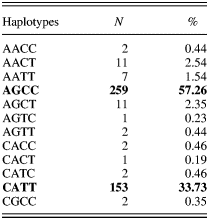
To our knowledge, this is the first study examining the joint influence of the FKBP5 gene and timing/chronicity of maltreatment on dissociative symptoms based on a haplotype analysis, and prospective reports of maltreatment. We also examine the interactive effects of maltreatment subtype (i.e., physical abuse, sexual abuse, emotional maltreatment, and neglect) and the CATT haplotype in order to account for possible variation in G × E interactions based on the form of maltreatment. Potential confounders of G × E interactions including ancestral variation are accounted for in order to rule out alternative explanations (Keller, Reference Keller2014). Variation across four FKBP5 SNPs (rs3800373, rs9296158, rs1360780, and rs9470080) is analyzed to examine the presence of the minor alleles across these four genes. In our sample, 90% was represented by either CATT or AGCC haplotypes, as the yin-yang haplotype block demonstrated in the literature (Roy et al., Reference Roy, Gorodetsky, Yuan, Goldman and Enoch2010).
Based on the lack of evidence in the literature, we do not expect a main genetic effect. Rather, we predict that chronically maltreated individuals whose maltreatment experience started in infancy would be more vulnerable to dissociation compared to those who were not maltreated or compared to those whose maltreatment experience started after the period of infancy, or whose maltreatment experience is relatively less chronic. However, the presence of one or more copies (vs. no copy) of the CATT haplotype will moderate the effect of maltreatment on dissociation. Given the inconclusive findings in the literature, we did not have a specific hypothesis regarding the direction of moderation.
Method
Design and sample
This study included 450 adolescents (195 females, 255 males, M age = 14.23, SD age = 1.16), who previously attended a summer camp research program for school-aged children (Cicchetti & Manly, Reference Cicchetti, Manly, Brody and Sigel1990). Of those, 279 of them had a history of maltreatment and 171 had no history of maltreatment. Regardless of their maltreatment status, the adolescents were from disadvantaged, low socioeconomic status families, with 96.9 % of them having a history of receiving public assistance. Parents of all adolescents provided informed consent for their children's participation in the study. They also consented to examination of any Department of Human Services (DHS) records regarding the family. The county DHS had identified children in the maltreatment group as having experienced child abuse and/or neglect, and the sample was typical of the children from families who receive services from the DHS.
Because the maltreated adolescents in our sample have a predominantly low-socioeconomic status background, nonmaltreated youth were recruited from families who receive Temporary Assistance for Needy Families. Absence of records of child maltreatment was verified via DHS record searches for these families. In addition, trained research assistants interviewed mothers of the adolescents to confirm absence of maltreatment history. Only children without any documented abuse and/or neglect history were retained in the nonmaltreatment group. To reduce the risk for undetected maltreatment that might exist within this group, we excluded families who had previously received preventive services from DHS due to concerns over potential maltreatment. The families in the nonmaltreated group were demographically comparable to the maltreating families in our sample, enabling us to examine the effects of maltreatment independently from that of socioeconomic adversity.
Procedures
The first phase of the study consisted of a weeklong day camp where children participated in recreational activities and various research assessments, providing their assent (see Cicchetti & Manly, Reference Cicchetti, Manly, Brody and Sigel1990, for details of camp procedures). The camp was not designed with an explicit aim of intervention. The second phase was conducted during adolescence. Trained research assistants, who were unaware of the participants’ maltreatment status and research questions, administered an extensive measurement battery of questionnaires and semistructured interviews individually in private rooms. A subset of these measures was employed in the present study.
Measures
Maltreatment Classification System (MCS)
Following comprehensive searches of DHS records, all information pertaining to maltreatment history was coded according to operational definitions from maltreatment nosology specified in the MCS (Barnett, Manly, & Cicchetti, Reference Barnett, Manly and Cicchetti1993). The MCS utilizes DHS records by detailing maltreatment investigations and findings about identified families over time. All available information from the DHS is coded in order to make independent determinations of maltreatment experiences, rather than relying on DHS-defined case designations. Trained research assistants, doctoral students, and clinical psychologists coded the DHS records according to operational criteria defined by the MCS, obtaining adequate reliability (weighted κs = 0.86–0.98; Manly, Kim, Rogosch, & Cicchetti, Reference Manly, Kim, Rogosch and Cicchetti2001). Earlier studies have shown that the MCS is a reliable and valid tool for classifying maltreatment (English et al., Reference English, Upadhyaya, Litrownik, Marshall, Runyan, Graham and Dubowitz2005; Manly, Reference Manly2005).
The MCS operational criteria designated all subtypes of maltreatment experienced by children, including neglect, emotional maltreatment, physical abuse, and sexual abuse. Neglect is defined as caregivers’ failure to provide basic physical needs for the child such as adequate food, clothing, shelter, and medical treatment as well as forms of inattention to the child's moral–legal needs, educational needs, and need for supervision. Emotional maltreatment is defined as extreme interruption of basic emotional needs of children by failing to provide psychological safety and security, acceptance and self-esteem, and age-appropriate autonomy. Severe examples of emotional maltreatment include disparaging and mocking of the child, extreme negative and hostile behavior toward the child, exposure to severe forms of violence, abandoning, and threats of suicide or homicide. Physical abuse is defined as nonaccidentally inflicting physical injury on the child, ranging from minor or temporary injuries such as bruises, welts, and choking to permanently disfiguring injuries such as severe burns and broken bones. Finally, sexual abuse is defined as any attempt or actual act of sexual contact between the child and caregiver aimed at caregiver's sexual or financial satisfaction. Examples of sexual abuse range from child's exposure to pornography or sexual activity of adults, to sexual touching or forced intercourse. As documented by DHS records, all adolescents in the maltreatment group had individual histories of abuse and/or neglect.
Consistent with the literature (Manly, Cicchetti, & Barnett, Reference Manly, Cicchetti and Barnett1994; Manly et al., Reference Manly, Kim, Rogosch and Cicchetti2001), in the current sample, the majority (n = 168, 68.8%) of maltreated adolescents experienced multiple maltreatment subtypes, with an average number of 2.16. For example, 49 adolescents had a history of sexual abuse. Of those, all except 2 cases had multiple forms of maltreatment, with 32 having physical abuse in addition to emotional maltreatment or physical neglect. The remaining 15 cases did not have physical abuse but had either emotional maltreatment or physical neglect. Similarly, 90 adolescents had a history of physical abuse, and except 7 cases, at least one other form of maltreatment. Due to this high comorbidity, analysis based on discrete subtypes was not feasible. According to the degree to which the form of maltreatment violated social norms, a hierarchy of maltreatment subtypes was utilized (Manly et al., Reference Manly, Cicchetti and Barnett1994). The subjects were grouped into two hierarchical subtype categories: sexual abuse or physical abuse (SA/PA) and emotional maltreatment or physical neglect (EM/PN). All adolescents who were sexually or physically abused were classified as SA/PA (n = 139, 33.5%). Adolescents who were emotionally maltreated or physically neglected but not sexually or physically abused were classified as EM/PN (n = 105, 25.3%).
In order to incorporate information on developmental timing of maltreatment experience, onset of maltreatment was considered in this study. Onset was defined as the earliest developmental period during which substantiated reports of maltreatment were present. Based on theoretical and empirical evidence indicating that infancy is an especially vulnerable period for dissociative processes in the context of disruptive caregiving (Carlson et al., Reference Carlson, Yates, Sroufe, Dell, O'Neil and Somer2009), the sample was grouped into three levels of onset. Those who had their first maltreatment experience in infancy were categorized as “infancy onset” (n = 114, 27.5%), and those who had their first maltreatment experience after infancy were categorized as “later onset” (n = 130, 31.3%). The third level consisted of “nonmaltreated” (n = 171, 41.2%) adolescents.
Chronicity of maltreatment was also examined. Chronicity was defined as the number of all developmental periods during which maltreatment was reported. The developmental periods designated by the MCS are infancy (0–18 months), toddlerhood (19–35 months), preschool (36–59 months), early school age (ages 5–7), later school age (ages 8–12), and adolescence (ages 13–18). Based on this continuum ranging from 0 (no maltreatment) to 6 (six developmental periods of maltreatment), the sample was divided into three groups of chronicity: nonmaltreated (n = 171), those who were maltreated for one or two developmental periods were categorized as “less chronic” (n = 127), and those who were maltreated for three or more developmental periods were categorized as “chronic” (n = 117).
The majority (approximately 80%) of chronically maltreated adolescents had a maltreatment onset in the period of infancy. As stated elsewhere, we hypothesized that those chronically maltreated adolescents with an infancy onset would be at highest risk. Thus, we created a variable (onset/chronicity) combining the maltreatment parameters, onset and chronicity, in order to differentiate between maltreatment that starts in infancy and continues through three or more developmental periods (“infancy and chronic,” n = 92, 22.2%) versus maltreatment that either does not start in infancy or does not happen during more than two developmental periods (“postinfancy or less chronic,” n = 152, 36.6%). Both of these onset/chronicity groups included all maltreatment subtypes and did not consist of a particularly predominant subtype. The third group again consisted of adolescents who were not maltreated at all (nonmaltreated, n = 171, 41.2%).
The Adolescent Dissociative Experiences Scale (A-DES)
A-DES is a self-report questionnaire with 30 items that was originally designed to screen for dissociative and posttraumatic disorders in adolescents between ages 11 and 18 (Armstrong, Putnam, Carlson, Libero, & Smith, Reference Armstrong, Putnam, Carlson, Libero and Smith1997). It measures the frequency of a wide range of normative and pathological dissociative experiences in four domains: dissociative amnesia, passive influence, depersonalization and derealization, and absorption and imaginative involvement. Each item rates symptoms on a scale ranging from 0 (never) to 10 (always). A mean score that is ≥4 suggests dissociation at pathological levels and warrants further consideration. In addition, as a taxometric subscale that measures pathological dissociation, the A-DES taxon is created from eight A-DES items (item numbers 6, 9, 15, 17, 20, 22, 25, and 30) from dissociative amnesia, and depersonalization and derealization domains. Examples of A-DES taxon items include “I find myself someplace and don't remember how I got there,” “I hear voices in my head that are not mine,” and “My body feels as if it doesn't belong to me.” The reliability and validity of A-DES has been established in the literature (Armstrong et al., Reference Armstrong, Putnam, Carlson, Libero and Smith1997; Putnam, Reference Putnam1997). Internal consistency was measured using coefficient alpha (Cronbach, Reference Cronbach1951). For this sample, the coefficient α value for A-DES was 0.95, indicating excellent internal consistency, and the coefficient α value for the A-DES taxon was 0.82, indicating good internal consistency (George & Mallery, Reference George and Mallery2003, p. 231).
DNA collection, extraction, and genotyping
Trained research assistants obtained DNA samples by collecting buccal cells using the Epicentre Catch-All Collection Swabs. DNA was extracted and prepared for polymerase chain reaction amplification using the Epicentre BuccalAmp DNA Extraction Kit (Epicentre, Cat. No. BQ090155C). SNP genotyping was conducted using Applied Biosystems Custom Taqman SNP Genotyping Assays. The products of these analyses were then analyzed using endpoint allelic discrimination. Genotypes were identified and sequenced with the Beckman-Coulter CEQ8000 semiautomated florescent sequencing system, which utilizes fragment analysis application and associated software. All samples were genotyped twice for quality control. Human DNA from cell lines was purchased from Coriell Cell Repositories for each genotype and used as control samples using DTCS chemistry on an ABI 3130xl. These cell lines and a no-template control were run with study samples representing 9% of the total data output. Samples that were not able to be genotyped to a 95% or greater confidence level were repeated under the same procedures up to four times.
Ancestral proportion determinations
DNA from the study participants was submitted to the BioMedical Genomics Center at the University of Minnesota for quantity and quality testing and subsequent SNP genotyping. Acceptable samples (99.0%) were subjected to SNP genotyping of the Burchard et al. panel of 106 SNPs (Lai et al., Reference Lai, Tucker, Choudhry, Parnell, Mattei, García-Bailo and Ordovás2009; Yaeger et al., Reference Yaeger, Avila-Bront, Abdul, Nolan, Grann, Birchette and Joe2008), known to be informative for ancestry from Africa, Europe, and Native America. The SNPs were genotyped using the iPLEX platform from Sequenom Bioscience, Inc., which uses the Sequenom MassArray. The SNP genotyping results were then recoded and uploaded into STRUCTURE v2.3.4, which uses algorithms developed by Pritchard et al. (Falush, Stephens, & Pritchard, Reference Falush, Stephens and Pritchard2003, 2007; Hubisz, Falush, Stephens, & Pritchard, Reference Hubisz, Falush, Stephens and Pritchard2009). Three SNP tests were excluded based on high allele call rates of the non-DNA containing wells. The data from the remaining 103 loci were uploaded into the software and set to analyze with an admixture model of ancestry and initialization of the simulation on the GALA cohort. The simulation was set to run with a burn-in of 10,000, 1,000 Markov chain Monte Carlo repetitions, and assuming three populations within the group. The results of the simulations were subsequently identified as percent association to each ancestry group, African, Native American, and European, based on the known ancestry of the GALA cohort. Logistic regression procedures were used to classify individuals into distinct ancestral groups, utilizing the continuous proportion scores of the ancestrally important markers to predict self-reported race (55.9% Black, 28.4% White, 11.6% Hispanic, 4.1% other).
Haplotyping
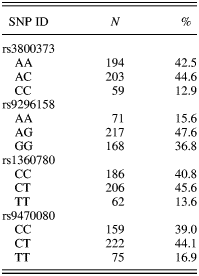
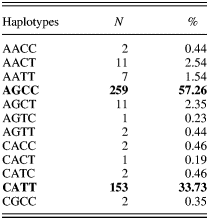
Table 1 presents the distribution of four FKBP5 SNPs (rs3800373, rs9296158, rs1360780, and rs9470080) in the sample. The package haplo.stats (Sinnwell & Schaid, Reference Sinnwell and Schaid2012) in R (R Development Core Team, 2015) was used to determine linkage disequilibrium and minor allele/haplotype frequencies of the four FKBP5 SNPs within the sample. The analyses indicated statistically significant linkage disequilibrium (likelihood ratio = 1,956.49, df = 7, p < .001). Twelve different combinations of the genotypes were found in the sample. Over 90% of the sample was represented by either the AGCC or the CATT haplotype (see Table 2). Each participant was then assigned a haplotype using the same software, which employs an expectation maximization algorithm to compute maximum likelihood estimates of posterior haplotype probabilities. All participants were haplotyped with greater than 98% confidence, with the exception of three participants, which were subsequently excluded from analyses. Following the haplotype assignment procedure, individuals with one or two copies of the CATT haplotype (N = 230) were grouped together and compared to individuals with zero copies of this haplotype (N = 185). In subsequent analyses, this dichotomous variable was used (1 = one or two copies of CATT, 0 = no copies) to examine the joint effects of childhood maltreatment and FKBP5 haplotype variation on dissociative symptoms.
Frequencies and percentages of FKBP5 SNPs

Note: FKBP5, FK506 binding protein 5; SNP, single nucleotide polymorphism.
Frequencies of haplotypes found in the sample
Statistical analysis
In preliminary analysis, 35 cases were excluded due to missing information on CATT haplotype, ancestry, or maltreatment parameters. In order to examine the joint effects of the CATT haplotype and maltreatment on dissociation, two one-way analyses of covariance (ANCOVAs) were conducted. In both analyses, the mean scores from the A-DES scale were used as the dependent variable that represents the observed frequency of dissociative symptoms. In both models, the moderator was the CATT haplotype consisting of two levels: 0 copies versus 1 or 2 copies of CATT. In the first ANCOVA model, we aimed at ruling out possible interaction of CATT with maltreatment subtype before testing our hypothesis on onset/chronicity of maltreatment. The independent variable was maltreatment subtype, which had three levels: nonmaltreated versus SA/PA versus EM/PN. The model tested for both main and interactive effects of the CATT haplotype and maltreatment subtype. In the second ANCOVA model, we tested our hypothesis that adolescents whose maltreatment was chronic and had an infancy onset will be more vulnerable to dissociative processes, and the hypothesis that the CATT haplotype will moderate this effect of developmental timing and chronicity on dissociation. The independent variable was the onset/chronicity of maltreatment that was examined at three levels: nonmaltreated versus infancy and chronic versus postinfancy or less chronic. This model also tested for both main and interactive effects of the CATT haplotype and the maltreatment parameters (onset/chronicity).
Considering the individual's developing cognitive skills that enable higher order regulatory and representational functioning over time, a normative decrease is expected in dissociative processes. Thus, age is considered as a potential covariate. Although research adopting a dimensional approach to dissociative psychopathology did not yield significant gender differences, epidemiology literature noted predominance of female cases in dissociative disorders (Spitzer et al., Reference Spitzer, Klauer, Grabe, Lucht, Stieglitz, Schneider and Freyberger2003). In addition, estimates of genotype effects and genotype–environment interactions are likely to be influenced by the sample's ancestral background. For these reasons, in addition to age (as a continuous variable), gender and ancestral classification groups were entered as covariates in both models. In a recent paper, Keller (Reference Keller2014) suggested all possible confounding factors to be included in analyses examining gene–environment interactions. Following his suggestion, in order to eliminate alternative explanations, follow-up ANCOVAs were conducted where all possible interactions among the three covariates and predictor variables were controlled for in the models. These ANCOVAs were aimed at testing the robustness of G × E findings against possible confounding factors. Following the significant findings in ANCOVAs, pairwise comparisons were conducted among the levels of significant predictors. Finally, chi-square tests of independence were performed to examine whether maltreatment subtype and onset/chronicity levels are independent of the CATT haplotype groups in the sample. All chi-square tests were nonsignificant, ruling out possible gene–environment correlations.
Results
Maltreatment subtype, CATT haplotype, and A-DES
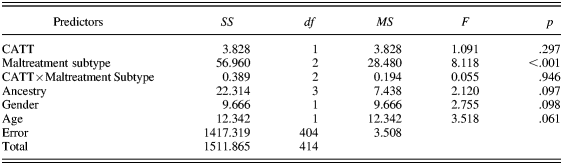
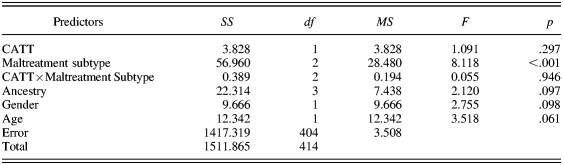
An ANCOVA model analyzing the effects of maltreatment subtype and the CATT haplotype on dissociation yielded a significant main effect of maltreatment subtype, F (2, 404) = 8.118, p < .001, ω2 = 0.03. However, the main effect of the CATT haplotype, F (1, 404) = 1.091, p = .297, and the interaction between maltreatment subtype and the CATT haplotype, F (1, 404) = 0.055, p = .946, were not statistically significant. The covariates age, gender, and ancestry group did not have any significant effects on A-DES scores (see Table 3).
Results of analysis of covariance for the Adolescent Dissociative Experiences Scale scores by CATT and maltreatment subtype
Note: SS, Sum of squares; MS, mean square.
Pairwise comparisons demonstrated that adolescents who were in the SA/PA group had significantly higher A-DES scores compared to adolescents who were in the nonmaltreated group and those in the EM/PN group. Adolescents who were in the EM/PN group did not differ from the nonmaltreated group. The ANCOVA model based on maltreatment subtype did not show interactions with the FKBP5 gene. It is important to note that the model did not account for developmental timing and chronicity of maltreatment. Thus, it does not differentiate between early versus late onset of these forms of maltreatment, as well as the levels of chronicity. As hypothesized, we turned to examine the joint effects of onset/chronicity of maltreatment and the CATT haplotype.
Developmental timing and chronicity of maltreatment, CATT haplotype, and A-DES
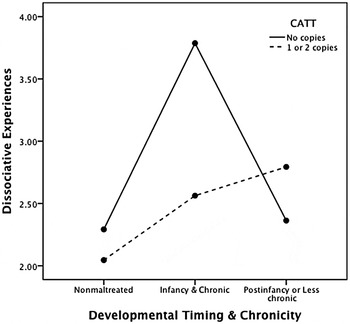
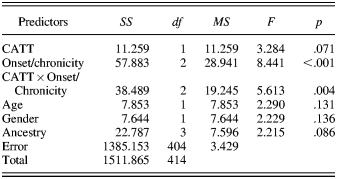
The ANCOVA model examining the effects of onset/chronicity of maltreatment and the CATT haplotype is presented in Table 4. The model was not significant for the main effect of the CATT haplotype, F (1, 404) = 3.284, p = .071. However, there was a significant main effect of onset/chronicity, F (2, 404) = 8.441, p < .001, ω2 = 0.03, and a significant interaction between onset/chronicity and the CATT haplotype, F (2, 404) = 5.613, p < .01, ω2 = 0.02 (see Figure 1). The covariates age, gender, and ancestry group did not have any significant effects on A-DES scores. The results indicated that onset/chronicity and the interaction of onset/chronicity and the CATT haplotype accounted for approximately 6.1% of the total variation in the A-DES scores, after controlling for the effects of gender, age, and ancestry.
The interaction of the CATT haplotype with onset/chronicity of maltreatment for Adolescent Dissociative Experiences Scale scores.

Results of analysis of covariance for the Adolescent Dissociative Experiences Scale scores by CATT haplotype and onset/chronicity of maltreatment
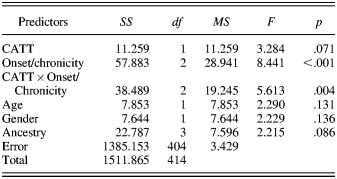
Note: SS, Sum of squares; MS, mean square.
Following Keller's (Reference Keller2014) suggestion for ruling out all possible confounders in G × E analysis, we repeated this ANCOVA by including all interactions between our covariates, and genetic and environmental parameters in the analysis. This model continued to yield a significant interaction between maltreatment onset/chronicity and the CATT haplotype, F (2, 382) = 4.895, p < .01, ω2 = 0.02, indicating that our G × E finding is robust after considering possible alternative explanations.Footnote 1
Follow-up tests were conducted using the adjusted means of the A-DES scores to evaluate pairwise differences among the participants with one or two copies of CATT and the participants with no copies of CATT across different levels of onset/chronicity (see Table 5). Pairwise comparisons for onset/chronicity indicated that in the infancy and chronic group, those with no copies of the CATT haplotype, showed significantly more dissociative symptoms than those with one or two copies of the CATT haplotype. However, for the postinfancy or less chronic group and the nonmaltreated group, the effect of the CATT haplotype was not significant.
Post hoc comparisons of the haplotype groups by onset/chronicity for the A-DES scores

Note: Mean difference = A-DES for 1 or 2 copies of CATT – A-DES for no copies of CATT. A-DES, Adolescent Dissociative Experiences Scale.
* p < .05.
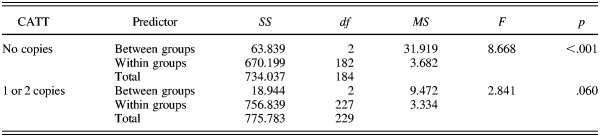
In order to examine these interactions further, between subjects analyses of variance were conducted for the effect of onset/chronicity on A-DES, within each haplotype group (see Table 6). There was a significant difference among onset/chronicity groups for the individuals with no copies of the CATT haplotype. However, A-DES scores did not differ among levels of onset/chronicity for those who carry one or two copies of the CATT haplotype. Additional follow-up comparisons for the individuals who had no copies of the CATT haplotype indicated that the mean A-DES score for the infancy and chronic group was significantly higher than both the nonmaltreated group (M difference = 1.417, SE = 0.373, p < .05) and the postinfancy or less chronic group (M difference = 1.437, SE = 0.383, p < .05).
Results of the between-subjects analysis of variance for onset/chronicity by CATT
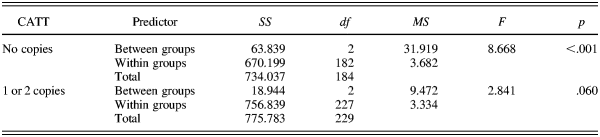
Note: SS, Sum of squares; MS, mean square.
Discussion
This study focused on the joint influence of child maltreatment and individual variations in the FKBP5 gene on dissociative symptoms within a high-risk sample of adolescents. To our knowledge, this is the first study examining the impact of developmental timing and chronicity of maltreatment experience on dissociative symptoms based on cumulative, infancy through adolescence accounts of maltreatment as moderated by haplotypic variation in the FKBP5 gene. When evaluated in light of the current literature, our results confirmed the interaction of the FKBP5 gene with child maltreatment in predicting trauma-related psychopathology. Moreover, building on the recent directions in G × E research, we measured not only the subtype of maltreatment experience but also its developmental timing and chronicity over development. Our results suggested that developmental timing and chronicity of maltreatment are important considerations in predicting dissociative symptoms through their interaction with the gene FKBP5.
There was no interaction between maltreatment subtype and the FKBP5 gene. However, the findings show a significant effect of maltreatment onset and chronicity on dissociative symptoms for those adolescents with zero copies of the CATT haplotype. In this haplotype group, chronically maltreated adolescents who had an infancy onset had higher levels of dissociation than those who were not maltreated or those whose maltreatment experience was either relatively less chronic or not started in infancy. None of these maltreatment effects were found among adolescents who carry one or two copies of the CATT haplotype. In addition, nonmaltreated individuals, individuals who did not have an infancy onset, and those with chronic maltreatment did not differ across haplotype groups on their levels of dissociation. A similar trend was observed when dissociation at clinical levels was examined as an outcome (via the subscale, A-DES taxon), suggesting a protective influence of the CATT haplotype against pathological dissociation for chronically maltreated adolescents with an infancy onset.
Previous research has revealed that the developmental timing and chronicity of maltreatment predicts concurrent and/or future dissociation (Calverley et al., Reference Calverley, Fischer and Ayoub1994; Ogawa et al., Reference Ogawa, Sroufe, Weinfield, Carlson and Egeland1997). Our study, however, makes a critical contribution to the literature suggesting that these effects of developmental timing may vary depending on individual differences at the genotypic level. Chronic maltreatment with an infancy onset predicted higher levels of dissociation for those adolescents who carry zero copies of the CATT haplotype. Our results are consistent with the organizational view that early caregiving experiences are foundational in the development of the individual's later functioning. Due to limited regulatory capacities in this period, maltreatment experiences that start in infancy could render the child more prone to dissociation. Following an infancy onset, maltreatment that encompasses multiple developmental periods might constitute a particular risk for continuing on a trajectory in which the child relies on dissociative strategies to cope with stress inside and outside the context of trauma. Genotypic differences, however, may render the individual more or less vulnerable to these effects of developmental timing and chronicity.
Furthermore, our findings can be interpreted as demonstrating a protective effect of the CATT haplotype against dissociative symptoms for those who were maltreated in infancy and through several subsequent periods of development. In our sample, those adolescents with chronic experiences of maltreatment exhibited higher levels of dissociation when they did not carry the CATT haplotype, which contains the minor “high induction” alleles across four SNPs (rs3800373, rs9296158, rs1360780, and rs9470080). Our results are in line with the literature suggesting an interaction between the CATT haplotype and exposure to adversity on psychological functioning (Binder et al., Reference Binder, Bradley, Liu, Epstein, Deveau, Mercer and Ressler2008; Dackis et al., Reference Dackis, Rogosch, Oshri and Cicchetti2012; Roy et al., Reference Roy, Gorodetsky, Yuan, Goldman and Enoch2010). However, the literature is inconclusive about the direction of CATT moderation. Our findings contribute to the literature demonstrating that both minor and major alleles may exert differential protective effects depending on exposure to adversity. For example, rs3800373 minor allele homozygosity was protective for individuals who did not experience trauma, whereas it conferred higher risk for depression for those with trauma exposure (Zimmermann et al., Reference Zimmermann, Brückl, Nocon, Pfister, Binder, Uhr and Ising2011). Similarly, individuals with rs9470080 minor allele homozygotes and no trauma exposure exhibited the lowest risk for PTSD, but this genotype was associated with highest risk for PTSD in cases with history of childhood adversity (Xie et al., Reference Xie, Kranzler, Poling, Stein, Anton, Farrer and Gelernter2010). However, when examined at the allelic level, there are many studies finding the major “low induction” alleles (A, G, C, C) rather than the “high induction” ones (C, A, T, T), in the FKBP5 to interact with childhood trauma in increasing risk for stress-related pathology. For example, Roy et al. (Reference Roy, Gorodetsky, Yuan, Goldman and Enoch2010) found major homozygotes (A allele in rs3800373, G allele in rs9296158, and C allele in rs1360780) constituting risk for suicide attempts in victims of childhood trauma. In another African American sample, genotypes carrying the major homozygote in rs3800373 interacted with childhood trauma to predict increased risk for suicidal behavior (an additive effect of another HPA axis gene, CRHBP was also found; Roy, Hodgkinson, DeLuca, Goldman, & Enoch, Reference Roy, Hodgkinson, DeLuca, Goldman and Enoch2012).
Our findings differed in the directions of genetic moderation from the study by Dackis et al. (2013), who investigated the moderating effects of the CATT haplotype on the linkage of childhood maltreatment with dissociative symptoms as mediated by limbic irritability. In a high-risk sample of women, Dackis et al. (2013) found a significant indirect effect of childhood maltreatment on dissociation via limbic irritability only for those individuals who carried one or two copies of the CATT haplotype. We found that when maltreatment experience is chronic and starts in infancy, the FKBP5 moderation is significant in the opposite direction: the presence of one or two copies of the CATT haplotype decreases risk for dissociation. However, it is important to note that the Dackis et al. (2013) study did not measure developmental aspects of maltreatment experience such as timing and chronicity. In addition, that study used a retrospective self-report measure of maltreatment in an adult sample, while our study uses the MCS, which is based on cumulative reports and accounts of maltreatment information. We did not find the same moderating effect of the CATT haplotype for those adolescents who were not maltreated in infancy or whose maltreatment experience is less chronic, suggesting that developmental timing and chronicity of maltreatment experience is an important factor to consider in future studies that examine how maltreatment interacts with the genotype in predicting future psychopathology. It might be possible that in the case of chronic maltreatment that starts in infancy, minor allele genotypes predict better adaptation. At the behavioral level, these alleles are linked with hyperresponsive HPA axis functioning, which might be protective depending on the timing and chronicity of contextual threat. Our results indicate that depending on whether or not maltreatment started in infancy and its level of chronicity, the CATT haplotype might serve as a protective factor, as opposed to conferring risk.
From a developmental perspective, such variation in the direction of genotype effects depending on context is in line with the principle of multifinality (Cicchetti & Rogosch, Reference Cicchetti and Rogosch1996), and supports the findings in the literature that link the G × E of childhood trauma and FKBP5 haplotype with a number of different outcomes later in life. For example, the interaction of FKBP5 genotypes and traumatic experiences follows different trajectories for individuals suffering from PTSD-related symptoms and those who have depressive symptoms (Zannas & Binder, Reference Zannas and Binder2013). For traumatized individuals who suffer from depression, minor alleles are associated with increased FBKP5 mRNA expression, which indicates upregulation of cortisol due to insensitive negative GR feedback to the HPA axis. In contrast, for those who suffer from PTSD, minor alleles predict lower expression of FKBP5 and, hence, hyposecretion of plasma cortisol due to up-regulation of GR. Although both trajectories reflect HPA axis dysregulation, they might manifest in differential outcomes at the psychological level. These findings demonstrate that translation of molecular patterns to psychological outcomes is complex and requires clarification of the mechanisms through which the genotype interacts with environmental adversity. Thus, rather than prematurely labeling variance at the allelic or haplotypic level as “risk” or “protective” factors, it is imperative to understand their interactions with context, including developmental timing and chronicity of maltreatment.
Besides genetics, there is also evidence from epigenetics literature that the same molecular mechanisms can lead to different phenotypic presentations later in development. In a landmark study, Klengel et al. (Reference Klengel, Mehta, Anacker, Rex-Haffner, Pruessner, Pariante and Binder2012) showed one such mechanism underlying the FKBP5 gene and childhood trauma interactions. The FKBP5 gene was preferentially demethylated in carriers of the “risk” allele when they were exposed to trauma early in life. This demethylation, which was found to persist into adulthood, may result in dysregulated GR expression and, hence, dysregulated release of cortisol through the HPA axis. This finding is considered as the first evidence demonstrating a mediating mechanism through which the environment modulates the effects of allelic variance on the phenotype. In addition, in line with the principle of multifinality, this finding constitutes evidence for another mechanism of pleiotropism in which identical genotypes can result in multiple trajectories of behavioral phenotypes as a function of experiential differences during sensitive developmental periods. Future studies that explicate the role of genetic and epigenetic processes as well as functional changes at the molecular level in response to trauma are warranted.
One of the major strengths of this study is the cumulative assessment of maltreatment over the course of the adolescent's life. All of the studies investigating childhood maltreatment and FKBP5 conducted to date have relied on retrospective reports, which are potentially biased and confounded with several factors that could render the findings unreliable (see Ehlert, Reference Ehlert2013, for a review of these factors). Our subjects all had CPS-documented maltreatment experiences earlier in life, prior to the measurement of dissociative experiences in adolescence. In addition, although the interactive effects of the FKBP5 gene with maltreatment experienced in childhood as opposed to adulthood (pointing at the significant role of the timing of adversity) has been replicated several times, the role of maltreatment experienced in infancy and maltreatment chronicity have not been investigated in the literature. We account for not only the presence/absence of maltreatment experiences but also developmental timing and chronicity.
Another strength of this study is the analysis based on a haplotype across four SNPs that are in high linkage disequilibrium. The majority of the studies that examine the FKBP5 gene, childhood trauma or maltreatment, and risk for trauma/stress symptomatology rely on SNP-based analysis. Only three studies to date have examined the haplotype that comprises the four SNPs we examined in the FKBP5 locus to find significant G × E interactions (Bevilacqua et al., Reference Bevilacqua, Carli, Sarchiapone, George, Goldman, Roy and Enoch2012; Dackis et al., Reference Dackis, Rogosch, Oshri and Cicchetti2012; Roy et al., Reference Roy, Gorodetsky, Yuan, Goldman and Enoch2010). In genetic epidemiology research, haplotype analysis is shown to be advantageous over individual SNP-based analysis in assessing disease susceptibility (Grigorenko & Cicchetti, Reference Grigorenko and Cicchetti2012; Morris & Kaplan, Reference Morris and Kaplan2002).
In addition, responding to Keller's (Reference Keller2014) criticisms regarding possible confounding variables that might result in false positives in G × E studies, we accounted for genetic heterogeneity in the population in addition to other factors such as gender and age. Utilization of ancestral biomarker scores was useful for ruling out spurious correlations that may potentially occur due to variation in genotype and prevalence of traits by population. Not only were these variables entered as covariates, but also all possible interactions across parameters and covariates were included in our statistical analyses.
Limitations
The limitations of the current study include its focus on a single gene rather than accounting for multiple genotypic variations that could potentially operate in concert. Possible interactions of the FKBP5 gene with other genes that are involved in the stress-response functioning, such as corticotropin-releasing hormone type 1 receptor (CRHR1; Amstadter et al., Reference Amstadter, Nugent, Yang, Miller, Siburian, Moorjani and Koenen2011) or, additive effects of polymorphisms located within other genetic loci (e.g., CRHR1, catechol-O-methyltransferase [COMT], neuronal acetylcholine receptor subunit α-5 [CHRNA5]) in the context of trauma exposure (Boscarino, Erlich, Hoffman, & Zhang, Reference Boscarino, Erlich, Hoffman and Zhang2012), were not accounted for in our analyses. As another limitation, although we employed a multiple levels of analysis approach, our study did not include data on the epigenetic level. There is considerable evidence that individuals are affected by trauma in different ways, depending on haplotypic variation. However, it is not clear whether it is because they are predisposed to react to trauma in certain ways or because they are experiencing epigenetic changes due to trauma, which then leads to maladaptation later in life. Little is known about the mechanisms in which environments talk to genes (Szyf, Reference Szyf2012) and how genes exert their influence on the phenotype. Genetic and epigenetic processes underlying the neurobiological underpinnings of stress-response systems have yet to be discovered in order to fully capture the role of genotypic variance in stress susceptibility.
This study is the first to date examining the impact of maltreatment documented cumulatively from infancy through teenage years on dissociative symptoms as moderated by haplotypic variance in the FKBP5 gene. To our knowledge, our findings are also the first to account for the interaction of developmental timing and chronicity of maltreatment with FKBP5 in predicting trauma-related psychopathology. Although risk factors at the genetic level (i.e., the DNA sequencing) are difficult to modify, psychosocial interventions are promising venues for maltreated individuals. When informed by the G × E interactions underlying the development of psychopathology and the role of developmental timing and chronicity of maltreatment, early intervention can be effective in helping maltreated children and adolescents who are on a maladaptive trajectory toward clinical dissociation (Zannas & Binder, Reference Zannas and Binder2013).