



LEARNING OBJECTIVES
After reading this article you will be able to:
-
describe the place of electroconvulsive therapy (ECT), clozapine and lithium in current treatment guidelines
-
understand likely reasons for underuse of these treatments
-
describe possible strategies to close the gap between current and expected usage rates.
Remarkable advances have occurred across medicine in recent decades which have deepened understanding of disease mechanisms and opened exciting new avenues for therapeutics (Mayfield Reference Mayfield, Ker and Steele2024). However, on average, new treatments may be only slightly superior to existing treatments (Djulbegovic Reference Djulbegovic, Kumar and Glasziou2012). Organisations like the UK’s National Institute for Health and Care Excellence (NICE) seek to disseminate best evidence of cost-effective practice using existing treatments, as summarised by NICE’s first chair, Sir Michael Rawlins: ‘the incremental health gain from implementing what we know works is far greater than from introducing new technologies’ (Rawlins 1999).
Within psychiatry, treatments exist with an established evidence base that are comparable to interventions in physical healthcare (e.g. see Leucht et al Reference Leucht, Hierl, Kissling, Dold and Davis2012 for pharmacological treatments). However, it is our contention that some key treatments in psychiatry are underused, which in turn adversely affects outcomes for patients who could have benefited if they had been considered. In this article, we look at electroconvulsive therapy (ECT), clozapine and lithium, examining their place in existing guidelines, patterns of use in everyday practice, and possible reasons for underuse and strategies to address this.
Electroconvulsive therapy (ECT)
What is the evidence-base/position in guidelines?
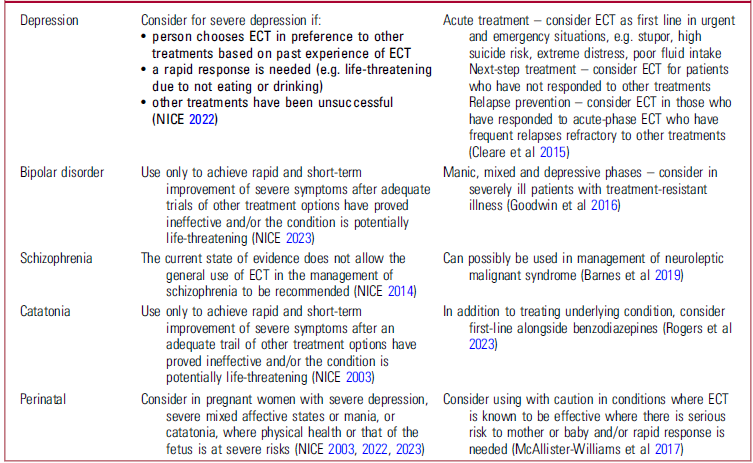
A summary of the place of ECT in current UK guidelines is provided in Table 1. As can be seen, guidance indicates that there are a range of specific situations where ECT is safe and effective, suggesting that ECT should be a common part of everyday psychiatric practice. However, ECT prescription rates, particularly in the UK, show that its use has fallen in the past 50 years and that it is used much less frequently than its evidence base would predict. This is unlikely to be primarily due to a reduction in indications for ECT, which are still wide-ranging and broadly similar to those described by Pippard & Ellam (Reference Pippard and Ellam1981), where 83% of ECT was used for a primary diagnosis of depression.
Current indications for electroconvulsive therapy (ECT) in UK guidelines

What is the evidence ECT is underused?
The chequered history of ECT is well-documented and it has proved one of the most controversial treatments in the whole of medicine. Following the first description of the technology by Cerletti and Bini in 1938, ECT became widely used and misused. Data quantifying levels of ECT use in the decades following its introduction are patchy and poor quality in most countries. Nevertheless, the trend in decreasing ECT use over the latter decades of the 20th century is clear in the UK. An indication of the extent of decline is provided in a study in selected South London teaching hospitals (Lambe Reference Lambe, Mask and Trimikas2014) which found that 35% of psychiatric in-patients received ECT in 1956 before widespread availability of effective pharmacotherapies, compared with 2.2% in 1991, despite large reductions in bed availability.
A survey in 1980–1981 (Pippard Reference Pippard and Ellam1981) documented 380–400 places providing ECT across Britain and approximately 7800 courses of ECT occurring over a 3-month period, equivalent to over 30 000 courses per year. Data collection via the Department of Health/National Health Service in the UK documents clearly, despite some methodological issues (e.g. whether individual ECT treatments, courses or patients were recorded, variable clinic response rates, which parts of the UK are included), a consistent decline in ECT use, particularly from the 1980s onwards. For example, Bickerton et al (Reference Bickerton, Worrall and Chaplin2009) found that in England the number of individual ECT treatment sessions (i.e. not ECT courses) in a 3-month period fell from 34 485 in 1985 to 16 482 in 1999 and then to 6782 in 2006. This last cohort represented 1276 patients undergoing ECT in a 3-month period, which would extrapolate to around 5000 patients undergoing the treatment in England in the whole of 2006.
The establishment in 2003 of the ECT Accreditation Service (ECTAS; www.rcpsych.ac.uk/improving-care/ccqi/quality-networks-accreditation/ectas) has substantially improved ECT data reporting in the UK, particularly since the introduction of a regular national survey (excluding Scotland, which has its own arrangements) in 2012. The most recent ECTAS survey (Electroconvulsive Therapy Accreditation Service 2023) covers the calendar year of 2021 and received data from 85 of the UK’s 93 registered ECT clinics (excludes Scotland). In this period there were 1989 acute courses, 62 continuation courses and 107 maintenance courses (total of 2158 courses), representing a further significant drop from the 2006 data in Bickerton et al’s study.
Why has ECT use fallen in the UK?
There are a range of interacting factors linked to the decline in usage of ECT, which can be summarised as (a) stigma/attitudinal factors, (b) concerns regarding effectiveness, (c) concerns about side-effects, (d) complex regulations/de-emphasis in guidelines and (e) subsequent reduced availability of and familiarity with the treatment.
Negative attitudes towards ECT have been reported among patients, the general public and health professionals, including psychiatrists (Maughan Reference Maughan and Molodynski2016). It is likely that this has been fuelled by poor standards of historic practice, which include crude, unmodified and poorly monitored stimulation paradigms across inadequately selected patients, as well as outright abuse of ECT by authoritarian regimes, for example in Nazi Germany and the Soviet Union. Negative perceptions of ECT have been maintained by media portrayal (especially Miloš Forman’s 1975 film One Flew Over the Cuckoo’s Nest) and critical psychiatry literature. Even in high-quality UK newspapers, recent potentially stigmatising accounts are not hard to find (Oppenheim Reference Oppenheim2022).
Although ECT has built a reliable evidence base in acute treatment of depressive episodes, studies have shown that up to 85% of patients relapse if an ECT course is followed by placebo antidepressant medication (Sackheim Reference Sackheim2017). This risk can be partly mitigated by pharmacotherapy and psychological treatment (Sackheim Reference Sackheim2017). This may be a contributing factor limiting use by psychiatrists. The introduction of effective antidepressant drugs from the 1960s onwards is also associated with falling rates of ECT usage.
ECT has historically been associated with burdensome side-effects, particularly cognitive, and indeed these have been prominent in critical media portrayals of the treatment. These are likely to still colour perception among patients and professionals despite major technical advances, such as use of general anaesthesia, muscle relaxants, threshold titration, electroencephalogram (EEG) monitoring, ultrabrief stimulation and unilateral electrode placement, which have improved the safety and tolerability of ECT.
In modern mental health practice, ECT operates under specific safeguards (e.g. requirements for independent second opinions for detained patients who cannot consent) and standards of practice (e.g. the ECTAS scheme). Although these are, of course, important for quality assurance, this may contribute to a perception of ECT being a risky treatment. It is arguable that some treatment guidelines have not given sufficiently robust recommendations for ECT based on its evidence base.
As rates of ECT prescription fall, clinics administering it close and younger psychiatrists become less familiar with the treatment, potentially leading to a further circular decline in ECT use.
What can be done to ensure more evidence-based use?
For ECT use to increase to levels expected if it was prescribed according to current UK guidelines, several things need to happen. Clinicians and patients need to be aware of up to date evidence of effectiveness and reassured about side-effects, and negative attitudinal barriers need to be challenged. The treatment should be easily accessible and, although overseen by effective clinical governance, not subject to excessive regulation or bureaucratic operational procedures.
There is therefore a need for high-quality information about ECT to be available to clinicians and patients. It is important to provide information about the safety of ECT, for example research showing it is not associated with an increased rate of serious medical events (Kaster Reference Kaster, Vigod and Gomes2021). Cognitive side-effects are now much reduced following improvements in technique, and if they do occur, they are likely to be transient (Sackheim Reference Sackheim2017). This is particularly important as evidence builds of relatively low remission rates with conventional antidepressant medications in patients who do not respond to the first couple of agents tried. Further research is needed to establish the most effective pharmacological treatment strategies following successful acute use of ECT, although lithium may have an important role for some patients (Lambrichts Reference Lambrichts, Detraux and Vansteelandt2021).
The Royal College of Psychiatrists and similar institutions in other countries have a central role in promoting evidence-based use of ECT. This includes challenging inaccurate or stigmatising portrayals of ECT and ensuring that the voices of patients and carers who have had recent direct experience of the treatment are heard. Surveys indicate significantly more positive attitudes towards ECT among people who receive it (Maughan Reference Maughan and Molodynski2016). To combat inaccurate perceptions among the workforce, exposure to ECT prescription and usage should be a central part of the training of psychiatrists and other mental health professionals. Academics and clinicians with expertise in neurostimulatory therapies need to be adequately represented in working groups responsible for producing guidelines to ensure ECT receives appropriate emphasis in treatment algorithms. Bodies such as ECTAS have an important function in striking a balance between effective governance of ECT without excessive bureaucratisation.
A final suggestion, recognising the major difference between the current practice of ECT and the original description by Cerletti and Bini, is to rename the treatment. In a public survey in Bangalore, India, Andrade & Thyagarajan (Reference Andrade and Thyagarajan2007) found that the term ‘electrostimulatory therapy’, for example, had significantly higher levels of acceptability than ‘electroconvulsive therapy’.
Clozapine
Clozapine was discovered in the 1950s during attempts to make new antidepressants. By the 1980s it was recognised as being effective in cases where chlorpromazine had not been (Kane Reference Kane, Honigfeld and Singer1988). It is the only medicine licensed for use in treatment-resistant schizophrenia in the UK, where it is also licensed for management of Parkinson’s psychosis. A standardised definition of treatment-resistant schizophrenia is where symptoms of at least moderate severity have failed to respond to two trials of antipsychotics at a therapeutic dose (the equivalent of at least 600 mg chlorpromazine per day) for at least 6 weeks, where at least 80% of doses have been taken (Howes Reference Howes, McCutcheon and Agid2017).
What is evidence-base/position in guidelines?
In a first episode of psychosis, the British Association for Psychopharmacology (BAP) (Barnes Reference Barnes, Drake and Paton2020) recommends that clozapine should be considered after there has been an adequate trial of two antipsychotics as well as family therapy and cognitive–behavioural therapy (CBT) for psychosis (where available). This is anticipated as being achieved within 3 years of initiating treatment.
The BAP guideline also recommends that clozapine is used first line in treatment-resistant schizophrenia as soon as the above pharmacological criteria have been met (provided that substance use and limited adherence have been ruled out as contributing factors). The trial should last a minimum of 3–6 months (during which time adverse effects should be proactively managed) before other options such as augmentation are considered.
The Scottish national clinical guideline on management of schizophrenia (Scottish Intercollegiate Guidelines Network 2013) states that clozapine should be offered to people with treatment-resistant schizophrenia, for example where their illness has not responded to two antipsychotics (including a second-generation antipsychotic), after reviewing diagnosis and accessing for any comorbidity. The dose should then be optimised, and augmentation with options such as a second-generation antipsychotic or lamotrigine should be considered only if there has been an inadequate response to clozapine monotherapy. It advises that high-dose antipsychotic medication should be used only after other trials, including clozapine, have failed.
In its clinical guideline for prevention and management of schizophrenia, NICE (2014) provides similar recommendations. It advises that clozapine is offered as soon as the following steps have been completed:
-
two consecutive antipsychotics (one of which should be second generation) have been trialled without success, at an adequate dose, for an adequate duration
-
a check of adherence to the antipsychotics
-
review of diagnosis
-
offer of CBT and family intervention (where appropriate)
-
consideration of other contributors to illness, such as substance use, other prescribed medicines and any physical illness.
Augmentation through the use of two antipsychotics is recommended only after clozapine has been used at an optimised dose.
These guidelines stem from a compelling evidence base in favour of using clozapine as gold standard treatment for resistant schizophrenia; for example, it is effective in 41% of people with treatment-resistant schizophrenia, whereas olanzapine at up to 25 mg per day is effective in only 5% (Conley Reference Conley, Tammiga and Kelly1999) (see also Kane Reference Kane, Honigfeld and Singer1988).
There is good reason to avoid delaying initiation. A 2017 study (Yoshimura Reference Yoshimura, Yada and So2017) found that if clozapine is started within 2.8 years of onset of psychosis, response rates are around 82%, as opposed to 31% in those where treatment is delayed beyond this.
There are additional benefits that come with using clozapine. There is plenty of evidence of its anti-suicidal properties, it is the most effective oral antipsychotic for reducing risk of relapse requiring psychiatric admission (Tihonan Reference Tihonan, Mittendorfer-Rutz and Majak2017) and it is associated with reduced use of drugs and alcohol once someone is taking it.
What is the evidence it is underused and why might this be?
Only around one-third of people eligible to use clozapine in the UK are prescribed it. This is substantially lower than in other parts of Europe (Whiskey Reference Whiskey, Barnard and Oloyede2021). It is likely that, at least in part, this is related to reluctance to prescribe, with surveys showing clinicians lack confidence in doing so (Tungaraza Reference Tungaraza and Farooq2015). Additionally, the media may have served to increase patients’ concerns, for example in January 2024, The Times ran an article about clozapine with the headline ‘Britain’s most dangerous prescription drug – linked to 400 deaths per year’, which prompted a counter-response letter from Lade Smith, the President of the Royal College of Psychiatrists. Public and clinician concerns are often a mismatch with the experience of patients who find they feel better on clozapine and want to stay on it (Taylor Reference Taylor, Shapland and Laverick2000).
The risk of dangerous, potentially fatal side-effects is a major consideration with clozapine, and is one of the reasons it is not a first-line antipsychotic. Severe complications include myocarditis, cardiomyopathy and gastrointestinal obstruction. In the UK, clozapine requires careful blood monitoring because of the risk of adverse effects on white blood cells. Neutropenia occurs in about 3% of patients and agranulocytosis in 0.4% (Li et al Reference Li, Zhong and Lu2020). This monitoring is resource-intensive, whereas NHS mental health services are comparatively underfunded, and requires significant long-term commitment from the patient. Furthermore, if a patient stops clozapine for more than 48 h, careful re-titration with short-term increase in mental health service input is required.
Drug interactions are another safety concern. Clozapine can adversely interact with other drugs, which could put off prescribers when they are treating patients who may be experiencing physical as well as mental illness (for example, care is needed when prescribing antibiotics; clozapine with trimethoprim is contraindicated; and the risk of QT prolongation increases with clarithromycin).
Psychiatrists may decide against prescribing clozapine in favour of a depot antipsychotic because of a patient’s history of poor adherence to other medicines, yet adherence to clozapine is typically very good, even for those where this was an issue before starting it (Brodeur Reference Brodeur, Courteau and Vanasse2022).
Changes in the amount of tobacco smoked must be carefully assessed in people taking clozapine, with dose adjustments by as much as 70% if someone gives up smoking, owing to the risk of clozapine toxicity from reduced metabolism. Dose adjustments also need to be made if someone starts smoking more, to minimise the risk of recurrence of psychosis through suboptimal clozapine levels caused by increased metabolism. This necessitates monitoring and making dose adjustments based on the patient’s smoking habits not just in the community – as in-patient units are increasingly smoke-free, this should be considered during the start and end of admissions too. However, this challenge is not exclusive to clozapine – it also applies to other antipsychotics, such as olanzapine.
A newer issue for people taking clozapine, and their healthcare teams, is the impact of COVID-19 infection. Bacterial and viral infections have been reported to increase plasma levels of clozapine, and clozapine use is thought to be associated with an increased risk of COVID-19 and pneumonia (Govind Reference Govind, Fonseca de Freitas and Pritchard2021), which might be another reason for reluctance to prescribe clozapine.
What can be done to ensure more evidence-based use?
As with ECT, educating prescribers about clozapine could improve their confidence in prescribing it as soon as a patient with schizophrenia has had insufficient response to two consecutive antipsychotics at adequate dose for an adequate duration. If clinicians and patients know the advantages of clozapine over other antipsychotics and if clinicians know how to monitor and address problems as they arise, it is likely to increase prescribing to bring clozapine use more in line with national guidelines.
As experts in balancing evidence, risks and benefits, psychiatrists and pharmacists could play a part in challenging the publication of misinformation or one-sided information in the media, to help the public be better informed.
The UK could also look to other countries and new perspectives to consider changes in how we license and use clozapine. A study in Finland looked at long-term risk of agranulocytosis and suggested that benefits of relaxing long-term neutrophil monitoring could outweigh the risks, as the likelihood of developing neutropenia decreases steeply over time (Rubio Reference Rubio, Kane and Tanskanen2024), and following review of Australian data, there has even been a call to stop monitoring altogether after 2 years (Northwood Reference Northwood, Myles and Clark2024). If the UK swapped to the USA’s less stringent neutrophil monitoring criteria (allowing a lower neutrophil count before stopping treatment, and no white cell count and platelet monitoring) there would be a significant reduction in the number of people having to stop clozapine for haematological reasons (Oloyede Reference Oloyede, Whiskey and Casetta2022).
Lithium
Lithium is one of the most effective treatments available in psychiatry and its clinical efficacy is superior to other mood stabilisers (Fiorillo Reference Fiorillo, Sampogna and Albert2023). It was first used to treat mental illness in the mid-19th century (Shorter Reference Shorter2009), and for a significant time has been the gold standard first-line treatment for the management of bipolar disorder in the longer term. A discrepancy between evidence-based recommendations and clinical practice in using lithium treatment for people with bipolar disorder has recently been highlighted (Fiorillo Reference Fiorillo, Sampogna and Albert2023).
What is the evidence-base/position in guidelines?
We will examine national clinical guidelines for four specific conditions with a strong evidence base for use of lithium.
Bipolar disorder in the longer-term
A summary of British Association of Psychopharmacology (BAP) guidelines on the treatment of bipolar disorder in the longer-term states that lithium monotherapy is first line, and second line is lithium or valproate in combination with olanzapine, aripiprazole, risperidone or quetiapine (Goodwin Reference Goodwin, Haddad and Ferrier2016). NICE (2023) advises that lithium should be offered as first line, but to prevent relapse, the clinician should consider drugs that have been previously effective during episodes of mania or bipolar depression and discuss the option to switch to lithium. It should be explained that lithium is the most effective long-term treatment for bipolar disorder.
If the patient fails to respond to lithium monotherapy and the burden of disease is mania, BAP guidance advises combining two predominantly anti-manic agents (e.g. lithium, valproate, a dopamine antagonist or a dopamine partial agonist). When the burden is depressive, a combination of lithium, lamotrigine, quetiapine, lurasidone or olanzapine is advised (Goodwin Reference Goodwin, Haddad and Ferrier2016).
Episodes of mania or hypomania
To treat episodes of mania or hypomania, NICE (2023) advice is that if two trials of antipsychotics are not tolerated or are ineffective at the maximum licensed dose, the clinician should consider adding lithium. BAP guidelines recommend dopamine antagonists as first line, but lithium is listed among other alternative options for treating mania or hypomania. BAP advice for severe or inadequately controlled manic episodes is to combine lithium or valproate with a dopamine antagonist (Goodwin Reference Goodwin, Haddad and Ferrier2016). For patients taking long-term treatment, BAP suggest ensuring that the highest well-tolerated dose of the current treatment is offered. If symptoms are still inadequately controlled, the combination of lithium or valproate with a dopamine antagonist/partial agonist should be considered (Goodwin Reference Goodwin, Haddad and Ferrier2016).
Both NICE and BAP advise that if the person has mania or hypomania and is already taking lithium, plasma levels should be checked to optimise treatment. The BAP guidelines state that lithium is effective for the acute treatment of mania at a plasma level of 0.8–1.0 mmol/L. If a faster action is needed, an adjunctive or single-agent antipsychotic with an evidence base for treating mania is recommended. If confirmed to be optimal, then adding a dopamine antagonist, a dopamine partial agonist or valproate is recommended.
Bipolar depression
Lithium is not one of the suggested medications for patients not already taking long term treatment in bipolar depression, with a combination of olanzapine and fluoxetine, or quetiapine, lamotrigine or olanzapine alone, being treatments of choice (Goodwin Reference Goodwin, Haddad and Ferrier2016; NICE 2023). For people with moderate or severe bipolar depression already taking lithium, NICE and BAP guidance suggests optimising the plasma lithium level. If lithium is at an optimum maximum level, BAP suggests then following the guidance for people not already taking long-term mood-stabilising treatment (Goodwin Reference Goodwin, Haddad and Ferrier2016). NICE suggests the combination of fluoxetine with olanzapine, or the addition of quetiapine to lithium. If there is no response to adding fluoxetine combined with olanzapine (again, this is mirrored in BAP guidance) or adding quetiapine, the additional treatment should be stopped and adding lamotrigine to lithium considered (NICE 2023).
Non-bipolar depression
In (non-bipolar) depression, if there has been no response to an antidepressant alone and the person does not want to try psychological therapy but wants to try a combination of medications, the NICE guidelines advise adding an antidepressant from a different class, adding a second-generation antipsychotic or lithium, or augmenting with ECT, lamotrigine or triiodothyronine (NICE 2023).
What is the evidence lithium is underused and why might this be?
The use of lithium is declining internationally. A UK study of prescribing patterns in Scotland showed large increases in the use of second-generation antipsychotics for the treatment of bipolar disorder between 2009 and 2016 (Lyall Reference Lyall, Penades and Smith2019) and a concurrent decrease in lithium use. In a cohort of 23 135 people with bipolar disorder who were prescribed psychotropic medication, the most common form of treatment was antidepressant monotherapy (24.96%), with only 5.90% of the cohort receiving lithium monotherapy. Prescribing of lithium in the cohort had decreased from 26% in 2009 to 22% in 2016. There were similar findings in another UK study (Ng Reference Ng, Man and Gao2021) and in a Denmark study (Kessing Reference Kessing, Vradi and Andersen2016). Nationwide data on bipolar disorder from the entire Danish population showed that lithium went from being the first drug prescribed to being the last and was replaced by atypical antipsychotic agents.
NICE reported that the prevalence of bipolar disorder in the UK in 2014 was 2.0% and stated that the World Mental Health Survey 2011 identified a rate of 2.4% across 11 countries outside the UK (NICE 2024). However, Bramness et al (Reference Bramness, Weitoft and Hallas2009) found that at least one prescription of lithium was redeemed by 0.17, 0.21 and 0.25% of the populations in Denmark, Norway and Sweden respectively over a 1-year period (2005–2006).
In a retrospective study, Ng et al (Reference Ng, Man and Gao2021) reported that the overall prevalence of a bipolar disorder diagnosis in the UK increased between 2001 and 2018. However, lithium use declined by 14.58% in the UK over the same period. There was a simultaneous increase in prescribing of antipsychotics and anti-epileptics. Similar patterns, albeit less marked, were found in Hong Kong. By 2018, patients were 4.6 times more likely to receive antidepressant monotherapy for bipolar disorder in the UK than in Hong Kong (15.62 v. 3.42%).
In a US study, Fernandes et al (Reference Fernandes and Al-Sukhni2020) found that 19% more psychiatrists initiated atypical antipsychotics than lithium therapy for newly diagnosed bipolar disorder. Regarding lithium therapy, more than half of the respondents reported that they were concerned about toxicity, organ dysfunction and other adverse effects, as well as therapeutic drug monitoring. Pérez de Mendiola et al (Reference Pérez de Mendiola, Hidalgo-Mazzei and Vieta2021) surveyed 500 psychiatrists in Spain and identified that adverse effects were the main reason for not prescribing lithium and that 57% of psychiatrists who treated patients under 18 did not use lithium in this population.
Older adults with bipolar disorder are not always receiving evidence-based treatment. In 2019, Morlet et al studied the effects of lithium in older people. Patients with bipolar disorder taking lithium (12.5 years on average) had less severe psychiatric symptoms and less use of benzodiazepines compared to those who had not received lithium therapy (Morlet et al Reference Morlet, Costemale-Lacoste and Poulet2019). Paton et al, in 2010, reported that lithium is used more frequently to augment antidepressants in the treatment of resistant depression than in bipolar disorder. Clinicians working with older people try to minimise the side-effects burden of medications. However, in Canada, older adults admitted to hospital with bipolar disorder are often prescribed multiple psychotropic medications on discharge, with very infrequent use of lithium monotherapy (Rej Reference Rej and Herrmann2017). This is despite an earlier finding (Fiorillo Reference Fiorillo, Sampogna and Albert2023) that, except for hypothyroidism, patients taking lithium have no more side-effects than those not taking lithium. Such practices may be putting patients at risk for both poor physical health and psychiatric outcomes (Rej Reference Pippard and Ellam2017).
Kessing (Reference Kessing2024) discusses a worldwide survey of lithium use, noting that clinicians’ preferences and attitudes towards the use of lithium in the treatment of bipolar disorder are affected by patients’ beliefs and the professional contexts in which the clinicians provide their services. Malhi et al (Reference Malhi, Bell and Jadidi2023) propose that reasons for disparity between the evidence base and clinical practice include a lack of confidence among clinicians, competition from newer treatments with an image of being safer, that lithium is an older medication with poor marketing, and that clinicians consider it difficult to manage. Fiorillo et al (Reference Fiorillo, Sampogna and Albert2023) argue that psychiatrists are discouraged from prescribing lithium because of its side-effects/tolerability profile and the need for regular blood checking. The fact that it may take up to 12 months after initiation for the full prophylactic effect of lithium to might occur may also reduce enthusiasm for its use.
What can be done to ensure more evidence-based use?
More research into the reluctance of clinicians to follow evidence-based guidelines on the use of lithium in bipolar disorder is required to inform the answer to this question. Fiorillo et al (Reference Fiorillo, Sampogna and Albert2023) argue that myths about the use of lithium should be dispelled by educating clinicians. They also offer potential solutions for some of the acute side-effects of lithium, such as drug interactions and hypothyroidism. Clinicians could be reassured that although lithium is associated with a higher risk of an impaired glomerular filtration rate, this can be minimised with once-daily dosing. Lithium also has advantages in the reduction of suicidality and its neuroprotective effects, while being less likely to cause weight gain, obesity, metabolic syndrome, hypertension and mortality due to cardiovascular events than atypical antipsychotics (Fiorillo Reference Fiorillo, Sampogna and Albert2023). It also does not affect the liver. Proactive education of both clinicians and psychiatric trainees, and of patients, about these advantages, the effectiveness of lithium in treating bipolar disorder, and evidence-based guidance may help to make it a more popular medication choice for clinicians and patients.
The UK should monitor emerging evidence about lithium use in pregnancy. Evidence accumulating recently, such as that gathered by Rybakowski (Reference Rybakowski2023), challenges the previously accepted teratogenic risk of lithium, but this is still debated. More research on the risks versus the benefits of continuing lithium in pregnancy is needed. For now, however, NICE (2014) guidelines on antenatal and postnatal mental health advise that lithium should not be offered to women who are planning pregnancy or are pregnant unless antipsychotic medication has not been effective.
Kessing (Reference Kessing2024) highlighted successful projects to increase lithium prescribing in Denmark and The Netherlands, with the creation of specialised and decentralised mood disorder services. These models could be adopted in the UK and worldwide.
Conclusions
It is to be hoped that exciting developments across medicine will lead to new personalised therapies in psychiatry. In the meantime, clinicians have a responsibility to use existing treatments as effectively as possible. ECT, clozapine and lithium serve as exemplars of psychiatric treatments that are ‘underused’. Common themes linked to this underuse are lack of awareness of evidence, concerns about adverse effects, perceptions of the treatments being complex or burdensome, effective marketing of alternatives and skewed media portrayals. In turn these lead to less familiarity and confidence using the treatment and, in the case of ECT, reduced availability.
Education lies at the heart of closing the gap between expected and actual usage. For psychiatrists, access to high-quality continuous professional development is essential, along with practical exposure to managing the treatments during training. For patients and relatives, balanced and reliable information is needed, crucially including those with lived experience. Inaccurate and stigmatising depictions need to be countered in the media by bodies such as the Royal College of Psychiatrists. There needs to be adequate expert representation on guideline-producing organisations to ensure that the best balance is struck between effective governance without contributing to overregulation and reduced accessibility.
MCQs
Select the single best option for each question stem
-
1 The ECT Accreditation Service (ECTAS) survey found that in 2021, 85 of the 93 registered ECT clinics in the UK (excluding Scotland) gave a total of 2158 courses of ECT. From the 2006 data in Bickerton’s study, this indicates a reduction in the number of patients receiving ECT annually. By extrapolating Bickerston’s data, how many patients are estimated to have undergone ECT treatment in 2006 in England?
-
a 30 000
-
b 16 000
-
c 10 000
-
d 5000
-
e 3500.
-
-
2 A 26-year-old had been less motivated, more withdrawn and blunted in affect. He was prescribed olanzapine after experiencing auditory hallucinations, which have not settled despite taking 20 mg of olanzapine for 6 weeks, and later risperidone at 8 mg. Which of the features of this presentation would be in keeping with a standardised definition of treatment-resistant schizophrenia?
-
a Antipsychotics at a therapeutic dose equivalent to at least 800 mg chlorpromazine per day
-
b At least 80% of antipsychotic doses have been taken
-
c Symptoms have not responded to one trial of antipsychotic
-
d Taken antipsychotic medication for at least 4 weeks
-
e The patient has had at least three prodrome symptoms.
-
-
3 What is the approximate relapse rate when ECT is followed by placebo treatment only?
-
a 5%
-
b 25%
-
c 45%
-
d 65%
-
e 85%.
-
-
4 A 67-year-old is unwell with bipolar depression despite optimisation of plasma lithium levels, trying fluoxetine combined with olanzapine, and later adding quetiapine to lithium. According to NICE guidelines, after stopping the additional treatment, which medication should next be added to lithium?
-
a Aripiprazole
-
b Carbamazepine
-
c Haloperidol
-
d Lamotrigine
-
e Valproate.
-
-
5 A patient experiences command auditory hallucinations and believes their movements are controlled by a chip placed in their brain by the military. They have been diagnosed with treatment-resistant schizophrenia. According to the British Association of Psychopharmacology, how long should clozapine be trialled as a minimum before other options are considered?
-
a 1–2 months
-
b 2–3 months
-
c 2–4 months
-
d 3–6 months
-
e 4–6 months.
-
MCQ answers
-
1 d
-
2 b
-
3 e
-
4 d
-
5 d
Data availability
Data availability is not applicable to this article as no new data were created or analysed in this study.
Acknowledgement
We thank pharmacist Mat Croft at Tees, Esk and Wear Valleys NHS Foundation Trust for his insight, knowledge and help with the clozapine section of this article.
Funding
This research received no specific grant from any funding agency, commercial or not-for-profit sectors.
Declaration of interest
None.



eLetters
No eLetters have been published for this article.