A current weed management issue in rice-producing areas throughout the world is the management of weedy rice, more particularly, imidazolinone-resistant (IR) weedy rice (Gressel and Valverde Reference Gressel and Valverde2009; Rustom et al. Reference Rustom, Webster, Bergeron and McKnight2015a, Reference Rustom, Webster, McKnight and Bergeron2015b, Reference Rustom, Webster, McKnight, Telo, Webster and Osterholt2017). IR rice technology, first commercialized in 2002, allowed producers to control red rice with an herbicide during cultivated rice production for the very first time (Croughan Reference Croughan2003). Weedy rice is taxonomically classified as the same species as cultivated rice but can include different phenotypic characteristics, such as various grain colors, medium-to-long grain size, awned or awnless seeds, light to dark green vegetation color, variable plant height, and pubescent to glabrous leaves (Gressel and Valverde Reference Gressel and Valverde2009; Rustom et al. Reference Rustom, Webster, Bergeron and McKnight2015a, Reference Rustom, Webster, McKnight and Bergeron2015b, Reference Rustom, Webster, McKnight, Telo, Webster and Osterholt2017). Weedy rice has greater height and tillering capabilities than does cultivated rice; therefore, it can compete for nutrients and light at a higher rate than cultivated rice (Estorninos et al. Reference Estorninos, Gealy, Gbur, Talbert and McClelland2005; Kwon et al. Reference Kwon, Smith and Talbert1992).
IR hybrid rice seed has dormancy characteristics, and if these seed are allowed to germinate, emerge, and establish, the plants can become a weeds in future growing seasons (Rustom et al. Reference Rustom, Webster, McKnight and Bergeron2015b, Reference Rustom, Webster, McKnight, Telo, Webster and Osterholt2017; Sudianto et al. Reference Sudianto, Beng-Kah, Ting-Xiang, Saldain, Scott and Burgos2013). These offspring can segregate, which can cause a serious weed problem with many different phenotypes, and can potentially be IR. Outcrossing between cultivated rice and its weedy and wild relatives, red rice (O. sativa) and brownbeard rice (Oryza rufipogon Griffiths), has also been reported (Chen et al. Reference Chen, Lee, Song, Suh and LU2004; Majumder et al. Reference Majumder, Ram and Sharma1997; Messegeur et al. Reference Messeguer, Catala, Guiderdoni and Mele2004; Song et al. Reference Song, Lu, Zhu and Chen2002, Reference Song, Lu, Zhu and Chen2003). Research has suggested that the technology used in IR rice can be transferred by natural outcrossing to produce IR red rice (Gealy et al. Reference Gealy, Mitten and Rutger2003; Rajguru et al. Reference Rajguru, Burgos, Shivrain and Stewart2005; Shivrain et al. Reference Shivrain, Burgos, Anders, Rajguru, Moore and Sales2007). The term weedy rice will refer to the entire complex of volunteer hybrids, outcrosses, and red rice.
Another weed management issue in rice-producing areas throughout the world is barnyardgrass. Barnyardgrass competing for nutrients and light can result in significant cultivated rice yield reductions (Smith Reference Smith1968, Reference Smith1974). Barnyardgrass resistant to imazethapyr and imazamox has become a common issue in rice production throughout the southern United States, which further reduces the usefulness of IR rice (Riar et al. Reference Riar, Norsworthy, Srivastava, Nandula, Bond and Scott2013). Historically, weed control programs in rice in the southern United States have included propanil for the control of annual grasses such as barnyardgrass (Smith Reference Smith1965; Smith and Hill Reference Smith and Hill1990). Propanil resistant barnyardgrass and other herbicide resistant weed biotypes have the potential to spread, and these resistant biotypes must be managed to prevent future problems (Talbert and Burgos Reference Talbert and Burgos2007).
With rising concerns about IR weedy rice and barnyardgrass resistant to herbicides with different modes of action, BASF is currently developing a new herbicide-resistant rice to be sold under the trade name Provisia®. The herbicide targeted for use is quizalofop, which will also be sold under the trade name Provisia® (Anonymous 2017). Quizalofop is a Group 1 herbicide, with a mode of action that inhibits acetyl-coA carboxylase (ACCase; EC, 6.4.1.2) (Burton et al. Reference Burton, Gronwald, Somers, Gengenbach and Wyse1989; Focke and Lichtenthaler Reference Focke and Lichtenthaler1987). Quizalofop provides postemergence control of annual and perennial grasses with little to no activity on broadleaf weeds and sedges (Shaner Reference Shaner2014). Quizalofop has been used to substantially reduce weedy rice infestations during soybean production when applied at rates from 35 to 84 g ai ha−1 and from 84 to 112 g ha−1 in noncrop areas for annual or perennial grass control (Askew et al. Reference Askew, Shaw and Street1998; Minton et al. Reference Minton, Shaw and Kurtz1989). The targeted single quizalofop application rate in ACCase-resistant (ACCase-R) rice production will be 92 to 155 g ha−1, not to exceed 240 g ha−1 yr−1 (Anonymous 2017).
Herbicide mixtures have proven to be beneficial for improving efficacy, broadening the weed control spectrum, and maximizing yield and economic returns (Carlson et al. Reference Carlson, Webster, Salassi, Hensley and Blouin2011; Pellerin and Webster Reference Pellerin and Webster2004; Pellerin et al. Reference Pellerin, Webster, Zhang and Blouin2003; Webster et al. Reference Webster, Carlson, Salassi, Hensley and Blouin2012, Reference Webster, Teló, Blouin and McKnight2017a, Reference Webster, Telo, Blouin, McKnight and Bergeron2017b). Herbicide mixtures can have one of three responses: synergistic, antagonistic, or neutral (Berenbaum Reference Berenbaum1981; Blouin et al. Reference Blouin, Webster and Bond2010; Drury Reference Drury1980; Fish et al. Reference Fish, Webster, Blouin and Bond2015, Reference Fish, Webster, Blouin and Bond2016; Hatzios and Penner Reference Hatzios and Penner1985; Morse Reference Morse1978; Nash Reference Nash1981; Streibig et al. Reference Streibig, Kudsk and Jensen1998). A neutral response refers to no difference in observed control compared with the expected control of the herbicides applied alone (Fish et al. Reference Fish, Webster, Blouin and Bond2015, Reference Fish, Webster, Blouin and Bond2016; Webster et al. Reference Webster, Teló, Blouin and McKnight2017a, Reference Webster, Telo, Blouin, McKnight and Bergeron2017b). ACCase herbicide activity is often antagonized when applied in combination with other herbicides (Barnwell and Cobb Reference Barnwell and Cobb1994). Herbicide antagonism is defined by Beste (Reference Beste1983) as “an interaction of two or more chemicals such that the effect when combined is less than the predicted effect based on each chemical applied separately.” Antagonism of ACCase herbicides for barnyardgrass control has previously been observed in Louisiana rice production; fenoxaprop activity was reduced when fenoxaprop was applied in a mixture with halosulfuron, bensulfuron, or carfentrazone. However, fenoxaprop mixtures with bentazon or molinate resulted in a neutral response (Zhang et al. Reference Zhang, Webster, Blouin and Leon2005). Blackshaw et al. (Reference Blackshaw, Harker, Clayton and O’Donovan2006) observed quizalofop antagonism by 2,4-D amine on volunteer wheat (Triticum aestivum L.) seedlings. Vidrine et al. (Reference Vidrine, Reynolds and Blouin1995) determined that quizalofop is less susceptible to antagonism when mixed with lactofen, imazaquin, chlorimuron, or fomesafen than are clethodim, fluazifop, sethoxydim, or fenoxaprop with regard to their effects on johnsongrass [Sorghum halepense (L.) Pers.] and barnyardgrass.
ACCase-R rice will provide producers with an additional tool to control weedy rice and a broad range of grasses with quizalofop during cultivated rice production. There are many herbicides currently labeled for use in rice production; however, given the history of ACCase antagonism when mixed with other herbicides, it is important to understand which herbicides are antagonistic, synergistic, or neutral when applied in a mixture with quizalofop. These responses will facilitate the development of weed control programs for rice producers who utilize this new technology. The overall objective of this research was to determine antagonistic, synergistic, or neutral interactions of quizalofop mixtures with acetolactate synthase (ALS)-inhibiting herbicides on weedy rice and barnyardgrass in ACCase-R rice production.
Materials and Methods
A study was conducted in 2015 and 2016 at the H. Rouse Caffey Rice Research Station (RRS) near Crowley, Louisiana (30.177147°N, 92.347743°W) to evaluate the activity of quizalofop applied independently or in a mixture with herbicides with the ALS mode of action. The soil type at the RRS is a Crowley silt loam with a pH of 6.4 and 1.4% organic matter. Plot size was 5.1 by 2.2 m, with eight 19.5-cm-wide drill-seeded rows planted as follows: four center rows of ACCase-R ‘PVL024B’ long grain rice, two rows of IR ‘CL-111’ long grain rice, and two rows of IR ‘CLXL-745’ hybrid long grain rice. All drill-seeded rice was planted to a depth of 15 mm. Rice was planted at a rate of 67 kg ha−1. Awnless straw-hull red rice was also broadcast in the plot area prior to drill seeding at a rate of 50 kg ha−1. The IR rice line, IR hybrid, and red rice were planted to represent a weedy rice population. The research area was also naturally infested with barnyardgrass.
The area was surface irrigated to a depth of 2.5 cm 24 hours after planting. A permanent 10-cm flood was established when ACCase-R rice reached the five-leaf to one-tiller stage, and was maintained until 2 weeks prior to harvest.
Each herbicide application was applied when ACCase-R rice was at the three- to four-leaf growth stage with a CO2-pressurized backpack sprayer calibrated to deliver 140 L ha−1 with five flat-fan 110015 nozzles spaced at 35 cm. Red rice, CL-111, and CLXL-745 were at the three- to four-leaf growth stage and barnyardgrass was at the two- to five-leaf growth stage with a population of 50 to 100 plants m2 when the applications were applied.
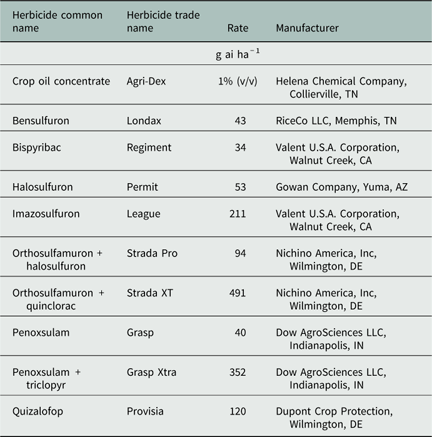
The study was a randomized complete block with a factorial arrangement of treatments with four replications. Factor A consisted of quizalofop applied at 120 g ha−1 or no quizalofop. Factor B consisted of penoxsulam at 40 g ai ha−1, penoxsulam plus triclopyr at 352 g ai ha−1, halosulfuron at 53 g ai ha−1, bispyribac at 34 g ai ha−1, orthosulfamuron plus halosulfuron at 94 g ai ha−1, orthosulfamuron plus quinclorac at 491 g ai ha−1, imazosulfuron at 211 g ai ha−1, bensulfuron at 43 g ai ha−1, or no mixture herbicide. Sources of materials are listed in Table 1. A second quizalofop application was applied to all treatments at a rate of 120 g ha−1 at 28 days after the initial quizalofop treatment (DAIT). This application was applied to evaluate quizalofop efficacy on weedy rice and barnyardgrass that escaped the initial application, potentially as a result of antagonism, and because it is recommended by the BASF stewardship program for managing resistance development for ACCase-R (Anonymous 2017). A crop oil concentrate was added to each herbicide application at a rate of 1% (v/v).
Sources of materials used.

Visual evaluations for this study included crop injury and barnyardgrass, red rice, CL-111, and CLXL-745 control. Injury and control were recorded as percentages, with 0 meaning no injury or control and 100 meaning complete plant death, at 14, 28, and 42 days after the initial treatment. Immediately prior to harvest, ACCase-R rice plant height from the ground to the tip of the extended rice panicle was recorded from four plants in each plot (data not shown). The center four rows planted in ACCase-R rice were harvested with a Mitsubishi VM3 (Mitsubishi Corporation, 3-1, Marunouchi 2-chome, Chiyoda-ky, Tokyo, Japan) plot combine, and grain yield was adjusted to 12% moisture.
Control data were analyzed using the Blouin et al. (Reference Blouin, Webster and Bond2010) augmented mixed model to determine synergistic, antagonistic, or neutral responses for herbicide mixtures by comparing an expected control calculated based on activity of each herbicide applied alone to an observed control (Fish et al. Reference Fish, Webster, Blouin and Bond2015, Reference Fish, Webster, Blouin and Bond2016; Webster et al. Reference Webster, Teló, Blouin and McKnight2017a, Reference Webster, Telo, Blouin, McKnight and Bergeron2017b). Rough rice yield data were analyzed using the MIXED procedure in SAS (SAS 2013). Tukey’s HSD test was used to separate yield means at the 5% probability level. The fixed effects for all models were the herbicide treatments and evaluation timing. The random effects were year, replication within year, and plot. Considering year or combination of years as a random effect accounts for different environmental conditions each year having an effect on herbicide treatments for that year (Carmer et al. Reference Carmer, Nyuist and Walker1989; Hager et al. Reference Hager, Wax, Bollero and Stroller2003). Normality of effects over all DAIT was checked using the UNIVARIATE procedure of SAS. Assumptions for normality were met (SAS 2013).
Results and Discussion
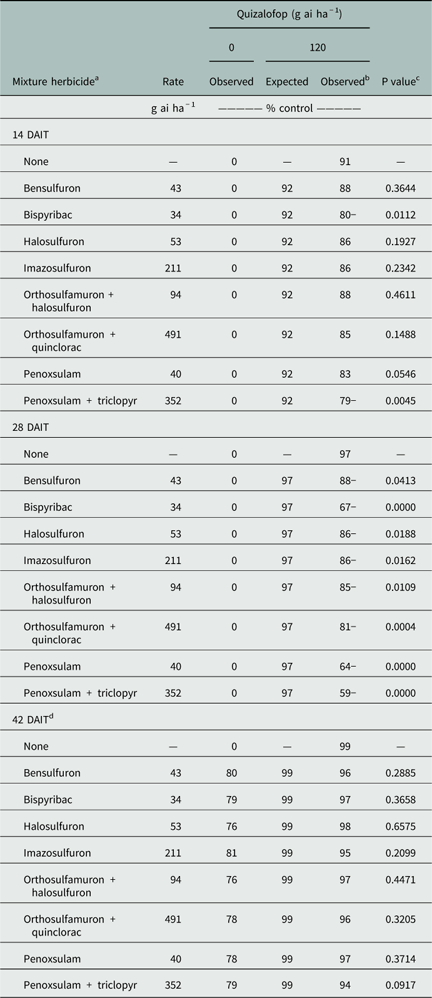
Antagonistic responses were observed for red rice control at 14 DAIT when quizalofop was mixed with bispyribac or penoxsulam plus triclopyr by reducing an expected control of 92% to an observed control of 80% and 79%, respectively (Table 2). All other mixtures resulted in a neutral response on red rice at 14 DAIT. However, at 28 DAIT, all mixture herbicides evaluated antagonized quizalofop for red rice control. Penoxsulam, penoxsulam plus triclopyr, or bispyribac mixed with quizalofop reduced the expected control of 97% to an observed control of 59% to 67%. Halosulfuron, orthosulfamuron plus halosulfuron, orthosulfamuron plus quinclorac, imazosulfuron, or bensulfuron mixed with quizalofop reduced red rice control to an observed control of to 81% to 88%. A neutral response for red rice control was observed at 42 DAIT for all mixtures evaluated, due to the second application of quizalofop applied 28 DAIT. Expected control for red rice at 42 DAIT was 99% with an observed control of 94% to 98% for red rice treated with all mixtures evaluated.
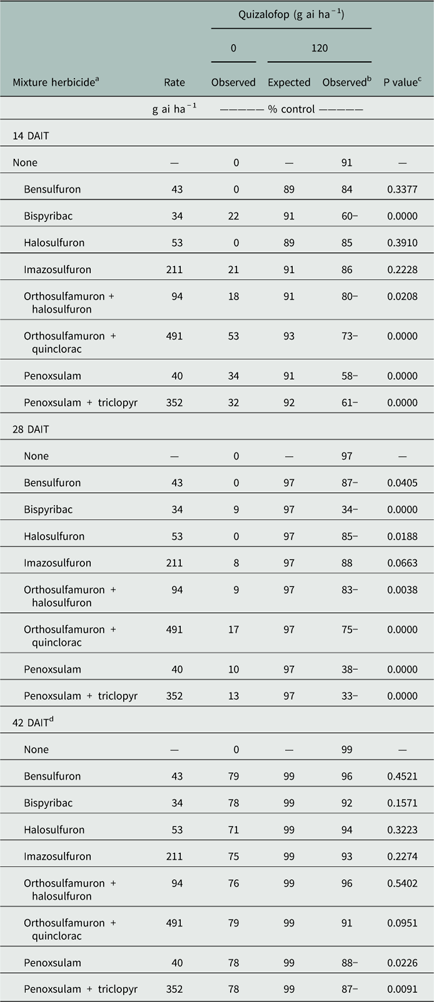
Red rice control with quizalofop applied alone or mixed with various herbicides with activity on the acetolactate synthase enzyme. Blouin’s modified Colby’s analysis was used to determine interactions in 2015 and 2016.

a Evaluation dates for each herbicide mixture are in days after initial treatment (DAIT).
b Observed means followed by a minus sign (−) are significantly different from Blouin’s modified Colby’s expected responses at the 5% level, which indicates an antagonistic response. No (—) indicates a neutral response.
c P<0.05 indicates an antagonistic response; P>0.05 indicates a neutral response.
d Control observed for each mixture herbicide with an additional independent application of quizalofop applied 28 days after the initial treatment.
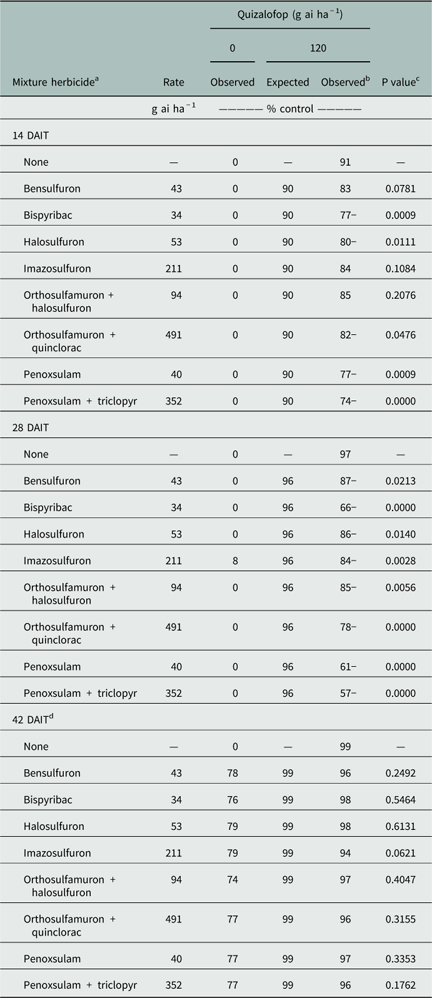
Hybrid CLXL-745 rice was also treated with all mixtures evaluated for red rice control. Similar to red rice responses at 14 DAIT, the addition of bispyribac or penoxsulam plus triclopyr antagonized quizalofop; however, the addition of penoxsulam alone, halosulfuron, or orthosulfamuron plus quinclorac also antagonized quizalofop on CLXL-745 (Table 3). All mixture herbicides that antagonized quizalofop reduced observed control to 74% to 82%, while the expected control was 90%. Similar to results observed with red rice, all ALS herbicides mixed with quizalofop proved to antagonize quizalofop on CLXL-745 at 28 DAIT. However, a second independent application of quizalofop at 28 DAIT overcame the antagonism observed at 14 or 28 DAIT, with observed control of 94% to 98%, similar to observed control of red rice at 42 DAIT.
Hybrid CLXL-745 imidazolinone-resistant rice control with quizalofop applied alone or mixed with various herbicides with activity on the acetolactate synthase enzyme. Blouin’s modified Colby’s analysis was used to determine interactions in 2015 and 2016.

a Evaluation dates for each herbicide mixture are in days after initial treatment (DAIT).
b Observed means followed by a minus sign (−) are significantly different from Blouin’s modified Colby’s expected responses at the 5% level, which indicates an antagonistic response. No (—) indicates a neutral response.
c P<0.05 indicates an antagonistic response; P>0.05 indicates a neutral response.
d Control observed for each mixture herbicide with an additional independent application of quizalofop applied 28 days after the initial treatment.
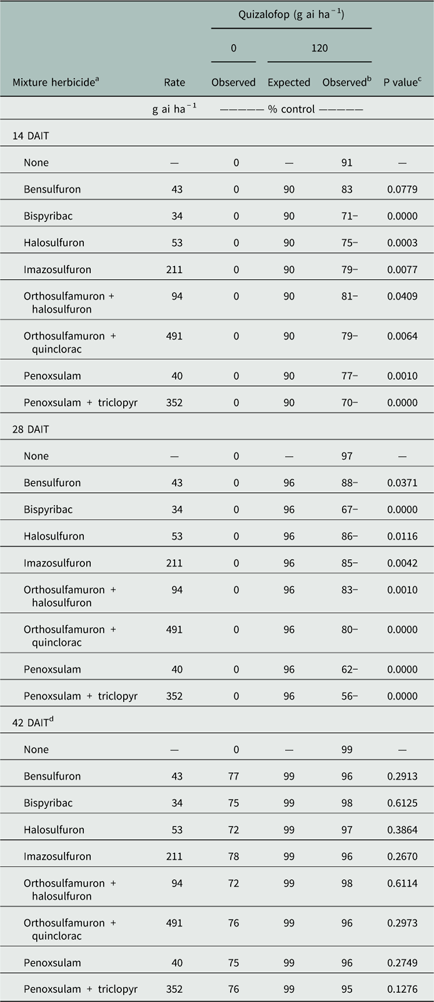
Antagonistic responses were observed at 14 DAIT for CL-111 when treated with quizalofop plus any ALS herbicide except bensulfuron, which indicated a neutral response at 14 DAIT (Table 4). All other ALS herbicides antagonized quizalofop, with an observed control of 70% to 81%, while the expected control was 90%. Bensulfuron was the only ALS herbicide that did not antagonize quizalofop activity on red rice (Table 2), CLXL-745 (Table 3), or CL-111 (Table 4) evaluated at 14 DAIT, and this may indicate the potential as a mixture herbicide with quizalofop early in the growing season when weedy rice is present. However, by 28 DAIT, antagonism was observed for all mixtures evaluated. Bensulfuron was slightly antagonistic to quizalofop activity; it decreased observed control to 88%, while the expected control was 96%, with a P value of 0.0371. As with red rice and CLXL-745, the addition of a follow-up application of quizalofop resulted in a neutral response for all ALS herbicide mixtures evaluated.
Imidazolinone-resistant CL-111 rice control with quizalofop applied alone or mixed with various herbicides with activity on the acetolactate synthase enzyme. Blouin’s modified Colby’s analysis was used to determine interactions in 2015 and 2016.

a Evaluation dates for each respective herbicide mixture are in days after initial treatment (DAIT).
b Observed means followed by a minus sign (−) are significantly different from Blouin’s modified Colby’s expected responses at the 5% level, indicating an antagonistic response. No (—) indicates a neutral response.
c P<0.05 indicates an antagonistic response; P>0.05 indicates a neutral response.
d Control observed for each mixture herbicide with an additional independent application of quizalofop applied 28 days after the initial treatment.
Barnyardgrass was evaluated each year of the study. At 14 DAIT, bispyribac and penoxsulam plus triclopyr antagonized quizalofop for barnyardgrass (Table 5), red rice (Table 2), CLXL-745 (Table 3), and CL-111 (Table 4) control. In addition, penoxsulam, orthosulfamuron plus halosulfuron, and orthosulfamuron plus quinclorac were also found to be antagonistic for barnyardgrass control at 14 DAIT, with 58% to 80% observed control when mixed with quizalofop, while the expected control was 91% to 93% (Table 5). As was seen in the red rice (Table 2), CLXL-745 (Table 3), and CL-111 (Table 4) control results at 28 DAIT, quizalofop activity for barnyardgrass control was antagonized when quizalofop was mixed with penoxsulam, penoxsulam plus triclopyr, or bispyribac: the observed control was 33% to 38%, while the expected control was 97%. Additionally, at 28 DAIT bensulfuron, halosulfuron, orthosulfamuron plus halosulfuron, or orthosulfamuron plus quinclorac antagonized quizalofop activity on barnyardgrass, with an observed control of 75% to 87% while the expected control was 97%. However, results from barnyardgrass treated with quizalofop plus imazosulfuron indicated a neutral response at 14 and 28 DAIT, with an observed control of 86% and 88%, respectively. As with red rice (Table 2), CLXL-745 (Table 3), and CL-111 (Table 4), any antagonism observed at 14 and 28 DAIT was overcome with a second application of quizalofop, except with penoxsulam-containing herbicides for barnyardgrass control. These data indicate that producers may need to avoid using penoxsulam in an ACCase-R rice production system.
Barnyardgrass control with quizalofop applied alone or mixed with various herbicides with activity on the acetolactate synthase enzyme. Blouin’s modified Colby’s analysis was used to determine interactions in 2015 and 2016.

a Evaluation dates for each respective herbicide mixture are in days after initial treatment (DAIT).
b Observed means followed by a minus sign (−) are significantly different from Blouin’s modified Colby’s expected responses at the 5% level, which indicates an antagonistic response. No (—) indicates a neutral response.
c P<0.05 indicates an antagonistic response; P>0.05 indicates a neutral response.
d Control observed for each mixture herbicide with an additional independent application of quizalofop applied 28 days after the initial treatment.
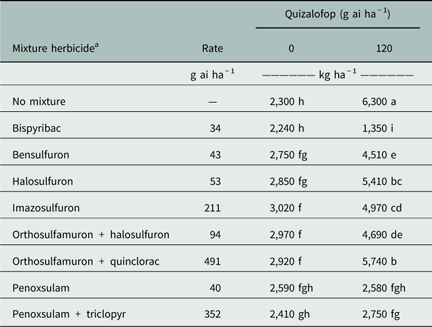
Crop injury was less than 10% across all evaluations (data not shown). ACCase-R rough rice yield was 6,300 kg ha−1 when treated with quizalofop applied alone (Table 6). ACCase-R rice yield was reduced to 1,350 to 2,750 kg ha−1 when treated with quizalofop mixed with bispyribac, penoxsulam, or penoxsulam plus triclopyr. These three mixtures also consistently antagonized quizalofop for red rice (Table 2), CLXL-745 (Table 3), CL-111 (Table 4), and barnyardgrass (Table 5) control. ACCase-R rice treated with quizalofop mixed with halosulfuron, orthosulfamuron plus halosulfuron, orthosulfamuron plus quinclorac, imazosulfuron, or bensulfuron resulted in a yield of 4,510 to 5,740 kg ha−1. These mixtures were also antagonistic for red rice, CLXL-745, CL-111, and barnyardgrass control. These yield data indicate that the antagonism of quizalofop by ALS-inhibiting herbicides in the initial application on the weedy rice complex and barnyardgrass resulted in corresponding yield reductions of ACCase-R rice. The second application of quizalofop overcame the initial antagonism observed, except when mixed with penoxsulam or penoxsulam plus triclopyr on barnyardgrass, and yield losses can be attributed to competition from surviving weeds due to antagonism.
Rough rice yields of acetyl-coA carboxylase inhibitor–resistant rice treated with quizalofop and acetolactate synthase herbicide mixtures in 2015 and 2016.

a Respective herbicide mixtures.
b Means followed by a common letter are not significantly different at P=0.05 by Tukey’s HSD.
In conclusion, it is important that one understand the compatibility between quizalofop and ALS-inhibiting herbicides before developing an herbicide program for ACCase-R rice. These data suggest that the application of quizalofop mixed with common ALS herbicides used in rice production can result in an antagonistic response resulting in yield reduction, thus potentially reducing economic returns. All mixtures evaluated indicated an antagonistic response on either barnyardgrass or weedy rice at 14 or 28 DAIT. By 28 DAIT, penoxsulam-containing compounds and bispyribac were least compatible with quizalofop for barnyardgrass and weedy rice control, thus resulting in greatest ACCase-R rice yield loss. ACCase-R rice had similar yields when treated with penoxsulam-containing herbicides applied alone or mixed with quizalofop. ACCase-R rice treated with bispyribac had lower yields when the bispyribac was applied in a mixture with quizalofop than when the bispyribac was applied alone, and this may indicate that quizalofop may also antagonize bispyribac. Zhang et al. (Reference Zhang, Webster, Blouin and Leon2005) reported similar antagonistic responses with ALS-inhibiting herbicides halosulfuron or bensulfuron mixed with the ACCase herbicide fenoxaprop. Another ACCase herbicide, cyhalofop, has also been reported to be antagonized when mixed with halosulfuron (Scherder et al. Reference Scherder, Talbert and Lovelace2005). These data indicate that a second application of quizalofop applied alone at 28 DAIT can result in a neutral response for red rice, CLXL-745, CL-111, and barnyardgrass control, except where quizalofop was previously applied mixed with penoxsulam-containing herbicides on barnyardgrass (Table 5). Though these data indicate neutral responses from a second quizalofop application for barnyardgrass and weedy rice, initially antagonized weeds can still compete with ACCase-R rice, resulting in yield reductions (Table 6). Independent applications of quizalofop are more beneficial than mixing quizalofop with ALS inhibiting herbicides for control of red rice and barnyardgrass which translates into increased rice yield.