1. Introduction
1·1. The interchange process and random walk on graphs and hypergraphs
Consider a finite undirected graph G on n vertices. In the interchange process (IP) on G, n distinct balls are placed at the vertices of G, one ball at every vertex. At every step of the process, one picks an edge of G uniformly at random, and interchanges the two balls at the endpoints of the chosen edge. Every step is independent of the other steps. This is a Markov chain with
 $n!$
states and accordingly has a spectrum of
 $n!$
eigenvalues. All eigenvalues are real, contained in
 $\left[-1,1\right]$
, with a trivial eigenvalue at 1 corresponding to the uniform distribution on all possible states.
One may also consider a simpler process on G, which we refer to as the random walk (RW) on G. In this process there is a single ball, which is located at one of the vertices. At each step, one picks an edge of G uniformly at random as before. If the ball sits at an endpoint of this edge, it is moved to the other endpoint, and otherwise it stays in its place. Note that unlike the ordinary simple random walk, we do not necessarily pick an edge incident to the ball. This Markov chain consists of n possible states and thus has a spectrum of n eigenvalues. As before, they are all real and contained in
 $\left[-1,1\right]$
, and the uniform distribution on the vertices gives a trivial eigenvalue at 1.
It is a simple observation (see Section 2) that the spectrum of RW is contained in that of IP, so, in particular,
 $\lambda_{2}^{\mathrm{RW}}\left(G\right)\le\lambda_{2}^{\mathrm{IP}}\left(G\right)$
, where
 $\lambda_{i}$
is the
 $i{\mathrm{th}}$
largest eigenvalue, counted with multiplicity. Around 1992, Aldous conjectured that for any graph, the spectral gaps
 $\lambda_{1}-\lambda_{2}=1-\lambda_{2}$
of both processes are, in fact, identical. Some partial results were proven along the following years (see [
Reference Caputo, Liggett and RichthammerCLR10
] for a survey), but it was only established in full in 2010, by Caputo, Liggett and Richthammer. Moreover, they established the conjecture for any fixed probability distribution on the edges of the graph G.
Theorem 1·1 [ Reference Caputo, Liggett and RichthammerCLR10 , theorem 1·1]. Let G be a finite weighted graph with non-negative weights on the edges. Then
 \begin{equation}\lambda_{2}^{\mathrm{RW}}\left(G\right)=\lambda_{2}^{\mathrm{IP}}\left(G\right)\!,\end{equation}
where RW and IP are the random walk and interchange process on G, respectively, with each edge chosen at every step with probability proportional to its weight.
The equality (1·1) is remarkable: although the spectrum of IP is much larger – of size
 $n!$
– its highest non-trivial eigenvalue always comes from the small pool of
 $n-1$
non-trivial eigenvalues of the RW process.
It is natural to wonder what possible generalisations of this intriguing result may hold. One such generalisation, sometimes called the
 $\alpha$
-shuffle conjecture, was suggested by P. Caputo ([
Reference PirasPir10
, conjecture 3], [
Reference CesiCes16
, p. 301], [
Reference Aldous, Caputo, Durrett, Holroyd, Jung and PuhaACD+20
, p. 78]). It is a natural generalisation to hypergraphs of the Aldous–Caputo–Liggett–Richthammer Theorem. A finite weighted hypergraph consists of a finite set of vertices together with a collection of distinct subsets of the edges, called hyper-edges, and a non-negative weight for each hyper-edge. So a weighted graph is the special case of a weighted hypergraph where all hyper-edges are of size 2. As before, at each step of the IP or the RW we may pick a random hyper-edge with probability proportional to its weight. Once a certain hyper-edge is chosen, say of size d, pick a uniformly random permutation of the d vertices contained in the hyper-edge, among all
 $d!$
possible permutations, and move around accordingly the balls at these vertices. Here we allow hyper-edges of cardinality 0 and 1, although they only add laziness to the two processes.
Conjecture 1·2 (Caputo’s conjecture for hypergraphs). Let G be an arbitrary finite weighted hypergraph with non-negative weights. Then
 \[\lambda_{2}^{\mathrm{RW}}\left(G\right)=\lambda_{2}^{\mathrm{IP}}\left(G\right)\!,\]
where RW and IP are the random walk and interchange process on G, respectively, defined by picking, at every step, a random hyper-edge with probabilities proportional to the weights and then a uniformly distributed permutation supported on the vertices of this hyper-edge.
As in the graph case, the equality
 $\lambda_{1}^{\mathrm{RW}}\left(G\right)=\lambda_{1}^{\mathrm{IP}}\left(G\right)$
and the inequality
 $\lambda_{2}^{\mathrm{RW}}\left(G\right)\le\lambda_{2}^{\mathrm{IP}}\left(G\right)$
are both easy observations – see Lemma 2·1. Note that Theorem 1·1 is the special case of Conjecture 1·2 where the hypergraph is restricted to be an ordinary graph. Indeed, although in the statement of Conjecture 1·2 we add laziness to the processes – at every step, with probability
 $1/2$
, we choose the identity permutation – this change shifts the entire spectrum of both processes linearly by
 $\lambda\mapsto({\lambda+1})/{2}$
, so (1·1) in one setup is equivalent to the same equality in the other setup.
The special case of Conjecture 1·2 where the weight of an hyper-edge depends only on its size was recently settled in [ Reference Bristiel and CaputoBC24 , theorem 1·8]Footnote 1 . Here we generalise Theorem 1·1 to include more cases from this conjecture:
Theorem 1·3. Let G be a finite weighted hypergraph with non-negative weights and B a subset of its vertices. Assume that every hyper-edge E of G satisfies
 $E\supseteq B$
and
 $\left|E\setminus B\right|\le2$
. Then
 \[\lambda_{2}^{\mathrm{RW}}\left(G\right)=\lambda_{2}^{\mathrm{IP}}\left(G\right)\!,\]
where the IP and RW processes are defined as in Conjecture 1·2.
When
 $B=\emptyset$
, Theorem 1·3 recovers Theorem 1·1. The setup in Theorem 1·3 can be thought of as a blow-up of the setup in Theorem 1·1: one takes the edges of the graph from Theorem 1·1, adds some singletons and possibly the empty set (both of which only add harmless laziness in the original setup), and then adds the external points of B to each one of the sets. To illustrate, Theorem 1·3 applies to the hypergraph in Figure 1·1 (with arbitrary non-negative weights on the hyper-edges).
A hypergraph for which Theorem 1·3 applies. With vertices
 $\left[6\right]=\left\{ 1,2,3,4,5,6\right\} $
, this hypergraph consists of the hyper-edges
 $\left\{ 1,2,3\right\} $
,
 $\left\{ 1,2,4\right\} $
,
 $\left\{ 1,3,4\right\} $
,
 $\left\{ 1,4,5\right\} $
,
 $\left\{ 1,5,6\right\} $
and
 $\left\{ 1,6\right\} $
. In the notation of Theorem 1·3, here
 $B=\left\{ 1\right\} $
.

We remark that limited simulations we conducted support Conjecture 1·2 in its full generality. We can also prove the conjecture in several additional cases not covered by Theorem 1·3. These cases include certain trees of hyper-edges or hypergraphs consisting of hyper-edges of size at least
 $n-1$
. We elaborate more in Section 7.
1·2. A representation theoretic point of view
A fruitful point of view on Aldous’ spectral gap conjecture and the results and conjectures above is that of representation theory. In fact, this whole line of research began in the seminal paper of Diaconis–Shahshahani [ Reference Diaconis and ShahshahaniDS81 ], which uses representation theory to analyse the IP of the complete graph. In addition, Cesi shows in [ Reference CesiCes16 ] how representation theory clarifies the proof of Aldous’ conjecture from [ Reference Caputo, Liggett and RichthammerCLR10 ]. In the current paper this perspective is extremely useful and we stick to it.
Definition. Denote the symmetric group on n elements by
 $\mathrm{Sym}_{n}$
and denote
 $\left[n\right]=\left\{ 1,\ldots,n\right\} $
. Consider the group ring element
 \begin{equation}\Sigma=\sum_{1\le i{\,\lt\,}j\le n}c_{i,j}\left(i\;j\right)\in\mathbb{R}\left[{\mathrm{Sym}}_{n}\right]\!,\end{equation}
where
 $\left(i\;j\right)$
is the transposition of i and j in
 ${\mathrm{Sym}}_{n}$
and
 $c_{i,j}\ge0$
for all
 $1\le i{\,\lt\,}j\le n$
. For every finite-dimensional complex or real representation
 $\rho\colon{\mathrm{Sym}}_{n}\to\mathrm{GL}\left(V\right)$
of
 ${\mathrm{Sym}}_{n}$
, the eigenvalues of
 $\rho\left(\Sigma\right)$
are all real (see Footnote 4 below). We denote by
 $\lambda_{i}\left(\Sigma,V\right)$
the ith largest eigenvalue of
 $\rho\left(\Sigma\right)$
, counted with multiplicity.
In these terms, the Caputo–Liggett–Richthammer theorem can be stated as follows:
Theorem 1·1’ (Representation theoretic version of Theorem 1·1). Let
 ${\bf R}=\mathbb{R}\;[{\mathrm{Sym}}_{n}]$
denote the regular representation of
 ${\mathrm{Sym}}_{n}$
and let
 $\mathbf{D=\mathbb{R}}^{n}$
be the standard representation of
 ${\mathrm{Sym}}_{n}$
via permutations of the coordinates. For
 $\Sigma\in\mathbb{R}\left[{\mathrm{Sym}}_{n}\right]$
as in (1·2) we have
 \begin{equation}\lambda_{2}\left(\Sigma,{\mathrm{\mathbf{D}}}\right)=\lambda_{2}\left(\Sigma,{\mathrm{\mathbf{R}}}\right)\!.\end{equation}
In this setup, the eigenvalues of
 $\Sigma$
in both
 ${\mathrm{\mathbf{R}}}$
and
 ${\mathrm{\mathbf{D}}}$
are all contained in the interval
 $\left[-\sum c_{i,j},{{\sum c_{i,j}}}\right]$
. The equality
 $\lambda_{1}\left(\Sigma,{\mathrm{\mathbf{D}}}\right)=\lambda_{1}\left(\Sigma,{\mathrm{\mathbf{R}}}\right)=\lambda_{1}\left(\Sigma,{\mathrm{\mathbf{I}}}\right)=\sum_{i,j}c_{i,j}$
(here
 ${\mathrm{\mathbf{I}}}$
is the trivial representation), and the inequality
 $\lambda_{2}\left(\Sigma,{\mathrm{\mathbf{D}}}\right)\le\lambda_{2}\left(\Sigma,{\mathrm{\mathbf{R}}}\right)$
are straightforward: indeed,
 ${\mathrm{\mathbf{D}}}$
is a sub-representation of
 ${\mathrm{\mathbf{R}}}$
, and
 ${\mathrm{\mathbf{I}}}$
is a subrepresentation of both — see Lemma 2·1.
It is natural to wonder which further elements
 $\Sigma\in\mathbb{R}\left[{\mathrm{Sym}}_{n}\right]$
satisfy the equality (1·3) or similar equalities. See the discussions in [
Reference CesiCes16
, section 5] and in [
Reference Parzanchevski and PuderPP20
, sections 1 and 4] around this question. In this language, Caputo’s
 $\alpha$
-shuffles conjecture becomes the following. For every
 $A\subseteq n$
define a
 $J_{A}\in\mathbb{R}\;[{\mathrm{Sym}}_{n}]$
using
 \begin{equation}{\displaystyle J_{A}\,{\stackrel{\mathrm{def}}{=}}\,\sum_{\sigma\in{\mathrm{Sym}}_{n}\colon\mathrm{supp}\left(\sigma\right)\subseteq A}\sigma}.\end{equation}
For example,
 $J_{\left\{ 1,2,4\right\} }={\mathrm{id}}+\left(1\;2\right)+\left(1\;4\right)+\left(2\;4\right)+\left(1\;2\;4\right)+\left(1\;4\;2\right)$
and
 $J_{\left\{ 5\right\} }=J_{\emptyset}={\mathrm{id}}$
.
Conjecture 1·2’ (Representation theoretic version of Conjecture 1·2). Let
 $\left\{ w_{A}\;:\;A\subseteq\left[n\right]\right\} $
be non-negative real numbers, and consider the group ring element
 \begin{equation}U=\sum_{A\subseteq\left[n\right]}w_{A}J_{A}\in\mathbb{R}\left[{\mathrm{Sym}}_{n}\right]\!.\end{equation}
Then
 $\lambda_{2}\left(U,{\bf D}\right)=\lambda_{2}\left(U,\mathbf{R}\right)$
.
Theorem 1·3 can be stated as follows:
Theorem 1·3’ (Representation theoretic version of Theorem 1·3). Let
 $B\subseteq\left[n\right]$
and consider the group ring element
 \[U=\sum_{\substack{B\subseteq A\subseteq\left[n\right]\colon\\\left|A\setminus B\right|\le2}}w_{A}J_{A}\in\mathbb{R}\left[{\mathrm{Sym}}_{n}\right],\]
where
 $w_{A}\ge0$
are arbitrary non-negative numbers. Then
 $\lambda_{2}\left(U,{\bf D}\right)=\lambda_{2}\left(U,\mathbf{R}\right)$
.
1·3. Generalisations of the Octopus Inequality
A key ingredient of the proof of Theorem 1·1’ in [
Reference Caputo, Liggett and RichthammerCLR10
], which we sketch in Section 3·1, is a certain inequality of operators in the group ring of
 ${\mathrm{Sym}}_{n}$
, called the Octopus Inequality. The Octopus Inequality is also of independent interest, see [
Reference ChenChe17
] and [
Reference Alon and KozmaAK20
]. Inspired by the proof in [
Reference Caputo, Liggett and RichthammerCLR10
], a main ingredient of our proof of Theorem 1·3’ is a generalisation of the Octopus Inequality. In fact, we also include further generalisations of the Octopus Inequality which are not used in the proof of Theorem 1·3’. We find this type of general inequalities of operators in the group algebra
 $\mathbb{R}\left[{\mathrm{Sym}}_{n}\right]$
remarkable and interesting for their own right.
Definition 1·4. For two elements
 $\Sigma_{1},\Sigma_{2}\in\mathbb{R}\left[{\mathrm{Sym}}_{n}\right]$
we write
 $\Sigma_{1}\ge\Sigma_{2}$
if
 $\rho\left(\Sigma_{1}-\Sigma_{2}\right)$
is a positive semi-definite operator for every (finite dimensional) representation
 $\rho$
of
 ${\mathrm{Sym}}_{n}$
.Footnote
2
Definition 1·5. For any subset
 $\emptyset\ne A\subseteq\left[n\right]$
denote
 \begin{equation}\alpha_{A}\,{\stackrel{\mathrm{def}}{=}}\,\frac{1}{\left(\left|A\right|-1\right)!}\sum_{\pi\in\mathrm{Sym}\left(A\right)}\left({\mathrm{id}}-\pi\right)\in\mathbb{R}\left[{\mathrm{Sym}}_{n}\right],\end{equation}
where
 ${\mathrm{id}}\in{\mathrm{Sym}}_{n}$
denotes the identity permutation.
Thus
 $\alpha_{A}=\left|A\right|\cdot{\mathrm{id}}-{J_{A}}/{\left(\left|A\right|-1\right)!}$
. For example,
 $\alpha_{\left\{ i,j\right\} }={\mathrm{id}}-\left(i\;j\right)$
. For completeness, we also define
 $\alpha_{\emptyset}\,{\stackrel{\mathrm{def}}{=}}\,0\in\mathbb{R}\left[{\mathrm{Sym}}_{n}\right]$
for A the empty set. Note that
 $\alpha_{A}=0$
whenever
 $\left|A\right|\le1$
. As explained in Lemma 2·3,
 $\alpha_{A}\ge0$
for all
 $A\subseteq\left[n\right]$
.
The Octopus Inequality [ Reference Caputo, Liggett and RichthammerCLR10 , theorem 2·3] (and see also [ Reference CesiCes16 , equation (4·6)]), can be formulated as follows:
Theorem 1·6 (Octopus Inequality). Let
 $c_{2},\ldots,c_{n}\ge0$
be non-negative numbers. Then we have the following inequality of operators in
 $\mathbb{R}\left[{\mathrm{Sym}}_{n}\right]$
:
 \begin{equation}\left(\sum_{i=2}^{n}c_{i}\right)\left(\sum_{j=2}^{n}c_{j}\alpha_{\left\{ 1,j\right\} }\right)\ge\sum_{2\le i{\,\lt\,}j\le n}c_{i}c_{j}\alpha_{\left\{ i,j\right\} }.\end{equation}
One generalisation of the Octopus Inequality is the following:
Theorem 1·7 (Generalised Octopus — disjoint sets). Let
 $A_{1},\ldots,A_{t}\subseteq\left\{ 2,\ldots,n\right\} $
be pairwise
 $\mathbf{disjoint}$
subsets and
 $c_{1},\ldots,c_{t}\ge0$
be non-negative numbers. Then we have the following inequality of operators in
 $\mathbb{R}\left[{\mathrm{Sym}}_{n}\right]$
:
 \begin{equation}\left(\sum_{i=1}^{t}c_{i}\left|A_{i}\right|\right)\left(\sum_{j=1}^{t}c_{j}\left(\alpha_{A_{j}\cup\left\{ 1\right\} }-\alpha_{A_{j}}\right)\right)\ge\sum_{i=1}^{t}c_{i}^{\;2}\alpha_{A_{i}}+\sum_{1\le i{\,\lt\,}j\le t}c_{i}c_{j}\left(\alpha_{A_{i}\cup A_{j}}-\alpha_{A_{i}}-\alpha_{A_{j}}\right)\!.\end{equation}
When all the
 $A_{i}$
’s are singletons, Theorem 1·7 recovers the Octopus Inequality (recall that
 $\alpha_{A}=0$
for A a singleton). Yet another generalisation of Theorem 1·6 in a different direction is the following result, which is the key ingredient in the proof of Theorem 1·3’.
Theorem 1·8 (Generalised Octopus — sets with large intersection). Let
 $A_{0}\subseteq\left\{ 2,\ldots,n\right\} $
, let
 $A_{1},\ldots,A_{t}\subseteq\left\{ 2,\ldots,n\right\} $
be distinct sets satisfying
 $A_{0}\subseteq A_{i}\subseteq\left\{ 2,\ldots,n\right\} $
and
 $\left|A_{i}\setminus A_{0}\right|=1$
, and let
 $c_{0},c_{1},\ldots,c_{t}\ge0$
be non-negative numbers. Then we have the following inequality of operators in
 $\mathbb{R}\left[{\mathrm{Sym}}_{n}\right]$
:
 \begin{equation}\left(\sum_{i=0}^{t}c_{i}\left|A_{i}\right|\right)\left(\sum_{j=0}^{t}c_{j}\left(\alpha_{A_{j}\cup\left\{ 1\right\} }-\alpha_{A_{j}}\right)\right)\ge\sum_{i=0}^{t}c_{i}^{\;2}\alpha_{A_{i}}+\sum_{0\le i{\,\lt\,}j\le t}c_{i}c_{j}\left(\alpha_{A_{i}\cup A_{j}}+\alpha_{A_{0}}\right)\!.\end{equation}
Theorem 1·8, too, restricts to Theorem 1·6: this time, when
 $A_{0}=\emptyset$
. A third inequality we prove in this paper is the content of the following theorem. This one does not contain the original Octopus Inequality as a special case.
Theorem 1·9 (Generalised Octopus — sets of co-size one). Let
 $A_{0}\subseteq\left\{ 2,\ldots,n\right\} $
, let
 $A_{1},\ldots,A_{t}$
be distinct sets satisfying
 $A_{i}\subseteq A_{0}$
and
 $\left|A_{0}\setminus A_{i}\right|=1$
for
 $i=1,\ldots,t$
, and let
 $c_{0},c_{1},\ldots,c_{t}\ge0$
be non-negative numbers. Then we have the following inequality of operators in
 $\mathbb{R}\left[{\mathrm{Sym}}_{n}\right]$
:
 \begin{equation}\left(\sum_{i=0}^{t}c_{i}\left|A_{i}\right|\right)\left(\sum_{j=0}^{t}c_{j}\left(\alpha_{A_{j}\cup\left\{ 1\right\} }-\alpha_{A_{j}}\right)\right)\ge\sum_{i=0}^{t}c_{i}^{\;2}\alpha_{A_{i}}+\sum_{0\le i{\,\lt\,}j\le t}c_{i}c_{j}\left(\alpha_{A_{0}}+\alpha_{A_{i}\cap A_{j}}\right)\!.\end{equation}
In Section 3.2 we explain how the three Theorems 1·7, 1·8 and 1·9 all originate from the same inequality scheme.
Paper organisation. We begin in Section 2 with some preliminaries on the representation theory of the symmetric group, as well as some lemmas that will be used in the following sections. Section 3 sketches the proof of Aldous’ conjecture by Caputo–Liggett–Richthammer, explains how one might generalise it to hypergraphs, and reduces Theorem 1·3’ to Theorem 1·8. Sections 4, 5 and 6 prove Theorems 1·7, 1·8 and 1·9, respectively, the proof of Theorem 1·8 being by far the most involved. In fact, in the latter proof we also rely partially on computer computations. In Section 7 we mention a few further special cases of Caputo’s conjecture on hypergraphs which hold true, and in Section 8 mention a few examples illustrating the limitations of our approach as detailed in Section 3. Finally, the appendix contains the sage-code we used in some arguments in the proof of Theorem 1·8, as detailed in Section 5.
Notation. Throughout the paper we repeatedly use the notation of
 $\alpha_{A}$
as defined in (1·6) and of
 $J_{A}$
as defined in (1·4). If E is a (finite) set and
 $d\in\mathbb{Z}_{\ge0}$
a non-negative integer, we denote by
 $\binom{E}{d}$
the set of subsets of E of size d.
2. Representation theory preliminaries
Let us start by a quick overview of the representation theory of the symmetric group. As in the introduction, we set
 ${\bf R}=\mathbb{R}\;[{\mathrm{Sym}}_{n}]$
,
 $\mathbf{D=\mathbb{R}}^{n}$
and
 ${\mathrm{\mathbf{I}}}=\mathbb{R}$
, where all three are considered as representations of
 ${\mathrm{Sym}}_{n}$
. We shall often use the ring embedding
 $\mathbb{R}\hookrightarrow\mathbf{R}$
via
 $c\mapsto c\cdot{\mathrm{id}}$
, in an implicit manner.
Recall that a partition
 $\mu=\left(\mu_{1},\dotsc,\mu_{r}\right)$
of a positive integer n is a sequence of integers
 $\mu_{1}\geq\mu_{2}\geq\dotsb\geq\mu_{r}{\,\gt\,}0$
such that
 $\sum\mu_{i}=n$
. This occurrence is denoted by
 $\mu\vdash n$
. We also set
 $|\mu|=n$
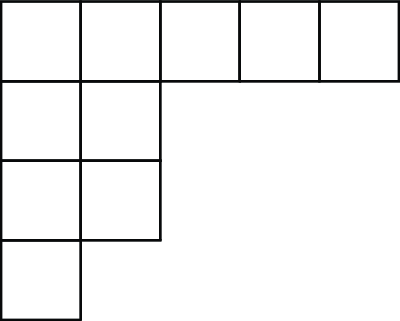
. A Young Diagram is a finite array of squares, which is made out of left aligned rows, such that the lengths of the rows (when viewed from top to bottom) are non-increasing. Therefore, there is a one-to-one correspondence between partitions of n and Young diagrams of size n: a partition
 $\mu$
corresponds to a Young diagram whose
 $i{\mathrm{th}}$
row has
 $\mu_{i}$
squares. See Figure 2·1. In the sequel, we shall not distinguish between a partition
 $\mu$
and its corresponding Young diagram.
The Young diagram corresponding to the partition
 $\mu=\left(5,2,2,1\right)\vdash10$
.

As a finite group, the symmetric group
 ${\mathrm{Sym}}_{n}$
has only a finite number of isomorphism classes of representations over
 $\mathbb{C}$
(this number is equal to the number of conjugacy classes of the group), and in the case of
 ${\mathrm{Sym}}_{n}$
they can all be realized overFootnote
3
 $\mathbb{R}$
. These isomorphism classes are classified by the Young diagrams of size n. For any
 $\mu\vdash n$
, we let
 $V_{\mu}$
denote a representation of
 ${\mathrm{Sym}}_{n}$
whose isomorphism class corresponds to
 $\mu$
. The following facts are well known:
-
(i)
 ${\mathrm{\mathbf{I}}}\cong V_{\left(n\right)}$
is the trivial (one-dimensional) representation of
${\mathrm{Sym}}_{n}$
;
-
(ii)
$\mathbf{D}\cong V_{\left(n\right)}\oplus V_{\left(n-1,1\right)}$
is the standard representation of
${\mathrm{Sym}}_{n}$
; and -
(iii)
${\bf R}\cong\bigoplus_{\mu\vdash n}\dim V_{\mu}\cdot V_{\mu}$
is the regular representation of
${\mathrm{Sym}}_{n}$
.


The last isomorphism means that the decomposition of the regular representation
 ${\mathrm{\mathbf{R}}}$
into irreducible representations contains all the irreducible ones, each with multiplicity equal to its dimension. In the sequel, we denote these three representations
 ${\mathrm{\mathbf{I}}}_{n}$
,
 ${\mathrm{\mathbf{D}}}_{n}$
and
 ${\mathrm{\mathbf{R}}}_{n}$
when the parameter n is not clear from the context.
We now expand on the notation from Definition 1·4. For any representation V of
 ${\mathrm{Sym}}_{n}$
and any group ring element
 $\Sigma\in\mathbb{R}\left[{\mathrm{Sym}}_{n}\right]$
, we shall denote by
 $\Sigma|_{V}$
the action of
 $\Sigma$
on V, which is an element of
 $\mathrm{End}\left(V\right)$
. If
 $\Sigma$
is symmetric (i.e.,
 $\Sigma=\sum_{\pi\in{\mathrm{Sym}}_{n}}a_{\pi}\pi$
with
 $a_{\pi}=a_{\pi^{-1}}$
for all
 $\pi$
), then the eigenvalues of
 $\Sigma|_{V}$
are realFootnote
4
. For any
 $\Sigma_{1},\Sigma_{2}\in\mathbb{R}\left[{\mathrm{Sym}}_{n}\right]$
, we shall denote by
 $\Sigma_{1} {=}_{V}\Sigma_{2}$
the fact that
 $\left(\Sigma_{1}-\Sigma_{2}\right)|_{V}=0$
, and by
 $\Sigma_{1}{{\ge}}_{V}\Sigma_{2}$
(respectively,
 $\Sigma_{1}{\gt}_{V}\Sigma_{2}$
) the fact that
 $\left(\Sigma_{1}-\Sigma_{2}\right)|_{V}$
is a positive semi-definite (respectively, positive definite) operator (see Footnote 4). If
 $\Sigma_{1}-\Sigma_{2}$
is symmetric, then this is equivalent to
 $\Sigma_{1}-\Sigma_{2}$
having only non-negative (respectively, positive) eigenvalues. Whenever
 $\Sigma_{1}\geq_{\mathbf{R}}\Sigma_{2}$
we shall simply write
 $\Sigma_{1}\geq\Sigma_{2}$
. Note that this is equivalent to
 $\Sigma_{1}\geq_{V_{\mu}}\Sigma_{2}$
holding for every
 $\mu\vdash n$
.
The following basic lemma will be very useful.
Lemma 2·1. Let
 $\Sigma=\sum_{\pi\in{\mathrm{Sym}}_{n}}a_{\pi}\pi\in\mathbb{R}\left[{\mathrm{Sym}}_{n}\right]$
be a symmetric element with
 $a_{\pi}\ge0$
for all
 $\pi$
(in particular, as stated above, it has a real spectrum in every representation). Then
 $\lambda_{1}(\Sigma,{\mathrm{\mathbf{D}}})=\lambda_{1}(\Sigma,{\mathrm{\mathbf{R}}})=\lambda_{1}(\Sigma,{\mathrm{\mathbf{I}}})=\sum_{\pi}a_{\pi}$
and
 $\lambda_{2}(\Sigma,{\mathrm{\mathbf{D}}})\le\lambda_{2}(\Sigma,{\mathrm{\mathbf{R}}})$
. Moreover, the statement
 $\lambda_{2}\left(\Sigma,{\mathrm{\mathbf{D}}}\right)=\lambda_{2}\left(\Sigma,{\mathrm{\mathbf{R}}}\right)$
(as in Conjecture 1·2’) is equivalent to that for every
 $\mu\vdash n$
,
 $\mu\ne\left(n\right),(n-1,1)$
,
 \[\lambda_{1}\left(\Sigma,V_{\mu}\right)\le\lambda_{1}\left(\Sigma,V_{\left(n-1,1\right)}\right)\!.\]
Proof. For every
 $\pi\in{\mathrm{Sym}}_{n}$
and every finite dimensional representation
 $\rho$
, the eigenvalues of
 $\rho(\pi)$
are roots of unity so, in particular,
 $\left\Vert \rho(\pi)+\rho(\pi^{-1})\right\Vert \le2$
. Hence the eigenvalue of the trivial representation of
 $\Sigma$
, which is
 $\sum_{\pi\in{\mathrm{Sym}}_{n}}a_{\pi}$
, is at least as large as any eigenvalue of any other representation. As
 ${\mathrm{\mathbf{I}}}$
is contained in both
 ${\mathrm{\mathbf{D}}}$
and
 ${\mathrm{\mathbf{R}}}$
, we obtain
 $\lambda_{1}(\Sigma,{\mathrm{\mathbf{D}}})=\lambda_{1}(\Sigma,{\mathrm{\mathbf{R}}})=\lambda_{1}(\Sigma,{\mathrm{\mathbf{I}}})=\sum_{\pi}a_{\pi}$
. The other statements of the lemma follow from the decompositions, mentioned above, of
 ${\mathrm{\mathbf{D}}}$
and
 ${\mathrm{\mathbf{R}}}$
to irreducible representations.
Every finite-dimensional representation V of
 ${\mathrm{Sym}}_{n}$
admits a
 ${\mathrm{Sym}}_{n}$
-invariant inner product. If
 $\Sigma\in\mathbb{R}\left[{\mathrm{Sym}}_{n}\right]$
is symmetric, then we have a spectral decomposition
 $V=\bigoplus V_{\lambda}$
where
 $V_{\lambda}=\ker\left(\Sigma-\lambda\right)$
is the eigenspace of the eigenvalue
 $\lambda$
. For every
 $\lambda_{1}\ne\lambda_{2}$
,
 $V_{\lambda_{1}}$
and
 $V_{\lambda_{2}}$
are orthogonal with respect to the inner product on V. Consequently,
 \begin{equation}V_{\lambda_{1}}^{\bot}=\bigoplus_{\lambda\ne\lambda_{1}}V_{\lambda},\end{equation}
regardless of which inner product we use.
The following lemmas are needed in the next sections.
Lemma 2·2. Let
 $A\subseteq\left[n\right]$
and let
 $\Sigma$
be in the group ring
 $\mathbb{R}\;[{\mathrm{Sym}}_{A}]$
. Then
 $\Sigma|_{\mathbb{R}\;[{\mathrm{Sym}}_{A}]}\geq0$
(
 $\Sigma|_{\mathbb{R}\;[{\mathrm{Sym}}_{A}]}=0$
) if and only if
 $\Sigma|_{\mathbf{R}}\geq0$
(
 $\Sigma|_{\mathbf{R}}=0$
, respectively), where
 $\Sigma$
is viewed as an element of
 $\mathbf{R}=\mathbb{R}\left[{\mathrm{Sym}}_{n}\right]$
through the natural embedding
 ${\mathrm{Sym}}_{A}\subseteq{\mathrm{Sym}}_{n}$
.
Proof. Let
 $g_{1},\dotsc,g_{k}\in{\mathrm{Sym}}_{n}$
be representatives of the right cosets of
 ${\mathrm{Sym}}_{A}$
in
 ${\mathrm{Sym}}_{n}$
. Each
 $g_{i}$
generates in
 $\mathbf{R}$
a
 ${\mathrm{Sym}}_{A}$
-submodule which is isomorphic, as a
 ${\mathrm{Sym}}_{A}$
-submodule, to
 $\mathbb{R}\;[{\mathrm{Sym}}_{A}]$
. As
 $\mathbf{R}$
decomposes as a direct sum of these submodules, the lemma follows.
Let
 $A\subseteq\left[n\right]$
be any subset. Recall the notations
 $J_{A}=\sum_{\pi\in{\mathrm{Sym}}_{A}}\pi\in\mathbb{R}\left[{\mathrm{Sym}}_{n}\right]$
from (1·4), and
 $\alpha_{A}=({1}/{\left(\left|A\right|-1\right)!})\sum_{\pi\in{\mathrm{Sym}}_{A}}\left({\mathrm{id}}-\pi\right)\in\mathbb{R}\left[{\mathrm{Sym}}_{n}\right]$
from (1·6) (with
 $\alpha_{\emptyset}\,{\stackrel{\mathrm{def}}{=}}\,0$
).
Lemma 2·3. For any
 $A\subseteq[n]$
,
 $\alpha_{A}\ge0$
.
Proof. By Lemma 2·1,
 $\lambda_{1}(J_{A},{\mathrm{\mathbf{R}}})=\left|A\right|!$
. The lemma follows as
 $\alpha_{A}=|A|\cdot{\mathrm{id}}-{J_{A}}/{\left(\left|A\right|-1\right)!}$
.
Lemma 2·4. Let
 $\mu\vdash n$
. Then
 \[\alpha_{\left[n\right]}\Big|_{V_{\mu}}\equiv\begin{cases}0 & \mathrm{if}\;\mu=\left(n\right)\!,\\n & \mathrm{otherwise.}\end{cases}\]
Proof. Recall that
 $J_{\left[n\right]}=\sum_{\pi\in{\mathrm{Sym}}_{n}}\pi$
. Since
 $J_{[n]}$
commutes with every element of
 ${\mathrm{Sym}}_{n}$
, by Schur’s lemma,
 $J_{[n]}$
acts as a scalar on any irreducible representation of
 ${\mathrm{Sym}}_{n}$
. Hence
 $J_{[n]}|_{V_{\mu}}=c$
for some
 $c\in\mathbb{R}$
. Since
 $\pi J_{[n]}=J_{[n]}$
for all
 $\pi\in{\mathrm{Sym}}_{n}$
, if
 $V_{\mu}$
is non-trivial then
 $c=0$
. If
 $\mu=(n)$
, namely, if
 $V_{\mu}$
is the trivial representation, then
 $J_{[n]}|_{V_{\mu}}=n!$
. The result now follows from
 $\alpha_{\left[n\right]}=({1}/{(n-1)!})\left(n!-J_{[n]}\right)$
.
Corollary 2·5. Let
 $A\subseteq\left[n\right]$
, and let
 $\mu\vdash n$
be a Young diagram such that
 $\mu_{1}{\,\lt\,}|A|.$
Then
 $\alpha_{A}|_{V_{\mu}}\equiv\left|A\right|$
.
Proof. By the branching rule [
Reference Fulton and HarrisFH13
, exercise 4·53], the action of
 $\alpha_{A}$
on
 $V_{\mu}$
can be decomposed into the action on irreducible representations of
 ${\mathrm{Sym}}_{\left|A\right|}$
with Young diagrams obtained from
 $\mu$
by removing
 $n-\left|A\right|$
squares (we apply the branching rule
 $n-|A|$
times). Since
 $\sum_{j\geq2}\mu_{j}{\,\gt\,}n-|A|$
, all these diagrams have more than one row, so the corresponding representations of
 ${\mathrm{Sym}}_{A}$
are non-trivial. We are done by Lemma 2·4.
Lemma 2·6. For any
 $A\subseteq\left[n\right]$
, we have
 \begin{equation}\alpha_{A}=_{\mathbf{D}}\sum_{\left\{ i,j\right\} \in\binom{A}{2}}\alpha_{\{i,j\}},\end{equation}
and
 \begin{equation}\alpha_{A}\le\sum_{\left\{ i,j\right\} \in\binom{A}{2}}\alpha_{\{i,j\}}.\end{equation}
Proof. For any
 $\pi\in{\mathrm{Sym}}_{n}$
,
 \[\sum_{i\in\left\{ 1,\ldots,n\right\} }\left(i\;\;\pi(i)\right)=_{\mathbf{D}}\pi+\pi^{-1}+\left(n-2\right),\]
(where if
 $\pi\left(i\right)=i$
, the notation
 $\left(i\;\;\pi\left(i\right)\right)=\left(i\;\;i\right)$
represents the identity permutation). Indeed, the above equality can be verified by comparing the action of the group ring elements on both sides on the elements of the standard basis of
 $\mathbf{D}$
. Hence,
 \[\sum_{i\in\left\{ 1,\ldots,n\right\} }\left(1-\left(i\;\;\pi(i)\right)\right)=_{\mathbf{D}}2-\pi-\pi^{-1},\]
so
 \[\sum_{i\in\left\{ 1,\ldots,n\right\} }\alpha_{\left\{ i,\pi(i)\right\} }=_{\mathbf{D}}\left(1-\pi\right)+\big(1-\pi^{-1}\big)\!.\]
Summing over
 $\pi\in{\mathrm{Sym}}_{A}$
, we get
 \[\left(|A|-1\right)!\sum_{i,j\in A}\alpha_{\left\{ i,j\right\}} =_{{\mathrm{\mathbf{D}}}} 2\left(|A|-1\right)!\alpha_{A},\]
which yields (2·2).
For the inequality (2·3), Lemma 2·2 shows that it is enough to show that
 $\alpha_{A}\le\sum_{\left\{ i,j\right\} \in\binom{A}{2}}\alpha_{\{i,j\}}$
in
 $\mathbb{R}\left[{\mathrm{Sym}}_{A}\right]$
. Denote
 $k=\left|A\right|$
. Both sides are equal in the standard representation
 ${\mathrm{\mathbf{D}}}_{k}=V_{\left(k\right)}\oplus V_{\left(k-1,1\right)}$
by the first part of the current lemma. We claim there is an inequality in
 $V_{\mu}$
for every
 $\mu\vdash k$
with
 $\mu\ne\left(k\right)\!,\left(k-1,1\right)$
. Indeed, the left-hand side (
 $\alpha_{A}$
) is equivalent to
 $\left|A\right|$
in
 $V_{\mu}$
for every
 $\left(k\right)\ne\mu\vdash k$
by Lemma 2·4. The right-hand side
 $\sum_{\left\{ i,j\right\} \in\binom{A}{2}}\alpha_{\{i,j\}}$
is a conjugation-invariant element in
 $\mathbb{R}\left[{\mathrm{Sym}}_{A}\right]$
and thus by Schur’s lemma acts as a scalar in every irreducible representation
 $V_{\mu}$
. Denoting by
 $\chi_{\mu}$
the character corresponding to
 $V_{\mu}$
, this scalar is
 \begin{equation}\binom{k}{2}\left(1-\frac{\chi_{\mu}\left(\left(1\;2\right)\right)}{\chi_{\mu}\left({\mathrm{id}}\right)}\right)\!,\end{equation}
and [
Reference Diaconis and ShahshahaniDS81
, lemma 10] states that among all
 $\mu\ne\left(k\right)$
, the scalar (2·4) is smallest for
 $\mu=\left(k-1,1\right)$
. We conclude that because there is equality
 $\alpha_{A}=_{V_{(k-1,1)}}\sum_{\left\{ i,j\right\} \in\binom{A}{2}}\alpha_{\{i,j\}}$
, there must be an inequality
 \[\alpha_{A}\le_{V_{\mu}}\sum_{\{i,j\}\in\binom{A}{2}}\alpha_{\left\{ i,j\right\} }\]
for every
 $\mu\vdash k$
with
 $\mu\ne\left(k\right),\left(k-1,1\right)$
.
We denote by
 ${\mathrm{tr}}$
the trace map.
Lemma 2·7. For any
 $A\subseteq\left[n\right]$
, we have
 ${\mathrm{tr}}\left(\alpha_{A}|_{\mathbf{D}}\right)=|A|\left(|A|-1\right)$
.
Proof. For
 $1\leq i{\,\lt\,}j\leq n$
we have
 $\alpha_{\{i,j\}}=1-(ij)$
. Consider the standard basis of
 ${\mathrm{\mathbf{D}}}$
corresponding to the elements
 $1,\ldots,n$
, so that if
 $v=\left(v_{1},\ldots,v_{n}\right)\in{\mathrm{\mathbf{D}}}$
, then
 $\pi.v=\left(v_{\pi^{-1}\left(1\right)},\ldots,v_{\pi^{-1}\left(n\right)}\right)$
for all
 $\pi\in{\mathrm{Sym}}_{n}$
. In this basis, the operator
 $\alpha_{\left\{ i,j\right\} }|_{{\mathrm{\mathbf{D}}}}$
corresponds to the
 $n\times n$
matrix with all zeros except for the
 $\left\{ i,j\right\} $
-minor which is
 \[\left(\begin{array}{cc}1 & -1\\-1 & 1\end{array}\right)\!,\]
and we get
 ${\mathrm{tr}}\left(\alpha_{\{i,j\}}|_{\mathbf{D}}\right)=2$
. The result now follows from Lemma 2·6.
Lemma 2·8. If
 $A\subseteq B\subseteq\left[n\right]$
then:
-
(1)
$\alpha_{A}\alpha_{B}=\alpha_{B}\alpha_{A}=|B|\alpha_{A}$
; -
(2)
$\ker\alpha_{B}\subseteq\ker\alpha_{A}$
(here
$\alpha_{A}$
and
$\alpha_{B}$
are viewed as linear operators on
${\bf R}=\mathbb{R}\;[{\mathrm{Sym}}_{n}]$
); -
(3) Each eigenvalue of
$\alpha_{A}$
on
$\mathbb{R}\left[{\mathrm{Sym}}_{n}\right]$
is either 0 or
$\left|A\right|$
; and -
(4)
$\left\Vert \alpha_{A}-\frac{|A|}{2}\right\Vert =\frac{|A|}{2}$
, where
$\left\Vert \cdot\right\Vert $
is the operator norm.


Proof.
 $\,$
-
(1) The claim is trivial when
$A=\emptyset$
(as
$\alpha_{\emptyset}=0$
), so assume
$A\ne\emptyset$
. Recall that
$\alpha_{A}=|A|-{J_{A}}/{\left(\left|A\right|-1\right)!}$
and that
${\mathrm{Sym}}_{A}$
and
${\mathrm{Sym}}_{B}$
are naturally embedded in
${\mathrm{Sym}}_{n}$
. For each
$\pi\in{\mathrm{Sym}}_{B}$
we have
$\pi J_{B}=J_{B}\pi=J_{B}$
. Since
${\mathrm{Sym}}_{A}\subseteq{\mathrm{Sym}}_{B}$
, we have Hence,
\[J_{B}J_{A}=J_{A}J_{B}=|A|!J_{B}.\]
Since
\begin{align*}\alpha_{B}\alpha_{A} & =\alpha_{A}\alpha_{B}=\alpha_{A}\left(|B|-\frac{J_{B}}{\left(\left|B\right|-1\right)!}\right)\\ & =|B|\alpha_{A}-\frac{\alpha_{A}J_{B}}{\left(\left|B\right|-1\right)!}=|B|\alpha_{A}-\frac{\left(|A|-\frac{J_{A}}{\left(\left|A\right|-1\right)!}\right)J_{B}}{\left(\left|B\right|-1\right)!}.\end{align*}
$\left(|A|-{J_{A}}/{\left(\left|A\right|-1\right)!}\right)J_{B}=|A|\cdot J_{B}-{|A|!J_{B}}/{\left(\left|A\right|-1\right)!}=0$
, we conclude the desired equality
$\alpha_{A}\alpha_{B}=\alpha_{B}\alpha_{A}=|B|\alpha_{A}$
.
-
(2) Let
$v\in\ker\alpha_{B}$
. By (1),
\[\alpha_{A}v=\frac{1}{|B|}\alpha_{A}\left(\alpha_{B}v\right)=0.\]
-
(3) Note that
$\alpha_{A}$
is a symmetric element of
$\mathbb{R}\left[{\mathrm{Sym}}_{n}\right]$
and so is diagonalizable (with real eigenvalues). Setting
$A=B$
in (1), we get
$\alpha_{A}^{2}=|A|\alpha_{A}$
, from which the claim follows. -
(4) This follows immediately from (3).


Next we note the following observation regarding the “Octopus” element – the difference between the two sides of (1·7). This observation is basically contained in [ Reference Caputo, Liggett and RichthammerCLR10 , section 2].
Lemma 2·9. Let
 \[\Delta\,{\stackrel{\mathrm{def}}{=}}\,\left(\sum_{i=2}^{n}c_{i}\right)\left(\sum_{\text{j}=2}^{n}c_{j}\alpha_{\left\{ 1,j\right\} }\right)-\sum_{2\le i{\,\lt\,}j\le n}c_{i}c_{j}\alpha_{\left\{ i,j\right\} }\in\mathbb{R}\left[{\mathrm{Sym}}_{n}\right]\]
be the difference of the two sides in the Octopus Inequality (1·7) (so
 $c_{i}\ge0$
for all
 $i=2,3,\ldots,n$
). Then
 $\Delta|_{{\mathrm{\mathbf{D}}}}$
is an (at most) rank-1, non-negative operator.
Proof. As in the proof of Lemma 2·7, we work in the standard basis of
 ${\mathrm{\mathbf{D}}}$
. Then, denoting
 $C=\sum_{i=2}^{n}c_{i}$
, the operator
 $\Delta|_{{\mathrm{\mathbf{D}}}}$
corresponds to the matrix
 \[\left(\begin{array}{ccccc}C^{2} & -C\cdot c_{2} & -C\cdot c_{3} & \cdots & -C\cdot c_{n}\\-C\cdot c_{2} & c_{2}^{\;2} & c_{2}c_{3} & \cdots & c_{2}c_{n}\\-C\cdot c_{3} & c_{3}c_{2} & c_{3}^{\;2} & \cdots & c_{3}c_{n}\\\vdots & \vdots & \vdots & \ddots\\-C\cdot c_{n} & c_{n}c_{2} & c_{n}c_{3} & \cdots & c_{n}^{\;2}\end{array}\right)\!,\]
which is clearly of rank at most one. The matrix is of rank-1 if and only if
 $C\ne0$
, in which case its unique nonzero (positive) eigenvalue is given by the trace:
 $C^{2}+\sum_{i=2}^{n}c_{i}^{\,2}$
.
We end this section with another set of representations of
 ${\mathrm{Sym}}_{n}$
, which are generally not irreducible, and that will be used in Section 5.3. For any
 $\mu=\left(\mu_{1},\ldots,\mu_{r}\right)\vdash n$
, we consider the subgroup
 ${\mathrm{Sym}}_{\mu}\,{\stackrel{\mathrm{def}}{=}}\,{\mathrm{Sym}}_{\mu_{1}}\times\dotsb\times{\mathrm{Sym}}_{\mu_{r}}\subseteq{\mathrm{Sym}}_{n}$
, and let
 $W_{\mu}$
be the induced representation from the trivial representation of
 ${\mathrm{Sym}}_{\mu}$
to
 ${\mathrm{Sym}}_{n}$
. Alternatively, we can view
 $W_{\mu}$
as the representation whose elements are formal linear combinations of cosets in
 ${\mathrm{Sym}}_{n}/{\mathrm{Sym}}_{\mu}$
, obtained from the action of
 ${\mathrm{Sym}}_{n}$
on these cosets. Note that these cosets correspond to partitions of
 $\{1,\dotsc,n\}$
to disjoint sets
 $F_{1},\dotsc,F_{r}$
such that
 $|F_{i}|=\mu_{i}$
for all i.
The relation between the
 $V_{\mu}'s$
and the
 $W_{\mu}'s$
is given by
 \begin{equation}W_{\mu}\cong\bigoplus_{\nu\trianglerighteq\mu}K_{\nu\mu}V_{\nu},\end{equation}
where
 $\nu\trianglerighteq\mu$
is the dominance order, meaning that
 $\sum_{i=1}^{j}\nu_{i}\geq\sum_{i=1}^{j}\mu_{i}$
for all j, and the numbers
 $K_{\nu\mu}$
are positive integers known as the Kostka numbers. In particular,
 $K_{\mu\mu}=1$
, namely,
 $V_{\mu}$
has multiplicity one in
 $W_{\mu}$
. The above relation is known as Young’s rule [
Reference Fulton and HarrisFH13
, corollary 4·39].
3. The proof of Aldous’ conjecture on graphs and how it may be generalised
Our main results in this paper generalise both the Octopus Inequality (Theorem 1·6 above) and the general framework of the proof by Caputo–Liggett–Richthammer of Aldous’ conjecture on graphs (Theorem 1·1’ above). To introduce the details of these generalisations, we first present a sketch of the proof of the latter theorem.
3·1. A sketch of the proof of Aldous’ conjecture on graphs
The proof scheme of Theorem 1·1 in [
Reference Caputo, Liggett and RichthammerCLR10
] builds on [
Reference Handjani and JungreisHJ96
] and uses induction on the number of vertices in the graph G. Assume the statement of Theorem 1·1 is true for every weighted graph on
 $n-1$
vertices. Because the weights on the edges of G may be zero, we may assume without loss of generality that G is the full graph on n vertices numbered
 $1,\ldots,n$
with non-negative weights
 $c_{i,j}\ge0$
for every
 $1\le i{\,\lt\,}j\le n$
. As in (1·2), write
 $\Sigma=\sum_{i{\,\lt\,}j}c_{i,j}\left(i\;j\right)$
. Our goal is to prove that
 $\lambda_{2}\left(\Sigma,{\mathrm{\mathbf{D}}}\right)=\lambda_{2}\left(\Sigma,{\mathrm{\mathbf{R}}}\right)$
. By Lemma 2·1, this is equivalent to that
 $\lambda_{1}\left(\Sigma,V_{\mu}\right)\le\lambda_{1}\left(\Sigma,V_{\left(n-1,1\right)}\right)$
for every
 $\mu\vdash n$
such that
 $\mu\ne\left(n\right),\left(n-1,1\right)$
. Equivalently, if we let
 \[S_{G}=\sum_{i{\,\lt\,}j}c_{i,j}\alpha_{\left\{ i,j\right\} }=\sum_{i{\,\lt\,}j}c_{i,j}\left({\mathrm{id}}-\left(i\;j\right)\right)=\left(\sum_{i{\,\lt\,}j}c_{i,j}\right)-\Sigma\in\mathbb{R}\left[{\mathrm{Sym}}_{n}\right]\!,\]
we ought to show that
 \[\lambda_{\min}\left(S_{G},V_{\mu}\right)\ge\lambda_{\min}\left(S_{G},V_{\left(n-1,1\right)}\right)\]
for every
 $\mu\vdash n$
as above, where
 $\lambda_{\min}\left(S_{G},V_{\mu}\right)=\lambda_{\min}\left(S_{G}|_{V_{\mu}}\right)$
is the smallest eigenvalue of
 $S_{G}|_{V_{\mu}}$
. Recall from Lemma 2·3 that
 $\alpha_{A}\ge0$
for every
 $A\subseteq\left[n\right]$
so
 $S_{G}\ge0$
. If G is disconnected (when disregarding weight-0 edges), then
 $\lambda_{\min}\left(S_{G},V_{\left(n-1,1\right)}\right)=0$
and we are done. So we may assume that G is connected, and in particular that for every vertex, the sum of the weights of edges incident to it is positive.
Define a weighted graph H on the vertices
 $2,\ldots,n$
as follows: For every
 $2\le i{\,\lt\,}j\le n$
, the weight of the edge
 $\left\{ i,j\right\} $
is
 $c_{i,j}+c_{1,i}c_{1,j}/\sum_{k=2}^n c_{1,k}$
. Denote by
 $S_{H}$
the corresponding element of
 $\mathbb{R}$
 $\left[{\mathrm{Sym}}_{n-1}\right]$
, and by
 $S_{H\sqcup\left\{ 1\right\} }$
the image of
 $S_{H}$
through the embedding of
 ${\mathrm{Sym}}_{n-1}$
in
 ${\mathrm{Sym}}_{n}$
as the stabilizer of the point 1. We have
 \begin{equation}\Delta\,{\stackrel{\mathrm{def}}{=}}\, S_{G}-S_{H\sqcup\left\{ 1\right\} }=\sum_{j=2}^{n}c_{1,j}\alpha_{\left\{ 1,j\right\} }-\frac{1}{\sum_{j=2}^{n}c_{1,j}}\cdot\sum_{2\le i{\,\lt\,}j\le n}c_{1,i}c_{1,j}\alpha_{\left\{ i,j\right\} }\end{equation}
is (up to a constant) the “octopus element” from Theorem 1·6. We claim that the following equality and inequalities hold for every
 $\mu\vdash n$
with
 $\mu\ne\left(n\right),\left(n-1,1\right)$
, yielding Theorem 1·1
 \begin{eqnarray}\lambda_{\min}\left(S_{G},V_{\mu}\right) & \stackrel{\left(1\right)}{\ge} & \lambda_{\min}\left(S_{H\sqcup\left\{ 1\right\} },V_{\mu}\right)\nonumber \\ & \stackrel{\left(2\right)}{=} & \min_{\mu'=\mu-\square}\lambda_{\min}\left(S_{H},V_{\mu'}\right)\nonumber \\ & \stackrel{\left(3\right)}{\ge} & \lambda_{\min}\left(S_{H},V_{\left(n-2,1\right)}\right)\nonumber \\ & \stackrel{\left(4\right)}{\ge} & \lambda_{\min}\left(S_{G},V_{\left(n-1,1\right)}\right)\!.\end{eqnarray}
Indeed,
-
(i) The inequality
$\left(1\right)$
uses the Octopus Inequality from Theorem 1·6:
$S_{G}-S_{H\sqcup\left\{ 1\right\} }\ge0$
as an operator by (1·7), which means that
$\left(S_{G}-S_{H\sqcup\left\{ 1\right\} }\right)|_{V_{\mu}}\ge0$
for every
$\mu\vdash n$
and
$\left(1\right)$
follows. -
(ii) The equality
$\left(2\right)$
follows from the branching rule in
${\mathrm{Sym}}_{n}$
[
Reference Fulton and HarrisFH13
, exercise 4·53]: the element
$S_{H\sqcup\left\{ 1\right\} }$
is supported on the subgroup
$\mathrm{Stab}_{{\mathrm{Sym}}_{n}}\left(1\right)\cong{\mathrm{Sym}}_{n-1}$
and the restriction of
$V_{\mu}$
to
${\mathrm{Sym}}_{n-1}$
satisfies
$V_{\mu}\cong\bigoplus_{\mu'=\mu-\square}V_{\mu'}$
, where the sum is over all Young diagrams
$\mu'$
with
$n-1$
squares obtained from
$\mu$
by removing a single square (which must be the rightmost square of some row of
$\mu$
and the bottom square of some column). -
(iii) The inequality
$\left(3\right)$
follows from the induction hypothesis together with the observation that as
$\mu\ne\left(n\right)\!,\left(n-1,1\right)$
then after removing a single square we get that
$\mu'\ne\left(n-1\right)$
. -
(iv) Finally, let us justify the inequality
$\left(4\right)$
. Consider the standard representation
${\mathrm{\mathbf{D}}}_{n-1}\cong V_{\left(n-2,1\right)}\oplus V_{\left(n-1\right)}$
of
${\mathrm{Sym}}_{n-1}$
. Recall that
$V_{\left(n-1\right)}={\mathrm{\mathbf{I}}}_{n-1}$
is the trivial representation so
$\alpha_{A}|_{V_{\left(n-1\right)}}=0$
for all A and
$S_{H}|_{V_{\left(n-1\right)}}=0$
. As
$S_{H}\ge0$
, we get that
$\lambda_{\min}\left(S_{H},V_{\left(n-2,1\right)}\right)$
is the second smallest eigenvalue of
$S_{H}|_{{\mathrm{\mathbf{D}}}_{n-1}}$
. Considering
$S_{H}|_{{\mathrm{\mathbf{D}}}_{n-1}}$
and
$S_{H\sqcup\left\{ 1\right\} }|_{{\mathrm{\mathbf{D}}}_{n}}$
as matrices in the standard basis corresponding to the elements
$\left\{ 2,\ldots,n\right\} $
and
$\left[n\right]$
, respectively, we see that
$S_{H\sqcup\left\{ 1\right\} }|_{{\mathrm{\mathbf{D}}}_{n}}$
is obtained from
$S_{H}|_{{\mathrm{\mathbf{D}}}_{n-1}}$
by adding a zero row and a zero column, so
$\lambda_{\min}\left(S_{H},V_{\left(n-2,1\right)}\right)$
is the third smallest eigenvalue of
$S_{H\sqcup\left\{ 1\right\} }|_{{\mathrm{\mathbf{D}}}_{n}}$
. Finally, Lemma 2·9 shows that the octopus element
$\Delta$
from (3·1) satisfies that
$\Delta|_{{\mathrm{\mathbf{D}}}_{n}}$
is a rank-1 (non-negative) element. By Cauchy’s interlacing formula (e.g., [
Reference Marcus, Spielman and SrivastavaMSS14
, lemma 3·4]) the eigenvalues
$\lambda_{n}\le\dotsb\le\lambda_{1}$
of
$S_{H\sqcup\left\{ 1\right\} }|_{{\mathrm{\mathbf{D}}}_{n}}$
interlace the eigenvalues
$\rho_{n}\le\dotsb\le\rho_{1}$
of
$S_{G}|_{{\mathrm{\mathbf{D}}}_{n}}=\left(S_{H\sqcup\left\{ 1\right\} }+\Delta\right)|_{{\mathrm{\mathbf{D}}}_{n}}$
in the sense that so
\[\lambda_{n}\le\rho_{n}\le\lambda_{n-1}\le\rho_{n-1}\le\dotsb\le\lambda_{1}\le\rho_{1},\]
$\lambda_{\min}\left(S_{H},V_{\left(n-2,1\right)}\right)=\lambda_{n-2}\ge\rho_{n-1}=\lambda_{\min}\left(S_{G},V_{\left(n-1,1\right)}\right)$
.


3·2. A general inequality scheme
Recall that our goal is to generalise Aldous’ conjecture to hypergraphs, in the form of Conjecture 1·2’. This conjecture asserts that
 $U=\sum_{A\subseteq\left[n\right]}w_{A}J_{A}$
as in (1·5) satisfies
 $\lambda_{2}\left(U,{\mathrm{\mathbf{D}}}\right)=\lambda_{2}\left(U,{\mathrm{\mathbf{R}}}\right)$
. By Lemma 2·1, this is equivalent to that
 $\lambda_{1}\left(U,V_{\mu}\right)\le\lambda_{1}\left(U,V_{\left(n-1,1\right)}\right)$
for all
 $\mu\vdash n$
with
 $\mu\ne\left(n\right)$
,
 $\left(n-1,1\right)$
. As
 $\alpha_{A}=\left|A\right|-{J_{A}}/{\left(\left|A\right|-1\right)!}$
, Conjecture 1·2’ is also equivalent to that for arbitrary non-negative weights
 $\left\{ w_{A}\right\} _{A\subseteq\left[n\right]}$
, the element
 $S_{G}=\sum_{A\subseteq\left[n\right]}w_{A}\alpha_{A}$
satisfies
 $\lambda_{\min}\left(S_{G},V_{\mu}\right)\ge\lambda_{\min}\left(S_{G},V_{\left(n-1,1\right)}\right)$
for all
 $\mu\vdash n$
with
 $\mu\ne\left(n\right)$
,
 $\left(n-1,1\right)$
.
In an attempt to generalise to hypergraphs the argument summarised in (3·2), one may try to use induction on the number of vertices again. If, as above, 1 is the “pivotal” vertex one tries to omit, one may hope to find an inequality similar to the Octopus Inequality (1·7), where one side (the larger side) is a weighted sum over all
 $\alpha_{A}$
with A an hyper-edge containing 1 (and coefficients corresponding to the weights), and the other side consists of
 $\alpha_{A}$
’s with A’s not containing 1. Such an inequality would allow us to imitate the first step
 $\left(1\right)$
in (3·2). Steps
 $\left(2\right)$
and
 $\left(3\right)$
are true by the branching rule and induction hypothesis for general hypergraphs. Finally, in order to recover the inequality
 $\left(4\right)$
in (3·2), it could be desirable that the difference between the two sides of our inequality, when restricted to the standard representation
 ${\mathrm{\mathbf{D}}}_{n}$
, be of rank 1.
Such considerations lead us to the following proposed inequality. Let
 $A_{1},\dotsc,A_{t}\subseteq\{2,3,\dotsc,n\}$
, and let
 $c_{1},\dotsc,c_{t}\geq0$
be non-negative weights. Denote
 $C\,{\stackrel{\mathrm{def}}{=}}\,\sum c_{i}\left|A_{i}\right|$
. When does the following inequality hold?
 \begin{equation}C\cdot\sum c_{i}\alpha_{A_{i}\cup\{1\}}\stackrel{?}{\ge}\sum(C\cdot c_{i}+c_{i}^{2})\alpha_{A_{i}}+\sum_{i{\,\lt\,}j}c_{i}c_{j}\left(\alpha_{A_{i}\cup A_{j}}+\alpha_{A_{i}\cap A_{j}}-\alpha_{A_{i}\setminus A_{j}}-\alpha_{A_{j}\setminus A_{i}}\right).\end{equation}
This inequality indeed generalises the Octopus Inequality (1·7) (there
 $A_{1},\ldots,A_{t}$
are all singletons, and recall that
 $\alpha_{\left\{ i\right\} }=\alpha_{\emptyset}=0$
). It also has the property that restricted to the standard representation
 ${\mathrm{\mathbf{D}}}$
, it coincides with the Octopus Inequality: this is the content of Lemma 3·2 below. Therefore, restricted to the standard representation
 ${\mathrm{\mathbf{D}}}$
, the difference between the two sides of (3·3) is rank-1 non-negative by Lemma 2·9, and step
 $\left(4\right)$
in (3·2) holds for this generalised inequality as well.
However, there are two main problems with this attempt to generalise the argument in (3·2) to hypergraphs:
-
(i) First, the right-hand side of (3·3) contains
$\alpha_{A}$
’s with negative coefficients, which means that if we simply replace in our weighted hypergraph all the hyper-edges containing 1 (represented in the left-hand side of (3·3)) with the hyper-edges as in the right-hand side of (3·3), we may get a new hypergraph with some of its weights negative, and in this regime Conjecture 1·2 is not true in general. -
(ii) Second, and more importantly, the inequality (3·3) in this general form, does always not hold. For example, it does not hold for
$n=4$
,
$A_{1}=\left\{ 2\right\} $
,
$A_{2}=\left\{ 2,3,4\right\} $
and
$c_{1}=c_{2}=1$
. See Section 8 for more details.


However, the inequality (3·3) does hold true if certain restrictions on the
 $A_{i}$
’s are set. First, as mentioned above, if all
 $A_{i}$
’s are singletons, (3·3) becomes the Octopus Inequality from Theorem 1·6. More generally, (3·3) holds if all the
 $A_{i}$
’s are disjoint – this is the content of Theorem 1·7; if all the
 $A_{i}$
’s are of size k or
 $k-1$
and all contain some fixed subset of size
 $k-1$
, where
 $k\in\left[n\right]$
– this is the content of Theorem 1·8; and if all sets are of size k or
 $k-1$
and all are contained in the some fixed subset of
 $\left[n\right]$
of size k – this is the content of Theorem 1·9.
Remark 3·1. Note that in all the cases where we know (3·3) holds – the cases covered by Theorems 1·6-1·9 – every non-vanishing
 $\alpha_{A}$
on the right-hand side of (3·3) has a total non-negative coefficient. Indeed, in the case of disjoint sets,
 $A_{i}\setminus A_{j}=A_{i}$
and the total coefficient of
 $\alpha_{A_{i}}$
is
 $c_{i}\left(c_{i}\left(\left|A_{i}\right|+1\right)+\sum_{j\ne i}c_{j}\left(\left|A_{j}\right|-1\right)\right)$
which is positive. In the remaining cases
 $\left|A_{i}\setminus A_{j}\right|\le1$
for all i, j so
 $\alpha_{A_{i}\setminus A_{j}}=0$
, and all remaining summands on the right-hand side of (3·3) have positive coefficients. However, the inequality (3·3) does not necessarily hold even if all coefficients on the right-hand side are positive — see Example 8.2.
As stated above, the following lemma shows that for general sets
 $A_{1},\dotsc,A_{t}$
and weights
 $c_{1},\dotsc,c_{t}$
, the inequality (3·3) restricted to the standard representation becomes an Octopus Inequality.
Lemma 3·2. Let
 $A_{1},\dotsc,A_{t}\subseteq\{2,3,\dotsc,n\}$
, let
 $c_{1},\dotsc,c_{t}\geq0$
and denote
 $C=\sum c_{i}\left|A_{i}\right|$
. Consider the difference between the two sides of (3·3):
 \[\Delta\,{\stackrel{\mathrm{def}}{=}}\, C\cdot\sum_{i}c_{i}\alpha_{A_{i}\cup\{1\}}-\sum_{i}(C\cdot c_{i}+c_{i}^{2})\alpha_{A_{i}}-\sum_{i{\,\lt\,}j}c_{i}c_{j}\left(\alpha_{A_{i}\cup A_{j}}+\alpha_{A_{i}\cap A_{j}}-\alpha_{A_{i}\setminus A_{j}}-\alpha_{A_{j}\setminus A_{i}}\right)\!.\]
There exist non-negative reals
 $x_{2},\ldots,x_{n}$
such that
 \[\Delta=_{\mathbf{D}}\left(\sum_{2\leq i\leq n}x_{i}\right)\left(\sum_{2\leq j\leq n}x_{j}\alpha_{\left\{ 1,j\right\} }\right)-\sum_{2\leq i{\,\lt\,}j\leq n}x_{i}x_{j}\alpha_{\left\{ i,j\right\} }.\]
In particular,
 $\Delta|_{{\mathrm{\mathbf{D}}}}$
is a non-negative rank-1 (or zero) operator by Lemma 2·9.
Proof. For
 $2\leq i\leq n$
define
 \[x_{i}=\sum_{j\colon i\in A_{j}}c_{j}.\]
Note that
 $\sum x_{i}=\sum_{i}\sum_{j:i\in A_{j}}c_{j}=\sum_{j}c_{j}|A_{j}|=C$
. By Lemma 2·6, we have
 \begin{align*}\sum c_{i}\left(\alpha_{A_{i}\cup\{1\}}-\alpha_{A_{i}}\right) & =_{\mathbf{D}}\frac{1}{2}\sum_{i}c_{i}\left(\sum_{j,k\in A_{i}\cup\left\{ 1\right\} }\alpha_{\left\{ j,k\right\} }-\sum_{j,k\in A_{i}}\alpha_{\left\{ j,k\right\} }\right)\\ & =\sum_{i}c_{i}\sum_{j\in A_{i}}\alpha_{\left\{ 1,j\right\} }=\sum_{j}\alpha_{\{1,j\}}\sum_{i:j\in A_{i}}c_{i}=\sum_{j}x_{j}\alpha_{\left\{ 1,j\right\} }.\end{align*}
It remains to prove that
 \begin{equation}\sum_{2\leq i{\,\lt\,}j\leq n}x_{i}x_{j}\alpha_{\left\{ i,j\right\} }=_{\mathbf{D}}\sum_{i}c_{i}^{2}\alpha_{A_{i}}+\sum_{i{\,\lt\,}j}c_{i}c_{j}\left(\alpha_{A_{i}\cup A_{j}}+\alpha_{A_{i}\cap A_{j}}-\alpha_{A_{i}\setminus A_{j}}-\alpha_{A_{j}\setminus A_{i}}\right)\!.\end{equation}
We start by calculating
 \begin{align}\sum_{2\leq i{\,\lt\,}j\leq n}x_{i}x_{j}\alpha_{\left\{ i,j\right\} } & =\frac{1}{2}\sum_{i,j}\alpha_{\left\{ i,j\right\} }\sum_{s_{1}\colon i\in A_{s_{1}}}\sum_{s_{2}\colon j\in A_{s_{2}}}c_{s_{1}}c_{s_{2}}\nonumber \\ & =\frac{1}{2}\sum_{s_{1},s_{2}}c_{s_{1}}c_{s_{2}}\sum_{\left(i,j\right)\in A_{s_{1}}\times A_{s_{2}}}\alpha_{\left\{ i,j\right\} }.\end{align}
If
 $s_{1}=s_{2}$
we have by Lemma 2·6 that
 \begin{equation}\frac{1}{2}\sum_{(i,j)\in A_{s_{1}}\times A_{s_{1}}}\alpha_{\{i,j\}}=_{\mathbf{D}}\alpha_{A_{s_{1}}}.\end{equation}
We now deal with the case
 $s_{1}\ne s_{2}$
. Consider the following multiset identity, valid for any sets A and B:
 \[A\times B+B\times A=\left(A\cup B\right)^{2}+\left(A\cap B\right)^{2}-\left(A\backslash B\right)^{2}-\left(B\backslash A\right)^{2}\!.\]
By this identity and Lemma 2·6, in the case
 $s_{1}\ne s_{2}$
we have that
 \begin{align}&{{\frac{1}{2}\left[\sum_{\left(i,j\right)\in A_{s_{1}}\times A_{s_{2}}}+\sum_{\left(i,j\right)\in A_{s_{2}}\times A_{s_{1}}}\right]\alpha_{\{i,j\}}}}\qquad\qquad\nonumber \\ & \qquad\quad =\frac{1}{2}\left[\sum_{(i,j)\in\left(A_{s_{1}}\cup A_{s_{2}}\right)^{2}}+\sum_{(i,j)\in\left(A_{s_{1}}\cap A_{s_{2}}\right)^{2}}-\sum_{(i,j)\in\left(A_{s_{1}}\backslash A_{s_{2}}\right)^{2}}-\sum_{(i,j)\in\left(A_{s_{1}}\backslash A_{s_{2}}\right)^{2}}\right]\alpha_{\{i,j\}}\nonumber \\ &\qquad\quad =_{\mathbf{D}}\alpha_{A_{s_{1}}\cup A_{s_{2}}}+\alpha_{A_{s_{1}}\cap A_{s_{2}}}-\alpha_{A_{s_{1}}\setminus A_{s_{2}}}-\alpha_{A_{s_{2}}\setminus A_{s_{1}}}.\end{align}
3·3. Reducing Theorem 1·3’ to Theorem 1·8
We can now prove our main result about hypergraphs — Theorem 1·3’ — assuming Theorem 1·8, which generalises the Octopus Inequality. Theorem 1·8 is proved in Section 5.
Proof of Theorem 1·3’ assuming Theorem 1·8. Let
 $B\subseteq\left[n\right]$
. We need to show that
 \[U=\sum_{\substack{B\subseteq A\subseteq\left[n\right]\colon\\\left|A\setminus B\right|\le2}}w_{A}J_{A}\in\mathbb{R}\left[{\mathrm{Sym}}_{n}\right]\]
satisfies
 $\lambda_{2}\left(U,{\mathrm{\mathbf{D}}}\right)=\lambda_{2}\left(U,{\mathrm{\mathbf{R}}}\right)$
for arbitrary non-negative weights
 $\left\{ w_{A}\right\} _{A}$
. By Lemma 2·1 and the definition of
 $\alpha_{A}$
, this is equivalent to that for arbitrary non-negative weights
 $\left\{ w_{A}\right\} _{A}$
, the element
 \[S_{G}=\sum_{\substack{B\subseteq A\subseteq\left[n\right]\colon\\\left|A\setminus B\right|\le2}}w_{A}\alpha_{A}\in\mathbb{R}\left[{\mathrm{Sym}}_{n}\right]\]
satisfies that for every
 $\mu\vdash n$
with
 $\mu\ne\left(n\right),\left(n-1,1\right)$
 \[\lambda_{\min}\left(S_{G},V_{\mu}\right)\ge\lambda_{\min}\left(S_{G},V_{\left(n-1,1\right)}\right)\!.\]
We prove this by induction on
 $n-\left|B\right|$
. If
 $B=\left[n\right]$
, then
 $S_{G}=w_{B}\alpha_{B}$
, by Lemma 2·4
 $\lambda_{\min}\left(S_{G},V_{\mu}\right)=\omega_{B}n$
for every
 $\mu\vdash n$
with
 $\mu\ne\left(n\right)$
and we are done.
Now assume that
 $\left|B\right|{\,\lt\,}n$
and assume the theorem is true whenever
 $n-\left|B\right|$
is smaller. As in Section 3·1, if the hypergraph G is disconnected (disregarding weight-0 hyper-edges), then
 $S_{G}\ge0$
and
 $\lambda_{\min}\left(S_{G},V_{\left(n-1,1\right)}\right)=0$
and we are done. So we may assume that G is connected. In particular, every vertex is contained in a hyper-edge with a positive weight. Let
 $v\in\left[n\right]\setminus B$
be a vertex outside B. Without loss of generality, we may assume that
 $v=1$
.
Denote
 $t=n-1-\left|B\right|$
,
 $A_{0}=B$
and
 $c_{0}=w_{B\cup\left\{ 1\right\} }$
. Let
 $\left[n\right]\setminus B=\left\{ 1,m_{1},\ldots,m_{t}\right\} $
and for every
 $i=1,\ldots,t$
let
 $A_{i}=B\cup\left\{ m_{i}\right\} $
and
 $c_{i}=w_{A_{i}\cup\left\{ 1\right\} }$
. Also denote
 $C=\sum_{i=0}^{t}c_{i}\left|A_{i}\right|$
, and note that
 $C{\,\gt\,}0$
by our assumption that every vertex is contained in a positive-weight hyper-edge.
Now define a hypergraph H on the vertices
 $\left\{ 2,\ldots,n\right\} $
with hyper-edges consisting of all subsets A containing B and satisfying
 $\left|A\setminus B\right|\le2$
, with the following non-negative weights
 $\overline{w}_{A}$
:
 \begin{equation}\overline{w}_{A}=\begin{cases}w_{A}+c_{0}+\frac{1}{C}\left(c_{0}^{\;2}+\sum_{0\le i{\,\lt\,}j\le t}c_{i}c_{j}\right) & \mathrm{if}\;A=B,\\w_{A}+c_{i}+\frac{1}{C}\left(c_{i}^{\;2}+c_{0}c_{i}\right) & \mathrm{if}\;A=B\cup\left\{ m_{i}\right\} ,1\le i\le t\\w_{A}+\frac{1}{C}c_{i}c_{j} & \mathrm{if}\;A=B\cup\left\{ m_{i},m_{j}\right\} ,1\le i{\,\lt\,}j\le t.\end{cases}\end{equation}
Note that the hypergraph H satisfies the assumptions of Theorem 1·3’ with vertex set
 $\left\{ 2,\ldots,n\right\} $
and the same special subset B. We denote
 \[S_{H\cup\left\{ 1\right\} }=\sum_{\substack{B\subseteq A\subseteq\left\{ 2,\ldots,n\right\} \colon\\\left|A\setminus B\right|\le2}}\overline{w}_{A}\alpha_{A}\in\mathbb{R}\left[{\mathrm{Sym}}_{n}\right]\!,\]
and
 $S_{H}$
the corresponding element of
 $\mathbb{R}\;\left[{\mathrm{Sym}}_{n-1}\right]$
(here
 ${\mathrm{Sym}}_{n-1}$
is embedded in
 ${\mathrm{Sym}}_{n}$
as the stabiliser of the point 1). By the induction hypothesis,
 $\lambda_{\min}\left(S_{H},V_{\mu'}\right)\ge\lambda_{\min}\left(S_{H},V_{\left(n-2,1\right)}\right)$
for every
 $\mu'\vdash n-1$
with
 $\mu'\ne\left(n-1\right)\!,\left(n-2,1\right)$
. The proof can now be completed as in (3·2). Indeed, for every
 $\mu\vdash n$
we have
 \begin{align}\lambda_{\min}\left(S_{G},V_{\mu}\right) & \stackrel{\left(1\right)}{\ge}\lambda_{\min}\left(S_{H\sqcup\left\{ 1\right\} },V_{\mu}\right)\stackrel{\left(2\right)}{=}\min_{\mu'=\mu-\square}\lambda_{\min}\left(S_{H},V_{\mu'}\right)\nonumber \\ & \stackrel{\left(3\right)}{\ge}\lambda_{\min}\left(S_{H},V_{\left(n-2,1\right)}\right)\stackrel{\left(4\right)}{\ge}\lambda_{\min}\left(S_{G},V_{\left(n-1,1\right)}\right)\!.\end{align}
The inequality
 $\left(1\right)$
follows from that
 $S_{G}-S_{H\cup\left\{ 1\right\} }$
is, up to a multiplicative constant, the operator which is non-negative by Theorem 1·8. The equality
 $\left(2\right)$
follows from the branching rule in
 ${\mathrm{Sym}}_{n}$
[
Reference Fulton and HarrisFH13
, exercise 4·53]. The inequality
 $\left(3\right)$
holds by the induction hypothesis. Finally,
 $S_{G}-S_{H\cup\left\{ 1\right\} }$
is a special case of the difference between the two sides of (3·3), so
 $\left(S_{G}-S_{H\cup\left\{ 1\right\} }\right)\!|_{{\,\mathrm{\mathbf{D}}}}$
coincides with an octopus element by Lemma 3·2, and thus the inequality
 $\left(4\right)$
is true similarly to the inequality
 $\left(4\right)$
in (3·2).
4. Proof of Theorem 1·7
The first generalisation of the Octopus Inequality that we prove is Theorem 1·7 dealing with disjoint sets. We will need the following lemma. Recall that
 $\ker\alpha_{A}$
denotes the kernel of the operator
 $\alpha_{A}$
in
 $\mathbb{R}\left[{\mathrm{Sym}}_{n}\right]$
.
Lemma 4·1. For every
 $A\subseteq\left\{ 2,\ldots,n\right\} $
, the following equality of operators holds inside
 $\ker\alpha_{A}$
:
 \begin{equation}\alpha_{A\cup\left\{ 1\right\} }=\sum_{a\in A}\alpha_{\left\{ 1,a\right\} }.\end{equation}
Proof. The case
 $A=\emptyset$
is trivial, so assume otherwise. Consider the operator
 \[T\,{\stackrel{\mathrm{def}}{=}}\,\left(\alpha_{A\cup\left\{ 1\right\} }-\sum_{\left\{ x,y\right\} \in\binom{A\cup\left\{ 1\right\} }{2}}\alpha_{\left\{ x,y\right\} }\right)\left(\alpha_{A}-\left|A\right|\right)\in\mathbb{R}\left[{\mathrm{Sym}}_{n}\right]\!.\]
Note that T is supported on
 $A\cup\left\{ 1\right\} $
, and we claim it vanishes in
 $S_{A\cup\left\{ 1\right\} }$
. Indeed, set
 $k=\left|A\right|+1$
. In the standard representation
 ${\mathrm{\mathbf{D}}}_{k}=V_{\left(k\right)}\oplus V_{\left(k-1,1\right)}$
Lemma 2·6 yields that
 $\alpha_{A\cup\left\{ 1\right\} }-\sum_{\left\{ x,y\right\} \in\binom{A\cup\left\{ 1\right\} }{2}}\alpha_{\left\{ x,y\right\} }=0$
. For any
 $\mu\vdash k$
with
 $\mu\ne\left(k\right),\left(k-1,1\right)$
we have
 $\alpha_{A}-\left|A\right|=0$
by Corollary 2·5. By Lemma 2·2 we conclude that
 $T\equiv0$
on
 $\mathbb{R}\left[{\mathrm{Sym}}_{n}\right]$
.
Restricted to
 $\ker\alpha_{A}\subseteq\mathbb{R}\left[{\mathrm{Sym}}_{n}\right]$
, the operator
 $\alpha_{A}-\left|A\right|$
acts by multiplication by a non-zero scalar, so
 $\alpha_{A\cup\left\{ 1\right\} }=\sum_{\left\{ x,y\right\} \in\binom{A\cup\left\{ 1\right\} }{2}}\alpha_{\left\{ x,y\right\} }$
. Finally, by Lemma 2·8,
 $\ker\alpha_{A}\subseteq\ker\alpha_{\left\{ x,y\right\} }$
whenever
 $x,y\in A$
, namely, inside
 $\ker\alpha_{A}$
we have
 $\alpha_{\left\{ x,y\right\} }=0$
. We conclude that inside
 $\ker\alpha_{A}$
 \[\alpha_{A\cup\left\{ 1\right\} }=\sum_{\left\{ x,y\right\} \in\binom{A\cup\left\{ 1\right\} }{2}}\alpha_{\left\{ x,y\right\} }=\sum_{a\in A}\alpha_{\left\{ 1,a\right\} }.\\[-24pt]\]
Recall that in the statement of Theorem 1·7,
 $A_{1},\ldots,A_{t}\subseteq\left\{ 2,\ldots,n\right\} $
are pairwise disjoint subsets,
 $c_{1},\ldots,c_{t}$
are non-negative numbers, and the theorem states the following inequality of operators in
 $\mathbb{R}\left[{\mathrm{Sym}}_{n}\right]$
:
 \begin{equation}\left(\sum_{i=1}^{t}c_{i}\left|A_{i}\right|\right)\left(\sum_{j=1}^{t}c_{j}\left(\alpha_{A_{j}\cup\left\{ 1\right\} }-\alpha_{A_{j}}\right)\right)\ge\sum_{i=1}^{t}c_{i}^{\;2}\alpha_{A_{i}}+\sum_{1\le i{\,\lt\,}j\le t}c_{i}c_{j}\left(\alpha_{A_{i}\cup A_{j}}-\alpha_{A_{i}}-\alpha_{A_{j}}\right)\!.\end{equation}
Proof of Theorem 1·7. Denote
 $C=\sum_{i=1}^{t}c_{i}\left|A_{i}\right|$
. Rearranging (4·2), we need to prove that
 \begin{equation}\sum_{i=1}^{t}c_{i}\left(C\cdot\alpha_{A_{i}\cup\left\{ 1\right\} }-\left(C+c_{i}-\sum_{j\ne i}c_{j}\right)\alpha_{A_{i}}\right)\ge\sum_{1\le i{\,\lt\,}j\le t}c_{i}c_{j}\alpha_{A_{i}\cup A_{j}}.\end{equation}
Denote by L the left-hand side of (4·3) and by R the right-hand side. A key observation is that for every
 $i=1,\ldots,t$
, the operator
 $\alpha_{A_{i}}$
commutes with
 $\alpha_{B}$
for every
 $\alpha_{B}$
appearing in (4·3): indeed, every such B either contains
 $A_{i}$
and then
 $\alpha_{A_{i}}\alpha_{B}=\alpha_{B}\alpha_{A_{i}}$
by Lemma 2·8(1), or is disjoint from
 $A_{i}$
and then
 $\alpha_{A_{i}}\alpha_{B}=\alpha_{B}\alpha_{A_{i}}$
because
 $\sigma\tau=\tau\sigma$
for every
 $\sigma,\tau\in{\mathrm{Sym}}_{n}$
with
 $\mathrm{supp}\left(\sigma\right)\subseteq A_{i}$
,
 $\mathrm{supp}\left(\tau\right)\subseteq B$
. In particular,
 $\alpha_{A_{1}},\ldots,\alpha_{A_{t}}$
can be diagonalized simultaneously, and we may split the space
 $\mathbb{R}\left[{\mathrm{Sym}}_{n}\right]$
to
 $2^{t}$
subspaces
 \[\mathbb{R}\left[{\mathrm{Sym}}_{n}\right]=\bigoplus_{z\subseteq\left[t\right]}V_{z},\]
where for every
 $z\subseteq\left[t\right]$
,
 \[V_{z}=\left(\bigcap_{i\in z}\ker\alpha_{A_{i}}\right)\cap\left(\bigcap_{i\notin z}\ker\alpha_{A_{i}}^{\;\perp}\right)\!.\]
Note that
 $\ker\alpha_{A_{i}}^{\;\;\perp}$
is nothing more than the eigenspace of
 $\alpha_{A_{i}}$
with eigenvalue
 $\left|A_{i}\right|$
, by Lemma 2·7(3). Moreover, as L and R commute with
 $A_{i}$
for every i, they preserve the eigenspaces of
 $A_{i}$
, and thus also preserve
 $V_{z}$
for each
 $z\subseteq\left[t\right]$
. It is therefore enough to prove the inequality (4·3) on
 $V_{z}$
for every z separately.
Fix, therefore, some
 $z\subseteq\left[t\right]$
. By Lemma 2·8(2), for every
 $i\notin z$
,
 $\ker\alpha_{A_{i}\cup\left\{ 1\right\} }\subseteq\ker\alpha_{A_{i}}$
so
 $\ker\alpha_{A_{i}}^{\;\perp}\subseteq\ker\alpha_{A_{i}\cup\left\{ 1\right\} }^{\;\perp}$
(recall that
 $\alpha_{A_{i}}$
and
 $\alpha_{A_{i}\cup\left\{ 1\right\} }$
commute), and by Lemma 2·8(3), inside
 $\ker\alpha_{A_{i}}^{\;\perp}$
we have
 $\alpha_{A_{i}}\equiv\left|A_{i}\right|$
,
 $\alpha_{A_{i}\cup\left\{ 1\right\} }\equiv\left|A_{i}\right|+1$
and similarly
 $\alpha_{A_{i}\cup A_{j}}\equiv\left|A_{i}\right|+\left|A_{j}\right|$
. Restricted to
 $V_{z}$
, the
 $i$
-th summand in the left-hand side of (4·3) is thus (still for
 $i\not\in z$
)
 \begin{align*}c_{i}\bigg[C\cdot\alpha_{A_{i}\cup\left\{ 1\right\} } & -\bigg(C+c_{i}-\sum_{j\ne i}c_{j}\bigg)\alpha_{A_{i}}\bigg]=c_{i}\left(C\cdot\left(\left|A_{i}\right|+1\right)-\left(C+c_{i}-\sum_{j\ne i}c_{j}\right)\left|A_{i}\right|\right)\\ & =c_{i}\left(C-c_{i}\left|A_{i}\right|+\sum_{j\ne i}c_{j}\left|A_{i}\right|\right)=c_{i}\left(\sum_{j}c_{j}\left|A_{j}\right|-c_{i}\left|A_{i}\right|+\sum_{j\ne i}c_{j}\left|A_{i}\right|\right)\\ & =c_{i}\sum_{j\ne i}c_{j}\left(\left|A_{j}\right|+\left|A_{i}\right|\right)=\sum_{j\ne i}c_{i}c_{j}\alpha_{A_{i}\cup A_{j}}.\end{align*}
So restricting to
 $V_{z}$
, if we subtract this last equality from (4·3) for every
 $i\notin z$
, we are left to prove that
 \[\sum_{i\in z}c_{i}\left(C\cdot\alpha_{A_{i}\cup\left\{ 1\right\} }-\left(C+c_{i}-\sum_{j\ne i}c_{j}\right)\alpha_{A_{i}}\right)\ge\sum_{\left\{ i,j\right\} \in\binom{z}{2}}c_{i}c_{j}\alpha_{A_{i}\cup A_{j}}-\sum_{\left\{ i,j\right\} \in\binom{\left[t\right]\setminus z}{2}}c_{i}c_{j}\alpha_{A_{i}\cup A_{j}}.\]
Using the non-negativity of
 $c_{i}c_{j}\alpha_{A_{i}\cup A_{j}}$
and that
 $\alpha_{A_{i}}\equiv0$
in
 $\ker\alpha_{A_{i}}$
, it is enough to prove that
 \begin{equation}C\cdot\sum_{i\in z}c_{i}\alpha_{A_{i}\cup\left\{ 1\right\} }\ge\sum_{\left\{ i,j\right\} \in\binom{z}{2}}c_{i}c_{j}\alpha_{A_{i}\cup A_{j}}.\end{equation}
If
 $z=\emptyset$
we are done. Otherwise, we conclude by the following sequence of equalities and inequalities in
 $V_{z}$
.
 \begin{eqnarray*}C\cdot\sum_{i\in z}c_{i}\alpha_{A_{i}\cup\left\{ 1\right\} } & \stackrel{\left(1\right)}{=} & C\cdot\sum_{i\in z}c_{i}\sum_{a\in A_{i}}\alpha_{\left\{ 1,a\right\} }\\ & \stackrel{\left(2\right)}{\ge} & \frac{C}{\sum_{i\in z}c_{i}\left|A_{i}\right|}\cdot\left[\sum_{i\in z}c_{i}^{2}\sum_{\left\{ x,y\right\} \in\binom{A_{i}}{2}}\alpha_{\left\{ x,y\right\} }+\sum_{\left\{ i,j\right\} \in\binom{z}{2}}c_{i}c_{j}\sum_{\substack{x\in A_{i}\\y\in A_{j}}}\alpha_{\left\{ x,y\right\} }\right]\\ & \stackrel{\left(3\right)}{\ge} & \sum_{\left\{ i,j\right\} \in\binom{z}{2}}c_{i}c_{j}\sum_{\substack{x\in A_{i}\\y\in A_{j}}}\alpha_{\left\{ x,y\right\} }\\ & \stackrel{\left(4\right)}{=} & \sum_{\left\{ i,j\right\} \in\binom{z}{2}}c_{i}c_{j}\sum_{\left\{ x,y\right\} \in\binom{A_{i}\cup A_{j}}{2}}\alpha_{\left\{ x,y\right\} }\\ & \stackrel{\left(5\right)}{\ge} & \sum_{\left\{ i,j\right\} \in\binom{z}{2}}c_{i}c_{j}\alpha_{A_{i}\cup A_{j}}.\end{eqnarray*}
Equality
 $\left(1\right)$
holds inside
 $V_{z}$
by Lemma 4·1. Inequality
 $\left(2\right)$
is an instance of the Octopus Inequality from Theorem 1·6. Inequality
 $\left(3\right)$
follows from that
 $0{\,\lt\,}\sum_{i\in z}c_{i}\left|A_{i}\right|\le\sum_{i=1}^{t}c_{i}\left|A_{i}\right|=C$
and that if
 $x,y\in A_{i}$
then
 $\alpha_{\left\{ x,y\right\} }\equiv0$
inside
 $\ker\alpha_{A_{i}}$
. The latter argument also gives equality
 $\left(4\right)$
, and inequality
 $\left(5\right)$
follows from inequality (2·3) in Lemma 2·6.
5. Proof of Theorem 1·8
In this section we prove Theorem 1·8 — our generalisation of the Octopus Inequality for sets with large intersections, which is used in the proof of our main result on hypergraphs (Theorem 1·3’). Recall that the setting is that
 $A_{0},A_{1},\ldots,A_{t}\subseteq\left\{ 2,\ldots,n\right\} $
are distinct subsets with
 $A_{i}\supseteq A_{0}$
and
 $\left|A_{i}\setminus A_{0}\right|=1$
for all
 $i=1,\ldots,t$
, and that
 $c_{0},\ldots,c_{t}$
are non-negative real numbers. We denote the size of
 $A_{1},\ldots,A_{t}$
by k, so that
 $\left|A_{0}\right|=k-1$
and
 $k\in\mathbb{Z}_{\ge1}$
. The case
 $k=1$
is the setting of the original octopus inequality, so we may assume that
 $k\ge2$
.
We rearrange (1·9) and get that we need to prove
 \begin{equation}U\ge0,\end{equation}
where
 \begin{equation}\begin{aligned}U\,{\stackrel{\mathrm{def}}{=}}\, & \sum_{i=0}^{t}c_{i}^{2}\left(\left|A_{i}\right|\alpha_{A_{i}\cup\{1\}}-\left(\left|A_{i}\right|+1\right)\alpha_{A_{i}}\right)\\ & +\sum_{0\leq i{\,\lt\,}j\le t}c_{i}c_{j}\left(\left|A_{i}\right|\left(\alpha_{A_{j}\cup\{1\}}-\alpha_{A_{j}}\right)+\left|A_{j}\right|\left(\alpha_{A_{i}\cup\{1\}}-\alpha_{A_{i}}\right)-\alpha_{A_{i}\cup A_{j}}-\alpha_{A_{0}}\right)\!.\end{aligned}\end{equation}
For the proof of (5·1) we will use the squaring strategy of [
Reference Caputo, Liggett and RichthammerCLR10
]. This strategy is based on the following idea: by Lemma 3·2, the restriction of U to the standard representation is equal to the difference between the sides of an octopus inequality. By Lemma 2·9, we conclude that
 $U|_{{\mathrm{\mathbf{D}}}}$
is of rank at most 1. Let
 $d=\text{tr}(U|_{\mathbf{D}})$
. Then d is the only (possibly) non-zero eigenvalue of
 $U|_{\mathbf{D}}$
. In addition, by the Octopus Inequality (1·7),
 $U|_{{\mathrm{\mathbf{D}}}}\geq0$
, so
 $d\geq0$
.
We will prove not only that
 $U\ge0$
, but also that
 $U\le d$
. In other words, we will prove the operator inequality
 $\left(U-d/2\right)^{2}\leq\left(d/2\right)^{2}$
, or, equivalently
 \begin{equation}\left(d/2\right)^{2}-\left(U-d/2\right)^{2}\geq0,\end{equation}
from which (5·1) immediately follows. Let us start by evaluating d. By Lemma 2·7,
 ${\mathrm{tr}}\left(\alpha_{A}|_{\mathbf{D}}\right)=|A|\left(|A|-1\right)$
, and recall that
 $\left|A_{0}\right|=k-1$
and
 $\left|A_{i}\right|=k$
for
 $i=1,\ldots,t$
. So,
 \begin{align*}d &={\mathrm{tr}}(U|_{\mathbf{D}})=\sum_{i=0}^{t}c_{i}^{\;2}\left(\left|A_{i}\right|^{2}\left(\left|A_{i}\right|+1\right)-\left(\left|A_{i}\right|+1\right)\left|A_{i}\right|\left(\left|A_{i}\right|-1\right)\right)\\ & \quad +\sum_{0\le i{\,\lt\,}j\le t}c_{i}c_{j}\left(4\left|A_{i}\right|\left|A_{j}\right|-\left|A_{i}\cup A_{j}\right|\left(\left|A_{i}\cup A_{j}\right|-1\right)-\left(k-1\right)\left(k-2\right)\right)\\ & =c_{0}^{\;2}k\left(k-1\right)+\sum_{i=1}^{t}c_{i}^{\;2}k\left(k+1\right)+\sum_{j=1}^{t}c_{0}c_{j}\left(2k^{2}-2\right)+\sum_{1\le i{\,\lt\,}j\le t}c_{i}c_{j}\left(2k^{2}+2k-2\right)\!.\end{align*}
We will prove (5·3) by expanding both squares and collecting terms by monomials in the variables
 $\{c_{i}\}.$
Let us write
 $U=\sum_{0\leq i\le j\le t}c_{i}c_{j}U_{ij}$
, where
 \begin{equation}U_{ij}=\begin{cases}\left(k-1\right)\alpha_{A_{0}\cup\left\{ 1\right\} }-k\alpha_{A_{0}} & 0=i=j,\\k\alpha_{A_{i}\cup\{1\}}-\left(k+1\right)\alpha_{A_{i}} & 1\le i=j,\\k\alpha_{A_{0}\cup\{1\}}+\left(k-1\right)\alpha_{A_{j}\cup\{1\}}-\left(k+1\right)\alpha_{A_{0}}-k\alpha_{A_{j}} & 0=i{\,\lt\,}j,\\k\left(\alpha_{A_{i}\cup\{1\}}+\alpha_{A_{j}\cup\{1\}}-\alpha_{A_{i}}-\alpha_{A_{j}}\right)-\alpha_{A_{i}\cup A_{j}}-\alpha_{A_{0}} & 1\le i{\,\lt\,}j.\end{cases}\end{equation}
We also have
 ${d}/{2}=\sum_{0\leq i\le j\le t}c_{i}c_{j}w_{ij}$
with
 \begin{equation}w_{ij}=\begin{cases}\frac{\left(k-1\right)k}{2} & 0=i=j,\\\frac{k\left(k+1\right)}{2} & 1\le i=j,\\k^{2}-1 & 0=i{\,\lt\,}j,\\k^{2}+k-1 & 1\le i{\,\lt\,}j.\end{cases}\end{equation}
Now (5·3) becomes
 \begin{equation}\left[\sum_{0\leq i\le j\le t}c_{i}c_{j}w_{ij}\right]^{2}-\left[\sum_{0\leq i\le j\le t}c_{i}c_{j}\left(U_{ij}-w_{ij}\right)\right]^{2}\ge0.\end{equation}
Let us write the left-hand side as
 \[\sum_{0\leq i\le j\le\ell\le m\le t}c_{i}c_{j}c_{\ell}c_{m}\Gamma_{ij\ell m}.\]
We will show that
 $\Gamma_{ij\ell m}\geq0$
for all
 $i,j,\ell,m$
, and (5·3) will follow.
For convenience, we will denote
 $\Gamma_{ij\ell m}=\Gamma_{i'j'\ell'm'}$
whenever
 $(i,j,\ell,m)$
(any quadruple of non-negative integers) is a rearrangement of
 $(i',j',\ell',m')$
and
 $i'\leq j'\leq\ell'\leq m'$
, and similarly for
 $U_{ij}$
and for
 $w_{ij}$
.
When expanding the squares in (5·6), we have to be mindful of the order of multiplication. To that end, we define
Definition 5·1. For operators A and B denote by
 $A{\mathrm{\star}} B$
the expression
 $({AB+BA})/{2}$
. This operation is called the Jordan product.
We get
 \begin{equation}\Gamma_{ij\ell m}=\sum_{\substack{e\leq f,e'\leq f'\colon\\\{e,f\}\cup\{e',f'\}=\left\{ i,j,\ell,m\right\}}}\Lambda_{efe'f'},\end{equation}
where the union
 $\{e,f\}\cup\{e',f'\}=\left\{ i,j,\ell,m\right\} $
is a union of multisets, and
 \begin{equation}\Lambda_{efe'f'}=w_{ef}w_{e'f'}-\left(U_{ef}-w_{ef}\right){\mathrm{\star}}\left(U_{e'f'}-w_{e'f'}\right)\!.\end{equation}
For example, if
 $i{\,\lt\,}j{\,\lt\,}\ell{\,\lt\,}m$
then
 $\Gamma_{ij\ell m}=\Lambda_{ij\ell m}+\Lambda_{\ell mij}+\Lambda_{i\ell jm}+\Lambda_{jmi\ell}+\Lambda_{imj\ell}+\Lambda_{j\ell im}$
, and if
 $i{\,\lt\,}j$
then
 $\Gamma_{iijj}=\Lambda_{iijj}+\Lambda_{jjii}+\Lambda_{ijij}$
.
Fixing
 $i,j,\ell,m$
, denote
 \[E=A_{i}\cup A_{j}\cup A_{\ell}\cup A_{m}\cup\left\{ 1\right\}\]
and note that
 $k\leq|E|\leq k+4$
and that the group ring element
 $\Gamma_{ij\ell m}$
is supported on
 ${\mathrm{Sym}}_{E}$
. By Lemma 2·2, it is enough to show that
 $\Gamma_{ij\ell m}\geq0$
in the group ring of
 ${\mathrm{Sym}}_{E}$
. Therefore, we need to show that
 $\Gamma_{ij\ell m}\geq_{V_{\mu}}0$
for any
 $\mu\vdash|E|$
. In the following subsections we will prove this claim under various assumptions on
 $\mu_{1}$
, the length of the first row of
 $\mu$
: in Section 5·1 we deal with the most straightforward cases where
 $\mu_{1}\le k-1$
or
 $\left|E\right|-1\le\mu_{1}$
; in Section 5·2 we prove the inequality when
 $\mu_{1}=k$
; and in Section 5·3 we deal with the remaining cases, namely,
 $k+1\le\mu_{1}\le\left|E\right|-2$
.
The following lemma will be helpful in all cases.
Lemma 5·2. For every
 $i,j,\ell,m$
, the subspaces
 $\ker\alpha_{A_{0}},\ker\alpha_{A_{0}}^{\;\perp}\subseteq\mathbb{R}\left[{\mathrm{Sym}}_{E}\right]$
are invariant under the operator
 $\Gamma_{{ij\ell m}}$
, and
 $\Gamma_{{ij\ell m}}|_{\ker\alpha_{A_{0}}^{\;\perp}}=0$
. Thus, in order to show that
 $\Gamma_{ij\ell m}$
is non-negative, it is enough to prove that
 $\Gamma_{{ij\ell m}}|_{\ker\alpha_{A_{0}}}$
is non-negative.
Proof. Recall from Lemma 2·8(3) that the eigenvalues of
 $\alpha_{A}$
are 0 and
 $\left|A\right|$
, so
 $\mathbb{R}\left[{\mathrm{Sym}}_{E}\right]=\ker\alpha_{A_{0}}\oplus\ker\alpha_{A_{0}}^{\;\perp}$
, where
 $\ker\alpha_{A_{0}}^{\;\perp}=\ker\left(\alpha_{A_{0}}-\left(k-1\right)\right)$
. Moreover, as
 $A_{0}\subseteq B$
for every
 $B\subseteq E$
such that
 $\alpha_{B}$
appears in
 $\Gamma_{{ij\ell m}}$
, then
 $\Gamma_{{ij\ell m}}$
commutes with
 $\alpha_{A_{0}}$
by Lemma 2·8(1), so
 $\Gamma_{{ij\ell m}}$
preserves the eigenspaces of
 $\alpha_{A_{0}}$
. So it is enough to prove that
 $\Gamma_{{ij\ell m}}|_{\ker\alpha_{A_{0}}}\ge0$
and that
 $\Gamma_{{ij\ell m}}|_{\ker\alpha_{A_{0}}^{\;\perp}}\ge0$
.
Now, for every
 $B\subseteq E$
such that
 $\alpha_{B}$
appears in the expression defining
 $\Gamma_{{ij\ell m}}$
, as
 ${{\ker\alpha_{B}\subseteq\ker\alpha_{A_{0}}} }$
and
 $\alpha_{A_{0}}$
and
 $\alpha_{B}$
commute by Lemma 2·8, we also have
 $\ker\alpha_{A_{0}}^{\;\perp}\subseteq\ker\alpha_{B}^{\;\perp}=\ker\left(\alpha_{B}-\left|B\right|\right)$
. So inside
 $\ker\alpha_{A_{0}}^{\;\perp}$
we have
 $\alpha_{B}\equiv\left|B\right|$
for every
 $B\supseteq A_{0}$
. Substituting
 $\alpha_{B}$
with
 $\left|B\right|$
in (5·4), we see that for all
 $e,f\in\left\{ i,j,\ell,m\right\} $
we have
 $U_{ef}|_{\ker\alpha_{A_{0}}^{\;\perp}}=0$
, so
 $U|_{\ker\alpha_{A_{0}}^{\;\perp}}=0$
and thus
 $\Gamma_{{ij\ell m}}|_{\ker\alpha_{A_{0}}^{\;\perp}}=0$
.
5·1. The easy cases:
$\mu_{1}\le k-1$
or
$\mu_{1}\ge\left|E\right|-1$


Lemma 5·3. An equality
 $\Gamma_{ij\ell m}=_{V_{\mu}}0$
holds for all
 $i,j,\ell,m$
and every
 $\mu\vdash\left|E\right|$
whenever
 $\mu_{1}\le k-2$
.
Proof. If
 $\left|A_{0}\right|=k-1\le1$
there are no such partitions
 $\mu$
. So assume that
 $\left|A_{0}\right|\ge2$
. By Corollary 2·5, for every such
 $\mu$
we have
 $\alpha_{A_{0}}=_{V_{\mu}}|A_{0}|$
, so
 $V_{\mu}\subseteq\ker\alpha_{A_{0}}^{\;\perp}$
and we are done by Lemma 5·2.
Lemma 5·4. The inequality
 $\Gamma_{ij\ell m}\geq_{V_{\mu}}0$
holds for all
 $i,j,\ell,m$
and every
 $\mu\vdash\left|E\right|$
with
 $\mu_{1}=k-1$
.
Proof. By Lemma 5·2, it is enough to prove that
 $\Gamma_{ij\ell m}$
is non-negative on
 $\ker\alpha_{A_{0}}\subseteq V_{\mu}$
. In that subspace
 $\alpha_{A_{0}}=0$
, and by Corollary 2·5,
 $\alpha_{B}=\left|B\right|$
for every
 $A_{0}\subsetneqq B\subseteq E$
. Hence all the operators
 $\alpha_{A_{i}}$
are scalars, and consequently, so are the operators
 $U_{ef}$
for all
 $e,f\in\left\{ i,j,\ell,m\right\} $
. By (5·4) we have
 \[U_{ef}=\begin{cases}k\left(k-1\right) & 0=e=f,\\0 & 1\le e=f,\\k^{2}-1 & 0=e{\,\lt\,}f,\\k-1 & 1\le e{\,\lt\,}f.\end{cases}\]
Comparing these constants with
 $w_{ef}$
from (5·5), we see that
 $0\leq U_{ef}\leq2w_{ef}$
for all
 $e,f\in\left\{ i,j,\ell,m\right\} $
, so
 $|U_{ef}-w_{ef}|\leq w_{ef}$
. We conclude that
 \[\left|(U_{ef}-w_{ef})\;{\mathrm{\star}}\;(U_{e'f'}-w_{e'f'})\right|=\left|(U_{ef}-w_{ef})\cdot(U_{e'f'}-w_{e'f'})\right|\leq w_{ef}w_{e'f'},\]
so
 \[\Lambda_{efe'f'}=w_{ef}w_{e'f'}-\left(U_{ef}-w_{ef}\right){\mathrm{\star}}\left(U_{e'f'}-w_{e'f'}\right)\geq0.\]
By (5·7) we have
 $\Gamma_{{ij\ell m}}\geq_{V_{\mu}}0$
.
Lemma 5·5. The equality
 $\Gamma_{ij\ell m}=_{V_{\mu}}0$
holds for all
 $i,j,\ell,m$
and every
 $\mu\vdash\left|E\right|$
with
 $\mu_{1}\ge\left|E\right|-1$
.
Proof. As mentioned above, U is of rank 1 on
 $\mathbf{D={\mathrm{\mathbf{D}}}}_{n}$
. Hence, the only non-zero eigenvalue of U in
 $\mathbf{D}$
is
 ${\mathrm{tr}}\left(U|_{\mathbf{D}}\right)=d$
. Therefore,
 $(U-d/2)^{2}$
has only
 $(d/2)^{2}$
as eigenvalue, so
 $\left(d/2\right)^{2}-\left(U-d/2\right)^{2}=_{\mathbf{D}}0$
, and
 $\sum_{i\le j\le\ell\le m}c_{i}c_{j}c_{\ell}c_{m}\Gamma_{ij\ell m}=_{\mathbf{D}}0$
for any choice of non-negative values for
 $\left\{ c_{i}\right\} $
. A polynomial in the
 $\left\{ c_{i}\right\} $
that vanishes on every non-negative values of the
 $\left\{ c_{i}\right\} $
must be the zero polynomial, so
 $\Gamma_{{ij\ell m}}=_{{\mathrm{\mathbf{D}}}}0$
. Finally, recall that
 $\mathbf{D}\cong V_{\left(n-1,1\right)}\oplus V_{\left(n\right)},$
so
 $\Gamma_{{ij\ell m}}=_{V_{\left(n-1,1\right)}}0$
and
 $\Gamma_{{ij\ell m}}=_{V_{\left(n\right)}}0$
. By the branching rule, we get
 $\Gamma_{{ij\ell m}}=_{V_{\mu}}0$
.
At this point we have established that
 $\Gamma_{{ij\ell m}}\ge0$
when
 $\left|E\right|\le k+1$
, namely, for
 $\Gamma_{0000}$
,
 $\Gamma_{000i}$
,
 $\Gamma_{00ii}$
,
 $\Gamma_{0iii}$
and
 $\Gamma_{iiii}$
for every
 $1\le i\le t$
.
5·2. The case
$\mu_{1}=k$

In this subsection we deal with the case that
 $\mu\vdash\left|E\right|$
with
 $\mu_{1}=k$
. We assume that
 $k{\,\lt\,}\left|E\right|-1$
, for otherwise the case
 $\mu_{1}=k$
is contained in Lemma 5·5. Lemma 5·6 below proves that
 $\Gamma_{{ij\ell m}}\ge_{V_{\mu}}0$
when
 $i,j,\ell,m$
are all positive and not necessarily distinct, Lemma 5·7 addresses the case of
 $\Gamma_{00ij}$
with i and j distinct, Lemma 5·8 the case of
 $\Gamma_{0iij}$
with i and j distinct, and Lemma 5·9 the case of
 $\Gamma_{0ij\ell}$
with
 $i,j,\ell$
distinct. As mentioned above, the remaining cases –
 $\Gamma_{0000}$
,
 $\Gamma_{000i}$
,
 $\Gamma_{00ii}$
,
 $\Gamma_{0iii}$
and
 $\Gamma_{iiii}$
– have already been established in Section 5·1.
Lemma 5·6. Assume that
 $i,j,\ell,m{\,\gt\,}0$
and
 $\mu\vdash\left|E\right|$
with
 $\mu_{1}=k$
. Then
 $\Gamma_{ij\ell m}\ge_{V_{\mu}}0$
.
Proof. By Lemma 5·2, it is enough to prove that
 $\Gamma_{ij\ell m}$
is non-negative on
 $\ker\alpha_{A_{0}}\subseteq V_{\mu}$
. By Corollary 2·5, we have
 $\alpha_{B}=_{V_{\mu}}k+1$
for every
 $B\subset E$
with
 $\left|B\right|=k+1$
. As we now show, this fact guarantees that
 \begin{equation}\left\Vert U_{ef}-w_{ef}\right\Vert \le w_{ef}\end{equation}
for all
 $e,f{\,\gt\,}0$
. Recall that by Lemma 2·8,
 $\left\Vert \alpha_{A}-{|A|}/{2}\right\Vert ={{{|A|}/{2}}}$
for any
 $A\subseteq E$
.
Let us consider first the case
 $1\le e=f$
. We have by (5·4) and (5·5) that
 \begin{eqnarray*}\left\Vert U_{ee}-w_{ee}\right\Vert & = & \left\Vert k\alpha_{A_{e}\cup\{1\}}-(k+1)\alpha_{A_{e}}-\frac{k\left(k+1\right)}{2}\right\Vert \\ & = & \left\Vert k\left(k+1\right)-\left(k+1\right)\alpha_{A_{e}}-\frac{k\left(k+1\right)}{2}\right\Vert \\ & = & \left\Vert \left(k+1\right)\left(\frac{k}{2}-\alpha_{A_{e}}\right)\right\Vert =\left(k+1\right)\frac{k}{2}=w_{ee}.\end{eqnarray*}
In the case
 $1\le e{\,\lt\,}f$
:
 \begin{align*}\left\Vert U_{ef}-w_{ef}\right\Vert & = \big\Vert k(\alpha_{A_{e}\cup\{1\}}+\alpha_{A_{f}\cup\{1\}}-\alpha_{A_{e}}-\alpha_{A_{f}})-\alpha_{A_{e}\cup A_{f}}-\alpha_{A_{0}}-\big(k^{2}+k-1\big)\big\Vert \\ & = \big\Vert k\big(2k+2-\alpha_{A_{e}}-\alpha_{A_{f}}\big)-(k+1)-\big(k^{2}+k-1\big)\big\Vert \\ & = \left\Vert k\left(k-\alpha_{A_{e}}-\alpha_{A_{f}}\right)\right\Vert =k\left\Vert \left(\frac{k}{2}-\alpha_{A_{e}}\right)+\left(\frac{k}{2}-\alpha_{A_{f}}\right)\right\Vert \\ & \quad \leq k\left\Vert \frac{k}{2}-\alpha_{A_{e}}\right\Vert +k\left\Vert \frac{k}{2}-\alpha_{A_{f}}\right\Vert =k^{2}\le k^{2}+k-1=w_{ef}.\end{align*}
As in the proof of Lemma 5·4, we conclude that
 \[\left\Vert \left(U_{ef}-w_{ef}\right){\mathrm{\star}}\left(U_{e'f'}-w_{e'f'}\right)\right\Vert \leq w_{ef}w_{e'f'},\]
so
 $\Lambda_{efe'f'}\geq_{V_{\mu}}0$
whenever
 $\left\{ e,f,e',f'\right\} =\left\{ i,j,\ell,m\right\} $
, and by (5·7),
 $\Gamma_{ijlm}\geq_{V_{\mu}}0$
.
Lemma 5·7. Assume that
 $i,j{\,\gt\,}0$
are distinct and that
 $\mu\vdash\left|E\right|$
with
 $\mu_{1}=k$
. Then
 $\Gamma_{00ij}\ge_{V_{\mu}}0$
.
Proof. By Corollary 2·5,
 $\alpha_{A_{i}\cup\left\{ 1\right\} }=_{V_{\mu}}\alpha_{A_{j}\cup\left\{ 1\right\} }=_{V_{\mu}}\alpha_{A_{i}\cup A_{j}}=_{V_{\mu}}k+1$
. As before, it is enough to prove the non-negativity on
 $V_{\mu}\cap\ker\alpha_{A_{0}}$
, so we assume that
 $\alpha_{A_{0}}=0$
. We therefore get from (5·4)
 \begin{eqnarray*}U_{00} & = & \left(k-1\right)\alpha_{A_{0}\cup\left\{ 1\right\} },\\U_{0i} & = & k\left(\alpha_{A_{0}\cup\left\{ 1\right\} }-\alpha_{A_{i}}\right)+k^{2}-1,\\U_{ij} & = & 2k^{2}+k-1-k\left(\alpha_{A_{i}}+\alpha_{A_{j}}\right)\!.\end{eqnarray*}
With (5·5) we have
 \begin{eqnarray*}U_{00}-w_{00} & = & \left(k-1\right)\left(\alpha_{A_{0}\cup\left\{ 1\right\} }-\frac{k}{2}\right)\!,\\U_{0i}-w_{0i} & = & k\left(\alpha_{A_{0}\cup\left\{ 1\right\} }-\alpha_{A_{i}}\right),\\U_{ij}-w_{ij} & = & k^{2}-k\left(\alpha_{A_{i}}+\alpha_{A_{j}}\right)\!.\end{eqnarray*}
By Lemma 2·8(4) we get the operator norm bounds
 \begin{eqnarray*}\left\Vert U_{00}-w_{00}\right\Vert & = & \frac{\left(k-1\right)k}{2},\\\left\Vert U_{0i}-w_{0i}\right\Vert & = & k\left\Vert \left(\alpha_{A_{0}\cup\left\{ 1\right\} }-\frac{k}{2}\right)-\left(\alpha_{A_{i}}-\frac{k}{2}\right)\right\Vert \le k^{2},\\\left\Vert U_{ij}-w_{ij}\right\Vert & = & k\left\Vert \left(\frac{k}{2}-\alpha_{A_{i}}\right)+\left(\frac{k}{2}-\alpha_{A_{j}}\right)\right\Vert \le k^{2}.\end{eqnarray*}
By (5·7) we have that in
 $\ker\alpha_{A_{0}}\cap V_{\mu}$
 \begin{align*}\Gamma_{00ij} & = 2(\Lambda_{00ij}+\Lambda_{0i0j})\\ & = 2w_{00}w_{ij}-2\left(U_{00}-w_{00}\right){\mathrm{\star}}\left(U_{ij}-w_{ij}\right)\\ & \quad + 2w_{0i}w_{0j}-2\left(U_{0i}-w_{0i}\right){\mathrm{\star}}\left(U_{0j}-w_{0j}\right)\!,\end{align*}
so it is enough to show that
 \[\left\Vert \left(U_{00}-w_{00}\right){\mathrm{\star}}\left(U_{ij}-w_{ij}\right)+\left(U_{0i}-w_{0i}\right){\mathrm{\star}}\left(U_{0j}-w_{0j}\right)\right\Vert \le w_{00}w_{ij}+w_{0i}w_{0j}.\]
The left-hand side is bounded from above by
 $({\left(k-1\right)k}/{2})\cdot k^{2}+k^{4}$
. The right-hand side is equal to
 $({\left(k-1\right)k}/{2})\cdot\left(k^{2}+k-1\right)+\left(k^{2}-1\right)^{2}$
. So our claim holds if
 \[\frac{\left(k-1\right)k}{2}\cdot k^{2}+k^{4}\le\frac{\left(k-1\right)k}{2}\cdot\left(k^{2}+k-1\right)+\left(k^{2}-1\right)^{2}\!,\]
which is equivalent to
 \[k^{3}-6k^{2}+k+2\ge0.\]
This inequality holds for
 $k\ge6$
. ForFootnote
5
 $k=2,3,4,5$
we verified by computer that
 $\Gamma_{00ij}\ge_{V_{\mu}}0$
– see Appendix B.
Lemma 5·8. Assume that
 $i,j{\,\gt\,}0$
are distinct and that
 $\mu\vdash\left|E\right|$
with
 $\mu_{1}=k$
. Then
 $\Gamma_{0iij}\ge_{V_{\mu}}0$
.
Proof. This proof is similar to the proof of Lemma 5·7. We have
 $\left|E\right|=k+2$
. As before, it is enough to prove the non-negativity of
 $\Gamma_{0iij}$
on
 $V_{\mu}\cap\ker\alpha_{A_{0}}$
. In this subspace,
 $\alpha_{A_{i}\cup\left\{ 1\right\} }=_{V_{\mu}}\alpha_{A_{j}\cup\left\{ 1\right\} }=_{V_{\mu}}\alpha_{A_{i}\cup A_{j}}=_{V_{\mu}}k+1$
and
 $\alpha_{A_{0}}=_{V_{\mu}}0$
.
We have seen in the proof of Lemma 5·7, that in this situation we have
 $\left\Vert U_{0i}-w_{0i}\right\Vert \leq k^{2}$
and
 $\left\Vert U_{ij}-w_{ij}\right\Vert \leq k^{2}$
. Let us estimate
 $\left\Vert U_{ii}-w_{ii}\right\Vert $
. By (5·4),
 \[U_{ii}=k\alpha_{A_{i}\cup\left\{ 1\right\} }-\left(k+1\right)\alpha_{A_{i}}=k\left(k+1\right)-\left(k+1\right)\alpha_{A_{i}},\]
and with (5·5) we have
 \[U_{ii}-w_{ii}=\frac{k\left(k+1\right)}{2}-\left(k+1\right)\alpha_{A_{i}}.\]
As
 $\left\Vert \alpha_{A}-{\left|A\right|}/{2}\right\Vert ={\left|A\right|}/{2}$
by Lemma 2·8(4) we get
 \[\left\Vert U_{ii}-w_{ii}\right\Vert =(k+1)\left\Vert \frac{k}{2}-\alpha_{A_{i}}\right\Vert \le\frac{k\left(k+1\right)}{2}.\]
By (5·7) (assuming without loss of generality that
 $i{\,\lt\,}j$
– this only affects the notation),
 \begin{align*}\Gamma_{0iij} & = 2(\Lambda_{0iij}+\Lambda_{0jii})\\ & = 2w_{0i}w_{ij}-2\left(U_{0i}-w_{0i}\right){\mathrm{\star}}\left(U_{ij}-w_{ij}\right)\\ & \quad +\,2w_{0j}w_{ii}-2\left(U_{0j}-w_{0j}\right){\mathrm{\star}}\left(U_{ii}-w_{ii}\right),\end{align*}
so it is enough to show that
 \begin{equation}\left\Vert \left(U_{0i}-w_{0i}\right){\mathrm{\star}}\left(U_{ij}-w_{ij}\right)+\left(U_{0j}-w_{0j}\right){\mathrm{\star}}\left(U_{ii}-w_{ii}\right)\right\Vert \le w_{0i}w_{ij}+w_{0j}w_{ii}.\end{equation}
The left-hand side is bounded from above by
 $k^{4}+k^{2}\cdot({k(k+1)}/{2})$
. The right-hand side is equal to
 $\left(k^{2}-1\right)\cdot\left(k^{2}+k-1\right)+\left(k^{2}-1\right)\cdot({k(k+1)}/{2})$
. So our claim holds if
 \[k^{4}+\frac{k^{3}(k+1)}{2}\le\big(k^{2}-1\big)\cdot\big(k^{2}+k-1\big)+\big(k^{2}-1\big)\cdot\frac{k(k+1)}{2},\]
which is equivalent to
 \[2k^{3}-5k^{2}-3k+2\ge0.\]
This inequality holds for
 $k\ge3$
. For
 $k=2$
we verified by computer that
 $\Gamma_{0iij}\ge0$
– see Appendix B.
Lemma 5·9. Assume that
 $i,j,\ell{\,\gt\,}0$
are distinct, and that
 $\mu\vdash\left|E\right|$
with
 $\mu_{1}=k$
. Then
 $\Gamma_{0ij\ell}\ge_{V_{\mu}}0$
.
Proof. This proof is similar to the proof of the last two lemmas. As before, we consider only the restriction of
 $\Gamma_{0ij\ell}$
to
 $\ker\alpha_{A_{0}}\cap V_{\mu}$
, where
 $\alpha_{A_{i}\cup\left\{ 1\right\} }=_{V_{\mu}}\alpha_{A_{j}\cup\left\{ 1\right\} }=_{V_{\mu}}\alpha_{A_{i}\cup A_{j}}=_{V_{\mu}}k+1$
and
 $\alpha_{A_{0}}=_{V_{\mu}}0$
.
By (5·7),
 \begin{eqnarray*}\Gamma_{0ij\ell} & = & 2(\Lambda_{0ij\ell}+\Lambda_{0ji\ell}+\Lambda_{0\ell ij})\\ & = & 2w_{0i}w_{j\ell}-2\left(U_{0i}-w_{0i}\right){\mathrm{\star}}\left(U_{j\ell}-w_{j\ell}\right)\\ & & +\,2w_{0j}w_{i\ell}-2\left(U_{0j}-w_{0j}\right){\mathrm{\star}}\left(U_{i\ell}-w_{i\ell}\right)\\ & & +\,2w_{0\ell}w_{ij}-2\left(U_{0\ell}-w_{0\ell}\right){\mathrm{\star}}\left(U_{ij}-w_{ij}\right)\!,\end{eqnarray*}
so it is enough to show that
 \[\begin{array}{l}\left\Vert \left(U_{0i}-w_{0i}\right){\mathrm{\star}}\left(U_{j\ell}-w_{j\ell}\right)+\left(U_{0j}-w_{0j}\right){\mathrm{\star}}\left(U_{i\ell}-w_{i\ell}\right)+\left(U_{0\ell}-w_{0\ell}\right){\mathrm{\star}}\left(U_{ij}-w_{ij}\right)\right\Vert \\ \le w_{0i}w_{j\ell}+w_{0j}w_{i\ell}+w_{0\ell}w_{ij}.\end{array}\]
We have seen in the proof of Lemma 5·7, that in this situation we have
 $\left\Vert U_{0e}-w_{0e}\right\Vert \leq k^{2}$
and
 $\left\Vert U_{ef}-w_{ef}\right\Vert \leq k^{2}$
for all distinct
 $e,f\in\{i,j,\ell\}$
. Hence, the left-hand side is bounded from above by
 $3k^{4}$
. The right-hand side is equal to
 $3\cdot\left(k^{2}-1\right)\cdot\left(k^{2}+k-1\right)$
. So our claim holds if
 \[k^{4}\le\left(k^{2}-1\right)\cdot\left(k^{2}+k-1\right)\!,\]
which is equivalent to
 \[k^{3}-2k^{2}-k+1\ge0.\]
This inequality holds for
 $k\ge3$
. For
 $k=2$
we verified by computer that in these representations
 $\Gamma_{0ij\ell}\ge0$
– see Appendix B.
At this point we have established that
 $\Gamma_{{ij\ell m}}\ge0$
also when
 $\left|E\right|=k+2$
, namely, for
 $\Gamma_{00ij}$
,
 $\Gamma_{0iij}$
,
 $\Gamma_{iiij}$
, and
 $\Gamma_{iijj}$
for every
 $i\ne j$
with
 $i,j\in\left\{ 1,\ldots,t\right\} $
.
5·3. The case
$k+1\le\mu_{1}\le\left|E\right|-2$

Recall that
 $\left|E\right|\le k+4$
, so if
 $k+1\le\mu_{1}\le\left|E\right|-2$
then necessarily
 $\left|E\right|=k+3$
or
 $\left|E\right|=k+4$
. Namely, the cases we ought to consider are the following three:
-
(1) prove that
$\Gamma_{ij\ell m}\ge_{V_{\mu}}0$
when
$i,j,\ell,m{\,\gt\,}0$
are distinct and
$\mu\vdash k+4$
with
$\mu_{1}=k+1$
or
$\mu_{1}=k+2$
; -
(2) prove that
$\Gamma_{iij\ell}\ge_{V_{\mu}}0$
when
$i,j,\ell{\,\gt\,}0$
are distinct and
$\mu\vdash k+3$
with
$\mu_{1}=k+1$
; -
(3) prove that
$\Gamma_{0ij\ell}\ge_{V_{\mu}}0$
when
$i,j,\ell{\,\gt\,}0$
are distinct and
$\mu\vdash k+3$
with
$\mu_{1}=k+1$
.


Without loss of generality, we assume that
 $A_{0}=\left\{ 2,\ldots,k\right\} $
and
 $A_{i}=A_{0}\cup\left\{ k+1\right\} $
,
 $A_{j}=A_{0}\cup\left\{ k+2\right\} $
,
 $A_{\ell}=A_{0}\cup\left\{ k+3\right\} $
and
 $A_{m}=A_{0}\cup\left\{ k+4\right\} $
.
By Young’s rule (2·5), all the representations in the first claimFootnote
6
are subrepresentations of the reducible representation
 $W_{\left(k+1,1,1,1\right)}$
– the action of
 ${\mathrm{Sym}}_{k+4}$
on ordered triplets of distinct numbers from
 $\left\{ 1,\ldots,k+4\right\} $
. Likewise, we need to prove that
 $\Gamma_{iij\ell}\ge0$
and
 $\Gamma_{0ij\ell}\ge0$
on irreducible representations
 $V_{\mu}$
of
 ${\mathrm{Sym}}_{k+3}$
with
 $\mu_{1}=k+1$
, all of which are subrepresentations of the reducible representation
 $W_{\left(k+1,1,1\right)}$
– the action of
 ${\mathrm{Sym}}_{k+3}$
on ordered pairs of distinct numbers from
 $\left\{ 1,\ldots,k+3\right\} $
.
Our strategy for all three cases is similar, and we illustrate it by the first one –
 $\Gamma_{ij\ell m}$
. By Lemma 5·2,
 $V_{k}:=W_{\left(k+1,1,1,1\right)}\cap\ker\alpha_{A_{0}}$
is invariant under
 $\Gamma_{ij\ell m}$
, and it is enough to prove that
 $\Gamma_{ij\ell m}\ge0$
in this
 $V_{k}$
. Since
 $({1}/{k-1})\alpha_{A_{0}}=\mathrm{id}-({1}/{\left(k-1\right)!})\sum_{\sigma\in\mathrm{Sym}\left(A_{0}\right)}\sigma$
,
 $V_{k}$
consists of linear combinations of triplets which are invariant under
 ${\mathrm{Sym}}_{A_{0}}$
. Therefore, for all
 $k\ge4$
, the following list of vectors forms a linear basis for
 $V_{k}$
:
-
(i)
$v_{x,y,z}\,{\stackrel{\mathrm{def}}{=}}\,\left(x,y,z\right)$
for distinct
$x,y,z\in\left\{ 1,k+1,k+2,k+3,k+4\right\} $
; -
(ii)
${\displaystyle v_{x,y,*}\,{\stackrel{\mathrm{def}}{=}}\,\sum_{s\in\left\{ 2,\ldots,k\right\} }\left(x,y,s\right)}$
and similarly
$v_{x,*,y}$
and
$v_{*,x,y}$
for distinct
$x,y\in\{1,k+1,k+2,k+3,k+4\}$
; -
(iii)
${\displaystyle v_{x,*,*}\,{\stackrel{\mathrm{def}}{=}}\,\sum_{\substack{s,t\in\left\{ 2,\ldots,k\right\} \colon\\s\ne t}}\left(x,s,t\right)}$
and similarly
$v_{*,x,*}$
and
$v_{*,*,x}$
for
$x\in\{1,k+1,k+2,k+3,k+4\}$
; -
(iv)
${\displaystyle v_{*,*,*}\,{\stackrel{\mathrm{def}}{=}}\,\sum_{s,t,r\in\left\{ 2,\ldots,k\right\} \colon\;s,t,r\;\mathrm{distinct}}\left(s,t,r\right)}$
.


In particular, the dimension of
 $V_{k}$
is the same, 136, for every
 $k\ge4$
. (For
 $k\le3$
some of these elements vanish. For example, for
 $k=3$
, the element
 $V_{*,*,*}=0$
. We check these cases separately and directly by computer — see Appendix B.)
Our next goal is to construct an explicit
 $136\times136$
matrix giving the action of
 $\Gamma_{ij\ell m}$
on
 $V_{k}$
with respect to this given basis. We will show that the entries of this matrix are rational functions of the parameter k, namely, elements in
 $\mathbb{Q}\left(k\right)$
. As
 $\Gamma_{ij\ell m}\,|\,_{V_{k}}$
is a (quadratic) polynomial in the operators
 $\alpha_{B}\,|\,_{V_{k}}$
with
 $A_{0}\subseteq B\subseteq\{1,\ldots,k+4\}$
, it is enough to describe the
 $136\times136$
matrix corresponding to each such
 $\alpha_{B}$
.
Fix a subset B as above. Let
 $v=v_{x,y,z}$
be a basis element, where
 $x,y,z\in\{1,k+1,k+2,k+3,k+4,*\}$
. Pick a triplet
 $\left(a,b,c\right)\in\{1,\dotsc,k+4\}^{3}$
in the support of the sum defining v and define
 $O_{B}(v)$
as the
 ${\mathrm{Sym}}_{B}$
-orbit of (a,b,c). Since
 $A_{0}\subseteq B,$
we have that
 $O_{B}(v)$
does not depend on the choice of (a, b, c) but only on B and v. Let
 $T_{B}\left(v\right)$
be the set of all basis elements v
′ supported on
 $O_{B}\left(v\right)$
. So
 $O_{B}\left(v\right)\subseteq\left[k+4\right]^{3}$
and
 $T_{B}\left(v\right)$
is a subset of the 136 basis elements.
Lemma 5·10. Fix B and
 $v=v_{x,y,z}$
a basis element as above. Let
 $n_{*}\left(v\right)$
denote the number of stars among x,y,z and
 $n_{B}\left(v\right)$
denote the number of x,y,z which are either a star or an element of
 $B\setminus A_{0}$
. The action of
 $\alpha_{B}$
on v is given by:
 \begin{equation}\alpha_{B}\cdot v=\left|B\right|v-\frac{(\left|B\right|-n_{B}(v))!\cdot\left(k-1\right)\cdots\left(k-n_{*}\left(v\right)\right)}{(|B|-1)!}\sum_{v'\in T_{B}\left(v\right)}v'.\end{equation}
Proof. Recall that
 $J_{B}=\sum_{\sigma\in\mathrm{Sym}(B)}\sigma$
, so
 $\alpha_{B}=\left|B\right|-{J_{B}}/{\left(\left|B\right|-1\right)!}$
. It is enough to prove that:
 \begin{equation}\frac{J_{B}}{\left(\left|B\right|-1\right)!}\cdot v=\frac{(\left|B\right|-n_{B}(v))!\cdot\left(k-1\right)\cdots\left(k-n_{*}\left(v\right)\right)}{(\left|B\right|-1)!}\sum_{v'\in T_{B}\left(v\right)}v'.\end{equation}
We have
 $|O_{B}(v)|=\left|B\right|!/(|B|-n_{B}(v))!$
, since within the triplet defining v, only the
 $n_{B}(v)$
elements belonging to B can be moved by
 ${\mathrm{Sym}}_{B}$
, and they all move to distinct places within B. Hence, for every
 $t\in O_{B}\left(v\right)$
,
 \[\left(\sum_{\sigma\in{\mathrm{Sym}}_{B}}\sigma\right)t=\frac{\left|{\mathrm{Sym}}_{B}\right|}{\left|O_{B}\left(v\right)\right|}\left(\sum_{s\in O_{B}\left(v\right)}s\right)=\frac{\left|B\right|!}{\left|B\right|!/(|B|-n_{B}(v))!}\left(\sum_{s\in O_{B}\left(v\right)}s\right)\!.\]
Summing the above equality over all
 $\left(k-1\right)\cdots\left(k-n_{*}\left(v\right)\right)$
triplets in the support of the sum defining v, and as
 $\sum_{s\in O_{B}\left(v\right)}s=\sum_{v'\in T_{B}\left(v\right)}v'$
, we obtain (5·12).
Denote by
 $M\left(\Gamma_{ij\ell m}\right)$
the matrix of the operator
 $\Gamma_{ij\ell m}$
in its action on
 $V_{k}$
, with respect to the above basis.
Lemma 5·11. The entries of
 $M\left(\Gamma_{ij\ell m}\right)$
are rational functions of k, and
 $k^{2}M(\Gamma_{ijlm})\in M_{136}(\mathbb{Z}[k])$
.
Proof. By the formulas (5·7), (5·4) and (5·5),
 $\Gamma_{ij\ell m}$
is a quadratic polynomial in the operators
 $\alpha_{B}$
for some sets
 $A_{0}=\{2,\dotsc,k\}\subseteq B\subseteq\{1,\dotsc,k+4\}$
such that
 $k-1\leq|B|\leq k+1$
, with coefficients in
 $\mathbb{Z}[k]$
. For each such B, consider the coefficient
 \[\frac{\left(|B|-n_{B}(v)\right)!\left(k-1\right)\cdots\left(k-n_{*}\left(v\right)\right)}{\left(|B|-1\right)!}=\frac{|B|\left(k-1\right)\cdots\left(k-n_{*}\left(v\right)\right)}{\left|B\right|\left(|B|-1\right)\cdots\left(|B|-n_{B}\left(v\right)+1\right)}\]
in (5·11). We have
 $|B|=k-1+|B\backslash A_{0}|$
and
 $n_{B}(v)\leq n_{*}(v)+|B\backslash A_{0}|,$
hence
 \[|B|-n_{B}(v)+1\geq k-1+|B\backslash A_{0}|-\left(n_{*}(v)+|B\backslash A_{0}|\right)+1=k-n_{*}(v).\]
As
 $|B|\leq k+1$
, all the terms in the denominator, with the possible exception of k (if
 $\left|B\right|-1=k$
), are canceled by terms in the numerator. We conclude that the matrix of
 $\alpha_{B}$
is in
 $({1}/{k})M_{136}(\mathbb{Z}[k])$
, hence
 $M(\Gamma_{ij\ell m})\in({1}/{k^{2}})M_{136}(\mathbb{Z}[k])$
.
Using a computer (see Appendix A), we calculated the matrix
 $A=k^{2}M(\Gamma_{ijlm})$
, and found its characteristic polynomial
 $p(k,t)\in\mathbb{Z}[k][t]$
. We then calculated
 $q(k,t):=p(k+3,-t)$
. As it turns out, all the coefficients of q are non-negative. Therefore, for each
 $k\geq1$
, q(k, t) has no positive real roots, hence for each
 $k\geq4$
, the characteristic polynomial of
 $M(\Gamma_{ij\ell m})$
has no negative roots, so the operator
 $\Gamma_{ij\ell m}$
has no negative eigenvalues. We conclude that
 $\Gamma_{ij\ell m}\geq_{V_{k}}0$
for
 $k\ge4$
. The cases
 $k=2,3$
were verified separately and directly – see Appendix B.
Remark 5·12. Our computer computations are all carried over the integers, so there are no issues of numerical mistakes.
The other two cases – of
 $\Gamma_{iij\ell}$
and of
 $\Gamma_{0ij\ell}$
– are proven similarly, with the computerized proof for
 $k\ge3$
appearing in Appendix A·2, and the computerized proof for
 $k=2$
appearing in Appendix B.
This concludes the proof of Theorem 1·8.
6. Proof of Theorem 1·9
Recall that in the statement of this theorem there is a set
 $A_{0}\subseteq\left\{ 2,\ldots,n\right\} $
, there are distinct sets
 $A_{1},\ldots,A_{t}$
satisfying
 $A_{i}\subseteq A_{0}$
and
 $\left|A_{0}\setminus A_{i}\right|=1$
for
 $i=1,\ldots,t$
, and there are non-negative numbers
 $c_{0},c_{1},\ldots,c_{t}\ge0$
. We ought to prove the following inequality of operators in
 $\mathbb{R}\left[{\mathrm{Sym}}_{n}\right]$
:
 \begin{equation}\left(\sum_{i=0}^{t}c_{i}\left|A_{i}\right|\right)\left(\sum_{j=0}^{t}c_{j}\left(\alpha_{A_{j}\cup\left\{ 1\right\} }-\alpha_{A_{j}}\right)\right)\ge\sum_{i=0}^{t}c_{i}^{\;2}\alpha_{A_{i}}+\sum_{0\le i{\,\lt\,}j\le t}c_{i}c_{j}\left(\alpha_{A_{0}}+\alpha_{A_{i}\cap A_{j}}\right)\!.\end{equation}
Proof of Theorem 1·9. Note that all the elements in (6·1) are supported on
 $A_{0}\cup\left\{ 1\right\} $
, so by Lemma 2·2, it is enough to prove that the inequality (6·1) is satisfied in
 $\mathbb{R}\left[{\mathrm{Sym}}_{A_{0}\cup\left\{ 1\right\} }\right]$
. Without loss of generality, assume that
 $A_{0}=\left\{ 2,\ldots,n\right\} $
. Denote
 \[C=\sum_{i=0}^{t}c_{i}\left|A_{i}\right|=\left(n-1\right)c_{0}+\left(n-2\right)\sum_{i=1}^{t}c_{i},\]
and define
 $S\,{\stackrel{\mathrm{def}}{=}}\,\sum_{i=1}^{t}c_{i}$
,
 $T\,{\stackrel{\mathrm{def}}{=}}\,\sum_{1\le i{\,\lt\,}j\le t}c_{i}c_{j}$
and
 $Q\,{\stackrel{\mathrm{def}}{=}}\,\sum_{i=1}^{t}c_{i}^{2}$
, so
 $C=\left(n-1\right)c_{0}+\left(n-2\right)S$
and
 $S^{2}=2T+Q$
. Now rewrite (6·1) as
 \begin{multline}C\cdot\left(\sum_{i=0}^{t}c_{i}\alpha_{A_{i}\cup\left\{ 1\right\} }\right)-\left(C\cdot c_{0}+c_{0}^{2}+\sum_{0\le i{\,\lt\,}j\le t}c_{i}c_{j}\right)\alpha_{A_{0}}\\\ge\left(\sum_{i=1}^{t}c_{i}\left(C+c_{i}+c_{0}\right)\alpha_{A_{i}}\right)+\sum_{1\le i{\,\lt\,}j\le t}c_{i}c_{j}\alpha_{A_{i}\cap A_{j}},\end{multline}
so that all the
 $\alpha_{B}$
’s with
 $\left|B\right|\ge n-1$
are on the left-hand side, and those with
 $\left|B\right|\le n-2$
are on the right-hand side. By Lemma 3·2, the inequality we ought to prove is satisfied in
 ${\mathrm{\mathbf{D}}}$
, namely in
 $V_{\left(n\right)}$
and
 $V_{\left(n-1,1\right)}$
. It remains to prove it for
 $V_{\mu}$
where
 $\mu\vdash n$
and
 $\mu_{1}\le n-2$
. Under these assumptions, by Corollary 2·5, if
 $\left|B\right|\ge n-1$
then
 $\alpha_{B}=_{V_{\mu}}\left|B\right|$
, so the left-hand side of (6·2) is equal to
 \begin{align*}\mathrm{LHS} & =C\left(c_{0}n+\left(n-1\right)\sum_{i=1}^{t}c_{i}\right)-\left(C\cdot c_{0}+c_{0}^{2}+\sum_{0\le i{\,\lt\,}j\le t}c_{i}c_{j}\right)\left(n-1\right)\\ & =C\left(C+S-\left(n-2\right)c_{0}\right)-\left(n-1\right)\left(c_{0}^{2}+c_{0}S+T\right)\\ & =C^{2}-\left(n-2\right)c_{0}C+\left(n-2\right)S^{2}-\left(n-1\right)\left(c_{0}^{2}+T\right)\!.\end{align*}
By Lemma 2·8(3),
 $\left\Vert \alpha_{B}\right\Vert \le\left|B\right|$
for every
 $B\subseteq\left[n\right]$
, so the right-hand side of (6·2) satisfies that its
 $\ell_{2}$
-norm is at most
 \begin{align*}\left\Vert \mathrm{RHS}\right\Vert & \le\left(n-2\right)\sum_{i=1}^{t}c_{i}\left(C+c_{i}+c_{0}\right)+\left(n-3\right)\sum_{1\le i{\,\lt\,}j\le t}c_{i}c_{j}.\\ & =\left(n-2\right)S\left(C+c_{0}\right)+\left(n-2\right)Q+\left(n-3\right)T\\ & =\left(C-\left(n-1\right)c_{0}\right)\left(C+c_{0}\right)+\left(n-2\right)Q+\left(n-3\right)T\\ & =C^{2}-\left(n-2\right)c_{0}C-\left(n-1\right)c_{0}^{2}+\left(n-2\right)Q+\left(n-3\right)T.\end{align*}
So
 \begin{align*}\mathrm{LHS}-\left\Vert \mathrm{RHS}\right\Vert & \ge\left(n-2\right)S^{2}-\left(n-1\right)T-\left(n-2\right)Q-\left(n-3\right)T\\ & =\left(n-2\right)\left[S^{2}-Q-2T\right]=0.\end{align*}
7. Further results around Caputo’s conjecture for hypergraphs
Recall that Caputo’s Conjecture 1·2 concerns arbitrary finite weighted hypergraphs, and Theorem 1·3 proves only a special case of this conjecture. In the current section we list a few further cases of this conjecture that we can prove.
Tree-like hypergraphs. Say that a hyper-edge in a hypergraph is a leaf if exactly one of its vertices intersects other hyper-edges. We say that a finite hypergraph is tree-like if it is connected and after gradually removing all leaves, one is left with a single hyper-edgeFootnote 7 .
Given the results in this paper, it is easy to see that weighted tree-like hypergraphs satisfy Caputo’s conjecture. Indeed, use induction on the number of vertices. The base case is trivial. Now in a general hypergraph, pick any hyper-edge E which is a leaf. If E is a singleton, removing it would only shift all spectra by a constant, so assume that
 $\left|E\right|\ge2$
and without loss of generality assume that
 $E=A\cup\left\{ 1\right\} $
and that the vertex 1 is not contained in any other hyper-edge.
As a special case of each of Theorems 1·7, 1·8 or 1·9, we get
 \[\left|A\right|\alpha_{A\cup\left\{ 1\right\} }\ge\left(\left|A\right|+1\right)\alpha_{A},\]
so we can replace the hyper-edge
 $A\cup\left\{ 1\right\} $
with some weight w, with the hyper-edge A with weight
 $(({\left|A\right|+1})/{\left|A\right|})w$
, and use the same argument as in (3·2) and (3·9) to use the induction hypothesis.
This argument can be used more generally whenever there is a hyper-edge E with some unique vertex v: a vertex belonging to no other hyper-edge. We can always reduce to the case where E is replaced with
 $E\setminus\left\{ v\right\} $
. (This simple trick was also observed in [
Reference PirasPir10
, section 4].)
When all hyper-edges are of size
 $\boldsymbol\ge \boldsymbol{n}-\textbf{1}$
. The statement of Conjecture 1·2’ is equivalent to that for every non-negative weights
 $\left\{ w_{A}\right\} _{A\subseteq\left[n\right]}$
, the element
 $S_{G}=\sum_{A\subseteq\left[n\right]}w_{A}\alpha_{A}$
satisfies
 $\lambda_{\min}\left(S_{G},V_{\mu}\right)\ge\lambda_{\min}\left(S_{G},V_{\left(n-1,1\right)}\right)$
for all
 $\mu\vdash n$
with
 $\mu_{1}\le n-2$
(see the beginning of Section 3·2). Now assume that
 $w_{A}=0$
whenever
 $\left|A\right|\le n-2$
. By Corollary 2·5,
 \[S_{G}=_{V_{\mu}}\sum_{A\subseteq[n]}w_{A}\left|A\right|\]
for all
 $\mu\vdash n$
with
 $\mu_{1}\le n-2$
. On the other hand,
 \[\left\Vert S_{G}|_{V_{\left(n-1,1\right)}}\right\Vert \le\sum_{A\subseteq\left[n\right]}w_{A}\left\Vert \alpha_{A}\right\Vert \le\sum_{A\subseteq\left[n\right]}w_{A}\left|A\right|\]
by Lemma 2·8. We note that although it seems related, this result does not seem to follow from Theorem 1·9.
Small values of n . Finally, let us also mention that using a combination of the results of this paper and ideas taken from [ Reference Alon and KozmaAK13 ] we managed to prove Caputo’s Conjecture 1·2’ for every hypergraph on at most six vertices. We do not include this argument in the paper as we were not able to generalise it to larger values of n.
8. Some counterexamples
We elaborate here two concrete examples illustrating the failure of the general inequality (3·3) to hold in all cases.
Example 8·1. The following example was brought to our attention by P. Caputo. Consider two subsets
 $A_{1}=$
 $\left\{ 2\right\} $
and
 $A_{2}=\left\{ 2,3,4\right\} $
of
 $\left[4\right]=\left\{ 1,2,3,4\right\} $
with weights
 $c_{1}=c_{2}=1$
. The inequality (3·3) says in this case that
 \begin{equation}4\left(\alpha_{\left\{ 1,2\right\} }+\alpha_{\left[4\right]}\right)\stackrel{?}{\ge}5\alpha_{\left\{ 2,3,4\right\} }+\left(\alpha_{\left\{ 2,3,4\right\} }-\alpha_{\left\{ 3,4\right\} }\right)\!,\end{equation}
namely that
 $U\,{\stackrel{\mathrm{def}}{=}}\,4\alpha_{\left\{ 1,2\right\} }+4\alpha_{\left[4\right]}-6\alpha_{\left\{ 2,3,4\right\} }+\alpha_{\left\{ 3,4\right\} }\stackrel{?}{\ge}0$
. However, direct computations show that U has a negative value of
 $-2$
in the representation
 $V_{\left(2,2\right)}$
(it is non-negative in all other irreducible representations of
 ${\mathrm{Sym}}_{4}$
).
This failure of this inequality with these sets also shows that the entire strategy laid out in Section 3 fails for certain hypergraphs. For example, it fails for the hypergraph G on four vertices with positive weights exactly to the hyper-edges
 $\left\{ 1,2\right\} $
,
 $\left\{ 3,4\right\} $
and
 $\left\{ 1,2,3,4\right\} $
. If these weights are precisely 1 each, then the failure of (8·1) shows we cannot use the induction scheme of Section 3 on any of the four vertices of G. This counterexample is a barrier for all kinds of Caputo–Liggett–Righthammer-like approaches to the conjecture.
Example 8·2. The following example, found using computer simulations, illustrates that the general inequality (3·3) may fail even when every non-vanishing
 $\alpha_{A}$
on the right-hand side of (3·3) has a positive coefficient (and see Remark 3·1). Let
 $n=6$
and consider three subsets
 $A_{1}=\left\{ 2,3,4,5,6\right\} $
,
 $A_{2}=\left\{ 2,3\right\} $
and
 $A_{4}=\left\{ 4,5,6\right\} $
, with weights
 $c_{1}={3}/{20},$
 $c_{2}={1}/{10}$
and
 $c_{3}={1}/{60}$
, respectively. In this case, (3·3) becomes
 \[\sum_{i=1}^{3}c_{i}\alpha_{A_{i}\cup\left\{ 1\right\} }\stackrel{?}{\ge}\frac{23}{120}\cdot\alpha_{\left\{ 2,3,4,5,6\right\} }+\frac{29}{240}\cdot\alpha_{\left\{ 2,3\right\} }+\frac{1}{360}\cdot\alpha_{\left\{ 4,5,6\right\} }.\]
But in the irreducible representation
 $V_{\left(4,2\right)}$
the difference between the left-hand side and the right-hand side has a negative eigenvalue of roughly
 $-0.00517$
, so this inequality does not hold.
Appendix
A. Code completing the proofs from Section 5·3 for almost every k
Appendices A and B contain the sagemath code used to finish the proof of Theorem 1·8, as described in Section 5. In particular, Section 5·3 discusses the non-negativity of
 $\Gamma_{ij\ell m}$
on
 $V_{\mu}$
when
 $\mu\vdash k+4$
and
 $\mu_{1}=k+1$
or
 $\mu_{1}=k+2$
, as well as the non-negativity of
 $\Gamma_{iij\ell}$
and of
 $\Gamma_{0ij\ell}$
when
 $\mu\vdash k+3$
and
 $\mu_{1}=k+1$
. That Section 5·3 explains how we verify the case of
 $\Gamma_{{ij\ell m}}$
for
 $k\ge4$
, and we include the corresponding code in this Appendix A. We also include in this appendix the code verifying the non-negativity of
 $\Gamma_{iij\ell}$
and of
 $\Gamma_{0ij\ell}$
in the above representations for every
 $k\ge3$
. The remaining cases —
 $\Gamma_{{ij\ell m}}$
when
 $k=2,3$
and
 $\Gamma_{iij\ell}$
and
 $\Gamma_{0ij\ell}$
when
 $k=2$
– are included in Appendix B.
The following code is used in the next two subsections.

A·1. The non-negativity of
$\Gamma_{ij\ell m}$
on
$W_{\left(k+1,1,1,1\right)}$
for
$k\ge4$


The way we verify that
 $\Gamma_{{ij\ell m}}$
is non-negative on
 $W_{\left(k+1,1,1,1\right)}$
for every
 $k\ge4$
is detailed in Section 5·3. As described there, we work in
 ${\mathrm{Sym}}_{k+4}$
with
 $A_{0}=\left\{ 2,\ldots,k\right\} $
,
 $A_{i}=A_{0}\cup\left\{ k+1\right\} $
and so on. The 136 elements of the basis we construct for
 $W_{\left(k+1,1,1,1\right)}\cap\ker\alpha_{A_{0}}$
are represented by triples of symbols from
 $\left\{ 1,k+1,k+2,k+3,k+4,*\right\} $
. In the code below we use 0 instead of a star (“*”), and
 $2,\ldots,5$
instead of
 $k+1,\ldots,k+4$
, respectively, (The number 1 still represents 1.) The code below also uses the functions from the beginning of this Section A. We remark that this piece of code took about two hours to complete in SageMath 9.2 on a Linux machine.

A·2. The non-negativity of
$\Gamma_{iij\ell}$
and of
$\Gamma_{0ij\ell}$
on
$W_{\left(k+1,1,1\right)}$
for
$k\ge3$


We now prove that
 $\Gamma_{iij\ell}$
and
 $\Gamma_{0ij\ell}$
(i, j and
 $\ell$
are distinct positive integers) are both non-negative on the reducible representation
 $W_{\left(k+1,1,1\right)}$
as explain in Section 5·3. We work in
 ${\mathrm{Sym}}_{k+3}$
and without loss of generality take
 $A_{0}=\left\{ 2,\ldots,k\right\} $
,
 $A_{i}=A_{0}\cup\left\{ k+1\right\} $
,
 $A_{j}=A_{0}\cup\left\{ k+2\right\} $
and
 $A_{\ell}=A_{0}\cup\left\{ k+3\right\} $
. Similarly to the
 $\Gamma_{{ij\ell m}}$
case, we may restrict our attention to
 \[V_{k}\,{\stackrel{\mathrm{def}}{=}}\, W_{\left(k+1,1,1\right)}\cap\ker\alpha_{A_{0}}.\]
The elements of this subspace are invariant under every
 $\sigma\in{\mathrm{Sym}}_{A_{0}}$
. Our basis for
 $V_{k}$
consists of the following 21 elements:
-
(i)
$v_{x,y}\,{\stackrel{\mathrm{def}}{=}}\,\left(x,y\right)$
for distinct
$x,y\in\left\{ 1,k+1,k+2,k+3\right\} $
; -
(ii)
${\displaystyle v_{x,*}\,{\stackrel{\mathrm{def}}{=}}\,\sum_{s\in\left\{ 2,\ldots,k\right\} }\left(x,s\right)}$
and similarly
$v_{*,x}$
for
$x\in\left\{ 1,k+1,k+2,k+3\right\} $
; -
(iii)
${\displaystyle v_{*,*}\,{\stackrel{\mathrm{def}}{=}}\,\sum_{\substack{s,t\in\left\{ 2,\ldots,k\right\} \colon\\s\ne t}}\left(s,t\right)}$
.


Note that
 $v_{*,*}$
vanishes for
 $k=2$
, so the current analysis applies to
 $k\ge3$
only. (Recall that we assume throughout Section 5 that
 $k\ge2$
.) In the code below we use 0 instead of a star (“*”) and 2,3,4 instead of
 $k+1,k+2,k+3$
, respectively. (The number 1 still represents 1.) The code below also uses the functions from the beginning of this Section A.

B. Code for all remaining, small k cases from Section 5
Finally, the following code deals with certain remaining cases from the proof of Theorem 1·8 in Section 5. It includes a function to check the cases
 $k=2,3,4,5$
in Lemma 5·7,
 $k=2$
in Lemma 5·8 and
 $k=2$
in Lemma 5·9. It also verifies the non-negativity of
 $\Gamma_{{ij\ell m}}$
on the irreducible representations discussed in Section 5·3 when
 $k=2,3$
, and the non-negativity of
 $\Gamma_{iij\ell}$
and
 $\Gamma_{0ij\ell}$
in the irreducible representations discussed in Section 5·3 when
 $k=2$
.

Acknowledgments
We thank the anonymous referee for suggesting some improvements to a previous version. G.K. and D.P. were supported by the Israel Science Foundation, ISF grants 607/21 and 1071/16, respectively. D.P. was also supported by the European Research Council (ERC) under the European Union’s Horizon 2020 research and innovation programme (grant agreement No 850956).