Healthcare-associated bloodstream infections (HABSIs) are a significant cause of morbidity and mortality worldwide. Recent multicenter studies in Europe, the United States, and Australia have reported HABSI incidence rates for acute-care inpatients ranging between 6 and 21 cases per 10,000 patient days,Reference Si, Runnegar, Marquess, Rajmokan and Playford 1 – Reference Kanamori, Weber and DiBiase 3 with case fatality rates between 12% and 31%.Reference Brady, Oza, Cunney and Burns 4 , Reference Goto and Al-Hasan 5 Estimates from Canada are limited to point-prevalence studies,Reference Lenz, Leal, Church, Gregson, Ross and Laupland 6 , Reference Taylor, Gravel and Matlow 7 which are subject to seasonality and time-dependent bias because they assume the population at risk is at a steady state and because they oversample sicker patients with longer lengths of stay.Reference Gastmeier, Brauer and Sohr 8 – Reference Beyersmann, Gastmeier, Wolkewitz and Schumacher 10 Accurate estimates of HABSIs are necessary to assess disease burden, to benchmark and cross-comparison across facilities and jurisdictions, and ultimately, to improve patient care and safety.
In Québec, Canada, HABSIs have been monitored in acute-care hospitals since April 1, 2007, by the Surveillance provinciale des infections nosocomiales (SPIN; Provincial Nosocomial Infection Surveillance) through the Surveillance des bactériémies nosocomiales panhospitalières (BACTOT) program. BACTOT differs from most HABSI surveillance programs by monitoring all acute-care HABSIs, regardless of infection source or ward type. March 31, 2017, marked the completion of 10 years of BACTOT surveillance, and only 1 peer-reviewed article focusing on HABSI secondary to a urinary focus has been published so far.Reference Fortin, Rocher, Frenette, Tremblay and Quach 11 This article provides a descriptive epidemiological presentation of BACTOT surveillance data from hospitals that have participated continuously for 10 years, describing the overall and source-specific incidence rates of HABSIs and their temporal changes.
Methods
Data collection
Beginning on April 1, 2007, SPIN required all voluntarily participating hospitals to perform active facility-wide surveillance of HABSIs, excluding psychiatric wards, long-term care, and nurseries. On April 1, 2013, participation in BACTOT became mandatory province-wide for all hospitals with >1,000 admissions per year, and a new online data entry platform was implemented to streamline data collection (Nosokos, Nosotech, Québec, Canada). The following information was collected for all participating facilities: health region, teaching status, number of beds and ICU beds, and proportion of patients ≥65 years of age. Facilities submitted overall and ICU-specific inpatient-days denominators for every administrative 4-week period. SPIN also gathered prespecified relevant variables for each HABSI case identified: patient demographics, date of diagnosis, unit in which the case arose, type of infection, microorganisms involved with antibiotic susceptibility profile, recent invasive procedures, risk factors for infection, suspected origin of acquisition, and complications resulting from the infection.
Case definitions
Episodes of BSI were identified using the National Healthcare Safety Network (NHSN) criteria.Reference Horan, Andrus and Dudeck 12 Cases had to meet at least 1 of the following criteria: (1) a patient with a recognized pathogen cultured from 1 or more blood cultures not related to an infection at another site (primary BSI); or (2) a patient with a recognized pathogen cultured from 1 or more blood cultures related to an infection at another site (secondary BSI); or (3) a patient found to have a common skin contaminant cultured from 2 or more blood cultures <1 day apart with ≥1 of the following signs or symptoms: fever >38°C, chills, hypotension or hypothermia <37°C, apnea, or bradycardia (also primary BSI). Prior to April 1, 2010, a primary catheter-related BSI with a common skin contaminant only required 1 positive blood culture as long as the treating physician had initiated treatment. The data used for this analysis were corrected retrospectively to reject BSIs with <1 blood culture. BSIs were deemed healthcare-associated (HABSI) if they occurred >2 calendar days after admission, unless they resulted from a preceding admission or procedure.Reference Horan, Andrus and Dudeck 12 Primary BSIs were subtyped as BSIs associated with a venous catheter (CA-BSI), either central or peripheral or non–catheter-associated primary BSIs (NCA-BSI). Secondary BSIs were subtyped as secondary to surgical site infections (BSI-SSIs), urinary tract infections (BSI-UTIs), pulmonary infections (BSI-PULMs), intra-abdominal infections (BSI-ABDOs), skin-and-soft-tissues infections (BSI-SSTs), bone-and-joint infections (BSI-BONEs) or any other primary focus (BSI-other). Between April 1, 2011, and March 31, 2013, primary BSIs following invasive procedures (classified under NCA-BSI) were defined as cases occurring within 2 calendar days following the procedure. After 2013, the window of causality was returned to 7 calendar days. Dialysis-associated primary BSIs are also followed by BACTOT but were not analyzed in this study because they predominantly occur in ambulatory setting.
Study design and analysis
This retrospective, descriptive study was conducted using BACTOT surveillance data from a closed cohort of eligible hospitals participating for at least 11 of 13 administrative periods annually from April 1, 2007, to March 31, 2017. Data pooled by hospital and administrative period were obtained directly from SPIN. Ethics approval was obtained from the McGill University Institutional Review Board.
Numerators
All incident HABSI cases among admitted patients were pooled by hospital and year and were stratified by type of infection and/or hospital type: nonteaching without an ICU, nonteaching with an ICU, or teaching.
Denominators
Patient days were pooled by hospital and year and were stratified by hospital type. Every day spent at a participating hospital by a patient was counted as 1 patient day. Days of admission and discharge were each counted as half a day.
Descriptive analyses
The characteristics of hospitals that met the inclusion criteria were described. A logistic regression was fitted to investigate any difference in the characteristics between included and excluded hospitals. The frequency distribution of HABSI subtypes over the 10-year period was reported. Annual and 10-year IRs were calculated by dividing the number of incident cases from each period by the total number of patient days of the same period and reported per 10,000 patient days. We calculated 95% confidence intervals (CIs) for these rates using the normal approximation method, which was further transformed to account for overdispersion using the following formula:
 $${{IR} \over {{\rm exp}\left( {1.96\sqrt {cases} } \right)}}\,;\, IR{\times}{\rm exp}\left( {1.96\sqrt {cases} } \right)$$
Generalized estimating equations (GEE)
GEE Poisson regression models with exchangeable correlation structures were fitted for all HABSIs and each subtype. The variables in each model were administrative year, coded as a categorical variable with 10 levels (year 1 as reference), and hospital type, coded as a categorical variable with 3 levels: nonteaching hospital without an ICU as the reference, nonteaching hospital with an ICU, and teaching hospital. The incidence rate ratios (IRRs) are reported. All analyses were conducted using R version 3.4.1 with RStudio version 1.0.143 (RStudio Team, Boston, MA).
Results
Cohort description
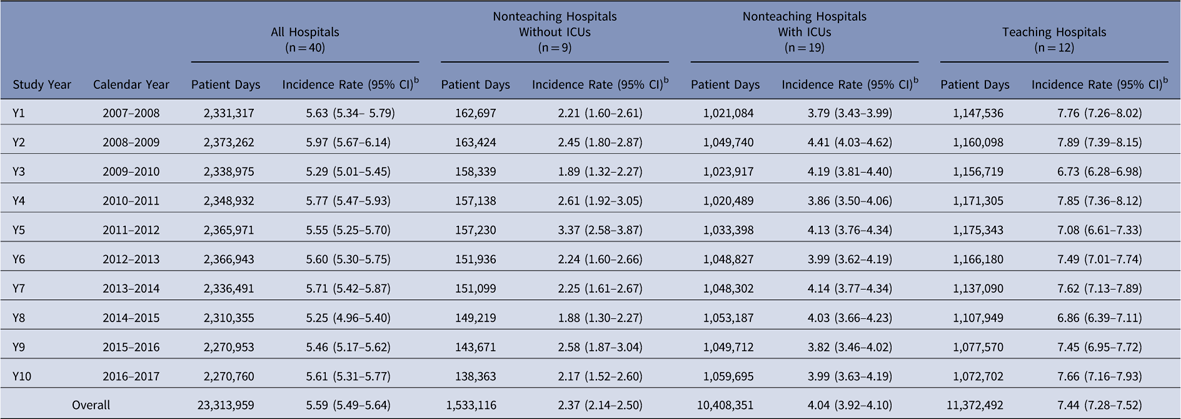
Of the 90 acute-care hospitals eligible to participate in BACTOT, 40 (44%) met the inclusion criteria. Between April 1, 2007, and March 31, 2017, a total of 13,024 HABSI cases were reported for 23,313,959 patient days (Table 1). The included hospitals contributed 47% of all BACTOT-recorded patient days in study year 10 (Y10, 2016–2017). 13 Of the included hospitals, 36 participated in all 130 administrative periods, while the remaining 4 contributed 129 periods each. Also, 30% of the cohort (n=12) were teaching hospitals, all of which had ICUs. Nonteaching hospitals with ICUs formed 48% (n=19) of the cohort, while nonteaching hospitals without ICUs represented 23% (n=9). Hospital sizes varied between 29 and 549 beds (median, 188.5 beds), with a total of 8,488 beds. In hospitals with ICUs, the number of ICU beds ranged from 3 to 75 (median, 10 beds). Only 1 hospital was exclusively pediatric. Between 30% and 57% of a given hospital’s patient population was aged ≥65 years (median, 47%). No statistically significant difference was detected between the included and excluded hospitals in the aforementioned characteristics.
Healthcare-Associated Bloodstream Infection (HABSI) Incidence Rates and Patient-days Reported for the Cohort Between 2007–2008 and 2016–2017, per Administrative Year, Stratified by Hospital TypeFootnote a

Note. CI, confidence interval.
a Between Y4 and Y6, BSIs following invasive procedures were considered primary NCA-BSI if they occurred 2 days after the procedure. Outside this period, the window of causality was 7 days.
b Rates and confidence intervals are reported per 10,000 patient days.
HABSI types
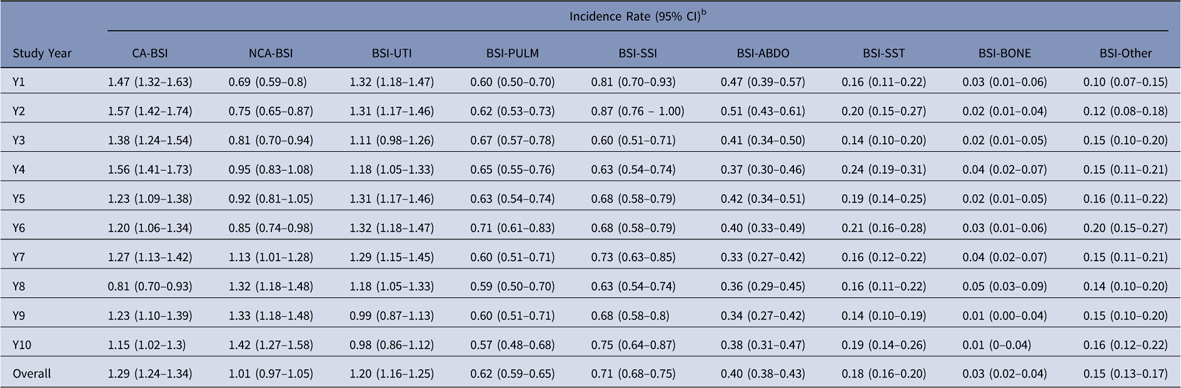
Of all reported cases, 41% were primary BSIs (23% CA-BSI and 18.2% NCA-BSI). The most common secondary HABSI was BSI-UTI (21.5%), followed by BSI-SSI (12.7%), BSI-PULM (11.2%), and BSI-ABDO (7.2%). BSI-SST represented 3.2% of all cases, BSI-other represented 2.6%, and BSI-BONE represented 0.5%.
Ten-year rates
The 10-year HABSI incidence rate for the cohort was 5.59 per 10,000 patient days (95% CI, 5.54–5.63) (Table 1). On average, nonteaching hospitals with ICUs had annual rates that were 1.47 (95% CI, 1.08–2.02) times higher than nonteaching hospitals without ICUs, while teaching hospitals had rates 3.10 (95% CI, 2.06–4.65) times higher than nonteaching hospitals without ICUs (Table 3).
Primary BSI
The 10-year incidence rate for CA-BSI’s was 1.29 per 10,000 patient days (95% CI: 1.24-1.34). It was the most frequent HABSI in teaching hospitals. The 10-year incidence rate for NCA-BSI was 1.01 per 10,000 patient days (95% CI, 0.97–1.05). Both types were significantly higher in teaching hospitals compared to nonteaching hospitals without ICUs (Table 3).
Secondary BSI
The 10-year incidence rate for BSI-UTI was 1.2 per 10,000 patient days (95% CI, 1.16–1.25) and was the most frequent HABSI in nonteaching hospitals. BSI-SSI had a relatively lower 10-year incidence rate of 0.71 per 10,000 patient days (95% CI, 0.68–0.75). The 10-year incidence rate for BSI-PULM was 0.62 per 10,000 patient days (95% CI, 0.59–0.65), and for BSI-ABDO, the 10-year incidence rate was 0.4 per 10,000 patient days (95% CI, 0.38–0.43). BSI-SST, BSI-other, and BSI-BONE were relatively infrequent (Table 2). For all secondary HABSIs except BSI-BONE, teaching hospitals had significantly higher rates than nonteaching hospitals without ICUs, while only BSI-UTI and BSI-SSI rates were significantly higher in nonteaching hospitals with ICUs (Table 3).
Source-Specific Healthcare-Associated Bloodstream Infection (HABSI) Incidence Rates for the Cohort from 2007 to 2017Footnote a

Note. CA-BSI, catheter-associated primary bloodstream infection (BSI); NCA-BSI, non-catheter-associated primary BSI; BSI-UTI, BSI secondary to urinary tract infections; BSI-PULM, BSI secondary to pulmonary infections; BSI-SSI, BSI secondary to surgical site infections; BSI-ABDO, BSI secondary to intra-abdominal infections; ; BSI-SST, BSI secondary to skin-and-soft-tissue infections; BSI-BONE, BSI secondary to bone-and-joint infections; BSI-Other, BSI secondary to any other primary focus; CI: confidence interval.
a Rates and confidence intervals are reported per 10,000 patient days.
b Between Y4 and Y6, BSIs following invasive procedures were considered primary NCA-BSI if they occurred 2 days after the procedure. Outside this time period, the window of causality was 7 days.
The Effect of Hospital Type on Overall Healthcare-Associated Bloodstream Infections (HABSI) and Source-Specific Incidence Rates

Note. ICU, intensive care unit; HABSI, healthcare-associated bloodstream infection; CA-BSI, catheter-associated primary bloodstream infection (BSI); NCA-BSI, non–catheter-associated primary BSI; BSI-UTI, BSI secondary to urinary tract infections; BSI-PULM, BSI secondary to pulmonary infections; BSI-SSI, BSI secondary to surgical site infections; BSI-ABDO, BSI secondary to intra-abdominal infections; BSI-SST, BSI secondary to skin-and-soft-tissue infections; BSI-BONE, BSI secondary to bone-and-joint infections; BSI-other, BSI secondary to any other primary focus; CI, confidence interval.
a Estimated using generalized estimating equations.
Time trends
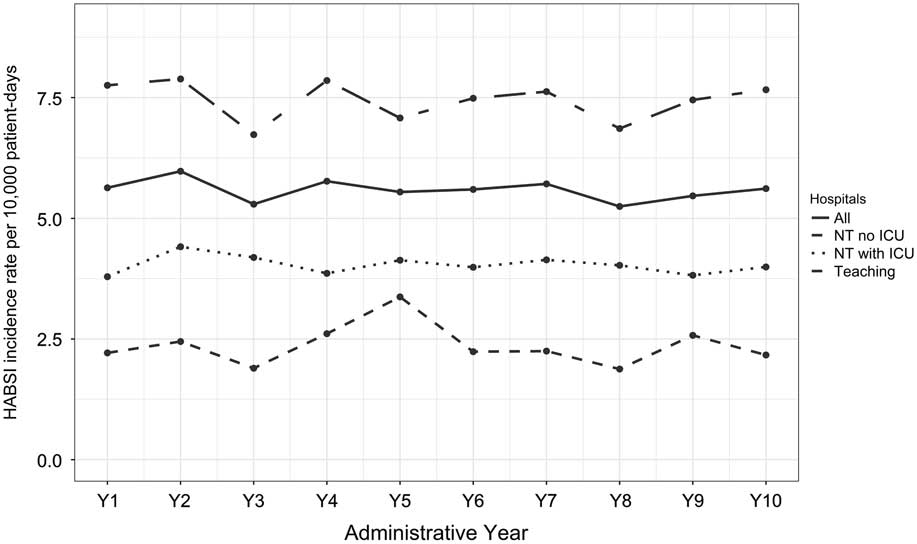
The HABSI rate in study year 1 (Y1) was 5.63 per 10,000 patient days (95% CI, 5.34–5.79) and showed minimal fluctuation until Y10, in which the rate was 5.61 per 10,000 patient days (95% CI, 5.31–5.77) (Fig. 1). Furthermore, GEE analyses showed no statistically significant effect of year on the incidence rates for the cohort.
Annual incidence rates of all healthcare-associated bloodstream infections (HABSIs) in hospitals that have participated in the Québec HABSI surveillance program (BACTOT) from 2007–2008 (study year 1, Y1) to 2016–2017 (Y10), stratified by hospital type. NT with ICU, nonteaching hospitals with an intensive care unit; NT no ICU, nonteaching hospital without an intensive care unit; Teaching: teaching hospitals. Note. Between Y4 and Y6, BSIs following invasive procedures were considered primary NCA-BSIs if they occurred 2 days after the procedure. Outside this period, the window of causality was 7 days.

Primary BSI
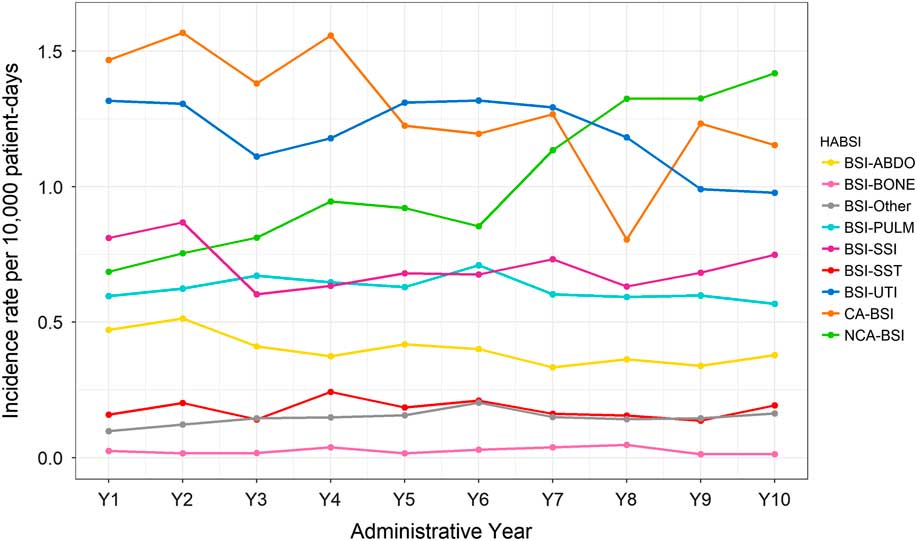
In Y1, annual CA-BSI rate was 1.47 per 10,000 patient days (95% CI, 1.32–1.63) and appeared to decrease consistently until Y8 (Fig. 2). However, only Y8 showed a statistically significant drop of 42% (95% CI, 26%–55%) relative to Y1, but the rate rebounded in the last 2 years of the study (Table 2). The NCA-BSI rate started at 0.69 per 10,000 patient days (95% CI, 0.59–0.8), almost half the rate of CA-BSI in Y1. These rates showed a steep increase in Y7, when the rate was 1.13 per 10,000 patient days (95% CI, 1.01–1.28), a 67% (95% CI, 20%–133%) increase from Y1. In Y8, the NCA-BSI rate of 1.32 per 10,000 patient days (95% CI, 1.18–1.48) surpassed the CA-BSI rate. This rise was sustained until Y10, when it ended with a rate that was 110% (95% CI, 60%–176%) higher than Y1.
Annual incidence rates of healthcare-associated bloodstream infections (HABSIs) in hospitals that have participated in the Québec HABSI surveillance program (BACTOT) from 2007–2008 (study year 1, Y1) to 2016–2017 (Y10), stratified by infection source. BSI-ABDO, bloodstream infection (BSI) secondary to intra-abdominal infections; BSI-BONE, BSI secondary to bone-and-joint infections; BSI-PULM, BSI secondary to pulmonary infections; BSI-SSI, BSI secondary to surgical site infections; BSI-SST, BSI secondary to skin-and-soft-tissue infections; BSI-UTI, BSI secondary to urinary tract infections; BSI-other, BSI secondary to any other primary focus; CA-BSI, catheter-associated primary BSI; NCA-BSI, non–catheter-associated primary BSI. Note. Between Y4 and Y6, BSIs following invasive procedures were considered primary NCA-BSIs if they occurred 2 days after the procedure. Outside this period, the window of causality was 7 days.

Secondary BSI
Annual BSI-UTI rates showed little year-to-year change (Table 2). Only in Y10 did the rates drop to 0.98 per 10,000 patient days (95% CI, 0.86–1.12), a 25% (95% CI, 2%–43%) reduction from the Y1 rate. The BSI-SSI rate was 0.81 per 10,000 patient days (95% CI, 0.70–0.93) in Y1 and dropped by 26% (95% CI, 9%–39%) in Y3, but this decrease was not sustained in the following years. The BSI-SST annual rates showed a statistically significant bump in Y4, with a 52% (95% CI, 4%–123%) increase compared to Y1. Similarly, BSI-other showed increases in Y5 and Y6 of 60% (95% CI, 19%–116%) and 108% (95% CI, 25%–244%), respectively, but these were not sustained. Annual BSI-PULM, BSI-ABDO, and BSI-BONE rates showed no statistically significant changes.
Discussion
Our study is one of the largest published reports on HABSI epidemiology describing a large population surveyed over a full decade with a high number of cases. It adds substantial knowledge to the scarce literature, especially from North America. We reported an overall HABSI rate of 5.59 HABSI cases per 10,000 patient days, similar to 6.0 per 10,000 patient days reported by the only recent high-coverage (24 hospitals), multicenter study in Queensland, Australia during a period overlapping ours.Reference Si, Runnegar, Marquess, Rajmokan and Playford 1 A smaller study in Denmark reported a rate of 6.4 per 10,000 patient days and another in the United States reported a range between 11.2 and 6.7 per 10,000 patient days.Reference Redder, Leth and Moller 2 , Reference Kanamori, Weber and DiBiase 3
The HABSI rates were consistently higher in teaching hospitals and often higher in nonteaching hospitals with ICUs compared to nonteaching hospitals without ICUs. It is common for HAI rates to be higher in teaching hospitals because they often receive sicker patients given their mission to provide specialized care for severely ill patients who are more vulnerable to HABSI.Reference Ayanian and Weissman 14 – Reference Tong, Clements, Haynes, Jones, Morton and Whitby 17 Higher HABSI rates in hospitals with ICUs can be explained by the usually higher rates in ICUs compared to wards outside the ICU.Reference Wisplinghoff, Bischoff, Tallent, Seifert, Wenzel and Edmond 18
The longitudinal nature of surveillance data collection allowed us to analyze temporal trends in rates. We found no significant changes in annual HABSI rates at the cohort level. While no province-wide interventions targeted HABSI as a whole, a campaign targeting multidrug-resistant HABSI, CLABSI, SSI, and ventilator-associated pneumonia was implemented in 2014 (Y7–Y8). 19 The degree to which hospitals complied with the campaign guidelines and its subsequent effects on our results are unknown. Other multicenter studies have reported variable temporal trends in HABSI rates. Some exhibited decreases,Reference Kanamori, Weber and DiBiase 3 , Reference Nielsen, Pedersen, Jensen, Gradel, Kolmos and Lassen 20 others increases,Reference Skogberg, Lyytikainen, Ollgren, Nuorti and Ruutu 21 and some no consistent trend.Reference Redder, Leth and Moller 2 , Reference Sogaard, Norgaard, Dethlefsen and Schonheyder 22 , Reference Uslan, Crane and Steckelberg 23 It is difficult to compare our reported temporal trends because (1) time periods did not overlap,Reference Nielsen, Pedersen, Jensen, Gradel, Kolmos and Lassen 20 , Reference Sogaard, Norgaard, Dethlefsen and Schonheyder 22 , Reference Uslan, Crane and Steckelberg 23 (2) studied hospitals had characteristics different to ours,Reference Redder, Leth and Moller 2 , Reference Kanamori, Weber and DiBiase 3 or (3) denominators used were population based, not hospital based.Reference Skogberg, Lyytikainen, Ollgren, Nuorti and Ruutu 21 , Reference Sogaard, Norgaard, Dethlefsen and Schonheyder 22
The BACTOT data collection procedure facilitated our analysis of HABSI cases and rates by infection source. The leading sources of cases were CA-BSIs, which include central-line–associated BSI (CLABSIs, the most targeted subset of HABSIs in infection prevention and control), BSI-UTIs, and NCA-BSI. Valles et alReference Valles, Calbo and Anoro 24 reported relatively similar proportions.
The CA-BSI rates began as the highest subtype in Y1 and showed a statistically significant drop in rates in Y8 (2014–2015) that was not sustained. A 2014 decrease was also seen in a recent study by Li et alReference Li, Fortin, Tremblay, Ngenda-Muadi and Quach 25 on another SPIN surveillance program (SPIN-BACC) that targets CLABSI in ICUs; it may be explained by bundled practices introduced in the beginning of Y3. While this drop may have contributed to the results seen here, our study includes an overall insubstantial number (6.4%) of patient days spent in ICUs compared to the Li et al study, which was limited to CLABSI in the ICU.
The NCA-BSI rates exhibited a sustained statistically significant increase in Y7 (2013–2014) and overtook other subtypes to become the most frequent in Y8–Y10. This rise coincides with returning the window of causality for BSIs following invasive procedures from 2 to 7 days. However, if the rise was a result of the definition change, an equal reduction should have been seen in Y5 when the window was reduced to 2 days, which was not the case. Y7 was also the year the new data entry platform for BACTOT data collection was implemented in participating hospitals. Because this was suspected to cause artificial changes in rates, SPIN validated the platform and concluded that new data entry rules contributed to some cases being miscategorized or erroneously rejected, and corrections were subsequently made. Because our analyses utilize the corrected data, it is plausible that the persistent increase in NCA-BSI reported here is a true one. A possible explanation could be an increase in the number of procedures performed.
Among secondary HABSIs, BSI-UTIs were consistently the most frequent, which is often the case in hospitals due to extensive use of urinary catheters, the main contributing cause of urinary tract infections and consequent BSI-UTIs.Reference Fortin, Rocher, Frenette, Tremblay and Quach 11 , Reference Valles, Calbo and Anoro 24 A considerable number of HABSIs were BSI-PULMs, BSI-ABDOs, and BSI-SSIs, but their rates did not exhibit any lasting changes in the 10-year study period. BSI-SST, BSI-BONE, and BSI-other occurred at relatively negligible rates.
The absence of a sustained change in HABSI rates is concerning but not necessarily an indication of ineffective surveillance. The observed trend may be a function of demographic changes and hospital performance developments masking the true effect of BACTOT participation on HABSI rates. For instance, the aging Canadian population results in more elderly patients in hospitals. The 13.5% increase in patient days contributed by patients aged ≥65 years from 2007–2008 to 2016–2017 indicates that more patients have become vulnerable to potentially nonpreventable HABSI. 26 Additionally, lengths of stay are reportedly decreasing following efforts to reduce unnecessary healthcare utilization. In Québec, the average length of stay decreased from 8.4 days in 2007–2008 to 7.8 in 2016–2017. 26 While this is a welcome improvement in hospital performance, it can result in inflated HABSI rates.
Nevertheless, it is not our objective to infer a causal mechanism of the observed trend. Our study’s goal is to report the cohort-level trend as it occurred, which it does with several strengths. This study covers 44% of all acute-care hospitals in Québec, capturing 47% of all patient days in 2016–2017. 13 Hospitals included in the study did not exhibit statistically significant differences in reported characteristics from excluded ones, suggesting that the cohort is representative of all eligible hospitals. The substantial overlap between our Y10 (2016–2017) HABSI rate (5.30; 95% CI, 5.22–5.64) and that published by SPIN-BACTOT (5.61; 95% CI, 5.31–5.77) further supports the validity of our results. 13 In addition, the study produces precise estimates of endemic rates not skewed to a particular type of hospital because of the diversity of included hospitals; therefore, these rates can be used for benchmarking, informing future prevention measures, and as a baseline for further evaluations. Rates were calculated using patient days, avoiding time-dependent bias common in point-prevalence studies and reducing confounding due to exposure duration when comparing rates across time or populations, which is a limitation of population-based denominators. The 10-year period covered by our study allowed the exploration of time trends in HABSI rates, which is a rarity in recently published literature. Finally, it was possible to stratify incidence based on the primary source of infection because HABSI clinical diagnoses were systematically reported. To our knowledge, this stratification has only been done once before and not to the granularity reported here.Reference Valles, Calbo and Anoro 24
While our study estimates HABSI rates and subtype characterizations comparable to those reported by other recent HABSI studies, the lack of an overall reduction in HABSI rates over the prolonged period is concerning, especially given the amount of resources employed by SPIN and the participating hospitals. For this reason, we recommend a more detailed exploration of the effect of BACTOT surveillance on HABSI to evaluate whether current surveillance measures are worthwhile. Aside from surveillance, interventions targeting potentially preventable BSI types are needed to see substantial reductions in rates. Alternative surveillance modalities should be considered, including less frequent HABSI reporting and prioritization of high-burden BSI types.
Acknowledgements
We are grateful to all the infection control practitioners and infectious disease physicians/medical microbiologists who participate in the SPIN program. SPIN-BACTOT working group members: Élise Fortin, Charles Frenette, Lise-Andrée Galarneau, Sylvie Latreille, Danielle Moisan, Muleka Ngenda-Muadi, Noémie Savard, Marc-André Smith, Claude Tremblay, Mélissa Trudeau, Jasmin Villeneuve.
Financial support
This work was supported by SPIN, a program from the Québec Institute of Public Health, funded by the Québec Ministère de la Santé et des services sociaux (Ministry of Health). Dr Quach is supported through an external salary award (FRQ-S merit, grant no. 252775). Dr Alex Carignan is supported through an external salary award (FRQ-S junior 1).
Conflicts of interest
All authors report no conflicts of interest relevant to this article.