Introduction
Emotional suffering in advanced age is largely explained by various psychiatric conditions, of which depression and dementia are the most common (Blazer, Reference Blazer2003). Depression frequently exists as a comorbidity, a component of, or a complication in, the syndrome of dementia (Amore et al., Reference Amore, Tagariello, Laterza and Savoia2007). The association between depression and dementia remains unclear, despite numerous studies (Fuhrer et al., Reference Fuhrer, Dufouil and Dartigues2003; Modrego and Ferrandez, Reference Modrego and Ferrandez2004; Mitchell, Reference Mitchell2005; Ganguli et al., Reference Ganguli, Du, Dodge, Ratcliff and Chang2006). While some studies have suggested that depression is a prodromal stage to dementia (Garre-Olmo et al., Reference Garre-Olmo2003; Vinkers et al., Reference Vinkers, Gussekloo, Stek, Westendorp and Van Der Mast2004; Ganguli et al., Reference Ganguli, Du, Dodge, Ratcliff and Chang2006), others have indicated that dementia causes depression, either by alterations in brain functions or as a reaction to the disease (Garre-Olmo et al., Reference Garre-Olmo2003; Mitchell, Reference Mitchell2005). However, insight into having Alzheimer's disease (AD) has not been shown to be associated with depression (Lyketsos and Olin, Reference Lyketsos and Olin2002).
Among those suffering from AD, the most prevalent type of dementia, as many as 50% will at some stage of the disease suffer from depression (Lyketsos and Olin, Reference Lyketsos and Olin2002). In vascular dementia, which accounts for 10–20% of all dementia cases, depression and other non-cognitive symptoms seem to be at least as common as in AD (Ballard et al., Reference Ballard, Neill, O'Brien, McKeith, Ince and Perry2000).
The natural history of depression in dementia is scarcely known (Olin et al., Reference Olin, Katz, Meyers, Schneider and Lebowitz2002), but epidemiological data suggest that mood symptoms are common in mild to moderate dementia (Lyketsos and Olin, Reference Lyketsos and Olin2002). The lower prevalence of depression found among people with severe dementia may be related to the difficulty of recognizing depressive symptoms in severe dementia (Forsell and Winblad, Reference Forsell and Winblad1998; Lyketsos and Olin, Reference Lyketsos and Olin2002). Although depressive symptoms might fluctuate over time (Olin et al., Reference Olin, Katz, Meyers, Schneider and Lebowitz2002), at least one study with long-term follow-up has reported that depression persists when the dementia disorder deteriorates (Ballard et al., Reference Ballard, Neill, O'Brien, McKeith, Ince and Perry2000; Lyketsos and Olin, Reference Lyketsos and Olin2002).
There has been a manifold increase in the prevalence of antidepressant treatment among old people in recent years (Lövheim et al., Reference Lövheim, Sandman, Kallin, Karlsson and Gustafson2008a). We have previously demonstrated that the prevalence of depressive symptoms seems to have decreased between two comparable samples from 1982 and 2000 (Lövheim et al., Reference Lövheim, Sandman, Kallin, Karlsson and Gustafson2008a). Longitudinal data from the PAQUID study also indicates a decreased prevalence of depressive symptoms in recent years (Montagnier et al., Reference Montagnier2006).
Whether the prevalence of depressive symptoms has decreased among people in different stages of dementia disorders has not yet been investigated. The aim of this study was to investigate the prevalence of depressive symptoms and the prevalence of psychotropic drug treatment among old people with different severity of cognitive impairment, in two large, comparable, cross-sectional samples from 1982 and 2000.
Methods
Surveys and participants
The present analysis is based on two cross-sectional questionnaire surveys performed in 1982 and in 2000 in the county of Västerbotten in northern Sweden. The two surveys used the same methodology and the same questionnaire. The surveys included all people in any kind of institutional care for old people in the county.
When the first investigation was conducted, the population in the area was 245,000 people, of whom 38,000 (15.5%) were more than 65 years of age. By the time of the second investigation the population had increased to approximately 256,000 people, of whom 44,000 (17.2%) were aged 65 years or more.
The number of people living in institutions providing geriatric care (nursing homes, residential care units, group dwellings for people with dementia, short-stay/rehabilitation units, somatic geriatric wards/somatic long-stay wards, psychogeriatric wards/long-stay wards (Kallin et al., Reference Kallin, Gustafson, Sandman and Karlsson2004)) was 3910 in 1982 and 4357 in 2000. The response rate was 92.3% and 87.3% respectively, rating 3607 and 3804 participants respectively. Those who were younger than 65 years or for whom no age was registered were excluded from the analysis, which finally included 3195 from 1982 and 3669 from 2000.
The study was approved by the Regional Ethical Review Board in Umeå (registration number 00–170).
Procedures
A form was sent to the settings and the staff were asked to complete the form and return it to the researchers. The staff received written instructions about how to carry out the assessments and were informed that the members of the research team could be contacted by telephone to answer questions or provide additional guidance. The member of staff who knew each individual resident best was asked to fill in the assessment scales. The staff were informed that their assessment should be based on observations of the resident's state during the preceding week.
The assessments were made using the Multi-Dimensional Dementia Assessment Scale (MDDAS) (Sandman et al., Reference Sandman, Adolfsson, Norberg, Nystrom and Winblad1988). The scale measures function in activities of daily living (ADL), cognition and behavioral and psychological symptoms and also includes registration of current drug prescriptions. The MDDAS has good inter- and intra-rater reliability (Sandman et al., Reference Sandman, Adolfsson, Norberg, Nystrom and Winblad1988).
A registered nurse filled in the data concerning medication prescribed, from the resident's prescription record. Psychotropic drug data were grouped, by members of the research team, into the following categories (codes are according to the WHO Anatomical Therapeutical Chemical (ATC) classification index) (World Health Organization, 2007): psychotropic drugs (N05A, N05B, N05C and N06A), with the subgroups antipsychotic drugs (N05A), anxiolytics, hypnotics and sedatives (N05B, N05C) and antidepressants (N06A). Every person was assigned a dichotomous value for each group. Information about doses and pro re nata (“as needed”) medication was not coded, thus only the figures for ongoing medication are given.
An ADL score was calculated based on the resident's ability to cope with dressing, hygiene, eating and bladder and bowel control. All ADL categories score 1–5, except that for bladder control, which scores 0–4. Hence the ADL score varies from 4 to 24, where a higher score indicates greater ADL independence.
Cognitive impairment was measured using a scale developed by Gottfries and Gottfries (Adolfsson et al., Reference Adolfsson, Gottfries, Nyström and Winblad1981). The scale consists of 27 items measuring a person's cognitive function. A score of less than 24 is considered to indicate cognitive impairment, which correlates with a sensitivity of 90% and a specificity of 91% (Adolfsson et al., Reference Adolfsson, Gottfries, Nyström and Winblad1981) to the cut-off 24/30, traditionally used in the Mini-mental State Examination (MMSE; Folstein et al., Reference Folstein, Folstein and McHugh1975). The cognitive scale was arbitrarily further divided into mild cognitive impairment (score 16–23), moderate cognitive impairment (score 8–15) and severe cognitive impairment (score 0–7).
The MDDAS behavioral and psychological symptom items have been described in depth by others (Sandman et al., Reference Sandman, Adolfsson, Norberg, Nystrom and Winblad1988). Each item is rated on a three-point scale, showing that the symptom or behavior occurred at least once a day, once a week or never during the one-week observation period. The variables were dichotomized between at least once a week and less than once a week. Hence, in the following text, the term “prevalence” always refers to the one-week prevalences. This paper presents data concerning the MDDAS items “Sad”, “Crying” and “Anxious and fearful”. These three items have previously been shown to group together in factor analyses (Lövheim et al., Reference Lövheim, Sandman, Kallin, Karlsson and Gustafson2006; Reference Lövheim, Sandman, Karlsson and Gustafson2008b), and were tested for internal consistency, using Cronbach's α analysis, with an α value of 0.71. A variable labeled “depressive symptom score” was constructed by 100x (the mean value of the MDDAS item “Sad”, “Crying” and “Anxious and fearful”).
Statistical analysis and calculations
Data handling and statistical calculation were performed using the Statistical Package for Social Science SPSS® versions 13.0 for Mac OS X. Chi-square tests were used for dichotomous variables and T-tests for continuous variables. Multiple logistic regressions were used to control for interacting effects of age, sex and level of ADL-dependence when comparing symptom prevalences and pharmacological drug use between the investigation years. Multiple linear regression including the same covariates was used for significance testing of changes in the variable “depressive symptom score” between the investigation years. To confirm the interacting effect between moderate cognitive impairment and investigation year, this analysis was repeated, including interaction terms.
Results
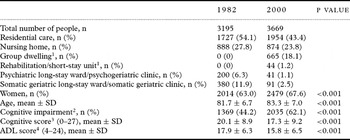
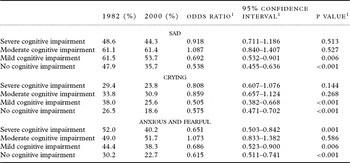
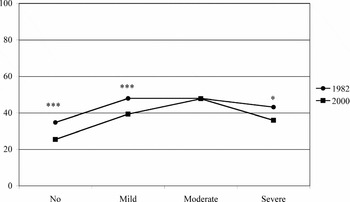
Basic characteristics of the study samples are presented in Table 1. The study sample of 2000 was older and had a higher proportion of those cognitively impaired than the sample of 1982. In Table 2 the various depressive symptoms are presented according to level of cognitive impairment for the different years. There had been a significant decrease in prevalence of depressive symptoms between 1982 and 2000 in all groups except that with a cognitive score of 8–15, i.e. moderate cognitive impairment. Figure 1 depicts the mean depressive symptom score in 1982 and 2000 in the different levels of cognitive impairment. A multiple linear regression model, including interaction terms, confirmed an interaction effect between moderate cognitive impairment and the year of investigation (data not shown).
Basic characteristics of the two samples studied

SD = Standard Deviation, ADL = Activities of Daily Living.
1This type of housing did not exist 1982.
2Score on Gottfries’ cognitive scale < 24.
3Lower score = more cognitively impaired.
4Lower score = more dependent in ADL.
One-week prevalence of certain depressive symptoms in 1982 and 2000 among people with different levels of cognitive impairment

Cognitive score ranges from 0 to 27, where a lower score means more cognitive impairment. The cut-off 24/27 indicates cognitive impairment. The scale is subdivided into four groups, 0–7 (severe cognitive impairment), 8–15 (moderate cognitive impairment), 16–23 (mild cognitive impairment) and 24–27 (no cognitive impairment). Sufficient data to calculate cognitive score were obtained in 3064/3195 cases in 1982 and in 3210/3669 cases in 2000.
1Controlled for age, sex and level of ADL impairment using logistic regression.
Prevalence of depressive symptoms in relation to level of cognitive impairment.
Depressive symptom prevalence is calculated here as 100x(“Sad”+”Crying”+”Anxious and fearful”)/3. Each variable could have the value of 0 or 1. Cognitive score ranges from 0 to 27, where a lower score means more cognitive impairment. The cut-off 24/27 indicates cognitive impairment. The scale is subdivided into four groups, 0–7 (severe cognitive impairment), 8–15 (moderate cognitive impairment) and 16–23 (mild cognitive impairment) and 24–27 (no cognitive impairment). Difference between the two years are tested multiple linear regression, controlling for age, sex and level of ADL impairment; * p < 0.05 *** p < 0.001.

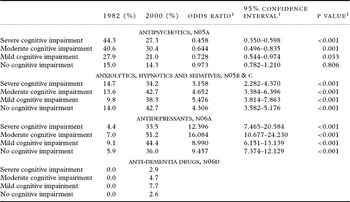
Psychotropic drug use is presented in Table 3. Antidepressant drug use increased in all groups of cognitive impairment, largely due to the use of selective serotonin reuptake inhibitors (SSRIs), which constituted 88.8% (1330/1463) of the antidepressant prescriptions in 2000. The use of anxiolytics, hypnotics and sedatives also increased. Antipsychotic drug use, on the other hand, became less common in all groups, except the group with a cognitive score of 24 or above (no cognitive impairment). Treatment with the combination of an antidepressant and an antipsychotic drug was uncommon in 1982 (51/3195, 1.6%), while in 2000 this has become more common (severe cognitive impairment: 67/660, 10.1%; moderate cognitive impairment: 113/642, 17.6%; mild cognitive impairment: 61/666, 9.2%; no cognitive impairment: 89/1242, 7.2%).
Prevalence of psychotropic drug use in 1982 and 2000

Cognitive scores range from 0 to 27, where a lower score means more cognitive impairment. The cut-off 24/27 indicates cognitive impairment. The scale is subdivided into four groups: 0–7 (severe cognitive impairment), 8–15 (moderate cognitive impairment), 16–23 (mild cognitive impairment) and 24–27 (no cognitive impairment). Sufficient data to calculate cognitive score were obtained in 3064/3195 cases in 1982 and in 3210/3669 cases in 2000.
1Controlled for age, sex and level of ADL impairment using logistic regression
Those people who had at least two out of three of the symptoms of “Sad”, “Crying” or “Anxious and fearful” (2269/6116 people, 37.1%) more often used psychotropic drugs than those without such symptoms. This was true of antidepressants (10.9% compared to 3.4% p<0.001 in 1982 and 51.7% compared to 35.0% p<0.001 in 2000), anxiolytics, hypnotics and sedatives and antipsychotics (data not shown).
Discussion
The prevalence of depressive symptoms was lower in 2000 compared to 1982 in all cognitive impairment groups, except moderate cognitive impairment. During the same period, there was a manifold increase in the use of antidepressants in all cognitive impairment groups. The group with moderate cognitive impairment had the very highest prevalence of antidepressant treatment, with more than 50% currently receiving treatment. Yet, among people in this stage of the dementia disorder, no decrease in the prevalence of depressive symptoms was seen over the years.
There are two main etiologies of depression in dementia that have been discussed in previous articles on the topic. The first hypothesis is that depression is a reaction, the suggested cause being the awareness of the dementia disorder and the associated functional decline (Garre-Olmo et al., Reference Garre-Olmo2003). The second is that there are neuropathological changes in which depression is thought to be correlated with the loss of serotonergic and perhaps noradrenergic neurons in certain areas of the brain. There is more evidence today in support of the second hypothesis (Modrego and Ferrandez, Reference Modrego and Ferrandez2004; Mitchell, Reference Mitchell2005).
Both these hypotheses might be true. They seem, in fact, to be applicable to a varying extent in different stages of dementia. Whereas awareness is a prerequisite of reactive depression, which thus might be accountable for depression in the earlier stages of dementia (Aalten et al., Reference Aalten, van Valen, de Vugt, Lousberg, Jolles and Verhey2006), neuronal loss and neurotransmitter deficit probably worsen as the disorder deteriorates, comprising the dominant cause in later stages.
A third reason might be chronic stress reaction. Chronic stress has previously been proposed a reason for depression in the elderly in general (Blazer and Hybels, Reference Blazer and Hybels2005). When the dementia disorder is moderate to severe, the affected person will have problems interpreting what is happening to him/her and will have increasing communication deficits of both impressive and expressive type. The person might become unable to understand the caring situation and may find being dressed or showered, for example, by people that he/she does not recognize very stressful and lead to both aggressive behavior and possibly to depression. Among people with dementia, previous studies have found a relationship between aggressive behavior and depression (Menon et al., Reference Menon2001; Leonard et al., Reference Leonard, Tinetti, Allore and Drickamer2006), both of which are most prevalent in middle stage dementia (Lövheim et al., Reference Lövheim, Sandman, Karlsson and Gustafson2008b). When the dementia later reaches its final stages, the person might no longer be concerned about not understanding his or her surroundings.
One of the main findings in this study was that the prevalence of depressive symptoms seemed not to have decreased among people with moderate cognitive impairment, in contrast to people with both milder and more severe cognitive impairment. One possible interpretation of this could be that, due to differences in etiology, pharmacological treatment might not be equally effective in treating depressive symptoms in different stages of dementia. The supposedly stress-induced depressive symptoms, most common in middle-stage dementia, might possibly be better treated using non-pharmacological strategies such as psychosocial measures and better-educated caring staff (O'Connor et al., Reference O'Connor, Ames, Gardner and King2008). Other possible causes of poor treatment results are insufficient follow-up and adjustment of the treatments, which might lead to suboptimal effects of antidepressant drugs. The combination of antidepressant drugs with antipsychotics, which was most common (17.6%) among people with moderate cognitive impairment, might also have contributed to worse treatment results in that group of people.
This study has some important limitations. It has to be borne in mind that these two cross-sectional studies only registered symptoms during a period of one week, reported by caring staff. No diagnosis of depression or dementia was recorded. However, in a population study including people aged 85 years or older in six municipalities in the county of Västerbotten, Sweden, the point prevalence of DSM-IV diagnosed depression was 62/149 (41.6%) among people living in institutional care (Bergdahl et al., Reference Bergdahl, Allard, Lundman and Gustafson2007), which approximately equals the proportion of people (37.1%) with at least two out of three of the MDDAS symptoms “Sad”, “Crying” or “Anxious and fearful”.
A number of other explanations, apart from pharmacological treatment, could also contribute to the decrease in symptom prevalence between 1982 and 2000, e.g. organizational changes such as the introduction of group dwellings for people with dementia, and better recognition of treatable disorders. Group dwellings are specialized caring units for people with dementia, and a more adjusted caring environment might have contributed to the decrease in depressive symptoms (Lövheim et al., Reference Lövheim, Sandman, Kallin, Karlsson and Gustafson2008a). A cross-sectional study, like the one presented here, cannot draw any conclusions about causality.
Conclusion
The prevalence of depressive symptoms decreased between 1982 and 2000, in all levels of cognitive impairment except moderate cognitive impairment. This might possibly be explained by the depressive symptoms having different etiologies in different stages of a dementia disorder, which in turn might not be equally susceptible to antidepressant treatment. Further randomized controlled trials of antidepressant treatment among people with different severity of dementia are needed.
Conflict of interest
None.
Description of authors’ roles
All authors were involved in the acquisition of data. H. Lövheim, Y. Gustafson and S. Karlsson analyzed and interpreted the data; H. Lövheim, E. Bergdahl and Y. Gustafson also prepared the paper; and P.O. Sandman and S. Karlsson were also responsible for the study concept and design. All authors reviewed the paper, added their comments and approved the final version.
Acknowledgments
This study was supported financially by grants from the Umeå University Foundation for Medical Research, the Swedish Foundation for Healthcare Sciences and Allergy Research, the Field Research Centre for the Elderly in Västerbotten, the Swedish Research Council, the Swedish Dementia Association (Stiftelsen Demensfonden) and Erik and Anne-Marie Detlof's Foundation, Umeå University.