





Introduction
Staphylococcus aureus colonization is common in healthcare settings and frequently precedes invasive infection, resulting in significant patient morbidity and mortality that can be healthcare-acquired. Over 80% of S. aureus bloodstream infections arise from preceding colonization. Reference Von Eiff, Becker, Machka, Stammer and Peters1 Patients can remain colonized for years, posing long term infection and transmission risk. Reference Scanvic, Denic, Gaillon, Giry, Andremont and Lucet2 Horizontal transmission of bacteria is an important driver of antimicrobial resistance, particularly with methicillin-resistant S. aureus (MRSA), and is a major source of nosocomial infection. Hospitals can employ multiple strategies to assist in reducing the overall S. aureus burden in facilities, including hand hygiene, surveillance, patient isolation, and decolonization. Nasal decolonization is one such strategy as the nose functions as a critical reservoir for S. aureus. This can reduce both subsequent S. aureus infection in the colonized patient, as well as downstream transmission events to other patients at risk.
Current guidance denotes high risk conditions where decolonization could be pursued, including before surgical procedures involving the implantation of hardware to reduce surgical site infection, and in known MRSA carriers in ICU settings and those outside of ICU settings with medical devices. Reference Popovich, Aureden and Ham3 Generally, mupirocin or povidone iodine is recommended, although resistance, intolerance, allergies, and cost may hinder use of either of these agents. S. aureus resistance to mupirocin, for example, is increasing over time globally, Reference Dadashi, Hajikhani, Darban-Sarokhalil, van Belkum and Goudarzi4 posing potential long-term implications and highlighting a need for alternative decolonization options.
Alcohol-based antiseptics are a third option for nasal decolonization; however, these are much less studied, and results have been mixed. In one study, a single dose application of an alcohol-based nasal antiseptic did not reduce nasal MRSA, and a triple-dose only transiently reduced nasal MRSA for several hours, suggesting frequent applications may be necessary. Reference Kanwar, Kumar and Ng-Wong5 However, a separate trial applied an alcohol-based nasal antiseptic at 4-hour intervals to healthcare workers known to be S. aureus carriers, showing >90% median S. aureus and total bacterial colony forming unit reduction. Reference Steed, Costello, Lohia, Jones, Spannhake and Nguyen6 Two small observational studies have also shown fewer laboratory-onset MRSA bacteremia events in patients who received nasal decolonization with ethyl alcohol. Reference Prascius, Wells, Collier, Renard, Hooper and Stein7–Reference Pratt, Heishman, Blizard and Cissell8
Due to persistently elevated rates of MRSA bacteremia in hospitalized inpatients at our health center, we implemented nasal S. aureus decolonization with an ethyl alcohol-based antiseptic to patients at risk for MRSA acquisition. Here, we outline our experience, and outcomes on MRSA and MSSA bacteremia after implementation.
Methods
This quasi-experimental study was conducted in adult inpatients, ages 18 years and older, at Yale New Haven Health System, a tertiary care system encompassing 2,681 licensed beds across five hospitals in two states. Starting in October 2023, twice daily 62% ethyl alcohol nasal swabs (Medline) were administered to adult inpatients at risk for MRSA acquisition. This included patients in all ICU settings, those outside of ICU settings who had central venous access devices or midline catheters (including those with non-accessed implanted ports), hemodialysis patients (including those with AV fistulas), and burn patients. Ethyl alcohol was chosen as a decolonization treatment due to cost, scalability, patient compliance concerns with alternate agents, and reported mupirocin resistance in some internal S. aureus strains. Clinical teams caring for patients identified with one or more of these risk factors had an automated alert with a prepopulated order set selected upon entering the patient’s chart. Treatment was not mandatory, and clinicians were not required to proceed with the auto-selected order set. Treatment continued for the duration of the hospitalization until discharge. Those who were receiving alternative decolonization methods, such as preoperative povidone iodine for cardiothoracic and orthopedic procedures, and those receiving mupirocin (at our center, this was primarily in patients with an already diagnosed active MRSA infection currently receiving intravenous antimicrobial therapy) had no changes to these protocols. There were no other changes to existing practices to prevent S. aureus transmission for the duration of the study period. Notably, our existing policy for MRSA isolation placed patients with an active MRSA infection into contact isolation requiring the use of gowns and gloves for all patient interactions, but no isolation was necessary for patients without an active infection (eg isolated MRSA colonization), which was a change in our institution’s policy once the COVID-19 pandemic started. No changes to this isolation policy occurred for the duration of the study period. There were no changes to receipt of daily chlorhexidine baths (4% chlorhexidine gluconate foam, Hibiclens®) by all patients in the ICU and those with central venous catheters.
Nurses caring for patients with low compliance rates were queried for feedback on reasons why ethyl alcohol was not given. The qualitative data was analyzed for thematic patterns using a grounded-theory approach.
Overall hospital-onset S. aureus (including both MRSA and MSSA) bacteremia events were compared for two time periods (predecolonization from January 2021 through September 2023 versus postdecolonization from October 2023 through December 2024) according to events/10,000 patient days using Pearson’s χ2 test. Hospital-onset S. aureus infection was defined as a positive blood culture MRSA or MSSA isolate obtained on or after day 4 of hospital admission, consistent with definitions from the National Healthcare Safety Network (NHSN). An autoregressive integrated moving average (ARIMA) model was performed pre and postintervention to account for improving trends in MRSA bacteremia prior to ethyl alcohol administration. For August and September of 2024, the product was unavailable from the manufacturer and the product was not administered. These months have been excluded from the data set. This quality improvement initiative was exempt from Institutional Board Review.
Results
From October 2023 through December 2024, 120,081 inpatients were screened for decolonization during the intervention period. Of these, 14,727 (12.3%) screened positive for having risk factors for MRSA acquisition. Excluding August and September 2024 due to product shortages where no ethyl alcohol was administered, a total of 274,999 applications of ethyl alcohol were given to 12,179 inpatients. In 18,744 instances (5.6%) ethyl alcohol was not given, and in 38,555 instances (11.6%) ethyl alcohol was refused by the patient. Overall compliance was 82.7%.
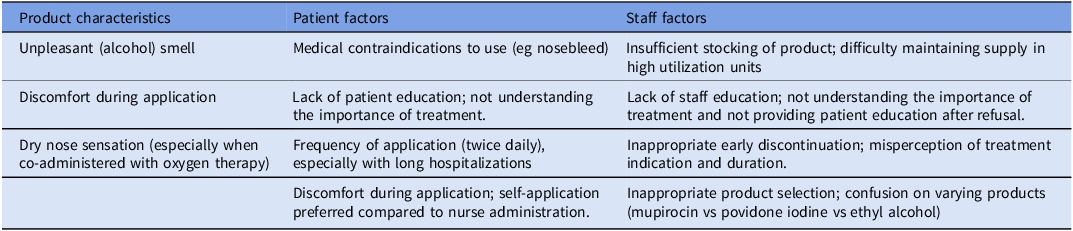
Reasons for non-compliance or refusal were centered on product, patient, and staff characteristics (Table 1). Reasons for refusal inherent to the product included discomfort with nasal swabs, a bad smell after application, and perceived changes in the nasal mucosa leaving a dry sensation. Certain patients were unable to receive the product due to comorbidities (nosebleeds, thrombocytopenia). Others declined owing to the frequency of dosing, especially patients with longer lengths of stays. Some of this was remedied by allowing patients to apply the product themselves, rather than having a nurse administer the treatment. Some patients who refused did not understand the reasoning for treatment or were inappropriately educated on the benefits of decolonization. Staff reasons for deferring treatment included a lack of knowledge on the benefits of decolonization, not providing additional education upon patient refusal, a misunderstanding on the duration of treatment (with some continuing for 5 days per mupirocin protocols), maintaining adequate supply on high utilization units, and challenges in maintaining consistent orders upon patient transfer to other units (such as patients transferring between the ICU and the floor).
Patient and staff perceptions for non-adherence of nasal ethyl alcohol

Table 1. Long description
A table with three columns and four rows detailing reasons for non-compliance or refusal of nasal ethyl alcohol use. The columns are labeled Product characteristics, Patient factors, and Staff factors. Row 1: Unpleasant alcohol smell, Medical contraindications to use, Insufficient stocking of product; difficulty maintaining supply in high utilization units. Row 2: Discomfort during application, Lack of patient education; not understanding the importance of treatment, Lack of staff education; not understanding the importance of treatment and not providing patient education after refusal. Row 3: Dry nose sensation especially when co-administered with oxygen therapy, Frequency of application twice daily, especially with long hospitalizations, Inappropriate early discontinuation; misperception of treatment indication and duration. Row 4: Discomfort during application; self-application preferred compared to nurse administration, Inappropriate product selection; confusion on varying products mupirocin vs povidone iodine vs ethyl alcohol.
From January 2021 through September 2023, there were 116 hospital onset MRSA bacteremia events out of 1,910,118 patient days for a rate of 0.61 cases/10,000 patient days. From October 2023 through December 2024 (excluding August and September of 2024 due to product unavailability), there were 28 MRSA bacteremia events out of 771,118 patient days for a rate of 0.36 cases/10,000 patient days. MRSA bacteremia events occurred less frequently in the months after ethyl alcohol administration (P = .013, odds ratio 0.60, 95% CI 0.40–0.90). A run chart of hospital onset MRSA bacteremia events and rates by month are outlined in the Figure 1. Preimplementation, the ARIMA model showed a positive, upward trend (0.7408–0.02414 C1 + 0.001098 C12) while postintervention a steady linear decrease was observed (0.3993–0.00267 C1).
Rate of hospital onset MRSA bacteremia events per 10,000 patient days over time. Use of twice daily 62% ethyl alcohol nasal treatment is represented by the green line starting in October 2023. For two months, August and September 2024, there was a product shortage and this was not administered.

There were 13 MRSA bloodstream infections in those who were classified as high risk (8.83 episodes per 10,000 patients). The number of high-risk patients who received decolonization was 12,179, of whom there were 8 episodes of MRSA bacteremia (6.57 episodes per 10,000 patients), compared to 2,548 eligible patients who did not receive decolonization, of whom there were 5 episodes of MRSA bacteremia (19.62 episodes per 10,000 patients, P = .044).
Of the 28 hospital onset MRSA bacteremia events in both high risk and standard risk patients, 8 (28.6%) received ethyl alcohol treatment and 20 (71.4%) did not (15 for not meeting criteria, and 5 for refusing treatment despite meeting the criteria). Two of fifteen patients who did not meet our initial selection criteria for treatment (13.3%) had a prior history of MRSA colonization or infection. The median days from admission to bloodstream infection was 11.5 (interquartile range 6–22). 13 (46.4%) had a prior history of MRSA colonization or infection, of which 5 underwent ethyl alcohol decolonization for qualifying based on other criteria. The median age was 67 years (interquartile range 59.75–80.35). Eight (28.6%) were women and 20 (71.4%) were men. Sixteen (57.1%) required an ICU admission for the management of their bacteremia. 30-day and 1-year all-cause mortality occurred in 8 (28.6%) and 14 (50%) respectively.
For MSSA bacteremia, there were 260 episodes of bacteremia for a rate of 1.36 events/10,000 patient days before decolonization was implemented, compared to 87 episodes of bacteremia for a rate of 1.13 events/10,000 patient days once decolonization started (P = .129, odds ratio 0.83, 95% CI 0.65–1.06). For overall S. aureus bacteremia events, combining both MRSA and MSSA, there were 376 events for a rate of 1.97 events/10,000 patient days before decolonization was implemented, compared to 115 events for a rate of 1.49 events/10,000 patient days after decolonization was implemented (P = .009, odds ratio 0.76, 95% CI 0.61–0.93).
Many facilities witnessed increases in the incidence of MRSA bacteremia during the pandemic that have since normalized. From 2017 through the end of 2019, we had 90 MRSA bacteremia events over 1,877,420 patient days (0.48 events/10,000 patient days). This is a higher rate of MRSA bacteremia than that observed in our intervention period (28 MRSA bacteremia events over 771,118 patient days for a rate of 0.36 events/10,000 patient, days, P = .19), though lower than that seen in the pandemic-era preintervention period from January 2021 through September 2023.
Discussion
S. aureus decolonization, often performed through a combination of nasal antisepsis with mupirocin or povidone iodine, and skin antisepsis with chlorhexidine, reduces infection in inpatients at risk for S. aureus infections. The impact of nasal decolonization with alternative agents, such as ethyl alcohol, is less clear. We found that implementation of a twice daily ethyl alcohol based nasal antiseptic for S. aureus decolonization to high-risk inpatients was associated with a decline in hospital-onset S. aureus bacteremia events at a large, tertiary health system. This difference was primarily due to fewer cases of MRSA bacteremia compared to MSSA bacteremia, although the latter trended toward an overall decrease as well. Nasal ethyl alcohol was administered to inpatients with select known risk factors for S. aureus acquisition, including those in the ICU setting, those with central venous catheters, patients receiving hemodialysis, and patients with burns.
We did not perform active surveillance for S. aureus identification, so causation is unable to be established. Active surveillance has the potential to narrow screening to those known to be colonized, which in turn could maximize the antimicrobial efficacy of any decolonization procedure while minimizing side effects and cost to patients where decolonization is unnecessary, yet this requires significant laboratory and operational investment to accomplish. Centers should consider the risk and benefits of active surveillance versus targeted administration to at-risk patients when considering initiative decolonization procedures.
Overall compliance with nasal ethyl alcohol decolonization was greater than 80%. Despite this high compliance, there continued to be hospital-onset S. aureus bacteremia events in patients who qualified for decolonization but did not receive it. Generally, this was due to patient refusal or staff adherence challenges. Strategies to improve compliance could assist in decolonizing at-risk patients who could benefit. Major themes for why ethyl alcohol was not administered included patient displeasure with the product (such as the smell and the drying sensation), the frequency of applications, and educational gaps on the benefits of decolonization, which occurred in both patients and healthcare workers. Targeted interventions, such as staff and patient education, or alternative products per patient preference, could be of benefit. Additionally, we found that many patients who developed hospital-onset MRSA bacteremia did not qualify for decolonization based upon our initial protocol. Expansion of patients who may benefit from decolonization should be considered, and our own institution has since expanded decolonization to additional high-risk patients, such as those with a recent history of MRSA nares colonization or clinical MRSA infection, as we observed this in several cases when other criteria for decolonization were not met.
Conversely, we identified patients with hospital-onset S. aureus bacteremia who received and were actively receiving ethyl alcohol decolonization. While the nares are the major reservoir for S. aureus carriage, colonization may have persisted elsewhere in the microbiome or environment, as has been shown from studies on differing anatomic sites of colonized patients. Reference Lautenbach, Nachamkin and Hu9 Prior studies on ethyl alcohol show that the effect of S. aureus reduction may be short lived, possibly only hours, and that dosing more frequently than twice daily may be required. We observed patients, especially with longer durations of hospitalization, refuse treatment due to the dosing frequency, so increasing dose frequency may not be a viable option. Bacterial resistance is also possible, although we did not evaluate this. Given these case failures, it is important to educate that nasal decolonization for S. aureus prevention should ideally be one component of a layered strategy for centers trying to prevent infection.
It is unknown how ethyl alcohol compares to established nasal decolonization products, including mupirocin and povidone iodine. Advantages of ethyl alcohol over either of these products include the lower cost, and possibly improved strain susceptibility since this is a less utilized product. With increased use, mupirocin resistance is rising worldwide. Reference Dadashi, Hajikhani, Darban-Sarokhalil, van Belkum and Goudarzi4 Future studies should help to determine comparative efficacy.
At the time of this writing, the manufacturer lists the price of an ethyl alcohol swab as $2.66/swab. A MRSA bacteremia event costs an estimated $22,293. Reference Nelson, Hyun, Jezek and Samore10 Facilities will need to weigh the benefits of preventing MRSA bacteremia against the costs of treatment, which likely depend on a patient’s baseline risk status and length of stay. Prior studies have demonstrated the cost effectiveness of universal decolonization, even in settings with low MRSA endemicity. Reference Gidengil, Gay, Huang, Platt, Yokoe and Lee11 Other bacteria besides S. aureus can colonize the nares, and we did not study the impact on other infections, so it is possible that this is the minimum benefit a center would see upon implementation. However, alternate non-decolonization-based methods could also assist in reducing MRSA transmission, including implementing contact precautions for patients colonized with MRSA, not just those with active isolation as is our system’s current policy.
This study has several limitations. The single center, retrospective, and quasi-experimental nature of the study may limit generalizability. Additionally, the lack of active S. aureus screening limits the understanding of the treatment on outcomes. While we were able to determine the total number of patients who received treatment, we were unable to determine who started the treatment course and subsequently stopped mid-admission. Chlorhexidine gluconate may have confounded the results, as we did not adjust for concurrent chlorhexidine use which occurred in most, but not all, patients. Lastly, it is unclear if the dosing schedule is adequate, as studies have shown MRSA to recover to pretreatment baselines in as short as six hours after treatment. Reference Kanwar, Kumar and Ng-Wong5
Implementation of twice daily nasal ethyl alcohol for S. aureus decolonization in high-risk inpatients was associated with a decrease in hospital-onset S. aureus bacteremia infections, particularly MRSA. Ethyl alcohol may be an alternate viable option for S. aureus nasal decolonization strategy, however future studies should confirm the benefit of this finding and compare to existing available products.
Acknowledgments
We wish to thank José Rivera-Vinas for his assistance with the statistical analysis.
Competing interests
SCR serves on the COVID-19 antiviral advisory boards for Pfizer and Shionogi, unrelated to this work. No other authors declare conflicts of interest.


 Open access

