Introduction
Transoral laryngotracheal surgery via a shared-airway procedure is often undertaken to treat lumen-encroaching lesions. However, such a procedure requires a fine balance to be maintained between the adequacy of surgical access and the maintenance of safe ventilation. One way of meeting this objective is the use of laser dissection and high-frequency jet ventilation.Reference El Baz, Caldarelli, Holinger, Faber and Ivanovich1 The use of laser has a number of additional benefits, including microsurgical accuracy, minimal scarring and improved haemostasis,Reference Roland, McRae and McCombe2 while high-frequency jetting enables adequate ventilation without further obscuring the operative field.Reference El Baz, Caldarelli, Holinger, Faber and Ivanovich1 However, intraluminal airway fires and explosions are a recognised hazard of these procedures; when they do occur, they cause high morbidity and mortality rates.Reference Alberti3–Reference Schramm, Mattox and Stool5
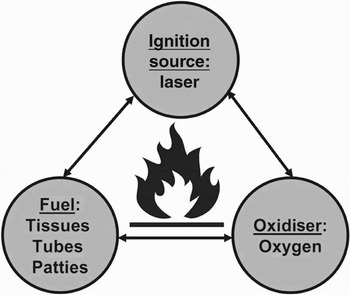
The factors influencing the probability of such ignition can be conceptualised as a ‘fire triad’ (Figure 1).Reference Barker and Polson6 To date, no studies have addressed the relationship between the different components of the fire triad and the occurrence of intraluminal airway fires, within the context of transoral laser microsurgery. We sought therefore to evaluate the relationship between the different components of the fire triad and the occurrence of intraluminal airway fires in an in vitro model approximating the clinical situation, in order to better inform clinical practice.
The ‘fire triad’.

Methods
Porcine model
Approval for experimentation on the carcass was gained via the Royal Veterinary College.
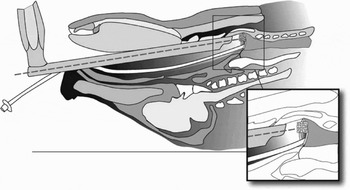
A large, white, 90 kg, female pig was sacrificed immediately prior to the experiment. Suspension microlaryngoscopy using a Dedo–Pilling laryngoscope (Pilling Surgical, Horsham, PA, USA) was established and subglottic jet ventilation at a frequency of 100 Hz was delivered through a Hunsaker tube (Xomed Surgical Products; Jacksonville, Fla, USA) by a Mistral jet ventilator (ACUTRONIC Medical Systems AG, Hirzel, Switzerland) at a pressure of 2.0 bar (Figure 2). Once jet-ventilated, the cadaveric pig was calculated to differ only minimally from a ventilated patient in terms of laryngeal gas composition and ventilatory pressures.
Schematic representation of the experimental configuration.

Experimental protocol
To avoid inter-operator variation, each experimenter was assigned a specific role throughout the study. The laser operator and the stopwatch and patty preparation operator were not aware which variables were being assessed. The primary variable of interest was the time to ignition of wet neurosurgical patties, which are commonly used to protect tissues from stray laser beams. Three oxygen concentrations were tested (50, 75 and 100 per cent) and three laser power settings (5, 7.5 and 10 W; each setting was tested at each oxygen concentration). Carbon dioxide laser was delivered using a Sharplan micromanipulator (Lumenis, The Hyde, London, UK). Both laser power and oxygen concentration were varied in a random order.
A further comparison was made between ignition times of wet and dry patties at 50 per cent oxygen concentration and 5 W laser power. Wet patties were prepared in a standardised fashion by soaking in 1:10 000 adrenaline, with no attempt at drying.
The cotton patty was placed at the level of the glottis and the laser was fired continuously at the centre of the patty. Ignition time was measured from the time verbally proclaimed as the laser start time to the moment of combustion as declared by the operator. The moment of combustion was recorded when a flash of fire was seen.
After each fire, a gap of 30 seconds was left to allow equilibration of the new oxygen concentration and cooling of the airway, in order to remove any ‘carry-over’ effect. Thirty seconds was judged to be an adequate gap, as determined by examining the larynx at the beginning of the experiment. The larynx was cleaned of debris and charred material between each fire. Due to time constraints, the combination of 7.5 W laser and 75 per cent oxygen could not be investigated.
Results
Dry vs wet patties
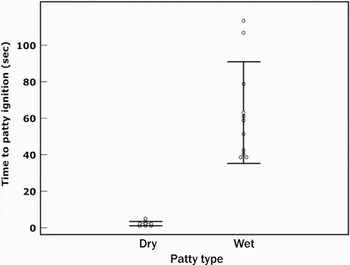
The average time to combustion of dry patties, at an oxygen concentration of 50 per cent and laser power of 5 W, was 2.3 ± 1.2 seconds (average ± standard deviation). The average ignition time for wet patties, under the same oxygen concentration and laser power settings, was 63.9 ± 27.8 seconds (p < 0.00001; unpaired Student's t-test) (Figure 3).
Comparison of dry and wet patty ignition times. Error bars represent 95 per cent confidence intervals. Oxygen concentration = 50 per cent; laser power = 5 W; p < 0.0001. Sec = seconds

Altered oxygen concentrations and laser settings
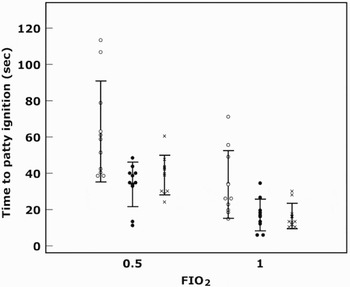
Given that observations were not taken at 75 per cent oxygen concentration and 7.5 W laser power, we removed all measurements taken under 75 per cent oxygen, in order to achieve a balanced analysis of variance design. Analysis showed that both oxygen concentration and laser power significantly affected the time to ignition, but that they did not significantly interact (Figure 4; analysis of variance).
Comparison of wet patty ignition times for different oxygen concentrations and laser power settings. Error bars represent 95 per cent confidence intervals. White circles = 5 W laser power; black circles = 7.5 W laser power; ×= 10 W laser power. Oxygen concentration, F = 31.07 (p < 0.001); laser power, F = 12.71 (p < 0.001); two-factor interactions, F = 0.75 (p = 0.48). F = Variance ratio test, FiO2 = Fraction of inspired oxygen concentration; sec = seconds

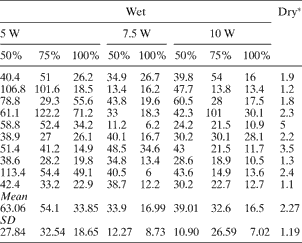
A further, unbalanced analysis of variance was performed with all data. This showed a statistically significant reduction in patty ignition time when the laser power setting was increased from 5 to 7.5 W (p < 0.05; Tukey test for multiple comparisons; two-way analysis of variance), but no further reductions when the power was further increased to 10 W. There was no significant reduction in the time to ignition between oxygen concentrations of 50 and 75 per cent. However, the time to ignition fell significantly when the oxygen concentration was further increased to 100 per cent. Table I shows all the raw data generated from the study.
Raw study data: time to wet and dry patty ignition
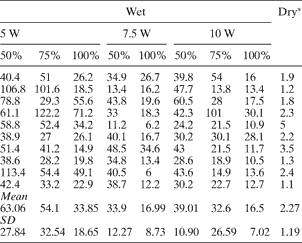
Data shown represent time in seconds, unless otherwise specified. x W = laser power setting; x% = oxygen concentration. *5 W laser, 50% oxygen.
Discussion
The present study found that dry neurosurgical patties ignite over 30 times more rapidly than wet patties. Therefore, in our opinion, dry patties should not be used under any circumstances; furthermore, wet patties should be changed regularly when prolonged procedures are undertaken, in order to reduce the risk of drying. We also found that laser power settings and oxygen concentration independently affect the risk of intraluminal fires. The major effect of increasing oxygen concentration was observed between 75 and 100 per cent, with no significant effect being found between 50 and 75 per cent. On the other hand, the most significant change in ignition time was observed when laser power was increased from 5 to 7.5 W; no further statistically significant changes were found when the power was further increased to 10 W.
These findings have significant implications for the safe practice of transoral laser microsurgery. Laser power settings of 10–12 W are routinely used by many surgeons in order to remove hypopharyngeal and laryngeal tumours and a variety of benign lesions. Our study findings imply that, at this laser setting, oxygen concentration should be reduced to the minimum safe level whenever possible.Reference Hunsaker7
• This study assessed the risk of airway fires during laser microlaryngoscopy
• Neurosurgical patties, used to prevent tissue injury from stray laser beams, are a potential fire risk
• Surgical patties should always be soaked and used for only short periods to prevent drying
• Prolonged laser use at high power settings and ventilation with 100 per cent oxygen should be avoided
However, a proportion of patients with head and neck tumours have respiratory comorbidities and may require high oxygen concentrations in order to maintain safe oxygenation. The operating surgeon should recognise that this combination of factors places the patient at the highest risk of airway fires. Therefore, it is incumbent on the surgeon to take all necessary precautions, including minimising continuous laser use, using the lowest possible laser power settings, ensuring that the co-axial beam is correctly aligned and changing patties frequently.
The main limitation of our study was that it was performed in a cadaveric model. This was however a necessity, as actual human studies on this topic are clearly highly unethical. A further limitation of the study was that we did not ignite all possible flammable materials present in the airway during jet ventilation, mainly the ventilation tube and the tissues (particularly exposed cartilage). This was due to three, pragmatic reasons. Firstly, neurosurgical patties were the most flammable substance in the airway. Secondly, igniting cartilage would have required the use of multiple pigs, and these were not available. Thirdly, we had been advised that setting fire to the oxygen-carrying plastic tube could lead to an uncontrolled explosion. Further research is needed in order to better elucidate the factors associated with the occurrence of intraluminal airway fires.
Conclusion
We found that airway fires can readily occur during shared-airway surgery. However, the risk to patients can be reduced through a better understanding of the fire triad and how it impacts on such clinical practice, and, consequently, through taking simple precautions when using lasers within the airway.