Introduction
Posttraumatic stress disorder (PTSD) is heterogeneous in its symptom presentation (Zoellner, Pruitt, Farach, & Jun, Reference Zoellner, Pruitt, Farach and Jun2014), response to treatment (Cusack et al., Reference Cusack, Jonas, Forneris, Wines, Sonis, Middleton and Gaynes2016; Hoskins et al., Reference Hoskins, Pearce, Bethell, Dankova, Barbui, Tol and Bisson2015), and neurobiology (Akiki, Averill, & Abdallah, Reference Akiki, Averill and Abdallah2017; Etkin & Wager, Reference Etkin and Wager2007; Hayes, VanElzakker, & Shin, Reference Hayes, VanElzakker and Shin2012; Koch et al., Reference Koch, van Zuiden, Nawijn, Frijling, Veltman and Olff2016a, 2016Reference Koch, Van Zuiden, Nawijn, Frijling, Veltman and Olffb; Liberzon & Abelson, Reference Liberzon and Abelson2016; Pitman et al., Reference Pitman, Rasmusson, Koenen, Shin, Orr, Gilbertson and Liberzon2012). Although there have been significant discoveries in our understanding of the neurobiological systems associated with trauma and stress, the heterogeneity associated with PTSD has impeded the identification of consistent biomarkers, which are rarely strong enough to make inferences at the individual level (although see Christova, James, Engdahl, Lewis, & Georgopoulos, Reference Christova, James, Engdahl, Lewis and Georgopoulos2015; Liu et al. Reference Liu, Xie, Wang, Guo, Fouche, Long and Chen2014). While some clinical subtypes correspond to distinct neurobiological systems (Lanius, Brand, Vermetten, Frewen, & Spiegel, Reference Lanius, Brand, Vermetten, Frewen and Spiegel2012), one significant limitation of biomarker identification in PTSD is that clinical symptoms and subtypes do not necessarily correspond to the same underlying neurobiology, as overlapping symptoms can stem from dysregulation of different neurobiological systems (Boccia et al., Reference Boccia, D'Amico, Bianchini, Marano, Giannini and Piccardi2016; Hayes et al., Reference Hayes, VanElzakker and Shin2012; Liberzon & Abelson, Reference Liberzon and Abelson2016; Pitman et al., Reference Pitman, Rasmusson, Koenen, Shin, Orr, Gilbertson and Liberzon2012). One promising approach to further refining biomarkers in PTSD is the examination of cognitive functioning, as the neurobiological systems implicated in PTSD are associated with a number of basic cognitive functions, including memory, emotional regulation, executive functioning, and attention. Dysfunction of these neurocognitive systems may contribute to the development and maintenance of PTSD symptoms such as intrusive thoughts, and alterations in memory, arousal, and concentration (Aupperle, Melrose, Stein, & Paulus, Reference Aupperle, Melrose, Stein and Paulus2012b; Scott et al., Reference Scott, Matt, Wrocklage, Crnich, Jordan, Southwick and Schweinsburg2015). Thus, specific patterns of cognitive dysfunction and aberrations in associated brain networks may explain clinical and neurobiological heterogeneity of PTSD, and reveal neurocognitive subtypes that can advance our understanding and treatment approach to PTSD. Recent studies have supported this premise, and provide initial evidence for neurocognitive subtypes of PTSD (Etkin et al., Reference Etkin, Maron-Katz, Wu, Fonzo, Huemer, Vértes and O'Hara2019). Specifically, Etkin et al. found that individuals with PTSD and relatively impaired verbal memory had a connectivity biomarker in the salience network (SN; hypoconnectivity), also referred to as the ventral attention network (VAN). In a conceptual replication of Etkin et al., we applied a similar neurocognitive approach to an independent sample of veterans with PTSD. We found that this SN connectivity biomarker was instead indicative of PTSD in the presence of clinically significant attention dysfunction (Esterman et al., Reference Esterman, Stumps, Jagger-Rickels, Rothlein, DeGutis, Fortenbaugh and McGlinchey2020). Investigating neurocognitive subtypes across other cognitive domains and neurobiological systems has wide-reaching clinical and translational implications, including refining diagnoses and personalizing treatments (Etkin et al., Reference Etkin, Maron-Katz, Wu, Fonzo, Huemer, Vértes and O'Hara2019; Marx et al., Reference Marx, Thompson-Hollands, Lee, Resick and Sloan2020; Van Rooij, Kennis, Vink, & Geuze, Reference Van Rooij, Kennis, Vink and Geuze2016).
Despite heterogeneity in the neurobiology of PTSD, several neurocognitive systems are commonly implicated. Associations between PTSD and dysfunctional brain activity and/or connectivity are most often reported in frontal-parietal control network (FPCN), default mode network (DMN), limbic network (LN), and SN (Akiki et al., Reference Akiki, Averill and Abdallah2017; Hayes et al., Reference Hayes, VanElzakker and Shin2012; Koch et al., Reference Koch, van Zuiden, Nawijn, Frijling, Veltman and Olff2016a, 2016Reference Koch, Van Zuiden, Nawijn, Frijling, Veltman and Olffb; e.g. triple network model, Menon, Reference Menon2011). For example, Akiki et al. (Reference Akiki, Averill and Abdallah2017) suggest that individuals with PTSD may have decreased DMN and FPCN connectivity (and hypoactivity), but increased SN/LN connectivity (and hyperactivity). These large-scale networks are not only associated with a range of psychopathy (Menon, Reference Menon2011; Xia et al., Reference Xia, Ma, Ciric, Gu, Betzel, Kaczkurkin and Satterthwaite2018) but are known to support numerous and overlapping cognitive functions. For example, the DMN has been implicated in several aspects of memory (e.g. autobiographical memory and prospection; Spreng, Mar, & Kim, Reference Spreng, Mar and Kim2009; Wen, Mitchell, & Duncan, Reference Wen, Mitchell and Duncan2020), as well as attention (e.g., mind-wandering; Kucyi, Esterman, Riley, & Valera, Reference Kucyi, Esterman, Riley and Valera2016). The SN plays a critical role in stimulus-driven or bottom-up attention, via its interactions with the DMN and FPCN (Chand & Dhamala, Reference Chand and Dhamala2016; Sridharan, Levitin, & Menon, Reference Sridharan, Levitin and Menon2008), and broadly integrates motivational, affective, and cognitive factors (Menon & Uddin, Reference Menon and Uddin2010; Seeley et al., Reference Seeley, Menon, Schatzberg, Keller, Glover, Kenna and Greicius2007). The FPCN, as well as its interaction with the DMN and SN/LN, are thought to be critical for executive function (EF) and goal-directed or top-down control of attention (Spreng, Stevens, Chamberlain, Gilmore, & Schacter, Reference Spreng, Stevens, Chamberlain, Gilmore and Schacter2010; Sridharan et al., Reference Sridharan, Levitin and Menon2008), emotion regulation (Hayes et al., Reference Hayes, Morey, Petty, Seth, Smoski, McCarthy and LaBar2010), and working memory (Gazzaley & Nobre, Reference Gazzaley and Nobre2012). As such, PTSD-related cognitive impairments in memory (Brewin, Kleiner, Vasterling, & Field, Reference Brewin, Kleiner, Vasterling and Field2007; Vasterling et al., Reference Vasterling, Duke, Brailey, Constans, Allain and Sutker2002), attention (DeGutis et al., Reference DeGutis, Esterman, McCulloch, Rosenblatt, Milberg and McGlinchey2015; Dutra, Marx, McGlinchey, DeGutis, & Esterman, Reference Dutra, Marx, McGlinchey, DeGutis and Esterman2018; Esterman et al., Reference Esterman, Degutis, Mercado, Rosenblatt, Vasterling, Milberg and Mcglinchey2013, Reference Esterman, Fortenbaugh, Pierce, Fonda, DeGutis, Milberg and McGlinchey2019; Fortenbaugh, DeGutis, & Esterman, Reference Fortenbaugh, DeGutis and Esterman2017b; Pineles et al., Reference Pineles, Mostoufi, Ready, Street, Griffin and Resick2011; Swick, Honzel, Larsen, & Ashley, Reference Swick, Honzel, Larsen and Ashley2013; Vasterling et al., Reference Vasterling, Duke, Brailey, Constans, Allain and Sutker2002), executive functioning and inhibitory control (Aupperle et al., Reference Aupperle, Melrose, Stein and Paulus2012b; DeGutis et al., Reference DeGutis, Esterman, McCulloch, Rosenblatt, Milberg and McGlinchey2015; Esterman et al., Reference Esterman, Fortenbaugh, Pierce, Fonda, DeGutis, Milberg and McGlinchey2019; Swick, Honzel, Larsen, Ashley, & Justus, Reference Swick, Honzel, Larsen, Ashley and Justus2012) may reflect unique patterns of dysfunction in these brain networks. Together, such patterns of impairment in these networks and their underlying cognitive functions could reveal unique neurocognitive mechanisms and underlying subtypes of PTSD.
Although the emergence of models such as the triple network model attempts to reduce the total number of potential networks implicated in pathology, nearly every large-scale brain network has been implicated in PTSD (Boccia et al., Reference Boccia, D'Amico, Bianchini, Marano, Giannini and Piccardi2016; Christova et al., Reference Christova, James, Engdahl, Lewis and Georgopoulos2015; Etkin & Wager, Reference Etkin and Wager2007; Liu et al., Reference Liu, Xie, Wang, Guo, Fouche, Long and Chen2014; Misaki et al., Reference Misaki, Phillips, Zotev, Wong, Wurfel, Krueger and Bodurka2018; Sripada et al., Reference Sripada, King, Welsh, Garfinkel, Wang, Sripada and Liberzon2012b). It is also important to note that the previous findings supporting network models are often derived from ROI/seed-based approaches or meta-analyses of studies with small sample sizes and varied methodology, rather than directly assessing whole-brain connectome-based networks in a large cohort of individuals with trauma exposure. Although network-based, whole-brain techniques do not limit conclusions regarding the specificity of results, ROI/seed-based approaches may inflate cross-study convergence on commonly assessed regions or networks. Recent studies have utilized a variety of machine learning and/or data-driven techniques alongside whole-brain network-based approaches in order to identify resting-state connectivity markers of PTSD, across varied sources of trauma. The majority of this literature converges onto disrupted connectivity between the FPCN and SN (Lei et al., Reference Lei, Li, Li, Chen, Huang and Lui2015; Misaki et al., Reference Misaki, Phillips, Zotev, Wong, Wurfel, Krueger and Bodurka2018; Nicholson et al., Reference Nicholson, Harricharan, Densmore, Neufeld, Ros, McKinnon and Lanius2020; Zandvakili et al., Reference Zandvakili, Barredo, Swearingen, Aiken, Berlow, Greenberg and Philip2020; Zilcha-Mano et al., Reference Zilcha-Mano, Zhu, Suarez-Jimenez, Pickover, Tal, Such and Rutherford2020). However, several studies implicate other networks, including the visual network (Christova et al., Reference Christova, James, Engdahl, Lewis and Georgopoulos2015; Maron-Katz et al., Reference Maron-Katz, Zhang, Narayan, Wu, Toll, Naparstek and Etkin2020; Misaki et al., Reference Misaki, Phillips, Zotev, Wong, Wurfel, Krueger and Bodurka2018; Nicholson et al., Reference Nicholson, Harricharan, Densmore, Neufeld, Ros, McKinnon and Lanius2020), sensorimotor network (Maron-Katz et al., Reference Maron-Katz, Zhang, Narayan, Wu, Toll, Naparstek and Etkin2020; Misaki et al., Reference Misaki, Phillips, Zotev, Wong, Wurfel, Krueger and Bodurka2018), and DMN (Nicholson et al., Reference Nicholson, Harricharan, Densmore, Neufeld, Ros, McKinnon and Lanius2020; Zandvakili et al., Reference Zandvakili, Barredo, Swearingen, Aiken, Berlow, Greenberg and Philip2020; Zilcha-Mano et al., Reference Zilcha-Mano, Zhu, Suarez-Jimenez, Pickover, Tal, Such and Rutherford2020). These inconsistencies could arise from varying methodologies and inadequate sample sizes (Misaki et al., Reference Misaki, Phillips, Zotev, Wong, Wurfel, Krueger and Bodurka2018; Zandvakili et al., Reference Zandvakili, Barredo, Swearingen, Aiken, Berlow, Greenberg and Philip2020; Zilcha-Mano et al., Reference Zilcha-Mano, Zhu, Suarez-Jimenez, Pickover, Tal, Such and Rutherford2020), as well as clinical and cognitive heterogeneity in the study samples. Given this heterogeneity, studies using whole-brain connectome-based approaches, large sample sizes, and data-driven techniques have the potential to advance our neurobiological understanding of PTSD and reveal underlying clinical or neurocognitive subtypes.
In the current study, we used a whole-brain network-based approach towards understanding the neurobiology of PTSD, and determined whether network-markers of PTSD interact with cognitive functioning in domains most commonly implicated in PTSD (attention, executive functioning, and verbal memory; Aupperle et al., Reference Aupperle, Melrose, Stein and Paulus2012b; DeGutis et al., Reference DeGutis, Esterman, McCulloch, Rosenblatt, Milberg and McGlinchey2015; Etkin et al., Reference Etkin, Maron-Katz, Wu, Fonzo, Huemer, Vértes and O'Hara2019; Hayes et al., Reference Hayes, VanElzakker and Shin2012), thus laying the groundwork for identifying neurocognitive subtypes of PTSD. Specifically, in a large sample of post-9/11 veterans (N = 271) who completed resting-state fMRI, as well as clinical and cognitive assessments, we identified large-scale connectome-based networks associated with PTSD symptom severity as well as implemented a graph-analytic approach to identify regional PTSD-related Hubs of Dysfunction (HoD) within these networks. We next determined if heterogeneity in these network-based PTSD markers could be explained by normative-based cognitive impairments, using a well-validated set of neuropsychological composite measures. Overall, this study aims to identify and explain variance in neurobiological markers of PTSD and lay the groundwork for validating subtypes of PTSD that incorporate clinical, cognitive, and brain measures.
Methods
Participants
Participants were post-9/11 veterans, aged 18–65, who served in Operation Enduring Freedom, Operation Iraqi Freedom, and Operation New Dawn and took part in the Translational Research Center for Traumatic Brain Injury and Stress Disorders (TRACTS) longitudinal cohort study (for details regarding recruitment, exclusion criterion, assessment battery, and other characteristics of this data, see Supplementary Methods and McGlinchey, Milberg, Fonda, & Fortier, Reference McGlinchey, Milberg, Fonda and Fortier2017). This study included the first consecutively enrolled 271 participants, out of a total of 307 participants with available data at the start of this study. These 271 participants completed both neuroimaging (resting-state fMRI) and the primary clinical/cognitive assessments, passed a stand alone performance validity measure, did not have a moderate or severe TBI (mild TBI included, see Table 1), and met quality control metrics for functional imaging (see Supplementary Methods for further details regarding performance validity and quality control metrics).
Sample characteristics

*, **Three EF groups (impaired, average, and above average) are significantly different at p < 0.05 and p < 0.001 respectively, using logistic or linear regression. †Nine participants were missing the executive composite data (N = 262). EF, executive function; CAPS, Clinician-Administered PTSD Scale (Blake et al., Reference Blake, Kaloupek, Weathers, Gusman, Nagy, Charney and Keane1995); WTAR, Wechsler Test of Adult Reading (Venegas & Clark, Reference Venegas, Clark, Kreutzer, DeLuca and Caplan2011).
a Mild military TBI are scored from the Boston Assessment of TBI-Lifetime.
b Depression and Anxiety are both total scores from the Depression Anxiety Stress Scales (Lovibond & Lovibond, Reference Lovibond and Lovibond1995).
c Average alcohol use is the average number of drinks on a drinking day from lifetime drinking history (Skinner & Sheu, Reference Skinner and Sheu1982).
d Average pain is from the average pain in the last month from the McGill Short Form (Melzack & Katz, Reference Melzack, Katz, Gebhart and Schmidt2013).
e Sleep quality is the Global Sleep Score from the Pittsburgh Sleep Quality Index (Buysse, Reynolds, Monk, Berman, & Kupfer, Reference Buysse, Reynolds, Monk, Berman and Kupfer1989).
Assessment of PTSD, comorbidities, and demographics
The Clinician-Administered PTSD Scale for DSM-IV (CAPS-IV; Blake et al., Reference Blake, Kaloupek, Weathers, Gusman, Nagy, Charney and Keane1995) was administered to assess PTSD symptom severity and diagnostic criteria. We considered the total CAPS symptom severity as our primary measure since evidence suggests that PTSD is dimensional (Forbes, Haslam, Williams, & Creamer, Reference Forbes, Haslam, Williams and Creamer2005; Ruscio, Rusciob, & Keane, Reference Ruscio, Rusciob and Keane2002), although diagnosis was considered in secondary analyses. For additional follow-up analyses, we consider symptom clusters of PTSD, which include total scores of Criterion B (re-experiencing), C (avoidance and numbing), and D (hyperarousal) items from the CAPS-IV. We account for general effects of demographics (age, gender, and years of education) and premorbid verbal abilities (Wechsler Test of Adult Reading, WTAR; Venegas & Clark, Reference Venegas, Clark, Kreutzer, DeLuca and Caplan2011) by including these measures as covariates in all main analyses. In subsequent follow-up analyses, we considered common comorbidities [including depression, anxiety, alcohol use, mild military TBI (mTBI), sleep quality, and pain], as well as medication use (current anti-depressant, hypnotic/sedative, pain, or epileptic medication). See Table 1 and Supplementary Materials for details regarding assessments of PTSD, comorbidities, demographics, and medication use.
Neuropsychological tests
We assessed cognitive functioning using a priori, previously validated composite measures of verbal memory, attention, and executive functioning (Riley et al., Reference Riley, Mitko, Stumps, Robinson, Milberg, McGlinchey and DeGutis2019). Then, using DSM-5 criteria for clinically significant mild neurocognitive impairment, impairment in a cognitive domain was defined as performance falling one standard deviation below normative expectations on two or more measures within that domain (Jak et al., Reference Jak, Bondi, Delano-Wood, Wierenga, Corey-Bloom, Salmon and Delis2009; Riley et al., Reference Riley, Mitko, Stumps, Robinson, Milberg, McGlinchey and DeGutis2019; Stricker et al., Reference Stricker, Lippa, Green, McGlynn, Grande, Milberg and McGlinchey2017). This method has been validated and used previously in a post-9/11 Veteran sample (Esterman et al., Reference Esterman, Stumps, Jagger-Rickels, Rothlein, DeGutis, Fortenbaugh and McGlinchey2020; Riley et al., Reference Riley, Mitko, Stumps, Robinson, Milberg, McGlinchey and DeGutis2019). In addition to defining mild neurocognitive impairment, we used a parallel approach to define above-average performance. Specifically, we defined those with above-average cognition as those that performed one standard deviation above normative expectations on two or more of the measures within a cognitive domain. All other participants were considered to have average cognitive functioning in a given domain. We used these previously published criteria to define groups with clinically significant differences in cognition within our sample, rather than continuous measures that emphasize differences in performance that may not be meaningful or reliable. Similarly, this cutoff procedure increases the reliability of defining impaired/above-average groups since it requires scoring above or below on two or more tests within a domain, creating three groups of cognitive functioning: impaired, average, and above-average functioning. Considering those with impaired functioning, average functioning, and above-average functioning using clinically significant cutoffs allowed us to determine how clinically significant and normative-based variation in cognitive ability accounts for neurobiological heterogeneity in PTSD. Finally, the Medical Symptom Validity Test (Green, Reference Green2004) was used to exclude participants that likely did not expend full effort, calling into question their clinical and neuropsychological performance, akin to previous studies with this population (Esterman et al., Reference Esterman, Stumps, Jagger-Rickels, Rothlein, DeGutis, Fortenbaugh and McGlinchey2020; Riley et al., Reference Riley, Mitko, Stumps, Robinson, Milberg, McGlinchey and DeGutis2019), and others (Heilbronner, Sweet, Morgan, Larrabee, & Millis, Reference Heilbronner, Sweet, Morgan, Larrabee and Millis2009; Iverson, Reference Iverson2005; Stricker et al., Reference Stricker, Lippa, Green, McGlynn, Grande, Milberg and McGlinchey2017). See Table 1 and the Supplementary Materials for more details regarding the neuropsychological tests, composites, and performance validity testing.
Neuroimaging methods
Anatomical and 8–12 min of resting-state neuroimaging data were acquired with a 3T Siemens (Erlangen, Germany) TIM Trio scanner, using a 12-channel head coil. Details regarding MRI acquisition, resting-state preprocessing, head motion calculation, and quality control criteria for inclusion can be found in the Supplementary Materials. The brain was parcellated using a seven-network atlas from Yeo et al. (Reference Yeo, Krienen, Sepulcre, Sabuncu, Lashkari, Hollinshead and Buckner2011). The bilateral amygdala and hippocampus were added to this parcellation's LN, from an atlas developed by Tullo et al. (Reference Tullo, Devenyi, Patel, Park, Collins and Chakravarty2018) to allow for analysis of these structures that are commonly implicated in neurobiological models of PTSD. This procedure generated 52 ROIs, embedded within the seven large-scale cortical networks. The average time series were extracted from each ROI (averaged across the set of voxels within the node) and correlated (Pearson) across nodes for a total of 1326 pairwise correlations (see Supplementary Materials and Table S1 for more information regarding this parcellation procedure).
Network connectivity analyses
To calculate both within- and between-network functional connectivity values, the resulting correlation coefficients for each ROI-pair were Fisher-z transformed, grouped by network, and averaged according to their corresponding large-scale network resulting in a total of seven within- and 21 between-network connectivity estimates (28 total). To determine network connectivity relationships with PTSD, connectivity in each network-pair was correlated (Pearson) with PTSD symptom severity for a total of 28 correlations. In addition to Pearson correlations, semi-partial correlations were used to determine if significant correlations survived accounting for general demographic covariates including age, education, gender identity, and WTAR. These 28 connections were also corrected for multiple comparisons using FDR correction (p < 0.05).
Follow-Up Symptom Cluster Analyses: Significant correlations between networks and overall symptom severity were revisited in order to determine the specificity of the relationship to underling PTSD symptom clusters. Each significant correlation was evaluated in separate Pearson correlations between network connectivity and each of the CAPS-IV symptom clusters (Re-experiencing, avoidance and numbing, and hyperarousal), followed by semi-partial correlations that included general demographic covariates (age, gender, education, and WTAR).
Secondary Control and Follow-Up Analyses: Follow-up analyses were conducted on significant Pearson correlations between network connectivity and overall PTSD symptom severity. These follow-up analyses considered the inclusion of three sets of covariates: comorbid clinical conditions (depression, anxiety, alcohol use, mTBI, sleep quality, pain), neuroimaging-related effects (head motion and scan duration), and medication use (anti-depressant, hypnotic/sedative, pain, or epileptic). For each significant correction, the semi-partial correlation was recomputed including each of the three categories of covariates.
Neurocognitive interaction analyses
For network(s) significantly related to PTSD, we examined how cognitive functioning further explained PTSD-network connectivity relationships by including cognitive functioning (impaired, average, above-average) in each domain (verbal memory, attention, executive functioning) and their interaction with PTSD symptom severity as terms in linear regression models to predict network connectivity. The same demographic covariates were used in these models (age, gender, years of education, and WTAR). These analyses were conducted independently for each of the three cognitive domains. Significant interactions between cognitive functioning and PTSD symptom severity would indicate that the relationship between PTSD symptom severity and network connectivity depends on the level of cognitive functioning. In addition to using a dimensional approach (continuous PTSD symptom severity), we included an additional regression analysis that used PTSD diagnosis instead of continuous PTSD symptoms to address whether network connectivity varied in those with a PTSD diagnosis and varying degrees of cognitive functioning.
Follow-Up Symptom Cluster Analyses: Similar to the network connectivity analyses, we revisited model(s) with significant interactions between overall PTSD symptom severity and cognition, in order to assess potential specificity to underlying symptom clusters (rexperiencing, avoidance and numbing, and hyperarousal symptom clusters).
Secondary Control and Follow-Up Analyses: Similar to the network connectivity analyses, models with significant interactions between overall PTSD symptom severity and cognition were re-evaluated with three sets of covariates: comorbid clinical conditions, neuroimaging-related effects, and medication use.
Regional PTSD-Hubs of Dysfunction
In order to more finely parse the observed PTSD-related network-level dysfunction to specific regions and potentially identify future targets for interventions, we evaluated evidence for regional hubs of PTSD-related dysfunction (HoD), using a graph-analytical technique that determined the degree of each node as it related to PTSD symptom severity. We adapted the metric of degree centrality, as it incorporates the whole brain (includes all edges) while preserving the ability to identify local nodes (hubs) for future research and potential targets for treatment-based studies. Specifically, the connectivity between each ROI (52 in total) and all other regions (51 in total) was correlated with PTSD symptom severity (p < 0.05). This initial analysis provided, for each of the 52 ROIs, the number of connections (degree) with a significant relationship with PTSD symptom severity (possible range of 0–51). We operationalized an HoD as a brain region with a greater number of PTSD-related connections than expected by chance given the nominal threshold (p < 0.05). To determine chance, PTSD symptom severity was randomized with respect to participants, and the HoD analyses were repeated 5000 times. For each randomization iteration, the number of PTSD-related connections was determined for each ROI. A random distribution was generated for each ROI, and regions were considered a significant hub if the observed number of PTSD-related connections occurred by chance <5% of the time in the random distribution. For the significant HoDs, follow-up analyses explored the patterns of hyper- and hypo-connectivity across the connectome.
Results
Network connectivity analyses
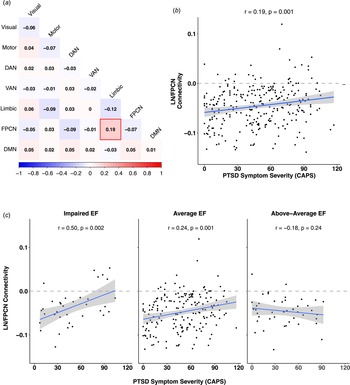
We computed correlations between functional connectivity in 28 brain-network pairs and PTSD symptom severity (Fig. 1a). After correcting for multiple comparisons (FDR), only the connectivity between the LN and FPCN remained significantly correlated with PTSD symptom severity (r = 0.19, p = 0.001, FDR-corrected q = 0.014; Fig. 1b), such that increased PTSD symptom severity was related to increased LN-FPCN connectivity. As the connectivity was negative overall, more severe PTSD symptoms resulted in a reduction of this negative connectivity, or reduction in the absolute connectivity. This effect remained significant after controlling for age, gender, years of education, and premorbid IQ (WTAR) (semi-partial r = 0.20, p = 0.001). Zero-order correlations between LN/FPCN and covariates are reported in the Supplementary Materials (Table S3).
Correlations between PTSD symptom severity and network connectivity. (a) Connectivity matrix displaying the Pearson correlations between the 28 network functional connectivity values and PTSD symptom severity. Only the connectivity between the frontal-parietal control network (FPCN) and the limbic network (LN) was significant after correcting for multiple comparison (r = 0.19, p = 0.001) and is highlighted by a red box. (b) Scatterplot of limbic-FPCN connectivity and PTSD symptom severity. (c) The relationship between limbic-FPCN connectivity and PTSD symptom severity across the three executive functioning (EF) groups. The first (left) panel displays the significant relationship between symptom severity and limbic-FPCN connectivity in the impaired EF group. The middle panel displays the significant relationship between connectivity and PTSD severity in the average EF group. The last (right) panel shows the insignificant relationship between connectivity and symptom severity in the above-average EF group. FPCN, frontal-parietal control network; LN, limbic network.

Follow-Up Symptom Cluster Analyses: To further determine specificity, we correlated LN-FPCN connectivity with each symptom cluster (re-experiencing, avoidance and numbing, and hyperarousal). All three symptom clusters were significantly correlated with each other (r = 0.71–0.75, p's < 0.001; see Supplementary Table S2), and with LN-FPCN (r = 0.15–0.19, p's < 0.015; see Supplementary Table S3), and remained significant after including covariates, suggesting no clear symptom specificity in the PTSD correlation with LN-FPCN connectivity.
Secondary Control and Follow-Up Analyses: Next, we conducted additional control analyses to determine the specificity and robustness of the relationship between PTSD symptom severity and LN-FPCN. The relationship between PTSD and LN-FPCN remained significant after controlling for clinical comorbidities (depression, anxiety, average alcohol use, mTBI, sleep quality, and average pain; r = 0.14, p = 0.041), neuroimaging-related effects (scan duration and head-motion; r = 0.19, p = 0.002), and medication use (anti-depressant, sedative/hypnotic, epileptic, and pain medication, r = 0.17, p = 0.006). See online Supplemental Table S2 for zero-order correlations between clinical comorbidities, scanner-related confounds, current medication use, and LN-FPCN connectivity.
Neurocognitive interaction analyses
Next, we examined whether cognitive functioning further explained variance in the relationship between LN-FPCN connectivity and PTSD, potentially identifying the patterns of functional connectivity unique to PTSD in combination with normative-based, clinically significant differences in cognitive function. To do this, we conducted a linear regression predicting LN-FPCN connectivity, with PTSD symptom severity, normative-based cognitive functioning (impaired, average, above-average), and the interaction between PTSD and cognition (as well as general demographic covariates, see Methods). This model was conducted separately for composite measures of verbal memory, attention, and executive functioning (see Methods). In these models, a main effect of cognitive functioning would indicate an additive relationship between cognition and PTSD in explaining LN-FPCN connectivity. On the other hand, an interaction between PTSD symptom severity and cognitive functioning would indicate that the relationship between PTSD and this connectivity marker varied across levels of cognitive functioning. For EF, the overall regression model was significant (adjusted R 2 = 0.07, p < 0.001), there was a main effect of PTSD symptom severity (β = 1.32, p < 0.001), a main effect of EF group (β = 0.27, p = 0.02), and a significant interaction between PTSD symptom severity and executive functioning (β = −1.13, p = 0.001; see Fig. 1c).
Upon closer inspection of this interaction (Fig. 1c; Table 2), in those with impaired EF, there was a moderately strong positive correlation between LN-FPCN connectivity and PTSD severity (r = 0.50, p = 0.002); in those with average EF, this positive correlation between LN-FPCN connectivity and PTSD symptom severity was numerically weaker (r = 0.24, p = 0.001); whereas in those with above-average EF, there was no significant correlation between PTSD symptom severity and LN-FPCN connectivity (r = −0.18, p = 0.24; see Fig. 1c). In other words, the reduced LN-FPCN connectivity associated with PTSD symptom severity was strongest in those with impaired EF, and absent in those with above-average EF. In contrast to EF, the Attention and Memory models were not significant (Attention: adjusted R 2 = 0.03, p = 0.06, Memory: adjusted R 2 = 0.03, p = 0.07; see Table 2). Accounting for the effects of EF did not improve either the memory or attention models (see Supplementary Table S4for these model statistics and details).
Linear regressions predicting limbic-FPCN connectivity

All models include age, education, gender, and WTAR. **p < 0.001. Attention, memory and executive functioning were ordinal three-level factors. β denotes standardized β coefficients.
a The attention domain had 27 with impaired attention, 208 with average attention, and 30 with above-average attention, six subjects had missing data.
b The memory domain had 43 with impaired memory, 204 with average memory, and 17 with above-average memory, seven subjects had missing data.
c The executive (EF) domain had 35 with impaired EF, 182 had average EF, and 45 with above-average EF, nine subjects had missing data.
The interaction between EF and PTSD remained significant after controlling for additional covariates that differed between the EF groups, including attention and memory composites as well as other comorbidities (see Table 1). We included the effects of EF (main effect of EF groups and the interaction between EF and PTSD symptom severity) in both the Attention and Memory regression models to help determine if Attention or Memory had better predictive power after accounting for effects of EF. Both the Attention and Memory models were significant after including EF and its respective interaction term (Attention model: adjusted R 2 = 0.073, p < 0.001, Memory model: adjusted R 2 = 0.08, p < 0.001). However, the significant predictors in both models only included PTSD symptom severity, EF groups, and the interaction between PTSD and EF, indicating that neither memory nor attention predicted LN-FPCN connectivity across a range of models and predictors.
Follow-Up Symptom Cluster Analyses: We investigated the specificity of the observed PTSD-EF interaction by considering symptom clusters (re-experiencing, avoidance and numbing, and hyperarousal) rather than overall PTSD symptom severity in the model. All three interactions between symptom cluster severity and EF significantly predicted LN-FPCN connectivity, (B symptoms β = −0.98, p = 0.005; C symptoms β = −0.77, p = 0.026; D symptoms β = −1.35, p < 0.001). See Supplementary Table S3 for the full report of all these three models.
Secondary Control and Follow-Up Analyses: Next we conducted additional control analyses to determine the specificity and robustness of the interaction between PTSD and EF. The interaction between PTSD and EF remained significant after controlling for clinical comorbidities (depression, anxiety, average alcohol use, mTBI, sleep quality, and average pain; β = −1.03, p = 0.005), neuroimaging-related effects (scan duration and head-motion; β = −1.10, p = 0.001), and medication use (anti-depressant, sedative/hypnotic, epileptic, and pain medication; β = −1.06, p = 0.002). See Supplementary Table S4 for more details.
This study found relatively small effect sizes (e.g., r = 0.19 and adjusted R 2 = 0.076). However, small-to-medium effect sizes are commonly observed in studies investigating brain and PTSD symptom relationships (e.g., Akiki et al., Reference Akiki, Averill, Wrocklage, Scott, Averill, Schweinsburg and Abdallah2018; Santhanam, Wilson, Oakes, & Weaver, Reference Santhanam, Wilson, Oakes and Weaver2019; Zhu et al., Reference Zhu, Helpman, Papini, Schneier, Markowitz, Van Meter and Neria2017), and for studies investigating cognitive relationships with PTSD symptom severity (e.g. DeGutis et al., Reference DeGutis, Esterman, McCulloch, Rosenblatt, Milberg and McGlinchey2015). Despite these effect sizes, the LN-FPCN relationship with PTSD symptom severity reported in this study was robust to multiple different covariates, including demographics, common clinical comorbidities, scanner-related confounds, and current medication use. Further, including EF and the interaction between EF and symptom severity almost doubled the amount of variance explained (model with PTSD severity only: R 2 = 0.036; model with interaction: R 2 = 0.076). Therefore, while a relatively small effect size, EF significantly adds explanatory power to understanding the relationship between LN-FPCN connectivity and PTSD.
Neurocognitive subtypes of PTSD
To test whether these executive functioning interactions with PTSD symptom severity reflect potential neurocognitive subtypes of PTSD diagnosis, we considered PTSD diagnosis in place of symptom severity in the EF model of LN-FPCN connectivity. The overall model was significant (adjusted R 2 = 0.055, p = 0.004), with a main effect of PTSD diagnosis (β = 0.74, p = 0.002), EF groups (β = 0.52, p = 0.008), as well as the interaction term (β = −1.11, p < 0.001). Post-hoc linear models revealed that in those without PTSD, EF groups did not significantly explain LN-FPCN connectivity (β = 0.15, p = 0.144), and the groups did not significantly differ from each other (independent samples t test p > 0.05). On the other hand, in those with PTSD, EF significantly explained LN-FPCN connectivity (β = −0.24, p = 0.005; Fig. 2). Using independent samples t tests, we found greater dysfunctional connectivity in those with PTSD and impaired EF compared to those with PTSD and above-average EF [t(27.81) = 2.92, p = 0.007].
Limbic-FPCN connectivity and executive functioning (EF) groups in those with PTSD diagnosis (vs. those without PTSD). PTSD+, individuals with PTSD; PTSD–, individuals without PTSD; Imp, impaired functioning; Avg, average functioning; AbvAvg, above-average functioning.

Regional PTSD-Hubs of Dysfunction
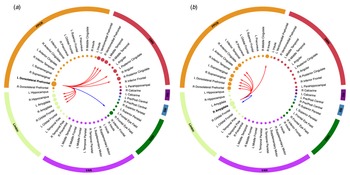
To further explore the regional nature of these LN-FPCN markers of PTSD, we next sought to examine which subregions within these networks were related to PTSD symptom severity. Based on the previous analyses, we hypothesized that regions within the LN and FPCN would be HoD. HoD analysis, a novel graph-analytic approach to functional connectivity, was employed that identifies individual brain regions with a significant number of connections (degree) related to PTSD symptom severity (see Methods). Two HoDs were identified (Fig. 3), the right amygdala, within the LN, and the left dorsolateral prefrontal cortex (DLPFC), within the FPCN. Twenty percent (10/51) of connections with the left DLFPC (p = 0.022) were correlated with PTSD symptom severity. Nine connections displayed hyper-connectivity with greater PTSD symptom severity, five to the DMN and four to the LN (Fig. 3a), all reflecting reductions in negative connectivity (or absolute reductions in connectivity strength). Sixteen percent (8/51) of connections with the right amygdala (p = 0.028) were correlated with PTSD symptom severity. Seven connections displayed hyper-connectivity to the FPCN, reflecting reductions in negative connectivity (absolute reductions in connectivity strength, Fig. 3b). Overall, there were consistencies between this HoD analysis and the previous network correlation analysis, specifically the decreased (negative) connectivity between the FPCN and LN. The HoD analysis further revealed PTSD-related connectivity between the DLPFC and DMN.
Hubs of Dysfunction (HoD) were defined as regions with significant numbers of PTSD-related connections. (a) Significant PTSD-related connections from the left dorsolateral prefrontal hub of the FPCN. (b) Significant PTSD-related connections from the right amygdala hub of the limbic network. The hub is denoted by a bolded label and large circle, whereas significant connections are denoted by medium circles. The color of the lines dictates if the connection is either hyper-connected (red) or hypo-connected (blue). Vis, visual network; SM, somatomotor network; DAN, dorsal attention network; VAN, ventral attention network; Limbic, limbic network; FPCN, frontal-parietal control network; DMN, default mode network.

Discussion
In this study, we examined intrinsic functional brain markers of PTSD using whole-brain network-based and graph-analytic approaches in a large sample (N = 271) of post-9/11 trauma-exposed veterans. We further considered how specific patterns of cognitive dysfunction modified the relationship between PTSD and brain functioning. A primary result from our study was that, across all network interactions, the LN-FPCN connectivity was uniquely correlated with PTSD symptom severity. This effect was robust to a variety of covariates (e.g., demographics, clinical comorbidities, neuroimaging-related effects, and medication use) and was not specific to any one symptom cluster. PTSD-related HoDs were identified within these networks, including the right amygdala and left DLPFC. In both the network and the HoD analyses, with increasing severity of PTSD symptoms, there was a reduction in negative connectivity strength (Fig. 1b and 3), or a reduction in absolute connectivity. Further, our analysis found that executive functioning modulated the relationship between the LN-FPCN connectivity and PTSD (Fig. 1c); those with clinically significant executive dysfunction exhibited the strongest relationship between LN-FPCN connectivity and PTSD symptom severity. This interaction between PTSD and EF was robust to accounting for clinical covariates and a range of potential confounds and was not specific to any one symptom cluster. Further, this pattern was unique to those with a PTSD diagnosis, such that those with PTSD and impaired EF had the strongest LN-FPCN dysfunction, and those with PTSD and above-average EF had equivalent connectivity to those without PTSD (Fig. 2). These relationships with LN-FPCN connectivity were unique to EF and absent for normative-based measures of attention or verbal memory. Together, these results suggest that while LN-FPCN dysregulation may be a general neural correlate of PTSD, it is most pronounced in those with impaired executive functioning and may represent a neurocognitive subtype of PTSD.
We considered normative-based cognitive functioning as a modulating factor and demonstrate that impaired EF amplifies the relationship between PTSD and LN-FPCN connectivity, and above-average EF reduces this relationship. This effect was evident when considering PTSD dimensionally, as well as by diagnosis, suggesting potentially meaningful neurocognitive subtypes of PTSD. Previous literature suggests poor EF may increase susceptibility to PTSD (Admon, Milad, & Hendler, Reference Admon, Milad and Hendler2013; Aupperle et al., Reference Aupperle, Melrose, Stein and Paulus2012b), and modulating these circuits may mark a potential target for treatment (Koch et al., Reference Koch, van Zuiden, Nawijn, Frijling, Veltman and Olff2016a 2016Reference Koch, Van Zuiden, Nawijn, Frijling, Veltman and Olffb; Nicholson et al., Reference Nicholson, Rabellino, Densmore, Frewen, Paret, Kluetsch and Lanius2017). Our results suggest that those with impaired EF may be more susceptible to LN-FPCN dysregulation as a result of PTSD, or, alternatively, it could be that poor EF and network dysregulation are exacerbated by PTSD in some individuals. Longitudinal studies of neurocognitive functioning will be required to tease apart the degree to which these neurocognitive markers reflect premorbid risk factors vs. sequelae of PTSD. In sum, our network-based and HoD analyses are consistent with prior neurobiological models of PTSD (Akiki et al., Reference Akiki, Averill and Abdallah2017; Liberzon & Abelson, Reference Liberzon and Abelson2016), and further implicate individuals with impaired EF as exhibiting a more prominent PTSD biomarker, potentially identifying a neurocognitive subtype of PTSD.
A wealth of evidence from resting-state, task-based fMRI, and neuropsychology studies have implicated regions within the LN and FPCN with PTSD symptomatology. The LN-FPCN brain connectivity with PTSD symptom severity in the network correlation analysis, and the specificity to the amygdala and DLPFC discovered by the HoD, are brain regions and neural circuits that have previously been implicated in current theories of PTSD. These theories include fear learning (Dunsmoor, Prince, Murty, Kragel, & LaBar, Reference Dunsmoor, Prince, Murty, Kragel and LaBar2011; Lissek et al., Reference Lissek, Bradford, Alvarez, Burton, Espensen-Sturges, Reynolds and Grillon2014), exaggerated threat detection (Aupperle et al., Reference Aupperle, Allard, Grimes, Simmons, Flagan, Behrooznia and Stein2012a; Bryant et al., Reference Bryant, Kemp, Felmingham, Liddell, Olivieri, Peduto and Williams2008; Sripada et al., Reference Sripada, King, Welsh, Garfinkel, Wang, Sripada and Liberzon2012b), as well as executive functioning and emotion regulation models (Buhle et al., Reference Buhle, Silvers, Wage, Lopez, Onyemekwu, Kober and Ochsner2014; Ochsner, Silvers, & Buhle, Reference Ochsner, Silvers and Buhle2012). Further, including EF in the network connectivity analyses of this study revealed that those with impaired EF had reduced connectivity compared to those with above-average EF. One of the dominant neurobiological theories of PTSD suggests that PTSD arises from reduced top-down control of prefrontal regions on emotional circuits (see Liberzon & Abelson, Reference Liberzon and Abelson2016). Generally, neuropsychological studies of PTSD find decreased top-down attention control, EF, and emotional regulation in both affective and emotionally neutral contexts (Aupperle et al., Reference Aupperle, Melrose, Stein and Paulus2012b), with some specificity to inhibitory control (DeGutis et al., Reference DeGutis, Esterman, McCulloch, Rosenblatt, Milberg and McGlinchey2015). This disruption in top-down control in turn has been linked to reduced prefrontal cortex activation (Rabinak et al., Reference Rabinak, MacNamara, Kennedy, Angstadt, Stein, Liberzon and Phan2014) and overactivation of limbic circuitry (Admon et al., Reference Admon, Milad and Hendler2013; Aupperle et al., Reference Aupperle, Allard, Grimes, Simmons, Flagan, Behrooznia and Stein2012a). Another neurobiological theory that may explain the results of this study describes emotional over-modulation and under-modulation (Lanius et al., Reference Lanius, Vermetten, Loewenstein, Brand, Christian, Bremner and Spiegel2010, Reference Lanius, Brand, Vermetten, Frewen and Spiegel2012). Emotional under-modulation involves decreased top-down control of corticolimbic systems and worsened re-experiencing and hyperarousal symptoms (Lanius et al., Reference Lanius, Vermetten, Loewenstein, Brand, Christian, Bremner and Spiegel2010, Reference Lanius, Brand, Vermetten, Frewen and Spiegel2012) and generally falls in line with the literature previously described (Liberzon & Abelson, Reference Liberzon and Abelson2016). Emotional over-modulation, however, reflects increased top-down control of corticolimbic systems and has been associated with the dissociative subtype of PTSD (Lanius et al., Reference Lanius, Vermetten, Loewenstein, Brand, Christian, Bremner and Spiegel2010, Reference Lanius, Brand, Vermetten, Frewen and Spiegel2012). On the one hand, our impaired EF PTSD group shows a pattern consistent with under-modulation, with reduced LN-FPCN connectivity. On the other hand, we found that those with above-average EF had the strongest connectivity between LN-FPCN, or a potential pattern of over-modulation. While it is possible that these two extreme PTSD groups (impaired EF and above-average EF) employ different mechanisms when responding to trauma corresponding to over- vs. under-modulation, the above-average EF group's connectivity did not vary as a function of PTSD symptom severity. As we did not assess dissociative symptoms, additional research will be needed to further investigate the possibility that dissociation and emotional over-modulation are reflected by LN-FPCN connectivity.
Our HoD analysis identified other regions and networks frequently implicated in PTSD, in addition to the aforementioned LN-FPCN relationship. For instance, the insula, anterior cingulate cortex, and hippocampus all exhibited PTSD-related alterations (Koch et al., Reference Koch, van Zuiden, Nawijn, Frijling, Veltman and Olff2016a, 2016Reference Koch, Van Zuiden, Nawijn, Frijling, Veltman and Olffb; Liberzon & Abelson, Reference Liberzon and Abelson2016; Nicholson et al., Reference Nicholson, Rabellino, Densmore, Frewen, Paret, Kluetsch and Lanius2017; Sripada et al., Reference Sripada, King, Welsh, Garfinkel, Wang, Sripada and Liberzon2012a; Van Rooij et al., Reference Van Rooij, Kennis, Vink and Geuze2016). Additionally, the HoD analysis revealed decreased negative coupling between the DMN and task-positive regions in the FPCN. Negative connectivity between the DMN and task-positive regions is thought to reflect the antagonistic relationship between internal thoughts, such as rumination and external task-related cognitive control (Chen et al., Reference Chen, Oathes, Chang, Bradley, Zhou, Williamsa and Etkin2013; Seeley et al., Reference Seeley, Menon, Schatzberg, Keller, Glover, Kenna and Greicius2007). Dysfunctional connectivity between DMN and task-positive networks may contribute to lapses in attention (Fortenbaugh, Rothlein, McGlinchey, DeGutis, & Esterman, Reference Fortenbaugh, Rothlein, McGlinchey, DeGutis and Esterman2018; Kucyi, Hove, Esterman, Hutchison, & Valera, Reference Kucyi, Hove, Esterman, Hutchison and Valera2017), impaired executive functioning (Kelly, Uddin, Biswal, Castellanos, & Milham, Reference Kelly, Uddin, Biswal, Castellanos and Milham2008; Melrose et al., Reference Melrose, Jimenez, Riskin-Jones, Weissberger, Veliz, Hasratian and Sultzer2018), as well as to other psychiatric disorders (Bartova et al., Reference Bartova, Meyer, Diers, Rabl, Scharinger, Popovic and Pezawas2015; Sheline et al., Reference Sheline, Barch, Price, Rundle, Vaishnavi, Snyder and Raichle2009). Together, these results are generally consistent with triple network models of psychopathology (Menon, Reference Menon2011), which include dysfunction in connectivity within and between the DMN, SN/LN, FPCN, and neurobiological models of PTSD that include dysregulation of the DMN (e.g. diminished EF model of PTSD; Liberzon & Abelson, Reference Liberzon and Abelson2016). Additionally, one region in the dorsal attention network (right frontal eye field), a network critical for goal-directed attention, exhibits hypoconnectivity with the FPCN, potentially reflecting abnormalities in attentional orienting commonly observed in PTSD (Russman Block et al., Reference Russman Block, King, Sripada, Weissman, Welsh and Liberzon2017). Together, the HoD analysis suggests that while the most consistent brain dysfunction associated with PTSD symptomatology is abnormal coupling between FPCN and LN regions, dysregulation of these networks has a cascading effect that includes the DMN, DAN, and SN. In addition to the variability accounted for by cognitive functioning, these complex connectivity patterns may also help account for the heterogeneity and variability of neuroimaging studies of PTSD.
While this study demonstrated a potential biomarker of PTSD modified by executive functioning, other cognitive functions commonly impaired in those with PTSD, such as verbal memory and attention dysfunction, may represent different susceptibilities and/or subtypes of PTSD. For example, a previous study identified a VAN (often synonymous with SN) subtype of PTSD, that was only evident in those with verbal memory impairments (Etkin et al., Reference Etkin, Maron-Katz, Wu, Fonzo, Huemer, Vértes and O'Hara2019). In contrast, in a conceptual replication of Etkin et al., we used a more extensive, normative-based neuropsychological battery and found that this VAN/SN marker of PTSD was present in those with clinically significant attention impairments, rather than verbal memory (Esterman et al., Reference Esterman, Stumps, Jagger-Rickels, Rothlein, DeGutis, Fortenbaugh and McGlinchey2020). The current dataset includes subjects from that study, and in fact, we continue to observe lower VAN/SN connectivity in those with PTSD and a clinically significant attention impairment (data not shown). Importantly, the current LN-FPCN connectivity biomarker of PTSD is robust to controlling for attention and verbal memory, and thus represents an independent potential subtype of PTSD (those with clinically significant executive dysfunction). Neurocognitive subtyping has also been applied to clinical depression (Williams, Reference Williams2017), with some evidence for an attention-impaired subtype characterized by hypo-connectivity in a fronto-parietal attention network that overlaps with FPCN and VAN/SN (Keller et al., Reference Keller, Ball and Williams2019). Together, these studies suggest that specific patterns of cognitive dysfunction may reveal subtypes of psychopathology trans-diagnostically, and that biomarkers of psychiatric disorders may not be identifiable without considering these cognitive features. Defining neurocognitive subtypes of psychopathology, with unique cognitive and neural signatures, has important implications for biomarker identification and precision psychiatry interventions (Williams, Reference Williams2017).
There are several limitations and potential future directions of the current study. Our sample included predominantly male, veteran participants with a number of comorbidities, including substance use, mTBI, chronic pain, depression, and anxiety (McGlinchey et al., Reference McGlinchey, Milberg, Fonda and Fortier2017). Connectivity biomarkers of PTSD may vary by sex and may differ across civilian and military trauma (e.g., Etkin et al., Reference Etkin, Maron-Katz, Wu, Fonzo, Huemer, Vértes and O'Hara2019). This study also did not consider the impact of early childhood adversity or trauma on the observed neurocognitive markers of PTSD. As neurodevelopmental experiences are known to have complex effects on executive functioning, emotional regulation, the brain development of these LN/FPCN systems (e.g., Fortenbaugh et al., Reference Fortenbaugh, Corbo, Poole, McGlinchey, Milberg, Salat and Esterman2017a), and increased risk for psychopathology in adulthood (Fortenbaugh et al., Reference Fortenbaugh, Corbo, Poole, McGlinchey, Milberg, Salat and Esterman2017a; Mclaughlin, Peverill, Gold, Alves, & Sheridan, Reference Mclaughlin, Peverill, Gold, Alves and Sheridan2015, Reference Mclaughlin, Lambert, Opin and Author2017; McLaughlin, Hatzenbuehler, Mennin, & Nolen-Hoeksema, Reference McLaughlin, Hatzenbuehler, Mennin and Nolen-Hoeksema2011), such factors could have implications for the current findings. Additionally, this study did not collect information regarding dissociative symptoms, which in light of the link between dissociation and hyper-connectivity (vs. reduced connectivity) of cognitive control systems, could further explain the current results (Lanius et al., Reference Lanius, Vermetten, Loewenstein, Brand, Christian, Bremner and Spiegel2010, Reference Lanius, Brand, Vermetten, Frewen and Spiegel2012; Nicholson et al., Reference Nicholson, Densmore, Frewen, Théberge, Neufeld, McKinnon and Lanius2015). Finally, while we controlled for a number of clinical comorbidities, combinations of PTSD alongside certain comorbidities may be critical to understand the underlying neurobiological heterogeneity and transdiagnostic neurocognitive subtypes in this polymorbid population (Esterman et al., Reference Esterman, Fortenbaugh, Pierce, Fonda, DeGutis, Milberg and McGlinchey2019).
There are also several limitations and room for further development regarding neuroimaging and neuropsychological methods. This study uses a fairly coarse brain parcellation and does not comprehensively consider subcortical and cerebellar structures that may provide further insights on the neurobiology of PTSD (Rabellino et al., Reference Rabellino, Densmore, Harricharan, Jean, McKinnon and Lanius2018a; Rabellino, Densmore, Théberge, McKinnon, & Lanius, Reference Rabellino, Densmore, Théberge, McKinnon and Lanius2018b). Further, task-based markers during executive functioning and emotional regulation may reveal stronger or additional markers of PTSD and interactions with cognitive ability, since recent studies suggest that static, atlas-based parcellations may be insufficient to characterize dynamic network structure that varies over time and by task (Liégeois et al., Reference Liégeois, Li, Kong, Orban, Van De Ville, Ge and Yeo2019). Thus, the current resting-state approach, while practical, may still be insensitive to other neurobiological features of PTSD. One potential improvement for future studies would be to include more fine-grained parcellations, which provide increased granularity in whole-brain analytical approaches, such as the HoD analysis. Regarding our analytical approach, the HoD analysis adapted a measure of degree centrality in order to identify individual nodes that were most related to PTSD. In the future, other measures that investigate whole-brain properties (e.g., modularity, or the participation coefficient) should be considered, as the properties of these measures could provide further evidence to support our results or identify additional patterns that are informed by different properties of brain connectivity. An additional aspect of our methods, the composite-based subgroups, while arguably a strength of this study, also has limitations. These groups were defined based on a priori DSM 5 criteria for clinically significant neurocognitive impairments in three cognitive domains. However, one limitation of this protocol is that it lacks tasks related to emotional regulation, learning, and decision-making aspects of cognition relevant to PTSD that are worthy of future research. Together, future research should strive to replicate our findings using other neuroimaging methods, analytical techniques, and expanded cognitive assessments.
Finally, we cannot determine if impaired executive functioning and reduced connectivity are premorbid risk factors or a reflection of current PTSD symptoms. Longitudinal work, such as premorbid neurocognitive assessments prior to deployment (Admon et al., Reference Admon, Milad and Hendler2013), as well as tracking these neurocognitive markers across symptom fluctuations, treatment, and recovery, will ultimately help answer these challenging questions. There is evidence that identifying these neurocognitive subtypes of PTSD has the potential to predict treatment response and advance a precision medicine approach. For example, a previous study suggested that brain activity, specifically SN and LN regions related to emotional processing, was predictive of persistent PTSD in patients after 6–8 months of trauma-focused therapy (Van Rooij et al., Reference Van Rooij, Kennis, Vink and Geuze2016). In a recent study, which presented a neurocognitive subtype of PTSD with impaired verbal memory and SN dysregulation, also suggested that this impaired subgroup may be treatment resistant to psychotherapy (Etkin et al., Reference Etkin, Maron-Katz, Wu, Fonzo, Huemer, Vértes and O'Hara2019; although see Esterman et al., Reference Esterman, Stumps, Jagger-Rickels, Rothlein, DeGutis, Fortenbaugh and McGlinchey2020). Also, aspects of EF (e.g., inhibitory control, working memory) have been shown to predict treatment response and efficacy to trauma-focused therapy (Haaland, Sadek, Keller, & Castillo, Reference Haaland, Sadek, Keller and Castillo2016) or cognitive processing therapy (Crocker et al., Reference Crocker, Jurick, Thomas, Keller, Sanderson-Cimino, Boyd and Jak2018; Jak et al., Reference Jak, Jurick, Crocker, Sanderson-Cimino, Aupperle, Rodgers and Twamley2019). Therefore, it may be that while our impaired EF subtype of PTSD is less responsive to some interventions that require emotional regulation (e.g., exposure therapy) or cognitive restructuring (e.g., cognitive processing therapy), the subtype with above-average EF may benefit the most. Future work testing these hypotheses will be needed to better understand the translational utility of the current study (e.g. Marx et al., Reference Marx, Thompson-Hollands, Lee, Resick and Sloan2020).
In sum, this study examined network-based markers of PTSD during resting-state fMRI. Further, we examined whether cognitive functioning explained variability in the observed PTSD biomarkers. Our results are consistent with previous network-based neurobiological models of PTSD, implicating dysfunctional connectivity between LN and FPCN with increased PTSD symptom severity. While this relationship was modest, it was significantly modulated by executive functioning, as this PTSD-biomarker was strongest in those with normative-based clinically significant EF impairment and absent in those with above-average EF. We further show that dysregulation of LN and FPCN regions as cascading effects that include the DMN and the DAN. Overall, this study helps explain heterogeneity in PTSD biomarkers both across individuals and across brain networks. It also provides preliminary evidence for EF subtypes of PTSD, that together with recent work (Etkin et al., Reference Etkin, Maron-Katz, Wu, Fonzo, Huemer, Vértes and O'Hara2019; Maron-Katz et al., Reference Maron-Katz, Zhang, Narayan, Wu, Toll, Naparstek and Etkin2020) has broad implications for precision psychiatry.
Acknowledgements
This research was supported by the Department of Veterans Affairs (VA) Translational Research Center for TBI and Stress Disorders (TRACTS), a VA Rehabilitation Research and Development National Network Center for TBI Research (B3001-C) to R.M., a Merit Review Award from the Department VA Clinical Sciences Research and Development (I01CX001653) to M.E., and a SPiRE Award from VA Rehabilitation Research and Development (I21RX002737) to M.E.
Conflict of interest
All authors report no biomedical financial interests or potential conflicts of interest.
Supplementary material
The supplementary material for this article can be found at https://doi.org/10.1017/S0033291721000842