I. INTRODUCTION
The icosahedral quasicrystalline phase (I-phase) has received considerable research interest from both scientific and technological fields because of its unique rotational symmetries that are incompatible with the conventional periodic lattice order since the first discovery of an I-phase in the rapid solidification of an Al–Mn alloy.Reference Shechtman, Blech, Gratias and Cahn1,Reference Abe, Yan and Pennycook2 Next, a number of other I-phases that exhibit similar structures were found in aluminum alloys and other alloys,Reference Tsai3 such as Al–TM (TM = Mn, Cr, V),Reference Zhang, Wang and Kuo4,Reference Inoue, Arnberg, Lehtinen, Oguchi and Masumoto5 Al–Li–Cu,Reference Sugawara, Edagawa, Oda, Seki, Ito, Ino, Kimura and Takeuchi6,Reference Dubost, Lang, Tanaka, Sainfort and Audier7 Al–Cu–Fe,Reference Tsai, Niikura, Inoue and Masumoto8,Reference Hiraga9 and Mg–Zn–RE (RE = rare earth).Reference Tsai, Niikura, Inoue and Masumoto8,Reference Luo, Zhang, Tang and Zhao10 Due to the characteristics of high strength, high hardness, and low surface energy, I-phases have been widely introduced in alloys as a reinforcing phase.Reference Kang, Wu, Li, Guo and Wang11–Reference Yuan, Amiya, Kato and Inoue14 The size, morphology, distribution, and volume fraction of the I-phases have important influences on the mechanical properties of the alloys. For instance, Inoue and KimuraReference Inoue and Kimura15,Reference Inoue, Kimura, Sasamori and Masumoto16 investigated the mechanical properties of aluminum alloys containing I-phases and suggested that homogeneous dispersion of spherical I-phases on the nanoscale may play a key role in obtaining high tensile strength. Bae et al.Reference Bae, Kim, Kim and Kim17,Reference Bae, Lee, Kim, Kim and Kim18 developed Mg–Zn–Y alloys reinforced by I-phases and concluded that the yield strength increases with an increase in the volume fraction of the I-phases. Thus, it is necessary to understand the 3D morphological evolution and growth mechanism of the I-phase.
In recent years, considerable work has been conducted on the morphologies of crystals because of the importance on the materials' physical and chemical performances, especially for intermetallic compounds,Reference Kang, Wang, Li, Su, Guo and Fu19 refractory ceramics,Reference Chen and Wang20 metallic oxides,Reference Prabhakaran and Murugan21 metallic sulfides,Reference Erce-Montilla, PiÑero, Rosa-Fox, Santos and Esquivias22 and so on. Previous studies on I-phases have been mainly focused on their quasiperiodic structure, stability, bulk and surface properties, and possibility of growing large single I-phases.Reference Tsai3,Reference Bancel, Heiney, Stephens, Goldman and Horn23,Reference Kelton24 Although theoretical efforts calculated by thermodynamics have been performed to determine the equilibrium shape of I-phases,Reference Ho, Jaszczak, Li and Saam25,Reference Ingersent and Steinhardt26 systematic studies from an experimental standpoint on the 3D morphological features and growth mechanisms of primary I-phase precipitated from melt remain scarce. Recently, Song et al.Reference Kim, Song, Fleury, Chattopadhyay, Kim and Kim27–Reference Song, Fleury, Kim, Kim and Kim29 found that Be addition to the Al–Mn alloy significantly enhances the quasicrystalline-forming ability (QFA) and the stability of the I-phase in Al–Mn alloy, which succeeds in lowering the critical concentration of Mn from 6 to 2.5 at.% and the critical cooling rate to several hundred Kelvins per second to form the I-phase. Then, Zupanic et al.Reference Zupanič, Bončina, Križman, Grogger, Gspan, Markoli and Spaić30,Reference Zupanič, Bončina, Šuštaršič, Anžel and Markoli31 also found that finely dispersed quasicrystalline particles in Al–Mn–Be melt-spun ribbons with thicknesses ranging from 30–200 μm can be achieved. In our previous work,Reference Kang, Li, Wang, Liu, Su, Hu, Guo and Fu32 primary I-phases were also observed in directionally solidified Al–Mn–Be alloy under relatively low cooling rates. In this study, we focus on clarifying the 3D morphological evolution with increasing growth rates and studying the growth mechanisms of primary I-phase particles in directionally solidified Al–6Mn–2.5Be alloy. Such fundamental information will be useful for controlling the structure of metal alloys containing I-phase particles for the purpose of improving the mechanical properties.
II. EXPERIMENTAL PROCEDURE
Alloy ingots of a nominal composition Al–6Mn–2.5Be (wt%) were prepared by induction melting Al (99.9 wt%), Mn (99.9 wt%), and Al–2.99 wt% Be mater alloy under an argon atmosphere. The as-cast samples with a size of D3 × 110 mm were obtained from the ingot by electrical discharge machining. The samples were placed into a high purity alumina tube of 3.5 mm inner diameter, which was connected with a motor. Then the sample was pulled at growth rates of (100–1500 μm/s) after initial melting and thermal stabilization together with the alumina tube. The specimens were directionally solidified in a Bridgman-type furnace. A large number of directionally solidified experiments (at least 20 growth rates) were carried out, but only six typical growth rates were selected in this study. The temperature gradient was 25 ± 0.5 K/mm, and more details of the experiments can be found elsewhere.Reference Kang, Wang, Li, Su, Guo and Fu19
The microstructure was characterized by scanning electron microscopy (Quanta 200FEG, FEI Company, Hillsboro, Oregon State). The primary I-phase particles and their structure were identified using transmission electron microscopy (TECNAI F30, FEI Company, Hillsboro, Oregon State). The samples for the TEM observation were prepared by a standard combination of mechanical and ion-beam-thinning techniques. An etchant of NaOH-aqueous solution was used to dissolve the eutectic matrix and preserve the primary I-phase particles whose 3D morphologies were characterized by secondary electron image (SE). X-ray diffraction (XRD) was conducted at the 4B9A beamline (Beijing Synchrotron Radiation Facility (BSRF), PR China) using synchrotron x-rays with a wave length of 0.154 nm in the reflection mode.
III. RESULTS AND DISCUSSION
A. Microstructures in directionally solidified Al–6Mn–2.5Be alloy
Figure 1 shows the XRD patterns of the directionally solidified Al–6Mn–2.5Be alloy at selected growth rates. All the samples show the presence of α-Al, I-phase, and T-phase (Al15Mn3Be2) reflections. The T-phase was first reported by Raynor et al. using XRD data,Reference Raynor, Faulkner, Noden and Harding33 and then it was identified as a hexagonal phase and denoted as H1 phase by Kim et al.Reference Kim, Song, Fleury, Chattopadhyay, Kim and Kim27 More recently, the composition of the T-phase was determined as Al72±3Mn19±2Be9±2 using Auger electron spectroscopy by Zupanic et al.Reference Zupanič, Markoli, Naglič, Weingärtner, Meden and Bončina34 The relative intensity of the α-Al reflections alternates with increasing growth rates indicating a change in the preferred growth direction, i.e., from <200> at 100 μm/s to <111> at 1000 μm/s. In addition, the diffraction intensity corresponding to the T-phase decreases with increasing growth rate, indicating a decrease of the volume fraction of the T-phase. Interestingly, all four XRD patterns exhibit a bump at low angles, which is similar to the observations of Boncina et al. in a cast Al–Mn–Be alloy.Reference BonČIna, Markoli and ZupaniČ35 The coverage area of the bumps increases with increasing growth rate, which may be attributed to the increase of the volume fraction of the I-phase and because of the increasing disorder in the I-phase.
Synchrotron radiation XRD patterns of directionally solidified Al–6Mn–2.5Be alloy at selected growth rates: (a) 100 μm/s; (b) 200 μm/s; (c) 600 μm/s; and (d) 1000 μm/s.

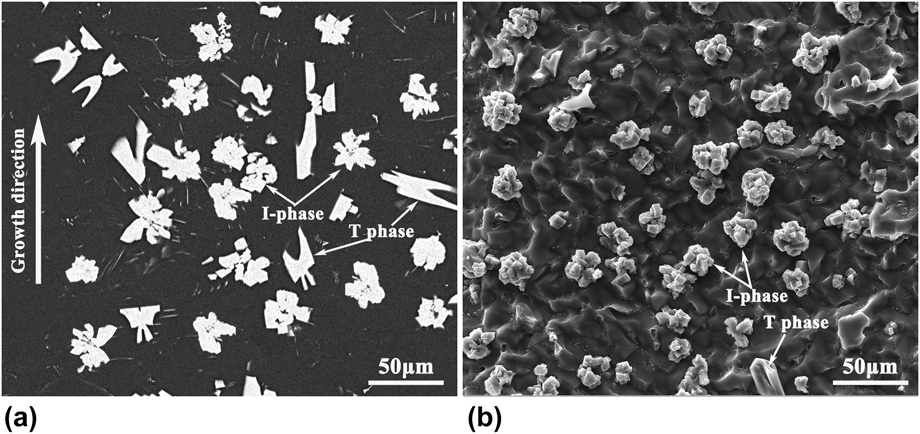
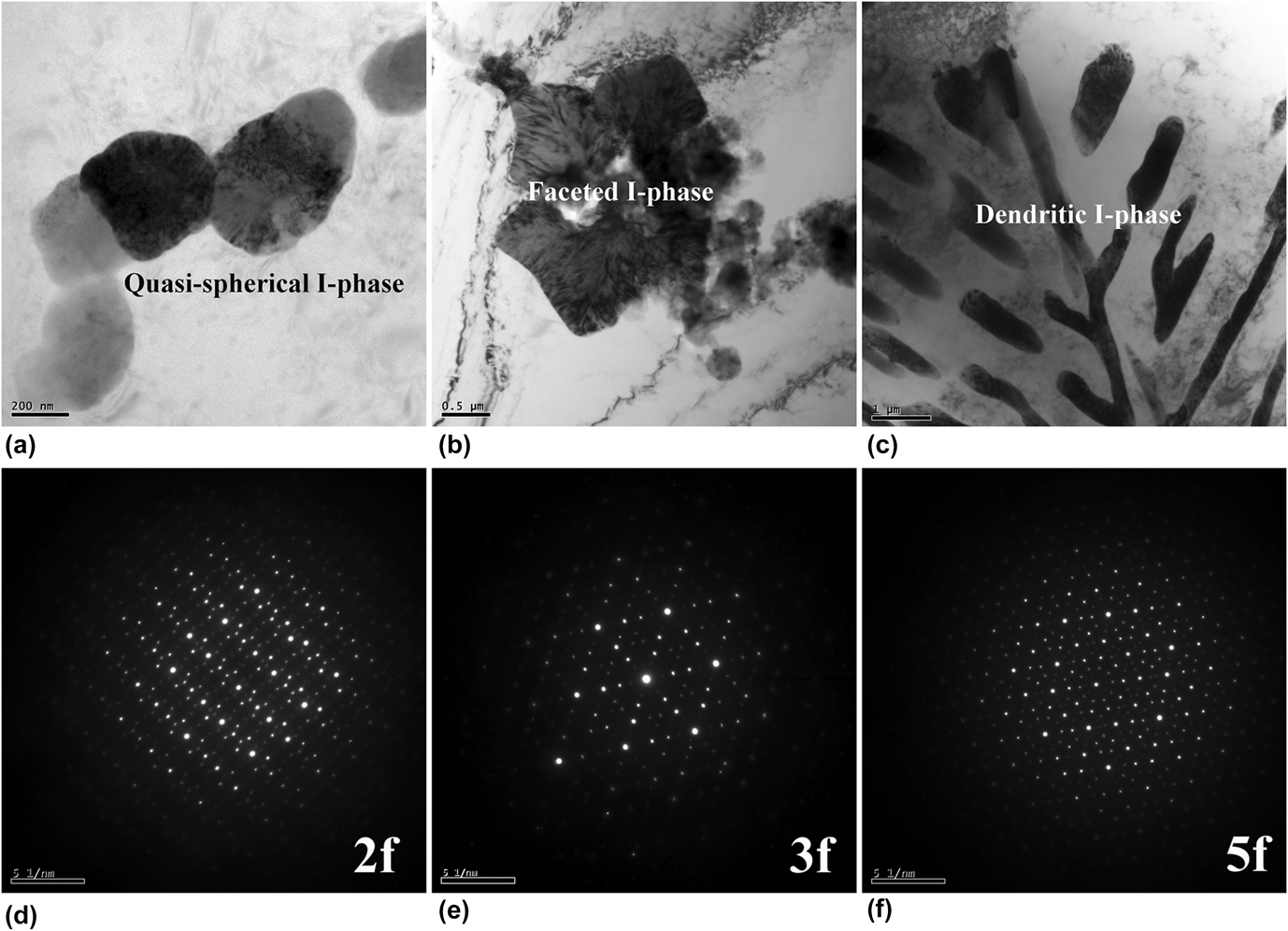
Figure 2 shows the microstructures at the longitudinal cross-sections of directionally solidified Al–6Mn–2.5Be alloy at a selected growth rate of 400 μm/s. Primary flower-like I-phases and H-like T-phases (bright contrast) with sizes of 20–50 μm are homogeneously distributed in the eutectic matrix (dark contrast). According to Fig. 2, it is reasonable to consider that the solidification process of this alloy should start from the nucleation and growth of the I-phase and/or the T-phase, and the remaining melt crystallizes thereafter into a eutectic matrix by a eutectic reaction. The typical 2D morphologies and structure of the primary I-phase particles can be described by TEM observations. Figures 3(a)–3(c) show the TEM bright-field images of the primary I-phase particles. The 2D morphologies of the I-phase particles can be classified into three types: quasispherical I-phases with sizes of 200–500 nm, faceted I-phase particles with sizes of 2–3 μm, and dendritic I-phases with sizes of over 5 μm. All the I-phases in Figs. 3(a)–3(c) show a typical mottled contrast, which is mainly due to the chemical disorder, small misorientation, or density fluctuations of the I-phases.Reference Kelton24,Reference Tsai, Niikura, Inoue, Masumoto, Nishida, Tsuda and Tanaka36 Figures 3(d)–3(f) show the typical selected area electron diffraction patterns (SADPs) of 2-, 3-, and 5-fold symmetries of the primary I-phase particles, respectively, indicating the icosahedral nature of the I-phase. The extra superlattice reflection pattern, which is only allowed for the face-centered icosahedral phase, is not observed in the 2-fold SADP [Fig. 3(d)], indicating a simple icosahedral phase.Reference Shechtman, Blech, Gratias and Cahn1 The average composition of the primary I-phase particles is measured about Al55Be30Mn15 by Auger electron spectroscopy and energy dispersive spectrometry in our previous work,Reference Kang, Li, Wang, Liu, Su, Hu, Guo and Fu32 and the corresponding valence electrons per atom ratio (e/a) for this composition is 1.70. Thus, this phase clearly belongs to the Frank–Kasper type.Reference Tsai, Niikura, Inoue, Masumoto, Nishida, Tsuda and Tanaka36
Microstructures at the longitudinal cross-sections of directionally solidified Al–6Mn–2.5Be alloy at a selected growth rate of 400 μm/s: (a) BSE image and (b) SE image.
TEM bright-field images of primary I-phase particles: (a) Quasispherical; (b) faceted; (c) dendritic, and corresponding SADPs taken along the 2-fold (d), 3-fold (e), and 5-fold (f) symmetry axes of primary I-phases.
B. 3D morphological evolution of I-phase particles at various growth rates
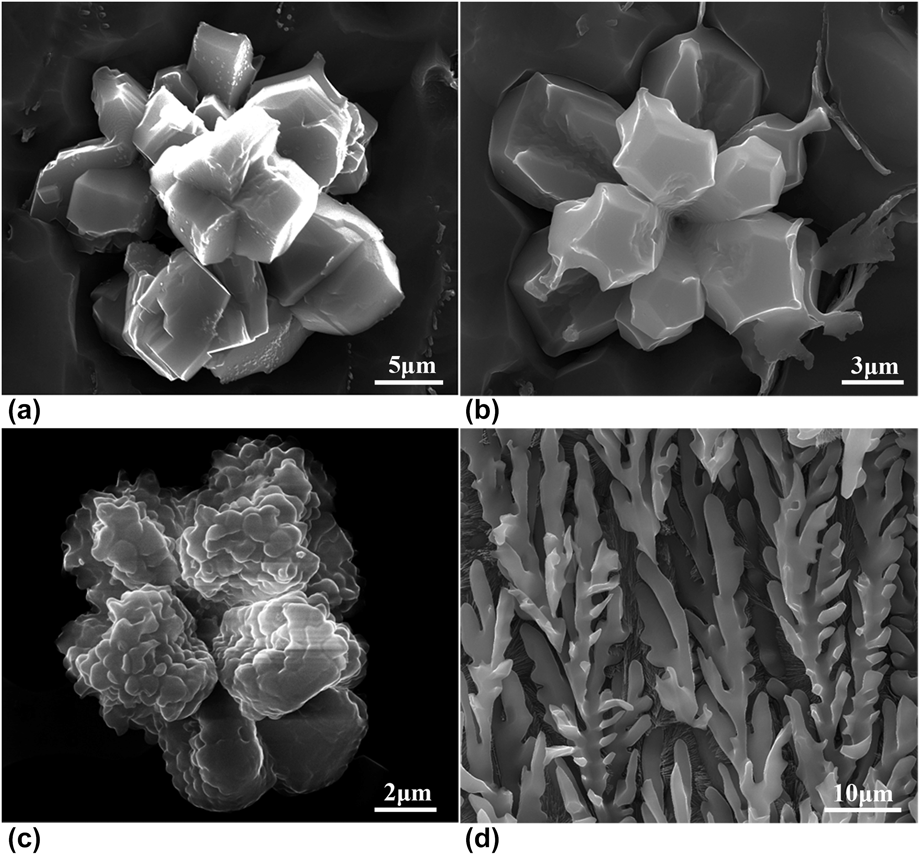
To reveal the 3D morphologies of the primary I-phase particles, a deep etching technology was used by eliminating the eutectic matrix. Figure 4 shows the 3D morphologies of the primary I-phase particles at various growth rates (selected and typical cases from our experiments). The primary I-phase particles formed at 400 μm/s are in a typical flower-like aggregate composed of irregular polyhedrons with sizes of 5–10 μm [Fig. 4(a)]. As shown in Fig. 4(b), the I-phase particles at 600 μm/s are still in the flower-like aggregate, but the compositive subunit changes into a pentagonal dodecahedron, the faceted face of which is normal to the 5-fold axis of the icosahedral structure. This result is similar to that found in binary Al–Mn alloys.Reference Nissen, Wessicken, Beeli and Csanady37 Meanwhile, the size of the pentagonal dodecahedron is reduced to 3–5 μm. A further increase of the growth rate over 1000 μm/s leads to a transition from faceted to nonfaceted growth and a further decrease in size, as shown in Figs. 4(c) and 4(d). For a fast growing process, long-range transport of heat and solute is important, or even dominant. In this situation, morphological instability will occur due to the nature of the long-range transport processes.Reference Sekerka, Müller, Métois and Rudolph38 Small bulges appear at the edges and corners of the faceted I-phase particle where the saturations attain their highest level and protrude further into the solute-rich regions in a self-sustained way to form branches. The continuous growth of the branches leads to the formation of dendritic morphologies, as shown in Figs. 4(c) and 4(d). In addition, the increase of the growth rate will cause a large undercooling ahead of the solid/liquid (S/L) interface in a directionally solidified process. When the undercooling reaches the requirement of continuous growth, the S/L interface becomes unstable and protrusions appear along the interface. As the growth proceeds, the protrusions will be exaggerated, and the I-phase particles exhibit a nonfaceted growth with an entirely dendritic morphology. As shown in Fig. 5, 3D subunit morphologies of the primary I-phase particles in directionally solidified Al–6Mn–2.5Be alloy are varied from the faceted flower-like aggregate (irregular polyhedrons or pentagonal dodecahedrons) to the flower-like aggregate with protrusions and finally to a dendrite in a range of growth rate from 100–1500 μm/s, which is similar to the observations of Boncina in a rapidly solidified Al–Mn–Be alloy.Reference Bončina39
3D morphologies of I-phase particles in directionally solidified Al–6Mn–2.5Be alloy at different growth rates: (a) 400 μm/s; (b) 600 μm/s; (c) 1000 μm/s; and (d) 1500 μm/s.
Typical 3D subunit morphologies corresponding to the range of growth rates.
In general, as for a crystalline system, the final morphology is primarily dependent on both its intrinsic crystallographic structure and external conditions for growth.Reference Kurz and Fisher40,Reference Sunagawa41 The former dictates the equilibrium crystal shape by minimizing the interfacial free energy, whereas the latter usually forces the crystal to deflect from the equilibrium crystal shape and develop into other morphologies following growth kinetics. Interestingly, although the translational periodicity is absent in the I-phase, strongly faceted shapes related to its icosahedral point group have been observed in many I-phase particles. For instance, a rhombic triacontahedral I-phase with a composition of Al6CuLi3 has been found in the as-cast Al–Li–Cu alloyReference Dubost, Lang, Tanaka, Sainfort and Audier7 and a pentagonal dodecahedron has been observed in the Al–Cu–Fe,Reference Tsai, Inoue and Masumoto42 Ga–Mg–Zn,Reference Ohashi and Spaepen43 and Mg–Zn–RE (RE = rare earth)Reference Tsai, Niikura, Inoue, Masumoto, Nishida, Tsuda and Tanaka36 alloys. As mentioned above, in this work, the stable faceted I-AlMnBe phases were also obtained in a directionally solidified Al–6Mn–2.5Be alloy at a growth rate of 600 μm/s. Figures 6(a)–6(c) show the 3D morphologies of the primary I-AlMnBe phases with icosahedral point symmetry along the 5-, 3-, and 2-fold symmetry axes, respectively. After careful examination of the morphologies of primary I-phase particles, most of these were found to form as a flower-like aggregate comprising a series of pentagonal dodecahedrons and exhibit typical icosahedral point symmetry. Each flower-like aggregate can be divided into two or more layers. For simplicity, only two layers are considered, namely the top layer and the bottom layer. The top layer is mainly composed of four to six almost perfect pentagonal dodecahedrons, whereas there are five or six elongated pentagonal dodecahedrons along the 3-fold symmetry axis for the bottom layer. Moreover, all the pentagonal dodecahedrons connect by the 5-fold face-sharing to form the flower-like aggregates. Based on the above description, three models of geometry related to the perfect and elongated pentagonal dodecahedrons along 5-, 3-, and 2-fold symmetry axes have been proposed to illustrate the configurations of the flower-like aggregates, as shown in Figs. 6(d)–6(f). It can be clearly seen that the 3D morphologies in Figs. 6(a)–6(c) are consistent with the configuration models in Figs. 6(d)–6(f).
Comparison of 3D morphologies (at a selected growth rate of 600 μm/s) and configuration models of I-phase particles (flower-like aggregates) along different directions: (a), (d) 5-fold; (b), (e) 3-fold; and (c), (f) 2-fold.
C. Growth mechanism of I-phase particles
It is now widely believed that preferential absorption of molecules and ions to different crystal faces makes the crystals develop into various shapes by controlling the growth rates along different crystal axes.Reference Murphy44 For cubic crystals, a relationship has been built between growth shapes and growth-rate ratios R between <111> and <100>.Reference Wang, Lu and Hogan45–Reference Li, Wu, Li and Liu48 Herein a similar work can be done for faceted I-phase particles. The 2- and 5-fold faces are the stablest faces because of the fastest growth rate along the 3-fold direction,Reference Kelton24 and there are two extreme external growth shapes for them: (i) rhombic triacontahedron,Reference Dubost, Lang, Tanaka, Sainfort and Audier7 which is a convex polyhedron enclosed with only thirty 2-fold rhombic faces and (ii) pentagonal dodecahedron,Reference Tsai, Niikura, Inoue, Masumoto, Nishida, Tsuda and Tanaka36,Reference Tsai, Inoue and Masumoto42,Reference Ohashi and Spaepen43 which is a convex polyhedron enclosed with only twelve 5-fold regular pentagonal faces. The shape selection is dependent on the growth rate ratio R in the 2- and 5-fold directions. For crystals, under equilibrium growth condition, the growth rates along different crystallographic directions are directly proportional to the surface free energies of the corresponding crystal faces.Reference Dobrushin, Kotecý and Shlosman49 Similarly, based on the BFDH theory,Reference Wang46,Reference Bravais50–Reference Friedel52 we have built a relationship between growth shapes and growth rate ratio R for the I-phases, where R = V 2f/V 5f, V 2f, and V 5f are the growth rates along the 2- and 5-fold directions, respectively. If R ≤ 0.85065, the I-phases will grow as a perfect rhombic triacontahedron. Complete 5-fold faces keep still and 2-fold faces disappear. If R ≥ 1.17557, a complete pentagonal dodecahedron can be obtained. Three- and 2-fold faces absolutely degrade to corners and edges and 2-fold faces become the most important faces which are exposed as surfaces on the pentagonal dodecahedron. If 0.85065 < R < 1.17557, 2-fold faces will appear partially on the incomplete pentagonal dodecahedron, and the I-phases will grow as a complicated polyhedron which encloses 2- and 5-fold faces. Therefore, the R values of the faceted I-AlMnBe should fall into the range of R ≥ 1.17557, and I-AlMnBe has the slowest growth rate along the 5-fold directions.
The preceding results suggest that a novel faceted morphology of the I-phase particles with icosahedral point symmetry can be formed at intermediate growth rates, and the morphology is closely related to the point group, size, and growth rate. By carefully examining the faceted morphologies of the I-phase particles, we proposed a growth mechanism to illustrate the formation of the flower-like aggregate obtained at a growth rate of 600 μm/s, as shown in Fig. 7. Similar to crystals, the nucleus of the I-phase exhibits a quasispherical morphology to minimize the total surface energy in the initial growth stage [Fig. 7(a)], which is also confirmed by the TEM results [Fig. 3(a)] and inset I in Fig. 7. The undercooled melt is mainly occupied by clusters of the icosahedral configuration in the quasicrystal-forming alloy system,Reference Shechtman and Blech53 which is easy to microsegregate in the local melt. Through the fluctuations of structure and energy, those clusters and microsegregation can easily extend to the critical size of the I-phase nucleus under relatively low undercooling. This is in accordance with the classical crystallographic theory, that is, the initial growth of the nucleus is mainly diffusion controlled. Meanwhile, the surrounding environments (heat and solute) of the nucleus in the small volume of melt are considered to be symmetrical. Thus, the I-phase nucleus keeps a quasispherical morphology during the isotropic growth. Due to the strong anisotropy of the interface energy, as well as the interface kinetics of the I-phase, the quasispherical nucleus will lose its stability concomitant with the increase in size. Small bulges will appear on the surface of the quasispherical nucleus and preferentially grow into the melt along the 3-fold axis direction,Reference Kelton24 becoming stable, primary dendritic arms, as shown in Fig. 7(b). These 20 arms exactly match the vertexes of the pentagonal dodecahedron. According to the microstructures shown in Fig. 2, the Al–6Mn–2.5Be alloy can be considered to be an off-eutectic-type alloy. During the growth of the primary I-phase particle, the Al atoms are rejected into the melt, leading to the supersaturation of Al ahead of the S/L interface. In this case, the growth of the primary dendritic arms will be restricted. Next, the secondary dendritic arms come into being along the 2-fold axis direction, which is similar to the observations of Li et al.Reference Li, Wu, Li and Liu48 in the Mg2Si intermetallic compound. As a result, these adjacent secondary arms join each other and form a pentagonal dodecahedral skeleton with symmetric hollows in the centers of the 5-fold faces. However, the hollow pentagonal dodecahedrons are seldom observed due to the relatively rapid growth rate of the I-phases. As the growth proceeds, these hollows gradually shrink until they disappear, resulting in the formation of a perfect pentagonal dodecahedral I-phase with regular pentagon faces (5-fold faces), as shown in Fig. 7(c) and the corresponding inset II. These morphologies of the pentagonal dodecahedrons can be explained by their inherent icosahedral structure. The I-phase has a preferential growth from the melt along the 3-fold directions, but has the slowest growth rate along the 5-fold directions.Reference Kelton24 Therefore, during the growth process, the fast-growing 3- and 2-fold faces gradually grow out and disappear from the I-phases and degrade into points and lines, respectively, whereas the slow-growing 5-fold faces remain, forming the pentagonal dodecahedral I-phase with strong anisotropy.Reference Kurz and Fisher40 Accompanied by the further growth of the I-phase, Mn and Be atoms are easier to pile up on the slow-growing 5-fold faces. When the critical concentrations of Mn and Be are achieved ahead of the S/L interface, 2D nuclei (first type) of the I-phase will be formed on the five equivalent 5-fold faces due to the similar growth environments and conditions, which is confirmed by the inset I in Fig. 7. These nuclei finally grow into perfect pentagonal dodecahedrons following the same procedure as the illustration above and constitute the bottom layer of the flower-like I-phases, as shown in Fig. 7(d). It should be stressed that the growth of the I-phase from five equivalent 5-fold faces has resulted in the generation of five reentrant corners formed by three neighboring pentagonal dodecahedrons, as marked in Fig. 7(d). The formed reentrant corners will provide favorable sites for nucleation. The newly generated nuclei (second type) also grow into perfect pentagonal dodecahedrons following the same procedure, constituting the top layer of the flower-like I-phases, as shown in Figs. 7(e) and 7(f). The second type nuclei should certainly not be more difficult to be generated than the first type nuclei, due to the more favorable geometry of the former. However, the second type nuclei are generated later than the first ones, and the pentagonal dodecahedrons on the bottom layer are elongated along the preferred 3-fold directions. A hierarchical flower-like I-phase with icosahedral morphological symmetry as shown in Fig. 7(f) is therefore formed, which is consistent with the 3D morphologies in Figs. 4(b) and 6.
Schematic illustration of the growth mechanism of I-phase (flower-like aggregate). Insets represent the SE images of I-phase particles in different stages.
IV. CONCLUSIONS
In summary, this study provides a facile and effective route for the morphology- and size-controlled synthesis of I-AlMnBe phases from melt. A number of typical morphologies, such as quasispheres, flower-like aggregates composed of irregular polyhedrons or pentagonal dodecahedrons, and dendrites, are obtained through the artificial manipulation of the growth rate. The correlation of 3D morphologies corresponding to the range of growth rates is quantitatively determined through systematical and well-designed experiments. Based on the clear understanding of the 3D morphological evolution of I-AlMnBe phases, a geometrical model and a growth mechanism for the typical flower-like aggregate have been proposed in terms of the perfect and elongated pentagonal dodecahedrons. The synthetic and mechanistic studies could be the basis for controlling the morphologies of a wide range of novel I-phase particles and, more importantly, for improving the properties of quasicrystal-reinforced metallic-matrix composites.
ACKNOWLEDGMENTS
The authors gratefully acknowledge the supports of National Natural Science Foundation of China (Nos. 51271068, 51274077, 51274054, and U1332115, 51401044), the Key grant Project of Chinese Ministry of Education (No. 313011), the China Postdoctoral Science Foundation (2014M551075), and the Fundamental Research Funds for the Central Universities. The authors wish to thank all the staff members of the 4B9A beamline of BSRF and BL14B1 beamline of SSRF for corresponding experiments and discussion.