




No CrossRef data available.
Article contents
Spaniards on the Silver Roll: Labor Troubles and Liminality in the Panama Canal Zone, 1904–1914
Published online by Cambridge University Press: 25 February 2005
Abstract
This article examines the experiences of Spanish workers during the construction of the Panama Canal by the United States from 1904 to 1914. Spaniards engaged in a wide range of protest actions during the construction years, from strikes to food riots to anarchist politics. Employing Victor Turner's concept of liminality, the article highlights the mutability of the Spaniards' position and identity and examines several factors that shaped their experiences: the US government's policies of racial segregation and the injustices Spaniards experienced; the political and racial identities they brought with them from Spain; and their complex racial and imperial status in the Canal Zone. Spaniards possessed a remarkably fluid racial identity, considered white or nonwhite depending on circumstances, and that shifting status fueled their racial animosities as well as their protests.
Information
- Type
- Research Article
- Information
- Copyright
- © 2004 The International Labor and Working-Class History Society
In July of 1911, during the construction of the Panama Canal by the United States, common laborers from Spain working on the infamous Culebra cut refused to do certain kinds of work and demanded the right to eat on the job. Spanish workers in several other gangs made a similar protest, and soon a strike involving dozens of gangs had begun. The foremen suspended these more than 500 workers for insubordination, and the incident blossomed into the biggest strike on the canal during the entire construction period (1904 to 1914).1
A.S. Brook, General Inspector, Memo for Mr. Zinn, July 28, 1911; Paul S. Wilson, “Memo re. the European laborers of the Culebra District . . . ” July 28, 1911; Chairman George Goethals, “Notice to the Spanish Laborers on Strike,” August 2, 1911: all Records of the Second Isthmian Canal Commission, 2-P-59, United States National Archives, Record Group 185, College Park, Maryland (hereafter cited as ICC Records).
Panamá has long served as a crossroads of transnational cultural relations and imperial adventures. In the 1820s British planters, accompanied by their slaves, began homesteading there. During the California Gold Rush, construction of a highly profitable railroad turned the Isthmus into an important point of connection between the laboring worlds of the Atlantic and Pacific. In the late nineteenth century the French government tried for nine years to build a canal before its effort ended disastrously, while innumerable banana plantations emerged farther north. In 1903 the United States forcefully entered the stage. Led by President Theodore Roosevelt, the government supported a group—including representatives of the New Panama Canal Company—plotting a revolution of independence from Colombia. After the revolution succeeded, the US negotiated a treaty with the new republic of Panamá, giving the former absolute control over the huge strip of land known as the Canal Zone, and proceeded to build the canal between 1904 and 1914. The United States maintained the Canal Zone as its colony until a treaty in 1979 began to return it to the government of Panamá. Only in December 1999 did Panamá finally resume complete control over the Panama Canal.2
On the history of Panamá, see Aims McGuinness, “In the Path of Empire: Land, Labor, and Liberty in Panamá during the California Gold Rush, 1848–1860,” (Ph.D. Diss., University of Michigan, 2001); Michael L. Conniff, Black Labor on a White Canal: Panama, 1904–1981 (Pittsburgh, 1985); Marco A. Gandásegui, Alejandro Saavedra, Andrés Achong, and Iván Quintero, Las Lucas Obreras en Panamá, 1850–1978, 2a edition (Panama City, 1990); Steve Marquardt, “‘Green Havoc’: Panama Disease, Environmental Change, and Labor Process in the Central American Banana Industry'” American Historical Review (Feb. 2001), 49–80.
The decade of canal construction provides a dramatic window into US colonial policies and working-class experiences during the era of the “New Imperialism.” To be sure, US politicians and bureaucrats had little time for imperial self-reflection. They were determined to carry out the construction project, one of the most demanding in world history, efficiently and successfully. It required the ability to manage a workforce from all over the world that reached numbers as high as 45,000 workers at a single time. US government officials created a rigid system in order to divide and control this diverse group of workers. Known as the gold and silver rolls, this system divided workers based upon their race, citizenship, and level of skill, into two very different categories. “Gold” employees, normally white US citizens, received high pay and many luxurious perks which were off limits to the “silver” workers, most of them black Caribbeans.
Spaniards fit uneasily into this system. As “white” men on a silver roll normally reserved for blacks, and as members of a once triumphant empire now contributing to building the US canal, Spanish workers felt profoundly liminal, caught between different worlds, empires, and races. Anthropologist Victor Turner developed the concept of liminality in the 1960s as a way to capture people, typically outsiders, whose identity is very much in flux. They inhabit a contradictory position, being simultaneously part of and yet not part of the existing structures, which makes them, he argued, structurally invisible. The concept of liminality helps us highlight both the mutability of the Spaniards' position and identity, and the fact that it hinged on several factors that were in turn highly fluid. This paper will explore those factors: the US government's policies of racial segregation and the injustices Spaniards experienced as a result of those policies; the political and racial identities they brought with them from Spain; and their complex racial and imperial status in the Canal Zone. Spaniards possessed a remarkably fluid racial identity, considered white or nonwhite depending on circumstances, and that shifting status fueled their racial animosities. They also came to the Zone as citizens of an empire and nation looked down upon by the US. These elements shaped the way Spaniards experienced life as well as the nature of their resistance. Migrants from a dying empire to one newly emergent, Spanish workers found much to dislike in the Zone and in the US government's policies and they responded with strikes, food riots, and anarchist protests.3
This article has been influenced by in James R. Barrett and David Roediger's “Inbetween Peoples: Race, Nationality and the ‘New Immigrant' Working Class,” Journal of American Ethnic History (Spring 1997), 3–44. My perception of Spanish workers is very close to their notion of “inbetween-ness.” With the concept of liminality, however, I hope to highlight the mutability of Spaniards' position and also detach it from purely racial considerations. Spaniards' marginalization was linked closely not only to race but also to nationality and their position in an imperial world. On liminality, see Victor Turner, The Forest of Symbols: Aspects of Ndembu Ritual (Ithaca, 1967), especially Chapter Four, “Betwixt and Between: The Liminal Period in Rites de Passage,” 93–111; for useful discussions of Turner's concept see Brian Morris, Anthropological Studies of Religion: An Introductory Text (Cambridge, 1987), especially 252–63; and Donald Weber, “From Limen to Border: A Meditation on the Legacy of Victor Turner for American Cultural Studies,” American Quarterly, 47 (3), Sept. 1995, 525–36. For a rather different way of using liminality to understand working people's actions, see Eric Rothenbuhler, “The Liminal fight: mass strikes as ritual and interpretation,” in Jeffrey C. Alexander, ed., Durkheimian Sociology: Cultural Studies (Cambridge, 1988), 66–89. Thomas Guglielmo's recent book, White on Arrival: Italians, Race, Color, and Power in Chicago, 1890–1945 (Oxford, 2003), also revises Barrett and Roediger's thesis. Distinguishing between “race” and “color,” Guglielmo argues that Italians in the US were never consistently perceived as non-white but that they were, nonetheless, perceived as racially inferior. His argument is quite persuasive for Chicago, but in the highly stratified environment of the US Canal Zone things played out rather differently. Southern Europeans were clearly classified as inferior and this involved a racial judgment as well as judgments about nationality, ethnicity, class, and imperial status.
When construction got underway in 1904 the Canal Zone became a spectacular site of working-class endeavor and imperial construction, drawing migrants from dozens of countries around the world, from Barbados to China, from Greece to India, from Scotland to Turkey and Venezuela. From the very beginning the “labor question” loomed larger than any other for US government officials as they contemplated how to build the canal most efficiently. As the canal's first Chief Engineer, John Stevens, proclaimed: “the greatest problem in building a canal of any type on the Isthmus . . . is the one of labor. The engineering and constructional difficulties melt into insignificance compared with labor.”4
US Senate, Investigation of Panama Canal Matters: Hearings before the Committee on Interoceanic Canals of the United States Senate, 50th Congress, 2d Session, Document No. 401, vol. III, (Washington, 1907) vol. 1, 47. David McCullough notes in The Path Between the Seas: The Creation of the Panama Canal, 1870–1914 (NY, 1977) that workers came to the Zone from ninety-seven different countries around the world (471).
Stevens quoted in Conniff, Black Labor on the White Canal, 25.
Hearings Concerning Estimates for Construction of the Isthmian Canal, for the Fiscal Year 1911 (Washington, 1910); Message from the President of the United States, Transmitting the Report of the Special Commission Appointed to Investigate Conditions of Labor and Housing of Government Employees on the Isthmus of Panama, 60th Congress, 2d Session, Document No. 539 (Washington, 1908), 7; and Quartermaster's Department, Census of the Canal Zone (Mount Hope, Canal Zone, 1912), especially 29–31.
Although civilians would build the Canal, the US military's fingerprints lay all over the project. Many of the men in command in the Canal Zone were on leave from the US Army, such as Colonel George Washington Goethals, Chief Engineer and Chairman of the Isthmian Canal Commission (ICC) from 1907 until the completion of the canal.7
David McCullough, The Path Between the Seas; Michael Conniff, Black Labor on a White Canal.
On efforts to police sexual relations between white men and “native or colored women,” consult ICC Records, 62-B-248 Part 1, Box 364.
Government officials struggled during most of the construction period to define the nature of the silver and gold system, disagreeing among themselves even about the reasons for its existence. Some thought it designed to give workers from the North special perks that would help them withstand the tropical climate (giving them, for example, extended paid vacations so they could return home). Others thought it meant to show, quickly and easily, how many black or white workers the government employed at any time, or to avoid conflicts between workers of different races.9
Assistant Chief Engineer J.G. Sullivan to D.W. Bolich, Aug. 4, 1906, ICC Records, 2-F-14, “Transfers, Gold to Silver”; E.A.M. McIlvaine to Mrs. William Swiget, Jan. 1, 1916, ICC Records, 28-B-233, Part I.
For this and the preceding paragraph see ICC Records, 2-F-14, especially: E.S. Bisson, General Auditor, to Charles E. Magoon, Sept. 4, 1905; Assistant Chief Engineer to D.W. Bolich, August 4, 1906; M.G. Tucker, Chief Clerk to General Manager, to E.P. Shannon, Secretary to Vice President, Sept. 1, 1906; H.W. Reed to John F. Stevens, Feb. 15, 1907; Hiram J. Slifer to Major D.D. Gaillard, Feb 12, 1908.
In early 1908 President Roosevelt stipulated in an executive order that gold-roll employment would be limited to US citizens, except in cases where none were available. Later that same year, Roosevelt added that Panamanian citizens would also be eligible for gold jobs. Finally in 1909 Goethals got the last word, reinterpreting Roosevelt's executive order in ways which defined the system by citizenship and by race. The gold system would consist of all US citizens and “a few Panamanians.” Other “white employees (i.e., not native to the tropics)” could be employed when white US citizens were not available.11
During this same period diplomatic maneuvering established that Puerto Ricans, while not considered eligible for the same privileges as US citizens, would be given preference over other aliens. The government thus ensured that colonial subjects would benefit from their status. President Roosevelt's Executive Order, Feb. 8, 1908; Executive Order, by Authority of the President, Dec. 23, 1908; George Weitzel, American Charge D'Affairs, American Legation, Panama, to Goethals, Nov. 17, 1908; Goethals to Heads of Departments, Nov. 23, 1908; all preceding from ICC Records, 2-E-11, on employment of aliens. ICC Records, Isthmian Canal Commission Records, 2-F-14, especially George W. Goethals to W.W. Warwick, Nov. 16, 1909.
With the government imposing such unrelenting segregation, workers' lives on and off the job varied tremendously according to their position in the silver/gold rolls, and the ways workers exercised agency varied radically as well. In this racialized empire not only did white US workers dominate, enjoying a great array of perks and luxuries restricted to them alone (and indeed, they gradually evolved into key enforcers of the racial system), they also developed effective means of protecting and extending their powers and rights.12
See Julie Greene, “As I am a True American: White U.S. Workers, Race, Empire, and Citizenship in the Canal Zone, 1904 to 1914,” unpublished paper presented at the Organization of American Historians annual conference, Memphis, April 4, 2003.
US Senate, Investigation of Panama Canal Matters, Hearings before the Committee on Interoceanic Canals of the U.S. Senate, 59th Congress, 2d Session, Document No. 401, vol. III (Washington, 1907), 2265–66 and 617; Supplement to Hearings Concerning Estimates, passim, and 347–48; Supplement to Hearings on the Panama Canal, Senate Committee on Interoceanic Canals (Washington, 1908), 52, 89.
The experiences of silver workers differed radically from their gold counterparts, of course, and although Spaniards and other southern Europeans received better treatment than West Indians (significantly higher pay, for example), all silver men confronted low wages and experienced exclusion from YMCA clubhouses and other perks reserved for white US citizens. When asked why the state did not furnish amusements for silver workers, Chief Engineer John Wallace responded “These silver men are most all colored, and they flock by themselves, and have their own methods of recreation.” But Wallace was sugarcoating a more punitive situation. Not only did the government not provide entertainment for silver workers, it also set strict curfews and attempted to limit socializing as much as possible. Silver workers received no paid vacation or sick leave. The government did grant them medical benefits, but doctors attended to them with little urgency and this, combined with harsher working and living conditions, resulted in a much higher death rate among silver workers—and particularly among West Indians.14
Investigation of Panama Canal Matters, 616, 798; G. Bonhamy, Consulate of France, to Charles Magoon, Nov. 16, 1905, ICC Records, 2-P-69.
Although West Indians had their advantages in the eyes of US officials (chief among them being their gentlemanly style, disinclination to cause trouble, and the fact that most, thanks to British colonialism, spoke English), their perceived lack of energy led the United States to seek European alternatives during the earliest days of construction. An easy source of workers immediately manifested itself amidst the turmoil generated by the decline of the Spanish empire. In the years after the War of 1898, Spanish immigration into Cuba soared.15
A note on terminology: the so-called “Spanish-American War” is now customarily referred to as the Spanish-American-Cuban-Filipino War. As even this cumbersome title does not fully grasp the spatial reach of this conflict (Puerto Rico, Guam, etc.), I refer to it simply as the War of 1898.
On Spaniards in Cuba, see Louis A. Pérez, Cuba: Between Reform and Revolution (Oxford, 1988); Ada Ferrer, Insurgent Cuba: Race, Nation, and Revolution, 1868–1898 (Chapel Hill, 1999); Joan Casanovas, Bread, or Bullets! Urban Labor and Spanish Colonialism in Cuba, 1850–1898 (Pittsburgh, 1998); Jackson Smith, “European Labor on the Isthmian Canal,” March 25, 1907, ICC Records, 2-E-3.
Impressed with the Spaniards' efficiency, Canal officials contracted to import nearly eight thousand more of them. Officials sent recruiting agents directly to Spain and to centers of migrant labor such as Marseilles, France. In Spain, agents focused their efforts in the larger cities but also in the depressed regions of the northwest. The number of Spaniards in the Canal Zone declined over the years, but as late as 1912 there remained more than four thousand of them. Most apparently came from Galicia, a depressed area in northwestern Spain where subsistence agriculture could not support the growing population (especially during a time of declining agricultural prices), with smaller numbers coming from nearby Asturias and the Basque country. Andalusia, an impoverished southern region of large estates and landless peasants, also likely provided recruits, as it was a common target for government-sponsored labor contracting. More generally, Spain sent huge numbers of migrants to the Americas between 1870 and 1914, ranking ahead of all other European countries except for Britain and Italy. Spanish immigrants rarely journeyed to the United States, preferring to land in Cuba, Panamá, Argentina, or Brazil. Galicia contributed more immigrants to the Americas than did any other region of Spain at the turn of the twentieth century, losing roughly half its population during the decades between 1850 and 1930. The rise of commercial agriculture and industrialization and the tumultuous changes associated with them explain this mass exodus of Spaniards. Recent research suggests that Spanish immigrants were typically not the most indigent, but rather working people with ambition who saw in the vast changes around them an opportunity to make a better life. Jose C. Moya found, for example, that those who left were more often literate than were those who remained behind, and that a fierce desire to save money and return home to purchase the land they rented influenced many immigrants.17
See Jackson Smith, “European Labor on the Isthmian Canal,” March 25, 1907, ICC Records, 2-E-3; Census of the Canal Zone, 30; Jose C. Moya, Cousins and Strangers: Spanish Immigrants in Buenos Aires, 1850–1930 (Berkeley, 1998); Salvador Palazón, Los Espanoles en America Latina, 1850–1990 (Madrid, 1995), 130–34; Walter Nugent, Crossings: The Great Transatlantic Migrations, 1870–1914 (Bloomington, IN, 1992), 101–105; Adrian Schubert, A Social History of Modern Spain (London, 1990); Yolanda Marco Serra, Los obreros espanoles en la construcción del Canal de Panamá: la emigración espanola hacia Panamá vista a través de la prensa espanola (Panamá, 1997).
Arriving in the Canal Zone, Spanish workers were startled by the harsh conditions and the poor treatment they received. Recruiting agents had blanketed their towns with leaflets promising spacious houses, pleasant hotels, the ability to bring one's family and receive special married housing, healthful food, and a variety of recreational activities. In reality, as an investigation carried out by the National Civic Federation elaborated, much of this was patently false. Canal officials rarely provided them with married housing, but gave them ragged or torn window screens (allowing insects and disease into their homes), foul water, stale food, and no recreational opportunities. Spaniards learned that the pleasant hotel pictured in the leaflet excluded all but white US citizens. On the job, they found foremen who typically spoke no Spanish and who insulted and mistreated them, long hours (twelve hour days or longer were common), an expectation that they would work even in the heaviest downpours and accept dangerous working conditions without protest, no provision made for families of injured or killed workers, and, of course, grave inequalities in terms of what benefits were afforded to gold employees but not to them.18
Gertrude Beeks, “Report for the National Civic Federation,” issued to William H. Taft, Jan. 28, 1908, especially pp. 43–46, ICC Records, 28-A-5; and “Statements made by a Delegation of European Laborers,” Aug. 9, 1911, ICC Records, 2-P-59.
The position of Spaniards in the Canal Zone—both in terms of the identities ascribed to them by others and in terms of their own consciousness—was awkward, complex, and highly mutable. They inhabited a liminal sphere both in terms of their racial identity and their status as imperial citizens. In the Canal Zone they were both white and nonwhite, yet, simultaneously, neither white nor nonwhite. How they would be considered depended a great deal on the exact circumstances. Sometimes US government officials referred to them, along with Italians or Greeks, as “semi-white.” At other times, especially when compared to black Caribbeans, they become unambiguously “white.”19
The Assistant Chief Engineer referred to Europeans as semi-white in a letter to D.W. Bolich, August 4, 1906, ICC Records, 2-F-14: “The point that I have always maintained is that in deciding whether or not a white foreigner, or semi-white foreigner (Dago) should be put on a gold basis is the fact as to whether or not they would take or whether or not they need, a trip to the States every year. We know that many of these men who have always lived in the tropics, or that come from warm climates, do not require a trip to the States, nor would they take it if they were given the opportunity. They would simply lay around the Isthmus and be less efficient for work when their vacation was over than they were when it started.” For an example where Spaniards are unambiguously referred to as white, see Acting Chief of Police to Commanding Officer, Culebra, Feb. 25, 1909, ICC Records, 2-P-59.
Amy Kaplan and Donald E. Pease, eds., Cultures of United States Imperialism (Durham, NC, 1993), especially the article by Amy Kaplan, “Black and Blue on San Juan Hill”; Theodore Roosevelt, The Rough Riders (New York, 1899).
Spaniards' liminal status can be seen not only in the identities ascribed to them by others, but also in the ways they experienced and expressed their own racial identity. Spaniards clearly chafed at their status as “white” men working on the low-status silver roll, an employment roll often defined precisely as being for nonwhites. And it must have been difficult to see themselves so completely differentiated from other white men—excluded from hotels, restaurants, and gymnasiums, or forced to stand in the line for “coloreds” at the post office. Yet they felt little affinity for their comrades on the silver roll, and fought repeatedly and bitterly with other Europeans and with Caribbeans. As time went on, moreover, their bitterness toward whites on the gold roll seems to have declined while their animosity toward black Caribbeans became ever more pointed.
Like Caribbean workers, Spaniards possessed no unions, could not appeal to the US Congress, and could not threaten the canal officials by saying they would quit (because there existed such a surplus of unskilled workers). Desperate for help, they called often on the Spanish Consul, the representative of the Spanish government in Panamá, for assistance, and he responded energetically—though not necessarily successfully. In 1907, for example, Spanish Consul Juan Potous petitioned the US officials regularly with concerns about accidents, demands for investigation and for compensation to the families of those killed. In October of that year a gang of workers at Miraflores (see Map 1) loaded a railroad car with large and heavy timber, while several Spaniards stood atop the pile of logs. To unload the car, the foreman simply attached a rope to a log near the bottom and pulled it out, bringing down all the logs and the workers standing on top of them. Several Spaniards were hurt, one of them dragged by the logs, breaking his neck and one arm. Consul Potous demanded an investigation. US government officials complained privately about the “continual interference of the Spanish Consul with the laborers. . . .” They worried he was hurting discipline and encouraging Spanish workers to believe they would win better treatment by going to an outside authority. Publicly, officials responded that the workers' carelessness caused such accidents.21
Juan Potous to Joseph Blackburn, Oct. 5, 1907; G. Garibaldi to Joseph Bucklin Bishop, Oct. 16, 1907; Joseph Blackburn to Juan Potous, June 18, 1907: all ICC Records, 2-P-69. Only very rarely did the French or British Consul get involved to assist Caribbean workers, and I have seen no evidence of involvement by the Italian or Greek Consuls.
A few weeks after this incident, Spaniards initiated the first major strike on the canal. More than one hundred men laid down their tools, complaining about an abusive foreman and unacceptable food. Although the workers immediately appealed to the Consul for assistance, they had decided his help alone would not suffice. They described their foreman as somebody “we bear with great patience in spite of his vile language, unfit for an educated man. . . .” Indeed, “we complied with his orders notwithstanding the insults flung at the Spaniards merely because they are Spaniards.” This same foreman discharged one worker although the latter had “worked with ardor,” simply because “he complained of the food furnished by the ICC. This food can hardly be compared with that furnished in the penitenciary. [sic]” Soon after this the foreman suspended another man for a minor offense, and after such a pattern of “outrage” the strike began. Two days later, US officials sent Italian workers to take the place of the striking Spaniards, assigned a cadre of police to prevent any trouble between the two European groups, and threatened to evict the Spaniards from their housing if they were not back on the job by noon of that same day. While the paper trail related to the strike runs out at this point, we can guess the Spaniards returned to work and ended their strike.22
Spanish workmen to Juan Potous, Oct. 30, 1907; Potous to Joseph Blackburn, Oct. 31, 1907; and governmental memo, Nov. 1, 1907: all ICC Records, 2-P-69.

Map of Panamá Canal Zone and Republic of Panamá, from Frank A. Gause and Charles Carl Carr, The Story of Panama: The New Route to India (Boston, 1912)
Trouble with foremen led to many of the frequent strikes. Spaniards often complained of foremen who spoke no Spanish or abused them verbally or physically. In 1907 an Italian foreman took charge of a Spanish gang near the construction town of Culebra. The Spaniards resented the Italian's authority over them, and ultimately they attacked the man and beat him. When police arrested a dozen Spaniards for this crime and took them off to jail in the nearby town of Empire, a group of about 200 fellow workers stopped work and headed toward town to liberate them. As the Spaniards marched toward Empire, they attempted to convince other workers to join them, but their effort failed. Instead, police and several foremen met them as they approached town and convinced them to turn back. Of the Spaniards arrested, all but one was convicted and required either to pay a fine or serve time in jail.23
George Shanton, Chief of Police, to H.D. Reed, Executive Secretary, Feb. 26, 1907; S.B. Schenk to George Shanton, Feb. 26, 1907; Benjamin Wood to George Shanton, Dec. 13, 1906: all ICC Records, 2-P-59.
While strikes rooted in tensions on the job continued, with time two other grievances emerged: the quality of food, and the role played by black Caribbeans. Repeatedly Spaniards rioted against food or conditions in the mess halls. They assaulted cooks who failed to prepare food to their liking, they rioted to protest the absence of Spaniards among the cooking staff in their mess halls, and occasionally they quit work to press their protest about the food. Government officials made some effort to hire Spanish cooks for the Spanish mess halls, yet they remained overall relatively unsympathetic to all the complaints. As Major William Sibert, who headed the Atlantic Division of the canal, declared, “the food is better than is ordinarily consumed by people of the class in question.”24
William Sibert to Joseph Blackburn, September 6, 1907; George Shanton to Blackburn, June 1, 1908; A.K. Evans, Zone Policeman, to George Shanton, May 2, 1907: all ICC Records, 2-P-59.
When food problems became enmeshed with racial hostilities, the resulting conflicts proved more difficult for police to handle. A major riot broke out in 1907 at a newly built mess hall for Spaniards in the construction town of Bas Obispo as a result of new government rules regulating where people could sit while dining. When one worker sat contrary to the rule, a black Caribbean waiter tried to instruct him, whereupon the Spaniard hit him. Then a worker named Angel Negrati jumped onto a table and proclaimed, “Kill the negroes!” Many Spanish workers followed Negrati by jumping upon tables and throwing plates and glasses while their compatriots attacked and beat the mess hall steward. Police arrived to find the mess hall empty, window screens torn out, lamps destroyed, and “the floor almost entirely covered with stones, cups, saucers, plates, and etc., which had been thrown at the mess steward and his assistants.” On a hillside near the mess hall sat about 200 Spaniards, “evidently contented with what they had accomplished.” Police sent the mess steward over to the hillside to identify the riot leaders. When he pointed out the first man, “the whole bunch of Spaniards arose as one man and said that we could not take him, but we did, after drawing our revolvers and warning them that we would shoot the first man who attempted to rescue the prisoner.” In this way they arrested the twelve men perceived as leaders. Later that night Spaniards again congregated at the mess hall and stoned the building. The Chief of Police considered the incident the “most serious affair of this kind that has yet happened on the Isthmus . . . ”25
J.P. Cooper, Sergeant, Zone Policemen, to George Shanton, March 13, 1907; George Shanton to H.D. Reed, March 14, 1907: ICC Records, 2-P-59.
Spaniards also reacted with hostility when black Caribbeans worked, lived, or commuted to work in too close a proximity to them. As early as 1907 Spanish workers at Pedro Miguel threatened a strike, demanding better food and that “all the negroes [be] taken away from their camp.”26
Clipping from the Panamá Sunday Sun, March 31, 1907; Stanley Ross, Zone Policeman, to George Shanton, May 2, 1907: ICC Records, 2-P-59.
Sgt. Kennedy to George Shanton, Chief of Police, Feb. 25, 1909; Capt. G.A. Porter, Acting Chief of Police, to Commanding Officer of Culebra, Feb. 26, 1909; Porter to Juan Potous, Feb. 26, 1909; Charles Palacio, Zone Policeman, to Porter, Feb. 26, 1909: ICC Records, 2-P-59.
The US government attempted to keep workers segregated by their race and citizenship, both in transportation and housing. While West Indians and Europeans often shared the same labor camp, for example, US officials segregated each group to different parts of the camp. Likewise, the government built completely separate mess halls for West Indians and Europeans. When circumstances prevented complete segregation, conflicts flared. In 1911, the government assigned a large group of Barbadians to quarters at Cirio camp that had, until that moment, been totally inhabited by Spanish workers and families. Thirty-nine Spanish workers petitioned the US government to get rid of the Barbadians, saying the latter were thieves and nuisances in terms of “sanitary and moral conditions.” The government conceded that when the Barbadians had first entered the camp, the bathhouses were not clearly labeled according to gender, and in some cases male Barbadians had entered a bathhouse and startled a Spanish female. But the government declined to move the Barbadians out of the camp. By August of that same year, racial animosities had grown more bitter and the Spanish, as we'll see below, had become a major concern for canal officials. This time, Barbadians arrived in the town of Paraiso and needed quarters. The police visited some of the most influential European laborers to say they would need to house the Barbadians in the same building with Spanish workers. When other Spaniards learned of the situation, they threatened trouble if the government brought Barbadians into the building. Fearing a major conflict, the police quartered the Barbadians in an empty building for the night, lacking even beds or bedding, then moved them the next day to quarters in a building filled with East Indians. The East Indians protested fiercely against this arrangement, but with less impact. After housing the two groups together for nearly two weeks, the government found new quarters for the East Indians.28
Memo, March 7, 1911, to Col. C.A. Devol, Chief Quartermaster; Devol to Chairman Goethals, March 17, 1911; J.B. Cooper, Zone Policeman, to Chief of Division, August 24, 1911; M.J. Thatcher to Goethals, Sept. 9, 1911; Devol to Goethals, Sept. 12, 1911: all ICC Records, 28-B-233.
In short, as one policeman observed, “Race feeling . . . here is at fever heat and is liable to develop seriously at any moment.”29
George Shanton to Redd, Executive Secretary, April 9, 1907, forwarding a letter written by G.H. Skinner, Zone Police, ICC Records, 2-P-59.
“They say that a gallego has died,
If only twenty more would die.
The more gallegos who die,
The more hides for oil.”30
Shubert, Social History of Modern Spain, 124–25.
In the Canal Zone, US officials regularly referred to all Spaniards as gallegos, and yet we know that the migrants came not only from Galicia but from many other parts of Spain. Thus gallego seems to have become a blanket term, one often carrying a negative connotation, for any Spaniard.31
Jose C. Moya found this to be the case in Argentina as well. See his Cousins and Strangers, 15.
Once in Panamá the racial identity of Spaniards became more complex. One can only imagine how differently they must have felt when enjoying their leisure time away from the Canal Zone, footloose in the entertainment districts of Panamá City. There they not only spoke the language, they were also living representatives of the empire that had colonized Panamá, Colombia, and much of Latin America. As Europeans they must have stood high on Panamá's racial hierarchy, seen not only as white men but as members of a race of conquerors, and as such, as members of a racial aristocracy. Those who came to Panamá from Cuba had experienced there a wide range of privileges based upon their racial and imperial identity. In the Zone, however, their racial identity mutated into another, more complicated form. No longer conquerors, they faced a new imperial power, one that owed its hegemony to victory in a war that destroyed the Spanish Empire, that looked down upon them, that refused to speak their language, that classed them as racial inferiors nearly comparable to people of African descent, and yet, contradictorily, left their exact position within the structured racial hierarchy of the Canal Zone distinctly unclear.32
On the decline of the Spanish empire and its impact on Spanish immigrants see Sebastian Balfour, The End of the Spanish Empire, 1898–1923 (Oxford, 1997); and Jordi Maluquer de Motes Bernet, Espana en la Crisis de 1898: de la gran depresión a la modernización económica del siglo XX (Barcelona, 1999). For the experiences of Spaniards in Cuba or Argentina, see Casanovas, Bread, or Bullets!; and Moya, Cousins and Strangers.
The US government's labor and racial policies greatly shaped relationships and animosities in the Canal Zone. Through the silver and gold rolls, the government elevated racial hierarchy, and the privileges, jealousies, and tensions that hierarchy generated, into a central tool of labor management in the Canal Zone. The segregated rolls encouraged diverse groups to compete against one another for higher status. The government also pitted workers against one another as a means of labor control, thereby complicating the racial hierarchy in a way that created anxiety. Canal officials carried out a systematic campaign to replace certain white skilled workers (such as firemen) with less-skilled black West Indians, to the fury of white US workers. When possible, officials also used “our higher grade silver men as pacemakers to shame our high grade mechanics in to doing a fair day's work . . . ” With time the government realized that employing many different races and nationalities on the construction project was in itself an effective means of labor control, and foremen would commonly request both a Spanish gang and a West Indian one, so that, as one put it, “I could keep them both on their metal by rivalry between the two.”33
See Julie Greene, “Race and the Tensions of Empire: The United States and the Construction of the Panama Canal, 1904–1914,” unpublished paper presented at the Johns Hopkins Conference “Between Two Empires,” November, 2000; and George Brooke to Goethals, Feb. 1, 1909, ICC Records, 2-P-49/P; Jackson Smith, memo, March 25, 1907, ICC Records, 2-E-3.
The government placed Spaniards in particular in a complicated position relative to Caribbean workers. It originally paid them well because officials had believed that they would work twice as efficiently as Caribbeans. As time went on, however, officials ruefully noted that West Indians were doing more work than the Spaniards. This led the United States to begin replacing Europeans with black Caribbeans during the final years of construction; with time, Spaniards would suspect a plot underfoot to replace them altogether with blacks.34
US Congressional Hearings Supplement, Senate Committee on Interoceanic Canals, United States Senate, 62nd Congress, 1908, p. 90.

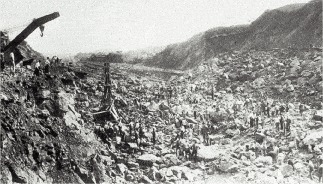
This shot of Culebra cut was taken near the town of Bas Obispo just after an accidental explosion of dynamite which killed twenty-three workers, on Dec. 12, 1908.
Photograph taken by Ernest Hallen, United States National Archives.

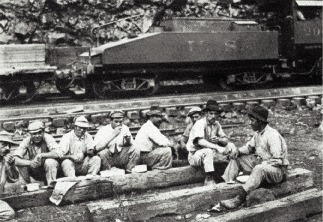
Spanish canal workers eat their lunch at Culebra cut in September, 1913.
Photograph taken by Ernest Hallen, United States National Archives.
All this helps explain the wave of labor militancy among Spanish workers in 1911, and the connections between that militancy, anarchist politics, and the growing racial hostility that pervaded the Zone. The big strike that began our story emerged quickly. The rebellious workers worked in Culebra cut, the nastiest spot in all the Zone, where they struggled to deal with the constant slides, avalanches of mud sweeping over labor gangs in mere seconds. One sub-foreman described this as “the hardest place in the Canal to work on. Nine times out of ten you got to work noon hours, or got to work night time. You got to work hard, because the Canal is sliding in there . . . we got to work the men hard—sometimes in mud and water up to their waist—and it is pretty hard.”35
“Notes of Investigation held on Sunday, July 30, 1911, in Office of Division Engineer at Empire Regarding Complains [sic] of Spanish Laborers in Culebra District,” p.6, ICC Records, 2-P-59.
Insubordination began spreading on July 22, 1911, among different gangs working the Culebra cut. In the following days more than three dozen gangs refused to follow orders, sat down on the job when prohibited from eating, or otherwise showed their determination to improve working conditions. Although striking workers had complaints to varying degrees against all the foremen, increasingly they focused on one from the United States named Pike, the foreman for about 200 of the workers. They accused him of arriving at work drunk and drinking rum on the job, throwing stones at them, verbally abusing them, making them work in heavy rain, and punishing West Indians by kicking or pushing them. The Spanish workers also reasserted their right to eat on the job, a practice that had previously been allowed them.36
A.S. Brouk, memo to Mr. Zinn, July 28, 1911; Petitions of the Strikers, n.d.; Jose Buigas de Dalmau, Spanish Consul, to Goethals, July 28, 1911: ICC Records, 2-P-59. Traditionally Spaniards drank only coffee at breakfast time. Prohibiting eating on the job meant they would eat nothing between 6:20 a.m., when they arrived on the job, until lunchtime at 1:00 p.m.
After some two hundred workers from Miraflores joined the strike in sympathy, bringing the total number of strikers close to eight hundred, workers began holding mass meetings to decide their demands and strategy. At these meetings representatives from other construction towns, like Las Cascadas, Empire, Pedro Miguel, and Gorgona, in addition to Culebra and Miraflores, spoke and contributed to a petition demanding that the government take action. In response Goethals decided to remove foreman Pike temporarily from the job, and to allow workers to resume eating on the job. He also instructed foremen to stop using abusive language, and ordered officials to interview workers and hear their charges against Foreman Pike. After much discussion, the strikers returned to work the morning of August 3, 1911. Soon thereafter the Committee appointed by Goethals interviewed a few dozen workers and heard their charges. After reflection the committee decided that the charges were not sufficiently corroborated, and, perhaps more to the point, they decided that keeping Pike on the job would not result in a significant number of desertions. With Goethals's approval they reappointed Pike to his original position. This represented a major defeat for the workers, for by this time the strike had ended and many activists had been encouraged to leave the Canal Zone.37
J.P. Fyffe to M.H. Thatcher, Head of Dept. of Civil Administration, Aug. 3, 1911; George Goethals, “Notice to the Spanish Laborers on Strike,” Aug. 2, 1911; for the workers' petition to the government see La Asamblia A La I.C.C., n.d.; Goethals to D.D. Gaillard, Division Engineer, Aug. 7, 1911; “Notes of Investigation Held on Sunday, July 30,1911”; C.A.S. Zinn, Acting Division Engineer, to Joseph Little, Superintendent of Construction, July 31, 1911: all ICC Records, 2-P-59.
A. Cornelison to Assistant Division Engineer, August 10, 1911; Cornelison to Division Engineer, Sept. 2, 1911: both ICC Records, 2-P-59.
Amidst this wave of labor militancy, with many strikes defeated but some important demands won, Spanish workers grew increasingly politicized and politically active. Anarchism began spreading as an organized movement across the Canal Zone, winning hundreds of followers among the Spaniards. What informed the Spaniards' resistance and politics in the US Canal Zone? Workers brought with them from Spain a rich tradition of rebellion and political protest, ranging from violence against property and other spontaneous acts to organized efforts to create associations and build schools. In Galicia, for example, peasants had begun withholding rent payments as early as the eighteenth century in order to fight efforts by landowners to renew their leases. In the early nineteenth century this strategy in Galicia blossomed into a more organized rent strike. Peasants and urban residents similarly rioted against those who charged overly high prices for food. A wave of food riots spread in 1904 and 1905, for example, just before Spaniards began heading to the Canal Zone.39
Shubert, Social History of Modern Spain (90–103, 193–96).
Anarchism came along with such rebellions. It flourished in Spain after the mid-nineteenth century, especially in the region of Andalusia, and wherever Spanish immigrants traveled in the Americas it tended to follow them—to Brazil, Argentina, Mexico, Uruguay, Ecuador, Cuba, Florida, and the Panama Canal Zone, among other places. Spanish immigrants moved amidst an international world of radical politics, their ideology, strategy, and tactics shaped not only by experiences constructing the canal or time spent in Spain, Cuba, and similar sites of international migration, but also by the ideas of a vibrant social and political movement. In both Spain and Cuba, anarchism became the dominant ideology among workers during the late nineteenth and early twentieth centuries, and although the movements differed in important ways, there were also close ties between them and Spanish anarchist periodicals were distributed widely in Cuban cities. Anarchists in Cuba built effective unions, led strike movements, created schools and workers' associations, and published newspapers. They strove to build unity between workers in different industries and of different levels of skill, and they were unusually supportive of women's struggles. They also made antiracism into an important part of their movement, taking an unprecedented stand for solidarity between peninsulares, creoles, and people of color. Strong links would emerge between anarchism in the Canal Zone and its counterparts in other places, especially Cuba and Spain, but important differences as well. As the example of Cuba suggests, anarchism typically emphasized building solidarity across boundaries of skill, status, race, ethnicity, and nationality. In the Panama Canal Zone, anarchism took a different form, becoming a movement limited to one group—unskilled male Spanish immigrants—and never developing an antiracist approach.40
See especially Casanovas, Bread, or Bullets!; and also Temma Kaplan, “The Social Base of Nineteenth-Century Andalusian Anarchism in Jerez de la Frontera,” Journal of Interdisciplinary History 6,1, Summer 1975, 47–70; George Reid Andrews, “Black and White Workers: Sao Paulo, Brazil, 1888–1928,” The Hispanic American Historical Review 68,3, Aug. 1988, 491–524; Shubert, Social History of Modern Spain, 97–99; George R. Esenwein, Anarchist Ideology and the Working-Class Movement in Spain, 1868–1898 (Berkeley, 1989); Raymond Carr, Spain, 1808–1975 (Oxford, 1982); Edward Malefakis, Agrarian Reform and Peasant Revolution in Spain: Origins of the Civil War (New Haven, 1970); Eric Hobsbawm, Primitive Rebels: Studies in Archaic Forms of Social Movement in the 19th and 20th centuries, 2nd Edition (NY, 1963); Gary R. Mormino and George E. Pozzetta, The Immigrant World of Ybor City: Italians and their Latin Neighbors in Tampa, 1885–1985 (Urbana, 1987); Maxine Molyneux, “No God, No Boss, No Husband; Anarchist Feminism in Nineteenth-Century Argentina,” Latin American Perspectives 13,1, Winter 1986, 119–45; Barry Carr, “Marxism and Anarchism in the Formation of the Mexican Communist Party, 1910–1919,” The Hispanic American Historical Review 63,2, May 1983, 277–305; John M. Hart, Anarchism and the Mexican Working Class, 1860–1931 (Austin, 1978); Vicente Díaz Fuentes, La clase obrera: entre el anarquismo y religión (Mexico City, 1994); Anton Rosenthal, “The Arrival of the Electric Streetcar and the Conflict over Progress in Early Twentieth-Century Montevideo,” Journal of Latin American Studies 27,2, May 1995, 319–41; Jose C. Moya, Cousins and Strangers.
According to US officials, a belief in the principles of anarchism arrived in the Canal Zone along with the very first Spanish workers in 1906. It appears to have become an organized movement only in 1911 as the wave of labor protests climaxed. By the autumn of that year, anarchist clubs existed in Rio Grande, Pedro Miguel, Las Cascadas, Corozal, Culebra, Empire, Gatun, Libertador, and Gorgona—in short, in almost every town where a significant number of Spaniards resided. One close observer of the movement believed it had more than 800 members across the Isthmus and, he noted, “But for requiring members to pay dues their organization would undoubtedly be much larger than it is.” Even Chief Medical Officer William Gorgas commented on the ubiquitous movement, observing that hospitalized Spaniards always included anarchist pamphlets among their reading materials.41
Paul Wilson to Joseph Bucklin Bishop (Secretary of the ICC), Aug. 31, 1911; William Gorgas to Goethals, Sept. 9, 1911: ICC Records, 2-P-59.
Bernardo Perez, a Spaniard who had previously spent time in Cuba, stood at the center of this anarchist movement. Perez published an anarchist newspaper, El Unico, in Colón, and was, according to a police spy, “an excellent orator, a well-educated man, and one who appears to have a great deal of experience along this line.” He possessed a vast knowledge of labor conditions and anarchist organization around the world, and used this knowledge effectively in mass meetings to educate and motivate his listeners. Aquilino Lopez, a younger man, assisted Perez. Lopez had only been in the Zone for three months, and “while he is very enthusiastic in the propaganda, very earnest in his efforts to convince, it can be seen that he is young in experience, and lacks the training of his comrade, Bernardo Perez.” Lopez demonstrated his earnest enthusiasm when he tried to convince a government official that anarchists were not the bomb throwers suggested by their enemies. Lopez described anarchists as deeply opposed to the Catholic Church and to drunkenness, gambling, war, and prostitution; they advocated reading and education, international peace, and vegetarianism.42
Wilson to Bishop, Aug. 31, 1911; Corporal #5, Zone Police, to Chief of Police, Sept. 19, 1911; Father Collins to Goethals, Oct. 13, 1911: ICC Records, 2-P-59.
In mass meetings and in the pages of El Unico Perez sounded fiercer than Lopez. Calling for more readers, Perez promised that by supporting his newspaper “you will have contributed to burying the clericalism which poisons your conscience, capitalism which sucks your blood, and the State which chokes your life.” In another article, he declared “We are the junior brothers of those who were hung in Chicago, Vergara, Paris . . . and of those who were shot in Warsaw, Barcelona, Buenos Ayres and in Japan . . .” Thus Perez placed the Canal Zone's anarchist movement within an international context. He also attended to the specific concerns of canal workers. He demanded public meeting rooms for their organizations, decried deportations of strikers, and attacked the US government for the abuses of its foremen, for overcrowding workers, and for treating them like slaves. Contradicting his own internationalism, he echoed the concerns of the mass of Spanish workers by focusing attention on the threat black Caribbeans seemed to represent. Declaring that “we should arise when they replace us by negroes,” Perez argued that the government had already begun moving on such a plan. If Spanish workers failed to unite, the black Caribbeans would gradually overtake them and they would “have to go about the Isthmus begging.” Other speakers developed similar themes. One, in a pointed attack on the government overseeing the canal construction, declared “We are scorned. The American Government despises us. It spits on us.”43
El Unico, Suplemento al número 1, Sept. 12, 1911; P.V. (Police spy) to Chief of Police, Sept. 25, 1911; F.H. Sheibley to Joseph Bucklin Bishop, Sept. 25, 1911: ICC Records, 2-P-59.
The anarchists continued meeting throughout the autumn of 1911 and at least through the spring of 1912, and Perez continued to publish El Unico. One leaflet distributed by the anarchists reflected a sense of grisly humor, noting that a coming meeting would include refreshments such as “Monks' heads, Friars' Juice, Fried Priests' Heart, Tenderloin of Colonel, and Iced Jesuits' blood.” These dark images were matched by occasional threats of violence as the anarchist movement grew. In letters and postcards a few anarchists and disgruntled employees threatened to “BLOW UP THE WORKS” or dynamite the locks. And a rumor spread through the Canal Zone that someone had threatened to assassinate Chief Engineer Goethals.44
Father Collins to Goethals, Oct. 10, 1911; F.B. alias Punatazot to Goethals, Nov. 6, 1911; R.J. Cochran to Goethals, Oct. 24, 1911; C.A.M. to the Chairman, August 17, 1911: ICC Records, 2-P-59.
The threats of violence increased pressure on the government to respond aggressively. Catholic priests in the area, at least those who had the government's ear, demanded that the government repress the anarchist movement ruthlessly. Some within the government, most notably M.H. Thatcher, who headed the department of civil administration, agreed. Calling Perez an outlaw who was encouraging violence, Thatcher urged strong action against him. Gradually, however, most in the government argued for a tolerant policy. The Spanish Consul, who believed that there was nothing threatening about the movement, joined them. The most influential voice, ultimately, appears to have been Goethals's chief clerk, who read over the spy reports and then assessed the anarchist threat for his boss. He declared that the anarchists were not inciting their followers to violence. “They believe that the present organization of society is unjust, and that their class suffers most from the injustice. What intelligent human being would deny this?” Although he believed their activities could lead to a strike or encourage an assassination attack, he noted the government's powerful police and military presence in the Zone, and doubted officials would have any trouble repressing either of those. Most emphatically, he warned that suppression would only keep the movement alive. And so the government took no steps to prohibit mass meetings, and did not deport Perez or any other anarchists—even though they had routinely deported strike leaders in the past. Officials continued to watch the Spanish workers carefully, keeping all of them, and especially their leaders, under tight police surveillance. In March 1912, the final piece of evidence regarding anarchism available to us notes simply, after a correspondent had informed Goethals that an anarchist meeting would soon take place, that the government refrained from interfering with any such meetings. Interestingly, the government took a stronger stance against strikers than against anarchist agitators.45
Father D. Quijano to Charles Mason, Sept. 26, 1911; Father Henry Collins to Goethals, Oct. 13, 1911; Gorgas to Goethals, Sept. 30, 1911; M. H. Thatcher to Goethals, Sept. 29, 1911; J.K.B. to Goethals, n.d.; Eugene T. Wilson to Acting Chairman, March 21, 1912: ICC Records, 2-P-59.
After early 1912, Spanish workers in the Canal Zone seem to have suspended their strikes, riots, and anarchist meetings. What happened? We can only guess at the nature of the denouement that followed the conflicts of 1911, because no more mention of Spanish workers exists in the voluminous records kept by the Isthmian Canal Commission. One might argue that the government's strategy worked: leniency killed the movement. Yet the basic conditions remained the same, and it seems improbable that all tensions and grievances would abruptly disappear. A more likely possibility is that the Spaniards' nightmare may have come true and the US government moved ahead rapidly with its plan to replace Europeans with black Caribbeans. We know that the government had begun this process already by 1911 and that Spanish protests focused precisely on that phenomenon. Furthermore, all the strikes and anarchist agitation must have encouraged the US government to proceed as fast as it could with this strategy, in order to eliminate the troublesome Spaniards. Thus it appears likely the silence of Spaniards resulted from their losing jobs, and hence their place in the Canal Zone, to West Indians.
Before their movement ended, however, Spanish workers had launched an articulate protest, one expressed through political agitation and through labor actions, against the US government's policies in the Canal Zone. Theirs would stand as the most effective resistance movement until the great silver workers' strike of 1920. The Spaniards enjoyed only the rare victory amidst many defeats. Yet they fought against the inhumanity of foremen and the absurdity of US government policies on the job. They struggled to win better food. They opposed police and judges who seemed to them to abuse their authority. And they expressed great hostility towards black Caribbeans whom they saw, increasingly, as the government's best weapon against their efforts to organize.
In all these battles one can sense how the liminal identity of Spaniards both shaped and was shaped by the conditions they encountered. Spanish workers came to Panamá with a sense of themselves based upon their culture, politics, imperial status, and racial or ethnic identity. Once in the Canal Zone, they confronted new conditions that challenged their identity in every way and made them feel poignantly the marginality of their position. The US government's harsh policies, and especially its system of racial segregation, cast Spaniards into an awkward position, one where their inferiority was made clear while their precise status remained uncertain. This uneasy situation ensured that their struggles would involve racial hostilities and competition. While the internationalist ideals of anarchism might have encouraged cooperation with men of different races and nationalities, harsh realities in the Canal Zone pushed the Spaniards' protest in a different direction. Facing their liminal position in a complex racial hierarchy, these men became increasingly focused on differentiating themselves from black Caribbeans and proving their superiority as a way to improve their status and clarify their racial and imperial identity.
Acknowledgements
This paper was researched and written with generous support from the American Council of Learned Societies. For comments on this manuscript I am very grateful to Nicola Miller, Eric Arnesen, Carol Byerly, Christopher Boyer, Bruce Calder, John Enyeart, Leon Fink, Donna Gabaccia, Michael Hanagan, Tobias Higbie, Susan Hirsch, Renee Johnson, R. Todd Laugen, Susan Levine, Marcel van der Linden, James Maffie, and Diana Paton.
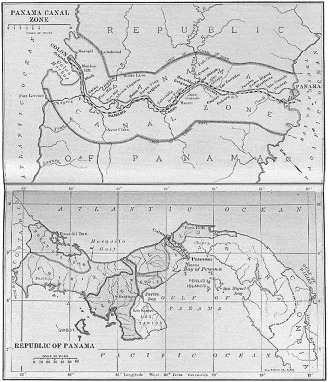
Map of Panamá Canal Zone and Republic of Panamá, from Frank A. Gause and Charles Carl Carr, The Story of Panama: The New Route to India (Boston, 1912)
This shot of Culebra cut was taken near the town of Bas Obispo just after an accidental explosion of dynamite which killed twenty-three workers, on Dec. 12, 1908.Photograph taken by Ernest Hallen, United States National Archives.
Spanish canal workers eat their lunch at Culebra cut in September, 1913.Photograph taken by Ernest Hallen, United States National Archives.
 You have
Access
- 6
- Cited by