Introduction
Avian influenza virus (AIV) is an infectious and contagious disease belonging to the genus Influenza A of family Orthomyxoviridae. The influenza A viruses are characterised by the envelope and the antisense, single-stranded, segmented RNA genome (Yu et al., Reference YU, HUA, WEI, ZHOU, TIAN, LI, LIU and TONG2008). Based on the antigenic variation of the two envelope glycoproteins i.e., haemaglutinin (HA) and neuraminidase (NA), these viruses have been classified into different subtypes i.e., H1-H16 and N1-N9 (Seifi et al., Reference SEIFI, ASASI and MOHAMMADI2010). The AIVs have been further classified as either HPAI (highly pathogenic AI) or LPAI (low pathogenic AI) on the basis of their pathogenicity index and molecular analysis. The H9N2 AIVs have been characterised as the LPAI viruses. These LPAI H9N2 viruses have maintained a wide-spread epidemiological disease profile since their first detection in Wisconsin, the United States in 1966 from turkeys (Dong et al., Reference DONG, LUO, ZHANG, WANG, DUAN, DELIBERTO, NOLTE, JI and HE2011). Apart from their wide-spread distribution in Asia, the Middle East, Europe, Africa and the USA, the H9N2 viruses also have a wide host range from domestic birds and wild birds to pigs and even humans, making them zoonotic in nature (Alexander, Reference ALEXANDER2000). This indicates their role in the past AIV pandemics (Lin et al., Reference LIN, SHAW, GREGORY, CAMERON, LIM, KLIMOV, SUBBARAO, GUAN, KRAUSS, SHORTRIDGE, WEBSTER, COX and HAY2000). It has been documented that the H9N2 viruses undergo mutations and widespread intra and inter re-assortments creating new variants of unknown biological properties. H9N2 viruses are enzootic in poultry and cause latent or asymptomatic infections with mild respiratory signs along with decreased egg production with slightly raised mortality (Pillai et al., Reference PILLAI, PANTIN-JACKWOOD, YASSINE, SAIF and LEE2010).
Despite extensive vaccination, it has been a major respiratory disease virus with significant morbidity and mortality rates due to its continuous circulation and evolution (Ali et al., Reference ALI, SIDDIQUE, ABBAS, GHAFAR, RAFIQUE, ALI, MEMON and NAEEM2015). There are several predisposing infections like coccidiosis (Bachaya et al., Reference BACHAYA, ABBAS, RAZA, IQBAL, REHMAN, BABER and HUSSAIN2015), Mycoplasma gallisepticum (Raza et al., Reference RAZA, AHMAD, RABBANI, MAHMOOD, YOUNUS, ALI and AHAD2016), Merek's disease (Cui et al., Reference CUI, LI, SU, CUI, DING, KANG, SUN and ZHU2016), Infectious bursal disease (Ma et al., Reference MA, YU, ZHANG, MO, OU, WANG and LIU2016) along with numerous immunosuppressive diseases, which aggravate the AIV magnitude in field conditions. A number of factors are involved in its persistent circulation and evolution which have been discussed in the following sections.
Wide host range
The H9N2 subtype virus is an extraordinary member of the influenza A group of viruses because it has a wide range of hosts from chickens, turkeys, ducks to pigs and even humans (Cong et al., Reference CONG, PU, LIU, WANG, ZHANG, ZHANG, FAN, BROWN and LIU2007; Yu et al., Reference YU, HUA, WEI, ZHOU, TIAN, LI, LIU and TONG2008). It was first isolated from chicken in 1992 in Guangdong province of China (Cong et al., Reference CONG, PU, LIU, WANG, ZHANG, ZHANG, FAN, BROWN and LIU2007). And since then, it has become the most prevalent subtype in China (Li et al., Reference LI, YU, TIAN, YU, LIU, JING, PING and CHEN2005). The H9 subtype has the ability to cross the species barrier and infect pigs with high morbidity and mortality. The host range is defined by the different amino acids within and around the HA receptor-binding pocket (RBP) (Cong et al., Reference CONG, PU, LIU, WANG, ZHANG, ZHANG, FAN, BROWN and LIU2007).
There are two types of hosts for avian influenza H9N2 viruses i.e., natural and aberrant hosts. The natural hosts for avian influenza include the wild waterfowl (ducks e.g.), gulls and shorebirds. The aberrant hosts include poultry (chickens, turkeys, quails) and mammals i.e., swine, horses and humans (Suarez, Reference SUAREZ2000).
natural hosts
Wild birds of the two orders i.e. the Anseriformes including waterfowl like ducks, geese and swans and the Charadriiformes including shorebirds and gulls are considered as the natural hosts of avian influenza H9N2 viruses. These wild fowl play a crucial role in the global spread and epidemiology of avian influenza viruses (Olsen et al., Reference OLSEN, MUNSTER, WALLENSTEN, WALDENSTRÖM, OSTERHAUS and FOUCHIER2006). In fact, the LPAI H9N2 viruses have adapted themselves to and are circulating freely in the wild birds due to the avirulent nature of the H9N2 infection in these natural hosts (Suarez, Reference SUAREZ2000).
aberrant hosts
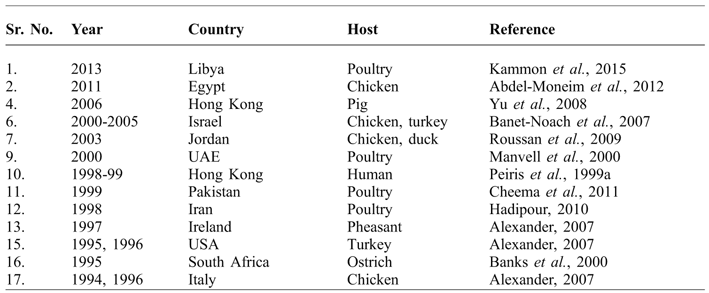
Chickens, turkeys, quails and mammals are considered aberrant hosts of the H9N2 viruses owing to the fact that the evolution rates of these viruses in poultry are similar to those in mammals (Suarez, Reference SUAREZ2000). The H9N2 virus has become enzootic worldwide in the poultry population (Webster et al., Reference WEBSTER, BEAN, GORMAN, CHAMBERS and KAWAOKA1992; Guo et al., Reference GUO, KRAUSS, SENNE, MO, LO, XIONG, NORWOOD, SHORTRIDGE, WEBSTER and GUAN2000). The H9N2 viruses cause asymptomatic/mild disease in the domestic poultry, which usually goes unnoticed. Outbreaks of H9N2 viruses have been common in chickens worldwide especially during 1994-1999 (Alexander, Reference ALEXANDER2000; Matrosovich et al., Reference MATROSOVICH, KRAUSS and WEBSTER2001) ( Table 1 ). The H9N2 strain was first isolated from and detected in turkeys in the USA in 1966 (Dong et al., Reference DONG, LUO, ZHANG, WANG, DUAN, DELIBERTO, NOLTE, JI and HE2011). Since then, H9N2 viruses have been enzootic in turkeys not only in the USA but also globally (Alexander, Reference ALEXANDER2000). Quail has become an important reservoir for the H9N2 viruses worldwide, especially in China as it serves as the linkage between waterfowl and terrestrial avian species and is susceptible to many of the AIV subtypes (Xu et al., Reference XU, SMITH, BAHL, DUAN, TAI, VIJAYKRISHNA, WANG, ZHANG, LI, FAN, WEBSTER, CHEN, PEIRIS and GUAN2007).
Overview of geographical widespread distribution of AIV H9N2.

The H9N2 viruses can also produce infections in mammals including pigs and humans (Cong et al., Reference CONG, PU, LIU, WANG, ZHANG, ZHANG, FAN, BROWN and LIU2007; Yu et al., Reference YU, HUA, WEI, ZHOU, TIAN, LI, LIU and TONG2008). This zoonotic potential raises many concerns as is evident from the past that the H9N2 viruses donated their internal genes to the HPAI H5N1 viruses during the Hong Kong outbreak of 1997 (Peiris et al., Reference PEIRIS, YUEN, LEUNG, CHAN, IP, LAI, ORR and SHORTRIDGE1999a; Guo et al., Reference GUO, KRAUSS, SENNE, MO, LO, XIONG, NORWOOD, SHORTRIDGE, WEBSTER and GUAN2000; Ge et al., Reference GE, ZHOU, LIU, WANG, ZHANG, SHENG, XU, JU, SUN and LIU2009).
Intermediate hosts/mixing vessels
Quails and pigs are considered intermediate hosts for the avian influenza viruses, especially H9N2. These hosts act as mixing vessels for the creation of new variants which can easily adapt to mammalian hosts. Quails are considered responsible for the linkage between aquatic and terrestrial poultry for the transmission of H9N2 viruses. The H9N2 viruses have remained genetically preserved in the porcine population, thus the identical homology to the avian viral species. Therefore, pigs have been found to remain as reservoirs for the older influenza viruses (Perez et al., Reference PEREZ, LIM, SEILER, YI, PEIRIS, SHORTRIDGE and WEBSTER2003; Yu et al., Reference YU, HUA, WEI, ZHOU, TIAN, LI, LIU and TONG2008).
Epidemiologically ubiquitous
The LPAI H9N2 viruses are epidemiologically widespread causing mild to severe infections as evident from Table 1 . Outbreak isolates have been reported during the last decade from Pakistan, Italy, Germany, Iran, Ireland, Saudi Arabia, South Africa, China, Hong Kong and the United States (Alexander, Reference ALEXANDER2000, Reference ALEXANDER2007). It has become the most prevalent influenza virus in poultry since its first isolation (Sun et al., Reference SUN, PU, JIANG, GUAN, XIA, XU, LIU, MA, TIAN, BROWN and LIU2010). For example, the overall isolation rate of H9N2 viruses has relatively increased in China, according to a study conducted during 2008-10 (Ge et al., Reference GE, ZHOU, LIU, WANG, ZHANG, SHENG, XU, JU, SUN and LIU2009). One reason might be the availability of inefficient vaccination in Shanghai, China (Sun et al., Reference SUN, PU, FAN, SUN, WANG, ZHANG, LIU and LIU2012). According to Li et al. (Reference LI, YU, TIAN, YU, LIU, JING, PING and CHEN2005), AIV H9N2 is the most prevalent subtype of the influenza viruses in the poultry industry.
Zoonotic potential of H9N2
The ability of the H9N2 influenza virus to cross the species barrier and transmit to humans as a zoonotic disease has been documented (Peiris et al., Reference PEIRIS, YAM, CHAN, GHOSE and SHORTRIDGE1999b; Li et al., Reference LI, YU, TIAN, YU, LIU, JING, PING and CHEN2005). The detection of H9N2 virus specific antibodies in the poultry workers and patients suggests the possibility of these LPAI viruses to directly infect humans. Thus, they are emerging as, or contributing to the re-emergence of HPAI viruses without acquiring any human or mammalian specific influenza genes in an intermediate host i.e., bypassing an intermediate host. This points to the overwhelming zoonotic potential of these H9N2 viruses (Xing et al., Reference XING, HARPER, ANUNCIACION, YANG, GAO, QU, GUAN and CARDONA2010). For instance, two children were infected with the H9N2 avian virus in 1999 followed by another child case in 2003 in Hong Kong (Peiris et al., Reference PEIRIS, YUEN, LEUNG, CHAN, IP, LAI, ORR and SHORTRIDGE1999a; Guo et al., Reference GUO, KRAUSS, SENNE, MO, LO, XIONG, NORWOOD, SHORTRIDGE, WEBSTER and GUAN2000; Ge et al., Reference GE, ZHOU, LIU, WANG, ZHANG, SHENG, XU, JU, SUN and LIU2009).
Mixed infections
The H9N2 virus has the ability to cause severe respiratory disease with other viruses including the Newcastle disease virus (NDV) (Kammon et al., Reference KAMMON, HEIDARI, DAYHUM, ELDAGHAYES, SHARIF, MONNE, CATTOLI, ASHEG, FARHAT and KRAIM2015), the infectious bronchitis virus (IBV) and Mycoplasma gallisepticum (Nili and Asasi, Reference NILI and ASASI2003). Staphylococcus aureus, Haemophilus paragallinarum and Escherichia coli have been found to not only co-infect with H9N2 virus but also promote viral replication, pathogenicity, shedding and virulence (Kishida et al., Reference KISHIDA, SAKODA, ETO, SUNAGA and KIDA2004). The extensive circulation of H9N2 viruses with other subtypes of avian influenza viruses is one of the many reasons for the significant morbidity and mortality and the creation of variants that are potential pandemic threats. The subtypes which are commonly found along with the H9N2 subtype include the swine pH1N1 subtype (Yu et al., Reference YU, HUA, WEI, ZHOU, TIAN, LI, LIU and TONG2008) and the highly pathogenic H5N1 and H7N3 subtypes (Lin et al., Reference LIN, SHAW, GREGORY, CAMERON, LIM, KLIMOV, SUBBARAO, GUAN, KRAUSS, SHORTRIDGE, WEBSTER, COX and HAY2000).
Undetected mild asymptomatic infections
The H9N2 virus usually causes mild asymptomatic infection in poultry (Alexander, Reference ALEXANDER2000; Matrosovich et al., Reference MATROSOVICH, KRAUSS and WEBSTER2001). The acquisition of the H9N2 virus in the general population through routine contact with birds causes asymptomatic infection. It is thought to be due to the low pathogenicity of the H9N2 virus with leucine at the 226 position at the HA cleavage site, which restricts the viral proliferation in the human respiratory tract. This may be due to the host range restriction of the viral RNA and RNA polymerase (PB2, PB1 and PA) (Mok et al., Reference MOK, YEN, YU, YUEN, SIA, CHAN, QIN, TU and PEIRIS2011). The signs in sick chickens range from mild to severe, and include head and facial oedema and reduced egg production (Pillai et al., Reference PILLAI, PANTIN-JACKWOOD, YASSINE, SAIF and LEE2010; Xing et al., Reference XING, HARPER, ANUNCIACION, YANG, GAO, QU, GUAN and CARDONA2010). H9N2 virus causes seasonal epidemics in both man and poultry, and can go unreported and unnoticed leading to the continuous persistence and consequent evolution of the viruses (Yu et al., Reference YU, HUA, WEI, ZHOU, TIAN, LI, LIU and TONG2008).
Human virus-like receptor specificity
Studies of the previous pandemic strains, including the 1957 H2N2 and the 1968 H3N2 indicates that these viruses evolved as avian-human reassortment viruses and acquired the human virus-like receptor-binding properties in the process. These receptors include the SA α-2, 6-gal-linked receptors to which the HA of the H9N2 isolates prefers to bind to, and these receptors are also characteristic of the human H3N2 virus. Amino acid substitution of leucine by glutamine at 226 position causes the specificity switch from animal to the human virus (Sorrell et al., Reference SORRELL, WAN, ARAYA, SONG and PEREZ2009; Xing et al., Reference XING, HARPER, ANUNCIACION, YANG, GAO, QU, GUAN and CARDONA2010).
Human-to-human transmission
So far, there is not much evidence reporting the human to human transmission of the H9N2 avian influenza virus (Wang et al., Reference WANG, JU, LIU, ZHOU, LV, LI, SHEN, SU, JIANG and JIANG2015). According to one virological study, none of the influenza-like illness (ILI) patients had H9 subtype (Xu et al., Reference XU, SMITH, BAHL, DUAN, TAI, VIJAYKRISHNA, WANG, ZHANG, LI, FAN, WEBSTER, CHEN, PEIRIS and GUAN2007). The absence of H9N2 virus from throat swabs from ILI patients is due to the low pathogenicity and host range restrictions of the virus (Mok et al., Reference MOK, YEN, YU, YUEN, SIA, CHAN, QIN, TU and PEIRIS2011; Wang et al., Reference WANG, JU, LIU, ZHOU, LV, LI, SHEN, SU, JIANG and JIANG2015).
Crossing the species barrier
H9N2 viruses have the ability to cross the species barrier by introducing a mutation in the internal genes, or antigenic shift, causing the virus to adapt to new mammalian hosts. The avian influenza viruses have adapted themselves to the avian hosts, thus the interspecies barrier prevails (Subbarao and Katz, Reference SUBBARAO and KATZ2000). However, these viruses have the ability to adapt to and infect mammalian hosts including humans. Leucine (L226), which is crucial for the transmissibility of the virus to mammals, has been identified in the H9N2 viruses. When this species cross-over occurs, the AIV causes severe disease in the new host that has no protective immunity against the new invader. The antigenic shift has occurred three times this past century among the influenza viruses in the human population (Webster et al., Reference WEBSTER, BEAN, GORMAN, CHAMBERS and KAWAOKA1992).
Resistance development
Antiviral therapy is not recommended in poultry due to the development of resistance to the influenza viruses. For instance, resistance to the antiviral drug amantadine is known to be introduced if the amino acid substitutions occur at any of the M2 residues (Hay et al., Reference HAY, ZAMBON, WOLSTENHOLME, SKEHEL and SMITH1986; Schnell and Chou, Reference SCHNELL and CHOU2008). Similarly, substitutions of the amino acids at the RNA binding domain have known to confer cytokine resistance as well as increased virulence in mammalian species. This phenomenon has been seen in the Egyptian H9N2 isolates as well as in the HPAI H5N1 viruses (Seo et al., Reference SEO, HOFFMANN and WEBSTER2004).
Introduction of novel variants
The lack of proof-reading DNA polymerase accounts for the high rates of mutations in the H9N2 viruses resulting in high error rates with the inability of the virus to repair the altered or damaged part of the genetic material, resulting in new variants (Stech et al., Reference STECH, XIONG, SCHOLTISSEK and WEBSTER1999).
mutations
The amino acid sequence at the viral haemaglutinin (HAO) cleavage site accounts for the differential pathogenicity of the different AIV subtypes. The globular head of the haemaglutinin surface antigen has a pocket of conserved amino acids known as the receptor binding site (RBS) which is surrounded by different antigenic regions (Thompson et al., Reference THOMPSON, BARCLAY and ZAMBON2004). The AIV H9N2 subtype can become virulent by introducing only a single nucleotide in the amino acid motif. The study of the Egyptian H9N2 isolates suggests that the virus has the ability to mutate the HA cleavage site by acquiring some amino acids, and become pathogenic (Abdel-Moneim et al., Reference ABDEL-MONEIM, AFIFI and EL-KADY2012). Similarly, a mutation in the neuraminidase glycoprotein (NA) can render the virus more pathogenic and virulent as it plays an important role in the pathogenicity of the AIV H9N2. Mutation in any of the glycosylation sites can influence in the adaptability of the H9N2 viruses to the host. These changes in the glycosylation site and stalk region of the NA protein can produce a mutation in the NA protein by affecting its structure, stability, localisation and turnover thereby altering the pathogenicity of the subtype (Hulse et al., Reference HULSE, WEBSTER, RUSSELL and PEREZ2004). This makes NA a suitable target for antiviral drugs which would be less helpful in case of any NA mutation which affects enzyme sensitivity to the drugs.
recombinations/reassortments
H9N2 viruses have segmented genomes with the ability to exchange segments among their counterpart subtypes creating novel variants or reassortants. The H9N2 viruses have given rise to reassortment events with other avian influenza subtypes thus generating multiple novel subtypes (Li et al., Reference LI, YU, TIAN, YU, LIU, JING, PING and CHEN2005). This emergence of the reassortants enhance the viral pathogenicity and virulence and help in the adaptability to the new hosts crossing species barrier and infecting mammals including humans. The Hong Kong pandemic H5N1 virus appears to be a reassortant of two AIV subtypes previously found locally i.e., H9N2 and H6N1 (Xu et al., Reference XU, SMITH, BAHL, DUAN, TAI, VIJAYKRISHNA, WANG, ZHANG, LI, FAN, WEBSTER, CHEN, PEIRIS and GUAN2007).
Antigenic drift and shift
Antigenic drift is the accumulation of mutations on the HA and NA glycoproteins that result in the generation of genomic diversity creating antigenic variants. The variation helps in the ecological diversity of the viruses thus making suitable changes over the course of time to better adapt to the new environments they are exposed to (Webster et al., Reference WEBSTER, BEAN, GORMAN, CHAMBERS and KAWAOKA1992; Caron et al., Reference CARON, GAIDET, DE GARINE-WICHATITSKY, MORAND and CAMERON2009). Antigenic shift is the result of the exchange of complete gene segments among different subtypes of the avian influenza viruses generating whole new diverse progeny. This can cause pandemic infections by evolving and adapting to new hosts (Caron et al., Reference CARON, GAIDET, DE GARINE-WICHATITSKY, MORAND and CAMERON2009).
Quasispecies phenomenon
The lack of proof-reading ability of the H9N2 viruses results in high rates of errors resulting in the generation of various genotypic viral species varying in fitness levels for the host environment. This phenomenon of generating heterogeneous viral genotypes is known as the quasispecies phenomenon (Domingo et al., Reference DOMINGO, MARTÍNEZ-SALAS, SOBRINO, DE LA TORRE, PORTELA, ORTÍN, LÓPEZ-GALINDEZ, PÉREZ-BREÑA, VILLANUEVA, NÁJERA, VANDEPOL, STEINHAUER, DEPOLO and HOLLAND1985).
Role of migratory birds in continental spread
Migratory birds play an important role in the transmission of many pathogens across the world especially the AIV subtype H9N2 (Reed et al., Reference REED, MEECE, HENKEL and SHUKLA2003). It is a common strategy for birds occupying seasonal habitats and may range from short local movements to intercontinental migrations (Olsen et al., Reference OLSEN, MUNSTER, WALLENSTEN, WALDENSTRÖM, OSTERHAUS and FOUCHIER2006). They play a key role in the assortment events of the H9N2 virus subtype. For instance, one of the important transit points for the Asia-Pacific migratory birds is Shanghai. The studies propose that these migratory birds are involved in the reassortment between chicken H9N2 and duck H7N9 viruses, creating new variants. This proposition has been supported by the fact the six internal genes of the H7N9 subtype are highly identical to those of the AIV H9N2 (Liu et al., Reference LIU, SHI, SHI, WANG, XIAO, LI, BI, WU, LI, YAN, LIU, ZHAO, YANG, WANG, MA, SHU, LEI and GAO2013).
Enhanced virulence and pathogenicity
The AIV H9N2 is a remarkable virus that can enhance its virulence and pathogenicity by different means e.g., a single amino acid mutation in the virus polymerase can increase replicative efficiency in mammals (Hatta et al., Reference HATTA, GAO, HALFMANN and KAWAOKA2001) and the production of a pro-virulent protein PA-X from the PA gene by ribosomal frameshifting (Gao et al., Reference GAO, XU, SUN, QI, WANG, KONG, SUN, PU, CHANG and LIU2015).
Ineffective vaccination
Vaccination has been the main control and preventative measure for the H9N2 virus (Chen et al., Reference CHEN, JIANG, LI, WANG, WANG and LI2016), but the continuous circulation and evolution of the virus causing antigenic drifts have rendered the vaccine programs ineffective and caused vaccine failures. This vaccine pressure has helped adapt the virus to new environments. Failure to update the vaccine strain with that of the field virus is the main reason behind this problem (Escorcia et al., Reference ESCORCIA, VÁZQUEZ, MÉNDEZ, RODRÍGUEZ-ROPÓN, LUCIO and NAVA2008; Sun et al., Reference SUN, PU, FAN, SUN, WANG, ZHANG, LIU and LIU2012).
Pandemic threats
The H9N2 virus poses a serious threat to poultry and humans as it is considered a potential pandemic threat in the near future because of its ability to give rise to new reassortants (Matrosovich et al., Reference MATROSOVICH, KRAUSS and WEBSTER2001). The study of the 2009 pandemic human influenza virus has revealed the presence of avian consensus amino acid residues, suggesting that these viruses had evolved from the avian counterparts. These avian influenza viruses have circulated freely in wild birds, creating and contributing critical genetic diversity necessary for the generation of new pandemic strains (Sorrell et al., Reference SORRELL, WAN, ARAYA, SONG and PEREZ2009).
Immunological/vaccination pressure
Immunological pressures either from natural infection or vaccination can hasten the alteration rate for the genetic makeup responsible for the surface glycoproteins. The vaccination pressure forces the virus to mutate these genes to adapt to and evolve in the new environment according to the experimental evidence (Lee et al., Reference LEE, SENNE and SUAREZ2004). Another negative aspect of the vaccination pressure is the rapid production of antigenic drifts in the avian influenza viruses (Escorcia et al., Reference ESCORCIA, VÁZQUEZ, MÉNDEZ, RODRÍGUEZ-ROPÓN, LUCIO and NAVA2008).
Live bird/poultry wholesale markets
The live wholesale markets are crucial for the spreading and sharing of the AI viruses because it is the gathering of different birds from different sources thus playing an important role in the speeding process of the emergence of novel genotypes and interspecies transmission (Wang et al., Reference WANG, JU, LIU, ZHOU, LV, LI, SHEN, SU, JIANG and JIANG2015; Siddique et al., Reference SIDDIQUE, NAEEM, AHMED, ABBAS, ALI, RAFIQUE, RASHID, BEGUM and FAROOQ2016). These markets serve as the contaminated environments, which are considered as one of the many risk factors for the seropositivity of the exposed poultry workers. These points may risk the emergence of a pandemic given the genetic diversity of the H9N2 variants and their pandemic potential. H9N2 has been the most widely spread-out AIV subtype in the live-bird markets in Asia since the 1990s (Peiris et al., Reference PEIRIS, YUEN, LEUNG, CHAN, IP, LAI, ORR and SHORTRIDGE1999a).
Modulation of immune responses to H9N2 LPAI viruses
The ability to modulate the host's immune responses is one of the many characteristics of H9N2 viruses in their continued survival and evolution. The host immune and apoptotic responses to the viral activity of the AIV H9N2 subtype have been demonstrated by a study conducted by Xing et al. (Reference XING, HARPER, ANUNCIACION, YANG, GAO, QU, GUAN and CARDONA2010). It was found that some pro-inflammatory interleukins contribute to the pathogenicity of the virus e.g., IL-1 b, IL-8, and IL-6.
Extensive cell and tissue tropism
The receptor binding assays suggest that H9N2 viruses have the preference for SA α-2, 6-gal-linked receptors and that the acquisition of the IH genes or receptors is not necessary to infect the humans or mammals (Matrosovich et al., Reference MATROSOVICH, KRAUSS and WEBSTER2001). The H9N2 viruses have tropism for the human tracheobronchial epithelia cells being the primary invasion sites for the virus. These cells have a pivotal role in the host defence and pathogenesis (Xing et al., Reference XING, HARPER, ANUNCIACION, YANG, GAO, QU, GUAN and CARDONA2010). This extensive tropism is partly responsible for ability of H9N2 viruses to donate genes to the HPAI viruses (Liu et al., Reference LIU, SHI, SHI, WANG, XIAO, LI, BI, WU, LI, YAN, LIU, ZHAO, YANG, WANG, MA, SHU, LEI and GAO2013).
Various modes of transmission
The portal of entry for the AIV H9N2 is the respiratory tract epithelial cells lining which is responsible for the first line of defence against the virus (Matrosovich et al., Reference MATROSOVICH, KRAUSS and WEBSTER2001). The modes of transmission vary from the direct contact of the susceptible birds with the infected birds to the indirect contact via aerosol droplets or contaminated fomites. In either case, the AIV H9N2 spreads readily both by birds and people as well as by the shared equipment, etc. The H9N2 virus has been reported to transmit to mammals including pigs and humans (Peiris et al., Reference PEIRIS, YAM, CHAN, GHOSE and SHORTRIDGE1999b; Li et al., Reference LI, YU, TIAN, YU, LIU, JING, PING and CHEN2005; Sorrell et al., Reference SORRELL, WAN, ARAYA, SONG and PEREZ2009).
Conclusions
H9N2 is an extraordinary member of the Influenza A group of viruses, and, despite the advances in technology and medical science, it has not been eradicated from the world since its first discovery in the 1990s. There are a number of factors which contribute to the evolutionary dynamics of the avian influenza H9N2 subtype. Its wide host range including almost all species from poultry and wild waterfowl to mammals like pigs and even humans has provided it with the ability to circulate and infect continuously and freely. This has caused it to adapt and eventually cross the species barriers and cause severe disease. Other factors such as its continuous mutation and intra and inter subtype reassortment, the under-reported and undetected nature, ineffective vaccination and its consequential antigenic drift have made it a perfect candidate for the cause of the future influenza pandemic. Extreme measures like updating the vaccine strain with that of the field and vigilant surveillance and biosecurity measures are needed to avoid the next pandemic.