While democratic elections provide citizens with the opportunity to select their leaders, a citizen can use her vote to reward or punish an elected official only if she has accurate information about that official’s performance in office. A large literature, both theoretical (e.g., Manin et al. Reference Manin, Przeworski and Stokes1999; Besley and Burgess Reference Besley and Burgess2002) and empirical (Ferraz and Finan Reference Ferraz and Finan2008, Reference Ferraz and Finan2011; Pande Reference Pande2011) supports the notion that information is crucial for citizen control over politicians.Footnote 1
Studies have examined how citizens respond to information from different sources and the types of individuals most likely to discern between information sources (Botero et al. Reference Botero2015; Alt et al. Reference Alt, Lassen and Marshall2016; Weitz-Shapiro and Winters Reference Weitz-Shapiro and Winters2017). Weitz-Shapiro and Winters (Reference Weitz-Shapiro and Winters2017) (WSW in future references) use evidence from a nation-wide survey in Brazil to show that respondents are more likely to punish a politician accused of corruption by a reputable government audit agency versus one accused by an opposition political party. In a context where corruption is a negative valence issue, an opposition party stands to benefit directly from corruption accusations against an incumbent, making such accusations inherently suspect. In contrast, accusations made by a federal agency staffed by career bureaucrats with no direct incentives to fabricate allegations are more credible. WSW also show that politically sophisticated citizens differentiate the most between more and less credible information about political corruption.
In this paper, we replicate the results from Brazil found in WSW using a nationally representative sample from Argentina. Like Brazil, Argentina is a middle-income country where corruption is highly salient. As compared to Brazil, Argentina has a more-established party system, helping us to explore whether partisan identity moderates citizen responses to information about corruption. Recent studies find that citizens are more likely to overlook corruption among copartisan politicians (Anduiza et al. Reference Anduiza, Gallego and Muñoz2014; Eggers Reference Eggers2014; Chang and Kerr Reference Chang and Kerr2017; Klašnja Reference Klašnja2017). Using data from Argentina, we replicate the main findings from WSW: overall, citizens respond differently to more versus less credible information about political corruption, and politically sophisticated respondents (when proxied by education) are particularly likely to discern between information sources. Consistent with the existing literature, we find that partisanship affects citizens’ baseline levels of support for candidates. In contrast to other work, however, we find that partisan identity only minimally affects how citizens punish corruption or assess information. Against initial expectations, copartisans and opposition partisans treat more and less credible sources of information in a similar manner.
Experimental design and hypotheses
We embed an experimental vignette into a large public opinion survey administered in Argentina in 2015 (Lupu et al. Reference Lupu, Oliveros and Schiumerini2019). The vignette describes a hypothetical, high-performing mayor who is running for reelection. Some information is randomly varied across respondents, including the mayor’s party affiliation (or whether a party is mentioned at all), whether the mayor has been accused of taking bribes and, if he has been accused, the source of those accusations. The beginning of the vignette reads as follows:Footnote 2
Imagine that you live in a neighborhood similar to your own but in a different city, and the mayor of that city is named Rodríguez. [no text OR Mayor Rodriguez is a Peronist. OR Mayor Rodriguez is a Radical.] Imagine that Mayor Rodriguez is running for reelection. During the four years that he has been mayor, the municipality improved: it had good economic growth, and health and transportation services improved.
One-quarter of respondents (assigned randomly) heard no additional information. The remaining respondents heard an additional sentence (again, assigned at random) that provided information about corruption. This sentence either explicitly stated that the mayor had not taken bribes or noted that the mayor was accused of receiving bribes (with the source of those accusations varying at random). This final sentence of the vignette read as follows:
In addition, it is well-known that Mayor Rodriguez has not accepted bribes to award public contracts. OR In addition, according to an independent NGO, Mayor Rodriguez has accepted bribes to award public contracts. OR In addition, according to [the opposition OR the Radical party OR the Peronist party], Mayor Rodriguez has accepted bribes to award public contracts.
This text replicates the main components of the treatments in WSW. As with that study, we designed the vignettes to explore whether the credibility of corruption accusations affects citizen responses. Following WSW, we understand credibility to be defined by the relationship between a source and a particular piece of information. In the vignette analyzed here, we treat corruption information attributed to “an independent NGO” as credible.Footnote 3 An independent, non-partisan NGO should not have positional incentives to fabricate corruption information. In addition, in a context where political parties and government institutions face high levels of mistrust, NGOs are seen as more reliable sources of information.Footnote 4 In contrast, we treat accusations about corruption that come from an opposition party as inherently less credible. As WSW argue, an opposition party has strategic incentives to fabricate corruption accusations.
Differing from WSW, we introduce partisanship into some conditions. These vignettes identify Mayor Rodriguez as a member of one of Argentina’s two historically largest and opposing political parties: the Peronist and the Radical party.Footnote 5 In those cases, respondents assigned to the “less credible” condition heard that corruption accusations were levied by the other party. After hearing the vignette, each respondent was asked to assess on a four-point scale his or her likelihood of voting for the hypothetical mayor.
We develop three hypotheses about how the different treatment conditions will affect expressed support for the mayor. WSW find that support for the mayor declines to a greater extent when corruption information comes from the more, as opposed to less, credible source. As described in H1 in the pre-analysis plan for this replication,Footnote 6 we expect to find the same result in Argentina: citizens should react more strongly to more credible information.
Second, we expect that some respondents will be more sensitive to the credibility of source information. WSW argue that political sophisticates are more likely to have the political knowledge and cognitive capacity necessary to understand actors’ incentives to provide truthful information. As a result, these respondents should be more likely to treat information from more and less credible sources differently.Footnote 7 We expect politically sophisticated respondents to distinguish the most between an opposition party, which has incentives to misrepresent information for its own benefit, and “an independent NGO,” which does not (H2).
Finally, we expect that the introduction of partisanship into the vignette should affect response patterns; we develop a set of three hypotheses about expected support for the mayor based on respondent partisanship and that of the mayor. The importance of partisanship in predicting vote choice is long established in the United States (e.g., Campbell et al. Reference Campbell, Converse, Miller and Stokes1960), and there is similar evidence from contexts where partisan identity is more limited, including Latin America (e.g., Lupu Reference Lupu2015). We thus expect copartisans (opposition partisans) to report higher (lower) average vote intention for the mayor as compared to other respondents (H3a).
It has also been argued that partisanship serves as a “perceptual screen” through which individuals understand and process new information they encounter. The prevalence of partisan motivated reasoning (Taber and Lodge Reference Taber and Lodge2006) means that copartisans who find corruption information to be inconsistent with their positive view of the party will minimize or disregard that information. Evidence from observational (Anderson and Tverdova Reference Anderson and Tverdova2003) and experimental (Anduiza et al. Reference Anduiza, Gallego and Muñoz2014) research suggests that shared partisanship weakens corruption’s negative effects on citizen attitudes. We therefore expect copartisans of the mayor to punish corruption accusations less (regardless of credibility) than other respondents (H3b).
Following and extending this logic, partisanship should also affect responses to corruption information provided by a named opposition party. Respondents who identify with the named opposition party should be more likely to treat those accusations as credible. For these opposition partisans, we expect to observe a reduced difference in declared support for the mayor between the more versus less credible information conditions (H3c). In the extreme, an opposition partisan’s positive disposition toward her own party could swamp any recognition that an opposition party has incentives to fabricate corruption claims. If this is the case, opposition partisans may not react differently to the more and less credible accusations at all—perhaps meaning that H1 does not hold for this subgroup.
Data collection
Our experiment was included on Wave 1 of the Argentina Panel Election Study conducted in July 2015 by MORI Argentina.Footnote 8 Following WSW, we use three measures as proxies for respondent political sophistication: education, political knowledge, and the frequency of political discussion. As compared to WSW, the Argentina survey provides us with a more extensive set of political knowledge questions (seven in total versus two in WSW), whereas the political discussion indicator is a yes/no measure of having discussed politics in the last year (as compared to the measure of frequency in WSW).Footnote 9
Results: credibility and sophistication
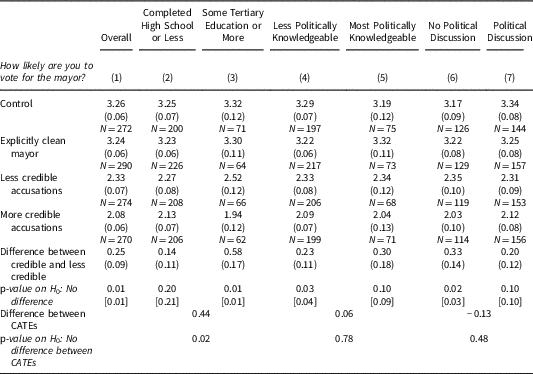
Table 1 reports the mean values across treatment conditions in the overall data and for subgroups defined by sophistication.Footnote 10 Consistent with H1, the data support the claim that citizens are sensitive to source credibility. When corruption accusations come from a credible source (“an independent NGO”) as compared to a less-credible source (either a generic or specific opposition party), vote intention for the mayor falls by a quarter of a unit on a four-point scale.
Respondent Sophistication and Responsiveness to Source Credibility in Argentina

Note: First panel presents condition- and subgroup-specific means for the outcome variable with standard errors in parentheses and N of non-missing responses. p-values for the null hypothesis on the conditional average treatment effect (CATE) for each group and for the null hypothesis of different reactions to each treatment across the two groups are based on difference-in-means t-tests and Wilcoxon rank sum tests (in brackets). p-values for differences across the CATEs are based on the randomization inference tests described in Gerber and Green (Reference Gerber and Green2012).
Columns (2)–(7) of the table show the estimated treatment effects across three measures of political sophistication: respondents who have more versus less education, political knowledge, or interest in politics. Consistent with H2, as well as WSW, the table shows a pronounced difference in the conditional average treatment effect (CATE) across the more versus less educated subgroups. This difference is statistically significant. The difference in CATEs is in the same direction for the subgroups defined by political knowledge but of a smaller magnitude, while the difference in CATEs for the subgroups defined by political discussion is in the opposite direction.Footnote 11
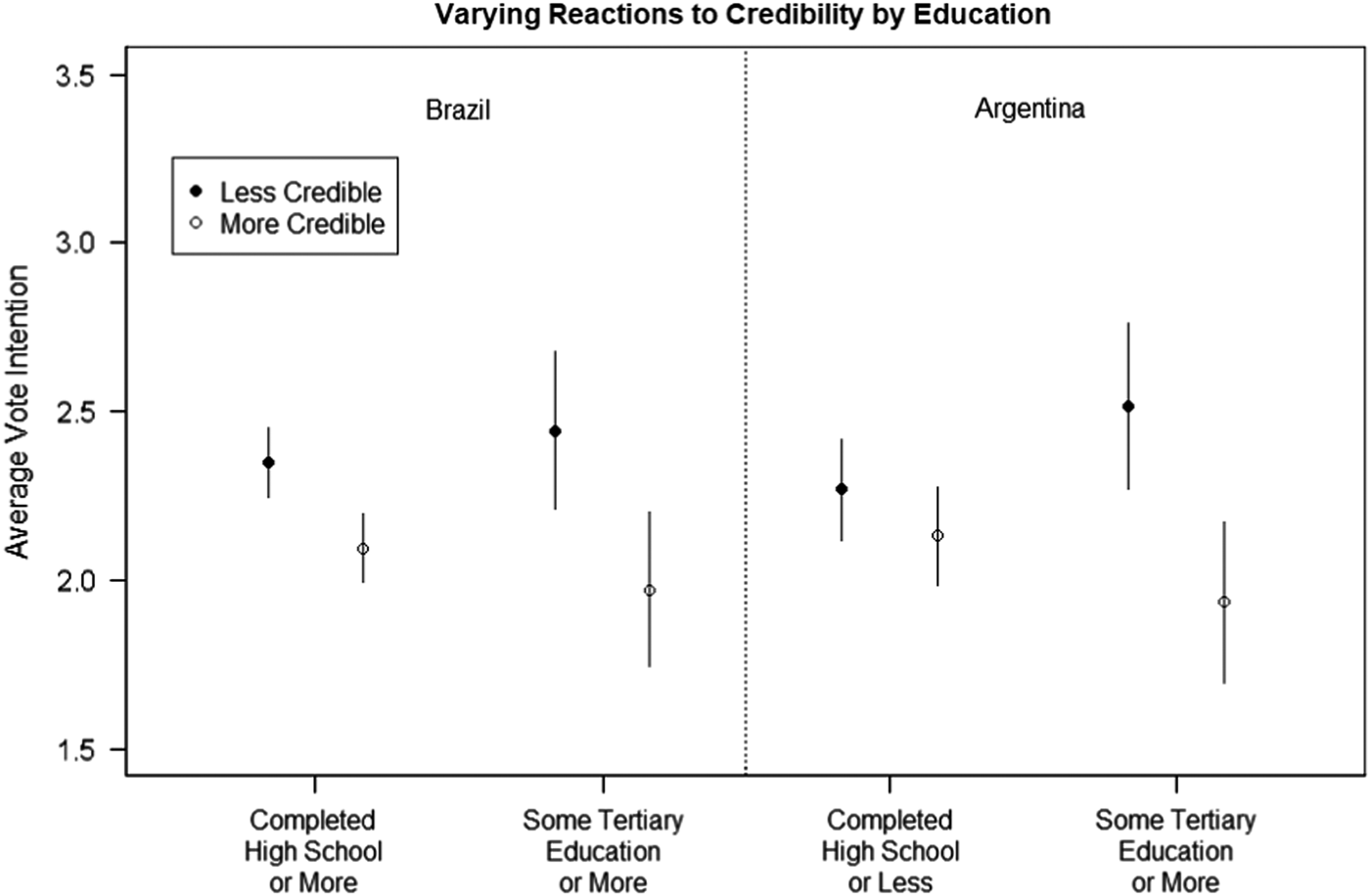
Figure 1 presents the results for the education subgroups alongside those from WSW. The figure makes clear the similarities between that study and this replication. In both cases, differences in the point estimates across treatment conditions suggest that all respondents are sensitive to information credibility and are more likely to withdraw support when corruption information comes from a more credible source. These differences are statistically significant, however, only for the more educated subgroup, where the magnitude of discernment is larger.
Responses to source credibility by education in Brazil and Argentina Note: Means and 95-percent confidence intervals based on estimates found in Appendix Table 1 (for Brazil) and Table 1 (for Argentina). See notes to tables for additional information. Brazil results are a replication of Weitz-Shapiro and Winters (Reference Weitz-Shapiro and Winters2017).

Partisan identity and responses to corruption information
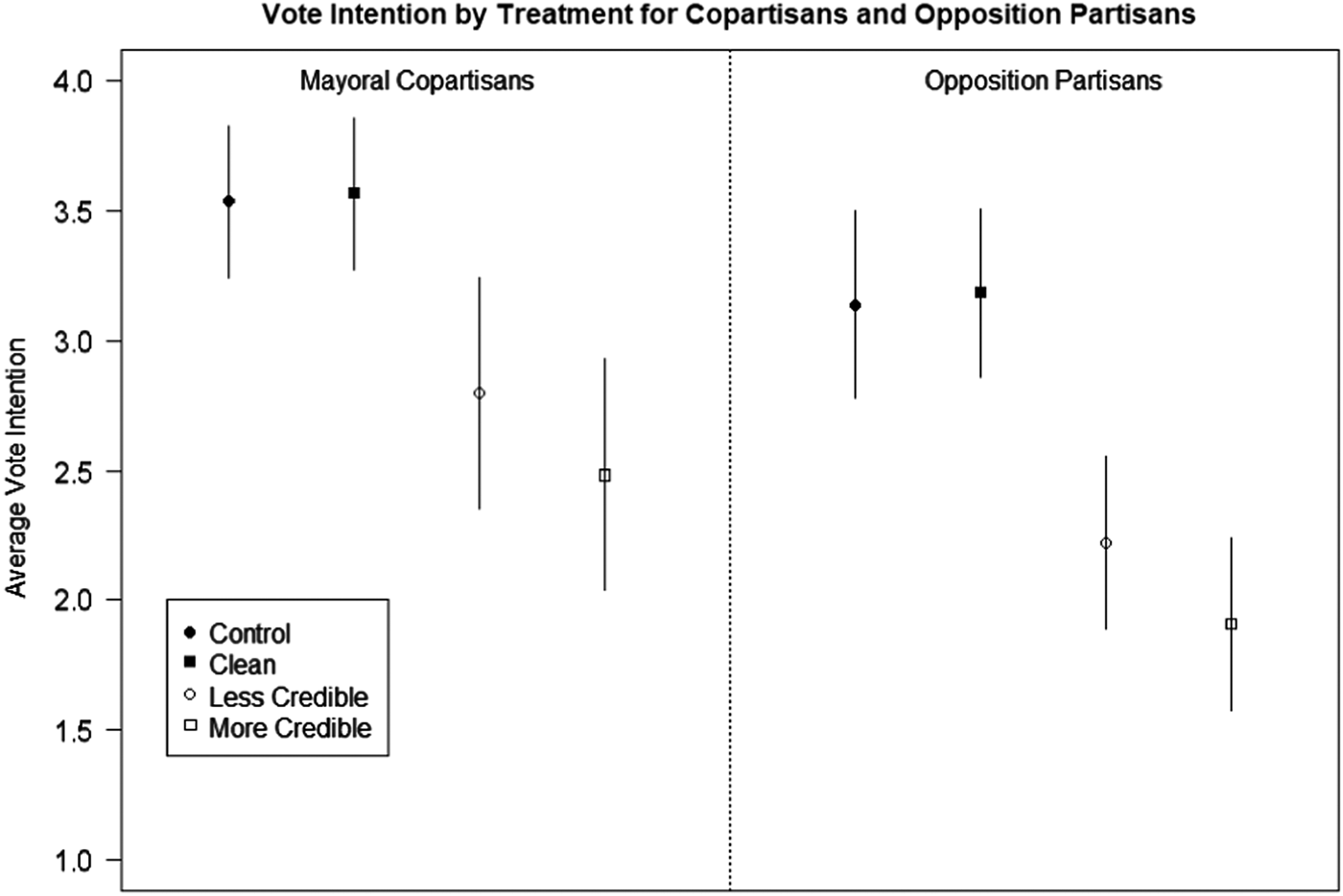
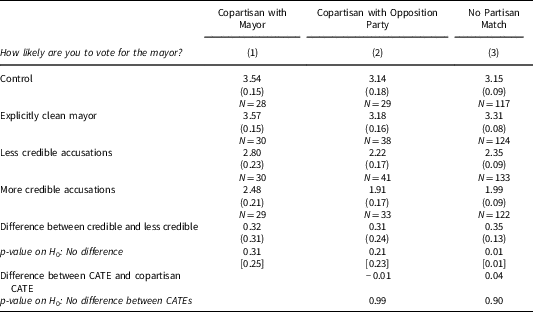
In Table 2 and Figure 2, we present the results that examine how the mayor’s partisan identity affects responses. The first three columns of the table present the results from (1) respondents who share a partisan match with the accused mayor (either PJ or UCR), (2) who share a partisan match with the main historical party that is not the mayor’s party (either UCR or PJ), and (3) all other respondents. As per H3a, those who share a partisan identity with the mayor (opposition) express higher (lower) baseline intentions to vote for the mayor. Although respondents who are not copartisans are less likely to say they would vote for the mayor, support nonetheless is relatively high in both the clean and control conditions, reflecting the fact that the mayor is described in positive terms.
Vote intention by treatment for copartisan and opposition partisans Note: Means and 95-percent confidence intervals based on estimates found in Table 2. See notes to table for more information.

Copartisanship as a Moderator of Reactions to Source Credibility in Argentina

Note: First panel presents the condition- and subgroup-specific means for the outcome variable with standard errors in parentheses and N of non-missing responses. See notes of Table 1 for full details.
CATE = conditional average treatment effect.
While we observe higher levels of overall support for the mayor among copartisans, hypothesis H3b (that copartisans would heavily discount all accusations of corruption as compared to other respondents) is not supported. To test H3b, we pool the clean and control conditions and all of the corruption information conditions. Among copartisans, learning about corruption depresses support for the mayor from 3.55 to 2.64, a decrease of 0.91 units. Among respondents who do not share a partisan identity with the mayor, information about corruption depresses support from 3.22 to 2.15, 1.07 units. Both differences are significant and consistent with the evidence that all respondents, including copartisans, punish corruption. Although the negative effect of corruption information is somewhat attenuated among copartisans, the difference in effect size is small (especially when compared to the overall punishment for corruption) and not statistically distinguishable from zero.Footnote 12
In addition, contrary to H3c, we do not find evidence that individuals who identify with the opposition party are especially likely to believe accusations made by that party. Opposition partisans, like mayoral partisans (and non-partisans), react more strongly to an NGO accusation than they do to an opposition accusation. Though these differences are not statistically significant at conventional levels because of the limited number of partisan respondents, they are almost identical in magnitude: learning about corruption from the NGO leads to a further decrease in support for the mayor of between 0.31 and 0.36 points, as compared to learning that information from the opposition party. It appears that all types of respondents, even those who identify with the opposition party, account for the opposition’s incentives.Footnote 13
Drawing on columns 1 and 2 of Table 2, Figure 2 presents the results discussed above. Overall, copartisan respondents are more likely to support the mayor than other respondents. Nonetheless, the penalty for not sharing partisanship is relatively limited, especially compared to the substantial punishment that respondents impose when they learn about corruption. Finally, the evidence seems to suggest that all respondents are sensitive to source credibility, although differences between more and less credible conditions are not statistically significant.Footnote 14
Discussion
Citizens face competing information sources. If citizens can discern between more and less credible sources, there is a greater likelihood that politicians will be held to account for their performance. In the context of elections, an opposition party has incentives to disseminate negative information about a sitting office-holder, whether true or fabricated; on the other hand, a government watchdog agency or an independent NGO is more likely to have incentives to release only accurate information.
We replicate the results of the nationally representative survey experiment in Brazil reported in Weitz-Shapiro and Winters (Reference Weitz-Shapiro and Winters2017) in a nationally representative survey in Argentina, showing in a new context that individuals discern between information sources: respondents are more likely to punish a politician described as corrupt when allegations come from a more credible source. We also replicate the finding that politically sophisticated individuals are more likely to discern between sources.
Finally, we extend the findings of WSW by examining how partisanship affects responses to corruption information. Consistent with the existing literature, respondents express higher levels of support for copartisan mayors party across all conditions. This partisan lens, however, appears limited in reach. Copartisans punish corruption only to a slightly lesser (and not statistically distinguishable) extent than nonpartisans. Furthermore, voters of all partisan identities assess the quality of information sources in the same way. Against our pre-registered expectations, we find that copartisans, opposition partisans, and other/non-partisans demonstrate very similar patterns of discernment of more versus less credible information. In general, these results suggest that a wide variety of voters in Argentina—as in Brazil—can distinguish between different types of political information and make informed voting decisions as a result.
Supplementary Material
To view supplementary material for this article, please visit https://doi.org10.1017/psrm.2018.50
Acknowledgments
This paper is part of an ongoing project in which the authors’ names rotate between first and second position; both authors contributed equally to this article. Thanks to Noam Lupu, Virginia Oliveros, and Luis Schiumerini for their work in organizing the 2015 Argentine Panel Election Study; to Simon Chauchard, Natascha Neudorfer, and seminar audiences at Boston University, Illinois State University, the University of Essex, the University of Pittsburgh, the University of Texas at Austin, and Yale University for comments; and to Pedro Dal Bó, Brian Gaines, and Jim Kuklinksi for very useful discussions. A related paper was presented at the 2016 annual meeting of the Midwest Political Science Association and the 2017 annual meeting of the European Political Science Association. Data collection was funded in part using a Salomon Faculty Research Award from Brown University.