1. Introduction
Many granitic intrusions are spatially, temporally and chemically related to layered mafic intrusions (Bonin, Reference Bonin2004; Shellnutt & Zhou, Reference Shellnutt and Zhou2007). Bimodal plutonic suites occur in many different tectonic settings such as post-collision (Zhang et al. Reference Zhang, Zhang, Tang, Wilde and Hu2008b; Yuan et al. Reference Yuan, Sun, Wilde, Xiao, Xu, Long and Zhao2010; Su et al. Reference Su, Zheng, Griffin, Zhao, Tang, Ma and Lin2012), within-plate extension (Zhong et al. Reference Zhong, Zhu, Chu, He and Song2007; Zhang et al. Reference Zhang, Li, Li, Ye and Li2008a, Reference Zhang, Xu, Li, Wang and Ye2010b) and mature island arc/active continental margin (Pin & Paquette, Reference Pin and Paquette1997; Zhang et al. Reference Zhang, Zhang, Tang, Wilde and Hu2008b; Geng et al. Reference Geng, Sun, Yuan, Xiao, Xian, Zhao, Zhang, Wong and Wu2009). The exact process which connects the two rock types also constitutes a matter of debate, with opinions including: (1) different crustal and mantle sources for the coeval granitic and mafic rocks (Bonin, Reference Bonin2004; Yuan et al. Reference Yuan, Sun, Wilde, Xiao, Xu, Long and Zhao2010; Su et al. Reference Su, Zheng, Griffin, Zhao, Tang, Ma and Lin2012); (2) extreme fractionation of coeval mafic magma (Turner, Foden & Morrison, Reference Turner, Foden and Morrison1992; Han et al. Reference Han, Wang, Jahn, Hong, Kagami and Sun1997; Chen & Arakawa, Reference Chen and Arakawa2005; Tian et al. Reference Tian, Campbell, Allen, Guan, Pan, Chen, Yu and Zhu2010) for the generation of granitic rocks; and (3) liquid immiscibility (Jakobsen et al. Reference Jakobsen, Veksler, Tegner and Brooks2005; Zhou et al. Reference Zhou, Robinson, Lesher, Keays, Zhang and Malpas2005, Reference Zhou, Chen, Wang, Prevec, Liu and Howarth2013; VanTongeren & Mathez, Reference Van Tongeren and Mathez2012). The geochronological and geochemical comparison between the two rock types can provide important constraints on their genetic relationship and tectonic process.
There are at least four Permian large igneous provinces (LIP) in Asia: the Siberian traps (~251 Ma; Kamo et al. Reference Kamo, Czamanske, Amelin, Fedorenko, Davis and Trofimov2003; Wei et al. Reference Wei, Xu, Luo, Zhao and Feng2015), Panjal Traps (~290 Ma; Shellnutt et al. Reference Shellnutt, Bhat, Wang, Brookfield, Dostal and Jahn2014, Reference Shellnutt, Bhat, Wang, Yeh, Brookfield and Jahn2015), Emeishan basalts (~260 Ma; Xu et al. Reference Xu, Luo, Huang, He, Xiao, Xie and Shi2008; Shellnutt & Jahn, Reference Shellnutt and Jahn2010) and Tarim basalts (280–290 Ma; Li et al. Reference Li, Li, Sun, Santosh, Langmuir, Chen, Yang, Chen and Yu2012b; Wei et al. Reference Wei, Xu, Feng and Zhao2014a,Reference Wei, Xu, Zhang, Zhao and Fengb; Sun et al. Reference Sun, Li, Li, Zou, Langmuir, Chen, Yang and Ren2016). Compared to intensive and systematic studies on the Siberian and Emeishan LIPs, information on the Tarim LIP still remains scarce, probably because of partial burial by the Taklamagan desert (Li et al. Reference Li, Chen, Song, Li, Yang and Yu2011; Xu et al. Reference Xu, Wei, Luo, Liu and Cao2014). The Tarim LIP is predominantly composed of basaltic lava flows, mafic–ultramafic layered intrusions/dykes, and minor felsic volcanic and plutonic rocks (Fig. 1a) (Zhou et al. Reference Zhou, Zhao, Jiang, Gao, Wang and Yang2009; Zhang, Liu & Guo, Reference Zhang, Liu and Guo2010; Yang et al. Reference Yang, Chen, Li, Li, Yu, Li and Meng2013; Liu et al. Reference Liu, Xu, Tian, Zhong, Mundil, Li, Yang, Luo and Shangguan2014). Previous studies of Tarim LIP have focused on the mafic–ultramafic rocks and related deposits (Yu et al. Reference Yu, Yang, Chen, Chen, Li, Batt and Li2011b; Zhang et al. Reference Zhang, Zhou, Yuan, Jowitt, Fan and Liu2012, Reference Zhang, Zhang, Santosh, Cheng, He and Kang2013; Li et al. Reference Li, Li, Yu, Langmuir, Santosh, Yang, Chen, Tang, Song and Zou2014; Cheng et al. Reference Cheng, Zhang, Hou, Santosh, Zhang and Ke2015). The petrogenesis of the granitic rocks from the Tarim Block is debated partially due to the lack of high-precision isotopic and geochronologic data. Consequently, the dearth of information hampers our understanding of crustal growth and crust–mantle interaction in the Tarim Block. Yu et al. (Reference Yu, Mo, Dong, Yu, Xing, Li and Huang2011a) and Huang et al. (Reference Huang, Zhang, Kusky, Santosh, Zhang, Zhang, Liu and Zhao2012) suggested that the felsic rocks were generated by the partial melting of a common Neoproterozoic gabbroic crustal source, whereas Zhang & Zou (Reference Zhang and Zou2013) claimed that the A-type syenite–granites were formed via intensive crystal fractionation from a common plume-derived parental mafic magma, coupled with variable extent of crustal contamination. Moreover the exact petrogenetic relationship with the neighbouring mafic–ultramafic complexes and the Tarim mantle plume is also debated (Huang et al. Reference Huang, Zhang, Kusky, Santosh, Zhang, Zhang, Liu and Zhao2012; Zhang & Zou, Reference Zhang and Zou2013). Thus, more geochronological and geochemical data are needed to constrain the debated issues.
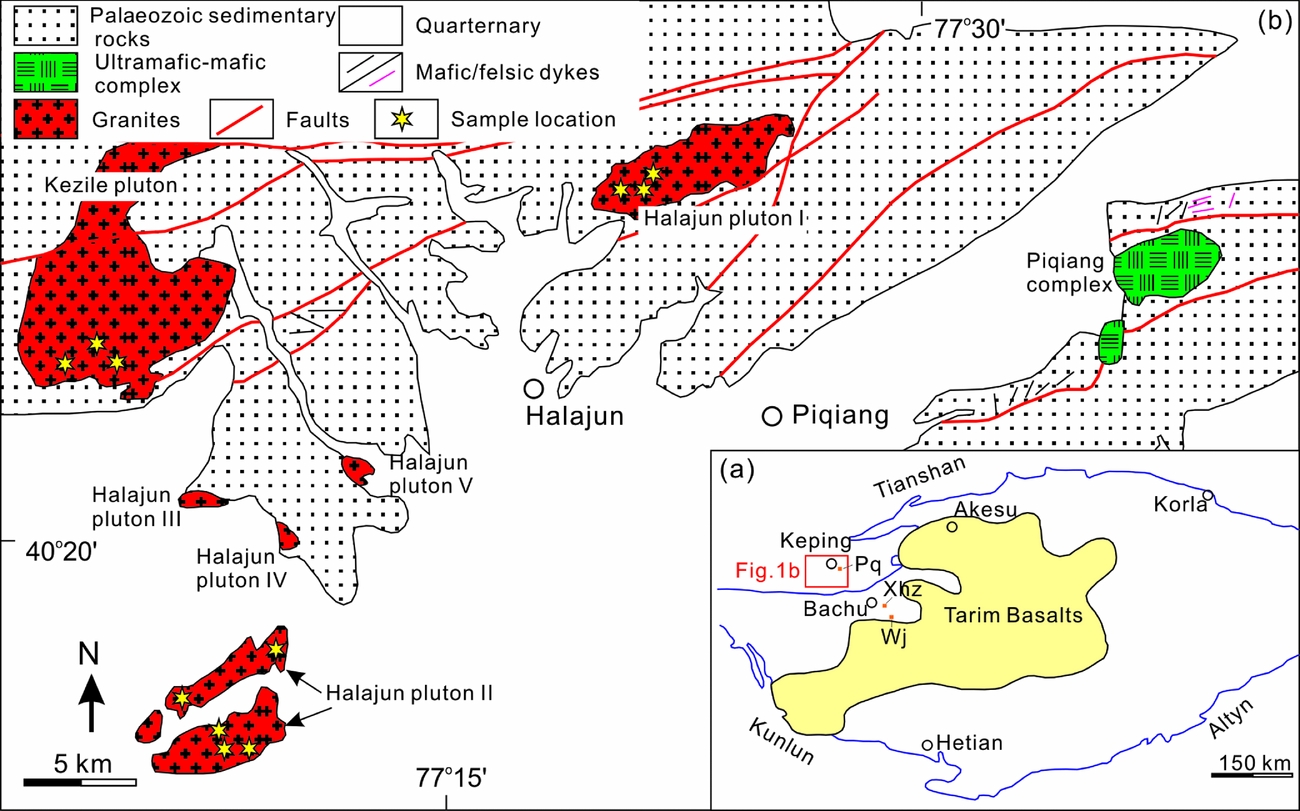
(a) Simplified geological map of the Tarim Block, showing the distribution of the Permian basalts and ultramafic–mafic–felsic complexes around the Bachu area (modified after Yang et al. Reference Yang, Li, Chen, Santosh, Dong and Yu2007b; Wei et al. Reference Wei, Xu, Luo, Zhao and Feng2015). Abbreviations here: Xhz, Xiaohaizi intrusion; Wj, Wajilitag complex; Pq, Piqiang complex. (b) Geological map of the granitic intrusions and Piqiang mafic–ultramafic complex in the Halajun area (modified after Zhang & Zou, Reference Zhang and Zou2013).
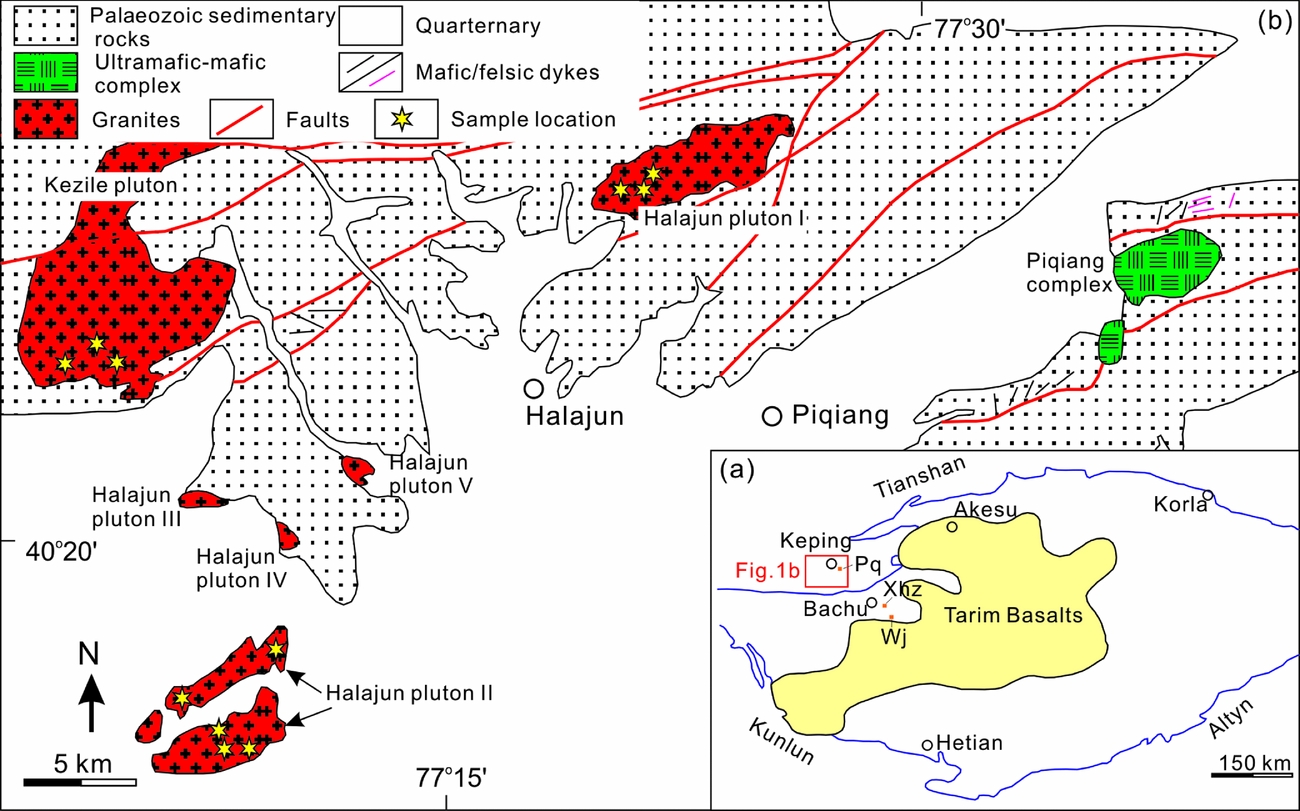
In this study, we report new geochemical and zircon U–Pb–Hf isotopic data for Halajun granitic rocks in the NW margin of the Tarim Block (Fig. 1a). Based on these results, together with published data for other mafic–ultramafic complexes, mafic dyke swarm, basalts and syenitic rocks, we attempt to: (1) trace temporal evolution of Permian Tarim LIP; (2) discuss the petrogenesis of the granitic rocks; and (3) decipher their relationship with the Tarim mantle plume. We suggest another genetic model of derivation from newly underplated rocks related with the Tarim mantle plume for the generation of the Halajun granitic rocks.
2. Geological background
The Tarim Block in NW China covers an area of more than 600,000 km2, and is one of the least-known continental blocks in Asia, due to poor exposure. It is surrounded by the Tianshan Mountains to the north, the Kunlun Mountains to the south and the Altyn Mountains to the southeast (Fig. 1a). The block was amalgamated with the southern Central Asian Orogenic Belt (CAOB) during the late Palaeozoic (Zhang et al. Reference Zhang, Li, Li, Ye and Li2008a; Han et al. Reference Han, He, Wang and Guo2011), and is composed of Precambrian crystalline basement and a thick Phanerozoic sedimentary cover. The Precambrian basement mainly consists of late Neoarchean – early Palaeoproterozoic tonalitic–trondhjemitic–granodioritic gneisses, late Palaeoproterozoic to early Neoproterozoic marine volcano-sedimentary rocks and late Neoproterozoic low-grade metamorphic volcaniclastic rocks and glacial deposits (Zhang et al. Reference Zhang, Zhang, Santosh, Cheng, He and Kang2013; Ge et al. Reference Ge, Zhu, Wilde, Wu, He and Zheng2014; Xu et al. Reference Xu, Wei, Luo, Liu and Cao2014). The Permian volcanic–sedimentary strata in the Tarim Basin, are dominantly composed of clastic rocks, muddy limestones and mafic–felsic volcanic rocks.
Several important phases of igneous activity have been identified in the Tarim Block, including Neoarchaean, Palaeoproterozoic, Mesoproterozic, Neoproterozoic and early Permian events (Hu et al. Reference Hu, Jahn, Zhang, Chen and Zhang2000; Long et al. Reference Long, Yuan, Sun, Zhao, Xiao, Wang, Yang and Hu2011; Xu et al. Reference Xu, Wei, Luo, Liu and Cao2014). Among these, the early Permian phase is the most extensive and considered to be a LIP probably related to mantle plume activity (Yang et al. Reference Yang, Li, Chen, Santosh, Dong and Yu2007b; Tian et al. Reference Tian, Campbell, Allen, Guan, Pan, Chen, Yu and Zhu2010; Li et al. Reference Li, Chen, Song, Li, Yang and Yu2011; Wei et al. Reference Wei, Xu, Feng and Zhao2014a). A large volume of Permian basalts, mafic–ultramafic complexes, mafic dyke swarms and minor syenitic–granitic rocks are exposed in the Piqiang, Bachu and Keping areas around the NW margin, and in the interior of the Tarim Basin (Fig. 1a) (Zhou et al. Reference Zhou, Zhao, Jiang, Gao, Wang and Yang2009; Li et al. Reference Li, Chen, Song, Li, Yang and Yu2011; Zhang et al. Reference Zhang, Zhou, Yuan, Jowitt, Fan and Liu2012; Zou et al. Reference Zou, Li, Song, Ernst, Li, Ren, Yang, Chen, Xu and Song2015). Industrial geophysical survey and oil exploration reveal that the Permian basalts (including related tuff and tuffaceous sedimentary rocks) may extend over an area of 250,000–300,000 km2 (Xu et al. Reference Xu, Wei, Luo, Liu and Cao2014). They were erupted at c. 280–290 Ma, and were suggested to be derived from an OIB-like, but isotopically more enriched, asthenospheric mantle source (Zhou et al. Reference Zhou, Zhao, Jiang, Gao, Wang and Yang2009) or a time-integrated, enriched lithospheric mantle source (Zhang et al. Reference Zhang, Xu, Li, Wang and Ye2010b).
The oxide (magnetite)-bearing mafic–ultramafic complexes are mainly exposed in the Piqiang, Xiaohaizi and Wajilitag regions (Fig. 1a). These intrusions cut Silurian and Devonian strata and host economic Fe–Ti oxide mineralization (Li et al. Reference Li, Li, Chen, Yang and Yu2012a; Cao et al. Reference Cao, Wang, Xing and Xu2014; Zhang et al. Reference Zhang, Zhang, Huang, Encarnación, Zhou and Ding2014). The Piqiang complex neighbouring our study area, has an outcrop area of c. 25 km2, and intrudes Devonian sedimentary rocks with the contact dipping 70–80° toward the interior of the complex. It is composed mainly of gabbro (accounting for c. 95% of the outcrop) with minor olivine-bearing gabbro and dolerite. Most of the crystalline rocks are cumulates (except for the dolerite) (Zhang et al. Reference Zhang, Xu, Li, Wang and Ye2010b). Except mafic–ultramafic rocks, the Xiaohaizi and Wajilitag complexes also contain some dioritic and syenitic rocks. Based on mineral assemblages, the syenitic rocks can be subdivided into fayalite syenite and amphibole syenite (Wei & Xu, Reference Wei and Xu2011). The former consists mainly of alkali feldspar (85‒90%), fayalite, clinopyroxene, amphibole with minor quartz and plagioclase, and the latter mainly contains alkali feldspar (~85%), amphibole, biotite with minor quartz and plagioclase. These dioritic to syenitic rocks were emplaced at 274–280 Ma, and were likely formed by crystal cumulation and fractionation of alkali basalts (Zhang et al. Reference Zhang, Li, Li, Ye and Li2008a; Wei & Xu, Reference Wei and Xu2011; Zou et al. Reference Zou, Li, Song, Ernst, Li, Ren, Yang, Chen, Xu and Song2015). Several granitic intrusions crop out in the Halajun area near the Piqiang complex (Fig. 1b), ~120 km NE of Atushi City. They intrude the upper Carboniferous sedimentary rocks with the contact dipping 50–60° outward. The hornfels belts with a width of 10–30 m, developed along the margin of the intrusions.
3. Materials and methods
3.a. Petrography
Ten granitic samples (HL1–HL8, HL20 and HL21) were collected from the Halajun pluton ІІ (50 km2). These alkali feldspar granites show medium- to coarse-grained granitic texture and massive structure, and mainly consist of alkali feldspar (30–50%), quartz (30–35%), plagioclase (10–15%) and mafic minerals (5–15%). Alkali feldspars are dominantly subhedral perthite as well as minor microcline with cross-hatched twinning. The quartz occurs as anhedral grains, and undulatory extinction is commonly present. Mafic minerals consist of hornblende and biotite, and are mainly interstitial to alkali feldspar and quartz. Among them, hornblende occurs as prismatic, subhedral to euhedral grains; biotite presents as subhedral to euhedral flakes, and in places as the inclusions in the alkali feldspar grains. In the sample HL5, mafic minerals are strongly altered.
The Kezile pluton, north of the Halajun pluton ІІ, has an outcropping area of c. 53 km2. Compared with the rocks from the Halajun pluton ІІ, six alkali feldspar granites (HL9–HL14) from this pluton show similar mineral compositions but have a fine-grained texture. The granodioritic phase reported from the pluton by Zhang & Zou (Reference Zhang and Zou2013), however, is not observed during our field investigation. Another five samples (HL15–HL19) were obtained from the Halajun pluton I (40 km2). The rock-forming minerals include alkali feldspar (35–50%), quartz (30–40%), plagioclase (5–15%) and mafic minerals such as hornblende and biotite (5–10%).
3.b. Analytical methods
3.b.1. Whole-rock geochemical analyses
Representative samples selected for major oxide and trace element analyses were reduced to chips after removal of altered surfaces. The chips were cleaned in Milli-Q water, then crushed to 60 mesh in a carborundum jaw crusher. About 60 g of this crushed material was powdered in an agate ring mill to less than 200 mesh. Major-element determinations were done by traditional X-ray fluorescence (XRF) methods using a Shimadzu Sequential 1800 spectrometer at the State Key Laboratory of Geological Processes and Mineral Resources, China University of Geosciences (CUG), Wuhan. According to the measured values of standards, the analytical uncertainties for major oxides are less than 1%. Trace elements were analysed by an Agilent 7500a inductively coupled plasma mass spectrometer at CUG. The powders were digested by HF+HNO3 in Teflon bombs. The detailed sample-digestion procedure for ICP-MS analyses, and the analytical precision and accuracy for the trace-element analyses, are the same as those described by Liu et al. (Reference Li, Yang, Chen, Langmuir, Yu, Lin and Li2008b). The precision of the trace-element analyses is estimated to be better than c. 5%. Elemental compositions of international rock standards used for the major- and trace-element analyses are listed in online Supplementary Material Table S1, available at https://doi.org/10.1017/S0016756817000838.
3.b.2. Zircon U–Pb dating
Zircon grains were separated by the routine method that employs elutriation, heavy liquid and magnetic techniques, followed by careful handpicking under a binocular microscope. Zircons were mounted in epoxy resin and polished down to their cores for analysis. All the analyses of zircons were carried out at the State Key Laboratory of Geological Processes and Mineral Resources, CUG. In order to examine zircon morphology and internal structure, backscattered-electron and cathodoluminescence (CL) images of zircon grains were taken on a JEOL JXA-8100 electron microprobe (EMP).
U–Pb dating of zircons was performed on an Agilent 7500a ICP-MS, coupled to a GeoLas 2005 193 nm laser microprobe at CUG. Detailed operating conditions for the laser ablation system and the ICP-MS and procedures for data reduction are the same as those described by Liu et al. (Reference Liu, Zong, Kelemen and Gao2008a, Reference Liu, Gao, Hu, Gao, Zong and Wang2010). Zircon 91500 was used as external standard for U–Pb dating, and analysed twice every five analyses. Offline selection and integration of background and analyte signals, and time-drift corrections and quantitative calibration were performed by ICPMSDataCal (Liu et al. Reference Liu, Zong, Kelemen and Gao2008a, Reference Liu, Gao, Hu, Gao, Zong and Wang2010). Concordia diagrams and weighted mean calculations were made using Isoplot/Ex_ver3 (Ludwig, Reference Ludwig2003). Common-Pb contents were evaluated using the method described by Andersen (Reference Andersen2002).
3.b.3. Zircon Hf isotope
Zircon Hf isotopes were analysed using a Neptune Plus multi-collector ICP-MS in combination with a Geolas 2005 excimer ArF laser ablation system. Lu–Hf isotopic compositions were obtained on the same zircon grains that were previously analysed for U–Pb isotopes. All data were acquired on zircons in single-spot ablation mode at a spot size of 44 μm. During the period of data acquisition, the GJ1 and 91500 zircons were analysed as external standards to check the reliability and stability of the instrument. Detailed operating conditions for the laser ablation system and the MC-ICP-MS instrument and analytical methods are those described by Hu et al. (Reference Hu, Liu, Gao, Liu, Zhang, Tong, Lin, Zong, Li, Chen, Zhou and Yang2012). The ε Hf(t) values were calculated using the 176Lu decay constant of 1.865×10⁻¹¹a−1 suggested by Scherer, Munker & Mezger (Reference Scherer, Munker and Mezger2001), and Lu–Hf isotopic ratios of chondrite recommended by Blichert-Toft & Albarede (Reference Blichert-Toft and Albarede1997). We also calculated the depleted-mantle model age (T DM) using the values from Griffin et al. (Reference Griffin, Pearson, Belousova, Jackson, O'Reilly, Van Achterberg and Shee2000), and average continental crust model age (T crust) using 176Lu/177Hf of 0.015 (Griffin et al. Reference Griffin, Belousova, Shee, Pearson and O'Reilly2004) for the average continental crust.
4. Results
4.a. Zircon U–Pb dating results
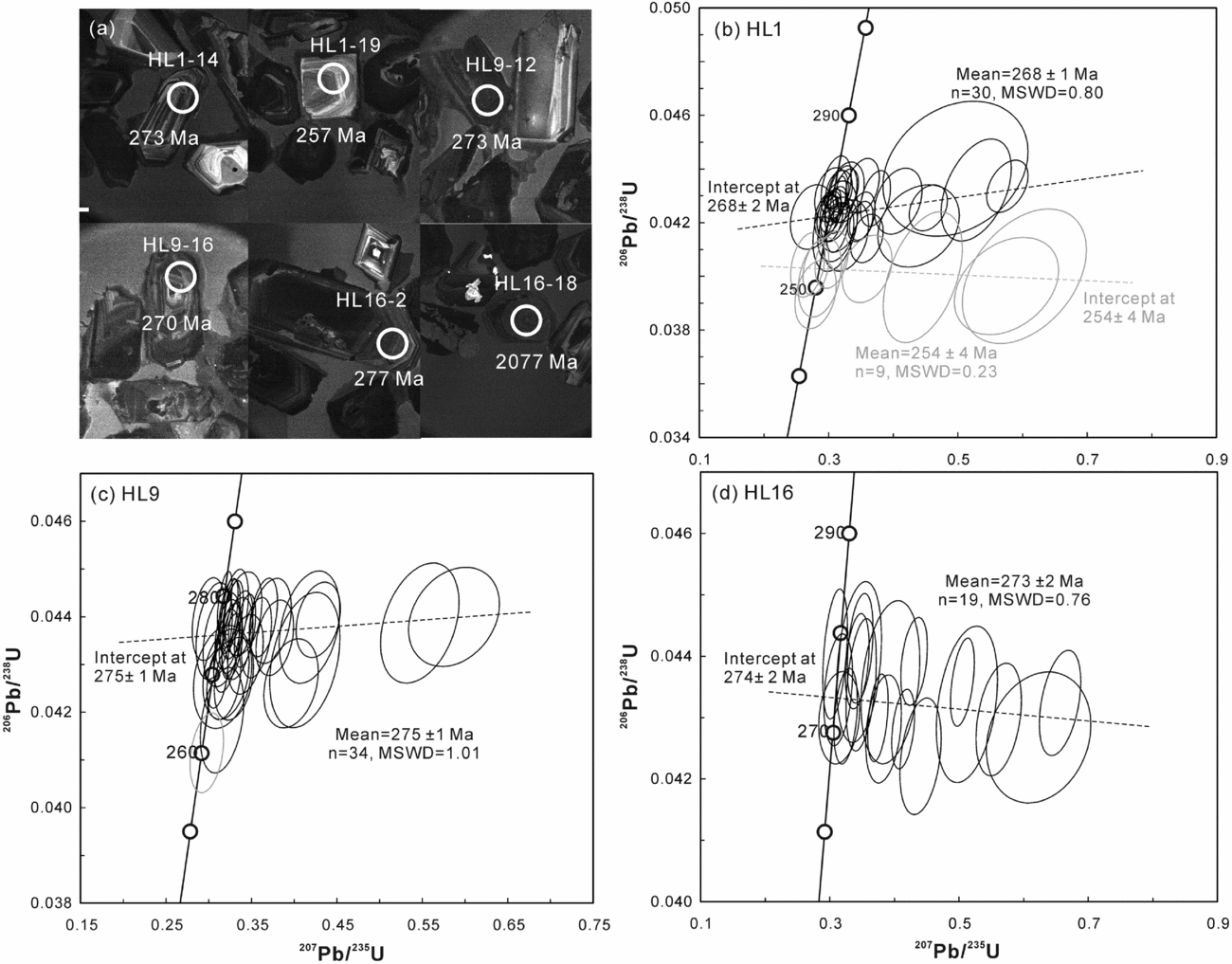
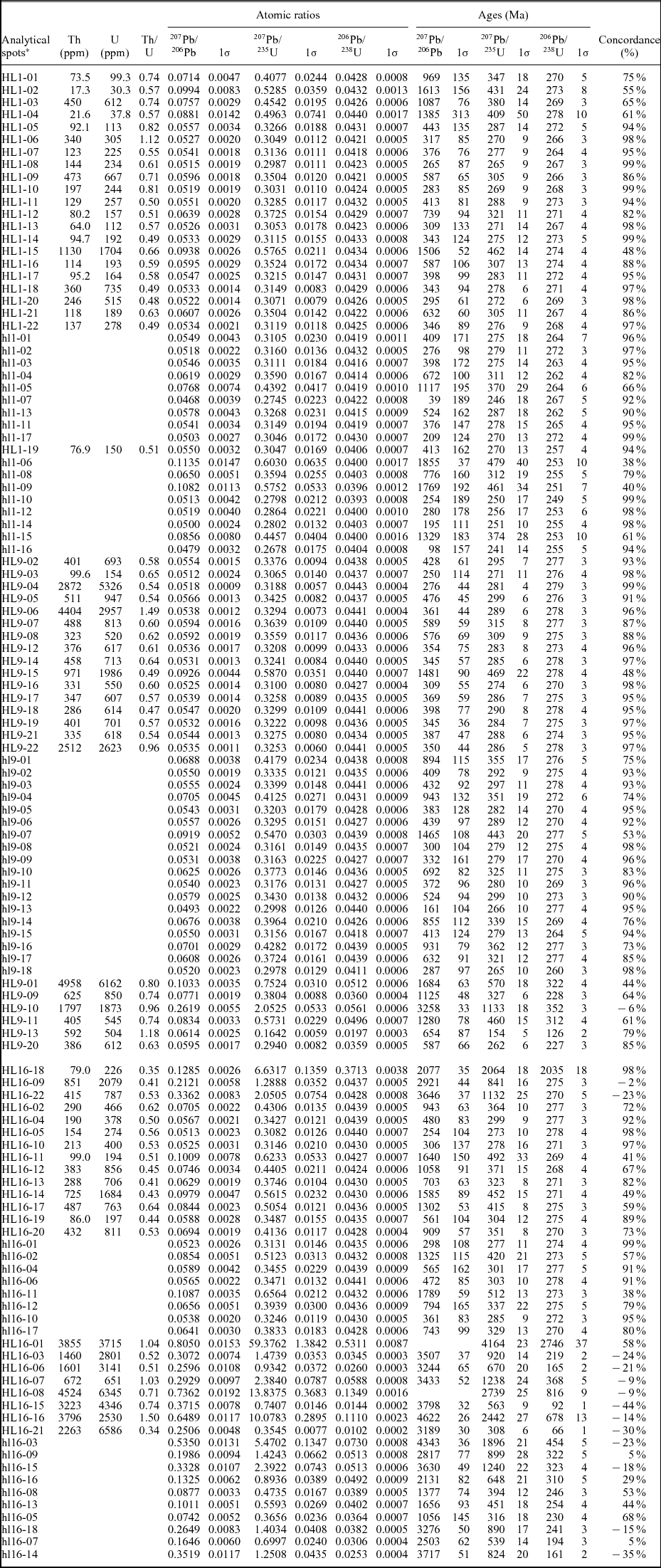
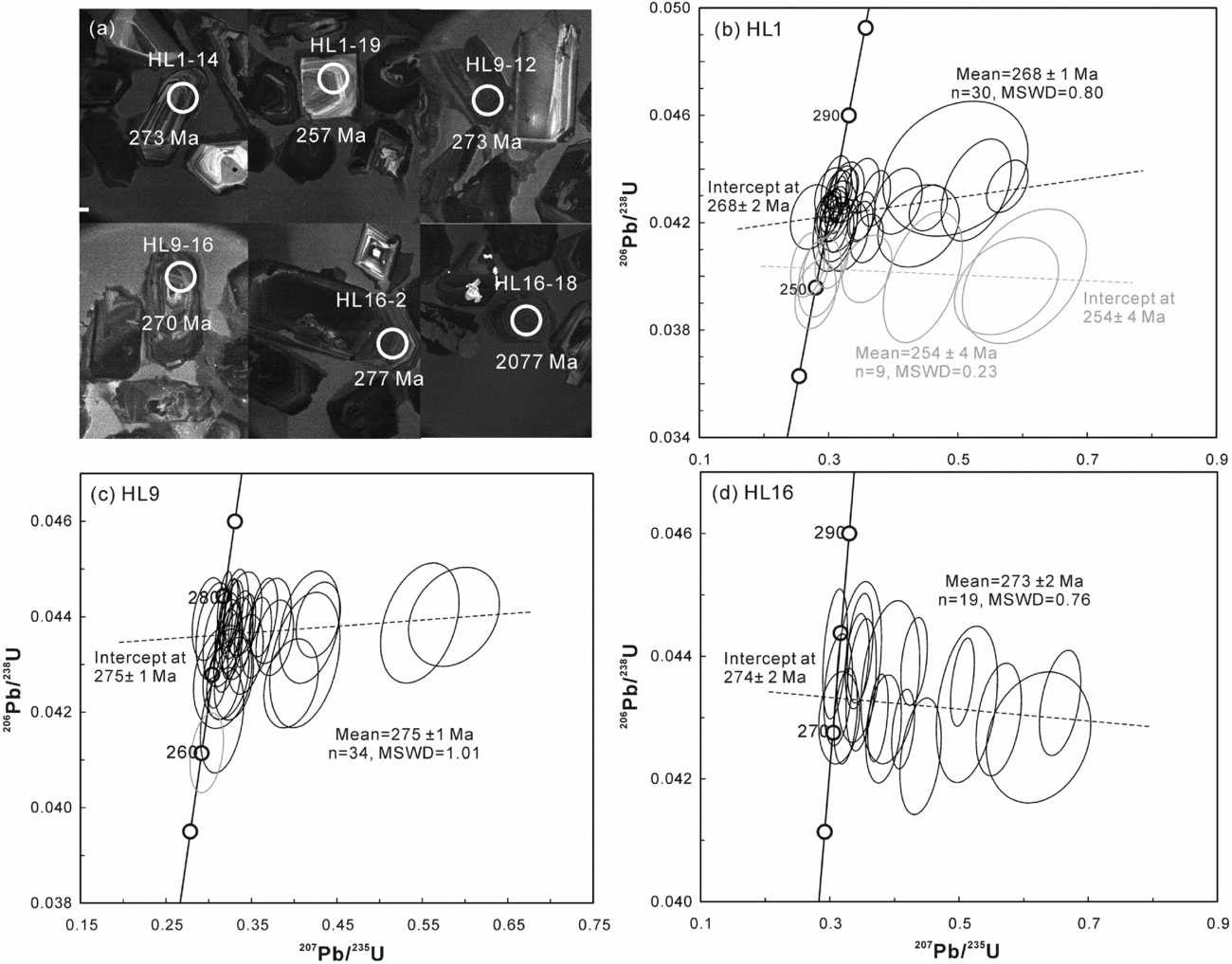
Three samples (HL1, HL9 and HL16) were selected to constrain the emplacement ages of the Halajun ІІ, Kezile and Halajun І plutons, respectively. The zircons from the sample HL1 are prismatic in shape, 100–300 μm long with length/width ratios of 1.5:1 – 3:1. The majority of zircon grains show grey to dark luminescence and clear oscillatory zoning (Fig. 2a); whereas a few zircons reveal bright luminescence and sector zoning or weak oscillatory zoning. All the zircons have variable Th and U concentrations, but high Th/U ratios ranging from 0.48 to 1.12 (Table 1), suggesting their igneous origin. In conventional U–Pb concordia diagrams (Fig. 2b), most zircon grains plot on the concordia or slightly off it. Based on the 206Pb/238U ratios, the zircons can be subdivided into two groups. One group contains 30 grains and has their 206Pb/238U ages ranging from 262 to 278 Ma, yielding a weighted mean 206Pb/238U age of 268±1 Ma (MSWD=0.80) and an intercept age of 268±2 Ma. The remaining nine grains constitute another group, and give a weighted mean 206Pb/238U age of 254±4 Ma (MSWD=0.23), with their 206Pb/238U ages between 249 and 257 Ma.
(a) Representative CL images and (b–d) Zircon U–Pb concordia diagrams for alkali feldspar granites from three different granitic plutons in the Halajun area. The circles in (a) show laser ablation – inductively coupled plasma – mass spectrometry (LA-ICP-MS) analysis spots with corresponding spot numbers and their 206Pb/238U ages (except for one grain HL16-18 with 207Pb/206Pb age).
Zircon U–Pb analytical results for the alkali feldspar granites in the Halajun area, NW Tarim Block.

* The analyses with the ‘hl’ prefix were performed in 2012, and those with the ‘HL’ prefix were added in 2015.
The zircons from the sample HL9 are prismatic in shape, 100–200 μm long. All the zircons show dark luminescence and weak oscillatory zoning, and have high Th/U ratios from 0.47 to 1.49 (Table 1), indicating their igneous origin. Apart from five discordant grains and one relatively young zircon with a 206Pb/238U age of 260 Ma, the remaining zircons form a tight cluster on the concordia. Their 206Pb/238U ages vary from 264 to 279 Ma, and yield the same weighted mean 206Pb/238U age and intercept age of 275±1 Ma (MSWD=1.01) (Fig. 2c).
The zircons from the sample HL16 show similar shape, size and CL images to those from the sample HL9. However, subordinate grains with core–rim structure are discerned. Nearly half of the grains are discordant, and have higher Th and U concentrations than the concordant ones (Table 1). One concordant analysis (HL16-18) on the core has a 207Pb/206Pb age of 2077 Ma (Fig. 2a), interpreted as an inherited zircon. The remaining 19 concordant or slightly discordant grains have their 206Pb/238U ages from 268 to 278 Ma, giving a weighted mean 206Pb/238U age of 273±2 Ma (MSWD=0.76) (Fig. 2d).
4.b. Whole-rock major and trace elements
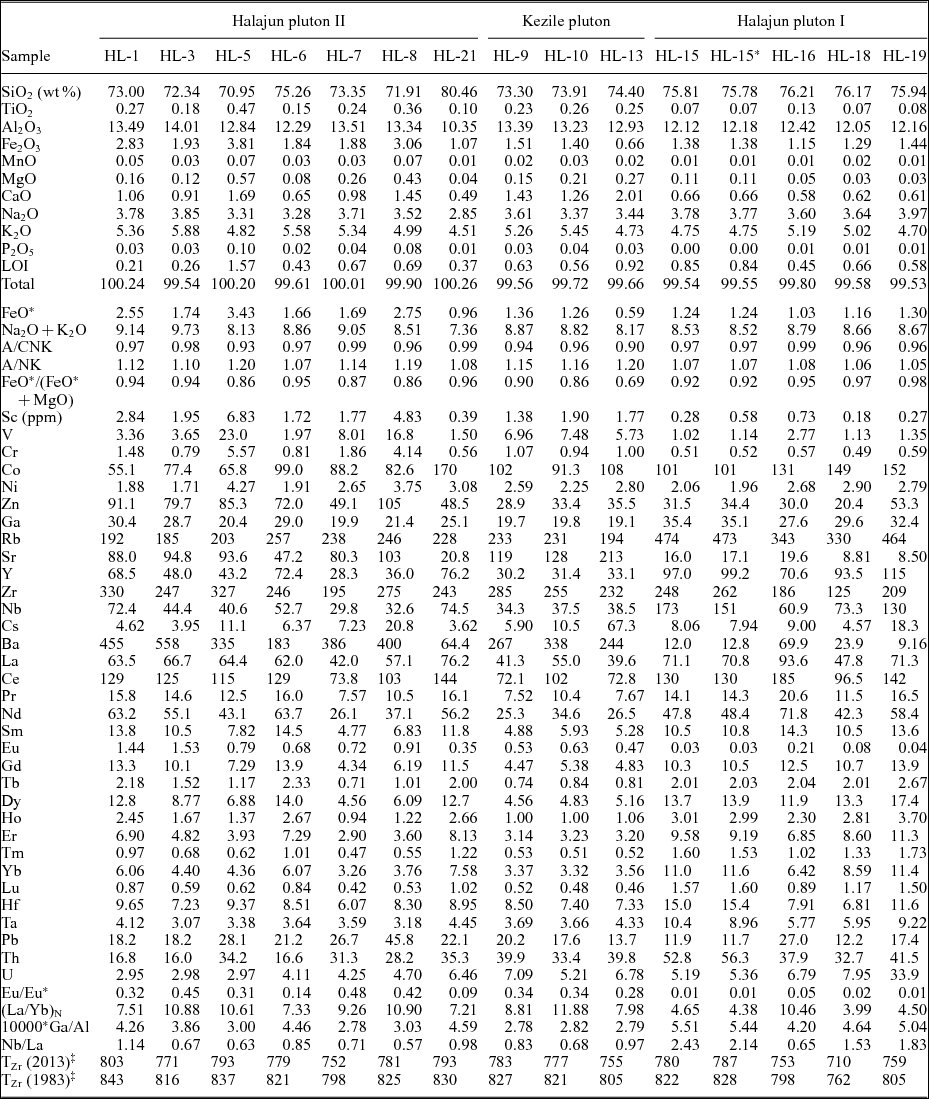
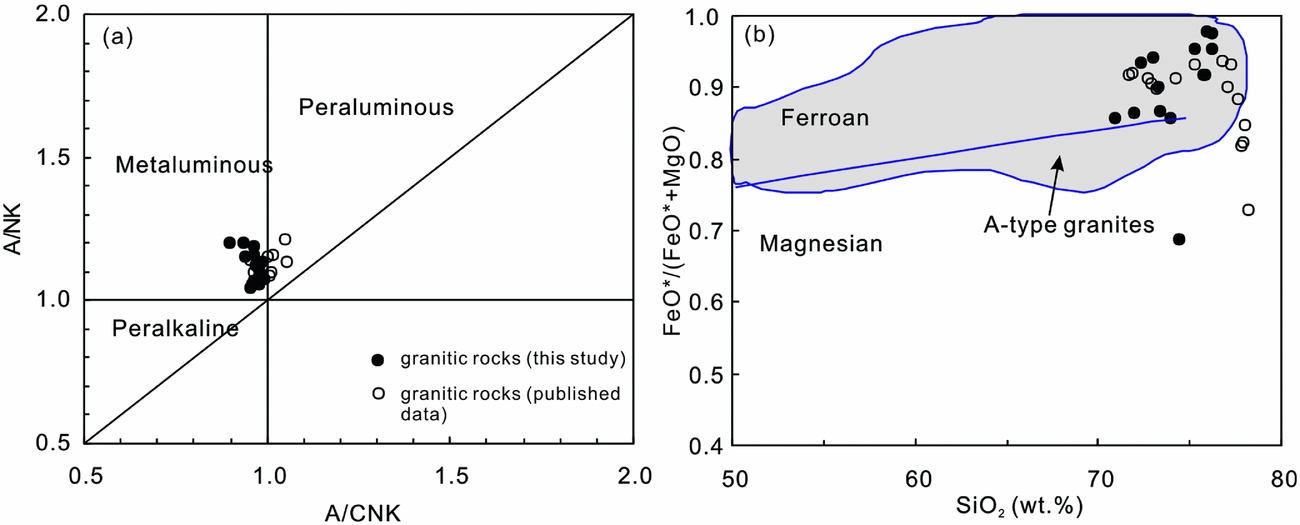
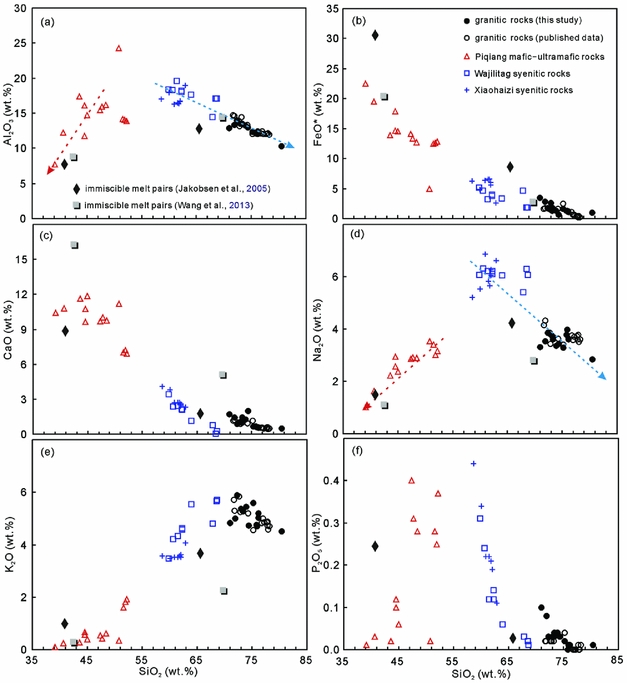
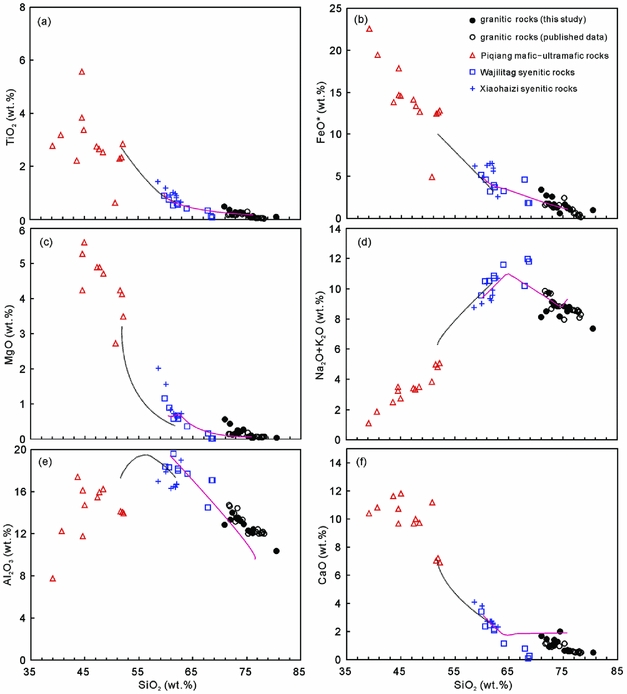
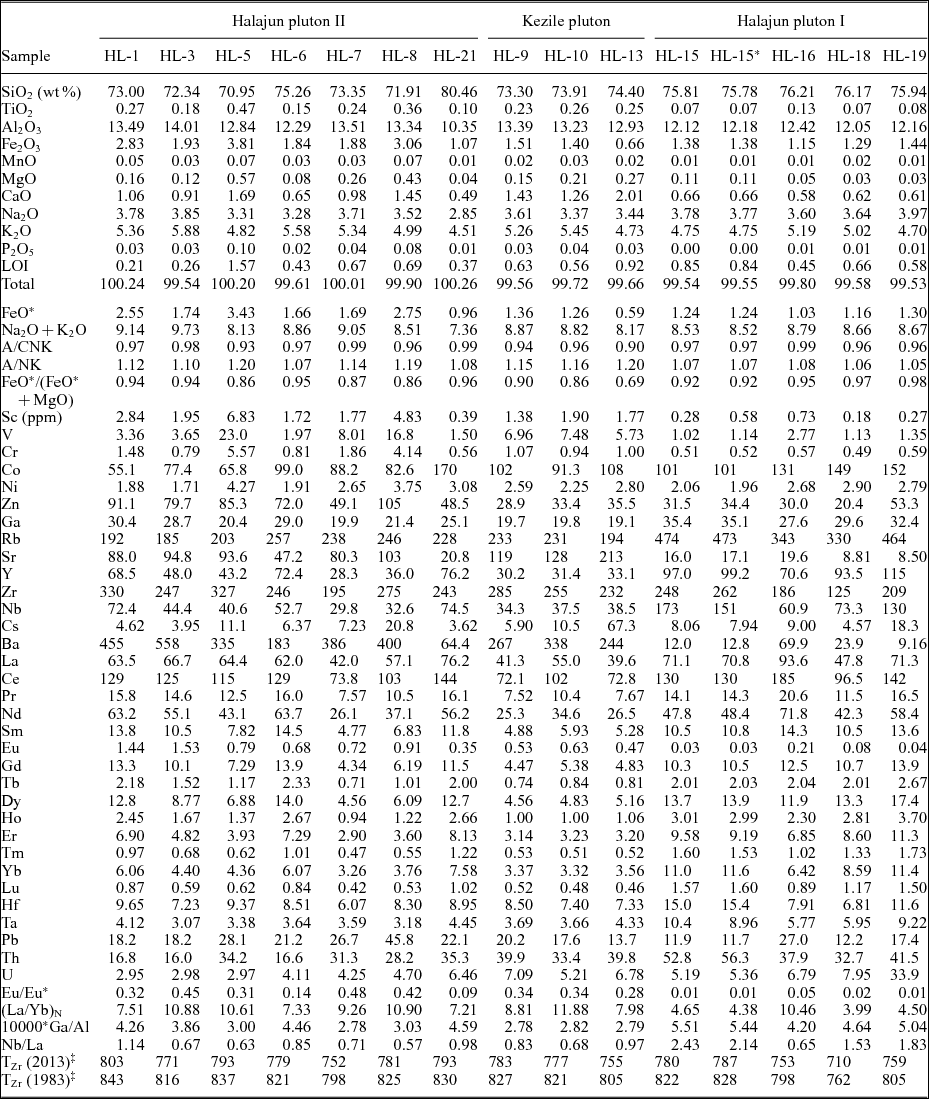
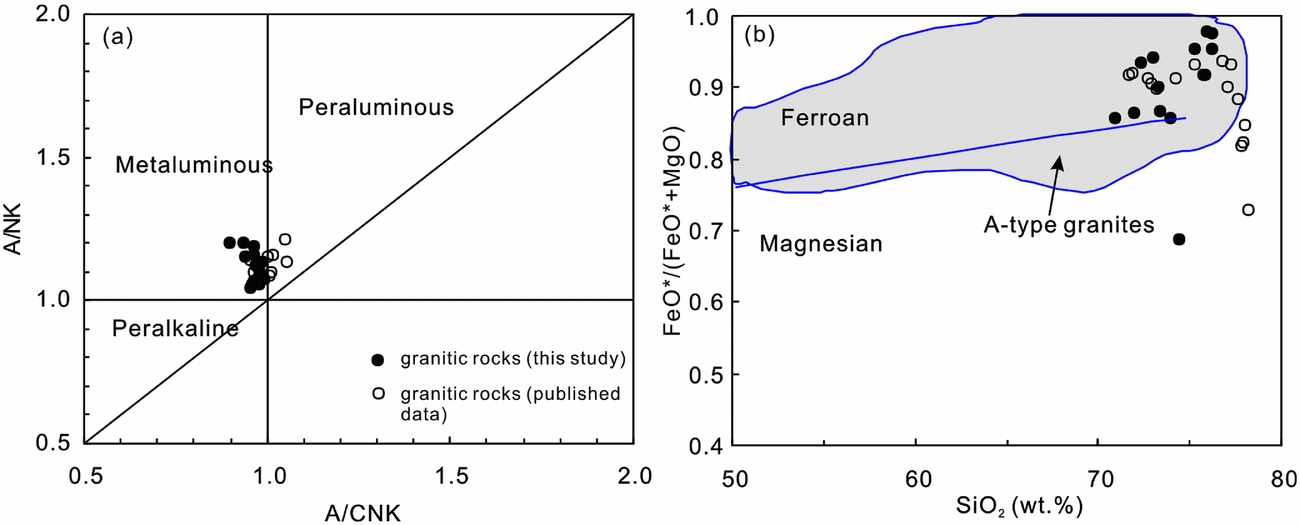
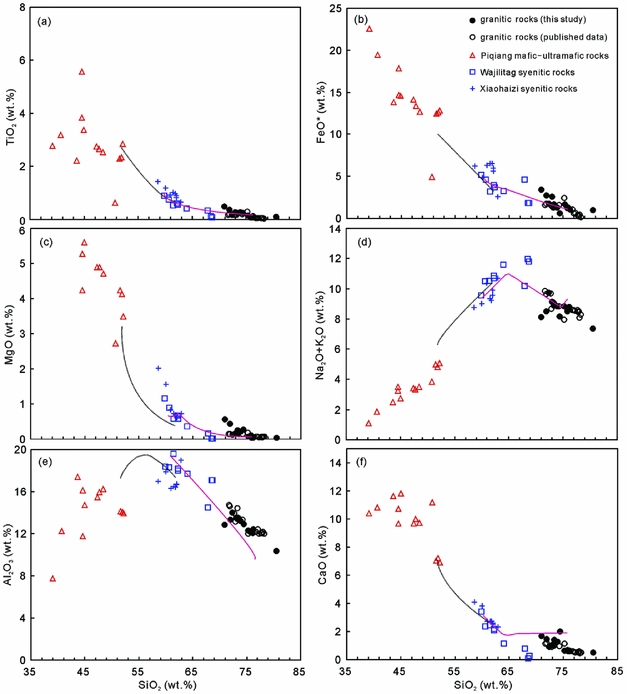
The major- and trace-element compositions for the alkali feldspar granites are given in Table 2. The rocks from all three plutons are described together as they have similar petrological, geochronological and geochemical characteristics. The rocks are highly siliceous, with SiO2 content ranging from 71.0 to 80.5 wt%, and have low abundances of Al2O3 (10.4–14.0 wt%), CaO (0.5–2.0 wt%), MgO (0.0–0.6 wt%), FeO* (0.6–3.4 wt%), and high contents of alkalis with Na2O+K2O=7.4–9.7 wt%. All these characteristics are typical of A-type granites (Whalen, Currie & Chappell, Reference Whalen, Currie and Chappell1987; Eby, Reference Eby1990). In the diagram of A/NK vs. A/CNK (Fig. 3a), the alkali feldspar granites are mainly plotted in the metaluminous field, consistent with their mineralogical features. These rocks have high FeO*/(FeO*+MgO) ratios ranging from 0.69 to 0.98, and fall within the field of ferron A-type granites (Fig. 3b) (Frost et al. Reference Frost, Barnes, Collins, Arculus, Ellis and Frost2001). Our major elements, as well as published data for mafic–ultramafic complexes and dioritic to syenitic rocks in the study area (Zhang et al. Reference Zhang, Li, Li, Ye and Li2008a, Reference Zhang, Xu, Li, Wang and Ye2010b; Wei & Xu, Reference Wei and Xu2011), show complicated geochemical evolution trends. Within increasing SiO2 contents, FeO*, MgO and CaO decrease, whereas Al2O3 and Na2O first show some increase for the mafic–ultramafic rocks and then decrease in a more evolved magma (Fig. 4).
Major- (wt%) and trace-element (ppm) concentrations of the alkali feldspar granites in the Halajun area.
* Duplicate analyses.
† FeO* represents total Fe oxides; LOI: loss on ignition; A/CNK = molar ratio of Al2O3/(CaO+Na2O+K2O), A/NK = molar ratio of Al2O3/(Na2O+K2O).
‡ Zircon saturation temperatures T Zr (1983) and T Zr (2013) are calculated using the method of Watson & Harrison (Reference Watson and Harrison1983) and Boehnke et al. (Reference Boehnke, Watson, Trail, Harrison and Schmitt2013), respectively.
Plots of A/NK versus A/CNK (a), and FeO*/(FeO*+MgO) versus SiO2 (b). The blue line separating ferroan and magnesian rocks and the field for A-type granites in (b) is after Frost et al. (Reference Frost, Barnes, Collins, Arculus, Ellis and Frost2001). Some published data for granitic rocks from Zhang et al. (Reference Zhang, Xu, Li, Wang and Ye2010b) are also shown for comparison.
Plots of selected major elements versus SiO2 for the Piqiang mafic–ultramafic complex and Halajun granites. The Wajilitag and Xiaohaizi syenitic rocks in the western Tarim Block are also shown for comparison. The data points for Piqiang mafic–ultramafic complex are from Zhang et al. (Reference Zhang, Xu, Li, Wang and Ye2010b); Wajilitag syenitic rocks from Zhang et al. (Reference Zhang, Zhang, Tang, Wilde and Hu2008b); Xiaohaizi syenitic rocks from Wei & Xu (Reference Wei and Xu2011); published granitic rocks from Zhang et al. (Reference Zhang, Xu, Li, Wang and Ye2010b). Immiscible melt pairs suggested by melt inclusions in the Skaergaard intrusion (Jakobsen et al. Reference Jakobsen, Veksler, Tegner and Brooks2005) and Panzhihua layer intrusion (Wang et al. Reference Wang, Xing, Ren and Wang2013) are also plotted in Harker diagrams. The Piqiang mafic–ultramafic complex and syenitic to granitic rocks show quite different evolution trends.

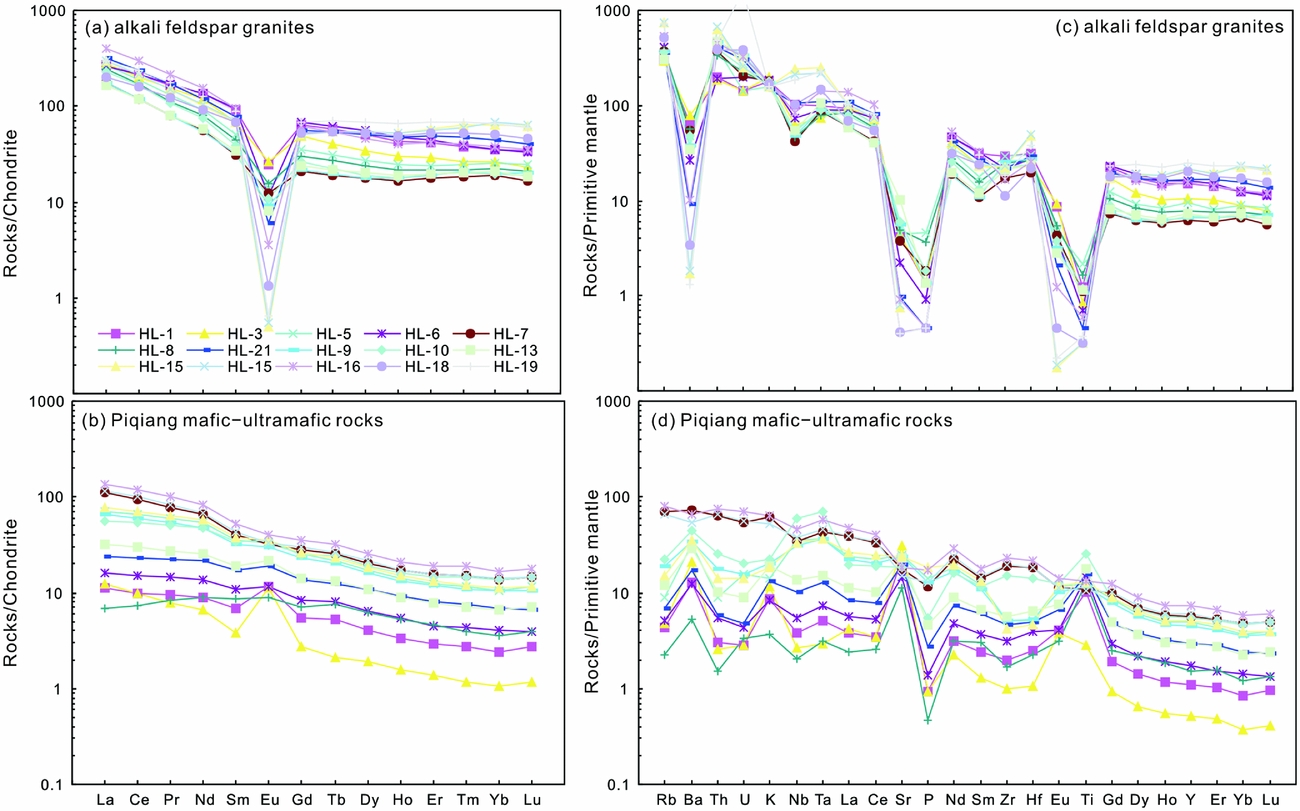
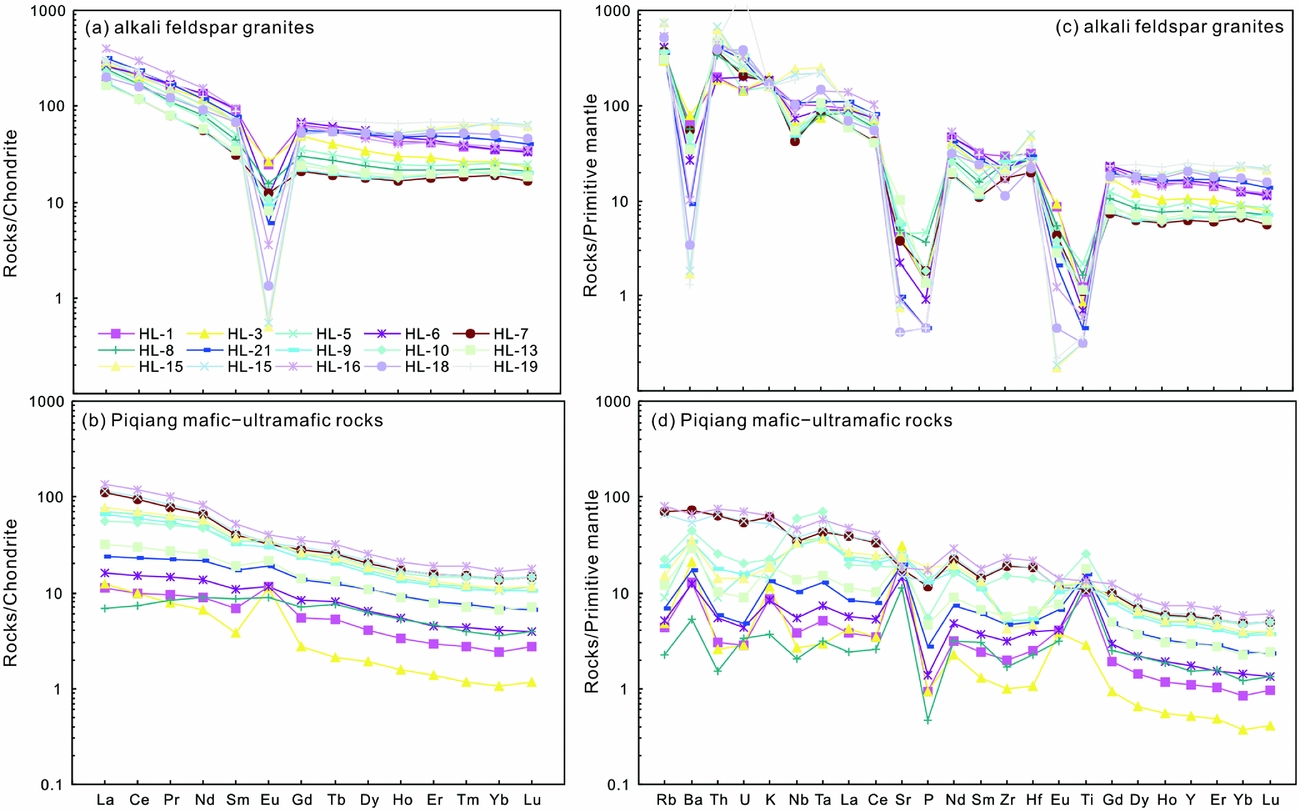
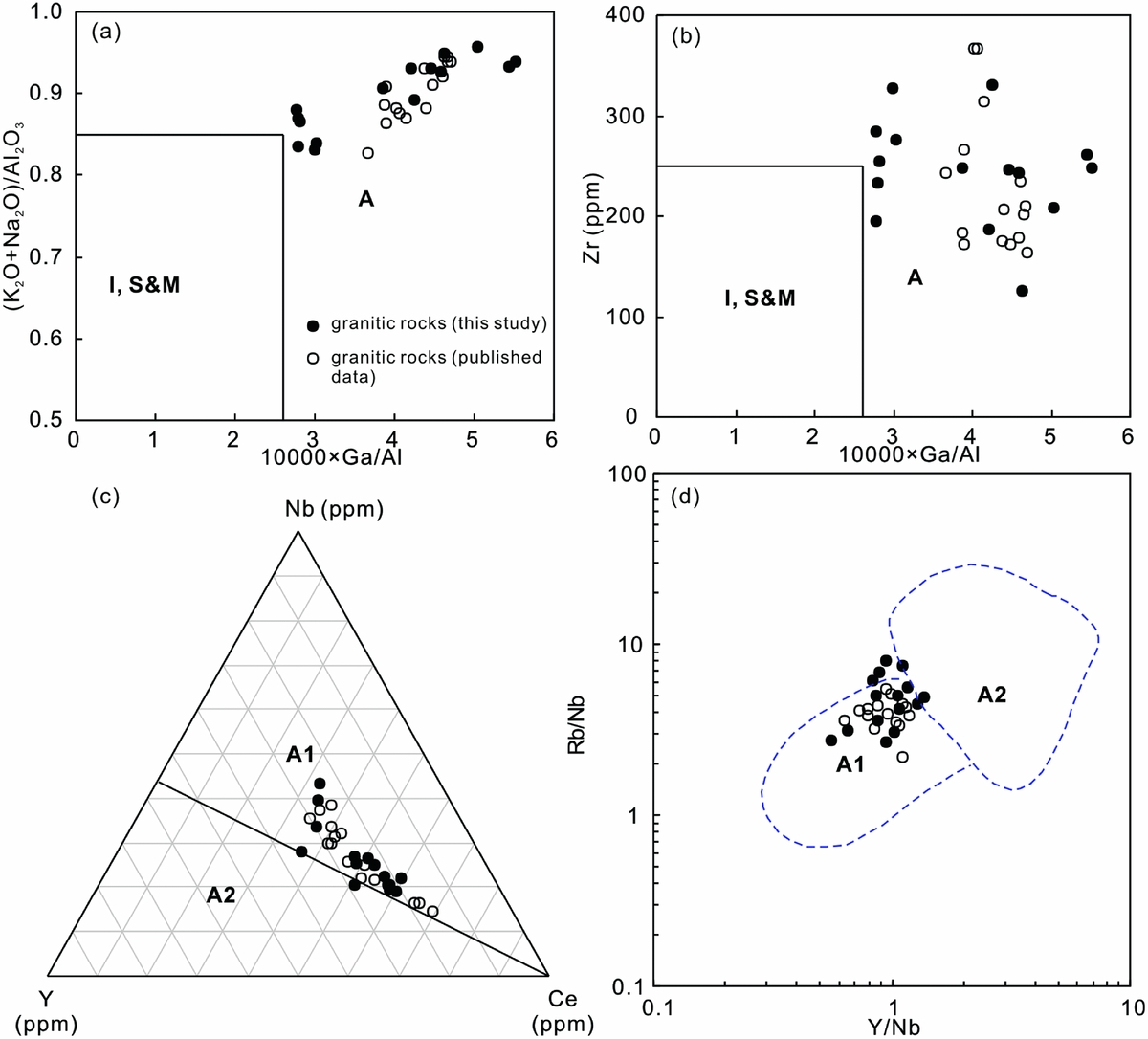
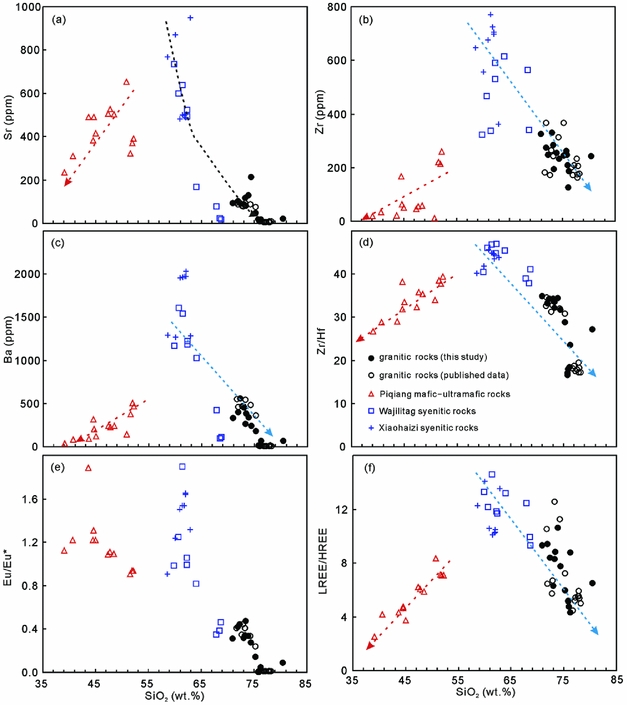
The alkali feldspar granites have high total REE (rare earth element) abundances (169–429 ppm), and display coherent chondrite-normalized REE patterns (Fig. 5a), characterized by moderate enrichment in LREE (light REE) with (La/Yb)N ratios of 3.99–11.9, and significant negative Eu anomalies (Eu/Eu*=0.01–0.48). The primitive-mantle normalized spidergrams (Fig. 5c) show that these rocks are enriched in LILE (large ion lithophile element) (Rb, Th, U, K) and HFSE (high field strength element) (Ta, Zr, Hf), but strongly depleted in Ba, Sr, P, Eu. They have high 10000×Ga/Al ratios ranging from 2.78 to 5.51, which are clearly higher than the average values of 2.1 and 2.28 for I- and S-type granites, respectively (Whalen, Currie & Chappell, Reference Whalen, Currie and Chappell1987). The alkali feldspar granites fall in the A-type granite fields of various discrimination diagrams but more specifically the A1 sub-type (Fig. 6) (Whalen, Currie & Chappell, Reference Whalen, Currie and Chappell1987; Eby, Reference Eby1992). Similar to major elements, some trace elements (Sr, Ba and Zr) and ratios (LREE/HREE and Zr/Hf) show complicated curved evolution trends, characterized by an early increase for the mafic–ultramafic rocks and then decrease in a more evolved magma (Fig. 7).
Chondrite-normalized REE patterns (a, b) and primitive mantle-normalized trace element spider diagrams (c, d) for the granitic rocks in the Halajun area. The Piqiang mafic–ultramafic complex from Zhang et al. (Reference Zhang, Li, Li, Ye and Li2008a) is also shown for comparison. Normalizing data for the chondrite and primitive mantle are from Sun & McDonough (Reference Sun, McDonough, Saunders and Norry1989).
Representative plots for discrimination (a, b, after Whalen, Currie & Chappell, Reference Whalen, Currie and Chappell1987) and subdivision (c, d, from Eby, Reference Eby1992) of A-type granites. Some published data for granitic rocks from Zhang et al. (Reference Zhang, Xu, Li, Wang and Ye2010b) are also shown for comparison.
Plots of selected trace elements versus SiO2 for the Piqiang mafic–ultramafic complex and Halajun granites. The Wajilitag and Xiaohaizi syenitic rocks in the western Tarim Block are also shown for comparison. Data sources are the same as in Figure 4. Similar to the major element, the Piqiang mafic–ultramafic complex and syenitic to granitic rocks show different trace-element evolution trends.
4.c. Zircon Hf isotopic compositions
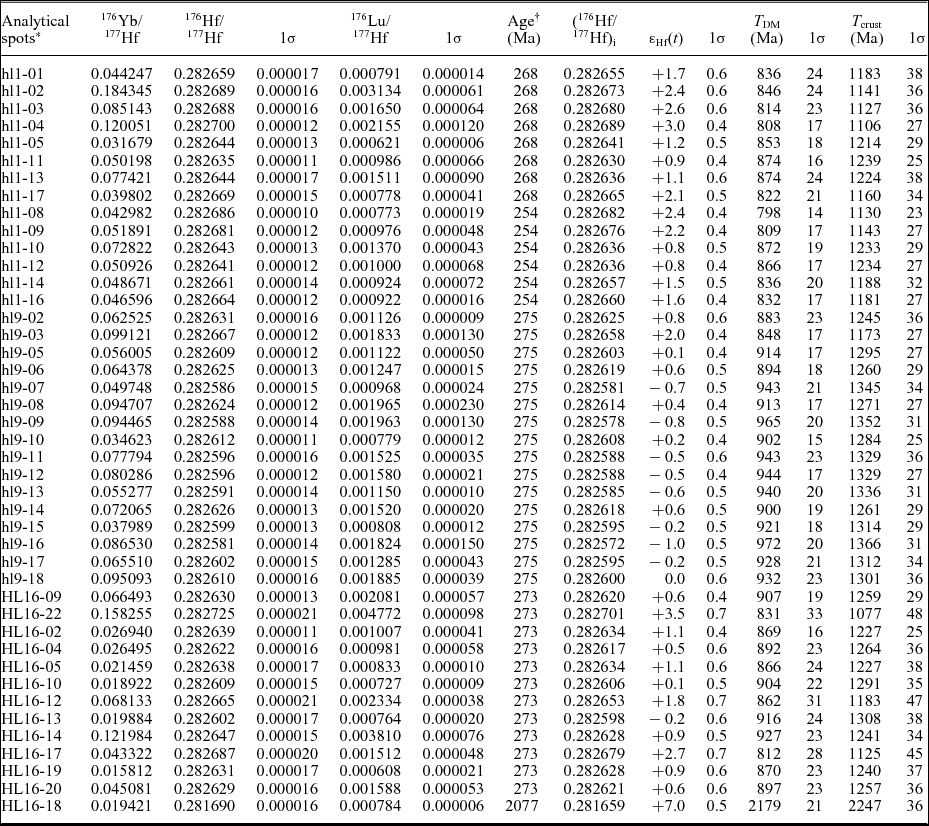
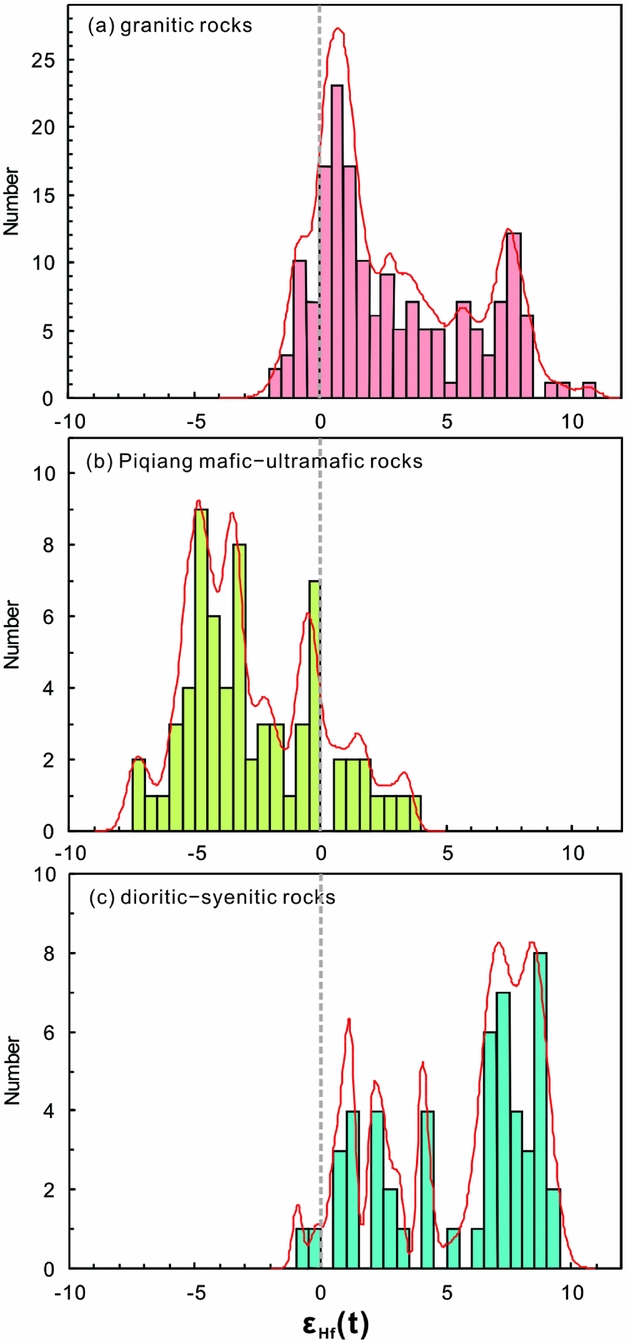
Eight zircons from sample HL1 that have an age of ~268 Ma show constant 176Hf/177Hf ratios from 0.282635 to 0.282700, and have positive ε Hf(t) values between +0.9 and +3.0 (Table 3; Fig. 8a). They possess Neoproterozoic T DM (808–874 Ma) and Mesoproterozoic T crust (1106–1239 Ma) model ages. The relatively young grains with ages of ~254 Ma from this sample show similar Hf isotopic results, with ε Hf(t) values from +0.8 to +2.4. Sixteen zircons with ages of ~275 Ma from the sample HL9 yield uniform 176Hf/177Hf ratios from 0.282581 to 0.282667 and ε Hf(t) values from −1.0 to +2.0. Their Neoproterozoic T DM and Mesoproterozoic T crust model ages vary from 848 to 972 Ma, and 1173 to 1366 Ma, respectively. With respect to the zircons from the sample HL16, the early Permian concordant grains have 176Hf/177Hf ratios from 0.282602 to 0.282725, and ε Hf(t273 Ma) values from −0.2 to +3.5 (Table 3; Fig. 8a). In contrast, one Palaeoproterozoic inherited zircon has a lower 176Hf/177Hf ratio of 0.281690 and a higher ε Hf(t2077 Ma) value of +7.0.
Zircon Hf-isotope results for three alkali feldspar granites in the Halajun area.
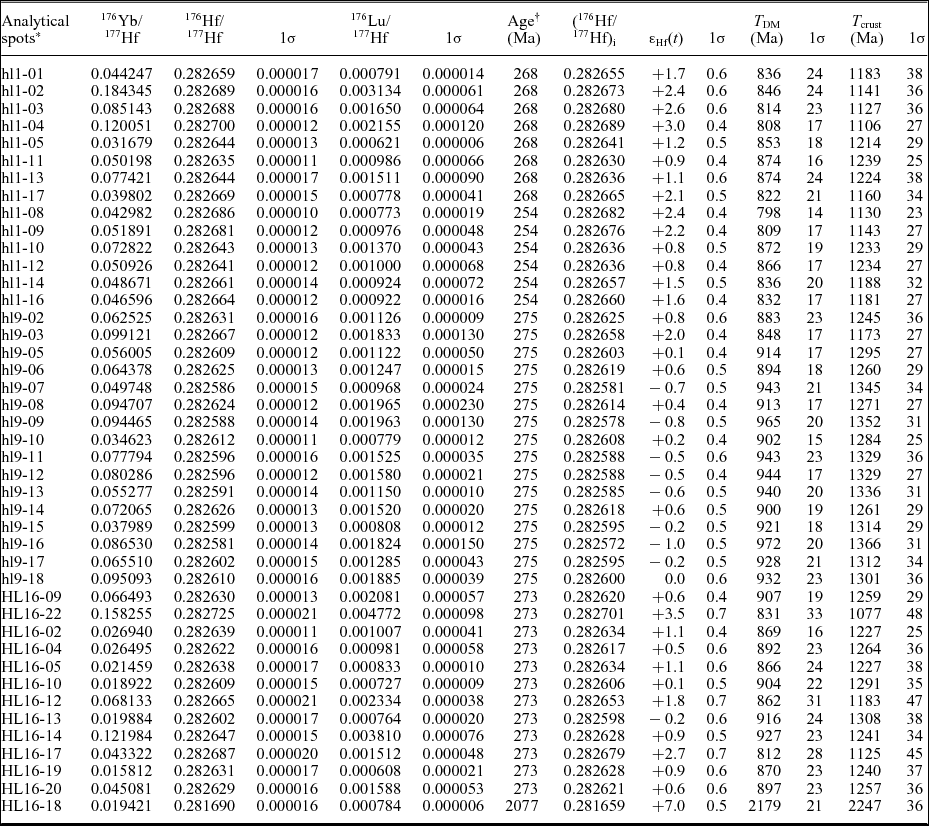
* The analyses with the ‘hl’ prefix were performed in 2012, and those with the ‘HL’ prefix were added in 2015.
† Ages stand for weighted mean 206Pb/238U ages for Permian zircons, and 207Pb/206Pb ages for Precambrian grains.
Histograms of zircon ε Hf(t) values for the Piqiang mafic–ultramafic complex and Halajun granites. Zircon ε Hf(t) values of the Wajilitag dioritic–syenitic rocks are also shown for comparison. The zircon Hf data for Piqiang mafic–ultramafic complex are from Zhang & Zou (Reference Zhang and Zou2013); Wajilitag dioritic–syenitic rocks from Zhang et al. (Reference Zhang, Li, Li, Ye and Li2008a) and Zou et al. (Reference Zou, Li, Song, Ernst, Li, Ren, Yang, Chen, Xu and Song2015); Halajun granites from this study and Zhang & Zou (Reference Zhang and Zou2013).

5. Discussion
5.a. Temporal evolution of Permian Tarim LIP
The zircons from the Halajun intrusion ІІ yield two age groups of 268±1 Ma and 254±4 Ma (Fig. 2b). Both of these age groups are younger than a zircon U–Pb age of 278±3 Ma reported for this intrusion by Zhang et al. (Reference Zhang, Xu, Li, Wang and Ye2010b). However, recalculation of zircon U–Pb data of sample 08KT03 from Zhang et al. (Reference Zhang, Xu, Li, Wang and Ye2010b) yields a weighted mean 206Pb/238U age of 272±4 Ma, not 278±3 Ma. It should be pointed out that zircon U–Pb analyses for each sample in this study were performed twice, and the results at different times are similar to each other. Moreover, both the Halajun plutons ІІІ and ІV show a crystallization age of 269±2 Ma (Zhang & Zou, Reference Zhang and Zou2013), consistent with 268±1 Ma in this study. Thus, we suggest that 268±1 Ma recorded by the majority of zircons represents the emplacement age of the Halajun intrusion ІІ. The geological significance of 254±4 Ma is not clear due to less similar ages reported previously, and possibly records a later thermal event. The zircons from the Kezile and Halajun І intrusions give the mean ages of 275±1 Ma and 273±2 Ma, respectively, both of which are consistent with previous reported zircon U–Pb ages of 272±1 Ma (Zhang & Zou, Reference Zhang and Zou2013) and 273±1 Ma (Huang et al. Reference Huang, Zhang, Kusky, Santosh, Zhang, Zhang, Liu and Zhao2012) for the Kezile pluton, and 278±3 Ma (Zhang et al. Reference Zhang, Xu, Li, Wang and Ye2010b) for the Halajun pluton І within error. Thus, the alkali feldspar granites in the Halajun area were emplaced at 268–275 Ma.
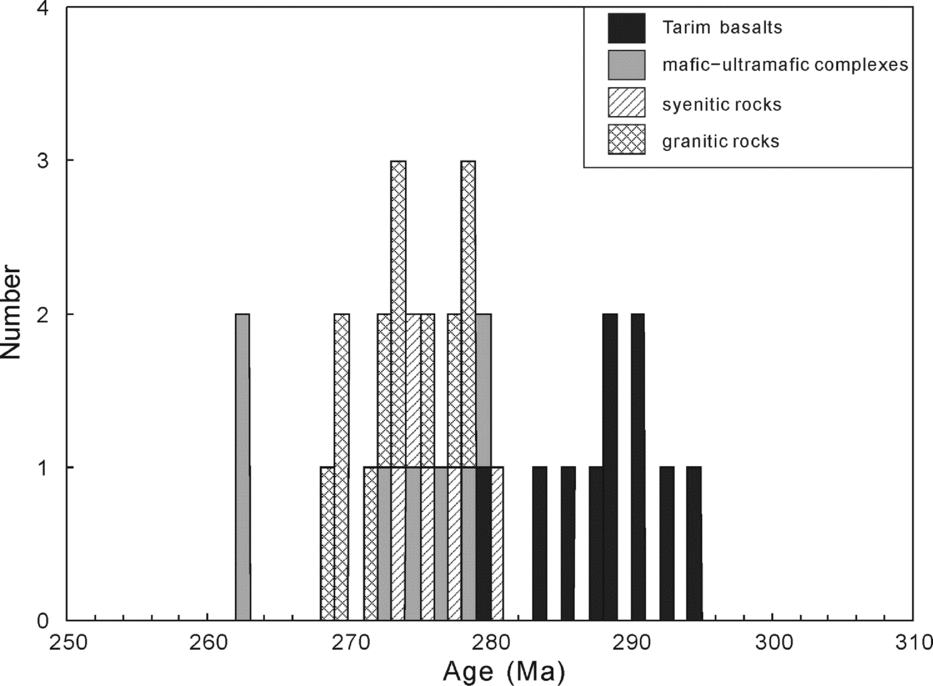
Compilation of reliable ages available in the literatures (Zhang et al. Reference Zhang, Li, Li, Ye and Li2008a, Reference Zhang, Xu, Li, Wang and Ye2010b; Yu et al. Reference Yu, Yang, Chen, Chen, Li, Batt and Li2011b; Zhang & Zou, Reference Zhang and Zou2013; Wei et al. Reference Wei, Xu, Feng and Zhao2014a,Reference Wei, Xu, Zhang, Zhao and Fengb) and this study indicates two main magmatic episodes during the Permian in the Tarim Block (Fig. 9). The flood basalts during the earlier episode (283–295 Ma) represent the major component of the Tarim LIP, and probably cover the entire Tarim Basin (Fig. 1a) as revealed by drilled cores (Li et al. Reference Li, Yang, Chen, Langmuir, Yu, Lin and Li2008; Chen et al. Reference Chen, Tian, Zhang, Pan and Song2010; Zhang, Liu & Guo, Reference Zhang, Liu and Guo2010). The later stage (268–281 Ma) is marked by the mafic–ultramafic complexes, mafic and felsic dyke swarms, syenitic–granitic intrusions and high-Nb–Ta rhyolites, which are just exposed along the margins of the Tarim Block towards the contact with the Tianshan orogenic belt (Yang et al. Reference Yang, Li, Chen, Xiao, Yu, Lin and Shi2006; Li et al. Reference Li, Kong, Qian, Zhang, Zhang, Chen, Cai and You2007; Wei & Xu, Reference Wei and Xu2011; Zou et al. Reference Zou, Li, Song, Ernst, Li, Ren, Yang, Chen, Xu and Song2015). Based on the dyke swarms, crustal uplift and high-temperature magmas, the late episode magmatism is also suggested to relate with the Tarim plume and Tarim LIP (Yang et al. Reference Yang, Chen, Li, Li, Yu, Li and Meng2013; Xu et al. Reference Xu, Wei, Luo, Liu and Cao2014). Moreover, mafic dykes and syenitic–granitic rocks show enriched isotopic features similar to those of the Tarim domain, but quite different from the mantle domain of the Central Asian Orogenic Belt (Zhang et al. Reference Zhang, Li, Li, Xu, Zhou and Ye2010a). Thus, both the early and late episode magmatism can reasonably be considered as integral components of the single Tarim LIP.
Compilation of reliable 40Ar/39Ar and zircon U–Pb ages for diverse magmatic rocks in the Tarim Block. The age data for the Tarim basalts are from Li et al. (Reference Li, Yang, Chen, Langmuir, Yu, Lin and Li2008), Chen et al. (Reference Chen, Tian, Zhang, Pan and Song2010), Zhang, Liu & Guo (Reference Zhang, Liu and Guo2010), Zhang et al. (Reference Zhang, Zhou, Yuan, Fan, Liu and Du2010c), Yu et al. (Reference Yu, Yang, Chen, Chen, Li, Batt and Li2011b) and Wei et al. (Reference Wei, Xu, Feng and Zhao2014a); mafic–ultramafic complexes from Li et al. (Reference Li, Kong, Qian, Zhang, Zhang, Chen, Cai and You2007), Zhang et al. (Reference Zhang, Xu, Li, Wang and Ye2010b), Zhang & Zou (Reference Zhang and Zou2013) and Wei et al. (Reference Wei, Xu, Zhang, Zhao and Feng2014b); syenitic rocks from Yang et al. (Reference Yang, Li, Chen, Xiao, Yu, Lin and Shi2006), Zhang et al. (Reference Zhang, Li, Li, Ye and Li2008a), Chen et al. (Reference Chen, Tian, Zhang, Pan and Song2010), Wei & Xu (Reference Wei and Xu2011) and Zou et al. (Reference Zou, Li, Song, Ernst, Li, Ren, Yang, Chen, Xu and Song2015); and granitic rocks from Zhang et al. (Reference Zhang, Xu, Li, Wang and Ye2010b), Huang et al. (Reference Huang, Zhang, Kusky, Santosh, Zhang, Zhang, Liu and Zhao2012), Zhang & Zou (Reference Zhang and Zou2013) and this study.

5.b. Petrogenesis of Halajun A1-type granites
The mineral assemblages and geochemical features indicate that the Halajun alkali feldspar granites are typical A-type granites. These A-type granitic rocks are spatially and temporally related to the Piqiang layered mafic–ultramafic complex. Several petrogenetic models for the A-type granites have been proposed, mainly including: (1) extensive fractional crystallization from mantle-derived mafic magmas (Turner, Foden & Morrison, Reference Turner, Foden and Morrison1992; Han et al. Reference Han, Wang, Jahn, Hong, Kagami and Sun1997; Chen & Arakawa, Reference Chen and Arakawa2005); (2) interaction of mantle-derived magmas and overlying crustal rocks (Kerr & Fryer, Reference Kerr and Fryer1993; Griffin et al. Reference Griffin, Wang, Jackson, Pearson, O'Reilly, Xu and Zhou2002); (3) liquid immiscibility (Jakobsen et al. Reference Jakobsen, Veksler, Tegner and Brooks2005; Zhou et al. Reference Zhou, Robinson, Lesher, Keays, Zhang and Malpas2005, Reference Zhou, Chen, Wang, Prevec, Liu and Howarth2013; VanTongeren & Mathez, Reference Van Tongeren and Mathez2012); and (4) anatexis of different middle or lower crustal source rocks (Collins et al. Reference Collins, Beams, White and Chappell1982; Creaser, Price & Wormald, Reference Creaser, Price and Wormald1991; Huang et al. Reference Huang, Zhang, Kusky, Santosh, Zhang, Zhang, Liu and Zhao2012). In the following, the possibility of each model will be assessed on the basis of available geological, geochronological and geochemical results.
5.b.1. Extreme fractionation of mafic magma
The A-type granites were apparently emplaced later than the Tarim basalts (Fig. 9), and show quite different whole-rock ε Nd(t) and ε Hf(t) and zircon ε Hf(t) values from the basalts (Zhang et al. Reference Zhang, Xu, Li, Wang and Ye2010b; Li et al. Reference Li, Li, Chen, Santosh, Yang, Xu, Langmuir, Chen, Yu and Zou2012c, Reference Li, Li, Yu, Langmuir, Santosh, Yang, Chen, Tang, Song and Zou2014), possibly suggesting distinct sources for the Tarim basalts and Halajun granites. However, these A-type granites are spatially and temporally related to the mafic–ultramafic complex, implying that the Halajun A-type granites may be derived from extreme fractionation of mantle-derived mafic magma. Nevertheless, there is an obvious ‘Daly gap’ between the Piqiang mafic rocks and Halajun granites. The compositional gap also exists when the Xiaohaizi and Wajilitag syenitic rocks were plotted in the Harker diagrams (Figs 4, 7). If extensive fractionation of mafic magmas took place, large volumes of gabbroic and dioritic rocks might be expected, which is not the case in the western Tarim Block. Although the Daly gap may result from massive oxide crystallization (Shellnutt, Zhou & Zellmer, Reference Shellnutt, Zhou and Zellmer2009) and intermediate rock unsampling, the extensive fractionation of mafic magmas cannot be considered as a principal process responsible for the formation of Halajun granitic rocks, as the mafic and granitic rocks show quite different zircon Hf features (Fig. 8). The zircon ε Hf(t) values for the syenitic and granitic rocks in the western Tarim Block are dominantly positive, whereas those for the Piqiang mafic–ultramafic rocks are mainly negative (Zhang & Zhou, Reference Zhang and Zou2013), reflecting different source rocks for the Piqiang mafic–ultramafic rocks and Halajun granites. Moreover, the following geochemical features also argue against the model of extensive fractionation of mafic magma: (1) Based on similar trace element ratios, the Baima and Taihe gabbroic and syenitic‒granitic units in the Emeishan large igneous province were suggested to be derived from the same parental magmas (Shellnutt, Zhou & Zellmer, Reference Shellnutt, Zhou and Zellmer2009; Shellnutt, Jahn & Dostal, Reference Shellnutt, Jahn and Dostal2010; Shellnutt et al. Reference Shellnutt, Wang, Zellmer, Iizuka, Jahn, Pang, Qi and Zhou2011). The syenitic and granitic rocks have different trace element ratios (such as Nb/U, Rb/La, Zr/Hf) from the Piqiang mafic–ultramafic rocks; (2) With increasing SiO2 contents, some major and trace elements and their ratios show different evolution trends for the Piqiang mafic–ultramafic rocks and Halajun A-type granites (Figs 4, 7); which cannot be explained by the fractionation process.
5.b.2. Magma mixing
Magma mixing between mantle-derived mafic magmas and more felsic crustal melts has been proposed to be an effective way to produce the granitoids (Griffin et al. Reference Griffin, Wang, Jackson, Pearson, O'Reilly, Xu and Zhou2002; Yang et al. Reference Yang, Wu, Wilde, Xie, Yang and Liu2007a). The granitic rocks of this origin have notable isotopic features which vary in a wide range (Griffin et al. Reference Griffin, Wang, Jackson, Pearson, O'Reilly, Xu and Zhou2002). The ε Nd(t) (Zhang et al. Reference Zhang, Xu, Li, Wang and Ye2010b) and zircon ε Hf(t) values of each sample and each pluton in this study display a narrow range of variation. The interaction of mantle-derived magmas and felsic crustal melts will inevitably lower the SiO2 content of original felsic melts, and thus cannot explain the highly siliceous nature of the Halajun A-type granites. Moreover, some major and trace elements show typical curved evolution trends (Figs 4, 7), which contradict the predicted trends of magma mixing (Chen & Arakawa, Reference Chen and Arakawa2005). In addition, field and petrological evidence such as mafic microgranular enclaves and acicular apatites implying magma mixing is not found in the granitic rocks. Thus, magma mixing may not be the major process for the generation of the Halajun A-type granites.
5.b.3. Silicate liquid immiscibility
The model of silicate liquid immiscibility has been suggested to explain the spatial and temporal association of mafic and felsic plutons within the LIP (Zhou et al. Reference Zhou, Chen, Wang, Prevec, Liu and Howarth2013, Reference Zhou, Robinson, Lesher, Keays, Zhang and Malpas2005; Liu et al. Reference Liu, Zhou, Ren, Wang and Wang2016). The mafic and felsic rocks formed by this model usually constitute a layered complex, and show similar isotopic features but reciprocal trace-element patterns. Although many trace elements such as Rb, Ba, Sr, Eu and Th in the spidergrams exhibit reciprocal patterns between the mafic–ultramafic rocks and A-type granites in this study (Fig. 5c, d), the Halajun granitic intrusions were emplaced separately at least 15 km from the Piqiang complex, and show quite different zircon Hf isotopes from the Piqiang mafic rocks (Fig. 8). Based on coexisting melt inclusions hosted by apatite and plagioclase (Philpotts, Reference Philpotts1982; Jakobsen et al. Reference Jakobsen, Veksler, Tegner and Brooks2005; Charlier et al. Reference Charlier, Namur, Toplis, Schiano, Cluzel, Higgins and Auwera2011), the average compositions of immiscible melt pairs were investigated. However, the syenitic‒granitic rocks and mafic‒ultramafic layered intrusions in the western Tarim Block show great compositional differences from the two immiscible melts reported by Jakobsen et al. (Reference Jakobsen, Veksler, Tegner and Brooks2005) and Wang et al. (Reference Wang, Xing, Ren and Wang2013) (Fig. 4). Thus, the model of liquid immiscibility may not play a significant role in the generation of the Halajun granites and Piqiang mafic–ultramafic complex.
5.b.4. Partial melting of crustal rocks
One concordant analysis (HL16-18) on the zircon core has a 207Pb/206Pb age of 2077 Ma. Such inherited zircons with Palaeoproterozoic ages are reported from the basalts and mafic dykes (Zhang et al. Reference Zhang, Zhou, Yuan, Fan, Liu and Du2010c, Reference Zhang, Zhou, Yuan, Jowitt, Fan and Liu2012; Wei & Xu, Reference Wei and Xu2013). Based on the zircon U–Pb ages of granulite xenoliths in the northwestern Tianshan neighbouring the study area, Zheng et al. (Reference Zheng, Griffin, O'Reilly, Zhang, Liou and Pearson2006) advocated that the lower crust contained components ≥2.5 Ga, and probably >3.4 Ga in age. These results lead us to infer that the lower crust is possibly dominated by Neoarchean–Palaeoproterozoic rocks. Partial melting of such ancient crustal rocks during the Permian period will generally generate felsic intrusions with much negative ε Nd(t) and zircon ε Hf(t) values, which is predicted by the Nd and zircon Hf isotopic evolution trends for the Neoarchean–Palaeoproterozoic crust in the Tarim Block (Hu et al. Reference Hu, Jahn, Zhang, Chen and Zhang2000). However, the alkali feldspar granites in the Halajun area have high ε Nd(t) (−2.9 to +1.9; Zhang et al. Reference Zhang, Xu, Li, Wang and Ye2010b; Huang et al. Reference Huang, Zhang, Kusky, Santosh, Zhang, Zhang, Liu and Zhao2012; Zhang & Zou, Reference Zhang and Zou2013) and zircon ε Hf(t) values from −1.0 to +3.5, which is in conflict with the model of partial melting of ancient crust. Although some zircons from the Halajun A-type granites show Neoproterozoic to Mesoproterozoic Hf model ages (Table 3; Fig. 8a), the Neoproterozoic basement cannot be considered as the source rock of the Halajun granites, since the Neoproterozoic granitoids in the Tarim Block have very negative ε Nd(t) values in the range −6.1 to −14.6 (Cao et al. Reference Cao, Lü, Liu, Zhang, Gao, Chen and Mo2011). Partial melting of young lithospheric mantle can also not explain the relatively low Mg# values (<0.40) and enrichment of Zr and Hf (Fig. 5) of the Halajun granites, as felsic rocks derived from the lithospheric mantle show depletion of HFSE and high Mg# values (>0.40) (Rapp & Watson, Reference Rapp and Watson1995; Chen & Arakawa, Reference Chen and Arakawa2005).
Taking into consideration high ε Nd(t) (Zhang et al. Reference Zhang, Xu, Li, Wang and Ye2010b; Huang et al. Reference Huang, Zhang, Kusky, Santosh, Zhang, Zhang, Liu and Zhao2012) and zircon ε Hf(t) values of the Halajun granites, newly underplated rocks at the crust–mantle interface triggered by the Tarim mantle plume are suggested to be the reasonable source rock for the Halajun granites. As this source rock was derived from relatively depleted mantle shortly before partial melting, the magmas stemmed from them maintain depleted mantle-like isotopic features.
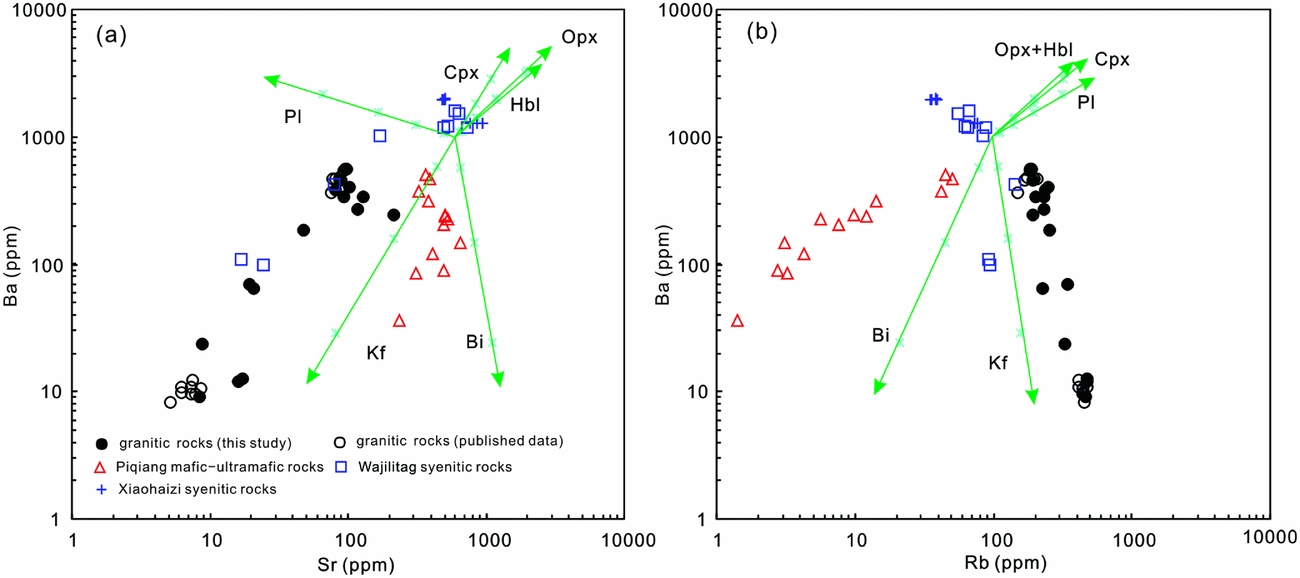
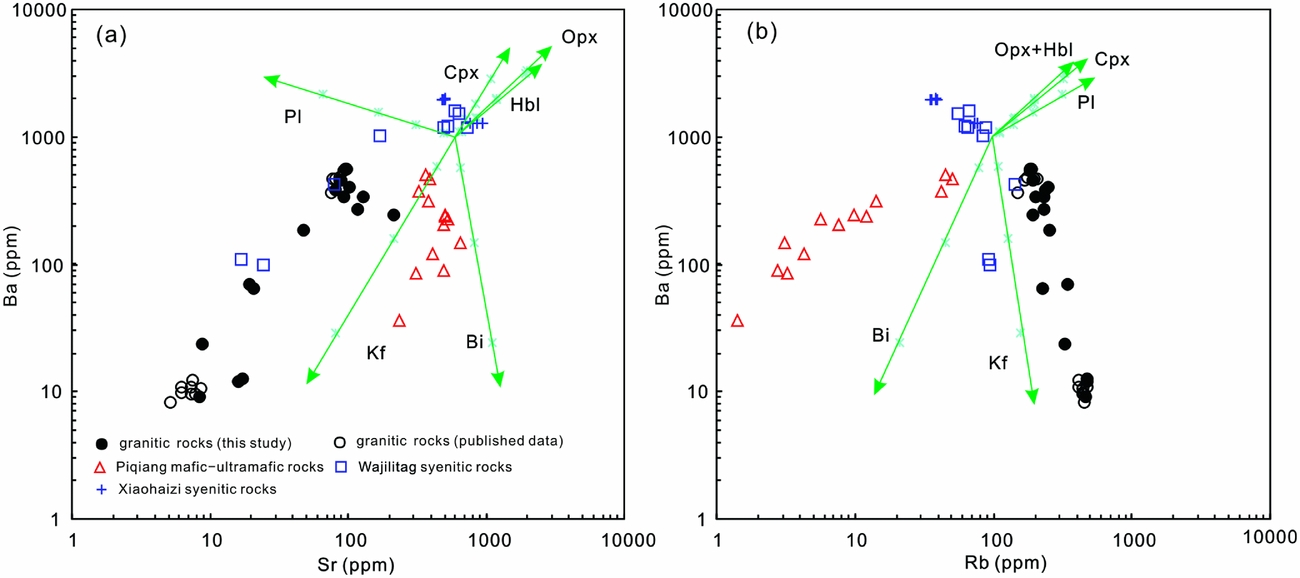
As well as the process of partial melting, crystal fractionation has also played an important role in the generation of Halajun A1-type granites. From syenitic rocks to A-type granitic rocks, CaO, FeO*, MgO, Cr and Ni contents all decrease with increasing SiO2 contents (Figs 4, 7), reflecting the fractionation of ferromagnesian minerals such as hornblende, pyroxene and biotite. Negative correlation between TiO2 and SiO2, and relatively high Nb and Ta concentrations and notable negative Ti anomalies for the A-type granites (Fig. 5c, d) suggest the crystallization of ilmenite and little influence of rutile or titanite (Xiong, Adam & Green, Reference Xiong, Adam and Green2005; Su et al. Reference Su, Zheng, Griffin, Zhao, O′Reilly, Tang, Ping and Xiong2013). As the main Ti-enriched minerals, rutile and titanite usually have higher partition coefficients for Nb and Ta than ilmenite (Xiong, Adam & Green, Reference Xiong, Adam and Green2005; Bédard, Reference Bédard2006). The A-type granites show more significant negative Eu, Sr, Ba and P anomalies in the spider diagrams and REE patterns (Fig. 5), which indicates the minerals of plagioclase, K-feldspar and apatite were also separated during the magmatic evolution. The variations of Ba, Sr and Rb from syenitic rocks to alkali feldspar granites are in good agreement with the K-feldspar fractionation (Fig. 10). In addition, the occurrence of inherited zircons and minor variations of ε Nd(t) values (Zhang & Zou, Reference Zhang and Zou2013) indicate crustal contamination was possibly involved in the generation of alkali feldspar granites. If the mafic dyke sample was supposed to represent the newly underplated rock with ε Nd(t) value of +0.6 and Nd concentration of 4.19 ppm (Zhang et al. Reference Zhang, Xu, Li, Wang and Ye2010b), and a hybrid crustal contaminant was assumed to have an ε Nd(t) value of −26.6 and Nd concentration of 48.7 ppm (Hu et al. Reference Hu, Jahn, Zhang, Chen and Zhang2000), trace element modelling suggests ~5% crustal contamination can well explain the Nd isotopic variations of alkali feldspar granites. Therefore, the alkali feldspar granites were generated by partial melting of newly underplated rocks, followed by extensive fractionation via removal of ferromagnesian minerals and K-feldspar, and minor crustal assimilation.
Plots of Ba versus Sr (a) and Ba versus Rb (b) for the ultramafic–granitic rocks in the Halajun area, showing the accumulation of pyroxene and hornblende during the evolution of mafic–ultramafic rocks, and the K-feldspar fractionation from syenitic rocks to alkali feldspar granites. Fractionation trends are calculated for Rayleigh fractionation of clinopyroxene (Cpx), orthopyroxene (Opx), hornblende (Hbl), plagioclase (Pl), biotite (Bi) and K-feldspar (Kf). Tick marks represent 10%, 30%, 50%, 70% fractional crystallization from the melt. Data sources are the same as in Figure 4.
5.b.5. Rhyolite-MELTS modelling
Partial melting of newly underplated rocks and then crystal fractionation of intermediate magmas are tested using Rhyolite-MELTS (Gualda et al. Reference Gualda, Ghiorso, Lemons and Carley2012), as both processes control the compositional evolution of Halajun granites. The mafic dyke sample 08KT18-1 (Zhang et al. Reference Zhang, Xu, Li, Wang and Ye2010b) was assumed to represent the newly underplated rock. The partial melting modelling is conducted under conditions of fO2=FMQ-1, starting temperature of 1200°C, H2O=1.50 wt%, and pressure of 8 kbar. The intermediate magma produced by the modelled melting at 1010°C is taken as the starting composition for the fractionation modelling, assuming fO2FMQ-1, starting temperature of 1050°C, H2O=3.00 wt%, and pressure of 600 bar.
Figure 11 compares the modelled results with the compositions of syenitic‒granitic rocks in the NW Tarim Block. For most major elements, the syenitic‒granitic rocks fall along the model trend lines, and thus can be reasonably explained by partial melting of newly underplated rocks and subsequent fractional crystallization. The Rhyolite-MELTS modelling predicts higher CaO and P2O5 contents than the syenitic‒granitic rocks. This problem is likely due to the crystallization of accessory minerals such as apatite, titanite, fluorite and Ce-monazite (Shellnutt et al. Reference Shellnutt, Wang, Zellmer, Iizuka, Jahn, Pang, Qi and Zhou2011), as Rhyolite-MELTS cannot model the fractionation of some accessory minerals.
The major-element comparison between the Rhyolite-MELTS modelled results and syenitic to granitic rocks in the NW Tarim Block. Data sources are the same as in Figure 4. The dark dotted lines show the melt evolution trends for partial melt modelling, and the pink lines for the crystallization modelling.
5.c. Tectonic implications
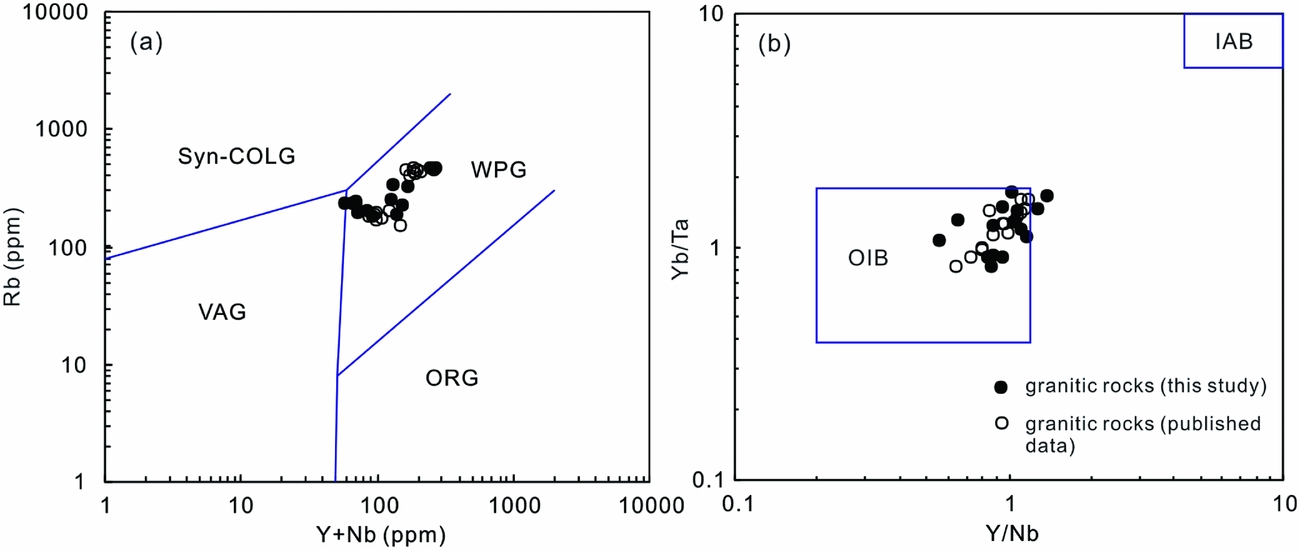
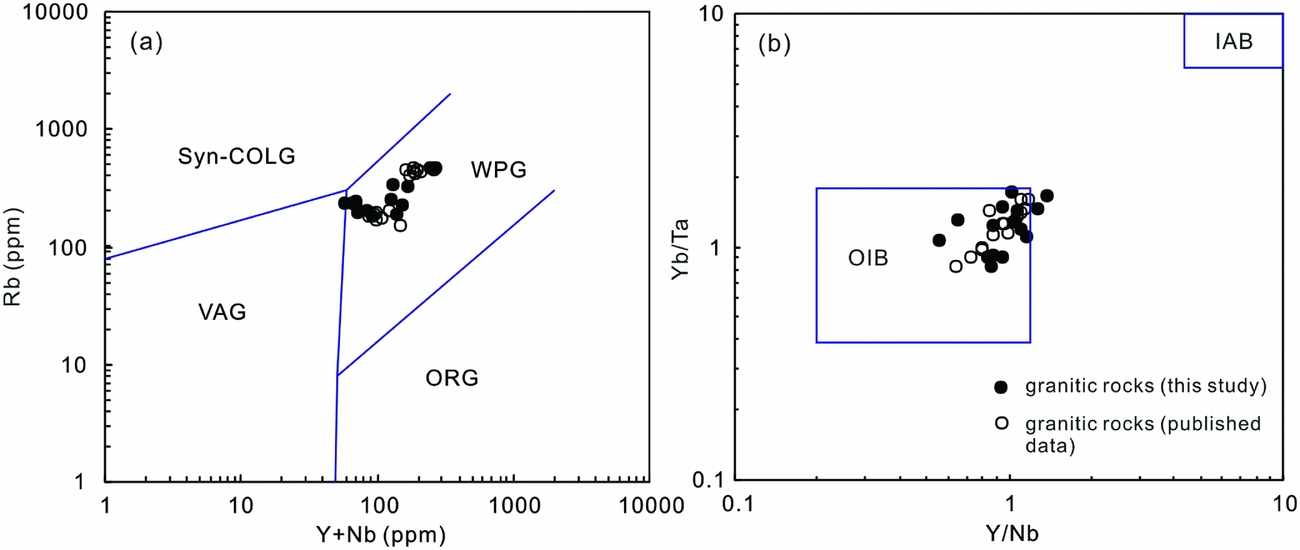
The geodynamic setting during the Permian in the Tarim Block remains debated, with views from post-collisional extension, intraplate setting to arc environment associated with palaeo-Tethyan subduction (Zhang et al. Reference Zhang, Li, Li, Ye and Li2008a, Reference Zhang, Xu, Li, Wang and Ye2010b; Huang et al. Reference Huang, Zhang, Kusky, Santosh, Zhang, Zhang, Liu and Zhao2012). The alkali feldspar granites are temporally and spatially related to the mafic–ultramafic complexes, and plotted in the area of within-plate granites on the tectonic discrimination diagrams (Fig. 12a). These A-type rocks show similar trace element ratios to those of oceanic island basalts (Fig. 12b), and thus belong to the A1 subtype (Fig. 6). The A1 subtype is suggested to represent differentiates of magmas derived from sources like those of oceanic-island basalts in continental rifts or during intraplate magmatism (Eby, Reference Eby1992). The relatively high zircon saturation temperatures (Table 2) also support their emplacement during the intraplate setting, as the plume-related granitoids usually show higher zircon saturation temperatures (generally >800°C) than subduction/collision-related granites (Zhong et al. Reference Zhong, Zhu, Chu, He and Song2007; Liu et al. Reference Liu, Xu, Tian, Zhong, Mundil, Li, Yang, Luo and Shangguan2014).
Plots of Rb versus Y+Nb (a, after Pearce, Reference Pearce1996) and Yb/Ta versus Y/Nb (b, after Eby, Reference Eby1992) for the Halajun granitic rocks. In (a), ORG – ocean ridge granites; VAG – volcanic arc granites; syn-COLG – syn-collisional granites; WPG – within-plate granites. In (b), OIB – oceanic island basalt; IAB – island arc basalts. Some published data for granitic rocks from Zhang et al. (Reference Zhang, Xu, Li, Wang and Ye2010b) are also shown for comparison.
Two episodes of Permian Tarim LIP have been discerned based on the compilation of available ages (Fig. 9). The earlier one is represented by extensive flood basalts with ages of 283–295 Ma; and the later stage (268–281 Ma) is marked by mafic–ultramafic complexes, dioritic–syenitic rocks and alkali feldspar granites with limited distribution. Many geophysical and geochemical investigations have confirmed the existence of Permian Tarim mantle plume on the basis of pre-volcanic crustal uplift, high-temperature magmas and large distribution area (Tian et al. Reference Tian, Campbell, Allen, Guan, Pan, Chen, Yu and Zhu2010; Xu et al. Reference Xu, Wei, Luo, Liu and Cao2014). As the alkali feldspar granites are genetically related to the Tarim mantle plume, it is necessary that the Tarim mantle plume lasts for more than 30 Ma. Indeed, some LIPs with a lifespan of >15 Ma have also been reported, for example from the Kerguelen, North Atlantic and Ontong Java plateaus (Frey et al. Reference Frey, Coffin, Wallace, Weis, Frey, Coffin, Wallace and Quilty2003; Cheng et al. Reference Cheng, Zhang, Hou, Santosh, Zhang and Ke2015). Xu et al. (Reference Xu, Wei, Luo, Liu and Cao2014) advocated a plume incubation model to account for the temporo-spatial distribution of the Tarim LIP, in which different styles of plume–lithosphere interaction are recognized. In the earlier episode, the mantle plume incubating the base of the craton provided the heat that triggered melting of mantle rocks to generate the flood basalts. In contrast, adiabatic decompression melting within the plume produced the later magmatic phase (Xu et al. Reference Xu, Wei, Luo, Liu and Cao2014).
The petrogenetic and tectonic model for the later episode of Tarim LIP is illustrated in Figure 13. After the generation of the flood basalts, the plume flow ascended along thinned spots and weak zones at the margins of the block, and subsequently caused the plume decompression melting and intensive upwelling of asthenospheric mantle, which resulted in a transitory thermal anomaly in the lithospheric mantle. The magmas derived from the lithospheric or asthenospheric mantle triggered by the upwelling plume will further underplate at the crust–mantle interface. The mafic–ultramafic complexes were formed by fractionation and accumulation of plume-derived magma with the addition of crustal assimilation, whereas the alkali feldspar granites in this study were generated by partial melting of newly underplated rocks induced by the upwelling asthenosphere, followed by extensive fractionation and minor crustal assimilation. Both the Piqiang mafic–ultramafic complex and Halajun granites represent two manners of vertical crustal growth. Meanwhile, partial melting of crustal sources induced by convective heating of underplating mafic magma led to the generation of low Nb–Ta rhyolites (Tian et al. Reference Tian, Campbell, Allen, Guan, Pan, Chen, Yu and Zhu2010; Liu et al. Reference Liu, Xu, Tian, Zhong, Mundil, Li, Yang, Luo and Shangguan2014) and thus crustal reworking.
The integrated petrogenetic and tectonic model showing the generation of mafic–ultramafic complexes, syenitic and granitic rocks in the western Tarim Block, all of which were genetically related to the Permian Tarim mantle plume. AFC – assimilation and fractional crystallization. See text for explanation.

Nd and Hf isotopes are widely used to understand the source rock and formation process of igneous rocks. As Nd and Hf isotopes behave somewhat differently during the process of oceanic subduction, crust–mantle interaction and metasomatism, Nd–Hf decoupling occurs in some cases (Zhong et al. Reference Zhong, Ma, Zhang, Wang, She, Liu and Xu2013; Frisby, Bizimis & Mallick, Reference Frisby, Bizimis and Mallick2016; Yu et al. Reference Yu, Sun, Long, Li, Zhao, Kröner, Broussolle and Yang2017). In this study, the Piqiang mafic–ultramafic complex (ε Nd(t)=−1.0 to +2.1) and Halajun granitic plutons (−2.9 to +1.9) (Zhang et al. Reference Zhang, Xu, Li, Wang and Ye2010b; Huang et al. Reference Huang, Zhang, Kusky, Santosh, Zhang, Zhang, Liu and Zhao2012) show similar ε Nd(t) values, which could be interpreted as evidence for extensive fractionation of mafic magmas as the formation model of Halajun granites. However, zircon Hf isotopes reveal obvious differences between mafic and granitic rocks, definitely demonstrating their derivation from a distinct source. Jiang & Guo (Reference Jiang and Guo2010) also suggested that the petrogenesis of xenoliths should be tested by integrated analysis of whole-rock Nd isotopes and zircon U‒Pb age and Hf isotopes. Thus, the combination of whole-rock Nd and zircon Hf isotopes provides more accurate information about the genetic and tectonic process of igneous rocks.
6. Conclusion
(1) The alkali feldspar granites in the Halajun area show geochemical features typical of A1-type granites, and were emplaced at 268–275 Ma, coeval with the mafic–ultramafic complexes and syenitic rocks.
(2) Partial melting of ancient crustal rocks and extreme fractionation of mafic magma cannot explain the geological and geochemical features of the A-type granites. Instead they were most likely formed by partial melting of newly underplated rocks induced by the mantle plume, followed by extensive fractionation and minor crustal assimilation.
(3) The A-type granites are genetically related to the Permian Tarim mantle plume, which possibly lasts for more than 30 Ma.
(4) The Piqiang mafic–ultramafic complex and Halajun granites represent two manners of vertical crustal growth.
Acknowledgements
We are grateful to Dr J. G. Shellnutt and an anonymous reviewer, and the journal editor (Dr Chad Deering) for their critical comments and suggestions, which considerably improved an earlier version of the manuscript. We are also indebted to Prof. J. G. Fitton and Dr C.Y. Xia from the University of Edinburgh for their suggestions and detailed polish of the English presentation. Prof. Z. C. Hu and Dr K. Q. Zong from China University of Geosciences (Wuhan) are greatly appreciated for their technical assistance during zircon analysis. This study was financially supported by the National Natural Science Foundation of China (NSFC) (41373038, 41673034, 41130315 and 91214204), the Fundamental Research Funds for the Central Universities, China University of Geosciences (Wuhan) (CUGL150406 and MSF GPMR06), and an award of the China Scholarship Council to Y.P. Su for a one-year visit to the UK (201406415005).
Supplementary material
To view supplementary material for this article, please visit https://doi.org/10.1017/S0016756817000838