Introduction
Nontraditional therapies, which include invasive or parenteral therapies such as stem cell joint injections, vitamin infusions, and certain cosmetic procedures, are increasingly available to consumers in the United States. Reference Turner1 These therapies typically lack Federal Drug Administration (FDA) approval and scientifically demonstrated benefit for an individual’s health condition or concern. While the benefits of these therapies are in doubt, they often entail significant costs and may pose a variety of risks, including acquisition of infections. Reference Perkins, Spoto and Rankin2–Reference Kuriyan, Albini and Townsend5 Infection risks may be compounded when these therapies are provided in nontraditional settings (eg, MedSpa, non-healthcare infusion center) or are performed by individuals unfamiliar with core infection prevention and control (IPC) practices. Reference Astha, Schaefer, Stone and Perz6–8
The settings and individuals administering these therapies often do not fall under local, state, or federal regulatory licensing or certification requirements or have infection control oversight or support. 9 This lack of oversight and unfamiliarity with public health reporting requirements and processesmay lead to underreporting when consumer harms or serious IPC lapses occur. Data on the occurrence of consumer harms and likelihood of reporting when harms occur are currently lacking.
The Division of Healthcare Quality Promotion (DHQP) at the Centers for Disease Control and Prevention (CDC) is routinely consulted by state, local, and territorial health jurisdictions regarding healthcare outbreaks and lapses in IPC practices that could cause harm, including those that involve nontraditional therapies and settings. Here, we summarize findings from our recent consultation experiences to help identify targets for prevention efforts and enhanced consumer protections.
Methods
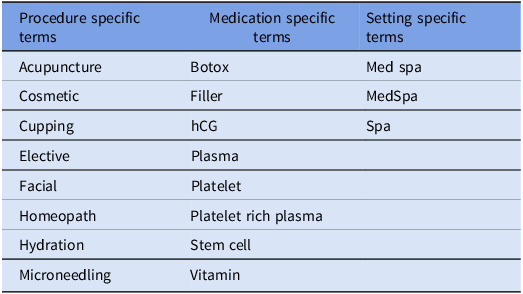
DHQP maintains internal records of consultations with health departments and healthcare facilities involving investigations of healthcare outbreaks and infection control lapses. We reviewed these records from January 1, 2016, through December 31, 2023, to identify consultations involving nontraditional therapies and settings in the United States. We defined nontraditional therapies based on the types of procedures or medications used, including those lacking FDA approval or having no proven or accepted therapeutic indication for the consumer’s condition or concern. A nontraditional setting was defined as a setting that was not licensed or certified by local, state, or federal authorities for the provision of healthcare services. Consultations were initially identified by reviewing summary descriptions of the consults, searching for terms that would potentially indicate a nontraditional treatment or setting, such as “stem cell,” “cosmetic,” and “medspa.” Based upon review of the investigations identified from this initial search, an expanded set of search terms was created and used to perform a more thorough search to identify consultations involving nontraditional treatments or settings (Table 1). Consultations including these search terms were then further reviewed for inclusion.
Search terms used to query Division of Healthcare Quality Promotion consultation records to identify nontraditional medical therapy-related investigations, CDC, United States, 2016–2023

Note. Botox, botulinum toxin; CDC, Centers for Disease Control and Prevention; hCG, human chorionic gonadotropin.
Consultations were excluded if they involved procedures or therapies used according to recognized standard of care practices, unless such procedures or therapies were provided by unlicensed or untrained individuals or within settings not licensed or certified for provision of healthcare services (eg, botulinum toxin administered in the home). Consultations that involved multiple facilities or jurisdictions but were part of the same multistate investigation were included as a single investigation.
We collected the following information for each investigation: (1) type of procedure or therapy received; (2) nature of the setting where the procedure or therapy was provided; (3) infection type; (4) pathogen(s) identified; (5) number of individuals with known infections; (6) types of IPC breaches or concerns identified; (7) number of individuals exposed to an infectious pathogen or an IPC breach; and (8) number of consumers notified (if notification was performed).
Two authors (K.B.S. and E.M.B.) reviewed all consultations identified from the records search using the terms in Table 1 for the study period for agreement on inclusion or exclusion from the study.
This activity was reviewed by CDC and was conducted consistent with applicable federal law and CDC policy (eg, 45 C.F.R. part 46.102(l) (2), 21 C.F.R. part 56; 42 U.S.C. §241(d); 5 U.S.C. §552a; 44 U.S.C. §3501 et seq.).
Results
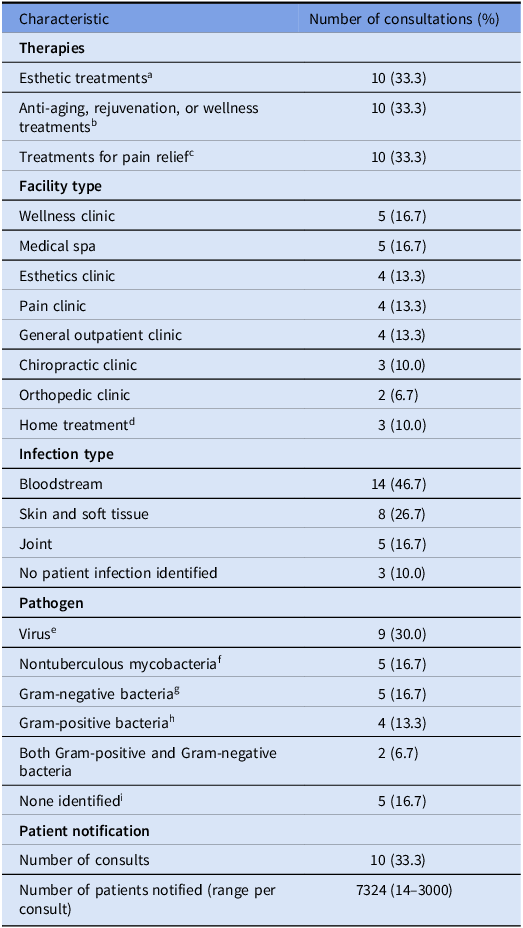
We examined 1500 consultations between January 1, 2016, and December 31, 2023, and identified 30 (2.0%) which met the inclusion criteria. Of these, infections were noted in 27 (90.0%) consultations, infection control breaches in the absence of confirmed infections at the time of investigation for two (6.7%), and presumed toxin-induced hepatitis in one (3.3%).
The most common types of therapies identified were esthetic treatments (ie, treatments primarily for cosmetic reasons or for weight reduction; n = 10, 33.3%), treatments for “rejuvenation,” “anti-aging” or general wellness (n = 10, 33.3%), and treatments for pain relief (n = 10, 33.3%) (Table 2). Esthetic treatments for cosmetic reasons included microneedling and “lymphatic massage.” Three consults involving FDA-approved products, such as botulinum toxin and dermal fillers, were included due to use by unlicensed individuals or in an unlicensed setting. Esthetic treatments for weight or fat reduction included injection of beta-hCG (human chorionic gonadotropin) and injection of purported “fat burning” products. Rejuvenation, anti-aging, or wellness treatments included intravenous (IV) vitamin infusions, IV administration of platelet-rich plasma, IV administration of exosomes derived from umbilical cord blood, and topical application of alkalinized water and other nonspecific homeopathic remedies. Treatments for pain relief most commonly involved stem cell injections (n = 8) but also included the use of platelet-rich plasma and subcutaneous injection of a compounded homeopathic remedy. Setting types varied, with the most common types identifying as a general wellness clinic or a medical spa dedicated to esthetic treatments (Table 2). Types of infections corresponded to the body sites where the therapies were administered (eg, hepatitis C bloodstream infection associated with intravenous vitamin infusion; Mycobacterium abscessus soft tissue infection after subcutaneous injections for “fat burning”) (Table 2). Infectious pathogens were identified in the blood in 14 (46.7%) consultations. Bloodstream infections involved bacterial pathogens in five of these 14 consultations (35.7%), while viral bloodborne pathogens (hepatitis C virus [HCV], hepatitis B virus [HBV], cytomegalovirus [CMV], human immunodeficiency virus [HIV]) were identified in nine consultations (64.3%). A consultation involving HIV infections was particularly notable; an investigation of multiple HIV infections among persons who received platelet-rich plasma with microneedling at an unlicensed spa revealed likely HIV transmission associated with these cosmetic injection services. Reference Stadelman-Behar, Gehre and Atallah10
Characteristics of consultations related to nontraditional medical therapies and settings (n = 30), Division of Healthcare Quality Promotion, CDC, United States, 2016–2023

a Cosmetic fillers, botulinum toxin injection, microneedling, platelet-rich plasma cosmetic treatments.
b IV infusion of vitamins, stem cells, exosomes; ingestion of homeopathic remedies.
c Stem cell injections into joints, IV infusion of platelet-rich plasma, subcutaneous use of homeopathic products.
d Home treatment under direction of provider.
e Hepatitis C virus (n = 6 consults), Hepatitis B virus (n = 1 consult), HIV (n = 1 consult), Cytomegalovirus (CMV; n = 1 consult).
f Mycobacterium abscessus, Mycobacterium chelonae, Mycobacterium fortuitum.
g Citrobacter freundii, Escherichia coli, Enterobacter cloacae, Klebsiella aerogenes, Proteus mirabilis, Pseudomonas fluorescens.
h Enterococcus faecalis, Parvimonas micra, Propionibacterium acnes, Staphylococcus xylosus.
i Two investigations with clinical joint infections diagnosed but no pathogen recovered from culture.
Pathogens identified across infection types included viruses, nontuberculous mycobacteria, and Gram-negative and Gram-positive bacteria, with HCV being the most commonly reported pathogen overall (n = 6, 20% of consultations) (Table 2). Consumer notification occurred in 10 (33.3%) consults, resulting in more than 7000 consumers receiving notification that they may have been exposed to an infectious pathogen due to breaches in infection control practices (Table 2). Such notification was most commonly performed when risk of acquisition of a bloodborne pathogen, such as through unsafe injection practices, was of specific concern.
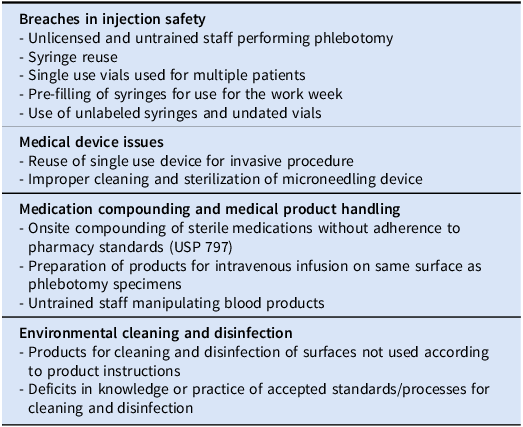
Several lapses in infection control practices were identified that could have contributed to infections (Table 3). Investigations typically identified multiple breaches in adherence to core IPC practices, such as injection safety, medical device reprocessing, medication preparation and handling, and environmental disinfection.
Breaches in infection control practices among investigations involving nontraditional medical therapies and settings, Division of Healthcare Quality Promotion, CDC, United States, 2016–2023

Discussion
As nontraditional therapies and the settings that offer them continue to expand and include a wider range of services and more invasive procedures, 11 consumer safety risks are a growing concern. Our analysis focused on one aspect, infection risks, and identified a range of infectious pathogens from various sources, including blood, joint fluid, and skin and soft tissue. Nontraditional therapies, especially those that are invasive or parenteral, can place consumers at risk for a variety of infection types and pathogens, 12 including bloodborne pathogens such as HCV, HBV, and HIV. Reference Astha, Schaefer, Stone and Perz6,9,Reference Stadelman-Behar, Gehre and Atallah10 Provision of these services in traditional medical settings does not assure patient protections such as when parenteral therapies such as injections are prepared or administered without adhering to recommended IPC practices. Infection risks may also be elevated when established medical therapies occur in nontraditional settings (eg, home or spa) or involve individuals practicing without appropriate supervision or credentials or beyond the scope of professional licensing requirements, as illustrated by harms from using presumed counterfeit botulinum toxin in nontraditional settings. Reference Thomas, McElroy and Yackley13 The lack of adherence to basic infection control, evident in numerous consultations we reviewed, can place large numbers of consumers at risk, especially if deficient practices are not identified and corrected in a timely manner.
In our review, a large proportion of investigations involved unsafe injection practices. Previous outbreaks of HCV and HBV in outpatient settings have highlighted the importance of adherence to safe injection practices. 9,14,Reference OYong, Coelho, Bancroft and Terashita15 The infection control lapses resulting in transmission of bloodborne pathogens may go unnoticed since symptoms of infection can be absent or take weeks to months to manifest, leading to ongoing exposure and risk of infection to many patients. Injection safety resources, such as CDC’s One and Only Campaign, have outpatient-specific tools that may be useful to public health partners working with facilities providing nontraditional therapies and may be high-yield areas of focus. 16 State, local, and territorial health departments can also consider establishing facility licensing and accreditation requirements or provider training, licensure, or certification requirements for outpatient facilities in their jurisdictions that provide nontraditional therapies. 17 CDC has developed the Outpatient Settings Policy Options for Improving Infection Prevention as a guide to assist health jurisdictions with ensuring that “basic standards of infection control are understood and observed consistently across the healthcare system,” and which can apply to non-healthcare settings as well.
Our review also identified consults that included the use of certain therapies for unapproved conditions, such as stem cells for joint or spinal injections for pain relief. In a multistate investigation of products advertised as stem cell therapies, the stem cell product was found to be contaminated at the point of manufacture. The product was not FDA-approved and the appropriate processes to ensure sterility of the product were not maintained. Reference Perkins, Spoto and Rankin2 This investigation highlighted the serious risks associated with products that are used without FDA-approval or proven benefits. Such practices place consumers at risk of harm, and providers and consumers may be unaware that the products they are using lack the appropriate approval and may have claims without scientific merit. Direct marketing of stem cell interventions to consumers highlights the difficulty consumers may have in distinguishing medically proven and accepted treatments from those that are not. Reference Turner18
Several consultations identified lapses in appropriate procedures for sterile medication compounding, which is the process of combining, mixing, diluting, pooling, reconstituting, repackaging, or otherwise altering a drug substance to create a sterile medication. 19 Sterile medication compounding should be done under strict standards outlined by The United States Pharmacopeial Convention to prevent medication contamination and protect patient safety. In 2021, the FDA released an announcement highlighting concerns regarding compounded vitamin infusions being prepared in unsanitary conditions and other infection control concerns that were responsible for a patient illness. 20 Our review also noted an investigation involving preparation of IV vitamin infusions on the same work surface where phlebotomy specimens were being manipulated, leading to the potential for contamination of medications with bloodborne and other pathogens.
Autologous use of biologic material (eg, stem cells, platelet-rich plasma) can also be problematic and potentially dangerous. This material may be manipulated in environments that are not well controlled by personnel who may not be trained in or using IPC processes necessary to reduce the risk of contamination. Reference Rhea, Morrison and Weaver4
This study is subject to several limitations. Our review only included investigations in which health departments and health care facilities consulted CDC/DHQP and, therefore, does not represent the full spectrum of outbreaks and infection control breaches occurring throughout the United States. We did not identify any investigation meeting our inclusion criteria in 2020. Public health resources during this time were overwhelmingly utilized for the COVID-19 pandemic response, decreasing the likelihood that outbreaks and infection control breaches involving nontraditional therapies were detected and reported, although they were likely still occurring. Of note, the FDA posted warnings in response to providers advertising and utilizing unapproved therapies for the treatment of COVID-19 and other conditions. 21,22 Information of interest collected for this study was not always available during CDC/DHQP consultative support, leading to incomplete data for some investigations included in this study. For example, ten consults (33.3%) involved notification of consumers of their risk of infection after undergoing a nontraditional therapy. This proportion may underestimate the actual number of investigations that resulted in notification and the number of individuals notified due to limitations of long-term follow-up with health departments and healthcare facilities on their investigations. Additionally, consumers who may have been notified through public notifications, such as CDC and FDA public postings and FDA press releases warning the public of the risks of using unapproved products during the multistate stem cell investigation or other investigations, were not included in our counts. Reference Perkins, Spoto and Rankin2,23 Finally, due to limited regulatory oversight in many settings where nontraditional therapies are performed, infections and outbreaks may go unreported.
This review highlights the potential infectious risks to consumers posed by nontraditional therapies, which may have unproven benefits and whose risks have not been well described in the literature. It is likely that traditional outpatient healthcare will continue to expand, as will care occurring in nontraditional settings, and the types of services available to consumers in these settings will grow as well. Reference Astha, Schaefer, Stone and Perz6,11 It is thus vital that efforts focus on: (1) establishing infection prevention and control expectations for individuals and facilities that provide these types of therapies, (2) providing education and training to those who perform nontraditional therapies, (3) educating consumers about the potential risks of unapproved products such as stem cells with unproven claims of effectiveness for certain conditions, and (4) continuing to educate consumers about potential risks from obtaining care in settings that lack oversight. Efforts to clarify and address the limitations of nontraditional therapies can help to protect consumers from potential harm.
Acknowledgements
The authors appreciate the work of the members of the Division of Healthcare Quality Promotion Prevention and Response Branch Outbreak Response Team and the Epidemic Intelligence Officers, as well as the health departments and other institutions, who contributed to investigations reviewed in this paper.
Financial support
None reported.
Competing interests
All authors report no conflicts of interest relevant to this article.
Disclaimer
The findings and conclusions in this report are those of the authors and do not necessarily represent the official position of the Centers for Disease Control and Prevention.