Paediatric dilated cardiomyopathy is the most common form of cardiomyopathy in children, but also the most aggressive, where death or transplantation within 1 year of the initial diagnosis is a common outcome.Reference Towbin, Lowe and Colan1 Despite a more ominous prognosis, paediatric dilated cardiomyopathy shares a similar phenotype of left ventricular dilation and systolic dysfunction as adult dilated cardiomyopathy. Despite the primary aetiologies of dilated cardiomyopathy in adults being due to acquired diseases, the large majority of paediatric dilated cardiomyopathies are idiopathic. Nevertheless, the clinical features of paediatric dilated cardiomyopathy are not unlike that seen in adults: a chronic and progressive alteration in myocardial structure that leads to myocardial systolic dysfunction, arrhythmias, congestive cardiac failure, and sudden death.
Maladaptive myocardial remodelling is the hallmark of dilated cardiomyopathy, and significant changes in the myocardial extracellular matrix are known to facilitate the structural and functional changes in the adult dilated cardiomyopathy.Reference Spinale2 Maintenance of extracellular matrix homeostasis is coordinated through the proteolytic degradation and synthesis of extracellular matrix components by the matrix metalloproteinases and their endogenous tissue inhibitors of metalloproteinase. Thus, changes in matrix metalloproteinase levels as well as the relative balance to tissue inhibitors of metalloproteinases can result in a condition of enhanced matrix remodelling. Indeed, increased myocardial levels of matrix metalloproteinase and abnormal balances between matrix metalloproteinases and tissue inhibitors of metalloproteinase levels have been identified in adult forms of dilated cardiomyopathy.Reference Gunja-Smith, Morales, Romanelli and Woessner3–Reference Spinale, Coker and Heung5 Despite the possibility of myocardial sampling providing a direct assessment of matrix metalloproteinase and tissue inhibitor of metalloproteinase levels, this approach can be problematic for serial studies. Indeed, a number of past studies have identified that it is possible to perform matrix metalloproteinase and tissue inhibitor of metalloproteinase measurements from a plasma sample in adult patients with chronic cardiac failure as well as following myocardial infarction.Reference Ahmed, Clark and Pennington6–Reference Frantz, Stork and Michels9 These past studies in adult patients suggest that plasma matrix metalloproteinase and tissue inhibitors of metalloproteinase levels have been reported to have prognostic and predictive values. However, whether, and to what degree, plasma matrix metalloproteinase and tissue inhibitors of metalloproteinase levels in children with dilated cardiomyopathy differ from those of age-matched normal subjects remains unknown. In addition, previous studies on adults primarily focused on a limited number of matrix metalloproteinases and tissue inhibitors of metalloproteinases, and thus a more robust examination of matrix metalloproteinases, tissue inhibitor of metalloproteinase, and the stoichiometric relationship between matrix metalloproteinases and tissue inhibitors of metalloproteinases has not been fully explored in any dilated cardiomyopathy state. Accordingly, we developed a high-sensitivity multiplex suspension assay to allow measurement of plasma matrix metalloproteinase and tissue inhibitors of metalloproteinase levels in children, using small (approximately 1 millilitre) blood volume. The central purpose of this study was to establish a plasma matrix metalloproteinase/tissue inhibitor of metalloproteinase profile in children diagnosed with idiopathic dilated cardiomyopathy, and compare these results to those of age-matched children with no history of cardiovascular disease.
Methods
Patients
Children presenting with dilated cardiomyopathy were initially screened for inclusion into this study. All patients underwent standard cardiomyopathy evaluation, including echocardiography, left and right cardiac catheterisation, coronary angiography, and myocardial biopsy with both light and electron microscopic examinations. A comprehensive viral workup including parvoviral, enteroviral, and Epstein–Barr viral polymerase chain reaction was performed. In all patients, the diagnosis of idiopathic dilated cardiomyopathy was established based on normal coronary arteries on echocardiogram/angiography and the absence of valvular or pericardial diseases. Patients with confirmed myocarditis, hypertrophic or restrictive cardiomyopathy, or with structural cardiac defects were excluded. This study also did not include patients with a history of haematologic, neoplastic, or primary renal/liver diseases, or those with acute or chronic infections, autoimmune diseases, and patients receiving anti-inflammatory drugs. From this initial screening, seven children with idiopathic dilated cardiomyopathy were identified for inclusion. The mean age of this sample cohort was 8 plus or minus 7 years, ranging from 3 months to 14 years, with a time interval of 2.7 plus or minus 1.4 years from the initial diagnosis to sample collection. The left ventricular fractional shortening computed from the echocardiogram most coincident with the sample collection was 18 plus or minus 2%, revealing significant systolic dysfunction. For the purposes of providing referent normal values for patients with dilated cardiomyopathy, 26 age-matched normal volunteers with a mean age of 6 plus or minus 6 years, ranged from 3 months to 17 years, were enrolled. These patients were carefully screened by history and physical examination, which included blood chemistries and an electrocardiogram to exclude any history of cardiovascular disease. All of the referent control subjects were in American Society of Anesthesiologists functional status class 1 and in New York Heart Association function class I. The study protocol was reviewed and approved by the Medical University of South Carolina Institutional Review Board (HR no. 17161) and parental/patient consents were obtained for all subjects enrolled in this study. Following informed consent, 1 millilitre of blood obtained from a peripheral venous site was collected into a chilled EDTA tube, centrifuged, and the plasma decanted and stored at minus 70 degrees Celsius.
Analytical measurements
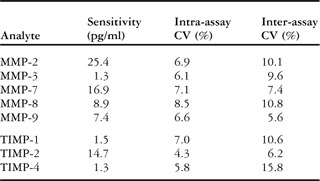
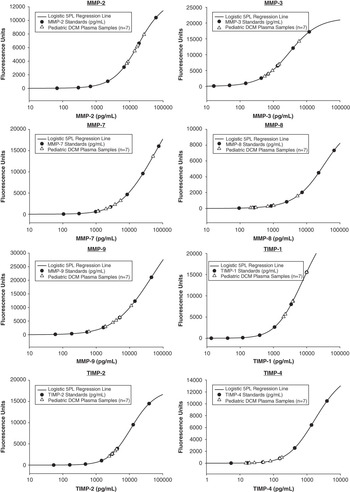
The plasma samples were thawed on ice and subjected to multiplex suspension array for matrix metalloproteinases (Human Fluorokine MAP matrix metalloproteinase Kit, R&D Systems, LMP000) and tissue inhibitors of metalloproteinases (Human Fluorokine MAP TIMP Kit, R&D Systems, LKT003, Minneapolis, Minnesota, United States of America) in which all samples could be measured in simultaneous fashion, thereby minimising the inter-assay coefficient of variation. For the matrix metalloproteinases, the matrix was assembled in order to measure representative subtypes from each class of matrix metalloproteinases, which included the collagenases (matrix metalloproteinase-8 and -13), the gelatinases (matrix metalloproteinase-2 and -9), and the stromelysins/matrilysins (matrix metalloproteinase-3 and -7). The four known tissue inhibitors of metalloproteinases (tissue inhibitor of metalloproteinase-1, -2, -3 and -4) were also measured. The relative fluorescence obtained for each distinct matrix metalloproteinase/tissue inhibitor of metalloproteinase (Bio-Plex 200, BioRad Laboratories, Hercules, California, United States of America) was converted to an absolute concentration using standards that were included in each assay and the specifications for each reagent and sensitivity are shown in Table 1. The coefficient of variation for these assays was 16% or less. The matrix metalloproteinase-13 and tissue inhibitor of metalloproteinase-3 levels were undetectable for patients with normal and dilated cardiomyopathy and were excluded from further analysis. For all other matrix metalloproteinase and tissue inhibitors of metalloproteinase multiplex assays, the sample readings fell within the targeted dynamic range for the analyte of interest. Representative standard curves and the paediatric sample results for all of the measured matrix metalloproteinases and tissue inhibitors of metalloproteinases are shown in Figure 1.
Multiplex array performance for MMPs and TIMPs.

CV = coefficient of variation
MMP = Matrix metalloproteinase
TIMP = Tissue inhibitors of metalloproteinases
The fluorescence emissions for each set of matrix metalloproteinases (MMP) and tissue inhibitor of metalloproteinase (TIMP) standards were fit to a five-parameter logistic (5-PL) equation, following a conventional format for non-linear fluorescence profiles.Reference Cheung, Luo and Yanagawa13 Using this 5-PL curve fit, the fluorescence emissions for the samples were converted to actual MMP/TIMP values and finally corrected for dilution (DCM = dilated cardiomyopathy).

Data analysis
The fluorescence emissions for each set of matrix metalloproteinase/tissue inhibitors of metalloproteinase standards were first fit to a 5-parameter logistic equation (Fig 1), following a conventional format for non-linear fluorescence profiles.Reference Gottschalk and Dunn10 Using this five-parameter logistic curve fitting algorithm, the fluorescence emissions for the samples were converted to actual matrix metalloproteinase and tissue inhibitors of metalloproteinase values. The comparisons of matrix metalloproteinase and tissue inhibitors of metalloproteinase profiles between the dilated cardiomyopathy and referent normal values were performed using a stepwise confidence interval-based t-statistics (PRCOMP, STATA Statistical Software, Intercooled version 8.0. College Station, Texas, United States of America). In order to examine the stoichiometric relationship between matrix metalloproteinase and tissue inhibitors of metalloproteinase profiles, matrix metalloproteinase/tissue inhibitors of metalloproteinase ratios were computed. For this analysis, a normal distribution was not achieved for a number of the matrix metalloproteinase/tissue inhibitors of metalloproteinase ratio computations, and therefore, pair-wise comparisons were performed using the non-parametric Mann–Whitney test. Results are presented as the mean and standard errors of the mean. Values of p less than 0.05 were considered to be statistically significant and actual p-values obtained from the individual comparisons have been tabulated.
Results
Patient demographics
Of the seven patients with dilated cardiomyopathy, five were in New York Heart Association class II. The other two patients presented at initial diagnosis in New York Heart Association class IV: one patient aged 9 years underwent successful cardiac transplantation and the other aged 10 months underwent Berlin Heart (Berlin Heart GmbH, Berlin, Germany) left ventricular assist device implantation. The histopathological characteristics of the ventricular biopsies for all patients showed non-specific features of dilated cardiomyopathy, including variable degrees of myocyte hypertrophy and atrophy, interstitial and replacement fibrosis, and myofibrillar loss (myocytolysis) with no evidence of active myocarditis. In these patients, the plasma brain natriuretic peptide at the time of sample collection was 1400 plus or minus 828 picograms per millilitre, which was approximately 14 times higher than that for referent normal values (less than 100 picograms per millilitre). Despite significant systolic dysfunction, renal function as determined by plasma creatinine values was preserved in these dilated cardiomyopathy patients when compared to the referent control subjects (0.6 plus or minus 0.2 versus 0.6 plus or minus 0.9 milligrams per decilitre, p equals 0.99).
Plasma matrix metalloproteinase and tissue inhibitors of matrix metalloproteinase levels
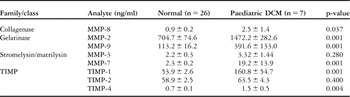
The quantitative plasma levels of all the matrix metalloproteinases and tissue inhibitors of metalloproteinases examined in this study are summarised in Table 2. The plasma levels of the collagenase matrix metalloproteinase-8, the gelatinases matrix metalloproteinase-2 and -9, and the matrilysin matrix metalloproteinase-7 were increased by over twofold in paediatric dilated cardiomyopathy when compared to referent normal values. With respect to the tissue inhibitors of metalloproteinases, the tissue inhibitors of metalloproteinase-1 and -4 were increased by over twofold when compared to referent normal values. The relative increase in tissue inhibitor of metalloproteinase-4 values observed in this study hold relevance, as this tissue inhibitors of metalloproteinase is highly expressed within the cardiovascular system, particularly the myocardium.Reference Bigg, Shi, Liu, Steffensen and Overall11, Reference Greene, Wang, Liu, Raymond, Rosen and Shi12
Plasma MMP and TIMP profiles in referent normal children and in paediatric DCM.

DCM =dilated cardiomyopathy
MMP = Matrix metalloproteinase
TIMP = Tissue inhibitors of metalloproteinases
Matrix metalloproteinase to tissue inhibitor of metalloproteinase ratios
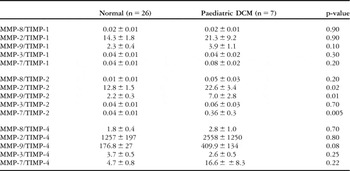
One of the critical post-translational control points that determines the overall net matrix metalloproteinase proteolytic activity is through the interactive binding between the matrix metalloproteinases and tissue inhibitors of metalloproteinases. In general terms, the relative affinity for tissue inhibitors of metalloproteinases to bind to active matrix metalloproteinases is equivalent and bind in a 1:1 stoichiometric relation. Accordingly, in order to more carefully examine the relative balance between matrix metalloproteinases and tissue inhibitors of metalloproteinase plasma profiles in paediatric dilated cardiomyopathy, the matrix metalloproteinase/tissue inhibitor of metalloproteinase ratios were computed and are summarised in Table 3. In this analysis, a higher matrix metalloproteinase/tissue inhibitor of metalloproteinase ratio would imply a greater proteolytic potential, whereas a lower matrix metalloproteinase/tissue inhibitors of metalloproteinase ratio would indicate reduced proteolytic potential. In this analysis, the matrix metalloproteinase-2, -9, and -7 to tissue inhibitor of metalloproteinase-2 ratios were increased by over threefold when compared to referent normal values. The matrix metalloproteinase-9/tissue inhibitor of metalloproteinase-4 ratio was also significantly increased from referent normal values, but did not reach statistical significance.
Plasma profiles of MMP/TIMP ratios in referent normal children and in paediatric DCM.

DCM =dilated cardiomyopathy
MMP = Matrix metalloproteinase
TIMP = Tissue inhibitors of metalloproteinases
Discussion
A large number of studies in adult cardiac disease have identified abnormalities in matrix metalloproteinase and tissue inhibitors of matrix metalloproteinases within the myocardium.Reference Spinale4, Reference Spinale, Coker and Heung5, Reference Cheung, Luo and Yanagawa13, Reference Li, Feldman, Sun and McTiernan14 These studies have identified that changes in the three major classes of matrix metalloproteinases, the collagenases, gelatinases, and stromelysin/lysins, can occur within the myocardium of adults with severe left ventricular dysfunction, that changes in tissue inhibitors of matrix metalloproteinase levels occur within the myocardium, and that alterations in the balance between myocardial matrix metalloproteinases and tissue inhibitors of metalloproteinases occur, which would favour extracellular matrix remodelling. Despite myocardial sampling providing a direct measure of matrix metalloproteinase and tissue inhibitors of metalloproteinase levels in the context of left ventricular remodelling and developing failure, repeat sampling can be problematic. A majority of matrix metalloproteinases and tissue inhibitors of metalloproteinases are released into the interstitial space, and therefore, egress into the vasculature will occur, resulting in the ability to measure these analytes within a systemic blood sample. Indeed, a number of studies in adults with left ventricular remodelling and dysfunction have been performed in which plasma matrix metalloproteinases and tissue inhibitors of metalloproteinases have been utilised as a surrogate index or biomarker for structural remodelling that may be occurring at the myocardial level.Reference Ahmed, Clark and Pennington6–Reference Frantz, Stork and Michels9, Reference Yokoseki, Yazaki, Suzuki, Imamura, Takenaka and Isobe15–Reference Noji, Shimizu and Ino23 These studies have shown a strong relationship between changes in matrix metalloproteinase/tissue inhibitors of metalloproteinase profiles to left ventricular remodelling, progression of cardiac failure, and also to hold prognostic significance. However, little is known about changes in matrix metalloproteinases and tissue inhibitors of metalloproteinases in children with left ventricular failure, and more importantly whether and to what degree plasma matrix metalloproteinases and tissue inhibitors of metalloproteinase profiles are altered in the context of paediatric dilated cardiomyopathy remained completely unexplored. Accordingly, this study utilised a validated high-sensitivity multiplex suspension array in order to directly quantify a large number of soluble matrix metalloproteinases and tissue inhibitors of metalloproteinases in a small plasma sample, and thereby provided a means to explore potential differences in age-matched normal children and in children with idiopathic dilated cardiomyopathy. The novel findings from this study were twofold. First, a large number of matrix metalloproteinases and tissue inhibitors of metalloproteinases could be reproducibly measured from a small volume of a peripheral blood sample in patients with normal and dilated cardiomyopathy. Second, a significant increase in a subset of matrix metalloproteinases and tissue inhibitors of metalloproteinases was observed in patients with paediatric dilated cardiomyopathy. These results underscore that fundamental alterations in the extracellular remodelling pathways exist in paediatric dilated cardiomyopathy. These results also set the stage for future studies in which plasma matrix metalloproteinases and tissue inhibitors of metalloproteinase profiling may serve as a potential novel biomarker platform for the development of prognostic algorithms as well as evaluating treatment strategies in this aggressive form of left ventricular failure in children.
The matrix metalloproteinases comprise a large family of proteolytic enzymes that process structural proteins as well as signalling molecules within the interstitial space.Reference Spinale2, Reference Spinale4, Reference Spinale, Coker and Heung5, Reference Overall and Butler24 The alterations in matrix metalloproteinase profiles within the adult myocardium has been the focus of a large number of previous studies.Reference Spinale2, Reference Gunja-Smith, Morales, Romanelli and Woessner3–Reference Spinale, Coker and Heung5, Reference Cheung, Luo and Yanagawa13, Reference Li, Feldman, Sun and McTiernan14, Reference Picard, Brehm and Fassbach25 Specifically, in adult forms of dilated cardiomyopathy, the increased overall matrix metalloproteinase activity and increased induction of certain matrix metalloproteinase types have been clearly established. Using large animal models of dilated cardiomyopathy, a clear time-dependent association in matrix metalloproteinase induction and left ventricular dilation has been shown, which was abrogated by selective matrix metalloproteinase inhibition.Reference Spinale2, Reference Yarbrough, Mukherjee and Brinsa26 On the basis of these studies, the current operational hypothesis in adult forms of left ventricular remodelling and failure is that increased myocardial matrix metalloproteinase expression results in increased matrix turnover, a loss of structural support to myocytes and myocardial fascicles, and progressive left ventricular remodelling. The potential utility of measuring matrix metalloproteinase levels from a systemic blood sample in adults with established left ventricular dysfunction, or in adult subjects with increased risk of developing left ventricular dysfunction, has been examined previously.Reference Ahmed, Clark and Pennington6–Reference Frantz, Stork and Michels9, Reference Yokoseki, Yazaki, Suzuki, Imamura, Takenaka and Isobe15–Reference Noji, Shimizu and Ino23 The previous studies have uniformly shown a prognostic relationship between changes in plasma matrix metalloproteinase levels and that of progressive left ventricular dysfunction and clinical outcomes. Correlating plasma matrix metalloproteinase-2 and -9 levels with left ventricular systolic function, investigators in the RESOLVD trial reported that in patients with symptomatic cardiac failure and low ejection fractions, the matrix metalloproteinase-2 levels increased with worsening disease, and matrix metalloproteinase-9 levels correlated with lower ejection fraction and left ventricular dilation.Reference Yan, Yan and Spinale19 In a cohort of subjects in the Framingham Heart Study, higher plasma matrix metalloproteinase-9 levels were associated with a more than twofold risk of adverse left ventricular remodelling.Reference Sundstrom, Evans and Benjamin20 Moreover, increased plasma matrix metalloproteinase-2 levels have been correlated with worsening symptoms and identified as an independent predictor of death in adults with congestive cardiac failure.Reference George, Patal, Wexler, Roth, Sheps and Keren8, Reference Jordan, Roldan and Garcia17, Reference Kelly, Khan and Thompson18, Reference Lubos, Schnabel and Rupprecht21 This study builds upon these earlier reports by performing plasma profiling of a number of matrix metalloproteinase types in the context of paediatric cardiac failure. The results from this study showed that a robust increase in certain matrix metalloproteinase types, such as matrix metalloproteinase-2 and -9, occurred in the plasma of children with established dilated cardiomyopathy.
In this study, increased plasma levels in matrix metalloproteinase subtypes from the three major matrix metalloproteinase classes were observed in a cohort of paediatric dilated cardiomyopathy patients when compared to referent age-matched normal subjects. The interstitial collagenase matrix metalloproteinase-8 was increased in paediatric dilated cardiomyopathy, which has also been previously termed “neutrophil collagenase”.Reference Spinale2, Reference Visse and Nagase27 In addition, plasma levels for the gelatinases matrix metalloproteinase-9 and -2 were increased in paediatric dilated cardiomyopathy. A predominant source of matrix metalloproteinase-9 is through inflammatory pathways and the activation of inflammatory cells such as neutrophils and macrophages.Reference Visse and Nagase27–Reference Cuenca, Martín-Sanz, Alvarez-Barrientos, Boscá and Goren29 Finally, this study showed a robust increase in the matrilysin, matrix metalloproteinase-7 with paediatric dilated cardiomyopathy, which has been co-localised to macrophages and resident interstitial cells such as fibroblasts. Taken together, the changes in these matrix metalloproteinase types most likely reflect the activation of upstream inflammatory-bioactive signalling cascades. Specifically, matrix metalloproteinases are tightly regulated at the transcriptional level,Reference Clark, Swingler, Sampieri and Edwards28 in which both the ligand- and adhesion-mediated receptor interactions alter the intracellular formation of transcription factors that specifically bind to regulatory elements within the matrix metalloproteinase promoter region. Thus, the absolute changes in matrix metalloproteinase profiles with paediatric dilated cardiomyopathy are most likely the result of altered transcription pathways that are reflective of the underlying disease process. Past studies have shown an association between increased levels of plasma matrix metalloproteinase-8 and matrix metalloproteinase-2 with changes in soluble tumour necrosis factor receptor levels in adult patients with dilated cardiomyopathy.Reference Wilson, Gunasinghe and Coker7 Moreover, matrix metalloproteinase-7 can proteolytically process the membrane-bound tumour necrosis factor to soluble form.Reference Spinale2, Reference Overall and Butler24 Taken together, the emergence of these matrix metalloproteinase types in the plasma of patients with paediatric dilated cardiomyopathy suggests that local inflammation may be a contributory factor. However, this study did not include any patients with acute inflammatory response, that is, increased white blood cell count, and rigorously excluded any dilated cardiomyopathy patient with suspected myocarditis. Thus, it remains unclear what upstream signalling pathways may be evoking the specific plasma proteolytic profile in paediatric dilated cardiomyopathy. More importantly, the relationship between the biological function of certain matrix metalloproteinase types and the quantitative measurements performed in this study remains associative at best with respect to any cause–effect relation to the progression of the paediatric dilated cardiomyopathy process. For example, due to the limited sample size and single time point measurements performed in this study, any direct relationship between plasma matrix metalloproteinase profiles and the left ventricular remodelling process could not be determined. Nevertheless, this study has clearly established that plasma profiling of matrix metalloproteinases in paediatric dilated cardiomyopathy results in a differential pattern from normal children, and that the small sample volumes required for assay would be amenable for future serial studies.
A critical control point for net matrix metalloproteinase activity is by forming non-covalent complexes with tissue inhibitors of metalloproteinases. In general terms, tissue inhibitors of metalloproteinases bind to the catalytic domain of active matrix metalloproteinases and thereby prevent access to substrates. This study examined this important determinant of matrix metalloproteinase proteolytic activity through quantifying all four of the known tissue inhibitors of metalloproteinases. The results from this analysis revealed that plasma tissue inhibitors of metalloproteinase-3 levels were below detection limits in both referent normal and paediatric dilated cardiomyopathy samples. In contrast, plasma tissue inhibitors of metalloproteinase-1, -2, and -4 levels were readily quantified and were within the dynamic range of the analytical assay system. In past adult studies of left ventricular failure, measurements of plasma tissue inhibitors of metalloproteinase-1 have been a predominant focus.Reference Ahmed, Clark and Pennington6–Reference Frantz, Stork and Michels9, Reference Jordan, Roldan and Garcia17, Reference Lubos, Schnabel and Rupprecht21, Reference Sundstrom, Evans and Benjamin22 In a Framingham Heart substudy with over 1000 patients, the plasma tissue inhibitors of metalloproteinase-1 levels were associated with major cardiovascular risk factors, and to indices of left ventricular hypertrophy and systolic dysfunction.Reference Fitzsimmons, Forough and Lawrence30 The elevated plasma tissue inhibitors of metalloproteinase-1 levels have also been shown to adversely impact prognosis, and are associated with increased mortality, in patients with congestive cardiac failure.Reference Frantz, Stork and Michels9, Reference Jordan, Roldan and Garcia17, Reference Lubos, Schnabel and Rupprecht21 Interestingly, the fact that increased plasma tissue inhibitors of metalloproteinase-1 levels also occur in paediatric dilated cardiomyopathy suggests that plasma tissue inhibitors of metalloproteinase-1 levels may reflect a common biological event in adverse myocardial matrix turnover, which in turn would influence the myocardial structure and function. The tissue inhibitors of metalloproteinases-4 constituted the most recently discovered member of the tissue inhibitors of the metalloproteinase family, and are noted for their high cardiovascular specificity.Reference Spinale2, Reference Bigg, Shi, Liu, Steffensen and Overall11, Reference Greene, Wang, Liu, Raymond, Rosen and Shi12 As with other tissue inhibitors of metalloproteinases, it complexes with matrix metalloproteinases in a 1:1 stoichiometric kinetics. This study identified a twofold increase in plasma tissue inhibitors of metalloproteinase-4 levels in paediatric dilated cardiomyopathy, which would further imply that the predominant source for changes in the tissue inhibitors of metalloproteinase profiles observed in this study was the myocardium. In light of the fact that the net level of matrix metalloproteinase proteolytic activity is dependent on the relative concentrations of matrix metalloproteinases and tissue inhibitors of metalloproteinases, one approach is to examine the relative stoichiometry between specific matrix metalloproteinases and tissue inhibitors of metalloproteinases. For example, Wilson et alReference Wilson, Gunasinghe and Coker7 reported increased matrix metalloproteinase-9/tissue inhibitors of metalloproteinase-1 ratios in adult patients with congestive cardiac failure. Others have also reported that adult patients with systolic cardiac failure or idiopathic dilated cardiomyopathy have elevated matrix metalloproteinase/tissue inhibitors of metalloproteinase ratios, including matrix metalloproteinase-2/tissue inhibitors of metalloproteinase-2.Reference Schwartzkopff, Fassbach, Pelzer, Brehm and Strauer16, Reference Jordan, Roldan and Garcia17, Reference Noji, Shimizu and Ino23 In this study, an increase in the relative matrix metalloproteinase/tissue inhibitors of metalloproteinase-2 ratio occurred, which would imply a net loss of endogenous matrix metalloproteinase inhibitory control and increased matrix metalloproteinase activity within the myocardial interstitium in paediatric dilated cardiomyopathy. However, this study performed a quantitative analysis of matrix metalloproteinase and tissue inhibitors of metalloproteinase levels in the plasma, and therefore, how these plasma levels may be reflective of local myocardial proteolytic activity can only be inferred. Future studies will be required to directly examine changes in plasma matrix metalloproteinase/tissue inhibitors of metalloproteinase levels to that of local matrix metalloproteinase activational states.
Limitations and summary
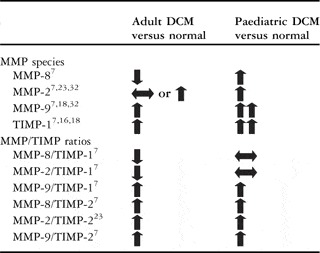
Despite the use of different techniques to quantify the systemic circulating matrix metalloproteinase and tissue inhibitors of metalloproteinase levels, the most commonly reported technique has been the enzyme-lined immuno-sorbent assay. However, and enzyme-lined immuno-sorbent assay is limited by the need for a large amount of blood sample volume, when multiple analytes are to be assessed. This presents a particular problem in infants and small children, who have less tolerance for large volume blood sampling. Therefore, a novel technique that uses a multiplex suspension array was developed to simultaneously measure multiple analytes with greater sensitivity, but requiring small volume of plasma. Multiplex suspension array has been validated by the traditional enzyme-lined immuno-sorbent assay, and this study showed the feasibility of using 1 millilitre of blood in children to quantify the various matrix metalloproteinase and tissue inhibitors of metalloproteinases levels using a multiplex suspension array. However, several limitations in adopting plasma matrix metalloproteinase and tissue inhibitors of metalloproteinase levels as surrogate markers of myocardial proteolytic process must be acknowledged. First, plasma matrix metalloproteinase and tissue inhibitors of metalloproteinase levels are not necessarily reflective of myocardial tissue concentrations. For example, matrix metalloproteinase-1 and -13 have very low or non-detectable plasma levels, but abundant levels of these matrix metalloproteinase types can be measured from myocardial samples.Reference Spinale2, Reference Spinale, Coker and Heung5, Reference Picard, Brehm and Fassbach25 Second, the multiplex assay measures the absolute total amounts of matrix metalloproteinases and tissue inhibitors of metalloproteinases that are synthesised locally, and reflects a spillover from local sources. Accordingly, increased plasma levels of matrix metalloproteinases or tissue inhibitors of metalloproteinases would reflect a change in synthesis kinetics at the local level and, in this particular instance, most likely the myocardium. However, these measurements may also be influenced by differences in clearance of these low molecular weight proteins, which is predominantly through renal clearance.Reference Fitzsimmons, Forough and Lawrence30, Reference Lauhio, Sorsa and Srinivas31 In order to address this potential confounding issue, plasma creatinine levels were assessed as an index of renal function in which no evidence for renal function impairment was found in the paediatric dilated cardiomyopathy group. Despite remaining speculative, these findings would imply that the increased plasma matrix metalloproteinase and tissue inhibitors of metalloproteinase levels were due to increased synthesis and spillover rather than impaired clearance kinetics. Finally, in this study, matrix metalloproteinase and tissue inhibitors of metalloproteinase plasma levels were only measured at one point in time, and the temporal relation to the natural history of the myocardial remodelling process and progression to cardiac failure remains to be established in paediatric dilated cardiomyopathy. Nevertheless, the matrix metalloproteinase/tissue inhibitors of metalloproteinase measurements obtained in this study can be utilised to provide some differential comparisons to past findings in adults with dilated cardiomyopathy (Table 4). The robust increase in plasma matrix metalloproteinase-7 appears to be a unique observation in paediatric dilated cardiomyopathy as this has not been reported previously in adult studies. Moreover, the relative increase in plasma matrix metalloproteinase-9 and the matrix metalloproteinase/tissue inhibitors of metalloproteinase-2 ratios are significantly higher in paediatric dilated cardiomyopathy when compared to adult dilated cardiomyopathy. These differential plasma matrix metalloproteinase and tissue inhibitors of metalloproteinase profile suggest that a more aggressive proteolytic milieu exists in paediatric dilated cardiomyopathy, which in turn would promote a more rapidly progressive left ventricular remodelling. Despite the necessity of additional studies, these distinct differences in determinants of myocardial matrix structure and function may contribute to the ominous nature of dilated cardiomyopathy in children and may be potentially useful as biomarkers for diagnosis and prognosis in paediatric dilated cardiomyopathy.
Comparative MMP and TIMP profiles of adult and paediatric DCM.

DCM = dilated cardiomyopathy
MMP = Matrix metalloproteinase
TIMP = Tissue inhibitors of metalloproteinases
Acknowledgements
This study was supported by the National Institutes of Health grants HL059165-09, HL057952-08, a Merit Award from the Veterans’ Affairs Health Administration, and the Children’s Cardiomyopathy Foundation, South Carolina, United States of America.