Introduction
Grammatical morphemes commonly present a difficult learning problem, both with respect to their form and with respect to their meaning. On the form side, such morphemes can consist of minimal phonological material, such as a single syllable or phoneme affixed to a larger item. On the meaning side, these morphemes often encode very abstract information, such as plurality, completion, or certainty. Learning grammatical morphology depends on being able to connect these two halves of the problem; moreover, as languages differ in precisely what abstract information is encoded and how they divide up conceptual space, having good access to the markers themselves is a useful tool for constructing one's language-specific grammatical representations. Therefore, it is plausible to believe that a child who has reduced access to the markers themselves will be at a disadvantage in acquiring grammatical meanings. We explore this possibility by investigating the naturalistic usage patterns of aspect morphology in children who are deaf and hard-of-hearing (DHH).
By definition, DHH children have reduced access to the acoustic features of their language and by hypothesis, we might therefore expect them to have difficulty constructing their grammatical systems. There is, moreover, a body of evidence demonstrating that DHH children are delayed relative to normal hearing (NH) children in their production and perception of various morphosyntactic elements (Blamey, Sarant, Paatsch, Barry, Bow, Wales & Tooher, Reference Blamey, Sarant, Paatsch, Barry, Bow, Wales and Tooher2001; DesJardin, Ambrose, Martinez & Eisenberg, Reference DesJardin, Ambrose, Martinez and Eisenberg2009; Koehlinger, Van Horne & Moeller, Reference Koehlinger, Van Horne and Moeller2013; McGuckian & Henry, Reference McGuckian and Henry2007; Moeller, Tomblin, Yoshinaga-Itano, Connor & Jerger, Reference Moeller, Tomblin, Yoshinaga-Itano, Connor and Jerger2007; Tomblin et al., Reference Tomblin, Harrison, Ambrose, Walker, Oleson and Moeller2015; Werfel, Reference Werfel2018). Aspect morphology and its associated semantics are acquired early among typically developing, normal-hearing (NH) children (see Wagner, Reference Wagner and Binnick2012), but they may pose an acquisition challenge under some circumstances; for example, they have been implicated as an area of special difficulty for children with language disorders, especially Specific Language Impairment (SLI; Leonard, Deevy, Kurtz, Chorev, Owen, Polite, Elam & Finneran, Reference Leonard, Deevy, Kurtz, Chorev, Owen, Polite, Elam and Finneran2007; Penner, Schulz & Wymann, Reference Penner, Schulz and Wymann2003; Stuart & van der Lely, Reference Stuart and van der Lely2015). We ask whether DHH children's spontaneous use of aspectual morphemes show the same distinctive patterns found in typical, NH children despite their hearing difficulties.
Aspect Marking and Its Acquisition in Typically Developing, NH Children
Aspect refers to two types of temporal marking within language. One type of aspect – lexical aspect – is conveyed through predicates and indicates overall temporal properties of events, such as whether or not they have inherent boundaries or involve changes of state (Dowty, Reference Dowty1979; Smith, Reference Smith1991; Vendler, Reference Vendler1967). The current study focuses on the lexical aspect property of telicity: telic predicates describe events as having a clear endpoint (The boy built a house), whereas atelic predicates describe events with no intrinsic temporal boundary (The girl walked). A variety of linguistic tests can be used to distinguish between telic and atelic predicates, such as the fact that the duration of a telic event can be specified with the phrase in X time (The boy built a house in 2 days) while the duration of an atelic event can be specified with the phrase for X time (The girl walked for 20 minutes).
Independently of the intrinsic event properties of lexical aspect, grammatical aspect provides temporal information about the speaker's perspective on an event: perfective marking signals that one should view an event as complete while imperfective marking takes an interior viewpoint that leaves completion open (Smith, Reference Smith1991). While the semantics of aspect are distinct from tense (e.g., past, present), there is some overlap in their morphological encoding in English: the English perfective is conveyed through the simple past tense form (-ed or irregular past marking) while the imperfective is conveyed through the progressive -ing construction. Aspect fulfills the core requirements needed to investigate the relationship between phonological access and grammatical acquisition. The forms of grammatical aspect are phonologically small: while the progressive marker is a full syllable (and is part of a periphrastic construction), the past tense is often marked with just a single phoneme (/t/ or /d/), and, for some irregular items, with a vowel or other change to the stem. Just as important, the semantics encoded by aspect are quite abstract: in English, the grammatical aspect morphemes are complex operations over times and events.
Grammatical aspect markers are among the earliest morphemes used productively by typically developing children (Brown, Reference Brown1973), but their use shows a distinctive pattern of under-extension. Typically developing children preferentially mark telic predicates with perfective (over imperfective) morphology and preferentially mark atelic predicates with imperfective (over perfective) morphology. That is, children acquiring English prefer to say The boy built a house and The girl is walking over The boy is building a house and The girl walked (Bloom, Lifter & Hafitz, Reference Bloom, Lifter and Hafitz1980; Shirai & Andersen, Reference Shirai and Andersen1995). These preferred pairings of perfective + telic and imperfective + atelic have been termed “prototypical” (Li & Shirai, Reference Li and Shirai2011) and there are varied explanations in the literature for why they guide language development (Blank, Holt & Wagner, Reference Blank, Holt and Wagner2020; Wagner, Reference Wagner and Binnick2012). What does appear to be clear, however, is that preferential production of prototypical aspectual combinations is widespread among typically developing children acquiring a variety of different languages (Li & Shirai, Reference Li and Shirai2011; Wagner, Reference Wagner and Binnick2012).
Acquisition of grammatical morphology in DHH children
Deaf and hard-of-hearing (DHH) children, even with the use of well-fit sensory aids, generally show difficulties with morphology relative to NH children in early childhood, with decreased use and inaccurate production of forms, including some grammatical aspect forms (Koehlinger et al., Reference Koehlinger, Van Horne and Moeller2013; McGuckian & Henry, Reference McGuckian and Henry2007; Moeller, McCleary, Putman, Tyler-Krings, Hoover & Stelmachowicz, Reference Moeller, McCleary, Putman, Tyler-Krings, Hoover and Stelmachowicz2010; Tomblin et al., Reference Tomblin, Harrison, Ambrose, Walker, Oleson and Moeller2015; Werfel, Reference Werfel2018). For example, in analyses of spontaneous speech, Koehlinger et al. (Reference Koehlinger, Van Horne and Moeller2013) found that DHH children produced fewer obligatory verb markers (3rd singular -s, past tense -ed, and conjugated forms of the copula be) than either age- or hearing-matched NH children; moreover, McGuckian and Henry (Reference McGuckian and Henry2007) further found that DHH children produced significantly fewer grammatical markers on nouns as well (plural -s and possessive -s) than MLU-matched NH children. In addition, in elicited production tasks, DHH children have also been shown to produce fewer accurate past tense/perfective markers (-ed) than typically developing NH children (Norbury, Bishop & Briscoe, Reference Norbury, Bishop and Briscoe2001; McGuckian & Henry, Reference McGuckian and Henry2007; DesJardin et al., Reference DesJardin, Ambrose, Martinez and Eisenberg2009; Tomblin et al., Reference Tomblin, Harrison, Ambrose, Walker, Oleson and Moeller2015; Werfel, Reference Werfel2018). The persistence of DHH children's problems with grammatical morphology is somewhat less clear but may be substantial. Norbury et al. (Reference Norbury, Bishop and Briscoe2001) found that the younger DHH children (~6 years of age) in an elicited production task performed more poorly than the older DHH children, suggesting that DHH children may be able to develop compensatory strategies with age. However, Delage and Tuller (Reference Delage and Tuller2007) found that in their French-speaking sample, at least some difficulties with grammatical morphology can persist into adolescence.
The possibility that DHH children's delays with grammatical morphology stem directly from their difficulty hearing comes from the fact that children with profound hearing loss who have been fit with cochlear implants (CIs) tend to outperform children with similarly profound hearing loss who are fit with hearing aids on standardized assessments (Caselli, Rinaldi, Varuzza, Giuliani & Burdo, Reference Caselli, Rinaldi, Varuzza, Giuliani and Burdo2012; Svirsky, Robbins, Kirk, Pisoni & Miyamoto, Reference Svirsky, Robbins, Kirk, Pisoni and Miyamoto2000; Tomblin, Spencer, Flock, Tyler & Gantz, Reference Tomblin, Spencer, Flock, Tyler and Gantz1999). The children with CIs still experience notable grammatical deficits (Hammer, Coene, Rooryck, Gillis & Govaerts, Reference Hammer, Coene, Rooryck, Gillis and Govaerts2010; Szagun, Reference Szagun2000), but the deficits appear to be somewhat ameliorated by the improved access to hearing that the CIs afford relative to hearing aids for children with profound hearing loss.
It is straightforward to argue that DHH children's limited access to the acoustic signal would result in difficulties with acoustic pieces of language, such as the individual phonemes that constitute the forms of grammatical morphemes. The deeper question is whether this limited acoustic access has cascading effects, such as difficulties with the semantics encoded by those morphemes. There is some reason to believe that such cascading effects are possible, based on children with SLI. By definition, children with SLI do not suffer from hearing loss (Leonard, Reference Leonard2014), but several researchers have argued that these children do have difficulties with auditory and/or phonological processing (Leonard, McGregor & Allen, Reference Leonard, McGregor and Allen1992; McArthur & Bishop, Reference McArthur and Bishop2001, Reference McArthur and Bishop2004; Paul & Shriberg, Reference Paul and Shriberg1982; Tallal & Gaab, Reference Tallal and Gaab2006; Ziegler, Pech-Georgel, George, Alario & Lorenzi, Reference Ziegler, Pech-Georgel, George, Alario and Lorenzi2005). Moreover, Leonard and colleagues (Leonard, Eyer, Bedore & Grela, Reference Leonard, Eyer, Bedore and Grela1997; Leonard, Reference Leonard2014) have argued that the processing difficulties in children with SLI contribute to special problems in picking out acoustically non-salient forms, and that this difficulty cascades into problems with integrating these non-salient forms into more complex grammatical functions. In the domain of grammatical aspect, children with SLI have been found to produce fewer aspect markers, particularly when those markers are used in less prototypical semantic combinations, such as atelic predicates with perfective marking: walked, crawled (Johnson & Morris, Reference Johnson and Morris2007; Leonard et al., Reference Leonard, Deevy, Kurtz, Chorev, Owen, Polite, Elam and Finneran2007).
However, some caution with the comparison between DHH children and children with SLI is warranted. A few studies have directly compared these populations and they suggest that DHH children's language and cognitive skills pattern more closely with NH peers than with children with SLI (Norbury et al., Reference Norbury, Bishop and Briscoe2001) and that the deficits in auditory perception are somewhat different and more severe among DHH children than children with SLI (de Hoog, Langereis, van Weerdenburg, Knoors & Verhoeven, Reference de Hoog, Langereis, van Weerdenburg, Knoors and Verhoeven2016). Thus, the downstream effects from auditory to morphological difficulties proposed in children with SLI may not emerge in DHH children. For example, DHH children may have the ability to draw from their previous lexical knowledge when their input consists of acoustically non-salient forms (Jung, Reed, Wagner, Stephens, Warner-Czyz, Uhler & Houston, Reference Jung, Reed, Wagner, Stephens, Warner-Czyz, Uhler and Houston2020). In cases where their input follows more prototypical semantic combinations, this relative strength of DHH children could prove beneficial.
Experimental overview and hypotheses
This study examined the spontaneous production of aspectual morphology among a set of DHH children (some with CIs and some with hearing aids) as well as a matched set of NH children. The data were collected as part of a larger study examining long-term trajectories of children who are DHH; that study included an in-home free-play session whose recordings were transcribed and analyzed. The current study analyzed those transcripts with respect to three main dimensions.
First and foremost, aspectual information was coded: every verb token was extracted and coded for both lexical and grammatical aspect. This kind of coding allowed us to explore with more depth the semantic organization that DHH children were creating with their aspect morphemes. As noted above, NH children show a distinctive pattern of use with their perfective and imperfective markers, strongly favoring prototypical patterns which combine perfective morphology with telic predicates and imperfective morphology with atelic predicates. Both prototypical and non-prototypical combinations are fully grammatical in English and contribute positively to the overall count of appropriate morpheme uses. However, if DHH children are constructing their aspectual semantics in the same manner that NH children are, then they would be expected to show the same favoring of prototypical forms.
The null hypothesis for this investigation is that there will be no difference in the pattern of aspectual morphology use between DHH and NH children: both populations of children will show a preference for prototypical combinations (perfective + telic and imperfective + atelic) over non-prototypical combinations (perfective + atelic and imperfective + telic). This result would suggest that the reduced access to phonological content among DHH children does not produce downstream effects on their semantic organization, at least in this domain. The alternative hypothesis is that the DHH children will not favor the prototypical combinations standardly found by NH children, but will instead distribute their morphological forms more equally across both telic and atelic predicates. This result would suggest that DHH children's reduced access to phonological content is impacting the way they construct their aspectual semantic systems, which may carry implications for a broader language problem.
In addition to coding for aspect, two additional coding dimensions served as critical control elements. First, all verb tokens were coded for the complexity of their syllable coda: how frequently did the children produce a final consonant cluster (e.g., walked)? Previous work has shown that DHH children tend to reduce such clusters in their nouns (Abraham, Reference Abraham1989; Asad, Purdy, Ballard, Fairgray & Bowen, Reference Asad, Purdy, Ballard, Fairgray and Bowen2018) and, given free choice, might be expected to avoid such clusters more generally. As will be discussed in the Method, while the overall hearing status of all participants was independently established, we did not have specific audiometric measures for all participants. The cluster coding, therefore, provides a check of children's expected ability to hear relevant dimensions of the input.
Second, the speech of one parent (the one in the free-play session) was coded both for aspect and for final consonant clusters. There is some evidence that DHH children might receive different parental input than their NH peers, perhaps especially including fewer tokens of grammatical morphemes (McGuckian & Henry, Reference McGuckian and Henry2007; Moeller et al., Reference Moeller, McCleary, Putman, Tyler-Krings, Hoover and Stelmachowicz2010). It is therefore important to verify whether the DHH children in this sample had roughly equivalent opportunities to learn about aspect morphology as the NH control group based on the dyadic interaction coding.
Method
Participants
Families were recruited from counties throughout Ohio and Indiana as part of a larger ongoing longitudinal study investigating the role of family processes on developmental outcomes of children with hearing loss. Two groups of child participants and their parents (all of whom self-reported normal hearing) were included. The normal hearing (NH) group consisted of 29 children (14 girls), with a mean age of 5;11 (year;months; range: 3;1–8;5 years). The group was primarily white (22 children) and many came from high SES backgrounds (average household incomes were reported in the $80,000 – $95,000 range and 26 parents had at least some college coursework). Twenty-eight of the 29 parents in this group were mothers. All NH children passed a bilateral behavioral hearing screening at 25 dB HL at octave frequencies between and including 250-4000 Hz (re: ANSI, 2004, 2010) to confirm normal auditory sensitivity. The screening was administered in the children's homes by researchers using an Earscan-3 handheld screening audiometer with insert earphones. The deaf and hard-of-hearing (DHH) group consisted of 30 children (17 girls), with a mean age of 6;8 (range: 4;0–8;9). This group also was primarily white (25 children) and came from a similarly high SES background (average household incomes were reported in the $65,000 - $79,000 range and 26 parents had at least some college coursework). Twenty-eight of the 30 parents in this group were mothers. All children in the DHH group had bilateral sensorineural hearing loss ranging from mild to profound based on parental report and cochlear implant surgical criteria. The DHH children were identified with hearing loss and received intervention with amplification before age 2;0. All parents in the DHH group had spoken language as a communication goal for their children.
Of the DHH children, 13 were fit with hearing aids and had mild-to-severe sensorineural hearing loss in the better ear. The remaining 17 DHH children were fit with cochlear implants (CIs) by 3;6 years of age and had severe-to-profound sensorineural hearing loss in the better ear. All but one of the children with CIs were bilaterally implanted. The DHH children were roughly age-matched to the NH children, but their hearing age (i.e., time since implantation/access to hearing aids) was somewhat younger: children with hearing aids were fit on average at age 0;9 (SD = 0;9) and children with cochlear implants were implanted at an average age of 1;10 (SD = 1;3).
Because the children were tested in their homes, hearing thresholds could not be obtained by our researchers (thresholds can only be obtained in quiet environments, such as those achieved by a sound booth). We did confirm that the NH group had normal hearing sensitivity with a behavioral hearing screening. Hearing threshold information from the DHH children was requested from children's parents and audiologists. However, we were only able to obtain audiometric information from a subset of 11 children with hearing aids and two children with cochlear implants. The unaided better-ear 4-frequency pure-tone average (PTA) was 54.09 dB HL (SD = 17.1) and 73.13 dB HL (SD = 7.9), respectively. Because only a subset of data was available for the DHH subgroups, we were unable to perform statistical analyses comparing unaided better-ear 4-frequency PTA between children with hearing aids and children with CIs.
The children with hearing aids and those with CIs did not differ in other demographic variables, such as parental income, t(28) = 1.60, p = .120, parental education, t(28) = .862, p = .396, chronological age t(28) = .208, p = .837, or gender, χ 2(1) = .222, p = .638. Further, children with hearing aids and children with CIs did not differ in receptive language (Comprehensive Assessment of Spoken Language [CASL; Carrow-Woolfolk, Reference Carrow-Woolfolk1999], t(27) = .983, p = .335; Clinical Evaluation of Language Fundamentals [CELF-5/P-2; Semel, Wiig & Secord, Reference Semel, Wiig and Secord2004, Reference Semel, Wiig and Secord2013], t(27) = 1.14, p = .263), but did differ in receptive vocabulary (Peabody Picture Vocabulary Test-4 [PPVT-4]; Dunn & Dunn, Reference Dunn and Dunn2007) with hearing aid users scoring higher (M = 100.46; SD = 14.2) than children with CIs (M = 89.41; SD = 14.9), t(28) = 2.05, p = .05. However, both groups fell within one standard deviation of the standardized mean for this measure and, thus, neither group showed clinically significant delays in receptive vocabulary. Therefore, both children with hearing aids and CIs were collapsed into one DHH group to increase power for subsequent analyses.
Children in the NH and DHH groups did not differ significantly in age, t (57) = −1.915, p = .061, gender, χ2 (1) = 0.416, p = .519, or category range of household income, t (57) = 1.536, p = .130. All of the children passed a non-verbal IQ screening and, according to parental report, none reported having any developmental difficulties (i.e., no neurological or cognitive concerns) other than those that are known sequelae of hearing loss (e.g., language delay).
Materials
As part of the larger study, receptive vocabulary and spoken language were assessed in the families’ homes for both NH and DHH children using the following norm-referenced measures:
Peabody Picture Vocabulary Test-4 (PPVT-4)
The PPVT-4 (Dunn & Dunn, Reference Dunn and Dunn2007) measures receptive vocabulary for individuals 2.5–90 years of age. The age-based normed standard score was used.
Comprehensive Assessment of Spoken Language (CASL)
The CASL (Carrow-Woolfolk, Reference Carrow-Woolfolk1999) measures advanced language skills across a variety of subscales for individuals 3–21 years of age. The age-based normed standard score for the “Sentence Comprehension” subscale was used.
Clinical Evaluation of Language Fundamentals (CELF-5/P-2)
The CELF-5 (Semel et al., Reference Semel, Wiig and Secord2013) was used to measure auditory comprehension for children who were 5–8 years of age, while the CELF-P-2 (Semel et al., Reference Semel, Wiig and Secord2004) was used for children 3–4 years of age. The scaled standard score of the “Following Directions” subscale was used.
Procedures
Families were tested inside their homes during a 1.5- to 2.5-hour visit. During the visit, children were tested on the PPVT-4, CASL, and CELF-5/P-2 (in addition to other measures not reported here), and participated in a 15-minute parent-child free-play interaction with a standard set of five age-appropriate toys, after which there was a 5-minute clean-up period. Dyads were instructed to engage in play as they normally would at home. Additionally, researchers instructed parents to refrain from physically assisting in the clean-up session with their child, other than providing verbal support. Both children and adults wore Audio-Technica ATW-T1801 transmitters with an omnidirectional lavalier microphone and were video recorded with a GoPro Hero4 camera.
Coding
All videos were transcribed independently by two trained undergraduate coders. Discrepancies were resolved by discussion. Children's mean length of utterance (MLU) and type-token ratio (TTR) were calculated from the transcripts using Systematic Analysis of Language Transcripts (SALT-2; Miller & Iglesias, Reference Miller and Iglesias2012). In addition, all verb tokens were phonetically transcribed so that a determination of final consonant clusters could be made.
To code for aspect, all verb tokens that were marked with an -ing or were in an identifiable past tense (regular -ed or an irregular form) were included, yielding 696 tokens for the children and 1210 tokens for the parents overall. Verbs were extracted along with their sentences so that a reasonable assessment of lexical aspect could be made.
For grammatical aspect, we used a generous interpretation for the morphology that included not only cases where the relevant form was a canonical expression of the intended aspectual meaning (e.g., simple past tense forms and full progressives), but also cases where the relevant forms expressed closely connected meanings (e.g., past participles and gerunds). That is, the perfective classification included all simple past tense forms whether regular or irregular (He almost spilled it; You just threw it) as well as past participles, which have the same surface form (What if we don't have all of them picked up?); past participles constituted 16% of the final sample. The imperfective classification included all verbs marked with -ing, whether they appeared with a past or present progressive construction (We're not playing with that; We were building a train) or with an aspectual or attitude auxiliary verb (I'll start making my castle; You have to keep twisting it; He loves cheating); non-“be”-form auxiliaries were present in 9% of the final sample. No auxiliary or copula verbs were coded.
For lexical aspect, the entire sentence was considered, and coders were told to discount any grammatical verbal morphology (perfective or imperfective) in making their decision about whether the sentence produced a telic or atelic interpretation. Coders were trained with the following classic tests for telicity (Dowty, Reference Dowty1979; Smith, Reference Smith1991; Vendler, Reference Vendler1967).
The in an hour/for an hour test
The temporal phrase in an hour naturally describes how long a telic event takes but is awkward with an atelic description (Mary wrote the paper in an hour/??Mary wrote in an hour); the temporal phrase for an hour is by contrast more natural with atelic than telic descriptions (??Mary wrote the paper for an hour/ Mary wrote for an hour).
The almost test
The word almost generates two interpretations with a telic predicate (for Mary almost wrote the paper, the event either hasn't started or the event hasn't completed) but only one interpretation with an atelic predicate (for Mary almost wrote, the event hasn't started is the only available interpretation).
The imperfective paradox test
For telic predicates, changing the verbal morphology from perfective to imperfective removes the entailment of completion (??Mary wrote the paper but didn't finish/Mary was writing the paper but didn't finish) but no similar change is found for atelic predicates (Mary wrote/was writing and stopped before she finished anything).
All tokens were coded by author one; 40% of the tokens were also coded by author three. Inter-rater reliability was very good, resulting in 91% agreement (κ = 0.817, SE = 0.031). Disagreements in coding were resolved by author four.
Statistical analyses
Descriptive statistics and parametric tests were performed using IBM SPSS v.25 (IBM Corporation). Independent sample t-tests were performed to compare participant groups on receptive and expressive language measures. One-way analysis of variance (ANOVA) tests were performed to examine phonological (i.e., final consonant clusters) and morphosyntactic (i.e., tense and aspect) productions across participant groups. Relevant assumptions were met for parametric tests.
Results
Descriptive statistics of the child participants’ overall language skills (as measured by the PPVT-4, CELF-5/P2, and CASL tests, as well as MLU and Type-Token Ratios within the sessions) are reported in Table 1.
Language Measures for NH and DHH children (standard deviations in parentheses)

As can be seen in the table, NH children had significantly better language skills than DHH children for most measures: receptive vocabulary (PPVT-4), auditory comprehension (CASL and CELF), and length of utterances used in the sessions (MLU). That said, within the sessions themselves, the children were not significantly different in terms of the number of verb tokens they produced and in their type-token ratio. Thus, the global differences in language ability were not reflected in the quantity of the specific dimension of language we were interested in.
A premise of our hypothesis is that the DHH children will have poorer access to the acoustic forms of aspectual morphology. We had no direct measure of children's specific difficulty with these forms, but one indirect measure is their ability to produce the morphology in its phonologically complex form. Based on the phonetic transcriptions of the verb forms, we identified all of the verbs which ended with a complex consonant cluster consisting of two immediately adjacent consonants, such as /kt/ (knocked) or /zd/ (closed). NH children produced an average of 4.3 words per session with these final clusters, which was significantly more than the 2.2 clusters per session produced by DHH children, t (58) = 5.55, p = .022. This result provides indirect evidence that the DHH children do experience specific difficulties in perceiving the relevant pieces of target morphology.
To further verify the relationship between auditory access and phonological production, we compared final cluster productions between NH children and the two sub-groups comprising the DHH group: children with hearing aids and children with CIs. Numerically, the average number of final clusters produced followed the expected trend, such that children with normal hearing produced more clusters (mean NH = 4.3, mean HA = 2.2, mean CI = 2.2), though this trend was not statistically significant F(2, 56) = 2.726, p = .074.
Parental input
Before turning to the main results, we first considered whether the DHH children were receiving significantly different input than the NH children. Whereas the parents of NH children did use longer utterances overall than parents of DHH children (NH-Parent MLU = 5.17; DHH-Parent MLU = 4.57, t (57) = 3.507, p = .001) the parental groups did not significantly differ from each other in any other measure. NH and DHH parents did not produce significantly different numbers of verb tokens in the sessions (22 vs. 19), type-token ratios (.21 vs. .23), and numbers of final consonant clusters in their aspect morphology (5.1 vs 3.6 per session). In addition, when looking more specifically at the aspectual morphology, the two groups of parents also did not produce significantly different numbers of perfective + telic combinations (6.9 vs. 5.2 per session), perfective + atelic combinations (3.5 vs. 3.7 per session), imperfective + telic combinations (2.0 vs. 2.3 per session), and imperfective + atelic combinations (9.3 vs. 8.3 per session). Moreover, inspection of the means suggested that parents were also favoring prototypical pairings (perfective + telic and imperfective + atelic) over non-prototypical ones (perfective + atelic and imperfective + telic). This impression was confirmed statistically: both NH parents and DHH parents showed a significant interaction between their grammatical aspect and lexical aspect use in line with the prototypical pattern, NH: F (1, 28) = 106.4, p < .001, partial eta squared = .79 and DHH: F (1, 29) = 47.8, p < .001, partial eta squared = .622. Thus, the input that children were receiving was comparable between the NH and DHH children.
Children's production of aspect
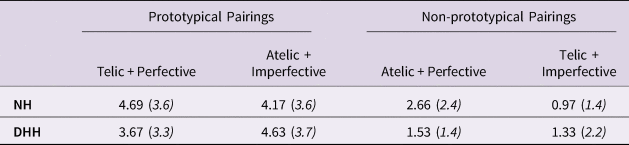
Figure 1 and Table 2 show the average number of perfective and imperfective morphological forms used by each participant during the free-play session broken down by the lexical aspect type and participant group. We conducted a repeated measures ANOVA with lexical aspect (telic vs. atelic) and grammatical aspect (perfective vs. imperfective) as within-subjects variables and hearing status as a between-subjects variable (NH vs DHH); the dependent variable was the number of tokens for each child. There was no main effect of hearing status, F (1,57) = 0.48, p = .49, reflecting the fact that both groups produced roughly the same number of codable tokens overall. There was also no main effect of grammatical aspect, F (1,57) = 1.15, p = .29, showing that children produced both perfective (simple past) and imperfective (progressive -ing) forms in equal quantities. There was, however, an interaction between hearing status and grammatical aspect, F (1,57) = 4.9, p = .03, partial eta squared = .08, revealing that the DHH children produced fewer perfective forms and more imperfective forms relative to the NH children. For lexical aspect, there was a slight, but non-significant trend for children to produce more atelic than telic predicates, F (1,57) = 3.9, p = .054, and no interaction between lexical aspect type and hearing status, F (1,57) = 0.0, p = .99. Children in both hearing groups produced similar numbers of each kind of lexical aspect predicate.
Children's Production of Aspect Morphology

Average number of productions of aspect morphology for NH and DHH children (standard deviations in parentheses)

Note: NH = normal hearing; DHH = Deaf and Hard-of-Hearing
Critically, there was a significant interaction between lexical aspect and grammatical aspect, F (1,57) = 70.3, p < .001, partial eta squared = .55, reflecting the expected prototype effect. Grammatical aspect forms appeared on lexical aspect predicates far more frequently in the prototypical pairings (perfective + telic and imperfective + atelic) than in the non-prototypical pairings (imperfective + telic and perfective + atelic). However, there was not a significant three-way interaction of grammatical aspect, lexical aspect, and hearing status, F (1,57) = 0.23, p = .88. The strength of the prototype effect was similar in both NH and DHH children.
One potential concern with these data is that the absolute numbers of tokens per child is relatively small and averaging across a few children with particularly small numbers may be skewing the data. We therefore classified each child for whether they individually produced more prototypical pairings (perfective + telic or imperfective + atelic), more non-prototypical pairings (perfective + atelic or perfective + telic), or equal numbers of both. Within the NH group, 24 of the 29 children produced more prototypical pairings than non-prototypical ones; within the DHH group, 26 of the 30 children also produced more prototypical pairings than non-prototypical ones. The effect thus held both for the groups as a whole and for almost all individual children, as well.
Discussion
The acquisition of aspectual morphology requires children to link acoustically transient forms in the input with abstract meanings in their semantics. This study examined the naturalistic production of aspect morphology in a group of DHH children. By definition, these children have reduced access to the acoustic signal than their NH counterparts; nevertheless, these data demonstrate that they show very similar patterns of production of aspectual morphology. Specifically, DHH children produced aspectual morphology in similar quantities to the NH control group and also favored prototypical pairings of aspect morphology with lexical aspect type to similar degrees.
Thus, the core hypothesis that motivated this study turned out to be unsupported: the DHH children in this sample appear to be organizing their temporal semantic system in a typical way to support its acquisition and use. This null effect is noteworthy because previous research has found that most domains of spoken language, including subdomains of morphosyntax, are areas of difficulty for children with hearing loss (Blamey et al., Reference Blamey, Sarant, Paatsch, Barry, Bow, Wales and Tooher2001; DesJardin et al., Reference DesJardin, Ambrose, Martinez and Eisenberg2009; Koehlinger et al., Reference Koehlinger, Van Horne and Moeller2013; McGuckian & Henry, Reference McGuckian and Henry2007; Moeller et al., 2007; Tomblin et al., Reference Tomblin, Harrison, Ambrose, Walker, Oleson and Moeller2015; Werfel, Reference Werfel2018). One possible reason for the null effect is that the DHH children in this sample may have had comparatively good language skills for children with hearing difficulties. We note that all of the DHH children were all independently verified as having hearing impairments and, even within this task, produced fewer difficult consonant clusters with their aspectual morphology. Therefore, their reduced access to auditory information was precisely as expected and any preservation of their language skills cannot be attributed to more typical hearing or particularly good acoustic access to the signal. However, it is also the case that while the DHH children in this sample performed significantly more poorly than the NH controls on standardized language assessments, their scores were not as low as many of those in previous studies (Hayes, Geers, Treiman & Moog, Reference Hayes, Geers, Treiman and Moog2009; Niparko, Tobey, Thal, Eisenberg, Wang, Quittner & CDaCI Investigative Team, Reference Niparko, Tobey, Thal, Eisenberg, Wang and Quittner2010; Nittrouer, Reference Nittrouer2010). It is possible that this particular group of DHH children had developed better than usual compensatory strategies for language learning which may have been reflected in their aspectual organization.
Alternatively, it may be that the semantic organization of aspect is a task that can be done by leveraging a relative strength of DHH children – their lexical knowledge (Jung et al., Reference Jung, Reed, Wagner, Stephens, Warner-Czyz, Uhler and Houston2020). While the verbal markers of grammatical aspect are clearly within the morphosyntactic domain, the lexical aspect classifications of telicity depend primarily on knowledge of open class words (verbs, nouns) and perhaps the DHH children were strong enough with their lexicons to help them access and interpret the grammatical aspect morphology that interacts with lexical aspect. This possibility cannot be ruled out with the current data but would require more direct testing of children's semantic interpretations of a variety of aspectual combinations (as in Blank et al., Reference Blank, Holt and Wagner2020).
One of the initial motivations for expecting that DHH children would have difficulty organizing their aspectual semantics came from a hypothesis generated about children with SLI (Leonard et al., Reference Leonard, Eyer, Bedore and Grela1997; Leonard, Reference Leonard2014) – namely, that their persistent difficulties with tense and aspect morphology might be a downstream effect of auditory processing problems. The current results show that simply having reduced acoustic access to those forms does not necessarily keep a child from using those forms in a semantically motivated way. Of course, other studies have similarly noted that DHH children tend to out-perform children with SLI on various tests of language proficiency (Briscoe, Bishop & Norbury, Reference Briscoe, Bishop and Norbury2001; de Hoog et al., Reference de Hoog, Langereis, van Weerdenburg, Knoors and Verhoeven2016; Norbury et al., Reference Norbury, Bishop and Briscoe2001) and the nature of the auditory difficulties is quite different between children with SLI and DHH children. But the current results are at least consistent with the idea that the acquisition of aspectual semantics is not impeded by some reduction in acoustic access to the grammatical aspect forms.
The one dimension of the data where the DHH children differed in their production of aspectual forms from NH children concerned past tense forms: the DHH children produced significantly fewer of these than the NH children did overall (and see also Hammer, Reference Hammer2010 for a similar finding in Dutch children with CIs). Further investigation of these data showed that DHH children produced more irregular past forms while the NH children produced more regular past forms. This difference in quantity of regular/irregular forms comes out in the analysis of final consonant clusters. Most of the complex clusters involve regular past tense forms (walked, knocked, supposed) and NH children produced significantly more such forms. DHH children may have favored irregular past tenses because of their acoustic salience. Irregular past tenses frequently involve changes to the (acoustically long) internal vowel rather than the (acoustically short) final consonant. This difference reinforces the fact that DHH children have reduced access to the acoustic signal compared to NH children, and their language production accommodates to that fact. This accommodation, however, does not have cascading implications for how these children construct their aspectual semantics and integrate grammatical aspectual morphology with lexical aspectual types.
One additional difference found between the groups concerned their parents. The parents of NH and DHH children were largely the same as each other. Most notably both sets of parents produced the prototypical pattern of aspectual use in their own speech, thus providing their children with relevant input. However, the parents of DHH children had lower MLU's than their NH counterparts and similarly showed a trend to use fewer final consonant clusters than their NH counterparts. Recall that DHH children showed the same pattern relative to NH children. While these data point to a relationship between the input of DHH children and their parents, it is unclear how to interpret the directionality of the relationship. On one hand, this relationship could reflect parents of DHH children providing subtly different input data to their children than parents of NH children; on the other, it is possible that both sets of parents are displaying appropriate sensitivity to their children's language ability and communicative needs (see Bergeson, Miller & McCune, Reference Bergeson, Miller and McCune2006).
Finally, we note that the aspectual prototype pattern has been previously found among very young, NH children, even children as young as 2 years old (Bloom et al., Reference Bloom, Lifter and Hafitz1980; Shirai & Andersen, Reference Shirai and Andersen1995). While the pattern persists in older children's (and even adults’) speech, it tends to get somewhat weaker with age (Wagner, Reference Wagner2009). The fact that the NH children in this sample, as well as both the NH and DHH parents, robustly showed the pattern might suggest that the free-play session we taped was particularly conducive to generating it. It also is possible that the DHH children do have delays in their aspectual morphology and this task was not sensitive enough to reveal them. Nevertheless, this study does show that these DHH children are creating the same semantic foundation for their aspectual system that NH children are.
Conclusion
The current investigation has some limitations, including a heterogenous group of DHH children with losses ranging from mild to profound, and a sample size that, while comparable to many pediatric hearing loss studies, may have prevented us from detecting some effects. Moreover, our data were composed exclusively of children's free productions, which might differ from those obtained under an elicited production task or from a comprehension measure. Even with these limitations, the current study is the first to investigate the naturalistic use of aspectual morphology in DHH children compared to established semantic patterns observed in NH children. Despite DHH children's reduced access to the acoustic signal, similar to NH children, they showed prototype effects in which a preference was observed for perfective + telic and imperfective + atelic pairings over perfective + atelic and perfective + atelic pairings. These results suggest that DHH children develop along similar trajectories for aspectual organization as their NH peers.
Acknowledgements
We thank Bobbi Colatruglio, Dr. Carrie Davenport, Allison Ditmars, Shirley Henning, Izabela Jamsek, and Caitlin Montgomery for their assistance in data collection, and Amanda Heath and Emily Thompson for their assistance in data transcription. We also extend a special thanks to the families who participated in this study. This project was supported by the National Institutes of Health (R01DC014956).