





Voluntas occupies a distinctive place in nonprofit and civil society scholarship. Since its founding, the journal has aimed to serve as an international and interdisciplinary forum for research on the third sector, and as the official journal of the International Society for Third-Sector Research (ISTR), it has also carried an important field-building role (Anheier & Knapp, Reference Anheier and Knapp1990). Over time, that role has only become more consequential. The study of nonprofit organizations, civil society, philanthropy, volunteering, NGOs, social entrepreneurship, social enterprise, and the broader third sector has expanded in scope, geography, and methodological sophistication. In that environment, the journals that define standards, identify emerging themes, and connect otherwise fragmented conversations matter a great deal.
Voluntas is now widely recognized as one of the leading journals in the field. (Walk and Andersson Reference Walk and Andersson2020) observed that a majority of the nonprofit and civil society scholars they surveyed regarded it as a top-tier outlet. That standing gives the journal influence beyond publication counts alone. What appears in Voluntas helps signal what topics are gaining traction, what kinds of evidence are considered persuasive, which national contexts are visible, and where the field may still need to broaden its lens.
In 2026, Voluntas transitioned from Springer to Cambridge University Press as an open-access journal, presenting new opportunities amid rapid changes in scholarly publishing. This editorial offers a descriptive retrospective on the journal’s publications from 2014 through 2024, including research articles as well as book reviews. Our purpose is not to present a full bibliometric study or a technical methods paper. Instead, we offer an accessible overview of what the journal’s publication record suggests about the current shape of nonprofit and civil society research. Looking across 1,287 published items over the 11-year period, several patterns stand out. Voluntas has grown and then stabilized at a high level of output. It is unmistakably international in reach, but that internationalism remains unevenly distributed. Its thematic center of gravity remains philanthropy, organizational and institutional analysis, and civil society and civic engagement. Methodologically, the journal continues to be led by empirical work, with quantitative and qualitative studies together accounting for roughly two-thirds of all published items. Taken together, these patterns present an encouraging picture of a journal that is both established and still evolving. They also suggest several opportunities for Voluntas and for ISTR as the society and its journal look ahead to the next decade.
Voluntas and the work of field-building
The journal’s long-term mission provides a useful starting point for interpreting the decade under review. In their inaugural editorial statement, Anheier and Knapp (Reference Anheier and Knapp1990) positioned Voluntas as a venue that would strengthen both the international and interdisciplinary character of research on the voluntary and nonprofit sector. A decade later, Kendall’s (Reference Kendall2000) reflection on the journal emphasized the breadth of contexts represented in the publications while also underscoring how much remained to be understood about the “hydra-like” character of the third sector across societies. Enjolras (Reference Enjolras2010), writing at the beginning of his term as Editor-in-Chief, again highlighted both the opportunities and the risks facing the field: expansion had increased legitimacy, but it also brought the dangers of fragmentation, specialization, and regionalism.
Those concerns continue to resonate. The challenge for a journal like Voluntas is not merely to publish excellent individual papers. It is to maintain a space where work emerging from different national settings, disciplinary traditions, and research designs can still be read as part of a shared scholarly conversation. The past decade suggests that the journal has largely succeeded in doing so. At the same time, the publication record shows where conversations continue to cluster and where more bridges could be built.
Output growth
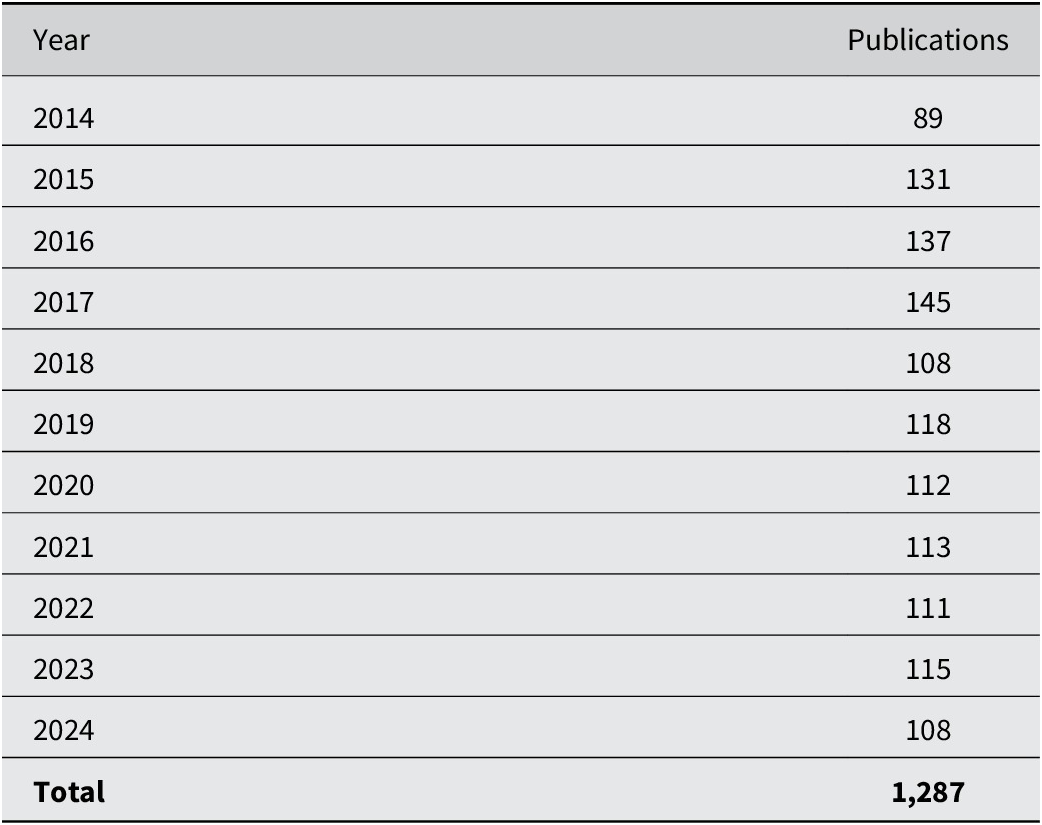
Voluntas was launched in 1990, and over the first 5 years (volumes 1 to 5) about 80 articles were published in 14 issues of the journal. Since then, the output of the journal has grown considerably. By our count, between 2014 and 2024, Voluntas published 1,287 articles and book reviews, averaging 117 pieces per year. Output rose from under 100 (89) in 2014 to a peak of 145 in 2017. After that expansionary phase, publication volume settled into a relatively stable range of roughly 108 to 118 pieces annually. This suggests that the journal did not simply experience a temporary surge in 2015; rather, it entered a period of sustained, high-volume production consistent with a mature and active field.
This stabilization is important for two reasons. First, it signals continuing demand from authors working across nonprofit, civil society, philanthropy, and related areas. Second, it suggests that Voluntas has become a dependable venue for a wide range of contributions rather than a niche outlet defined by a narrow slice of scholarship. In editorial terms, this kind of stability can be an asset as it gives the journal room to maintain established strengths while also curating new directions (Table 1).
Number of publications in Voluntas, 2014–2024

Table 1. Long description
The table consists of two columns: Year and Publications.
* 2014: 89 publications.
* 2015: 131 publications.
* 2016: 137 publications.
* 2017: 145 publications.
* 2018: 108 publications.
* 2019: 118 publications.
* 2020: 112 publications.
* 2021: 113 publications.
* 2022: 111 publications.
* 2023: 115 publications.
* 2024: 108 publications.
* Total: 1,287 publications.
The data shows a peak in publication volume in 2017, followed by a relatively stable output ranging between 108 and 118 publications per year from 2018 through 2024.
International reach yet uneven representation
One of the clearest findings from the past decade is that Voluntas has achieved substantial international reach, though not evenly so. Across the 1,287 items published between 2014 and 2024, lead authors from 63 countries were represented—an impressive breadth for any journal, and especially for one whose mission since its inception has been explicitly international. Yet this breadth coexists with clear concentration. As Table 2 shows, the United States accounts for 355 lead-authored items over the period, followed by the United Kingdom, China, Canada, Germany, and Australia.
Geographic distribution of authors by country and year

Table 2. Long description
The table lists author counts across 61 countries and regions over an 11-year period. The columns are Country, years 2014 through 2024, and Total.
Top contributing countries by total count include:
* United States: 355 total (peaking at 42 in 2017).
* United Kingdom: 93 total (consistent range of 5 to 11 per year).
* China: 73 total (peaking at 13 in 2016).
* Canada: 69 total (peaking at 10 in 2017).
* Germany: 67 total (peaking at 13 in 2016).
* Australia: 56 total (peaking at 10 in 2019).
* Spain: 45 total.
* The Netherlands: 44 total.
* Italy: 43 total.
* Belgium: 34 total.
Other notable countries include Israel (27), Sweden (25), Denmark (24), Switzerland (21), Austria (20), and South Korea (19). Many countries, such as Egypt, Iran, and Argentina, have a total count of 1.
The bottom row provides annual totals for all countries:
* 2014: 89
* 2015: 131
* 2016: 137
* 2017: 145
* 2018: 108
* 2019: 118
* 2020: 112
* 2021: 113
* 2022: 111
* 2023: 115
* 2024: 108
* Grand Total: 1,287.
This pattern should be read in two ways. On the one hand, it confirms that Voluntas has built a genuinely international authorship base. On the other hand, it shows that the journal’s internationalism remains uneven, with much of its published output anchored in North America, Western Europe, Australia, and increasingly in China, while many other countries appear only occasionally. In that sense, Voluntas is global in reach, but it also reflects the wider asymmetries that continue to shape academic knowledge production. Because these figures are based on lead authors only, they do not capture the full diversity of multi-authored collaborations; still, they offer a useful indicator of who is most visible in the journal.
A similar concentration appears in the settings studied. Our analysis found that the most frequently examined contexts were North America, Western Europe, and China, suggesting that the geography of authorship and the geography of scholarly attention are closely related. This is not surprising. Researchers often work in settings where they have linguistic competence, institutional access, policy familiarity, and stronger professional networks. At the same time, this concentration points to an important editorial opportunity. If Voluntas seeks not only international authorship, but also stronger comparative and contextual insight, the journal would benefit from more work that connects regions, moves across cases, and brings less-represented settings into dialogue with the field’s dominant sites of inquiry.
What themes have defined the journal?
Given Voluntas’ longstanding commitment to publishing research from a plurality of disciplinary, methodological, and international perspectives, it is unsurprising that the journal’s output over the past decade spans a wide range of questions and substantive areas. To make that diversity more comprehensible, we grouped the 2014–2024 publications into seven broad thematic categories, shown in Table 3.
Thematic distribution of publications, 2014–2024

Table 3. Long description
The table consists of 13 columns: Topic, years from 2014 to 2024, and a Total column.
* Philanthropy: 20 in 2014, peaking at 65 in 2019, with a total of 392.
* Institutional and Organizational Research: 27 in 2014, peaking at 51 in 2016, with a total of 331.
* Civil Society and Civic Engagement: 19 in 2014, remaining relatively stable, with a total of 269.
* Social Entrepreneurship, Enterprises and Social Economy: 5 in 2014, peaking at 19 in 2017, with a total of 111.
* State-Nonprofit Relationship: 11 in 2014, with a total of 82.
* Nonprofit Management and Leadership: 7 in 2014, with a total of 57.
* Methodology: No entries until 2020, peaking at 23 in 2023, with a total of 45.
The annual totals for all topics combined are: 89 in 2014, 131 in 2015, 137 in 2016, 145 in 2017, 108 in 2018, 118 in 2019, 112 in 2020, 113 in 2021, 111 in 2022, 115 in 2023, and 108 in 2024, resulting in a grand total of 1,287 publications.
Three categories account for the clear majority of the journal’s output: Philanthropy (392 items), Institutional and Organizational Research (331), and Civil Society and Civic Engagement (269). Together, these categories comprise just over three-quarters of all published items during the review period. Philanthropy’s leading position reflects the sustained vitality of scholarship on volunteering, fundraising, donor behavior, humanitarianism, and related forms of giving and prosocial action. The prominence of Institutional and Organizational Research points to continued interest in accountability, legitimacy, organizational capacity, governance, and sustainability. Civil Society and Civic Engagement, meanwhile, highlights the journal’s enduring concern with participation, advocacy, activism, collaboration, and the democratic functions of associations.
The remaining categories are smaller in number but still important in what they reveal about the journal’s breadth. Social Entrepreneurship, Enterprises, and Social Economy reflects continued attention to market-oriented approaches to social value creation, hybridity, and innovation. State-Nonprofit Relationship shows that public policy, regulation, contracting, and welfare-state arrangements remain central concerns, even if they have not constituted the dominant frame of the decade. Nonprofit Management and Leadership likewise confirms that Voluntas continues to publish research on the internal practices and capacities of nonprofit organizations. Inevitably, there is overlap across these categories. That overlap is itself informative, as the journal has continued to publish work that spans both the organizational and the civic faces of the field. This remains one of Voluntas’ great strengths. The nonprofit and third sector are not only managerial or policy domains; they are also arenas of participation, identity, conflict, and social change.
The smallest category is Methodology. That finding should not be read to mean that methodology is unimportant in Voluntas or in nonprofit and third-sector research more broadly. Rather, it suggests that methodological reflection has only rarely appeared as a visible topic in its own right.
Seen in this light, the two methods special issues published by the journal at the end of 2022 and the beginning of 2023 are worth noting. They made methodological reflection far more visible within the journal and, in doing so, highlighted an appetite in the field for more explicit discussion of how third-sector research is conducted.
Methodological patterns in a plural field
Table 4 suggests a journal that is methodologically broad and firmly anchored in empirical inquiry.
Methodological distribution of publications, 2014–2024

Table 4. Long description
The table tracks seven methodological categories across an 11-year period. The columns represent years from 2014 to 2024, followed by a Total column. The rows are as follows.
* Quantitative: Starts at 26 in 2014, peaks at 50 in 2015 and 2016, and ends at 43 in 2024, with a total of 442.
* Qualitative: Starts at 25 in 2014, peaks at 47 in 2016, and ends at 35 in 2024, with a total of 394.
* Book Review: Starts at 16 in 2014, peaks at 29 in 2017, and ends at 18 in 2024, with a total of 182.
* Theoretical Analysis: Starts at 13 in 2014, peaks at 24 in 2019, and ends at 4 in 2024, with a total of 122.
* Literature Review: Starts at 6 in 2014, peaks at 10 in 2015, and ends at 4 in 2024, with a total of 64.
* Mixed Methods: Starts at 3 in 2014, peaks at 6 in 2015, 2019, and 2020, and ends at 4 in 2024, with a total of 44.
* Methodological Analysis: Shows no data for most years except 1 in 2015, 1 in 2020, 17 in 2022, and 20 in 2023, with a total of 39.
The bottom row shows the yearly totals: 89 in 2014, 131 in 2015, 137 in 2016, 145 in 2017, 108 in 2018, 118 in 2019, 112 in 2020, 113 in 2021, 111 in 2022, 115 in 2023, and 108 in 2024. The grand total of all publications is 1,287.
Quantitative studies account for 442 items and qualitative studies for 394, together representing roughly 65 percent of all publications between 2014 and 2024. Book reviews remain a substantial feature of the journal (182 items), while theoretical analyses (122) and literature reviews (64) also make important contributions to its intellectual life. Mixed-methods studies (44) and methodological analyses (39) are present, but comparatively limited.
Several conclusions follow from this pattern. First, Voluntas remains strongly oriented toward empirical research. Second, the journal does not exhibit a strong methodological monoculture. Quantitative work is the single largest category, but qualitative research follows closely behind, suggesting a field that continues to value different forms of evidence, explanation, and interpretation. Third, conceptual and synthetic contributions still matter, even if they occupy less space than empirical studies. That too is important. A field needs data-rich studies, but it also needs theoretical framing, interpretive synthesis, and cumulative reflection.
At the same time, Table 4 suggests an important distinction between methodological diversity in practice and methodological reflection as an explicit topic. The journal clearly publishes work using a wide range of approaches, but comparatively few items have been devoted directly to methods themselves. In that sense, methodology has often been present in Voluntas as an embedded feature of scholarship rather than as a sustained subject of debate in its own right. This is precisely the gap identified in the two methods special issues published in 2022 and 2023. The guest editors noted that even though third-sector research is already diverse in its epistemologies, tools, and traditions, the field has devoted too little visible attention to questions of research design, transparency, pluralism, data representation, and the ethical implications of methodological choice (Kim & Raggo, Reference Kim and Raggo2022). The response to this observation was striking, with the guest editors receiving 131 proposal abstracts and ultimately publishing 37 manuscripts across the two volumes, suggesting that the demand for venues devoted to research methods and process, and not only research findings is substantial.
What Table 4 illustrates is encouraging but also instructive. It confirms that Voluntas has preserved a plural methodological core, yet it also points to an opportunity: to create more space for explicit theoretical and methodological discussion. For a journal that serves an international and interdisciplinary readership, that kind of reflection is not peripheral. It is central to how the field improves its standards, broadens its toolbox, and remains open to new forms of evidence without losing sight of questions of rigor, equity, and relevance.
What comes next for Voluntas?
A retrospective is most useful when it does more than summarize the past. The publication record from 2014 to 2024, read alongside reflections by three recent Editors-in-Chief of Voluntas (Appe, Reference Appe2025; Simsa & Brandsen, Reference Simsa and Brandsen2021), suggests several avenues and priorities for the future. These reflections are helpful because they move beyond broad aspiration and speak directly to the opportunities and constraints facing the journal as a central outlet for ISTR and for the wider third-sector research community.
A first observation is to continue deepening internationalism, not only in where manuscripts come from, but in the kinds of conversations the journal enables and the forms of support it provides. Our review shows a broad authorship base, yet the pattern remains uneven. Simsa and Brandsen (Reference Simsa and Brandsen2021) observed that published papers continued to be dominated by authors from North America, Europe, and Australia, while Asia beyond China, Africa, and Latin America remained underrepresented. They also stress that this imbalance reflects structural disparities in training, institutional support, and language resources, not problems that a journal can solve by invitation alone. Appe’s (Reference Appe2025) reflections suggest a more constructive path forward, including targeted special issues, translation support, and workshops that lower barriers to participation. Her example of the Latin America special issue, supported by translation from Spanish and Portuguese into English and a two-day virtual workshop, shows that editorial design can make internationalization more substantive and more equitable. As noted in this review, Voluntas has clearly succeeded in attracting work from a broad set of countries. The next step is to cultivate more scholarship that connects regions and cases that do not typically travel together in the literature. Comparative work across less frequently paired regions would add analytical value while also broadening the field’s center of gravity. This is closely aligned with ISTR’s mission to recognize and support researchers globally and to advance knowledge production across the full spectrum of the third-sector community.
Second, the journal should continue welcoming strong national case studies while insisting on wider relevance and encouraging more comparative work. This expectation has long been part of Voluntas’ identity, and it remains important. A paper need not be cross-national to matter internationally; however, it should help readers beyond the focal setting think differently about theory, institutions, methods, or practice. The former editors further note that comparative work, especially cross-national comparison, remains rarer than the journal’s mission would imply. That makes comparative scholarship not just desirable, but strategically important to the journal’s future evolution and profile.
A third priority is to make more room for methodological reflection and innovation, while keeping pluralism at the center. The past decade shows a field rich in empirical work but thinner in explicit methodological debate. The two methods special issues help define what is at stake. The first called for greater openness, transparency, and methodological pluralism, arguing that the field needs more visible discussion of research design, epistemological assumptions, and the research process itself. The second extended that conversation into the digital realm, emphasizing that computational tools, administrative data, and new forms of online evidence create opportunity, but also raise issues of consent, representation, privacy, bias, and exclusion. In this respect, the future methods agenda for Voluntas is not only about technical sophistication; it is also about reflexivity, accountability, and ensuring that (technological) innovation does not narrow the field’s understanding of the people and organizations it studies.
A fourth priority is to strengthen theory building, the application of theory, and scholarly communication. Appe (Reference Appe2025) is very direct on this point, noting that too many submissions fail to use theory well enough to build, test, or extend conversations in the field, and that this is one reason manuscripts are rejected for publication. She also argues that the field should move toward greater concision, with supplementary online materials offering one way to preserve depth without sacrificing readability. This is an important addition to the journal’s future agenda. The next decade should not simply bring more submissions; it should bring work that is more clearly framed, more theoretically engaged, and more deliberately written for an international and interdisciplinary audience.
A fifth priority is to preserve Voluntas’ broad intellectual identity while continuing to curate conversations across topics, regions, and approaches. The concentration of publications in philanthropy, organizational research, and civic engagement is understandable, but it is also essential to highlight that the journal’s value lies in its capacity to convene a wider field. Simsa and Brandsen (Reference Simsa and Brandsen2021) describe a field whose center of gravity has shifted over time, with greater visibility for social enterprise, philanthropy, grassroots action, and new forms of volunteering. Appe (Reference Appe2025), meanwhile, highlights special issues and virtual issues as tools for sustaining ongoing scholarly conversations and connecting emerging themes to the journal’s wider aims and scope. The lesson is not to narrow the journal’s scope, but to continue using careful curation to keep the field connected.
Sixth, the future of Voluntas depends not only on what gets published, but also on the infrastructure that makes publication possible. One of the clearest warnings in the recent editorials concerns peer review. Simsa and Brandsen (Reference Simsa and Brandsen2021) note that the volume of submissions has placed growing strain on the review system, while Appe (Reference Appe2025) describes increasing difficulty in securing reviewers, keeping them engaged across rounds, and obtaining timely, constructive reports. She goes so far as to call for stronger systems of accountability and more deliberate training of scholars and doctoral students as reviewers. This is an especially important point for ISTR and similar scholarly associations. If the society’s mission is to support global knowledge production, then reviewer development, mentorship, and editorial socialization are not peripheral tasks; they are part of the field’s long-term capacity.
Finally, one feature that will influence all aspects of publishing for the foreseeable future is the use and impact of artificial intelligence (AI) systems. We are only beginning to understand the influence of this technological development, but it is clearly a double-edged sword as AI can, for example, improve efficiency and lead to productivity gains while also creating new risks around trust and misuse.
Taken together, these reflections suggest that the next chapter for Voluntas should be defined not by narrower specialization, but rather by deeper internationalism, stronger comparative ambition, more explicit methodological debate, clearer theoretical engagement, and renewed investment in the scholarly institutions and practices that sustain the journal itself. In that sense, the future challenge is not only to publish excellent research, but also to build the conditions under which a plural, global, and intellectually ambitious field can continue to flourish.
Conclusion
The decade from 2014 to 2024 shows that Voluntas is a journal with both reach and responsibility. Its publication volume reflects a field that is active, vibrant, and increasingly mature. Its authorship record confirms a genuinely international presence, even as important imbalances remain. Its thematic focus shows the continuing centrality of philanthropy, organizational and institutional analysis, and civil society and civic engagement. Its methodological profile reflects a strong empirical orientation and a welcome pluralism between quantitative and qualitative inquiry. For readers of Voluntas and members of ISTR, the main lesson is not simply that the journal has been successful. It is that this success creates new opportunities. A leading international journal must do more than mirror the field; it can and should also help shape it. That means widening representation, encouraging comparison, supporting methodological reflection, and continuing to publish work that is locally grounded but internationally meaningful.
The past decade shows that the journal is exceptionally well positioned to do exactly that. Its history, reach, and intellectual breadth give it a unique capacity not only to reflect where nonprofit and civil society scholarship has been, but also to help guide where it goes next. If the last decade demonstrates anything, it is that Voluntas remains a vital forum for a global and evolving field—and that its next chapter can be even more inclusive, connected, and influential.


 Open access

