1 Introduction
Contracting social relationships in communities of varying complexity and fluidity is a fundamental social action that people engage in. Both linguists and historians usually reconstruct communities in territorial terms as common localities but, unlike sociolinguists and dialectologists, historians seldom combine this information with the community members’ linguistic behaviour. My aim in this article is to present some sociolinguistic tools for tackling the task and to revisit their application to historical sociolinguistic research in order to better understand the workings of linguistic change. The impetus for this work comes from two sources: new digital resources, which can provide a rich contextualization for the material studied, and advances in quantitative methods that help us make the best use of the linguistic data available. The locality I focus on is Early Modern London and the sociolinguistic tool I discuss is social network analysis, which can be used to relate territoriality and mobility to the diffusion of linguistic change.
The sociologist Mark Granovetter (Reference Granovetter1983) introduced his idea of social network analysis informally as follows:
The argument asserts that our acquaintances (weak ties) are less likely to be socially involved with one another than are our close friends (strong ties). Thus the set of people made up of any individual and his or her acquaintances comprises a low-density network (one in which many of the possible relational lines are absent) whereas the set consisting of the same individual and his or her close friends will be densely knit (many of the possible lines are present). (Granovetter Reference Granovetter1983: 201–2)
Granovetter's interest was largely focused on low-density networks and the strength of weak ties in the diffusion of cultural innovations. Subsequently, social network analysis has been adopted by scholars in various other fields, including sociolinguistics, who argue that weak ties are likely to promote the diffusion of linguistic change and strong ties to inhibit it (Milroy & Milroy Reference Milroy and Milroy1985, Milroy Reference Milroy2004: 562–5).
For sociolinguists, the practical challenges in social network analysis lie in reconstructing network structures and documenting the network members’ linguistic practices. As personal interviews and participant observation are not an option for earlier periods, the idea of linking social networks and linguistic practices of the past presents problems which are directly proportional to the amount and detail of the linguistic and external evidence recoverable from a given period or group of people. The more recent past, the eighteenth century in particular, has therefore attracted more research than earlier times (e.g. Bax Reference Bax2000; Fitzmaurice Reference Fitzmaurice2000, Reference Fitzmaurice and Hickey2010; Tieken Boon van Ostade Reference Tieken-Boon van Ostade, Dossena and van Ostade2008, Reference Tieken-Boon van Ostade2009: chapter 6; Sairio Reference Sairio2009). In-depth studies focusing on the Middle Ages, such as those on the fifteenth-century Paston family by Bergs (Reference Bergs2005) and Conde-Silvestre & Hernández-Campoy (Reference Conde-Silvestre and Hernández-Campoy2004), stand out as exceptions. For some reason, work on the sixteenth and seventeenth centuries is also scarce (but see Nurmi Reference Nurmi, van der Wal and Rutten2013).
My article will concentrate on Early Modern London as a place where people could contract a large number of weak ties, on the one hand, and have strong ties locally in their ‘worlds within worlds’, as Rappaport (Reference Rappaport2002) put it, on the other. London's population quadrupled between 1550 and 1650, when it has been estimated at about 400,000 inhabitants (Boulton Reference Boulton1987: 3). Apart from waves of immigration, large sections of the population of Tudor and Stuart England came into contact with the capital during their lives; it has been estimated that one out of eight adults had some experience of London life in 1550–1650 (Nevalainen & Raumolin-Brunberg Reference Nevalainen, Raumolin-Brunberg, Kastovsky and Mettinger2000). One of my two case studies presents a merchant network with extensive London ties and the other focuses on a native Londoner who was multiply networked both in the City of London and at the Royal Court in Westminster. Previous research shows that the two localities frequently projected different profiles with regard to language change (Nevalainen & Raumolin-Brunberg Reference Nevalainen and Raumolin-Brunberg2003: chapter 8).
In what follows I will examine the linguistic cohesion of the social networks under study by looking at changes in progress in Tudor and Stuart England and analysing both leaders of linguistic changes and those who resist them. When assessing the role of networks as norm-enforcement mechanisms, this approach recognizes that not all processes of change are socially indexed (Eckert Reference Eckert2000: 139–70; Labov Reference Labov2001: 28–9). The phase of change also matters. I will begin by discussing the ways in which linguists have reconstructed social networks in section 2 and move on to approaches to communities and networks adopted by historians in section 3. Presenting my data and methods in section 4, I reconstruct a Tudor merchant family network in section 5.1 and the web of network ties of Samuel Pepys, a London naval administrator and diarist, in section 5.2. These studies are compared in section 6 and a brief conclusion follows in section 7.
2 Approaches to social networks and communities of practice
For the purpose of measuring social network strength for linguistic analysis, social networks can be defined as the sum of the relationships which an individual has contracted with others over time and space (Milroy Reference Milroy2004: 552). Networks are structural and functional entities that are characterized by the properties of the ties, strong or weak, which connect an individual with other members of their network. These properties can be determined by charting a person's relationships of kin, work and friendship and their territorial clustering, and evaluating network strength on the basis of shared kinship ties, place of work and voluntary leisure activities (Milroy Reference Milroy1987: 141–2).
Granovetter (Reference Granovetter1983) stresses that new ideas are not adopted automatically across social boundaries. Although weak ties may enable homogenization, structural considerations alone cannot explain the adoption of ideas but ‘[c]ontent and the motives for adopting one rather than another idea must enter as a crucial part of the analysis’ (Granovetter Reference Granovetter1983: 216).
Based on the structural and content properties of the ties that make up personal networks, social network analysis typically does not extend to the co-construction of particular social meanings by the network members. To zoom in on those contexts of interaction, the concept of coalition has been introduced to refer to an alliance contracted for a particular purpose, for example, literary, religious or political (Fitzmaurice Reference Fitzmaurice2000, Reference Fitzmaurice and Hickey2010; Milroy Reference Milroy2000: 221). Interwoven into social networks are communities of practice, defined ethnographically as aggregates of people coming together around a particular enterprise; examples range from a garage band and a kindergarten class to a research group (Wenger Reference Wenger1998; Eckert Reference Eckert2000: 34–41; Milroy Reference Milroy2004: 552). Besides their defining characteristics of mutual engagement and joint enterprise, communities of practice come with assumptions about shared repertoires, which can include both linguistic and non-linguistic elements. Shared repertoires reflect the history of a mutual engagement and are used as a resource for the negotiation of meaning in the pursuit of the joint enterprise (Wenger Reference Wenger1998: 82–4).
In a recent volume connecting communities of practice to language change in earlier English, Jucker & Kopaczyk (Reference Jucker and Kopaczyk2013: 19) view shared repertoires in linguistic terms, including grammatical patterns, lexical choices, formulaic expressions, lexical bundles, and so on. Seen from this angle, a community of practice can have a similar homogenizing effect on language practice as a dense social network with strong, multiplex ties, which serves as the interactional site where localized styles and norms are constructed (Milroy Reference Milroy2004: 552).
As family usually makes up one component in social network analysis, Hazen (Reference Hazen2004: 519) raises the issue of the influence of the family unit on sociolinguistic variation. He notes that relatively little is known about the extent to which families use sociolinguistic patterns to signal in-group and out-group status, and whether there is variation in this respect between blood relatives and married relatives. As a relevant sampling unit, families have received a fair amount of attention in historical social network studies (e.g. Bergs Reference Bergs2005).
As shown below, family networks can be embedded in many other communities. The close-knit Tudor family network analysed in section 5.1 is also the core of a London business network, which, in turn, forms part of a larger, geographically mobile merchant community. By contrast, for Samuel Pepys, discussed in section 5.2., the family forms only one of his many parallel sites of interaction in seventeenth-century London. With the Tudor family my interest is in the network's capacity to harmonize its members’ linguistic practices whereas with Pepys the focus shifts to the spread of linguistic influence across his principal interactional sites, the City of London and Westminster.
3 Social history research on communities and networks
Besides offering material for reconstructing personal social networks, social and cultural historians have actively researched social networks and communities. The early seventeenth-century notion of community in fact resembles the concept of community of practice in certain respects. On the basis of historical dictionary evidence, Withington & Shepard (Reference Withington and Shepard2000: 10–11) stress the role of mutual participation in community creation and assert that ‘community was not a given entity, but was rather constructed through the recurrent decisions and actions of people’. It was not until the end of the seventeenth century that the term acquired its explicit relation to place.
On the other hand, Burke (Reference Burke2004) uses the term community to study a variety of domains of language use such as churches, occupations, genders, regions and nations in Europe between 1450 and 1789, linking them to issues in identity formation as well as to the rise of and rivalry between vernaculars. He emphasizes that individuals usually belong to a number of different communities and that:
a record of the language used by an individual on a particular occasion . . . is no more than the record of the identity that came to the fore on that occasion. (Burke Reference Burke2004: 6)
In other words, the degree to which a particular community or social network may serve as a norm enforcement mechanism is likely to vary.
Archival evidence also provides material for reconstructing micro-level social networks. D'Cruse (Reference D'Cruse, Barry and Brooks1994) presents a study of community brokers in early eighteenth-century Colchester, contrasting a shoemaker and church warden with a wealthy Tory attorney, active in local politics. She shows that, setting himself up as a broker between his business clients and patrons, the attorney had many more links and less dense networks than the more densely networked shoemaker. The attorney's business arrangements were, typically, enabled by his household members contributing to both the economic and the domestic enterprise (D'Cruse Reference D'Cruse, Barry and Brooks1994: 181). It was common in trade that ‘relatives provided “an operational extended family” of trusted individuals with shared commercial interests, who provided credit, advice, support, and contacts’ (Wrightson Reference Withington and Shepard2000: 83). In social network terms, this would be an example of an exchange network (Milroy Reference Milroy2004: 551).
Barbara Winchester (Reference Winchester1955) discusses such an operational extended family, the Tudor merchant family of John Johnson, a merchant of the Staple, and his relatives, friends and business associates. She pastes together their life and times based on their correspondence (1541–53), John's account books and other documentary sources. Winchester's lively volume provides a key to understanding the context in which to interpret the letters of the Johnson family that she edited for her doctoral dissertation in history (Winchester Reference Winchester1953). In section 5.1 I study this family network active in and around London.
Directly relevant to my second case study in section 5.2 is Archer's (Reference Archer2000) work on Samuel Pepys's social networks based on his shorthand diary. Archer discusses the information that Pepys records on the people he dined, drank or shopped with in 1660 and 1666, during which time he established himself as a naval administrator with considerable political influence. Focusing on the topography of Pepys's daily movements, Archer shows that the diarist divided his time between the commercial City of London and Westminster, where the central administration of the country and the Royal Court were located.
4 Material and methods
Although the documentation problem besets the work of historical sociolinguists and historians alike, combining various data sources offers new opportunities for connecting historical networks and linguistic information. Social networks as reconstructed by historians can provide a solid basis for linguistic analyses, and many sociolinguistic findings may be further interpreted in terms of social networks. My article explores both these prospects, analysing network members’ participation in language change over time and space. I will focus on the uses of personal letters and diaries in connecting social networks with linguistic usage in the sixteenth and seventeenth centuries.
4.1 Corpora and databases
Designing the Corpus of Early English Correspondence (CEEC) as a data source for historical sociolinguistic work, we mostly worked with existing letter collections, which had been compiled and edited by historians interested in particular individuals, families or indeed diverse coalitions or communities of practice. Many of the family-based collections, for example, were published by local historical societies or record offices and thus represent a wide spread of regionally focused networks. Collections based on individuals – administrators, lawyers, clergymen, merchants, writers, actors and so on – provide material for reconstructing their family and professional networks and gaining at least partial access to their communicative interactions.Footnote 2
The entire corpus covers the period from 1410 to 1800 and consists of material drawn from 192 letter collections and produced by over a thousand letter writers. The 1998 version, which provides the data discussed in this article, extends from c. 1410 to 1681 and comprises 96 collections and 778 writers. A separate database specifies for each letter writer and recipient the metadata available on their life spans, socio-economic status, education, career, social and regional mobility and parents’ background, as well as the relation between the writer and the recipient. The published tagged and parsed version of the corpus, the Parsed Corpus of Early English Correspondence (PCEEC), comes with a selection of these metadata, including bibliographical information on the editions sampled (Nevalainen & Raumolin-Brunberg Reference Nevalainen and Raumolin-Brunberg2003: 43–9; Raumolin-Brunberg & Nevalainen Reference Raumolin-Brunberg, Nevalainen, Beal, Corrigan and Moisl2007).
Compiled by professional historians, these letter editions proved valuable sources for the personal metadata included in the database. In many cases, especially with older editions, they have been supplemented and updated by information from sources like the Oxford Dictionary of National Biography. Various other online resources can take the work further by facilitating the retrieval of external information. Where available, they help contextualize the writers and their contacts and activities in much greater detail than would otherwise be feasible by an individual researcher.
As an example of rich contextualization of an individual, in section 5.2 I discuss the information contained in the diary of Samuel Pepys (1660–9), which has been made available in a weblog format. This site contains the text of his diary from Henry B. Wheatley's edition, the most complete copyright-free version, and ‘thousands of pages of further information about the people, places and things in his world’ (www.pepysdiary.com/about/). This information is invaluable when analysing Pepys's social networks as he recorded them almost on a daily basis over the course of nearly ten years.
This site is a good example of making the most of a particular data source. As a single ego-document, a diary does not of course suffice for ascertaining linguistic influence, but in Pepys's case it can be supplemented by his personal letters, as is done in section 5. However, there are always gaps in the historical record. We often do not have sufficient ethnographic and linguistic information for finding out which ties were meaningful to groups and individuals (Milroy Reference Milroy2000). For the study of language change, aggregate macro-level analyses of changes in progress therefore provide a useful point of comparison for micro level analyses of possible network influence.
4.2 Quantifying Change Database
In this study I look at a number of changes in progress in Tudor and Stuart England to assess the linguistic cohesion of the social networks discussed. My focus will be on those individuals who are leading these processes as opposed to those lagging behind their contemporaries. This information comes from the Quantifying Change Database (Nevalainen et al. Reference Nevalainen, Raumolin-Brunberg and Mannila2011), which is derived from the quantitative analyses carried out in the Sociolinguistics and Language History project (Nevalainen & Raumolin-Brunberg Reference Nevalainen and Raumolin-Brunberg2003). In Nevalainen et al. (Reference Nevalainen, Raumolin-Brunberg and Mannila2011) we developed a computational model for comparing contemporaries in each phase of a given change in order to distinguish progressive and conservative individuals from those in between who were neither.
We distinguished progressive and conservative individuals by means of a resampling technique known as bootstrapping, used to obtain estimates of summary statistics (Efron & Tibshirani Reference Efron and Tibshirani1993). The data were resampled per linguistic variable and per period a large number of times, and the frequency of occurrence of the incoming variant was computed in each resample. The variation observed in the resamples gives a confidence interval for its frequency in the original data. An individual differs from others if their data deviate significantly from the estimate obtained by the bootstrap method. Those individuals can be identified either as progressive or conservative with respect to their contemporaries.
When analysing a change in progress, its temporal progression becomes relevant (see Labov Reference Labov1994: 79–83). We distinguished five stages depending on the overall frequency of the study variable in the community at large: incipient (below 15%), new and vigorous (15%–35%), mid-range (36%–65%), nearing completion (66%–85%), and completed (over 85%; Nevalainen et al. Reference Nevalainen, Raumolin-Brunberg and Mannila2011: 7). In this study I analyse changes at the stages they had reached: (a) by the 1540s and 1550s and (b) by the 1660s and 1670s. Those in the first period encompass two changes in the new and vigorous stage, i.e. the verbal (s) and (ing) variables; those in mid-range three, (neg), (my) and (you); and those nearing completion one, (which). They are defined and illustrated below:
° (s) variable: change in the third-person singular indicative suffix in verbs other than have and do (she go eth → she go es)
° (ing) variable: loss of the preposition of in the object of the gerund (writing ofthe letter → writing Øthe letter)
° (neg) variable: loss of multiple negation (we can notsee nothing → we can notsee anything)
° (my) variable: loss of the nasal in first- and second-person possessive determiners (mine/thineenemy → my/thyenemy).
° (you) variable: replacement of the second-person subject pronoun by the object form (yego → yougo)
° (which) variable: change in the form of the relative pronoun which (the which → which)
In the latter period only two related processes are examined, (s) and (has). At the time the diffusion of verbal -s was as good as completed in verbs other than have and do, and the replacement of hath by has had reached its mid-range in the language community at large, as represented by the wide variety of writers included in the CEEC (Nevalainen & Raumolin-Brunberg Reference Nevalainen and Raumolin-Brunberg2003: chapters 4 and 8; Gries & Hilpert Reference Gries and Hilpert2010: 308, 313).
4.3 Social network applications to CEEC data
To obtain baseline information on processes of language change in Tudor and Stuart England, Nevalainen & Raumolin-Brunberg (Reference Nevalainen and Raumolin-Brunberg2003) studied broad sociolinguistic variables such as gender, socio-economic status and region. We have also analysed some of our findings from the perspective of social networks at the macro-level. Raumolin-Brunberg (Reference Raumolin-Brunberg, Fisiak and Krygier1998) suggests that the English Civil War accelerated language change by virtue of the unprecedented numbers of weak ties it gave rise to. Nevalainen (Reference Nevalainen2000) and Nevalainen & Raumolin-Brunberg (Reference Nevalainen, Raumolin-Brunberg, Kastovsky and Mettinger2000) discuss the role of London in multiplying interpersonal contacts and as a site conducive to language change. Diverse networks and communities of practice have also been studied from various viewpoints using the CEEC and other corpora, including families, caregivers, merchants, printers, groups of early industrialists, and men of science (e.g. Nurmi et al. Reference Nurmi, Nevala and Palander-Collin2009; Kopaczyk & Jucker Reference Kopaczyk and Jucker2013).
Our study of the leaders of linguistic change (Nevalainen et al. Reference Nevalainen, Raumolin-Brunberg and Mannila2011) came to the conclusion that progressiveness and conservativeness can pattern according to the stage, duration and type of the change. Family ties were found to be a common denominator for some multiply progressive individuals. The East Anglian Bacon family, for example, a father and two sons, were all progressive in several changes in the late sixteenth century. Like their father, Sir Nicholas, Edward and Nathaniel Bacon were educated at the University of Cambridge and Gray's Inn in London and were later active in politics. Another family with members progressive in several changes was the Johnson merchant circle, discussed below (Nevalainen et al. Reference Nevalainen, Raumolin-Brunberg and Mannila2011: 29–30).
Another relevant social network approach to the Johnsons was developed by Nurmi (Reference Nurmi, van der Wal and Rutten2013) in her analysis of this wool merchant family and their business associates. To explore the role played by social distance in the use of deontic modals, Nurmi calculated network strength scales (NWS) for the members of the Johnson circle centring on the eldest brother John Johnson. Her analysis was based on two sets of indicators, kinship and business partnership. Rating them, she established network strength scales for nuclear family members and partners in the Johnson trading house. Nurmi's analysis will be referred to in section 5.1.
5 Two case studies
5.1 The Johnson merchant family network
5.1.1 An operational extended family
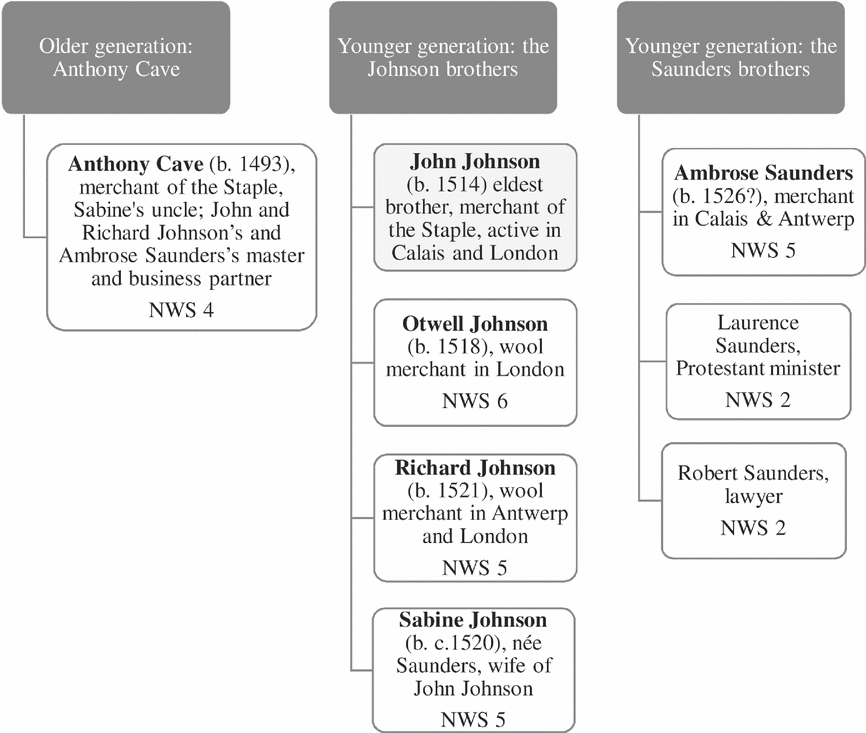
My first study discusses a mid-sixteenth-century family-based network trading in wool and other goods in London, Calais (part of England at the time) and Antwerp. The family business was run from London, Calais and his Northamptonshire estate by John Johnson, a merchant of the Staple and the eldest of the Johnson brothers. His brother Otwell was based in the City of London and Richard, the youngest, in London and Antwerp. John's wife was Sabine Saunders, to whose uncle Anthony Cave both John and Richard had been apprenticed. She herself was variously involved in household and wool trade matters at home. One of her younger brothers, Ambrose Saunders, became a partner in his brother-in-law's business. On Sabine's side there were also two brothers, Robert, a lawyer, and Laurence, a Protestant minister, who were close to the Johnsons in various ways although not their trading partners (Winchester Reference Winchester1953; Reference Winchester1955).
Figure 1 shows these connections and provides the basis for considering them in both family and business terms. The ego in the multiplex family business network, John Johnson, is highlighted in grey. The basic nature of the network ties does not change during the period covered, 1541–53. I have identified the members of the core kin-based business network: the three Johnson brothers, John's wife Sabine, her uncle and John and Richard's master Anthony Cave, and her younger brother Ambrose Saunders. Two other members of Sabine Johnson's family with no direct business connections are included in the figure for comparison. Applying the rating system used by Nurmi (Reference Nurmi, van der Wal and Rutten2013: 169), the network strength scores (NWS) in figure 1 range from the strongest 6 (Otwell Johnson) to the weakest 2 (Laurence and Robert Saunders).
Johnson network's family and business ties
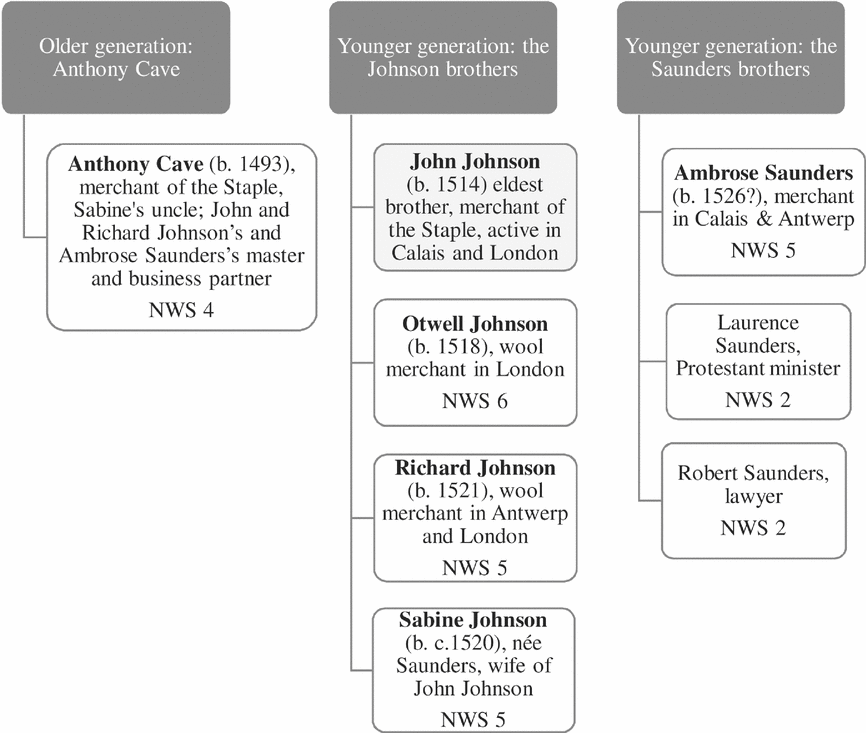
Although my focus is on kinsfolk united by business interests, it is clear that the network was not insulated from others but, by nature of its trade, integrated into several mobile urban networks in London and on the continent. These various merchant communities were characterized by mutual engagement and joint enterprise, and to a certain extent a shared repertoire (see Wenger Reference Wenger1998: 73). My interest is to explore the role of the network in spearheading or possibly retarding processes of language change.
5.1.2 Linguistic analysis
Looking for possible connections between network ties and language variation and change, we may start with the hypothesis that siblings resemble each other with respect to their language variation patterns. In the Johnsons’ case, this assumption is supported by the close-knit structure of the family business network that could be expected to enforce shared linguistic practices. On the other hand, analysing linguistic variation within the family, Hazen (Reference Hazen2004: 518) notes that differences may arise from siblings’ diverse social connections in the community and identification with and participation in diverse communities of practice. This is in evidence, for example, in the linguistic profiles of the two fifteenth-century Paston brothers studied by Conde-Silvestre and Hernández-Campoy (Reference Conde-Silvestre and Hernández-Campoy2004).
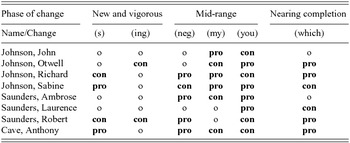
Table 1 shows how the Johnson network members pattern according to their progressiveness (pro) or conservativeness (con) with respect to six ongoing processes of change viewed against the norms of the wider community (for details, see section 4.2).Footnote 3 John Johnson, the ego of the network, is a middle-of-the-roader linguistically: he was neither progressive nor conservative in as many as four out of the six changes studied, and progressive only in his use of the determiners my/thy and conservative in preferring ye to you, both changes at mid-range, between 36 and 65 per cent, in the wider community; see (1).
(1) I sold in the countrey bouthe the rest of your wull and my awne also, so that ye shall have all youre money by Whitsontyde or shortely after with honest proffit, (John Johnson, 1545; CEEC Johnson, 222)
Johnson network members’ participation in ongoing linguistic changes (CEEC, 1540–59)

(pro = progressive, con = conservative, o = in-between)
The youngest of the Johnson brothers, Richard, is like John in that they both profile similarly on (my) and (you). By contrast, John's favourite brother and partner Otwell is his complete opposite with respect to these two processes, preferring you but lagging behind with respect to the (my) variable.
Sabine Johnson resembles her husband John in promoting the short form (i.e. without the nasal) of the first- and second-person determiners, as in (2). Although her usage is categorical, this change is only at mid-range in the community at large at the time and some variation occurs in John's usage, as shown in (3). In general, Sabine is more extreme in her reactions to ongoing changes than John: she promotes the use of third-person -s and subject you but continues using negative concord and the relativizer the which.
(2) I trust I shall have qualles shortely to make fat agenst my ounckell Anthony and my aunt comyn, (Sabine Johnson, 1545; CEEC Johnson, 303)
(3) I have appoynted Ambrose to take owte vijC of the barist of myne awne felles . . . (John Johnson, 1545; CEEC Johnson, 271)
Compared to John, Ambrose Saunders's profile is rather different again: like John he is neither progressive nor conservative with respect to the two new and vigorous changes and the one nearing completion, but as far as (my) and (you) are concerned, he patterns with Otwell. Otwell, too, agrees with John being in-between with respect to two of the changes, the diffusion of verbal -s and the disappearance of negative concord. These results suggest that social proximity need not result in similar profiles in linguistic leadership (see Nurmi (Reference Nurmi, van der Wal and Rutten2013: 180) for similar findings on deontic modals).
As to conservatism, the lawyer Robert Saunders is the most conservative of the Saunders brothers and within the whole extended network: he is lagging behind in the new and vigorous changes (s) and (ing) as well as (you). In three cases his profile matches that of his uncle, Anthony Cave. By contrast, in four changes out of six the clergyman Laurence Saunders is a middle-of-the-roader, just like John Johnson.
Looking at the network from the perspective of the changes, the greatest divide appears with (you), the levelling of the subject and object forms of the second-person pronoun, where the members are either progressive (Otwell, Sabine and her brothers Ambrose and Laurence) or conservative (John, his brother Richard, their master Anthony Cave and Robert Saunders, the lawyer). The relatively low-frequency syntactic variable (ing) makes the least difference, leaving six of the eight members in-between the extremes and the remaining two being conservative.
Although the members of the Johnson merchant network were geographically mobile, key activities of their wool business took place in the City of London. The City was the country's mercantile centre and the government and the Royal Court were located at Westminster. To be able to make comparisons, we sampled writers from both these localities when compiling the CEEC (Nevalainen & Raumolin-Brunberg Reference Nevalainen and Raumolin-Brunberg2003: 162–84). This information enables me to examine the extent to which the Johnsons aligned with their London contemporaries.
To assess the metropolitan allegiances of the network members, I compared the use of the six linguistic variables by individuals resident in the City as opposed to those at Westminster in 1520–59. The results show that most members of the Johnson network were progressive or in-between with respect to which and the loss of negative concord, which were also promoted at Court, i.e. by the royalty, nobility, officials and diplomats resident in Westminster. As to the loss of negative concord, the Saunders brothers and their uncle Anthony Cave were more advanced than the Johnson brothers, as educated men in general were at the time (Nevalainen Reference Nevalainen1999).
By contrast, there were more conservatives at Court than in the City in the use of the originally northern forms my and verbal -s, with respect to which most of the Johnson network members were either in-between or progressive. Sabine Johnson was the only one to be progressive with respect to both of them. Again agreeing among themselves, her brothers and uncle were either in-between or conservative in their use of the short determiner my. Finally, the (you) variable divided the two metropolitan locations into progressive and conservative individuals in equal numbers, just as it divided the Johnson network members.
A brief comparison can be made between the Johnsons and their contemporary Henry Machyn, a merchant taylor (1496/8–1563). Machyn lived in the City and kept a Chronicle between 1550 and 1563, in which he recorded the major events of his time. Analysing the Chronicle, Bailey & Moore (Reference Bailey, Moore, Cain and Russom2007: 242–4) find Machyn linguistically conservative: he regularly uses several outgoing forms, including the which. Findings such as these indicate that there was a good deal of variation in the City as well.
We have seen that the Johnson network had divided allegiances between the City and Westminster depending on the linguistic process in question, with some division within the network also detected among blood relations. As individuals, the network members present rather divergent profiles with respect to changes in mid-range. However, John Johnson, the ego of the network, proved remarkably noncommittal in that he was in-between the two polarities in four processes out of the six studied. In this respect, he was matched by his brother-in-law Laurence Saunders, a clergyman. Both of them had various roles and responsibilities in their communities, which would have placed particular demands on their linguistic choices. Their middle-of-the-road usage may hence have served them in the linguistic marketplace but been less conducive to reinforcing family norms.
5.2 Samuel Pepys's London networks
5.2.1 Locating Pepys's contacts
My second case study approaches the complexity of reconstructing the multiple social networks of someone whose life and circumstances have been extensively documented. Samuel Pepys (1633–1703), a naval administrator, provides detailed information about his daily contacts in the diary that he kept between 1660 and 1669, and a rich documentation has been preserved on his public and private life. He was born in London, the son of a tailor whose family came from Cambridgeshire, and his mother was a London butcher's daughter. Pepys was educated at St Paul's School in London and at Magdalene College, Cambridge. In 1655 he married Elizabeth St Michel and entered the service of his distant cousin Admiral Edward Montagu, later to be created Earl of Sandwich.Footnote 4
In the following decade, Pepys established himself both professionally and financially. The diary also displays the wide range of relations in other spheres of life that he contracted in the 1660s. Archer (Reference Archer2000: 79) concludes that his social life was bi-polar: he was a community broker with frequent contacts both in the City of London and at Westminster. As various linguistic differences have been detected between people active in the City and those associated with the Royal Court at Westminster, a sociolinguist would be interested to know the extent to which Pepys may also have been a linguistic broker (Nevalainen & Raumolin-Brunberg Reference Nevalainen and Raumolin-Brunberg2003: 162–4). The answer will depend on a successful reconstruction of some of Pepys's social networks and connecting these networks with linguistic information. Digital resources such as the diary website discussed in section 4.1 provide a step forward in the first enterprise. Section 5.2.2 compares Pepys's usage with his progressive and conservative contemporaries in the City and at Court.
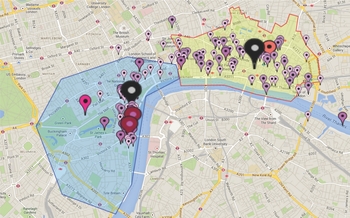
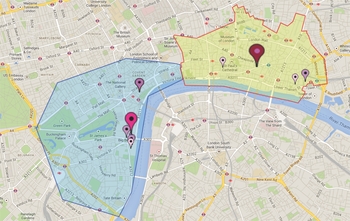
The fact that Samuel Pepys divided his time between the City and Westminster becomes visible when the localities he refers to in his diary are put on a map. Figure 2 presents this information for the City (right) and Westminster (left); the size of the icons corresponds to the number of mentions. The figure maps the same years as Archer (Reference Archer2000), but because of the large number of mentions it only includes three months for both 1660 and 1666.Footnote 5
Pepys's London locations, diary (3 months, January, June and October, 1660 and 1666)

We can see that there are more individual mentions of places in the City than in Westminster, where Pepys's visits concentrated on a more circumscribed area, with Whitehall Palace and Westminster Hall receiving the largest numbers of single mentions, and Westminster itself coming third. In the City the largest number of place identifiers refers to the City and its synonyms.Footnote 6 The largest icon for a specific locality within the City represents the area of the Royal Exchange.
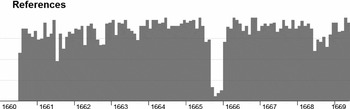
The numerous references to ‘home’ and ‘office’ are not included in the map, ‘home’ referring to the Pepyses’ home in Seething Lane, which was part of the Navy Office building complex in the City. The Navy Office was Samuel's ‘office’ and it housed the Navy Board. In the whole diary, Pepys refers to his ‘office’ some 2,000 times. Figure 3 shows the timeline of references (altogether over 2,500) to his Seething Lane home. The gaps in 1665 and early 1666 stand for a period of the plague, during which the Pepyses often stayed in Greenwich.
Frequency of Pepys's diary references to his home in Seething Lane (detail from www.pepysdiary.com/encyclopedia/1023/#references)

Figure 4 shows a map with place name references in Pepys's personal letters included in the CEEC from the period 1660–81. As in the diary, the City and Westminster both figure prominently in these letters, which mostly date from the 1670s and are addressed to Pepys's immediate family. However, there are notable differences between the map in figure 4 and that in figure 2. Although the letters have almost 33,000 running words and the diary for the selected months in 1660 and 1666 twice that number, i.e. 67,500 words, place name density is much higher in the diary sample (the scale indicating the number of mentions by the size of icon is the same in both).
Pepys's London locations, letters (1660–81, most dating from the 1670s)

The diary is thus obviously the better source for identifying Pepys's social networks, both places and people, in the 1660s. As to the latter, we obtain a rough idea of the density of Pepys's network ties by looking up the number of mentions he makes of individuals. Unsurprisingly, his wife gets the most mentions (over 2,000) within the family, his father one quarter of that number, and his brother-in-law, Balthasar St Michel, well over a hundred. As to his friends and colleagues, Henry Moore, Montagu's ‘man of business’ and a lawyer at Gray's Inn, is referred to over 250 times, mostly in the first half of the 1660s. By contrast, a fellow diarist and Pepys's close life-long friend to be, John Evelyn, is mentioned fewer than forty times in the diary period (see Knighton Reference Knighton2004).
In the course of the 1660s, the professional company that Pepys kept shifted from clerks and men of business to public figures with considerable political influence. This shift can be observed, for example, by comparing the key words in his diary for 1660 with those for 1669, using the whole diary as a reference corpus. In 1660 the first keyword is Mr, referring to the title of many of Pepys's contacts at the time. In 1669 the list is headed by York, with reference to James Stuart, Duke of York and the future king James II, who was then the Lord High Admiral and Pepys's superior.
Within Pepys's professional network, his patron Sir Edward Montagu is mentioned some 900 times in the diary, most of them in the first half of the decade, and the Duke of York over 800 times, mostly in the second half, as also suggested by the keyword analysis. King Charles II has the most mentions (well over 1,000), spread evenly over the whole period but no doubt divided between navy business and general gossip.
Latham (Reference Latham1983: 57–8) explains that the Navy was the common concern Pepys shared with the King throughout his reign. They first met during the voyage that brought Charles back from exile in 1660. In the years that followed, Pepys held several offices related to naval administration and was often heard by the King on Navy Office business. They also conversed in less formal contexts, as Pepys records in his diary as shown in (4):
(4) And the King come to me of himself, and told me, ‘Mr. Pepys,’ says he, ‘I do give you thanks for your good service all this year, and I assure you I am very sensible of it.’ And the Duke of Yorke did tell me with pleasure, that he had read over my discourse about pursers, and would have it ordered in my way, and so fell from one discourse to another. I walked with them quite out of the Court into the fields. (28 January 1665/66)
In the 1670s the King habitually consulted Pepys on naval matters, making him in practice his secretary of state for the marine. Pepys's final verdict on his master was that the King ‘understood the sea’ (Latham Reference Latham1983: 58).
5.2.2 Linguistic analysis
The Pepys letters included in the CEEC consist of family correspondence. Pepys wrote to members of his family – his father, younger brother John, sister Paulina and his brother-in-law Balthasar St Michel (‘Brother Balty’). Their letters to Samuel were also included but only Balthasar St Michel's amount to quantifiable numbers. As noted in section 4.2, the linguistic analysis of Pepys's correspondence is focused on two changes, the (has) and (s) variables; see (5) and (6). As Pepys was shown to be consistently progressive with respect to both of them, in principle he could have acted as a linguistic broker with regard to the diffusion of (has), which had only reached mid-range in the language community at large at the time.
(5) Very glad I am that my Sister hath disposed as shee tells me of her troublesome parsonage, I pray God blesse her and hers in what she doth therein. (Samuel Pepys, 1677; CEEC SPepys, 53)
(6) As to what relates to my Brother Johns Accompt I doe hope in a very little time, soe soone as Will Hewer shall come to Towne againe, which wilbe at the end of this Weeke, to be able to finish my lookeing over all his Papers, and see in what condition hee has left the World. (Samuel Pepys, 1677; CEEC SPepys, 54)
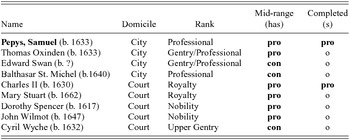
The others singled out as progressive among the hundred letter writers in the database included, in the City, Thomas Oxinden writing to his father and stepmother and, at Court, the King himself, who corresponded with his sister Henrietta or ‘Minette’ (Duchess of Orléans), and James Stuart's young daughter Mary (the future Mary II), who wrote to a childhood friend. Dorothy Spencer also wrote to a close friend, and John Wilmot to his nuclear family, mostly to his wife. The conservatives in the City included two men, Balthasar St Michel, who communicated with his brother-in-law Samuel Pepys, and Edward Swan, who had fallen on hard times and wrote to his old friend in the country. At Court, Sir Cyril Wyche corresponded in his professional capacity with Arthur Capel, Earl of Essex. Table 2 summarizes these findings.Footnote 7
Progressive and conservative individuals in the City and at Court (CEEC, 1660–81)

(pro = progressive, con = conservative, o = in-between)
As has was more common in spoken interaction than in formal genres in the late seventeenth century (Kytö Reference Kytö1993: 126), this variation may be linked to stylistic considerations and the writer's kin-based social networks or networks based on particular friendships. This is the case with both Pepys and Charles II, who were progressive with respect to has and verbal -s in general, the latter change nearly completed in most verbs at the time (Gries & Hilpert Reference Gries and Hilpert2010: 313). By contrast, in the case of Cyril Wyche and probably Bathasar St Michel as well, the writer's humbler status vis-à-vis the addressee may have been partly indexed by their use of the conservative form hath.
Despite being in-laws, St Michel's relationship with Pepys was unequal in that St Michel's naval career depended on Pepys's patronage (Latham Reference Latham1983: 375). He addressed Pepys as ‘Honoured Sir’ or ‘Most Ever honoured Sir’ and signed off as ‘Your Most faithfull and Obedient Servant’ or ‘Your Honour's Most Dutifull and Ever Obedient Servant’. As a social superior who could afford more intimacy, Pepys addressed St Michel as ‘Brother Balty’ or simply ‘Brother’ and subscribed ‘Your truely affectionate Brother to serve you’. As Lesley Milroy (Reference Milroy2004: 550) points out, personal social networks are not independent of broader social and economic frameworks constraining individual behaviour.
There is also evidence to suggest that Pepys used hath in his less private writings, especially when he was younger. In order to establish what those shorthand figures that had multiple readings stood for in the diary, Latham (Reference Latham1983: lvi) examined all available documents that Pepys wrote in longhand between 1660 and 1699, including his Navy White Book, his letters in various libraries and archives, Heath's edition of his family letters (the one also used in the CEEC) and Howarth's edition of his Letters and second diary. The forms Latham examined included the symbol used for the various allomorphs of have. He concluded that in that decade Pepys wrote hath far more often that he wrote has, and for that reason hath was adopted for the diary edition.
Although Latham obviously did not pay attention to register variation when he made this choice, his impression appears to be justified. The vast majority of Pepys's letters in the CEEC come from the 1670s and attest to Pepys's preference for has. This is the trend that continues and intensifies in his letters in the next two decades included in the CEEC Extension. Taking a look at some earlier and less personal letters from the 1660s outside the corpus we find that Pepys used hath, for example, when writing to John Evelyn. But his usage changes in the 1670s: as shown in (7), he already mixes has and hath when writing to the King in January 1670.
(7) Sir
Your Majesty's having been pleased with one hand to receive what has been offered you in charge against the Officers of your Navy, I cannot without offence to your justice doubt your vouchsafing me the other, for what in most humble manner I come to tender your Majesty in their and my own behalf, being a duplicate of what hath lately gone from me in answer to the observations of the Commissioners of Accounts. (De la Bédoyère Reference De la Bédoyère2006: 82–3; spelling modernized)
If we were to assess who was the more progressive writer in the corpus material with respect to the (has) variable, the King or his subject, the answer would be the King. Charles II wrote his private letters in the 1660s, Pepys mostly in the 1670s. But since there were also other progressive writers in the 1660s both at Court (Dorothy Spencer, see (8)) and in the City (Thomas Oxinden) writing in their private capacity, we cannot infer brokering influence one way or the other. It would rather appear that the change had advanced to a stage where the incoming form had found a firm footing both within the capital and outside it.
(8) Tis a dangerous thinge I finde for Ladyes to brage of power in State affaires and I am confident it has caused that to be don that would not have bine to any other gentlewoman. Her brother is extremely concerned in her disgrace wh. has bine nowe a greate while to satisfy those who did not wishe her in favour. I believe nobody is unwillinge she should showe herselfe in the Drawingroome, the Queene has taken no notice of this businesse except very privately. (Dorothy Spencer, 1668; CEEC Giffard, 98–9)
6 Discussion
Reconstructing social networks in a historical context is inevitably an exercise in informational maximalism in order to ‘to gain a maximum of information from a maximum of potential sources’ (Janda & Joseph Reference Janda, Joseph, Joseph and Janda2003: 37). The closer we move from broad ‘socio-centric’ approaches to ‘ego-centric’ applications of social networks, the more pressing such sources become (Conde-Silvestre Reference Conde-Silvestre, Hernández-Campoy and Conde-Silvestre2012). But the two analytic approaches can also be brought to bear on each other.
The socio-centric approach can provide the researcher with the baseline against which to measure ego-centric variation. As far as linguistic change is concerned, in Tudor and Stuart England, the City of London and the Court at Westminster cut different aggregate profiles depending on the regional origin and stage of the change in progress. Of northern origin, verbal -s, for example, was adopted earlier in the City than at Westminster. However, as shown by the multivariate analyses of personal correspondence in Nevalainen & Raumolin-Brunberg (Reference Nevalainen and Raumolin-Brunberg2003: 195), it had also gained momentum at Court by Samuel Pepys's time, when it was nearing completion in the country at large. It is hence no wonder that it should be preferred by Pepys and the King alike.
Two indexical layers can be distinguished for verbal -s in contemporary metatextual commentary: social (diatopic) and stylistic (diatypic). By the early seventeenth century the incoming -s variant had advanced to mid-range in most verbs in the CEEC data (Nevalainen, Raumolin-Brunberg & Mannila Reference Nevalainen, Raumolin-Brunberg and Mannila2011: 42), but the diffusion of has was in its incipient stage with an average frequency of 8 per cent. In Logonomia Anglica (1621: 17, 59) Alexander Gil indexes has diatopically as a northern variant of hath, and always uses hath /hɑþ/ himself, but notes that in other verbs -eth can shorten to -s or -z, or become -ez after a sibilant. In his reformed spelling he retains -eth /eþ/ as an elevated or metrical variant, thus indexing it as a diatypically marked form in speech.
As suggested by the variation between has and hath in the London and Court data in1660–81 in the CEEC, hath followed the path of -s more generally in moving from diatopic to diatypic evaluation. The evidence for social indexing is usually indirect and can be deduced from register variation, as in section 5.2, or from the way in which social aspirers react to ongoing changes, either hypercorrecting or dispreferring them (Nevalainen & Raumolin-Brunberg Reference Nevalainen and Raumolin-Brunberg2003: 150–3).
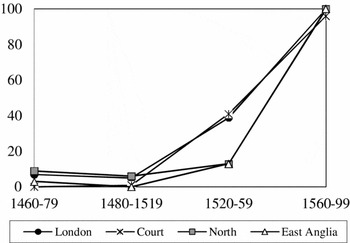
However, this was only one pattern of diffusion among several in the correspondence data. Subject you, for example, spread from the capital region to the rest of the country in the sixteenth century. As figure 5 indicates, in the forty years between 1520 and 1560 when the Johnsons were active, no distinction can be found between the City and the Court at the aggregate level. We may assume that variation in the use of the incoming form was not locally indexed in the same way as it was with the (s) variable but that it originated in diatypic variation (Nevalainen & Raumolin-Brunberg Reference Nevalainen and Raumolin-Brunberg2003: 60–1). It hence turns out that processes of change can project patterns of diffusion that are far from uniform in social, regional and chronological terms. This is why they are not likely to be subject to uniform reinforcement even by close-knit social networks.
Replacement of subject ye by you (modified from Nevalainen & Raumolin-Brunberg Reference Nevalainen and Raumolin-Brunberg2003: 172)

7 Conclusion
The population of London grew substantially between 1550 and 1650, making the capital ‘the crucible . . . in which dialects were melded’ (Bailey & Moore Reference Bailey, Moore, Cain and Russom2007: 245). In this article I explored the diffusion of half a dozen linguistic changes and their possible social network connections in Tudor and Stuart London. By concentrating on leaders and laggers, I showed the varying degrees to which the members of a close-knit merchant family network participated in ongoing processes of change in the mid-sixteenth century. John Johnson, the head of the family business, in fact proved to be in-between these two extremes in most of the processes, suggesting that he accommodated flexibly to the diverse linguistic influences he encountered.
As shown by the study on Samuel Pepys, combining new digital resources with social networks reconstructed by historians can provide a rich basis for linguistic network analysis. These tools encourage an exploratory approach which allows comparisons within and across networks. More focused locally than the wool merchant John Johnson, Pepys proved progressive with respect to the ongoing changes studied but not uniquely so either in the City or at Westminster. More work is obviously needed to ascertain his possible role as a community broker in linguistic terms.Footnote 8
Lesley Milroy (Reference Milroy2004: 567) notes that it would be helpful to have a two-level sociolinguistic analysis linking small-scale networks with larger-scale social structures which determine relationships of power. I made this linking indirectly by relating the usage of individuals in their social networks to that of their contemporaries in the wider community. This approach enabled a comparison of usage patterns in the City of London and at Westminster, which represented different bases of power at the time. It is at this aggregate level that their local linguistic similarities and differences unfolded over time, providing the backdrop for the individual histories of their inhabitants.