Introduction
Fasciolosis caused by Fasciola hepatica and Fasciola gigantica remains a public health problem with a worldwide distribution (Mas-Coma et al., Reference Mas-Coma, Valero and Bargues2009). As a major livestock infection, it also has a marked economic impact through liver condemnation and reduced milk and meat yields (Dalton, Reference Dalton1999). Due to different epidemiological and sociological factors, fasciolosis is one of the most important food-borne trematodoses in Asian countries. For many decades Vietnam has been recognized as endemic for human fasciolosis (WHO, 2007). However, the real impact of human fasciolosis was poorly known and the disease was reported sporadically. For instance, only two cases were reported in 1978 (cited by Tran et al., Reference Tran, Tran, Nguyen, Phan and Pham2001). Recently, the number of recorded cases has increased dramatically and 47 out of 63 Vietnamese provinces have reported human infections. The central-highland region is considered to be highly endemic, with more than 10,000 reported cases between 2006 and 2009 (Trieu et al., Reference Trieu, Nguyen and Huynh2012). Fasciolosis is a well-known animal disease in Vietnam and is responsible for marked economic losses (Phan, Reference Phan1983; T.G.T. Nguyen et al., Reference Nguyen, Le, Dao, Tran, Praet, Speybroeck, Vercruysse and Dorny2011). Fasciolosis transmission is dependent on different species of Lymnaeidae freshwater snails, which act as intermediate hosts (Dalton, Reference Dalton1999). Some vectorial aspects of faciolosis in Vietnam are still very confusing. The present review aims at describing the present status of human and animal fasciolosis in Vietnam and surrounding countries, in relation to malacological data. Publications were collected through an online search, from the libraries of universities and institutes, or directly by request to the authors. Publications in national journals (including thesis and conference proceedings) were translated from Vietnamese. Fasciolosis in humans and animals, and Fasciola spp. in lymnaeid snails were mapped by using Arcgis software v10.2 (ESRI, Inc., California, USA). The graphs were made with Stata Statistical Software, Release 12 (StataCorp, College Station, Texas, USA).
Identification of Fasciola species
Adult stage
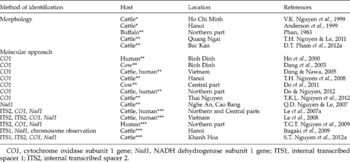
Fasciola gigantica and F. hepatica are the two species responsible for human and animal fasciolosis (Dalton, Reference Dalton1999). Fasciola hepatica is common in temperate zones, especially in Europe, America and Australia, whereas F. gigantica is the most prevalent species in tropical regions of Africa and Asia (Mas-Coma et al., Reference Mas-Coma, Esteban and Bargue1999, Reference Mas-Coma, Valero and Bargues2009). In Vietnam, both species were reported in cattle long ago, based on morphological characteristics (T.L. Nguyen et al., Reference Nguyen, Ha, Nguyen, Pham and Nguyen1996b; Anderson et al., Reference Anderson, Luong, Vo, Bui, Smooker and Spithill1999; V.K. Nguyen et al., Reference Nguyen, Le, Hong, Jacquiet and Dorchies1999). However, according to morphological and molecular data, F. gigantica seems to be the major species causing human and animal fasciolosis (table 1). By using the cytochrome oxidase subunit 1 (CO1) gene sequence, all Fasciola isolates were confirmed as F. gigantica (Ho et al., Reference Ho, Le, Tran and Dang2000; Dang et al., Reference Dang, Le and Cao2003; Dang & Nawa, Reference Dang and Nawa2005; Q.D. Nguyen & Le, Reference Nguyen and Le2007; Do et al., Reference Do, Nguyen, Nguyen, Dang and Le2011; Do & Nguyen, Reference Do and Nguyen2012; T.K.L. Nguyen et al., Reference Nguyen, Le, Le and Ta2012). Recently, hybrid forms between F. hepatica and F. gigantica were reported by comparing internal transcribed spacer 2 (ITS2) and CO1/Nad1 (NADH dehydrogenase subunit 1) gene sequences (T.H. Le et al., Reference Le, Nguyen, Ngo, Kim, Agatsuma, Blair and McManus2006, Reference Le, De, Agatsuma, Blair, Vercruysse, Dorny, Nguyen and McManus2007a, Reference Le, Nguyen, Nguyen, Nguyen, Dang, Vu, Nguyen, Le, Nguyen and Blairb, Reference Le, De, Agatsuma, Thi Nguyen, Nguyen, McManus and Blair2008; T.G.T. Nguyen et al., Reference Nguyen, Van De, Vercruysse, Dorny and Le2009; S.T. Nguyen et al., Reference Nguyen, Amer, Ichikawa, Itagaki, Fukuda and Nakai2012a). The alignment of the ITS2 sequence indicates that, typically, F. gigantica and F. hepatica differ from each other at seven sites: 207 (C–T); 218 (T–C); 231 (C–T); 270 (T–C); 276 (T–C); 327 (– –T) and 334 (A–G). As far as ITS2 sequences are concerned, there was a single nucleotide difference at position 327 between the two species. The ITS2 sequences have singly T at the 327th position, characteristic of F. hepatica, but half the variable sites contain the base pair typical of F. gigantica and half that of F. hepatica (T.H. Le et al., Reference Le, Nguyen, Nguyen, Nguyen, Dang, Vu, Nguyen, Le, Nguyen and Blair2007b; T.G.T. Nguyen et al., Reference Nguyen, Van De, Vercruysse, Dorny and Le2009). This suggests that the maternal lineage of the hybrid form is from F. gigantica. On the other hand, the spermic diploid specimens were accurately identified as F. gigantica, while the aspermic triploids might be hybrids between F. hepatica and F. gigantica and/or their offspring, which has also been confirmed by the molecular approach (Itagaki et al., Reference Itagaki, Sakaguchi, Terasaki, Sasaki, Yoshihara and Van Dung2009).
Morphological and molecular identification of Fasciola gigantica for comparison with F. hepatica and hybrid forms between 1999 and 2012.

*Hosts with Fasciola gigantica and F. hepatica, **F. gigantica only, ***F. gigantica and hybrid form.
CO1, cytochrome oxidase subunit 1 gene; Nad1, NADH dehydrogenase subunit 1 gene; ITS1, internal transcribed spacer 1; ITS2, internal transcribed spacer 2.
Larval stages
The members of the Fasciolidae family produce gymnocephalous cercaria with the following characteristics: a tail is present, and it is longer than the body length; the tail is not forked and is devoid of setae/fin-folds, the tip of tail is without adhesive gland cells; there is an excretory canal located at the tail base; the body is entirely anterior to the tail; two intestinal caeca, one oral and one ventral sucker are present; the ventral sucker is located on the mid-ventral surface of body whereas the oral sucker is devoid of stylet or spines; eyespots are absent (Shell, Reference Shell1970). In Vietnam, an accurate description of the different cercariae was absent from most of the available publications and consequently the validity of some data are to be questioned (Vu, Reference Vu2009). T.L. Nguyen et al. (Reference Nguyen, Dang, Do and Ha1995) and N.D. Pham & Nguyen (Reference Pham and Nguyen2005) described the morphology of different cercarial types (gymnocephala, echinostomatata, xiphidiocercaria and furcocercaria) observed in Lymnaea viridis and L. swinhoei. Recently, N.D. Pham et al. (Reference Pham, Hoang, Nguyen and Dang2012) described the accurate morphological characteristics of Fasciola spp. cercariae, with a photo.
Snail intermediate hosts
In Vietnam, two lymnaeid snail species (L. viridis and L. swinhoei) were described in the 1980s as the intermediate hosts of Fasciola spp. (Dang et al., Reference Dang, Thai and Pham1980). Recently, the presence of an additional species of the genus Lymnaea was advocated (N.D. Pham et al., Reference Pham, Hoang, Nguyen and Dang2012). Based on updated morphological and molecular (ITS2) data, the two most common lymnaeid snails in Vietnam were renamed as Austropeplea viridis (formerly L. viridis) and Radix auricularia (formerly L. swinhoei). The third species (Radix rubiginosa) was a new record for Vietnam (T.D. Bui et al., Reference Bui, Pham, Dang, Ho, Losson and Caron2013). Therefore, these new species names are used in the present review. Austropeplea viridis is the most important snail species acting as the intermediate host for Fasciola spp. in Vietnam under natural conditions (N.D. Pham et al., Reference Pham, Hoang, Nguyen and Dang2012; T.D. Bui et al., Reference Bui, Pham, Dang, Ho, Losson and Caron2013). Recently, experimental F. gigantica infection in A. viridis and R. auricularia showed that only A. viridis was infected after exposure to F. gigantica miracidiae (up to 80%) (N.D. Pham et al., Reference Pham, Nguyen, Hoang and Bui2015).
Fasciolosis in livestock
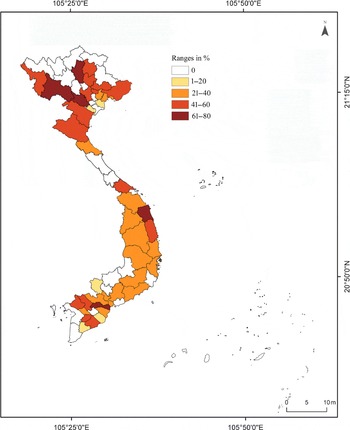
Fasciolosis in cattle was found to be widespread in Vietnam. The distribution of fasciolosis in livestock is mapped according to published data (fig. 1) (Phan, Reference Phan1983; Ho & Nguyen, Reference Ho and Nguyen1987; Vu et al., Reference Vu, Do, Nguyen and Nguyen1989; K.L. Bui et al., Reference Bui, Luong, Nguyen and Do1995, Reference Bui, Do, Le, Sasaki and Yoshihara2003; Luong & Bui, Reference Luong and Bui1996; T.K.T. Nguyen, Reference Nguyen1996; T.K. Nguyen, Reference Nguyen1997a; T.K. Nguyen & Pham, Reference Nguyen and Pham1997; Anderson et al., Reference Anderson, Luong, Vo, Bui, Smooker and Spithill1999; Holland et al., Reference Holland, Luong, Nguyen, Do and Vercruysse2000; H.K. Le et al., Reference Le, Nguyen and Huynh2001; V.L. Pham & Pham, Reference Pham and Pham2006; T.T.T. Tran, Reference Tran2006; Geurden et al., Reference Geurden, Somers, Thanh, Vien, Nga, Giang, Dorny, Giao and Vercruysse2008; Ha, Reference Ha2008; V.N. Tran, Reference Tran2008; H.H. Nguyen, Reference Nguyen2009, Reference Nguyen2011; V.T. Nguyen & Nguyen, Reference Nguyen and Nguyen2009; Vu & Nguyen, Reference Vu and Nguyen2009; V.T.H. Le, Reference Le2010; Hoang et al., Reference Hoang, Pham, Pham and Dang2011; V.H. Nguyen, Reference Nguyen2011; T.H. Nguyen & Le, Reference Nguyen and Le2012; T.K.L. Nguyen et al., Reference Nguyen, Le, Le and Ta2012; D.T. Pham et al., 2012a; T.L.A. Nguyen et al., Reference Nguyen, Dao, Doan, Do, Nguyen and Anderson2014). Important variations are observed depending on climatic conditions; for example, prevalence is higher in the lowland areas (around 60%) when compared to the highland areas (around 20%) (Phan, Reference Phan1983; Vu et al., Reference Vu, Do, Nguyen and Nguyen1989; Do et al., Reference Do, Pham, Pham, Nguyen and Nguyen2006). Similarly, the prevalence of fasciolosis in cattle and buffaloes decreases from the north to the south of the country (Hoang et al., Reference Hoang, Pham, Pham and Dang2011). The genus Fasciola was found in the seven ecological regions and F. gigantica (identified according to morphological criteria) was prevalent (90.0% in cattle) (H.K. Le et al., Reference Le, Nguyen and Huynh2001).
Ranges in the prevalence (%) of fasciolosis in livestock (1983–2014) based on geographical distribution; abattoir surveys, serology and faecal analysis (0: no data).

Most of the previous investigations dealing with fasciolosis focused on livestock. Indeed, buffaloes and cows are common definitive hosts of Fasciola spp. in Vietnam and may exhibit high infection rates (Phan, Reference Phan1983; T.K. Nguyen, Reference Nguyen1997a; H.K. Le et al., Reference Le, Nguyen and Huynh2001), for instance in dairy cows (T.L. Nguyen et al., Reference Nguyen, Ha, Nguyen, Dang, Do, Pham, Nguyen and Nguyen1996a; Giang et al., Reference Giang, Thanh and Thanh2008). Fasciolosis is also found in goats, with a prevalence of infection ranging from 5.3 to 30.4% (T.K.L. Nguyen et al., Reference Nguyen, Nguyen, Phan and Nguyen1997, Reference Nguyen, Phan, Nguyen and Nguyen1998, Reference Nguyen, Phan, Nguyen and Nguyen1999; Phan et al., Reference Phan, Nguyen and Nguyen2002). In wild animals, F. gigantica was found in deer (Cervus nippon) with a prevalence reaching 13.22% (D.D. Nguyen, Reference Nguyen1995).
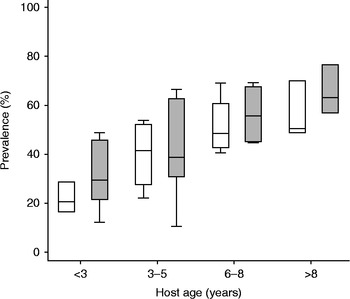
In Vietnam, cows and buffaloes are two common livestock species and are free-grazing in the fields where lymnaeid snails are very abundant. The prevalence of fasciolosis is influenced by the age of the animals (fig. 2). A lower prevalence is detected in young cattle (less than 3 years of age). Infection and intensity rates are higher in older cattle, which have been exposed for longer periods of time through grazing (Holland et al., Reference Holland, Luong, Nguyen, Do and Vercruysse2000; T.K.L. Nguyen et al., Reference Nguyen, Le, Le and Ta2012).
The prevalence (%) of Fasciola spp. infection in buffalo (white bars) and cattle (grey bars), relative to host age.

Assessment of the prevalence of fasciolosis in animals is based on stool examination, liver inspection at the slaughterhouse and/or serology (enzyme-linked immunosorbent assay (ELISA), agar gel diffusion test). The data indicate that prevalence varies according to animal host species, diagnostic technique, time and location. Generally speaking, the prevalence of fasciolosis in livestock is very high in Vietnam and the parasite is widespread. The highest fasciolosis infection rate observed was 72.2% (289/400) using ELISA (K.L. Bui et al., Reference Bui, Luong, Nguyen and Do1995; T.G.T. Nguyen et al., Reference Nguyen, Le, Dao, Tran, Praet, Speybroeck, Vercruysse and Dorny2011). Indeed, serological examination was found to be more sensitive than stool examination (Anderson et al., Reference Anderson, Luong, Vo, Bui, Smooker and Spithill1999; Holland et al., Reference Holland, Luong, Nguyen, Do and Vercruysse2000; Geurden et al., Reference Geurden, Somers, Thanh, Vien, Nga, Giang, Dorny, Giao and Vercruysse2008; T.G.T. Nguyen et al., Reference Nguyen, Le, Dao, Tran, Praet, Speybroeck, Vercruysse and Dorny2011).
Human fasciolosis
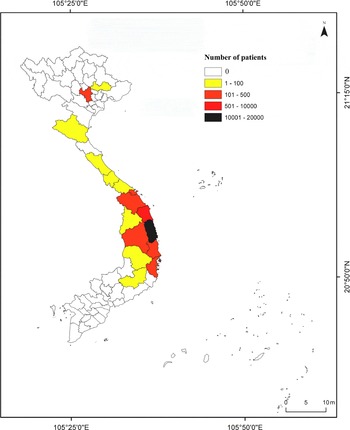
The geographical distribution of human fasciolosis in Vietnam is reported based on the available publications (fig. 3) (Tran et al., Reference Tran, Tran, Nguyen, Phan and Pham2001; V.D. Nguyen et al., Reference Nguyen, Le and Waikagul2006; Doan et al., Reference Doan, Nguyen, Nguyen, Do, Do and Nguyen2007; Huynh & Nguyen, Reference Huynh and Nguyen2007; Huynh et al., Reference Huynh, Nguyen and Dinh2007; V.D. Nguyen, Reference Nguyen2012; Trieu et al. Reference Trieu, Nguyen and Huynh2012). The first two cases of human fasciolosis were reported in 1978 by Trinh Van Thinh (cited by Tran et al., Reference Tran, Tran, Nguyen, Phan and Pham2001). Between 1997 and 2001, over 500 cases were reported, mainly in hospitals (Tran et al., Reference Tran, Tran, Nguyen, Phan and Pham2001). A cutaneous human fasciolosis case report was presented by T.X. Le et al. (Reference Le, Nguyen and Waikagul2005). Later there was a further increase in the number of patients and/or increase of reporting. Indeed, between 2006 and 2009, 11,240 cases were recorded, mainly in the 12 provinces of central Vietnam. Among them, Binh Dinh province was found to be highly endemic with 8542 patients out of the total (Trieu et al., Reference Trieu, Nguyen and Huynh2012). Between 2009 and 2011, an investigation on zoonotic parasitic infections in patients seeking medical care in the 103 hospital in Hanoi revealed a 16.86% infection rate based on different methods (ELISA, Lugol staining and direct stool examination) (T.A. Le & Nguyen, Reference Le and Nguyen2013). Recently, over 20,000 patients were identified; central Vietnam was again the ‘hot spot’ in 2011 (V.D. Nguyen, Reference Nguyen2012). The highest numbers of patients were recorded in two periods (May–June and November–December) (Trieu et al., Reference Trieu, Nguyen and Huynh2012).
Ranges in number of fasciolosis patients (2001–2012) based on geographical distribution; serology analysis (0: no data).

Several diagnostic approaches are used in health centres, having different specificity, sensitivity and relative cost. Stool examination is commonly used to detect Fasciola eggs in the faeces. However, this technique has a low sensitivity and requires some expertise in the morphological identification of the eggs (Tran et al., Reference Tran, Tran, Nguyen, Phan and Pham2001). Ultrasonography is a useful technique to confirm the presence and extent of hepatobiliary lesions and to diagnose the acute and chronic phases of the disease (Huynh et al., Reference Huynh, Nguyen and Dinh2007). In addition, antibody detection (by ELISA) is considered to be a very reliable method for the diagnosis in fasciolosis, with very good sensitivity and specificity (Tran et al., Reference Tran, Tran, Nguyen, Phan and Pham2001; V.D. Nguyen et al., Reference Nguyen, Le and Waikagul2006; T.G.T. Nguyen et al., Reference Nguyen, Le, De, Doan, Dao, Vercruysse and Dorny2010). A higher prevalence was found in Quang Ngai province when using ELISA (10.2%) compared to stool examination (0.35%). Fasciolosis can be found in most age categories, but it is most often observed in children and women. Indeed, female patients represented two-thirds of 393 patients (T.H. Nguyen et al., Reference Nguyen, Le, Le and Ta2012). The majority of the latter (85%) were 21–50 years old (Tran et al., Reference Tran, Tran, Nguyen, Phan and Pham2001). Thirty-five children out of 404 patients were found to be infected. They were below 16 years of age (Tran et al., Reference Tran, Nguyen and Nguyen2009). However, the full age range of patients was 3–93 years. The ingestion of metacercariae present in drinking water represents a potential source of infection in children (according to one interview 12.26% children eat raw vegetables and 48.58% of children drink water from rivers or ponds (Huynh & Nguyen, Reference Huynh and Nguyen2007). Eating raw vegetables, a very common culinary habit in Vietnam, probably represents the main source of infection (Tran et al., Reference Tran, Tran, Nguyen, Phan and Pham2001).
Identification of snails as intermediate hosts
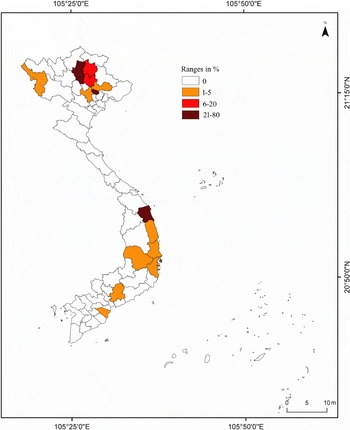
The identity of the snails acting as intermediate hosts of Fasciola spp. in Vietnam is still controversial. In fact there are many reports of the presence of Fasciola spp. larval stages in snails belonging to the Lymnaeidae family. T.K. Nguyen Reference Nguyen(1997a) reported the presence of Fasciola larval stages in R. auricularia (= L. swinhoei), A. viridis (= L. viridis), Gyraulus chinensis and Polypylis chemisphaerila. This is most probably incorrect because the latter two species do not belong to the family Lymnaeidae. Additionally, G. chinensis and P. chemisphaerila have never been reported previously as intermediate hosts for Fasciola spp. Two lymnaeid snails (A. viridis and R. auricularia) were reported to be infected with Fasciola spp. The geographical distribution of the prevalence of Fasciola infection in snails is presented according to available data (fig. 4) (Phan, Reference Phan1983; Ho & Nguyen, Reference Ho and Nguyen1987; Vu et al., Reference Vu, Do, Nguyen and Nguyen1989; T.L. Nguyen et al., Reference Nguyen, Dang, Do and Ha1995; T.K. Nguyen et al., Reference Nguyen1997b; T.K.L. Nguyen, Reference Nguyen2001; Dang & Nawa, Reference Dang and Nawa2005; N.D. Pham & Nguyen, Reference Pham and Nguyen2005; Do et al., Reference Do, Pham, Pham, Nguyen and Nguyen2006; Ha, Reference Ha2008; D.H. Vu, Reference Vu2009; D.T. Nguyen et al., Reference Nguyen, Le, De, Doan, Dao, Vercruysse and Dorny2010; H.A. Vu, Reference Vu2011; T.H. Nguyen & Le, Reference Nguyen and Le2012; S.T. Nguyen et al., 2012b; D.T. Pham et al., Reference Pham, Nguyen, Tran and Tran2012b; N.D. Pham et al., Reference Pham, Hoang, Nguyen and Dang2012; T.T. Pham, Reference Pham2012; T.D. Bui et al., Reference Bui, Pham, Dang, Ho, Losson and Caron2013).
Ranges in the prevalence (%) of Fasciola sp. infection in lymnaeid snails (1983–2013) based on geographical distribution; crushing analysis (0: no data).

Some authors reported that both snail species can harbour the larval stages of Fasciola spp. (T.K.L. Nguyen, Reference Nguyen2001; S.T. Nguyen et al., Reference Nguyen, Nguyen, Van Nguyen, Huynh, Le, Fukuda and Nakai2012b; T.H. Nguyen & Le, Reference Nguyen and Le2012). However, huge differences were observed in the prevalence of larval infection in both A. viridis (0.06–86%) and R. auricularia (0.56–92%). Other publications reported that either A. viridis (0.11–2.1%) (Dang & Nawa, Reference Dang and Nawa2005; N.D. Pham et al., Reference Pham, Hoang, Nguyen and Dang2012; T.D. Bui et al., Reference Bui, Pham, Dang, Ho, Losson and Caron2013) or R. auricularia (4.75%) were receptive to Fasiola spp. (Do et al., Reference Do, Pham, Pham, Nguyen and Nguyen2006). S.N. Vu et al. (Reference Vu, Do, Nguyen and Nguyen1989) found larval stages only in R. auricularia in Daklak and Phu Khanh provinces, with a very high infection rate (50.0%). Low rates of infection were reported most of the time in A. viridis (0.04–2.76%) (Ho & Nguyen, Reference Ho and Nguyen1987; Dang & Nawa, Reference Dang and Nawa2005; D.T. Nguyen et al., Reference Nguyen, Le, De, Doan, Dao, Vercruysse and Dorny2010; S.T. Nguyen et al., Reference Nguyen, Nguyen, Van Nguyen, Huynh, Le, Fukuda and Nakai2012b; N.D. Pham et al., Reference Pham, Hoang, Nguyen and Dang2012; T.D. Bui et al., Reference Bui, Pham, Dang, Ho, Losson and Caron2013) and R. auricularia (0.56–4.75%) (Do et al., Reference Do, Pham, Pham, Nguyen and Nguyen2006; D.T. Nguyen et al., Reference Nguyen, Le, De, Doan, Dao, Vercruysse and Dorny2010; S.T. Nguyen et al., Reference Nguyen, Nguyen, Van Nguyen, Huynh, Le, Fukuda and Nakai2012b).
The prevalence of larval infection in A. viridis increases from March to September and reaches its peak in August (3%), while lower rates are observed during the remaining months ( ± 0.7%). The highest prevalence in A. viridis was observed in the north, then declining in central and southern Vietnam. The prevalence in R. auricularia follows a similar profile, with a peak in July (2.5%), and a lower infection rate in the rest of the year (0.7%) (T.K.T. Nguyen, Reference Nguyen1996). Recently, D.T. Pham et al. (Reference Pham, Nguyen, Lan, Thang and Thao2014) reported that under experimental conditions F. gigantica eggs develop into metacercariae in 51–113 and 27–52 days in winter and spring–summer, respectively. However, temperatures were not recorded during the experimental infection.
Austropeplea viridis is widely distributed in Vietnam, whereas the distribution of R. auricularia seems to be more limited. Austropeplea viridis is found in various shallow water bodies whereas R. auricularia is present in deeper water (Phan, Reference Phan1983; D.T. Pham et al., 2012a; T.D. Bui et al., Reference Bui, Pham, Dang, Ho, Losson and Caron2013). The distribution of A. viridis reveals that there is an increasing frequency from the delta and coastal regions to the midlands and then to the mountainous regions. As far as R. auricularia is concerned, the opposite is the case (Phan, Reference Phan1983). There is also a seasonal influence, with peak populations of both species being found in the spring (Phan, Reference Phan1983; T.K.T. Nguyen, Reference Nguyen1996; T.K. Nguyen, Reference Nguyen1997b).
Several techniques are available for the detection of larval infection in the snail intermediate hosts. They have different specificities and sensitivities (Caron et al., Reference Caron, Rondelaud and Losson2008). The crushing method was mainly used during surveys in Vietnam. However, the shedding method (i.e. the release of cercariae by exposed snails) is fairly time consuming but provides useful information about the suitability of different snail species as intermediate hosts (T.D. Bui et al., Reference Bui, Madsen and Dang2010). More recently the polymerase chain reaction (PCR) and multiplex PCR were applied to detect Fasciola spp. in lymnaeid snails (T.D. Bui & Hoang, Reference Bui and Hoang2011; T.D. Bui, Reference Bui2012). PCR and multiplex PCR were found to have high sensitivity and specificity (Caron et al., Reference Caron, Rondelaud and Losson2008; T.D. Bui & Hoang, Reference Bui and Hoang2011; T.D. Bui, Reference Bui2012).
Metacercariae
Infected snails release motile cercariae into the environment. After fixation on a suitable plant material the cercariae mature into metacercariae (Dalton, Reference Dalton1999). Therefore, investigation of the presence of metacercariae of Fasciola spp. in different environments is important in order to prevent human exposure. Examinations of submerged edible plants and water samples were performed at places occupied by grazing cattle. V.T. Nguyen & Nguyen (Reference Nguyen and Nguyen2009) reported that, in all sampled places, rice and water convolvulus (Ipomoea aquatica), a widely consumed plant in Asian countries, were contaminated with metacercariae of Fasciola spp. In another study, D.T. Pham et al. Reference Pham, Nguyen, Tran and Tran(2012b) found metacercariae of Fasciola spp. on submerged grass surrounding cattle-grazing areas; 255 out of 1350 examined samples were positive for metacercariae.
Discussion
These data indicate that Vietnam is highly endemic for both animal and human faciolosis. Fasciola gigantica and hybrid forms between F. hepatica and F. gigantica are present in Vietnam. Many years ago, F. hepatica was reported but this might have been the result of a morphological misidentification. The presence of hybrids is also recorded in neighbouring countries to Vietnam, such as Thailand and China (Liu et al., Reference Liu, Gasser, Young, Song, Ai and Zhu2014; Wannasan et al., Reference Wannasan, Khositharattanakool, Chaiwong, Piangjai, Uparanukraw and Morakote2014). Fasciola gigantica is the main species responsible for faciolosis in Thailand, Laos, Cambodia and China (Tum et al., Reference Tum, Puotinen, Skerratt, Chan and Sothoeun2007; Quang et al., Reference Quang, Duong, Richard-Lenoble, Odermatt and Khammanivong2008; Liu et al., Reference Liu, Gasser, Young, Song, Ai and Zhu2014; Wannasan et al., Reference Wannasan, Khositharattanakool, Chaiwong, Piangjai, Uparanukraw and Morakote2014). Based on morphological identification, F. hepatica was reported in Thailand, China and Vietnam many years ago (Anderson et al., Reference Anderson, Luong, Vo, Bui, Smooker and Spithill1999; V.K. Nguyen et al., Reference Nguyen, Le, Hong, Jacquiet and Dorchies1999; Wang et al., Reference Wang, Qiu, Zhu, Han, Ni, Zhao, Zhou, Zhang and Lun2006; Salzer & Schmiedel, Reference Salzer and Schmiedel2015). In fact, recent molecular data indicate that these records were probably dealing with hybrid forms of the fluke. This might be supported further by the fact that Vietnam and its neighbours share similarities with regard to their lymnaeid snail fauna. For instance, in Thailand A. viridis, R. rubiginosa and R. auricularia are also present (Kaset et al., Reference Kaset, Eursitthichai, Vichasri-Grams, Viyanant and Grams2010). Fasciola hepatica has been reported in humans and sheep in China (Chen, Reference Chen1991; Zhang et al., Reference Zhang, Moreau, Hope, Howard, Huang and Chauvin2005). Sheep are susceptible to F. hepatica infection but relatively less susceptible to F. gigantica (Wang et al., Reference Wang, Qiu, Zhu, Han, Ni, Zhao, Zhou, Zhang and Lun2006). In addition, Galba pervia seems to be the main host of F. hepatica in China (Fang et al., Reference Fang, Li, Li, Chen and Liu2014), but this species has not been recorded in Vietnam.
Due to several factors, the epidemiology of the disease is complicated. Among these factors are the bio-climatic diversity of the country, the multitude of irrigated areas suitable for completion of the life cycle, the extensive use of livestock in rice fields and the close contact with humans, the traditional consumption of raw, hand-picked vegetables potentially contaminated with metacercariae, the possibility of ingesting metacercariae present in uncontrolled water sources, and the presence of F. gigantica and the potential for hybridization between F. gigantica and F. hepatica. During the past two decades there has been a sharp increase in the number of human infections. This is probably due to better awareness by the medical profession and the availability of advanced diagnostic tools. However, other factors (climatic and socio-economical changes) might also be involved, at least partially. The higher impact of the disease in rural populations when compared to urban groups is most probably due to the use of uncontrolled water bodies as drinking water and the consumption, mainly by children, of raw plant material (Huynh & Nguyen, Reference Huynh and Nguyen2007). The most common vegetables (lettuce, Lactuca sativa; heartleaf, Houttuynia cordata; water convolvulus, I. aquatica; rice-paddy herb, Limnophila aromatica; water cress, Nasturtium officinale; coriander, Coriandrum sativum; and Vietnamese cilantro, Persicaria odorata) are consumed raw and/or undercooked by humans and livestock, and this represents a major source of infection. Therefore, education is a key factor in the prevention of fasciolosis in Vietnam. In livestock, there is a high risk of infection because the animals are free to graze most of the time during the year (T.L.A. Nguyen et al., Reference Nguyen, Dao, Doan, Do, Nguyen and Anderson2014). The use of untreated manure is also responsible for the dispersion of infective material in the environment. In addition, regular deworming is not always carried out, due to financial constraints, and this can be responsible for massive losses through mortalities and decreased milk and meat production.
The role of different snail species as intermediate hosts of Fasciola spp. in Vietnam is still controversial and additional work is needed. Many publications reported very high levels of larval infection in lymnaeid snails (up to 86.0%). This might be due to mis-identification of larval stages in the different snails, which is particularly true when the crushing technique is used by non-experienced people. Additional work in vitro is clearly needed in order to determine the suitability of lymnaeid snails (A. viridis, R. auricularia and R. rubiginosa) as intermediate hosts in Vietnam. The central region of Vietnam has been reported as a ‘hot spot’ for fasciolosis in humans (Trieu et al., Reference Trieu, Nguyen and Huynh2012). Additional epidemiological and sociological studies are urgently needed in order to implement cost-effective control measures.
Acknowledgements
We wish to thank the Belgian Technical Cooperation, Belgium for their financial support.
Financial support
The mixed PhD programme was supported by the Belgian Technical Cooperation (BTC) – grant number 10VIE/0016.
Conflict of interest
None.