INTRODUCTION
Research on women's experiences of cervical cancer as a health problem focuses primarily on cervical screening, while their experiences of cervical cancer as a disease seems to be underresearched. This study addresses this understudied area and aims to give insight into the experiences of underprivileged women confronted with this disease.
Cervical cancer is relatively rare in countries that have introduced and maintained effective national cervical screening programs. Most (80%) women newly diagnosed with cervical cancer live in countries where this process has failed (Denny & Anorlu, Reference Denny and Anorlu2012). According to Anorlu (Reference Anorlu2008), cervical cancer is the second most common cancer in women worldwide and the most common cancer in women living in sub-Saharan Africa. Cervical cancer is not limited to the developing world, as this disease is responsible for the deaths of approximately 32,000 women in the WHO European region. The risk of dying from cervical cancer is 10 times higher in central Europe than in Western Europe (World Health Organization Regional Office for Europe, 2007). In many instances, women who die from cervical cancer are in the prime of life and taking care of children. As cervical cancer can be prevented and effectively treated if detected early, loss of life is not only unnecessary for the woman, but also for the family and her community. The cure rate for cervical cancer is closely linked to the stage of the disease at diagnosis and the availability of treatment. If left untreated, cervical cancer is almost always fatal. Unfortunately, most women in developing countries present with advanced disease—too late to be cured (World Health Organization, 2006).
Invasive cervical cancer has various symptoms, which the World Health Organization (2006) divides into early, late, and very late. Early symptoms include irregular bleeding in women of reproductive age, postmenopausal bleeding, postcoital bleeding or spotting, and vaginal discharge. Late symptoms include backache, lower abdominal pain, and urinary frequency and urgency, while very late symptoms include weight loss, severe back pain, decreased urinary output, fistulae, swelling of the lower limbs, and breathlessness. A definite diagnosis of cervical cancer can only be made after a histopathological examination of a tissue specimen and is obligatory before any therapy can be initiated.
In South Africa, the public healthcare system serves 80% of the population (SouthAfrica.info, 2012) and follows a hierarchical referral system. South Africa supports a district health system with nurse-led primary health clinics being the point of entry. Patients who cannot be managed at district level are referred to regional hospitals, and those needing highly specialized care, like cancer care, to tertiary hospitals (Mojaki et al., Reference Mojaki, Basu and Letskokgohka2010). This system is not always followed, and private healthcare can also feed into the system. The route from experiencing the first signs of cervical cancer to commencement of cancer treatment can be challenging, especially for underprivileged South African women, as they face various obstacles during this time period (Van Schalkwyk et al., Reference Van Schalkwyk, Maree and Wright2008). How women experience the onset of their cervical cancer until a definite treatment decision has been made is not clear. For instance, only a few studies focusing on the developed world have explored breaking the bad news from a patient perspective (Brown et al., Reference Brown, Parker and Furber2011). Patient experiences before, during, and after hearing the bad news are largely unknown.
Any diagnosis of cancer involves the breaking of bad news. Bad news can be described as any information that changes a person's expectations for the future negatively. Bad news is subjectively determined, and one's personal experience influences the manner in which the bad news is perceived. Sharing the bad news of a diagnosis is mostly in the hands of the medical profession (Barclay et al., Reference Barclay, Blackhall and Tulsky2007). Sharing a diagnosis of cancer is much more than telling a person what is wrong with him or her. The manner in which this is done influences the patient's adjustment to cancer with respect to hope, anxiety, depression, and decision making (Back & Curtis, Reference Back and Curtis2002), as well as their satisfaction with treatment and care (Fallowfield & Jenkins, Reference Fallowfield and Jenkins1999). According to Costantini and colleagues (Reference Costantini, Baile and Lenzi2009), it is estimated that globally less than 50% of cancer patients are told about their cancer diagnosis. A possible explanation is that truth telling about cancer is influenced by medical traditions, religious values, and attitudes determined by culture. The purpose of our study was therefore to elicit the experiences of underprivileged women being confronted with cervical cancer.
METHOD
Design and Context
This study was qualitative, exploratory, and contextual with descriptive and interpretive elements. According to Begley (Reference Begley and Watson2008), qualitative research is exploratory, focuses on how people understand their experiences, and allows researchers to understand, interpret, and present people's unique situations.
The context for our study was a radiation oncology department at an academic hospital in Gauteng Province of South Africa. This hospital forms part of the public healthcare system, and the Department of Radiation Oncology serves patients from metropolitan Johannesburg and surrounding areas. Women with cancer of the vulva, endometrium, and cervix are treated at the gynecological oncology clinic. Cervical cancer represents 20% of all cancer diagnoses, and 75% of women diagnosed with gynecological cancer have cervical cancer. External beam radiation, brachytherapy, radiochemotherapy, and palliative care services are available to patients, and the International Atomic Energy Agency's guidelines for the management of cervical cancer in limited resource settings (IAEA, 2012) inform the management of patients.
Population and Sampling
The target population was all patients diagnosed with cervical cancer referred for treatment at the specific hospital in Gauteng. Convenience sampling was employed to select participants typical of the population. Nineteen participants meeting the inclusion criteria of 18 years and older, newly diagnosed with cervical cancer, still to receive the routine counseling concerning cervical cancer and its treatment, and willing to participate were invited to take part. All women invited were willing to participate and became the convenience selected sample (n = 19).
Data Collection and Analysis
Unstructured open-ended interviews were conducted after demographic data were collected. The interview started with the question “Please tell me what made you think there was something wrong with you?” and developed from there, the participant leading the conversation. Participants were encouraged to discuss their factual experiences as well as their feelings, attitudes, and views about their experiences of cervical cancer. The interviewer provided keywords to participants when they were at a loss for words or lost focus, and attempted to clarify the meaning and understanding of the specific aspects of their experiences throughout the interview (McCance & Mcilfatrick, Reference McCance, Mcilfatrick and Watson2008).
We employed thematic methods to analyze the data. Thematic analysis was deemed appropriate as it allows for identification, analysis, and reporting of patterns or themes within the data in rich detail and aids in interpreting various aspects of the research topic (Braun & Clarke, Reference Braun and Clarke2006). The phases outlined by Braun and Clarke were used to analyze the data. First, the data were transcribed verbatim, then read and reread while initial ideas were written down. Initial codes were identified by coding interesting features across the entire dataset, and then potential themes were identified. The identified themes were compared to the coded extracts across the entire dataset to ascertain applicability. Ongoing analysis refined the specifics of each theme, which assisted in defining and naming each theme. Intense and riveting examples were selected to present in the report.
Ethics and Permissions
Our study was approved by the human ethics committee at the University of the Witwatersrand. Permission was also obtained from the Gauteng Department of Health and the hospital authorities. Informed consent was obtained from all women before participation in the study, and women had the right to decide whether to participate on a voluntary basis. The interviews were recorded with their permission. Although the women were addressed by their names, these were removed during transcription to enhance anonymity and confidentiality. No harm was intended; however, due to the sensitive nature of the study, emotional discomfort could have been experienced. Those who experienced emotional discomfort were counseled by the interviewer, who is an experienced oncology and palliative care nurse. Should any distress have warranted further intervention, the services of a professional counselor was organized beforehand. As it turned out, this person's services were not required.
RESULTS
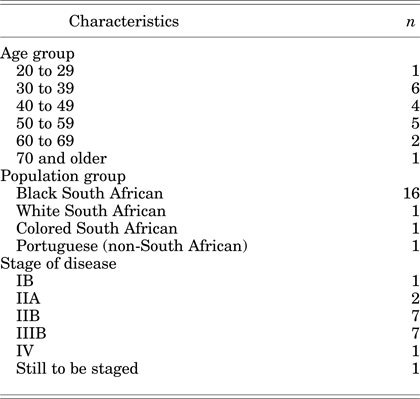
The demographic information revealed that the average age of participants was 47.2 years, with the youngest participant 29 and the oldest 70. The age group 30–39 represented the most participants (6 of 19). The greatest majority (16 of 19) were black South African women from various cultural backgrounds. Most participants had either stage IIB or IIIB disease; one participant had stage IV disease, and one still needed to be staged at the time of the interview. Table 1 presents the general characteristics of the participants. Three themes arose from the data: experiencing the symptoms of the cervical cancer, hearing the bad news, and unanswered questions.
General characteristics of participants (n = 19)

Experiencing the Symptoms of Cervical Cancer
Vaginal bleeding and pain were the most common signs of cervical cancer the women experienced. Most women described their bleeding as “bleeding too much,” while some bled to such an extent that they “had lower blood” and even required blood transfusions. As one participant explained,
I started bleeding. I was bleeding too much; it did not stop for a month (. . .) for 30, 35 days (. . .) I lost so much blood, they had to give me [some] back.
Except for not knowing what was wrong with them (expressed as “I didn't know what's happening to me” or “I thought it was because of working hard”), the bleeding caused great embarrassment and frustration. Participants expressed their embarrassment as follows:
The bleeding came that day, it was like big, big clots (. . .) I had to use a diaper.
(. . .) when I got up, the blood fell under.
One participant expressed her frustration in this manner:
I haven't used this pad for so long (. . .) I don't even know how to put this pad (. . .) it goes backward, forwards (. . .) There is one, you know, it sticks to your panty. I forgot to take this thing out; it fell in the toilet (. . .) to start using it again is so frustrating, so frustrating.
Participants described the pain they were experiencing. They experienced pain in the back, “low down,” and even in their legs and feet. The pain was described as ranging from severe to “slightly.” A patient who experienced mild pain described her pain thus:
I was feeling pain, not much, slightly pain is in my fanny sometimes.
In contrast, for some participants the pain was so severe that they could not sleep. One said,
I can't sleep with that pain, every day (. . .) when I sleep I cry (. . .) I take Panado [paracetamol], the pain stop (. . .) two hours, it start me the pain again.
Another participant reported,
The pain of the cancer is very strong; for the womb it is very strong. You can't sleep, you can't eat, you can't lift heavy (. . .) even five liters is so heavy, you can't (. . .) you can't. I take the Paracet. I drink Paracet; the pain stops. Two hours, three hours, the pain start again. In a day I take eight tablets, morning, afternoon, four o'clock, before I sleep. I take two, two, two, two to stop the pain.
Pain was also considered an indication of the magnitude of the disease, and experiencing pain was seen as a sign of advanced disease. One participant explained as follows:
All I had was the bleeding, but I have not experienced pain as yet, which makes me different from them. Some of them you can see they are walking in a different way, which you can see they are in an advanced stage. Maybe I was lucky that I had to start with bleeding.
Participants suffered other late signs of cervical cancer like decreased urinary output and weight loss. Weight loss was described as “I lost my weight” and “I am losing the weight (. ..) the time I go to the scale I was 68, 70, now I was 52, 55, so I am losing the weight.”
Participants explained their urinary symptoms as follows:
(. . .) and then the problem not going to the toilet (. . .) I'm not going to the toilet (. . .) I am maybe sitting five minutes it's [dripping] toh-toh-toh.
I had kidney failures and cancer at the same time (. . .) so they put me on dialysis.
Both the public and private healthcare systems were employed to find an answer to symptoms. Participants experienced challenges with both. The public system failed some participants in terms of prompt diagnosis, and participants realized this delay allowed time for the cancer to progress. Participants using the public healthcare system reported,
It takes them a whole year to see that I've got cancer (. . .) I don't know whether it had spread in my body (. . .) maybe then it was in part one, now it is in part two (. . .) it takes the whole year now for me to get the treatment. That's what I was not happy about.
I am very cross with the sisters at the clinic because it started last year; I could have maybe only be stage one.
The private healthcare system also added to the burden of participants as they could not afford the consultations and treatment offered. Some carried the cost of the initial consultations while employers and family members paid for others. Once diagnosed, participants were referred to the public health system for further management. One participant was so desperate that she consulted a private gynecologist, knowing full well that she was unable to pay for his services. As she explained,
So the second one, this one is a gynae, I paid R600 (approximately 75 USD) to look at me, and I paid R600 because it was tough, the situation was bad, I could not take anything, I was sick at that time; I could feel that something must be done, I must act quickly (. . .) I was with my sisters, because they were the ones that paid for me (. . .) I am not working.
Another participant explained her experience thus:
So I went to doctor X, (. . .) and she ran some tests as well. Then she discovered that, yes, it was cancer for sure. Then she sent me to another doctor; (. . .) that is where I had more tests. I was supposed to pay a lot of money, which I could not afford.
Hearing the Bad News
Except for two participants who were informed by a nurse and social worker, doctors broke the bad news to the participants. Some participants could not remember what they were told, while others indicated they were told “straight.” One could not remember how the news was broken: “I don't remember (. . .) I don't remember.” Another participant reported, “He said it's a (. . .) it's a (. . .) No, actually he didn't explain.” A third participant recalled her experience in this manner:
I can't remember the words he used, I was too much in shock (. . .) I was shocked but I expected (. . .) They warned me beforehand (. . .) the nurses when I went for my first checkup. He didn't say it in a nice way, but he didn't say it in a ugly way, he just said it. He just said “You see, it is cancer.”
Being told “straight” was also described as “No, it was not easy, but she was just say it, ‘You've got cancer,’ just like that.” “He said ‘You've got sick, you've got cancer (. . .) cancer of the womb, of the mouth of the womb.’ ” Some participants remembered that laboratory results were used when the bad news was broken. As one participant recalled,
He opened the lab results and then said, “This is what we expected (. . .) It is cancer.”
Another participant said, “So she told me, ‘Your results told me you've got cancer.’ ”
Participants were of the opinion that it was not easy for the doctors to tell them the bad news. One participant said, “So in this case, she doesn't have another choice; she has to tell me so that I can also know,” while another said, “No, it was not easy, but she was just say it.”
Most participants were alone when the bad news was broken to them. Some were satisfied with being alone, while others wished their mother or parents had been present to assist them to “understand better.” Some participants could not think of a reason for not being alone. One said, “It will not be better, because it will be the same news (. . .) nothing will change,” while another stated, “What kind of a person was supposed to be there? Because I was understanding what the doctor said to me.” Those accompanied by family members experienced being “helped” and “comforted” and “supported” even with practical help. One participant explained,
My daughter stayed out of work to come with me (. . .) She was sitting outside (. . .) So when I went out I was still crying (. . .) she stood up and hugged me; from there she went everywhere I had to go, until I was in the ward.
Another participant reported,
I was with my sisters. They told me that you see, your cancer is like this, but we are going to take you to the Gen [public hospital]; they are going to take care of you, those people, for there they have all the facilities for this disease.
Participants experienced a variety of emotions when the bad news was broken to them. Words like “it was too much,” “shock,” “I am going to die,” “wept much,” “scared,” and “this is it” expressed their emotions. As one participant explained:
It was a bit hard for me (. . .) it was very, very hard (. . .) very sore (. . .) I wept a lot because I stay alone. I did not think one other thing; I thought I am finished; my life has ended because I have the cancer.
Another participant described her experience thus:
I was so scared, I saw I was going to lose my life (. . .) I was so sad, I did not eat the whole day (. . .) I was crying the whole day (. . .) the whole day and even the night I was crying.
One participant did not know that cancer is a life-limiting condition and laughed after she had been told she had cancer:
(. . .) it was just a sickness (. . .) I didn't take it nowhere (. . .) He says I've got cancer. When I came out of there even when telling my son and my family and my friends, I was laughing and telling them I've got cancer, I did not know it's a serious sickness. We were taking that cancer it was a sick for the white people only (. . .) So when they say to me, I say, “Ag, they say I've got cancer and that's the end of the story” (. . .) We didn't know it was something that can kill you.
Another participant said she was not informed of her diagnosis and was taken to the social worker at the academic hospital to inform her of her diagnosis:
(. . .) the doctor said they cannot tell me (. . .) Maybe I am not feeling alright; then they can't tell me (. . .) I said, “Tell me doctor, what is happening to me?” They say, we will tell you one day (. . .) That is why I came here today; they take me to the social worker to tell me before the doctor tell me it was the cancer.
Participants who were alone when the bad news was broken had the additional burden of informing their significant others. These participants tried to protect their loved ones, as they were especially concerned about the influence their diagnosis would have on their children and elderly parents. This led to distress and anxiety about when, how, and what to tell them. Participants reported, “I also had the problem that I did not know how to break the bad news to my family,” “I felt for my children,” and “for me it is difficult (. . .) what about them?” Another participant explained how difficult it was to inform her children thus:
I don't know, even my children, how I must tell them (. . .) How will I tell them, for they are getting worried and they are driving cars. You know when you are driving a car and you are worried you make mistakes, you know (. . .) Now I am thinking, where will I start to tell them?
Having to inform her elderly mother resulted in one participant postponing her treatment for four weeks as she insisted on telling and “consulting” with her mother before she could be prepared to be admitted to hospital:
When they told me about the operation, I promise, I said I must go and talk to my mother. I went to my mother (. . .) I didn't tell my mother (. . .) my mother is too old, she is 92 (. . .) so I did not tell her (. . .) I came back and I went and I had an op (. . .) I said it would worry her, (. . .) so I kept it that way.
What Remained Unsaid
Many things were left unsaid during the discussion of the bad news, and participants had various unanswered questions. Some felt they were not provided with any additional information except for their diagnosis, while others misunderstood what they were told. Misunderstanding was expressed as, “there is stage 1, 2, 3, 4, 5, 6, 7” and “the machine, they call it the radiator.”
Some participants were not sure what cancer meant and what kind of cancer they had:
You see many people who have cancer, some of the throat, some of the titties, everywhere (. . .) so we don't know what kind of a cancer is that (. . .) They tell us that it's a cancer, and they don't explain anything to us.
(. . .) is the cancer in the kidney, is the cancer in the blood?
Another participant experienced not being informed and reported as follows
After two days, I found out from my next bed. She told me she's got a cancer too (. . .); she came and sat down, told me what‘s wrong and what was happening with cancer. So I was at least feeling better. She was explaining everything for me.
Participants also stated that they needed more information about cancer, the causes, the symptoms they were experiencing and the implications of having cancer. One participant remarked,
I want somebody to tell me about the cancer (. . .) I just want to know about this pain (. . .) The last time I was try to talk to the doctor about the pain (. . .) they said, “there is no medication for the cancer; cancer is cancer; there is no medication for that. That is going to be your pain till for good”; (. . .) that was getting me really worried.
Another participant explained,
I wanted to understand the effects of this (. . .) what causes that people have to die of cancer at some stage. Is it when it is discovered very late; is it when the medication is not working in your body?
Another participant also wanted reassurance that she would be cured once she received the treatment:
I want the doctor to tell me when they treated me, the cancer is not coming again to me (. . .) I want to know that.
DISCUSSION
Living with the symptoms of cervical cancer was difficult for the women and caused physical and emotional suffering. Statements like “bleeding too much” and “they had to give me back” indicate how severe the vaginal bleeding was. Bleeding so profusely caused embarrassment as the blood not only fell on the floor (“it fell under”) but also had to be contained by means of a diaper: “I had to use a diaper.” The bleeding also caused frustration as women had to revert to sanitary protection and even diapers—something that was not part of their daily lives anymore. Abnormal vaginal bleeding is not uncommon in women with cervical cancer, as it has been found to be the most common presenting complaint (Eze et al., Reference Eze, Emeka-Irem and Edegbe2013). No studies have been found to support or contradict the evidence provided by our study on how women experience the unexpected vaginal bleeding, an important practical problem involving sanitary protection that might not be affordable for underprivileged women and could add to their humiliation.
The pain women experienced added to their suffering. Cancer pain is a well-known phenomenon, and it is estimated that one of every two patients using cancer outpatient services suffers from unrelieved pain (Miaskowski, Reference Miaskowski2005). The World Health Organization (2006) describes backache and lower abdominal pain as signs of late cervical cancer, with severe back pain being one of the signs of very late invasive cancer. The pain some participants experienced was “very strong,” and the paracetamol they took only provided relief for a short period of time, as evidenced by “two hours, three hours, the pain start again.” The pain experience also resulted in lack of sleep and misery, which, according to Twycross (Reference Twycross2003), both increase pain intensity, as pain is a multidimensional phenomenon.
The dual healthcare system also added to women's suffering. As indicated by “they were the ones that paid for me” and “I could not afford,” women using private healthcare could not afford the consultations and diagnostic tests, and some had to rely on others to pay for them; even those who paid for themselves could not afford it. This comes as no surprise, as approximately 21% of the South African population who are not medically insured use private healthcare, primarily for primary level care on an out-of-pocket basis while they depend on the public sector for hospital care (Coovadia et al., Reference Coovadia, Jewkes and Barron2009). The public health system failed these women. Statements like “it takes the whole year now for me to get the treatment” and “I am very cross (. . .) it started last year” indicated that women were not promptly diagnosed. Van Schalkwyk and colleagues (Reference Van Schalkwyk, Maree and Wright2008) also found that women experiencing signs of cervical cancer were failed by the public healthcare system as they repeatedly consulted at primary healthcare clinics before they were diagnosed. In addition, there was an average delay of more than 17 months from experiencing the first sign of cervical cancer to correct diagnosis and an additional delay of three to seven months between diagnosis and referral for further treatment. Women in the current study were quite aware, “unhappy,” and “cross” that the delay in diagnosis could have resulted in disease progression: “maybe it was then in part one, now it is in part two” and “I could have maybe only be stage one.” According to Gandhi et al. (Reference Gandhi, Kachalia and Thomas2006), patient safety becomes an important problem when diagnosis is missed or delayed in ambulatory care settings. According to the World Health Organization (2009), South Africa has a weak healthcare system, and the implementation cervical screening executed at nurse-led primary health clinics is problematic. When analyzing 307 closed malpractice claims in the United States, Gandhi and coworkers (Reference Gandhi, Kachalia and Thomas2006) found that 59% of misdiagnoses involved cancer, while failure to order appropriate diagnostic or laboratory tests and failure to obtain an adequate medical history or physical examination were among the four most frequent process breakdowns—something that this group of women also experienced.
Shock prevented the women from recalling the words that were used when the bad news was broken: “I can't remember (. . .) I was too much in shock.” Those who could remember indicated they were told “straight.” However, none of the women complained about the way the bad news was broken to them, and it seemed that it was done in a kind and empathic manner. One participant reported that it was not said in a “nice way,” but also not in an “ugly way.” It was a positive finding that the principle of “gentle truths” (Twycross, Reference Twycross2003) was upheld and that the initial impact of emotionally negative words were softened by giving a “warning shot” using phrases like “what we expected” and “you've got sick,” as Twycross (Reference Twycross2003) suggested.
As illustrated by “no, it was not easy, but she was just say it,” participants were of the opinion that it was not easy for the doctors to tell them that they had cancer. It is indeed true that nobody likes to be the bearer of bad news, even if it is part of the job of healthcare professionals (Brixey, Reference Brixey2004). According to Brixey (Reference Brixey2004), the expert in breaking bad news is not the person who gets it right every time but the one who gets it wrong less often and is less unsettled when things do not go smoothly. Therefore, keeping the diagnosis from the patient (“they say, we will tell you one day”) is not acceptable.
Women who were not alone when the bad news was broken had the advantage of experiencing their family members' love, affection, and support (“she hugged me,” “we are going to take you to the Gen”). In contrast, those who were alone faced the additional burden of having to tell their children and parents. As illustrated by “how will I tell them” and “where will I start,” having to break the bad news to family members added to women's suffering. It was therefore interesting to find that some women were satisfied with being alone when they were informed about their cancer. This phenomenon, however, is not limited to the current study. Exploring the preferences of Australian patients diagnosed with melanoma, Schofield et al. (Reference Schofield, Beeney and Thompson2001) found that almost half of patients did not want another person present when they were told of their diagnosis. This is in contrast to the findings of Fujimori and colleagues (Reference Fujimori, Akechi and Morita2007), who found that 78% of patients in their study conducted in Japan preferred to have family present.
Our study provides evidence that the information given to women when they were told of their cancer was not clear and well understood by all, and some had to rely on another patient or a social worker to explain their diagnosis. In addition, there were unanswered questions (“is it cancer of the kidney, is it cancer of the blood?”). However, providing “correct” information is a challenge, as patients differ in what they would like to know during the discussion of the bad news. Studying patient preferences of how to receive a diagnosis and how to be told about its implications and treatment options, Schofield et al. (Reference Schofield, Beeney and Thompson2001) found that the majority wanted to know “everything” about their diagnosis and treatment. They also wanted to know about their prognosis, and how the cancer would influence other aspects of their life such as their family life, work, and daily activities. In a systematic review on how cancer patients preferred the bad news to be broken, Fujimori and Uchitomi (Reference Fujimori and Uchitomi2009) found that most patients preferred the bad news to be communicated clearly and honestly, in simple terms, in order to facilitate the patient's full understanding. This was unfortunately not the case for some of the women included in our study. Having unmet information needs is not without consequences, as patients who are of the opinion that they were not told enough often suffer from feelings of insecurity due to perceived lack of professional interest in their symptoms, lack of information about what is going on and what to expect in the immediate future, as well as perceived lack of good care (Mystakidou et al., Reference Mystakidou, Parpa and Tsilika2004).
LIMITATIONS OF THE STUDY
Our study was restricted to women referred to one academic hospital in one of the provinces of South Africa, a country hosting people from various cultural and income groups. It is therefore not possible to conclude that all women diagnosed with cervical cancer will share the same themes as the participants in our study. There could also be more than one interpretation of the narratives as no qualitative study can divine only one true meaning.
CONCLUSION
Being confronted with cervical cancer can be described as a traumatic experience. Women suffer unexplained, severe, humiliating vaginal bleeding and unrelieved pain. They have to face a dual healthcare system: on the one hand, unaffordable effective private healthcare and, on the other, the free-of-cost public healthcare that failed them. The bad news of their cervical cancer is most commonly broken in a kind and sympathetic manner, yet misunderstandings and the need for additional information prevail after this conversation. Finally, having to inform their families of their cancer only adds to their suffering.