Introduction
Anxiety and depressive symptoms are common in older people with chronic obstructive pulmonary disease (COPD). Pooled international data from studies investigating this group of patients estimate the prevalence of depressive and anxiety symptoms to be approximately 40% and 36% respectively (Yohannes et al., Reference Yohannes, Baldwin and Connolly2000b; Maurer et al., Reference Maurer2008). A previous New Zealand study found a prevalence of anxiety symptoms to be as high as 50% in patients with COPD (Dowson et al., Reference Dowson, Laing and Barraclough2001). The prevalence of Generalized Anxiety Disorder may be as high as 15.8% in subjects with COPD, which is more than three times the general adult population (Brenes, Reference Brenes2003; Kunik et al., Reference Kunik2005). Panic attacks also appear to be more common in this group of patients.
COPD is the fourth most common cause of avoidable hospitalization for New Zealand adults aged 45 years and over. In 1998/9 there were 7,450 admissions to public hospitals for COPD with an average length of stay of 6.2 days and total cost of NZ$16.4 million (Asthma and Respiratory Foundation of New Zealand, 2001). Anxiety is a major predictive factor for increased hospital admissions for acute exacerbation of COPD in the elderly (Yohannes et al., Reference Yohannes, Baldwin and Connolly2000a). Thus, timely recognition and treatment of anxiety symptoms may reduce avoidable hospitalization in this group of patients.
Current European and Australasian COPD guidelines recommend routine screening for anxiety and depression (Thoracic Society of Australia and New Zealand and Australian Lung Foundation, 2002; National Institute for Clinical Excellence, 2004). However, anxiety and depressive disorders in patients with COPD are often under-recognized and under-treated. Healthcare providers may recognize less than 40% of anxiety or depressive disorders in patients with COPD and treat only 30% of those recognized (Kunik et al., Reference Kunik2005). Importantly, under-treatment of anxiety and depressive disorders is associated with poorer quality of life and earlier death (Yohannes et al., Reference Yohannes, Baldwin and Connolly2003; Gudmundsson et al., Reference Gudmundsson2006). Therefore, a valid, reliable and easily administered screening tool may assist with the identification of these disorders in patients with COPD and improve prognosis. Two other studies have investigated the validity and reliability of screening tools in detecting depressive and anxiety disorders in patients with COPD (Yohannes et al., Reference Yohannes, Baldwin and Connolly2000a; Kunik et al., Reference Kunik2005). The instruments assessed in these studies were the PRIME-MD screening questions, Beck Anxiety Inventory, Beck Depression Inventory and Brief Assessment Schedule Depression Cards (BASDEC). However, these screening tools have not been specifically investigated for use in older people with COPD.
The aim of this study was to investigate the sensitivity and specificity of two easily applied screening tools in detecting anxiety disorders in older people with COPD. The Geriatric Anxiety Inventory (GAI) was recently developed in Australia to screen anxiety symptoms specifically in older people (Pachana et al., Reference Pachana, Byrne and Siddle2007) and has not yet been validated in patients with COPD. It is a 20-item self-report or rater-administered scale which assesses anxiety symptoms in older people that were experienced during the preceding week. It has been shown to have good validity in determining the presence or absence of anxiety disorder specifically in older patients (Pachana et al., Reference Pachana, Byrne and Siddle2007). In that study, the optimum cut point to identify patients with any anxiety disorder was 8/9 (specificity of 80% and sensitivity of 78%). The authors of the GAI, when developing the inventory, initially formulated more than 60 items to reflect anxiety symptoms. These were reduced to the 20 items now used in the final version of their inventory. These items were specifically chosen to include those with minimal somatic focus in an effort to reduce overlap with symptoms of physical conditions such as COPD. Only one previous study has investigated the use of GAI for screening for anxiety disorders in people with a chronic medical condition (Matheson et al., Reference Matheson2010). The authors found the GAI to be an appropriate tool for use with Parkinson's disease patients with no dementia, where the optimum GAI cut point was 6/7.
The Hospital Anxiety and Depression Scale (HADS) is a self-report or rater-administered scale composed of seven items measuring anxiety symptoms and seven items measuring depressive symptoms experienced during the preceding week (Zigmond and Snaith, Reference Zigmond and Snaith1983). The scale was designed for general hospital patients and has been widely used to screen for psychiatric morbidity. It has been shown to have a high validity when used as a screening instrument in the medical outpatient setting. The current study assessed the sensitivity and specificity of the HADS anxiety subscale. A score ≥8 has previously been established as optimal for detection of anxiety or depression during screening (Zigmond and Snaith Reference Zigmond and Snaith1983; Bjelland et al., Reference Bjelland, Dahl, Haug and Neckelmann2002). Although HADS is the screening tool recommended in the Australian/New Zealand COPD management guidelines (Thoracic Society of Australia and New Zealand and Australian Lung Foundation, 2002), its validity in older people with COPD has not been examined.
We assessed the sensitivity and specificity of the GAI and HADS in older people with COPD. For the purposes of the study, a structured psychiatric interview, the Mini International Neuropsychiatric Interview (MINI) (Sheehan et al., Reference Sheehan1998) was used as the gold standard to confirm the presence or absence of anxiety disorders.
Methods
Subject selection
This was a cross-sectional study of subjects recruited from the COPD patient database maintained by the respiratory service at Waikato Hospital, a large regional hospital in New Zealand. Ethics approval was obtained from the Northern Y Regional Ethics Committee and informed consent was obtained from all eligible participants.
Entry criteria included older people with a diagnosis of COPD (fixed airflow obstruction characterized by FEV1 <70% predicted, FEV1/FVC <80%, and <15% reversibility with bronchodilator) and recent stable respiratory status (no oral corticosteroid or antibiotic rescue therapy in the previous month). Older people were defined as aged 65 years or older except in Maori participants where the age was set at 55 years or older. Maori are the indigenous people of New Zealand and are well recognized to suffer overall poorer health status, shorter life expectancy, higher rates of COPD and to present with exacerbations of COPD at an earlier age compared to non-Maori New Zealanders (Chang et al., Reference Chang2007). Other inclusion criteria included a score ≥ 24 on the standardized Mini-Mental State Examination (MMSE) and fluency in the English language in order to complete the various rating scales.
Subjects were excluded if they had concurrent diagnoses of other chronic respiratory illnesses (e.g. asthma or bronchiectasis) or an acute medical condition that could significantly influence their overall health status (e.g. unstable ischemic heart disease, cancer and heart failure).
Instruments
(i) Geriatric Anxiety Inventory
(ii) Hospital Anxiety and Depression Scale
(iii) Mini-Mental State Examination: the MMSE was used to ensure the exclusion criterion regarding cognitive capacity was met.
(iv) Mini International Neuropsychiatric Interview: selected parts of the MINI, a structured diagnostic psychiatric interview (Sheehan et al., Reference Sheehan1998), were used as the diagnostic gold standard in this study. The selected parts of the MINI included the identification of anxiety related disorders, namely Generalized Anxiety Disorder, Panic Disorder, Social Phobia, Agoraphobia, Obsessive-Compulsive Disorder, Post-traumatic Stress Disorder, and the mood related disorders of Dysthymia and Major Depressive Disorder.
Study design
Subjects were identified from the existing outpatient respiratory database and, if consenting, underwent further screening (including a full respiratory assessment and spirometric measurements) by a respiratory physician (CC) and respiratory nurse specialist (GS). Other information collected after recruitment included demographic data (age, gender, marital status, and ethnicity), smoking history, other medical history and the use of anxiolytic/antidepressant medications.
Subjects were seen within one week of screening by a specialist psychiatrist (GC or CP) and research assistant (MC). To investigate and minimize the potential confounding from prior questioning about mental health symptoms, subjects were randomly assigned to two groups: Stream 1 subjects were asked to complete the rating scales (GAI, HADS) first and then undergo the MINI and MMSE; Stream 2 subjects were required to undergo the MINI and MMSE first and then complete the screening scales. The MINI and MMSE were conducted by a specialist psychiatrist (GC or CP). The GAI and HADS were self-report tools and they were administered by MC.
Statistical analysis
SPSS version 17.0 (SPSS Inc., Chicago, IL, USA) was used for statistical analysis. The sensitivity, specificity, positive predictive value and negative predictive value were calculated for each of the scales used in the diagnosis of anxiety disorder. The MINI diagnoses constituted the criterion standard for presence or absence of anxiety disorders and these results were compared to the disorders identified by the GAI and the HADS. Receiver operating characteristic (ROC) curves were constructed to determine the optimal cut points for the two anxiety scales. Two tailed t-tests were used to investigate any significant difference in the GAI and HADS scores in (i) Stream 1 vs. Stream 2, and (ii) subjects taking anxiolytic and/or antidepressant medications vs. those not taking these medications. P values ≤0.05 were regarded as significant.
Results
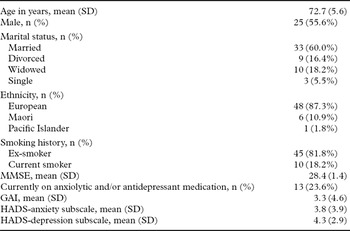
Sixty-three subjects were screened between June 2007 and April 2008. Eight subjects were excluded after initial screening and the remaining 55 subjects completed the study protocol. Participant characteristics are summarized in Table 1. An anxiety and/or depressive disorder was identified using the MINI in 14 (25.5%) subjects. Conditions identified by the MINI included Generalized Anxiety Disorder (n = 4), Panic Disorder (n = 7), Agoraphobia (n = 4), Social Phobia (n = 1), Obsessive Compulsive Disorder (n = 1), Dysthymia (n = 4) and Major Depressive Episode (n = 2). (Eight subjects had more than one diagnosis identified by MINI.) Two (14.3%) of the 14 subjects were Maori and nine (64.3%) were female.
Overall participant characteristics

Geriatric Anxiety Inventory
Subjects with an identifiable anxiety disorder on the MINI (n = 14) had significantly higher mean GAI scores than those without an anxiety disorder (mean score = 7.6 (SD = 5.7) and 1.8 (SD = 3.1) respectively, p = 0.002).
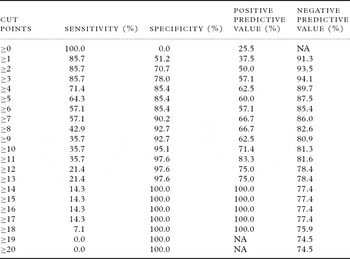
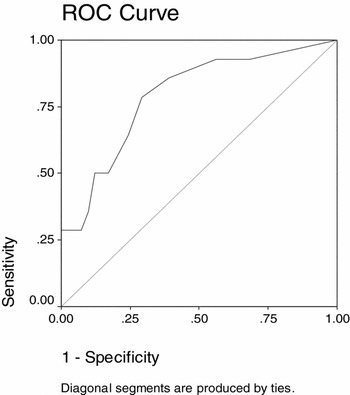
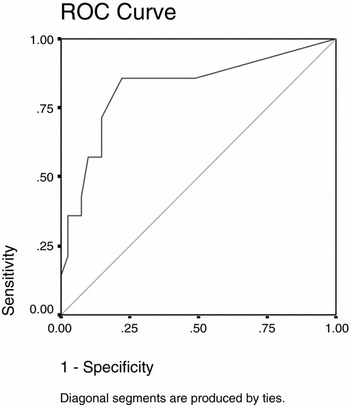
Table 2 shows the sensitivity and specificity of the GAI at various cut points. The ROC curve for the GAI is shown in Figure 1. The area under the curve (AUC) was 0.83 (SE = 0.07). The optimum cut point was 2/3 (i.e. scores of three or greater). This cut point correctly classified 80.0% of the sample with a sensitivity of 85.7%, specificity of 78.0%, positive predictive value of 57.1% and negative predictive value of 94.1%.
The sensitivity and specificity of GAI for detecting an anxiety disorder in older people with COPD at different cut points

ROC Curve – GAI

Hospital Anxiety and Depression Scale – anxiety subscale
Subjects with an anxiety disorder identified on the MINI (n = 14) had significantly higher mean HADS-anxiety subscores than those without an anxiety disorder (mean score = 7.1 (SD = 4.9) and 2.6 (SD = 2.8) respectively, p = 0.005).
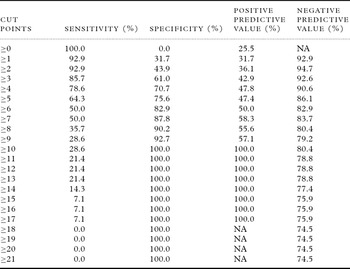
Table 3 shows the sensitivity and specificity at various HADS cut points. The ROC curve for the HADS-anxiety subscore is shown in Figure 2. The AUC was 0.79 (SE = 0.07) and the optimum cut point was 3/4 (i.e. scores of four or greater). This cut point correctly classified 72.7% of the sample with a sensitivity of 78.6%, a specificity of 70.7%, a positive predictive value of 47.8% and a negative predictive value of 90.6%.
The sensitivity and specificity of HADS-anxiety subscale for detecting an anxiety disorder in older people with COPD at different cut-points

ROC Curve – HADS-anxiety subscale

Comparison of patient streams
The order in which subjects received their GAI/HADS screen and MINI did not appear to affect screening scores. There was no significant difference in the mean scores between patient streams for either GAI (Stream 1 = 2.7; Stream 2 = 3.9; p = 0.324) or HADS (Stream 1 = 3.4; Stream 2 = 4.4; p = 0.324).
Discussion
The association between anxiety disorders and a wide range of medical disorders is well known. This association may be seen as a pathophysiological consequence of the general medical disorder, a psychological reaction to the experience of having the medical condition, a side effect of treatment, a combination of these or a chance happening (Muller et al., Reference Muller, Koen and Stein2005). This broad range of possible causes makes it difficult to determine whether anxiety symptoms are due to the respiratory disease itself or whether the symptoms are due to psychiatric conditions occurring in the context of COPD. Dyspnoea and fatigue are common in COPD but also feature in mood or anxiety disorders. In addition, mood and anxiety symptoms may be caused by medications commonly used to treat the pulmonary illness such as beta-agonist bronchodilators and corticosteroids (Shanmugan et al., Reference Shanmugam, Bhutani, Khan and Brown2007).
A dyspnoea-fear theory has been proposed as a possible explanation for the link between respiratory disorders and anxiety (Ley, Reference Ley1989). It has been hypothesized that patients with asthma or COPD misconstrue the severity of their dyspnoea and their fear of severe breathlessness leads to a heightened state of psychological arousal. This in turn results in the further misperception of increased dyspnoea and worsening breathlessness due to hyperventilatory panic attacks. Another theory suggests that panic disorder, in particular, represents a false suffocation alarm, possibly triggered by increases in pCO2 and brain lactate (Klein, Reference Klein1993). A reduction in the anxiogenic effect of pCO2 using a range of antidepressants including paroxetine, sertraline and imipramine has been shown in panic disorders (Bertani et al., Reference Bertani, Perna and Arancio1997).
This study aimed to investigate the sensitivity and specificity of two screening tools for anxiety disorder in older people with COPD. The GAI was specifically developed to screen anxiety in older people. The HADS is already known to be useful in detecting anxiety disorders in a range of medical patients but has not previously been formally evaluated in the assessment of older subjects with COPD. Our results support the use of the GAI and HADS as screening instruments for anxiety disorders in this population.
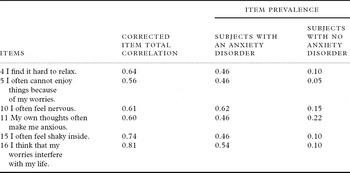
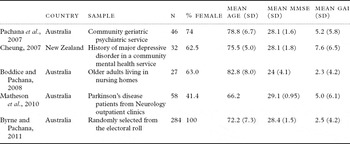
The optimal GAI cut point for the screening of anxiety disorder found in this study was 2/3, which is much lower than the cut point of 8/9 recommended in its initial development (Pachana et al., Reference Pachana, Byrne and Siddle2007). We undertook a post hoc analysis of the item total correlation and item prevalence of the GAI in our sample. An α of 0.92 was found and this suggests good overall reliability of the GAI. The corrected item total correlation coefficient ranged from 0.40 (item 8) to 0.81 (item 16). In terms of item prevalence, the items which were better at differentiating subjects with and without an anxiety disorder were items 4, 5, 10, 11, 15 and 16 of the GAI-20 (Table 4). Difference in sampling may be one of the reasons for the unusually low cut point found in this study. The study by Pachana et al. (Reference Pachana, Byrne and Siddle2007) included 46 older people with no significant cognitive impairment attending a community geriatric psychiatry service. None of the participants in our study was a psychiatry service patient and only a minority (23.6%) were taking any anxiolytic and/or antidepressant medication. Anxiety symptomatology is common in a number of psychiatric conditions so the level of anxiety, as measured by the GAI, is expected to be greater in a psychiatric sample than a non-psychiatric sample such as in the current study. A sub-analysis of the two subgroups – those taking anxiolytic and/or antidepressant medications and those not taking these medications in our sample found that the medication subgroup had a higher mean GAI score (5.3 vs 2.7), although this did not reach statistical significance (p = 0.073). Table 5 summarizes the mean GAI and other characteristics in previous studies of GAI. The mean GAI in our study was 3.3, in line with the mean GAI found in other studies which ranged from 2.3 to 7.6.
GAI corrected item-total correlation and item prevalence

Summary of published studies on GAI

The GAI cut point for screening for anxiety disorders in patients with Parkinson's disease with no dementia was found to be 6/7 (Matheson et al., Reference Matheson2010). A substantial proportion of patients in this study had psychiatric comorbidities: 28% of the participants had a current anxiety disorder; 21% had a current depressive disorder; and 17% had a comorbid anxiety and depressive disorder.
The standard deviations of the GAI and HADS scores in our sample are relatively large. Large standard deviations of the GAI scores were also found in previous studies, as listed in Table 5. This raises the issue of the heterogeneity of these samples and may explain the variation in optimal cut points.
The HADS was originally developed for medical outpatients aged between 18 and 65 years. A review of the literature suggests that the optimal balance between sensitivity and specificity was achieved when caseness was defined by a score ≥ 8 on the anxiety subscale (Dennis and Boddington, Reference Dennis and Boddington2007). However, there are concerns that the anxiety subscale may be less useful in identifying anxiety in geriatric medical inpatients (sensitivity of 41% and specificity of 76.6% when the cut point of 8 was used) (Davies et al., Reference Davies, Burn, McKenzie, Brothwell and Wattis1993). In another study, the HADS showed a high sensitivity (80%) but a low specificity (46%) resulting in high misclassification rates when screening for the presence of anxiety in a group of older people from secondary and tertiary psychiatric services (Dennis and Boddington, Reference Dennis and Boddington2007). Our study found sensitivity and specificity were optimal using a lower cut point. Similarly, a study that screened Chinese elderly in a general practice for anxiety also found a relatively low optimal cut point of 2/3 for the HADS anxiety subscale (Lam et al., Reference Lam, Pan, Chan, Chan and Munro1995). The HADS is the recommended screening tool for anxiety in chronic respiratory disease guidelines and is increasingly adopted by respiratory services in many countries. We believe there is an urgent need to investigate its suitability for screening anxiety disorders in older people with COPD and its optimal cut point in this population.
The strengths of this study include robust disease definition with all included patients undergoing pre- and post-bronchodilator spirometry as well as specialist respiratory physician assessment for the diagnosis of COPD. Psychiatric assessments were made by an independent investigator blinded to the subjects’ respiratory assessment results. The main limitation of this study was potential sampling bias: the sample size was small and the study participants were consenting volunteers rather than chosen randomly from the existing database, thus raising an issue about the generalizability of our findings.
The International Consensus Group on Depression and Anxiety currently advises brief screening of all patients using a validated scale of symptom severity (Ballenger et al., Reference Ballenger, Davidson and Lecrubier2001). Anxiety symptoms are relatively common in patients with COPD. A screening scale which can validly and reliably indentify those patients who fulfilled the psychiatric diagnostic criteria for an anxiety disorder will be of great clinical use. When symptoms meet criteria for diagnosis of anxiety or depression, or cause significant distress and have impact on functional status, referral and treatment is warranted. Ideally, screening tools should be quick to administer and simple to use. This study suggests the GAI has better sensitivity and specificity than the HADS as a screening instrument in older people with COPD. However, the optimal cut points for both the GAI (scores of 3 or greater) and HADS (scores of 4 or greater) found in our study were unusually low. We suggest the results of this study should be replicated before these cut points can be recommended for general use in older people with COPD.
Conflict of interest
None.
Description of authors’ roles
G. Cheung designed the study, completed the psychiatric assessments, carried out the statistical analysis and wrote the paper. C. Patrick supervised the data collection by M. Cooray, completed the psychiatric assessments and wrote the paper. M. Cooray contributed to data collection and project coordination. C. Chang and G. Sullivan contributed to the study concept, recruited patients, conducted the respiratory assessments and critically revised the paper.
Acknowledgments
The authors wish to thank the volunteer subjects. This study was funded by the Waikato Clinical School, University of Auckland (through a summer studentship), the Waikato Medical Research Foundation and the Waikato Respiratory Research Fund.