INTRODUCTION
Temporal variation in foraminiferal population and species assemblage are among the most extensively applied foraminiferal proxies for palaeoclimatic and palaeoceanographic reconstruction (Gooday, Reference Gooday2003). The applicability of such foraminiferal proxies for palaeoclimatic reconstruction arises from the studies suggesting that under natural field conditions, reproduction in foraminifera is influenced by a number of ecological parameters, including food, temperature, salinity, pH, dissolved oxygen, etc (Boltovskoy & Wright, Reference Boltovskoy and Wright1976; Murray, Reference Murray1991; Gooday & Rathburn, 1997; Gooday, Reference Gooday2003). Thus, changes in the mode and rate of reproduction of foraminiferal species under different environmental conditions, lead to the variation in foraminiferal assemblages and population. Such changes in planktonic foraminiferal population and species diversity have mainly been attributed to productivity and hydrographic changes (Pujol & Grazzini, Reference Pujol and Grazzini1995; Brunner & Biscaye, Reference Brunner and Biscaye2003). Additionally, planktonic foraminiferal abundance and species assemblage is altered significantly during the sinking of planktonic foraminiferal tests towards the sea-bottom, after the death of the organisms (Berger & Piper, Reference Berger and Piper1972). The lunar cycle has also been shown to affect the reproductive cycle of certain planktonic foraminiferal species (Bijma et al., Reference Bijma, Erez and Hemleben1990; Carstens & Wefer, Reference Carstens and Wefer1992; Schiebel et al., Reference Schiebel, Hiller and Hemleben1995).
However, the changes in benthic foraminiferal population and species diversity have mainly been attributed to the change in surface water productivity leading to variation in the organic matter flux to the sea bottom and bottom water oxygenation (Gooday & Rathburn, Reference Gooday and Rathburn1999, and references therein). It has further been suggested that out of the biotic and abiotic environmental factors, abiotic factors play a dominant role in shaping the benthic foraminiferal assemblage, especially in marginal marine environments (Murray, Reference Murray1991; Sen Gupta, Reference Sen Gupta and Sen Gupta1999). Out of abiotic factors, temperature and salinity have been reported as the most important ecological parameters, which affect the distribution, growth and reproduction of foraminifera along the coastal areas (Boltovskoy & Wright, Reference Boltovskoy and Wright1976). Pollution has also been reported as an important factor that significantly influences the benthic foraminiferal population, species assemblage and morphology, in the near-shore shallow water regions (Debenay et al., Reference Debenay, Guillou, Redois, Geslin and Martin2000; Chatelet et al., Reference Chatelet, Debenay and Soulard2004; Nigam et al., Reference Nigam, Saraswat and Panchang2006a).
However, according to Bradshaw (Reference Bradshaw1961), in an area with imperceptible pollution, temperature may limit the distribution of species geographically and also affect growth, reproduction and other vital functions. In coastal areas the marine water characteristics vary as a result of fresh water influx during monsoon, which in turn affects the foraminiferal assemblages (Murray, Reference Murray1991; Nigam et al., Reference Nigam, Khare and Borole1992; Nigam & Khare, Reference Nigam and Khare1994, Reference Nigam and Khare1999; Murray & Alve, Reference Murray and Alve1999).
Increased information of the factors affecting the foraminiferal reproduction can increase the reliability of palaeoclimatic proxies that are based on temporal changes in foraminiferal abundance and species diversity. However, since under natural environmental conditions, a number of ecological parameters simultaneously affect the foraminifera, it is difficult to study the effect of specific change in ecological parameters, on the foraminifera. Therefore, to give more reliability to the field-based proxies, culturing of foraminifera under controlled laboratory conditions is necessary. In laboratory culture studies, the effect of one or a combination of parameters on foraminifera can be studied, by keeping the rest of the parameters constant. Therefore, field based observations have continuously been evaluated by laboratory culture studies (Bradshaw, Reference Bradshaw1955, Reference Bradshaw1957, Reference Bradshaw1961; Nigam et al., Reference Nigam, Saraswat and Sujata2006b). However, laboratory culture studies to understand the effect of different temperature and salinity on different benthic foraminiferal species are limited.
Therefore, in the present study an attempt has been made to study the combined effect of temperature and salinity on the growth as well as mode and rate of reproduction of the shallow water benthic foraminiferal species Rosalina leei. Since the reported range of seawater temperature over a period of one year was found to be between 24.4°C and 30.6°C (Table 1, this study; Rodrigues, Reference Rodrigues1984) it was decided to subject the R. leei specimens to seawater temperatures within this limit.
The temperature, salinity and pH during different times of the year at the sampling station.

Premonsoon, February–May; Monsoon, June–September; Postmonsoon, October–January.
MATERIALS AND METHODS
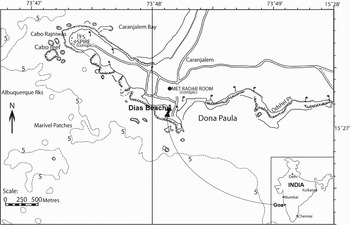
In order to pick live specimens, material (sediment and sea grass) was collected from the coastal areas off Goa (Figure 1), by using the methods suggested by Myers (Reference Myers1935) and Arnold (Reference Arnold1954). Material for live specimens was collected from the shallow water regions off Goa. Both, floating as well as attached (to rocks submerged in seawater) seaweeds and algal material were collected and transferred to plastic tubs having filtered seawater. The seaweeds and algal material were shaken vigorously to detach foraminifera from the substrate. The complete material was then put over sieves of size 1000 µm and 63 µm, in order to get rid of extraneous material and concentrate the foraminifera. The >63 µm and <1000 µm material was collected in glass beakers, along with seawater and brought to the laboratory for further processing. The foraminifera were isolated from the samples with the help of a stereozoom microscope, and transferred to multi-well culture dishes. When the isolated specimens responded through movement, collection of food material or extended pseudopodia, as observed under the inverted microscope, the specimens were confirmed to be live.
Location of sampling station.

Once live specimens required to carry out the experiment were available, they were subjected to different combinations of temperature (25°C, 30°C and 35°C) and salinity (25‰, 30‰ and 35‰). Though R. leei has previously been reported to reproduce at 17–20°C (Hedley & Wakefield, Reference Hedley and Wakefield1967), seawater temperature in the present study area throughout the year remains well above the reported range of seawater temperature for the reproduction of R. leei (Table 1) (Rodrigues, Reference Rodrigues1984).
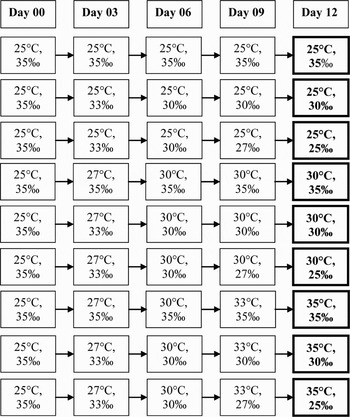
A total of 216 specimens were used for the experiment. Initially, all the specimens were kept at 25°C temperature and 35‰ salinity, as this temperature and salinity were reported at the time of collection of material for picking of live specimens. Two specimens were kept in each well of the six-welled culture tray. Thus, 12 specimens were subjected to each combination of salinity and temperature. After three days one set was kept at the temperature and salinity reported from the field while in other sets the temperature and salinity were changed according to the desired combination. The schematic diagram of the experimental set-up is illustrated in Figure 2. The salinity and temperature were changed gradually, in order to prevent a sudden experimental shock, which the organisms could experience if they were transferred directly to the respective intended salinity and temperature.
The experimental set-up as and how the salinity and temperature was changed.

The number of chambers and maximum diameter for each specimen subjected to the experiment were noted in the beginning, and subsequently at a regular interval of eight days during the course of the experiment. Seawater with salinity lower than that from the field was prepared by diluting the seawater with distilled water. Higher saline water was prepared by controlled evaporation at 45°C temperature. Food in the form of mixed diatom culture was added every time the media was changed, i.e. every fourth day. All the observations regarding the growth, number of chambers and general physiological changes, including pseudopodial activity etc, were made with the help of a Leica inverted microscope. The experiment was carried out in duplicate.
RESULTS AND DISCUSSION
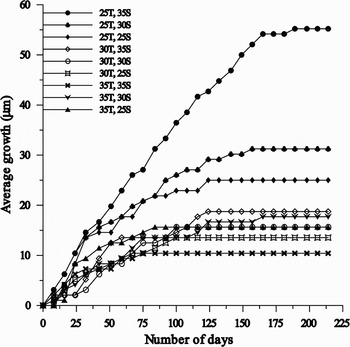
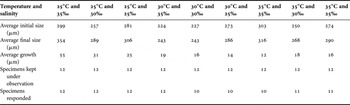
All specimens showed significant growth from the beginning of the experiment until about 50 days Maximum growth was observed in the specimens kept at 25°C temperature and 35‰ salinity (Figure 3; Table 2). Growth was observed even until 189 d and the average growth was ~55 µm. The specimens maintained at 30‰ salinity showed growth only for 157 d with an average growth of 31 µm and in case of the specimens kept at 25‰ salinity the specimens showed growth for 92 d with an average growth of 25 µm. The specimens kept at 30°C and 35°C temperature and different salinities showed much less growth as compared to the specimens maintained at 25°C temperature and different salinities.
Graph showing observed average growth in response to varying temperature–salinity combinations.

Out of the three sets of specimens kept at 30°C temperature and different salinities, specimens kept at 35‰ salinity showed the maximum growth (Figure 3; Table 2). The growth was reported for 122 d and the average growth was noted to be around 18 µm. Likewise the specimens maintained at 30‰ salinity showed growth only for 96 d with an average growth of 15 µm and in the case of the specimens subjected to 25‰ salinity, the growth was reported for 96 d with an average of 13 µm.
In the case of the set of specimens maintained at 35°C temperature, specimens kept at 30‰ salinity showed maximum growth (Figure 3; Table 2). Growth was reported for 135 d and the average growth was noted to be around 17 µm. Similarly, the specimens at 35‰ salinity showed growth only for 159 d with an average growth of 12 µm and in the case of the specimens kept at 25‰ salinity the specimens grew for 95 d with an average growth of 15 µm. In the present experiment, growth in R. leei was observed to be directly proportional to salinity and inversely proportional to temperature. However, none of the specimens reproduced during the course of the experiment.
Average initial and final size of the specimens of Rosalina leei along with the number of specimens subjected to experiment.

As the majority of the foraminiferal tests are made up of calcium carbonate, salinity of the seawater plays an important role in distribution, growth and abundance of foraminifera. Boltovskoy & Wright (Reference Boltovskoy and Wright1976) reported that the solubility of CaCO3 is proportional to salinity of the seawater. Therefore, as the salinity decreases, the concentration of CaCO3 also decreases which in turn lowers the growth of the foraminifera. In the present experiment maximum growth was observed in the specimens maintained at 25°C temperature and 35‰ salinity. It indicates that at comparatively higher salinity and lower temperature, Rosalina leei specimens will be abundant and the test size will be large. But at relatively lower salinity, the size of the R. leei tests will also decrease. Bradshaw (Reference Bradshaw1961) reported that the highest growth rate was observed in cultures of Ammonia beccarii tepida grown at normal salinity (34‰). But the growth rate decreased at lower salinity. Similar results were also reported from both fields as well as laboratory culture experiments (see Boltovskoy et al., Reference Boltovskoy, Scott and Medioli1991, for review; Nigam et al., Reference Nigam, Saraswat and Sujata2006b).
Caron et al. (Reference Caron, Faber and Be1987) reported that in the planktonic foraminiferal species Globigerinoides sacculifer, subjected to different temperature and salinity, maximum shell size was observed in the specimens kept at or closest to the reported temperature and salinity optima (25°C and 35.25–37.25‰). Carpenter (Reference Carpenter1856) suggested that temperature could play an important role in the morphological variations of the foraminiferal test. In the present experiment, larger specimens are noticed at relatively cooler temperatures. Rhumbler (Reference Rhumbler1911) also suggested that the same species might have larger specimens in cold water than in warm. Similarly, Bradshaw (Reference Bradshaw1957) reported that at comparatively higher temperature (35°C), no growth was observed in Streblus beccarii var. tepida specimens and eventually the specimens died.
Though growth was noticed in all the specimens subjected to the experiment, reproduction did not take place at any of the several combinations. The lack of reproduction under the present set of experimental conditions probably indicates that R. leei prefers a narrow range of seawater temperature and salinity for reproduction, which is different from the seawater temperature and salinity conditions in the present study. However, in another experiment, R. leei showed dissolution when subjected to 25°C and 15 to 10‰ (Kurtarkar et al., in preparation). Such response is significant for the application of benthic foraminiferal characteristics for palaeoclimatic studies. Comparatively cooler as well as extremely warmer conditions will lead to lack of reproduction or decreased reproduction rate in R. leei, thus decreasing its abundance. Bradshaw (Reference Bradshaw1955, Reference Bradshaw1957) reported that at temperatures outside the reproductive temperature limits, the foraminifera might remain alive and yet not reproduce; he also observed that though foraminifera may have reached maturity it would only reproduce if the environmental conditions were favourable. Interestingly, the cooler conditions and higher salinity are the result of decreased monsoon strength during glacial periods. Thus the temporal variation in the R. leei abundance can provide an idea about the past monsoon changes.
CONCLUSION
With this laboratory culture experiment wherein live specimens of Rosalina leei were subjected to different combinations of temperature (25°C, 30°C and 35°C) and salinity (25‰, 30‰ and 35‰), it is inferred that:
• Out of the set of temperature–salinity conditions, 25°C temperature and 35‰ salinity appeared to be the best suited for the growth of R. leei.
• The specimens subjected to higher temperature (>25°C) and lower salinity (<35‰) or same temperature (25°C) and lower salinity (<35‰) as well as same salinity (35‰) and higher temperature (>25°C) showed comparatively lower growth. Therefore, we conclude that at comparatively lower temperature and higher salinities the growth rate of R. leei increases, but as the temperature increases and salinity decreases the growth rate also decreases.
• Rosalina leei prefers a narrow range of temperature and salinity for reproduction, which is different from the set of conditions in the present study. However, the specimens survived for a longer time span, and significant growth was also noticed.
The findings are significant as the response of benthic foraminifera to different temperature and salinity is often used for palaeoclimatic reconstruction.
ACKNOWLEDGEMENTS
The authors are thankful to the Director, National Institute of Oceanography, Goa for his support and permission to publish this work. We are also thankful to the Department of Science and Technology, New Delhi for the financial support (SR/S4/ES-74/2003) to the RN and ‘Women Scientist Scholarship’ (WOS–B) to L.V.N. Two of the authors (S.R.K.) and (S.S.R.) are thankful to the Council of Scientific and Industrial Research, New Delhi for granting a Senior Research Fellowship. The authors thankfully acknowledge the suggestions of Ms Rajani Panchang that helped to improve the manuscript. Mr D.H. Shanmukha and Mr Pawan Govil are acknowledged for their help and support.