Introduction
Given the significant increase in the size of the older adult population, the numbers of people living with dementia are increasing with unprecedented speed all around the world (Alzheimer's Disease International, 2015). Consequently, a high demand for services overwhelms formal healthcare systems, and leaves the vast majority of care in the hands of family or friend care partners “caregivers” (Mark, Reference Mark2016). Caregivers devote substantial time, energy, and resources to helping their care recipients navigate everyday tasks. With progressive cognitive and functional decline, people with dementia become more dependent and caregiving roles come to encompass oversight, decision-making, and often total management of all aspects of a care recipient's life and health. Though caregiving can be highly meaningful and rewarding (Roth et al., Reference Roth, Fredman and Haley2015), dementia is a long and challenging journey that may be detrimental to the caregivers’ health and wellbeing (Bremer et al., Reference Bremer2015). This role strain is felt particularly during times of medical crises of people with dementia that intensify caregiving demands and often deplete caregivers’ capacity to handle emotional and physical stress (Bloomer et al., Reference Bloomer, Digby, Tan, Crawford and Williams2014; Boltz et al., Reference Boltz, Chippendale, Resnick and Galvin2015; MacNeil Vroomen et al., Reference MacNeil Vroomen, Bosmans, van Hout and de Rooij2013). Acute illnesses and injuries of people with dementia frequently lead to hospitalizations – a private crisis that intersects with a major public health focus which aims to improve management of illness on an ambulatory basis and avoiding hospitalization when possible. Hospitalization occurs when a caregiver's and outpatient health system's resources, knowledge, and skills are not sufficient to manage exacerbations of pre-existing chronic conditions, prevent injury, or control a new acute illness. People with dementia have two to four times the hospitalization rates of other older adults (Bynum et al., Reference Bynum, Rabins, Weller, Niefeld, Anderson and Wu2004; Phelan et al., Reference Phelan, Borson, Grothaus, Balch and Larson2012; Feng et al., Reference Feng, Coots, Kaganova and Wiener2014) and are much more likely to have prolonged, high cost stays (Bynum et al., Reference Bynum, Rabins, Weller, Niefeld, Anderson and Wu2004; Lin et al., Reference Lin, Adelman, Diamond and Evans2014; Bail et al., Reference Bail, Goss, Draper, Berry, Karmel and Gibson2015), complications (Bail et al., Reference Bail, Goss, Draper, Berry, Karmel and Gibson2015), poor outcomes (Bail et al., Reference Bail, Goss, Draper, Berry, Karmel and Gibson2015), and institutionalization after discharge (Zekry et al., Reference Zekry2009). Furthermore, people with dementia are two to five times more likely to be admitted for certain illnesses – termed ambulatory care sensitive conditions (ACSCs), that if well managed in outpatient care might not require hospitalization at all (Bynum et al., Reference Bynum, Rabins, Weller, Niefeld, Anderson and Wu2004; Phelan et al., Reference Phelan, Borson, Grothaus, Balch and Larson2012; Lin et al., Reference Lin, Adelman, Diamond and Evans2014; Zhu et al., Reference Zhu, Cosentino, Ornstein, Gu, Andrews and Stern2015). Similarly, they are at increased risk for sustaining a serious injury as a result of a fall, with a three-fold increase in hip fracture and almost two-fold increase in death rate (Baker et al., Reference Baker, Cook, Arrighi and Bullock2011). Several potentially modifiable risk factors for fall-related injuries in people with dementia have been identified, such as impaired vision, behavioral disturbances, functional impairment and medications, and in-home interventions can reduce their effects (Harlein et al., Reference Harlein, Dassen, Halfens and Heinze2009). Caregivers who provide daily hands-on care at home are uniquely poised to monitor emerging symptoms of illness and to take action that might mitigate the risk of injury. With adequate preparation and support, family caregivers can learn to monitor and act on both early signs of illness and risks for fall-related injuries (Harlein et al., Reference Harlein, Dassen, Halfens and Heinze2009; Roth et al., Reference Roth, Fredman and Haley2015).
When a person with dementia is sick or injured, caregivers must make rapid decisions to act, often under urgent, ambiguous, and uncertain circumstances that disrupt caregivers’ routines and increase their stress (Boltz et al., Reference Boltz, Chippendale, Resnick and Galvin2015). Family caregivers who are knowledgeable and well supported by an ambulatory healthcare system could function as an early-warning system for clinicians by reporting early signs of new or worsening illness, proactively scheduling appointments, monitoring symptoms and engaging help. However, little is known about how to help caregivers prevent, mitigate, or manage escalation of an evolving health crisis in persons with dementia or how to support caregiver and care recipient's wellbeing when crises do occur (AARP Public Policy Institute, 2015). This pilot study describes the experiences of dementia family caregivers during their care recipient's health crises with the aim of identifying opportunities for new caregiver-focused interventions.
Methodology
Design and data collection
We used convenience sampling to recruit 20 family caregivers of people living with dementia who had experienced a hospitalization for an ACSC and/or a fall-related injury in the prior 12 months. We used the ACSC classification developed by the Center for Medicare and Medicaid Services (Centers for Medicare & Medicaid Service (CMS), 2015), adding fall-related injuries that we consider a potentially preventable cause of hospitalization (Tinetti and Kumar, Reference Tinetti and Kumar2010). Family caregivers of people with dementia who had consented to be re-contacted were selected from participants in our previous (2014–2016) qualitative studies of caregivers’ self-assessed knowledge and skills to manage patients’ health. We screened caregivers by phone. Participants had to read and speak English and self-identify as a non-paid dementia caregiver who is regularly involved in managing their care recipient's health and provide hands-on care at home. Caregivers were asked if their loved one had been hospitalized in the past 12 months, and if yes, they were asked to provide an admission diagnosis or a reason for the hospitalization. We contacted 38 caregivers. Two declined to participate in screening – one was busy and another declined because their care recipient was actively dying. Twenty caregivers reported a qualifying hospitalization and agreed to participate in 60-minute telephone interviews. All participants were interviewed by one of three researchers trained on a semi-structured interview guide and a sample interview with review and coaching by the first author. The University of Washington Institutional Review Board approved this study (approval #42778). Following verbal informed consent conducted by phone, participants provided basic demographic information including: age, gender, ethnicity, time since assuming caregiving responsibilities, relationship to the care recipient with dementia, and the care recipient's age, dementia type, and stage.
Interview
We included broad question categories that, when appropriate, were supplemented by probes; for example: “The last time your care recipient was hospitalized, what was the reason? Please tell us about his/her experience. When did you first notice that something was wrong? What did you do about it? When did you contact a health care provider? Were you satisfied with the response? How did this acute worsening of your care recipient's health affect you?”
Data analysis
All phone interviews were recorded, transcribed, and entered into mixed methods software (Dedoose, 2016). Transcripts were analyzed using interpretive phenomenological analysis (Smith et al., Reference Smith, Jarman and Osborn1999). This method was deemed most suitable because it allows for exploration of the quality of individual experience. All 20 transcripts were read by two independent investigators (TS and EI) to capture general narrative impressions. During subsequent detailed reading, researchers assigned thematic codes for each interview question by creating and tagging the excerpts in Dedoose. Emerging themes were clustered into higher order concepts. Once thematic coding was complete, interviewers reviewed coding schemes and reconciled codes and themes during a three-way discussion. To reduce potential bias introduced by the dual roles of two co-authors (TS and EI) as interviewers and coders, we engaged researchers who did not conduct interviews (SFZ and SB) to evaluate the coding scheme, reconcile and finalize themes, and serve as tie-breakers if needed. Once major themes were finalized, we created a code co-occurrence matrix to review codes most frequently co-occurring in two or more themes and determined whether themes should be merged. Themes and sub-themes were finalized based on the consensus of TS, EI, and SFZ. SB reviewed all transcripts, codes, and final themes for consistency and to assure that all themes were grounded in participants’ reported experiences. SB also assessed the data extraction and interpretation process and the final themes using Yardley's criteria: sensitivity to context, commitment and rigor, transparency and coherence, and impact and importance (Yardley, Reference Yardley2000).
The goal of this thematic analysis was to classify caregivers with respect to their perceived ability to understand and manage acute challenges arising from health decompensation in the care recipient. We therefore identified themes that represent varying levels of caregiver confidence in their ability to respond effectively to a potential care recipient health crisis, and to highlight both potential targets for intervention and any factors that caregivers felt improved their ability to respond effectively. A consequence of this approach is that themes representing low confidence represent potential points of intervention to meet a specific caregiver need. Therefore, subthemes representing opposite ends of the same axis of meaning can sort into different themes. In the Results section below, we include selected direct quotations from caregiver interviews to exemplify content included in each subtheme and represent three different caregiver–care recipient relationships (spouse, child, other).
Results
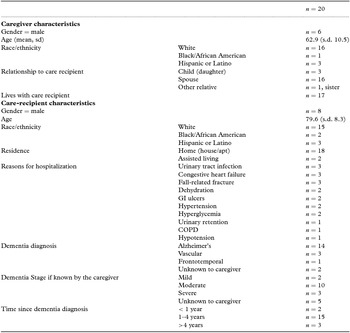
Participant demographics (Table 1). Our caregiver participants were predominantly female (n = 14), White (n = 16), spouses (n = 16); with a mean age of 62.9 (s.d 10.5); three quarters of whom lived at home with their care recipient. People with dementia were predominantly female (n = 12), White (n = 15), diagnosed with Alzheimer's dementia (n = 14); with mean age 79.6 (s.d. 8.3). Five caregivers did not know the stage of their care recipient's dementia and two did not know a specific diagnosis of dementia. Among those who knew the stage, majority reported that care recipient had moderate to severe dementia (n = 13).
Respondent characteristics, proportion of responses, or mean % (s.d.)

Reasons for hospitalization included: Dehydration, GI ulcers, urinary tract infection, congestive heart failure, hypertension, hypotension, urinary retention, COPD, hyperglycemia, fall-related fracture (Table 1).
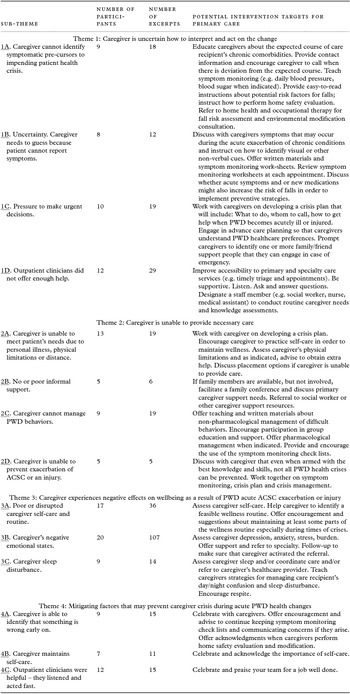
Thematic analyses. (Numbers of excerpts and participants endorsing each theme are listed in Table 2.)
Themes and potential intervention targets

THEME 1. Caregiver is uncertain how to interpret and act on the change.
SUB-THEME 1A. Caregiver cannot identify symptomatic precursors to impending patient health crisis and does not know what to do.
Selected quotes:
-
• Wife: “He had been, and he still is quite dizzy on occasion, especially when his blood pressure is too low, so I knew that he was unsteady on his feet, but I didn't envision him falling, the way he did, and breaking his ribs.”
-
• Sister: “I knew something was not right, but I did not know what.”
-
• Husband: “If it comes to me and I don't know, can't comprehend this, I don't know what's going on, don't know what to do and she's complaining about it, that's more of a crisis of not being able to deal with things that Alzheimer's presents through the patient, through the caregiver, not know what's going on with the patient.”
SUB-THEME 1B. Uncertainty. Caregiver has to guess because the patient cannot report symptoms.
Selected quotes:
-
• Husband: “She just told me that she is mad and told me to stay away, but I knew that something must be wrong, but she could not tell me what.”
-
• Wife: “Guessing, always guessing. I want to do right by him, but he has not been able to tell me when he is ill or hurting for over a year now, so I have to be vigilant.”
-
• Daughter: “He was more irritated every time he was hurting, this was the only way I would know that something is wrong, but he hated to go to doctors so I do not know what is worse for him being ill or going to the doctor.”
SUB-THEME 1C. Pressure to make urgent decisions.
Selected quotes:
-
• Daughter: “Him getting worse so suddenly and in pain and his doctor not listening and bullying us was a crisis for me, I had to decide not to listen and to take him to the ER right away. This urgency and lack of support were really hard.”
-
• Husband: “I went through a lot, I had to make all treatment decisions, kids were arguing, they were scared. Now I live in constant fear that every trip to the hospital will be his last, so you can say that my life is a crisis. Always needing to think on my feet.”
-
• Wife: “Well it depends upon the situation, if you know that he may get worse and you expect it, you have an idea of what to do. . . But when things happen suddenly and you have to make all the decisions, but you do not have time to think or to consult someone. . . this is really hard.”
SUB-THEME 1D. Outpatient clinicians did not offer enough help.
Selected quotes:
-
• Wife: “Maybe his doctor could have instructed me better what to do to prevent these episodes, ask me if I know what to do or whom and when to call.”
-
• Sister: “I just felt that what they (doctors) thought that there was no cure, so they (doctors) did not bother to give the help my wife needed at the time, since she was going to die from dementia anyway.”
-
• Husband: “Hospitalization could have been prevented if her doctor would have been able to get her to office appointments earlier, so that he could have seen that she wasn't eating and was dehydrated or if they could have sent somebody to the house, for home health care, that would have really helped.”
THEME 2: Caregiver is unable to provide necessary care.
SUB-THEME 2A. Caregiver is unable to meet patient's need due to personal illness, physical limitations or distance.
Selected quotes:
-
• Wife: “When I broke my arm and had to go to the hospital and there was no one to watch him and I was scared and did not have anyone to call.”
-
• Husband: “Well, if it came up, it would be my being sick or not being able to take care of her in the sense of, she depends on me for everything and if suddenly I passed out or something and was not available to her, that would be very confusing, I worry about that like when we're driving on long trips to Portland to visit our daughter, if something happened to me, she would not know what to do.”
-
• Sister: “When his BP dropped and he fainted, I could not lift him, and had to call 911.”
SUB-THEME 2B. Caregiver has no or poor informal support.
Selected quotes:
-
• Husband: “When I had the flu and was home bound and there was no one else to watch her. I did not have anyone to ask.”
-
• Wife: “Family is essential at that time, but I did not have anyone.”
-
• Daughter: “My siblings never came around, if somebody did come around they wanted to talk about a nursing home, and my mother was still able to talk and she told them no.”
SUB-THEME 2C. Caregiver cannot manage care recipient's behaviors.
Selected quotes:
-
• Wife: “He was more confused and irritable, seemed to be in more pain. He seemed worse off, he could not urinate and he almost hit me, so I had to call 911.”
-
• Husband: “She would lay in her bed and she would just see things and talk about things that weren't there, I got frightened and took her to the hospital, turned out she had bad UTI.”
-
• Daughter: “Sometimes she gets angry, out of control.”
SUB-THEME 2D. Caregiver is unable to prevent injury or exacerbation of ACSC.
Selected quotes:
-
• Wife: “He had severe urinary tract infections and prostate problems, and he went from being himself, eating and feeding himself to not even being able to hold his head up, let alone walk or do anything. No matter what I did, he did not get better. Doctors wouldn't just prescribe something without an appointment. I did what I could, hydrated him, kept him company, but I ended up just taking him to the ER.”
-
• Husband: “Not—it's just part of the failing systems, that's all. Her systems are getting confused messages in her body and that's just the disease. And she needs to be reminded constantly to hydrate and sometimes that just doesn't get done, and it's my fault, but I do my best because she doesn't think about it.”
-
• Daughter: “You can hover over them, watch them, but you do not know everything and even when you are always there, they can get very ill fast.”
THEME 3. The health crisis negatively affected the caregiver's wellbeing and self-care.
SUB-THEME 3A. Poor or disrupted caregiver self-care and routine.
Selected quotes:
-
• Husband: “Sleep and taking care of me was kind of the last things on my mind at that time.”
-
• Wife: “Lack of time for myself. Because it developed into sleep problems and gaining weight and I'm not moving like I used to. So those are probably going to turn into some health issues later on for me.”
-
• Daughter: “I felt ill myself, not sure why, maybe the lack of sleep and the broken routine, but I just did not feel good. . . You feel helpless when you hit rock bottom and can't care for yourself, but have to figure out how to help him.”
THEME 3B. Caregiver's negative emotional states.
Selected quotes:
-
• Husband: “Physically I was exhausted, mentally I was exhausted. Let's just use this, I think exhausted kind of caps it. I think what happens, and so yeah, that was the perfect word, it was just exhausting. And, that is one of the things that happens with being a caregiver is that you can't count on things, you can't count on your time.”
-
• Wife: “I panic and shut down, sometimes I just want to go to my room and close the door and pretend he is not there, but I need to be there for him. I frequently feel that I cannot do one more thing, make one more decision, take one more breath.”
-
• Daughter: “We always have a hospital bag packed and the ambulance guys know us well. I wish that I could predict these things better, but I do not think that this is possible. I live on the edge all the time, there is no respite mentally.”
SUB-THEME 3C. Caregiver sleep disturbance.
Selected quotes:
-
• Husband: “I had to stop sleeping also, watching for clues.”
-
• Daughter: “Your phone starts ringing at 2 a.m. because your mother is looking for your father who's been gone for 7 months, I learned that she became more confused because of the stomach ulcer and pain, so she called me all night long.”
-
• Wife: “He tossed and turned, kept me awake for a few nights, but I did not know he was having hard time breathing because of the COPD.”
THEME 4. Mitigating factors may prevent caregiver crisis during care recipient's acute health changes.
SUB-THEME 4A. Caregiver is able to identify that something is wrong early on.
Selected quotes:
-
• Wife: “He looked very uncomfortable, I knew he was hurting right away, so I call the clinic.”
-
• Husband: “Especially when you're the caregiver and you're used to dealing with the one person and you're the person they deal with mostly, you start to build a routine and also know when something is off.”
-
• Daughter: “She was getting weak and would be more confused and we decided to start taking her blood pressure. She was lethargic and just not wanting to do anything or just not aware. I knew shortly that her blood pressure was too high.”
SUB-THEME 4B. Caregiver maintains self-care.
Selected quotes:
-
• Husband: “I think a lot of times caregivers will just brush things aside, and say, ‘I got to do this, or why am I feeling that way, I have no right to.’ Well you have to recognize your own feelings and say yes, I have a right to, or even if I don't, this is what I'm feeling.”
-
• Daughter: “We have to be very sensitive to the other person and realize that some of their actions may be frustrating or exasperating, but they cannot help it, it's what's happening. We have to respect and honor the moment. I try to continue meditation and this helps me center myself even when things are tough.”
-
• Wife: “I still make time to exercise no matter what.”
SUB-THEME 4C. Outpatient clinicians were helpful, listened, and acted fast.
Selected quotes:
-
• Daughter: “I was able to tell the doctor what was going on with my mom. And he was grateful for the knowledge. He told me what to expect and when to call the clinic. I felt better prepared after that.”
-
• Husband: “They (doctors) supported me morally, but I was half way in shock, so I did not appreciate it at the time. In retrospect, this made a huge difference that they took their time and listened to me.”
-
• Wife: “Occasionally, if things weren't too bad, he'd (doctor) prescribe something where I could just pick it up and at least get him started on something to take care of some of the symptoms before we can get in. I think that this kept us away from the hospital for a while.”
Discussion
The World Health Organization (WHO) declared dementia one of the greatest societal challenges of this century due to its worldwide prevalence and broad impact on the person living with dementia and their caregiver as well as many other societal stakeholders (World Health Organization, 2012). Typical daily care tasks for a person living with dementia range from providing schedule reminders and assistance with chores or errands; to complete management of all healthcare needs, including direct personal care and complex decision making. An acute exacerbation of patients’ chronic health issues frequently prompts a complex critical care situation that places additional demands on family caregivers. For the majority of dementia caregivers, making decisions on behalf of their care recipients is only one aspect of their key role in healthcare; they are also expected to coordinate health services, advocate for timely and appropriate care, and perform complex medical/nursing tasks at home (Reinhard et al., Reference Reinhard, Levine and Samis2012). An American Association of Retired Persons (AARP) national survey found that caregivers in the most complex care situations (e.g. person living with dementia and with multimorbidity) are the ones most likely to be called on to perform medical/nursing care tasks at home with little or no preparation and oversight from clinicians (AARP Public Policy Institute, 2015). A study of dementia care in eight European countries similarly concluded that the majority of care is provided at home by family caregivers and that caregiver training and support options are very limited (Hallberg et al., Reference Hallberg2013).
Our study offers a glimpse into what occurs in dementia family caregivers’ lives during acute health crises of their care recipient's health. One of the most frequently endorsed themes (20/20 caregivers and 107 separate excerpts) was the negative emotional impact on caregivers (e.g. stress, burden, overwhelm, depression, anxiety). The second most frequent emerging theme was poor or disrupted caregiver self-care (17/20 caregivers, 36 separate excerpts). Though these themes are universally known to clinicians and researchers who work with caregivers, relatively little attention has been given to the role of patient health crises in precipitating crises in caregiving or in altering the way healthcare is provided to patients with dementia. In the USA, the Centers for Medicare and Medicaid Services have recently incorporated these themes into a new comprehensive care planning benefit for patients and families (American Academy of Neurology, 2017).
Crisis in dementia is defined as “A process (involving) a stressor that causes an imbalance requiring an immediate decision, which leads to a desired outcome and crisis resolution. If the crisis is not resolved, the cycle continues” (MacNeil Vroomen et al., Reference MacNeil Vroomen, Bosmans, van Hout and de Rooij2013). Our findings indicate that acute illness or injury in a person with dementia often becomes a crisis for family caregivers as well. In the case of hospitalization related to ACSC exacerbation or fall-related injury, the crisis continues until the patient is stabilized in the hospital, but both patients and their caregivers can experience enduring sequelae (Bynum et al., Reference Bynum, Rabins, Weller, Niefeld, Anderson and Wu2004, Lin et al., Reference Lin, Adelman, Diamond and Evans2014; Bail et al., Reference Bail, Goss, Draper, Berry, Karmel and Gibson2015). During these crises, caregivers “drop everything” to focus all their efforts and energy on supporting the person with dementia through resolution of the crisis and are likely to neglect their own needs to recover from its effects on them. Consequently, when the crisis passes, caregivers can be left with anxiety, depression, stress, strain, burden, and disrupted routines, and may not resume self-care behaviors that would enhance their own health outcomes (Boltz, Reference Boltz2012; Boltz et al., Reference Boltz, Chippendale, Resnick and Galvin2015). Therefore, caregivers in complex care situations, who are at most risk for encountering their care recipient's health crisis, need additional support to develop the knowledge and skills to proactively manage their loved one's health, detect, and respond to risks and warning signs of illness and injury, engage healthcare providers, and attend to caring for themselves as well as for the person living with dementia.
This current study found that caregivers frequently feel unprepared and unsupported in identifying symptomatic precursors to impending patient health crisis (9/20 caregivers, 18 separate excerpts); feel uncertain and confused about what's wrong (8/20 caregivers, 12 separate excerpts); feel pressured to make urgent decisions (10/20 caregivers, 19 separate excerpts), and frequently do not feel supported by outpatient clinicians (12/20 caregivers, 29 separate excerpts). We learned that the responsibility and pressure to make the “right decision” can be overwhelming, especially when the person with dementia is not able to report early symptoms of acute illness (e.g. pain, nausea) and the caregiver does not know when to watch and wait versus when to alert clinicians. One caregiver reported: “There is nothing more defeating and heart breaking than to fail him. He now relies on me for everything and I try to do my best, but the last time I did not catch his pneumonia in time. He did not look right, but we lost power for two days and I thought that he was just out of sorts because of it. When I realized that he was very ill and got him to the hospital, we almost lost him. I could not live with myself if he died because I was not careful enough.”
Our prior work found that dementia caregivers differ in knowledge, skills, and confidence for managing chronic and acute health conditions of care recipients, alerting clinicians about worrisome changes, and practicing self-care (Sadak et al., Reference Sadak, Korpak and Borson2015). This further highlights the urgency of understanding caregivers’ roles in potentially preventing and mitigating their care recipient's health crises and in developing assessment tools and interventions that improve the caregiver's knowledge and skills in patient's symptom management and address caregiver wellness and self-care in the context of heightened caregiving responsibility. This is a new area of study that requires novel assessment tools and intervention approaches.
This current study also identified that the same critical change in care recipient's health may not be perceived as a crisis by the caregiver if they feel prepared and well supported. Nearly half of our sample (9/20 caregivers, 15 separate excerpts) reported that crises were mitigated by their ability to identify impending symptoms with confidence; 7/20 caregivers (11 separate excerpts) indicated that in some situations, for a period of time, they were able to maintain self-care and therefore avoided a sense of personal crisis; and 12/20 caregivers, (15 separate excerpts) reported that outpatient clinicians were helpful and supportive to them. Our findings highlight an important role for clinicians who care for people living with dementia in supporting the preparation of their caregivers for healthcare management at home and in explicitly and specifically promoting the cultivation of caregiver self-care and resilience.
Clinical implications. Living at home and receiving care from family members and friends offers significant cost savings to people living with dementia, health systems, and governments around the world (Alzheimer's Disease International, 2015), and may prevent premature death associated with long-term care placement (Aneshensel et al., Reference Aneshensel, Pearlin, Levy-Storms and Schuler2000; McClendon and Smith, Reference McClendon and Smyth2015). The ability of a person with dementia to remain at home greatly depends on their own and on their caregiver's health and wellbeing (Mark, Reference Mark2016). Ambulatory care clinicians, both specialists, and primary care providers, play a pivotal role in supporting the health and wellbeing of the caregiver–patient dyad, which supports overall improvement in quality of life. Clinicians have the responsibility of engaging caregivers in the care management process and assessing their knowledge and skills in managing their loved one's health while maintaining their own wellness. They therefore need to educate dementia family caregivers about the expected “normal” course of chronic comorbidities and encourage them to call when there is deviation from the expected course. Clinicians also should regularly communicate with caregivers about observed symptoms and behaviors, and when indicated, appropriate vital signs (e.g. daily blood pressure, blood sugar) and offer suggestions for improving care coordination (e.g. care coordination tracking work sheets that contain the names of all clinicians, an up-to-date list of all diagnoses and medications) (Chmelik et al., Reference Chmelik, Emtman, Borisovskaya and Borson2016). In the context of fall prevention, clinicians might relay easy-to-read instructions about potential risk factors and ways to mitigate the risks of recurrent falls. Additionally, clinicians might instruct caregivers on how to perform a home safety evaluation and encourage removal of environmental hazards. It is also important for healthcare teams to assist caregivers with developing a crisis plan that includes information about what to do, whom and how to contact, and how to get help when the person with dementia becomes acutely ill. Anticipatory, individualized planning for potential future health crises based on known chronic conditions and risks should become routine in clinical encounters with patients and caregivers, and may include referrals to ancillary services (e.g. occupational therapy, physical therapy, social work, community support organizations) to provide additional physical, functional, and psychosocial resources to caregivers in need. Clinicians should acknowledge and celebrate successful caregiver/clinician collaborations, reduction, or avoidance of crisis in dementia caregiving and improvement in caregiver self-care practices. To illustrate how the themes identified here can inform clinical care, we suggested some possible clinical recommendations (Table 2), based on the combined clinical/research experience of the co-authors (geriatric psychiatry, nursing, social work, and primary care).
Limitations. The sample size was relatively small, homogeneous, and predominantly White, comprised of volunteers who had participated in our earlier studies and agreed to be contacted again, and their care recipients had mild to moderate dementia; caregivers whose care recipients were near the end stages of the dementia trajectory were not represented. Interviews were conducted at variable intervals following a hospitalization, which could have affected recall, and medical records were not available to verify reasons for hospitalization or surrounding events. For example, a caregiver may have reported that the reason for a hospitalization was a fall, but medical records may indicate that admitting diagnosis was syncope due to new onset atrial fibrillation. Our suggestions for clinical practice (Table 2) require empirical testing. Systematic study of larger, more representative samples and triangulation of caregiver reports with data from patients’ medical records is needed to better understand the degree to which acute health crises in persons with dementia might in fact be preventable, and how best to support caregiver self-care and resilience when crises occur.
Future directions. Current findings substantiate the need for developing interventions to (1) prepare for and support caregivers during periods of acute illness in their care recipient; (2) promote adoption of comprehensive models of healthcare delivery for dementia; and (3) train healthcare professionals (e.g. primary care providers and their care teams), to assess caregiver needs for knowledge, skills, and support as the managers of their care recipient's health at home and to meet those needs through need-based coaching and partnership.
Conflict of interest
None.
Description of author's roles
T. Sadak designed the study, supervised data collection, carried out the analyses, and wrote the paper. S. Foster Zdon carried out the analyses, contributed to writing the paper, and offered primary care clinical expertise. E. Ishado collected data, contributed to writing the paper, and offered social work clinical expertise. O. Zaslavsky contributed to writing the manuscript and offered expertise in fall prevention. S. Borson designed the study, carried out the analyses, contributed to writing the paper, edited the paper, and offered geriatric psychiatry expertise.
Acknowledgments
The authors thank the Robert Wood Johnson Foundation Nurse Faculty Scholars Fellowship that funded this project and the research assistant Doreen Johnson who assisted with data collection.