Mastitis in dairy heifers has been studied increasingly over the last few years since the economic damage associated with this disease has been proven to be significant, and several studies have found a high prevalence of subclinical and clinical intramammary infections (IMI) in heifers (Aarestrup & Jensen, Reference Aarestrup and Jensen1997; Bareille et al. Reference Bareille, Seegers, Kiebre-Toe, Beaudeau and Fourichon2000; De Vliegher et al. Reference De Vliegher, Barkema, Stryhn, Opsomer and de Kruif2005; Reinecke et al. Reference Reinecke, Hansen, Tenhagen and Heuwieser2006). Infected heifers may represent an important reservoir of pathogens for the dairy herd (Waage et al. Reference Waage, Mørk, Røros, Aasland, Hunshamar and Ødegaard1999).
Three major pathogenic pathways have been described so far for heifer mastitis: first, calves and heifers sucking on each others' teats can affect the development of the juvenile udder (‘juvenile intersucking’). This, in conjunction with the transmission of mastitis pathogens (e.g. Streptococcus agalactiae) is prone to lead to heifer mastitis (Schalm, Reference Schalm1942). Second, it has been proven that stable flies can transmit pathogens such as Staphylococcus aureus from lactating or dry cows to non-lactating heifers (Nickerson et al. Reference Nickerson, Owens and Boddie1995). Third, a high proportion of teat canals already open several months before calving. This opening of the teat canal before calving is an important factor in the aetiology of heifer mastitis (Krömker & Friedrich, Reference Krömker and Friedrich2009). A series of risk factors for both clinical (CM) and subclinical mastitis (SCM) in dairy heifers have already been identified. They comprise factors affecting the entire herd (e.g. season and climate; Fox et al. Reference Fox, Chester, Hallberg, Nickerson, Pankey and Weaver1995; Hallberg et al. Reference Hallberg, Dame, Chester and Miller1995; De Vliegher et al. Reference De Vliegher, Laevens, Opsomer, de Mûelenaere and de Kruif2001) but also those associated specifically with management peripartum e.g. insufficient fly control and poor hygiene in the calving area (Bareille et al. Reference Bareille, Seegers, Kiebre-Toe, Beaudeau and Fourichon2000; Reinecke et al. Reference Reinecke, Hansen, Tenhagen and Heuwieser2006). Finally, animal and teat-related risk factors such as open teat canals before calving or an advanced age at first calving (Nickerson et al. Reference Nickerson, Owens and Boddie1995; Bassel et al. Reference Bassel, Kelton, Godkin, Leslie and Lissemore2003; Krömker & Friedrich, Reference Krömker and Friedrich2009) must also be considered.
Several authors demonstrated that the prevalence of IMI increased as the calving date approaches and that it was highest during the last trimester of pregnancy. This suggests that heifers may be most susceptible during that period of gestation. Most likely this circumstance is associated with the rapid mammary gland development during that time period (Oliver & Mitchell, Reference Oliver and Mitchell1983; Fox et al. Reference Fox, Chester, Hallberg, Nickerson, Pankey and Weaver1995; Aarestrup & Jensen, Reference Aarestrup and Jensen1997). An increased age at first calving is a significant risk factor for IMI by Staph. aureus and environmental pathogens (Bassel et al. Reference Bassel, Kelton, Godkin, Leslie and Lissemore2003).
Reported IMI prevalence at quarter level ranges from 29 to 86% before calving and from 18 to 55% at calving (Meaney, Reference Meaney1981; Oliver & Mitchell, Reference Oliver and Mitchell1983; Trinidad et al. Reference Trinidad, Nickerson and Alley1990; Pankey et al. Reference Pankey, Drechsler and Wildman1991; Roberson et al. Reference Roberson, Fox, Hancock, Gay and Besser1994; Fox et al. Reference Fox, Chester, Hallberg, Nickerson, Pankey and Weaver1995; Myllys, Reference Myllys1995; Aarestrup & Jensen, Reference Aarestrup and Jensen1997). These authors detected IMI in heifers, particularly those due to coagulase-negative staphylococci (CNS), Staph. aureus and environmental pathogens, in the time close to parturition. IMI at calving increased the risk of CM within the first week after calving. Mastitis prior to calving and mastitis within the first week post partum increased the risk of further cases of CM and culling during the first 45 d of lactation (Edinger et al. Reference Edinger, Tenhagen, Heuwieser, Kalbe, Klunder and Baumgärtner1999). In most cases, the number of infected quarters decreases markedly after parturition. After several weeks, only a few quarters remain infected, but these are responsible for clinical cases during the rest of the first lactation and for repeated mastitis cases in the subsequent lactation (Krömker & Friedrich, Reference Krömker and Friedrich2009).
The objective of this study was to evaluate the distribution of mastitis pathogens in dairy heifers in the timeframe between 4 and 8 weeks after calving and to determine animal and management-related variables associated with IMI and SCM.
Materials and Methods
This cross-sectional study was conducted at three auction places in Lower Saxony (Verden, Uelzen, Osnabrück). The animals traded there were dairy heifers in their first months of lactation and on the basis of milk yield and health status, probably extraordinary within their age cohorts. At these three auction places, more than 95% of German Holstein heifers available in Lower Saxony auctions (approx. 600) are traded at regular monthly intervals. On the days of the auctions between March 2003 and February 2004, a total of 512 German Holstein heifers were randomly selected. On an auction day, only one animal per herd was included in the study to avoid confounding, and so a farm could participate only once in this evaluation. If a farmer offered more than one animal on a given auction day, randomization was achieved by selecting the cow with the lowest auction number. A documented yield of >30 kg of fat- and protein-corrected milk per day were preconditions for an animal to be part of this survey, as animals without this milk yield were not considered marketable by the traders. The number of animals examined on an auction day was determined by using a simple computerized randomization list, based on the auction number. Participation in this trial was optional. All heifers had been evaluated at least once in relation to their production parameters by the local (Lower Saxony) dairy herd improvement association. Data regarding udder health history, previous diseases and treatments of a given animal, as well as management practices and housing and rearing conditions of heifers were obtained by interviewing the owners; a questionnaire covering 14 items supported this interview. Before the auction, a clinical examination took place; it comprised the udder conformation and eventual pathomorphological findings (hyperkeratosis, injuries, skin modifications). This clinical examination was conducted based on the methods described by Rosenberger (Reference Rosenberger1979) and Mein et al. (Reference Mein, Neijenhuis, Morgan, Reinemann, Hillerton, Baines, Ohnstad, Rasmussen, Timms, Britt, Farnsworth, Cook and Hemling2001). The data obtained from the interviews and the clinical examination of the heifers were encoded binomially. The list of questions that could be answered either positively or negatively is presented in Tables 3 & 4.
Aseptic duplicate quarter foremilk samples were collected for cyto-microbiological diagnosis from the front right and the hind left quarters owing to the limited time available for individual testing at the auctions. Teat ends were cleaned and disinfected with ethanol (70%) before sampling. Strict foremilk (first jets) was discharged, and then two 10-ml samples of milk were collected aseptically from the udder quarters into sterile vials. Samples were kept at 4°C until cyto-microbiological examination took place.
Laboratory procedures
For culturing, 10 μl of each milk sample was spread on blood agar plates (5% defibrinated sheep blood, Oxoid, Wesel, Germany). The plates were incubated aerobically at 37°C and examined after 24 h and 48 h. Colonies were provisionally identified on the basis of Gram stain, morphology and haemolysis patterns, and the numbers of each colony type were recorded. Representative colonies were then subcultured on blood agar plates and incubated aerobically at 37°C for 24 h to obtain pure cultures. Catalase and coagulase production was tested for Gram-positive cocci. Specific identification of staphylococci was done using the coagulase test. Gram-positive, catalase-negative isolates were tested by CAMP, aesculin-reaction, growth at 45°C, and commercial micromethods (Oxoid DR0575M Strep Plus Kit, Germany). Some Gram-positive rods were identified with simple procedures (Gram-staining, cell morphology, catalase test), e.g. Corynebacterium bovis. Gram-negative rods were subcultured on Violet Red Bile Agar, tested afterwards for oxidase and indole-reaction and additionally cultured in triple sugar iron agar and Simmons citrate agar. This method allowed identification of bacteria at genus or species level in most cases; otherwise, unidentified organisms were recorded as either Gram-negative or Gram-positive.
Culture status of milk samples was defined according to the procedures recommended by the German Veterinary Association (GVA, 2002). A milk sample was defined as being contaminated if >3 bacterial species were isolated. The somatic cell count (SCC) of every milk sample was determined by fluorescence (Fossomatic 360, Foss Electric, Hillerød, Denmark).
Definition of udder health
Udder health categorization as recommended by IDF and cited by GVA (2002; i.e. the presence or absence of pathogenic bacteria and a threshold of 100000 somatic cells/ml quarter foremilk sample) started on quarter level. Based on this, the corresponding cows were categorized accordingly. IMI was recorded if in duplicate samples >500 CFU/ml of the same bacterial species were cultured, and 1–3 bacterial species could be isolated. Quarters with only one bacteriological positive sample were considered to be non-infected. We defined a quarter as subclinically mastitic (SCM) when its SCC ranged >100000/ml (foremilk samples in duplicate) and it did not display any signs of CM. Following IDF definitions, bacteriological findings and SCC were analysed separately, because on one hand, finding pathogens in the milk of an udder quarter relates only to a (latent) infection. On the other hand, increased cell counts are a sign of an inflammatory reaction that may have been produced by a pathogen that is no longer detected.
Statistical analysis
Data were gathered and analysed using the programs Excel, Access 2000 (Microsoft Corporation), and SPSS (SPSS 13.0, Chicago IL, USA). The udder quarter was the statistical unit. The associations between IMI and SCM respectively and morphological, pathomorphological or management variables (covariates, factors) were analysed using logistic regression procedures (Urban, Reference Urban1993). Binary dichotomous dependent variables comprised ‘IMI/no IMI’ and ‘SCM/no SCM’ in one quarter. Independent explanatory variables that were graded at more than two levels in the questionnaire or the clinical protocol were dichotomized and coded as 0 or 1. The relationships between animal history, management and clinical examination, and IMI or SCM were tested using Student's t test for continuous measurements and the χ2-test (likelihood ratio statistic) for proportions in a first step. However, predictors that strongly correlated with each other (r>0·70) were not included in the same model to avoid multicollinearity. As a second step, variables that were associated with the outcome variables at P<0·10 in Student's t test for continuous measurements and the χ2-test for proportions were included in binary logistic regressions with IMI and SCM as the binary outcome. A forward stepwise process was used for final model selection, applying a P value <0·05 for inclusion. We used likelihood-ratio tests for significance test to include predictors. Goodness of fit of models was assessed by the Hosmer–Lemeshow goodness of fit statistics (Hosmer & Lemeshow, Reference Hosmer and Lemeshow2000). The predictive power of a model was measured by a rescaled pseudo R 2 with the maximum of 1 (Nagelkerke, Reference Nagelkerke1991).
Odds ratios (OR) with 95% confidence intervals (95% CI) were calculated. Statistical significance was assumed at P⩽0·05.
Results
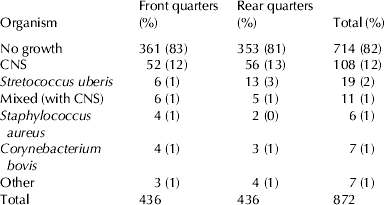
The animals used for this survey originated from dairy herds in Lower Saxony and were 2·8 years old (mean value) on the date of the auctions. On average they had been in milk for 40·7±12·4 d. The material available for analysis included 436 heifers with complete data sets (milk samples, clinical examinations and questionnaire-based interviews); in the other cases, data sets were incomplete as data were raised during the ongoing auctions, and these animals were brought to auction before data raising could be completed. 31% of heifers (n=136) had IMI on the day of the auction in at least one quarter. 18% (n=158) of quarters were infected. CNS were the most prevalent bacteria isolated, accounting for 68% of positive samples. After CNS, environmental streptococci were most frequent, followed by mixed infections (CNS and streptococci) and Staph. aureus (Table 1). SCM on one or two quarters at the auction was diagnosed in 16% of heifers (n=68).
Culture results by organism

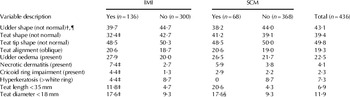
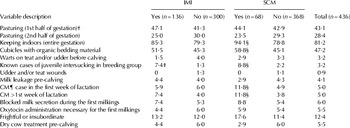
The distribution of clinical examination variables and management variables across the categories IMI and SCM is presented in Tables 2–4. Some variables were correlated with IMI and SCM. Short front teats and a higher calving age were associated with IMI and SCM. Increased IMI were particularly observed in teats shorter than 35 mm and with diameters <18 mm. The thresholds of 35 mm in teat length and 18 mm in teat diameter were chosen because they represented the quartile of German heifers with shortest and thinnest teats (Krömker & Grabowski, Reference Krömker and Grabowski2002). Chronical ring formation and necrotic dermatitis (‘foul udder’) were more frequent in heifers with IMI on the day of the auction. Heifers with SCM at the auctions had been kept in freestall barns and on organic bedding material during gestation more often than non-infected heifers. Furthermore these heifers had had more cases of CM during the first 5 d after calving or during the entire time before the auction. When known cases of juvenile intersucking in the breeding group had occurred, the animals subjected to this condition were more likely to develop IMI and SCM.
Continuous variables

† =Different (P<0·05) from animals without IMI (intramammary infections)
‡ =Different (P<0·05) from animals without SCM (subclinical mastitis)
Distribution of clinical examination variables in animals (% animals)

† =Percentage of animals
‡ =Different (P<0·05) from animals without IMI (intramammary infections)
§ =Different (P<0·05) from animals without SCM (subclinical mastitis)
¶ =Clinical examination based on the methods described in Rosenberger (Reference Rosenberger1979) and Mein et al. (Reference Mein, Neijenhuis, Morgan, Reinemann, Hillerton, Baines, Ohnstad, Rasmussen, Timms, Britt, Farnsworth, Cook and Hemling2001)
Distribution of management practice and animal variables in the animals' history (% animals)

† Percentage of animals
‡ Different (P<0·05) from animals without IMI (intramammary infections)
§ Different (P<0·05) from animals without SCM (subclinical mastitis)
¶ Clinical mastitis
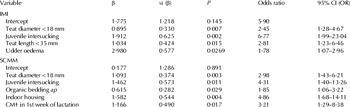
Table 5 provides the final logistic regression models for IMI and SCM as dependent variables. The rescaled R 2 of the final models were 0·248 and 0·277 for IMI and SCM, respectively. The goodness of fit statistic did not give any reason to doubt the validity of the models (IMI: P=0·979; SCM: P=0·292). Significant risk factors for IMI identified by the final logistic regression model were ‘juvenile intersucking’, ‘teats shorter than 35 mm’, ‘teat diameter <18 mm’, ‘udder oedema (at the time of examination)’.
Final logistic regression models for the probability of a quarter (n=872) to acquire an intramammary infection or a subclinical mastitis during the first 41 d of lactation

† Clinical mastitis
Significant risk factors for SCM identified by the final logistic regression model were ‘freestall pens during gestation’, ‘juvenile intersucking’, ‘CM during the 1st week after calving’, ‘teat diameter <18 mm’, ‘organic bedding material in the stable before calving’.
Discussion
As stated before (Krömker & Friedrich, Reference Krömker and Friedrich2009) quarters with IMI during the first weeks after calving are prone to develop CM both afterwards and repeatedly. This is why the present study focused on the association among these variables (morphological, pathomorphological and management variables) and the occurrence of IMI and SCM during early lactation, exemplified by choosing the day of the auction. As a second goal, it was intended to define criteria to easily identify animals prone to develop IMI and SCM on the day of the auction.
This paper is based on a selection of animals from a single age cohort. Heifers destined to be sold during an auction have to be clinically healthy and belong, in terms of their milk yield, to the top flight of their age cohort. We accepted this selection bias deliberately in order to examine the conditions for better heifers in better-managed farms. All farmers who brought animals to the auction gladly participated in this survey. The data obtained were not passed on to potential buyers. Only two farmers refused to participate, so that the effect by omitting non-responders was irrelevant. Therefore we assume that our results may be transferable to other high-yielding animals. Since the interviewer himself may also affect the answers (Schukken et al. Reference Schukken, van de Geer, Grommers and Brand1989), all questionnaires in this study were conducted by one and the same person.
By selecting one front and one rear quarter, the different probabilities of getting infected are in fact considered. The observed array of mastitis pathogens corresponds largely to bacteriological distributions reported by Oliver & Mitchell (Reference Oliver and Mitchell1983), Trinidad et al. (Reference Trinidad, Nickerson and Alley1990), Pankey et al. (Reference Pankey, Drechsler and Wildman1991), Roberson et al. (Reference Roberson, Fox, Hancock, Gay and Besser1994), Fox et al. (Reference Fox, Chester, Hallberg, Nickerson, Pankey and Weaver1995), Myllys (Reference Myllys1995) and Aarestrup & Jensen (Reference Aarestrup and Jensen1997).
In theory, variables identified as risk factors for the development of IMI and SCM relate to these diseases mostly owing to their connection with an opening of the teat canal before calving. Very thin and short teats, owing to their short teat canals, teats from animals with a history of juvenile intersucking, and teats of animals with marked udder oedema are theoretically more prone to present open teat canals before parturition. The open teat canals are directly linked to an elevated risk of infection (Krömker & Friedrich, Reference Krömker and Friedrich2009). However, very thin and very short teats are more easily subjected to milking technopathies, and so corresponding quarters might have become infected after calving, possibly owing to a massive impairment of the teat condition (Wendt et al. Reference Wendt, Köhler, Sass, Spaskovski and Piltz2007). So, these results suggest that the onset and the occurrence of heifer mastitis could be reduced if breeding programmes focusing on less short and less thin teats were applied.
Regarding SCM in particular, management conditions pre-calving also seem to play an important role. Keeping the animals in freestall barns apparently increases the bacterial counts and encourages the development of SCM, especially when organic bedding material is used (Zadoks et al. Reference Zadoks, Allore, Barkema, Sampimon, Gröhn and Schukken2001; Magnusson et al. Reference Magnusson, Herlin and Ventorp2008). SCM is a disease, which is the last step of an IMI. Therefore the pre-calving management conditions are able to promote an infection which can be identified as SCM in their first months of lactation.
As a matter of principle, any observational study is only capable of showing associations between variables rather than predicting causal relations. Yet, if causal mechanisms for the development of an infection are known, or if the relations encountered are biologically sound, these results may allow hypotheses on causal relations.
The results suggest that the risk of purchasing a heifer with IMI or SCM can be reduced if animals with very short and very thin teats and animals presenting an udder oedema on the day of the auction are excluded from the buyer's selection.
Conclusions
The survey showed that the prevalence for IMI and SCM in heifers on the day of the auction was 31% and 16%, respectively, CNS being the most prevalent bacteria isolated. Juvenile intersucking, teats shorter than 35 mm, teats with diameters <18 mm and an udder oedema at 41 d after calving were identified as risk factors for IMI in heifers during the first two months after calving. Freestall barns during gestation as opposed to tied-stalls, juvenile intersucking, CM during the first week of lactation, teat diameters <18 mm, and organic bedding material in the stable before calving were identified as risk factors for SCM.
The authors thank the farmers who provided information on their heifers. We also gratefully acknowledge the support of Masterrind (Verden, Germany) and OHG-Genetic (Osnabrück, Germany). This project was partially funded by the chamber of agriculture of Lower Saxony.