I. INTRODUCTION
Magnesium alloys are highly sought in automobile industries for their attractive combination of relatively low density, high specific stiffness and strength, and good damping capacity. Reference Blawert, Hort and Kainer1–Reference Kainer, von Buch and Kainer3 Among the magnesium alloys, wrought alloys are considered to be ideal for automotive applications, as solid-state processed parts are free from microstructural defects like pores and/or cavities, which are usually present in cast alloys due to high solidification shrinkage, and with improved mechanical properties from refined microstructure. However, hexagonally close-packed crystal structure with very limited slip system restricts the ductility of pure magnesium till 225 °C, 4 which leads to the necessity of using the temperature above 350 °C for hot work for magnesium alloys Reference Kainer, von Buch and Kainer3 and considered to be one of the major hurdles for wider magnesium application. Hence, our focus of enormous research work Reference Maksoud, Ahmed and Rodel5–Reference Mwembela, Konopleva and McQueen9 to understand the deformation characteristics of these alloys is centered on at and/or above this commonly used high temperature. Among the wrought magnesium alloys, AZ31 has high potential for wider automotive body application due to relatively competitive combination of strength and ductility compared with other commercially available Mg–Al–Zn ternary alloys. However, the broader application of this alloy as an ideal and competitive substitute requires overcoming these challenges including improvement in toughness, high temperature deformability, and corrosion resistance. The requirement for the significantly high temperature (nearly 0.67 T m (K)) in hot work for magnesium alloys is mainly due to the presence of brittle intermetallics and formation of twin under stress instead of basal or prismatic slip. Reference Blawert, Hort and Kainer1,Reference Raynor2 The nearly ideal c/a ratio of the hexagonally close-packed crystal structure is believed to be the promoter of the deformation twin in magnesium microstructure. Quest in recent years has led to significant improvements in ambient temperature toughness of the AZ31 alloy with nanosized nonmetallic reinforcements, namely, alumina and carbon nanotubes (CNTs) Reference Paramsothy, Hassan, Srikanth and Gupta10,Reference Paramsothy, Hassan, Srikanth and Gupta11 with potential induction of extra slip system. Reference Goh, Wei, Lee and Gupta12 Among these nanosized reinforcements, alumina effectively reduced flow stress required for high temperature deformation of AZ31 alloy. Reference Hassan, Paramsothy, Patel and Gupta13 The presence of nanosized reinforcements suppressed the twinning in AZ31 alloy and induced dynamic recrystallization at a relatively much lower temperature, 4,Reference Marya, Hector, Verma and Tong7–Reference Mwembela, Konopleva and McQueen9 which is a significant development and opens the horizon of low-temperature processing of AZ31. Absence of a comparative and comprehensive study to find the nano-reinforcement most effective in improvement of high-temperature formability of AZ31 alloy let to initiate the current work. Accordingly, the focus of this work is to do a comparative study of the effect of alumina and CNTs on the high temperature deformation characteristics of AZ31 alloy to identify the most effective one among them.
II. EXPERIMENTAL PROCEDURES
A. Materials
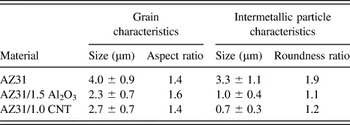
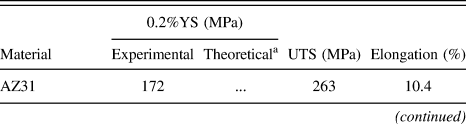
The composition of the AZ31 alloy (provided by Alfa Aesar, MA) used in this present investigation was Mg–(2.50–3.50)Al–(0.60–1.40)Zn–(0.15–0.40)Mn–0.10Si–0.05Cu–0.01Fe–0.01Ni. Reference Paramsothy, Hassan, Srikanth and Gupta10,Reference Paramsothy, Hassan, Srikanth and Gupta11 The alloy was reinforced with powder of alumina (50 nm size and 1.5 vol.%, provided by Baikowski, Japan) and CNTs (40–70 nm outer diameter and 1.0 vol.%, provided by Nanostructured & Amorphous Materials Inc., TX) using hybrid casting process (called disintegrated melt deposition) followed by hot extrusion at 350 °C. Hot extruded rods with 8 mm diameter were used for ambiance temperature and physical, microstructural, and mechanical properties of the developed reinforced alloy and a summary is given in Tables I and II. Further details of the processing and characterization studies are available elsewhere. Reference Paramsothy, Hassan, Srikanth and Gupta10,Reference Paramsothy, Hassan, Srikanth and Gupta11
Microstructural characteristics of AZ31 alloy containing nanoparticles. Reference Paramsothy, Hassan, Srikanth and Gupta10,Reference Paramsothy, Hassan, Srikanth and Gupta11

Ambient temperature tensile characteristics of the nanosized reinforcement incorporated AZ31 alloy. Reference Paramsothy, Hassan, Srikanth and Gupta10,Reference Paramsothy, Hassan, Srikanth and Gupta11

a Theoretical room temperature yield strength of nanocomposite in accordance with the model of Dai et al. Reference Dai, Ling and Bai14
B. Tensile testing
Tensile characteristics of the extruded reinforced AZ31 alloy samples were studied at 25, 150, 200, and 250 °C. Elongation-to-fracture tensile tests were performed in accordance to the ASTM E8M-05. Specimens used were with 5 mm diameter and 25 mm gauge length. Tests were conducted using Instron 5500 machine (Norwood, MA) coupled with air circulated resistance heating closed chamber with a strain rate of 0.01 s−1. Tensile specimens are soaked at testing temperature for ∼5 min prior to the test.
Upon completion of each of the tensile tests, one half of the fractured tensile sample is left for furnace cooling and the other half quenched into cold water to freeze the grain morphology that existed during fracture. Metallography of the quenched AZ31 alloy microstructure is conducted using optical microscope to understand the deformed grain morphology. Fractography on the furnace cooled AZ31 alloy fracture surface is conducted using JEOL JSM-5800 LV scanning electron microscope (JEOL, Tokyo, Japan).
III. RESULTS AND DISCUSSION
A. Ambient temperature tensile behavior
Results of elongation-to-fracture test revealed significant improvement in ambient temperature strength and ductility of the AZ31 alloy (see Table II) due to the incorporation of the nanosized reinforcement, and interestingly both nanosized alumina and CNTs are proven to be equally effective in enhancing the tensile properties of AZ31 alloy. Increase in the strength of AZ31 alloy is believed to be the cumulative effect Reference Paramsothy, Hassan, Srikanth and Gupta10,Reference Paramsothy, Hassan, Srikanth and Gupta11 of (a) dislocation generation due to the mismatch of elastic modulus and coefficient of thermal expansion (CTE) between AZ31 alloy and the nanosized reinforcement, (b) Orowan strengthening process, and (c) effective load transfer from matrix to reinforcement.
According to the analytical model proposed by Dai et al. Reference Dai, Ling and Bai14 for strengthening of reinforced metallic materials, ambient temperature yield strength of the AZ31 alloy can be predicted by the following equation:
 $$\sigma _{{\rm{my}}} = \sigma _{{\rm{m0}}} + \Delta \sigma \quad,$$
σmy and σm0 are the yield strength of nanosized reinforced and unreinforced AZ31 alloy, respectively. Δσ represents the anticipated contribution in yield strength increment of AZ31 alloy by the incorporated nanosized reinforcement and can be estimated by Reference Clyne and Withers15
 $$\Delta \sigma = \sqrt {\left( {\Delta \sigma _{{\rm{EM}}} } \right)^2 + \left( {\Delta \sigma _{{\rm{CTE}}} } \right)^2 } \quad.$$
ΔσEM and ΔσCTE are the components in strength increments induced by the mismatch in elastic modulus and CTE between the matrix and reinforcement and calculated by Taylor dislocation strengthening relations:
 $$\Delta \sigma _{{\rm{EM}}} = \sqrt 3 \alpha \mu _{\rm{m}} b\sqrt {\rho _{\rm{G}}^{{\rm{EM}}} } \quad,$$
 $$\Delta \sigma _{{\rm{CTE}}} = \sqrt 3 \beta \mu _{\rm{m}} b\sqrt {\rho _{\rm{G}}^{{\rm{CTE}}} } \quad,$$
μm is the shear modulus of AZ31, b is the Burgers vector, and α and β are the strengthening coefficients (0.5 and 1.25, respectively).
According to the model proposed by Dai et al., the geometrically necessary dislocations require to be intimately close to the surfaces of reinforcement to accommodate the distortion deformation in AZ31 alloy induced by matrix–reinforcement elastic mismatch. Reference Ashby16 Dislocation density due to elastic modulus mismatch can be estimated by
 $$\rho _{\rm{G}}^{{\rm{EM}}} = {{6f_{\rm{p}} } \over {bd_{\rm{p}} }}\varepsilon \quad,$$
f p and d p are the volume fraction and size of nanosized reinforcement, respectively, and ε is the strain under uniaxial tensile test, which can be estimated using Ramburg–Osgood relation:
 $$\varepsilon = {\sigma \over {E_{\rm{m}} }} + \xi {{\sigma _{{\rm{m0}}} } \over {E_{\rm{m}} }}\left( {{\sigma \over {{\rm{\sigma }}_{{\rm{m0}}} }}} \right)^{{1 \over n}} \quad.$$
Ramburg–Osgood factor ξ is taken as 0.43, E m is the Young's modulus of AZ31, and n is the strain hardening exponent.
According to Arsenault et al., Reference Arsenault and Shi17 CTE mismatch between matrix and reinforcement induced nonuniformly distributed dislocation in the AZ31 alloy during extrusion process. Dislocation density due to CTE mismatch can be estimated Reference Li, Viereckl, Rottmair and Singer18 by
 $$\rho _{\rm{G}}^{{\rm{EM}}} = {{Bf_{\rm{p}} (\Delta {\rm{CTE}})\Delta T} \over {\sqrt 3 {\rm{b}}\left( {1 - f_{\rm{p}} } \right)d_{\rm{p}} }}\quad.$$
B is the geometric constant with a value of 4, Reference Arsenault and Shi17 ΔCTE is the difference in CTE between AZ31 alloy and nanosized reinforcement, ΔT is the difference between processing and test temperature.
Dai model predicted the contribution of the incorporated nanosized reinforcement, which is supported by the experimental results (see Table II) for both the alumina and CNTs and in essence established equal effectiveness of both of the reinforcements used in this study.
Ambient temperature ductility of AZ31 is also believed to be significantly enhanced due to the cumulative influence Reference Paramsothy, Hassan, Srikanth and Gupta10,Reference Paramsothy, Hassan, Srikanth and Gupta11 of the presence of (a) uniformly distributed nanosized particles and (b) intermetallic particles with reduced size and roundness ratio.
B. High temperature tensile behavior
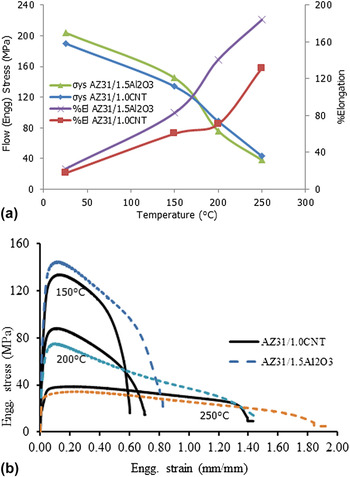
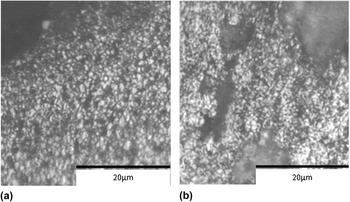
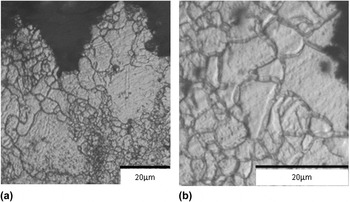
Strength required to yield the flow stress of AZ31 alloy was found to be diminishing in nonlinear form [see Table III and Fig. 1(a)] with the increase in test temperature used in this study, which is also traditionally typical. Strain hardening effect on the deforming microstructure of AZ31 alloy was absent as reflected in the tensile stress–strain graphs shown in Fig. 1(b). In practice, the need of high temperature for activation of extra slip system, considerable twinning, presence of intermetallic in microstructure, and absence of dynamic recrystallization in deforming microstructure induce relatively higher flow stress requirement for AZ31 alloy around up to 250 °C Reference Myshlyaev, McQueen, Mwembela and Konopleva8,Reference Mwembela, Konopleva and McQueen9 and beyond which introduction of dynamic recrystallization process initiates reduction of flow stress with improved ductility. Dynamic recrystallization in deforming AZ31 alloy is dependent on the strain rate and applied temperature. Significantly increased dynamic recrystallization accompanied by disappearance of twinning Reference Kainer, von Buch and Kainer3,Reference Myshlyaev, McQueen, Mwembela and Konopleva8,Reference Mwembela, Konopleva and McQueen9 is considered to be the contributor to considerably reduce flow stress as well as declining strain hardening effect in AZ31 alloys at a temperature above 360 °C. However, optical microscopy on the quenched fractured sample revealed that the AZ31 alloy microstructure is completely recrystallized (see Fig. 2) by dynamic recrystallization process at 150 °C due to the presence of nanosized reinforcement. Optical microscopy also revealed that at 150 °C the nanosized reinforcement-induced finer intermetallic particles Reference Paramsothy, Hassan, Srikanth and Gupta10,Reference Paramsothy, Hassan, Srikanth and Gupta11 was apparently dissolved into the alloy matrix and the activity of extra slip system prevented twinning in the deformed AZ31 microstructure. Combined effect of the above-mentioned microstructural features significantly reduced the flow stress, accompanied by diminishing strain hardening, of AZ31 alloy under this study. In essence, the nanosized reinforcements used in this study have induced complete dynamic recrystallization in AZ31 alloy at a temperature even much below than the lower limit of warm-working temperature region (i.e., 180–260 °C) as reported by many of the researchers. Reference Maksoud, Ahmed and Rodel5,Reference Myshlyaev, McQueen, Mwembela and Konopleva8,Reference Mwembela, Konopleva and McQueen9 It should be noted that a significant amount of dynamic recrystallization (not complete) in deforming AZ31 alloy is achievable at a temperature above 250–360 °C. Relatively less clustering tendency of alumina nanopowder, compared to CNTs, believe to have restricted the grain growth (see Fig. 3) by pinning the advancing grain boundary Reference Porter, Easterling and Sherif19 of recrystallized grains of AZ31 alloy.
Temperature-dependent yield strength and ductility of nanosized reinforcement incorporated AZ31 alloy.

Graph showing effect of temperature on the (a) flow stress and ductility, and (b) stress–strain relationship of AZ31 alloy with nanoparticles with test temperature.

Optical micrographs showing complete recrystallized of AZ31 alloy tested at 150 °C when reinforced with (a) Al2O3 and (b) CNTs.

Optical micrographs showing complete grain growth of AZ31 alloy tested at 250 °C when reinforced with (a) Al2O3 and (b) CNTs.

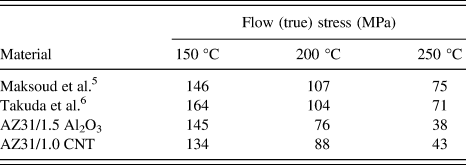
The microstructural evolution in AZ31 alloy due to the presence of nanosized reinforcements also significantly reduced the true flow stress compared to the theoretically predicted requirements as shown in Table IV. Flow stress (peak true stress) required for the deformation of AZ31 alloy was predicted using recently developed two different types of mathematical models proposed by Maksoud et al. Reference Maksoud, Ahmed and Rodel5 and Takuda et al. Reference Takuda, Morishita, Kinoshita and Shirakawa6
Theoretical and experimental true flow stress values for AZ31 alloy with thermally stable nanoparticles.

Maksoud et al. proposed that the required peak true stress for AZ31 alloy deformation is
 $${\rm{\sigma }} = 19.231\;\sinh ^{ - 1} \left( {5.961 \times 10^{ - 9} {{\dot \varepsilon }}\exp \left( {{{152080} \over {RT}}} \right)} \right)^{0.441} \quad,$$
where,
 ${{\dot \varepsilon }}$
= strain rate (s−1), R = molar gas constant (J mol−1 K−1), and T = deformation temperature (K).
Takuda et al. proposed that the required peak true stress for AZ31 alloy deformation is
 $$\sigma = K{\rm{\varepsilon }}^n \left( {{{{{\dot \varepsilon }}} \mathord{\left/ {\vphantom {{{\rm{\dot \varepsilon }}} {{\rm{\dot \varepsilon }}_0 }}} \right. \kern-\nulldelimiterspace} {{{\dot \varepsilon }}_0 }}} \right)^m\quad.$$
where
 $K = {\rm{stress}}\;{\rm{coefficient}} = {{3.24 \times 10^5 } \over t} - 406$
;
 ${{\dot \varepsilon }}_{\rm{0}}$
= 1 s−1; n = A log(
 ${{\dot \varepsilon }}$
/
 ${{\dot \varepsilon }}_{\rm{0}}$
) + B, A = 0.016 and
 $B = {{62.0} \over t} + 0.053$
;
 $m = {{ - 105} \over t} + 0.303$
, t = T[K]/1[K].
Result shows that nanosized alumina is relatively more effective in reducing the true flow stress of AZ31 alloy at a higher temperature when compared to the effect of CNTs on true flow stress of the alloy.
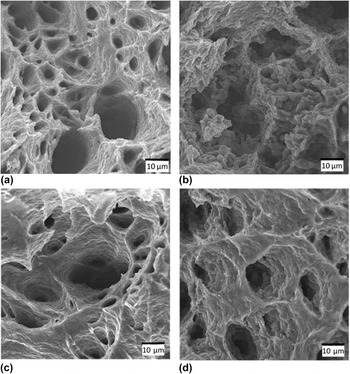
High temperature tensile deformation process also revealed extraordinarily high failure strain of AZ31 alloy due to the presence of nanosized reinforcements as shown in Fig. 1 and Table III. Activation of non-basal slip system, induced by nanosized reinforcements and thermal energy, coupled with complete dynamic recrystallization at a much lower temperature followed by significant grain growth and absence of intermetallic secondary phases is believed to cumulatively contribute in the improvement of failure strain (i.e., ductility) of AZ31 alloy. Relatively higher efficiency in reducing the flow stress (both engineering and true) of AZ31 alloy made nanosized alumina proportionately highly efficient in increasing the ductility of the deforming alloy when compared to the effect of CNTs on the deforming AZ31 alloy. Incorporation of considerably a very small amount of nanosized reinforcements used in this study has enhanced the failure strain (i.e., ductility) of AZ31 alloy to a level much higher than the values reported by various researchers working on AZ31 alloy. Reference Maksoud, Ahmed and Rodel5,Reference Takuda, Morishita, Kinoshita and Shirakawa6,Reference Myshlyaev, McQueen, Mwembela and Konopleva8,Reference Mwembela, Konopleva and McQueen9 In essence, the study revealed potential of near net shape formation of AZ31 alloy at a temperature much below than the widely used 350 °C. Solid state formability is mostly needed for industrial, especially, in automobile applications. Fractography (see Fig. 4) revealed ductile fracture features, as dimples, are overwhelmingly dominating the fracture surface of AZ31 alloy matrix, which is supportive to the extraordinary ductility achieved by the reinforced AZ31 alloy under study.
Scanning electron micrographs showing fracture surfaces of AZ31 alloy reinforced with Al2O3 tested at (a) 150 °C and (b) 250 °C, and reinforced with CNTs tested at (c) 150 °C and (d) 250 °C.

IV. CONCLUSIONS
The current study has revealed that in the AZ31 alloy matrix, nanosized alumina and CNT reinforcements are competitively effective in inducing (i) refinement in grains and intermetallic particles and (ii) strengthening almost to a theoretically predicted value. Although reduction in the high temperature flow stress of AZ31 was found to closely match for both of the nanosized reinforcements, alumina was relatively efficient in improving the failure strain of matrix alloy. Addition of remarkably a small amount of nanosized alumina particles or CNTs introduced huge potential of near net shape processing of AZ31 alloy at a temperature much below than the widely used 350 °C. Among the two reinforcements used in this study, alumina was found to be more efficient when compared to the effect of CNTs.
ACKNOWLEDGMENT
The authors would like to acknowledge the support provided by the Deanship of Scientific Research (DSR) at King Fahd University of Petroleum and Minerals (KFUPM) for funding this work through project No. IN100013.