Introduction
Pethoxamid (FMC Corp., Philadelphia, PA) is a very-long-chain fatty acid (VLCFA)–inhibiting herbicide, which belongs to the chloroacetamide family. Pethoxamid is under development in US rice, with registration anticipated in 2021 (Don Johnson, personal communication). There are no VLCFA-inhibiting herbicides labeled for use in US rice production; therefore, pethoxamid would present a unique site of action (SOA) to combat herbicide-resistant weeds in rice.
Pethoxamid is currently used as a PRE herbicide for European corn (Zea mays L.) and soybean [Glycine max (L.) Merr.] (Schlosser et al. Reference Schlosser, Hunt, Teicher and Cheminova2016) and is a soil-applied, systemic herbicide with activity on many annual grasses and small-seeded broadleaf weeds, including barnyardgrass and red rice (Anonymous 2016). Pethoxamid, like other VLCFA-inhibiting herbicides, is a root and shoot inhibitor; therefore, it controls germinating seeds (Lingenfelter Reference Lingenfelter2015). Pethoxamid has similar activity to such commonly used herbicides in US row crops as acetochlor, alachlor, and metolachlor.
Previous research has shown that the over-reliance on one particular herbicide or herbicide SOA is the leading cause for the selection of herbicide resistance (Norsworthy et al. Reference Norsworthy, Ward, Shaw, Llewellyn, Nichols, Webster, Bradley, Frisvold, Powles, Burgos, Witt and Barrett2012). This has led to the selection of barnyardgrass resistance to several of the most commonly used herbicides in rice. In a survey of crop consultants in Arkansas and Mississippi, clomazone was listed as the most often recommended PRE herbicide by 91% of respondents (Norsworthy et al. Reference Norsworthy, Bond and Scott2013a). The most commonly used POST herbicides included imazethapyr, quinclorac, fenoxaprop, and propanil (Norsworthy et al. Reference Norsworthy, Ward, Shaw, Llewellyn, Nichols, Webster, Bradley, Frisvold, Powles, Burgos, Witt and Barrett2012). Barnyardgrass resistance has been confirmed by the University of Arkansas resistance screening program to propanil, quinclorac, imazethapyr, penoxsulam, bispyribac, imazamox, and clomazone; and fenoxaprop and cyhalofop-resistant barnyardgrass populations have been confirmed in Mississippi (Heap Reference Heap2017; Miller et al. Reference Miller, Norsworthy, Scott and Barber2015).
Targeting the most resistance-prone weeds by rotation, mixing, and sequential applications of differing herbicide SOAs can delay the onset of resistance by reducing selection pressure (Norsworthy et al. Reference Norsworthy, Ward, Shaw, Llewellyn, Nichols, Webster, Bradley, Frisvold, Powles, Burgos, Witt and Barrett2012). Although yearly herbicide rotations and sequential applications of herbicides with different SOAs can reduce selection on weed species compared to a monoherbicidal program, there is a possibility that multiple resistance may evolve.
Mixtures of herbicides with multiple SOAs applies simultaneous selection, reducing the risk for resistance (Diggle et al. Reference Diggle, Neve and Smith2003). Modeling research has shown that resistance has the lowest risk to evolve when herbicides are applied as mixtures having different SOAs (Diggle et al. Reference Diggle, Neve and Smith2003). Hence, the integration of a new herbicide SOA in rice production broadens the grower’s ability to mix pethoxamid with other rice herbicides to combat herbicide-resistant weed species.
VLCFA-inhibiting herbicides have been used in Asian dry- and water-seeded rice culture as both PRE and POST herbicides. Pretilachlor and butachlor are used in Asian rice production. Butachlor controlled barnyardgrass at least 59% when applied 1, 3, 5, and 7 d after direct seeding sprouted rice seed in India (Mutnal et al. Reference Mutnal, Kumar, Joshi and Honnannavar1998). In a separate study conducted in Sri Lanka, pretilachlor plus pyribenzoxim followed by (fb) MCPA was applied to rice 8 d after sowing in a dry-seeded system, reducing weed densities of barnyardgrass, Chinese sprangletop (Leptochloa chinensis L.), and knotgrass (Paspalum distichum L.) by 99% (Chauhan Reference Chauhan2012).
Preliminary research has been conducted on the tolerance of rice to pethoxamid. Pethoxamid was applied delayed preemergence (DPRE), at spiking, and one- to two-leaf rice stages. Rice treated with pethoxamid was injured no more than 5%, and yield was not reduced compared to the nontreated (Godwin et al. Reference Godwin, Norsworthy, Scott, Barber, Young and Duren2016). In other research, rice exhibited tolerance to pethoxamid at 420 and 560 g ai ha–1 alone or mixed with clomazone, pendimethalin, or quinclorac when applied to spiking rice, with 80% barnyardgrass and 86% Amazon sprangletop [Leptichloa panicoides J. Presl (Hitchcock)] control provided by the 560 g ha–1 rate at 66 d after treatment (Doherty et al. Reference Doherty, Barber, Norsworthy and Hill2016).
Many of the commonly used herbicides in US rice production inhibit acetolactate synthase (ALS) and acetyl CoA carboxylase (ACCase). ALS-inhibiting and ACCase-inhibiting herbicides have confirmed resistance in 51 and 15 different weed species, respectively, in the United States alone (Heap Reference Heap2017). There is lower risk for the selection of weed resistance to VLCFA-inhibiting herbicides compared to many commonly used rice herbicides based on there being only five confirmed resistant species worldwide, and only one in the United States, that being Italian ryegrass (Lolium multiflorum Lam.) (Heap Reference Heap2017).
It is believed that pethoxamid may provide an effective and alternative herbicide SOA for use in US rice production when used in combination with other herbicides. It was hypothesized that rice would display adequate tolerance to pethoxamid applied alone and in combination with other rice herbicides at various application timings, while providing an effective level of weed control. The objective of this research was to evaluate weed control and rice tolerance following pethoxamid-containing programs in drill-seeded rice.
Materials and Methods
Field trials were conducted at the Rice Research and Extension Center near Stuttgart (hereafter referred to as Stuttgart), AR (34 28'23'' N, 91 25'05'' W), in 2015 and 2016 and at the Pine Tree Research Station near Colt (hereafter referred to as Colt), AR (35 07'23'' N, 90 55'46'' W), and the University of Arkansas Pine Bluff Lonoke Farm near Lonoke (hereafter referred to as Lonoke), AR, in 2016. Studies located at Stuttgart evaluated only rice tolerance, whereas those at Colt and Lonoke assessed weed control. The soils at Stuttgart, Colt, and Lonoke were a Dewitt silt loam (fine, smectic, thermic typic albaqualf), Calloway silt loam (fine-silty, mixed, active, thermic aquic fraglossudalfs), and Immanuel silt loam (fine-silty, mixed, active, thermic oxyaquic glossudalfs), respectively. Imidazolinone-resistant (Clearfield™, BASF Corp., Research Triangle Park, NC) inbred rice cultivars CL111 (Stuttgart) and CL151 (Colt and Lonoke) were drill-seeded in 18-cm rows at a seeding rate of 72 seeds m–1 of row. Plot size was 1.8 by 5.2 m. Rice was planted on May 5, 2015 and April 29, 2016 at Stuttgart, and on May 9 and May18, 2016 at Colt and Lonoke, respectively. Rice fertility programs were based on University of Arkansas Division of Agriculture Research and Extension recommendations (Norman et al. Reference Norman, Slaton and Roberts2013).
At each location, the experiment was a randomized complete block design with four replications. In total, 12 different herbicide treatments were evaluated along with a nontreated plot. Herbicides and adjuvants evaluated in all studies are shown in Table 1. Treatments evaluated are presented in Table 2. Herbicides were applied with a CO2-pressurized backpack sprayer through 110015 AIXR (TeeJet, 1801 Business Park Drive, Springfield, IL 62703) nozzles calibrated to deliver 143 L ha–1 using a three-nozzle boom at a 51-cm nozzle spacing at 4.83 km h–1.
Description of herbicides and adjuvants used in rice experiments.

a Pethoxamid is not registered in any crop and thus does not have a trade name.
b Abbreviations: EC, emulsifiable concentrate; ME, microencapsulated.
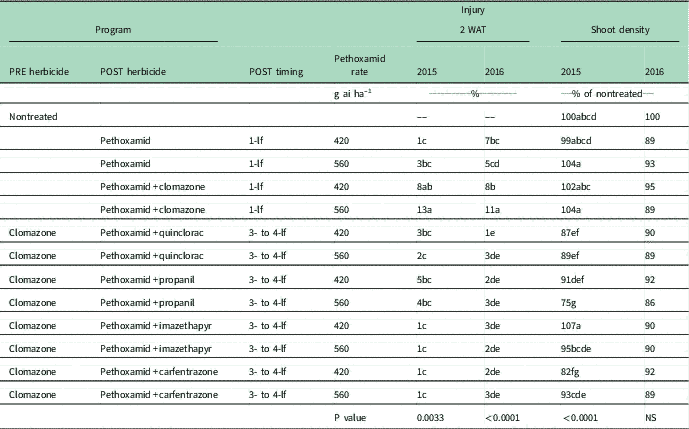
Rice injury ratings 2 wk after treatment (WAT) and shoot density at Stuttgart, AR, in 2015 and 2016.Footnote a – Footnote c

a Abbreviations: lf, leaf.
b Means within a column followed by the same lowercase letter are not different according to Fisher’s protected LSD (α=0.05).
c PRE clomazone applied May 6, 2015 and April 29, 2016; one-leaf rice treated May 19, 2015 and May 12, 2016; three- to four-leaf rice treated May 27, 2015 and June 1, 2016.
The trial at Stuttgart was placed in an area of low weed density, and plots were occasionally hand-rogued to remove any weeds not controlled by the treatments. Entire study areas at Colt and Lonoke were tilled prior to planting to destroy existing weed populations. All one-leaf herbicide applications were made with an average of 11 barnyardgrass plants m–2 ranging from 2 to 5 cm at Lonoke and 1 barnyardgrass plant m–2 ranging from 2 to 4 cm at Colt. The three-leaf applications were applied to an average of 2 barnyardgrass plants m–2 ranging from 6 to 9 cm at Lonoke and 4 barnyardgrass plants m–2 ranging from 5 to 8 cm at Colt.
At Stuttgart, visual assessment of crop injury using a scale of 0 to 100% with 0 being no injury and 100% being crop death, was evaluated every 2 wk following the first application until physiological maturity. Visible-injury assessments included reduction in crop density, height, and overall plant vigor. Shoot density (number of shoots m–1 of row) was recorded 5 wk after planting. Crop heights were recorded 8 wk after planting by measuring height in three random locations with each plot. Also collected were days to 50% heading relative to the nontreated and rough rice yield (kg ha–1), adjusted to 12.5% moisture. Shoot density and crop height were normalized for each site-year by converting them to a percentage of the nontreated plot. At Colt and Lonoke, a visual assessment of barnyardgrass control (0 to 100%) compared to the nontreated plot was assessed every 2 wk following the first herbicide application until physiological maturity.
Data were analyzed in JMP Pro 12 (SAS Institute Inc., Cary, NC). Data were analyzed separately by site-year with block (replication) included as a random effect. The nontreated data were removed from the analysis for the rice tolerance and barnyardgrass control assessments. All means were separated using Fisher’s protected LSD (α=0.05). To determine the effect of pethoxamid rate, the use of a PRE herbicide, and the use of an additional herbicide with pethoxamid on barnyardgrass control, contrasts were conducted for the rate of pethoxamid applied (420 g ha–1 vs. 560 g ha–1); the use of a PRE herbicide compared to no PRE; and pethoxamid plus clomazone, pethoxamid plus quinclorac, pethoxamid plus propanil, pethoxamid plus imazethapyr, or pethoxamid plus carfentrazone compared to pethoxamid applied alone for barnyardgrass control 3 wk after pethoxamid treatment (WAT) and 4 wk after rice flooding (WAF) at Colt and Lonoke.
Results and Discussion
Rice injury ratings at Stuttgart were less than 10% for all treatments, except for pethoxamid at 560 g ha–1 plus clomazone applied to one-leaf rice 2 WAT in both 2015 and 2016 (Table 2). By 4 WAF, rice injury had dissipated to less than 5% following all treatments (data not shown), indicating that pethoxamid can be safely applied at either one-leaf or three- to four-leaf rice stages alone or in combination with other rice herbicides. These results coincide with previous research on a silty clay soil where a higher rate of pethoxamid applied at 840 g ha–1 at DPRE, spiking, and one- to two-leaf rice caused less than 5% injury 3 WAT (Godwin et al. Reference Godwin, Norsworthy, Scott, Barber, Young and Duren2016).
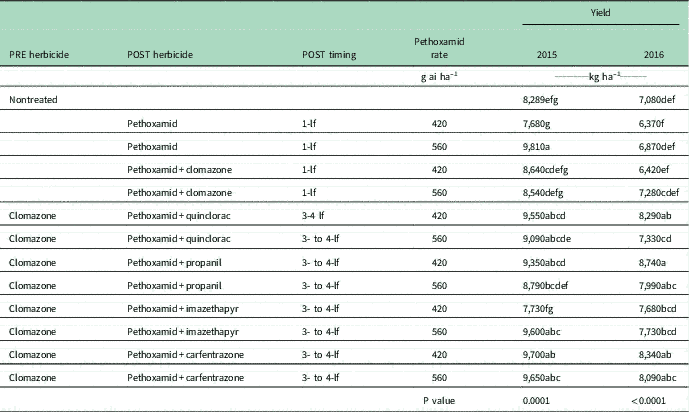
Even though injury was no more than 13% and no height reduction occurred for any treatment in 2015 or 2016 (data not shown), differences in shoot density occurred at Stuttgart in 2015 as a result of herbicide treatment. In 2015, clomazone fb pethoxamid at 420 g ha–1 plus carfentrazone or clomazone fb pethoxamid at 560 g ha–1 plus propanil applied to three- to four-leaf rice had shoot densities less than the nontreated (Table 2). The reduced shoot density may be a result of two emulsifiable concentrate formulations being applied as a mixture; however, it should be noted that there are no known published reports of carfentrazone or propanil alone reducing rice shoot density. Observed rice injury from both of these treatments was less than 5% in both 2015 and 2016. Even though a reduction in shoot density was observed, there was no delay in heading (data not shown), and yield was not reduced relative to the nontreated (Table 3).
Rough rice yield at Stuttgart, AR, in 2015 and 2016.Footnote a – Footnote c

a Abbreviation: lf, leaf.
b Means within a column followed by the same lowercase letter are not different according to Fisher’s protected LSD (α=0.05).
c PRE clomazone applied May 6, 2015 and April 29, 2016; one-leaf rice treated May 19, 2015 and May 12, 2016; and three- to four-leaf rice treated May 27, 2015 and June 1, 2016.
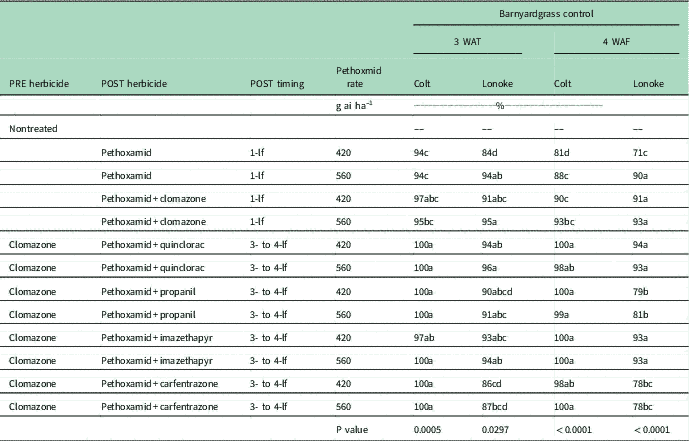
Barnyardgrass was controlled 97% or more up to 4 WAF at Colt with PRE-applied clomazone-containing herbicide programs that were fb pethoxamid plus another herbicide to three- to four-leaf rice (Table 4). At Lonoke, barnyardgrass was controlled 93% or more 3 WAT and 4 WAF following applications of clomazone PRE fb pethoxamid plus quinclorac or imazethapyr. The reduction in control with propanil-containing programs was attributed to the population of barnyardgrass at Lonoke being confirmed resistant to propanil. Propanil resistance is a common problem in Arkansas. From 2006 to 2012, nearly 50% of barnyardgrass samples submitted to the University of Arkansas herbicide resistance screening program were documented as resistant to propanil (Norsworthy et al. Reference Norsworthy, Scott and Johnson2013b). The low barnyardgrass control (78% to 87%) when pethoxamid plus carfentrazone was applied to three- to four-leaf rice following PRE-applied clomazone is probably a result of emerged barnyardgrass at the time of application. Pethoxamid only provides residual control, and carfentrazone is only used for POST control of broadleaf weeds (Scott et al. Reference Scott, Barber, Boyd, Selden, Norsworthy and Burgos2016).
Barnyardgrass control 3 wk after treatment (WAT) and 4 wk after permanent flood (WAF) at Colt and Lonoke, AR in 2016.Footnote a – Footnote c

a Abbreviation: lf, leaf
b Means within a column followed by the same lowercase letter are not different according to Fisher’s protected LSD (α=0.05).
c At Colt, PRE clomazone applied May 10, 2016; one-leaf rice treated May 25, 2016; and three- to four-lear rice treated June 2, 2016. At Lonoke, PRE clomazone applied May 19, 2016; one-leaf rice treated May 31, 2016; and three- to four-leaf rice treated June 13, 2016.
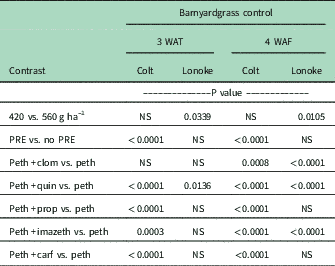
Contrasts revealed differences in barnyardgrass control between the rate of pethoxamid used, the use of pethoxamid in combination with other rice herbicides vs. the use of pethoxamid alone, and the use of a PRE vs. the absence of a PRE (Table 5). At Lonoke, barnyardgrass control was improved with pethoxamid at 560 g ha–1 compared to 420 g ha–1 at both 3 WAT and 4 WAF (Table 5). Also, pethoxamid in combination with all herbicides evaluated, except propanil or carfentrazone at Lonoke, enhanced barnyardgrass control 4 WAF (Table 5). Likewise, the use of a PRE herbicide resulted in higher levels of barnyardgrass control at Colt, 3 WAT and 4 WAF, when compared to treatments without a PRE. Hence, for season-long barnyardgrass control, it is imperative that pethoxamid be used in an herbicide program rather than applied alone to one-leaf rice.
Contrasts for percentage barnyardgrass control 3 WAT and 4 WAF at Colt and Lonoke, AR in 2016.Footnote a , Footnote b

a Abbreviations: Carf, carfentrazone; clom, clomazone; imazeth, imazethapyr; peth, pethoxamid; prop, propanil; quin, quinclorac; WAF, wk after permanent rice flood; WAT, wk after treatment.
b At Colt, PRE clomazone applied May 10, 2016; one-leaf rice treated May 25, 2016; and three- to four-leaf rice treated June 2, 2016. At Lonoke, PRE clomazone applied May 19, 2016; one-leaf rice treated May 31, 2016; and three- to four-leaf rice treated June 13, 2016.
All treatments at Colt and Lonoke containing clomazone PRE fb pethoxamid in a mixture with another herbicide applied to three- to four-leaf rice provided three different herbicide sites of action, including a diterpene biosynthesis inhibitor (clomazone), a VLCFA inhibitor (pethoxamid), and the corresponding site of action for the herbicide added to pethoxamid. The three effective herbicide sites of action at Colt resulted in an increase in weed control both 3 WAT and 4 WAF when compared to pethoxamid applied alone (Table 4). Hence, pethoxamid in a program can provide residual control until permanent flood is established, resulting in season-long barnyardgrass control.
Practical Implications
The minimal rice injury or reduction in yield shows that rice can tolerate pethoxamid POST at the rates evaluated on a silt loam soil. Chloroacetamides, such as pethoxamid, have activity on weeds prior to emergence and inhibit early seedling growth (Fuerst Reference Fuerst1987); therefore, pethoxamid would only control weeds that germinate after the herbicide application. If pethoxamid is to be used POST in rice, it is necessary to mix pethoxamid with a rice herbicide that has activity on weeds that have already emerged. Chloroacetamides are considered relatively low-risk herbicides for the selection of weed resistance (Powles and Shaner Reference Powles and Shaner2001); therefore, pethoxamid used in a herbicide program offers an alternative and effective herbicide site of action to control many of the resistant weed species found in rice, such as barnyardgrass. Considering the tolerance of rice and high levels of barnyardgrass control associated with the use of pethoxamid-containing rice herbicide programs, an early POST application of pethoxamid provides a unique site of action and aids residual weed control until the permanent rice flood is established.
Acknowledgments
Funding for this research was provided by the Arkansas Rice Research and Promotion Board. The authors have no conflicts of interest to report.