INTRODUCTION
Job-related stress is defined as an uncomfortable and undesirable feeling experienced by an individual ‘who is required to deviate from normal or self-desired functioning in the work place as the result of opportunities, constraints, or demands relating to potentially important work-related outcomes’ (Parker & DeCotils, Reference Parker and DeCotils1983: 165). Given the high costs and deleterious effects associated with job-related stress such as burnout, higher employee turnover, lower work performance, decreased organizational effectiveness, and organizational health-care costs (Beehr & Newman, Reference Beehr and Newman1978; Kram & Hall, Reference Kram and Hall1989; Manning, Jackson, & Fusilier, Reference Manning, Jackson and Fusilier1996; Maslach, Schaufeli, & Leiter, Reference Maslach, Schaufeli and Leiter2001), the topic of managing stress reduction has drawn great attention from researchers in recent years (e.g., Ganster & Schaubroeck, Reference Ganster and Schaubroeck1991; Harris & Kacmar, Reference Harris and Kacmar2006).
As one of the most important interpersonal relationships at work, workplace mentoring has been linked with reducing employees’ job-related stress (e.g., Allen, McManus, & Russell, Reference Allen, McManus and Russell1999). Workplace mentoring refers to a developmentally oriented relationship between a less experienced employee (the protégé) and a more experienced employee (the mentor) where the goal is personal and professional development of the protégé (Kram, Reference Kram1985). It includes formal and informal forms of mentoring. Our study focuses on the informal mentoring as previous studies have suggested that, compared with formal mentoring, informal mentoring provides greater psychological support and has longer effects on protégés (e.g., Ragins, Cotton, & Miller, Reference Ragins, Cotton and Miller1995; Linnehan, Reference Linnehan2003). There are two perspectives in mentoring research: one focuses on the mentoring functions received by protégés and the other on the mentoring functions provided by mentors. In this study, we adopt the former. Several decades of research has documented many positive effects of mentoring on protégés (e.g., Allen, Eby, Poteet, Lentz, & Lima, Reference Allen, Eby, Poteet, Lentz and Lima2004; Waters, Reference Waters2004; Eby, Allen, Evans, Ng, & DuBois, Reference Eby, Allen, Evans, Ng and DuBois2008). Mentors provide protégés with both psychological mentoring functions, which refer to the interpersonal aspects of the mentoring relationship such as counseling, friendship, acceptance, and role-modeling behaviors, and career-related mentoring functions, which refer to actions that advance the protégé within the organization such as coaching, sponsorship, exposure, protection, and providing challenging assignments (Kram, Reference Kram1985; Allen, Eby, O'Brien, & Lentz, Reference Allen, Eby, O'Brien and Lentz2008). According to social support theory, individuals tend to seek out and count on supportive relationships to prevent, reduce, and cope with stress (House, Reference House1981). Thus, it would seem straightforward to expect employees who have been involved in mentoring relationships to experience less job-related stress. However, contrary to this expectation, literature on the relationship between mentoring and job-related stress has yielded rather mixed and inconclusive results. While some research has found that mentoring can lower the levels of job-related stress (e.g., Sosik & Godshalk, Reference Sosik and Godshalk2000), other studies, however, have reported that mentoring increases protégé stress (e.g., Kram & Hall, Reference Kram and Hall1989). This ambiguity shows how the relation between mentoring and stress is much more complicated than it has previously been taken to be. Therefore, an important research question raised from our review is: what factors may influence the effect of mentoring on relieving protégés’ job-related stress?
Recent research suggests that protégés differ in their responses to mentoring functions on the basis of their individual differences (e.g., Turban & Dougherty, Reference Turban and Dougherty1994; Aryee, Lo, & Kang, Reference Aryee, Lo and Kang1999; Wanberg, Welsh, & Hezlett, Reference Wanberg, Welsh and Hezlett2003; Folkman & Moskowitz, Reference Folkman and Moskowitz2004). For example, Turban and Dougherty (Reference Turban and Dougherty1994) found that protégés’ personality characteristics, such as internal locus of control, high self-monitoring, and high emotional stability, enhance the relationship between mentorship initiation and mentoring received, though they did not address these characteristics’ moderating effects on the effectiveness of mentoring functions.
The domain of organizational research is becoming more international, bringing into question the transportability of social science models from one society to another (Tsui, Reference Tsui2004), and particularly to those undergoing profound transitions in institutional rules, social norms, and values (Farh, Hackett, & Liang, Reference Farh, Hackett and Liang2007). A case in point is China, where the workforce values are increasingly diverse, ranging from traditionalist Chinese to those with a strong international cultural influence (Ralston, Egri, Steward, Terpstra, & Kaicheng, Reference Ralston, Egri, Steward, Terpstra and Kaicheng1999). For example, traditionality has been demonstrated to moderate Chinese employees’ experience of work (e.g., managerial practices/organizational support) and their behavioral and attitudinal reactions (e.g., Chen & Aryee, Reference Chen and Aryee2007). Traditionality can be constructed at both societal and individual levels. Traditionality at the individual level works as a kind of social construct that orientates the individual to reflect socially accepted values (Yang, Yu, & Yeh, Reference Yang, Yu and Yeh1989). We examine traditionality at the individual level because previous studies have suggested that cultural differences can affect individuals more meaningfully at the individual level of analysis than the societal level (e.g., Clugston, Howell, & Dorfman, Reference Clugston, Howell and Dorfman2000; Kirkman, Chen, Farh, Chen, & Lowe, Reference Kirkman, Chen, Farh, Chen and Lowe2009). We examine the moderating effect of individual protégés’ traditionality on the relationship between mentoring and job-related stress to echo the call to investigate the influence of individual diversity on values that are likely to exist in a transitional society (e.g., Farh, Hackett, & Liang, Reference Farh, Hackett and Liang2007; Kirkman et al., Reference Kirkman, Chen, Farh, Chen and Lowe2009).
In addition, the study conducted by Ragins, Cotton, and Miller (Reference Ragins, Cotton and Miller1995) found that the quality of mentoring relationship has a stronger impact on mentoring outcomes than the presence of a mentor. Agreeing with this assessment, Eby and colleagues have pointed out that ‘mentoring relationships are developmental and relational in nature; they are not simply tickets to advancement in organizational settings’ (Eby, Butts, Durley, & Ragins, Reference Eby, Butts, Durley and Ragins2010: 83). Moreover, Ragins and Cotton (Reference Ragins and Cotton1999) suggest that the intimacy or closeness of the relationship, which is a construct related to the trust and comfort between mentor and protégé, could exert an influence on mentoring process. Trust in mentor refers to the belief that a mentor will enact promised support and that such support is likely to be helpful (Young & Perrewé, Reference Young and Perrewé2000b). However, previous research on mentoring and stress has not addressed this possibility of mentorship quality as moderators of mentoring effectiveness. Therefore, in this study, we attempt to bridge this research gap by examining the moderating effect of protégés’ individual-level traditionality, the moderating effect of trust in mentor, and the joint moderating effect of both, on the relationship between mentoring and job-related stress.
In this regard, our research seeks to reconcile conflicting implications of past research for understanding relationships between mentoring and job-related stress while making three primary contributions to mentoring and job-related stress literature. First, we examined the moderating influence of an individual cultural difference of traditionality on the stress-reduction effects of mentoring. Whereas mentoring has made considerable progress in Western countries, a recent review of the mentoring literature shows that research conducted in other cultures has lagged behind (Allen et al., Reference Allen, Eby, O'Brien and Lentz2008). In addition, although some have conducted mentoring field studies in other cultural settings (e.g., Aryee & Chay, Reference Aryee and Chay1994; Aryee, Wyatt, & Stone, Reference Aryee, Wyatt and Stone1996), the unique influence that cultural values have on protégés has not been theorized or empirically examined. Accordingly, our study makes a first contribution by examining the moderating effects of the individual cultural value of traditionality using a Chinese sample. Second, we made a contribution by examining the moderating influence of a relational quality construct of trust in mentor on the stress-reduction effects of mentoring. This is important because the popular press tends to present mentoring as an essential ingredient for employee development, yet mentors know little about the important factors when building such relationships (Young & Perrewé, Reference Young and Perrewé2000a, Reference Young and Perrewé2000b; Eby & Lockwood, Reference Eby and Lockwood2005), and more importantly how to make sure that the time and effort that mentors devote to the relationship is worthwhile. Third, we posited and tested the joint moderating effect of traditionality and trust in mentor on the relationship between mentoring and job-related stress. Examining the interactions of an individual difference in cultural value and a relationship quality as moderator of the stress reduction effects of mentoring should provide a better understanding of the conditions under which it influences job-related stress. Figure 1 schematically depicts interrelationships among the variables examined in this study.
Hypothesized model linking mentoring to job-related stress

LITERATURE REVIEW AND HYPOTHESES
Mentoring and job-related stress
We propose that mentoring is negatively related to protégés’ stress level in terms of preventing stress or assisting the coping with stress. Through psychological mentoring functions such as acceptance, encouragement, and serving as role model, mentors help counter the threats to protégés’ self-worth that often result from stressful events and give protégés an energizing sense of meaning and empowerment (Allen et al., Reference Allen, Eby, O'Brien and Lentz2008; Burk & Eby, Reference Burk and Eby2010). Psychological mentoring functions also facilitate protégés’ positive emotions and reframes stressful situations as opportunities for growth. These positive effects on self-worth and affect suggest that psychology mentoring is negatively related to job-related stress (Allen et al., Reference Allen, Eby, Poteet, Lentz and Lima2004; Allen et al., Reference Allen, Eby, O'Brien and Lentz2008). Career-related mentoring functions, such as coaching, providing feedback, and development of new skills, helps protégés become less vulnerable to stressors and more capable of coping with stress (Allen et al., Reference Allen, Eby, O'Brien and Lentz2004, Reference Allen, Eby, Poteet, Lentz and Lima2008). This is because realistic analysis of the situation along with developing relevant skills and providing available opportunities for protégés could directly expand protégés’ coping resources, which have been demonstrated to reduce stress level (Antonovsky, Reference Antonovsky1979, Reference Antonovsky1987). Thus, with psychological and career functions provided, mentors should be able to help protégés reduce job-related stress. This leads us to the following hypothesis:
Hypothesis 1: Mentoring will be negatively associated with a protégé's reported job-related stress.
Moderating influence of traditionality
Traditionality can be traced to Yang's early work in 1989 (Yang, Yu, & Yeh, Reference Yang, Yu and Yeh1989), and is most frequently observed in Chinese societies such as Taiwan, Hong Kong, and Mainland China (Yang, Reference Yang2003). In its early version, traditionality includes five clusters of values: submission to authority, filial piety and ancestral worship, conservatism and endurance, fatalism and defensiveness, and male dominance. Recent findings have suggested that among these five factors, submission to authority is arguably the most prominent, and they have defined and measured traditionality as the extent to which an individual endorses the traditional hierarchical role relationships prescribed by Confucian social ethics (e.g., Farh, Earley, & Lin, Reference Farh, Earley and Lin1997; Hui, Lee, & Rousseau, Reference Hui, Lee and Rousseau2004; Spreitzer, Perttula, & Xin, Reference Spreitzer, Perttula and Xin2005). A construct similar to traditionality is power distance, both of which capture deference to authority figures (Hui, Lee, & Rousseau, Reference Hui, Lee and Rousseau2004). However, compared with power distance, traditionality originates from a broader societal and familial frame of reference rooted in Confucianism (Schwartz, Reference Schwartz1992). This rationale has been used to build the theoretical framework of previous organizational behavior studies (e.g., Chen & Aryee, Reference Chen and Aryee2007; Farh, Hackett, & Liang, Reference Farh, Hackett and Liang2007).
In the context of the mentoring relationship, it is typical for high-traditionality protégés to accept status differences while being more willing to be influenced by their mentors who are more experienced than themselves. As a result, they will sense, explore, and exploit more support from career and psychological mentoring functions such that the effectiveness of mentoring in reducing their job-related stress level for high traditionality protégés will be higher. Indeed, Allen, Eby, and Lentz (Reference Allen, Eby and Lentz2006) posit that protégés’ respect and admiration for the knowledge of mentors could enhance the amount and quality of mentoring functions received. In contrast, low traditionality protégés are those who have high sense of agency and less subscribe to the mentorship and less easily to be influenced. When in stressful situations, they are more likely to maximize the control in the coping process, both psychologically and instrumentally. Therefore, low traditionality protégés may either reply less on mentors’ aid or be less willing to be influenced by the mentor. As such, we expect low-traditionality protégés to exploit less from their mentoring relationships than high-traditionality protégés can, thus the stress reduction function of mentoring on job-related stress for low traditionality protégés are less effective. Accordingly,
Hypothesis 2: Protégés’ traditionality moderates the negative relationship between mentoring and job-related stress in such a way that the relationship will be stronger for protégés who are higher rather than lower in traditionality.
Moderating influence of trust in mentor
The existence of trust has been highlighted as central to exchange relationships (Blau, Reference Blau1964) and previous mentoring studies have pointed out that trust in mentor is of particular importance for mentorship effectiveness (Young & Perrewé, Reference Young and Perrewé2000b; Eby et al., Reference Eby, Butts, Durley and Ragins2010). When protégés have a higher level of trust in their mentors, they are more likely to perceive mentors’ goodwill, feel psychologically safe, and form higher confidence in the quality of the mentoring provided (Liang, Spencer, Brogan, & Corral, Reference Liang, Spencer, Brogan and Corral2008). High trust in mentor encourages employees to share experience with mentors, try their best to sense, and internalize the mentor's psychological and career-related support and to exploit as much as possible from the mentoring relationship. Therefore, the mentoring effectiveness will be enhanced and the mentoring–stress relationship will be stronger when trust in mentor is higher rather than lower. In contrast, when protégés have a lower level of trust in their mentor, they will be reluctant to be influenced by their mentor. They may either doubt the quality of the mentoring functions provided or the intentions of their mentors. Protégées who have lower trust in their mentor would be less likely to share their work experience and psychological concerns with their mentors, and may be less willing to make good use of the mentoring provided or even ignore them. The mentoring effectiveness on reducing stress level thus will be lower when protégés’ trust in mentor is low rather than high. Accordingly, we hypothesized that:
Hypothesis 3: Protégés’ trust in mentor moderates the negative relationship between mentoring and job-related stress in such a way that the relationship will be stronger when trust in mentor is higher rather than lower.
Joint moderating influence of traditionality and trust in mentor
Following the preceding discussion, a logical question arises: what would happen if both moderators (i.e., traditionality and trust in mentor) work together? Adopting an interactionist perspective of employee behavior (Mischel, Reference Mischel1977), we suggest that whether high traditionlists’ inclination to make an input of the mentoring functions has its stress level implications is determined by the extent to which they trust their mentor. Protégés who are high in traditionality are more sensitive and responsive to their trusted mentors (Yang, Reference Yang2003). They can gain more from mentoring relationships when they perceive their mentor as trustworthy (Young & Perrewé, Reference Young and Perrewé2000b; Eby et al., Reference Eby, Butts, Durley and Ragins2010). Trust-in-mentor indicates the belief that the mentor holds positive intentions and enacts appropriately helpful behaviors, which could encourage high traditionality protégés to engage in the execution of mentoring functions and make them more effective (Lewis & Wiegert, Reference Lewis and Weigert1985; McAllister, Reference McAllister1995). Therefore, when high traditionality protégé has a high level of trust in their mentor, they will be more willing to make good use of them. Accordingly:
Hypothesis 4: Trust-in-mentor and traditionality jointly moderates the negative relationship between mentoring and job-related stress such that mentoring will have the strongest effect on stress when traditionality and trust in mentor are both high.
METHOD
Participants and procedure
Participants in the current study consist of 388 full-time employees from a high-tech communication company located in a major city in northern China. There are three main reasons why we chose this company. First, it is a privately owned and operated firm, which generally means that the work environment is more flexible and less uniform than state-owned enterprises in China tend to be, leading to more unpredictable work patterns and more sources of variance regarding employees’ job-related stress (e.g., Wang, Tsui, Zhang, & Ma, Reference Wang, Tsui, Zhang and Ma2003; Peng, Tan, & Tong, Reference Peng, Tan and Tong2004). Second, this firm operates within a high-tech industry where staff turnover is high with a continual influx of new employees. Informal mentoring, as an important part of employee orientation and career development, therefore plays a greater role than formal mentoring. Third, there was no officially sanctioned formal mentoring program at the time the study was conducted.
Survey packets were distributed in a company-wide meeting. Surveys were completed on a voluntary basis. Each packet contained an information sheet explaining the objective of the survey, along with a consent form, the survey questionnaire, and a return envelop with seal tape to protect the respondents’ confidentiality. Participants were instructed to complete the survey and to bring it back to the upcoming meeting 2 weeks later. To protect the confidentiality of participants, they were instructed to seal the questionnaires in the envelopes provided after finishing their questionnaires. Two short messages were sent to the participants 3 days after the questionnaire was distributed and 1 day before the second meeting to encourage participants to complete the survey and to remind them to bring it with them. A box was placed outside the meeting venue and the participants were reminded by one of the authors to put their completed and sealed questionnaire into the box before and after the meeting.
A total of 285 surveys were returned with a response rate of 73.5%. After eliminating 43 incomplete questionnaires and 32 questionnaires that did not report any informal mentoring, 210 respondents remained and contributed to the sample of the present study. On average, protégés were 34.4 years old (SD = 7.51) and mostly males (69.0%). Most participants held a Bachelors degree (68.6%), with the remainder reporting a polytechnic diploma or associate degree (14.3%), a graduate degree (15.7%), or high school education (1.4%). The average company tenure was 8.23 years (SD = 6.57). In all, 62.9% of them were non-supervisory employees, 31.9% were first-line supervisors, and 5.2% were middle managers. The average number of informal mentors reported was 1.79 (SD = 0.74). The average mentorship duration for the referred mentoring relationship was 5.5 years (SD = 4.17). In all, 73.8% of the mentors were male and 33.3% of the protégés have mentored others before.
Measures
The translation and back-translation method was applied to verify the questionnaire in Chinese. According to Behling and Law (Reference Behling and Law2000), this technique is necessary, as creating a translation from one language to another that maintains the conceptual equivalence is very difficult because of cultural differences. As several researchers have raised the concerns of the potential constrains of this method (e.g., Wang, Reference Wang1993; Xie, Schaubroeck, & Lam, Reference Xie, Schaubroeck and Lam2008), one of the authors discussed each questionnaire item with the focus group members to ensure clarity. A few minor changes have been made based on the comments received. Response options ranged from 1 = ‘strongly disagree’ to 5 = ‘strongly agree’.
Protégé status
This section was designed to (1) screen participants to identify those who currently have informal mentors; (2) instruct those who have mentors to complete the questionnaire by filling in the following five sections; (3) instruct protégés who have more than one mentor to respond to the following five sections by referring to the most influential mentor; and (4) guide non-protégés to ignore the following sections and return the questionnaire on the designated date.
Whether or not an employee currently has an informal mentor is determined by 2 items, which are preceded by the following definition based on past mentoring studies (e.g., Fagenson, Reference Fagenson1992).
A mentor is an experienced employee who serves as a role model, provides direction, support, and feedback regarding career and personal development. A mentor is also someone with influence and insight, who directly provides upward mobility and/or brings your accomplishments to the attention of people who have power in the company. A mentor can be your supervisor or anybody else in the company.
Respondents were asked to indicate whether they are currently in an informal mentoring relationship. Those without an informal mentor were coded ‘0’. Others who have mentor(s) were also asked to give the number of informal mentors they currently have. Protégés who reported more than one mentor were instructed to complete the questionnaire by referring to the most influential mentor.
Mentoring function
Noe's (Reference Noe1988a) 21-item measure of mentoring functions was used in the present study to indicate the amount of mentoring received by respondents. Some items were reworded to fit the context of the present study (the workplace setting). For example, the original item ‘Mentor reduced unnecessary risks that could threaten the possibility of becoming a school principle or receiving a promotion,’ was changed to ‘My mentor reduced unnecessary risks that could threaten the possibility of becoming a manager or receiving a promotion.’ The career-related mentoring functions subscale consists of 7 items (e.g., ‘My mentor has shared history of his/her career with me’). The psychological mentoring functions subscale contains 14 items (e.g., ‘My mentor has conveyed empathy for the concerns and feelings I have discussed with him/her’). The Cronbach's α for career and psychological mentoring functions were 0.89 and 0.94, respectively. The internal consistency reliability for the scale was 0.96.
Job-related stress
House and Rizzo's (Reference House and Rizzo1972) 7-item job-related tension subscale was used to measure protégés’ work stress (e.g., ‘I work under a great deal of tension’). Higher scores were indicative of a higher level of job-related stress. The reliability estimate for the scale was 0.93.
Traditionality
Yang, Yu, and Yeh's (Reference Yang, Yu and Yeh1989) Chinese 8-item individual traditionality scale was used to measure this construct. This scale has been used in previous Chinese research with reliabilities of 0.70, 0.89, and 0.73, respectively (Chen & Aryee, Reference Chen and Aryee2007; Chen, Tsui, & Zhong, Reference Chen, Tsui and Zhong2007). Sample items included: ‘The best way to avoid mistakes is to follow the instructions of senior persons’ and ‘When people are in dispute, they should ask the most senior person to decide who is right.’ The scale's reliability was 0.94.
Trust in mentor
Trust in mentor was measured with 4 items developed by Butler (Reference Butler1991). It has been previously used in mentoring research (Young & Perrewe, Reference Young and Perrewé2000a, Reference Young and Perrewé2000b). A sample item from this scale is ‘I can count on my mentor to be trustworthy.’ The scale's α coefficient was 80.
Control variables
We included nine control variables for testing the hypotheses. In keeping with other mentoring research (e.g., Hunt & Michael, Reference Hunt and Michael1983; Kram, Reference Kram1983: 608; Noe, Reference Noe1988b; Ragins, Reference Ragins1989; Whitely, Dougherty, & Dreher, Reference Whitely, Dougherty and Dreher1992), we controlled the participants’ age, gender, education, position, and tenure. Age and company tenure were measured by the number of years. Gender was coded 0 for ‘female’ and 1 for ‘male’. Education was coded 1 for ‘high school’, 2 for ‘polytechnic diploma or associate’, 3 for ‘undergraduate’ and 4 for ‘graduate’. The nominal variables of the employee position was coded 1 for ‘non-supervisory employees,’ 2 for ‘first-level supervisor/manager,’ and 3 for ‘middle-level manager’.
We also controlled four-mentorship status variables as previous research has demonstrated that they could account for variance in mentoring received and/or mentoring outcomes (e.g., Allen, Reference Allen2003; Eby, Durley, Evans, & Ragins, Reference Eby, Durley, Evans and Ragins2006). The variables were number of mentors, mentorship duration (number of years), gender of mentor (0 = female, 1 = male), and protégé as mentor (0 = no, 1 = yes).
DATA ANALYSIS
To examine the distinctiveness of the variables studied, we conducted a confirmatory factor analysis to compare the fit of the hypothesized 4-factor model to the fit of alternative models. Following the widely used approach by previous research (e.g., Shin & Zhou, Reference Shin and Zhou2007; Shalley, Gilson, & Blum, Reference Shalley, Gilson and Blum2009), we ran hierarchical regression analyses to test the two-way and three-way moderating effect hypotheses. To minimize any potential problems of multicollinearity, we centered the variables used in the interaction term (Aiken & West, Reference Aiken and West1991). To further validate the results of the moderating effect analysis, we also conducted slope difference tests (Dawson & Richter, Reference Dawson and Richter2006).
RESULTS
Descriptive statistics
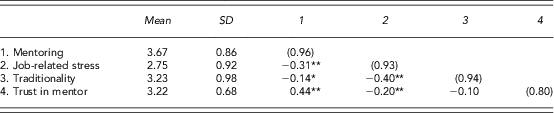
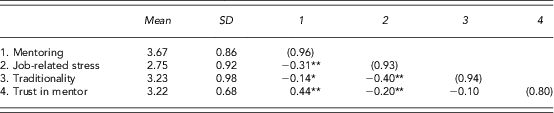
The means, standard deviations, and intercorrelations among all the study variables are reported in Table 1.
Means, standard deviations, reliabilities, and correlations among study variables
Notes. N = 210 with listwise deletion.
*p < .05; **p < .01.
Confirmatory factor analysis
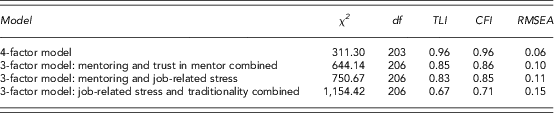
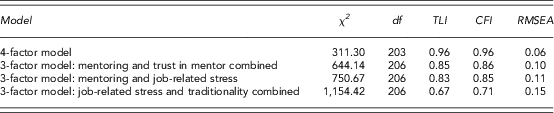
Table 2 presents the results of the confirmatory factor analysis that examined the distinctiveness of the study variables. The fit indices revealed that the 4-factor model reflecting the hypothesized constructs had an adequate fit with the data (χ2 = 311.30, df = 203; TLI = 0.96, GFI = 0.96, RMSEA = 0.06). We compared this model with a series of alternative models. The 4-factor model fitted better than any of the alternative models, providing support for the distinctiveness of the constructs in the current study.
Results of the confirmatory factor analysis of the variables studied
Notes. N = 210 with listwise deletion.
CFI = the comparative fit index; RMSEA = the root-mean-square error of approximation; TLI = Tucker–Lewis index.
Common method variance
As all our data were collected from protégés, there is a potential for common method variance (Podsakoff & Organ, Reference Podsakoff and Organ1986; Podsakfoff, MacKenzie, Lee, & Podsakoff, Reference Podsakfoff, MacKenzie, Lee and Podsakoff2003). We adopted several procedural steps to prevent method-related artificially inflated variance; for example, using highly specific items, counterbalancing question order, and protecting respondent anonymity. We also assessed whether the use of single-rating source data was a concern in our study. Following previous studies (e.g., Podsakoff, MacKenzie, Moorman, & Fetter, Reference Podsakoff, MacKenzie, Moorman and Fetter1990; Carlson & Kacmar, Reference Carlson and Kacmar2000; Podsakfoff et al., Reference Podsakfoff, MacKenzie, Lee and Podsakoff2003), we did this by comparing the fit indices of our hypothesized four-factor model with those of a four-factor model with an unmeasured method factor. The fit indices revealed that the model with four factors and an unmeasured method factor did not have a better data fit (χ2 = 499.90, df = 221; TLI = 0.93, GFI = 0.94, RMSEA = 0.08) than our hypothesized four-factor model (χ2 = 311.30, df = 203; TLI = 0.96, GFI = 0.96, RMSEA = 0.06). Therefore, using the same source data had little impact on the statistical results of our study.
Main effect test
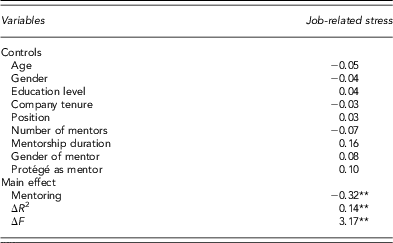
Hypothesis 1 proposed that workplace mentoring would relate negatively to protégés’ job-related stress. As shown in Table 3, mentoring negatively related to protégés’ job-related stress (β = −0.32, p < .01). Hence, Hypothesis 1 was fully supported, indicating that the protégés who reported that they received the greater extent of mentoring functions were more likely to experience less job-related stress.
Results of main effect test

Notes. N = 210 with listwise deletion.
*p < .05; **p < .01.
Moderating effect tests
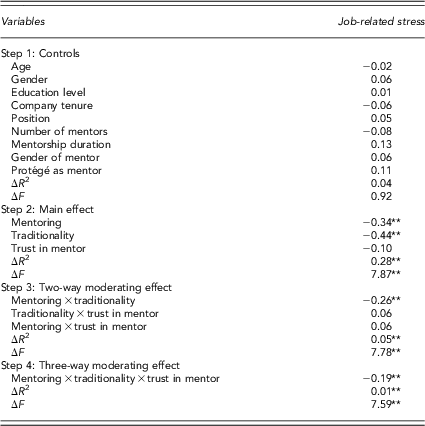
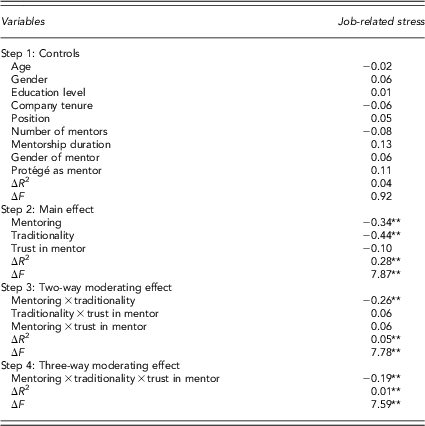
When testing the separate and joint moderating effect of traditionality and trust in mentor (Hypothesis 2, 3, and 4), we entered the variables into the regression analysis at four hierarchical steps: (1) the control variables; (2) mentoring, traditionality, and trust in mentor; (3) the two-way interaction terms of mentoring × traditionality, mentoring × trust in mentor, and traditionality × trust in mentor; (4) the three-way interaction term (mentoring × traditionality × trust in mentor). As shown in Table 4, traditionality moderated the influence of mentoring on job-related stress (β = −0.26, p < .01), providing support for Hypothesis 2. However, the β of mentoring × trust in mentor was not significant, failing to support Hypothesis 3.
Results of hierarchical regression analysis for moderation
Notes. N = 210 with listwise deletion.
*p < .05; **p < .01.
To interpret the specific moderating effects in Hypothesis 2, we first standardized the data using the following equation: centered variable = (x − mean)/standard deviation (Aiken & West, Reference Aiken and West1991). Standardization shifted the mean mentoring variable from 3.67 (the original value listed in Table 1) to 0, and the standard deviation from 0.86 to 1. We then followed Cohen and Cohen (Reference Cohen and Cohen1983) to define high mentoring as plus one standard deviation from the mean (i.e., 0 + 1 = +1) and define low mentoring as minus one standard deviation from the mean (i.e., 0 − 1 = −1). Regression equations were then calculated for the relationship between mentoring and job-related stress for high and low traditionality. These are plotted in Figure 2, where high mentoring is +1 and low mentoring is −1. As predicted, the linear relationship between mentoring and job-related stress was stronger for the high traditionality group and weaker for the low traditionality group, fully supporting Hypothesis 2.
Mentoring and job-related stress by traditionality
In addition, the slope difference test showed that the slope for high traditionality differed to low traditionality significantly (t = −8.73, p < .01), which provided further support for Hypothesis 2.
Table 4 shows that the standardized regression coefficient associated with the mentoring × traditionality × trust in mentor three-way interaction (β = −0.19, p < .01) was statistically significant. Figure 3 depicts the interactions. We created the figure by following the same procedure for Figure 2. As predicted in Hypothesis 4, mentoring was most negatively related to stress when traditionality and trust in mentor were both high.
Mentoring and job-related stress by traditionality and trust in mentor
As shown in Figure 3, protégés with high traditionality generally have a lower level of job-related stress. Figure 3 also showed that for protégés with low traditionality, the relationship between mentoring and job-related stress is more negative when these protégés simultaneously have high trust in mentor. Similarly, for protégés with high traditionality, the relationship between mentoring and job-related stress is more negative when these protégés simultaneously have high trust in mentor. When comparing the two groups, the slope difference test further showed that the slope for high traditionality and high trust in mentor differed to the slope for low traditionality and high trust in mentor significantly (t = −2.08, p < .05). The slope difference test therefore further supported Hypothesis 4.
DISCUSSION
Although research into mentoring has steadily grown, the contingencies under which mentoring may be related to protégés’ stress remain largely unknown. To this end, our study suggests two findings to help counter this blind spot. First, the negative relationship between mentoring and job-related stress was moderated by the protégés’ cultural value of traditionality in such a way that the negative relationship was stronger for protégés with a higher rather than lower level of traditionality. Second, results of the three-way interaction revealed that trust-in-mentor and traditionality jointly moderated the negative relationship between mentoring and job-related stress such that mentoring had the strongest effect on stress when traditionality and trust in mentor were both high.
Theoretical implications
The results of this study provide important contributions to the literature on mentoring and job-related stress in three ways. First, our findings revealed that mentoring is conducive to protégés’ job-related stress in a Chinese context, showing that mentoring could prevent and/or reduce a protégé's stress level. Second, our paper provided a plausible explanation of the mixed results obtained in previous mentoring literature by advocating an underrepresented perspective on the contingency effect of mentoring relationships. We addressed the exploratory question of whether individual difference of traditionality and trust in mentor separately played an important role in mentoring effectiveness in terms of reducing a protégé's job-related stress level (Allen et al., Reference Allen, Eby, O'Brien and Lentz2008). In addition, we investigated the contingency side of the mentoring–stress relationship by testing the joint moderating roles of traditionality and trust-in-mentor on the mentoring–stress relationship. We found that protégé's traditionality moderated the influence of mentoring on job-related stress such that the influence was stronger for protégés with high traditionality. Although we did not find a significant moderating effect of trust in mentor, Figure 3 showed that for protégés with high traditionality, the effect of mentoring was stronger when these protégés had high trust in mentor; for protégés with low traditionality, the effect of mentoring was stronger again when these protégés had high trust in mentor. Such results demonstrated that we should take both traditionality and trust in mentor into account simultaneously. In support of this, our findings concerning the joint moderating effect of traditionality and trust in mentor showed that the mentoring–stress relationship was moderated by protégés’ traditionality as well as the interactions between traditionality and trust in mentor.
Practical implications
The present study provides some interesting implications for mentoring practice. Our findings suggest mentoring as a strategy to reduce employees’ job-related stress. A further implication stems from the results of the moderation analysis. After finding the moderating effect of traditionality, mentors should pay extra attention to individual differences when conducting mentoring activities to improve the effectiveness of mentoring programs. Last but not least, the moderating effect of the interplay of traditionality and trust in mentor provides opportunities for mentors to understand how to maximize mentoring effectiveness for protégés with various individual characteristics. Specifically, we encourage mentors not only to consider individual differences when providing mentoring functions, but also at the same time to exert an effort to develop their protégés’ trust in them. Such educative efforts are important because the popular press tends to present mentoring as an essential ingredient for protégé development, yet mentors know little about how to build such relationship (Young & Perrewé, Reference Young and Perrewé2000a, Reference Young and Perrewé2000b; Eby & Lockwood, Reference Eby and Lockwood2005), and more importantly how to make sure that the time and effort that they put into such relationships is worthwhile. Other than some factors that go beyond the control of a mentor or an organization (such as personality), trust in mentor is something that can be developed (e.g., McAllister, Reference McAllister1995). We therefore suggest that mentors need to pay special attention to protégés’ individual differences such as their cultural value of traditionality when mentoring them, while simultaneously building trust with them through the recommended strategies of perspective taking, emotional intervention, and reflection and self-corrective actions (e.g., Williams, Reference Williams2007).
Study limitations
Despite these findings, this study is not without limitations. First, the data used in the present study were only collected from one workplace within the high-tech industry, thus the extent to which the results are applicable to other organizations or industries can only be speculated. The general applicability of the present findings should therefore be examined in other types of organizations and/or industries in future research. The second limitation concerns the cross-sectional design, which means that the causal relationship cannot be ascertained from the findings of the present study. Additional quasi-experimental or longitudinal research would be useful to ascertain the causal basis of the relationship examined in this study (Kearney, Gebert, & Voelpel, Reference Kearney, Gebert and Voelpel2009). Third, our data were collected from a single source, which indicates that our results may have been affected by common method variance. However, our analyses suggest that common method variance was not a concern here. In addition, although obtaining data from the mentor was beyond the scope of the present study and using self-report data is well-accepted in mentoring studies (e.g., Allen et al., Reference Allen, Eby, O'Brien and Lentz2008), we encourage future studies to adopt additional procedural remedies, such as employing a time lag between measuring independent and dependent variables or collecting data from both protégés and mentors. Finally, our model is a single-level model, which cannot explain the multi-level phenomena. We suggest future studies investigating the relationship between mentoring and protégés’ job-related stress extend our model to a multi-level model, such as including organization type or organizational culture as higher-level moderating variables.
CONCLUSION
In sum, our results highlight the importance of studying the contingency side of mentoring effects on protégés’ job-related stress. Our findings suggest that the individuals’ differential cultural values of traditionality is the boundary condition of the mentoring–stress relationship, and that the influence of mentoring on job-related stress was strongest for high traditionality protégés with a high level of trust in mentor. We therefore suggest that research on workplace mentoring will be advanced by considering the role of the moderating process.
Acknowledgements
We thank the JMO editors and anonymous reviewers for their helpful comments on the drafts of this paper. This research is supported by the national Natural Science Foundation of China (project 71302022 & 71162008), Beijing Natural Science Foundation (project 5144028) and the Fundamental Research Funds for the Central Universities. For further inquiries, please contact Dr. Xiaosong Lin (Xiaosong.lin@xmu.edu.cn).