Introduction
In 2010, the Swedish National Board of Health and Welfare published the first national guidelines for care of people with a dementia disorder (The Swedish National Board of Health and Welfare, 2010). These national guidelines consist of recommendations for care practice on a 10-point priority scale, ranging from priority one recommendations (1) to recommendations of avoidance in practice (10). The strength of recommendations was based on the level of available evidence or best practice. The guidelines address the following 16 domains of care: care planning; multisensory stimulation; dementia-specific communication strategies; use of restraints; malpractice; activities of daily living; eating and nutrition; physical and psychosocial environment; information and communication technology; falls and falls prevention; physical activity; oral care; incontinence and constipation; end of life care; caregiver support; and pressure ulcers. The overall priority one recommendation in the Swedish guidelines is that care for people with dementia disorders should be person-centered, something which was further described as: focusing on the person more than on the disease or its symptoms; respecting the personal understanding of reality as perceived by people with dementia in all aspects of care; personalizing care activities and decisions to the person's past, present, and emerging life history; and respecting people's values, culture, priorities, and preferences to the largest extent possible (The Swedish National Board of Health and Welfare, 2010). The concept of person-centeredness was articulated as the underlying philosophy that should saturate the content of care for all 16 dimensions central to Swedish dementia care.
In the academic literature, the concept of person-centeredness has had substantial uptake in care of older people and people with dementia, since its inception in the field by influential scholars such as Tom Kitwood, Dawn Brooker, and Brendan McCormack (Kitwood, Reference Kitwood1997; McCormack, Reference McCormack2004; Brooker, Reference Brooker2007). Generally described as outlining a social, humanistic, and holistic perspective on how to understand and promote the best possible life and care for people with dementia, being person-centered, promoting person-centeredness, and providing person-centered care builds on a fundamental respect of subjectivity and personhood (Edvardsson et al., Reference Edvardsson, Winblad and Sandman2008; McCormack and McCance, Reference McCormack and McCance2010). It is not difficult to agree to such an ethical philosophy that saturates the concept of person-centered care; however, it may be more difficult to operationalize this concept at bedside in everyday care practice. Consequently, publications on person-centeredness have evolved from an initial focus on conceptual content, policy implications, and theoretical structures, towards intervention effects and how this elusive concept can be facilitated in practice.
A number of intervention studies in the field of dementia care have emerged recently, where the aims have been to explore various effects of person-centered interventions on residents with dementia and direct care staff. In relation to resident outcomes of person-centered care, studies have reported increased well-being and reduced agitation for people with dementia following interventions based on meaningful activities and psychosocial interactions (Chenoweth et al., Reference Chenoweth2009; Bone et al., Reference Bone, Cheung and Wade2010), increased well-being, and fewer symptoms of depression (Brooker, Reference Brooker2007), as well as improved bowel patterns for residents after individualized care management (Palese et al., Reference Palese, Granzotto, Broll and Carlesso2010). Regarding outcomes of person-centered care on direct care staff, studies have reported that person-centered interventions lead to decreased job stress and strain as well as increased personal and professional satisfaction (McCormack et al., Reference McCormack2010; McKeown et al., Reference McKeown, Clarke, Ingleton, Ryan and Repper2010; Jeon et al., Reference Jeon2012), and fewer symptoms of burn-out (Passalacqua and Harwood, Reference Passalacqua and Harwood2012). Studies have also suggested that if direct care staff perceive themselves as unable to do “good” in care (i.e. being prevented from providing the quality care they want to provide to residents), they can experience a troubled conscience (Glasberg et al., Reference Glasberg2006). The stress of conscience concept has been defined as capturing the stress generated by such a troubled conscience for care staff, and a prevalent stress of conscience has been associated with experiences of burnout (Juthberg et al., Reference Juthberg, Eriksson, Norberg and Sundin2010). Thus, it would seem reasonable to hypothesize that if care staff are able to provide the care they want to provide (i.e. person-centered care), they may perceive less stress of conscience. This would suggest potential links between person-centered care and staff stress of conscience. These are worthy of further exploration.
It is challenging to reach conclusions when interpreting and synthesizing existing evidence on effects of providing person-centered care. This is due to the fact that what actually comprises the person-centered components in some intervention studies are unclear – various studies have targeted very different and highly specific aspects of person-centeredness, such as person-centered interventions to improve resident bowel patterns (Palese et al., Reference Palese, Granzotto, Broll and Carlesso2010), and person-centered interventions to improve care staff communication skills (Passalacqua and Harwood, Reference Passalacqua and Harwood2012). The accumulation of evidence is further challenged by the general lack of empirical data to indicate that care practice was actually perceived as becoming more person-centered post-intervention. Commonly, only endpoint measures have been included in existing studies; if endpoints were improved at follow-up, the conclusion is that the intervention increased the person-centeredness of care even though process measures on perceived levels of person-centeredness have rarely been included.
Questions also remain on how to implement the existing evidence and guidelines on person-centered care in practice, for the potential benefit of people with dementia, family members, and direct care staff. A number of predictors for successful implementation of evidence-based guidelines have been suggested; these include: designing multifaceted interventions with interactive educational components; having a strong evidence base; using active and skilled facilitators; developing a partnership between university and health services and having leadership support; and having a positive attitude to change within the organizational, social, and professional context (Grol and Grimshaw, Reference Grol and Grimshaw2003; Prior et al., Reference Prior, Guerin and Grimmer-Somers2008; Gray et al., Reference Gray, Joy, Plath and Webb2012). These predictors for implementation success have been described as valid for residential aged care contexts as well (Rahman et al., Reference Rahman, Applebaum, Schnelle and Simmons2012), and it seems that implementing person-centered care is best facilitated through interactive and democratic intervention designs where staff participate in defining and designing the problem area and its intervention(s). However, further studies are needed on how to successfully implement an increased use of evidence across care practice areas (Flodgren et al., Reference Flodgren, Rojas-Reyes, Cole and Foxcroft2012).
To conclude, the literature indicates that person-centered care represents best practice care of people with dementia, and that person-centered care is associated with positive outcomes for resident well-being as well as for staff strain and satisfaction. However, there is less evidence in the literature on how to successfully implement person-centered care, and very few studies provide data to indicate if care practice was actually perceived as becoming more person-centered post-intervention, and if this was accompanied with significantly improved endpoints at follow-up. In addition, very few studies have designed large-scale, interactive, and bottom-up interventions that explicitly build on predictors for successful practice implementation. This study attempted to address this gap in the literature and aimed to evaluate the effects of implementing national guidelines for person-centered care of people with dementia on self-reported person-centeredness, strain, and stress of conscience as perceived by care staff.
Methods
Study design
The study employed a quasi-experimental, one-group pre-test–post-test design (12-month follow-up) to explore intervention effects on person-centeredness of care and the environment (primary endpoints), and on staff strain and stress of conscience (secondary endpoints).
Study context and participants
The study was conducted in a Swedish residential aged care facility located in the metropolitan Stockholm area. The facility had 200 residents living in 24 small-scale units and each unit contained 8–9 residents. Within these units, residents had their own personally furnished private rooms and a communal kitchen, dining, and living room. The majority of residents had a diagnosed dementia disorder, or exhibited symptoms of such. At the time of the study, the facility had 200 care staff consisting of 170 nurse aides, 25 health professionals (registered nurses, physiotherapists, and occupational therapists) and five managers.
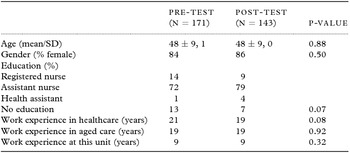
At baseline, the study sample consisted of 171 staff members, where the majority were female (84%), being qualified as assistant nurse (42%), with a mean work experience of 21 years in healthcare, 19 years in aged care, and nine years in the current unit. At follow-up, the study sample consisted of 143 staff members, with a continuing majority of female staff (86%) being qualified as assistant nurse (55%), with a mean work experience of 19 years in healthcare, 19 years in aged care and nine years in the current unit. No significant differences were found regarding sample characteristics between baseline and follow-up. The sample characteristics at baseline and follow-up are presented in Table 1.
Baseline and follow-up characteristics of staff

SD = standard deviation.
Intervention
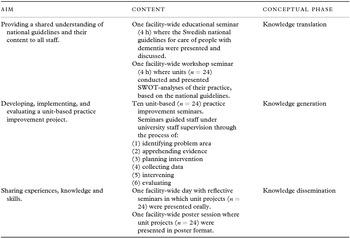
The intervention consisted of an interactive step-wise program of knowledge translation, knowledge generation, and knowledge dissemination based on the participatory action research cycle (Freire, Reference Freire1993). The Swedish national guidelines for care of people with dementia (The Swedish National Board of Health and Welfare, 2010) were central to the intervention program which aimed at (1) translating the guidelines and their evidence base to all care staff, (2) using the guidelines for developing, implementing, and evaluating unit-specific practice improvement projects, and (3) disseminating the improvement processes and findings across the facility. As presented in Table 2, the intervention was conducted over a period of ten months and consisted of the following three key parts:
Content, aim, and conceptual phases of the intervention

-
1. Knowledge translation
Two introductory day-long seminars were held at the residential aged care facility. The first was devoted to presenting the Swedish national guidelines for dementia care to all care staff – providing a shared understanding of the guidelines and outlining the implications of the guidelines for clinical practice and staff responsibilities – as the basis for the forthcoming knowledge-generation process. The second seminar had a workshop character; staff from each of the 24 units were asked to perform and present a SWOT analysis of their unit's strengths, weaknesses, opportunities, and threats in relation to the national guidelines, and to present a topic for their unit-based knowledge-generation process. The main aim of the workshop was to support staff in operationalizing the national guidelines to identify relevant practice improvement areas for their specific units.
-
2. Knowledge generation
After the initial knowledge translation phase, staff within each unit took part in a total of ten two-hour practice improvement seminars. During these seminars, the participatory action research process and methodology was used (Freire, Reference Freire1993) to guide the staff in planning, implementing, and evaluating a person-centered practice improvement initiative for their unit. Ongoing seminar supervision and support was provided to all units from participating university scholars, who guided the staff through the process of analyzing, reflecting, and systematizing their work, as well as in basing their arguments and decisions on the best available evidence. Each unit used the national guidelines to critically analyze their current routines, environment, and care provision in relation to their identified practice improvement areas; and these were discussed in light of evidence available in the seminar sessions. The seminars moved systematically through the following phases: (1) identifying and deciding on practice improvement area, (2) capturing and critically discussing the best available evidence, (3) planning the unit-based intervention, (4) performing initial data collection, (5) conducting interventions, and (6) performing follow-up data collection, analyses, and reflection.
-
3. Knowledge dissemination
The third intervention phase consisted of two activities to facilitate knowledge dissemination between the 24 unit-based practice improvement initiatives. These activities involved a facility-wide reflective seminar and a facility-wide poster exhibition. First, all staff members were invited to a facility-wide day of reflective seminars, with a focus on sharing knowledge between units and presenting their experiences, reflections, and conclusions. Second, a facility-wide poster exhibition was conducted in which each unit displayed and presented their practice improvement process, from problem identification, implementation activities, and interpretation of findings. All units and most staff members were represented at the poster session.
Measures
Primary endpoints
To measure the primary endpoints of perceived person-centeredness of care and the environment, the Swedish version person-centered care assessment tool (PCAT; Sjögren et al., Reference Sjögren, Sandman, Zingmark and Edvardsson2012) and the person-centered climate questionnaire were used (PCQ; Edvardsson et al., Reference Edvardsson, Sandman and Rasmussen2009). The 13-item PCAT asks direct care staff to provide self-report ratings on the extent to which the organization, process, and content of care at their unit reflects the central elements of person-centered care, such as prioritizing relationships with residents, adapting care delivery to resident needs and preferences, and facilitating meaningful activities and shared decision-making. Ratings are provided on a five-point Likert-type scale (1 = disagree completely and 5 = agree completely) on items such as: The life history of the residents is formally used in the care plans we use; and Residents are offered the opportunity to be involved in individualized everyday activities. Scaling the tool involves calculating a total score that can range between 13 and 65, as well as two subscale scores that can range between 8–40 and 5–25 respectively (individualization of care, environmental and organizational support). Higher values indicate more person-centered care. The Swedish version PCAT has shown satisfactory psychometric estimates (Sjögren et al., Reference Sjögren, Sandman, Zingmark and Edvardsson2012).
In addition, the PCQ was used to explore the extent to which staff perceived the environment of their setting as being supportive and person-centered (Edvardsson et al., Reference Edvardsson, Sandman and Rasmussen2009). This 17-item questionnaire asks care staff to rate their perception of the psychosocial environment of their unit in relation to person-centered aspects such as feeling safe and welcomed, experiencing staff as being available, approachable and competent, and experiencing an environment which is neat, clean, and decorated, incorporating positive distractions, and supporting human interaction and personal well-being. Scoring is performed on a six-point Likert-type scale, ranging from 0 (No, I disagree completely) to 5 (Yes, I agree completely). Simple sum scores are used for total score and the three subscale scores (safety, everydayness, and hospitality). The total score can range from 0 (a minimally person-centered climate) to 70 (a maximally person-centered climate). Satisfactory psychometric properties have been reported for the Swedish PCQ (Edvardsson et al., Reference Edvardsson, Sandman and Rasmussen2009).
Secondary endpoints
To measure the secondary endpoints of staff strain and stress of conscience, the demand/control/support questionnaire and the stress of conscience questionnaire were used (Karasek and Theorell, Reference Karasek and Theorell1990; Glasberg et al., Reference Glasberg2006). The demand/control/support questionnaire asks staff to rate how they perceived their work on a four-point Likert-type scale (1 = yes often to 4 = no never) on items such as: Does your job require you to work very fast?; and Do you have the possibility to decide for yourself how to carry out your work? An index is calculated for each domain using sum scores, where higher values indicate less strain. Validity and reliability have been reported as satisfactory (Sanne et al., Reference Sanne, Torp, Mykletun and Dahl2005). The stress of conscience questionnaire (Glasberg et al., Reference Glasberg2006) was used to explore perceived stress of conscience related to not being able to provide the care or activities that one wants to provide. The questionnaire consists of nine items and scores can vary between 0 and 225, where higher scores indicate more stress of conscience. Satisfactory psychometric properties have been reported (Glasberg et al., Reference Glasberg2006). Demographic data included age, gender, educational level, and work experience in aged care generally and in this facility specifically.
Statistical analyses
Sample characteristics were explored using descriptive statistics, and the paired samples t-test was used to explore baseline and follow-up differences on demographic variables as well as on primary and secondary endpoints. p-values of <0.05 were regarded as statistically significant and effect sizes of >0.3 was regarded clinically significant. SPSS Statistics 21 was used to analyze all data.
Ethics
The study complied with the Helsinki Declaration, and the Regional Board of Research Ethics approved the study in Stockholm.
Results
Effects on person-centeredness of care and the environment
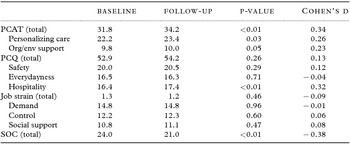
In relation to the primary endpoints, staff reported significantly higher scores on the person-centeredness of care at follow-up as compared to those at baseline (p < 0.01, Cohen's d = 0.34). There was no significant difference in perceived overall person-centeredness of the environment between baseline and follow-up on total PCQ scores. However, staff reported that the units were perceived as being significantly more hospitable at follow-up as compared to ratings at baseline (p < 0.01, Cohen's d = 0.32). Primary endpoint scores at baseline and follow-up are further presented in Table 3.
Baseline and follow-up scores (mean and effect size) on person-centeredness (PCAT), person-centered climate (PCQ), staff job strain (DCS), and stress of conscience (SOC)

PCAT = person-centered care assessment tool; PCQ = person-centered climate questionnaire; DCS = demand/control/support; SOC = stress of conscience; Org/env = organizational/environmental.
Effects on staff job strain and stress of conscience
In relation to the secondary endpoints of staff strain and stress, no significant differences were found regarding staff job strain between baseline and follow-up. It was found that staff scores on their stress of conscience were significantly reduced post-intervention (p < 0.01, Cohen's d = 0.38). Secondary endpoint scores on job strain and stress of conscience at baseline and follow-up are presented in Table 3.
Discussion
This study aimed to evaluate the effects of implementing national guidelines for person-centered care of people with dementia on perceived person-centeredness, staff strain and stress of conscience. Results showed that the intervention led to care practice becoming significantly more person-centered at follow-up according to the self-report from direct care staff. The results further showed that the facility was perceived as being significantly more hospitable at follow-up; that is, making visitors feel welcome, entertained, and at home. In addition, the intervention also resulted in a statistically significant reduction of staff-reported stress of conscience, which suggests that, to a larger extent, the staff perceived themselves to be able to provide the care and activities they wanted to provide at the follow-up.
The significant pre-test–post-test increase in the extent to which care staff perceived care being person-centered is unique, as, to our knowledge, this study is the first to provide a process measure of perceived person-centeredness in addition to outcome measures, making possible concurrent analyses of both intervention uptake and intervention outcomes. These results seem to indicate that the intervention succeeded in operationalizing person-centeredness into everyday care practice, as staff reported higher levels of person-centered care post-intervention. As such, the intervention in this study can provide a useful model for staff training/education in regard to person-centeredness in the care of older people and people with dementia (Edvardsson et al., Reference Edvardsson, Winblad and Sandman2008; McCormack et al., Reference McCormack2010).
The study results also add to the growing body of literature on staff outcomes from person-centered interventions. Previous studies have reported positive outcomes on staff stress, strain, and personal and professional satisfaction (Chenoweth et al., Reference Chenoweth2009; McCormack et al., Reference McCormack2010; McKeown et al., Reference McKeown, Clarke, Ingleton, Ryan and Repper2010; Jeon et al., Reference Jeon2012). This study adds results on staff stress of conscience being lower post the person-centered intervention – results that can be interpreted as staff perceiving that an increased person-centeredness, corresponded with increased possibilities to do “good” for residents post-intervention; that is, to do good for residents by providing the care and activities staff wanted to provide. This is an important intervention effect in light of the demanding, task-oriented, and challenging work situation recurrently connected to residential aged care practice, which contributes to high staff turnover (Cohen-Mansfield, Reference Cohen-Mansfield1997). Staff experiences of being dissatisfied with the quality of care they can provide, a lack of job satisfaction from not having enough resources to provide good care, and not feeling supported and appreciated, are main reasons for staff leaving their work within aged care, as identified in the literature (Vernooij-Dassen et al., Reference Vernooij-Dassen2009). Others have suggested that staff unable to provide the care they want to provide experience a stress of conscience and a risk of burnout (Juthberg et al., Reference Juthberg, Eriksson, Norberg and Sundin2010). Thus, findings from this study relating to less-reported staff stress of conscience can also be interpreted as supporting the notion that person-centered care represents the care that residential aged care staff want to provide. The findings can also be interpreted as supporting the use of interactive and bottom-up interventions to improve staff outcomes as well as facilitating a more person-centered practice. However, replication of these findings is needed before conclusive judgments can be made.
Furthermore, the study results also highlight that the residential aged care facility was perceived as being significantly more hospitable at follow-up. Semantically, hospitality is a concept that denotes the act or practice of being hospitable; to receive and entertain guests, visitors, or strangers, with liberality and goodwill (Oxford English Dictionary, 2013). Theoretically, hospitality has been described as an essential enactment of ethics that communicates a sense of value or worth, and as a caring act by opening up a home to others and making efforts to make others feel welcome and at home in an environment away from home (Marcel, Reference Marcel1951). Empirically, experiences of hospitality have been described as emanating from the concepts of welcoming and generosity (Rasmussen and Edvardsson, Reference Rasmussen and Edvardsson2007). Welcoming has been conceptualized as emerging from feelings of being expected, being seen, and being invited to settings or situations, and generosity stems from experiences of receiving something unexpected; something a little extra that is significant for this person (Rasmussen and Edvardsson, Reference Rasmussen and Edvardsson2007).
These study results of improved hospitality may be related to the work undertaken in several units to create a more homelike environment and to make efforts to increasingly involve family members in facility activities. It seems reasonable to argue for the importance of working further with the concept of hospitality and its content, meaning and outcomes for residents and families in aged care practice and research, as the possibility to experience a long-term care setting as a home away from home may be important for well-being and satisfaction. Further studies would be valuable.
The positive intervention outcomes from this study can also be interpreted as a testament to the intervention design itself, building on interactive educational components, active and skilled facilitators, leadership support, a partnership between university and health service, and a positive attitude to change within the organizational, social, and professional context (Grol and Grimshaw, Reference Grol and Grimshaw2003; Gray et al., Reference Gray, Joy, Plath and Webb2012). Active participation from direct care staff was strongly encouraged and central to the whole intervention process, and designing the intervention in continuous dialogue with care staff made the intervention process person-centered towards staff in terms of influence, and not person-centered only towards residents in terms of addressing unmet needs (Brooker, Reference Brooker2007).
Other facilitators to intervention uptake were the active roles and skills of the facilitators. All facilitators were involved with the facility on site at least monthly to actively guide the knowledge-generation seminars, and most facilitators had a PhD in or closely related to aged care (Gray et al., Reference Gray, Joy, Plath and Webb2012). Furthermore, leaders of the residential aged care facility were highly supportive and led by example in expressing positive organizational and professional attitude to change, something which also facilitated the intervention process and uptake (Grol and Grimshaw, Reference Grol and Grimshaw2003). However, there was some resistance to change among direct care staff at the initial stages of the intervention, and staff struggled, pre-test, to identify areas in need of improvements for residents and families. Through an initial focus on challenges that direct care staff perceived at bedside, and linking these challenges to resident/family needs and potential solutions as described in the literature, staff seemed to acknowledge that the intervention could actually make a difference. Linking staff challenges to the literature, together with having a strong staff influence on the intervention process, were factors that seemed to facilitate positive staff attitudes towards change that is central to intervention uptake and actual practice change.
Limitations
The quasi-experimental, one-group pre-test–post-test design of this study imposes some limitations to be considered when interpreting the results. First, the one-group sample means that the possibility of bias from extraneous variables was not controlled for, and thus the extent to which this may have influenced the internal validity of the study remains unknown. Second, the non-random sampling means that the external validity of the results needs to be interpreted with caution. The extent to which the results are generalizable beyond this sample and setting needs further study. Another limitation was that all data were based on self-report from direct care staff. Thus, the extent to which reported increase in person-centeredness of care and hospitality of the setting is also representative for the experiences of residents and family members, remains to be studied. Last, the one-year follow-up means that some questions remain regarding intervention sustainability and long-term effects. Further data collection on temporal stability of practice change and intervention outcomes will be conducted.
Conclusions
The results of this study indicate that an interactive and step-wise action research intervention of knowledge translation, generation, and dissemination, based on national guidelines for care of people with dementia, can increase staff self-reported person-centeredness of care, perceived hospitality of the setting, and reduce self-reported staff stress of conscience by enabling staff to increasingly do good for residents by providing the quality care and activities they want to provide.
Conflict of interest
None.
Description of authors’ roles
D. Edvardsson formulated the research questions, conducted data collection, analyzed the data and wrote the paper. PO Sandman formulated the research questions, carried out the study, conducted data collection, analyzed the data and wrote the paper. L. Borell formulated the research questions, carried out the study, conducted data collection, and wrote the paper.
Acknowledgments
We are grateful to Stockholms Stad and the Swedish Brain Power Initiative for funding, and to Lotta Saarnio and Ewa Stenwall for assisting with data collection.