Introduction
FMRFamide-like peptides (FLPs) comprise a large family of molecules especially important for controlling normal physiological function in nematodes. FLPs are broadly involved with regulating sensory and neuromuscular activities (McVeigh et al., Reference McVeigh, Geary, Marks and Maule2006; Holden-Dye & Walker, Reference Holden-Dye and Walker2011) affecting nearly all physiological events (Holden-Dye & Walker, Reference Holden-Dye and Walker2011) including behaviour (Liu et al., Reference Liu, Kim, Li and Barr2007; Cohen et al., Reference Cohen, Reale, Olofsson, Knights, Evans and de Bono2009), locomotion (Kimber et al., Reference Kimber, McKinney, McMaster, Day, Fleming and Maule2007), feeding (Rogers et al., Reference Rogers, Reale, Kim, Chatwin, Li, Evans and de Bono2003; Papaioannou et al., Reference Papaioannou, Marsden, Franks, Walker and Holden-Dye2005), reproduction (Moffett et al., Reference Moffett, Beckett, Mousley, Geary, Marks, Halton, Thompson and Maule2003) and others (Maule et al., Reference Maule, Mousley, Marks, Day, Thompson, Geary and Halton2002; Kimber & Fleming, Reference Kimber and Fleming2005).
This systemic involvement of FLPs in nematode behaviour and development, supporting the capacity of parasitic nematodes to successfully infect and reproduce, have made FLPs important targets of research into novel nematode control strategies (Greenwood et al., Reference Greenwood, Williams and Geary2005; Kimber & Fleming, Reference Kimber and Fleming2005; Kimber et al., Reference Kimber, McKinney, McMaster, Day, Fleming and Maule2007). One important element in exploiting FLPs for such strategies is understanding their degradation in nematode systems (Husson et al., Reference Husson, Mertens, Janssen, Lindemans and Schoofs2007; Masler, Reference Masler2008), since proteolytic digestion is a major factor in titre maintenance and signal attenuation.
FLPs are encoded on multiple genes and are characterized by a conserved, amidated C-terminus with highly varied N-terminal extensions (McVeigh et al., Reference McVeigh, Leech, Mair, Marks, Geary and Maule2005; Li & Kim, Reference Li, Kim, Geary and Maule2010). This gives rise to a great variety of sequences. Knowledge of how these FLP sequences respond to the nematode degradome (Craig et al., Reference Craig, Isaac and Brooks2007; Castagnone-Sereno et al., Reference Castagnone-Sereno, Deleury, Danchin, Perfus-Barbeoch and Abad2011), and how these responses differ between parasitic species, will have fundamental implications for nematode control.
The present report describes the degradation of three nematode FLPs, two highly conserved across all nematode species and one confined to plant parasites, by preparations from two important plant-parasitic nematodes, Heterodera glycines and Meloidogyne incognita. Results reveal significant quantitative differences in FLP metabolism between species and, for the first time, evidence that a conserved FLP is metabolized more efficiently by the species in which it is found.
Materials and methods
Nematode rearing and extraction
Heterodera glycines was raised on soybean (Glycine max ‘Kent’), and M. incognita was raised on pepper (Capsicum annuum ‘PA-136’) using a constant moisture system (Sardanelli & Kenworthy, Reference Sardanelli and Kenworthy1997), at 27°C and 16 h light:8 h dark photoperiod. Plants were inoculated near the rhizosphere. Soybean was inoculated with ~1500–2000 H. glycines eggs per plant and harvested after 5 weeks. Cysts were collected from infected G. max roots, broken open in water to release eggs, and the freed eggs placed on modified Baermann funnels kept at the above temperature and photoperiod. Hatched H. glycines infective juveniles were collected daily, and freshly collected worms were centrifuged to remove most water, then stored at − 20°C. Pepper was inoculated with ~3000 M. incognita eggs per plant and harvested after 2 months. Egg masses were collected from infected C. annuum roots under a dissecting microscope and placed on funnels for collection and storage of infective juveniles as described above.
Worms were thawed and suspended in ice-cold autoclaved double-distilled water (~10 volumes of water/worm volume) and mechanically disrupted in 1.5-ml polypropylene tubes containing 0.5-mm zirconia–silica beads shaken in a Bead Beater (BioSpec Products, Bartlesville, Oklahoma, USA). Processing consisted of six rounds of shaking (30 s per round) alternated with six periods of cooling on ice (3 min each). The processed homogenates were centrifuged at 16,000 g for 30 s at room temperature and the supernatants (S1) were transferred to glass high-speed centrifuge tubes on ice. The 16,000 g pellets were washed using three rounds of shaking and cooling, and the resulting wash supernatant (S2) was added to S1. Washed pellets were microscopically examined at 40 × and 100 × to ensure that all worms were disrupted. The S1/S2 supernatant pool was centrifuged at 40,000 g, 20 min, 5°C, and the resulting supernatant was dried as aliquots by vacuum centrifugation and stored at − 20°C. Total protein was determined using the microBCA assay (Pierce Chemical Co., Rockford, Illinois, USA).
Peptide substrates and protease inhibitors
Substrates were synthesized as FRET-modified sequences representing three different nematode FLPs. QXL520-KHEYLRF-K(5-FAM)a, QXL520-KSAYMRF-K(5-FAM)a, and QXL520-KHEFVRF-K(5-FAM)a were all obtained from AnaSpec (Fremont, California, USA). Each substrate was dissolved in 50% aqueous acetonitrile, dried as aliquots by vacuum centrifugation, and stored at − 30°C. Inhibitors (G-Biosciences, St. Louis, Missouri, USA) were chosen to cover broad protease specificities: AEBSF (4-(2-aminoethyl)-benzenesulfonyl-fluoride-HCl), irreversible serine; bestatin, aminopeptidase; chymostatin, reversible serine and cysteine; EDTA-Na2, metalloproteases; E-64 (trans-epoxysuccinyl-l-leucylamido(4-guanidino)butane), reversible cysteine; pepstatin, aspartate. All were supplied as 100 × solutions and were diluted into assay buffer to obtain indicated concentrations as needed for individual experiments.
Protease assays
Reactions were performed at 27°C in 384-well assay plates (flat bottom, non-treated, Corning, Inc., Corning, New York, USA) in 100 mm TRIS, pH 7.8 assay buffer, 25 μl reaction volume. Extract aliquots were dissolved directly into assay buffer. FRET-peptide substrate aliquots were dissolved in dimethylsulphoxide (DMSO) prior to addition to the assay mixture (final concentration of DMSO in all reactions was 2%). Reactions contained 0.08–0.12 μg/μl extract protein and were initiated by the addition of substrate. For the protease inhibitor tests, inhibitors were diluted in assay buffer to provide the final reaction concentrations and were incubated with reactions for 30 min at 27°C prior to addition of the substrate. Final substrate and inhibitor concentrations are indicated for each experiment.
Reactions were monitored for 60 min for increasing fluorescence (E x= 490 nm, E m= 520 nm; SpectraMAX EM fluorescent plate reader; Molecular Devices, Sunnyvale, California, USA). Substrate controls (no extract) were used to correct for background. Reaction rates were quantified using SoftMax Pro instrument control and data collection software (Molecular Devices), and increase in relative fluorescence units (RFU) over time was recorded and reduced to V max/s. Data were then converted to V max/min/total reaction μg. Inhibitor data are presented as the percentage reduction in V max/min/μg in test versus control reactions: ((V max/min/μgcontrol− V max/min/μginhibitor)/V max/min/μgcontrol) × 100.
Data analysis
Individual data means were compared using Mann–Whitney non-parametric t-test, with P indicated for each comparison. Relationships among data means were analysed using one-way ANOVA with Tukey's multiple comparison. Statistical analyses were done using GraphPad Prism (GraphPad Software, La Jolla, California, USA). Inhibitor and substrate attributes (specificities, primary structure features) were evaluated using online resources provided by MEROPS Peptidase Database (http://www.merops.sanger.ac.uk) and the Swiss Institute of Bioinformatics (http://www.expasy.org/).
Results
Substrate comparisons
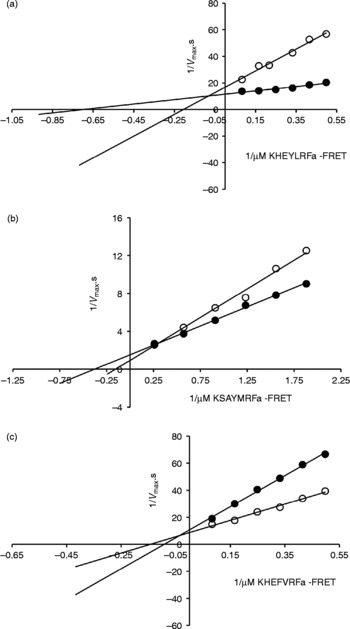
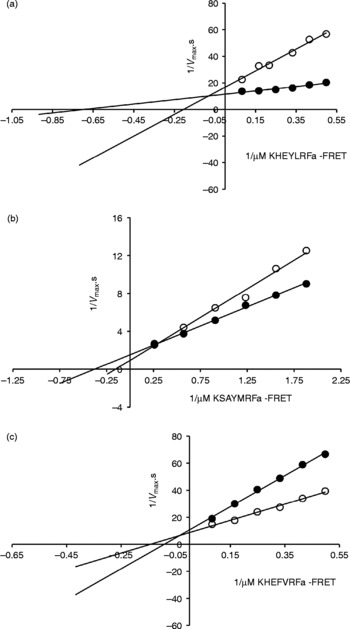
Differences in substrate preferences and rates of substrate digestion were observed both within and between species. Relative affinities for KHEYLRFa and KSAYMRFa were each higher in H. glycines than in M. incognita (P< 0.05; fig. 1a and b). Estimated K m values for KHEYLRFa were 1.48 ± 0.34 μm in H. glycines preparations and 5.26 ± 1.30 μm for M. incognita. Values for KSAYMRFa were 2.13 ± 0.24 μm in H. glycines and 3.90 ± 0.61 μm in M. incognita. In contrast, preparations from M. incognita showed higher affinity (P< 0.05) for KHEFVRFa (K m= 5.83 ± 0.36 μm) than did those from H. glycines (11.01 ± 1.26 μm; fig. 1c). Within species, no differences were observed between the affinities for KHEYLRFa and KSAYMRFa, but each species demonstrated much lower affinity for KHEFVRFa than either KHEYLRFa or KSAYMRFa (P< 0.05).
Affinity estimations of Heterodera glycines (black circles) and Meloidogyne incognita (white circles) extracts for three nematode FLP substrates. Extracts and FRET-peptide substrates were prepared as described, and digestion reactions conducted in 25 μl 100 mm TRIS, pH 7.8 with 0.08–0.12 μg/μl extract protein, 2% DMSO, and variable substrate concentrations. Reactions were initiated by substrate addition and monitored for 60 min at 27°C for increasing fluorescence. Results are presented as double reciprocal plots (1/V max per second versus 1/μm substrate) and used to estimate Michaelis–Menten K m. Each data point represents the mean ± SE of a minimum of three separate determinations. Substrates tested were: (a) KHEYLRF (QXL520-KHEYLRF-K(5-FAM)a); (b) KSAYMRF (QXL520-KSAYMRF-K(5-FAM)a); (c) KHEFVRFa (QXL520-KHEFVRF-K(5-FAM)a).
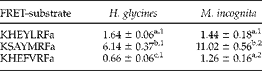
KSAYMRFa was digested much more rapidly (P< 0.05) than either of the other two substrates by extracts of each species (table 1). Digestion rates for KSAYMRFa in H. glycines preparations were 3.7-fold greater than KHEYLRFa and 9.3-fold greater than KHEFVRFa (table 1). KSAYMRFa digestion rates in M. incognita preparations were 7.6-fold and 8.7-fold greater, respectively, than KHEYLRFa and KHEFVRFa (table 1). In H. glycines, KHEYLRFa was digested 2.5-fold more rapidly than KHEFVRFa (P< 0.05), but there was no difference between KHEYLRFa and KHEFVRFa digestions rates in M. incognita (table 1). KHEYLRFa was digested at the same rate in each species, but rates of digestion of KSAYMRFa and KHEFVRFa were each nearly twofold higher in M. incognita than in H. glycines preparations (table 1; P< 0.05). Since KSAYMRFa digestion rates were considerably higher than the other two FLPs in each species, it was selected as substrate to compare the effects of protease inhibitors between the two nematodes.
Comparison of digestion rates of three nematode FMRFamide-like peptide substrates by extracts prepared from two plant-parasitic nematodes.
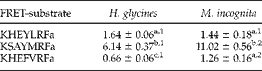
Extracts and FRET-peptide substrates were prepared as described, and digestion reactions were conducted in 25 μl 100 mm TRIS, pH 7.8 with 0.08–0.12 μg/μl extract protein, 2% DMSO and 4 μm final substrate concentration. Substrates tested were: KHEYLRF (QXL520-KHEYLRF-K(5-FAM)a), KSAYMRF (QXL520-KSAYMRF-K(5-FAM)a), KHEFVRFa (QXL520-KHEFVRF-K(5-FAM)a). Reactions were initiated by substrate addition and monitored for 60 min at 27°C for increasing fluorescence. Data are expressed as the mean ± SE V max/min/μg for a minimum of four separate assays. Means were compared using Student's t with Mann–Whitney post-test. Means compared within species and across substrates followed by different letters are significantly different, and means compared between species for each substrate followed by different numbers are significantly different (P< 0.05).
Response to inhibitors
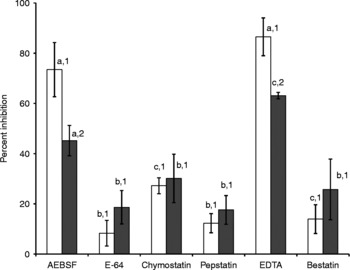
Similarities and significant differences were observed between species in the ability of their extracts to digest KSAYMRFa in the presence of protease inhibitors. AEBSF and EDTA were the most effective inhibitors of activity in each species (fig. 2). EDTA was more effective (63.28 ± 0.64% inhibition) than AEBSF (45.17 ± 3.01%) in H. glycines (P< 0.05), while the inhibitory effects of these two treatments did not differ significantly in M. incognita. However, AEBSF (73.45 ± 5.40%) and EDTA (86.47 ± 3.77%) were each more effective inhibitors of M. incognita activity than H. glycines activity (P< 0.05). There were no significant species differences observed in the inhibition of KSAYMRFa digestion by E-64, chymostatin, pepstatin or bestatin.
Effect of six protease inhibitors on the digestion of KSAYMRF (QXL520-KSAYMRF-K(5-FAM)a) by extracts from Heterodera glycines (black bars) and Meloidogyne incognita (white bars). Assays were conducted as described with inhibitors added 30 min prior to the addition of substrate. Aliquots of inhibitor stock solutions were first diluted into assay buffer and then added to reactions to provide the following final concentrations: AEBSF (1.19 mm), E-64 (32 μm), chymostatin (113 μm), pepstatin (12 μm), EDTA-Na2 (1 mm), bestatin (148 μm). Calculations of percent inhibition used the formula: ((V max/min/μgcontrol− V max/min/μginhibitor)/V max/min/μgcontrol) × 100. Results are expressed as the mean ± SD of a minimum of three separate assays. Means within species were compared across inhibitors using one-way ANOVA with Tukey's multiple means comparison. Means with different letters are significantly different (P< 0.05). Means for each inhibitor were compared between species using Student's t with Mann–Whitney post-test. Means with different numbers are significantly different (P< 0.05).
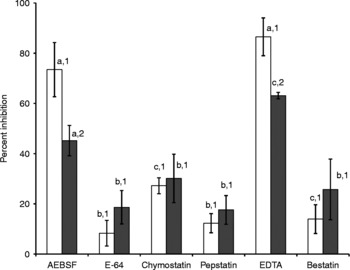
Further examination of EDTA and AEBSF effects revealed additional differences between the two nematodes. Inhibition of H. glycines activity by 8 mm EDTA was 89.02 ± 0.72%, a 26% increase over the 1 mm inhibition level. In contrast, the inhibition of M. incognita activity by 1 mm EDTA was essentially maximal (fig. 2), since treatment with 8 mm EDTA increased inhibition by less than 3%, to 89.01 ± 0.51%. These percentages of inhibition by EDTA were, however, the highest observed in any of the inhibitor–species combinations.
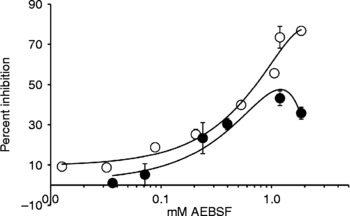
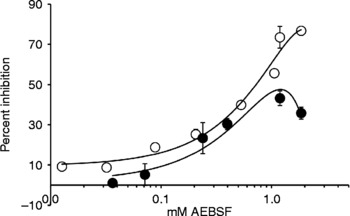
AEBSF showed little to no increase in inhibition above the 1.19 mm screening concentration (fig. 3). Increasing AEBSF to 1.85 mm did not significantly increase inhibition in H. glycines or M. incognita. In fact, H. glycines was clearly at maximum inhibition at 1.19 mm. The dose–response curves of AEBSF inhibition of KSAYMRFa digestion for each species were best fitted by second-order polynomials. Half-maximal inhibition for H. glycines (21.6%) was at 0.29 mm, and inhibition never reached 50%. Half-maximal inhibition for M. incognita (38.3%) occurred at 0.48 mm and 50% inhibition occurred at 0.73 mm. The mean percent inhibition at both 1.19 mm and 1.85 mm was greater (P< 0.05) in M. incognita than in H. glycines.
Inhibition of protease activities in extracts of Meloidogyne incognita and Heterodera glycines by the serine protease inhibitor AEBSF. Assays were conducted as described using the substrate KSAYMRF (QXL520-KSAYMRF-K(5-FAM)a) at 4 μm. Thirty minutes prior to addition of substrate, reactions were incubated with AEBSF prepared as described and diluted in assay buffer to provide 0.01–1.85 mm per reaction. Each data point represents the mean ± SE of a minimum of three separate assays, except for M. incognita 0.01 mm AEBSF, where n= 2. Percent inhibition was calculated as: ((V max/min/μgcontrol− V max/min/μginhibitor)/V max/min/μgcontrol) × 100. Second-order polynomial regression lines: M. incognita (white circles), y= − 17.179x 2 +68.352x+9.5177; r 2= 0.98; H. glycines (black circles), y= − 31.354x 2 +75.518x+2.0066; r 2= 0.95.
Discussion
Soluble fractions prepared from the aqueous extracts of two plant-parasitic nematodes, the soybean cyst nematode H. glycines and the southern root knot nematode M. incognita, varied qualitatively and quantitatively in their abilities to digest FMRFa-like peptides (FLPs). Substrates used for the comparisons comprised two highly conserved nematode FLP sequences, KHEYLRFa and KSAYMRFa (McVeigh et al., Reference McVeigh, Leech, Mair, Marks, Geary and Maule2005) and one FLP sequence, KHEFVRFa, associated primarily with Meloidogyne species (McVeigh et al., Reference McVeigh, Leech, Mair, Marks, Geary and Maule2005; Johnston et al., Reference Johnston, McVeigh, McMaster, Fleming and Maule2010), and also with the plant-parasitic lesion nematode Pratylenchus vulnus (McVeigh et al., Reference McVeigh, Leech, Mair, Marks, Geary and Maule2005). An expressed sequence tag (EST) search did not detect KHEFVRFa in any Heterodera species (Masler, Reference Masler2012).
KHEYLRFa and KHEFVRFa are the products of flp-14 and KSAYMRFa is encoded by flp-6 (McVeigh et al., Reference McVeigh, Leech, Mair, Marks, Geary and Maule2005; Johnston et al., Reference Johnston, McVeigh, McMaster, Fleming and Maule2010; Li & Kim, Reference Li, Kim, Geary and Maule2010). Flp-14 is expressed exclusively in anterior neurons of M. incognita and the potato cyst nematode Globodera pallida (Kimber et al., Reference Kimber, Fleming, Prior, Jones, Halton and Maule2002; Johnston et al., Reference Johnston, McVeigh, McMaster, Fleming and Maule2010) while flp-6 has been localized to neurons in both anterior and posterior regions of G. pallida (Kimber et al., Reference Kimber, Fleming, Prior, Jones, Halton and Maule2002). Thus, the tested FLPs differ in sequence, species distribution, gene origin and neuronal expression.
Although the rate of digestion of KSAYMRFa was higher in M. incognita than in H. glycines, and the rates of digestion of KHEYLRFa were the same for each species, substrate affinities for these two conserved sequences were significantly higher (lower apparent K m values) in H. glycines. Conclusions must be drawn with caution, since the crude enzyme sources have highly heterogeneous protease complements, but it is clear that these complements vary significantly between the two species. A quantitative explanation for the KHEYLRFa results is that M. incognita has a greater abundance of proteases than does H. glycines, or at least a greater abundance of proteases involved with KHEYLRFa digestion. This rationale may be even more applicable to KSAYMRFa, where lower affinity in M. incognita is combined with a nearly twofold greater digestion rate than in H. glycines. Alternatively, the specific mixtures of proteases and endogenous protease inhibitors may differ between the two species. This suggests a combination of quantitative and qualitative differences to explain the digest results, which will require more extensive biochemical fractionations and analyses to parse out.
Within each species, the affinities for KHEYLRFa and KSAYMRFa were the same, but KSAYMRFa was digested at much higher rates. This might be related to the relative abundance of the two FLPs in plant-parasitic nematodes. For example, flp-6 encodes four copies of KSAYMRFa in the cyst nematodes Globodera rostochiensis, G. pallida and H. glycines, and two copies in Meloidogyne species (McVeigh et al., Reference McVeigh, Leech, Mair, Marks, Geary and Maule2005; Kimber et al., Reference Kimber, McKinney, McMaster, Day, Fleming and Maule2007). Flp-14 encodes two copies of KHEYLRFa in G. rostochiensis, three copies in M. arenaria, but only single copies in other Meloidogyne species, including M. incognita (McVeigh et al., Reference McVeigh, Leech, Mair, Marks, Geary and Maule2005). These numbers, and the expression of KSAYMRFa in more widely distributed anatomical locations than KHEYLRFa (Kimber et al., Reference Kimber, Fleming, Prior, Jones, Halton and Maule2002; Johnston et al., Reference Johnston, McVeigh, McMaster, Fleming and Maule2010), may indicate the relative abundance of KSAYMRFa and KHEYLRFa in plant-parasitic nematodes. One could argue that this abundance requires more rapid digestion of KSAYMRFa than KHEYLRFa to control peptide titres.
KHEFVRFa presents an intriguing case since it is detected in M. incognita but not in H. glycines, and both the affinity for this substrate and its digestion rate are significantly greater in M. incognita than in H. glycines preparations. Conversely, specific activity and especially affinity are lower for KHEFVRFa than for KHEYLRFa in H. glycines. Thus, the protease complement in H. glycines is less able than that of M. incognita to metabolize a structural homologue of KHEYLRFa, while only the species in which the two homologues are co-expressed metabolizes them equally. This implies species specificity for the metabolism of an endogenous FLP. An expansion of these comparisons, to include P. vulnus extracts and additional structural variants of KHEYLRFa, should be valuable.
Inhibitor screening revealed that the metabolism of KSAYMRFa in both H. glycines and M. incognita is heavily dependent upon metallo- and serine proteases. This may not be surprising given that metalloproteases comprise the largest group of proteases encoded by nematode genomes, and serine proteases represent a significant proportion (>15%; Castagnone-Sereno et al., Reference Castagnone-Sereno, Deleury, Danchin, Perfus-Barbeoch and Abad2011). However, while digestion was nearly completely inhibited at a high dose of the metalloprotease inhibitor EDTA in both H. glycines and M. incognita preparations, significant differences in digestion rates in the two species became apparent at a reduced inhibitor concentration. This suggests, at least with KSAYMRFa digestion, that M. incognita is more sensitive to EDTA than is H. glycines.
As with EDTA, M. incognita is also more sensitive than H. glycines to AEBSF inhibition but, unlike EDTA, increasing the concentration of AEBSF did not result in a significant increase in inhibition in either species. The AEBSF results did reveal a significant difference between H. glycines and M. incognita in the contributions of serine proteases to the digestion of KSAYMRFa. It would be interesting to see if the serine protease differences between H. glycines and M. incognita might contribute to the differential digestion of KHEFVRFa in these two species. However, the digestion of KHEFVRFa by a M. incognita preparation was inhibited by AEBSF and by cysteine protease inhibitors but not by EDTA (Masler, Reference Masler2012).
Highly complex, species-related interactions clearly exist among proteases and FLP substrates, and they may be exploited for the design of inhibitor-based nematode control agents. Biochemical identification of soluble and membrane proteases, isolation of their mRNAs and inclusion of additional FLP substrates of particular physiological importance will be needed. Substrates such as FLP-21, which affects behavioural and feeding activities, and the peptides encoded on flp-1 that have wide-ranging effects on locomotion and egg laying are good candidates. High-throughput screening of FLP-analogue and inhibitor libraries will also be essential for a description of the peptide degradome in plant-parasitic nematodes.