Introduction
We are invisible. No one knows we do a good job and that we are a great team because we sort out issues before they happen (participant).
The above comment is one that is all too familiar to managers who know they work with excellent or brilliant teams, yet are unsure how to sustain the brilliance or legitimise it to others. Two co-managers of an Australian government health service – the Queensland Cancer Control Analysis Team (QCCAT) – were faced with this conundrum. This article represents a scholarly response to this puzzle.
In 2013, the Metro South Hospital and Health Service requested all employees to participate in the Best Practice Australia employee survey. The survey aims to capture employee perceptions and provide managers with comparative feedback at the work-unit and/or team level(s). Relative to similar teams, QCCAT demonstrated remarkable results in all categories, including engagement, values, and leadership. Although the survey provided numerical data and some narrative text on the positive perceptions of QCCAT, it offered limited insight into why team members held these perceptions. The narrative text provided some themes with limited detail or contextual references. Controversial comments were also purged to protect employees and managers.
To better understand how and why QCCAT demonstrated and experienced high performance, the co-managers commissioned discovery interviews to solicit stories grounded in members’ personal experiences (NHS Modernisation Agency, 2003; Bate, Reference Bate2007; Bridges, Gray, Box, & Machin, Reference Bridges, Gray, Box and Machin2008; Weberg & Davidson, Reference Weberg and Davidson2017). To ensure the empirical interview material was approached in an impartial, positive, and scholarly way, the co-managers invited the authors, as positive organisational scholars in healthcare (withheld for blind review), to analyse the material and develop a framework to promote brilliant teamwork within health services. They wanted to share the findings with their team and a wider audience, as well as learn new ways to analyse and use empirical material to inform practice.
There is a real need to identify exceptional performance in healthcare. The co-managers worked with us to find ways to analyse and communicate the brilliant, remarkable, and excellence in their experiences as well as having received external recognition for the results of the Best Practice Australia employee survey. The interviewees wanted to expand upon the survey results and provide insights into their high-performing team by providing confirmatory evidence of positive dynamics in QCCAT. Hybrid dynamics were also found that were different to the positive dynamics but necessary for lifting the performance of QCCAT.
This article demonstrates the application and embodiment of positive organisational scholarship in healthcare (POSH) to discover, delve into, understand, and give ‘experiential legitimacy’ (Nilsson, Reference Nilsson2015: 370) to the positive dynamics that underpin brilliant team performance – dynamics that are seldom noticed and explored. Building on Bright’s (Reference Bright2009) depreciating and appreciating dynamics, this article presents an analytical framework that incorporates hybrid dynamics to account for utterances that combine depreciating dynamics with those that are appreciative, thus ‘recogniz[ing] … the plasticity of positive and negative framings’ (Nilsson, Reference Nilsson2015: 379). Furthermore, to legitimise and potentially sustain appreciating dynamics, the article connects these to the construct of positive institutional work (PIW); that is, ‘the creation or maintenance of institutional patterns that express mutually constitutive experiential and social goods’ (p. 373). This article makes two contributions to organisational scholarship. First, it introduces an analytical framework to deductively ‘assess the state of an organization with respect to appreciative dynamics’ (Bright, Reference Bright2009: 4); and second, it moors this framework to PIW.
To demonstrate these contributions, the article commences with an overview of positive organisational scholarship (POS). It then details the context of this research, namely, QCCAT; the inductive and deductive approaches used, which served to further Bright’s (Reference Bright2009) dynamics; and the associated findings. The article concludes with a discussion that connects the brilliance embodied by QCCAT to three key positive experiential orientations (Nilsson, Reference Nilsson2015), thereby presenting a new framework to operationalise POS. Furthermore, with the introduction of hybrid dynamics, it also illustrates the tensions and uncertain nature of working with an experiential approach resolve. Following this, pertinent, though incomplete observations about this complex process are presented and future research directions are signposted.
POS
Within the discipline of organisational behaviour, POS emerged to specifically focus on positive work–life and performance. Its four key components are: self-efficacy, hope, optimism, and resilience (Luthans, Reference Luthans2002; Youssef & Luthans, Reference Youssef and Luthans2007). Spreitzer and Cameron (Reference Spreitzer and Cameron2012) suggested that although the ‘p’ component remains the most contested, challenging, and inspiring, it nonetheless has four consensual meanings. First, it denotes a unique positive orientation that prefigures ‘strengths rather than weaknesses, optimism rather than pessimism, supportive rather than critical communication’ (p. 1035), even under negative circumstances. Second, it requires an affirmative bias to foster resourcefulness or create an amplifying effect for individuals and their organisations through exposure to positivity. Third, it involves virtuousness and/or the quest for human virtues that capture the highest aspirations of humankind. Fourth, it encompasses the pursuit of extraordinary outcomes and/or positive deviance by ‘identifying and explaining spectacular results, surprising outcomes, and extraordinary achievements … including those in the context of change’ (pp. 1035–1036). Collectively, these four meanings reveal the positive conditions that enable individuals and organisations to flourish. The ‘o’ component addresses ‘the positive processes and states that occur in association with or through organisational contexts’, whereas the ‘s’ component reflects the pursuit of ‘rigorous, systematic, and theory-based foundations for positive phenomena’ (Cameron & Spreitzer, Reference Cameron and Spreitzer2012a: 2).
Although a unifying definition of POS does not exist, Nilsson (Reference Nilsson2015: 372) reasoned that its core constructs share ‘an unusual duality’. On the one hand, they focus on subjectively or personally fulfilling aspects (experienced as energising, pleasurable, and intrinsically good), whereas on the other hand, they focus on the ‘long-term sustainability of people, organizations, society, and the environment’ (Spreitzer & Cameron, Reference Spreitzer and Cameron2012: 1037), thereby transcending the organisation and its moral, social, and/or spiritual conceptions of good. According to Nilsson, the inherent duality of POS encompasses an experiential orientation, as illustrated by three key aspects. These include experiential surfacing, agency as inquiry, and inclusion. Given their relevance to this article, each is briefly addressed in turn.
Experiential surfacing represents a purposeful effort to engage with the inner experiences of organisational members. It affords individuals a safe space in which to express their experiences and voice their emotions, with the potential to diffuse and amplify these within and beyond institutions. Experiential surfacing explicitly recognises that ‘everything in our work is personal’ (Block, Reference Block2017: 29) – and by bringing this personal element to the fore, experiential evaluation can become a social structuring mechanism. As Nilsson (Reference Nilsson2015) advised, ‘If something is socially invisible, it can’t be socially evaluated’ (p. 376). Experiential surfacing requires individuals to be open and flexible – and through story-rich communications that are highly intersubjective and unpredictable, experiential surfacing creates a dynamic that heightens the need to maintain positive energy for social good.
Agency as positive inquiry is a relational paradigm that emphasises distributed action, connections, and open dialogue. It can foster the participation of diverse people, relationships, and fields to explore potentialities that raise organisational consciousness and build organisational knowledge capacity. This awareness occurs through conversations that inspire curiosity; recognise multiple logics, contractions, paradoxes, and ideas; and reveal implicit assumptions, whereby individuals come to know what they do not know and ‘question … the hitherto unquestioned’ (Moore & Beadle, Reference Moore and Beadle2006: 383). According to Nilsson (Reference Nilsson2015):
Actors start with the awareness that they are not aware of all the different assumptions, values, and beliefs framing their institutional experiences. They catalyze agency not by understanding how their experience is institutionally constituted but by recognizing that their experience is institutionally constituted (p. 382).
Finally, inclusion serves as a ‘fundamental strategy’ (Nilsson, Reference Nilsson2015: 387) to bolster positive institutional stability. It involves purposeful efforts to continually align group boundaries and material practices with experiential purposes, rather than rules, norms, and beliefs. This is not to suggest a quest for an unchanging, static context – but rather, a quest to ‘enable consistent inconsistency’ (Smith, Lewis, & Tushman, Reference Smith, Lewis and Tushman2012: 802) and sustain the generative elements of an institution – the creative, the improvisational, the deviant, and even the flawed.
Despite extant literature on POS, Spreitzer and Cameron (Reference Spreitzer and Cameron2012) contended that the path forward for POS involves widening its scope to encompass different contexts, including health services, as well as different voices, like those of ‘nonmanagerial and nonelite populations and perspectives’ (p. 1042). POSH partly represents a response to this call.
POSH is an emerging movement, exhorting researchers to understand human excellence in health services. As a methodology, it is particularly useful to study health service management for (at least) two reasons. First, it awards primacy to theories, constructs, and approaches – like relational coordination, positive deviance, and appreciative inquiry (AI), respectively (Gittell, Reference Gittell2002; Spreitzer & Sonenshein, Reference Spreitzer and Sonenshein2003) – that can promote positive outcomes and shape health services that flourish in the face of adversity (Karp, Reference Karp2004; Cameron & Lavine, Reference Cameron and Lavine2006; Havens, Reference Havens2011). This is because these theories, constructs, and approaches can facilitate transformation at different levels. They recognise knowledge, cognition, and experience as inextricably entwined and shaped by context, collectively generating action. As ‘groundless’ awareness (Varela, Thompson, & Rosch, Reference Varela, Thompson and Rosch1991), this collective action represents ‘an exciting “space” where possibility arises for how we think about knowledge, cognition, and experience’ (Haskell, Linds, & Ippolito, Reference Haskell, Linds and Ippolito2002, para. 7).
Second, POSH draws attention to process – that is, ‘how and why things [notably, those that are virtuous] emerge, develop, grow, or terminate over time’ (Langley, Smallman, Tsoukas, & Van de Ven, Reference Langley, Smallman, Tsoukas and Van de Ven2013: 1). Lee, Caza, Edmondson, and Thomke (Reference Lee, Caza, Edmondson and Thomke2003) used POS to examine knowledge-creation processes; similarly, Luthans and Avolio (Reference Luthans and Avolio2003) investigated the positive processes that create leadership patterns. Akin to process studies generally, POSH recognises the ‘importance and inescapability of time and timing in human affairs in general and in the lives of organizations in particular’ (Langley et al., Reference Langley, Smallman, Tsoukas and Van de Ven2013: 4); the importance of interactional expertise (Collins, Reference Collins2004), which requires ‘immersion in the discourse of the community’ (Collins, Evans, Ribeiro, & Hall, Reference Collins, Evans, Ribeiro and Hall2006: 658); and the value of the narrative, which helps to coherently convey complex tales of a lived experience.
The value of the narrative is particularly pertinent to this research. Cameron and Spreitzer (Reference Cameron and Spreitzer2012b) noted the need to focus on ‘a more qualitative process to understand people’s actual lived experiences’ (p. 1044, emphasis added); they also made a heartfelt call for scholarship that helps to define constructs and develop better instrumentation, including validated measures of core constructs. Similarly, Nilsson (Reference Nilsson2015) offered clear directions for future research, including a consideration of how experientially legitimated patterns are institutionalised, and how positive organisational phenomena interact with institutional logics and roles. Heeding these calls, the following sections describe a qualitative approach towards a rigorously developed framework, which is presented in the final section, to interpret and learn from the positive experiences of QCCAT members. Following the framework, the article concludes by explicating connections between these positive experiences and the wider context in which the team operated – this follows the observation that, ‘the positive in POS is at once subjectively, experientially positive and objectively positive in some larger, more abstract, culturally shared way, and these two dimensions are mutually constitutive’ (p. 372).
A POSH analytical framework
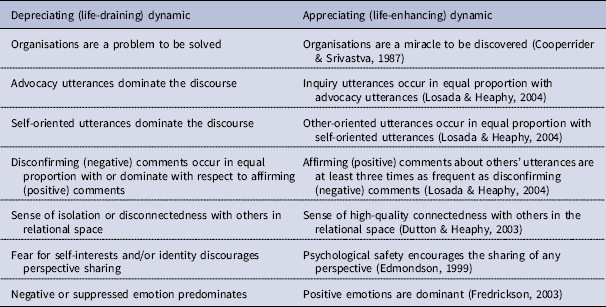
In his exposition on the role of AI and POS in organisational development, Bright (Reference Bright2009) identified 14 appreciating and depreciating dynamics, which can be used to appraise an organisation by examining typical conversations (see Table 1). Appreciating and depreciating dynamics are not opposites; but rather, they capture different types of behaviours – and between them lie ‘functional state or mixed dynamics’ (p. 3), which Bright did not tabulate. He contended that there is a constant pull from the pressures of high performance in the appreciating dynamics and the problem-focussed depreciating dynamics to maintain the status quo or do business-as-usual.
A comparison of depreciating and appreciating dynamics as demonstrated in POS research (Bright, Reference Bright2009: 4)

The appreciative dynamics are epistemologically grounded in a different worldview – one associated with generativity. Generativity is the source of creativity and new ways of framing and seeing the world. It does not start with a problem-oriented focus, but commences with conversations about new possibilities, novel ideas, and even serendipity. In operational terms, appreciating dynamics are mainly associated with either achieving better performance or, in organisational development terms, from whence the taxonomy emanates, building a form of social capital that encourages connections, resilience, strength, values, and organisational potential.
During the deductive phase of the research presented in this article, discovery interview transcripts provided by QCCAT’s co-managers were analysed, guided by Bright’s (Reference Bright2009) depreciating and appreciating dynamics. However, using these was challenging, partly due to their strong organisational development undertones, which award primacy to organisational change. Thus, to enhance the practical use of the appreciative dynamics and optimise the likelihood of a shared understanding among the researchers, the appreciative dynamics were refined and explicated, as the transcripts were revisited. Following this iterative and recursive process, the seven appreciating dynamics were articulated as follows.
Organisations are a miracle
When we consider the future of our organisations and how we work together from an appreciative perspective, we shift our attention away from problems and deficits. When we start with what makes things work, we open and energise ourselves, stimulate broader and more positive dialogue, and are more likely to discover opportunities to realise potential. Using powerful exploratory and discovery-oriented questions, AI enables us to determine what is best about the system to uncover more of that which is good; it takes inspiration from the current state of what is, and it seeks to understand the factors that can be activated to heighten potential. The problem-solving comes afterwards. It is all about where you start. AI promotes a dynamic that is engaging and energising – it recognises that we need to deal with problems and gaps; yet if we routinely start this way, we tend to stay locked in this space and all we identify are more problems and deficits. It is a rationale for POSH and is ‘a central feature of experience enveloping (1) our perceptual consciousness; (2) our way of relating to others, the world, and our own research; and (3) our way of knowing’ (Cooperrider & Srivastva, Reference Cooperrider and Srivastva2013: 58).
Inquiry and advocacy utterances
Unlike depreciating dynamics, appreciating dynamics or grounded positivity means measured and constructive negative feedback has a place and serves to keep things moving towards agreed objectives; a sense of ‘we’, rather than you and I, or self and other binaries, which can drive competitive or resistant behaviour; the polarity of inquiry and advocacy drives a productive dialogue where people listen in considered ways to others’ ideas; and constructive negative feedback helps to create enthusiasm to strive for higher ideals, such as excellence.
Other- and self-oriented utterances
Appreciating dynamics involve an outward focus (on others) as well as an internal one (on the self). This is also influenced by the balance of advocacy and inquiry in interpersonal exchange, whereby we appreciate others’ views and downplay self-centred research.
Affirming comments
Positive affirmations can occur during interviews and similar exchanges, and might not be quite the same as what one might hear during a conversation – for instance, comments like, ‘that was a dumb idea’ or ‘that’s a great idea’. Such affirmations in either context reflect intentions and practices to expand, discover, and learn – for example, the observation that a team leader encourages a group to open-up and explore difficult topics.
High-quality connections
High-quality connections have higher emotional carrying capacity, as shown by people feeling safe to display different emotions; the degree of connectivity; and connections that can bend and withstand strain, and function in a variety of circumstances. Teams will display expansive spaces for buoyancy, action, and creativity. High-quality connections offer three key subjective experiences for members, namely, a sense of vitality and aliveness; a heightened sense of positive regard; and a feeling of mutuality. Being engaged and actively participating allows a team to move from mutual vulnerability to mutual responsiveness. As Bright (Reference Bright2009) explained, ‘Extraordinary organizations create a pervasive state of connectedness among members … Generative capacity increases to the extent that people connect through dialogue in vibrant, healthful relational spaces’ (p. 5).
Psychological safety
Learning behaviours are encouraged and their inherent potential to result in embarrassment or threat is diminished because excessive concern about the associated risk is alleviated. Psychological safety is therefore personally and socially beneficial, as it encourages individual development and cohesion:
when the interpersonal risks of a group make an individual member feel safe, workers can express their thoughts and questions without concern… if a person perceives a high level of psychological safety among a team, this indicates that the team has developed a safe environment where colleagues and staff feel protected (Lee, Yang, & Chen, Reference Lee, Yang and Chen2016, pp. 7–8).
Positive emotions
People are helpful to others; they feel good about helping others and people who receive help are grateful. Positive emotions can also transform groups of people, within communities and organisations. For example, the positive environment enhances the social connections between the players, which lead to a constructive and an innovative work environment. This connects with the underlying rationale for inquiring into appreciating dynamics via POS. The dynamics are not mutually exclusive and some do have stronger influences (e.g., advocacy and adversarial statements).
Following this explication of the seven appreciative dynamics, the subsequent sections describe how the empirical material was analysed and interpreted.
Method
QCCAT is a unique entity in the context of Queensland health. This multidisciplinary team, which includes expertise in clinical care, data analytics, and service improvement, was established in 2004 in response to several key catalysts – notably, the need for robust, reliable cancer information to inform clinical practice across the state, and the need for quality improvement. From the outset, the Queensland Cancer Control and Safety Partnership was established as a gazetted Quality Assurance Committee under the Hospitals and Health Boards Act (State of Queensland, 2011) – the first of its kind in cancer care and one of only a few gazetted committees at that time in Queensland. At the time of writing, QCCAT performed the work of the aforesaid partnership, which primarily focussed on clinician-led service improvement and monitoring, as well as the auditing and evaluation of cancer services across the state. As a gazetted committee, it reports directly to the Director General of Health. It is a unique entity in the context of a very complex health service and is aptly described as such by several participants who indicated, ‘[it’s] like an island of sanity’, ‘it’s like a little private sector company, right in the middle of the public service’, ‘sitting between corporate-land and district-land’. An area that QCCAT is organisationally innovative is collecting data about individual experiences within the team via discovery interviews (Colquist, Reference Colquist2013).
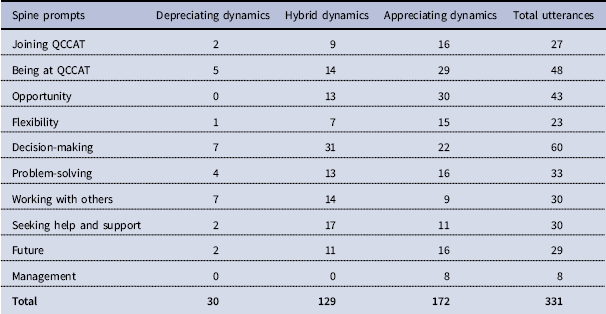
Discovery interviews are an innovative technique to improve healthcare by better understanding individual experiences and needs (Bate, Reference Bate2007). They have been used to collect stories from patients and carers and share these with clinicians. They typically involve face-to-face interviews, using open, neutral phrases to encourage participants to directly tell their story. A ‘spine’ is used to guide participants through key stages of their experience. For patients and carers, the spine reflects the care pathway, from diagnosis to living with a condition – this spine aims to encourage storytellers to weave in descriptions and interpretations of their experiences during this journey (Bridges et al., Reference Bridges, Gray, Box and Machin2008). The skilled use of a spine by an interviewer encourages a natural discussion about a participant’s experiences that trigger significant memories and thoughts. Its use with other cohorts has the same intent and been championed by QCCAT. Although the discovery interview is an experiential approach, it is not conducted with positivity in mind, and as such represents a purposefully unbiased approach. Hence, even probing prompts are neutral, with phrases like ‘tell me more about that’ and ‘can you expand on what you said?’ The overarching prompt guiding the research is also neutral, as in the case of this study, which was ‘what it’s like being at QCCAT’. The researchers were provided with 11 interview transcripts for analysis, which reflected the spine (as per Table 3). Not all participants responded to all the prompts, and the transcripts were on average six pages in length.
This analysis was approached using a critical, interpretive, and reporting style that is consistent with the qualitative nature of data collection, namely, the use of discovery interviews and the exploratory purpose of this study. Over 2 years, the team of multidisciplinary and multisite researchers deliberated on, and debated appropriate ways to examine and understand the positive survey results. Several approaches were trialled – like a lexical analysis (Smith & Humphreys, Reference Smith and Humphreys2006) – before settling on a deductive approach, given its relative structure and direction (Eisenhardt & Graebner, Reference Eisenhardt and Graebner2007; Rosenbaum, More, & Steane, Reference Rosenbaum, More and Steane2017).
During the inductive phase, and following approval from the relevant ethics committees, the deidentified transcripts were analysed in an open manner. Each transcript differed in terms of question-order and answer. Notwithstanding an interest in positivity, this process was unguided; that is, data were not categorised according to a priori codes, but rather, the researchers attended to general themes related to being ‘positive, flourishing, and life giving’ (Cameron & Caza, Reference Cameron and Caza2004: 731). The researchers’ initial reaction was that QCCAT embodied positive dynamics. For instance, they were drawn to the many excerpts that spoke of warm and trusting relationships within QCCAT. Although these references were sporadically peppered with contradiction and negativity, these were not salient, but paled in comparison when compared to the positive sentiments shared by the participants. This inductive process was not opaque; nor was it conducted by the researchers in isolation – but rather, they discussed and critiqued the material that was ‘positive, flourishing, and life giving’ and collectively constructed themes that served to clarify the points of comparability, or the common denominators.
To connect initial interpretations with POS and AI, and to enhance the credibility and integrity of the findings, Bright’s (Reference Bright2009) taxonomy was used. Discovery interviews have a quality of their own, created by a participant’s musings and the experiential messiness of everyday organisational life. Thus, the empirical material was never going to be easily analysed deductively. For this reason, the transcripts were combed to familiarise with participants’ reflections on how their team worked, and how they interpreted these dynamics. Anchored by POS, Bright’s appreciating dynamics were identified, as were those that were depreciating. This helped the researchers to consider the material, systematically. Given its relevance to organisational development, Bright’s taxonomy was used differently to analyse interview material. The researchers aimed to develop a framework to interpret empirical material and account for utterances that Bright did not explicitly consider. While doing this, several ‘hybrid dynamics’ were identified, representing an addition to Bright’s taxonomy, though already cited within POS literature (DeGraff & Nathan-Roberts, Reference DeGraff and Nathan-Roberts2012).
Hybrid descriptors were first developed by identifying excerpts that did not fit with each of Bright’s (Reference Bright2009) seven depreciating and appreciating dynamics. As such a new space was populated with a range of excerpts and these concrete examples were used to abstract the general ideas described by the hybrid utterances. The hybrid dynamics reflected a simultaneous and sometimes contradictory interaction between appreciating and depreciating dynamics within the same aspects of the work environment, not just a mix of appreciating and depreciating. There were many proviso terms, such as: ‘but’, ‘and’, ‘yet’, and ‘with’. This conditional and fluid element changed participants’ interpretations of how they worked – it captured the ambivalence, ambiguity, and tensions inherent within the team. The QCCAT members simultaneously identified both appreciating and depreciating dynamics within the same aspect of their work, but not in a binary way. For example, they would speak of the joy of autonomy in being self-directed, while describing their concerns that no-one told them what to do. The hybrid dynamics emerged strongly and early in the analysis.
Finding so many hybrid exemplars prompted a refinement and an extension of the POSH analytical framework to reflect this nuanced phenomenon. This helped to ensure it was ‘fit for purpose’ (Inglis, Reference Inglis2008: 350), accommodating empirical material (which was not grounded in organisational development) and the heterogeneous utterances it contained.
Much of the material reflected appreciating and hybrid dynamics, with very few examples of depreciating dynamics. Thus, these are not described in this article. The hybrid dynamics, similar to – yet conceptually different from – the mixed dynamics identified by Bright (Reference Bright2009), were the second most common.
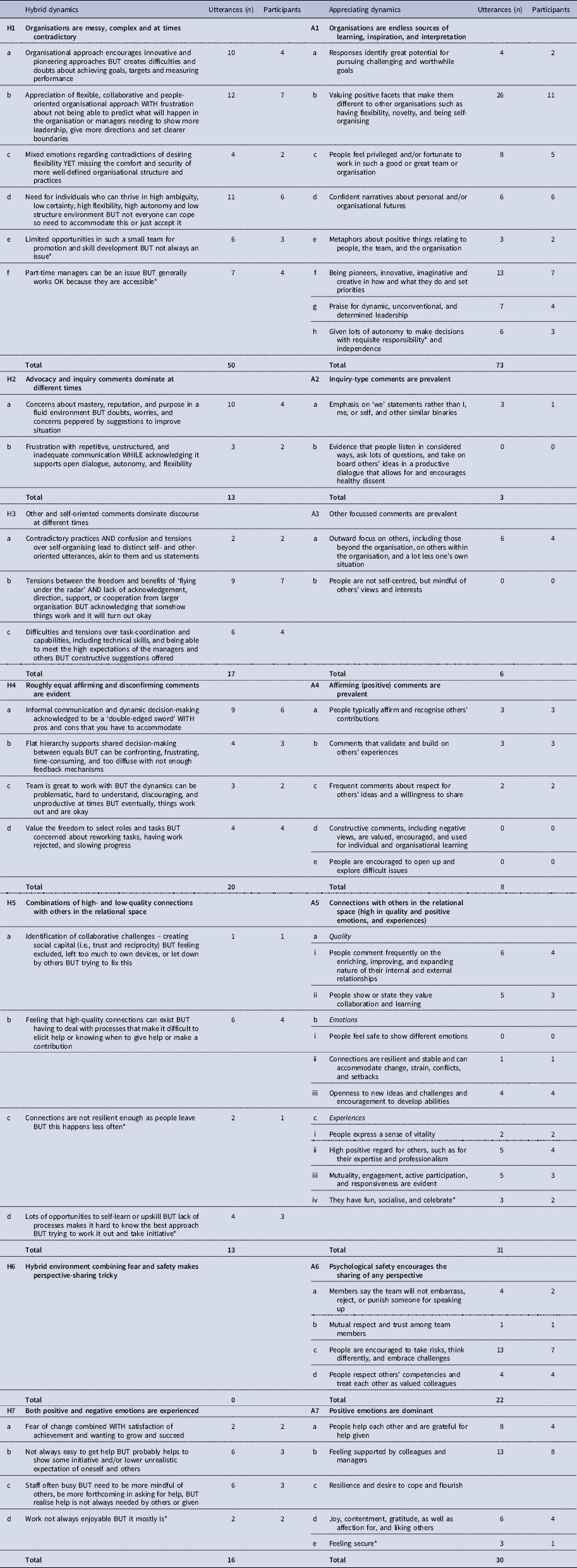
The hybrid dynamics emerged inductively, as did the depreciating and appreciating dynamics. This involved considerable thought, debate, and much iteration of the interpretations, which in turn served to cross-check, triangulate, and validate the analysis and interpretations. As per the edict of discovery interviews (Bridges et al., Reference Bridges, Gray, Box and Machin2008), the aim was not to rigidly thematise the material. Colour-coding was used to differentiate the descriptors, and each paragraph became a potential descriptor. Because of this and the associated length of each descriptor, codes were used to refer to each descriptor for succinctness (as per Table 2). Two or more descriptors were often required to depict a single utterance, whereas on rare occasions, the descriptors did not align with the empirical material; for instance, no hybrid dynamics were relevant to psychological safety. Each transcript served as a template and could be analysed for the main dynamics at play.
Hybrid and appreciating dynamics within QCCAT

Results
To increase the credibility of the findings, the appreciating, depreciating, and hybrid dynamics were counted. This is not to suggest the primacy of quantification, but rather to be confident that claims about the proportion of these dynamics, their distribution, and their relationships were firmly grounded in the data. This would help to ensure that claims about the significance of positivity and hybridity stood up to scrutiny. The co-managers of QCCAT also wanted to ensure the findings spoke to different audiences, including those that associated credible evidence with numeric representations.
An overview of the transcripts suggested six (of 11) participants offered comments that unequivocally represented appreciative dynamics. A further three spoke of hybrid dynamics, though only one offered utterances that were undeniably hybrid. One noted mixed responses between hybrid and appreciative dynamics, and only one offered chiefly depreciating dynamics. Three participants recorded no depreciating dynamics, while three others mentioned only one.
For succinctness, the following description of the findings refers to the codes assigned to each descriptor (as per Table 2). Furthermore, for brevity, only the descriptors that were identified with double-digit utterances are discussed.
Overall, the appreciative dynamic, A1, was most apparent within the text (n = 73), particularly A1-b (n = 26), which was noted by all 11 participants (see Table 2). A1-f was also prominent (n = 13). Of the hybrid dynamics, H1 was frequently identified (n = 50) with H1-a, H1-b, and H1-d mentioned most (n = 10, n = 12, n = 11, respectively). This was followed by A5 (n = 31), with comments spread across all three areas, with A5-c being the most prominent (n = 15); and A7 (n = 30), notably A7-b (n = 13). Also prominent was A6 (n = 22), especially A6-c (n = 13), as well as H4 (n = 20). Despite these salient representations, the remaining descriptors were mentioned less frequently, if at all.
In relation to the spine prompts, appreciative dynamics were most apparent (n = 173), followed by hybrid dynamics (n = 129), (see Table 3). Most of the appreciative utterances referred to opportunity (n = 30), being at QCCAT (n = 29), and decision-making (n = 22). Of the hybrid dynamics, decision-making (n = 31) was the most apparent comment. References to seeking help and support, working with others, and decision-making were associated with more hybrid dynamics, relative to those that were appreciative.
Key findings on the spine prompts and the dynamic descriptors

The spine prompts that dominated the A1 dynamic mostly focussed on opportunity, flexibility, and joining QCCAT. The A5 dynamic chiefly drew attention to being at QCCAT, whereas the A6 and A7 dynamics were represented across the spine prompts. The H1 and H4 dynamics mainly pertained to decision-making.
Discussion
Framework development
The findings presented in the preceding section suggest that, relative to its depreciating and hybrid counterparts, the appreciating dynamics are more apparent within the empirical material sourced from QCCAT. However, discovering the hybrid dynamics opened the possibility to explore new triggers for change and learning. POSH offers a distinct perspective on the discovery interviews other than that intended by the co-managers. Developing Bright’s (Reference Bright2009) taxonomy was a different experience for the researchers, partly impelled by the co-managers who were keen to examine their team differently – in a way that remained attentive to narratives and relationships. Yet, the identification of hybrid dynamics enabled the taxonomy to be adapted into a tool to support POSH, better understand team dynamics, and work constructively to strengthen teams. With a better understanding of these descriptors, it became apparent that something was amiss, for the researchers were attempting to apply a dichotomous arrangement to empirical material that reflected more than two dynamics. To manage this challenge, a hybrid dynamic was fashioned, which warranted additional descriptors to complement Bright’s 14 descriptors.
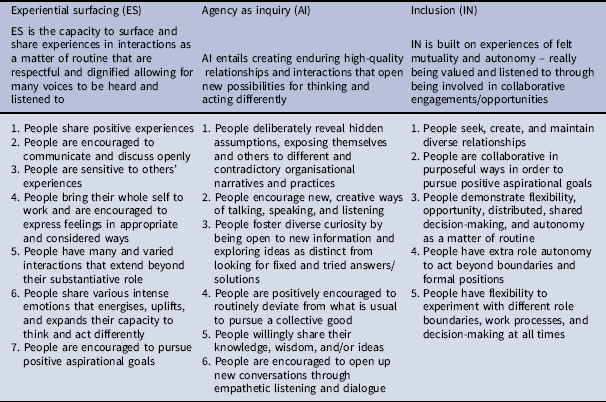
Having identified many appreciative dynamics within the empirical material, the researchers turned to PIW (Nilsson, Reference Nilsson2015) to strengthen their understanding of the relational elements therein. More specifically, the foundational aspects of PIW – namely, experiential surfacing, agency as inquiry, and inclusion – were considered to explain how the prevalent appreciative dynamics sustained positivity (see Table 4). Empirical support for all three was established.
Positive institutional work (Nilsson)

The field of PIW is a new and complex one that we aim to develop through this research. Micro-practices (e.g., in teams) form the focus of the approach rather than whole organisations. Hence the QCCAT context is actually ideally suited to this approach as it represents a microcosm within a larger, organisational setting. Nilsson (Reference Nilsson2015: 371) argues that PIW starts with a focus on micro-emancipatory practices and draws on institutional (embedded) agency and a practice lens to explore situated, intentional activity of individuals and collectives. He says, PIW seeks to “[…] fully engage with the experiential nature of normative social purpose … and ‘to explicitly reconnect institutional theory to the lived experiences of organizational actors’” (pp. 371–372). Thus, he contends that PIW needs to push and prod institutional work conversations in an experiential direction. Nilsson (Reference Nilsson2015: 372) also asserts that the positive in PIW has to be established as subjectively and experientially positive as well objectively in some larger, more abstractly, culturally shared way. The QCCAT study pushes in these two directions and the study itself contributes to PIW as described here. Nilsson (Reference Nilsson2015: 383) also gives examples of teams displaying inquiry as opposed to advocacy as exemplars of PIW.
Experiential surfacing, agency as inquiry, and inclusion help identify appreciating dynamics within the multiple logics of institutions. According to Nilsson, a positive experiential approach is fraught and susceptible to being hijacked or turned on itself. This might partly explain why he encouraged positivity in measured and considered ways that have to take account of institutional contexts. The PIW approach gives us insight into how remarkable QCCAT was in creating positivity (and hybridity) within its competing and constraining institutional logics, noted in the introductory section of this article and the transcripts. The positivity reported in the discovery interviews provide evidence of Nilsson’s troika captured in QCCAT members’ rich experiences. The following section explores this evidence s through the empirical material.
Many examples of experiential surfacing were found within the appreciative dynamics. In addition to the innovative use of discovery interviews, QCCAT members spoke of flexibility and generating opportunities in an otherwise structured health system. They encouraged new ideas and supported each other to translate these into pioneering practices. As demonstrated in the following excerpt, experiential surfacing helped positive feelings to be shared within and beyond the team, creating aspirational energy and agency, where individuals shared a collective work ethic:
I can see [a colleague’s] future for the team and what her big outlook is. I really like seeing that. I think we can do it and that’s what I really enjoy – just striving to go for that, because there is nothing in Queensland Health like what we do (participant 3; A1-a, A1-b).
It’s been a slow process but, increasingly, key people are suddenly saying, ‘Ah, this is good and useful, we like this’. I think key people are realising that QCCAT can do a valuable job in providing information, which supports clinicians in their role with patients, as well as getting out information, which is value-added (participant 7; A3-a, A1-d).
We can chose our own direction, and we do that a lot actually; we almost do that exclusively. We chose the direction that we want to go. Because we’re able to choose our direction, there’s lots of opportunity and we get lots of opportunity. We are often ground-breakers. So using tools, adapting tools for us, is an opportunity that we get given and I think we do that quite well (participant 1; A1-f).
QCCAT members actively demonstrated their agency via inquiry, rather than advocacy. They referred to acts of positive deviance; they created tensions, paradoxes, uncertainty, and ambivalence; and they ‘question[ed] … the hitherto unquestioned’ (Moore & Beadle, Reference Moore and Beadle2006: 383). According to Nilsson (Reference Nilsson2015), agency as inquiry can be demonstrated when individuals have the freedom to engage with others across an organisation via discussions, debates, and curiosity. Subsequently, knowledge is shared and created, and ideas shift through ongoing mutual inquiry. This was a strong experiential focus among QCCAT members – they indicated that flexibility and autonomy helped them to think differently:
We work so closely together and we learn from each other, both skills and character; I’ve hopefully improved in my skills and hopefully in my character, integrity (participant 9; A3-a, A5-a-i).
QCCAT’s different in that we’re a lot more flexible and each of us here has our own sphere and dimension. There’s a lot of legroom for making decisions, which I think you wouldn’t find in many places or certainly not in government (participant 4; A1-b, A1-h).
You just learn to try all different avenues and think outside the square to get through pretty hard negotiations with lots of different people within Queensland Health (participant 3; A6-c).
We’re not stuck in the same old mundane way of doing things. We’re not staying on the same thing, same technology. We’re constantly looking at new technologies; we’re constantly thinking, ‘What can we do that’s going to improve things?’ (participant 9; A1-f, A5-c-i, A6-c).
Additionally, the quality of the relationships reduced professional boundaries and silos, increasing organisational learning and inquiry. This is demonstrated by the salience of AI, implying the team was an endless source of learning, inspiration, and interpretation:
Internally there’s lots of opportunity. For example, if I’d said I really want to take over the work that a peer was doing, and I don’t know anything about the detail of the work, I bet they would have gone, ‘Yes, you can do that. Go right ahead’. That’s part of the team; part of what we do here… They would probably say, ‘Yeah, that’s great. We love your initiative’, which is fantastic (participant 5; A1-b, A6-c).
Flexibility is definitely one of the positive things about being part of QCCAT. It is very flexible… Here you can find your own way, or you can define your own role if you like. I find that flexibility unusual, where you can join a team and find your niche and off you go. The management style and the way the team is set up support that, I think that’s a positive thing and I really enjoy that aspect of being in this team (participant 11; A1-b, A1-c).
QCCAT demonstrated inclusiveness by building a strong relational paradigm – shaping and altering relational boundaries and creating structural plasticity, as indicated by flexibility, opportunity, and distributed agency, especially in decision-making. Members fostered positive emotions to broaden and build members’ ‘thought-action repertoires’ (Fredrickson & Joiner, Reference Fredrickson and Joiner2002: 172). Inclusion, as described by Nilsson (Reference Nilsson2015), suggests high-quality connections within and beyond the institution, fostering openness to new ideas. When flexibility, autonomy, and distributed decision-making are encouraged, work practices are fluid, experiential, and aspirational:
QCCAT team members are very friendly, easy to get along, and very helpful. We all go out of our way to help each other and it’s just the QCCAT nature (participant 2; A7-b).
Being at QCCAT is different to being in an office where it is a competitive environment and loyalty seems to be in short supply. QCCAT has a different ethos and one which I’m more familiar where there’s support and you feel you’re part of a team, working towards a common goal and it’s just a much nicer environment. So, it’s good working at QCCAT (participant 7; A7-b).
I really liked that about this team, all sitting around, thinking, ‘What’s the best way to do this?’ and everybody’s opinions were valued. I like that a lot about the decision-making process that we have (participant 5; A3-a; A5-a-ii).
I enjoy using new technologies and the opportunity to see the work that we do improve the way patients are treated. It’s good to hear that their experiences have been improved by what we’ve done – maybe not directly what we’ve done, but part of what we’ve done has helped improve it. The opportunity to do work that’s going to help people, is important to me. I think that’s important to me over and above wanting to achieve career heights (participant 9; A1-a).
Although the three dynamics are difficult to capture and translate into practice, QCCAT appears to have exemplified PIW. The three foundational aspects are mutually constitutive of each and critical to understanding and promoting experiential conversations that can foster positivity (Nilsson, Reference Nilsson2015). Although not all features of the appreciative dynamics aligned with PIW, there are ample proxies of the troika to warrant the conclusion that QCCAT empirically demonstrated the three foundational aspects.
Hybrid dynamics
PIW helps to connect the organisational dynamics – notably the appreciative and hybrid dynamics – with institutional logics. Its three foundational aspects – experiential surfacing, agency as inquiry, and inclusion – are challenged by countervailing forces with strong pressures to create negativity and failure. This is partly reflected in the duality that pervades POS. Although Nilsson (Reference Nilsson2015) recognised the limitations associated with this dichotomy, he did not consider the potential value of hybridity, unlike other institutional theorists (e.g., Schildt & Perkmann, Reference Schildt and Perkmann2017). From the perspective of participants, they are quite distinct and significant. The ways in which participants talk about hybrid dynamics indicate they are socially constructed but within a more contested, confusing, and creative meaning that makes space when compared to appreciating and depreciating dynamics. Better understanding of these dynamics, how they arise and are played out, may provide us with greater insights into the nuances of organisational dynamics and PIW in particular.
The hybrid dynamics suggest that a dichotomous understanding of POS can hinder a capacity to understand and harness positivity. This is because it can foreclose the unexplored and often overlooked rich, knowledgeable, and frustrating experiences of organisational members. This is why Bright’s (Reference Bright2009) taxonomy was extended – incorporating hybrid dynamics helps to redress the extremes of depreciating and appreciating dynamics as an ‘ordinary-equilibrium state’ (p. 3). Instead of striving for, ‘The middle, ordinary state … in which acceptable norms rule’ (p. 4), this analysis identified hybrid dynamics – the paradoxes of managing complex and contradictory states, including simultaneous desires for autonomy and structure. Bright saw the space between appreciating and depreciating dynamics as unrelated to either of the other these two dynamics. Our paper builds on both the Bright (Reference Bright2009) framework and PIW by introducing a new construct called hybridity. Bright did not overcome the difficulty of the mutually constitutive nature of the dynamics (Nilsson, Reference Nilsson2015: 379) and neither did Nilsson. The hybrid dynamics embody QCCAT members’ concurrent exemplars of positive, negative, ambivalent, constructive, and creative states. These exemplars were not exclusively appreciating or depreciating, but contained elements of both, but also much more:
Well, I think there are probably positives and negatives with that management style. Sometimes people crave structure, so it’s a difficult balance. It’s okay to be flexible and to find your own way, but some people struggle. Sometimes I’m not so sure. I’m not sure if it’s the right way to go. We are pushed a little bit to find our own way and that can be hard. Sometimes you would like someone to say that this is what you’ve got to do. That’s the double-edged sword, isn’t it? You can’t have it all ways. I think there are more positives than there are negatives to that style and I think that’s probably why the team goes well with it. There are times when you think, ‘I just want to be told this is what you’re doing; this is the direction we are going in and let’s stick to it and do it’. But, we don’t necessarily always have that (participant 11; H1-b; H4-a).
Although POS recognises oppositional factors as sources of tension that can yield innovative or hybrid solutions (DeGraff & Nathan-Roberts, Reference DeGraff and Nathan-Roberts2012), the participants’ experiences reveal an interplay, chiefly between the appreciating dynamics, to yield hybridity:
New staff need a little bit of reassurance that [it] doesn’t [matter]… if you send something off and it gets rewritten, or if you think that you’re on the right track and you’re completely not on the right track… it’s not necessarily that you’ve misunderstood – the actual goal posts have moved and that’s just the way it is. I think that can take a bit of time to get used to that. But, once you are used to it, and if you can accept it, they’re the people that stay on our team (participant 11; H4-c; H4-d).
Hybridity supports creativity, innovation, and interventions that bolster positivity. The discovery interviews are peppered with examples of how positive experiences were tempered by doubt, concern, uncertainty, and unresolved tension – yet this amalgam created healthy thinking and encouraged QCCAT members to question and contemplate improvements and progress:
The downside… is that, often it feels as if we’re hanging out there without a clear direction and it’s good to be able to set your own directions and work at things at your own pace. Occasionally, I suppose it would also be good to get clear directions on, or at least broad strategies. Where exactly are we going, what are our expected milestones? I wouldn’t want it to be too restrictive myself, but it would be good to be able to know what those broad boundaries are, as to where we’re heading. What do we want to be our impact, what do we want to be able to claim as our achievement three years from now? (participant 4; H1-a; H1-b).
Given this evidence, there is little reason to characterise ‘The middle, ordinary state’ (Bright, Reference Bright2009: 4) between the dysfunctional and the extraordinary as norm-driven. Norms regulate behaviour; they support conformity, if not obedience; and they create symbolic forms of legitimacy and consistency (Nilsson, Reference Nilsson2015). The empirical material indicated that participants acknowledged how much they appreciated autonomy, while challenged by the lack of formal leadership structures and independence:
There have been times when trying to make decisions has been difficult. I think [the co-managers] believe that there’s quite a lot of autonomy in the team because they are professionals working in their area of expertise. They are allowed to develop and get on with the job. I have found that at times, making decisions were difficult because I needed some comments or feedback from other people. Perhaps I need to ask more specifically for the comments and feedback, so that I can make a decision. Often, I felt the decision was not really my decision; it should be somebody else’s decision. I might feel that, ‘It should be such-and-such, but you guys need to tell me what you want’. Obviously… there’s always going to be a problem or something coming up; but generally, it’s been easy enough to find support and get problems solved (participant 7; H4-b).
Decision-making, as described in the preceding excerpt, clearly illustrates incidents of hybrid dynamics. According to one co-manager, she did not make decisions, in the conventional sense. She incrementally worked through a program of work, recognising that progressive problem-solving, which requires flexibility and healthy workplace relationships, requires few major decisions and as such, few major risks. Given that she avoided conventional understandings of decision-making, she recognised that others – including fellow team members – might equate her practices with poor leadership:
I don’t know if it is related to [the co-managers] not being here all the time, or being forceful with their decision-making. I appreciate that they want… to be very fluid and flexible… but there comes a time when a decision does need to be made and some direction does need to be held by strong leaders. They’re strong people. I think it actually has been a conscious decision from them to stand back from some of those decisions and sometimes they just need to go, ‘No, this is what we’ve got to do. This is where we’re going to head’, because it does seem to leave this underlying unrest I think (participant 10; H1-b; H1-f).
Despite these unmet expectations, the co-manager indicated that making decisions was less important than actively involving each team member in incremental decision-making. This was facilitated by a flat team structure. Yet this in turn gave rise to ambiguities and contradictions – participants used descriptions like, ‘good and bad’, ‘positive and negative’, and ‘double-edge sword’ to highlight the paradoxes of QCCAT. Some simultaneously loved and loathed the autonomy and freedom they were afforded, because although they were encouraged to decide what they did and how they did it, they longed for direction and boundaries.
The framework presented in this article can be used as an analytic, a diagnostic, and possibly an intervention tool to help scholars and practitioners to operationalise POSH to better understand and harness organisational dynamics. Using PIW to understand these dynamics reveals both the power and problems of fostering an experiential approach based on positivity. QCCAT experimented with an experiential way of working that embodied both appreciating and hybrid dynamics. This study clarifies why this might be the case and how others might learn from this approach. However, PIW is bounded by context and institutional logics that are considerable, tricky, and pervasive (Nilsson, Reference Nilsson2015) – as such, QCCAT’s approach is likely to be unique. For this reason, the framework is not naïvely presented as a panacea for all organisations, let alone health services. But rather, others are invited to use, experiment with, and adapt the framework to gauge its potential within different contexts.
The addition of hybrid dynamics to Bright’s (Reference Bright2009) dichotomy represents a fuller range of ‘indicators that can be used to assess the state of an organization with respect to appreciative dynamics’ (p. 4). The hybrid dynamics offer opportunities to recognise potential innovative forms of appreciating dynamics. This is because, by starting from, and remaining faithful to a position of what works, scholars and practitioners can engage with, and negotiate the hybrid tensions to potentially avert a sole focus on depreciating dynamics. Furthermore, emerging from the experience of a team-in-action, the framework presented in this article better reflects the complexity of teams with all their nuances, contradictions, and creative tensions. As such, this analysis and reformulation enriches the framework and enables it to be of greater practical value.
Despite the theoretical contribution of this article, two limitations warrant mention. First, the use of secondary data suggests data quality might have been compromised (Bryman, Reference Bryman2012). Second, the reliance on interview transcripts limits the lifespan of the identified findings.
Notwithstanding these limitations, the thesis of this article has clear implications for scholars and practitioners, alike.
First, it presents an encompassing framework to examine and understand organisational dynamics, and ultimately promote team performance. Second, it provides a platform for further research. More specifically, further study is needed to refine the constructs associated with the three types of dynamics, as well as Nilsson’s (Reference Nilsson2015) three foundational aspects: use these constructs to understand organisational practices and artefacts; and harness the strengths of different methodologies and research methods – like those that award primacy to the senses – to make meaningful contributions to POSH.
Research for QCCAT has now been completed and we continue to develop the PIW approach. For the current study we are conducting a health service in Western Sydney, NSW. We are developing the framework using experiential methods such as DIs and World Café methods (Carson, Reference Carson2011) to explore the experiences of patients, carers, staff, and other users. Our methodology is based on a positive pragmatic approach (Huffman, Reference Huffman2013) aimed at fostering collaborative moral inquiry (Nilsson, pp. 391) with practitioners who believe their service is brilliant.
Returning to the question posed in the title of this article, this article suggests that team brilliance is likely to involve a blend of appreciating and hybrid dynamics that effectively and positively negotiate institutional logics. Through experiential surfacing, agency as inquiry, and inclusion, QCCAT demonstrated its capacity to welcome contradictions, sensitively manage tensions, and encourage positive change. Reflecting on this study, one of the co-managers observed:
The analysis revealed that appreciative dynamics, which pull teams towards high performance, particularly in respect of opportunity, being in the team, and decision making, were strong and centred on: great potential for pursuing challenging and worthwhile goals and valuing the positive facets such as flexibility, novelty and self-organising. These were perceived to be points of difference between the team and other parts of the organisation. Hybrid dynamics comprised of BUT, YET, WHILE or WITH statements and contained constructive and thoughtful feedback aimed at preserving the good things about the team but also on improvement. For example, the way of working encourages innovative and pioneering approaches BUT creates difficulties and doubts about achieving goals, targets and measuring performance and suggestions to address these concerns.
Appreciative dynamics highlighted where the team was excelling but could also not afford to be complacent. Hybrid dynamics reflected the personal, everyday ‘worries’ of team members. Concerns that were invisible from the survey data yet potentially critical to sustain team performance. Understanding the hybrid dynamics of work-life identified opportunities to look after team well-being and maintain the commitment and energy needed for the team to grow and flourish. POSH enables practitioners to celebrate brilliance and provides a vehicle to disseminate, support the uptake of, and enhance successful, initiatives (Dr Hazel Harden, August 2017).
Acknowledgements
The authors would like to acknowledge the support of Ms Shoni Philpot and Dr Hazel Harden, as co-managers of the Queensland Cancer Control Analysis Team (QCCAT), Queensland Health, for organising the collection of and providing the data.