Introduction
Postoperative delirium (POD) affects up to 15–50% of older adults undergoing major surgery (Marcantonio, Reference Marcantonio2017). It is defined by an acute change in mental status and is characterized by fluctuating levels of consciousness and inattention (American Psychiatric Association, 2013). A bidirectional relationship between POD and cognitive dysfunction is reported; preexisting cognitive impairment is both a risk factor for and a consequence of POD (Jones et al., Reference Jones2016; Kazmierski et al., Reference Kazmierski2014a; Lindroth et al., Reference Lindroth2019; Racine et al., Reference Racine2018) Growing evidence suggests that POD is associated with the development of subsequent mild cognitive impairment and Alzheimer’s disease and other related diseases (ADRD; Girard et al., Reference Girard2018; Inouye et al., Reference Inouye2016; Pandharipande et al., Reference Pandharipande2013; Sprung et al., Reference Sprung2017; Vasunilashorn et al., Reference Vasunilashorn2018). It is not well understood how underlying neuropathology contributes to POD and how the mechanisms of POD such as dysregulation of inflammation and vascular processes may lead to new or further neurodegenerative disorders. However, the underlying pathophysiology for POD is still an active area of research (Wang et al., Reference Wang2020). Biomarker characterization of this interrelationship between POD and ADRD could provide a deeper understanding of the pathophysiology which may link these two disorders (Khachaturian et al., Reference Khachaturian2020).
One approach to systematically characterize the relationship between disease state markers of POD and those of ADRD is to use the National Institute on Aging-Alzheimer’s Association (NIA-AA) diagnostic framework (Jack et al., Reference Jack2018). This framework characterizes disease state biomarkers to detect the pathophysiology of ADRD even before clinical symptoms of present. These disease state biomarkers are categorized into amyloid (A), tau (T), and neurodegeneration (N). Biomarkers that do not fit into these categories, namely non-AD etiologies (e.g. vascular, inflammation, TDP-43), are placed into category X. We synthesized the literature on POD and ADRD biomarkers by conducting this meta-analysis of disease state biomarkers which aligned with the AT(N)-X categories in POD biomarker studies.
Methods
Eligibility and search strategy
Details about the search strategy are described in an earlier systematic review characterizing delirium biomarker studies using the NIA-AA framework (Wang et al., Reference Wang2020). In brief, PRISMA guidelines were followed to search Ovid MEDLINE, PsycInfo, Embase, and the Cochrane Library were searched from January 1, 2000, through February 20, 2020, using a combination of controlled vocabulary and keyword terms developed in collaboration with a medical librarian and content experts in ADRD and delirium. The overall search strategy was designed to ensure citations included both the concept of delirium and AT(N)-X (X = other) biomarkers.
Study inclusion criteria were: (1) age 18 years old, (2) used standardized delirium screening tools or diagnostic assessments, and (3) biomarker measurements listed in NIA-AA framework. Study exclusion criteria were: (1) delirium not included or measured using standardized screening tools or diagnostic assessments, (2) age < 18 years old, (3) biomarker measurements not aligned with AT(N)-X categories, (4) primary focus on delirium in the following contexts: (4a) premorbid or comorbid ADRD (i.e. delirium superimposed on dementia); (4b) psychiatric disorders (e.g. alcohol dependence, alcohol withdrawal, major depressive disorder, bipolar disorder, and psychotic disorders) (4c) central nervous system disorders other than ADRD; (4d) terminal illness (palliative care or hospice services); (4e) persistent delirium (etiology may be different); (4f) long-term care settings; (5) nonhuman studies; and (6) non-English articles. Of note, the meta-analysis did not include studies which focused only on biomarker levels to predict delirium.
Details of the study selection and data extraction are described elsewhere (Wang et al., Reference Wang2020). The study selection procedures including data extraction were conducted with independent, blinded reviewers, and discrepancies were evaluated by consensus panels. A predetermined data extraction list was used to extract data for this meta-analysis. In total, 61,256 studies were retrieved from the literature search. We included 113 articles after abstract review and full-text evaluation. Out of these remaining 113 delirium biomarker studies, there were 56 total articles that examined POD. Thirty of these studies are described in this article. (Supplementary Table 1 contains the references of 26 articles not included in this article because they either did not contain enough studies to conduct a meta-analysis or they focused on EEG, functional connectivity, or other biomarkers not easily compared in this format.) The quality of these articles was graded independently with the Newcastle–Ottawa Scale (NOS; Wells et al., Reference Wells2018) and REMARK Scale. The following quantitative data were extracted from the included studies: the means and standard deviations of biomarkers and the sample sizes of delirium cases and controls, separately. For studies that only reported the median, the minimum and maximum values, and/or the interquartile ranges, means, and SDs were estimated from these quantities using the formulae proposed by Wan and colleagues (Wan et al., Reference Wan, Wang, Liu and Tong2014). When mean (SD) value of biomarker levels could not be provided by the authors but data were available in the articles in graph format, values were extracted using the ImageJ software (version 1.53a, National Institutes of Health, Bethesda, MD, USA), which is a free, downloadable, public domain image processing software program (http://rsbweb.nih.gov/ij/download.html). Following our prespecified inclusion and exclusion criteria, we included the one-time point results if they were only available from individual studies. For a few studies with available data on multiple time points, we included the data with significant results or larger sample sizes for the purpose of hypothesis testing.
Statistical analysis
The standardized mean difference (SMD) and 95% confidence interval (95% CI) were calculated for each biomarker as a continuous outcome using both fixed and random effect models. The classical DerSimonian and Laird’s random-effects meta-analysis method using inverse variance weights were preferred if significant heterogeneity was expected as they assumed and accounted for between-study variance (DerSimonian and Laird, Reference DerSimonian and Laird1986). We presented the results of the random effects meta-analysis in the results section. We estimated SMDs using Hedges’s g, a SMD score corrected for inflation due to small sample sizes. A Q-statistic was calculated using a chi-squared test to quantify the heterogeneity among combined results (Cochran, Reference Cochran1950). Inconsistency was calculated using the I 2 Index to determine the impact of heterogeneity (Higgins et al., Reference Higgins, Thompson, Deeks and Altman2003). I 2 is a percentage and its values lie between 0% and 100%. A value of 0% indicates no observed heterogeneity. The presence of heterogeneity can be quantified as low, moderate, high, and considerably high with ranges of 0–25%, 25–50%, 50–75%, and 75–100% for I 2, respectively. Publication bias was examined by funnel plots and the Egger test. All analyses were conducted using STATA/SE version 16.1 for Windows (STATACorp, College Station, TX, USA). P values are based on two-sided hypothesis tests. A p value of less than 0.05 was considered statistically significant.
Results
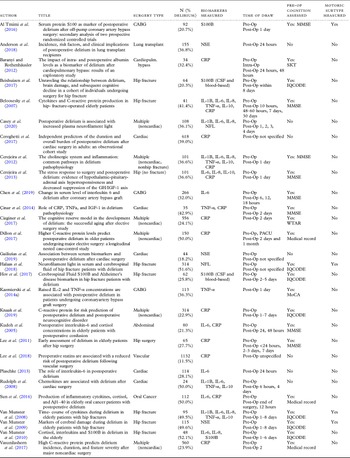
We included 28 POD biomarker studies in the meta-analysis. The overall age of participants ranged from 50 to 83 years old (Control mean: 71.35, SD: 8.56; Delirium mean: 74.71, SD: 7.08). Table 1 depicts the demographics and clinical characteristics of the 28 studies (Al Tmimi et al., Reference Al Tmimi2016; Anderson et al., Reference Anderson2018; Baranyi and Rothenhäusler, Reference Baranyi and Rothenhäusler2012; Beishuizen et al., Reference Beishuizen, Scholtens, van Munster and de Rooij2017; Beloosesky et al., Reference Beloosesky2007; Casey et al., Reference Casey2020; Cereghetti et al., Reference Cereghetti2017; Cerejeira et al., Reference Cerejeira, Nogueira, Luís, Vaz-Serra and Mukaetova-Ladinska2012; Reference Cerejeira, Batista, Nogueira, Vaz-Serra and Mukaetova-Ladinska2013; Chen et al., Reference Chen2019; Çinar et al., Reference Çinar, Balikçi, Sertoğlu, Mehmet, Serdar and Özmenler2014; Cizginer et al., Reference Cizginer2017; Dillon et al., Reference Dillon2017; Gailiušas et al., Reference Gailiušas, Andrejaitienė, Širvinskas, Krasauskas, Švagždienė and Kumpaitienė2019; Halaas et al., Reference Halaas2018; Hov et al., Reference Hov2017; Kazmierski et al., Reference Kazmierski2014b; Knaak et al., Reference Knaak2019; Kudoh et al., Reference Kudoh, Takase, Katagai and Takazawa2005, Lee et al., Reference Lee, Hwang, Wang, Chee, Baeg and Kim2011; Reference Lee, Lee, Park, Kim, Kim and Park2018; Plaschke, Reference Plaschke2013; Rudolph et al., Reference Rudolph2008; Sun et al., Reference Sun2016, van Munster et al., Reference van Munster, Korevaar, Zwinderman, Levi, Wiersinga and De Rooij2008; Reference van Munster, Korse, de Rooij, Bonfrer, Zwinderman and Korevaar2009; Reference van Munster2010; Vasunilashorn et al., Reference Vasunilashorn2017). Sample sizes of the studies were highly variable (mean number of delirious subjects = 57.96, SD = 54.68; mean number of nondelirious subjects = 140.36, SD = 201.72). Combined, cardiac surgeries (n = 9), and hip fracture repair (n = 10) represented 2/3 of the studies.
Characteristics of postoperative delirium biomarker studies

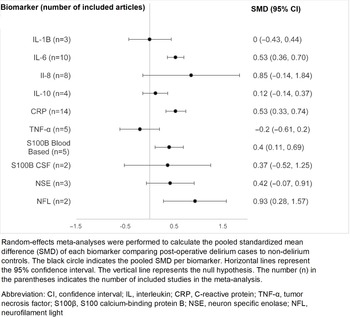
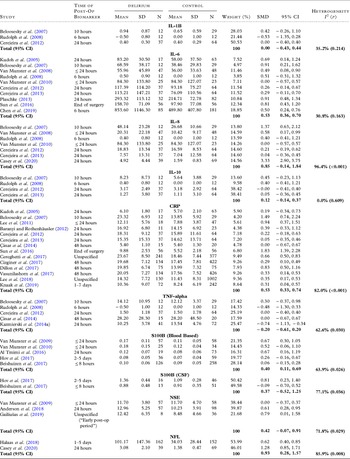
The mean (SD) NOS and REMARK scores were 6.83 (SD: 1.73) and 16.13 (3.78), respectively, suggesting these articles were of moderate quality. Figure 1 and Table 2 depict the results from meta-analysis of the association between biomarkers and POD. These included blood-based biomarkers (interleukin (IL)-1B, IL-6, IL-8, IL-10, C-reactive protein (CRP), tumor necrosis factor (TNF)-α, S100B, neuron specific enolase (NSE), and neurofilament light chain (NfL)) and cerebrospinal fluid (CSF) biomarkers (IL-8 and S100B). Although there was an insufficient number of studies for amyloid (n = 3) and tau (n = 1) biomarkers to conduct a meta-analysis, the findings of these studies are briefly summarized below.
POD biomarker meta-analysis graph.

Random-effects meta-analysis of studies regarding the association between postoperative delirium and biomarkers

Studies are ordered by the year of publication.
CI = confidence interval; SD = standard deviation; SMD = standardized mean difference.
Amyloid and Tau biomarkers
Three articles examined amyloid biomarkers, CSF Aβ1–42, amyloid PET scan, and the blood-based biomarker Aβ1–40. Idland et al. (Reference Idland2017) found that CSF Aβ1–42 levels were lower in nondemented patients who had delirium than those who did not have delirium. CSF was collected at the time of spinal anesthesia; the results of amyloid biomarkers, however, were from patients those who had delirium preoperatively and then developed delirium postoperatively. Rolandi et al., (Reference Rolandi2018) found that the postoperative amyloid PET scan in 5 patients with POD were all negative, although it was positive in 6 out of 11 patients who did not develop POD. Finally, Sun et al. found that at postoperative day 2, blood-based levels of Aβ1–40 were significantly more elevated (Wilson et al., Reference Wilson2020). Of note, although the blood-based biomarker Aβ1–40 was intended by the authors to measure the role of amyloid pathogenesis in POD, this was not listed as a widely accepted biomarker to measure aggregated Aβ. Due to the types of amyloid biomarkers collected and the methodological issues noted, a meta-analysis of the amyloid biomarkers was not conducted.
In the one article which measured tau biomarker, CSF P-tau was slightly elevated in nondemented patients who had delirium compared to those without delirium, although this was of borderline significance (p = 0.06; van Munster et al., Reference van Munster, Korse, de Rooij, Bonfrer, Zwinderman and Korevaar2009). However, the results of phosphorylated tau biomarkers in delirium group combined findings from patients those who had delirium preoperatively and then developed delirium postoperatively. Since there was only one tau biomarker study, a meta-analysis of the tau biomarker was not conducted.
Inflammatory biomarkers
Analyses identified two inflammatory biomarkers to be positively associated with POD. Specifically, IL-6 and CRP showed a significant relationship to delirium incidence (IL-6 n = 10, SMD: 0.53, 95% CI: 0.36–0.70; CRP n = 14, SMD: 0.53, 95% CI: 0.33–0.74). In contrast, analyses did not identify a significant association between POD and other inflammatory biomarkers. Specifically, no relationships were observed with IL-1B (n = 3, SMD: 0.00; 95% CI: −0.43–0.44), IL-8 blood-based levels (n = 7, SMD: 0.85; 95% CI: −0.14–1.84), and IL-10 (n = 4, SMD: 0.12; 95% CI: −0.14–0.37).
Neuronal injury biomarkers
The analyses identified two neuronal injury biomarkers that were positively associated with POD. Specifically, S100B blood-based levels and NfL showed a significant relationship to delirium prevalence (S100B blood-based n = 5, SMD: 0.40, 95% CI: 0.11–0.69; NfL n = 2, SMD: 0.93, 95% CI: 0.28–1.57). In contrast, no significant relationships were observed with TNF-α (n = 5, SMD: −0.20; 95% CI: −0.61–0.20), S100B CSF levels (n = 2, SMD: 0.37; 95% CI: −0.52–1.25), and NSE (n = 3, SMD: 0.42; 95% CI: −0.07–0.91). Of note, for the purposes of this study, S100B was utilized as a neuronal injury biomarker, though it has been linked to a variety of neuronal biomarkers, included blood-brain barrier breakdown.
Heterogeneity of studies
As shown in Table 2, a majority of analyses were impacted by significant study heterogeneity. Namely, studies of IL-8 levels (I 2= 96.4%, p < 0.001), CRP (I 2 < 82.0%, p = 0.001), TNF-α (I 2 = 62.6%, p = 0.030), blood-based S100B levels (I 2 = 63.9%, p = 0.026) and CSF levels (I 2 = 77.1%, p = 0.036), NSE (I 2 = 71.8%, p = 0.029), and NfL (I 2 = 85.9%, p = 0.008).
Discussion
The ATN(X) framework was developed as a conceptual biological framework to categorize both current and future disease state biomarkers (Jack et al., Reference Jack2018). Our meta-analysis suggests that we are still in the early stages of using the ATN(X) framework to characterize the complex relationship between POD and ADRD. One major gap identified through our project is the relatively small number of studies measuring amyloid and phosphorylated tau as disease state markers of POD. Meta-analysis could not be conducted on the amyloid biomarker category studies since they measured different biomarkers from this category. The data that were available for the amyloid biomarkers were concerning for methodological issues. One of the studies that found a difference in amyloid biomarkers between the nondelirious and delirious patients but had methodological concerns in terms of its approach for POD and timing of the CSF in relation to the development of delirium (Idland et al., Reference Idland2017), and the other studies that found a difference did not collect an amyloid biomarker listed in the Jack et al., paper (van Munster et al., Reference van Munster, Korse, de Rooij, Bonfrer, Zwinderman and Korevaar2009). The third paper which did collect the amyloid PET scan during the postoperative phase did not find a difference between nondelirious and delirious patients (Rolandi et al., Reference Rolandi2018).
The most well-studied disease state biomarkers in the POD literature have focused predominantly on neuronal injury (N) and inflammation (X) categories, but even these findings are inconsistent. Several inflammatory biomarkers (IL-6 blood-based and CRP blood-based levels) and neuronal injury biomarkers (S100B blood-based and NfL blood-based levels) were significantly elevated in those patients with POD compared to those without POD. Of note, three of these biomarkers IL-6, CRP, and NfL have moderate to large-size effects. While the evidence for IL-6 and CRP is fairly consistent with the current hypothesis that inflammation being a contributor to neurodegeneration after POD, the examination of NfL as a marker of postoperative neurodegeneration from delirium requires further investigation. However, not all inflammatory (blood-based levels for IL-1β, IL-8, IL-10, and TNF-α) and neuronal injury biomarkers (S100B CSF and NSE blood-based levels) were significantly associated with POD. This suggests that although the processes of inflammation and neuronal injury are key to the pathophysiology of POD and subsequent ADRD, only specific disease state biomarkers may be altered in POD.
The current model of POD proposes that surgery triggers inflammation, in which tissue macrophages and blood monocytes become activated and secrete various mediators, such as IL-1, IL-1β, IL-6, and TNF-α (Wilson et al., Reference Wilson2020). Peripheral inflammation leads to microglial activation, and this state of neuroinflammation can lead to neuronal dysfunction, which clinically manifests as delirium. Our findings only partially support this model; the strongest evidence is for certain peripheral inflammatory (IL-6 and CRP) and blood–brain barrier breakdown (S100B blood-based levels) being linked to POD. Our meta-analysis also supported the importance of neurodegeneration (NfL) in POD, but this finding was compromised by the small number of studies.
The connection between POD and ADRD is even less well understood. It is hypothesized that persistent neuronal dysfunction leads to persistent neuronal injury, which then manifests clinically as ADRD. Nevertheless, it is not well understood whether the pathophysiology of POD, most notably the dysregulated inflammatory response, trigger, accelerate, or unmask an underlying neurodegenerative process which may eventually lead to ADRD. The use of the ATN-(X) framework to characterize the interrelationship between POD and ADRD can lay the foundation for a systematic process to answer these complex relationships.
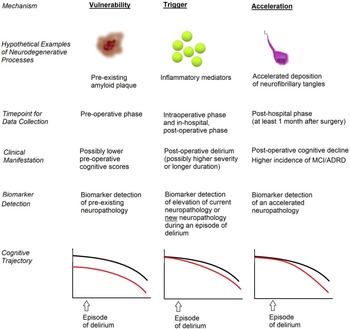
Figure 2 depicts possible mechanisms about the interrelationship between the pathophysiology of POD and ADRD—which could possibly coexist in the AT(N)-X framework. The first possible mechanism is that there is underlying vulnerability to ADRD (such as preexisting amyloid plaques) and with an outside stressor, such as surgery, the neurodegeneration manifests as POD, and subsequent postoperative cognitive decline reflects the preepisode trajectory of cognitive decline leading to ADRD that would have occurred independent of the episode of POD (Wilson et al., Reference Wilson2020). The second possible mechanism is that POD may be associated with an increase in the preexisting neurodegenerative process or a de novo neurodegenerative process happening during the episode of delirium. Hypothetical examples include transient elevation of Aβ from anesthesia during surgery or new-onset inflammation causing neuronal injury and death, leading to ADRD (Cavallari et al., Reference Cavallari2016; Choi et al., Reference Choi2012). The third possible mechanism is that POD may accelerate a preexisting neurodegenerative process (such as faster postoperative deposition of neurofibrillary tangles; Cunningham et al., Reference Cunningham2009; Davis et al., Reference Davis2015). Figure 2 outlines how studies can test these models by using concomitant collection of cognitive data and biomarkers using the AT(N) framework during the preoperative, intra-operative (or within 24 hours postoperative), postoperative, and long-term recovery phases. Based on our Table 1, we can see that many studies included preoperative biomarkers, only a few articles examined the long-term recovery phase, approximately 1 month or longer after surgery (n = 2). These findings suggest that having delirium biomarker studies with an extended timeline beyond the usual prehospital or in-hospital phases are crucial to deeper understanding of POD and ADRD.
ATN-(X) framework characterizing interrelationship between POD and ADRD.

Earlier studies have examined the relationship between preoperative ADRD biomarkers and POD. While some studies suggest a role for preexisting Aβ and tau pathology (both phosphorylated and total tau measurements) increasing the risk of POD, this has not been a consistent finding (Cunningham et al., Reference Cunningham2019; Witlox et al., Reference Witlox2011). Likewise, various studies (n = 18) have examined whether a preoperative inflammatory state may predispose to POD, but a previous systematic review found that in noncardiac surgical patients, only preoperative CRP was associated with POD (Ayob et al., Reference Ayob, Lam, Ho, Chung, El-Beheiry and Wong2019). There were too few studies to comment on other blood-based or neuroimaging biomarkers. Our meta-analysis of ADRD biomarkers as “disease state markers for delirium” showed findings similar to the literature for preoperative ADRD biomarkers. CRP appears to be both a marker of increased risk of delirium as well as a disease state marker for delirium. The finding of IL-6 as a disease state marker for delirium is consistent with our other meta-analysis of ICU delirium studies which also showed IL-6 was associated with ICU delirium. On the other hand, the role of neuronal injury markers appears to be more complicated. Although blood-based levels of S100B were associated with POD, S100 CSF levels were not, possibly because there were so few studies.
One particularly promising category of biomarker in the ATN(X) framework which will be especially crucial to understanding the relationship between POD and ADRD is the neuronal injury category. Two additional studies published after the timeframe of this meta-analysis supported our initial findings about the importance of neurodegeneration biomarkers in POD (Ballweg et al., Reference Ballweg2020; Fong et al., Reference Fong2020). One study found that NfL remained persistently elevated in those with long-term postoperative decline (Fong et al., Reference Fong2020), whereas another study found that total tau levels correlated with severity of delirium and then resolved with the delirium episode (Ballweg et al., Reference Ballweg2020). Understanding whether certain neuronal injury markers could be disease state biomarkers for POD, postoperative ADRD, or both will be advance our understanding of the pathophysiology which is unique to POD.
Strengths and Limitations
The major strength of our study is that it is the first meta-analysis of POD biomarker studies using the AT(N)-X framework. This analysis points to the need to collect more data about amyloid and tau biomarkers, as well as certain neuronal injury biomarkers (such as GFAP, NfL, and total tau) that are well-known to be linked to ADRD. Indeed, since the majority of the studies were conducted prior to the proposed framework, many of them do not concurrently measure all of AT(N) biomarkers within a single cohort.
There were a number of limitations to this study. First, due to the lack of random allocation, the influence of confounding variables cannot be completely ruled out and thoroughly assessed. Second, there were significant discrepancies in study numbers, with most analyses limited to only a few studies. This means that analyzing subsets of surgical populations (cardiac vs noncardiac) was not possible, which limits our understanding as to whether specific types of surgeries may be predisposed to certain pathologies, for example, vascular pathology with cardiac surgeries. Third, there is the possibility of type 1 error due to multiple outcome assessments.
As mentioned previously, the heterogeneity of study methodologies may have impacted some overall outcomes, particularly with our analyses for blood-based IL-8, CRP, TNF-α, S100B blood based and CSF, NSE, and NFL levels. One issue could be the analysis of the time points. There was inconsistent reporting of time points, making a meta-analysis of the time-dependent data very difficult. Since certain studies reported the results at only one time point, we aimed to maximize statistical power to identify potential predictors based on overall results as the main study purpose. For a few studies with available data on multiple time points, we included the only one time point data with significant results or larger sample sizes in the final meta-analysis for the hypothesis testing purpose. Also, while timing of the blood draw may have contributed to the heterogeneity, other factors such as differences in clinical characteristics also likely contributed. For example, inflammatory markers may also be affected by other factors, including timing of the blood draw in relationship to delirium severity and circadian rhythms (with inflammatory levels being higher in the evening).
The methodologies for longitudinal sampling of biomarkers in relation to delirium were of variable quality in the studies we included for meta-analysis. Most studies only looked at the presence or absence of POD, but only a few examined the association of biomarkers with delirium severity or duration. Demonstration of a dose–response relationship (i.e. correlation of biomarker levels with delirium severity or duration) would have strengthened our analyses. Likewise, there were limitations in terms of the preoperative data. Since we did not have enough data to measure pre and postoperative change, our observational evidence only indicates a causal relation but cannot demonstrate causality, particularly between delirium and inflammation. Also, we cannot exclude the possibility that some of our observations may be due to the presence of preclinical ADRD pathology prior the episode of delirium. Conversely, there were not enough studies which measured biomarkers 1 month or later after surgery to provide much needed data about whether ADRD disease state biomarkers in those affected by POD are distinct. It is worth noting that in the proposed best practices for examining delirium biomarkers, biomarker assessment should be timed to be collected at delirium onset and resolution, and in the case of populations who are at risk for delirium (such as POD populations), prior to delirium onset (Amgarth-Duff et al., Reference Amgarth-Duff, Hosie, Caplan and Agar2020).
Conclusion
In summary, this meta-analysis identified biomarkers associated with neuroinflammation and neuronal injury that were positively associated with POD. Specifically, higher blood-based levels of IL-6, CRP, S100B, and NfL were associated with POD. As with previous literature on this topic, this meta-analysis identified several limitations to current POD biomarker research, including a need for more systematic methodology in biomarker identification and collection, as well as delirium documentation. Concurrent characterization of delirium biomarkers within a single cohort using the AT(N)-X framework may help future researchers understand the complex, bidirectional interrelationship between delirium and ADRD. Finally, future studies could incorporate multimodal measurements such as neuroimaging and electroencephalography methods outlined by the AT(N) framework with blood and CSF-based biomarkers to provide a multidimensional evaluation of brain function and neuronal injury throughout the perioperative timeframe.
Funding
SW is supported by NIA 2P30AG010133 and K23AG062555-01. RDS is supported by NIA R01 AG063849-01 and NINDS R01NS117901-01. BK is supported by NHLBI R01HL131730, NIA R01AG055391, and NIA R01AG067631-02.
Competing interests
There are no competing interests.
Authorship roles
All authors have: (1) agreed on the journal to which the article will be submitted; (2) reviewed and agreed on all versions of the article before submission, during revision, the final version accepted for publication, and any significant changes introduced at the proofing stage; and (3) agree to take responsibility and be accountable for the contents of the article. SW was involved in the conception, study design, execution, analysis, and interpretation and drafted the paper. RG was involved in the conception, analysis, interpretation, and drafted the paper. YS was involved in the study design, analysis, and interpretation and substantially revised the paper. CC was involved in the execution and analysis and substantially revised the paper. SK was involved in the conception and study design and critically reviewed the paper. GR was involved in the conception and execution and critically reviewed the paper. RS was involved in the study design, interpretation, and critically reviewed the paper. BK was involved in the conception, study design, and critically reviewed the paper.
Data availability
Data supporting the results reported in the manuscript can be available upon request.
Supplementary material
The supplementary material for this article can be found at https://doi.org/10.1017/S104161022100274X.