Twin-to-twin transfusion syndrome is a severe complication of monochorionic twin pregnancy, and results from circulatory disequilibrium caused by vascular anastomosis between the circulation of the donor and the recipient.Reference Duncan, Denbow and Fisk 1 Although the mortality of severe twin-to-twin transfusion syndrome has been reported to be 90% without any treatment,Reference Haverkamp, Lex, Hanisch, Fahnenstich and Zerres 2 the introduction of foetoscopic laser photocoagulation has dramatically improved mortality and neurological outcomes.Reference Sago, Hayashi and Saito 3 , Reference Senat, Deprest, Boulvain, Paupe, Winer and Ville 4 Several reports have documented the haemodynamic changes and subsequent complications observed after foetoscopic laser phtocoagulation;Reference Sago, Hayashi and Saito 3 , Reference Senat, Deprest, Boulvain, Paupe, Winer and Ville 4 however, there are few longitudinal follow-up reports of cases involving complications associated with the procedure.Reference Senat, Deprest, Boulvain, Paupe, Winer and Ville 4 In this report, we present the case of a donor twin with right ventricular failure associated with a high echoic right ventricular wall on echocardiography after foetoscopic laser photocoagulation.
Case report
A 35-year-old primigravida was referred to our hospital at 8 weeks of gestation due to twin pregnancy. At 17 weeks of gestation, the maximum vertical pocket in the recipient twin was 8.1 cm, whereas that in the donor twin was 1.3 cm, and we diagnosed the foetus as having twin-to-twin transfusion syndrome. In addition, foetal echocardiography revealed that the bladder of the donor was empty. It also showed pulsations in the umbilical vein and reverse flow of the ductus venosus in the recipient twin, although bilateral ventricular functions were preserved. Therefore, we judged the twin-to-twin transfusion syndrome stage to be Quintero stage III and planed foetoscopic laser photocoagulation.Reference Quintero, Dickinson and Morales 5
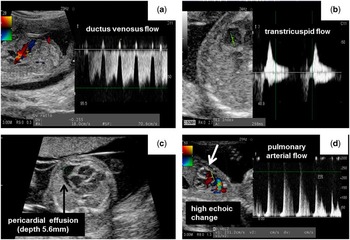
Several arterio venous anastomoses were coagulated without any complications, such as infection, on 18w1d of gestation. In the recipient, the retrograde flow of the ductus venosus returned to anterograde, and pulsations in the umbilical vein disappeared 2 days after the procedure without any other findings. Regarding the donor, ventricular functions were normal without any morphological abnormalities before the procedure. The direction of flow of the ductus arteriosus was right to left, flow pattern of tricuspid annulus showed 2-peaks pattern, pulmonary artery flow was antegrade, and no tricuspid regurgitation was detected. During the first 3 days after the procedure, no haemodynamic changes such as ventricular dysfunction or enlargement were detected; however, a reverse ductus venosus flow and a 1-peak pattern of the transtricuspid flow were detected at 19w1d of gestation (Fig 1a and b). At 20w1d of gestation, left-to-right shunt became dominant in the ductus arteriosus, with an extremely decreased forward flow from the right ventricle. Moderate tricuspid regurgitation appeared and pericardial effusion was confirmed (Fig 1c). At 21w1d of gestation, the inner layers of the right ventricle wall became highly echoic, and there was no forward flow in the pulmonary artery (functional pulmonary artery). Pulmonary valve regurgitation appeared, and the tricuspid regurgitation became severe (Fig 1d). At 24w1d of gestation, however, the forward flow in the pulmonary artery returned to detectable levels, and the pulmonary valve regurgitation disappeared without treatment. A normal spontaneous delivery occurred at 35 weeks of gestation.
Donor’s echocardiography during the foetal period. ( a ) At 19w1d of gestation, the flow of ductus venousus reversed. ( b ) One peak pattern of transtricuspid flow was detected. ( c ) At 20w1d of gestation, pericardial effusion was confirmed. ( d ) At 21w1d of gestation, the wall of right ventricle became high echoic and pulmonary arterial flow changed to the reverse direction.

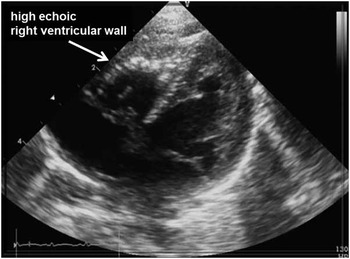
The birth weight of the donor twin was 1938 g, whereas the weight of the recipient twin was 1918 g. After birth, the donor was breathing spontaneously. The oxygen saturation was 79% on room air and improved to 82% with supplemental oxygen at FiO2 0.3. The heart rate was 112 beats/minute, and the blood pressure was 51/35 mmHg. The cardio-thoracic ratio was 54% on a chest X-ray. No arrhythmia was detected. Echocardiography showed a high echoic wall of the right ventricle (Fig 2). The transtricuspid flow velocity wave forms showed a 1-peak pattern, which indicated right ventricular diastolic dysfunction. Echocardiography also demonstrated right-to-left shunt through the foramen ovale, which was considered to have resulted from right ventricular dysfunction and consequently have caused the patient’s cyanosis.
Donor’s echocardiography after birth. The right ventricular wall remained high echoic, and both systolic and diastolic right ventricular functions were impaired; however, right ventricular function has been gradually recovering.

The donor’s cyanosis gradually disappeared, and we stopped oxygen therapy at 27 days of age. The cardio-thoracic ratio decreased to 49%, the transtricuspid flow velocity wave forms started to show a 2-peaks pattern, and the cyanosis thereafter disappeared. The donor was discharged on day 29 after birth. The twins are currently 1-year old with normal growth and development, although the donor’s high echoic right ventricular wall change remains on echocardiography.
Discussion
It has been reported that some recipient twins have pulmonary stenosis or lethal cardiomyopathy in addition to cardiomegaly and hydrops foetalis observed at the end stage of severe twin-to-twin transfusion syndrome.Reference Zosmer, Bajoria, Weiner, Rigby, Vaughan and Fisk 6 Meanwhile, a donor twin with coarctation of the aorta and hypoplastic arch has also been reported.Reference van den Boom, Battin and Hornung 7 In the present case, hydropic changes with a high echoic wall of the right ventricle were detected in the donor. There are several possible pathological reasons for this characteristic finding.
First, Rudolph reported that the aortic isthmus acts as a site of functional separation and that afterload increase in the descending aorta affects the right ventricle.Reference Rudolph 8 Therefore, arterial resistance increase caused by foetoscopic laser photocoagulation might have influenced the right ventricle, leading to pathological wall change. Second, 27.0% of donors transiently develop hydropic signs after the procedure without any morphological change in the myocardium.Reference Gratacos, Van Schoubroeck and Carreras 9 In addition to increased arterial resistance, cardiac volume overload secondary to relative hypervolaemia and impaired diuresis were considered to be the reasons for this phenomenon.Reference Mahieu-Caputo, Dommergues and Delezoide 10 Third, high echoic change was observed in the inner layers of the right ventricle, which indicated that the haemodynamic change was not due to coronary artery disease but due to the imbalance of oxygen supply and demand by increases in the preload and afterload for the right ventricle.
We consider that the present patient was barely able to cope with the dramatic haemodynamic changes caused by foetoscopic laser photocoagulation, although the hydropic signs persisted for 6 weeks. After birth, right ventricular function recovery reduced right atrial pressure, and shunt flow direction at the foramen ovale subsequently turned from left to right, resulting in an improvement in oxygenation.
In conclusion, to the best of our knowledge, this is the first report of a donor case of right ventricular failure associated with a high echoic ventricular wall after foetoscopic laser photocoagulation. Although the present patient was able to overcome drastic haemodynamic changes and was weaned from transient oxygen administration after birth, providing careful follow-up is essential, as pathological wall change in the right ventricle has the potential to cause arrhythmia or right ventricle failure in the future.
Acknowledgements
The authors thank the doctors at the National Center for Child Health and Development, especially Haruhiko Sago, Satoshi Hayashi, Masahiro Sumie, and Rika Sugibayashi. The authors also thank doctors at the Kitasato University Hospital, especially Yuji Kanai, Shoko Kawano, Sumito Kimura, and Hisashi Ando.
Financial Support
This research received no specific grant from any funding agency, commercial, or not-for-profit sectors.
Conflicts of Interest
None.