

1. INTRODUCTION
Høyanger is a well-known location in the sociolinguistic world. In literature about dialect contact, Høyanger's linguistic history is often presented as a golden example of new dialect formation, where the strong influence of in-migrants’ languages is clearly demonstrated. However, the basis for our knowledge about this process has until recently been rather limited. The original source of information about the Høyanger dialect (Omdal Reference Omdal1977) is a brief paper based on empirical data collected by a group of dialectology students. Later, Peter Trudgill discussed the paper in depth in his important book on dialect contact (Trudgill Reference Trudgill1986), where he used examples from Høyanger to support his ideas on new dialect formation. Today these ideas are widespread and have been further developed and discussed by Peter Trudgill himself as well as by a number of other sociolinguists (cf. Siegel Reference Siegel and Smith2001; Kerswill Reference Kerswill, Chambers, Trudgill and Schilling-Estes2002; Trudgill Reference Trudgill2004).
Thus, Høyanger has become a point of reference for researchers from all over the world who are dealing with new dialect formation. The description above, however, indicates the need for a more extensive study. This was the point of departure for the research project presented in this article, where central lines of the dialect development are studied against a background of constantly changing sociocultural relations within the local community. Qualitative interviews and linguistic data from speakers who represent successive generations are compared to recordings on file in the dialect archives and the accompanying descriptions, giving the study a real-time perspective.Footnote 1 Because the Høyanger society has been characterized by rapid changes, it stands out as a cultural as well as a linguistic laboratory. It is well suited once again to shed new light on dialect contact and dialect change.
2. THE HISTORY OF HØYANGER
In 1916 an aluminium factory was established in Høyanger. Migrants came from all over Norway and some also from abroad. From originally being a small rural community with 124 inhabitants, the place fast developed into a modern industrial town. In 1930, the number of inhabitants was 2220 – a dramatic increase which in itself suggests the dimensions of the cultural, social and linguistic changes that were taking place. Literally, a new society was built around the factory. Thereby, norms, values and social patterns of the industrial society gradually displaced more traditional, rural ways of living.
As elsewhere in industrial towns, social class distinctions were evident in Høyanger in the years before World War II. They also play a central role in descriptions of language variability and dialect development: Most of the unskilled industrial workers moving to Høyanger were from the neighbouring areas. They brought their western dialects with them. Additionally, a small group of natives of Høyanger maintained the local dialect and the traditional rural culture. Most of the industrial upper class, on the other hand, were recruited from similar industries in the eastern parts of Norway. They soon obtained status positions outside the factory gates as well. Consequently, their eastern varieties of Norwegian gained local prestige in the new society. This linguistic prestige was buttressed by the fact that the South-Eastern and greater Oslo dialects enjoyed, and still enjoy, a high status throughout Norway.Footnote 2 Thereby, a South-Eastern standard influence made itself felt both at the local and at the national level. In Høyanger, this made convergence towards a standardized eastern variety common for a period after the industrial establishment, in a sense eradicating the speakers’ personal or geographical background. Speakers could, for example, use a South-Eastern variety or standardized features, even if they had spent all their lives in Høyanger.
The industrial workers of Høyanger soon developed a strong political identity that countered the power of the ruling elites. The increasing disparity between different groups of inhabitants was evident, not least through separate residential areas. Leaders, workers and natives also had their own voluntary organizations and meeting places. For example, Høyanger had two local sport clubs, and hard class struggles were fought at the football ground.
After World War II, the social and linguistic development of Høyanger took a new turn, as people gradually built a common culture. The social differences did not fully disappear, but we could say that they became a more integrated part of the industrial culture. At the same time, family connections and local references grew stronger and tied the inhabitants together – and to the place. As a result, the growth of the industrial culture connected different social layers, and gradually Høyanger became increasingly different from adjacent rural villages. The development towards a more homogenous culture is also evident in the dialect formation, which will be discussed below.
The story about Høyanger reflects the formation of a new culture as well as a new dialect, through simultaneous and mutually dependent processes. From a social constructionist perspective (see e.g. Berger & Luckman Reference Berger and Luckmann1967; Gergen Reference Gergen1994, Reference Gergen2001), we can understand this as a result of social changes taking place in, and coloured by, the specific local context. Language plays a central part here, not only as a means of communication, but also as a constitutive element that may contribute to keeping society together. The new dialect of Høyanger contained elements of the traditional local society as well as the different in-migrants’ languages, and it was influenced by various geographical, cultural and social circumstances. Thereby, it became a medium of the new composite cultural unit.
3. NEW DIALECT FORMATION IN HØYANGER: THEORETICAL AND METHODOLOGICAL PERSPECTIVES
New dialect formation is a result of contact between speakers of different dialects within a geographic area, due to increased mobility and migration. The resulting process is often referred to as koineization, describing the development of a common, more uniform language (see Siegel Reference Siegel1985). Trudgill (Reference Trudgill1986:107) describes koineization as a focusing process that takes place in the new linguistic situation through a reduction of available equivalent forms, levelling of marked features, and different types of simplification. Siegel (Reference Siegel and Smith2001:176) presents a broader and more dynamic definition of a koine, understood as ‘a stabilized contact variety which results from the mixing and subsequent levelling of features of varieties which are similar enough to be mutually intelligible’. He stresses that koine formation occurs as a result of increased interaction and integration among speakers of the actual varieties. This means that social and cultural perspectives are more prominent within this approach than Trudgill's.
The formation of so-called immigrant koines, as in Høyanger, is the result of large-scale migration and intense contact between various dialects in new settlements, followed by dramatic cultural and linguistic changes. The development of an immigrant koine is usually described in three distinct stages; these stages may also coincide with the three generations succeeding the initial contact situation. The dialect development of Høyanger is compatible with established theories of koineization. This is shown below, through a brief listing of some characteristics of the stages and generations of the process (I–III), based on sources such as Siegel (Reference Siegel1985, Reference Siegel and Smith2001), Trudgill (Reference Trudgill1986) and Kerswill (Reference Kerswill, Chambers, Trudgill and Schilling-Estes2002), adjusted in this context to fit the experiences from the Høyanger study.
I. At the initial stage – the contact phase – people from different places and with different dialects met. Most of the new inhabitants kept their own dialects, but already at this stage linguistic levelling processes started to work. Consequently, some of the most salient features of the local dialects disappeared.
II. The second stage – the chaos period – was characterized by extensive diversity and variability. Dialects and sociolects met in complex and versatile situations, and different groups of speakers negotiated language forms as well as social positions. The levelling was extensive at this stage, which gradually led the language development towards a more homogeneous norm.
III. At the third stage – in the focusing phase – a new common dialect crystallized. This consolidation process took place primarily among the grandchildren of the first inhabitants.
The youngest informants from the Høyanger study represent generation IV after the initial contact situation. These speakers make it possible to discuss further development tendencies, but it is too early yet to define this generation as making up a separate stage.
As we often lack evidence from the early stages, studies of linguistic development in new towns have concentrated on the result of the koineization, i.e. the koine itself, not on the process. The present study of Høyanger, on the other hand, is based on data from several older studies, which include different generations of speakers and different stages of the new dialect formation. The old material covers generation I–III, while new fieldwork is focused on generations II–IV in the model presented above. Together, this material gives valuable insights into the process of change. It is thus possible to study the dialect development from both a diachronic and a synchronic point of view, and to let different time perspectives complement each other. As regards the interesting and decisive second stage of the koineization process, the entire data set contains data from this generation collected at various points in time, namely in 1956, 1975 and 2001, which gives the study a real-time perspective of 45 years. Interviews with speakers who took part in the older studies also provide information on language development at the level of the individual.
A methodological problem is the use of data from traditional dialectology within a modern sociolinguistic framework. Most of the old material was collected by asking standardized questions about single words, and it sought primarily to describe phonological and morphological systems. The old material is thus quite far from this study's qualitative approach to linguistic variation and change. Nevertheless, new qualitative interviews with speakers from the oldest generation make it possible to place the word lists and system descriptions in a broader sociolinguistic context. In addition to insights into different linguistic strategies, the generation II informants give essential information on everyday life in the young industrial society, which make the descriptions of the social developments more complete. This social and cultural frame of the dialect contact, also mentioned in Siegel's definition above, is given weight in this study, where the new dialect formation is seen as part and parcel of the social construction of the new industrial society.
4. SECOND-GENERATION SPEAKERS
The first meetings between the different in-migrants and the locals was the starting point for the new dialect formation in Høyanger. A multiplicity of contact situations, face-to-face interaction and acts of accommodation gave the linguistic development a new dynamic. Still, the linguistic outcomes were most obvious among the in-migrants’ children – the first generation that grew up in the new industrial society. Second-generation speakers represent the most interesting stage of koineization; they may give an impression of the diversity and the complex levelling processes that took place in ‘the chaos period’. Some of the oldest informants in this study have not changed their traditional dialect significantly. In this way they inadvertently demonstrate the contrasts between the local western dialect on the one hand and the different in-migrants’ dialects on the other. Generation II speakers who use different kinds of mixing strategies also illustrate the standard's influence on the local dialect.
Two of the oldest informants, a man and a woman from generation II, represent extreme points of different dialects and social distinctions. Consequently, they illustrate the wide range and complexity of the language situation at this stage, and the linguistic space within which the new dialect formation took place. These two informants, their background and their language use are briefly presented below.
The first informant, Mr P, was 81 years old at the time of recording, and has spent all his life at his family's farm in Høyanger. He feels very connected to his home town, and takes great interest in local history. These values are reflected in his traditional dialect, which has a distinctive local character that contains several older forms and features, which differentiates it from the modern Høyanger dialect. Among these characteristics is the diphthongization of Old Norse /aː/ as in båt ‘boat’, pronounced [bɑʊːt]. This is a characteristic, traditional feature of the Sogn area, whereas the levelled monophthongized variant, [bɔːt] is found all over Norway. Studies of the older language material from Høyanger show that this kind of diphthongization was levelled out shortly after the beginning of industrialization (stage II). In contemporary Høyanger, it may therefore be described as a form of extra strong salience (Trudgill Reference Trudgill1986:37). Other salient features from Mr P's language that did not become a part of the new Høyanger dialect, is the dissimilation of Old Norse consonant combinations, several traditional vowel qualities, pronouns, question words and numerous lexical variables (see Solheim Reference Solheim2006:278 for further details). Altogether, Mr P's extensive use of traditional linguistic features makes him a representative of the pre-industrial society and the traditional rural dialect (see early descriptions by Larsen Reference Larsen1926; Vassenden Reference Vassenden1956).
The second informant, Ms I, who was 76 years old at the time of the recording, comes from a completely different background. This is also reflected through a different language use. Ms I's parents were in-migrants with high social status, and she grew up among industrial leaders and engineers in the upper-class area called ‘the Villa Town’. Like her parents and most of the inhabitants in this neighborhood, she spoke a standardized eastern Norwegian variety, which was generally regarded as a prestige variety at a national as well as the local level. Although Ms I has spent all her life in Høyanger, and grew up in a period characterized by the dramatic linguistic change here, her language use does not reflect this. She still speaks her eastern dialect, almost without any local or western traces. This may be illustrated by the use of marked eastern forms with great symbolic value, such as the 1st person pronoun jeg ‘I’, and the negation ikke ‘not’, in contrast to the western variants, eg and ikkje.
Ms I's standardized eastern dialect represents the most influential component in the linguistic melting pot. Mr P's language, on the other hand, represents the traditional dialect that was the starting point of the entire koineization process. Even though the two informants’ linguistic and cultural backgrounds are different, they actually belong to the same social sphere today. They often meet as neighbours and friends, but their awareness of the considerable linguistic differences are rarely a topic of conversation. Both of them incidentally consider their language as being a natural part of the language development and the current linguistic situation of Høyanger. Consequently, they both represent a part of Høyanger's local history.
Among the other informants from the second generation, we find great linguistic variability in addition to interesting intermediate strategies. One such strategy combines a western Norwegian intonation with a standardized eastern Norwegian vocabulary. For example, this strategy is used by a Høyanger native whose mother and father came from eastern and western parts of the country, respectively. In other situations, the parents’ social background was more important, and children from the upper social class could use eastern varieties even if both parents came from the Sogn area. Through data from qualitative interviews, it is possible to correlate certain linguistic strategies from this generation to individual backgrounds, interests, occupations and social situations – as illustrated in Mr P's and Ms I's stories. This interesting phenomenon characterizes the second stage of the koine formation. In general, it may also give insights into how social and individual relations may affect linguistic choices in complex social situations.
Even though most of the younger generation II speakers have accommodated to the modern Høyanger dialect, this generation is characterized by a certain breadth of linguistic differences. This characteristic can be seen as a consequence of the speakers’ years of growth in an unstable and changing society. During their important linguistic formation phase, a stable local dialect did not exist, neither in their peer groups nor in the local society. Therefore, their language was influenced to a greater extent by their parent's language, social background and identity. In contrast, stage III speakers became part of a new social order, where local peer groups had more important roles as linguistic socialization agents. This development illustrates the important role of successive generations and historical continuity in extensive koine formation (Kerswill Reference Kerswill, Chambers, Trudgill and Schilling-Estes2002:696).
5. CHANGING PROCESSES AND LINGUISTIC FOCUSING
The prestigious eastern standard variety played a central role in the linguistic negotiations and levelling processes that took place at the second stage of the new dialect formation in Høyanger. The relationship between this variety and the traditional local dialect can be viewed as opposite poles in a linguistic continuum. The processes that took place between them can be illustrated as in Figure 1 (above).
Levelling of salient features from the poles, unification.

The figure shows how salient features from both sides were levelled out in favour of more frequent and widespread forms from the linguistic melting pot. These complex accommodation processes gradually led to the focusing of the new dialect. Some of the linguistic features mentioned in the presentation of Mr P and Ms I above, may illustrate these changes. The diphthongization of Old Norse /aː/ was levelled out because of its local/geographical salience. On the other hand, characteristic eastern standard variants such as jeg and ikke (‘I’ and ‘not’) disappeared. These forms had a strong symbolic value as markers of the standardized eastern language. After the homogenization of the industrial society, they became socially as well as geographically salient, and were therefore levelled out. In this way, the speakers gradually gathered around the mid-area of the model. The result of these processes may be characterized as a compromise norm: A West-Norwegian dialect with distinctive elements from the unofficial standard language.
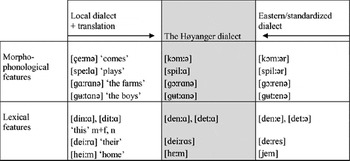
We can also, at a more specific level, study linguistic compromises created in the span between the local and the standardized. Table 1 contains some examples of intermediate forms and linguistic compromises, related to morphological and lexical categories. (The Høyanger dialect is placed in the middle column, between the arrows, as an indication of the Høyanger koine's status as the outcome of mixing opposing norms; cf. Figure 1.)
Examples of compromise variants.

The first example in Table 1 above shows how the irregular present tense form [çeːmə] ‘comes’ from the traditional dialect is replaced with the regular form [kɔmːə]. This represents an approximation to the eastern variant as well as to regular morphology. In the early 21st century, this feature is spreading over greater parts of Norway. The next example, the present tense verb form [spilːɑ] ‘plays’ from the modern Høyanger dialect, can be seen as a compromise between the local variant, [speːlɑ], and the standard form [spilːər]. The morphology represents the West-Norwegian system, while the stem ([spilː]) is an eastern variant. Examples of nouns illustrate how the Høyanger compromise mixed standard eastern stems, [ɡʉtː] ‘boy’ and [ɡɔːr] ‘farm’, with the West-Norwegian plural suffix [ɑnə]. The following examples of lexical features show phonetic compromises between eastern and western variants in different parts of speech. These and other compromise forms are a result of the specific local conditions and changing processes which took place in Høyanger. Some of the features and changing processes mentioned above are particular to Høyanger, and may be considered as new local markers and representatives of the composite linguistic fellowship. Still, the same developmental tendencies, e.g. the resistance of the local morphological system, in contrast to standardization of phonological and lexical features, may also be seen in dialect levelling processes in other Norwegian language communities (cf. Røyneland Reference Røyneland2005:413).
It has to be emphasized that the dialect development in Høyanger was not as linear and schematic as the model presented in Figure 1 above and the examples cited here suggest. The changes took place through mutual accommodation and linguistic negotiations, but this was not a goal-directed process. Several linguistic features changed status and symbolic values during the formation of the local culture, and could move in different directions in the imagined continuum, before the focusing stage. This implies that we have to talk about multidimensional levelling processes, which differ from more common, mainly unilateral, levelling processes in other language communities. Where cities influence smaller villages, for instance, we often focus on the influence of one superior dialect. However, with respect to Høyanger, it is more relevant to talk about interaction between several contributing dialects, resulting in a compromise variety.
A central lesson from the Høyanger study is that the new dialect formation must be studied in the light of specific local conditions and the new industrial culture. The study also shows how some of the linguistic mechanisms of the koineization are dependent on sociocultural relationships. The clearest example of this concerns the majority principle (see e.g. Trudgill Reference Trudgill1986:143; Kerswill & Williams Reference Kerswill and Williams2000:84f.), which describes how forms that occur in a majority of the dialects in the initial contact situation win out in the new dialect. Part of the reason why the character of today's Høyanger dialect may be seen as basically West-Norwegian, lies with the majority principle. About 70% of the inhabitants in the young industrial society came from the neighbouring surroundings. Still, the 17% that came from the eastern parts of the country had a considerable influence: Standardized eastern forms and features were adopted because of their status and prestige, and in spite of their minority position. Even today, eastern elements give the Høyanger dialect a distinctive, composite character, cf. Table 1. It is a mixed dialect, a linguistic alloy created as a result of intensive dialect contact in the melting pot. This character is best illustrated through various lexical features, but can also be exemplified by tendencies in phonology and morphology. One example is the extensive monophthongization of traditional diphthongs, for example in høyre ‘to hear’ > høre and meir ‘more’ > mer. According to the majority principle, none of the monophthongized standard forms would gain a foothold in the new dialect of Høyanger. The fact that they did proves that cultural values and social relations may overrule the mechanism of the majority principle.
Furthermore, we should stress the mutual connections between dialect change and sociocultural relationships in Høyanger by following the linguistic development of central variables. One dominant development curve goes from the traditional local dialect in generation I, via standard influence and great variability in generation II, towards linguistic compromises and a more local character in generation III. The last turn is interesting because the focusing of the new dialect and the establishment of a new local identity took place as simultaneous events. As the in-migrants settled in Høyanger and the community stabilized as a West-Norwegian industrial community, the new dialect became part of the local identity. By re-integrating elements from traditional western varieties, the new dialect represented the society's complex history in a richer fashion. We might call this a ‘superior reallocation process’, as some of the local features achieved a symbolic value as markers of tradition in the modern society (see e.g. Britain & Trudgill Reference Britain and Trudgill2005). A clear example of reallocation in the Høyanger dialect can be found in the system of diphthongs: The back diphthongs [ɑi] and [ɔy] are traditional variants from the Sogn area. Shortly after the industrialization of Høyanger, these were standardized to [æi] and [øy] – as in major parts of Norway. Most of my informants from generation II use these standard variants, while speakers from generation III reintroduced the traditional variants, as shown in Table 2 above.
Realization of diphthong phonemes /ei/ and /øy/ – main tendencies.

During and after the focusing stage (generation III), the traditional diphthong qualities were reallocated and got a symbolic value as ‘new local markers’. Combined with the many standardized features in the modern Høyanger dialect, these and other traditional elements gave the dialect a distinctive local, but still composite, character. For example, the pronunciation of the place name as [hɔyːɑŋɡər], with the traditional diphthong quality, was a strong symbolic marker in this context. Today, the traditional diphthong variants seem to be on the decline among speakers from generations III and IV. This is a result of more extensive processes of linguistic change to be discussed below. Still, most of the inhabitants, including young speakers, use the traditional diphthong pronunciation [ɔy] in the name of Høyanger. This obviously works as an important sign of local identity.
6. THE HØYANGER DIALECT IN THE EARLY 21ST CENTURY AND CONTEMPORARY DEVELOPMENT TENDENCIES
The effects of the initial dialect contact situation in Høyanger decreased along with the stabilization of the industrial society, and we could argue that the language situation of Høyanger, as well as the social situation, has gradually normalized. Still, the Høyanger dialect contains linguistic elements from different times and places, and it is distinctive because of the unusual combination of local and standardized forms. These characteristics represent the particular background of this industrial community. The relative frequency of standardized eastern forms within the West-Norwegian linguistic system makes many outsiders perceive the Høyanger dialect as a sort of ‘neutral’ or indeterminate variety. This is due to the many linguistic compromises that were made in the focusing phase of the koine formation. The convergence towards forms in the middle part of Figure 1 above illustrates the focusing process as a strategy of neutralization (see e.g. Myers Scotton Reference Myers-Scotton1976; Mæhlum Reference Mæhlum and Mattheier2000).
So far, I have advocated that the koine formation has to be studied against the backdrop of the initial contact situation and the contemporary historical context. But to understand the mechanisms that work today, we have to look beyond the local level and focus on more extensive processes of dialect change in Norway. The ‘normalization’ of the linguistic situation discussed above implies that Høyanger is now involved in the same linguistic changes as the neighbouring communities. At the most superiordinate level, these changes concern standardization (including aspects of status and prestige), levelling and regional accommodation. Consequently, salient local forms – also the new local markers of the Høyanger dialect – are levelled out, which reduces the differences between the various local dialects. These linguistic tendencies seem to correspond to the local developments of the society, which include increased social contact and cooperation with neighbouring areas and a wider geographic orientation in general.
Some of the linguistic outcomes of the koineization in Høyanger are consistent with supralocal developmental tendencies. Still, the processes of dialect change that worked in Høyanger were entirely different from those which may be observed in the rest of the county today: In Høyanger, the changes took place within a restricted local frame, over a brief period of time, and in an extremely intensive way. These characteristics may be illustrated by comparing features from the focused Høyanger dialect with recent linguistic changes in the outer Sogn area. For example, the traditional local pronoun /me/ ‘we’ has been replaced in several communities with the standard form /vi/. And the traditional morphophonological alternations between velar and palatal consonants in forms like [bʊːk] ‘book’ – [bʊː ɑ] ‘the book’ and [ryɡː] ‘back’ – [ry
 en] ‘the back’ are now on the decline. These features show how salient local forms today tend to be replaced by standardized variants. But in Høyanger, exactly the same changes were completed already 50–60 years ago. Other industrial societies in western Norway also went through similar intensive development processes. For instance, the local features mentioned above were levelled out from the dialects of Odda and Tyssedal in the same period that these changes took place in Høyanger (see Sandve Reference Sandve1976; Kerswill Reference Kerswill, Chambers, Trudgill and Schilling-Estes2002:67f.). The levelled variants appeared soon after the industrial development in the 1920s, but they have not until recently spread to the surrounding areas. These parallels say a great deal about the intensive changes that took place in Høyanger and similar linguistic melting pots, compared to more extensive, more gradual, slower and more general processes of linguistic development.
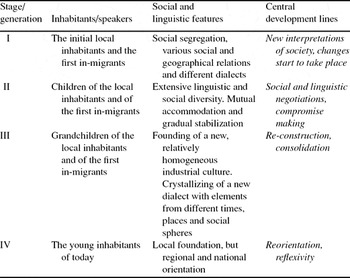
From a social constructionist point of view, Table 3 illustrates the mutual and dynamic relations between linguistic and social development in Høyanger, as discussed in this study. The model is based on established theories on koine formation briefly presented in section 3 above, and has been extended by the inclusion of social perspectives. Also a fourth generation has been added. Even though these informants do not actually constitute their own developmental stage, they are interesting as representatives of a ‘post-koineization period’. This model illustrates how linguistic and social characteristics are harmonious with different orientations in the changing society. At the first stage, the original inhabitants and the distinct groups of in-migrants had to make new interpretations of the complex social situation. The second phase is primarily characterized by extensive linguistic and social diversity. Still, a new fellowship started to evolve through negotiations of roles and positions, careful accommodation processes and compromises. Compromises at different levels are also basic elements in the new culture that gradually crystallized in the third phase. The consolidation is based on re-constructions of elements from the traditional society, as well as new impulses from the in-migrants. This process of consolidation gives a common understanding of the new industrial culture. The focused koine that emerged in the third phase illustrates these processes, as it combines features from the traditional local dialect with features from the in-migrants’ various dialects and sociolects. The fourth stage, which includes young people today, may be labelled a reflexive phase in which the speakers combine their local identity with new orientations towards a national or global level. Linguistically, this split may be articulated through a combination of local and standardized features. Still, similar orientation phases and linguistic strategies are found among young speakers in several language communities. Furthermore, these general tendencies strongly indicate that, after the focusing stage of the koineization, Høyanger has reached a ‘normal’ linguistic situation. We could argue that the situation of Høyanger has been caught up in more general processes of linguistic development and change, such as regionalization and standardization. Over great parts of Norway, regions tend to replace local communities as the most important orientation unit, at a social as well as a linguistic level. Linguistic regionalization implies that local features are levelled out or standardized, while the dialects gradually become more similar within a larger geographical area (see Røyneland Reference Røyneland2009 on regional developments in Norway). In Høyanger, these changes primarily took effect after the focusing of the new dialect.
A social constructionist perspective on the development of language and society.

The local foundation played an important part in the shaping of place, culture and language in Høyanger. Relations between traditional and modern elements are evident in all stages of the new dialect formation, but local qualities appeared to be decisive during the focusing phase. Therefore, it may be relevant to talk about a re-construction of the traditional dialect as well as the shaping of a new one: The Høyanger dialect is the very sound of local history. Thus, the formation of the Høyanger dialect is also a social construction process formed through mutual exchange, passed on and reformulated in a constantly changing society.
7. CLOSING COMMENTS
The tendencies and examples described above illustrate that the formation of the new dialect of Høyanger was the outcome of dynamic relations between the speakers and the changing society. This does not corroborate Trudgill's recent work on new dialect formation (e.g. Trudgill Reference Trudgill2004, Reference Trudgill2008), in which he presents a more deterministic and mechanical view of new dialect formation. In his discussion of dialect contact in New Zealand and other British ex-colonies, he claims that the linguistic development is pre-determinated by geographical and demographical backgrounds, and controlled by the majority principle and quasi-automatic accommodation processes – without any trace of identity and social conditions at all. Even though Trudgill (Reference Trudgill2004:26f.) stresses that this deterministic model only applies to so-called ‘tabula rasa’ situations in new colonies, and not to towns like Høyanger with prior speakers in place, one could argue that the development of the colonial dialects was not that special (see e.g. Kerswill Reference Kerswill2007). It is, in fact, problematic to talk about ‘tabula rasa’ societies at all; migrants will always bring with them the values and norms of their families and places of origin. From a sociolinguistic point of view, it is controversial to study linguistic mechanisms of new dialect formation without considering social and individual factors. This controversy is part of an ongoing debate within the field of sociolinguistics, where the role of identity and social factors in linguistic accommodation and new dialect formation is discussed (see especially Language in Society 37(2) 2008;Footnote 3 Kerswill forthcoming). As we have seen, the major findings of the Høyanger study presented here support the basic sociolinguistic tenet that identity and social factors play important parts in language change in general, as well as in new dialect formation. Linguistic strategies clearly coloured by personal backgrounds, as well as local and cultural surroundings, are evidence of this. The Høyanger study confirms established theories on koine formation through three generations or developmental stages. In addition, the study's combination of old and new material shed some light on koineization in progress. Information about the complex accommodation processes at the decisive second stage of the koineization is important here.
The relations shown between linguistic and sociocultural development indicate that the new dialect formation in Høyanger must be seen as part and parcel of the society's growth from originating as a traditional rural village to becoming a modern industrial society, and further becoming an integrated part of the new industrial culture. After the industrial establishment, the Høyanger dialect has undergone different kinds of changes, from the local koineization to the more comprehensive regional and national levelling processes. To understand today's linguistic situation, and to discuss further developmental tendencies of the established koine, we have to find a balance between the specific local conditions and the processes that involve contact and relations beyond this level. Even though regional and national tendencies are present today, the historical circumstances still make the modern Høyanger dialect special because of its combination of elements from different times, places and social spheres.